 YouTube
Explain how cognitive models such as Beck’s model, hopelessness theory and response styles theory account for depression, and evaluate their value for understanding, researching and treating mental health disorders.
Each is in the Psychology glossary, with every other term in the subject.
A tendency to attend selectively to certain kinds of information, such as negative or threatening stimuli, so that they are noticed sooner or held in attention longer.
A person’s habitual way of explaining the causes of events; a depressive attributional style explains bad events as internal, stable and global.
A systematic error in reasoning, such as overgeneralisation or catastrophising, that leads a person to interpret events more negatively than the evidence justifies.
Beck’s model in which a dormant negative self-schema, activated by a matching stressful event, produces cognitive distortions and negative thoughts about the self, world and future that cause depression.
In Beck’s model, the pattern of negative thinking about the self, the world and the future that characterises depression.
A cognitive theory proposing that people who explain negative events by stable, global causes become hopeless after negative life events, and that hopelessness leads to depression.
Brief, spontaneous negative thoughts about the self, the world or the future that arise in everyday situations, feel believable and are rarely questioned.
Describe Beck’s cognitive model of depression, including negative self-schemas, the cognitive triad, cognitive distortions and negative automatic thoughts.
Explain how hopelessness theory and attributional style account for depression after negative life events.
Explain how rumination and attentional bias maintain low mood, according to response styles theory and research on information processing.
Describe the aim, method, results and conclusions of the Temple–Wisconsin Cognitive Vulnerability to Depression Project.
Compare and contrast cognitive models of depression with the cognitive model of panic disorder.
Evaluate the value of cognitive models for understanding mental health disorders, with reference to causality, measurement and perspective.
Apply a cognitive model to an unfamiliar scenario about a person’s mental health.
A cognitive model of a mental health disorder explains the disorder through the way a person processes information: what they pay attention to, how they interpret events, what they expect and what they remember. The most researched example is the explanation of major depressive disorder, a disorder that affects about 5% of adults worldwide.
Sources: WHO, Depression fact sheet (2023 estimates).
Cognitive models belong to the cognitive approach, but they rarely work alone. Most of them are diathesis-stress models in which a way of thinking is the vulnerability and a stressful event is the trigger, and their value is judged by how well they explain, predict and help to treat the disorder. Research on them raises questions of causality (is negative thinking a cause or a symptom of depression?),
With a free account, Augment remembers where you stopped and what you have practiced.
An organised set of negative beliefs about the self, formed through early experience, that biases how self-relevant information is processed and creates vulnerability to depression.
A style of responding to distress by repeatedly and passively focusing on one’s symptoms and their possible causes and consequences, without acting to solve the problem.
A cognitive model is a simplified representation of a mental process, usually drawn as boxes and arrows, that makes predictions which research can test. The multi-store model of memory is the classic example from cognitive psychology. A cognitive model of a disorder applies the same idea to suffering: it names the thoughts, beliefs and processing habits that are thought to produce or maintain the symptoms, and the order in which they act.
All cognitive models of depression share one central assumption. Emotional reactions depend less on events themselves than on the way people interpret them. Two students who fail the same important test may react in very different ways: one decides that the test was unusually hard and plans to prepare differently, while the other decides that the failure proves they are stupid and will never succeed. The cognitive models predict that only the second student is at risk of depression.
In the Diagnostic and Statistical Manual of Mental Disorders (DSM-5-TR), a diagnosis of major depressive disorder requires at least five of nine symptoms for at least two weeks, and one of them must be depressed mood or a loss of interest or pleasure. The other symptoms include changes in sleep and appetite, fatigue, poor concentration, feelings of worthlessness or excessive guilt, and thoughts of death. Biological explanations of the disorder focus on genes, neurotransmitters and stress hormones; cognitive models focus on the symptoms that are themselves thoughts, such as worthlessness, guilt and hopelessness.
A good cognitive model has to explain several facts about depression. Depression often begins after a stressful event, but most people who experience such an event do not become depressed. Episodes tend to recur. Depressed people think about themselves, their lives and their future in consistently negative ways. A model that explains why one person and not another becomes depressed after the same event has real value, because it identifies who is at risk and what could be changed.
Aaron Beck (1921–2021) was an American psychiatrist trained in psychoanalysis. In the 1960s he noticed that his depressed patients reported a stream of quick, negative thoughts about themselves that they rarely questioned. Beck (1967, 1976) built these observations into the cognitive model of depression, which has three linked parts: negative self-schemas, the cognitive triad and cognitive distortions. Beck’s model became the basis of cognitive therapy, later developed into cognitive behavioural therapy.
YouTubeA schema is a mental framework of knowledge and beliefs, built from experience, that guides how new information is processed. Beck proposed that people who are vulnerable to depression hold negative self-schemas: deep beliefs about themselves such as “I am unlovable” or conditional rules such as “If I fail at anything, I am a failure as a person”. These beliefs are thought to form in childhood and adolescence through experiences such as criticism, rejection or the loss of a parent.
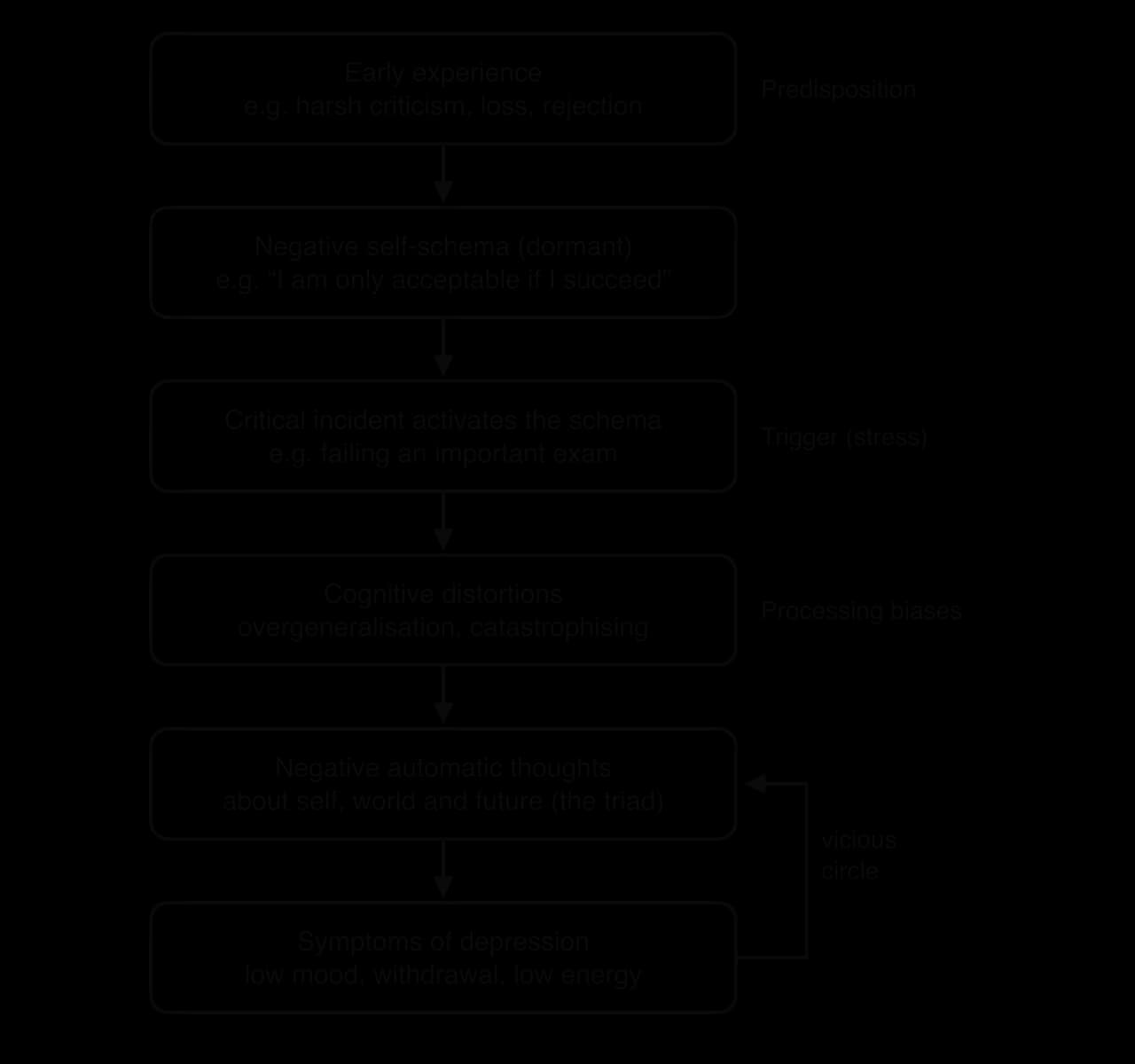
In Beck’s model the schema is usually dormant. A person may hold the belief “I am only worth something if I succeed” for years without any sign of depression, because life has not tested it. The schema is activated by a critical incident, a stressful event that matches its content: a failure at school for someone whose worth depends on success, or a break-up for someone who believes they are unlovable. This makes Beck’s model a diathesis-stress model: the schema is the diathesis and the critical incident the stress.
Once the schema is active, the person’s thinking becomes negative in three areas, which Beck called the cognitive triad: a negative view of the self (“I am worthless”), of the world, including other people and present experience (“Nobody cares about me”), and of the future (“Things will never get better”). The three views strengthen one another. A person who believes they are worthless expects others to reject them and sees no reason why the future should be different.
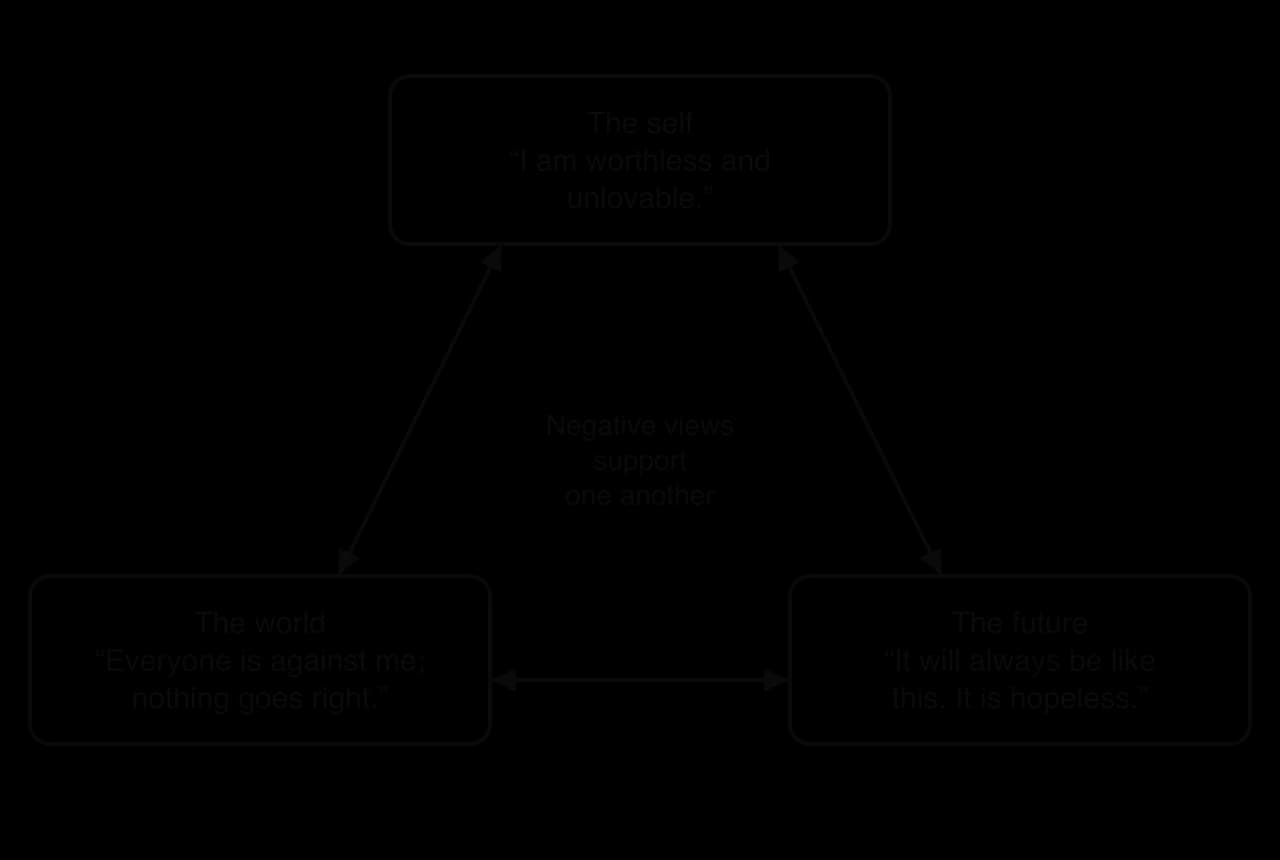
The negative view of the future is especially important, because it links the model to hopelessness and to suicidal thinking. It also explains some behavioural symptoms. A person who expects every effort to fail stops trying, withdraws from friends and activities, and so loses the experiences that might have lifted their mood.
The triad shows itself in negative automatic thoughts: brief, unplanned thoughts that pop into the mind in response to everyday events and feel obviously true to the person who has them. Examples include “I always mess things up” after a small mistake, or “She thinks I am boring” when a friend looks at her phone. Because they are fast and seem self-evident, they are rarely examined.
Beck argued that the thoughts are produced by systematic errors in reasoning, which he called cognitive distortions. A distortion is a biased way of processing information that leads to a conclusion not supported by the evidence. The table lists the distortions most often described.
Cognitive distortion | What happens | Example |
|---|---|---|
Overgeneralisation | A broad conclusion is drawn from a single event | Failing one test → “I fail at everything.” |
Selective abstraction | One negative detail is focused on while the rest is ignored | Remembering the one critical comment in an otherwise positive report |
Arbitrary inference | A negative conclusion is drawn without evidence | A friend does not reply → “She doesn’t like me any more.” |
Magnification and minimisation | Failures are exaggerated and successes played down | “My good grade was luck; my mistake shows who I really am.” |
Catastrophising | The worst possible outcome is assumed | “If I fail this test my life is ruined.” |
Personalisation | Unrelated events are taken as being about oneself | “The team lost because I was playing.” |
Dichotomous (all-or-nothing) thinking | Things are seen in extreme categories | “If I am not top of the class, I am a failure.” |
The parts of the model fit together as a sequence. Early experience forms a negative self-schema; a critical incident activates it; the schema biases processing through distortions; the distortions produce negative automatic thoughts about the self, world and future; and these thoughts produce the emotional, motivational and physical symptoms of depression. The symptoms then feed back into the thoughts: a person who is exhausted and withdrawn finds new evidence that they are failing, so the depression maintains itself.
 YouTube
Cognitive models can be tested only if their parts can be measured. Because beliefs and thoughts are private, almost all measures are self-report questionnaires. The Beck Depression Inventory (BDI-II) asks people to rate 21 symptoms over the past two weeks and measures the severity of depression. The Dysfunctional Attitude Scale (DAS), developed by Weissman and Beck, asks how far people agree with statements such as “If I fail partly, it is as bad as being a complete failure”, and is used as a measure of negative self-schemas. Diaries of automatic thoughts are used in therapy.
This creates a problem of measurement. A schema is a construct that cannot be observed directly, and the DAS measures what people are willing and able to report about their beliefs. Scores on such scales also rise when people are depressed, which makes it hard to know whether a high score reflects a lasting vulnerability or the current state of the disorder. Later research tried to solve this with reaction-time tasks and with prospective designs that measure thinking before depression begins.
A second family of cognitive models grew out of animal research rather than clinical observation. In the 1960s Seligman and Maier found that dogs exposed to electric shocks they could not escape later failed to escape shocks they could avoid. This learned helplessness looked like a model of depression: passivity after experiencing that one’s actions make no difference. Human research soon showed that people react to uncontrollable events in very different ways, and that the difference depends on how they explain the events to themselves.
Abramson, Seligman and Teasdale (1978) reformulated learned helplessness theory for humans by adding attributions, the explanations people give for why an event happened. They proposed that people differ in a habitual attributional style, and that people are at risk of depression if they tend to explain bad events in three ways.
Dimension | Depressive attribution | Protective attribution | Example after failing a driving test |
|---|---|---|---|
Internal vs external | Internal: caused by me | External: caused by circumstances | “I am a hopeless driver” vs “The tester was very strict” |
Stable vs unstable | Stable: will last | Unstable: temporary | “I will never be able to drive” vs “I was tired today” |
Global vs specific | Global: affects everything | Specific: affects this area only | “I am useless at everything” vs “Parallel parking is hard for me” |
The theory predicts that a person who explains a setback as internal (“it is my fault”), stable (“it will always be like this”) and global (“it ruins everything”) will expect future failures in many areas and will lose self-esteem. Attributional style is measured with questionnaires such as the Attributional Style Questionnaire, in which participants imagine hypothetical good and bad events, write down the most likely cause and rate it on each dimension.
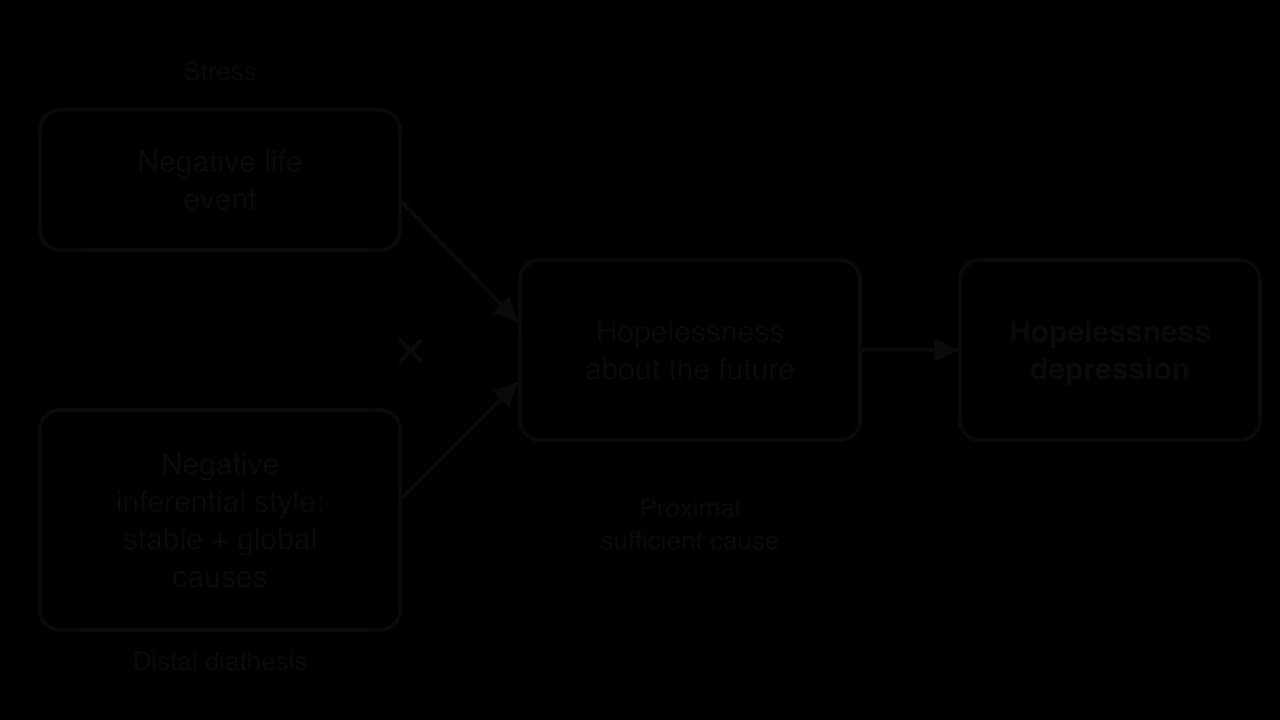
Abramson, Metalsky and Alloy (1989) developed this idea into hopelessness theory. They argued that the stable and global dimensions matter more than the internal one, and that the key step towards depression is hopelessness: the expectation that desired outcomes will not happen, bad outcomes will happen, and nothing can be done to change this. Hopelessness was proposed as a sufficient cause of one subtype of the disorder, which the authors called hopelessness depression.
In the theory, a negative inferential style is a distal cause: a background vulnerability that acts only when a negative life event occurs. Hopelessness is the proximal cause: the last step in the chain, immediately before the symptoms. As well as attributions about causes, the inferential style includes two other habits: inferring that a bad event will have terrible consequences, and inferring that it shows something is wrong with oneself.
Hopelessness theory and Beck’s model make similar predictions, and researchers often test them together. Both say that a lasting cognitive vulnerability interacts with stressful events, which is why both are tested with prospective designs that measure thinking before stress and depression occur. The Temple–Wisconsin Cognitive Vulnerability to Depression Project was designed to test this prediction for both models at once.
Beck’s model and hopelessness theory focus on what people think. Susan Nolen-Hoeksema’s response styles theory (1991) focuses on how people respond to feeling low. She proposed that people who respond to sad mood with rumination, repeatedly and passively thinking about their symptoms, their causes and their consequences, have longer and more severe periods of depression than people who respond by distracting themselves or solving problems.
Rumination is thought to maintain depression in several ways. It brings more negative memories to mind, makes negative interpretations of current events more likely, gets in the way of practical problem-solving, and drives away friends who tire of hearing the same worries. Typical ruminative thoughts are “Why do I always react this way?” and “What is wrong with me?” The theory also offers one explanation of the gender difference in depression: on average, women report ruminating more than men.
Nolen-Hoeksema and Morrow (1991) used a chance event to test the theory. They had measured the response styles and mood of 137 Stanford University students 14 days before the 1989 Loma Prieta earthquake near San Francisco. At follow-ups 10 days and 7 weeks after the earthquake, students who already had higher symptoms and a ruminative style before it had more depressive symptoms. Students who ruminated about the earthquake in the days after it were also more depressed seven weeks later. Because the stressor was not created by the researchers and rumination was measured before it happened, the study gives prospective evidence that rumination predicts how people respond to stress.
Later community research by Nolen-Hoeksema (2000) found that rumination predicted new onsets of major depressive episodes over a year, as well as increases in symptoms. Rumination also predicted anxiety symptoms, which suggests that it is a process shared by more than one disorder rather than one specific to depression.
Beck’s model predicts that an active negative schema biases information processing at every stage. Research using laboratory tasks, which do not rely on self-report, has tested this for attention and memory. An attentional bias is a tendency to give priority to one kind of information, such as negative words or sad faces.
Koster et al. (2005) compared dysphoric (mildly depressed) and non-dysphoric students in two experiments using a spatial cueing task. A negative, positive or neutral word appeared briefly on one side of a screen, followed by a target on the same or the opposite side. Dysphoric participants were slower to respond to targets on the opposite side after negative words shown for longer durations, which suggests that they found it hard to disengage their attention from negative information once it had been caught. Non-dysphoric participants held their attention more on positive words.
A similar bias appears in memory. Depressed people tend to recall more negative than positive information about themselves, and their memories of their own past are often over-general (“I was always unhappy at school”) rather than specific. In Beck’s terms, the negative schema guides which information is encoded and retrieved, so that the person’s store of evidence about themselves becomes steadily more negative.
Disner et al. (2011), a review written with Beck himself, linked each part of the model to brain activity. They concluded that the negative biases in depression are associated with increased influence from regions that process emotion, such as the amygdala, combined with weaker top-down control from regions of the prefrontal cortex. This is an example of how a cognitive model and biological research can describe the same process at two levels.
If attentional bias causes depression, reducing the bias should reduce the symptoms. Cognitive bias modification programmes try to do this by training people, through hundreds of computer trials, to look away from negative stimuli. The results have been disappointing. A meta-analysis of 23 trials with children and adolescents by Cristea et al. (2015) found that training changed the targeted bias (a moderate effect) but had small and non-significant effects on symptoms of depression or anxiety. This result suggests that the bias may be a marker of the disorder rather than a cause, or that changing one narrow bias in a laboratory task is not enough to change how a person thinks in daily life.
Cognitive models are not limited to depression. David Clark’s (1986) cognitive model of panic disorder, an anxiety disorder, shows the same logic applied to a very different set of symptoms. A panic attack is a sudden surge of intense fear with physical symptoms such as a racing heart, breathlessness and dizziness. In panic disorder, attacks recur unexpectedly and the person lives in fear of the next one.
Clark proposed that panic attacks result from the catastrophic misinterpretation of normal bodily sensations. A person who notices their heart beating faster after climbing stairs interprets it as a sign of a heart attack; the interpretation causes fear; fear produces more physical arousal (a faster heart, faster breathing); and the stronger sensations seem to confirm the catastrophe. The circle builds within seconds into a full attack. The model explains why panic seems to come “out of the blue”: the trigger is an internal sensation that the person may not consciously notice.
Feature | Cognitive models of depression | Cognitive model of panic |
|---|---|---|
Key cognition | Negative beliefs about self, world and future; stable, global attributions | Catastrophic misinterpretation of bodily sensations |
Time scale | Weeks to months; schemas formed over years | Seconds to minutes during an attack |
Typical thought | “I am worthless; it will never get better.” | “I am having a heart attack; I am going to die.” |
Maintaining loop | Symptoms and withdrawal confirm negative thoughts; rumination prolongs mood | Fear increases arousal, which confirms the catastrophic interpretation; avoidance prevents disconfirmation |
Treatment it led to | Cognitive therapy: identifying and testing automatic thoughts | Cognitive therapy for panic: testing interpretations, for example by producing harmless sensations deliberately |
The comparison shows what all cognitive models of disorders share: a specific way of interpreting information, a vicious circle that keeps the disorder going, and a therapy that targets the interpretation. It also shows their differences. Each disorder has its own characteristic content, which supports the idea that the content of thinking, not just its negativity, shapes which disorder develops.
Lauren Alloy and Lyn Abramson designed the Cognitive Vulnerability to Depression (CVD) Project to test the central prediction of Beck’s model and hopelessness theory: that people with negative cognitive styles are more likely to develop depression in the future than people without them. Testing this in people who were not depressed at the start answers the most common objection to cognitive models, that negative thinking might only be a symptom of being depressed.
The project was a prospective, longitudinal design run at two sites, Temple University in Philadelphia and the University of Wisconsin in Madison, USA. First-year university students were screened with two questionnaires: the Dysfunctional Attitude Scale, a measure of the negative self-schemas in Beck’s model, and the Cognitive Style Questionnaire, a measure of the negative inferential style in hopelessness theory. Students who scored high on both measures were classified as high cognitive risk, and students who scored low on both as low cognitive risk.
The analysis reported by Alloy et al. (2006) included 347 students who had no psychiatric disorder at the start of the study. Some had been depressed earlier in life and some had never been depressed, which allowed the researchers to study first onsets and recurrences separately. Participants were followed for 2.5 years and repeatedly assessed with structured diagnostic interviews, which recorded any episodes of major depression, minor depression and hopelessness depression, and also of anxiety disorders. The interviewers did not know which risk group a participant belonged to.
Cognitive risk was the independent variable only in a loose sense: it was not manipulated but measured, so the design is a prospective quasi-experiment (or a correlational cohort study). The outcomes were operationalised as the onset of diagnosable episodes of each disorder during follow-up.
Outcome over 2.5 years | Finding (high-risk vs low-risk students) |
|---|---|
Major, minor and hopelessness depression | High-risk students had odds of each disorder 3.5 to 6.8 times greater than low-risk students |
First onsets vs recurrences | Negative cognitive styles predicted first onsets and recurrences of major depression and hopelessness depression to a similar degree; for minor depression they predicted first onsets more strongly than recurrences |
Anxiety disorders without depression | No difference between the risk groups |
Anxiety occurring together with depression | More likely in the high-risk group |
Sources: Alloy, L. B., Abramson, L. Y., Whitehouse, W. G., Hogan, M. E., Panzarella, C. and Rose, D. T. (2006). Prospective incidence of first onsets and recurrences of depression in individuals at high and low cognitive risk for depression. _J Abnorm Psychol, 115(1), 145–156. Design: Alloy et al. (1999), Behaviour Research and Therapy, 37(6), 503–531._
Two features of the results matter most. First, cognitive style predicted first onsets in students who had never been depressed. Their negative thinking could not be a leftover “scar” of an earlier episode, so it existed before the disorder. Second, the prediction was specific: high cognitive risk predicted depression but not anxiety disorders on their own, which is what the theories predict, since they are theories of depression rather than of distress in general.
Negative cognitive styles, as described by Beck’s model and hopelessness theory, act as a vulnerability to depression. People who hold them are several times more likely to develop a depressive disorder over the following years, including a first episode. The findings support the claim that negative thinking can come before depression and is not only a symptom of it.
Measuring cognitive style before the disorder establishes temporal precedence, one of the conditions for a causal claim, and the first-onset analysis rules out the possibility that the thinking was caused by earlier depression. However, cognitive style was not manipulated, so the study remains correlational. A third variable, such as genetic risk, childhood adversity or a temperament high in negative emotion, could produce both negative thinking and depression.
Cognitive style was measured by self-report, so participants’ answers depend on their insight and honesty. Diagnoses were made through structured interviews by interviewers who did not know the risk group, which increases their reliability. Selecting only students who scored high or low on both questionnaires creates two extreme groups. This is a powerful way to test a theory, but it exaggerates the difference that would be found across the whole range of people, most of whom score in the middle.
The participants were first-year students at two American universities, a sample that is young, educated and drawn from a WEIRD population. Students are at an age when depression often begins, which is a strength, but the findings may not generalise to older adults, people with less education or other cultures. Abela et al. (2011) helped to answer the cultural question: in two samples of adolescents in urban and rural Hunan, China, dysfunctional attitudes and a negative cognitive style predicted increases in depressive (but not anxiety) symptoms after negative events over six months, above the effect of neuroticism.
A model is valuable if it explains what is known, makes predictions that research can test, leads to useful applications and encourages better research, even if it is later revised or shown to be incomplete. Cognitive models of depression can be judged on each of these criteria.
They make testable predictions. Because the models specify a vulnerability (a schema or inferential style) and a trigger (a stressful event), they predict who will become depressed. Prospective studies such as the CVD Project, Nolen-Hoeksema and Morrow (1991) and Abela et al. (2011) have tested and broadly supported these predictions.
They explain individual differences. The models explain why the same stressful event leads to depression in some people and not in others, which a purely environmental explanation cannot do.
They led to effective treatment. Beck’s model produced cognitive therapy, which identifies automatic thoughts and tests them against evidence, and which is now one of the most widely used treatments for depression. The model of panic produced a cognitive therapy for panic disorder in the same way.
They suggest prevention. If negative cognitive styles are vulnerabilities, they can be identified before depression starts and targeted, for example in school programmes that teach young people to examine their explanations of setbacks.
They connect with other approaches. The models are diathesis-stress models, so they fit with environmental research on life events. A review by Disner et al. (2011) also linked each part of Beck’s model to brain systems involved in negative bias.
Negative thoughts about the self are part of the definition of depression, so it is not surprising that depressed people report them. The question is whether they come first. Lewinsohn et al. (1981) measured depression-related thinking in a community sample of 998 adults and followed them for a year. People who later became depressed did not differ from the others on the cognitive measures beforehand, and negative cognitions were raised mainly while people were depressed. This suggested that the cognitions arise together with an episode rather than before it.
The CVD Project, with its focus on first onsets, was designed partly to answer this challenge. Lewinsohn et al. measured general depression-related thinking in an unselected sample, whereas the CVD Project selected students with extreme scores on two measures of stable cognitive style. Together, the two sets of findings suggest that whether cognitions predict depression depends on how vulnerability is measured.
Beck’s model assumes that depressed thinking is less accurate than normal thinking. Alloy and Abramson (1979) found the opposite in a laboratory task: depressed students judged how much control they had over a light quite accurately, while non-depressed students overestimated their control when outcomes were frequent or desirable. This depressive realism effect suggests that non-depressed people may hold a protective positive bias.
A meta-analysis of 75 studies by Moore and Fresco (2012) found that the effect was very small overall, and that both groups showed some positive bias, so the claim that depressed people are “sadder but wiser” is not well supported either. The debate shows that “distortion” is harder to define and measure than the model implies.
Most people rate themselves as above average, overestimate their control over chance events and expect good things to happen to them more than to others. These positive illusions may protect mood and motivation. If they are the healthy norm, then the realistic or negative judgements of depressed people may reflect the loss of a protective bias rather than the presence of a distortion, a different causal story from the one in Beck’s model.
A related limitation is that the model can underestimate real circumstances. For a person living in poverty or facing discrimination, the thought “my situation will not improve soon” may be an accurate judgement rather than a distortion. Treating such thoughts only as errors risks locating the problem inside the individual.
The success of cognitive therapy is often used as evidence for Beck’s model, but this reasoning is an example of the treatment–aetiology fallacy: a treatment can work for reasons that have nothing to do with the cause of a disorder. Jacobson et al. (1996) separated cognitive therapy into components and found that behavioural activation alone, which schedules rewarding activities and does not try to change thoughts, worked as well as the full treatment package, and a two-year follow-up of the same patients by Gortner et al. (1998) found that it prevented relapse as well. If changing thoughts is not necessary for recovery, the role of thoughts in causing depression is less certain.
Cognitive models explain depression through processes inside the person. They say little about why negative schemas form (for example through poverty, abuse or discrimination) or about biological factors such as genetic vulnerability and stress hormones, although these influence how people think. In this sense the models are reductionist.
Cognitive models also developed mainly in the USA and Europe, where the self is understood as independent and where stable, internal explanations for success are valued. Where the self is understood through relationships, the content of negative schemas and the meaning of self-critical thinking may differ, although studies such as Abela et al. (2011) show that the core predictions hold in at least some non-Western samples.
Concept | How it applies to cognitive models of depression |
|---|---|
Causality | Prospective designs (CVD Project; Nolen-Hoeksema and Morrow, 1991) show negative thinking can come before depression, but they are correlational; bias-modification experiments have not reduced symptoms reliably. |
Measurement | Schemas and attributional styles are constructs measured mainly by self-report (DAS, CSQ, ASQ), which are influenced by current mood; reaction-time tasks offer less subjective measures. |
Perspective | The cognitive approach explains vulnerability inside the person; biological and sociocultural approaches explain where that vulnerability comes from and what triggers it. |
Bias | Most research uses Western student samples; the assumption that depressed thinking is distorted is itself challenged by depressive realism. |
Change | The models identify thoughts that can be changed, which underpins cognitive therapy and prevention programmes. |
Responsibility | Explaining depression through “faulty thinking” can be heard as blaming the person, especially when their negative thoughts reflect real hardship. |
Cognitive models are most useful when they are combined with the other approaches in a biopsychosocial model. The sequence in Beck’s model already contains the other two approaches. Negative schemas are learned through early social experience, such as harsh criticism or the loss of a parent, which places the origin of the vulnerability in the environment. The critical incidents that activate schemas are stressful life events, which are the subject of environmental explanations of depression.
Biological factors interact at the same points. People with genetic vulnerability to depression may be more likely to develop negative biases, and the brain regions involved in emotional processing and its control are the same ones studied in biological explanations. Once a person is depressed, low energy and disturbed sleep make negative thoughts more convincing. A complete explanation of why one student becomes depressed after a setback at school therefore includes their genes, their history, their way of thinking and the support around them.
Cognitive models of mental health disorders are an area of study in the health and well-being context. They can appear in Paper 1 Section B, where a short unseen scenario asks you to apply an approach term such as schema theory or cognitive models to a person’s mental health, and in Paper 1 Section C, where a 15-mark essay combines this area of study with one of the six concepts. Beck’s model is also a strong example for Section A questions on cognitive models or schema theory.
Cognitive models explain mental health disorders through patterns of thinking and information processing and make testable predictions about who will develop them.
In Beck’s model a dormant negative self-schema is activated by a matching critical incident, producing distortions, negative automatic thoughts and the cognitive triad (self, world, future).
Hopelessness theory proposes that explaining negative events by stable, global causes leads to hopelessness, and hopelessness to depression; attributional style is the vulnerability.
Response styles theory proposes that rumination prolongs and deepens low mood; Nolen-Hoeksema and Morrow (1991) supported it prospectively.
Depressed and dysphoric people find it hard to disengage attention from negative information, but training the bias away has not reliably reduced symptoms.
The CVD Project found that students at high cognitive risk had 3.5–6.8 times the odds of developing depression over 2.5 years, including first onsets, but not anxiety alone.
The models’ value lies in prediction, treatment and prevention; their limits concern causality (cause or symptom), self-report measurement, depressive realism and a reductionist focus on the individual.
Clark’s model of panic disorder applies the same logic to anxiety: catastrophic misinterpretation of bodily sensations creates a vicious circle of fear.
I can describe Beck’s cognitive model of depression, including schemas, the cognitive triad, distortions and automatic thoughts.
I can explain hopelessness theory and the three dimensions of attributional style.
I can explain how rumination and attentional bias may maintain depression, with a study for each.
I can describe the aim, method, results and conclusions of the Temple–Wisconsin CVD Project.
I can compare and contrast cognitive models of depression with Clark’s cognitive model of panic.
I can evaluate the value of cognitive models with reference to causality, measurement and perspective.
I can apply a cognitive model to an unfamiliar scenario, linking each part of the model to details of the scenario.