Explain how stressful life events, childhood adversity, poverty, isolation and the physical environment contribute to mental health disorders such as depression, and evaluate the evidence, especially its claims about causality.
Each is in the Psychology glossary, with every other term in the subject.
Any influence on behaviour or mental health that comes from outside the person’s biology, such as life events, relationships, socioeconomic conditions, culture and physical surroundings.
The proposal that the stresses and deprivations of low socioeconomic status cause mental health disorders.
The proposal that people with mental health disorders, or a predisposition to them, move down to lower socioeconomic positions because the disorder disrupts education, work and relationships.
A lack of social contacts and relationships; distinguished from loneliness, the subjective feeling that one’s relationships are inadequate.
The emotional, practical and informational help a person receives from their relationships; it is thought to protect mental health mainly by reducing the impact of stress.
A person’s or family’s social and economic position relative to others, usually measured through income, education and occupation.
Significant changes or threats in a person’s life, such as bereavement, divorce, job loss or assault, that demand adjustment and are associated with the onset of mental health disorders.
Describe the main environmental factors linked to mental health disorders, including stressful life events, childhood adversity, socioeconomic status, social isolation and the urban environment.
Explain how environmental factors may lead to depression, using the ideas of provoking agents, vulnerability factors and social support.
Describe the aim, method, results and conclusions of Brown and Harris’s (1978) study of the social origins of depression.
Explain the social causation and social drift hypotheses and how natural experiments help to separate them.
Explain how environmental factors interact with biological and cognitive factors.
Evaluate research on environmental factors with reference to causality, measurement and change.
Apply knowledge of environmental factors to an unfamiliar scenario about mental health.
An environmental factor is any influence on a person that comes from outside their body, from a bereavement or a divorce to poverty, loneliness or polluted air. Research on major depressive disorder shows that such factors help to explain who becomes ill and when, and, unlike genes, many of them can be changed by individuals, communities and governments.
Environmental explanations draw mainly on the sociocultural approach, but they are closely tied to the other two. In the diathesis-stress model, the environment supplies the stress; in cognitive models, early experience forms the negative beliefs that later make people vulnerable. Research in this area raises sharp questions of causality, because people cannot be randomly assigned to poverty or bereavement, of measurement
With a free account, Augment remembers where you stopped and what you have practiced.
A characteristic or circumstance that does not cause a disorder on its own but increases the chance that a stressful event will lead to it, such as lacking a confiding relationship.
In psychology, “environment” means much more than the natural world. It covers everything a person experiences that is not inherited, from the womb onwards: events, relationships, social and economic conditions, culture and the physical surroundings. Environmental factors can be sudden (an assault, a job loss) or chronic (years of poverty, a difficult marriage), and they can act early in life or close to the onset of a disorder.
Level | Examples of environmental factors | Example of a link to depression |
|---|---|---|
Life events | Bereavement, divorce, job loss, assault, serious illness | Onset of depression often follows a severe event within weeks |
Early experience | Abuse, neglect, parental loss, household dysfunction | Childhood adversity raises the risk of depression decades later |
Social relationships | Social support, isolation, loneliness, conflict | A confiding relationship protects people who face severe events |
Socioeconomic conditions | Income, education, employment, housing, debt | Low socioeconomic status is linked to higher rates of depression |
Physical surroundings | City living, noise, air pollution, green space | Urban living is linked to slightly higher rates of mood and anxiety disorders |
Social position | Discrimination, migration, minority status | Perceived discrimination is associated with poorer mental health |
These levels overlap. Poverty makes stressful events more likely, reduces social support and often means living in polluted, crowded areas, so a single factor rarely acts alone. Researchers often distinguish distal factors, which create long-term vulnerability (such as childhood adversity), from proximal factors, which trigger an episode (such as a recent bereavement).
Stressful life events are major changes or threats in a person’s life that require adjustment, such as the death of a loved one, separation, serious illness, losing a job or being assaulted. Research consistently finds that episodes of depression are more likely to begin in the weeks after a severe event, especially events involving loss, humiliation or a sense of being trapped.
Life events can be measured with checklists, in which people tick the events they experienced in a period, or with interviews, in which a researcher asks about each event in detail and rates how threatening it was in the context of the person’s life. A checklist is quick but treats every divorce or move of house as equal; an interview can recognise that losing a job is more threatening for a single parent with debts than for someone about to retire. Brown and Harris developed the interview approach in their study of depression in women in Camberwell, London.
A correlation between life events and depression does not show which comes first. Some events, such as being fired or a relationship ending, can be partly caused by a person’s own behaviour, including early symptoms of depression; these are called dependent events. Others, such as the death of a parent in an accident, are independent of the person’s behaviour. If independent events still predict depression, the case for a causal effect is stronger.
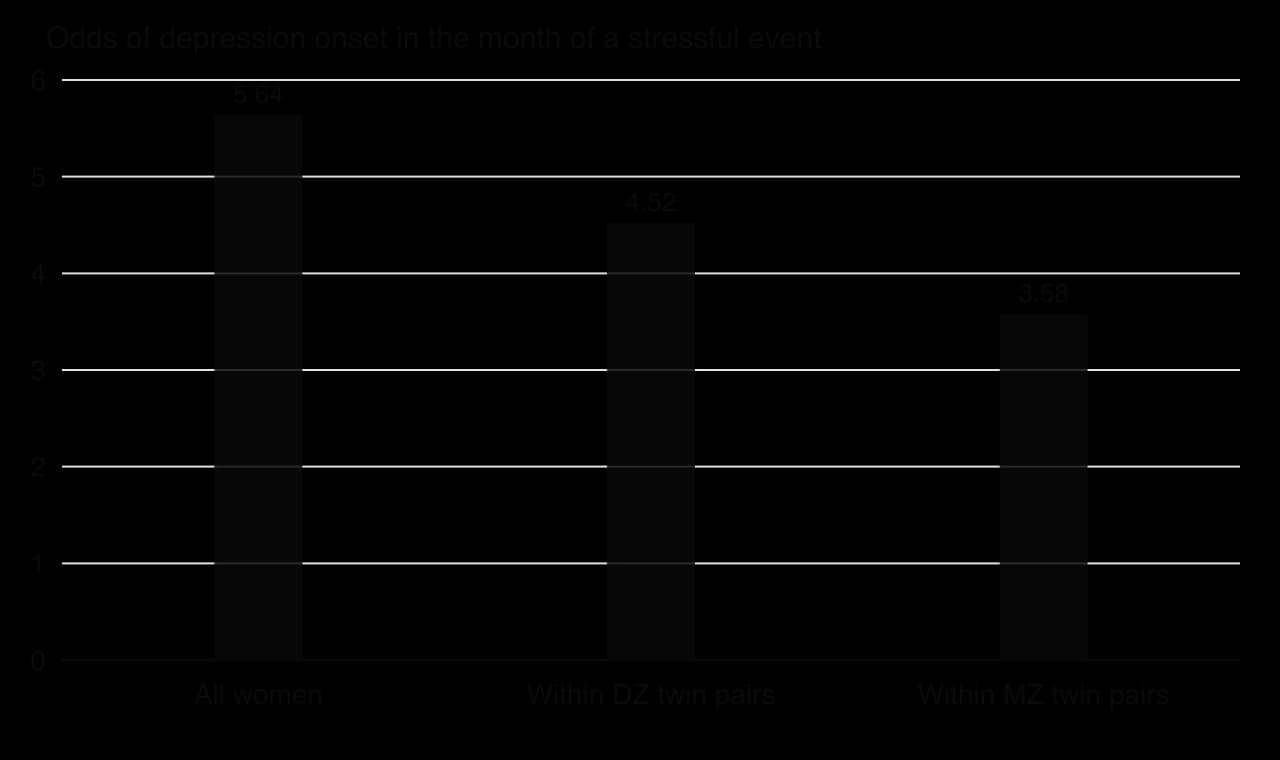
Kendler, Karkowski and Prescott (1999) used twins to test this. They recorded 15 kinds of stressful life events and the onset of major depression month by month over a year in female twins from a population register in Virginia, USA. Each event was rated for threat and for how far the woman might have brought it about. Independent events predicted onset, but dependent events did so more strongly. The researchers then used a co-twin control design: comparing twins in the same pair removes the effect of the genes and family background they share.
The odds ratio fell from 5.64 across all women to 4.52 within non-identical (DZ) pairs and 3.58 within identical (MZ) pairs, who share all their genes. Kendler and colleagues concluded that stressful life events have a substantial causal effect on depression, but that about a third of the association is not causal, because people with a genetic predisposition to depression tend to select themselves into high-risk situations. This is a gene–environment correlation: genes influence which environments people experience.
Life events are also the environmental half of gene–environment interaction research. In the Dunedin study by Caspi et al. (2003), stressful life events between the ages of 21 and 26 predicted depression more strongly in people with a particular variant of the serotonin transporter gene, although large later studies did not replicate this interaction. Whatever the role of that gene, the research treats life events as the trigger that a vulnerability needs.
George Brown and Tirril Harris aimed to explain why depression was more common among working-class women than middle-class women, by identifying the social factors that bring about depression and showing how they combine. Their central question was why severe life events lead to depression in some women but not in others.
The study was a community survey of women aged 18 to 65 living in Camberwell, an inner-city area of south London, together with a comparison sample of women receiving psychiatric treatment for depression. Women in the community sample were randomly selected and interviewed at home. Depression was assessed with a standardised psychiatric interview, so that women who met criteria for depression could be identified whether or not they had ever seen a doctor.
Life events and ongoing difficulties were measured with the semi-structured interview that Brown and Harris developed, the Life Events and Difficulties Schedule (LEDS). Interviewers asked in detail about events in the previous year and dated them carefully in relation to any onset of depression. A separate panel of researchers, who did not know whether the woman had become depressed, then rated each event for its contextual threat: how threatening it would be for an average person in the same circumstances. The interviews also recorded the women’s social circumstances, including their relationships, children, employment and childhood history.
Brown and Harris identified two kinds of factor. Provoking agents were severe life events, usually involving loss or disappointment, such as the death or serious illness of someone close, separation or the discovery of a partner’s infidelity, and major difficulties that had lasted at least two years. Most women who became depressed had experienced a provoking agent in the months before onset, but most women who experienced one did not become depressed.
Whether a provoking agent led to depression depended on four vulnerability factors. Women with a provoking agent were much more likely to become depressed if they also had one or more of these factors. On their own, without a provoking agent, the vulnerability factors did little to raise the risk.
Vulnerability factor | Why it may increase vulnerability |
|---|---|
No intimate, confiding relationship with a partner | No one to share problems with; the most powerful factor in the study |
Three or more children under 14 living at home | Heavy daily demands and little time or money for oneself |
No employment outside the home | Fewer sources of self-esteem, social contact and income |
Loss of mother before the age of 11 | Possibly lasting low self-esteem and insecurity |
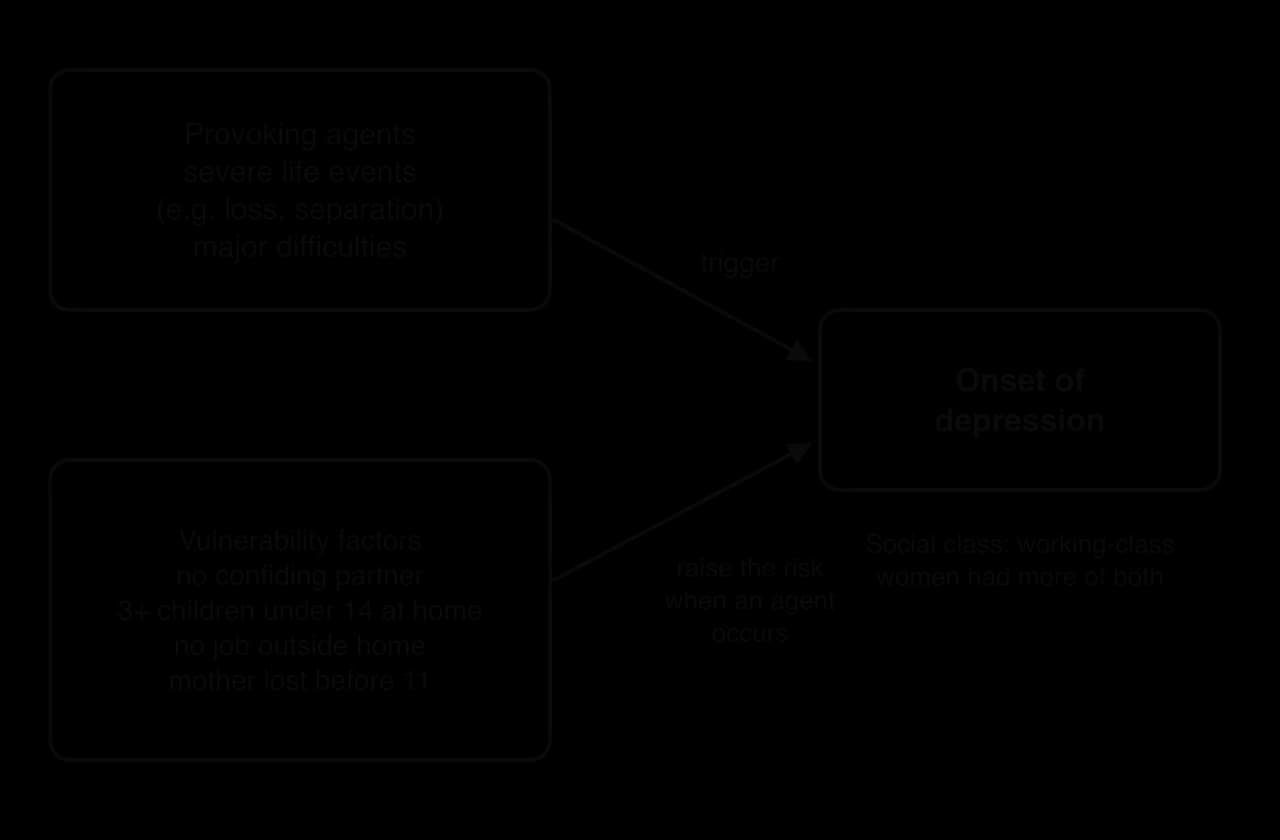
Working-class women experienced more severe events and major difficulties and were more likely to have vulnerability factors, especially three or more young children at home and no confiding relationship. Together, these differences accounted for their higher rate of depression.
Sources: Brown, G. W. and Harris, T. (1978). _Social Origins of Depression: A Study of Psychiatric Disorder in Women. London: Tavistock. Critique: Tennant, C. and Bebbington, P. (1978). Psychological Medicine, 8(4), 565–575._
Depression has social origins. It usually follows a severe event or long-term difficulty, and the risk that such an event leads to depression depends on the woman’s social circumstances, which act as vulnerability factors. Brown and Harris proposed that the vulnerability factors work by lowering self-esteem, so that a loss leads to generalised hopelessness. Social class affects depression through these specific events and circumstances, which makes the model an example of the social causation hypothesis.
The LEDS was a major advance on checklists. Rating events by their contextual threat, by raters who did not know whether the woman became depressed, reduced the risk that depressed women would describe the same events as more threatening. Careful dating of events relative to onset helped to show that events came first. The interview is still used as a benchmark measure of life stress.
Events and onset were reported in the same interview and recalled over the previous year, so the design is retrospective and correlational. Depressed women might remember more negative events or remember them as worse, although the contextual rating was designed to limit this. The vulnerability factors were not manipulated, so they may stand for something else: lacking a confiding partner, for example, may partly reflect a woman’s personality or earlier difficulties rather than cause depression.
Brown and Harris suggested that the vulnerability factors work through self-esteem: a woman who can confide in a partner is helped to keep a sense of her own worth when a loss occurs, so the loss does not spread into general hopelessness. An alternative is that women who are already more resilient are better at forming and keeping confiding relationships, which would make the relationship a marker of resilience rather than its cause.
The sample consisted only of women, in one area of London in the 1970s, when few women with young children worked outside the home, so the findings may not generalise to men, to other places or to today. The statistical claim that vulnerability factors and provoking agents interact was challenged: Tennant and Bebbington (1978) reanalysed the published data and argued that it did not support separating risk factors into vulnerability factors and provoking agents.
Replications were mixed. In a replication with 449 women in Calgary, Canada, C. G. Costello (1982) confirmed the role of severe events and difficulties and of a lack of intimacy with a partner, but found no link between onset and social class, employment, the number of children at home or early loss of the mother.
Some of the most powerful environmental factors act long before a disorder begins. Adverse childhood experiences (ACEs) include abuse, neglect, and growing up with household problems such as domestic violence, parental mental illness, substance misuse or a parent in prison. They are distal factors: they are thought to create a lasting vulnerability that shows itself when later stress occurs.
Felitti et al. (1998) mailed a questionnaire about seven categories of adverse childhood experience to 13,494 adults who had attended a medical check-up at a large health organisation in San Diego, USA; 9,508 replied. More than half reported at least one category. The number of categories showed a graded relationship with adult health: people who reported four or more, compared with none, had a 4- to 12-fold increase in the risk of alcoholism, drug abuse, depression and suicide attempts.
A graded or dose–response relationship, in which more adversity goes with more risk, is consistent with a causal effect, although it does not prove one. The ACE study also relied on adults’ retrospective reports of childhood, which may be influenced by their current mood: depressed adults may recall their childhood more negatively. Prospective studies that record adversity during childhood, such as cohort studies following children from birth, help to address this.
Socioeconomic status (SES) is a person’s position in society based on income, education and occupation. Across many countries, people with lower SES have higher rates of most mental health disorders, including depression. The relationship is often described as a social gradient: risk rises step by step with each step down the social ladder, not only among the very poorest.
Lorant et al. (2003) combined 51 prevalence studies, 5 incidence studies and 4 persistence studies in a meta-analysis. People in the lowest SES group had higher odds of being depressed than those in the highest group. The odds of a new episode were only modestly raised, while the odds of depression persisting were about doubled, and there was a dose–response relationship with education and income.
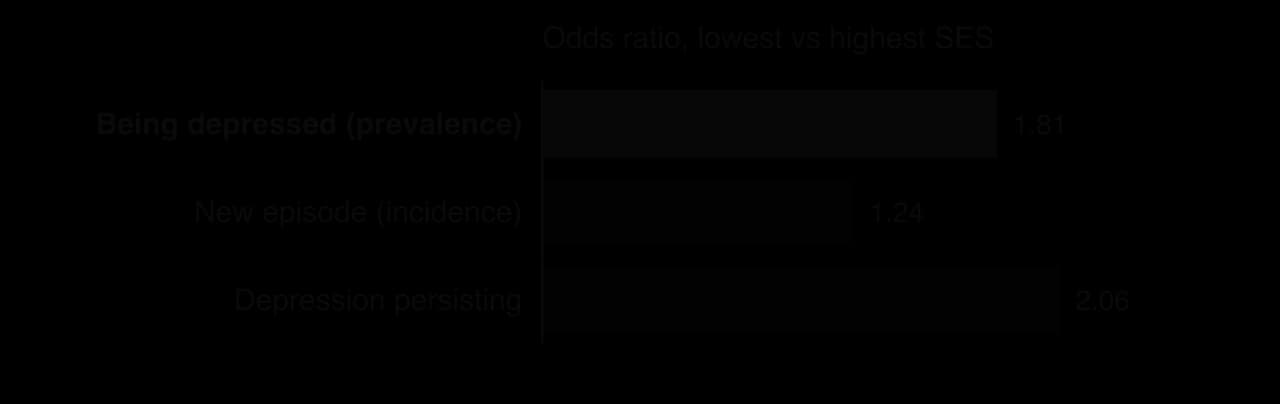
The pattern matters for interpretation. If low SES mainly makes depression last longer, poverty may act by making recovery harder (less access to treatment, more ongoing stress) as much as by causing episodes to begin. It also leaves open the question of direction.
 YouTube
Two hypotheses compete to explain the link between low SES and mental health disorders. The social causation hypothesis proposes that the conditions of poverty, such as financial strain, insecure work, poor housing, crime, discrimination and low control over one’s life, cause disorders. The social drift hypothesis (also called social selection) proposes the reverse: people who develop a disorder, or who are genetically predisposed to one, drift down the social ladder because the illness disrupts their education, work and relationships.
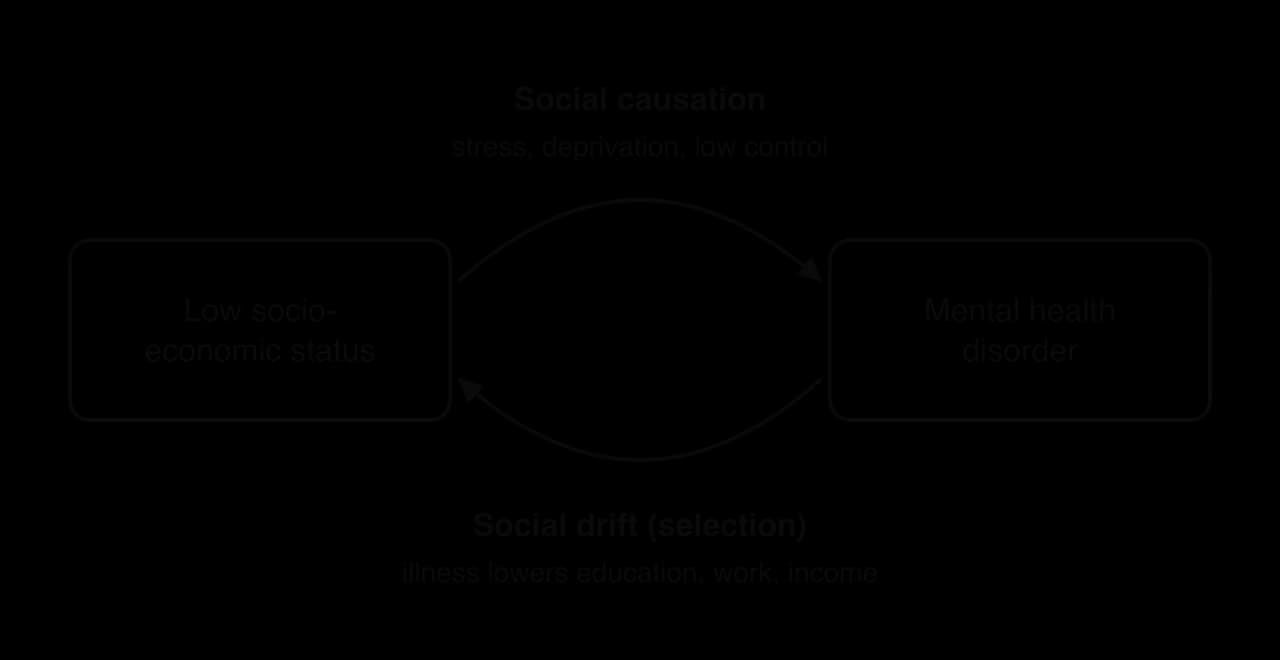
Separating the two directions requires research designs that break the usual link between them. Dohrenwend et al. (1992) used a comparison of ethnic groups in Israel. They studied 4,914 young Israeli-born adults of European and North African background; ethnic background is fixed at birth and could not be caused by illness, and North African Israelis faced more disadvantage and discrimination. The results suggested that social causation was more important for depression in women and for antisocial personality and substance use disorders in men, while social drift (selection) was more important for schizophrenia.
A natural experiment gives even stronger evidence. Costello et al. (2003) were following 1,420 rural children in North Carolina, a quarter of them American Indian, with yearly psychiatric assessments when a casino opened on the Eastern Cherokee reservation and began paying every tribal member an income supplement. The supplement moved 14% of families out of poverty for reasons unrelated to their own characteristics.
Afterwards, behavioural symptoms (conduct and oppositional problems) among children whose families had left poverty fell to the level of never-poor children, while those of persistently poor children stayed high. However, symptoms of anxiety and depression were unaffected, so the study supports social causation for behavioural problems but not for depression in childhood.
Relationships are among the most important environmental influences on mental health. Social isolation refers to having few social contacts; loneliness is the subjective, painful feeling that one’s relationships are not as close or as many as one wants. The two overlap, but a person can feel lonely despite many contacts, or have few contacts without feeling lonely. In this area of research, loneliness is often a stronger predictor of depression than the number of contacts.
The direction of the link is again the key question, since depression makes people withdraw. Cacioppo, Hawkley and Thisted (2010) followed 229 adults aged 50 to 68 in Chicago for five years. Using a cross-lagged design, which tests whether each variable predicts later change in the other, they found that loneliness predicted later increases in depressive symptoms, but depressive symptoms did not predict later loneliness. The effect remained after controlling for objective social isolation, stress, social support and the personality trait of neuroticism.
 YouTube
Social support is the practical help, emotional comfort and information that people receive from others. According to the stress-buffering hypothesis, reviewed by Cohen and Wills (1985), support protects people mainly when they face stress: it may lead them to appraise an event as less threatening, or help them cope once it happens. Brown and Harris’s finding that a confiding relationship protected women who experienced a severe event is an example of buffering.
People who live in cities have somewhat higher rates of some disorders. A meta-analysis of 20 population surveys by Peen et al. (2010) found that urban populations had higher rates of mood and anxiety disorders than rural populations, although not of substance use disorders, and that adjusting for confounding factors changed the results little. The incidence of schizophrenia is also higher among people born and raised in cities.
Lederbogen et al. (2011) tested a possible mechanism with fMRI. Participants performed difficult tasks under social evaluative stress, such as criticism from the experimenter. Current city living was associated with greater activity in the amygdala, while having grown up in a city was associated with activity in the perigenual anterior cingulate cortex, a region that helps to regulate the amygdala. The study suggests that the urban social environment may change how the brain processes social stress, an example of an environmental factor working through biology.
Air pollution is a newer area of research. A systematic review and meta-analysis by Braithwaite et al. (2019) found that long-term exposure to fine particulate matter (PM2.5) was associated with a small increase in the odds of depression, about 10% for each additional 10 micrograms per cubic metre. The authors warned that the evidence was limited and that residual confounding was likely: polluted areas also tend to be poorer, noisier and more crowded.
Discrimination is an environmental factor that acts through social position. A meta-analysis of 134 samples by Pascoe and Smart Richman (2009) found that perceived discrimination had a significant negative effect on both mental and physical health, and that it was linked to heightened stress responses and to unhealthy behaviours. Discrimination may help to explain higher rates of some disorders among minority and migrant groups, alongside the acculturative stress of adapting to a new culture.
Environmental factors rarely act on their own. In the diathesis-stress model, an environmental stressor triggers a disorder in a person with a vulnerability, which may be genetic, biological or cognitive. In Brown and Harris’s model the vulnerability is social; in Beck’s cognitive model it is a negative self-schema, itself shaped by early environment; in twin research it is genetic. The same stressful event can therefore lead to depression in one person and not in another.
Environment and genes also influence each other. Gene–environment correlation, shown by Kendler et al. (1999), means that genes partly shape the environments people experience. Gene–environment interaction means that the effect of an environment depends on genes. Epigenetics offers a possible mechanism by which experiences such as early adversity change how genes involved in the stress response are expressed, without changing the genes themselves. Environmental, biological and cognitive explanations are therefore best seen as describing different parts of one process, which is the reasoning behind the biopsychosocial model.
Environmental factor | Biological route | Cognitive route | Social route |
|---|---|---|---|
Childhood adversity | More reactive stress-hormone system | Negative self-schemas | Fewer supportive relationships later |
Severe life event | Activation of the stress response | Activates a dormant schema; hopelessness | Loss of a role or relationship |
Poverty | Chronic stress; poorer nutrition and health | Low sense of control | Less access to treatment and support |
Loneliness | Raised stress physiology | Expecting rejection from others | Fewer sources of help |
Most evidence on environmental factors is correlational, because it would be unethical to expose people to poverty, abuse or bereavement. Three problems follow. The direction may be reversed (depression can cause job loss, isolation and some life events); a third variable, such as genetic risk or personality, may cause both the environment and the disorder; and environmental factors cluster together, so their separate effects are hard to isolate.
Researchers have developed designs that reduce these problems. Prospective cohort studies measure the environment before the disorder begins. Co-twin designs, such as Kendler et al. (1999), compare people who share genes and family background. Natural experiments, such as the casino income in Costello et al. (2003), use events that change the environment for reasons unrelated to the people involved. Each design strengthens the causal case without fully proving it, and together they suggest that environmental factors have real causal effects on depression, alongside effects running the other way.
Many environmental factors are measured by self-report, often retrospectively. Adults reporting their childhood (the ACE study) or the past year (Brown and Harris) may recall selectively, especially if they are depressed. Interviews with contextual ratings, such as the LEDS, reduce this by separating the facts of an event from how the person felt about it. Objective records, such as income data, pollution monitors or child-protection files, avoid recall problems but capture less of what the experience meant to the person.
Classic studies sampled particular groups: women in 1970s London, mostly white, insured adults in San Diego, older adults in Chicago. The meaning of an environmental factor can differ across cultures and periods. Having no job outside the home was a vulnerability factor for women in Camberwell when it often meant isolation at home with young children, but it may not carry the same meaning in a society with different family structures. Most research also comes from high-income countries, while the heaviest burdens of poverty and conflict are elsewhere.
Environmental explanations have an important strength: they point to factors that can be changed. Income support, employment programmes, anti-discrimination policies, cleaner air, programmes that reduce loneliness in older people and support for families at risk of adversity are all forms of prevention suggested by this research. They also shift some responsibility for mental health from the individual to society, which can reduce stigma. A risk is that they can be heard as deterministic, as if everyone who is poor or bereaved will become ill, when most people facing adversity do not.
Concept | Strength of environmental research | Limitation |
|---|---|---|
Causality | Co-twin designs and natural experiments show some causal effects | Most data are correlational; drift and gene–environment correlation explain part of the link |
Measurement | Contextual interviews (LEDS) rate events objectively | Retrospective self-report of events and childhood is open to recall bias |
Change | Identifies factors open to prevention and policy | Effects of single interventions may be small; Costello et al. found no effect on depression |
Perspective | Explains why disorders cluster in disadvantaged groups | Cannot explain why most people exposed to adversity stay well without biological and cognitive factors |
Environmental factors can appear in Paper 1 Section B, where an unseen scenario asks you to apply an approach term such as the diathesis-stress model, social learning or acculturation to a mental health situation, and in Paper 1 Section C, where an essay links this area of study to a concept. Causality, measurement and change are the concepts that fit environmental factors most naturally.
Essays in Section C need a clear argument. On causality, a strong line of argument judges how far the evidence on each environmental factor justifies a causal claim.
Environmental factors are influences from outside the person’s biology: life events, early experience, relationships, socioeconomic conditions, the physical surroundings and social position.
Brown and Harris (1978) found that provoking agents (severe events, major difficulties) led to depression mainly in women with vulnerability factors such as no confiding relationship.
Kendler et al. (1999) showed that stressful life events have a substantial causal effect on depression, but about a third of the association reflects gene–environment correlation.
Felitti et al. (1998) found a dose–response relationship between childhood adversity and adult depression, though the data were retrospective.
Lorant et al. (2003) found that low SES is linked to depression, especially to its persistence; social causation and social drift both operate, with causation more important for depression and drift for schizophrenia.
Costello et al.’s (2003) natural experiment reduced children’s behavioural symptoms when families left poverty, but not depression or anxiety.
Cacioppo et al. (2010) found that loneliness predicted later depressive symptoms but not the reverse; social support buffers the effect of stress.
City living, air pollution and discrimination are associated with poorer mental health, but confounding between environmental factors is a major limitation.
Environmental factors interact with biological and cognitive vulnerability, which is why the diathesis-stress and biopsychosocial models are the best frameworks.
I can describe the main environmental factors linked to depression and give an example of each.
I can explain how provoking agents, vulnerability factors and social support combine to influence depression.
I can describe the aim, method, results and conclusions of Brown and Harris (1978).
I can explain the social causation and social drift hypotheses and how natural experiments help to test them.
I can explain how environmental factors interact with biological and cognitive factors.
I can evaluate research on environmental factors with reference to causality, measurement and change.
I can apply the diathesis-stress model and environmental factors to an unfamiliar scenario.