Explain why the Tokugawa shogunate fell, how the Meiji leaders turned Japan into a centralised, industrialising constitutional monarchy, and what resistance and challenges the transition met by 1894.
Each is in the History glossary, with every other term in the subject.
The Indigenous people of Hokkaido, Sakhalin and the Kuril Islands, whose lands were colonised and culture suppressed by the Meiji state.
The treaty signed on 16 July 1894 under which Britain agreed to end extraterritoriality in Japan from 1899, the first revision of the unequal treaties.
The repression of 1858–1859 in which the shogunate's chief minister Ii Naosuke punished daimyō, court nobles and activists who opposed his treaty and succession policies.
The government of the shogun (literally "tent government"), with its councils, officials and finances based in Edo.
The political order of Tokugawa Japan, combining the shogun's government (bakufu) with the semi-independent domains (han) of the daimyō.
Rural risings of 1873 against conscription and other reforms, named after the phrase "blood tax" in the conscription ordinance, which rumour took literally.
The civil war of January 1868 to June 1869 in which the forces of the new imperial government, led by Satsuma and Chōshū, defeated supporters of the Tokugawa.
"Civilisation and enlightenment": the early Meiji movement to adopt Western institutions, learning and customs.
The Meiji Restoration was the overthrow of the Tokugawa shogunate in 1868 and the reforms that followed, carried out in the name of Emperor Meiji. Within a generation Japan changed from a collection of feudal domains, closed to most foreign contact, into a centralised constitutional monarchy with a conscript army, railways and factories, and the first non-Western state to force the Western powers to treat it as an equal.
With a free account, Augment remembers where you stopped and what you have practiced.
The five-article statement of aims sworn by Emperor Meiji on 6 April 1868, promising deliberative assemblies, unity of all classes, the end of evil customs and the search for knowledge abroad.
The armed rising of indebted farmers in Chichibu, north-west of Tokyo, in October–November 1884, crushed by the army; the largest rural revolt of the Meiji period.
Compulsory enlistment of people, usually young men, into the armed forces by law.
A lord who ruled one of the roughly 260 domains (han) of Tokugawa Japan, with his own samurai, laws and taxes, under the control of the shogun.
The right of foreigners to be tried under their own country's law, usually by their own consuls, rather than in the courts of the country where they live.
The movement of the 1870s and 1880s, begun by former officials such as Itagaki Taisuke, that demanded an elected national assembly, a constitution and civil rights.
"Rich country, strong army": the Meiji slogan for building industry and modern armed forces together to protect Japan's independence.
The Education System Order of 1872, which planned universal elementary schooling for boys and girls throughout Japan.
"Elder statesmen": the senior surviving Meiji oligarchs, such as Itō Hirobumi and Yamagata Aritomo, who advised the emperor informally from the 1890s and chose prime ministers.
The abolition of the domains and their replacement by centrally governed prefectures on 29 August 1871.
The return of the daimyō's domain registers to the emperor in 1869, which made the lords imperial governors of their former domains.
The commercial treaty of 29 July 1858 between the United States and Japan, negotiated by Townsend Harris, which opened ports to trade and imposed extraterritoriality and fixed low tariffs.
A Japanese term for a peasant protest or uprising, used for the many rural risings of the Tokugawa and early Meiji periods.
The parliament created by the Meiji Constitution, with a House of Peers and an elected House of Representatives, which first met in November 1890.
The statement of moral principles issued in the emperor's name on 30 October 1890, combining Confucian virtues with loyalty to the throne; it was read aloud in every school.
The mission of Meiji leaders and students, led by Iwakura Tomomi, to the United States and Europe in 1871–1873, which failed to revise the treaties but studied Western institutions.
The Liberal Party founded by Itagaki Taisuke in 1881, drawing on rural notables and radical activists; it dissolved in 1884.
"National learning": an eighteenth- and nineteenth-century school that studied ancient Japanese texts to recover a native tradition and exalted the emperor as divine.
The reform announced in 1873 that gave landowners title deeds and replaced rice taxes with a cash tax of 3 per cent of assessed land value, cut to 2.5 per cent in 1877.
The financial policy of Finance Minister Matsukata Masayoshi from 1881, which cut spending and withdrew paper money; it stabilised the currency but caused a sharp fall in farm prices.
The constitution promulgated on 11 February 1889 as the emperor's gift, which made the emperor sovereign and created an Imperial Diet with an elected lower house.
The overthrow of the Tokugawa shogunate in 1868 and the restoration of rule in the emperor's name, followed by the reforms that turned Japan into a centralised, industrialising state.
A school of thought centred on the Tokugawa branch domain of Mito that combined Confucian loyalty with reverence for the emperor and called for resistance to the West.
A treaty clause promising that any privilege granted to one foreign country will automatically be granted to the country holding the clause.
Government by a small, privileged group, such as the landowning and merchant elites of many Latin American states or, in Meiji Japan, the dozen or so former samurai and court nobles who held the key offices of state from 1868 into the 1890s.
The war of 1839–1842 in which Britain defeated Qing China and forced it, in the Treaty of Nanjing, to open ports, cede Hong Kong and pay an indemnity.
"Hired foreigners": the Western experts and teachers employed by the Meiji government and private firms to transfer technology and knowledge.
"Dutch learning": the study of Western science, medicine and military technology in Tokugawa Japan through Dutch books obtained at Nagasaki.
The Constitutional Reform Party founded by Ōkuma Shigenobu in 1882, supported by urban professionals and favouring British-style parliamentary government.
The Tokugawa policy of strictly limiting foreign contact from the 1630s to 1853, under which only the Dutch and Chinese could trade, at Nagasaki.
The hereditary warrior class of Japan, who by the Tokugawa period served mainly as administrators on stipends paid in rice; their status was abolished in the 1870s.
The Tokugawa rule of alternate attendance, which required each daimyō to spend every other year in Edo and to leave his family there as hostages.
The rising of former samurai led by Saigō Takamori in 1877, defeated by the conscript army; the last armed challenge to the Meiji government.
The debate of 1873 over sending Saigō Takamori to Korea to provoke a war; its rejection split the government and led to samurai rebellion and the people's rights movement.
"Men of high purpose": young samurai activists of the 1850s and 1860s who left their domains to work, often violently, for the imperial cause.
The legal category of former samurai families created in 1869, which kept a title but lost the stipends, offices and swords of the old samurai status.
The hereditary military ruler of Japan who held real political power in the emperor's name; from 1603 to 1867 the office belonged to the Tokugawa family.
"Revere the emperor, expel the barbarians": the slogan of activists of the 1850s and 1860s who opposed the shogunate's foreign policy and later the shogunate itself.
The organisation of Shinto shrines and rituals under state control from the Meiji period, presenting the emperor as a descendant of the sun goddess and the focus of national loyalty.
A state's right to set its own customs duties. Japan lost it under the treaties of 1858–1866 and regained it fully only in 1911; China lost it under the treaties of 1842–1844 and recovered it in 1928–1930.
The farming of land owned by someone else in return for rent paid in cash, crops or labour; in Song China and Meiji Japan most tenants paid a large share of their harvest as rent.
A famine of 1833–1837 caused by repeated harvest failures, which led to riots and Ōshio Heihachirō's rising and exposed the weakness of the shogunate.
A state-run model silk-reeling factory opened in 1872 with French machinery, which trained women workers in mechanised production; it was sold to Mitsui in 1893.
The "outer" daimyō whose ancestors had opposed the Tokugawa in 1600 and who were excluded from central government; they included Satsuma, Chōshū, Tosa and Hizen.
The treaty of February 1876 by which Japan forced Korea to open three ports, recognise Japanese extraterritoriality and declare itself independent of China.
The treaty of 31 March 1854 between the United States and Japan that opened Shimoda and Hakodate to American ships and ended the policy of exclusion, without opening trade.
A port opened to foreign trade and residence by treaty, such as Yokohama or Nagasaki, where foreigners lived under their own laws.
A nineteenth-century treaty imposed on an Asian state by Western powers that granted foreigners privileges such as extraterritoriality and fixed low tariffs without equal rights in return.
The large family-controlled business groups, such as Mitsui and Mitsubishi, that dominated the Japanese economy before 1945; the US occupation ordered them broken up.
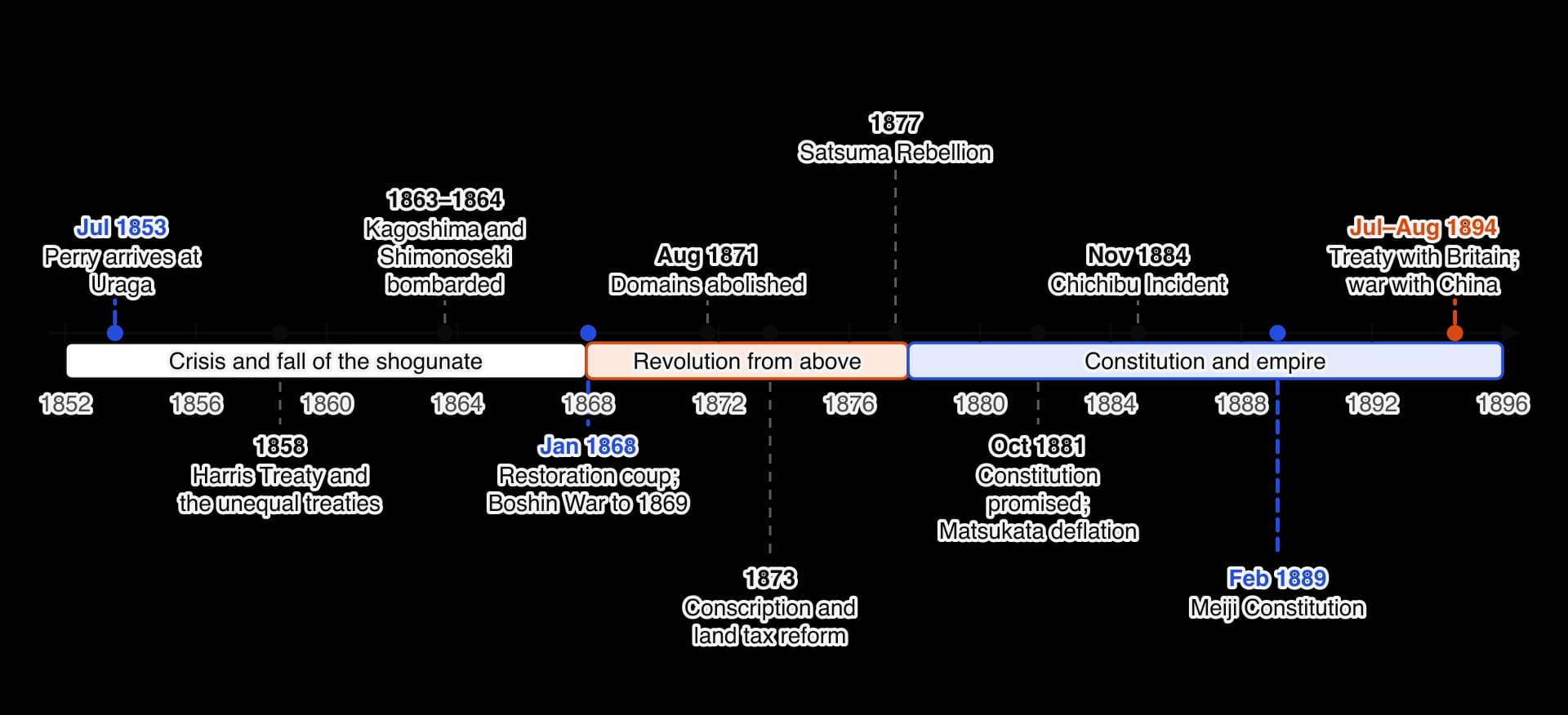
The timeline of 1853–1894 shows the three stages of the transition. Political collapse came first, between 1853 and 1868; a decade of radical reform from above followed, and it provoked armed resistance; from the late 1870s the new leaders consolidated their state in a constitution and began to expand overseas.
From 1603 Japan was ruled by the shogun, the hereditary military ruler from the Tokugawa family, from his castle city of Edo (modern Tokyo). The emperor lived in Kyoto, appointed each shogun in name and performed religious rituals, but had no army and no say in government. The shogun's government is known as the bakufu ("tent government"), a name that recalls its military origins.
The shogun did not govern the whole country directly. About a quarter of the land belonged to the Tokugawa house; the rest was divided into about 260 domains (han), each ruled by a lord, or daimyō, with his own samurai, laws and taxes. Historians call this mixture of central and local rule the bakuhan system.
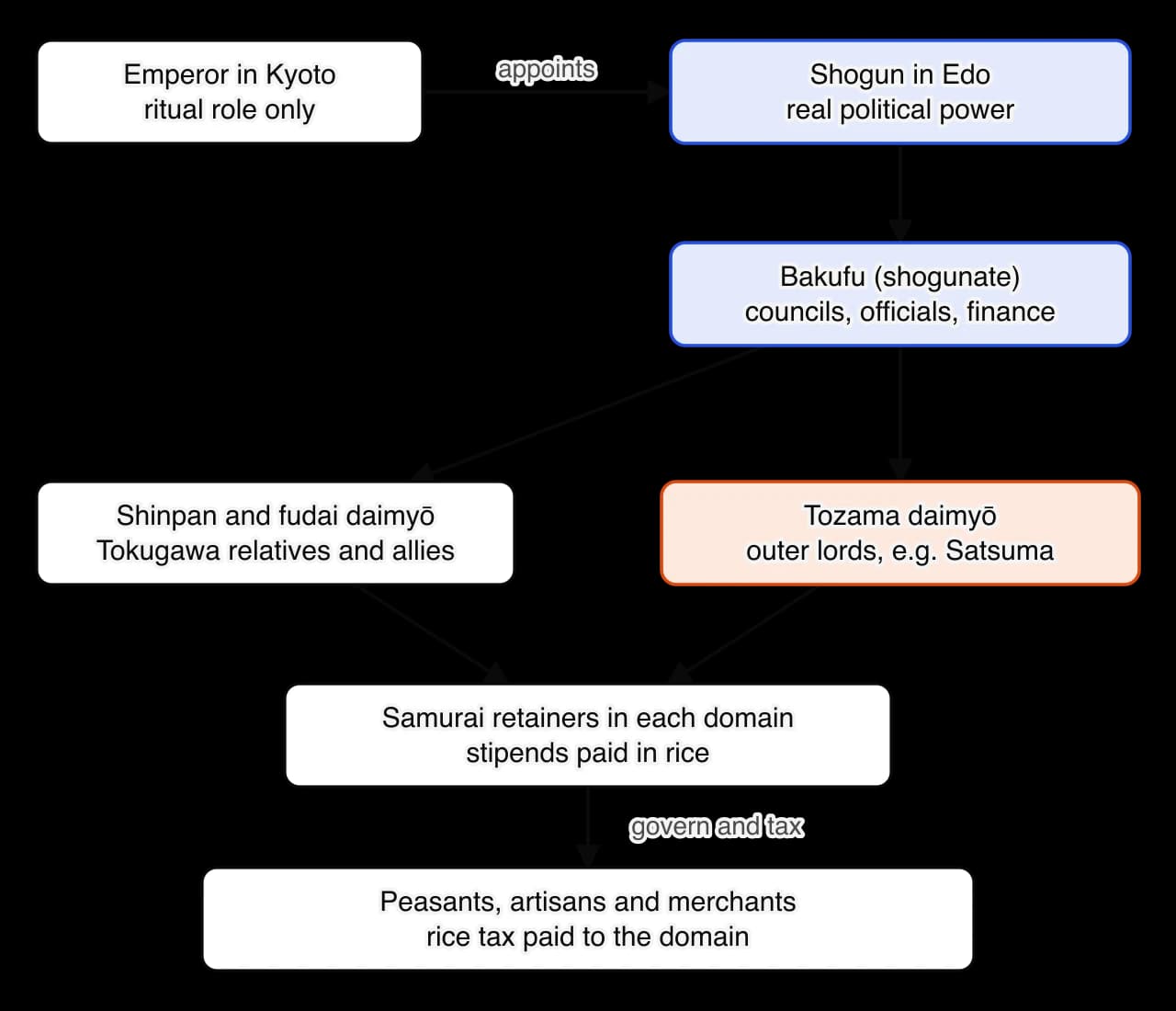
The shogunate kept the daimyō obedient through several controls. The most important was sankin-kōtai (alternate attendance): each daimyō had to spend every other year in Edo and leave his wife and heir there as hostages when he returned home. The great processions to and from Edo and the cost of keeping two households absorbed a large share of domain income, which limited the lords' ability to challenge the shogun. Daimyō also needed permission to marry, to repair castles or to move troops.
The daimyō were ranked by their relationship to the Tokugawa. Relatives (shinpan) and hereditary allies (fudai) held most posts in the bakufu. The tozama ("outer") lords, whose ancestors had fought against the Tokugawa at the battle of Sekigahara in 1600, were excluded from central government. Among them were the large south-western domains of Satsuma, Chōshū, Tosa and Hizen, which would lead the movement that overthrew the shogunate in the 1860s.
Society was divided into hereditary status groups: samurai (about 6 per cent of a population of roughly 30 million), peasants, artisans and merchants, with outcaste groups below them. Samurai had become an administrative class, living in castle towns on fixed stipends paid in rice. In Confucian theory merchants ranked lowest because they produced nothing, yet by the nineteenth century many of them were far richer than the samurai who governed them.
Contact with the outside world was strictly limited by the policy later called sakoku ("closed country"). From the 1630s Christianity was banned, Japanese could not travel abroad, and the only Europeans allowed to trade were the Dutch, confined to the small artificial island of Dejima in Nagasaki harbour. Chinese merchants also traded at Nagasaki, and the domains of Satsuma and Tsushima conducted relations with the Ryūkyū kingdom and Korea.
The Tokugawa system rested on a rice economy that no longer matched reality. The shogunate and the domains taxed peasants mainly in rice and paid samurai in rice, but a commercial economy had grown up around them. Osaka was the centre of a national rice market, and Edo, with more than a million people in the eighteenth century, was one of the largest cities in the world. Merchants who handled rice, credit and goods grew rich, while samurai stipends were fixed. Many samurai families and domains fell deeply into debt to merchant houses.
The bakufu's own finances were weak. Its income came largely from its own lands, so it could not tax the domains for national purposes, and it repeatedly debased the coinage to cover deficits. The Tenpō famine of 1833–1837, caused by a series of bad harvests, killed large numbers in north-eastern Japan and led to rice riots in the cities. In 1837 Ōshio Heihachirō, a former police official and Confucian scholar, led an uprising in Osaka in protest at the authorities' failure to feed the poor; it was crushed within a day, but a rising led by a former official of the shogunate itself alarmed the regime.
The chief councillor Mizuno Tadakuni tried to restore order through the Tenpō reforms of 1841–1843: sumptuary laws against luxury, the abolition of merchant guilds, cuts in spending and a plan to take over lands near Edo and Osaka. The reforms failed and Mizuno was dismissed. Several outer domains did better. Satsuma, under the financial official Zusho Hiromichi, effectively repudiated much of its debt and profited from a sugar monopoly and illegal trade through the Ryūkyū Islands; Chōshū, under Murata Seifū, reorganised its finances and trade. These domains entered the 1850s with money, ambitious leaders and long memories of their exclusion from power.
Discontent also grew among ordinary samurai. Status determined office, so a talented samurai of low rank had little chance of promotion, while many could not live on their stipends and took up crafts or married into merchant families. These frustrated lower-ranking samurai, educated and trained in arms, supplied most of the activists of the 1850s and 1860s and most of the leaders of the Meiji state.
Three intellectual movements weakened the ideological basis of shogunal rule. Kokugaku ("national learning") studied ancient Japanese texts to recover a native way of thinking free of Chinese and Buddhist influence. Its leading scholar, Motoori Norinaga (1730–1801), praised the emperor as the descendant of the sun goddess and Japan as a divine land. Without intending it, national learning raised the question of why the emperor should be a figurehead while a military family ruled.
The Mito school (Mitogaku), based in the Tokugawa branch domain of Mito, combined Confucian loyalty with reverence for the emperor. In Shinron (New Theses, 1825) the scholar Aizawa Seishisai warned that Western powers used trade and Christianity to undermine nations and called for national unity around the throne and military reform. The Mito school gave activists their slogan, sonnō jōi: "revere the emperor, expel the barbarians".
Rangaku ("Dutch learning") was the study of Western medicine, astronomy, geography and military science through Dutch books obtained at Nagasaki. In 1774 the physicians Sugita Genpaku and Maeno Ryōtaku published a translation of a Dutch anatomy text after seeing that its drawings matched a dissected body more closely than the Chinese medical books did. By the 1840s, rangaku scholars knew of Western steamships and artillery, and of Britain's victory over China in the Opium War, and some argued that Japan must learn from the West to defend itself.
These currents produced the shishi ("men of high purpose"), young samurai who left their domains to work, and often to kill, for the imperial cause in the 1860s. Their best-known teacher was Yoshida Shōin of Chōshū, whose small private academy trained future leaders such as Itō Hirobumi and Yamagata Aritomo. Yoshida tried to stow away on one of Perry's ships in 1854 to study the West, plotted to assassinate a shogunal official, and was executed in 1859 at the age of twenty-nine.
Western ships appeared off Japan with growing frequency from the 1790s, as Russian, British and American vessels sought supplies, trade or shipwrecked sailors. In 1825 the bakufu ordered that foreign ships be driven off by force. News of China's defeat by Britain in the Opium War (1839–1842) changed the calculation: if the greatest power in Asia could be forced to open its ports and pay an indemnity, Japan could not resist. In 1842 the bakufu softened its order and allowed foreign ships to take on fuel and water.
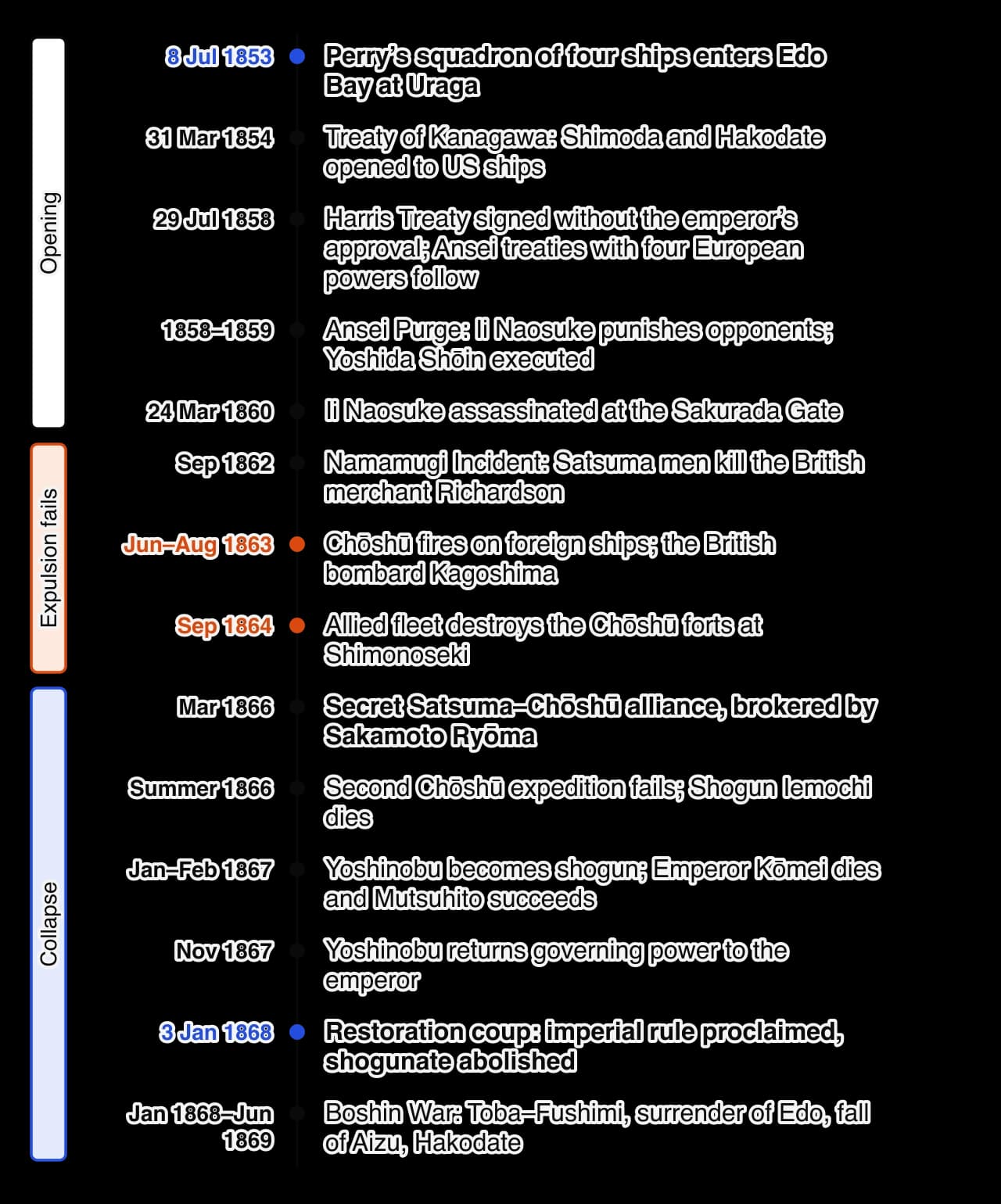
The United States had particular reasons to open Japan. American whaling ships worked the North Pacific, steamships needed coal on the route from California to China, and shipwrecked American sailors had been badly treated in Japan. In 1852 President Millard Fillmore sent Commodore Matthew Perry with a squadron and a letter to the emperor. On 8 July 1853 Perry's four ships, two of them steam-powered warships, anchored at Uraga at the entrance to Edo Bay. The Japanese called them the "black ships" for their hulls and coal smoke.
I have directed Commodore Perry to assure your imperial majesty that I entertain the kindest feelings towards your majesty's person and government, and that I have no other object in sending him to Japan but to propose to your imperial majesty that the United States and Japan should live in friendship and have commercial intercourse with each other. […] These are the only objects for which I have sent Commodore Perry, with a powerful squadron, to pay a visit to your imperial majesty's renowned city of Yedo: friendship, commerce, a supply of coal and provisions, and protection for our shipwrecked people.
Millard Fillmore, President of the United States, letter to the Emperor of Japan, dated 13 November 1852 and presented by Perry on 14 July 1853. The letter is polite and stresses friendship and trade, but it was carried by a "powerful squadron" that sailed into Edo Bay against Japanese law, and Perry made clear he would return for an answer. Its friendly words and its delivery by warships together show the mixture of commerce and force in Western diplomacy in Asia. It was addressed to the emperor, whom Americans wrongly took for the ruler; in practice it was answered by the shogun's officials.
Perry promised to return for a reply. The senior councillor Abe Masahiro took the unprecedented step of circulating the letter to the daimyō and asking their advice. Most opposed opening the country, but few thought Japan could fight. Consulting the lords, and later the imperial court, broke the convention that foreign policy belonged to the shogun alone, and it invited outsiders into national politics.

Perry returned in February 1854 with a larger squadron. The Treaty of Kanagawa of 31 March 1854 opened the small ports of Shimoda and Hakodate to American ships for fuel and supplies, promised good treatment of shipwrecked sailors, allowed an American consul at Shimoda and gave the United States most-favoured-nation status. It did not open trade. Britain, Russia and the Netherlands soon obtained similar agreements.
The American consul Townsend Harris, who arrived at Shimoda in 1856, pressed for a full commercial treaty, pointing to the Anglo-French war on China (the Second Opium War) as a warning of what Japan might face. The Harris Treaty (Treaty of Amity and Commerce) of 29 July 1858 was followed within months by similar treaties with the Netherlands, Russia, Britain and France, together known as the Ansei treaties after the era name.
Treaty | Main terms | Why it was resented |
|---|---|---|
Treaty of Kanagawa, 31 March 1854 (USA) | Shimoda and Hakodate opened for supplies; consul at Shimoda; most-favoured-nation clause | Signed under the threat of Perry's warships; ended the policy of exclusion |
Harris Treaty, 29 July 1858 (USA), and the Ansei treaties with four European powers | Kanagawa (Yokohama), Nagasaki and Hakodate opened to trade in 1859, other ports later; foreigners could live in Edo and Osaka; low tariffs fixed by treaty; extraterritoriality | Japan could not set its own tariffs or try foreigners in its courts; signed without the emperor's approval |
Tariff Convention, 1866 | Most import duties cut to about 5 per cent | Further reduced Japan's control over its own trade |
These were unequal treaties. Under extraterritoriality, foreigners accused of crimes in Japan were tried by their own consuls, not Japanese courts. Japan lost tariff autonomy: it could not change its import duties without the powers' agreement. Foreigners lived and traded in treaty ports such as Yokohama, which opened in 1859. Revising these treaties became the central aim of Japanese foreign policy for the next forty years.
The treaties tore the ruling class apart. In 1858 the chief minister (tairō) Ii Naosuke signed the Harris Treaty although Emperor Kōmei had refused to approve it. At the same time Ii settled a dispute over the shogunal succession in favour of a young candidate, defeating a group of lords, led by Tokugawa Nariaki of Mito, who backed Hitotsubashi Yoshinobu. In the Ansei Purge of 1858–1859 Ii placed his critics under house arrest and had several activists, including Yoshida Shōin, executed. On 24 March 1860 a band of samurai, most of them from Mito, killed Ii outside the Sakurada Gate of Edo Castle. The assassination of the shogun's chief minister in front of his own castle showed how far the bakufu's authority had fallen.
In the early 1860s Kyoto, not Edo, became the centre of politics, as shishi gathered around the court and murdered officials and foreigners. In September 1862, at Namamugi near Yokohama, retainers of the Satsuma leader Shimazu Hisamitsu killed the British merchant Charles Richardson for failing to give way to their procession. Under pressure from the court, the shogun agreed to set a date in June 1863 for the expulsion of foreigners. Only Chōshū acted on it, firing on Western ships passing through the Shimonoseki Strait.
Western retaliation was swift. In August 1863 a British squadron bombarded Kagoshima, the Satsuma capital, after Satsuma refused to hand over Richardson's killers. In September 1864 a fleet of British, French, Dutch and American warships destroyed the Chōshū forts at Shimonoseki. Both domains drew the same lesson: expulsion was impossible until Japan had modern weapons. Satsuma opened friendly relations with Britain, and Chōshū bought Western rifles and formed mixed units of samurai and commoners, such as the Kiheitai raised by Takasugi Shinsaku in 1863.
Foreign trade opened at Yokohama, Nagasaki and Hakodate in 1859 and grew quickly. Raw silk and tea, which Europe needed because disease had devastated French and Italian silkworms, became the main exports, while cotton cloth, yarn and weapons were the main imports. Silk producers and the merchants of Yokohama prospered, but the sudden demand pushed up the prices of silk and other goods at home.
Currency caused a more serious shock. In Japan gold was valued at only about five times its weight in silver, against about fifteen times on world markets, so foreign traders could exchange silver for Japanese gold coins and make a large profit abroad. Gold flowed out of the country until the bakufu reminted its coins in 1860, which in turn fuelled inflation. Rice prices rose several-fold during the 1860s. Samurai on fixed stipends and the urban poor suffered most, and many blamed the foreigners and the shogunate that had admitted them.
Popular unrest grew. Peasant protests (ikki) and urban riots reached a peak in 1866, a year of poor harvests and war, when "world renewal" (yonaoshi) risings attacked moneylenders and rich farmers in several regions. In the autumn of 1867 crowds in the Kyoto–Osaka region danced through the streets chanting ee ja nai ka ("isn't it fine?") after reports that protective amulets had fallen from the sky. Historians read these mass dances as a sign that ordinary people sensed the old order was ending, although they had no political programme.
Many Meiji leaders, and Western observers, described Tokugawa Japan as backward and stagnant, and for a long time historians agreed. The image served the new government, which justified its reforms by contrasting them with a "feudal" past. The members of the Iwakura Mission, who toured the United States and Europe in 1871–1873, were struck by the gap in industry, technology and institutions between Japan and the West.
From the late 1950s historians questioned this picture. Thomas C. Smith, in The Agrarian Origins of Modern Japan (1959) and later Native Sources of Japanese Industrialization, 1750–1920 (1988), showed that Tokugawa villages were already commercial, with rural industries such as silk-reeling, cotton-weaving and sake-brewing. Susan Hanley and Kozo Yamamura argued that the stable population of about 30 million from the 1720s to the 1840s reflected deliberate family limitation and rising living standards for many, not stagnation. Ronald Dore estimated that by 1868 roughly 40 per cent of boys and perhaps 10 to 15 per cent of girls received some schooling outside the home, a high level for the time.
On this reading, Japan had important foundations for rapid modernisation: a national market, merchant capital, a literate population, a skilled administrative class and political units used to managing their own finances. The weakness of the Tokugawa order lay mainly in a political system that could not respond to new pressures, while the economy continued to grow.
By the mid-1860s many samurai leaders had concluded that only a strong, unified state could protect Japan from Western domination. Two slogans expressed their programme. Fukoku kyōhei ("rich country, strong army") meant building industry and a modern military together, as a matter of national survival. Bunmei kaika ("civilisation and enlightenment") meant adopting Western institutions, learning and even customs, so that Japan would be treated as a "civilised" nation and the unequal treaties could be revised.
The shogunate itself took up modernisation. It sent students and missions abroad, built a shipyard at Yokosuka with French help from 1865, and under the last shogun, Tokugawa Yoshinobu, began a French-advised reform of its army and administration in 1867. By 1867 the contest was over who would lead modernisation, the Tokugawa or a coalition of domains acting in the emperor's name.
After 1864 the struggle became one between the bakufu and the two outer domains that had learned from defeat. In Chōshū, radical samurai and the mixed units led by Takasugi Shinsaku seized control of the domain in 1865 after the shogunate had forced it to submit in a first punitive expedition. In Satsuma, the leaders Ōkubo Toshimichi and Saigō Takamori steered their domain towards opposition to the bakufu.
Satsuma and Chōshū had been rivals; Satsuma troops had helped drive Chōshū forces out of Kyoto in 1864. In March 1866 they formed a secret alliance, brokered by Sakamoto Ryōma, a samurai from the domain of Tosa. When the bakufu launched a second expedition against Chōshū in the summer of 1866, Satsuma refused to take part and Chōshū's modernised forces defeated the shogunal armies. The death of the young Shogun Iemochi gave the bakufu a reason to end the campaign, but its failure to defeat one domain was a decisive blow to its prestige.
Tokugawa Yoshinobu became shogun in January 1867. Emperor Kōmei, who had disliked foreigners but supported the shogunate, died the same month, and the fourteen-year-old Mutsuhito succeeded him. In November 1867, on the advice of Tosa, Yoshinobu formally returned governing power to the emperor, hoping to lead a council of lords in the new system as the largest landholder in Japan.
Satsuma and Chōshū, with court nobles led by Iwakura Tomomi, moved first. On 3 January 1868 their troops seized the palace gates in Kyoto and an imperial decree proclaimed the restoration of imperial rule and abolished the shogunate. The new government demanded that Yoshinobu surrender his lands. The Boshin War followed. Satsuma and Chōshū forces defeated the larger shogunal army at Toba–Fushimi near Kyoto (27–30 January 1868), helped by modern rifles and the imperial banner, which made the Tokugawa side appear rebels. Edo surrendered without a fight in May 1868 after negotiations between Saigō Takamori and the bakufu official Katsu Kaishū. The domain of Aizu held out until November 1868, and the last Tokugawa naval forces, which had set up a short-lived "Republic of Ezo" at Hakodate under Enomoto Takeaki, surrendered in June 1869.
 YouTube
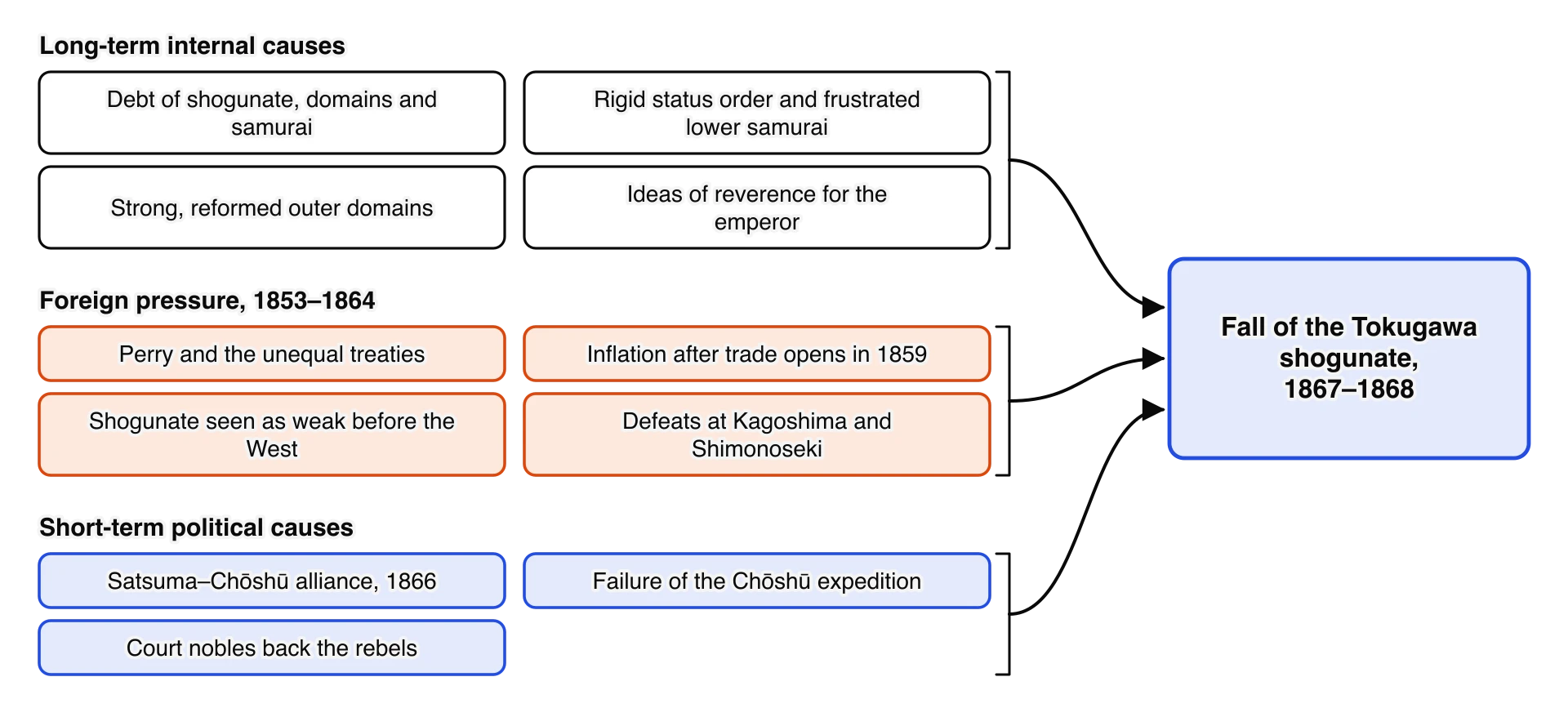
The diagram of causes groups the factors by type. Long-term weaknesses explain why the shogunate was vulnerable: it lacked the revenue to defend the country, its status order frustrated able men, and new ideas gave the emperor a political meaning. Yet the system had survived famine and rebellion before 1853, and there is little sign that it was about to collapse on its own.
Foreign pressure turned weakness into crisis. The treaties forced the bakufu to act in a way that most samurai saw as humiliating, it drew the daimyō and the court into national politics, and the inflation that followed trade hurt the samurai and the poor. The bakufu's claim to rule rested on its role as the military protector of the realm, and after 1853 it could not perform that role.
The outcome, however, was decided inside Japan. The shogunate fell because two well-armed outer domains combined, because the court backed them, and because enough daimyō stayed neutral. Historians who stress foreign pressure, such as W. G. Beasley, and those who stress the domestic political contest, such as Conrad Totman, agree that both were needed; they differ in the weight they give each.
The new government ruled in the name of Emperor Mutsuhito, known after his death by his era name, Meiji ("enlightened rule"). He was fifteen when the shogunate fell, and for most of his reign decisions were made by a small group of leaders who controlled access to him. Historians call this group the Meiji oligarchy; its senior survivors were known from the 1890s as the genrō ("elder statesmen").
Leader | Origin | Main role in the transition |
|---|---|---|
Ōkubo Toshimichi (1830–1878) | Satsuma samurai | Leading figure of the 1870s; Home Minister; directed centralisation, the land tax and industrial policy; assassinated in 1878 |
Saigō Takamori (1828–1877) | Satsuma samurai | Commander in the Boshin War; left government in 1873 over Korea; led the Satsuma Rebellion and died in 1877 |
Kido Takayoshi (1833–1877) | Chōshū samurai | Drafted the final text of the Charter Oath; pressed for the abolition of the domains; favoured gradual constitutional government |
Itō Hirobumi (1841–1909) | Chōshū, low-ranking samurai family | Studied in Britain in 1863; chief author of the 1889 constitution; first prime minister (1885) |
Yamagata Aritomo (1838–1922) | Chōshū, low-ranking samurai family | Founder of the conscript army (1873); prime minister 1889–1891; distrusted political parties |
Iwakura Tomomi (1825–1883) | Court noble | Planned the January 1868 coup; led the mission to the West (1871–1873); defended imperial authority |
Ōkuma Shigenobu (1838–1922) | Hizen samurai | Finance minister in the 1870s; expelled in 1881 for demanding an early British-style parliament; founded the Kaishintō |
Matsukata Masayoshi (1835–1924) | Satsuma samurai | Finance minister from 1881; deflation policy; founded the Bank of Japan (1882) |
The oligarchs were united by fear of Western domination and a determination to make Japan strong, but they were not a party with a single programme. They disagreed over the pace of reform, over Korea, and over whether and when to allow an elected assembly. What held them together was control of the emperor's name: an order issued as the emperor's will was hard for any Japanese to resist openly, and the oligarchs used this repeatedly to impose reforms that hurt powerful groups.
On 6 April 1868, while the Boshin War was still being fought, the young emperor swore an oath before the gods in Kyoto in the presence of court nobles and lords. The Charter Oath set out the aims of the new government in five short articles.
1. Deliberative assemblies shall be widely established and all matters decided by public discussion.
2. All classes, high and low, shall unite in vigorously carrying out the administration of affairs of state.
3. The common people, no less than the civil and military officials, shall each be allowed to pursue his own calling so that there may be no discontent.
4. Evil customs of the past shall be broken off and everything based upon the just laws of Nature.
5. Knowledge shall be sought throughout the world so as to strengthen the foundations of imperial rule.
The Charter Oath (Gokajō no Goseimon), sworn by Emperor Meiji on 6 April 1868, in the translation of Tsunoda, de Bary and Keene, Sources of Japanese Tradition. Drafted by Yuri Kimimasa and Fukuoka Takachika and revised by Kido Takayoshi, it was issued by a new government that controlled only part of the country and needed the support of the daimyō. Its vague promise of "deliberative assemblies" reassured the lords that they would be consulted; later, people's rights activists read it as a promise of an elected parliament.
In 1868 Edo was renamed Tokyo ("eastern capital") and the emperor moved into the shogun's castle there in 1869, a powerful symbol that the emperor had taken over the shogun's place. The era name Meiji was proclaimed in October 1868, and from then on a single era name was used for each reign.
In 1868 the new government directly controlled only the former Tokugawa lands. The domains still had their own armies and taxes. In March 1869 the lords of Satsuma, Chōshū, Tosa and Hizen, persuaded by their own samurai officials, offered their domain registers (lists of land and people) to the emperor, and most other lords followed. This step, known as hanseki hōkan, made the daimyō imperial governors of their former domains, but in practice little changed.
The decisive step came on 29 August 1871, when an imperial decree abolished the domains and replaced them with prefectures run by governors appointed from Tokyo (haihan chiken). The government first gathered an imperial guard of about 10,000 troops from Satsuma, Chōshū and Tosa in case of resistance, but none came. The daimyō were moved to Tokyo and given generous pensions, and the government took over the domains' debts. The 3 urban prefectures (fu) and 302 prefectures (ken) created in August 1871 were merged into 3 fu and 72 ken within a few months, and by 1888 further mergers had produced the 3 fu and 43 ken that, with Hokkaido, make up Japan's 47 prefectures today.
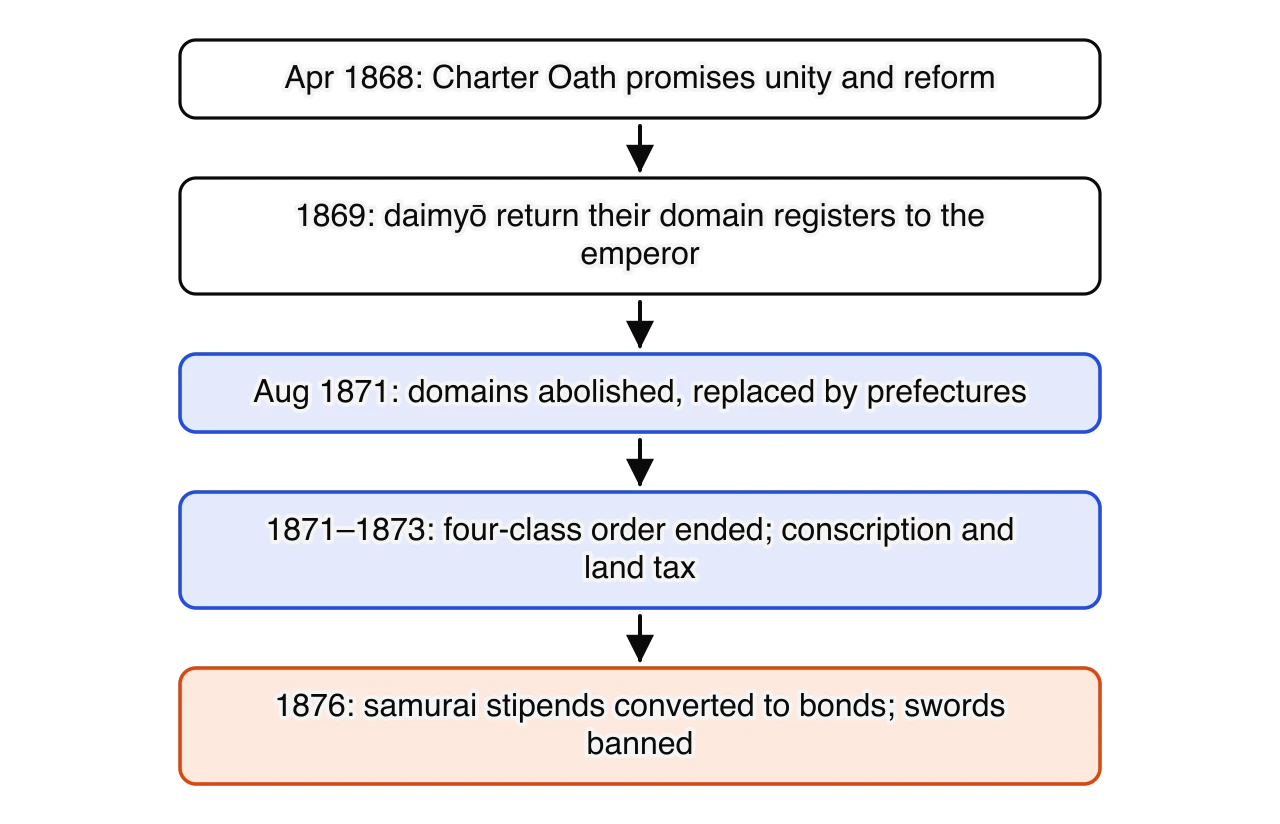
The chain of centralising reforms shows how quickly the old order was dismantled. The lords gave up their domains with little protest because many were heavily in debt, the government took on those debts, and their own samurai officials had already decided that the domains had no future. The samurai class as a whole lost much more, as the reforms of 1871–1876 show.
Between 1869 and 1871 the four-class order was replaced by three categories: nobility (kazoku: former court nobles and daimyō), former samurai (shizoku) and commoners (heimin). Commoners were allowed surnames, free choice of occupation and marriage across classes, and an edict of 1871 formally ended the legal status of outcaste groups, although discrimination against them, now known as the Burakumin, continued. Former samurai lost their monopoly of office and arms.
In January 1873 the government introduced conscription, designed by Yamagata Aritomo after studying European armies. Men were registered at the age of twenty for three years' active service, irrespective of class, although heads of households, officials, students and those who could pay a fee of 270 yen were exempt. The new army of commoners replaced the samurai as the defenders of the state.
No one in the world is exempt from taxation with which the state defrays its expenditures. In this way, everyone should endeavor to repay one's country. The Occidentals call military obligation "blood tax," for it is one's repayment in life-blood to one's country. When the State suffers disaster, the people cannot escape being affected.
Imperial Conscription Ordinance issued by the Council of State (Dajōkan), December 1872, in the translation of Tsunoda, de Bary and Keene, Sources of Japanese Tradition. Written to persuade village heads and commoners to accept a new duty, it presents service as natural and equal for all, and it attacks the samurai earlier in the text as men who lived "without working". The phrase "blood tax" was meant figuratively, but rumours spread that the government literally wanted conscripts' blood, which helped spark the riots of 1873.
The samurai were dismantled step by step. Their stipends, which took about a third of the government's spending in the early 1870s, were first cut and then, in August 1876, compulsorily converted into government bonds that paid a modest interest. In March 1876 the wearing of swords in public, the badge of samurai status, was banned except for soldiers and police. Some former samurai prospered as officials, officers, teachers, police or businessmen, but many, especially lower-ranking families whose bonds produced little income, fell into poverty.
In December 1871, only months after abolishing the domains, nearly half the leadership left Japan. The Iwakura Mission, led by Iwakura Tomomi with Ōkubo Toshimichi, Kido Takayoshi and Itō Hirobumi among its members, took about fifty officials and some sixty students, including five girls, to the United States and Europe. It visited the United States, Britain, France, Belgium, the Netherlands, Germany, Russia and several smaller European states, and returned in September 1873.
The mission's first aim, to begin revising the unequal treaties, failed at once: American officials made clear that Japan would have to change its laws and institutions first. Its second aim, to study the West, shaped the rest of the Meiji period. The members toured factories, shipyards, parliaments, schools and prisons. The official account by the historian Kume Kunitake, published in 1878, recorded both admiration and the conclusion that Western power was recent, the product of about forty years of industrial growth, and could therefore be matched.
The leaders came home convinced that Japan should strengthen itself at home before risking conflict abroad. The mission's meeting with the German chancellor Otto von Bismarck in March 1873, at which he described how small states had to rely on their own strength in a world of great powers, is often cited as one source of the later preference for German models in law, the army and the constitution.
A centralised state needed subjects who identified with it, not with their old domains. The oligarchs set out to make the emperor the focus of national loyalty. Between 1872 and 1885 the emperor made six great tours of the country, appearing before people who had never seen an emperor. Official photographs of him, taken by Uchida Kuichi in 1872 and 1873, and later portraits were distributed to government offices and schools. Shinto shrines were organised under state control and separated from Buddhism, creating what historians call State Shinto, which presented the imperial house as descended from the sun goddess.
Education spread the same message. The Gakusei (Education System Order) of 1872 set out a plan for universal elementary education, declaring the aim that no village should have an unschooled family and no family an unschooled member, women included. Attendance grew slowly because families had to pay fees and lost children's labour, but it rose from about 28 per cent of children of school age in 1873 to more than 90 per cent by the early 1900s. In 1882 the Imperial Rescript to Soldiers and Sailors, drafted under Yamagata, told the armed forces that their loyalty belonged directly to the emperor and ordered them to keep out of politics.
Ye, Our subjects, be filial to your parents, affectionate to your brothers and sisters; as husbands and wives be harmonious, as friends true; bear yourselves in modesty and moderation; extend your benevolence to all; pursue learning and cultivate arts, and thereby develop intellectual faculties and perfect moral powers; furthermore, advance public good and promote common interests; always respect the Constitution and observe the laws; should emergency arise, offer yourselves courageously to the State.
Imperial Rescript on Education, issued in the emperor's name on 30 October 1890, in the translation of Kikuchi Dairoku, Japanese Education (1909). Drafted by Inoue Kowashi and the Confucian scholar Motoda Nagazane, it combined Confucian family virtues with loyalty to the throne and the new constitution. Copies were placed in every school beside the emperor's portrait and read aloud at ceremonies, so it shows how the government used schools to make loyalty to the emperor a duty of every subject. As a statement of official ideals, it says nothing about how far pupils or teachers accepted it.
The Imperial Rescript on Education marked a reaction against the enthusiasm for Western ideas of the 1870s. In that decade Fukuzawa Yukichi's best-selling An Encouragement of Learning (1872–1876) had opened with the claim that heaven created all people equal, and Western clothes, haircuts, food and the Gregorian calendar (adopted on 1 January 1873) were fashionable symbols of bunmei kaika. By the 1880s conservatives in and around government warned that Western individualism threatened social order. The government kept Western technology and institutions but placed them inside a framework of imperial loyalty and Confucian ethics. Carol Gluck, in Japan's Modern Myths (1985), and Takashi Fujitani, in Splendid Monarchy (1996), argue that this emperor-centred ideology, with its tours, portraits and rescripts, was largely built by the Meiji state in the 1880s and 1890s rather than inherited from the past.
 YouTube
The new state needed a reliable income. The domains had taxed peasants in rice, at rates that varied from place to place and rose and fell with the harvest. The Land Tax Reform announced in July 1873 replaced this with a single national tax. Each plot of land was surveyed and valued, its owner received a certificate of ownership (chiken), and the owner paid a tax of 3 per cent of the land's assessed value each year, in cash, regardless of the harvest. Local governments added a further surcharge.
The reform created private property in land: owners could now buy, sell and mortgage it freely. It gave the government a predictable revenue that it could plan around, and through the 1870s and 1880s the land tax supplied the great majority of the government's tax income. The money funded the army, the pensions of the former daimyō and samurai, and state industry.
The burden fell on farmers. The tax was set to raise about as much as the old rice taxes, so most peasants paid no less than before, and payment in cash exposed them to changes in crop prices. Common lands such as forests, which villages had used for fuel and fodder, were often classified as state land. After large riots in Ibaraki and Mie prefectures in late 1876, the government cut the rate to 2.5 per cent in January 1877. Over the following decades, many small owners who could not pay their taxes or debts sold or lost their land and became tenants; tenanted land rose from under a third of farmland in the early 1870s to about two-fifths by the 1890s.
Private capital in early Meiji Japan was scarce and cautious, so the state led industrialisation itself, especially in sectors linked to defence and communications. A Ministry of Public Works (Kōbushō), founded in 1870, built and ran railways, telegraphs, mines and shipyards. The government took over and expanded the arsenals and shipyards of the shogunate and the domains, including the Yokosuka shipyard and the Nagasaki ironworks.
Communications. The first telegraph line, between Tokyo and Yokohama, opened in 1869; a national postal service began in 1871. The first railway, the 29 kilometres between Shinbashi in Tokyo and Yokohama, built with British engineers and loans, opened in October 1872. The line between Tokyo and Kobe was completed in 1889, and by the early 1890s Japan had nearly 3,000 kilometres of railway, most of it built by private companies such as the Nippon Railway Company (founded 1881).
Model factories. The Tomioka silk mill, opened in 1872 with French machinery and a French manager, Paul Brunat, trained young women from samurai and farming families in mechanised silk-reeling; they then spread the methods to private mills. The state also set up model cotton-spinning, cement, glass and brick works.
Foreign experts. The government hired several thousand foreign advisers and teachers, the oyatoi gaikokujin ("hired foreigners"), at high salaries: British railway and telegraph engineers, French naval builders and lawyers, German doctors and army officers, and American educators and agricultural experts. They were employed on short contracts and replaced by Japanese trained abroad or by them as soon as possible.
Money and banking. The New Currency Act of 1871 made the yen the national currency. A national banking law of 1872, copied from the United States, allowed private banks to issue notes, and by 1879 there were 153 national banks. The Bank of Japan, a central bank on the Belgian model, was founded in 1882.
Industrialisation also depended on the private sector and on older industries. Raw silk, produced mostly by farm households and small reeling mills, was Japan's largest export through the Meiji period and paid for imports of machinery and raw materials. Tea was the second major export in the early decades. Cotton-spinning grew from the 1880s: the Osaka Spinning Company, founded in 1882 by the banker and entrepreneur Shibusawa Eiichi, ran steam-powered mills with more than 10,000 spindles and night shifts from 1883, and its success set off a boom in cotton mills in the late 1880s.
By the late 1870s the state's finances were in trouble. The government had paid for the Satsuma Rebellion of 1877 by printing paper money, and the national banks issued more notes. Prices rose sharply, the real value of the fixed land tax fell, and the trade deficit drained the country's silver.
Matsukata Masayoshi, finance minister from October 1881, reversed course. He cut government spending, raised indirect taxes such as those on sake and tobacco, withdrew paper money from circulation and built up reserves of silver. The Bank of Japan, founded in 1882, became the only bank allowed to issue notes, and from 1885–1886 its notes could be exchanged for silver. The budget was balanced and the currency stabilised, laying the basis for the private investment boom of the late 1880s.

The chain of effects shows why the Matsukata deflation was so painful in the countryside. Rice prices roughly halved between 1881 and 1884, and silk prices fell as well. Farmers still had to pay the same cash tax, and many had borrowed during the inflation. Large numbers of small owners lost their land to moneylenders and wealthier landlords, and the sharpest rural protests of the Meiji period followed in 1884.
Matsukata also continued the sale of state enterprises, begun under a law of 1880, which had been losing money. Mines, shipyards and factories were sold, often cheaply and on easy terms, to businessmen with close ties to the government.
State enterprise | Sold to | Year |
|---|---|---|
Nagasaki shipyard | Mitsubishi (Iwasaki family) | 1887 |
Miike coal mine | Mitsui | 1888 |
Tomioka silk mill | Mitsui | 1893 |
Innai and Ani mines | Furukawa Ichibei | 1884–1885 |
These purchases helped turn a few family businesses into the zaibatsu, huge conglomerates such as Mitsui, Mitsubishi and Sumitomo that combined banks, trading companies, mines and factories under one family's control. Their close relationship with the state, which gave them contracts, subsidies and cheap assets, became a lasting feature of Japanese capitalism. Mitsubishi, for example, grew from a shipping company that carried troops for the government during the Taiwan expedition of 1874 and the Satsuma Rebellion.
Japan's ability to protect its new industries was limited by the treaties, which fixed most import duties at about 5 per cent until tariff autonomy was restored in 1911. Industry therefore grew without protective tariffs, unlike in the United States or Germany. Historians generally judge that the state's direct role in manufacturing was smaller than its role as a builder of infrastructure, a source of trained people and technology, and a customer, and that private and rural enterprise did much of the work.
The demand for an elected assembly came first from leaders who had lost power. After the split of 1873 over Korea, Itagaki Taisuke of Tosa, Etō Shinpei of Hizen and others who had left the government submitted a memorial in January 1874 calling for a "popularly elected assembly".
Your respectful memorialists, having considered with whom the power of the government at present lies, (see that;) it is neither with the Emperor nor with the people, but with the officials alone. […] As the people, as is their duty, pay the taxes to the government, they should possess the right and power to examine government affairs. This being a self-evident proposition, should be understood by all, without requiring any explanation from us.
Itagaki Taisuke, Gotō Shōjirō, Etō Shinpei, Soejima Taneomi and four others, Memorial on the Establishment of a Representative Assembly, 17 January 1874, in the contemporary English translation sent to Washington by the American minister John A. Bingham on 19 February 1874 (Foreign Relations of the United States, 1874). Four of the signatories had resigned from the government in October 1873, so the memorial is partly an attack on their rivals Ōkubo and Iwakura. Its argument that taxpayers should have a say in government drew on Western liberal ideas, and its publication in a newspaper started a national debate.
The Freedom and People's Rights Movement (jiyū minken undō) grew from this beginning. Itagaki founded a political society in Tosa in 1874 and a national association, the Aikokusha (Society of Patriots), in 1875. By the late 1870s the movement had spread beyond former samurai to rich farmers and village leaders, who paid most of the land tax and wanted a say in how it was spent. Local study groups debated Western political ideas, and some wrote their own draft constitutions; the Itsukaichi draft of 1881, discovered in a village storehouse in 1968, included extensive guarantees of rights. In 1880 the League for Establishing a National Assembly (Kokkai Kisei Dōmei) tried to present a petition carrying about 87,000 signatures, one of dozens of petitions for an assembly sent from across the country that year; the government refused to accept them.
The government responded with both repression and concession. Press and libel laws of 1875 and public meeting regulations of 1880 restricted criticism, and editors were jailed. At the Osaka Conference of 1875, Ōkubo persuaded Kido and Itagaki to return to the government by promising gradual steps towards constitutional rule, and elected prefectural assemblies were created in 1878.
In 1881 two controversies came together. Ōkuma Shigenobu, the leading oligarch from Hizen, proposed in a private memorial that a British-style parliament with a cabinet responsible to it should meet as early as 1883. At the same time, newspapers exposed a plan by Kuroda Kiyotaka, head of the Hokkaido Colonisation Office, to sell its assets cheaply to associates from Satsuma. Public anger was intense.
The Satsuma and Chōshū leaders, led by Itō Hirobumi, acted together. In October 1881 they expelled Ōkuma from the government, cancelled the Hokkaido sale and issued an imperial rescript promising that a national assembly would meet in 1890. This bought time and gave the oligarchs control of the timetable and the content of the constitution. Political parties formed at once: the Jiyūtō (Liberal Party) under Itagaki in October 1881, and the Rikken Kaishintō (Constitutional Reform Party) under Ōkuma in 1882. The Jiyūtō drew on rural notables and radical activists; the Kaishintō on urban professionals and businessmen, and it favoured British-style parliamentary government.
In 1882–1883 Itō Hirobumi spent eighteen months in Europe studying constitutions, mainly in Berlin and Vienna, where the legal scholars Rudolf von Gneist and Lorenz von Stein advised him. He concluded that the Prussian–German model, with a strong monarch and ministers responsible to him rather than to parliament, suited Japan better than British parliamentary government. On his return the oligarchs prepared the ground before any assembly met:
The Peerage Act of 1884 created a new nobility of five ranks, including many oligarchs, to fill an upper house.
A cabinet system replaced the old Council of State in December 1885, with Itō as the first prime minister.
Civil service entrance tests (1887) built a bureaucracy recruited by merit and loyal to the state.
The Privy Council, created in 1888 with Itō as its president, reviewed the draft in secret.
The draft was written in secret by Itō, Inoue Kowashi and others, with advice from the German legal adviser Hermann Roesler. The Peace Preservation Law of December 1887 expelled hundreds of activists from Tokyo while the work went on.
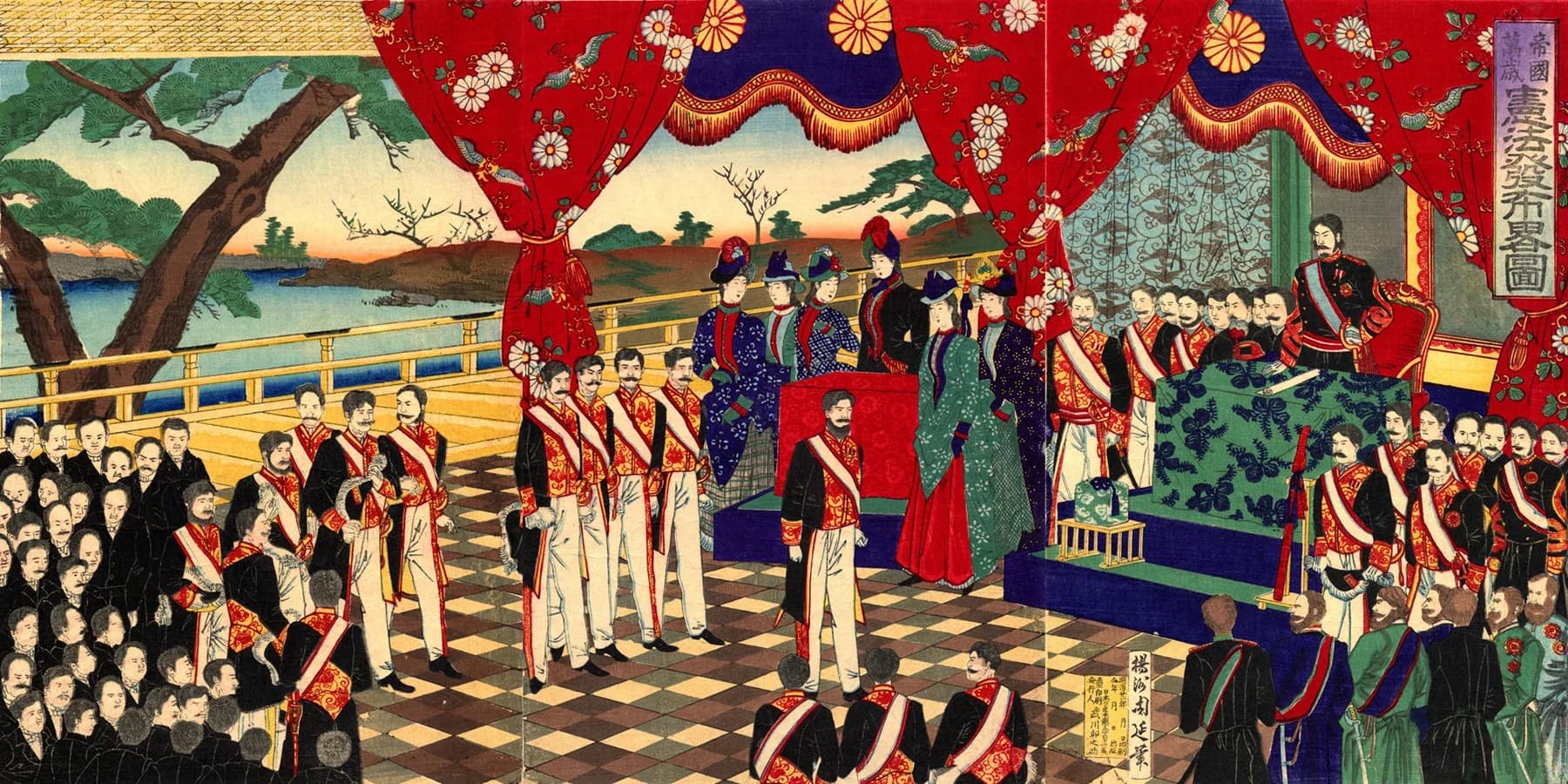
The Meiji Constitution was promulgated on 11 February 1889, the anniversary of the legendary founding of Japan, in a ceremony at the new imperial palace. It was presented as a gift from the emperor to his subjects, not an agreement between ruler and people. It came into force with the opening of the first Diet in November 1890.
Article 1. The Empire of Japan shall be reigned over and governed by a line of Emperors unbroken for ages eternal.
Article 3. The Emperor is sacred and inviolable.
Article 4. The Emperor is the head of the Empire, combining in Himself the rights of sovereignty, and exercises them, according to the provisions of the present Constitution.
Article 11. The Emperor has the supreme command of the Army and Navy.
Article 29. Japanese subjects shall, within the limits of law, enjoy the liberty of speech, writing, publication, public meetings and associations.
The Constitution of the Empire of Japan, promulgated 11 February 1889, in the official English translation by Itō Miyoji (National Diet Library). The articles show where sovereignty lay: with the emperor, not the people. Rights are granted "within the limits of law", so the government could restrict them by ordinary legislation. As an official text it states the formal rules, but not how they worked in practice, where the oligarchs, the bureaucracy and the army held most real power.
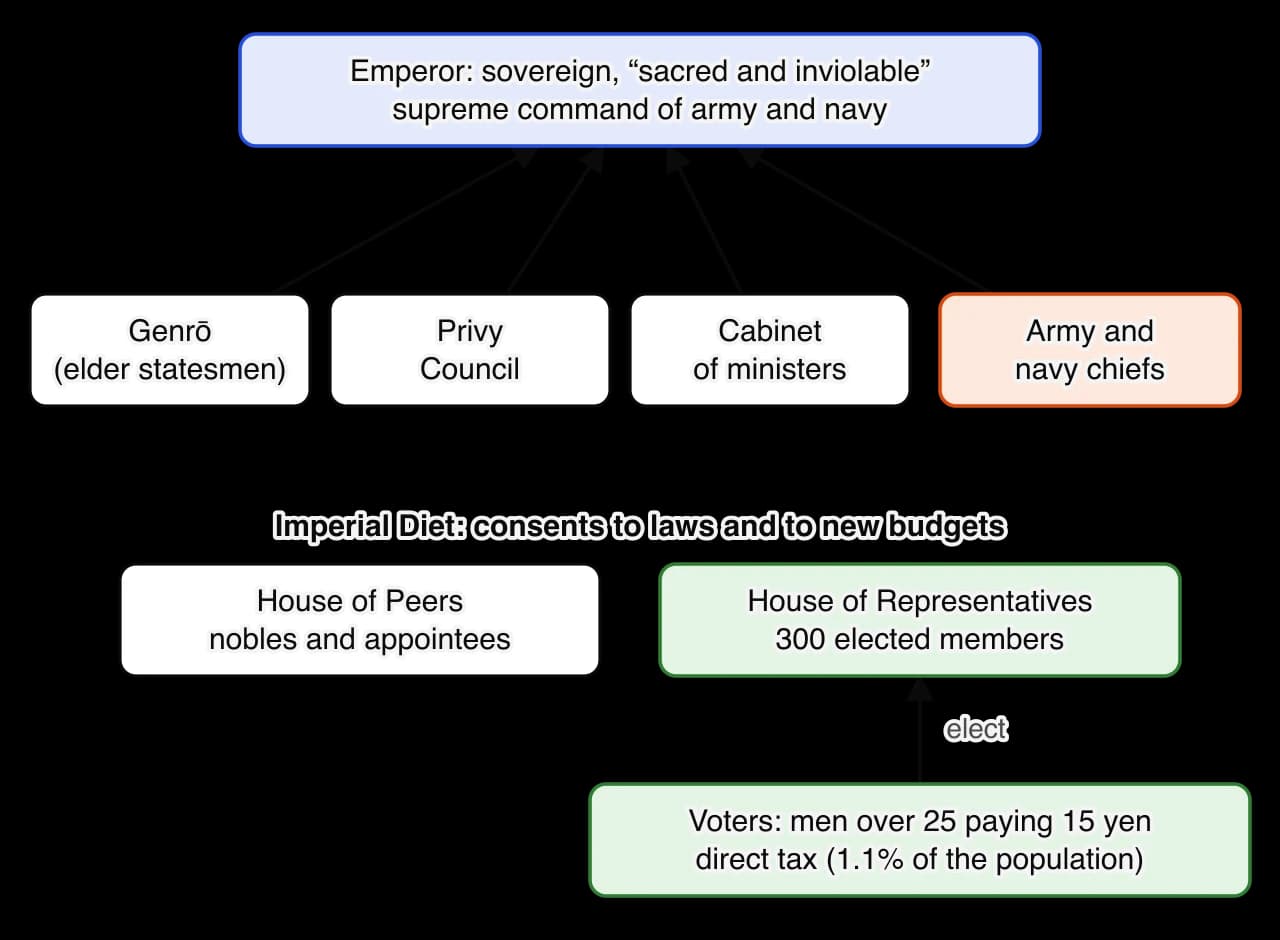
The diagram of the constitution shows that every branch of government answered to the emperor. The Imperial Diet had two chambers: a House of Peers of nobles and imperial appointees, and a House of Representatives of 300 members. The elected house had real powers: its consent was needed for new laws and for the budget. But ministers were responsible to the emperor, not to the Diet, so it could not choose or remove a government. Article 71 provided that if the Diet failed to pass a budget, the government could carry on with the previous year's budget. The army and navy chiefs had the right to approach the emperor directly, which later allowed the military to act outside civilian control.
The right to vote was narrow. Only men aged 25 or over who paid at least 15 yen a year in direct national taxes could vote, which in practice meant landowners. At the first general election, on 1 July 1890, there were 450,872 voters, about 1.1 per cent of the population.
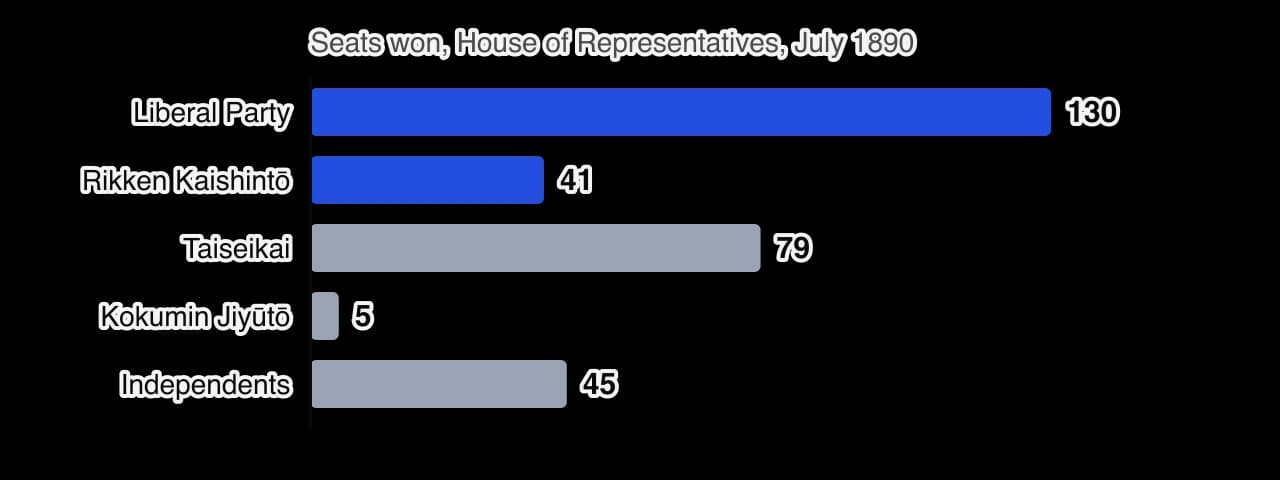
The first election shows the limits of the oligarchs' control. The parties descended from the people's rights movement won a majority of seats, and the first Diets fought the government over the budget, demanding tax cuts for landowners. Prime ministers dissolved the lower house, and in the election of 1892 the Home Ministry used police violence and bribery to try to defeat the parties, leaving about twenty-five people dead, but the parties still won. The constitution created a lasting arena in which the oligarchs had to bargain with elected politicians, which led to cooperation between government and parties by the late 1890s.
Charter Oath (1868) | Meiji Constitution (1889) | |
|---|---|---|
Who holds authority | The emperor, swearing before the gods | The emperor as sovereign, "sacred and inviolable" |
Representation | Vague promise that "deliberative assemblies" will decide by "public discussion" | An elected lower house, chosen by about 1 per cent of the population, with power over laws and budgets but not over ministers |
Rights of the people | Each may "pursue his own calling" | Freedom of speech, press, assembly and religion "within the limits of law" |
Relationship with the West | Knowledge to be "sought throughout the world" | Modelled largely on the Prussian–German constitution |
What it shows | A new regime seeking support during a civil war | An established oligarchy fixing its power in law before allowing elections |
The comparison of the Charter Oath and the constitution shows both continuity and change. The promise of 1868 was kept in form, since Japan gained an elected assembly, but the constitution limited that assembly carefully and fixed the emperor's sovereignty in law. For the oligarchs it completed the transition by giving their state a legal, internationally respected form, a precondition of treaty revision. For people's rights activists it was a partial victory at best.
Peasants made up about 80 per cent of the population, and the Meiji reforms changed their lives more than any earlier government had. Many welcomed the end of the domains' arbitrary dues, the freedom to choose crops and occupations, and the chance to buy land. But the new state also asked far more of them: cash taxes, conscripts, school fees, a new calendar and new rules on everyday life. In the first decade after 1868 there were hundreds of rural disturbances, more than in any comparable period under the Tokugawa.
The first wave of protest, in the years 1868–1873, was directed against the reforms themselves. Rumours spread quickly in villages where few people could read the new decrees. The "blood tax" in the conscription ordinance was taken by some to mean that the government would drain conscripts' blood to sell to foreigners. In 1873 blood tax riots broke out in western Japan, especially in the Okayama and Tottori regions, where crowds attacked government offices, schools, registry offices and the homes of village heads. In several places rioters also attacked communities of the former outcastes, whose legal emancipation in 1871 they resented; the violence there was a reminder that the end of legal discrimination did not end prejudice.
The second wave was directed at the land tax. In late 1876, as rice prices fell, tens of thousands of farmers in Ibaraki and in Mie, Aichi and Gifu rose against tax assessments they could not pay. The government suppressed the risings with troops and executions, but it also cut the tax rate from 3 to 2.5 per cent in January 1877. Ōkubo Toshimichi, then the most powerful oligarch, was facing samurai discontent at the same time and judged that the state could not afford a rural rebellion and a samurai one together.
Why should the "quiver" of poverty be so very full? one asks as one looks at the swarms of gentle, naked, old-fashioned children, born to a heritage of hard toil, to be, like their parents, devoured by vermin, and pressed hard for taxes.
Isabella Bird, Unbeaten Tracks in Japan (1880), describing a village in the mountains north of Nikkō in 1878. Bird, a British travel writer, was one of the first Western women to journey through the interior of northern Japan, and she wrote for a British audience that expected the exotic. Her account is valuable as an outsider's eyewitness evidence of rural poverty and the weight of taxation a decade after the Restoration, but it reflects her own assumptions about cleanliness and civilisation and records nothing of how the villagers themselves saw the new government.
The most serious rural rising came during the Matsukata deflation. In the silk-producing district of Chichibu, north-west of Tokyo, the collapse of silk prices left many farm families unable to repay loans. After moneylenders and officials refused their requests for debt relief, local farmers organised as the Konmintō ("Poor People's Party"), with links to the radical wing of the Jiyūtō. On 31 October 1884 several thousand of them, estimates range from about 5,000 to more than 10,000, rose in arms, destroyed debt records, attacked moneylenders and seized the district office, proclaiming a new rule of benevolence.
The Chichibu Incident was crushed within about ten days by police and army units. Nearly 3,000 people were punished, and seven leaders were sentenced to death. It was the largest of several "incidents of intensification" (gekka jiken) of 1882–1886, in which radicals of the people's rights movement and indebted farmers turned to violence, including the Fukushima Incident of 1882 and the Kabasan Incident of 1884. The Jiyūtō leadership, alarmed by the violence and by government repression, dissolved the party in October 1884.
Rising | Date | Main grievances | Outcome |
|---|---|---|---|
Blood tax riots, western Japan | 1873 | Conscription, schools, registration, the new calendar; resentment of outcaste emancipation | Suppressed by troops; thousands punished; reforms continued |
Land tax risings, Ibaraki and Mie | Nov–Dec 1876 | Cash land tax assessments at a time of falling rice prices | Suppressed, but the tax rate cut to 2.5 per cent in January 1877 |
Fukushima Incident | 1882 | Forced labour for road building; repression of Jiyūtō members by the governor | Jiyūtō leaders arrested and tried |
Chichibu Incident | Oct–Nov 1884 | Debts and collapse of silk prices under the Matsukata deflation | Crushed by the army; nearly 3,000 punished, seven sentenced to death |
The table of rural risings shows how the grievances changed. Early protests rejected the new state and its demands; later ones were about the price of the new economy, especially taxes and debt, and some were linked to a political movement. Historians such as Irokawa Daikichi and Roger Bowen see the Chichibu rebels as part of a popular democratic tradition, whereas others stress their local and economic aims. None of the risings threatened the government's survival: they were local, poorly armed and easily crushed by the conscript army, which had been created partly for this purpose.
The reforms of 1871–1876 took away almost everything that had defined samurai status: domains, stipends, the monopoly of arms, and finally the right to wear swords. Many former samurai turned to Saigō Takamori, the hero of the Boshin War, who had remained in charge of the government while the Iwakura Mission was abroad.
In 1873 the Korean government, which regarded the new Japanese regime with suspicion, refused to accept Japanese diplomatic letters written in the new imperial style. Saigō proposed that he go to Korea as an envoy; if he was killed or insulted, Japan would have a reason for war. In this seikanron ("debate on conquering Korea") Saigō, Itagaki, Etō and others saw a foreign war as a way to give the former samurai a role and to raise Japan's standing. When Iwakura and Ōkubo returned from the West in September 1873, they blocked the plan, arguing that Japan was too weak and that domestic reform must come first. In October 1873 Saigō, Itagaki, Etō, Gotō and Soejima resigned.
The split produced both peaceful and armed opposition. Itagaki turned to the campaign for an elected assembly. Etō Shinpei returned to his home domain of Saga and in February 1874 led a rising of several thousand former samurai; it was crushed within weeks and Etō was executed. In October 1876, after the ban on swords and the conversion of stipends, three more risings broke out in western Japan: the Shinpūren (League of the Divine Wind) in Kumamoto, which attacked the garrison with swords and spears, and risings at Akizuki and at Hagi in Chōshū. All were quickly suppressed.
The largest and last was the Satsuma Rebellion of 1877. In Kagoshima, Saigō's private military schools had trained thousands of former samurai, and the prefecture largely ignored orders from Tokyo. In January 1877 the government tried to remove weapons from the Kagoshima arsenal, and Satsuma men believed that it had sent agents to assassinate Saigō. Saigō led his army north in February, at first about 13,000 men, joined by allies until the rebel forces may have reached about 30,000.
The rebels besieged Kumamoto Castle, whose garrison of conscripts held out for almost two months until a relief force arrived in April. The government mobilised the conscript army, the navy and police units, eventually more than 60,000 men, and used the telegraph and steamships to move troops and supplies. The rebels were driven back into Kagoshima, and on 24 September 1877 the last few hundred were overwhelmed at Shiroyama, where Saigō died. Each side lost thousands killed and wounded; the war cost so much that it caused the inflation of 1877–1881.
The rebellion had important consequences. It proved that an army of commoner conscripts, trained and equipped in the Western way, could defeat the samurai, which confirmed both the conscription policy and the end of samurai privilege. It ended armed opposition by former samurai; from then on, opposition moved into the people's rights movement, the press and later the Diet. It also left a legacy of violence: in May 1878 Ōkubo Toshimichi was assassinated in Tokyo by former samurai who blamed him for Saigō's death.
Saigō himself became a national legend. Within months of his death prints and stories presented him as a loyal hero misled by bad advisers or betrayed by corrupt officials. In 1889, as part of the celebrations of the constitution, the emperor posthumously pardoned him and restored his court rank, and a bronze statue was unveiled in Ueno Park in Tokyo in 1898.
For every Meiji government the first aim of foreign policy was to revise the unequal treaties. Extraterritoriality was a daily humiliation, since foreigners who committed crimes in Japan were tried by their own consuls, and the fixed tariffs denied the state revenue and the power to protect its industries. The Western powers made clear that they would not give up these privileges until Japan had a legal system they trusted: codified laws, independent courts and a constitution.
Much of the domestic reform programme was shaped by this demand. Legal codes on Western models were drafted from the 1870s (a criminal code based on French law came into force in 1882), and the constitution of 1889 was in part a demonstration of "civilisation" to foreign governments. Foreign Minister Inoue Kaoru tried to show that Japan's elite had adopted Western ways: the Rokumeikan, a reception hall designed by the British architect Josiah Conder and opened in Tokyo in 1883, hosted balls at which officials and their wives danced in Western dress. Critics mocked these displays as imitation.
Revision proved politically dangerous. Inoue's draft of 1887, which would have allowed foreign judges in Japanese courts for a transitional period, caused such public anger that he resigned. In 1889 Ōkuma Shigenobu, as foreign minister, negotiated a similar compromise and lost a leg when a member of a nationalist society threw a bomb at his carriage. Treaty revision became a test of whether a government could defend national honour, a pressure that pushed later governments towards a firmer foreign policy.
Success came in 1894. The Anglo-Japanese Treaty of Commerce and Navigation, signed in London on 16 July 1894, provided that British extraterritoriality would end in 1899; the other powers signed similar treaties soon after. Britain agreed because Japan now had modern law codes and a constitution, and because it saw Japan as a useful counterweight to Russia in East Asia. Full tariff autonomy followed only in 1911.
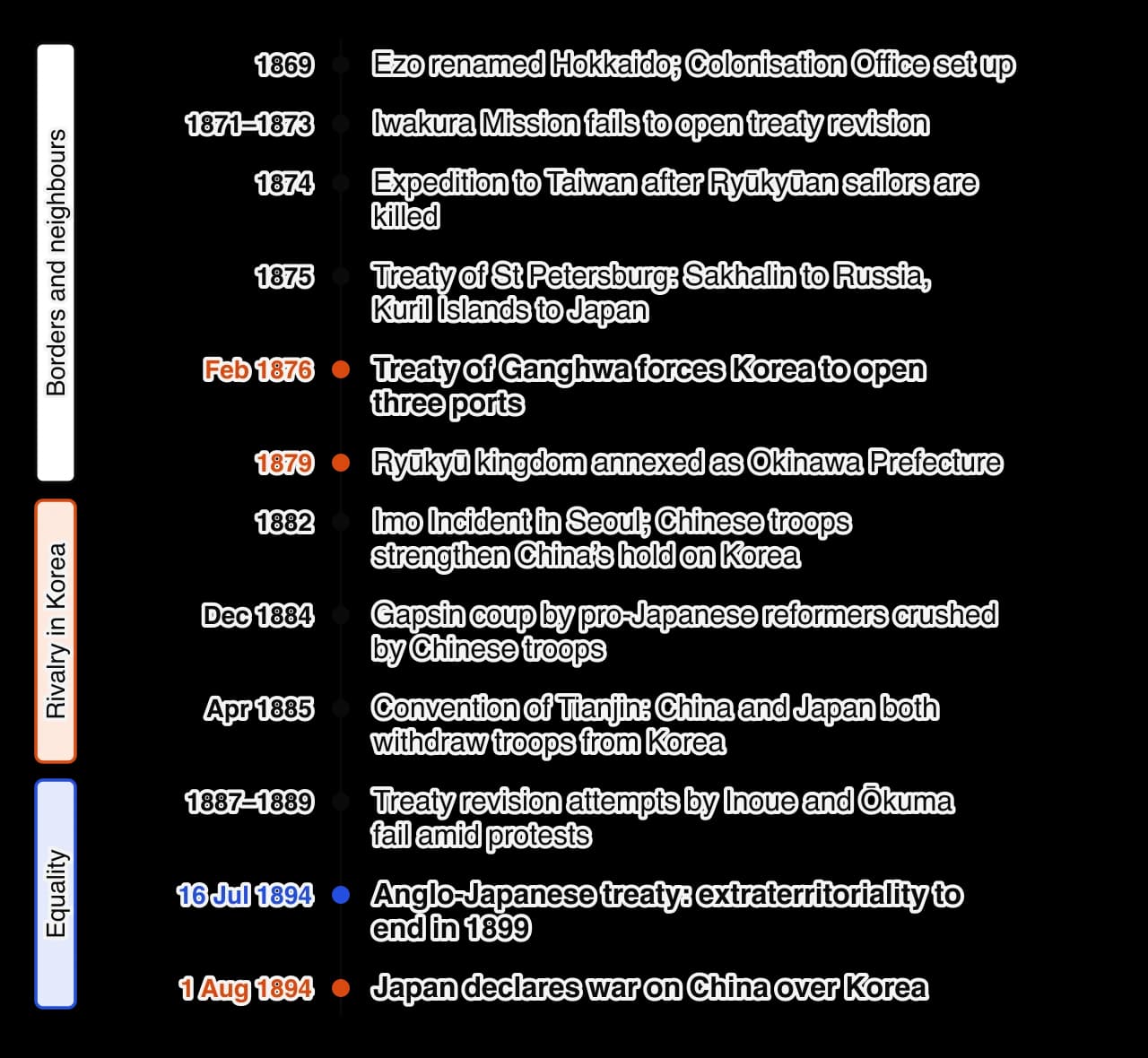
The vertical timeline of foreign relations shows that while Japan sought equality with the West, it also expanded its own borders. In the north, Ezo was renamed Hokkaido in 1869 and placed under a Colonisation Office (Kaitakushi), which hired American advisers, encouraged settlement by former samurai and farmer-soldiers (tondenhei) and opened mines and farms. The Indigenous Ainu people lost their land and fishing and hunting rights, were pressed to adopt Japanese names and customs, and were registered as commoners; the Hokkaido Former Aborigines Protection Act of 1899 later made their status as a dependent minority law. The Treaty of St Petersburg (1875) gave Sakhalin to Russia and all the Kuril Islands to Japan.
In the south, the Ryūkyū kingdom had sent tribute both to China and, through Satsuma, to Japan. In 1871 shipwrecked Ryūkyūan sailors were killed by Indigenous people in Taiwan. Japan claimed the Ryūkyūans as its subjects and in 1874 sent a military expedition to Taiwan; China paid an indemnity, which Japan treated as recognition of its claim. In 1879 Japan deposed the Ryūkyūan king, Shō Tai, and annexed the islands as Okinawa Prefecture. Like the Ainu, the Okinawans were incorporated as subjects but treated as culturally inferior and subjected to policies of assimilation.
Korea, ruled by the Joseon dynasty, was a tributary state of China and, like Japan before 1853, restricted foreign contact. After the seikanron crisis of 1873, Japan used gunboat diplomacy of the kind Perry had used against it. In 1875 a Japanese warship, the Unyō, provoked an exchange of fire with Korean forts on Ganghwa Island. The Treaty of Ganghwa of February 1876 declared Korea an independent state, which denied China's claim to authority over it, opened three ports to Japanese trade and gave Japanese subjects extraterritoriality in Korea.
Japan and China then competed for influence in Seoul. In the Imo Incident of 1882, Korean soldiers rioted and attacked the Japanese legation; China sent troops and strengthened its hold. In December 1884 pro-Japanese Korean reformers led by Kim Ok-gyun staged the Gapsin coup, which Chinese troops crushed within days. To avoid war, Itō Hirobumi and the Chinese statesman Li Hongzhang signed the Convention of Tianjin in April 1885: both countries withdrew their troops and agreed to notify each other before sending troops again.
The editorial Datsu-A Ron ("On Leaving Asia"), published unsigned in Fukuzawa Yukichi's newspaper Jiji Shinpō in March 1885 and usually attributed to him, expressed a new mood. Written after the failure of the Gapsin coup, which Fukuzawa's circle had supported, it argued that Japan could not wait for China and Korea to reform and should leave the company of its Asian neighbours to join the civilised nations of the West, treating its neighbours as the Westerners did. It attracted little attention at the time, but historians have since read it as an early statement of the outlook behind Japanese imperialism.
In 1890 Prime Minister Yamagata Aritomo told the first Diet that Japan must defend both its "line of sovereignty", its own territory, and a "line of advantage" beyond it, in which Korea lay. In 1894 a peasant rebellion in Korea, led by the Donghak religious movement, gave both powers a reason to send troops. Japan seized the royal palace in Seoul in July, sank a Chinese troop transport on 25 July, and declared war on 1 August 1894. Victory over China in 1895 brought Japan Taiwan and an indemnity, and marked its arrival as an imperial power; the war and its results lie beyond 1894 and belong to the history of Korea and of Japanese expansion.
The name "Restoration" (ishin, more exactly "renewal") was chosen by the new leaders themselves. It presented the events of 1868 as a return to direct rule by the emperor, as in ancient times, and so gave a radical change the authority of tradition. Yet the changes of the next twenty years, the end of the domains, of the samurai class and of the status order, a new tax system, conscription, industry and a constitution, were as sweeping as those of many revolutions. The contemporary British diplomat Ernest Satow already called the events "the Revolution of 1868".
Historians who stress revolution point to the scale of change and to the fact that the old ruling class lost its privileges. Those who stress restoration, such as Albert Craig in Chōshū in the Meiji Restoration (1961), argue that the men who made it were driven by traditional values, loyalty to their domain and to the emperor, more than by any new ideology, and that they did not set out to transform society. Thomas C. Smith offered a third view: the Restoration was an "aristocratic revolution", in which members of the samurai class abolished their own privileges, because their ideal of service and their frustration with hereditary rank mattered more to them than status.
In the 1920s and 1930s Japanese Marxist historians fought a long debate over the character of the Restoration, because it decided what kind of revolution Japan needed next. The Kōza-ha (Lectures faction), named after a multi-volume series on the development of Japanese capitalism published in 1932–1933, argued that the Restoration had created an absolutist state resting on semi-feudal landlordism; Japan therefore still needed a bourgeois-democratic revolution. The Rōnō-ha (Worker–Farmer faction) argued that the Restoration had been an incomplete bourgeois revolution that made Japan a capitalist country, so the next step was socialism.
The Canadian historian E. H. Norman, in Japan's Emergence as a Modern State (1940), drew on the Kōza-ha view. He presented the Restoration as what later writers called a revolution from above, carried out by an alliance of lower samurai and wealthy merchants, which modernised the state and economy quickly but left landlord power, the authority of the emperor and the army untouched. In his account this incomplete revolution explained the weakness of democracy and the rise of militarism in the 1930s. Later writers, such as Ellen Kay Trimberger in Revolution from Above (1978), used the term to compare Meiji Japan with Atatürk's Türkiye and other cases of bureaucrats transforming their own states.
After 1945, many American historians, in what is often called the modernisation school, asked why Japan had industrialised so quickly when other non-Western states had not. W. G. Beasley, in The Meiji Restoration (1972), stressed nationalism provoked by the foreign threat: men of middle rank whose aim was national strength reshaped every institution towards that end. Marius Jansen, in Sakamoto Ryōma and the Meiji Restoration (1961) and The Making of Modern Japan (2000), combined foreign pressure with the ambitions of the shishi and the political skill of the oligarchs.
Social and economic historians shifted attention back to the Tokugawa period. Thomas C. Smith and Susan Hanley argued that Tokugawa commercial growth, rural industry, literacy and administrative experience explain why Meiji reforms worked, so the success of the transition was not only the achievement of a few leaders. Other historians have stressed the costs and the people who paid them: Irokawa Daikichi and Roger Bowen recovered the voices of the people's rights movement and the Chichibu rebels, and historians of the Ainu and Okinawa have shown how the new nation-state was built partly through the colonisation of its edges. Mark Ravina, in To Stand with the Nations of the World (2017), places the Restoration within a global process in which states had to prove themselves sovereign to the Western powers, combining borrowed institutions with invented national traditions.
Historian or school | Main argument | Evidence stressed |
|---|---|---|
Kōza-ha Marxists (1930s); E. H. Norman (1940) | An absolutist "revolution from above" that left feudal survivals and led to militarism | Landlord power after the land tax; the emperor's sovereignty; the army's independence |
Albert Craig (1961) | A restoration driven by traditional loyalties, not a planned revolution | The motives of Chōshū leaders; loyalty to domain and emperor |
Thomas C. Smith (1961, 1988) | An "aristocratic revolution"; success built on Tokugawa economic foundations | Samurai abolishing their own privileges; rural industry and commerce before 1868 |
W. G. Beasley (1972) | Nationalism stirred by the foreign threat drove the transition | The impact of the treaties; the slogan fukoku kyōhei; reforms aimed at national strength |
Carol Gluck (1985); Takashi Fujitani (1996) | Emperor-centred ideology and ritual were constructed by the Meiji state | Imperial tours and portraits; the Rescript on Education |
Irokawa Daikichi; Roger Bowen (1980) | A popular democratic movement from below shaped and challenged the transition | Local draft constitutions; the Chichibu Incident |
Mark Ravina (2017) | The Restoration as part of a global contest for recognised sovereignty | Treaty revision; selective borrowing; invented traditions |
These views can be weighed against each other rather than chosen between. The Marxist and Norman view explains the authoritarian features of the 1889 constitution and the burdens on the countryside, but it understates how much changed after 1868. The modernisation view explains the speed and direction of reform, but it tends to tell the story from the point of view of the oligarchs. Views "from below" and from the edges restore the experiences of peasants, activists, the Ainu and the Okinawans, but they explain less about why the state succeeded. A strong judgement uses each for what it explains best.
This set is written in the style of the IB Paper 1 for Focused study 3: Political and economic transitions. The Meiji Restoration (1853–1894). Using the three sources on the collapse of the shogunate and considering the overarching inquiry question of "To what extent was foreign pressure the main reason for the collapse of the Tokugawa shogunate?", respond to the three questions that follow.
Source A: Matthew C. Perry, commander of the United States naval squadron in Japanese waters, in a letter to Hayashi Daigaku-no-kami, the senior Japanese negotiator, written aboard the flagship Powhatan off Yokohama in reply to the Japanese answer of 8 March (10 March 1854).
Though the propositions set forth in the communication of your highness furnish strong evidence of the enlightened spirit with which the imperial commissioners are disposed to meet the suggestions which I have had the honor to submit, they fall far short of my anticipations, and I do not hesitate to say that they would not satisfy the views of the President. […] These are all very well so far as they go, and can be incorporated in the treaty which I shall expect to make; but my instructions require me to look for an intercourse of a more enlarged and liberal character, and I feel assured that the Imperial government, in consideration of the spirit of the age, and with the full knowledge of my strong desire to conduct my mission in peace and friendship, will no longer hesitate to enter with cordiality into a treaty that will be mutually honorable and advantageous to both nations. […] It would be needless in me again to express the sincerest desire of my heart to bring these negotiations to an amicable and satisfactory termination; nor will I again allude to the importance of such an issue, important as well to save time as to prevent the necessity of sending from America more ships and men, and possibly with instructions of more stringent import.
Source B: the shogunate's commissioners, in their written answer to President Fillmore's letter, handed to Perry at their first meeting at Yokohama and signed by the interpreter Moriyama Einosuke, in the American translation printed in Francis L. Hawks (compiler), Narrative of the Expedition of an American Squadron to the China Seas and Japan (1856) (8 March 1854). [The "former Emperor" and "present Emperor" are the shoguns Tokugawa Ieyoshi, who died in 1853, and Tokugawa Iesada.]
It is quite impossible to give satisfactory answers at once to all the proposals of your government, as it is most positively forbidden by the laws of our Imperial ancestors; but for us to continue attached to the ancient laws, seems to misunderstand the spirit of the age; however, we are governed now by imperative necessity. At the visit of your excellency last year to this Empire, his Majesty the former Emperor was sick, and is now dead. Subsequently, his Majesty the present Emperor ascended the throne; the many occupations in consequence thereof are not yet finished, and there is no time to settle other business thoroughly. Moreover, his Majesty the new Emperor, at the succession to the throne, promised to the princes and high officers of the Empire to observe the laws. It is therefore evident that he cannot now bring about any alteration in the ancient laws. […] However, we admit the urgency of, and shall entirely comply with, the proposals of your government concerning coal, wood, water, provisions, and the saving of ships and their crews in distress.
Source C: Ernest Satow, an interpreter and later a senior diplomat at the British legation in Japan from 1862, in his memoir A Diplomat in Japan (1921), describing the domains of the 1860s.
This led to the surprising results of the revolution of 1868, when the power nominally exercised by the chief daimiôs came to be wielded by the more energetic and intelligent of their retainers, most of whom were samurai of no rank or position. These men it was who really ruled the clan, determined the policy of its head and dictated to him the language he should use on public occasions. […] This strange political system was enabled to hold together solely by the isolation of the country from the outer world. As soon as the fresh air of European thought impinged upon this framework it crumbled to ashes like an Egyptian mummy brought out of its sarcophagus.
[daimiôs: daimyō, the domain lords; clan: Satow's word for a domain]
Inquiry question: "To what extent did the constitution of 1889 complete the Meiji transition?" Use the extract from the Meiji Constitution (Articles 1, 3, 4, 11 and 29) and the 1874 memorial of Itagaki and his colleagues.
I can describe the bakuhan system, alternate attendance, the status order and the limits on foreign contact under the Tokugawa.
I can explain the fiscal and social problems of the shogunate before 1853, including the Tenpō famine and reforms and the strength of the outer domains.
I can explain how national learning, the Mito school and Dutch learning weakened the ideological basis of shogunal rule.
I can describe Perry's mission and the unequal treaties, and explain how they caused a political crisis from the Ansei Purge to the bombardments of 1863–1864.
I can explain the economic effects of opening trade, weigh the claim that Tokugawa Japan was "stagnant", and explain fukoku kyōhei and bunmei kaika.
I can narrate the collapse of the shogunate from the Satsuma–Chōshū alliance to the end of the Boshin War.
I can reach a supported judgement on the relative importance of foreign pressure and internal weakness in the fall of the shogunate.
I can name the main Meiji oligarchs and explain how they used the emperor's authority.
I can analyse the Charter Oath as a source and explain the steps of centralisation, including the abolition of the domains and of samurai privileges.
I can explain the aims and results of the Iwakura Mission and of the government's efforts to build loyalty to the emperor.
I can explain the land tax reform of 1873, state-led industrialisation, the Matsukata deflation and the rise of the zaibatsu.
I can explain how the Freedom and People's Rights Movement and the crisis of 1881 led to the constitution, analyse its main features and compare it with the Charter Oath.
I can explain the causes of the blood tax riots, the land tax risings and the Chichibu Incident.
I can explain the causes, course and significance of the samurai risings, above all the Satsuma Rebellion.
I can explain how Japan pursued treaty revision and expanded into Hokkaido, Okinawa and Korea before the war with China in 1894.
I can outline the main historians' interpretations of the Restoration and weigh them against each other.
I can use a set of sources on the Meiji Restoration to answer questions on their content, context and perspectives.