
Explain why a mass independence movement emerged in Kenya after 1945, how independence was won in 1963, and how Kenyatta’s state shaped a new national identity to 1978.
Each is in the History glossary, with every other term in the subject.
The claim of African leaders such as Nyerere, Senghor and Kenyatta that socialism grew from the communal values of African societies; in practice it ranged from Tanzania's ujamaa to Kenya's mixed, largely capitalist economy.
The policy of transferring jobs, businesses and property from Europeans and Asians to African citizens after independence.
A joint declaration of war aims by Churchill and Roosevelt in August 1941, promising the right of all peoples to choose their own form of government.
British laws of 1940 and 1945 that provided money for economic development, education and health in the colonies.
Informal and legal racial segregation that excluded Africans from European hotels, clubs, schools, residential areas and better-paid jobs.
The pursuit of self-government through legal political methods such as petitions, delegations, elections and negotiation, rather than violence.
The military, political and social methods a government uses to defeat a guerrilla or insurgent movement, above all by separating it from the population.
Colonial laws of 1902 and 1915 that let the Kenyan government grant land to European settlers and declared all land in the colony, including African-occupied land, to be Crown land.
Kenya became independent from Britain on 12 December 1963 after one of the most violent end-of-empire conflicts in Africa. Its path to independence combined armed revolt, mass detention, constitutional bargaining and the release of a detained leader who became the first head of the new state, and the way Kenyans have remembered that path has shaped their national identity ever since.
With a free account, Augment remembers where you stopped and what you have practiced.
The process by which colonies gained independence from imperial powers, in Africa mainly between the late 1950s and the 1970s.
A British government statement of 1923 that African interests in Kenya must be paramount where they conflicted with those of immigrant races; it blocked Indian demands but changed little for Africans.
Swahili for “let us all pull together”: Kenyatta's national motto and a movement of community self-help projects.
A secondary school in Kenya built and run with money raised by the local community through fund-raising meetings.
The killing of 11 detainees by guards at Hola detention camp on 3 March 1959, which became a political scandal in Britain.
A force of loyalist Kikuyu, Embu and Meru raised by the colonial government from 1952 to fight Mau Mau and guard villages.
The Kenya African Democratic Union, founded in 1960 by leaders of smaller ethnic groups; it favoured regional government and merged into KANU in 1964.
The Kenya African National Union, founded in 1960 and led by Jomo Kenyatta, which won the 1963 election and ruled Kenya, from 1969 as the only party in practice.
Jomo Kenyatta, Bildad Kaggia, Kung'u Karumba, Fred Kubai, Paul Ngei and Achieng' Oneko, convicted in 1953 of managing Mau Mau after a trial at Kapenguria later shown to rest on false evidence.
Kenya's first colony-wide African political organisation, founded in 1944 and led by Jomo Kenyatta from 1947; it used constitutional methods and was banned in 1953.
The name Mau Mau fighters used for their own forces, reflecting their demands for land and freedom.
The opposition party founded by Oginga Odinga in 1966 on a more radical land and economic programme; it was banned in 1969.
A Kikuyu political organisation founded in 1924 that campaigned over land and colonial controls; Jomo Kenyatta was its general secretary from 1928, and it was banned in 1940.
An organisation of African-run schools founded after the female circumcision controversy of 1929–1931, combining Western education with Kikuyu cultural values.
The British colonial army regiment recruited from East and Central Africa, in which tens of thousands of Kenyans served in the Second World War.
A registration certificate with fingerprints and employment record that every African man over 15 in colonial Kenya had to carry from 1920, used to control movement and labour.
The three conferences in London (1960, 1962 and 1963) at which the British government, settlers and African parties negotiated Kenya's constitutions and independence.
The law-making body of a British colony, made up of officials and nominated and elected members; in Kenya Africans had no elected members until 1957.
In the Kenya Emergency, an African who sided with the colonial government against Mau Mau, such as chiefs, Home Guards and many Christians.
Kenya's constitution of 1954, which created a Council of Ministers with three European, two Asian and one African unofficial minister.
1 June, the anniversary of Kenya's internal self-government in 1963, a national holiday.
Swahili for “regions”: KADU's plan for a federal Kenya with regional assemblies, partly adopted in the 1963 constitution and abolished soon after.
The settlement programme of 1962 to about 1970 that bought over a million acres of European farms and divided them into smallholdings for about 35,000 African families.
The colonial policy of the 1950s of sharing power among Europeans, Asians and Africans in separate, unequal blocs rather than by majority rule.
An area of colonial Kenya set aside for a particular African ethnic group, outside which Africans could not own land.
The swearing of solemn oaths, based on Kikuyu ritual, that bound people to secrecy and loyalty to the Mau Mau movement and, in later oaths, to fight.
The Kenya Education Commission of 1964–1965, chaired by Simeon Ominde, which planned a national, non-racial school system to build unity and train Kenyans.
A state in which only one political party holds power, either by law (de jure) or in practice (de facto).
The British military operation of April 1954 that sealed off Nairobi and screened its African population, detaining tens of thousands of suspected Mau Mau supporters.
The mass arrest of Jomo Kenyatta and about 180 other African leaders on the night the State of Emergency was declared, 20–21 October 1952.
The movement for the unity, dignity and liberation of all people of African descent, which by 1945 demanded independence for African colonies.
The system of detention camps in the Kenya Emergency through which detainees were classified and moved towards release as they confessed oaths and accepted rehabilitation.
The interrogation of suspects in the Kenya Emergency to decide whether they had taken Mau Mau oaths and where they should be detained.
The right of a people to decide its own political future, including whether to form an independent state.
The Kenyan government's policy paper African Socialism and its Application to Planning in Kenya (1965), which committed the state to a mixed economy and Africanisation.
The guerrilla war of 1963–1967 in which Somalis of north-eastern Kenya sought to join Somalia; the government called the fighters shifta, “bandits”.
An African family living and working on a European-owned farm in colonial Kenya, allowed to cultivate a plot and graze livestock in return for labour, but with no legal right to the land.
A legal declaration giving a government special powers, such as detention without trial and bans on organisations; Kenya's lasted from October 1952 to January 1960.
A colonial programme of 1954 to consolidate African landholdings, register them with individual title deeds and allow Africans to grow cash crops such as coffee and tea.
The forced resettlement of more than a million Kikuyu, Embu and Meru into guarded fortified villages in 1954–1955 to cut Mau Mau off from civilian support.
The fertile central uplands of Kenya reserved for European ownership between 1902 and 1961, covering about 31,000 square kilometres.
The principle that land would be transferred only by voluntary sale at market prices, without confiscation.
The timeline of Kenya from 1945 to 1978 divides the period into four phases. Each phase was shaped by the one before it: the failure of peaceful pressure fed the revolt, the Emergency changed British policy, and the way independence was negotiated shaped the state Kenyatta built.
British rule in what became Kenya began with a trading company. The Imperial British East Africa Company received a royal charter in 1888, but it ran out of money, and in 1895 the British government took over the territory as the East Africa Protectorate. Its main purpose at first was to protect the route to Uganda and the headwaters of the Nile.
Between 1896 and 1901 the British built the Uganda Railway from the port of Mombasa to Kisumu on Lake Victoria. About 32,000 indentured labourers were recruited from British India to build it, and many of those who stayed formed the basis of Kenya’s South Asian community of traders, clerks and artisans. The railway was expensive, and officials argued that European farmers producing crops for export would make it pay.
Settlement therefore became official policy. The commissioner, Sir Charles Eliot, encouraged white farmers from Britain and South Africa to take up land in the cool central highlands from 1902. In 1920 the territory became the Kenya Colony and Protectorate: the interior was a Crown colony, while a ten-mile coastal strip remained, in law, a protectorate leased from the Sultan of Zanzibar.
Land was at the centre of colonial rule in Kenya. The Crown Lands Ordinance of 1902 allowed the government to grant land to settlers, and the ordinance of 1915 made all land in the colony, including land occupied by Africans, Crown land. Africans became, in law, tenants of the Crown on land they had farmed or grazed for generations.
Africans were confined to native reserves, areas set aside for each ethnic group. The Maasai were moved twice, in 1904 and 1911, losing most of their best grazing land in the Rift Valley. The Kikuyu lost less land in total, but the land they lost, around Kiambu near Nairobi, was close to their densely farmed home districts, and their population was growing fast. By the 1940s parts of the Kikuyu reserves were badly overcrowded.
Many Kikuyu moved to settler farms in the Rift Valley as squatters, or resident labourers. In Kikuyu such people were sometimes compared to ahoi, tenants who farmed another family’s land with its permission. In return for working for the settler, a squatter family could farm a plot and graze livestock. The arrangement suited both sides while land was plentiful, but it gave squatters no legal right to the land they lived on.
Settler farms needed African labour, and the colonial state helped to supply it. A hut tax (from 1901) and a poll tax (from 1910) had to be paid in cash, which pushed men into paid work. From 1920 every African man over the age of 15 had to carry a kipande, a registration certificate with fingerprints and employment record, usually worn in a metal container round the neck. It let employers and police track workers and punish those who left a job.
Africans were also kept out of the most profitable farming. Until the 1950s they were in practice not allowed to grow arabica coffee, the colony’s most valuable export crop, on the grounds that it would spread disease and lower quality. In towns a colour bar kept Africans out of European hotels, clubs, schools and residential areas, and Africans were paid much less than Europeans for the same work.
Measure | Date | What it did | Effect on Africans |
|---|---|---|---|
Crown Lands Ordinances | 1902, 1915 | Let the state grant land to settlers; made all land Crown land | Loss of land; Africans became tenants of the Crown |
Maasai Agreements | 1904, 1911 | Moved the Maasai out of the central Rift Valley | Loss of the best grazing land |
Hut and poll taxes | 1901, 1910 | Made every household and adult man pay a tax in cash | Forced men into wage labour on settler farms |
Kipande (registration) | 1920 | Made every man over 15 carry a registration certificate | Controlled movement; deeply resented |
Ban on African coffee growing | To the 1950s | Kept the most valuable cash crop for settlers | Limited African incomes from farming |
Organised African protest began soon after the First World War. In 1921 Harry Thuku, a Kikuyu clerk and telephone operator in Nairobi, founded the East African Association, which campaigned against the kipande, higher taxes and wage cuts and tried to unite Africans across ethnic lines. His arrest in March 1922 brought a large crowd to the police station in Nairobi. The police opened fire on the crowd, and some European onlookers also fired. At least 20 people were killed, and some accounts give considerably higher figures. Thuku was exiled without trial to Kismayu, in the far north-east of the colony, and was not allowed to return until 1930–1931.
The Kikuyu Central Association (KCA), founded in 1924, took up the same grievances with a focus on land. Its general secretary from 1928 was Johnstone Kamau, who later took the name Jomo Kenyatta. He edited the KCA’s Kikuyu-language newspaper Muigwithania (“the reconciler”) and travelled to London in 1929 to present its case.
British policy in theory protected Africans. In the Devonshire Declaration of 1923, a government statement on Kenya, the Colonial Secretary declared that the interests of the African population must be "paramount" where they conflicted with those of the immigrant races. The declaration was written mainly to block the demands of Indian settlers for equal rights with Europeans, and it did not lead to the return of any land or end European political dominance.
A cultural conflict deepened Kikuyu distrust of the missions. In 1929 the Church of Scotland Mission and other Protestant missions demanded that their African members give up female circumcision, an initiation rite central to Kikuyu ideas of adulthood. Thousands left the mission churches and schools. They founded independent churches and schools, organised by the Kikuyu Independent Schools Association and the Kikuyu Karing’a Education Association, which combined Western education with pride in Kikuyu culture.
Kenyatta spent most of the years 1931–1946 in Europe. He studied anthropology at the London School of Economics under Bronisław Malinowski and published Facing Mount Kenya (1938), a study of Kikuyu society that defended its customs and argued that land was the foundation of Kikuyu social and religious life. He also worked with Pan-African activists in London, which gave him contacts across Africa and the Caribbean.
Kenya was governed by a governor appointed in London and responsible to the Colonial Office. The Legislative Council (LegCo), which passed the colony’s laws, included government officials, nominated members and members elected by the European and Asian communities. Africans, about 97 per cent of the population, had no elected members at all.
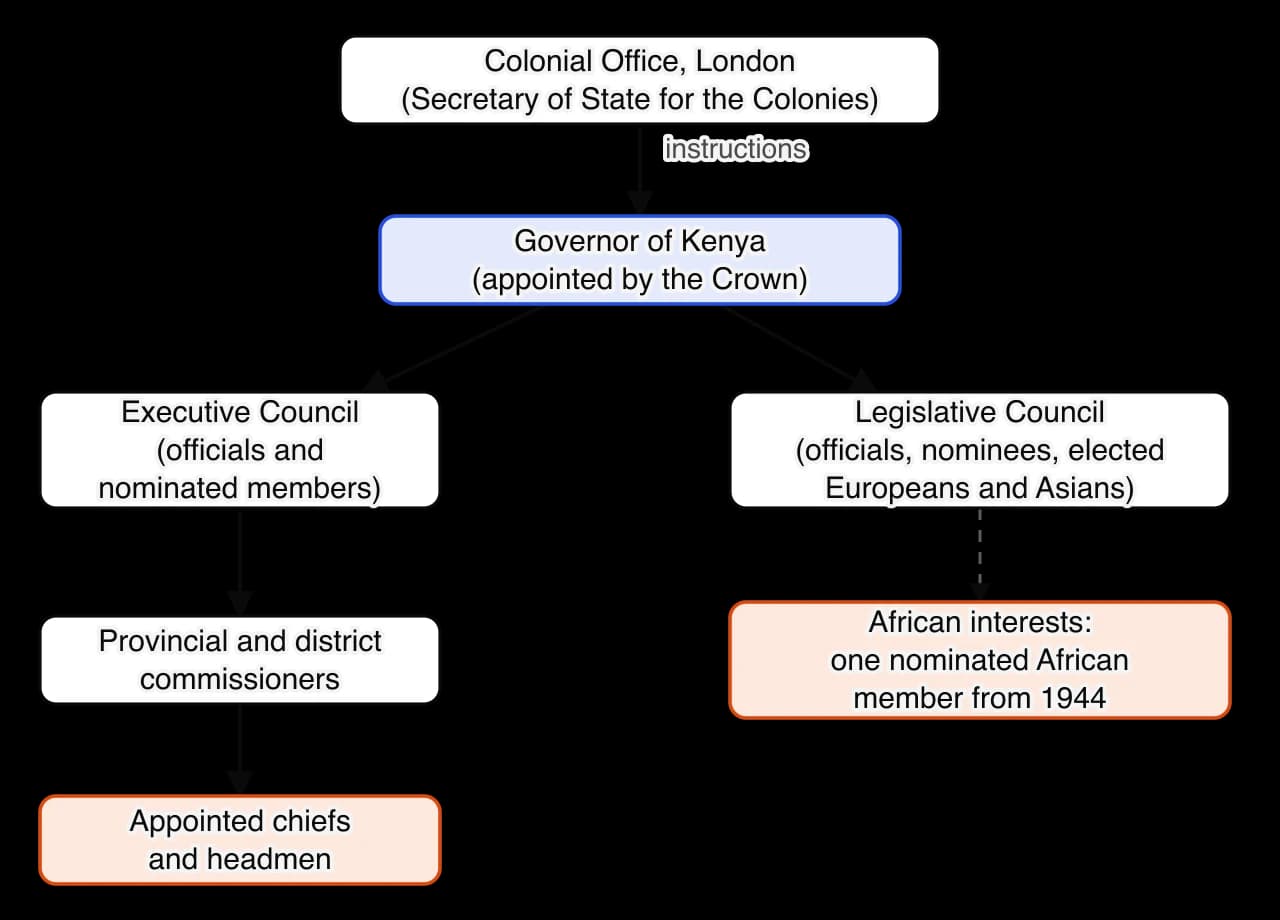
The flow chart of colonial government shows why Africans saw so little room for change through official channels. Their only representatives were chosen by the Governor, and in the districts the government worked through appointed chiefs and headmen, many of whom became wealthy from their position. The first African member of LegCo, Eliud Mathu, a teacher educated at Oxford, was nominated in October 1944.
Kenyan Africans served in large numbers in the Second World War, in the King’s African Rifles (KAR) and in labour and transport units. Estimates of the number vary because the records combine soldiers, carriers and labourers; figures between about 75,000 and 98,000 are commonly given. Kenyan soldiers fought against the Italians in Somaliland and Ethiopia (1940–1941), took part in the occupation of Madagascar (1942) and fought against the Japanese in Burma (1944–1945).
Service changed many soldiers’ view of the world. They learned to read, drive and use modern weapons, met soldiers from other parts of Africa and the empire, and saw white soldiers fight, suffer and die. Some heard Indian soldiers speak of their own country’s coming independence. When they returned, many found that their pay and gratuities did not buy land, that the colour bar was unchanged, and that the government expected them to go back to their old lives.
Some ex-servicemen became leaders of the later revolt. Waruhiu Itote, who served with the KAR in Ceylon and Burma, became the Mau Mau commander known as “General China” on Mount Kenya. In his memoir “Mau Mau” General (1967) he described the war as the experience that changed his view of Europeans and of what Africans could achieve. Ex-soldiers were also prominent in the militant “Forty Group” in Nairobi.
The war also changed the language of politics. In August 1941 Churchill and Roosevelt issued the Atlantic Charter, a statement of Allied war aims. Its third clause promised the right of peoples to choose their own government, the principle of self-determination.
Third, they respect the right of all peoples to choose the form of government under which they will live; and they wish to see sovereign rights and self government restored to those who have been forcibly deprived of them.
Franklin D. Roosevelt and Winston Churchill, The Atlantic Charter, joint declaration, 14 August 1941. Churchill told Parliament in September 1941 that the clause applied to the nations of Europe under Nazi occupation, not to the British Empire. Educated Africans read it more widely, and the gap between the Charter’s words and Churchill’s interpretation became a standard nationalist argument after 1945.
The Fifth Pan-African Congress, held in Manchester from 15 to 21 October 1945, gave that argument an organised voice. Kenyatta attended alongside Kwame Nkrumah of the Gold Coast and the African American scholar W. E. B. Du Bois, who chaired it. Earlier Pan-African congresses had asked for reforms; this one demanded independence.
We affirm the right of all Colonial peoples to control their own destiny. All Colonies must be free from foreign imperialist control, whether political or economic. The peoples of the Colonies must have the right to elect their own governments, without restrictions from foreign powers.
Fifth Pan-African Congress, Declaration to the Colonial Workers, Farmers and Intellectuals, Manchester, October 1945, published by George Padmore in Colonial and Coloured Unity (1947). The declaration was written by activists, many of them socialists, for colonial audiences, and it shows the shift of Pan-Africanism from appeals to the colonial powers to demands for self-rule. It shows what Kenyatta’s generation of leaders hoped for in 1945, not what most Kenyans knew of at the time.
Britain came out of the war with large debts, and the Labour government elected in July 1945 wanted the colonies to earn dollars by exporting more food and raw materials. The Colonial Development and Welfare Acts of 1940 and 1945 provided money for roads, schools, health and farming. The Colonial Office spoke of gradual progress towards self-government, but over a long period, and in Kenya the settlers’ influence over the government meant that the benefits of development went mainly to European agriculture.
The independence of India and Pakistan in August 1947 showed that the empire could be ended, and the Gold Coast’s move towards self-rule after 1951 gave African nationalists a nearby example. To Kenya’s settlers, by contrast, these events made it more urgent to secure their own position, and many hoped for a self-governing white-led dominion on the model of Southern Rhodesia.
The war years brought prices up much faster than African wages. Thousands of young men moved to Nairobi looking for work, and the city grew quickly in the 1940s, with overcrowded African locations, unemployment and crime. Nairobi became the place where ex-soldiers, unemployed school-leavers and trade unionists met.
At the same time, settlers tightened their control over squatters. Many farms were mechanising, and new rules limited the number of livestock squatters could keep and the land they could farm. Squatters who refused were evicted, and tens of thousands of Kikuyu were sent back to reserves that had no room for them. The case of Olenguruone became a symbol. Kikuyu families resettled there by the government in the 1940s refused to accept its farming rules, which they saw as a sign that the land would never be theirs. They were evicted between 1948 and 1950, and before leaving they swore a collective oath of unity that later became a model for mass oathing.
In the reserves, officials enforced soil conservation through compulsory terracing, often carried out by women in unpaid communal labour. The aim of saving the soil was real, but the method was hated, and in 1947 women in Murang’a (then Fort Hall) refused to do the work. Grievances in the reserves, the squatter areas and Nairobi now fed each other.
African workers began to organise. In January 1947 a general strike in Mombasa, led by Chege Kibachia’s African Workers’ Federation, won wage rises before Kibachia was detained. In Nairobi the East African Trade Union Congress, led by Makhan Singh, an Asian trade unionist, and Fred Kubai, called a general strike in May 1950 after both men were arrested; it lasted more than a week before it was broken. Trade union leaders such as Kubai, and later Tom Mboya, who became general secretary of the Kenya Federation of Labour in 1953, linked workers’ grievances to the demand for political rights.
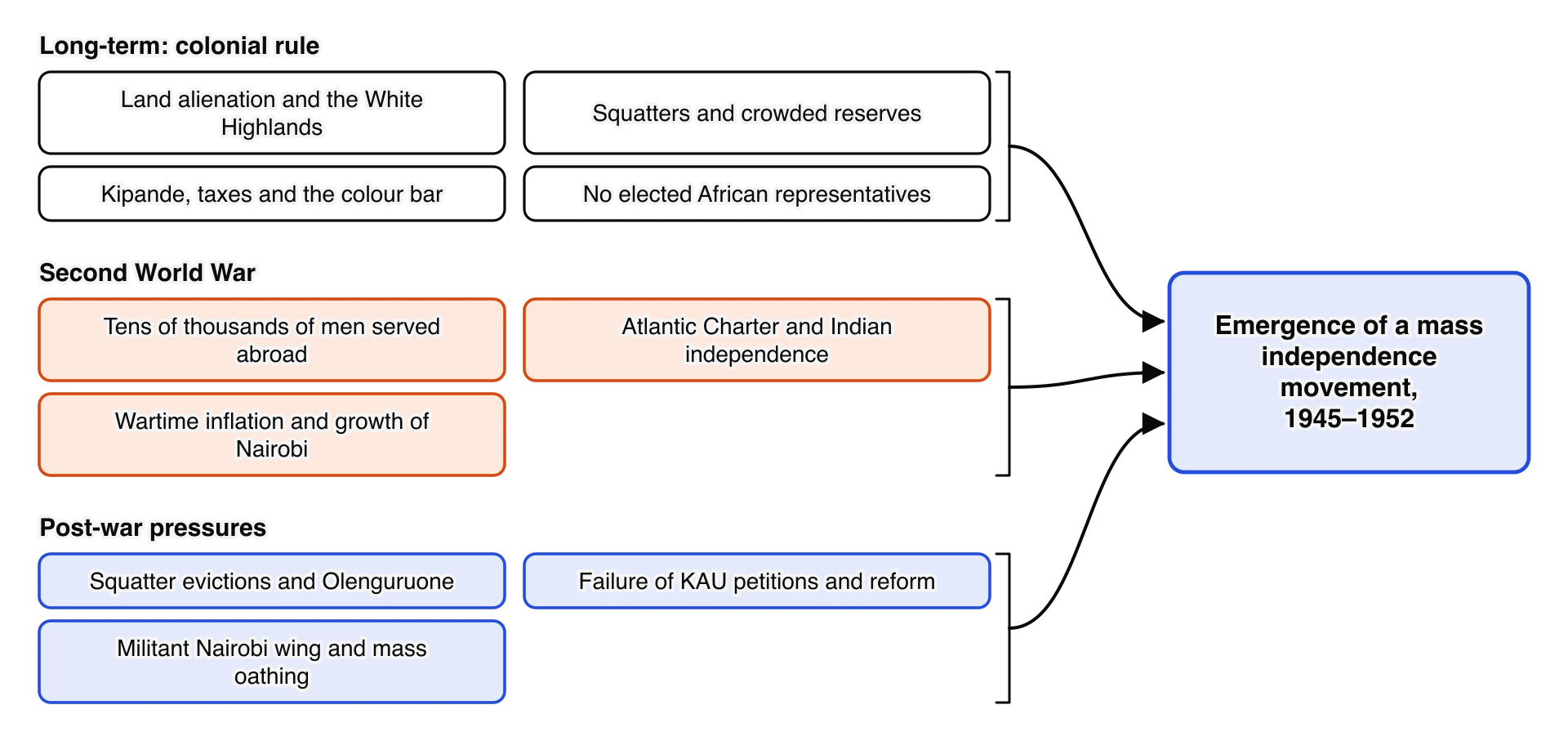
The diagram of causes shows that the movement had roots in three timescales. Colonial rule supplied the grievances; the Second World War gave Africans new experience, new arguments and new economic hardship; and the post-war years brought evictions, strikes and the failure of reform, which turned a political movement into a mass one.
The first colony-wide African political organisation was founded in Nairobi on 1 October 1944, nine days before Eliud Mathu was nominated to LegCo. At the Governor’s insistence it was called the Kenya African Study Union, to stress that it would advise Mathu rather than challenge the government. In February 1946 it dropped “Study” and became the Kenya African Union (KAU). Its early leaders, Harry Thuku and then James Gichuru, a teacher, were moderates, and it drew members from several ethnic groups.
Kenyatta returned to Kenya in September 1946 after fifteen years abroad, and in June 1947 Gichuru stood aside for him as KAU president. Kenyatta was by now the best-known African in Kenya, and he also became principal of the independent teachers’ college at Githunguri, the centre of the Kikuyu independent schools movement. Under him KAU set out to become a mass national party.
KAU’s demands covered all three of the grievances of colonial rule: the return of alienated land and title deeds for Africans; an end to the kipande, taxes paid only by Africans and the colour bar; equal pay for equal work; more schools; and more African members in LegCo, leading to elected representatives. In June 1951 it called for self-government within three years, and in November 1951 it sent a delegation with a petition on African land grievances to the United Nations General Assembly, then meeting in Paris.
Its methods were petitions, delegations to the Governor and to London, a newspaper and above all mass meetings. The largest, in 1952, drew crowds of tens of thousands. The government responded with small concessions. African nominated seats in LegCo rose from one in 1944 to four in 1948 and six in 1952, while 14 members were elected by the European community, which numbered only about 40,000. Proposals for more African seats, discussed when the Colonial Secretary James Griffiths visited in 1951, left Europeans with control.
The most famous of KAU’s meetings was held at Nyeri on 26 July 1952, less than three months before the Emergency. Kenyatta used it to set out KAU’s demands and to deny any link with the secret movement the government called Mau Mau.
True democracy has no colour distinction. It does not choose between black and white. … We are the only race in Kenya which does not elect its own representatives in the Legislature and we are going to set about to rectify this situation. … We want our cattle to get fat on our land so that our children grow up in prosperity; we do not want that fat removed to feed others. … K.A.U. speaks in daylight. He who calls us the Mau Mau is not truthful. We do not know this thing Mau Mau.
Jomo Kenyatta, speech at the Kenya African Union meeting at Nyeri, 26 July 1952, from the report of the meeting by the Assistant Superintendent of Police, Nyeri, printed in F. D. Corfield, Historical Survey of the Origins and Growth of Mau Mau (1960). The police estimated the crowd at about 25,000. Kenyatta knew that officers and informers were present, so he chose his words for two audiences at once: supporters who wanted action and a government looking for evidence against him. The text is a police officer’s record, reprinted in an official report written to show that Kenyatta was behind Mau Mau; the same report notes that the interpreter, Jesse Kariuki, was rendering the speech to the crowd in a more inflammatory way than Kenyatta’s own words.
Constitutional methods produced few results, and younger activists lost patience. The KCA had been banned in 1940, but its members continued to work through KAU and through the independent schools. In Nairobi, the “Forty Group” (Anake a 40, named after the age-set circumcised in 1940), many of them ex-servicemen, turned to direct action. By 1951 radical trade unionists such as Fred Kubai and Bildad Kaggia had taken control of the Nairobi branch of KAU and formed a secret central committee, known as Muhimu (“important”), which organised oathing.
The government banned the secret society it called Mau Mau in August 1950, but oathing continued to spread. Kenyatta’s position became very difficult. Militants expected him to back them, settlers and officials demanded that he condemn them, and loyalist chiefs warned that the movement threatened them. At a mass meeting in Kiambu on 24 August 1952 he publicly denounced Mau Mau. Whether he secretly approved of the oathing remains disputed.
Moderates | Militants | |
|---|---|---|
Leaders | James Gichuru, Eliud Mathu, Kenyatta in public | Fred Kubai, Bildad Kaggia, the Forty Group, Muhimu |
Base | Teachers, clerks, traders, landowners; several ethnic groups | Nairobi workers, the unemployed, squatters, ex-servicemen; mainly Kikuyu |
Methods | Petitions, delegations, LegCo, mass meetings | Mass oathing, strikes, intimidation, and later armed revolt |
Aims | More representation and reform leading gradually to self-rule | Land and freedom (ithaka na wiathi) at once |
The table of moderates and militants shows the tension inside KAU on the eve of the Emergency. The same tension later shaped the debate about Kenyatta: the British saw him as the hidden leader of the militants, while many militants came to see him as a cautious moderate who had held them back.
Mau Mau drew its support mainly from three closely related peoples of central Kenya, the Kikuyu, Embu and Meru, and from Kikuyu living in Nairobi and on settler farms in the Rift Valley. Its members included squatters evicted from the Rift Valley, landless young men in the reserves, the unemployed and workers of Nairobi, and some ex-servicemen. Its demands were summed up in its slogan of land and freedom: the return of land taken by settlers, and an end to colonial rule.
The movement had three linked causes. The first was land hunger: by the late 1940s the Kikuyu reserves were among the most densely farmed areas of Kenya, squatters were being pushed off settler farms, and the poorest Kikuyu had nowhere to go. The second was the failure of constitutional politics: KAU’s petitions and meetings had produced only a handful of nominated seats. The third was cultural and religious: oathing drew on Kikuyu ritual, independent churches and schools had already built an alternative to mission authority, and the revolt was also a moral argument among Kikuyu about who deserved land and respect.
By 1952 oathing had spread through Central Province and Nairobi, and attacks on loyalist chiefs, informers and European farms were increasing. A new governor, Sir Evelyn Baring, arrived on 30 September 1952. On 7 October Senior Chief Waruhiu, the most prominent loyalist chief in Kiambu, was shot dead in his car near Nairobi. Baring asked London for emergency powers, and the Colonial Secretary, Oliver Lyttelton, approved.
Baring signed the declaration on 20 October 1952. That night, in Operation Jock Scott, police and troops arrested Kenyatta and about 180 other KAU and trade union leaders, and British troops were flown in from Egypt. The government believed that removing the leaders would end the movement within weeks. Instead, many younger militants escaped to the forests, and the arrests, followed by beatings and mass evictions, drove many undecided Kikuyu to support the revolt.
Kenyatta and five others, Bildad Kaggia, Kung’u Karumba, Fred Kubai, Paul Ngei and Achieng’ Oneko, were tried at Kapenguria, a remote town in the north-west, from December 1952. The prosecution claimed that they had managed Mau Mau. The main witness, Rawson Macharia, said that Kenyatta had administered an oath to him; he later swore that his evidence had been false, and documents released since show that witnesses were offered rewards and that the judge had secret contact with the Governor. All six, the Kapenguria Six, were convicted in April 1953 and sentenced to seven years’ hard labour, followed by restriction in remote northern Kenya. KAU was banned in June 1953.
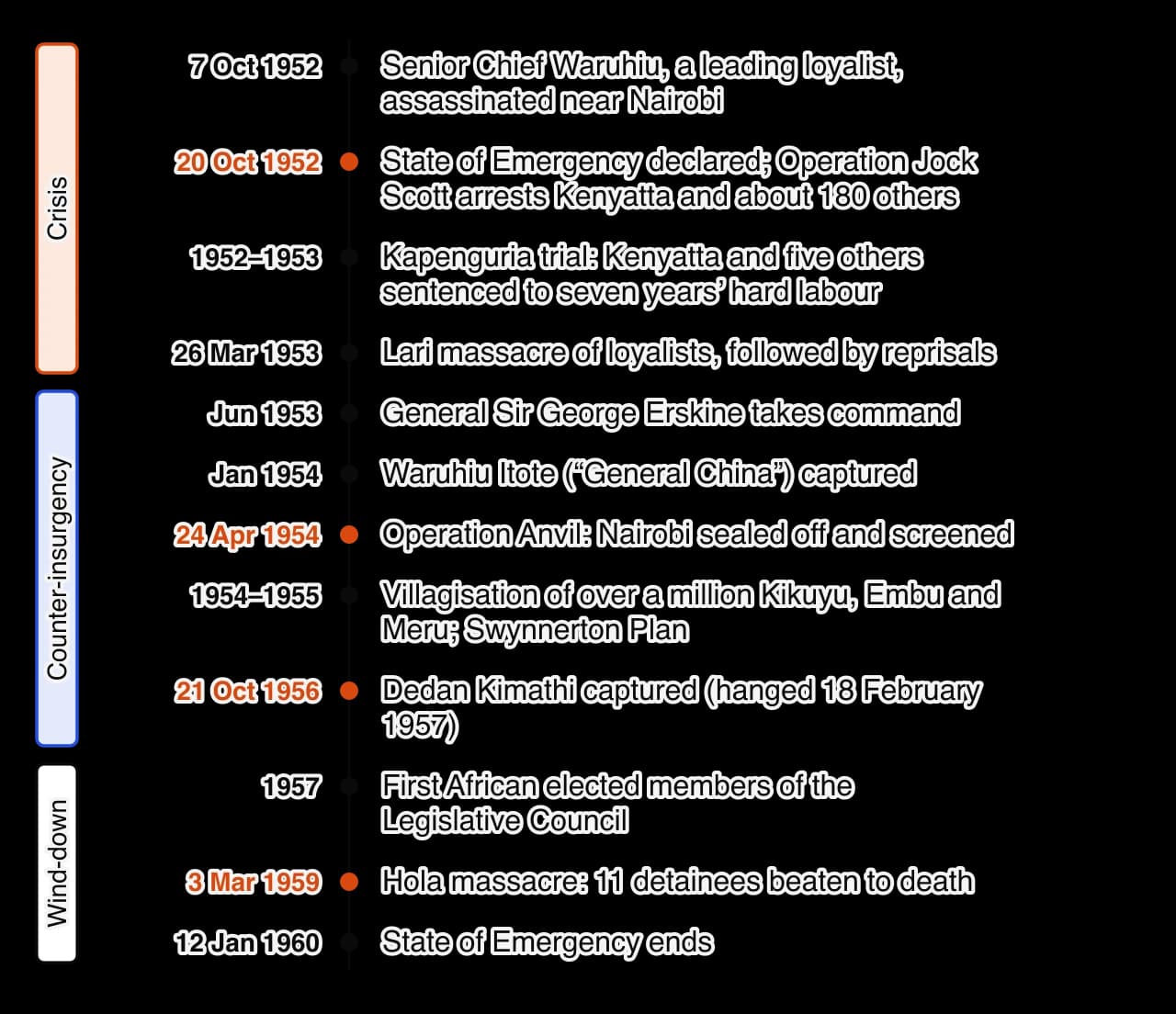
The chronology of the Emergency shows how quickly the conflict escalated. From early 1953 several thousand fighters lived in the forests of the Aberdare mountains and Mount Kenya, organised in groups under leaders such as Dedan Kimathi, a former clerk and teacher who became the best-known Mau Mau commander, and Waruhiu Itote (“General China”). They raided police posts, loyalist homes and settler farms for weapons, food and cattle, and depended on a passive wing in the reserves and Nairobi for supplies, recruits and information.
The worst single attack came on the night of 26 March 1953 at Lari, in Kiambu, where Mau Mau killed about 74 people, mostly the wives, children and elderly relatives of loyalist Home Guards, in a settlement linked to an old land dispute. The government publicised the massacre widely, and Home Guards and police carried out reprisal killings in the following days. Lari hardened opinion against Mau Mau in Britain and among many Kikuyu.
The British response grew from police action to a full military campaign. General Sir George Erskine took command in June 1953 with British battalions, the King’s African Rifles, the settler Kenya Regiment and the Home Guard. The Royal Air Force bombed the forests. Prohibited areas were declared in which any African could be shot on sight, and special courts tried Mau Mau offences. Offences such as carrying a weapon or ammunition, or administering an oath, carried the death penalty, and by the end of the Emergency 1,090 Kenyans had been hanged.
In 1954 the British changed their counter-insurgency strategy, from chasing fighters in the forest to cutting them off from their supporters. On 24 April 1954 Operation Anvil sealed off Nairobi. About 25,000 troops and police searched the city sector by sector; about 20,000 Kikuyu, Embu and Meru men were sent to a camp at Langata for screening, and many thousands more were sent back to the reserves. Mau Mau’s supply network in the capital was broken.
Detention without trial grew into a system that officials called the Pipeline. Suspects were screened and classified as “white” (cooperative), “grey” or “black” (the “hard core”), and moved through a chain of camps towards release as they confessed their oaths and accepted “rehabilitation”. Detainees were made to work on public projects such as irrigation schemes and roads. Official figures put the number held at any one time at about 80,000 at the peak; the total who passed through the camps was much larger. A few thousand women were held, mostly at Kamiti camp.
Women played a larger part in Mau Mau than early accounts recognised. They took oaths, carried food, weapons and messages to the forest, hid fighters and gathered intelligence, and a smaller number fought. In villagisation they bore much of the forced communal labour. Wambui Waiyaki Otieno, who joined the movement as a young woman in Nairobi and was later detained, described this work in her memoir Mau Mau’s Daughter (1998).
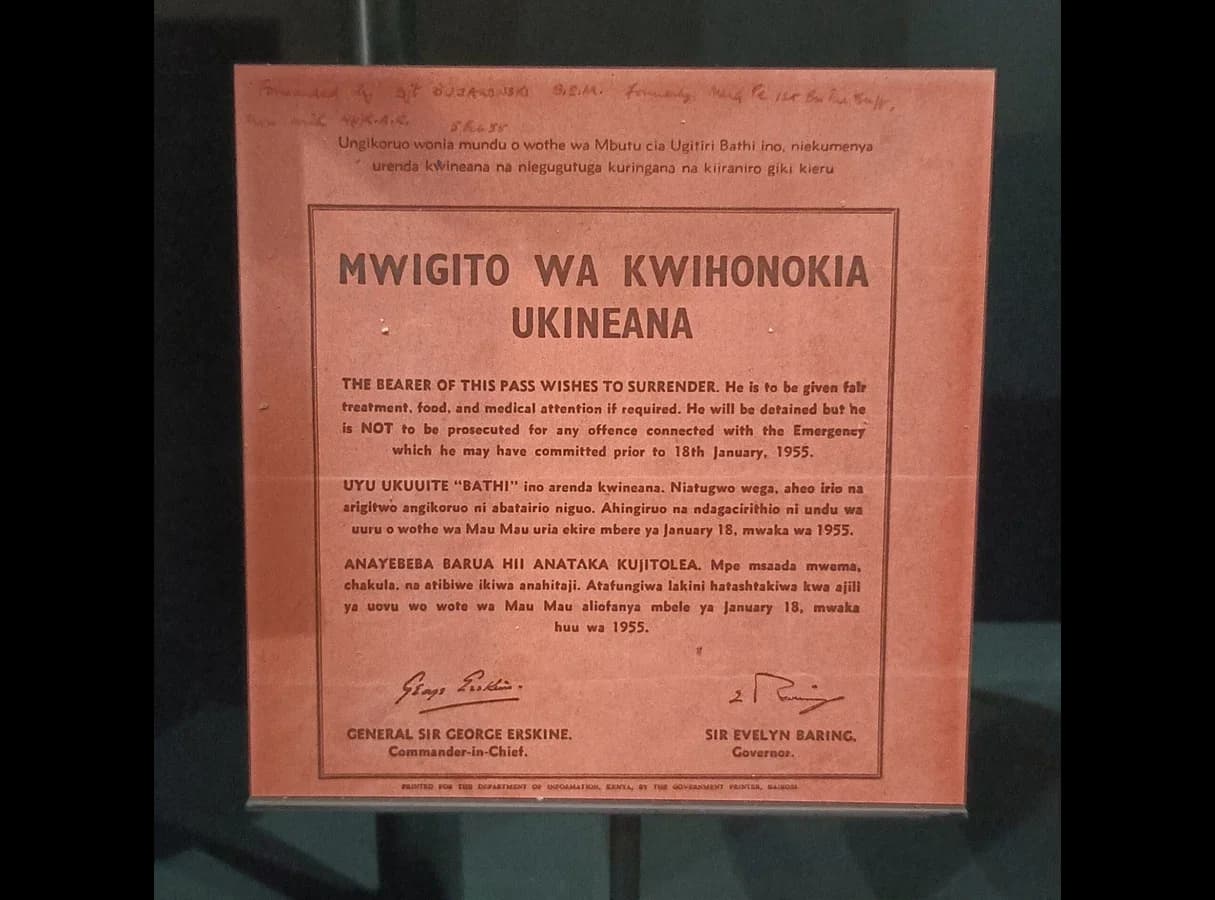
The safe conduct pass shows the other side of the government’s strategy. Alongside force, it offered surrender terms, as in the amnesty announced in January 1955, and used propaganda leaflets, loudspeaker aircraft and “counter-gangs” of former fighters to break the movement from inside. By the end of 1956, after Kimathi was wounded and captured on 21 October, the forest war was over. Kimathi was tried, convicted of possessing a firearm, and hanged on 18 February 1957.
The fighting ended in 1956, but tens of thousands of detainees remained in camps. On 3 March 1959, at Hola camp in the dry south-east of the colony, guards beat 11 detainees to death after they refused to work, under a plan that allowed force to compel work. The colonial government first claimed that the men had died from drinking contaminated water. The inquest showed that they had been beaten.
The scandal reached the House of Commons. In a debate on 27 July 1959, the Conservative MP Enoch Powell, speaking from the government’s own side, rejected the argument that the victims’ character or African conditions excused what had happened.
Nor can we ourselves pick and choose where and in what parts of the world we shall use this or that kind of standard. … We must be consistent with ourselves everywhere. All Government, all influence of man upon man, rests upon opinion. What we can do in Africa, where we still govern and where we no longer govern, depends upon the opinion which is entertained of the way in which this country acts and the way in which Englishmen act. We cannot, we dare not, in Africa of all places, fall below our own highest standards in the acceptance of responsibility.
Enoch Powell, speech in the House of Commons debate on Hola Camp, Kenya, 27 July 1959 (Hansard). In the same passage Powell rejected the idea that Britain could keep different standards for Africa, Asia and Britain itself. He spoke as a backbencher of the governing party, so his criticism carried more weight than the attacks of the Labour opposition. His argument was about Britain’s reputation and principles of responsibility, not about Kenyan independence, which shows that by 1959 the Emergency was damaging the moral case for colonial rule in Britain itself.
Hola, together with the shooting of protesters in Nyasaland the same year, convinced ministers that holding African colonies by force had become too costly. By June 1959 the Emergency had cost about £55 million, more than half of it paid by the British government. Mau Mau had been defeated in the field, but the methods used to defeat it had made continued colonial rule politically impossible to defend.
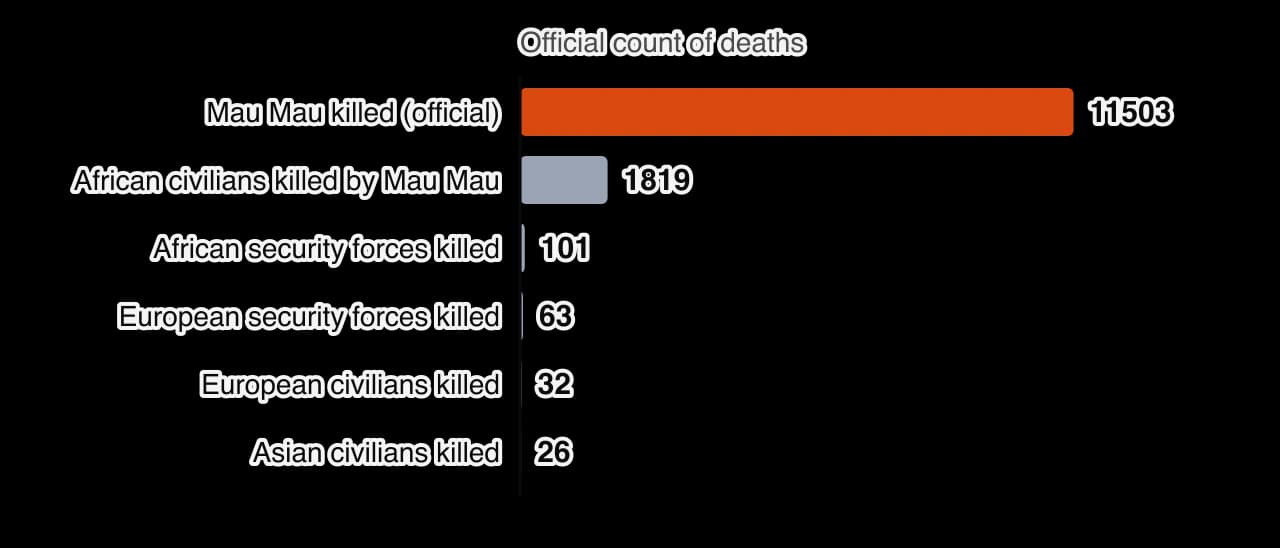
The chart of official deaths shows the scale of the violence and who suffered most. The numbers are disputed because many records were destroyed or hidden at the end of colonial rule, and because the colonial government counted only certain kinds of death. The detention camps and villages are at the centre of the debate.
Source or historian | Estimate | Basis and limits |
|---|---|---|
Colonial government (Corfield, 1960) | 11,503 Mau Mau killed; about 80,000 detainees at the peak | Official military and prison records; counted only deaths in combat and the number held at one time |
Caroline Elkins, Imperial Reckoning (2005) | 160,000–320,000 people passed through the camps; tens of thousands, possibly hundreds of thousands, of deaths | Oral testimony and archives; her death estimate has been strongly criticised as too high |
David Anderson, Histories of the Hanged (2005) | About 25,000 deaths in total; 1,090 executions | Court records of the capital trials and official files |
John Blacker (demographer, 2007) | About 50,000 excess deaths, half of them children under ten | Kikuyu population figures in the 1948, 1962 and 1969 censuses |
In 2011 the British government admitted that it held about 8,800 files removed from Kenya and other colonies at independence, the so-called “migrated archives”, at Hanslope Park. Their release confirmed much of the violence in the camps described by former detainees and by Elkins, while the arguments about the total number of deaths continue.
 YouTube
While it fought Mau Mau, the colonial government also tried to remove its causes and to build up African allies. The Swynnerton Plan of 1954, drawn up by the agriculture official Roger Swynnerton, aimed to create a prosperous class of African farmers.
The plan raised African farm incomes and laid the basis of the Kenyan smallholder economy, but its timing gave it a political edge. Land was consolidated in Central Province while tens of thousands of Mau Mau suspects were in detention, so loyalists were often able to secure the best plots and title deeds while detainees lost land. As the historian Daniel Branch has shown, the Emergency created a loyalist landowning class that went on to play a leading role in independent Kenya.
Political reform followed a policy of multiracialism, in which Europeans, Asians and Africans would share power in separate, unequal blocs. The Lyttelton Constitution of 1954 created a Council of Ministers with six unofficial ministers: three Europeans, two Asians and one African. In March 1957 Africans voted for the first time, electing eight members of LegCo on a restricted franchise. The winners included Tom Mboya, the trade union leader, Oginga Odinga, a Luo businessman, Ronald Ngala from the coast and Daniel arap Moi from the Rift Valley.
The elected Africans refused to accept ministerial posts under the Lyttelton system and demanded more seats. The Lennox-Boyd Constitution of 1958 raised the number of elected Africans to 14, equal to the elected Europeans. Political parties were still allowed only at district level, and the Kikuyu, Embu and Meru were kept out of politics during the Emergency, so leadership passed to politicians from other regions, notably the Luo and the coast. Their demand, repeated in every speech, was the release of Kenyatta.
After the general election of October 1959, the Prime Minister Harold Macmillan appointed Iain Macleod as Colonial Secretary, and the pace of decolonisation in Africa changed sharply. Ministers concluded that the cost of holding colonies by force, shown in Kenya, Nyasaland and the French war in Algeria, was greater than the cost of leaving, and that delay risked driving African nationalists towards the Soviet Union. On a tour of Africa in early 1960, Macmillan made the point publicly in a speech to the South African Parliament.
The wind of change is blowing through this continent and, whether we like it or not, this growth of national consciousness is a political fact. We must all accept it as a fact, and our national policies must take account of it.
Harold Macmillan, British Prime Minister, speech to the Parliament of South Africa, Cape Town, 3 February 1960. Macmillan was speaking to a white government committed to apartheid, and he was also addressing settler communities across British Africa, including Kenya’s. The speech shows that the British government now saw African nationalism as a force to be managed rather than defeated, and that it framed decolonisation partly in Cold War terms.
The first Lancaster House Conference met in London from 18 January to 21 February 1960, chaired by Macleod; the Emergency had ended on 12 January. The African elected members came as a united group, with Mboya and Ngala among their leaders. The conference agreed a constitution giving Africans a majority of the elected seats in LegCo and of the ministers, and accepted that Kenya would become an African-ruled state. For most settlers this was a betrayal; Michael Blundell, the leader of the liberal settlers’ New Kenya Group who accepted the outcome, was denounced by settler hardliners.
Kenyatta was not allowed to attend, and was still under restriction at Lodwar in the north. While refusing to release him, Governor Sir Patrick Renison described him publicly as “the African leader to darkness and death”. The phrase showed how far the official view of Kenyatta still rested on the Corfield report and the Kapenguria trial.
With national parties allowed again in 1960, two parties formed. Their rivalry was about who would hold power and land after independence as much as about ideas.
KANU (Kenya African National Union) | KADU (Kenya African Democratic Union) | |
|---|---|---|
Founded | 14 May 1960 | June 1960 |
Leaders | James Gichuru (acting president), Tom Mboya, Oginga Odinga; Kenyatta president after his release | Ronald Ngala, Daniel arap Moi, Masinde Muliro |
Main support | Kikuyu and Luo, the two largest ethnic groups; Nairobi; trade unions | Smaller groups: Kalenjin, Maasai, Turkana, Samburu, coastal peoples, some Luhya |
Constitutional aim | A strong central government elected by universal suffrage | Regional government (majimbo) to protect smaller groups and their land |
Position on Kenyatta | Refused to form a government until he was freed | Called for his release but feared Kikuyu dominance |
In the election of February 1961, KANU won the most votes and the most seats but refused to take office while Kenyatta was detained. KADU formed a minority government with Blundell’s supporters and nominated members, with Ngala as Leader of Government Business. Renison now accepted that no stable government was possible without Kenyatta. He was moved to Maralal in April 1961, allowed home to Gatundu in August 1961 as a free man, and formally became president of KANU in October 1961.
The second Lancaster House Conference, from February to April 1962 under the new Colonial Secretary Reginald Maudling, had to reconcile KANU’s demand for a strong central state with KADU’s plan for regions. The British government backed much of KADU’s plan, partly to reassure settlers and smaller ethnic groups. The compromise was a constitution with a central parliament of two chambers, a House of Representatives and a Senate, and regional assemblies with their own powers, entrenched so that they could not easily be changed. KANU and KADU formed a coalition government in April 1962, in which Kenyatta and Ngala both served as ministers.
Britain also agreed to fund the purchase of European farms for African settlement, which made the political transfer acceptable to many settlers and to the British government. The White Highlands had already been opened to Africans by the Land Control Regulations of 1961.
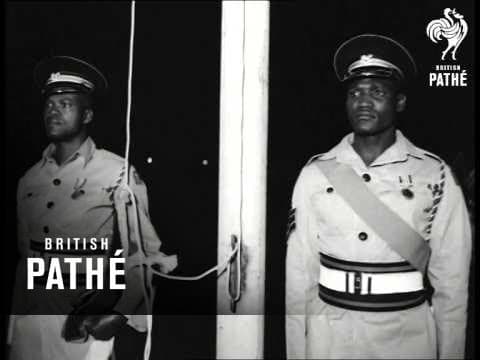
Elections in May 1963 gave KANU a clear victory, with 83 of the 124 seats in the House of Representatives. On 1 June 1963, Madaraka Day (“responsibility day”), Kenya became self-governing with Kenyatta as Prime Minister. A third conference in London in September–October 1963, under Duncan Sandys, settled the independence constitution; KANU won some changes that strengthened the central government but kept the regional structure. Kenya became independent on 12 December 1963, with Kenyatta as Prime Minister and Queen Elizabeth II as head of state. It joined the Commonwealth, and the Duke of Edinburgh handed over the instruments of independence at a ceremony in Nairobi.

The chain of conferences and elections shows that independence was negotiated step by step, with each agreement tested at the ballot box. African politicians used British deadlines and elections to push the pace, and the British government used the conferences to protect settlers’ property and to choose the African leaders it could work with.
 YouTube
Jomo Kenyatta (born Kamau wa Ngengi, probably in the 1890s; died 1978) was the most important individual in Kenya’s path to independence, but his role was different at each stage. Before 1952 he was the leader of constitutional nationalism: general secretary of the KCA, a Pan-Africanist in London, the author of Facing Mount Kenya and, from 1947, president of KAU. He was an older, Western-educated figure who spoke for the land grievances of the Kikuyu but wanted to build a national movement.
From 1952 to 1961 he was a detainee, and his importance came from what others made of him. The British treated him as the organiser of Mau Mau: the Kapenguria trial and the official Corfield report of 1960 both presented him as its secret leader. Mau Mau fighters sang songs in his name. Politicians who had never been in the movement, such as Mboya and Odinga, demanded his release. By 1960 Kenyatta had become a symbol that united Africans of every region, partly because he had been absent while they argued.
After his release in 1961 Kenyatta used his position to unite KANU and to reassure the British and the settlers. He insisted that he had never supported violence. In August 1963, as Prime Minister, he met about 300 European farmers at Nakuru and told them that they were welcome to stay in an independent Kenya if they accepted African rule, calling on all communities to put the past behind them. His slogan, Harambee, became the motto of the new state.
Kenyatta’s attitude to Mau Mau was ambiguous from the start. In a speech in 1962 he described Mau Mau as a disease that had been eradicated and should not be remembered, a statement widely quoted by historians. Former fighters who came out of the forests in 1963 received little land or recognition, and Mau Mau remained a banned organisation under Kenyatta and his successor.
Argument | Evidence for | Evidence against |
|---|---|---|
Kenyatta led the independence movement | KAU president from 1947; the symbol of the nationalist cause; KANU refused to govern without him; led KANU to victory in 1963 | Detained from 1952 to 1961, when the revolt was fought and the first two conferences took place |
Kenyatta led Mau Mau | The British claim at Kapenguria and in the Corfield report; his name in Mau Mau songs and oaths | He denounced Mau Mau in 1952; key trial evidence was false; J. M. Kariuki and other detainees said his name was never mentioned in the oaths they knew |
Kenyatta made a peaceful transfer possible | His release united KANU; he reassured settlers and Britain; Kenya avoided the civil wars seen elsewhere | He was released only after Britain had already decided to leave; Mboya, Ngala and others negotiated in 1960 |
The table of arguments about Kenyatta shows why historians disagree about his role. He was essential to the final stage of independence as the leader all sides could accept, but the revolt that changed British policy, and the negotiations of 1960, took place without him.
Independent Kenya had to turn a colony of more than 40 ethnic groups, with European, Asian and Arab minorities and deep inequalities in land and wealth, into a nation. Kenyatta’s government built that identity around a strong central state, the presidency, Harambee, development and the Swahili language, while it played down the divisive memory of Mau Mau. Its methods also brought new challenges: the narrowing of political freedom, ethnic rivalry over patronage and land, and the exclusion of some groups from the nation.
The constitution of 1963 was the product of the Lancaster House bargaining. It created a parliamentary system with a Prime Minister responsible to a two-chamber parliament, a Bill of Rights, protection for property and minority rights, and regional assemblies (majimbo) with powers over land, local government and some services. Changing the regional provisions needed large majorities in both houses. It was designed to share power between KANU and KADU and to protect settlers and minorities.
KANU’s leaders saw the regional system as a colonial device to weaken the new state, and they took it apart within three years. Starved of funds and powers by the central government, the regions never worked as intended. In November 1964 KADU dissolved itself and its members joined KANU, attracted by government posts and convinced that opposition was hopeless; Ngala and Moi became loyal supporters of Kenyatta. On 12 December 1964 Kenya became a republic, with Kenyatta as executive President, head of state and head of government combined. In 1966 the Senate was merged with the House of Representatives into a single National Assembly, and further amendments allowed detention without trial.
KANU soon divided. Oginga Odinga, the Vice-President, and his allies argued that independence had not brought economic freedom: land was being sold rather than given to the landless, and foreign and settler capital still dominated. Kenyatta and the party’s conservative wing, with Mboya as their leading organiser, favoured growth through private enterprise and foreign investment. In 1965 the government set out its position in an official policy paper.
Our entire approach has been dominated by a desire to ensure Africanization of the economy and the public service. … We cannot establish these if we continue with debates on theories and doubts about the aims of our society. Let this paper be used from now as the unifying voice of our people …
Jomo Kenyatta, “Statement by the President” prefacing Republic of Kenya, Sessional Paper No. 10 of 1965: African Socialism and its Application to Planning in Kenya, 1965. The paper was drafted under Tom Mboya as minister for economic planning, at the height of the conflict with Odinga’s faction. Its claim to end the “debates on theories” was a political move: by defining African socialism as a mixed economy that welcomed foreign capital and ruled out large-scale nationalisation, it took the language of socialism away from the radicals.
The paper also claimed that “No class problem arose in the traditional African society and none exists today among Africans.” That claim served a vision of the nation as a single community working together, and it left little room for the argument that independent Kenya was creating new classes of rich and landless Kenyans.
In April 1966 Odinga resigned and founded the Kenya People’s Union (KPU). Parliament quickly passed a constitutional amendment forcing MPs who changed party to stand for re-election. In this “Little General Election” of June 1966, held with the press and radio on KANU’s side and the KPU obstructed, the KPU won only nine of the seats contested, most of them in Luo areas of Odinga’s home region of Nyanza. The opposition survived, but as a mainly Luo party.
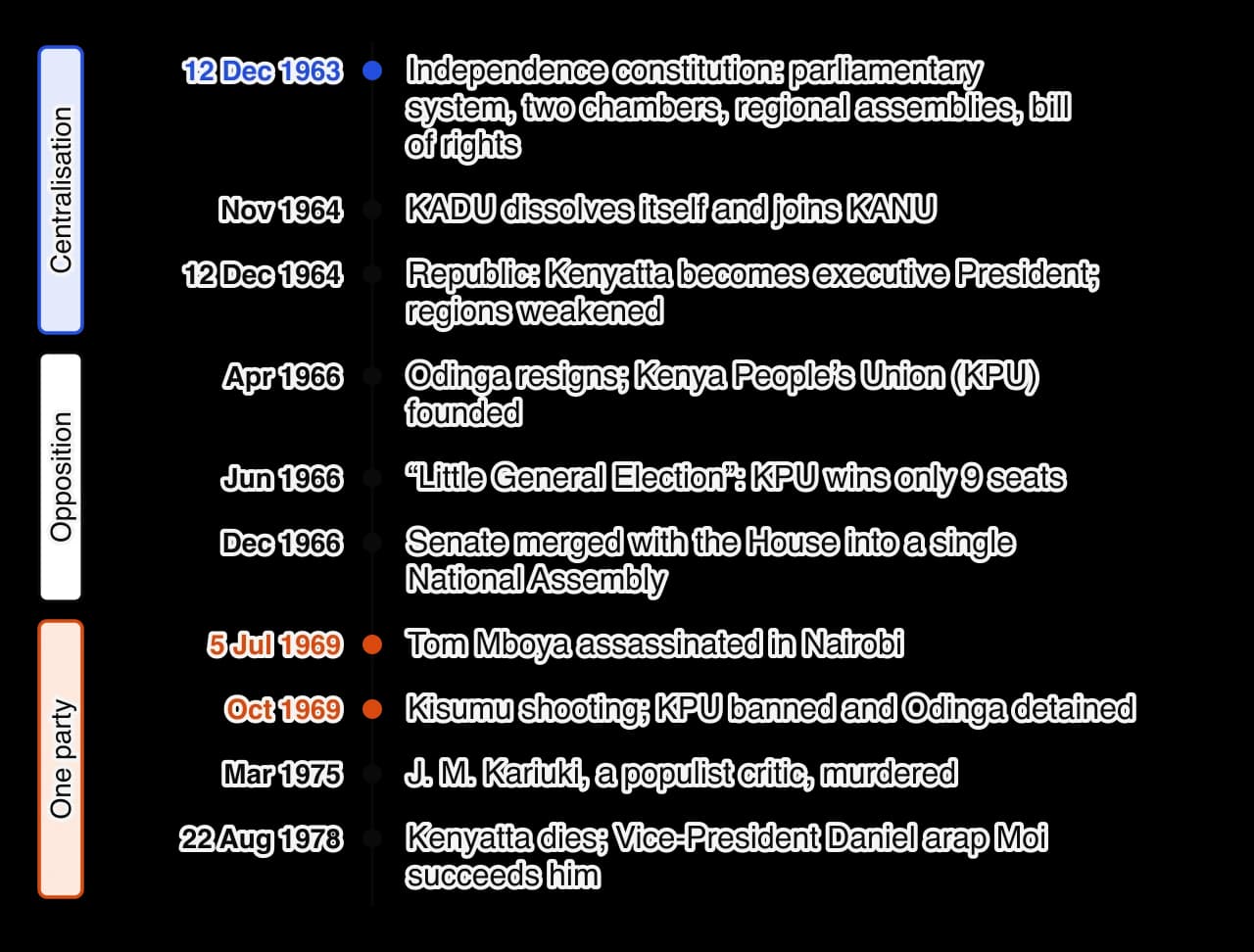
The timeline of the move to one-party rule shows how political competition became ethnic conflict. On 5 July 1969 Tom Mboya, a Luo and one of the most able politicians in the government, widely seen as a possible successor to Kenyatta, was shot dead in Nairobi. A Kikuyu man was convicted and hanged; many Luo believed the killing was political. The government organised mass oathing of Kikuyu loyalty to Kenyatta at Gatundu until church protests stopped it in September. In October 1969 Kenyatta visited Kisumu, the main Luo town, where a hostile crowd met him and his bodyguards opened fire, killing a number of people. Days later the KPU was banned and Odinga detained. In the elections of December 1969 every candidate was from KANU.
One-party rule did not end all debate. KANU primaries allowed voters to remove MPs, and many ministers lost their seats in 1969 and 1974. But criticism of the President carried growing risks. In March 1975 J. M. Kariuki, a former Mau Mau detainee, MP and outspoken populist who had warned that Kenya was becoming a country of “ten millionaires and ten million beggars”, was abducted and murdered; a parliamentary inquiry pointed to senior police officers. Critics such as the writer Ngũgĩ wa Thiong’o were detained without trial. When Kenyatta died on 22 August 1978, power passed constitutionally to Vice-President Daniel arap Moi, a Kalenjin and former KADU leader.
Independence constitution, 1963 | Kenya in 1969–1978 | |
|---|---|---|
Head of state | Queen Elizabeth II, represented by a Governor-General | Executive President (Kenyatta) since 1964 |
Parliament | Two chambers: House of Representatives and Senate | One chamber, the National Assembly (from 1966) |
Regions | Regional assemblies with entrenched powers (majimbo) | Regions abolished; power centralised in Nairobi and the provincial administration |
Parties | KANU government and KADU opposition | KANU only in practice (KADU merged 1964; KPU banned 1969) |
Civil liberties | Bill of Rights; no detention without trial | Detention without trial allowed from 1966; critics detained |
Education was the most popular promise of independence. Colonial Kenya had few secondary schools for Africans, and in 1963 most senior posts in government and business were held by Europeans and Asians. Even before independence, Tom Mboya’s student airlifts of 1959–1961 sent hundreds of young Kenyans to study at universities in the United States, among them the future Nobel Peace Prize winner Wangari Maathai; many returned to staff the new state.
In 1964 the government appointed the Kenya Education Commission, chaired by Professor Simeon Ominde, to plan a national system. The Ominde Commission recommended a single school system open to all races, with a common curriculum that would build national unity, and gave priority to secondary and higher education to train Kenyans for jobs held by expatriates. Schools reserved for Europeans were opened to African and Asian pupils in 1964.
The demand for schools far outran what the government could pay for, and communities filled the gap themselves. Harambee schools were secondary schools built and run with money raised locally at fund-raising meetings, often with politicians as the chief donors. They spread fastest in Central Province and other prosperous areas, which widened regional inequality, but they made secondary education available to far more children. The University of Nairobi became Kenya’s first national university in 1970, and in 1974 school fees were abolished for the first four years of primary school.
By the end of the 1970s most Kenyan children went to primary school, and Kenyans had replaced most expatriates in the civil service. Schools also taught a national story, in which the struggle for independence was the work of all Kenyans under Kenyatta’s leadership.
The government promoted a shared Kenyan identity through symbols and language. The national flag of 1963 used black for the people, red for the blood shed in the struggle for independence, green for the land and white for peace, with a Maasai shield and spears at its centre. The national anthem, written in Swahili and English, was based on a traditional Pokomo lullaby. Statues of colonial figures, such as the settler leader Lord Delamere in central Nairobi, were removed and streets renamed after Kenyan leaders.
Swahili, a Bantu language of the coast with many Arabic loanwords, was the language of trade across East Africa and belonged to no single large ethnic group, which made it a neutral national language. The government encouraged its use, and in 1974 Kenyatta announced that Swahili would be used in the National Assembly alongside English. English remained the language of secondary schools, universities and senior government. The state also supported music, dance and the arts of many communities, for example at the Bomas of Kenya, a national cultural centre opened near Nairobi in 1971.
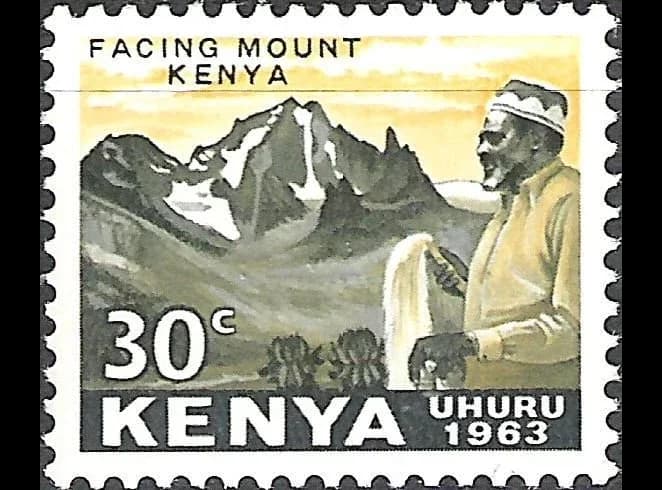
The independence stamp shows how closely the new national identity was tied to the person of Kenyatta. His image appeared on the currency and in public buildings, and loyalty to the nation was increasingly expressed as loyalty to the President.
National symbols could not remove the importance of ethnicity, which colonial rule had built into the reserves, the native authorities and politics. Kenyatta’s cabinet included ministers from many groups, but Kikuyu, about a fifth of the population, held a large share of the most powerful posts, and a small group of advisers from Kenyatta’s home district of Kiambu became known as the “Kiambu clique”. Many Kenyans came to see independence as having replaced a British elite with a Kikuyu one. Government spending, jobs and land followed political loyalty, which encouraged voters to see politics as competition between ethnic groups for the state’s resources.
The Somali people of the north-east were not included in the nation on equal terms. In 1962 most people in the Northern Frontier District had made clear that they wished to join the new Somali Republic, but Britain kept the district in Kenya. From 1963 to 1967 Somali secessionists fought a guerrilla war, which the government called the Shifta War (shifta means “bandit”) to deny it any political meaning. The army moved much of the population into guarded villages and killed or seized large numbers of livestock. A ceasefire was agreed at Arusha in October 1967, but the region remained under emergency rule and neglected.
Kenya’s Asian community, about 176,000 people at the 1962 census, faced a different kind of exclusion. Many had kept British citizenship rather than become Kenyan citizens by the 1965 deadline. The Kenya Immigration Act and the Trade Licensing Act of 1967 obliged non-citizens to hold work permits and barred them from trading in many goods and areas, as part of the policy of Africanisation. Thousands of Kenyan Asians left for Britain, and in March 1968 the British government rushed through the Commonwealth Immigrants Act to restrict their entry. Africanisation created opportunities for African traders and civil servants, while it defined Kenyan identity in racial terms.
Land had been the central grievance of Mau Mau, and land was the hardest question the new government faced. In 1960 Europeans still owned most of the former White Highlands, which produced much of Kenya’s export income. Hundreds of thousands of Africans were landless or land-poor: squatters evicted in the 1940s and 1950s, former detainees whose land had been consolidated in their absence, and young families in the crowded reserves. Settlers, meanwhile, feared that an African government would seize their farms.
The solution agreed at the Lancaster House conferences protected property. European farms would not be confiscated; they would be bought at market prices from owners who wished to sell, the principle of “willing buyer, willing seller”. Britain, the World Bank and the Commonwealth Development Corporation lent the money, and the Kenyan government and the new African owners were to repay it.
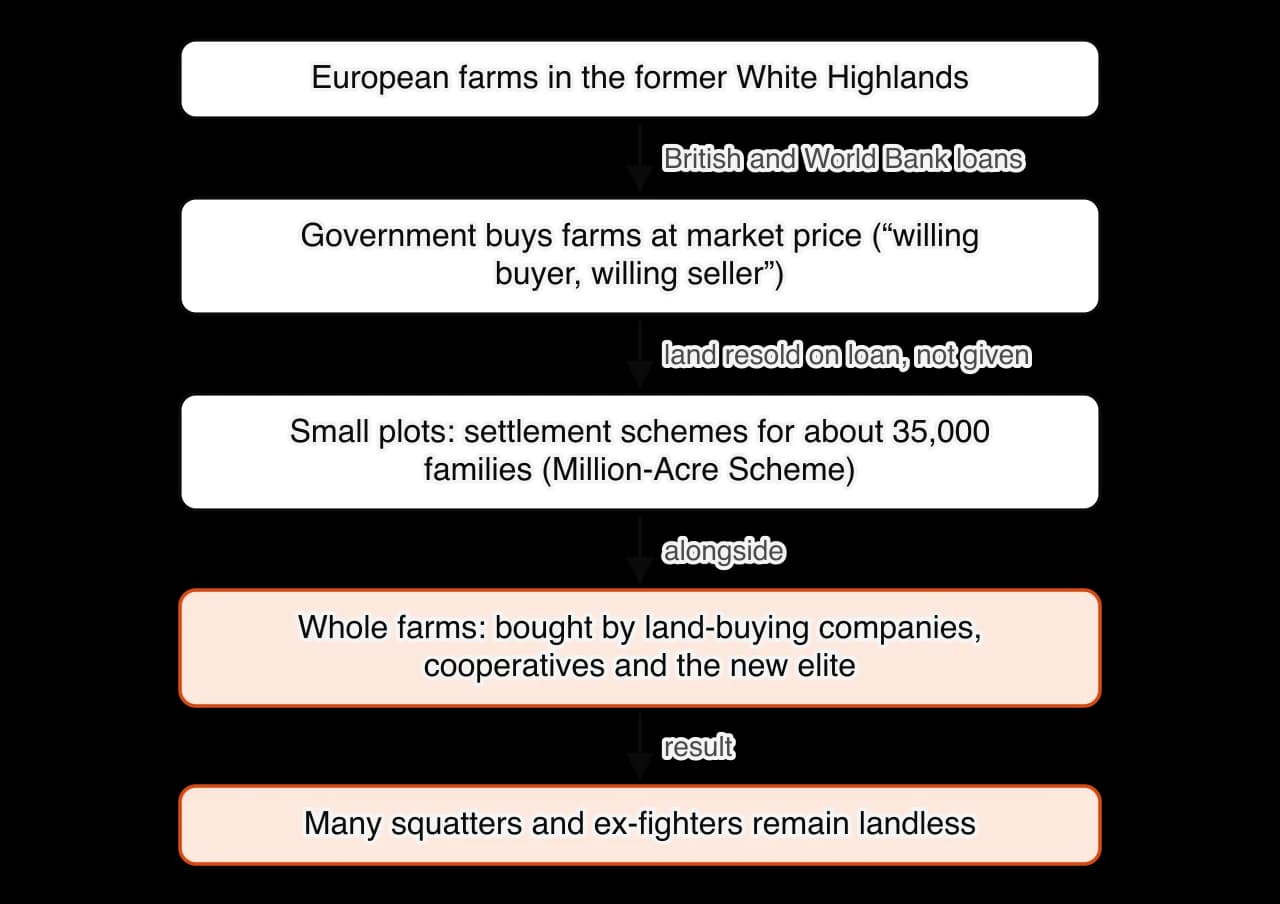
The chain of land transfer shows how the policy worked. The largest programme, the Million-Acre Scheme (1962–about 1970), bought over a million acres of European mixed farms in the highlands and divided them into smallholdings. It settled about 35,000 families, who received plots on loans that they had to repay. Other European farms were bought whole, often by groups of Africans organised in land-buying companies and cooperatives, or by individual politicians, civil servants and businessmen. Large plantations of tea, coffee and sisal and many ranches stayed in European or company hands.
The results were mixed. Smallholder farming expanded rapidly, and Kenya’s agriculture grew quickly in the 1960s and 1970s. But land went mainly to those who could raise money or had political connections. The Kenyatta family acquired large estates in Central Province, the Rift Valley and the coast, and other members of the elite did the same. Many former Mau Mau fighters and squatters, who had no money and had often been away in the forests or camps, received little or nothing.
Settlement also changed the ethnic map of Kenya. Land-buying companies brought many Kikuyu settlers into parts of the Rift Valley that the Kalenjin and Maasai regarded as their ancestral land, taken by Europeans in the colonial period. In 1969 the Nandi politician Jean-Marie Seroney protested against the sale of Nandi land to outsiders, and he was later detained. These disputes over who had the right to land in the Rift Valley shaped ethnic violence in Kenya long after 1978.
Group | What land reform brought them, 1960–1978 |
|---|---|
European farmers | Paid market prices for farms they chose to sell; many stayed on plantations and ranches |
Loyalists and new elites | Title deeds from the Swynnerton Plan; credit and connections to buy whole farms |
Settlement-scheme families | Small farms on the Million-Acre Scheme, with debts to repay |
Squatters and many ex-Mau Mau | Often nothing; some joined land-buying companies, others remained landless |
Kalenjin and Maasai communities | Lost claims to former lands in the Rift Valley to settlers from other groups |
The table of who gained from land reform shows that the colonial pattern of land ownership was changed in its racial form more than in its social form. Private property, title deeds and the market, introduced by the colonial state, continued after independence, and the new state left the inequality between landowners and the landless in place.
The way Kenya remembered its independence struggle was part of the identity Kenyatta’s state created. The official story stressed national unity, the leadership of Kenyatta and KANU, and reconciliation with Britain and the settlers. Mau Mau did not fit this story: it was associated with one ethnic group, with violence among Africans, and with demands for land that the government had not met. Mau Mau remained a banned organisation, veterans received no official recognition, and the loyalists who had fought against it held many posts in the new state.
The memory of Mau Mau revived after Kenyatta’s death, and above all after the end of KANU rule in 2002. President Mwai Kibaki’s government lifted the ban on Mau Mau in 2003; a statue of Dedan Kimathi was unveiled in central Nairobi in 2007; and under the 2010 constitution Kenyatta Day (20 October) was renamed Mashujaa Day (Heroes’ Day). In 2011 the High Court in London allowed a case brought by former detainees, Mutua and others v Foreign and Commonwealth Office, to go ahead, and the migrated archives were released. In June 2013 the British government settled the claims.
The British Government recognises that Kenyans were subject to torture and other forms of ill treatment at the hands of the colonial administration. The British government sincerely regrets that these abuses took place, and that they marred Kenya’s progress towards independence. Torture and ill treatment are abhorrent violations of human dignity which we unreservedly condemn.
William Hague, Foreign Secretary, statement to the House of Commons on the settlement of Mau Mau claims, 6 June 2013. The statement accompanied a legal settlement of £19.9 million for 5,228 claimants, and its wording was chosen with care: it expressed regret without accepting that Britain was legally liable for the actions of the colonial government. As a source it shows how official British memory of the Emergency changed after the release of the archives, sixty years after the events.
People at the time understood the revolt in very different ways, and the sources they left reflect their positions. The colonial government and most settlers saw Mau Mau as a savage, backward-looking cult. The official history commissioned by the government, F. D. Corfield’s Historical Survey of the Origins and Growth of Mau Mau (1960), presented it as a deliberate return to primitive practices organised by Kenyatta, and argued that land and poverty were not its real causes. Loyalist Kikuyu, many of them Christians, saw it as a threat to their faith, property and lives.
Former fighters and detainees told a different story once they were free to publish. J. M. Kariuki’s “Mau Mau” Detainee (1963), Waruhiu Itote’s “Mau Mau” General (1967) and later Wambui Waiyaki Otieno’s Mau Mau’s Daughter (1998) present the movement as a struggle for land and freedom, provoked by a government that ignored peaceful demands. British critics in Parliament, such as Barbara Castle and Fenner Brockway on the Labour side and Powell on the Conservative side, attacked the methods of the Emergency without supporting the revolt.
Approach | Historians and works | Argument | Evidence stressed |
|---|---|---|---|
Official colonial | F. D. Corfield, Historical Survey (1960) | An atavistic, criminal conspiracy led by Kenyatta, exploiting the Kikuyu | Oaths, violence against loyalists, KAU links to militants |
Nationalist | Carl Rosberg and John Nottingham, The Myth of “Mau Mau” (1966) | A rational nationalist movement, the culmination of Kikuyu politics since the 1920s | Continuity from Thuku and the KCA to KAU; land and political grievances |
Radical / liberation | Maina wa Kinyatti, Kenya’s Freedom Struggle: The Dedan Kimathi Papers (1987) | A national liberation war of peasants and workers betrayed by the elite after 1963 | Fighters’ own documents; the landlessness of veterans |
Social history | Tabitha Kanogo, Squatters and the Roots of Mau Mau (1987); Frank Furedi, The Mau Mau War in Perspective (1989) | A revolt rooted in the grievances of squatters, the landless and the urban poor | Squatter evictions, Olenguruone, Nairobi’s poor |
Moral ethnicity | Bruce Berman and John Lonsdale, Unhappy Valley (1992) | An argument within Kikuyu society about land, work and who deserved respect, as well as a revolt against Britain | Divisions between landed and landless Kikuyu; the civil war with loyalists |
Violence of empire | Caroline Elkins, Imperial Reckoning (2005); David Anderson, Histories of the Hanged (2005) | The British response was far more violent than admitted, through detention, torture and executions | Detainee testimony, court records, later the migrated archives |
Loyalists and the state | Daniel Branch, Defeating Mau Mau, Creating Kenya (2009) | The loyalists who won the civil war shaped the independent state | Land consolidation, loyalist careers after 1963 |
Each approach reflects the sources and questions of its time. Rosberg and Nottingham wrote in the 1960s to answer the Corfield view; Kinyatti wrote under the one-party state to restore the fighters to the national story; Lonsdale, Berman and Branch drew on Kikuyu sources to show conflicts within African society; Elkins and Anderson used testimony and court files that earlier historians had not used. Elkins’s book won the Pulitzer Prize in 2006 and helped bring the 2011 court case, but historians including Bethwell Ogot, a leading Kenyan historian, criticised its use of evidence and its estimates of deaths.
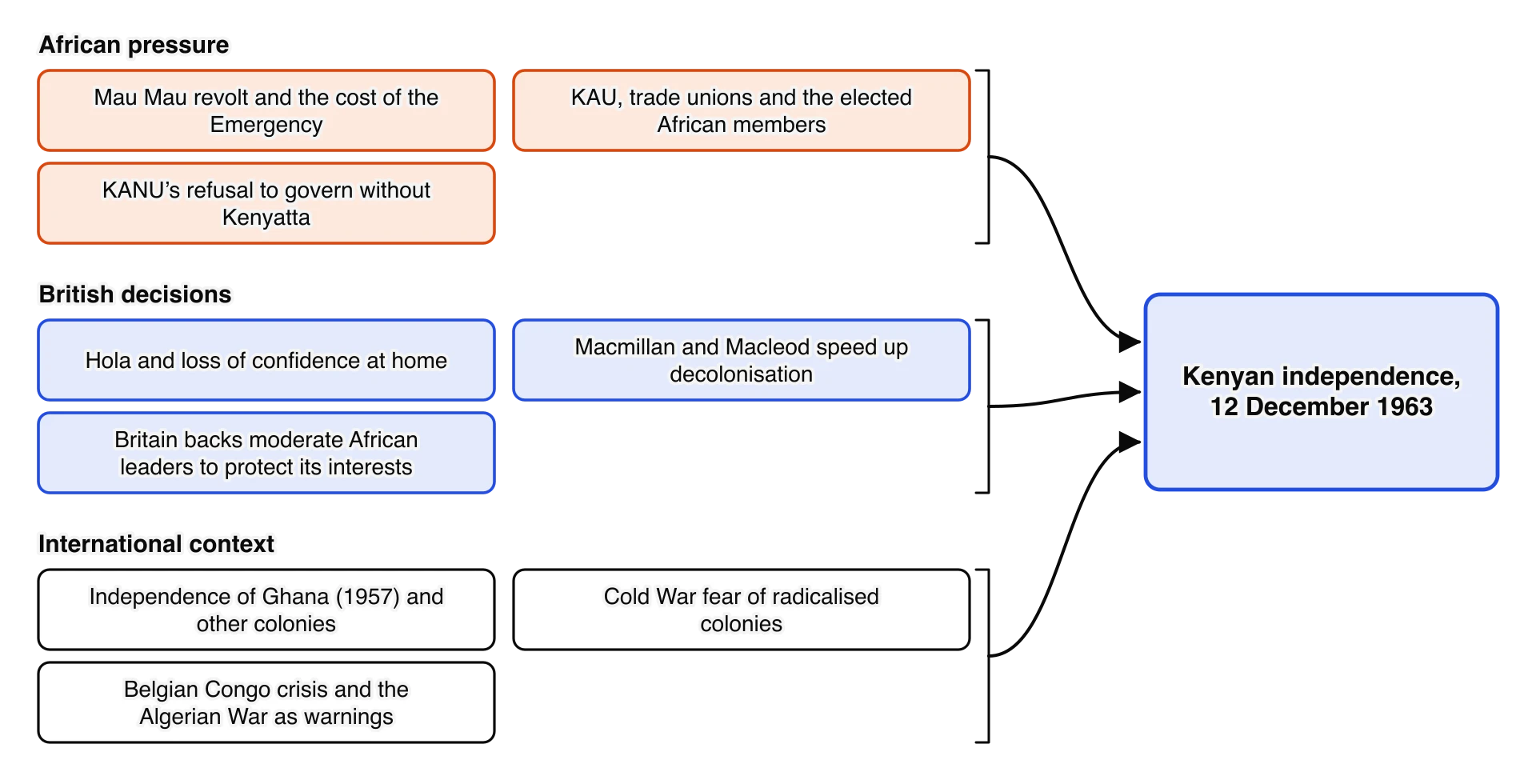
The diagram of factors in Kenyan independence sets out the three groups of explanation. Historians who stress Mau Mau argue that the revolt made settler rule impossible: before 1952 Britain planned slow, multiracial change, and after 1959 it gave way quickly, because the Emergency had shown the cost of holding Kenya. Without the revolt, on this view, settlers would have kept power for much longer, as in Southern Rhodesia.
Historians who stress British decisions point out that Mau Mau was militarily defeated by 1956, and that the change of policy came in 1959–1960 across the whole of British Africa, including colonies without armed revolts. On this view, Macmillan and Macleod decided to leave for reasons of cost, Cold War strategy and international opinion, and the timing in Kenya followed the timing elsewhere. Historians who stress African politics point to the elected members from 1957, the unions, KANU and KADU, who negotiated the transfer, and note that most of them had no part in Mau Mau.
Most historians now combine these views. The revolt and its suppression were a necessary cause of rapid independence, because they destroyed the settlers’ claim to lead Kenya and made the Emergency a scandal in Britain; but independence itself was negotiated by constitutional politicians and granted by a British government that had its own reasons to leave. This is one reason why the memory of Mau Mau was contested after 1963: the fighters could claim to have made independence possible, while those who held power owed it to negotiation.
Admiring accounts, such as Jeremy Murray-Brown’s biography Kenyatta (1972), present Kenyatta as the leader who united a divided country, reconciled Africans and Europeans and gave Kenya stability and economic growth while many African states fell to coups and civil war. Kenya’s economy grew strongly in the 1960s and 1970s, and its transfer of power in 1978 was peaceful and constitutional.
Critical accounts, such as Daniel Branch’s Kenya: Between Hope and Despair, 1963–2011 (2011), argue that Kenyatta built a state that served a narrow elite. He kept the colonial administration and its powers of detention, centralised power in the presidency, used land and jobs to reward supporters, and allowed political violence against critics. On this view, the inequality and ethnic politics that troubled Kenya later had their roots in the Kenyatta years. A balanced judgement weighs both: Kenyatta achieved stability and growth, and the methods he used to achieve them limited democracy and fairness.
Focused study 2: Independence and identity. Kenyan independence (1945–1978). Using the three provided sources on the achievement of Kenyan independence and considering the overarching inquiry question of “To what extent was the Mau Mau Uprising the main reason Kenya achieved independence in 1963?”, respond to the following three questions.
Source A: Josiah Mwangi Kariuki, a Kikuyu activist detained in camps from 1953 to 1960 who became a member of the Kenya Parliament, in his memoir “Mau Mau” Detainee (1963).
It is easy enough for anyone who knows my people to understand that it was a spontaneous decision that they should be bound together in unity by a simple oath. … It started slowly, indeed regretfully, and was an oath of unity and brotherhood in the struggle for our land and our independence. It eventually spread all over the country among a people desperate to retain their self-respect and to prevent their subjugation in a European-dominated State. Although the situation was dangerous, even in October 1952, it was not so dangerous that it could not have been put right by a few political concessions (which would today, ten years later, seem trivial) and a little understanding. … the Government chose to answer it with a series of the harshest and most brutal measures ever taken against a native people in the British Empire in the twentieth century, and so the movement developed by action and re-action into a full-scale rebellion involving the soul of my people.
Source B: Harold Macmillan, British Prime Minister, in a speech to the Parliament of South Africa in Cape Town (3 February 1960).
The wind of change is blowing through this continent and, whether we like it or not, this growth of national consciousness is a political fact. We must all accept it as a fact, and our national policies must take account of it. … As I see it, the great issue in this second half of the twentieth century is whether the uncommitted peoples of Asia and Africa will swing to the East or to the West. Will they be drawn into the Communist camp? Or will the great experiments of self-government that are now being made in Asia and Africa, especially within the Commonwealth, prove so successful, and by their example so compelling, that the balance will come down in favour of freedom and order and justice?
Source C: F. D. Corfield, a retired British colonial official, in a report commissioned by the Government of Kenya and presented to the British Parliament, Historical Survey of the Origins and Growth of Mau Mau (1960). [atavistic: reverting to primitive ways]
Mau Mau in its shortest terms was the violent manifestation of a limited nationalistic revolutionary movement confined almost entirely to the Kikuyu tribe. Although it assumed its atavistic form by intent, at a definite period in time, it was no sudden uprising; it was the culmination of a long period of political unrest among the Kikuyu people of Kenya. … It is too often assumed that the stresses and strains which beset the Kikuyu and which are in fact common to all primitive societies in transition, were the causes of Mau Mau. This is not true.
Inquiry question: “To what extent did Kenyatta’s government create a new national identity between 1963 and 1978?” Use Kenyatta’s foreword to Sessional Paper No. 10 of 1965, quoted in the account of the move to one-party rule.
I can explain how British rule created a settler colony, with the White Highlands, reserves, squatters, the kipande and a colour bar.
I can describe African politics before 1945: Thuku, the KCA, the Devonshire Declaration, the circumcision controversy and Kenyatta’s years abroad.
I can explain how the Second World War influenced the independence movement, and why historians such as Parsons qualify the role of ex-servicemen.
I can explain the aims, methods and limits of the Kenya African Union, and the split between moderates and militants.
I can explain the causes of Mau Mau and describe the main stages of the Emergency, from Jock Scott to Hola.
I can explain why the death toll and the scale of detention are disputed, and name the historians involved.
I can explain how the Swynnerton Plan and the constitutions of 1954–1958 changed Kenya during the Emergency.
I can explain why Britain changed policy in 1959–1960 and outline the three Lancaster House conferences, KANU, KADU and majimbo.
I can weigh the role of Jomo Kenyatta at each stage, from KAU leader to detainee to Prime Minister.
I can explain how the 1963 constitution was dismantled and how Kenya became a de facto one-party state by 1969.
I can explain how education, Swahili, Harambee and national symbols were used to build identity, and the challenges of ethnicity, the Shifta War and the treatment of Asians.
I can explain how land reform worked, who gained and who lost, and why it shows continuity across 1963.
I can explain how the memory of Mau Mau was suppressed and later revived, including the 2013 settlement.
I can weigh different explanations of why Kenya became independent and use sources with different perspectives to answer an inquiry question.