FS3 Political and economic transitions
How Japan after 1853 and Russia after 1985 changed both their political systems and their economies within a generation, and how this focused study is studied and examined.
- IB History
- SL and HL
What FS3 covers
From the subject guide: what you need to know and be able to do.
Focused study: two paired examples, assessed through sources in paper 1.
2 subtopics in Political and economic transitions
Each one has its own page once something is published for it.
- FS3.1The Meiji Restoration (1853–1894)notes
- FS3.2The Russian Federation (1985–1999)notes
An overview of FS3 Political and economic transitions
Political and economic transitions is a focused study of countries that changed both how they were governed and how their economies worked, quickly and at the same time. Its two examples are the Meiji Restoration in Japan (1853–1894), which turned a decentralised feudal state into a centralised, industrialising constitutional monarchy, and the Russian Federation (1985–1999), which moved from Soviet one-party rule and a planned economy to a presidential republic and a market economy.
Two examples, three questions
The examples are more than a century apart and moved in very different directions, but the diagram of the focused study shows that they are studied through the same three key questions: why each transition happened, how it was carried out, and what problems it left.
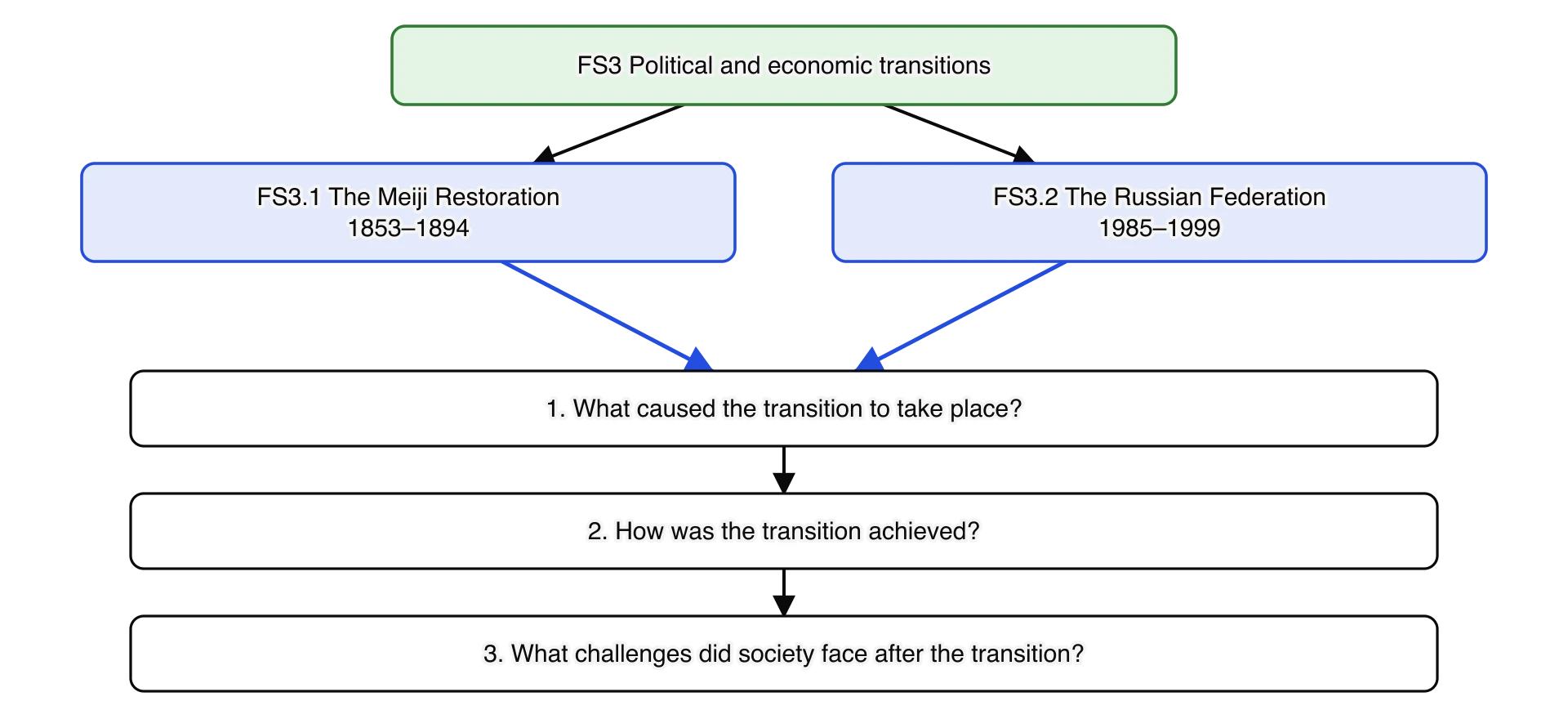
The table of the key questions summarises what each example covers under each question.
Key question | FS3.1 The Meiji Restoration (1853–1894) | FS3.2 The Russian Federation (1985–1999) |
|---|---|---|
What caused the transition to take place? | The decline of the Tokugawa shogunate: debt, a rigid status order and new ideas that exalted the emperor; demands for rapid modernisation; the arrival of Commodore Perry (1853) and the unequal treaties of 1854–1858 | The role of the Communist Party and its ageing leadership; economic stagnation and the failure of reform; the collapse of communism in Eastern Europe in 1989 |
How was the transition achieved? | The roles of the Meiji oligarchy and Emperor Mutsuhito (Meiji); land reform and a cash land tax, state-led industrialisation and trade; the constitution of 1889 | The roles of Mikhail Gorbachev (glasnost, perestroika) and Boris Yeltsin; the constitution of 1993; privatisation, freed prices ("shock therapy") and tax reform |
What challenges did society face after the transition? | Peasant unrest; the Satsuma Rebellion of 1877; foreign relations, treaty revision and the beginnings of Japanese imperialism | The hardline coup of August 1991 and the constitutional crisis of September–October 1993; strikes, protests and organised crime; the First Chechen War (1994–1996) |
Big ideas that run through the focused study
Both transitions were driven by a sense of falling behind. Japan's leaders saw the unequal treaties as proof that the country would be colonised unless it built Western-style armed forces, industry and institutions. Soviet leaders in the 1980s faced an economy that had stopped growing and could not match the West. In both cases internal weakness existed long before the crisis, and an outside shock or example turned it into a crisis of legitimacy.
Both were carried out largely from above, by small groups. Lower-ranking samurai from Satsuma and Chōshū ruled in the name of the emperor; Gorbachev, Yeltsin and their advisers set the pace in Moscow. Their choices mattered greatly, but so did the resistance they met: from peasants and former samurai in Japan, and from hardliners, parliament, workers whose wages went unpaid and Chechen separatists in Russia.
Continuity and change is the central concept. The Meiji constitution created an elected assembly but kept sovereignty with the emperor and power with the oligarchs; Russia's constitution of 1993 created elections but also a very strong presidency. Historians still debate whether the Meiji Restoration was a revolution or a restoration, and whether Russia's 1990s prepared the way for the authoritarian rule of Vladimir Putin. Success is judged differently too. By 1894 Japan was beginning to win revision of the unequal treaties and had gone to war with China as an imperial power; by 1999 Russia's output had fallen by about 40 per cent and life expectancy had dropped sharply.
The sources are very different. The Meiji period is known through government documents, memoirs of the oligarchs, foreign observers and the writings of critics such as former samurai. The Russian transition produced a flood of newspapers, television, speeches, opinion polls and economic statistics, as well as memoirs by its leaders, each written to justify their own record.
How the focused study is studied and examined
All students, at SL and HL, study one of five focused studies (Climate and innovation, Independence and identity, Political and economic transitions, Conflict and displacement, or Protest and change). Each consists of two examples, and both must be studied in full, in about 50 teaching hours.
The focused study is assessed by Paper 1 (1 hour 15 minutes, 24 marks; 30 per cent of the SL grade and 20 per cent of the HL grade), the same paper at SL and HL. Each session the sources are on only one of the two examples, so Japan or Russia may appear. The paper sets an inquiry question ("To what extent …?"), three sources and three questions whose wording never changes: how the content of Sources A and B can be used to answer the inquiry question (6 marks), how the context of Source C influences how it can be used (6 marks), and how the perspectives in all three sources can be used (12 marks).
Carry on with FS3 in Augment
With a free account, Augment remembers where you stopped and what you have practiced.