Notes on TS2.1 Why did new innovations emerge?
An innovation is a new technology, technique, institution or practice that people actually adopt, from paper and printed money to steam engines, high-yielding seeds and mobile phone payments. Explaining why innovations emerged where and when they did is one of the central problems of world history, because it helps explain why some societies grew richer and more powerful than others.
Invention, innovation and diffusion
Historians separate three stages. An invention is a new idea, device or method. An innovation is the first time it is put to practical, regular use. Diffusion is its spread to other people, places and uses, usually with changes along the way. The three stages can be centuries apart and can happen in different places.
Paper is a clear case. It was invented in China around the second century BCE. It became an innovation in the Islamic world when the Abbasid government in Baghdad began to use it for its records in the late eighth century, and it reached Christian Europe through Muslim Spain and Italy, where the first paper mills appeared in the twelfth and thirteenth centuries. Each stage needs its own explanation: the reasons why the Chinese invented paper say little about why Abbasid officials adopted it a thousand years later.
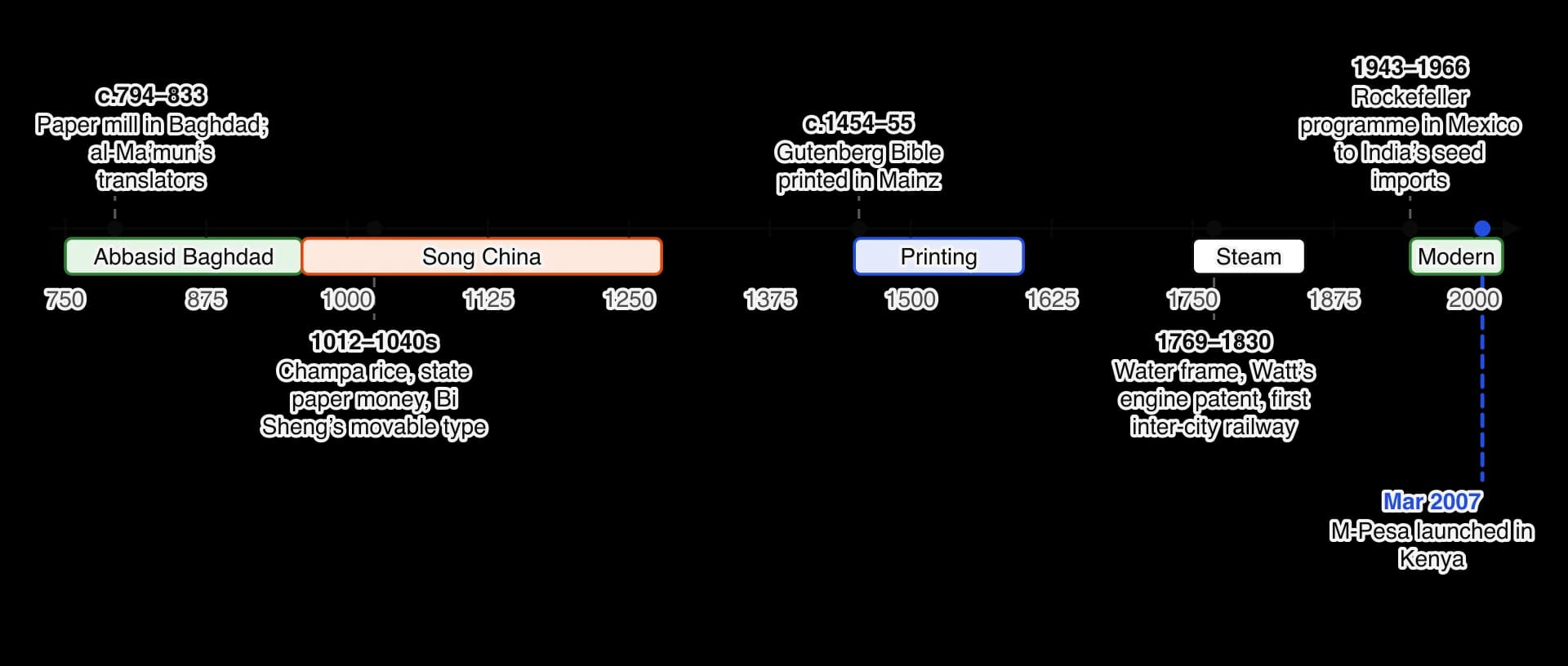
The timeline of six innovations shows how widely the cases are spread in time and place. They run from the eighth century to the twenty-first and come from four regions, so comparing them shows which causes recur and which belong to one society.
Demand-pull and supply-push
Two kinds of explanation recur in every case. Demand-pull explanations start from a need: a shortage, a problem, a market or a crisis that made people look for something new. The old saying "necessity is the mother of invention" is a demand-pull argument. Supply-push explanations start from capacity: the knowledge, materials, skills and capital that made a new solution possible at that time and place.
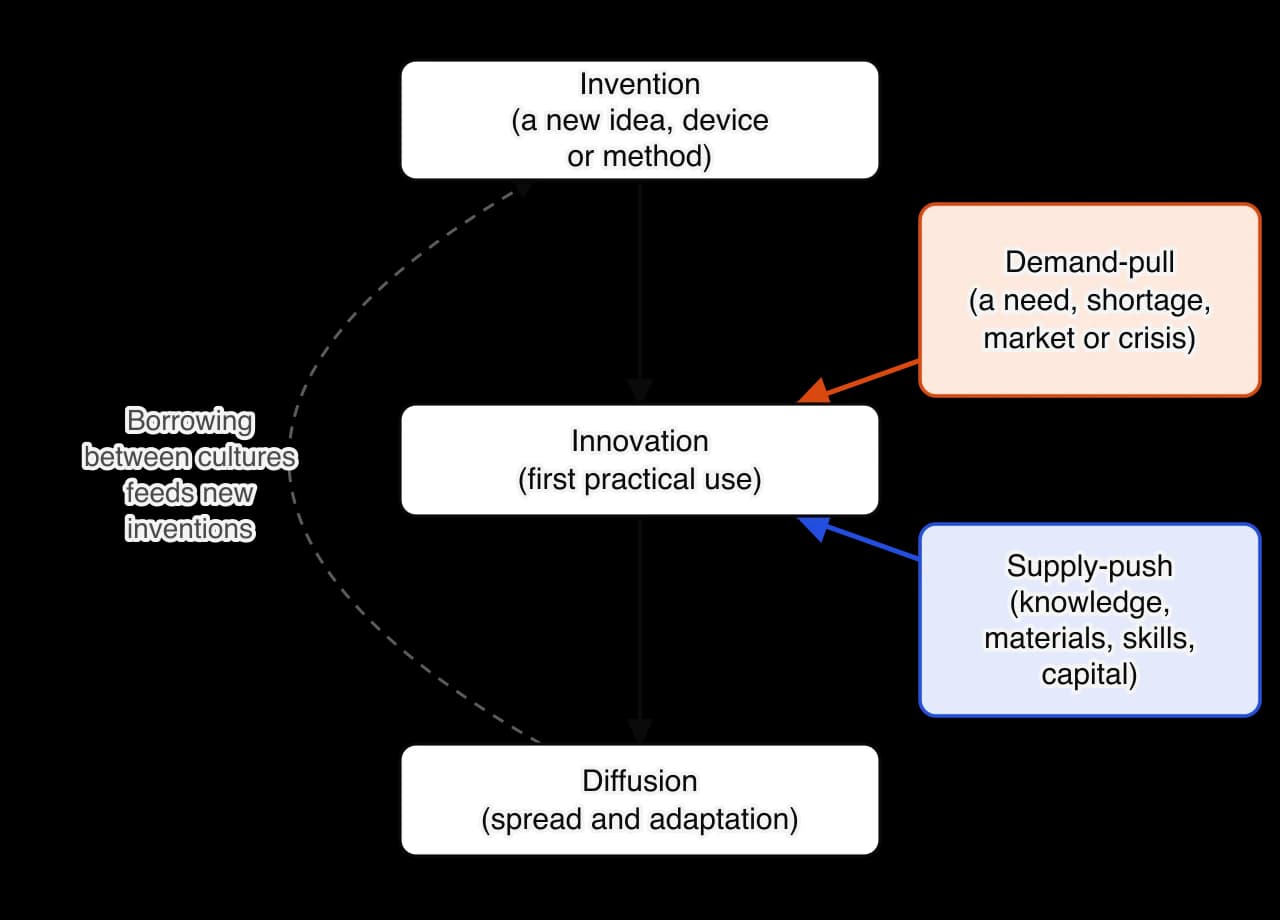
The diagram of the two pressures shows why both are needed. A need without the means to meet it produces no innovation: famine threatened South Asia many times before the 1960s, but high-yielding seed did not exist until plant breeders in Mexico produced it. Means without a need produce inventions that nobody adopts. Most strong explanations show the two meeting, and then ask which one changed first.
Individuals and structures
A second debate is about agency. Popular histories often tell the story of a heroic inventor, a version of the great man theory: Gutenberg and the printing press, James Watt and the steam engine, Norman Borlaug and the "miracle" wheat. Structural explanations stress the conditions that made such people possible and the many others who contributed, from the craftsmen who built the machines to the farmers who tested the seed.
Writing in 1776, the Scottish economist Adam Smith already identified three sources of new machines.
A great part of the machines made use of in those manufactures in which labour is most subdivided, were originally the invention of common workmen, who, being each of them employed in some very simple operation, naturally turned their thoughts towards finding out easier and readier methods of performing it. … Many improvements have been made by the ingenuity of the makers of the machines, when to make them became the business of a peculiar trade; and some by that of those who are called philosophers, or men of speculation.
Adam Smith, An Inquiry into the Nature and Causes of the Wealth of Nations, Book I, chapter 1, 1776. Smith wrote to show the benefits of the division of labour, so he had a reason to stress improvements made by ordinary workers. Even so, the passage shows a contemporary observer of early industrial Britain seeing invention as the work of three groups (users, specialist machine-makers and scientists), not of lone geniuses.
Most historians now combine the two approaches. Individuals made choices that mattered: Gutenberg spent borrowed money on an untested idea, and Borlaug decided to breed wheat in two Mexican locations a year to halve the time each generation took. But their choices only produced innovations because markets, institutions and earlier knowledge were ready to support them.
Transfer and borrowing between cultures
Very few innovations were invented from nothing in the place where they were adopted. Most were technology transfer: knowledge carried by trade, war, migration, missionaries or scholars, then adapted to local needs. Paper moved from China across Central Asia to Samarkand and Baghdad. Abbasid scholars translated Greek, Persian and Indian works into Arabic and built on them. The Green Revolution's wheat combined Mexican varieties with a Japanese dwarf strain, and M-Pesa grew out of a British government grant, a Vodafone pilot and the habits of Kenyan and other African phone users.
Openness to outside knowledge is therefore itself a cause of innovation. Societies at the crossroads of trade routes, or with institutions that collected and translated foreign learning, had more ideas to choose from and combine.
Social factors
Social factors are features of a society's people and culture: how many there were and where they lived, how many could read, what they believed and valued, how scholars and craftsmen were organised, and how open the society was to newcomers and new ideas. They shaped innovation in two ways. They created demand, because literate, urban or growing populations wanted new goods; and they created supply, because schools, religious institutions and networks of scholars produced the people able to invent.
Religion, learning and the Abbasid translation movement
The Abbasid Caliphate, which ruled most of the Islamic world from 750 and founded Baghdad as its capital in 762, sponsored one of the largest transfers of knowledge in history. Over about two centuries, scholars in Baghdad translated hundreds of Greek works on philosophy, medicine, astronomy and mathematics into Arabic, along with Persian and Sanskrit texts. This translation movement supplied the knowledge on which new work was built, such as Muhammad ibn Musa al-Khwarizmi's book on algebra, written in Baghdad around 820.
Religious and social needs created part of the demand. Muslims needed to calculate the direction of Mecca for prayer, the times of the five daily prayers and the start of the lunar months, which made astronomy and mathematics practical sciences. Islamic inheritance law divides an estate between many relatives in fixed fractions, and the longest part of al-Khwarizmi's algebra book deals with inheritance problems, alongside other legal and commercial calculations. Doctors wanted Galen's medical works, and officials wanted accurate land measurement for taxation.
The movement also depended on people. Baghdad drew Syriac-speaking Christian scholars who already knew Greek, Persian administrators trained in an older imperial culture, and scholars from India and Central Asia. Hunayn ibn Ishaq, a Nestorian Christian doctor who translated many of Galen's works in the ninth century, is the best-known translator. A mixed, multilingual elite, brought together in a new imperial capital, was a social precondition that no single ruler could have created.
Literacy, education and demand for books
Rising literacy creates demand for cheaper ways of producing text. In Song China the civil-service examinations created a large class of men who spent years studying the Confucian classics. In fifteenth-century Europe the number of readers was also growing. Universities had multiplied since the twelfth century; merchants needed reading and arithmetic for business; and lay people bought devotional books such as books of hours.
Hand copying could not keep up. A trained scribe might take months to copy a Bible. Before Gutenberg, workshops already produced cheap woodcut prints of saints and short block-printed books, which shows that a market for cheaper texts existed before movable metal type. The religious culture of the time added more demand: the Church sold indulgences on printed forms, and among the earliest dated products of Gutenberg's Mainz workshop were indulgence forms printed in 1454–1455, ordered in thousands of copies.
In March 1455 Enea Silvio Piccolomini, a senior churchman who later became Pope Pius II, wrote to Cardinal Juan de Carvajal about the printed Bible that had been shown at Frankfurt in 1454. He reported that he had seen some of its quires (gatherings of pages), praised the clear, regular script, and passed on reports that buyers had been found for the copies before the edition was finished. The letter shows that the Church elite, the main users of Latin Bibles, formed a market for printed books from the start. Gutenberg's own printing press, adapted from the screw presses used for wine, olive oil and paper, combined with a hand mould for casting metal type and an oil-based ink, was the supply-side breakthrough that met this demand. Gutenberg's background in metalworking mattered here: in Strasbourg in the late 1430s he taught gem polishing and made metal pilgrim mirrors, skills close to those needed to cast type accurately. The result, the Gutenberg Bible, was completed in Mainz in about 1454–1455 in an edition of roughly 180 copies.
Useful knowledge and the industrial enlightenment in Britain
Eighteenth-century Britain had an unusually dense network linking scientists, engineers, manufacturers and skilled craftsmen. The Royal Society (founded 1660), the Society of Arts (1754), which offered prizes for useful inventions, and provincial clubs such as the Lunar Society of Birmingham, whose members included Matthew Boulton, James Watt, the potter Josiah Wedgwood and the chemist Joseph Priestley, brought these groups together. Public lectures on mechanics, cheap technical books and a large trade in scientific instruments spread practical knowledge well beyond the universities.
The economic historian Joel Mokyr calls this culture an industrial enlightenment: the belief, drawn from the Enlightenment, that systematic knowledge of nature could and should be used to improve production. In The Enlightened Economy (2009) he argues that it explains why Britain had so many people able to build, repair and improve machines. Watt is an example: he worked as an instrument maker at the University of Glasgow, where he repaired a model Newcomen engine in 1763–1764 and discussed heat with the chemist Joseph Black before devising his separate condenser in 1765.
Population growth, cities and migration
Population pressure is one of the oldest explanations for innovation. The economist Ester Boserup argued in The Conditions of Agricultural Growth (1965) that rising population density pushes farmers to adopt more intensive methods, the reverse of the older view that food supply limits population. Song China's population roughly doubled between the tenth and the twelfth century, and its farmers adopted new early-ripening rice, more double-cropping and more irrigation. In eighteenth-century Britain, population rose from about 5 million in England in 1700 to over 8 million by 1800, while agricultural improvements (new crop rotations with turnips and clover, enclosure of open fields, selective breeding) fed more people with a smaller share of the workforce, freeing labour for industry. In India in the 1960s, a population growing by more than 2 per cent a year and repeated food crises created pressure for the Green Revolution. The Bengal famine of 1943 was within living memory; estimates of its deaths range from about 1.5 million (the official Famine Inquiry Commission of 1945) to 3 million or more, and books such as the American biologist Paul Ehrlich's The Population Bomb (1968) predicted mass famine in South Asia.
Cities concentrated demand and skills. Kaifeng, the Northern Song capital, and Hangzhou, the Southern Song capital, each had a population that historians estimate at between several hundred thousand and over a million, with markets, printers and workshops. Mainz, Strasbourg and the other cities of the Rhine where early printing developed were centres of trade, goldsmithing and church administration.
Migration spread skills. Gutenberg himself worked in Strasbourg for about a decade in the 1430s and 1440s before returning to Mainz; his partner Peter Schöffer had worked as a scribe in Paris. In Kenya, the movement of workers from rural areas to Nairobi and other towns meant that millions of families depended on sending money home, a need that shaped M-Pesa.
Economic factors
Economic factors decide whether an invention is worth adopting. An idea becomes an innovation only when someone expects it to pay: because buyers want the product, because it cuts the cost of something already made, or because it beats competitors. Markets, trade networks, capital and credit, relative prices, property rights and competition all affected that calculation.
Markets, trade and the cost of materials
Paper in Baghdad shows a cost advantage at work. The Abbasid state ran a huge written administration of tax registers, correspondence and accounts. Its older writing materials were Egyptian papyrus, which had to be imported and did not grow in Iraq, and parchment, made from animal skins and expensive. Papermaking was already practised in Samarkand in Central Asia. A popular story, first told by Arab writers in the tenth and eleventh centuries, says that Chinese prisoners captured at the Battle of Talas in 751 taught it to the Muslims; the historian Jonathan Bloom, in Paper Before Print (2001), argues that this is a later legend and that paper had reached Central Asia earlier through ordinary trade and migration. From Samarkand, papermaking spread to Baghdad, where the first paper mill is usually dated to about 794–795, under the caliph Harun al-Rashid. Paper could be made locally from linen rags and hemp, and chancery officials valued it because erasures and alterations were easier to detect than on parchment.
Trade networks carried both the materials and the knowledge. The Silk Roads linked Samarkand, Baghdad and China. In Europe, the paper that Gutenberg printed most of his Bibles on came from Italian mills, and the trade fairs of Frankfurt gave printers a place to sell to buyers from across the continent. Long-distance trade also widened markets, so a printer or a cotton spinner could sell far more than the local town could buy.
Competition from imports could also drive innovation. Indian cotton cloth (calico) was so popular in Britain by 1700 that Parliament banned imports of printed Indian calicoes in 1700 and, in the second of the Calico Acts, their sale and wearing in 1721, to protect English wool and silk producers. British spinners and weavers then tried to make cotton cloth of Indian quality at home, which needed machines that could spin a fine, strong thread. The economic historian Prasannan Parthasarathi, in Why Europe Grew Rich and Asia Did Not (2011), argues that this competition with India was a central reason why Britain mechanised cotton production. By common estimates, Britain's imports of raw cotton rose from a few million pounds a year around 1760 to about 22 million in 1787 and over 50 million by 1800.
Capital, credit and investors
Developing an invention costs money long before it earns any. Gutenberg borrowed from relatives and then twice from the Mainz merchant Johann Fust, 800 guilders in about 1450 and another 800 for the Bible project, at 6 per cent interest. In 1455 Fust sued to recover the debt, which with interest had grown to over 2,000 guilders, and took control of the press and type. The case shows both how much capital printing needed and how much risk investors carried; the first great printing business belonged to Fust and his partner Schöffer, not to the inventor.
James Watt's separate condenser, patented in 1769, needed precision manufacture that Watt and his first backer, John Roebuck, could not supply. Roebuck went bankrupt in 1773, and his share passed to Matthew Boulton, who owned the Soho manufactory near Birmingham. In a letter to Watt in 1769, turning down Roebuck's offer of a share limited to three counties, Boulton explained what he had wanted from the partnership.
I was excited by two motives to offer you my assistance—which were, love of you, and love of a money-getting ingenious project. I presumed that your engine would require money, very accurate workmanship, and extensive correspondence, to make it turn out to the best advantage … my idea was to settle a manufactory near my own, by the side of our canal, where I would erect all the conveniences necessary for the completion of engines, and from which manufactory we would serve the world with engines of all sizes.
Matthew Boulton, letter to James Watt, 1769, as printed in Samuel Smiles, Lives of Boulton and Watt (1865). Boulton was a businessman writing privately to a possible partner, so he set out frankly the economic conditions an invention needed: capital, skilled workers, a canal for transport and a market wider than one region. Smiles, a Victorian writer who celebrated self-made engineers, chose letters that showed his heroes at their best, but the letter itself is a contemporary document from the Boulton papers.
Boulton and Watt became partners in 1775. In the same year Parliament extended Watt's patent to 1800, which gave the partners twenty-five years to recover their investment.
Relative prices: high wages and cheap energy
The economic historian Robert Allen offers the best-known economic explanation of why the Industrial Revolution began in Britain. In The British Industrial Revolution in Global Perspective (2009) he argues that the key inventions were not beyond the reach of other societies; what differed was whether they paid. In eighteenth-century Britain, wages were high by international standards, while coal was cheap. Machines that replaced workers and burned coal therefore cut costs in Britain but would have lost money in France or India, where labour was cheaper and energy dearer.
In Allen's account, this is why British entrepreneurs invested in developing machines like the spinning jenny (c.1764), Richard Arkwright's water frame (patented 1769) and steam engines. Once the machines had been improved enough, they became profitable elsewhere too, which explains their later diffusion. Allen's argument is a form of demand-pull: relative prices created the demand for labour-saving, energy-using technology.
The best-known British innovations followed one another quickly once the incentive existed: James Hargreaves' spinning jenny (c.1764), Arkwright's water frame (1769), Samuel Crompton's mule (1779), Watt's separate condenser (patented 1769, built with Boulton from 1775), Henry Cort's puddling process for iron (1784), and George Stephenson's locomotive Rocket on the Liverpool and Manchester Railway, the first inter-city railway, opened in 1830. Each solved a bottleneck created by the one before: faster spinning created a shortage of power, steam engines created demand for better iron, and more goods created demand for faster transport.
 YouTube
Property rights and patents
A patent gives an inventor a legal monopoly over an invention for a fixed period, so that others cannot copy it without permission. England's Statute of Monopolies (1624) allowed patents of up to fourteen years for new inventions. Supporters argue that patents encouraged investment by letting inventors such as Watt and Arkwright profit from their work. Critics point out that many important inventions, such as Samuel Crompton's spinning mule (1779), were never patented, and that Watt used his patent to block rival steam engine designs until 1800.
Secure property rights more generally mattered as well. Merchants and landowners were more willing to invest in canals, mines and mills when they trusted that the state would not seize their profits; this links the economic factors to the political settlement in Britain after 1688.
Mobile money in Kenya: a market nobody was serving
M-Pesa, a mobile money service launched by the mobile network company Safaricom and its part-owner Vodafone in March 2007, is a recent example of an economic need meeting a new technology. In the mid-2000s fewer than one in five Kenyan adults used a bank, according to the FinAccess survey of 2006. Banks had few branches outside the towns, and their fees were high. At the same time, millions of Kenyans owned a basic mobile phone, and many urban workers needed to send part of their wages to families in rural areas as remittances, usually by bus drivers, friends or slow and costly money transfer services.
Phone users had already found an improvised solution: they sent prepaid airtime to relatives, who used it or sold it on, so airtime worked as a kind of money. M-Pesa formalised this. A customer paid cash to one of Safaricom's airtime dealers acting as an agent, received electronic money on their phone, and sent it by text message to anyone with a phone, who collected it as cash from another agent. The pilot, run from 2005 for a microfinance lender, showed that customers used it mainly to send money to each other, so Safaricom relaunched it as a way for people to send money home.
Political factors
Political factors concern power: what rulers and states wanted, what they paid for, what they allowed and what they forbade. Governments could create demand (for weapons, records or food), supply resources (money, scholars, laboratories), provide the stability that made long-term investment safe, or block innovations they saw as a threat. In many cases a political decision decided the timing of an innovation more than any other factor.
Patronage: the Abbasid caliphs and the House of Wisdom
The translation movement in Baghdad depended on patrons. The caliph al-Mansur (r. 754–775), who founded Baghdad, commissioned translations of astronomical and astrological works; Harun al-Rashid (r. 786–809) and his viziers of the Barmakid family, a Persian family of administrators, supported scholars; later writers credit a Barmakid vizier (named as al-Fadl or Ja'far ibn Yahya) with setting up the first paper mill in Baghdad, so that government records could be kept on paper. Under al-Ma'mun (r. 813–833) patronage reached its peak, centred on the library known as the House of Wisdom (Bayt al-Hikma), where scholars translated and copied texts and worked on astronomy and mathematics.
Why did rulers pay for this? The classicist Dimitri Gutas, in Greek Thought, Arabic Culture (1998), argues that the movement served the political and practical needs of the Abbasid state and elite more than curiosity alone. Astrology helped rulers choose the timing of decisions; medicine and engineering had obvious uses; and the claim to inherit and surpass Greek learning helped the Abbasids present themselves as superior to their Christian rival, the Byzantine Empire, whose emperors, Gutas argues, Abbasid writers portrayed as having neglected the ancient wisdom. The tenth-century Baghdad bookseller Ibn al-Nadim recorded a story that al-Ma'mun began sending for Greek books after Aristotle appeared to him in a dream; Gutas reads the story as later propaganda for the caliph's policies, not as a literal cause.
Stability, institutions and the political settlement in Britain
Investors commit money for decades only when they trust the state. After the Glorious Revolution of 1688, Parliament controlled taxation and the crown could no longer seize property or default on its debts at will. The economists Douglass North and Barry Weingast argued in 1989 that this settlement made property rights and government borrowing more secure in England, which encouraged investment. Britain also had no internal customs barriers after the union with Scotland in 1707, giving manufacturers a large domestic market.
Political stability did not mean a peaceful Britain. Britain fought major wars in most decades of the eighteenth century, and military demand drove some innovations directly. In 1774 the ironmaster John Wilkinson patented a machine for boring cannon from solid iron; the same precise boring method produced the accurate cylinders that made Watt's engines work from 1776. The Royal Navy was the largest single buyer of iron, timber and rope in the country, and Henry Cort, who patented the puddling process for making wrought iron in 1784, had worked as a Navy agent and hoped to supply it.
Empire and control over resources
Imperial power gave some states resources that others lacked. Britain's colonies and its dominance of Atlantic trade supplied raw cotton, most of it grown by enslaved people in the Caribbean and, after the 1790s, the American South, as well as protected markets for British cloth. Pomeranz argues that these colonial "ghost acres" relieved Britain of the need to grow its own fibre, food and timber, so that labour and land could move into industry. The Abbasid caliphs, ruling an empire from Central Asia to North Africa, could likewise draw scholars, manuscripts and techniques from a vast territory into one capital.
Political fragmentation and freedom
Political structures could also allow or block innovation. Europe in the fifteenth century was divided among many states, and the Holy Roman Empire alone contained hundreds of semi-independent territories and free cities. When a city or ruler restricted printers, they could move. After Mainz was sacked in 1462 during a conflict between rival archbishops, its printers spread to other cities, and by 1500 presses operated in more than 250 European towns. The economic historian Joel Mokyr and others argue that this competition between states made it hard for any authority to suppress new ideas.
Where one authority controlled a large territory, its decisions had a bigger effect. In the Ottoman Empire, printing in Arabic script by Muslims was not authorised until 1727, when İbrahim Müteferrika received permission to open a press in Istanbul. The reasons for this delay are a question about resistance to innovation as much as its emergence.
State policy and the Green Revolution
The Green Revolution, the rapid spread from the 1960s of high-yielding varieties of wheat and rice together with fertiliser and irrigation, was the product of deliberate state and foundation policy. In 1943 the Mexican government asked the Rockefeller Foundation, a large US philanthropic organisation, for help in raising maize, wheat and bean production. The American plant scientist Norman Borlaug, who joined the programme in 1944, later described Mexico's position at the start.
At that time Mexico was importing more than fifty percent of the wheat that it consumed, as well as a considerable percentage of its maize. Wheat yields were low and static, with a national average yield of 750 kilos per hectare, even though most of the wheat was grown on irrigated land. … Mexican soils were impoverished and chemical fertilizer virtually unknown.
Norman Borlaug, Nobel Peace Prize lecture, "The Green Revolution, Peace, and Humanity", Oslo, 11 December 1970. Borlaug spoke as the scientist being honoured for the programme, so he stressed the scale of the problem and the success of research. Even so, his account shows that the programme began as a response to a specific national problem, import dependence, at the request of the Mexican government.
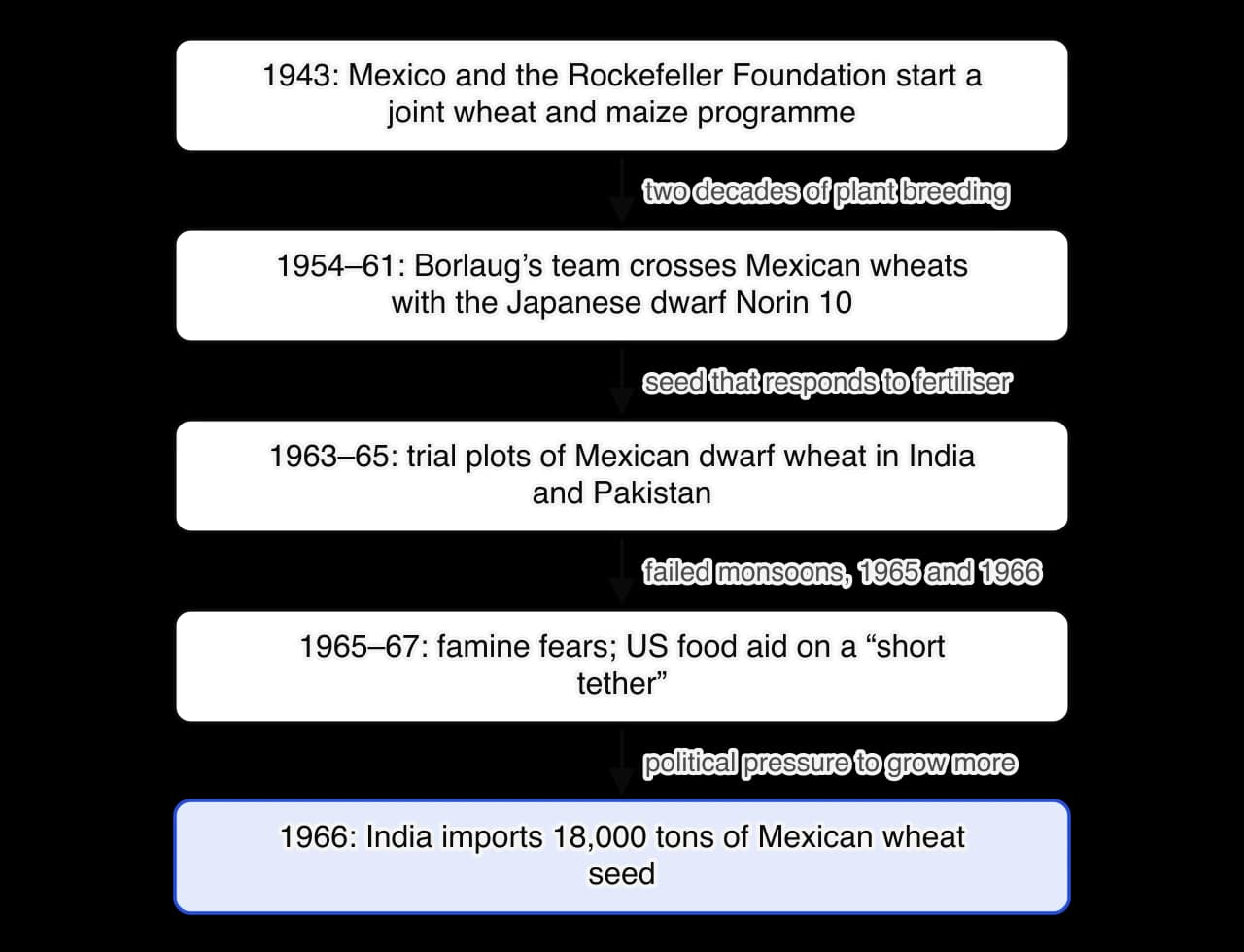
The research base was international. In 1960 the Ford and Rockefeller foundations, with the government of the Philippines, founded the International Rice Research Institute (IRRI) at Los Baños, which released the high-yielding rice IR8 in 1966. The new seeds depended on cheap nitrogen fertiliser, made possible by the Haber–Bosch process for fixing nitrogen from the air, developed in Germany in 1909–1913.
The chain from Mexico to India shows how politics turned a research success into a revolution in South Asia. India suffered failed monsoons in 1965 and 1966, and depended on US wheat shipped under the PL-480 food aid programme. President Lyndon Johnson deliberately released these shipments a few months at a time, a policy known as the "short tether", to press India to give priority to its own agriculture. India's food minister, C. Subramaniam, with the scientist M. S. Swaminathan, pushed through the import of 18,000 tons of Mexican wheat seed in 1966, together with fertiliser imports and guaranteed prices for farmers.
Cold War rivalry gave the United States a strong motive. American officials feared that hunger would push poor countries towards communism. When William Gaud, the head of the US Agency for International Development (USAID), named the new movement in a speech in Washington, he framed it in exactly these terms.
These and other developments in the field of agriculture contain the makings of a new revolution. It is not a violent Red Revolution like that of the Soviets, nor is it a White Revolution like that of the Shah of Iran. I call it the Green Revolution.
William S. Gaud, Administrator of USAID, address to the Society for International Development, Washington DC, 8 March 1968. Gaud was speaking to an audience of development professionals at the height of the Cold War, and his choice of words presents agricultural technology as a peaceful alternative to communist revolution. The speech shows that, for the US government, the political purpose of the innovation was part of the reason for promoting it.
Regulation: allowing mobile money in Kenya
In Kenya the decisive political choice was to allow M-Pesa at all. A mobile phone company holding customers' money looked like a bank, and banking law could have stopped it. The Central Bank of Kenya chose to let the service start and to watch it closely, an approach later described as "test and learn". When banks lobbied against the service in late 2008, a government audit found it safe and it was allowed to continue. The UK government's Department for International Development (DFID) had already paid part of the cost of developing and piloting the service through a grant to Vodafone from its Financial Deepening Challenge Fund.
Political crisis also increased demand. During the violence that followed the disputed presidential election of December 2007, in which more than 1,100 people were killed, many Kenyans used M-Pesa to send money safely to relatives in areas where travel was dangerous and banks were closed.
Environmental factors
Environmental factors are features of the natural world: climate and weather, soils, rivers and coastlines, mineral deposits, and disease. They acted on innovation in two ways. Environmental shocks such as drought, crop failure and epidemics created urgent problems to solve. Environmental resources such as coal, fast-flowing rivers and fertile land supplied the means of solving them, or made some solutions cheaper in one place than in another.
Climate stress and crop failure
Several of the core innovations followed environmental crises. In 1011–1012 drought struck the rice-growing lands of the lower Yangzi and Huai rivers in China, and the Song court responded by distributing a drought-resistant, quick-ripening rice from Fujian, known as Champa rice. In India, the monsoon failed in 1965 and again in 1966, food grain production fell sharply, and parts of Bihar faced famine conditions in 1966–1967. The crisis was the moment when Indian leaders decided to adopt the Mexican wheat on a large scale.
Disease could act in the same way. Smallpox was one of the main killers of the eighteenth century, and inoculation with live smallpox matter was already practised in China, India, the Ottoman Empire and Africa before Lady Mary Wortley Montagu promoted it in England in the 1720s. In 1796 the English doctor Edward Jenner tested the safer method of vaccination with cowpox, which built on the observation that milkmaids who caught cowpox did not catch smallpox.
Resources: coal, water and raw materials
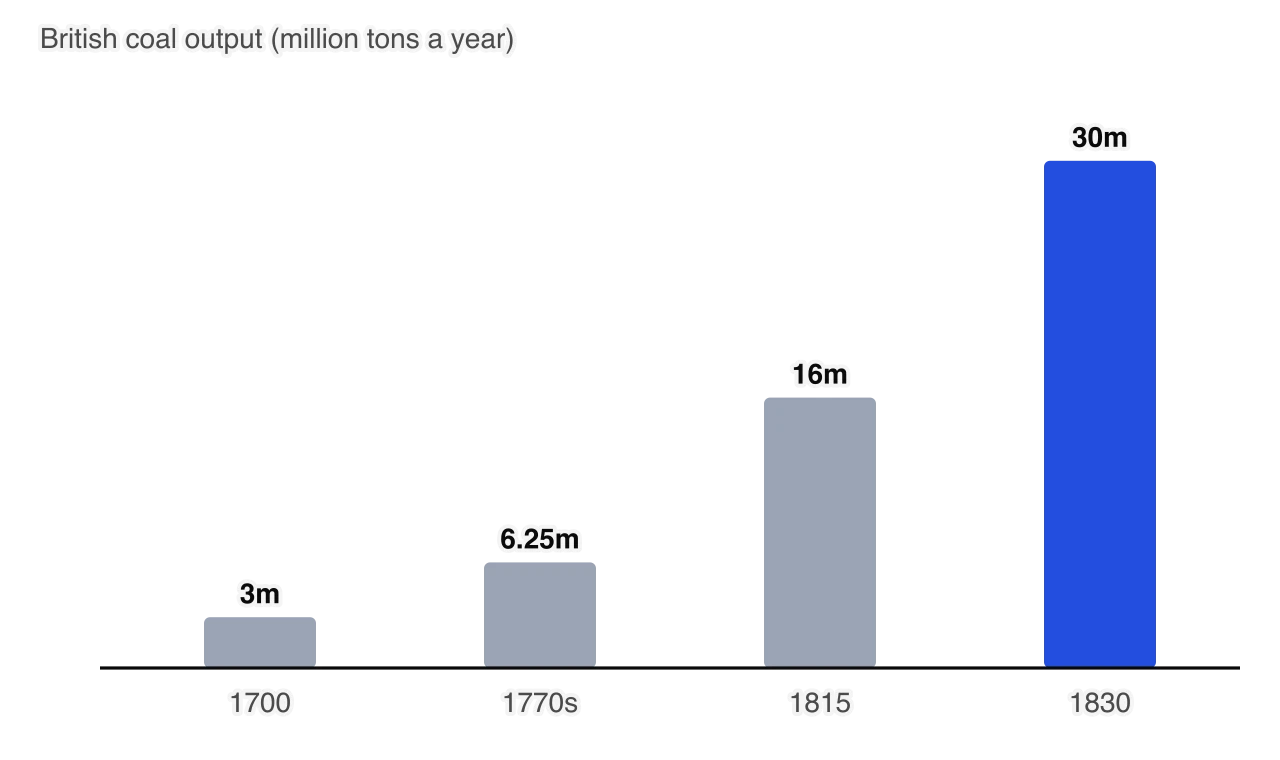
The bar chart of British coal output shows how much energy Britain had available. Coal mining was already a large industry in 1700, mainly for heating London and other towns; output doubled by the 1770s and rose roughly fivefold again by 1830. Steam engines were first used at coal mines, to pump out water, where fuel was almost free. Thomas Newcomen's engine of 1712 was so wasteful of coal that it paid only at or near the pithead, which is why Watt's more efficient engine mattered.
Water was the other key source of power. Richard Arkwright built his first water-powered cotton mill at Cromford in Derbyshire in 1771 on a fast stream, and water power remained widely used in the cotton industry into the 1830s. In Baghdad, the first paper mills used water power on the Tigris and the canals around the city to beat rags into pulp.
Geography affected the cost of moving resources. Britain is an island with long coasts and navigable rivers, so coal could travel cheaply by sea from Newcastle to London. When the Duke of Bridgewater's canal opened in 1761 to carry coal from his mines at Worsley to Manchester, the price of coal in Manchester fell by about half, and a canal-building boom followed.
Environmental determinism and its limits
Environmental explanations are attractive because resources and climates can be measured. But they explain why innovations were possible or profitable, not why they happened. Northern China had large coal and iron deposits, and the Song iron industry used coal on a large scale in the eleventh century, but China did not develop steam power. The historian Kenneth Pomeranz argues that a key difference was location: China's main coal fields lay in the north-west, far from the commercial heartland of the lower Yangzi, while Britain's coal lay close to its industrial towns and to water transport.
Case study: why Song China innovated, 960–1279
The Song dynasty ruled China from 960 to 1279, at first from Kaifeng in the north (the Northern Song) and, after the Jurchen Jin conquered northern China in 1127, from Hangzhou in the south (the Southern Song). In these three centuries China adopted early-ripening rice on a large scale, printed books in great numbers, issued the world's first government paper money, used gunpowder weapons in war and used the magnetic compass at sea. Song China is therefore the clearest case of a cluster of innovations in one society, and a test of how the four kinds of factor worked together.

The chronology of the Song dynasty shows the clustering. Most of the innovations appeared in the first century of the dynasty, between the reunification of China and the reforms of the 1070s, when a strong central state, a fast-growing economy and continual military pressure from the north came together.
 YouTube
Champa rice: an environmental shock and a political decision
Rice in the Yangzi valley was usually planted once a year and needed a long growing season and a reliable water supply. Varieties from Champa, a kingdom in what is now central Vietnam, had reached Fujian on the south-east coast earlier. They ripened in about 100 days after transplanting instead of 150, needed less water and tolerated drought. When drought struck the lower Yangzi, Huai and Zhejiang regions in 1011–1012, Emperor Zhenzong ordered about 30,000 bushels of Champa seed to be brought from Fujian and distributed to farmers there, with instructions on how to grow it.
The innovation was therefore not the variety itself, which already existed, but its deliberate transfer by the state into a new region in response to a crisis. Over the following two centuries, early-ripening rice allowed double-cropping in the warm, wet south and the farming of higher, drier land. Together with irrigation, fertilising with manure and the clearing of new land, it supported a population that roughly doubled: by about 1100 the census recorded some 20 million households, around 100 million people by most estimates.
Commerce and paper money: an economic problem and state action
Population growth, rising farm output and a dense network of canals and rivers produced what many historians call a commercial revolution. Markets spread into the countryside, cities grew, tea, silk, porcelain and iron were traded across the empire and overseas, and the state collected a growing share of its revenue from commercial taxes. The Song minted copper coins in enormous quantities, about 6 billion a year by 1085, yet coins were never plentiful enough for the volume of trade, and many flowed out to Japan, Korea and Southeast Asia.
The problem was worst in Sichuan, in the south-west, where the government had made iron the main coinage. Iron coins were heavy and of low value, so carrying enough of them for a large purchase was impractical. Merchants in Chengdu began to issue paper certificates, called jiaozi, which could be exchanged for coins; a group of sixteen leading merchant houses later took over and standardised the notes. When some issuers went bankrupt and could not redeem their notes, the state took over. A government Jiaozi Bureau was set up in 1023, and the first official notes were issued in 1024.
Paper money combined several factors: an economic need (trade had outgrown heavy coinage), a supply-side condition (cheap paper and printing technology), and a political decision (the state took over to restore trust and to profit from issuing money). Later Song governments printed notes in such quantities to pay for war that their value fell, an unintended consequence of the innovation rather than a cause of it.
The examination state and printing
The Song rulers governed through scholar-officials recruited by competitive written examinations on the Confucian classics. Emperor Taizong enlarged the civil-service examinations from 977, and over the dynasty the number of candidates grew into the hundreds of thousands. Every candidate needed accurate copies of the classics and commentaries, which created a large and steady demand for books. The Directorate of Education in Kaifeng printed official editions of the classics from woodblocks, and private commercial printers, especially in Jianyang in Fujian, produced cheaper editions, examination guides and encyclopedias.
Religion added to the demand. Buddhism was widespread, and between 971 and 983 the complete Buddhist canon was carved at Chengdu on about 130,000 woodblocks, at imperial command. Woodblock printing, in which each page was carved as one block, already suited Chinese needs well: a block could be stored and reprinted whenever more copies were wanted.
In the 1040s a commoner named Bi Sheng invented movable type, made from individual characters of baked clay. The only account of his method comes from the scholar-official Shen Kuo, who wrote it down in his Dream Pool Essays about forty years later.
If one were to print only two or three copies, this method would be neither simple nor easy. But for printing hundreds or thousands of copies, it was marvelously quick. As a rule he kept two formes going. While the impression was being made from the one forme, the type was being put in place on the other.
Shen Kuo, Dream Pool Essays (Mengxi Bitan), completed c.1088, translated by Thomas F. Carter in The Invention of Printing in China, as given in Joseph Needham and Tsien Tsuen-hsuin, Science and Civilisation in China, vol. 5 part 1 (1985). Shen Kuo was an official with wide scientific interests who recorded inventions and techniques he thought remarkable, writing for an educated readership rather than for printers. His comment on costs explains both why the invention was useful and why it spread slowly: movable type paid only for large print runs.
War, the state and gunpowder
The Song never controlled the northern frontier securely. The Khitan Liao dynasty held territory south of the Great Wall, and in the Treaty of Chanyuan of 1005 the Song agreed to pay it annual "gifts" of silk and silver. From 1038 the Tangut state of the Western Xia fought the Song in the north-west, and in the twelfth century the Jurchen Jin conquered the whole north. Military pressure was continuous, and the Song state kept a standing army of more than a million men by the mid-eleventh century.
Gunpowder had been discovered earlier, probably by alchemists of the Tang period searching for elixirs. The Song state turned it into an organised military technology. The Wujing Zongyao, a military manual compiled by order of Emperor Renzong and completed in 1044 during the war with the Western Xia, contains the earliest surviving written formulas for gunpowder, for use in incendiary arrows and bombs thrown by catapult. State arsenals in Kaifeng produced such weapons in large numbers, and by the 1130s Song defenders used the fire lance, a bamboo tube of gunpowder fixed to a spear.
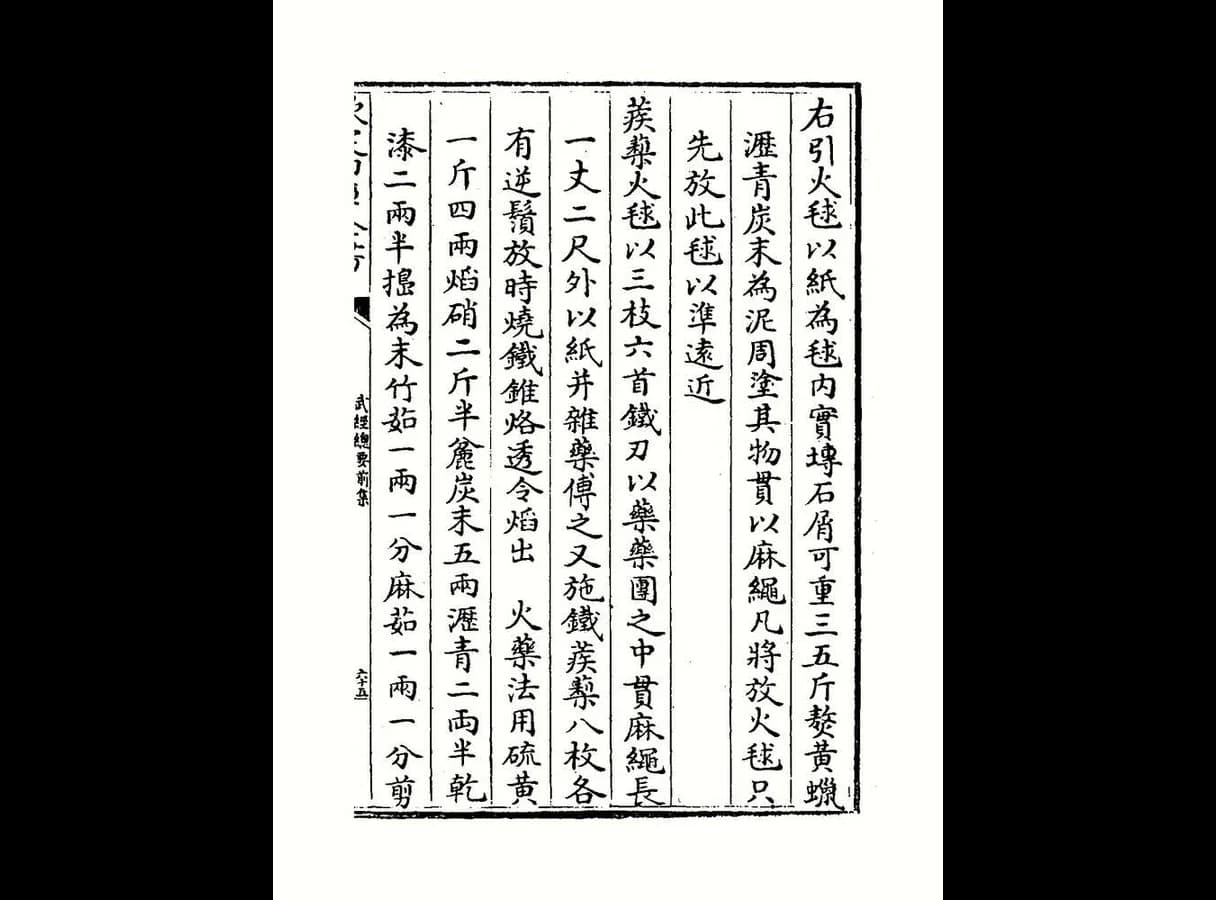
The recipe page shows that the state, not individual inventors, organised this innovation: the manual was written by officials for the court, recorded exact quantities and was intended for arsenals. The same military pressure helped explain other Song innovations, such as a permanent navy, set up in the twelfth century after the court moved south, and the use of the magnetic compass at sea, first recorded by Zhu Yu in 1119.
Resources and industry
Northern China had large deposits of iron ore and coal. As forests near Kaifeng were cut down, households and ironworks turned to coal, and by the late eleventh century iron output was very high: the historian Robert Hartwell, working from tax records, estimated it at around 125,000 tons in 1078. Later historians treat the exact figure as a rough estimate, but accept that it points to a very large industry. Iron went into farm tools, weapons, armour and coins. This shows that the environmental base of an "industrial" economy was present in Song China.
Weighing the factors in the Song case
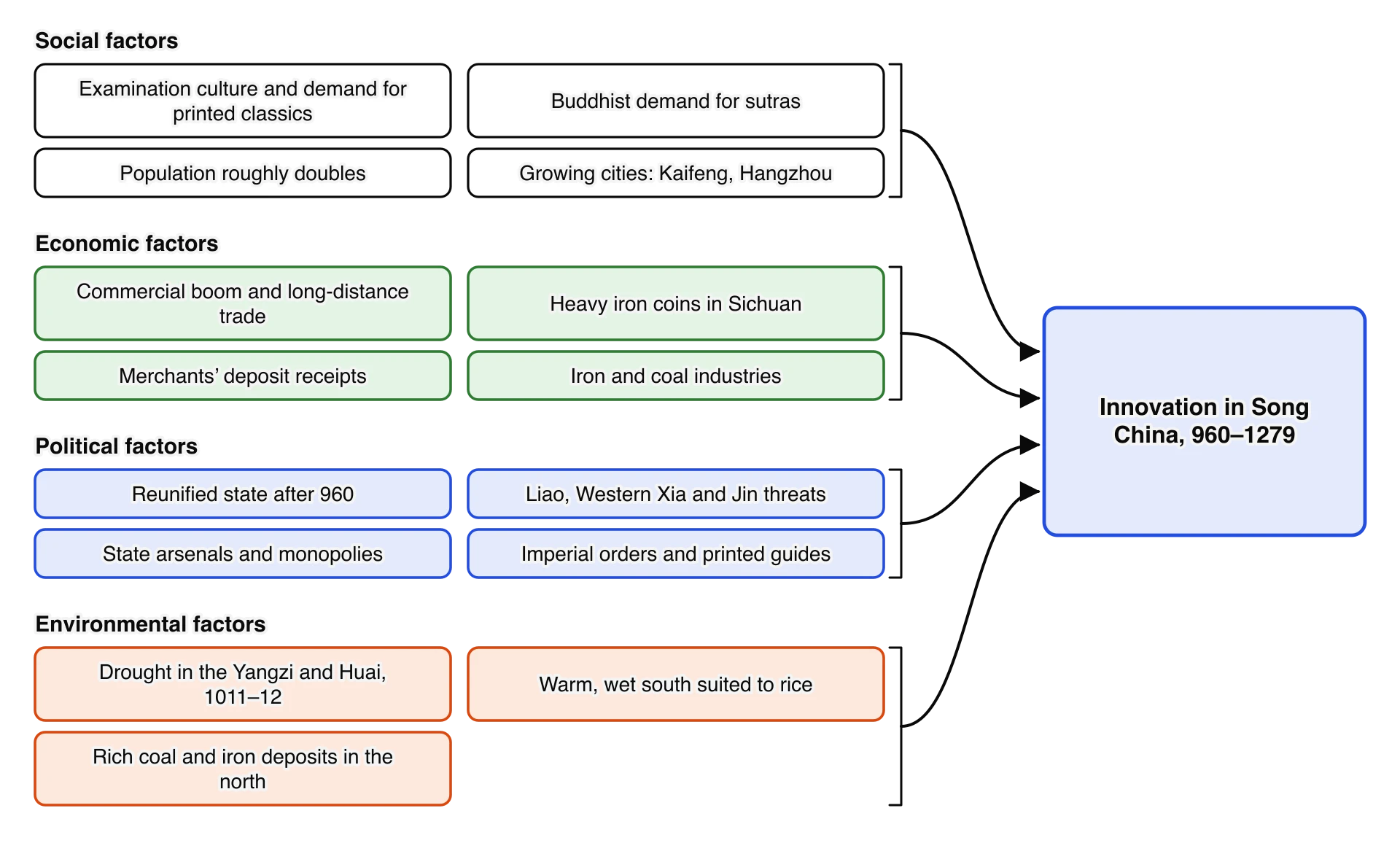
The diagram of Song factors groups the causes into the four kinds of factor. The strongest explanation combines them. Economic growth and a commercialising society created demand (for money, books, tools) and the wealth to pay for innovation. The state turned possibilities into widespread practice: it distributed Champa rice, took over paper money, printed the classics and organised gunpowder production. Military pressure gave it the motive to do so. Environmental shocks and resources supplied particular problems and means.
Political factors stand out in the Song case because the state was the main agent in almost every innovation. That conclusion does not hold for every society: in Kenya after 2007 or in eighteenth-century Britain, private companies and entrepreneurs played the leading role. Comparing Song China with the other cases is what allows a judgement about which factors mattered most in general.
Comparing the cases and weighing the factors
Each of the core innovations emerged from a combination of factors, but the combination and the leading factor differed. The comparison table sets out the main evidence for each line of inquiry in each case.
Innovation (region) | Social | Economic | Political | Environmental | Leading factor |
|---|---|---|---|---|---|
Paper and translation, Baghdad, c.750–1000 (Africa and the Middle East) | Islam's demand for astronomy, mathematics and law; multilingual scholars | Paper cheaper than parchment and made locally; Silk Road trade | Caliphs' and viziers' patronage; rivalry with Byzantium; a vast bureaucracy | Rivers for water-powered mills; no local papyrus | Political (patronage and state needs) |
Song China, 960–1279 (Asia) | Examination culture; Buddhism; population doubles | Commercial revolution; heavy coinage; iron industry | Reunified state; war on the northern frontier; state arsenals and monopolies | Drought of 1011–12; rice-growing south; coal and iron | Political, acting on economic needs |
Printing press, Europe, c.1450–1600 (Europe) | Rising literacy; universities; devotional reading | Market for books and indulgences; Fust's capital; Italian paper | Many small states; printers could move | Little direct role | Economic and social demand |
Industrial Revolution, Britain, c.1760–1850 (Europe) | Industrial enlightenment; scientific societies | High wages and cheap coal; Atlantic markets; patents; Indian competition | Stable state after 1688; Navy demand; empire | Accessible coal; rivers and coasts | Economic (relative prices), with resources |
Green Revolution, Mexico and India, c.1943–1980 (the Americas and Asia) | Rapid population growth; trained scientists | Cheap fertiliser; guaranteed prices for farmers |
The table is a summary; the "leading factor" column is a judgement that can be challenged with evidence.
Patterns across the cases
Four patterns appear when the cases are compared.
Political factors decided timing and scale where states led. In Baghdad, Song China and the Green Revolution, a ruler or government chose to adopt, pay for and spread an innovation, and did so at a particular moment: al-Ma'mun's patronage, Zhenzong's order of 1012, India's seed imports of 1966.
Economic factors decided adoption where markets led. Gutenberg's press, the cotton machines and M-Pesa were private ventures that succeeded because they cut costs or met an unserved demand. Governments mattered here mainly by allowing them (patents, permissive regulation, freedom to move).
Environmental factors were usually triggers or enabling conditions. Drought in 1011–1012 and 1965–1966 set off decisions; coal and water made British machines cheap to run. In no case did the environment produce an innovation without human choice.
Social factors were long-term preconditions. Literacy, religious demand for texts, scholarly networks and population growth built up over generations and made societies ready to use innovations when they appeared.
These patterns also show how factors connect. In Song China, population growth (social) increased trade (economic), which outgrew the coinage, which led the state (political) to take over paper money. In India, failed monsoons (environmental) made famine likely in a fast-growing population (social), which gave the US government a lever (political) and made farmers willing to buy seed and fertiliser (economic). The strongest explanations follow these links instead of treating each factor separately.
Perspectives and debates
Why did Britain industrialise first?
The causes of the British Industrial Revolution are among the most debated questions in economic history. Each major interpretation emphasises a different line of inquiry.
Historian and work | Main argument | Kind of factor stressed | Evidence stressed |
|---|---|---|---|
Robert Allen, The British Industrial Revolution in Global Perspective (2009) | High wages and cheap coal made labour-saving, energy-using machines profitable in Britain first | Economic (relative prices); environmental (coal) | Comparisons of wages and energy prices in London, Paris, Beijing and Delhi; profitability of the jenny and steam engine |
Joel Mokyr, The Enlightened Economy (2009) | An industrial enlightenment spread useful knowledge between scientists and craftsmen, and Britain had many skilled mechanics | Social and cultural (ideas, institutions) | Scientific societies such as the Lunar Society of Birmingham; engineers' training; the flow of technical publications |
Kenneth Pomeranz, The Great Divergence (2000) | Until about 1800 the Yangzi delta and England were similar; Britain diverged because its coal was close to industry and its colonies supplied land-intensive goods | Environmental (coal location); political (empire) | Living standards in China and Europe; coal geography; New World cotton, sugar and timber |
Eric Williams, Capitalism and Slavery (1944) | Profits from the slave trade and slave plantations helped finance British industry | Economic (capital); political (empire) | Fortunes of Liverpool and Bristol merchants; plantation profits |
Douglass North and Barry Weingast (1989) | The 1688 settlement made property rights and state borrowing secure | Political (institutions) | Parliament's control of taxation; falling interest rates on government debt |
Each interpretation has critics. Allen's wage data have been challenged by historians who find British wages lower, especially outside London; Mokyr is criticised for describing a culture that is hard to measure. Williams's argument that slave-trade profits financed industry was attacked by historians such as Stanley Engerman, who calculated that those profits were too small a share of British investment; later historians such as Joseph Inikori shifted the argument to the importance of Atlantic markets and slave-grown cotton. Pomeranz's comparison of China and England has been challenged by historians who find that living standards in the Yangzi delta had already fallen behind by 1700.
The interpretations are not exclusive. Allen explains why British entrepreneurs wanted machines; Mokyr explains why Britain had the people able to build and improve them; Pomeranz explains why growth could continue without running out of land and energy. Many historians now combine them, while still disagreeing about which carries most weight.
The Great Divergence and the Needham question
The British debate is part of a wider one. The biochemist and historian Joseph Needham, who spent most of his career writing the many-volume Science and Civilisation in China (from 1954), asked why China, which led the world in many technologies in the Song period, did not go on to develop modern science and industry. This is known as the Needham question.
The historian Mark Elvin, in The Pattern of the Chinese Past (1973), answered with a high-level equilibrium trap: late imperial China had such efficient traditional farming and transport and such a large, cheap labour force that there was little incentive to invest in labour-saving machines. Elvin's explanation is close to Allen's from the other side, since both turn on the relative cost of labour. The phrase Great Divergence, popularised by Pomeranz, refers to the period after about 1800 when western Europe's economy pulled away from China's and the rest of the world's.
Eurocentrism and who gets the credit
Older histories of technology often told the story of innovation as a European achievement, beginning with Gutenberg and leading to Watt and the railway. This Eurocentrism distorts the evidence in two ways. It leaves out earlier innovations elsewhere, and it hides how much Europe borrowed: paper, the compass and gunpowder all reached Europe from China, often through the Islamic world, and Arabic numerals and algebra reached Europe through translations of works such as al-Khwarizmi's.
Printing is the clearest example. Woodblock printing was used in China from at least the seventh century, Bi Sheng made movable type in the 1040s, and Korean printers in the Goryeo kingdom used cast metal type: the Jikji, a Buddhist text printed in 1377, is the oldest surviving book printed with movable metal type, about 75 years before the Gutenberg Bible. Historians still debate whether knowledge of Asian printing reached Gutenberg; there is no clear evidence that it did, and his press, oil-based ink and type-casting mould were different.
The significance of an innovation is therefore partly a matter of perspective. Gutenberg's press mattered so much in European history because it spread rapidly in an alphabetic script, in a market economy with many competing states; Bi Sheng's type mattered less in China because woodblocks suited Chinese conditions. Neither fact makes one society "more innovative" than the other.
Heroic inventors and collective innovation
The historian Christine MacLeod, in Heroes of Invention (2007), shows how the cult of James Watt and other "heroic" inventors was built in nineteenth-century Britain through statues, biographies and memorials, partly to give engineers and industrialists public honour. Samuel Smiles's Lives of Boulton and Watt (1865), the source of Boulton's letter, belongs to this tradition. Historians since have stressed the many skilled workers, partners and investors behind each famous name, as Adam Smith had already suggested in 1776.
The debate matters for explanation. If innovation depends on lone genius, it is hard to explain why it clusters in particular places and periods. If it depends on structures (markets, states, institutions, networks), clusters such as Song China or Lancashire are easier to explain, but the decisions of individuals like al-Ma'mun, Gutenberg, Boulton or C. Subramaniam still need a place in the account.
Applying the ideas in exam questions
Paper 2 Section A: a concept question
Paper 2 Section B, Part A: political factors
Paper 2 Section B, Part B: economic factors
Paper 2 Section B, Part B: environmental pressures
Self-check
- To do:
I can define invention, innovation and diffusion and explain why each stage needs its own explanation.
- To do:
I can explain demand-pull and supply-push and use both to explain one innovation.
- To do:
I can explain the debate between individual and structural explanations, using Adam Smith or the cult of the heroic inventor.
- To do:
I can explain how cultural borrowing and technology transfer shaped paper, algebra, the Green Revolution and M-Pesa.
- To do:
I can explain how religion, literacy, scholarly networks, population growth, cities and migration contributed to innovation, with examples.
- To do:
I can explain how markets, trade, capital, relative prices, patents and competition contributed to innovation, including Allen's argument.
- To do:
I can explain how patronage, stability, war, state policy, fragmentation and regulation contributed to innovation, with examples from Baghdad, Britain, India and Kenya.
- To do:
I can explain how drought, disease, coal, water and geography contributed to innovation, and the limits of environmental explanations.
- To do:
I can explain why Song China produced Champa rice, paper money, printing and gunpowder weapons, and weigh the factors involved.
- To do:
I can compare the core innovations and judge which factor mattered most in each and in general.
- To do:
I can outline the arguments of Allen, Mokyr, Pomeranz, Williams, Elvin and Gutas, and explain the Needham question and the Great Divergence.