Explain how military outcomes, political decisions, social factors and peacebuilding established peace after conflicts from the Crusades to the Algerian War, and judge how lasting each peace was.
Each is in the History glossary, with every other term in the subject.
A legal pardon for past offences, usually for a whole group, granted to help end a conflict or reconcile former enemies.
The clause of Japan's 1947 constitution by which the Japanese people renounce war and the threat or use of force to settle international disputes.
Laws passed by Southern states in 1865–1866 to control the labour, movement and legal rights of freed African Americans.
An agreement to halt military operations, sometimes only in one area or for a set time, usually as a first step towards negotiations.
The informal settlement of the disputed presidential election of 1876, by which Republican Rutherford B. Hayes became president and federal troops were withdrawn from the South, ending Reconstruction.
The charge, first used at the Nuremberg and Tokyo trials, of planning, starting or waging a war of aggression.
The 1924 agreement that rescheduled German reparation payments and provided American loans to stabilise the German economy.
German for a dictated order; the name many Germans gave the Treaty of Versailles because Germany was not allowed to negotiate its terms.
The end of the fighting in a war and the making of peace are separate processes. Every conflict raised the same questions at its end: who had won, on what terms the fighting would stop, how the defeated and the victims would be treated, and how a society damaged by war would be rebuilt. The answers decided whether a conflict was settled for generations, as Japan’s defeat in 1945 was, or whether it left grievances that fed the next war, as many Germans’ rejection of the 1919 settlement did.
With a free account, Augment remembers where you stopped and what you have practiced.
A group of early-twentieth-century historians, named after William A. Dunning, who portrayed Reconstruction as a corrupt failure imposed on the South; their views reflected and supported segregation.
President Woodrow Wilson's statement of war aims and principles for peace, given to Congress on 8 January 1918, including open diplomacy, arms reduction, borders drawn by nationality and a League of Nations.
The amendment to the US Constitution, ratified in 1868, that made everyone born in the United States a citizen and promised all citizens the equal protection of the laws.
The federal agency created in March 1865 to help formerly enslaved people with food, schools, labour contracts and legal disputes; it worked until 1872.
Community courts in Rwanda, working nationally from 2005 to 2012, that tried nearly two million cases against people accused of taking part in the 1994 genocide, combining punishment with confession and reconciliation.
The international organisation set up by the peace settlement of 1919, which came into being in January 1920, to settle disputes peacefully and protect its members through collective security.
The agreements of 1925 in which Germany, France and Belgium accepted their shared borders, guaranteed by Britain and Italy, opening a brief period of reconciliation in Europe.
The arrangement under which former German colonies and Ottoman territories were governed after 1919 by Allied powers on behalf of the League of Nations, in theory as a step towards self-government.
Peace understood as the absence of war and direct violence, without necessarily removing the injustices behind a conflict (Johan Galtung's term).
A clandestine organisation of French army officers and settlers formed in 1961 that used bombings and assassinations to prevent Algerian independence.
The conference of the victorious powers, opened in January 1919, that drew up the treaties ending the First World War, including the Treaty of Versailles.
A formal written agreement between states that ends a state of war and sets the terms of peace, such as borders, compensation and limits on armed forces.
The longer work after a conflict of preventing it from starting again: reconstruction, new institutions, the rule of law, economic recovery, disarmament and the return of soldiers and refugees.
A deeper peace in which the injustices that caused or followed a conflict have also been addressed through justice, rights and reconciliation (Johan Galtung's term).
The members of the Republican Party in Congress who pressed for emancipation during the Civil War and for strong federal protection of Black civil and political rights during Reconstruction.
The period from 1865 to 1877 in which the defeated Confederate states were brought back into the United States and the rights of freed African Americans were defined, enforced and then abandoned.
The change in US occupation policy in Japan from about 1948, when economic recovery and anti-communism took priority over the earlier reforms.
The title of General Douglas MacArthur as head of the occupation of Japan from 1945 to 1951, also used for his headquarters.
The treaty signed in September 1951 by Japan and 48 other countries that formally ended the Second World War in Asia and the Pacific and restored Japanese sovereignty in 1952.
A temporary suspension of fighting for an agreed period, after which war may resume unless a peace is made.
A surrender in which the defeated side gives up its armed forces and its government's authority without negotiating any terms; the victors decide what follows.
A peace settlement whose terms are set by the winning side and imposed on the defeated, as opposed to a compromise negotiated between equals.
Historians separate the end of the fighting from the making of peace. Fighting can stop through a battlefield victory, a surrender, a ceasefire or simple exhaustion. Peace is the political settlement that follows: the agreed or imposed terms, the new borders and governments, and the treatment of the people who fought and suffered. The two can be years apart. The fighting between Japan and the Allies stopped in August 1945, but the treaty that formally restored peace was signed only in September 1951.
A peace treaty is a formal written agreement between states that ends a state of war and sets the terms of peace, usually covering territory, compensation, armed forces and future relations. Some wars ended with a treaty; others did not, either because one side ceased to exist or because the sides could not agree.
The way a war ended shaped the kind of peace that was possible. Where one side was completely defeated, the victor could dictate terms; where neither side could win, both had to give something up. The table of kinds of ending sets out the main patterns, each with examples from the core conflicts and from elsewhere.
Kind of ending | What it means | Core example | Other example |
|---|---|---|---|
Conquest and incorporation | One side is destroyed as a state and absorbed by the victor; there is no one left to sign a treaty | Mongol conquest of the Song, 1276–1279 | Abbasid victory over the Umayyads, 750 |
Unconditional surrender and imposed peace | The defeated side gives up all claims to bargain; the victors set the terms and may occupy the country | Japan, 1945 | Germany, 1945 |
Armistice followed by an imposed treaty | Fighting stops on agreed terms, then the victors draft the treaty with little negotiation | Germany, 1918–1919 | Bulgaria, Austria and Hungary, 1919–1920 |
Surrender of armies and political reintegration | In a civil war, the rebel armies surrender and their territory is brought back under the national government | US Civil War, 1865 | Nigerian Civil War, 1970 |
Negotiated compromise from stalemate | Neither side can win; both accept less than their war aims | Treaty of Jaffa, 1192 | Peace of Westphalia, 1648 |
Ceasefire without a peace treaty | Fighting stops but the political dispute is not settled | none among the core cases | Korean War armistice, 1953 |
Independence agreement | A colonial power negotiates its withdrawal and the transfer of power | Évian Accords, Algeria, 1962 | Lancaster House Agreement, Zimbabwe, 1979 |
Contemporaries often contrasted a peace of compromise with a victor’s peace, in which the winners impose terms on the losers. A victor’s peace could be generous or harsh. Grant’s terms at Appomattox in 1865 were generous to the defeated Confederate soldiers; the Treaty of Versailles in 1919 was seen by most Germans as harsh. Its acceptance by the defeated mattered as much as its content.
The Norwegian sociologist Johan Galtung, a founder of the academic field of peace research, gave historians a useful pair of terms in his article "Violence, Peace, and Peace Research" (1969). He distinguished the absence of direct violence from the absence of what he called structural violence: injustice built into the way a society is organised, such as denial of rights, poverty or discrimination.
The distinction helps to explain why historians judge the same settlement differently. Reconstruction after the US Civil War achieved negative peace between North and South: the Union never fought the South again. For the four million people freed from slavery, however, the end of Reconstruction in 1877 brought segregation, disenfranchisement and terror, which is a long way from positive peace. Asking "peace for whom?" is often the key to a strong judgement.
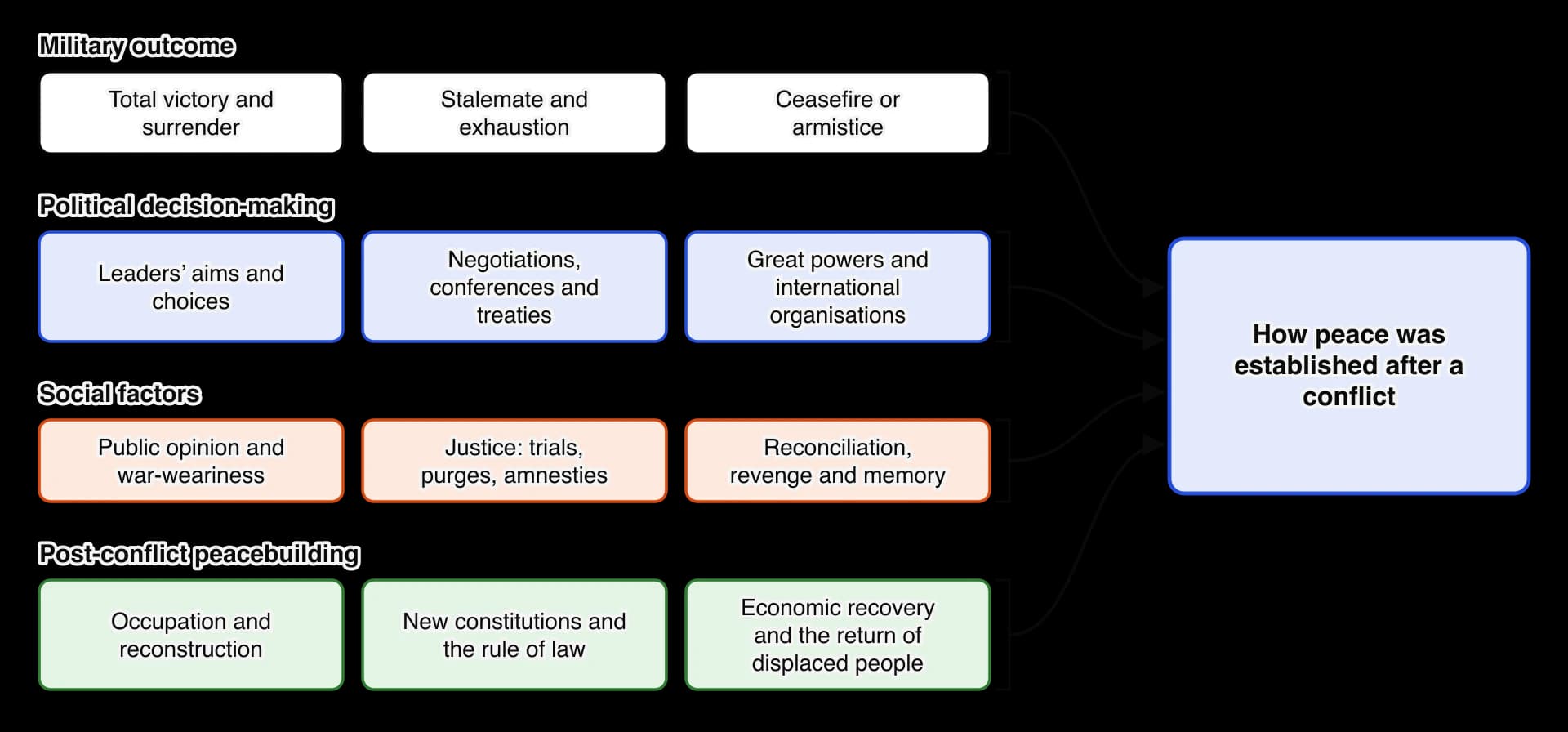
The diagram of the four kinds of factor groups the factors that explain how peace was established. They worked together. A military outcome made some kinds of peace possible and ruled others out; political decision-makers chose among the possibilities; social factors decided whether the result was accepted; and peacebuilding decided whether it lasted.
The military outcome of a war set the limits of the peace. It decided who had the power to set terms, how much the defeated side could hope to keep, and whether there was still a government on the losing side able to negotiate. Four broad patterns appear among the core conflicts: stalemate and exhaustion, total victory, a defeat that the losers did not accept as a defeat, and a decisive victory followed by a generous surrender.
The Third Crusade (1189–1192) was launched after Saladin, the sultan who ruled Egypt and Syria, destroyed the army of the crusader Kingdom of Jerusalem at Hattin in July 1187 and took Jerusalem in October 1187. The crusade led by Richard I of England recaptured Acre in July 1191 and defeated Saladin’s army at Arsuf in September 1191. Richard twice marched within reach of Jerusalem, in January and June 1192, but turned back both times. His advisers argued that even if the city could be taken, it could not be held once the crusaders went home.
By the summer of 1192 both sides were exhausted. Richard was ill and needed to return to defend his lands in England and France from his brother John and the French king Philip II. Saladin’s troops had served for years and his emirs were reluctant to keep fighting; he could not drive the crusaders from the coast. The Treaty of Jaffa, agreed on 2 September 1192 (some sources give 1 September), turned this military stalemate into a truce.
A truce of three years (some chroniclers add eight months) between the crusaders and Saladin’s territories.
The crusaders kept the coastal strip from Tyre to Jaffa, including Acre, which became the new capital of the kingdom.
Jerusalem stayed under Muslim rule, but unarmed Christian pilgrims could visit the holy places.
Ascalon, a fortress Richard had rebuilt to threaten Egypt, was to be demolished.
Neither side achieved its war aim. The crusaders did not recover Jerusalem; Saladin did not drive the Franks from the coast. The treaty was a compromise because neither army could win outright. It nonetheless gave the Frankish states a century more of life: the coastal kingdom survived until the fall of Acre in 1291.
At the other extreme, a war could end with one side destroyed. The Mongol conquest of the Southern Song, the Chinese dynasty that ruled south China from its capital at Lin’an (modern Hangzhou), took more than forty years from the first Mongol attacks in 1235. The turning point was the siege of the twin cities of Xiangyang and Fancheng on the Han River (1268–1273), which the Mongols won by building their own river fleet and bringing in Muslim engineers from the Mongol Ilkhanate in Persia and Iraq, who built counterweight siege engines.
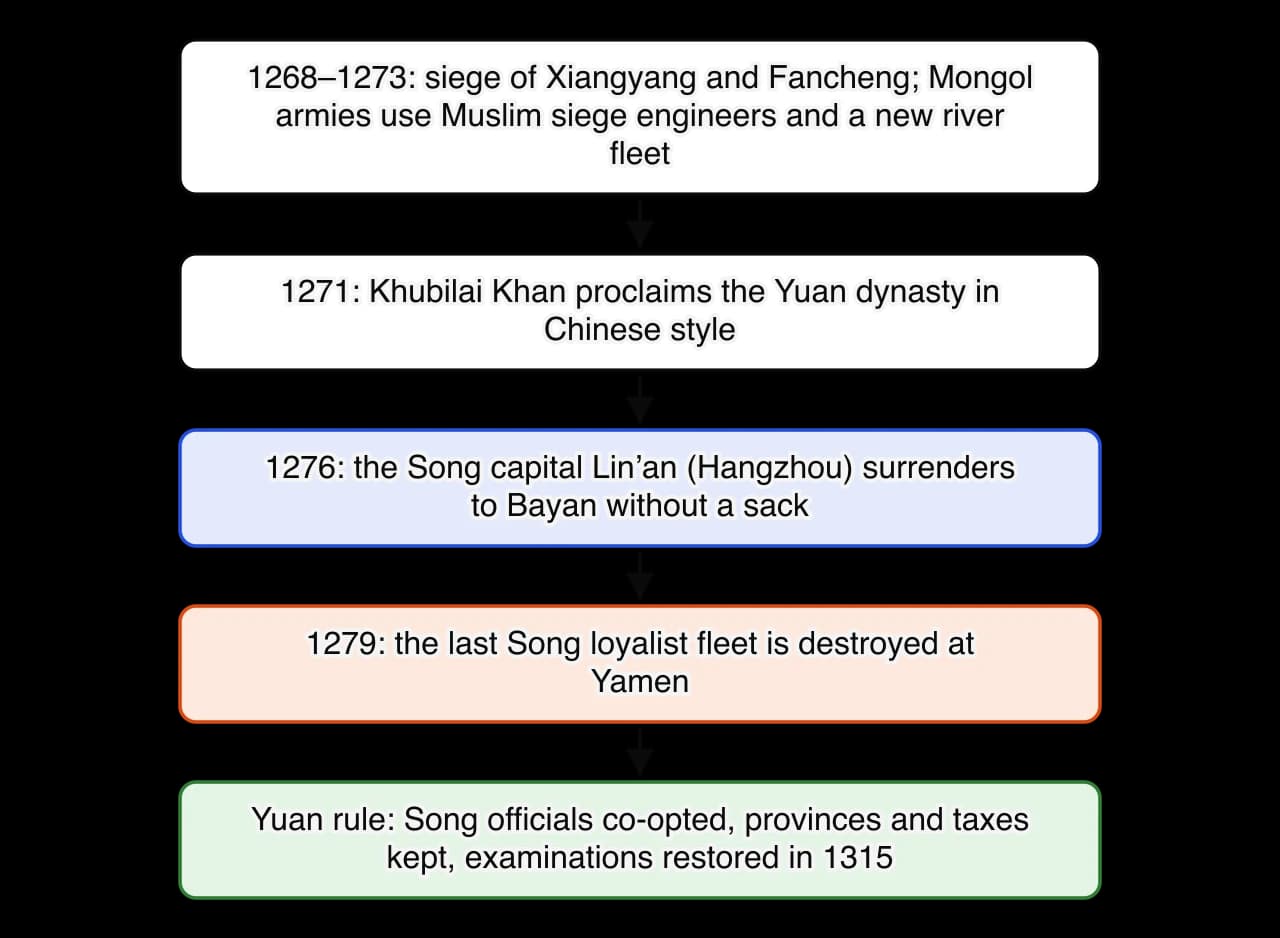
The chain from conquest to incorporation shows why there was no peace treaty. When the Mongol general Bayan reached Lin’an in 1276, the Song court surrendered, and the child emperor was taken north to Khubilai Khan’s capital at Dadu (modern Beijing). Loyalists carried on resistance in the south with other young princes until their fleet was destroyed at the Battle of Yamen in 1279. With no Song state left, peace could only come from how the new rulers governed.
Khubilai had already proclaimed the Yuan dynasty in 1271, taking a Chinese dynastic name to present himself as a legitimate emperor of China and not only a conqueror. Khubilai urged Bayan to avoid the massacres that had marked earlier Mongol campaigns in the north. The order was not always kept (the city of Changzhou was sacked after resisting in 1275), but Lin’an, one of the largest cities in the world, surrendered and was taken without a sack. Peace by conquest therefore depended on the decisions that followed the military outcome: how the Yuan governed the south after 1279.
The First World War ended with the defeat of Germany, but in a way that allowed many Germans to deny they had been beaten. After the failure of its spring offensives of 1918 and the Allied counter-offensives from August, the German army was retreating. On 29 September 1918 General Erich Ludendorff, the most powerful figure in the German high command, told Kaiser Wilhelm II that Germany must ask for an armistice at once.

The chain of events in the autumn of 1918 shows how the army leaders passed the task of ending the war to civilians. A new government under Prince Max of Baden asked President Woodrow Wilson for peace on the basis of his Fourteen Points. A naval mutiny at Kiel on 3 November spread revolution to German cities, and on 9 November the Kaiser abdicated and a republic was proclaimed. The armistice was signed at Compiègne on 11 November 1918 by a delegation led by the Catholic Centre Party politician Matthias Erzberger.
The German army was still on French and Belgian soil when the fighting stopped, and Germany itself had not been invaded. Returning troops were greeted in Berlin as undefeated. This made it easier for nationalists to spread the stab-in-the-back myth: the claim that the army had not been beaten in the field but betrayed at home by socialists, Jews and the politicians who signed the armistice. In November 1919 Paul von Hindenburg, the former chief of the general staff, gave the myth public weight in his evidence to a parliamentary inquiry.
The Second World War in Asia and the Pacific ended with total defeat. By the summer of 1945 Japan’s navy and air force were largely destroyed, American bombing had burned most of its large cities, and a naval blockade was cutting off food and raw materials. The Allies had committed themselves to unconditional surrender, a policy announced by Roosevelt at Casablanca in January 1943, so that no Axis government could later claim it had been tricked, as German nationalists claimed after 1918.
Even so, the ending was decided by a political choice. Japan’s leaders were divided until the atomic bombings of Hiroshima (6 August) and Nagasaki (9 August) and the Soviet declaration of war and invasion of Manchuria (8–9 August). Historians still debate which of these shocks mattered most. For the making of peace, the decisive step was that Japan’s leaders then chose to accept the Allied terms. The formal surrender was signed aboard the battleship USS Missouri in Tokyo Bay on 2 September 1945.
Because Japan’s defeat was complete and undeniable, no stab-in-the-back myth took hold. The armed forces were disbanded and the country was occupied, so there was no army left to resist the peace. Total military victory gave the occupiers far more freedom to remake the defeated country than the Allies had in 1919.
The US Civil War ended in a clear Union victory, and the way that victory was turned into an end to the fighting shaped the peace. By April 1865 Union armies had taken Richmond, the Confederate capital, and Robert E. Lee’s Army of Northern Virginia was surrounded near Appomattox Court House. Lee surrendered to Ulysses S. Grant on 9 April 1865.
This done, each officer and man will be allowed to return to his home, not to be disturbed by United States authority so long as they observe their paroles and the laws in force where they may reside.
Ulysses S. Grant, letter to Robert E. Lee setting out the terms of surrender, Appomattox Court House, Virginia, 9 April 1865. Grant wrote as the victorious commander, but his terms followed Lincoln’s wish for a lenient peace. By promising that paroled Confederate soldiers would not be prosecuted, and letting officers keep their side arms and men keep their horses, the terms discouraged a guerrilla war and made surrender easier for other Confederate armies, which gave up over the following weeks.
Appomattox shows that even a decisive military victory left room for choice. Grant could have imprisoned Lee’s army; he chose terms that would help the South’s soldiers return to civilian life. Whether that generosity extended to the formerly enslaved, and to the political settlement of the South, depended on decisions made in Washington over the next twelve years.
A military outcome did not settle the terms of peace by itself. Leaders had to decide what they wanted from the peace, how far to bargain, and how to sell the result at home. Their choices were shaped by their war aims, their ideas about what would make peace last, the pressure of public opinion and allies, and the interests of other great powers.
The Treaty of Jaffa was the product of more than a year of on-and-off negotiation, conducted mainly between Richard and Saladin’s brother al-Adil, while the fighting continued. Both rulers used diplomacy as part of war, testing what the other would concede. In October 1191 Richard even proposed that his widowed sister Joan should marry al-Adil and that the couple should rule Jerusalem and the coast together. The plan failed because Joan refused to marry a Muslim and al-Adil would not convert, but it shows how far both sides were willing to bargain.
Two things limited what could be agreed. Jerusalem was holy to both Christians and Muslims, so neither ruler could hand it over without losing religious legitimacy; the pilgrim clause was a way round this. Both rulers also had to keep their followers loyal: Saladin consulted his council of emirs before accepting terms, and Richard had to satisfy crusaders who had sworn to free Jerusalem. The peace was a compromise between leaders who each needed to show their own side that they had not given in. A later treaty, also signed at Jaffa in 1229, went further: the Holy Roman Emperor Frederick II and the Ayyubid sultan al-Kamil agreed by negotiation alone to return Jerusalem to Christian rule for ten years, with the Muslim holy sites left in Muslim hands, a deal condemned by hardliners on both sides.
The settlement after the First World War was made at the Paris Peace Conference, which opened on 18 January 1919. Delegates from about thirty countries attended, but the main decisions were taken by the leaders of the victorious great powers: President Woodrow Wilson of the United States, Prime Minister Georges Clemenceau of France and Prime Minister David Lloyd George of Britain, with the Italian prime minister Vittorio Orlando. The defeated powers were not invited to negotiate. Germany was handed the draft treaty on 7 May 1919 and allowed to reply only in writing.
Wilson had set out his aims in a speech to Congress on 8 January 1918, before the war ended. His Fourteen Points called for open diplomacy, freedom of the seas, lower trade barriers, arms reductions, an impartial settlement of colonial claims, borders drawn along lines of nationality in Europe, and an international organisation to keep the peace.
XIV. A general association of nations must be formed under specific covenants for the purpose of affording mutual guarantees of political independence and territorial integrity to great and small states alike.
Woodrow Wilson, address to a joint session of Congress (the Fourteen Points), 8 January 1918. Wilson spoke while the war was still being fought, partly to answer the Bolsheviks, who had published the Allies’ secret treaties and called for a peace without annexations, and partly to persuade Germans that a fair peace was on offer. The fourteenth point became the League of Nations. Germany’s request for an armistice on the basis of the Fourteen Points later fed the German belief that the final treaty broke an Allied promise.
Leader | Main aims | Pressures on him |
|---|---|---|
Woodrow Wilson (USA) | A peace based on the Fourteen Points; a League of Nations; borders drawn by nationality; a settlement fair enough to prevent another war | Republican opponents in the Senate, which had to ratify any treaty; Allied leaders who saw his ideals as unrealistic |
Georges Clemenceau (France) | Security against Germany: a weak German army, a demilitarised Rhineland, the return of Alsace-Lorraine, reparations for the damage to northern France | France had lost about 1.4 million soldiers, and its industrial north-east had been fought over for four years; French opinion wanted Germany punished |
David Lloyd George (Britain) | Reparations and the end of the German navy and colonies, but a Germany strong enough to trade with and to balance France | The December 1918 election, in which many candidates promised to "make Germany pay"; the interests of the British Empire |
Vittorio Orlando (Italy) | The territory promised to Italy in the secret Treaty of London (1915), and the port of Fiume | Italian nationalists; he walked out of the conference in April 1919 when Fiume was refused |
The table of the peacemakers’ aims explains why the treaty was a compromise among the victors, not between victors and defeated. Clemenceau gained less than he wanted on the Rhineland, which was demilitarised and occupied for fifteen years but not separated from Germany. Wilson gained the League but saw his principle of nationality applied mainly where it hurt the defeated powers. Lloyd George moderated some French demands, but helped push the reparations bill higher.
The Treaty of Versailles was signed in the Hall of Mirrors at the Palace of Versailles on 28 June 1919, five years to the day after the assassination of Archduke Franz Ferdinand.
Territory: Germany lost about 13 per cent of its European territory and about 10 per cent of its population. Alsace-Lorraine went to France; West Prussia and Posen went to the new Polish state, cutting East Prussia off from the rest of Germany; Danzig became a free city under the League; the Saar coalfield was run by the League for fifteen years; union with Austria was forbidden.
Colonies: all German colonies were handed to the Allies as mandates, territories governed under League supervision.
Armed forces: the army was limited to 100,000 men with no conscription, tanks or air force; the navy to six battleships and no submarines; the Rhineland was demilitarised and occupied by Allied troops for up to fifteen years.
Responsibility and reparations: Article 231 stated German responsibility for the loss and damage of the war, and Germany was to pay reparations, with the amount to be fixed later.
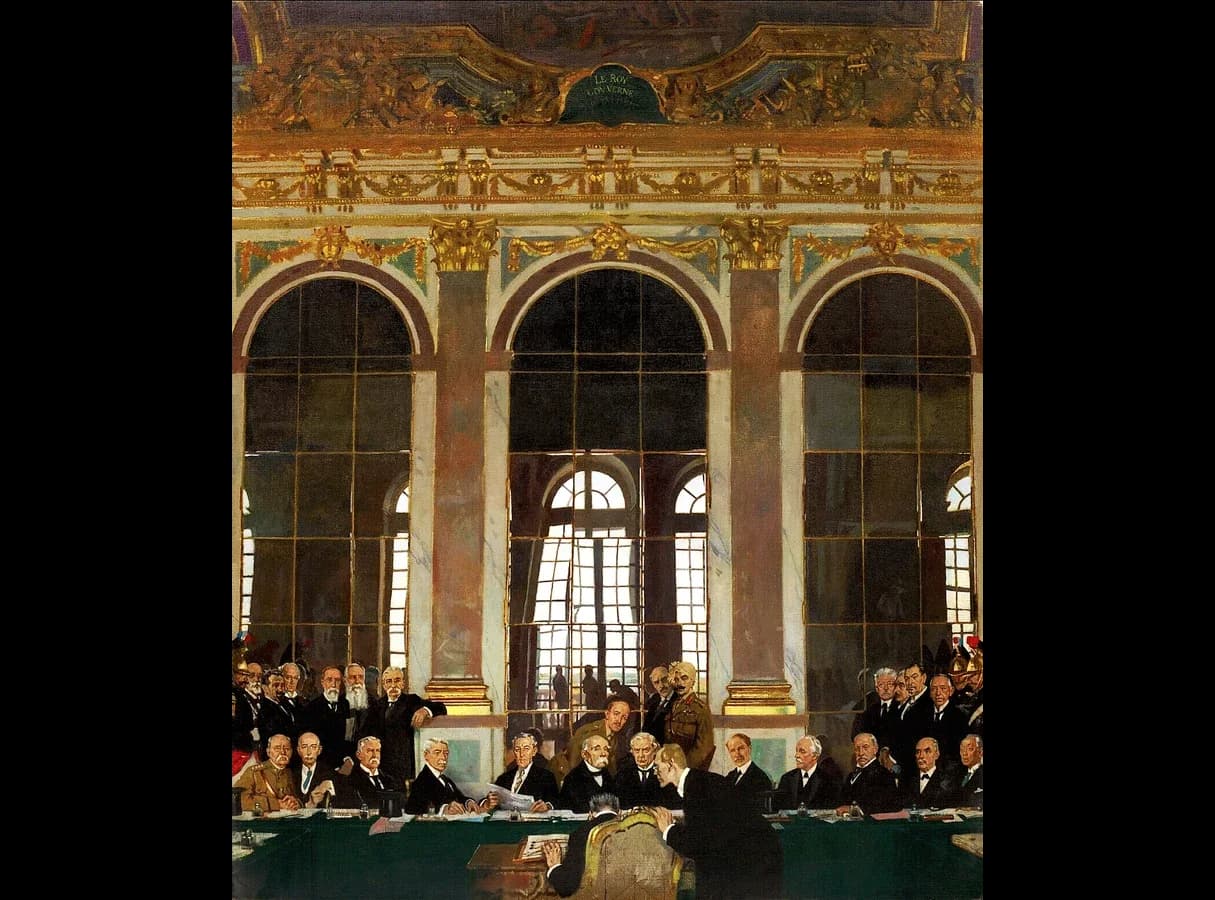
Orpen’s painting is a primary source for how the victors saw the moment. The signing was staged as a ceremony of Allied triumph in the room where Germany’s own empire had been proclaimed; the German delegates were brought in, signed and left. Many Germans called the treaty a Diktat, a dictated peace, because their representatives had no say in its terms.
The Allied and Associated Governments affirm and Germany accepts the responsibility of Germany and her allies for causing all the loss and damage to which the Allied and Associated Governments and their nationals have been subjected as a consequence of the war imposed upon them by the aggression of Germany and her allies.
Treaty of Versailles, Part VIII (Reparation), Article 231, signed 28 June 1919. The article was drafted by American lawyers as a legal basis for reparations, and similar articles appeared in the treaties with Austria and Hungary. In Germany it became known as the war guilt clause, read as a moral verdict that Germany alone had caused the war. The gap between its legal purpose and its political effect is one reason it caused such lasting anger.

The chart of reparations shows why the size of the bill is still argued over. The London Schedule of Payments of May 1921 set the total at 132 billion gold marks, but the real burden was the 50 billion in A and B bonds. Germany paid about 20 billion before payments were suspended in 1931 and cancelled at the Lausanne Conference in 1932, and much of that was paid with American loans under the Dawes Plan (1924). Reparations caused political crises, above all the French occupation of the Ruhr in 1923 when Germany fell behind with deliveries, even where their economic weight was less than Germans claimed.
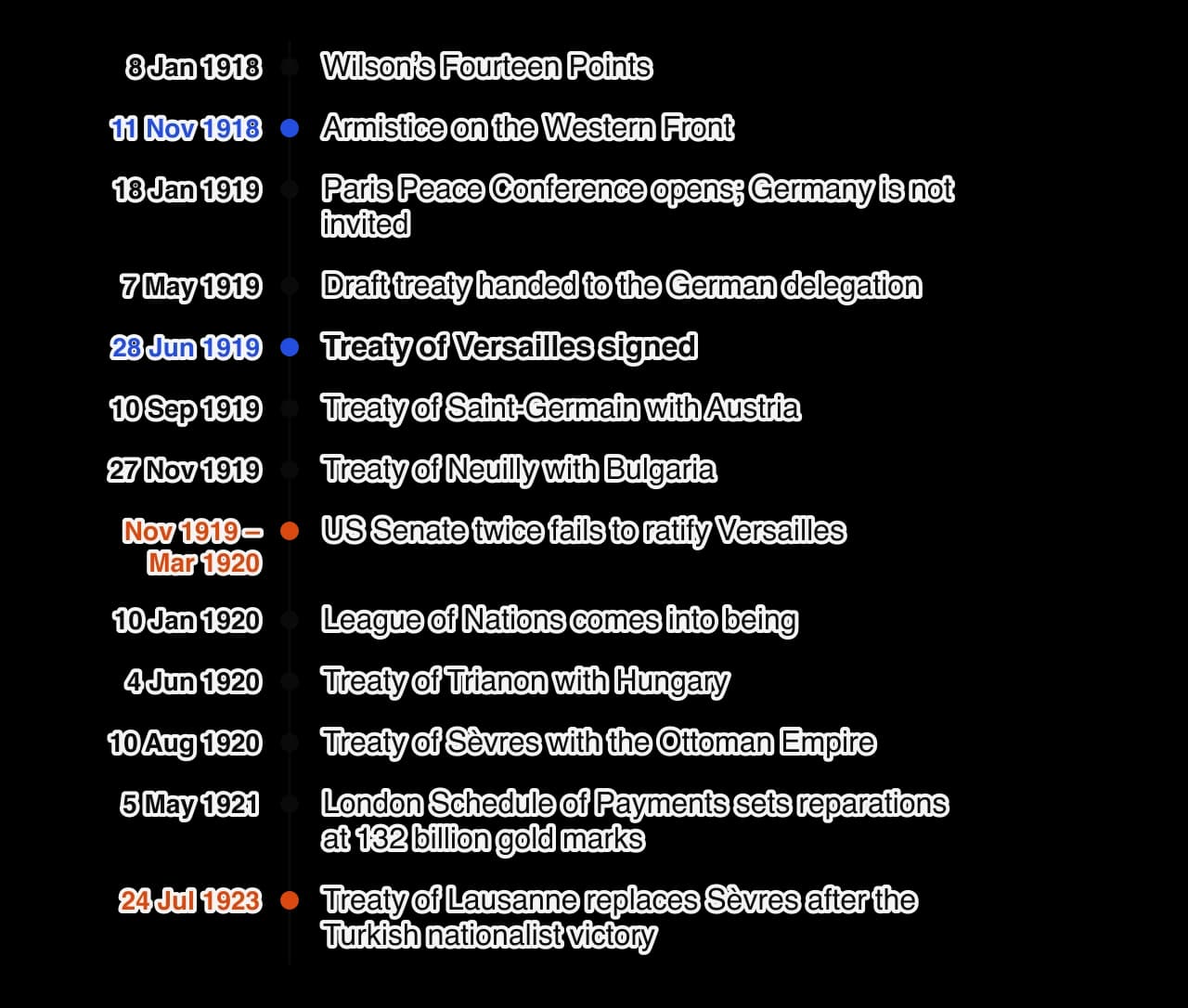
The timeline of the Paris settlement shows that peace was made through a series of treaties, each named after a palace or suburb near Paris. The Treaty of Saint-Germain confirmed the break-up of Austria-Hungary; the Treaty of Trianon left Hungary with less than a third of its pre-war territory and millions of Hungarians outside its borders; the Treaty of Sèvres partitioned the Ottoman Empire. Sèvres was never put into effect: Turkish nationalists led by Mustafa Kemal fought for and won a new settlement at Lausanne in 1923, the only case in which a defeated power overturned its treaty by force within a few years.
The League of Nations was the peacemakers’ main attempt to make the peace last by collective decision-making. Its members promised to settle disputes by arbitration and to act together against an aggressor. The decision of the US Senate not to ratify the Treaty of Versailles, in votes in November 1919 and March 1920, meant the United States never joined. Wilson, weakened by a stroke in October 1919, refused to accept the reservations demanded by Republican senators led by Henry Cabot Lodge, who feared that the League Covenant would commit the United States to wars without the approval of Congress. The League’s failures in the 1930s shaped the next attempt: the United Nations, founded in October 1945, gave the great powers permanent seats and a veto on its Security Council, so that the states most able to enforce peace would be inside the organisation.
 YouTube
The Allied terms for Japan were set out in the Potsdam Declaration, issued by the United States, Britain and China on 26 July 1945 during the Potsdam Conference.
We call upon the government of Japan to proclaim now the unconditional surrender of all Japanese armed forces, and to provide proper and adequate assurances of their good faith in such action. The alternative for Japan is prompt and utter destruction.
Potsdam Declaration ("Proclamation Defining Terms for Japanese Surrender"), paragraph 13, 26 July 1945. The declaration promised that Japan would not be "enslaved as a race or destroyed as a nation", that war criminals would be punished, and that the occupation would end once a peaceful and responsible government had been set up. It said nothing about the future of the emperor, which was the main concern of Japan’s leaders, and that silence helps explain why Japan did not accept it at once.
Japan’s war policy was decided by the six-member Supreme Council for the Direction of the War, which split three to three. The foreign minister Tōgō Shigenori and his allies wanted to accept the Potsdam terms on the single condition that the emperor’s position was preserved; the army minister Anami Korechika and the two chiefs of staff demanded further conditions, such as no occupation and Japan running its own war crimes trials. On the night of 9–10 August, after Nagasaki and the Soviet invasion, Emperor Hirohito broke the deadlock in favour of acceptance, an intervention known in Japan as the "sacred decision".
The American reply of 11 August said only that the emperor’s authority would be "subject to" the Allied supreme commander. This kept the debate going until Hirohito intervened a second time on 14 August. Army officers attempted a coup that night to stop the surrender broadcast and failed. The emperor’s recorded message was broadcast on 15 August 1945; for most Japanese it was the first time they had heard his voice.
Despite the best that has been done by everyone ... the war situation has developed not necessarily to Japan’s advantage, while the general trends of the world have all turned against her interest. ... We have resolved to pave the way for a grand peace for all the generations to come by enduring the unendurable and suffering what is insufferable.
Emperor Hirohito, Imperial Rescript on the Termination of the War, broadcast 15 August 1945 (official English translation of the time). The rescript never used the word "surrender" or "defeat", and it presented the decision as the emperor’s choice to save his people and "human civilization" from a "new and most cruel bomb". It was written for a domestic audience that had been told for years that Japan was winning, and its wording helped the armed forces accept surrender as obedience to the emperor.
Political decisions on the Allied side mattered as much. The United States decided to keep Hirohito on the throne and not to try him as a war criminal, judging that his authority would make the surrender and occupation easier to enforce. That decision made a peaceful occupation possible, but it also meant that the emperor’s own responsibility for the war was never examined in court.
The Korean War shows political decision-making producing an end to fighting but not a peace. By the summer of 1951 the front had settled close to the 38th parallel, where the war had begun in June 1950, and neither the UN Command, led by the United States, nor the North Korean and Chinese forces could break through. Armistice talks opened at Kaesong on 10 July 1951 and moved to Panmunjom in October, but they lasted two years while fighting and casualties continued.
The main obstacle was a political question, not a military one: whether prisoners of war should be returned home against their will. The United States insisted that prisoners who refused to go back to North Korea or China should not be forced to; China and North Korea demanded the return of all prisoners, since mass refusals would be a propaganda defeat. The deadlock was broken by decisions in Moscow and Washington. After Stalin’s death in March 1953 the new Soviet leaders wanted to end the war, and the new US president, Dwight Eisenhower, who had promised American voters to end it, pressed for a settlement. Prisoners who refused repatriation were handed to a neutral commission, and in the end about 22,000 of them, most of them Chinese, did not return home.
The armistice was signed at Panmunjom on 27 July 1953 by the UN Command, the North Korean army and the Chinese People’s Volunteers. South Korea’s president, Syngman Rhee, who wanted to reunify Korea by force, refused to sign. The armistice created a demilitarised zone about 4 kilometres wide along the ceasefire line. A conference at Geneva in 1954 failed to agree on a political settlement, so the two Korean states have remained divided ever since, an example of negative peace held in place by deterrence.
A peace had to be accepted by the people who lived under it, not only by the leaders who signed it. Social factors worked in two directions. War-weariness and the desire to return to normal life pushed governments towards ending wars, while anger, grief and demands for punishment pushed them towards harsh terms. After the fighting, the way societies dealt with justice, reconciliation and memory decided whether the former enemies could live alongside each other.
Exhaustion at home ended some wars before armies were destroyed. In Germany in 1918, four years of the Allied naval blockade had brought hunger to the cities, and strikes and mutinies turned military defeat into revolution. The new republican government had little choice but to accept the armistice, and later the treaty, because the population would not support a renewed war. The same pressure that ended the war made the peace look like a betrayal to those who had not seen the front collapse.
Public opinion in the victorious countries pushed in the opposite direction. During the British general election of December 1918 many candidates promised to "make Germany pay", and in France the devastation of the north-east created strong demands for security and compensation. Leaders who had promised victory could not easily offer the defeated a generous peace. Lloyd George privately feared that a punitive peace would drive Germany towards Bolshevism, as he argued in his Fontainebleau Memorandum of March 1919, but his own election campaign had raised British expectations of a harsh settlement.
War-weariness also decided how long victors were willing to enforce a peace. In the United States the Northern public’s commitment to Reconstruction faded in the 1870s, as an economic depression after the Panic of 1873 turned attention to jobs and wages and many white Northerners tired of the cost of keeping troops in the South. In France, the rising "yes" vote in the referendums of 1961 and 1962 on Algeria showed how far conscription and the violence of the war had worn down support for keeping Algeria French. Organised peace movements added to the pressure: in September 1960 the "Manifesto of the 121", signed by writers and academics including Jean-Paul Sartre and Simone de Beauvoir, defended the right of conscripts to refuse to fight in Algeria.
Every peace had to decide what to do with those blamed for the war or for crimes committed during it. Punishment could satisfy victims and deter future aggression, but could also be seen by the defeated as revenge. Amnesty, a legal pardon for past acts, could help former enemies live together, but could leave victims without justice.
The International Military Tribunal for the Far East, known as the Tokyo trials, opened in May 1946. Eleven judges from the Allied countries, including India and the Philippines, tried 28 of Japan’s wartime leaders for crimes against peace (planning and waging aggressive war), war crimes and crimes against humanity. Two defendants died during the trial and one was found unfit to stand trial. In November 1948 all 25 remaining defendants were convicted; seven, including the wartime prime minister Tōjō Hideki, were sentenced to death and hanged in December 1948. In separate trials across Asia, thousands of lower-ranking officers and soldiers were tried for crimes such as the abuse of prisoners of war, and nearly 1,000 were sentenced to death.
The trials gave the Allies a public record of Japanese aggression and atrocities, including the Nanjing massacre. Critics at the time and since have called them "victors’ justice". The Indian judge Radhabinod Pal wrote a long dissenting judgment that would have acquitted every defendant, arguing that "crimes against peace" had not been a crime in international law when the acts were committed and that the Allies were not judged for their own actions. Other omissions weakened the trials’ claim to complete justice: the emperor was not charged, and members of Unit 731, which had carried out lethal experiments on prisoners in China, were given immunity by the United States in exchange for their research data.
The trials’ effect on the peace is debated. They removed the wartime leadership from public life, which helped the occupation’s democratic reforms. They also left many Japanese with a sense that guilt had been placed on a few leaders, making it easier for society as a whole to see itself as a victim of militarists. Several of those convicted, including Tōjō, were later enshrined at the Yasukuni Shrine in Tokyo, which became a source of tension with China and South Korea.
Conflict | How justice was handled | Effect on the peace |
|---|---|---|
Mongol conquest of the Song | Most Song officials who submitted were pardoned and many kept office; loyalists who refused, such as the minister Wen Tianxiang, were imprisoned, and Wen was executed in 1283 | Leniency to those who submitted won over much of the southern elite; executions turned loyalists into martyrs remembered by later generations |
US Civil War | Johnson pardoned most Confederates; Henry Wirz, commander of the Andersonville prison camp, was one of only two men executed for war crimes (the other was the guerrilla leader Champ Ferguson); Jefferson Davis was imprisoned for two years and never tried; a universal amnesty followed in December 1868 | Leniency helped white reunion; it also returned the old Southern elite to power and left Black Southerners exposed |
First World War | The treaty demanded the trial of the Kaiser (who had fled to the Netherlands, which refused to hand him over) and of war criminals; Germany instead tried a few cases itself at Leipzig in 1921, with few convictions and light sentences | The Allied demands angered Germans; the weak trials satisfied no one |
Algerian War | French amnesty decrees and laws (1962–1968) covered acts by French forces and later the OAS; the Évian Accords barred reprisals for acts during the war | Amnesty allowed both states to move on but blocked trials for torture and killings, and the ban on reprisals was not respected in Algeria |
Rwanda, 1994 (extra example) | An International Criminal Tribunal for Rwanda tried leaders of the genocide; from 2005 to 2012 community gacaca courts heard nearly two million cases against ordinary participants | Justice on a mass scale and confession were linked to reconciliation, though critics questioned fairness to the accused |
The table of justice after conflicts shows two broad approaches. Where victors wanted a quick return to order, they offered amnesty, as after the US Civil War and the Algerian War. Where they wanted to mark a clear break with the old regime, they held trials, as in Tokyo. Neither approach guaranteed acceptance: amnesty could leave victims bitter, and trials could be dismissed as revenge.
Reconciliation means restoring relations between former enemies so that they can live or trade together in peace. After a civil war it is essential, because the two sides must share one state. Abraham Lincoln set out the spirit he hoped would guide it in his second inaugural address, delivered a month before Appomattox.
With malice toward none, with charity for all, with firmness in the right as God gives us to see the right, ... to bind up the nation’s wounds, to care for him who shall have borne the battle and for his widow and his orphan, to do all which may achieve and cherish a just and lasting peace among ourselves and with all nations.
Abraham Lincoln, second inaugural address, Washington, 4 March 1865. Lincoln spoke when Union victory was close, to a Northern audience that had lost about 360,000 soldiers. His call for "charity" towards the South did not say what a "just" peace would mean for the four million formerly enslaved people, and earlier in the speech he described the war as God’s judgement on the whole nation for slavery. The tension between reconciliation with white Southerners and justice for Black Americans ran through the whole of Reconstruction.
Memory shaped the peace for generations. In the American South, the "Lost Cause" interpretation, which presented the Confederacy as a noble fight for states’ rights and played down slavery, spread through monuments, school textbooks and veterans’ groups from the 1870s onwards. It helped white Northerners and Southerners to reconcile with each other on terms that ignored the cause of the war and the rights of Black Americans. In Germany, the memory of 1918 as a betrayal and of Versailles as a humiliation became a political weapon for the nationalist right, and Hitler made the destruction of the treaty a central promise.
Religion could support or limit reconciliation. The pilgrim clause of the Treaty of Jaffa respected the religious meaning of Jerusalem for Christians while leaving the city in Muslim hands, a practical compromise between two faiths. In China, Confucian ideas of loyalty led some Song scholars to refuse office under the Yuan; these loyalists kept the memory of the Song alive in poetry and painting, but posed little military threat after 1279.
Ending the fighting and signing terms did not by themselves make a peace last. Peacebuilding is the longer work of rebuilding a society after a conflict so that war does not return: restoring order and the rule of law, rebuilding the economy, writing new constitutions, bringing soldiers and displaced people home, and dealing with the causes of the conflict. Two of the core cases show the range of outcomes: Reconstruction in the United States, which secured the Union but failed the people it was meant to protect, and the occupation of Japan, which built a lasting peace.
Reconstruction was the process of bringing the eleven Confederate states back into the Union and deciding the place of four million freed people in American society. It was fought over by the president and Congress, and its result was a peace for white Americans at the expense of Black Americans.

Lincoln had planned a lenient policy: in December 1863 he offered to readmit any Confederate state once 10 per cent of its 1860 voters swore loyalty to the Union and accepted emancipation. After his assassination on 14 April 1865, his successor Andrew Johnson, a Tennessee Democrat who had opposed secession but had little sympathy for Black rights, went further. He pardoned most Confederates, allowed Southern states to form new governments with almost no conditions beyond abolishing slavery, and in 1865 reversed the order by which General Sherman had settled freed families on confiscated coastal land, the origin of the hope of "forty acres and a mule".
The new Southern governments passed Black Codes, laws that restricted the freedom of Black people to own or rent land, move, change employers or testify against white people, and that forced many back into labour for white planters. Former Confederate leaders were elected to Congress. To many Northerners this looked as if the South was winning the peace after losing the war.
Congress, controlled by the Republican Party and led by its Radical Republicans, refused to seat the Southern representatives. It created the Freedmen’s Bureau (March 1865), which gave food, set up schools and oversaw labour contracts, passed the Civil Rights Act of 1866 over Johnson’s veto, and in March 1867 passed the Reconstruction Acts, which divided ten Southern states into five military districts until they accepted Black male suffrage and ratified the Fourteenth Amendment. Johnson’s attempts to block the policy led to his impeachment in 1868; he was acquitted by one vote in the Senate.
Amendment | Ratified | What it did |
|---|---|---|
Thirteenth | December 1865 | Abolished slavery throughout the United States |
Fourteenth | July 1868 | Made everyone born or naturalised in the United States a citizen and promised all citizens "equal protection of the laws" |
Fifteenth | February 1870 | Forbade states to deny the vote on grounds of "race, color, or previous condition of servitude" |
For a few years the results were striking. Black men voted in large numbers, and about 2,000 held public office during Reconstruction, from local posts to sixteen members of Congress, including the senators Hiram Revels and Blanche K. Bruce of Mississippi. Freedmen’s Bureau and missionary schools and the new state school systems gave many formerly enslaved people their first chance to learn to read. Black families reunited, built churches and bought land where they could.
White Southern resistance was violent. The Ku Klux Klan, founded in Pulaski, Tennessee, in 1865–1866, and later groups such as the White League used murder and intimidation against Black voters and Republican officials. At Colfax, Louisiana, in April 1873, a white militia killed dozens of Black men, many after they had surrendered. Congress passed Enforcement Acts in 1870–1871, and federal prosecutions broke the first Klan, but the Supreme Court weakened federal protection of civil rights in cases such as United States v. Cruikshank (1876).
Northern commitment faded after the Panic of 1873, and white Democrats regained control of one Southern state after another. The disputed presidential election of 1876 was settled by the Compromise of 1877: Democrats accepted the Republican Rutherford B. Hayes as president, and federal troops were withdrawn from the last Southern state capitals. Over the next two decades Southern states removed most Black men from the voting rolls and imposed segregation.
The occupation of Japan was formally an Allied occupation, but in practice it was run by the United States under General Douglas MacArthur, the Supreme Commander for the Allied Powers (SCAP). Unlike the occupation of Germany, it governed through the existing Japanese government and civil service, issuing directives that Japanese ministers carried out.
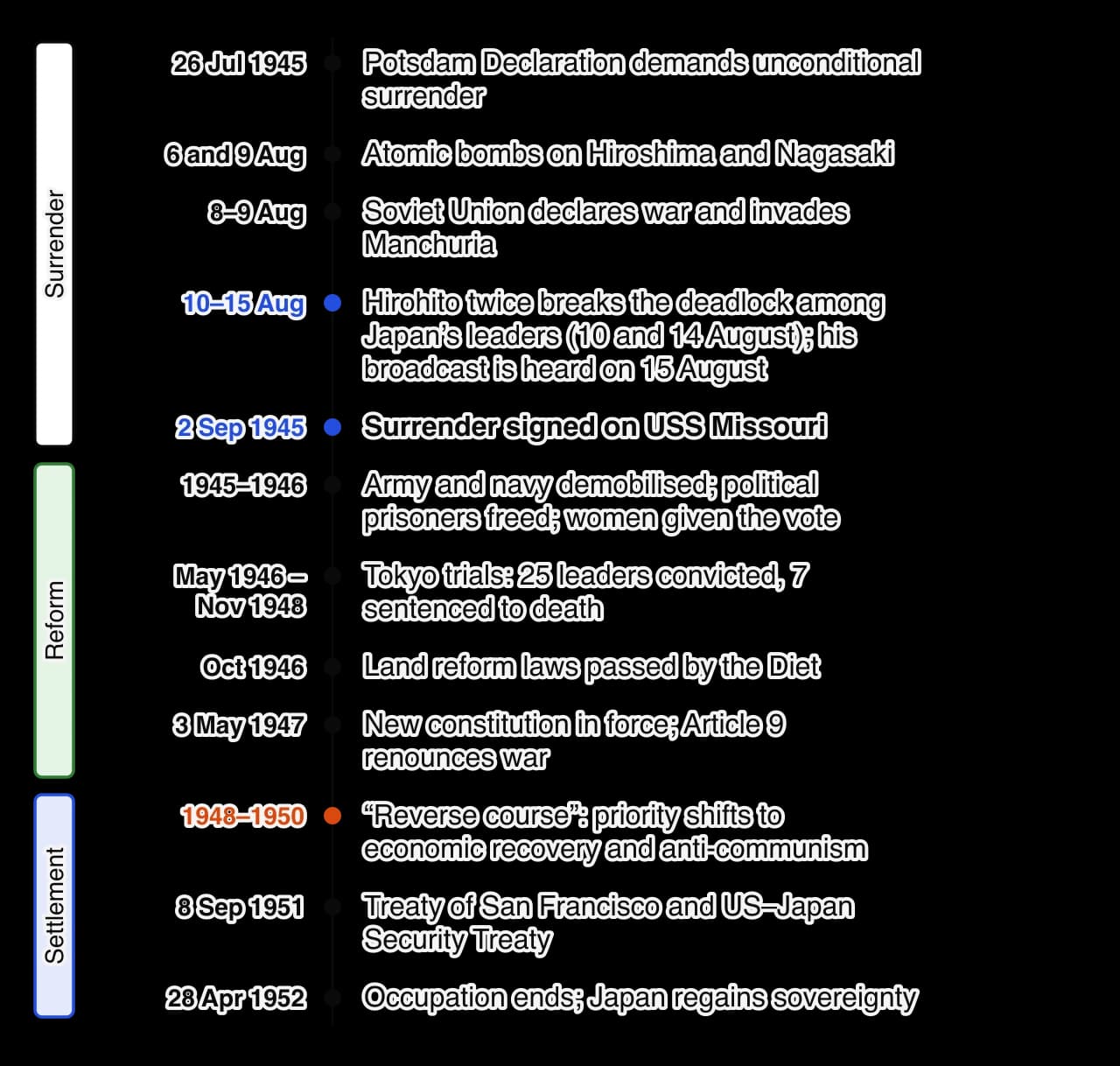
The timeline of Japan from surrender to settlement shows three stages. In the first, the occupation demilitarised and democratised Japan: about seven million soldiers and sailors were demobilised, political prisoners were released, the secret police was abolished, women gained the vote in December 1945 and voted for the first time in April 1946, and trade unions and a free press were allowed. Many officials and business leaders were purged from public life.
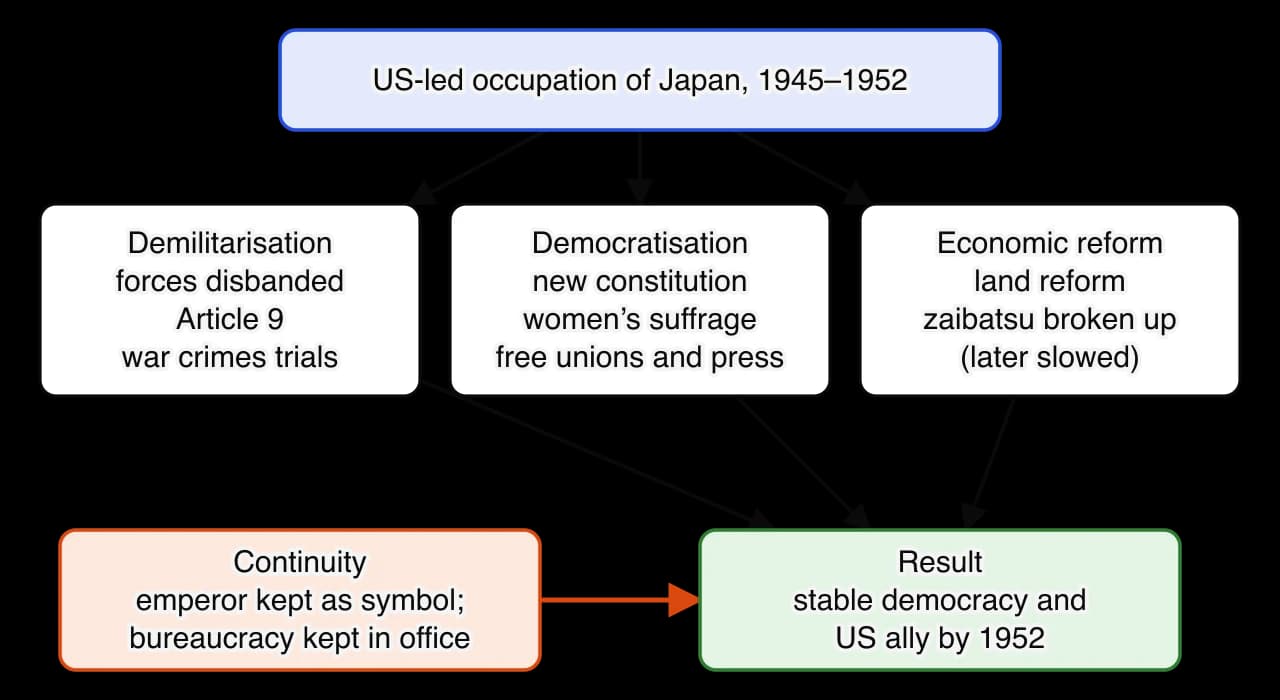
The diagram of the occupation’s reforms shows how they fitted together. The most lasting was the new constitution, drafted in English by occupation staff in February 1946 and passed, with amendments, by the Japanese Diet. It came into force on 3 May 1947. It made the emperor "the symbol of the State and of the unity of the people", with no powers of government, and placed sovereignty in the people.
Aspiring sincerely to an international peace based on justice and order, the Japanese people forever renounce war as a sovereign right of the nation and the threat or use of force as means of settling international disputes.
Constitution of Japan, Article 9, paragraph 1, in force from 3 May 1947. The article was written under occupation, and its origin, whether in MacArthur’s headquarters or in a suggestion by the Japanese prime minister Shidehara Kijūrō, is disputed. Its second paragraph forbade armed forces altogether, but from 1954 Japan built up Self-Defence Forces, interpreting the article as allowing defence. Many Japanese embraced it as an expression of their own rejection of war, which is one reason it has never been amended.
Economic reform aimed to remove the social roots of militarism. The land reform of October 1946 forced landlords to sell land to the government, which resold it to tenants at low prices, so that the share of farmland worked by its owners rose from just over half to about 90 per cent by 1950. The great business conglomerates, the zaibatsu, were ordered to be broken up.
From about 1948 the occupation changed direction, in what Japanese critics called the reverse course. With the Cold War spreading to Asia and the communists winning in China, the United States wanted Japan as an economically strong ally. The break-up of the zaibatsu was scaled back, communist union leaders were purged, and some purged conservatives returned to politics. The Korean War from 1950 brought American military orders that revived Japanese industry.
The Treaty of San Francisco, signed on 8 September 1951 by Japan and 48 other countries, formally ended the war and restored Japanese sovereignty from 28 April 1952. Japan gave up its claims to Korea, Taiwan and other territories. The Soviet Union attended but refused to sign, and neither Chinese government was invited. On the same day Japan signed a security treaty that allowed American forces to stay. Okinawa remained under American administration until 1972.
The occupation established a peace that has lasted to the present: Japan has not fought a war since 1945 and became a stable democracy. Several issues were left unresolved, however. Korea was divided; no peace treaty was signed with the Soviet Union, so the dispute over the southern Kuril Islands continues; and the claims of victims of Japanese wartime policies, such as the "comfort women" forced into military brothels, were left out of the settlement, which became a lasting source of conflict with neighbouring countries.
After 1279 the Mongols built peace in south China by incorporating the conquered state into their own. The Yuan kept much of the Song system of provinces, prefectures and taxes, left many Song officials in office and restored the Grand Canal to carry southern grain to Dadu. The examination system that had selected officials under the Song was not restored until 1315, and when it was, it reserved places for Mongols and other non-Chinese. Under Yuan rule, southern Chinese were placed at the bottom of a legal hierarchy, although historians debate how rigidly it was applied.
This was peace without reconciliation. The south was not seriously threatened by revolt for decades, and its economy recovered. But southern scholars were largely shut out of high office, and the resentment helped the rebellions of the 1350s that ended Yuan rule in 1368. Incorporation established a peace that lasted about ninety years.
After the First World War, peacebuilding came late. In the early 1920s the dispute over reparations led to the French and Belgian occupation of the Ruhr (1923) and hyperinflation in Germany. Only then did the Allies try to stabilise the peace: the Dawes Plan (1924) rescheduled reparations with American loans, the Locarno treaties (1925) confirmed Germany’s western borders by agreement, and Germany joined the League of Nations in 1926. This period of reconciliation, linked to the foreign ministers Gustav Stresemann of Germany and Aristide Briand of France, collapsed under the Great Depression after 1929. After the Second World War, by contrast, the United States poured aid into Europe and Japan through the Marshall Plan (1948–1952) and occupation budgets; after the First it had demanded the repayment of Allied war debts.
The Algerian War of Independence (1954–1962) was fought between France and the National Liberation Front (FLN), the nationalist movement that launched an armed revolt on 1 November 1954. Algeria was legally part of France, divided into French départements, and about a million people of European origin, the pieds-noirs, lived among about nine million Muslim Algerians. That made the war both a colonial war and, for many in France, a civil one, and it made peace unusually hard to establish.
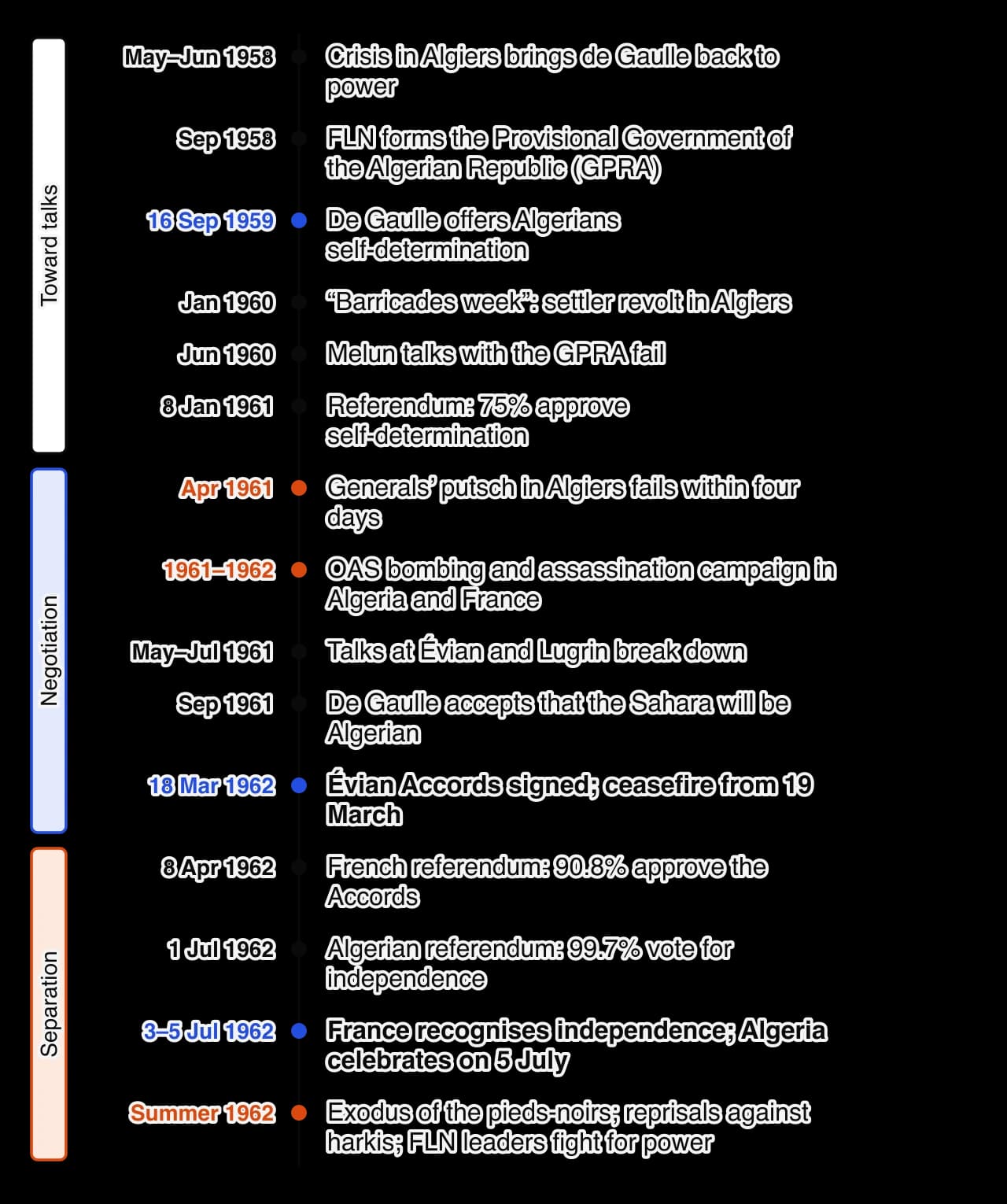
The timeline of the road to the Évian Accords shows that the war ended through a long political process. Military, political and social factors and the failures of peacebuilding all help to explain it, and the ending is a clear example of a settlement that stopped the war between France and the FLN but left the conflict between communities unresolved.
By 1960 the Challe Plan offensives, the fortified border barriers and the regroupment camps had badly weakened the ALN, the FLN’s armed wing, inside Algeria, yet the FLN’s political organisation and its army in Tunisia and Morocco survived. France could not impose a settlement by force, and the methods of its counter-insurgency, above all torture, had cost it the support of Muslim Algerians and much international opinion. Peace had to be negotiated.
The decisive political actor was Charles de Gaulle, brought back to power in May–June 1958 by a crisis in which settlers and army officers in Algiers demanded a government that would keep Algeria French. In October 1958 he offered the FLN a "peace of the brave", in effect a surrender with honour, which it rejected.
De Gaulle’s broadcast of 16 September 1959 changed what was being negotiated. It offered Algerians a vote on their future once peace was restored, with three options: separation from France, full integration, or association with France. Recognising the right to self-determination meant accepting that Algeria might become independent, so the question was no longer whether France would leave, but on what terms. De Gaulle’s reasons are debated: some historians stress his concern for France’s international standing and nuclear and European ambitions, others the cost of the war and his view that integrating nine million Muslims would change France itself.
Settler and military opponents tried to stop him. In January 1960 pied-noir activists built barricades in Algiers; in April 1961 four generals seized power in Algiers in the generals’ putsch, which collapsed within four days after de Gaulle appealed on television to the conscripts, many of whom refused to follow their officers. Opponents then formed the Organisation armée secrète (OAS), which used bombings and assassinations in Algeria and France to block any settlement.
De Gaulle at first wanted to negotiate only a ceasefire, and talks at Melun in June 1960 failed. By 1961 he accepted the need to negotiate the whole future of Algeria with the FLN’s Provisional Government of the Algerian Republic (GPRA), formed in Cairo in September 1958. The talks at Évian and Lugrin in 1961, led on the French side by Louis Joxe and on the Algerian side by Krim Belkacem, broke down over three issues: the Sahara, where oil and gas had been found in 1956 and France tested its first nuclear weapon in 1960; the status of the Europeans; and French military bases. In September 1961 de Gaulle conceded that the Sahara would be part of Algeria, which unblocked the talks. Secret meetings at Les Rousses in February 1962 were followed by the final round at Évian, which ended with the signing of the Évian Accords on 18 March 1962.
Issue | What the Évian Accords provided | What happened |
|---|---|---|
Ceasefire | Fighting to stop at noon on 19 March 1962; a joint ceasefire commission | The FLN and the French army stopped fighting; the OAS escalated its attacks until June |
Transition | A Provisional Executive and a French High Commissioner to govern until a vote on self-determination within three to six months | The referendum was held on 1 July 1962; France recognised independence on 3 July |
Rights of Europeans | A three-year period in which Europeans could take Algerian civil rights or keep French nationality as protected foreigners; guarantees for their property and culture | Most Europeans left in 1962; the guarantees were overtaken by their departure |
No reprisals | No one to be punished or discriminated against for acts or opinions during the war | Thousands of harkis and their families were killed in 1962 |
Cooperation | French aid for three years at existing levels; French companies’ rights to Saharan oil and gas | Cooperation continued until Algeria nationalised its oil and gas in 1971 |
Military | French troops cut to 80,000 within a year; the naval base at Mers-el-Kébir leased to France for fifteen years; use of Saharan test sites | France left Mers-el-Kébir in 1968, well before the lease ended, and carried out nuclear tests in the Sahara until 1966 |
The table of the Accords shows a typical decolonisation settlement: independence in exchange for guarantees for the departing power’s citizens and interests. It also shows how quickly the guarantees broke down once the people they protected had gone.
Nul ne pourra faire l’objet de mesures de police ou de justice, de sanctions disciplinaires ou d’une discrimination quelconque en raison : d’opinions émises à l’occasion des événements survenus en Algérie avant le jour du scrutin d’autodétermination ; d’actes commis à l’occasion des mêmes événements avant le jour de la proclamation du cessez-le-feu.
Évian Accords, Déclaration générale of the two delegations, chapter II, published in the French Journal officiel, 20 March 1962. In English: "No one may be subjected to police or judicial measures, disciplinary sanctions or discrimination of any kind on account of opinions expressed in connection with the events in Algeria before the day of the self-determination vote, or of acts committed in connection with the same events before the day the ceasefire is proclaimed." The clause was meant to protect everyone who had taken sides, including Algerians who had fought for France. It was a promise by the future Algerian state, but the French government, which drafted it with the GPRA, had no means of enforcing it after independence, and did little to protect those who relied on it.
Social pressure in France pushed the government towards a settlement. More than a million young Frenchmen served as conscripts in Algeria, and about 25,000 French soldiers died. Reports of torture divided French opinion, and violence spread to France itself: on 17 October 1961 the Paris police killed Algerian demonstrators protesting against a curfew, with estimates ranging from several dozen to more than 200 deaths, and on 8 February 1962 nine people died when police charged an anti-OAS march at the Charonne metro station.
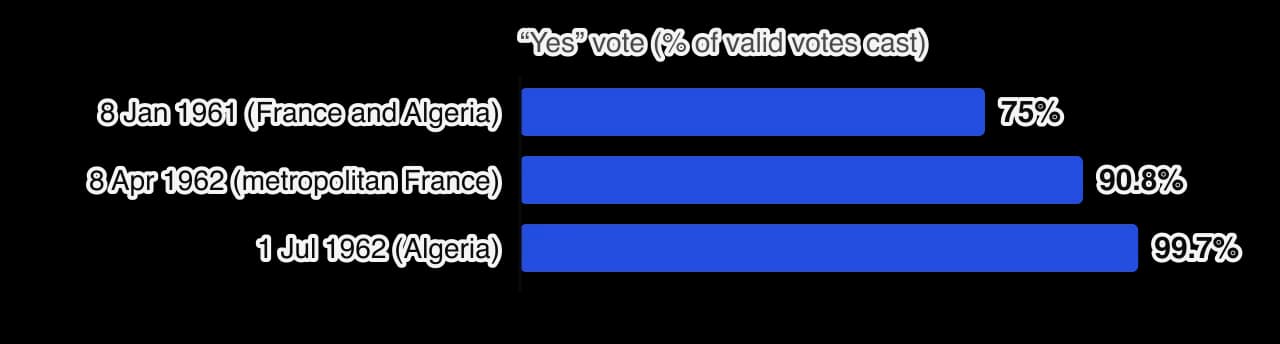
The chart of the referendums shows the peace gaining democratic backing. In January 1961 three-quarters of voters approved self-determination; in April 1962, 90.8 per cent of voters in metropolitan France approved the Évian Accords; and on 1 July 1962, 99.7 per cent of Algerian voters chose independence in cooperation with France. The April vote was held only in metropolitan France, so the pieds-noirs had no say in it, which shows that the French state had decided to make peace over their heads.
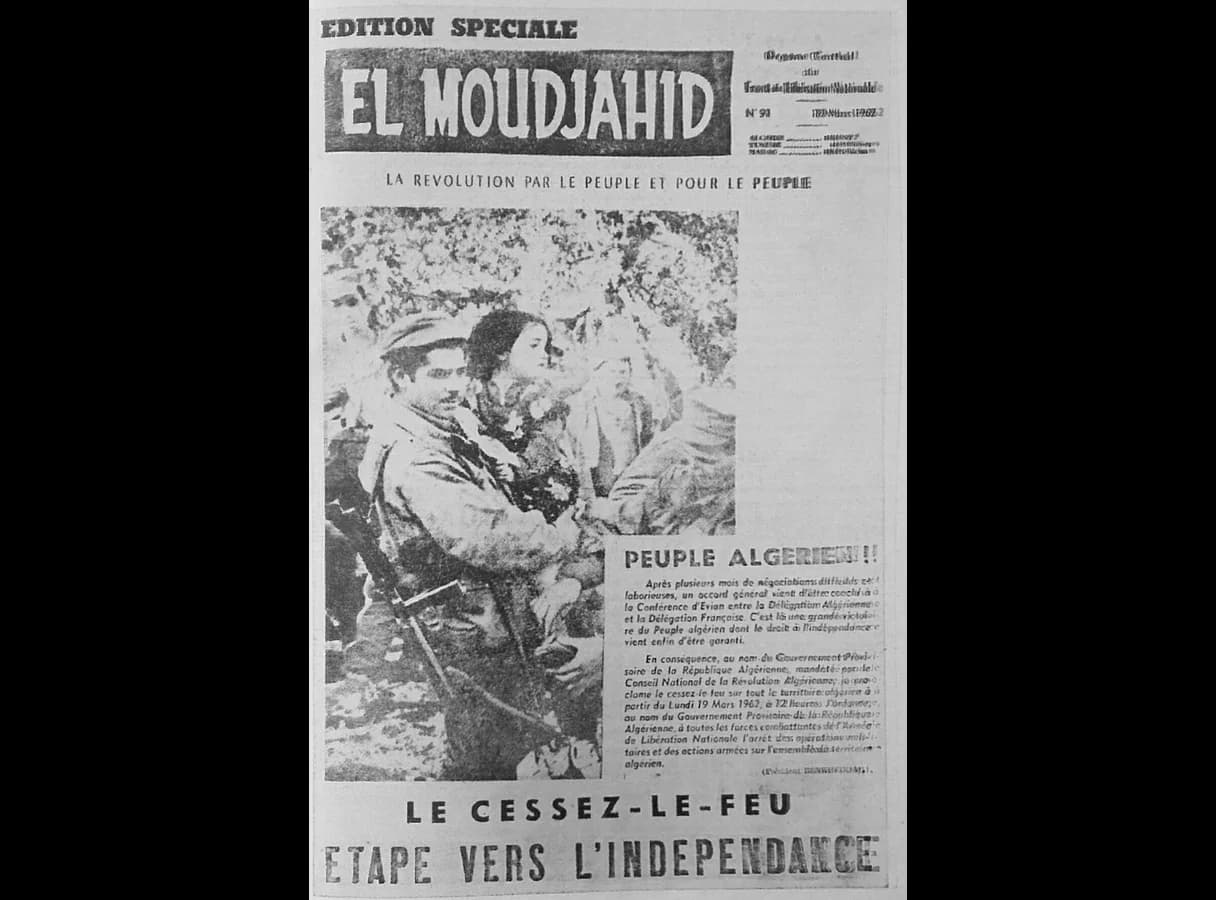
The FLN’s newspaper presented the ceasefire as a victory for the Algerian people, while de Gaulle presented independence as France’s free choice. Both sides needed a version of the ending their own people could accept.
The OAS answered the Accords with a campaign of terror against Muslim Algerians and French forces, and then with a scorched-earth policy of destroying schools, hospitals and public buildings so that Algeria would not inherit them. In the Algiers district of Bab el-Oued the OAS fought the French army, and on 26 March 1962 French troops fired on a pied-noir crowd in the rue d’Isly in Algiers, killing dozens. The OAS campaign ended with an agreement between OAS leaders and FLN representatives on 17 June 1962, by which time it had made the coexistence the Accords assumed almost impossible.
The peace that followed was a peace of separation. Fearing reprisals, and remembering the slogan "the suitcase or the coffin", more than 800,000 pieds-noirs left for France between 1962 and 1964, most of them in the summer of 1962. Violence against Europeans continued after independence: in Oran on 5 July 1962, the day of independence celebrations, several hundred Europeans were killed or disappeared, although the exact number is disputed.
The fate of the harkis was the greatest failure of the settlement. Harkis were Muslim Algerians who served as auxiliaries with the French army; together with other pro-French Algerians they numbered well over 150,000 by 1962. Many were disarmed by the French army after the ceasefire, and the French government at first ordered officials not to organise their transfer to France. In the months after independence, thousands were killed by FLN units or crowds in revenge. Estimates of the number killed range from about 10,000 to 150,000, and remain disputed because few records survive. About 90,000 harkis and family members reached France, where many were held for years in camps such as Rivesaltes. In 2021 President Emmanuel Macron asked the harkis for forgiveness on behalf of France.
Inside Algeria, independence was followed by a struggle for power. The GPRA was challenged by Ahmed Ben Bella, a founder of the FLN released from French prison in March 1962, backed by Colonel Houari Boumediene and the border army. Fighting between rival units in the summer of 1962 killed hundreds before Ben Bella took power in September 1962 and set up a one-party state. The end of the war with France did not bring internal peace or democracy.

France chose amnesty and silence as its means of peace at home. Decrees of March 1962 amnestied acts committed in the maintenance of order in Algeria, and laws of 1964, 1966 and 1968 extended the amnesty, finally to the OAS. No French officer was tried for torture. The French state described the conflict officially as "operations to maintain order" until a law of October 1999 recognised it as a war. In Algeria, the war became the founding story of the state, told in an official account centred on the FLN.
Estimates of the number of Algerians who died vary widely. Most estimates by French historians fall between about 250,000 and 400,000, some others are higher, and the Algerian state’s official figure is 1.5 million; the number is still argued over by historians and remains a political issue between the two countries. In 2021 the historian Benjamin Stora delivered a report to President Macron on the memory of colonisation and the war, recommending joint commissions and symbolic acts, but not an official apology. Its reception in Algeria was cool, which shows how far the peace between states had run ahead of reconciliation between memories.
Set side by side, the core conflicts show how the four kinds of factor combined in different ways. The comparative table of the six core cases summarises how each peace was made and how lasting it proved.
Conflict (region) | How the fighting ended | How the terms were set | Justice and reconciliation | How lasting was the peace? |
|---|---|---|---|---|
Third Crusade, 1189–1192 (Middle East and Europe) | Stalemate and exhaustion on both sides | Negotiated truce between Richard I and Saladin (Treaty of Jaffa, 1192) | Pilgrim access to Jerusalem; no punishment on either side | The truce held; the coastal kingdom lasted until 1291, but crusading resumed within a few years |
Mongol conquest of the Song, 1235–1279 (Asia) | Total conquest; the Song state destroyed | No treaty; Yuan rule imposed | Pardons for officials who submitted; loyalists executed or excluded | About ninety years of Yuan rule; resentment fed the rebellions that ended it in 1368 |
US Civil War, 1861–1865 (Americas) | Surrender of Confederate armies, from Appomattox in April 1865 | Decided in Washington by the president and Congress; constitutional amendments | Broad amnesty for Confederates; rights for freed people promised, then abandoned | Lasting negative peace between the sections; positive peace denied to Black Americans for nearly a century |
First World War, 1914–1918 (Europe, global) | Armistice with a German army still on foreign soil | Imposed by the victors at Paris, 1919–1920, without the defeated powers | Article 231, reparations, demands for trials; little reconciliation until Locarno (1925) | About twenty years in Europe; the settlement was overturned in the 1930s |
Second World War in Asia and the Pacific, 1937–1945 (Asia and Oceania) | Unconditional surrender after total defeat | Imposed by the United States through occupation; treaty in 1951 | Tokyo trials; emperor kept and not tried | Lasting peace and democracy in Japan; regional disputes over memory unresolved |
Algerian War, 1954–1962 (Africa and the Middle East) | Political decision by France despite military success; ceasefire | Negotiated between France and the GPRA (Évian Accords, 1962); approved by referendums | Amnesty in France; reprisals against harkis in Algeria; separation of communities | No renewed war between the states; reconciliation of memories still incomplete |
The military outcome was a necessary condition of every peace. It decided who could set terms: the Mongols and the Allies in 1945 dictated, Richard and Saladin had to bargain. But it was rarely sufficient. Both world wars ended in Allied victory, yet the peace after 1918 collapsed and the peace after 1945 lasted, so the military outcome alone cannot explain the difference.
Political decision-making explains most of the variation in the terms. Decisions such as Grant’s and Lincoln’s leniency, the Big Three’s compromises at Paris, the American choice to keep the emperor and de Gaulle’s acceptance of self-determination turned similar military outcomes into very different settlements. Leaders were constrained, however, by their allies, by domestic opinion and by what the military outcome allowed.
Social factors decided whether a peace was accepted. The German belief that the army had not been defeated, the Lost Cause in the American South and the demand for revenge against the harkis in 1962 all show a settlement on paper being resisted or reshaped by what people believed and felt. Where a population was exhausted and its defeat undeniable, as in Japan in 1945, acceptance came more easily.
Post-conflict peacebuilding decided whether a peace lasted. Japan received occupation, reform and economic recovery; Germany after 1918 received neither occupation of the whole country nor recovery aid until the Dawes Plan. Reconstruction shows peacebuilding abandoned halfway, and Algeria shows a settlement whose guarantees could not survive the departure of the people they protected.
A strong judgement links the factors in sequence: the military outcome set the possibilities, political decisions chose among them, social factors decided legitimacy, and peacebuilding decided durability. On that view the most important factor depends on what is being explained. If the question is why a war ended when it did, the military outcome and political decisions weigh most; if it is why a peace lasted, peacebuilding and social acceptance weigh most.
Historians have argued about how peace was made after each of the core conflicts, and their judgements have changed as new evidence appeared and as the concerns of their own times changed. The debates turn on three questions: how harsh or fair a settlement was, whom a peace served, and whether a settlement caused later conflict.
The British economist John Maynard Keynes, who resigned from the British delegation at Paris, set the terms of the debate in The Economic Consequences of the Peace (1919). He called the settlement a "Carthaginian peace", after Rome’s destruction of Carthage, and argued that reparations were beyond Germany’s capacity to pay and would ruin the European economy. His book was widely read in Britain and the United States and helped convince many that the treaty was unjust, which later encouraged the British policy of appeasement.
Later historians have challenged Keynes. The French economist Étienne Mantoux, in The Carthaginian Peace, or the Economic Consequences of Mr Keynes (1946), argued that Germany could have paid and that Keynes’s book weakened the will to enforce the treaty. Sally Marks, in "The Myths of Reparations" (1978), showed that the real sum Germany was expected to pay was far lower than the headline figure, and that German governments chose to resist payment. Margaret MacMillan, in Peacemakers (2001), argues that the peacemakers faced impossible pressures and did better than their critics allow, and that the Second World War resulted from the decisions of the 1930s, above all Hitler’s, more than from the treaty. Zara Steiner, in The Lights That Failed (2005), stresses the failure to enforce or revise the treaty in the 1920s and 1930s.
A third view holds that the treaty was the worst of both worlds: too harsh to be accepted by Germans as fair, but not harsh enough to stop Germany from becoming the strongest power in Europe again, because it left the country united and its industry intact. This view helps to explain why the settlement depended so heavily on enforcement that Britain and the United States were unwilling to provide.
In the early twentieth century the dominant Dunning School, named after the Columbia historian William A. Dunning, portrayed Reconstruction as a disaster in which corrupt Northern Republicans and ignorant freedmen misgoverned the South until white "redeemers" restored order. Its work reflected the racial attitudes of the time and supported segregation. W. E. B. Du Bois, in Black Reconstruction in America (1935), reversed this picture, presenting Reconstruction as a democratic experiment in which Black workers played the leading part and which was destroyed by white violence and Northern indifference. Eric Foner, in Reconstruction: America’s Unfinished Revolution, 1863–1877 (1988), built on Du Bois and on the research of the civil rights era to argue that Reconstruction was a real but incomplete attempt to create an interracial democracy, defeated by violence and abandoned by the North.
Early accounts, including MacArthur’s own, presented the occupation as American reform imposed on a defeated nation. John Dower, in Embracing Defeat: Japan in the Wake of World War II (1999), argues that the reforms lasted because many Japanese took them up as their own, from trade unions and women voters to supporters of Article 9, while also showing that the occupation was undemocratic in its own methods, censored the press and protected the emperor. Critics on the left stress the "reverse course" and continuity: Kishi Nobusuke, held for three years as a suspected war criminal but never tried, became prime minister in 1957.
Alistair Horne’s A Savage War of Peace (1977) presents the ending as the result of de Gaulle’s realism in the face of a war France could not win politically. Benjamin Stora, in La Gangrène et l’oubli (1991), argues that the amnesties and official silence in France, and the official FLN version of the war in Algeria, created rival and incomplete memories that poisoned relations between the two countries and within France. Todd Shepard, in The Invention of Decolonization (2006), argues that the French state presented Algerian independence as the inevitable result of historical progress, which allowed France to strip most Algerian Muslims of French citizenship in 1962 and to avoid facing its own choices.
Historian | Work | Argument | Evidence stressed |
|---|---|---|---|
John Maynard Keynes | The Economic Consequences of the Peace (1919) | Versailles was a vindictive peace that would ruin Germany and Europe | The size of reparations; the economic interdependence of Europe |
Sally Marks | "The Myths of Reparations" (1978) | Reparations were payable; Germany chose to resist | The A, B and C bond structure; German fiscal policy |
Margaret MacMillan | Peacemakers (2001) | The peacemakers did as well as their circumstances allowed; later failures were not inevitable | The pressures on the Big Three; decisions of the 1930s |
W. E. B. Du Bois | Black Reconstruction in America (1935) | Reconstruction was a democratic experiment led by Black Americans and destroyed by white violence | Black political participation and labour; the role of terror |
Eric Foner | Reconstruction (1988) | An "unfinished revolution": real gains reversed by violence and Northern retreat | Black officeholders; the amendments; the Compromise of 1877 |
John Dower | Embracing Defeat (1999) | Japanese society took up the occupation’s reforms from below | Popular culture, unions, letters to MacArthur; the 1947 constitution |
Benjamin Stora | La Gangrène et l’oubli (1991) | Amnesty and silence produced rival, damaging memories of the Algerian War | Amnesty laws; official commemorations in France and Algeria |
The perspectives can be weighed by the questions they ask. Keynes and Marks argue about whether a peace was economically workable; MacMillan asks what was politically possible in 1919; Du Bois and Foner ask whom a peace served; Dower and Stora ask how a peace was lived and remembered. Each is a different measure of "success", and a strong answer says which measure it is using.
The strongest answers do two things: they explain how a factor produced a peace, and they judge how far that peace was accepted and how long it lasted.
I can explain the difference between an armistice, a ceasefire, a truce and a peace treaty, and give an example of each.
I can describe the main kinds of war ending (conquest, unconditional surrender, imposed treaty, negotiated compromise, ceasefire without a treaty, independence agreement) with examples.
I can explain the difference between negative and positive peace and use it to judge a settlement.
I can explain how stalemate and exhaustion led to the Treaty of Jaffa (1192) and what its terms were.
I can explain why the Mongol conquest of the Song ended without a treaty and how the Yuan established peace by incorporation.
I can explain how the way the First World War ended in 1918 weakened the peace, including the stab-in-the-back myth.
I can describe the aims of Wilson, Clemenceau and Lloyd George and explain how they shaped the Treaty of Versailles.
I can outline the main terms of Versailles, including Article 231 and reparations, and the other Paris treaties.
I can explain how Japan’s leaders decided to surrender in August 1945 and why the emperor was kept.
I can explain how political decisions in Moscow, Washington and Panmunjom produced the Korean armistice of 1953, and why it did not become a peace.
I can explain how war-weariness, public opinion, justice and memory affected the making and acceptance of peace.
I can evaluate the Tokyo trials as a form of post-war justice, including Justice Pal’s dissent.
I can explain the stages of Reconstruction (1865–1877) and judge how far it established peace, and for whom.
I can explain the reforms of the occupation of Japan and the reverse course, and why the peace lasted.
I can explain how the Algerian War ended, the terms of the Évian Accords, and why the peace became a separation.
I can compare how peace was established in at least two conflicts from different regions and weigh the military outcome, political decision-making, social factors and peacebuilding.
I can outline the debates about Versailles, Reconstruction, the occupation of Japan and the end of the Algerian War, naming historians and their arguments.