Notes on TS2.2 How did the innovations transform societies?
Innovations matter to historians because of what they changed. Paper, printing, steam power, high-yielding seeds and mobile money each altered the economies, politics, environments and cultures of the societies that adopted them, sometimes within a generation and sometimes over several centuries. Asking how far an innovation transformed a society means measuring change against what stayed the same.
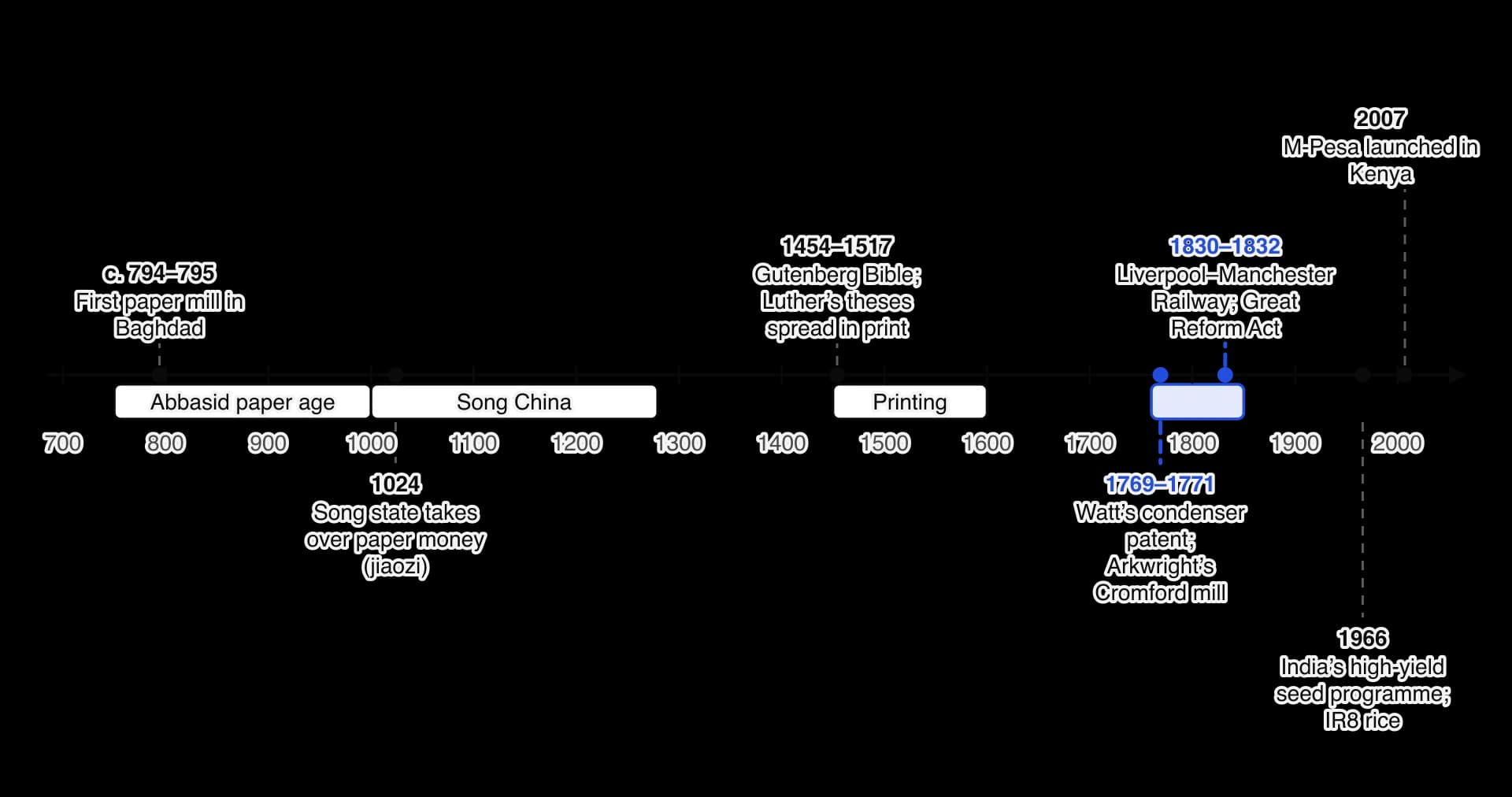
What makes change a transformation?
Not every innovation transforms a society. Many inventions remained curiosities, and many innovations changed one industry without changing the society around it. Historians judge whether change amounted to a transformation by asking four questions about it.
Measure | Question to ask | Example |
|---|---|---|
Scale | How many people, places and activities did the change reach? | By 1500 printing presses were working in over 200 European towns; Bi Sheng’s movable type of the 1040s, by contrast, stayed a rarity in China. |
Speed | How quickly did the change happen, and was it faster than earlier change? | M-Pesa reached most Kenyan households in under a decade; the spread of paper from Baghdad to Spain took about three centuries. |
Depth | Did it change structures (class, power, beliefs) or only techniques? | The factory changed the relationship between employer and worker; a better plough often changed only yields. |
Duration | Did the change last, or was it reversed? | Song paper money collapsed into inflation and the Ming dynasty returned to silver and coin; print never retreated. |
Two further distinctions help. Some changes were intended by the people who introduced an innovation (Borlaug and the Indian government wanted more wheat), while others were unintended (nobody planned the falling water tables of Punjab). And every transformation had people who drove it and people who benefited from it, who were often not the same: the factory system was driven by mill owners, but some of its benefits reached workers only after 1850.
Transformation also coexists with continuity. In Britain the aristocracy kept most seats in the Cabinet until late in the nineteenth century, even while industrialists remade the economy. In Song China commercial wealth grew enormously, yet officials continued to rank merchants below farmers in the Confucian order of society. A judgement about transformation must say what changed, for whom, and what stayed the same.
Economic change: production, trade and work
Economic transformation is the easiest kind to measure. Historians look for rising productivity (more output from the same land, labour or capital), new industries and jobs, wider trade, the growth of towns, and changes in who owned wealth. Every core case shows some of these, but they differ greatly in scale and in how widely the gains were shared.
Song China: a commercial revolution, 960–1279
Under the Song dynasty China became the most commercialised economy in the world. The historian Mark Elvin called the changes a medieval economic revolution in The Pattern of the Chinese Past (1973), and many historians now use the looser term commercial revolution. Several innovations worked together. Fast-ripening Champa rice, spread by the state from 1012, allowed two harvests a year in much of the south. Paper money (jiaozi) and printed contracts made trade easier, and the compass made sea voyages safer.
The results showed in population, cities and industry. A Song household register of 1102 recorded about 20 million households, usually estimated at around 100 million people, roughly double the population of the late Tang. Kaifeng, the Northern Song capital, and Hangzhou, the Southern Song capital from 1138, each grew to several hundred thousand people and perhaps a million. Robert Hartwell estimated in the 1960s that iron output reached about 125,000 tons in 1078, more than Britain produced at the start of its own Industrial Revolution; later historians think his figure may be too high, but agree that production rose steeply, using coal as well as charcoal.
Trade changed most. Farmers in the Yangzi delta grew rice, tea, silk or sugar for sale rather than for their own use, and bought what they needed in periodic markets. Overseas trade through Quanzhou and Guangzhou carried silk, porcelain and copper coins to Southeast Asia and the Indian Ocean. The compass, first recorded in use at sea in a Chinese text of the early twelfth century, helped Chinese ships take a larger share of this trade.
The transformation had limits. Most people remained farmers, and the commercial economy was concentrated in the south-east and along the Grand Canal. Merchants grew rich but did not form an independent political class: wealthy families invested in land and in educating sons for the civil-service examinations, so commercial wealth was turned back into the traditional status of the scholar-official.
Printing and the European book economy, c. 1450–1600
Before printing, a book was a costly hand-made object. Gutenberg’s press, working in Mainz by about 1450, made books a manufactured product. By 1500 presses were working in well over 200 European towns, and the economic historians Eltjo Buringh and Jan Luiten van Zanden estimate that they had produced about 12.6 million books by then, followed by over 200 million more in the sixteenth century. Older estimates put the fifteenth-century total higher, at around 20 million; all such figures are reconstructions from surviving editions. The price of books fell sharply, because the cost of setting the type was spread across a print run of several hundred copies.
Printing created new trades (type founders, compositors, pressmen, booksellers and paper makers) and new commercial centres. Venice became the largest printing city of fifteenth-century Europe, and the Frankfurt book fair became the main market where printers traded stock. Print also spread commercial knowledge: Luca Pacioli’s Summa de arithmetica (Venice, 1494) set out double-entry bookkeeping for merchants across Europe. The economic historian Jeremiah Dittmar has found that European cities which had a press by 1500 grew about 60 per cent faster in the following century than similar cities which did not.
Most Europeans, however, still worked on the land and could not read. Printing transformed the economy of knowledge, and of the trading cities that used it, more than the economy as a whole.
Industrial Britain: from workshop to factory, c. 1760–1850
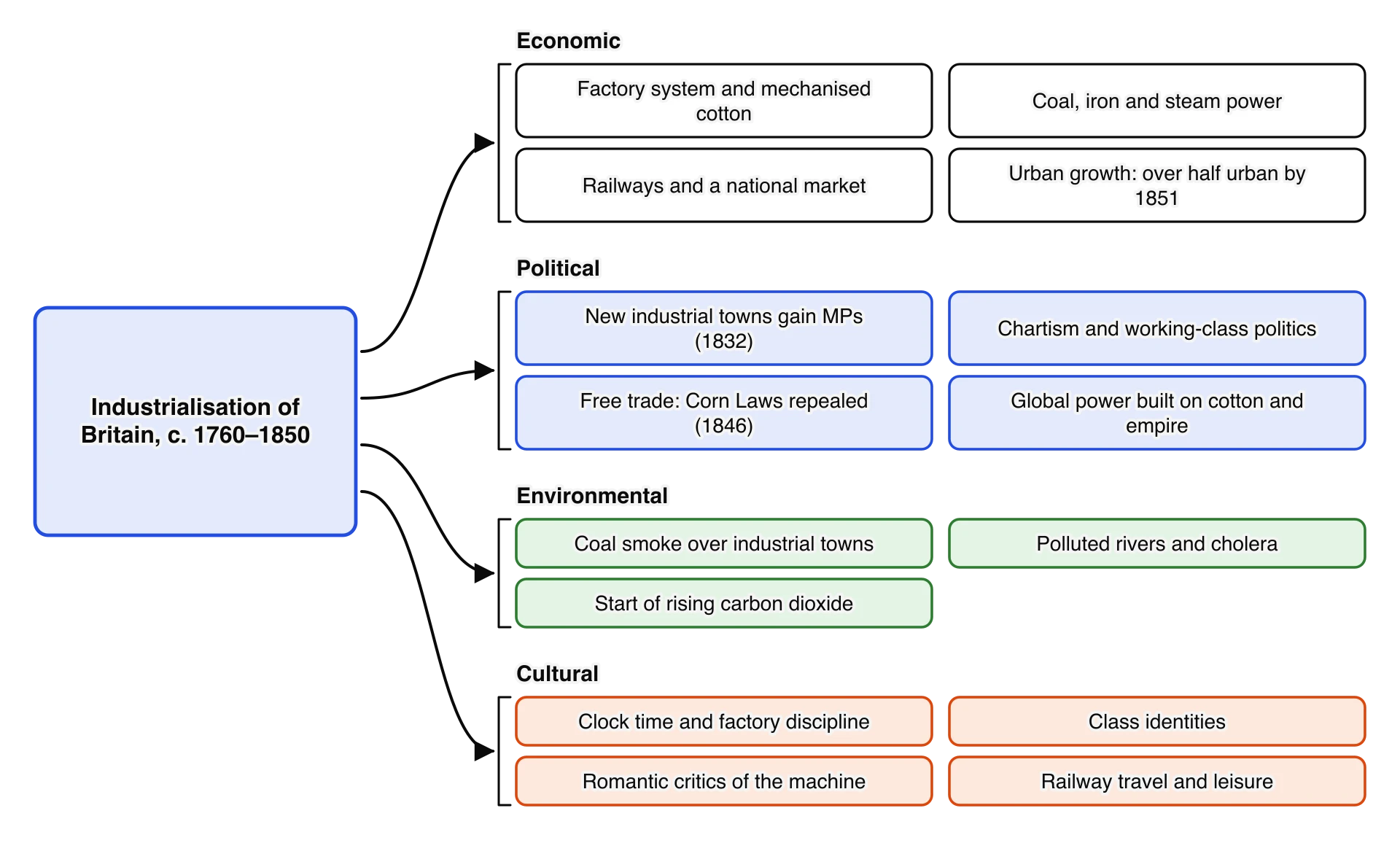
The British Industrial Revolution is the clearest case of an innovation-led transformation, because it changed all four areas of British life at once. It was not one invention but a cluster: machines for spinning and weaving cotton, the steam engine, new ways of making iron with coal, canals and then railways. Their combined effect is summarised in the diagram of the consequences of industrialisation.
The factory system
Before industrialisation, most cloth was spun and woven by families in their own homes, often for a merchant who supplied the raw material and collected the finished goods (the putting-out system). Spinning machines changed this. Richard Arkwright’s water frame was too large and heavy to work by hand, so in 1771 he built a water-powered mill at Cromford in Derbyshire that brought hundreds of workers under one roof. This was the model of the factory: central power, machines that set the pace of work, a large wage-earning workforce and a manager enforcing discipline.
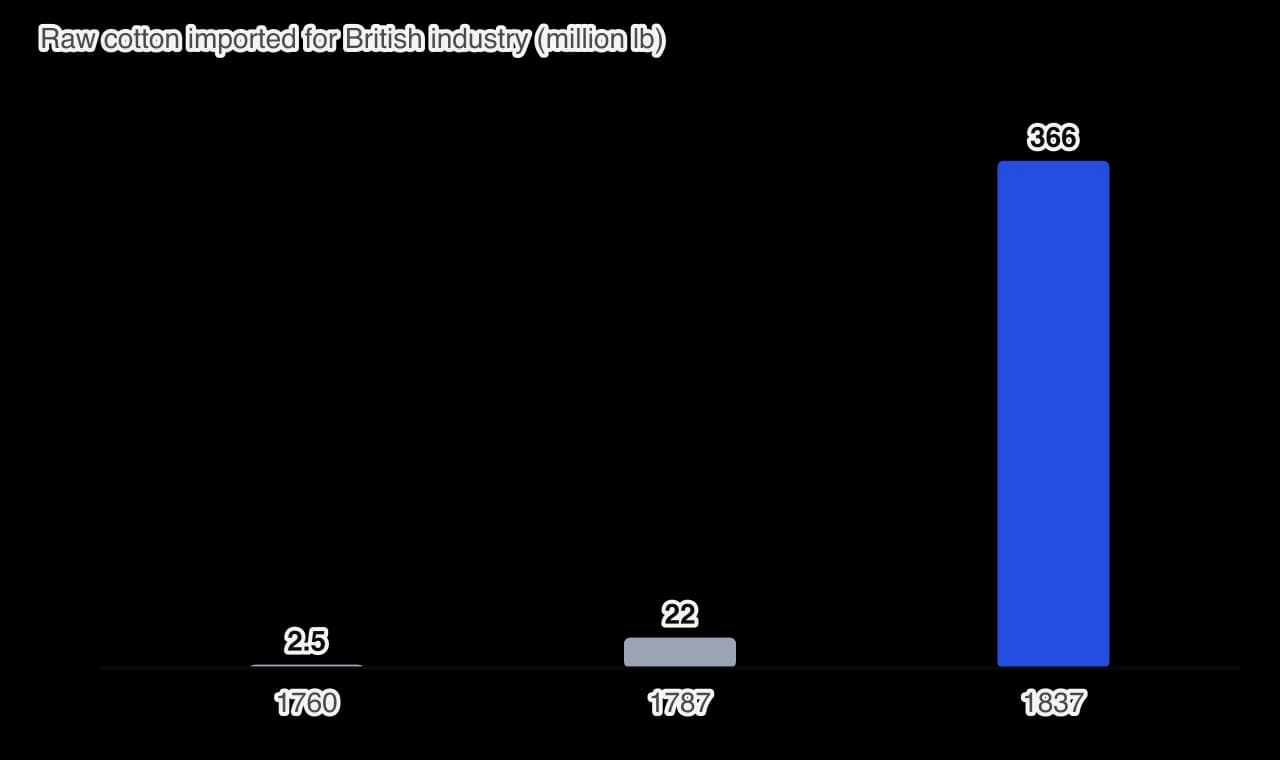
Cotton grew faster than any other industry. The chart of raw cotton imported for British industry shows imports rising almost 150-fold between 1760 and 1837. By the 1830s cotton goods made up about half the value of all British exports. The cotton itself came increasingly from slave plantations in the southern United States, so the British factory and American slavery grew together.
Coal, iron, steam and railways
Steam power freed factories from riversides. James Watt’s separate condenser (patented 1769) cut the coal an engine needed, and the firm of Boulton and Watt sold rotary engines that could drive machinery from the 1780s. Coal output rose from roughly 15 million tons a year around 1800 to about 50 million by the 1850s. Henry Cort’s puddling process (1784) let ironmasters make wrought iron with coal instead of scarce charcoal, so iron became cheap enough for machines, bridges and rails.
Railways joined these changes into a national market. The Liverpool and Manchester Railway, opened in 1830, was the first line to carry both passengers and goods between two cities entirely by steam locomotive. A burst of investment in the 1840s (the "railway mania") gave Britain over 6,000 miles of track by 1850. Railways cut the cost of moving coal and goods, created a large market for iron and engineering, and employed tens of thousands of navvies to build them.
Towns, jobs and wealth
Industry drew people into towns. Manchester grew from about 25,000 people in the 1770s to over 300,000 by 1851, and the census of 1851 showed that, for the first time in any large country, more than half of the population of England and Wales lived in towns. By then only about a fifth of the workforce was employed in farming. Britain had become the "workshop of the world", producing a large share of the world’s cotton cloth, iron and coal.
The gains were unevenly shared. Factory owners, merchants and bankers made fortunes, while real wages for most workers grew slowly until the 1840s. Charles Feinstein’s estimates (1998) suggest real wages rose by only about 30 per cent between 1780 and 1850, while output per head grew much faster. Some groups lost heavily: handloom weavers, who had been well paid around 1800, were pushed into poverty by power looms by the 1830s. How far ordinary people’s living standards rose before 1850 is the subject of a long dispute among historians, the standard of living debate.
 YouTube
The Green Revolution in Mexico and India, c. 1943–1980
The Green Revolution was the spread of high-yielding varieties of wheat and rice, grown with chemical fertiliser, pesticides and controlled irrigation. It began with the Rockefeller Foundation’s Mexican Agricultural Program (1943), where the American plant breeder Norman Borlaug developed short-stemmed ("semi-dwarf") wheat that could carry heavy heads of grain without falling over. Mexico, which imported about half of its wheat in 1943, was self-sufficient by 1956.
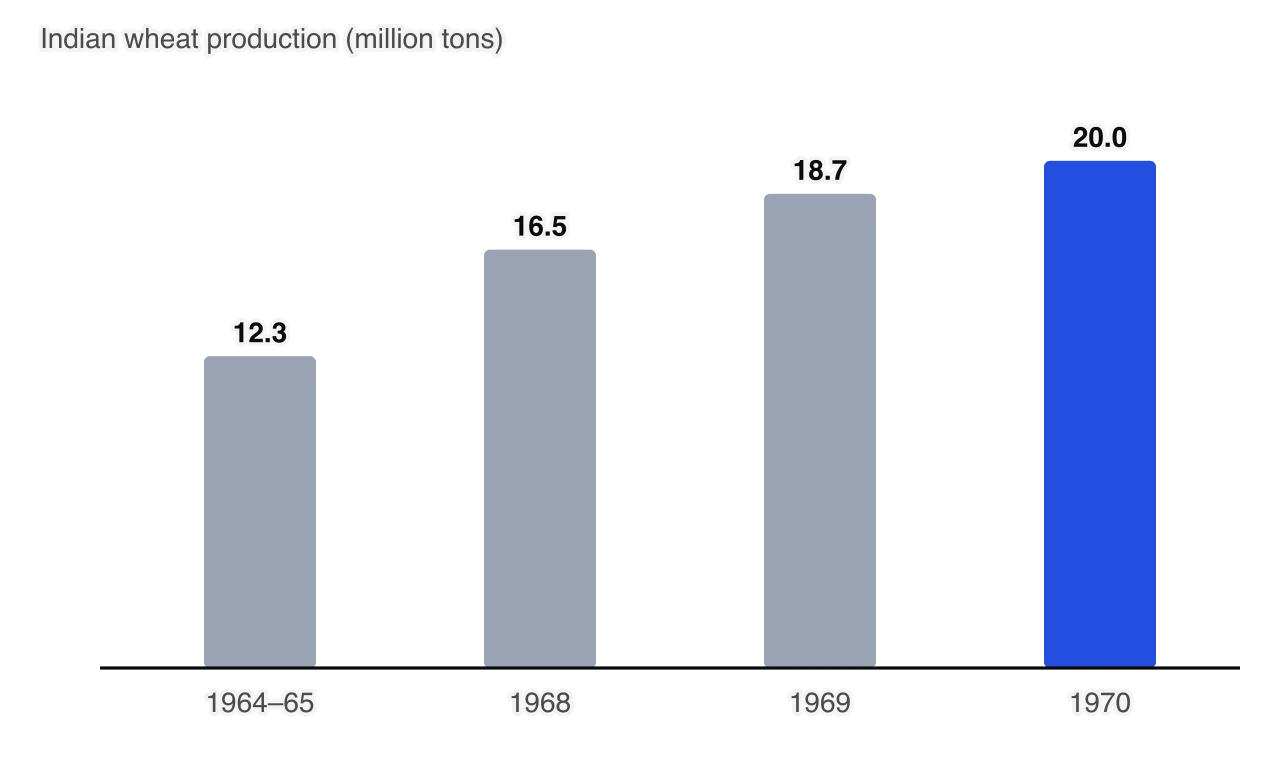
The largest transformation came in South Asia. After the failed monsoons of 1965 and 1966 left India dependent on shipments of American grain, the Indian government imported Mexican seed and in 1966 launched a programme to spread high-yielding varieties, with subsidised fertiliser, credit and guaranteed prices. The International Rice Research Institute (IRRI) in the Philippines released IR8, the first high-yielding rice, in the same year. Wheat output rose fastest in irrigated Punjab, Haryana and western Uttar Pradesh, as the chart of Indian wheat production shows.
Borlaug himself warned against exaggerating the change in his Nobel Peace Prize lecture.
The term "The Green Revolution" has been used by the popular press to describe the spectacular increase in cereal-grain production during the past three years. Perhaps the term "green revolution", as commonly used, is premature, too optimistic, or too broad in scope. Too often it seems to convey the impression of a general revolution in yields per hectare and in total production of all crops throughout vast areas comprising many countries. Sometimes it also implies that all farmers are uniformly benefited by the breakthrough in production. These implications both oversimplify and distort the facts.
Norman Borlaug, The Green Revolution, Peace, and Humanity, Nobel lecture, Oslo, 11 December 1970. Borlaug was the programme’s best-known scientist and was accepting a prize for it, so his caution is significant: he admits that only wheat, rice and maize had been transformed and that farmers had not all gained equally. Elsewhere in the lecture he uses the same evidence to argue for more investment in the new methods, which shows his purpose of persuading governments and donors.
The economic gains were real but uneven. India’s use of nitrogen fertiliser rose from 58,000 tons in 1950–51 to 1.2 million tons in 1969–70, and farmers who could afford them sank thousands of private tube-wells to pump groundwater. India stopped importing grain under the American PL-480 food-aid programme in the early 1970s. The political scientist Francine Frankel’s field studies, published as India’s Green Revolution: Economic Gains and Political Costs (1971), found that larger farmers in irrigated districts gained most, while tenants and landless labourers often lost land or work as landowners took back plots to farm themselves with machines. Smaller farmers who borrowed to pay for seed, fertiliser and pumps risked falling into debt when harvests or prices failed. Rain-fed regions and crops such as millet and pulses, which poorer families ate, changed little.
Mobile money in Kenya, from 2007
Mobile money transformed an economy in which most adults had no bank account. Safaricom, Kenya’s largest mobile phone company, launched M-Pesa ("mobile money", from the Swahili pesa) in March 2007. Customers paid cash into an account linked to their phone number at a shop acting as an agent, sent money by text message, and withdrew cash at another agent. By March 2012 about 15 million customers had registered for M-Pesa in a country of roughly 43 million people, and by 2014 over 90 per cent of Kenyan households included at least one user.
The economic effects were measured unusually carefully. Tavneet Suri and William Jack, economists who tracked thousands of Kenyan households over several years, estimated in the journal Science (2016) that access to M-Pesa had lifted about 194,000 households, or 2 per cent of all Kenyan households, out of poverty. They traced the gains to two changes: households saved more and could cope better with shocks such as illness or harvest failure, because relatives could send money instantly; and many people, especially women, moved out of farming into business.
New businesses were built on the system. M-Kopa (from 2011) sold solar home lighting kits on credit, collected in small daily payments by phone, to families without mains electricity. The service spread to Tanzania (2008) and other African countries, but failed to take hold in India, Romania and Albania, where banks were more widespread and regulation differed. This contrast shows that the transformation depended on Kenyan conditions as much as on the technology.
Comparing economic change
The six cases show three patterns. Some innovations raised productivity directly (Champa rice, the spinning machines, high-yielding seed). Others lowered the cost of exchange and so widened markets (paper money, printed books, railways, mobile payments). In every case the gains went first to those with land, capital or skills to use them: Song landlords and merchants, printers and merchants in trading cities, British mill owners, Punjab’s larger farmers. The British case differs in scale and permanence. Only there did innovation lead to sustained growth in output per head, the change economic historians regard as the beginning of the modern economy.
Political change: states, rights and power
Innovations change politics in two ways. They can strengthen those who already rule, by giving them more information, more revenue or better weapons. They can also create new groups with new resources and grievances, who then demand a share of power. Most of the core cases show both at once, and the balance between them is what a judgement about political transformation has to weigh.
The Abbasid state and the paper record
The Abbasid Caliphate ruled from Baghdad, founded in 762, over lands stretching from North Africa to Central Asia. Governing them meant tax registers, correspondence with provincial governors and records of land and payments, all kept by the government departments known as the diwan. Paper, made in Baghdad from the 790s, was cheaper than parchment and more plentiful than Egyptian papyrus. Later Arabic writers, among them Ibn Khaldun in the fourteenth century, credited the Barmakid family of viziers with making paper the material of official documents under Caliph Harun al-Rashid (r. 786–809).
Paper therefore served the growth of a large, literate bureaucracy, staffed by secretaries (kuttab) who were often Persian converts or Christians. It also served political legitimacy. The historian Dimitri Gutas argues in Greek Thought, Arabic Culture (1998) that the caliphs paid for the translation movement partly to present themselves as heirs of the Persian kings and as patrons of the learning that their Byzantine rivals were said to neglect. The Abbasid state was strengthened by these changes rather than challenged by them, although the caliphs’ own power declined from the mid-ninth century for reasons unconnected with paper.
Song China: the examination state, paper money and gunpowder
Printing changed who could compete for power in Song China. The Song recruited officials through civil-service examinations on the Confucian classics, and cheap printed editions, sold by the state’s Directorate of Education and by private printers, put the texts within reach of many more families. According to John Chaffee’s The Thorny Gates of Learning in Sung China (1985), the number of candidates sitting the first-level examinations rose from perhaps 30,000 in the early eleventh century to around 400,000 by the mid-thirteenth. Pass rates were tiny, so the main political effect was to bind a broad educated class to the dynasty’s values: the scholar-official elite, rather than the old aristocratic clans, dominated government.
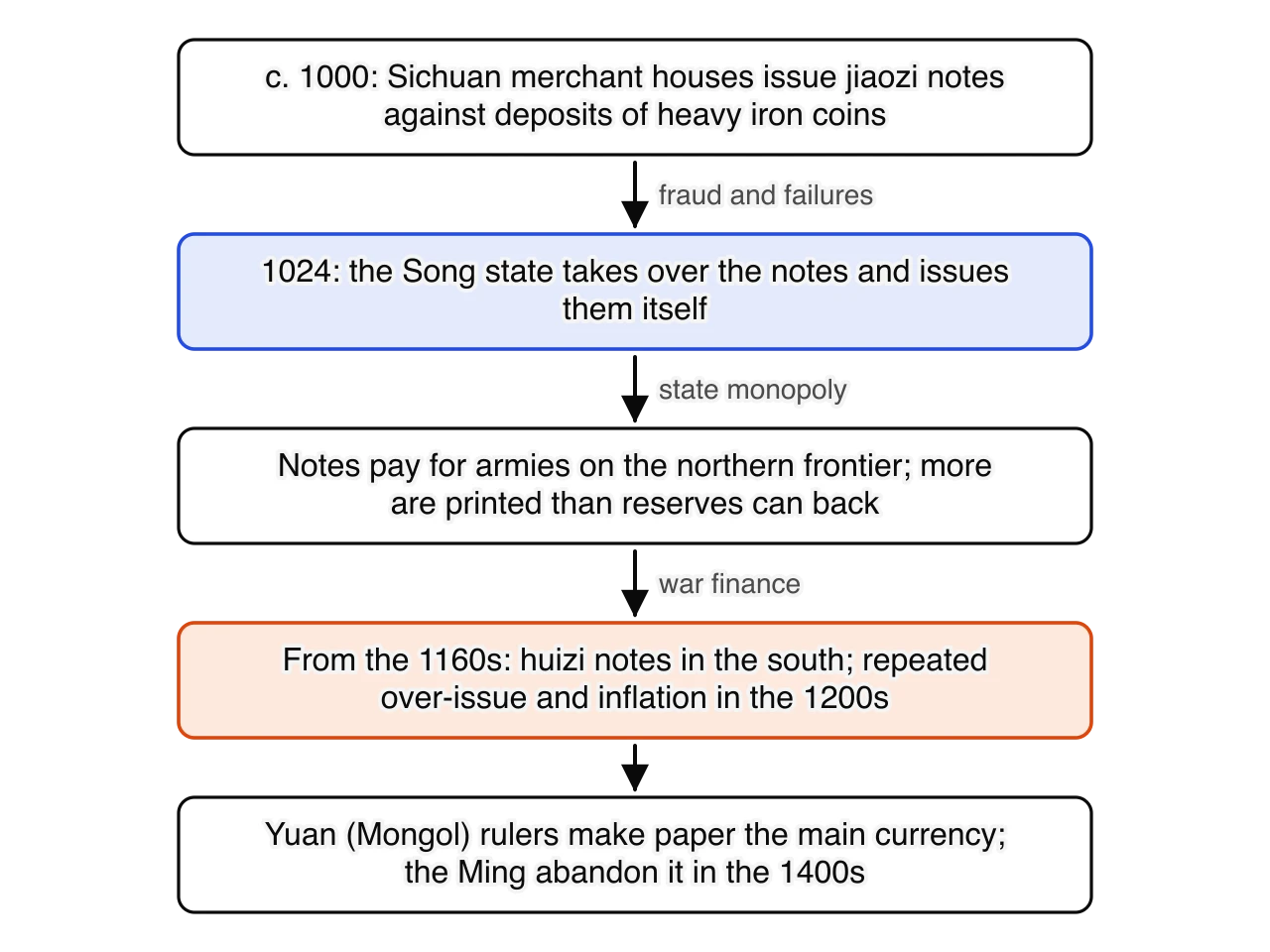
Paper money gave the Song state a new instrument of power, traced in the diagram of Song paper money. When the government took over the jiaozi notes of Sichuan merchants in 1024, it gained the ability to pay soldiers and suppliers with paper. This helped to finance the long frontier wars with the Liao, the Xi Xia and the Jin, but over-issue caused inflation and loss of trust in the thirteenth century. The Mongol Yuan dynasty that conquered the Song in 1279 inherited the system, and a Venetian visitor described how the Mongol emperor used it.
With these pieces of paper, made as I have described, he causes all payments on his own account to be made; and he makes them to pass current universally over all his kingdoms and provinces and territories, and whithersoever his power and sovereignty extends. And nobody, however important he may think himself, dares to refuse them on pain of death.
Marco Polo, The Travels, dictated c. 1298, translated by Henry Yule (revised by Henri Cordier, 1903). Polo described the Yuan court of Kublai Khan, not the Song, and wrote for European readers who used only coins, so he stressed what would astonish them. His account is valuable because it shows paper money as an instrument of state power, enforced by the threat of death, a generation after the Song collapse; its limitation is that he exaggerates the emperor’s wealth and says nothing of the inflation that had already weakened Song paper money.
Gunpowder transformed warfare and, in time, politics far beyond China. Song armies used fire arrows, bombs and, by the 1130s, the fire lance, a bamboo or paper tube that shot flame at close range. The Song founded a permanent navy in 1132 and armed river boats with gunpowder weapons against the Jin. Gunpowder did not save the Song from the Mongols, but the Mongols carried its use westwards. By the sixteenth century cannon and handguns underpinned the large states that the historians Marshall Hodgson and William McNeill called the gunpowder empires: Ottoman cannon breached the walls of Constantinople in 1453, and the Mughal founder Babur used field guns and matchlocks to win the battle of Panipat in 1526. These rulers could break the castles of local lords, which concentrated power in the hands of whoever could afford artillery.
Printing, the Reformation and the state
Printing helped turn a dispute about religion into a political revolution in Europe, the Reformation. Martin Luther, a monk and university teacher in Wittenberg, wrote his 95 Theses against the sale of indulgences in October 1517. Within weeks printers in Leipzig, Nuremberg and Basel had reprinted them, and between 1518 and 1520 about 300,000 copies of Luther’s works were printed. Andrew Pettegree argues in Brand Luther (2015) that Luther’s success depended on the printers of Wittenberg, who made his short German pamphlets recognisable, cheap and quick to reprint. The diagram of print and the Reformation follows the chain from the theses to the political settlement of 1555.

Print carried the argument to people who could not read the texts. Luther’s supporters produced woodcut images that anyone could understand, such as the pairs of pictures in the Passional Christi und Antichristi.
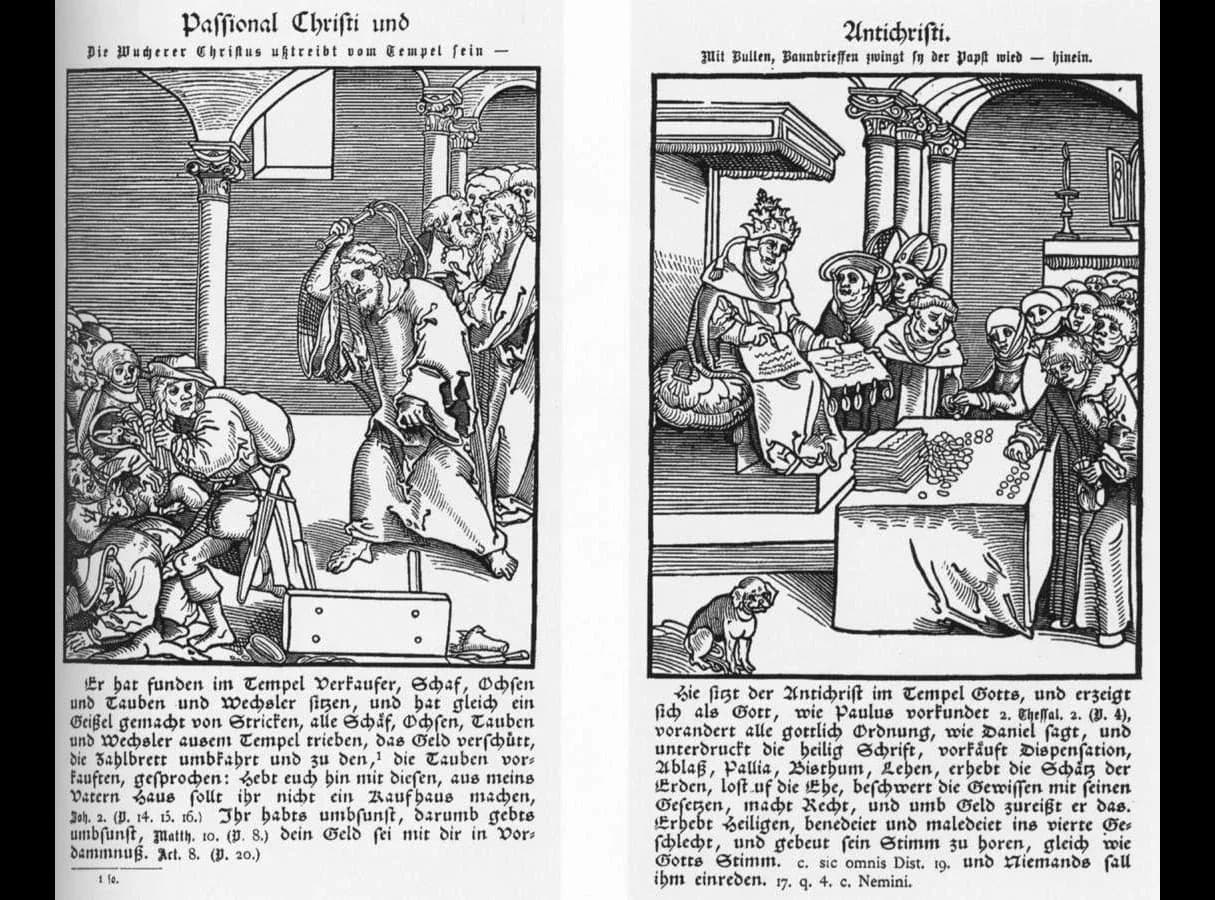
The political effects were large. Princes and city councils who adopted the Reformation took control of church property and appointments, so religious reform strengthened secular rulers. The economist Jared Rubin has found that cities with a printing press by 1500 were much more likely to have become Protestant by 1600 than cities without one. The religious wars that followed ended in Germany with the Peace of Augsburg (1555), which allowed each ruler to decide whether his territory would be Lutheran or Catholic. Rulers also learned to use print for their own purposes, issuing printed laws, proclamations and propaganda, while trying to control what others printed.
Industrial Britain: new classes and the reform of the state
Industrialisation created two new social groups with political demands. Factory owners, merchants and professionals in the northern towns formed an industrial middle class that resented a Parliament dominated by landowners. Wage earners in mills, mines and workshops became a working class, increasingly aware of shared interests. Manchester, with tens of thousands of people by 1800 and far more by 1830, had no member of Parliament of its own until 1832, while some almost empty "rotten boroughs" elected two.
The vertical timeline of industrial politics traces how the state responded. In August 1819 cavalry charged a peaceful meeting of about 60,000 people demanding parliamentary reform at St Peter’s Field in Manchester, killing between 15 and 18 people and injuring hundreds; the radical press named it Peterloo in mocking reference to Waterloo. The Great Reform Act of 1832 gave seats to Manchester, Birmingham, Leeds and Sheffield and the vote to more of the middle class, raising the electorate to about one adult man in five in England and Wales.

Working men were left out, and their response was Chartism, a mass movement named after the People’s Charter of 1838, which demanded the vote for all men, secret ballots and annual parliaments. Its petitions of 1839, 1842 and 1848 gathered millions of signatures and were rejected by Parliament each time. Middle-class manufacturers had more success. The Anti-Corn Law League, founded in Manchester and led by the cotton manufacturer Richard Cobden and John Bright, campaigned against the Corn Laws, tariffs that kept grain prices high to protect landowners. Their repeal in 1846, by a Conservative prime minister, Robert Peel, marked a shift in national policy towards free trade, the interest of industry.
The state also took on new tasks. The Factory Act of 1833 limited children’s hours in textile mills and appointed paid inspectors to enforce it, the first time the British state regulated working conditions in this way. The Municipal Corporations Act (1835) created elected town councils, and the Public Health Act (1848) allowed local boards of health to improve drains and water supplies. Abroad, industrial power underpinned imperial power: cheap cotton cloth, steamships and later railways helped Britain expand its influence in India, China and Latin America.
Continuity was strong. After 1832 Parliament and the Cabinet were still dominated by landowners, the Chartists failed, and working men won the vote only in stages, in the towns in 1867 and in the countryside in 1884. The political transformation of industrial Britain was therefore real but gradual: a change in whose interests governments served more than in who governed.
The Green Revolution: food as Cold War politics
The Green Revolution was political from the start. The name itself was coined by William Gaud, head of the US Agency for International Development (USAID), in a speech of 8 March 1968, in which he said the new agriculture was "not a violent Red Revolution like that of the Soviets" but one he called "the Green Revolution". American foundations and governments hoped that more food would reduce the hunger and rural unrest in which communism might grow.
For India, the political prize was independence from foreign food aid. In 1965–1967 President Lyndon Johnson released American grain shipments month by month to press India over its economic policies and its criticism of the Vietnam War, which Indian leaders found humiliating. Self-sufficiency in wheat by the early 1970s strengthened Indira Gandhi’s government and India’s claim to non-alignment. Inside India, farmers who prospered from the new seeds became a powerful political force: the peasant leader Charan Singh built a party of middle and rich farmers in northern India and became prime minister briefly in 1979, and farm subsidies became very hard for any government to cut.
Some writers link the Green Revolution to the crisis in Punjab in the 1980s. The activist Vandana Shiva argued in 1991 that its inequalities and environmental damage fed the discontent that turned into the Sikh separatist conflict. Most historians give greater weight to religious, constitutional and party-political causes, so the link should be presented as a contested interpretation, not a fact.
Mobile money and digital communication
Mobile money gave the Kenyan state new sources of information and revenue. Because every transaction was recorded, money that had circulated invisibly as cash became traceable, and from 2013 the government taxed the fees charged on transfers. Government agencies began to collect fees and pay benefits through mobile accounts. Critics have raised concerns about who can see the data and about the market power of Safaricom, which ran most of the system.
Digital communication more broadly changed political mobilisation. Mobile phones and social media helped protesters organise and spread images during the uprisings of 2010–2011 in Tunisia and Egypt, a role examined in the study of the Tunisian revolution. Governments responded with censorship, surveillance and, in Egypt in January 2011, by shutting down the internet, which shows that the same technology could strengthen states as well as their opponents.
Comparing political change
Across the cases, innovations most often strengthened existing rulers: the Abbasid and Song bureaucracies, the gunpowder empires, the Indian state after 1970. Transformations that challenged rulers happened where an innovation gave independent resources to a group outside the ruling elite. Printers and pamphleteers in a politically divided Germany, and industrialists and workers in Britain, are the clearest examples. Even then, change came through bargaining and reform more often than through revolution.
Environmental change: land, water, air and climate
Environmental change was the least intended effect of most innovations, and often the slowest to be noticed. It includes changes in land use (forests cleared, wetlands drained, new crops planted), in the use of resources such as water, timber and coal, and in pollution of air, rivers and soil. Some effects were local and short-lived; others, such as the rise in atmospheric carbon dioxide that began with industrial coal burning, became global and permanent.
Song China: reclaimed land and the turn to coal
Song economic growth rested on reshaping the land. In the Yangzi delta, farmers and landlords enclosed marshes and lake shores behind dykes to create polder fields, and in the hills they cut terraces for drought-resistant Champa rice. In the north, centuries of clearing had left the region around Kaifeng short of timber, so iron works and households in the capital turned to coal on a large scale. Mark Elvin’s later work, The Retreat of the Elephants (2004), places these changes in a three-thousand-year story of Chinese deforestation and the draining of wetlands, in which the Song period was a phase of rapid acceleration.
These changes supported a much larger population but made it more vulnerable. Reclaimed lowlands flooded, and the hydraulic works needed to protect them depended on a functioning state. In 1048 the Yellow River broke its banks and shifted to a new course in the north, a disaster that the historian Ling Zhang, in The River, the Plain, and the State (2016), links in part to the Song state’s own attempts to use the river as a defensive barrier against the Liao.
Industrial Britain: smoke, sewage and fossil fuel
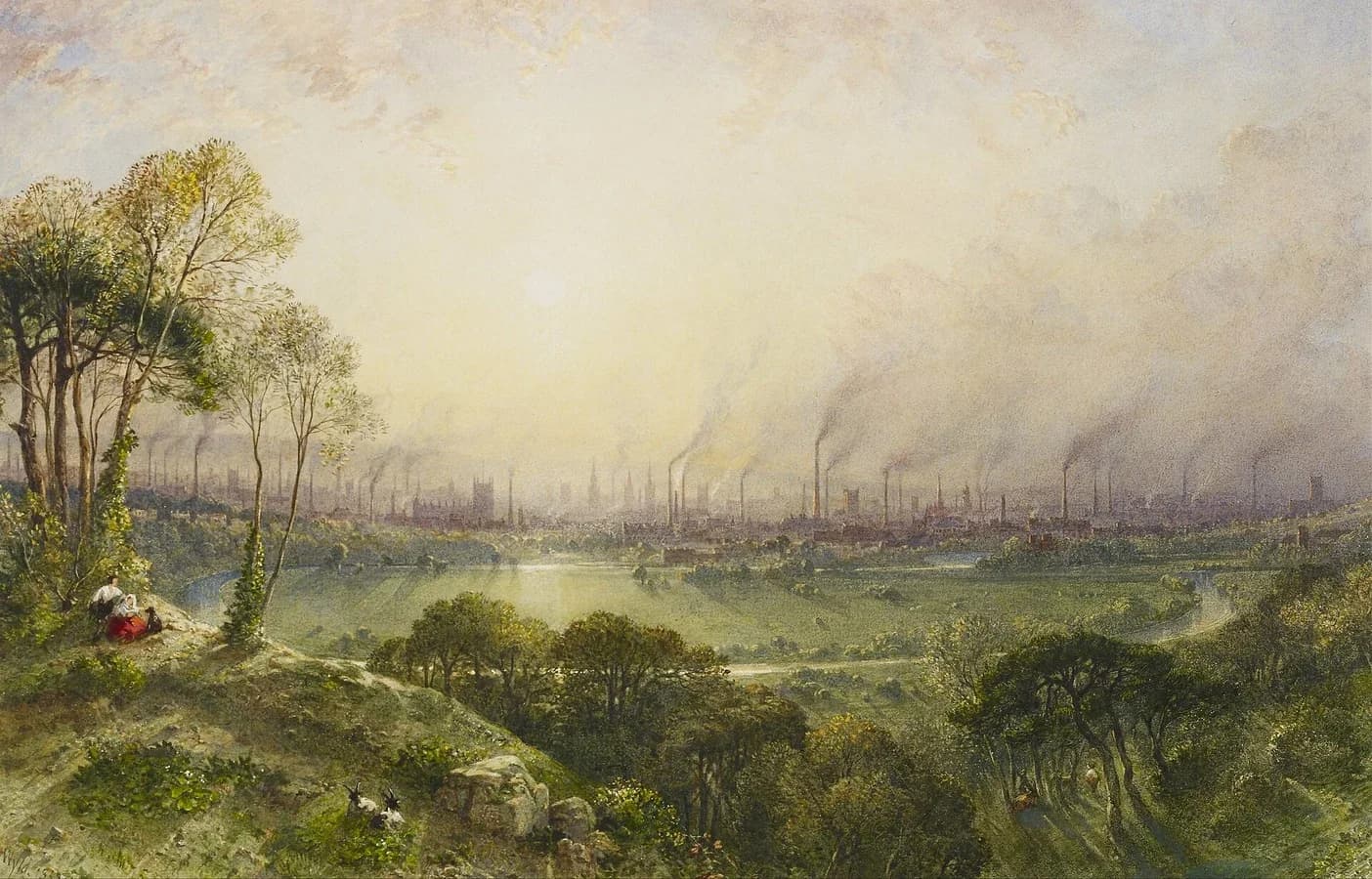
Industrial cities were built around coal. Factory chimneys, steam engines and household fires covered towns such as Manchester with smoke, and dye-works, tanneries and sewage turned rivers like the Irwell into open drains. Alexis de Tocqueville, a French aristocrat and political writer touring England, recorded his impressions of Manchester in July 1835.
A sort of black smoke covers the city. The sun seen through it is a disc without rays. Under this half daylight 300,000 human beings are ceaselessly at work. […] From this foul drain the greatest stream of human industry flows out to fertilize the whole world. From this filthy sewer pure gold flows. Here humanity attains its most complete development and its most brutish; here civilisation works its miracles, and civilised man is turned back almost into a savage.
Alexis de Tocqueville, travel notes on Manchester, 2 July 1835, published in English in Journeys to England and Ireland, edited by J. P. Mayer and translated by George Lawrence (1958). Tocqueville wrote private notes, not propaganda, and as a visitor from a less industrial country he was struck by what local people took for granted. His paradox of filth and gold captures the two sides of the transformation; his figure of 300,000 is an impression, not a counted total.
Crowded housing without clean water or drains made the industrial towns unhealthy. Cholera, a waterborne disease new to Britain, killed tens of thousands in the epidemics of 1831–1832 and 1848–1849. In 1854 the London doctor John Snow traced a cholera outbreak in Soho to a single contaminated water pump, evidence that the disease spread through dirty water. Life expectancy in the largest industrial towns was well below the national average in the 1840s. The state’s responses, such as the Public Health Act (1848) and laws against factory smoke in London (1853), were the first attempts to regulate the environmental effects of industry.
The longest-lasting change was invisible at the time. Burning coal released carbon dioxide stored for millions of years, and the concentration of carbon dioxide in the atmosphere began to rise from about 280 parts per million before industrialisation, passing 420 by the 2020s. In 2000 the atmospheric chemist Paul Crutzen proposed that a new geological age, the Anthropocene, should be dated from the late eighteenth century and James Watt’s steam engine. Geologists have since debated the start date, but the proposal shows how the environmental significance of the Industrial Revolution has grown with hindsight.
The Green Revolution: water, chemicals and crops
High-yielding varieties needed far more water and fertiliser than traditional crops. In Punjab and Haryana farmers sank tube-wells and pumped groundwater with subsidised electricity, and a rotation of irrigated wheat in winter and rice in summer replaced a mixture of pulses, millets and oilseeds. A study using NASA satellite measurements, published in Nature in 2009 by Matthew Rodell and colleagues, estimated that north-western India was losing about 18 cubic kilometres of groundwater a year between 2002 and 2008, mostly to irrigation. Heavy use of pesticides and fertiliser polluted soils and water, and hundreds of local crop varieties fell out of use.
Supporters of the Green Revolution answer that higher yields spared land. Because each hectare produced more, less forest and grassland had to be cleared to feed growing populations, an argument Borlaug made throughout his life. Both claims can be true: the Green Revolution reduced the pressure to farm new land worldwide while damaging the land and water of the regions that adopted it most intensively.
Paper, print and mobile money: lighter footprints
Not every innovation transformed the environment. Early Islamic and European paper was made from linen rags, so it recycled an existing material and did not require large-scale tree felling; wood pulp paper came only in the nineteenth century. Printing’s environmental effects were small. Mobile money depends on phones, towers and electricity, and has added to electronic waste, but services built on it, such as M-Kopa’s solar lighting kits, replaced kerosene lamps in many rural homes.
The contrast is useful for judgement. Innovations that changed how energy was produced or how land and water were used (coal and steam, new crop systems) transformed environments; innovations that changed how information or money moved (paper, print, mobile money) transformed societies mainly in other ways.
Cultural change: knowledge, belief and ways of life
Cultural change covers what people knew and believed, how they communicated, what they read, made and enjoyed, and how they organised their days. Innovations in recording and copying knowledge (paper, print, digital media) changed culture most directly, because they changed who could learn what and how quickly ideas spread. Innovations in production changed culture more indirectly, through new kinds of work, new towns and new social identities.
Abbasid Baghdad: a culture of books
Cheap paper turned Baghdad into a city of books. A booksellers’ market grew up near the Round City, where copyists (warraqun) made and sold manuscripts, and the geographer al-Ya’qubi, writing in 891, counted about a hundred bookshops there. In 987 the Baghdad bookseller Ibn al-Nadim compiled the Fihrist, a catalogue of all the books in Arabic he knew of, with thousands of titles from poetry and law to astronomy and alchemy. Owning, copying and debating books became part of the life of the educated urban elite, not only of scholars at court.
Paper also made possible the scientific culture that later writers called the Golden Age of Islamic science. Translators such as Hunayn ibn Ishaq, a Nestorian Christian physician, put the medical works of Galen into Arabic, and new works built on the translations. Muhammad ibn Musa al-Khwarizmi’s book on calculation by completion and balancing (c. 820) gave its name to algebra, and his treatise on Indian arithmetic spread the Hindu-Arabic numerals, including zero. Ibn Sina’s Canon of Medicine (completed c. 1025) drew together Greek, Persian and Arabic medicine.
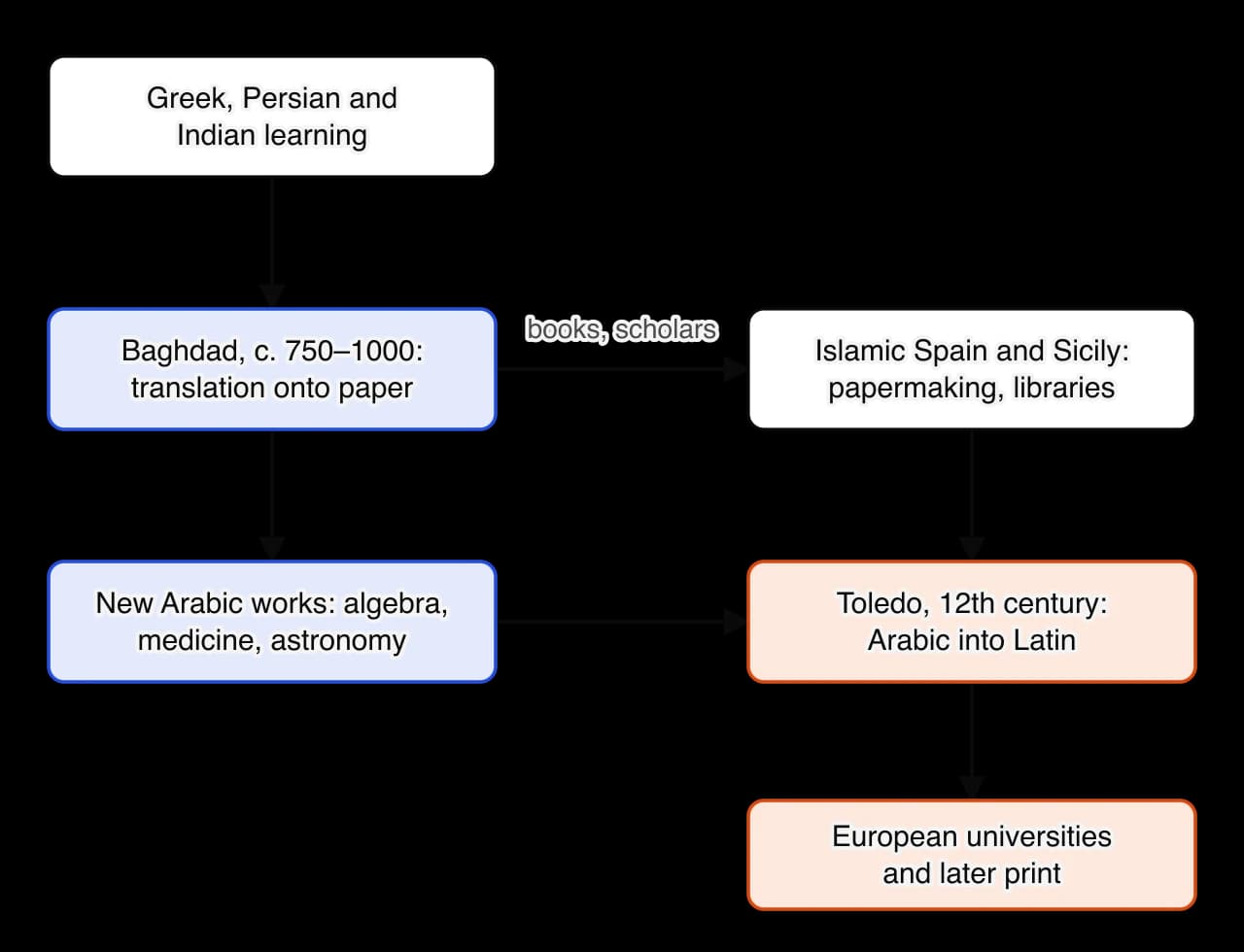
The cultural change crossed regions, as the diagram of knowledge transfer shows. Papermaking reached Islamic Spain, where the town of Xàtiva was producing paper by the twelfth century. In Toledo, after its capture by Castile in 1085, scholars such as Gerard of Cremona (d. 1187) translated dozens of Arabic works into Latin, including Ptolemy’s Almagest and Ibn Sina’s Canon, which European universities used for centuries. Leonardo of Pisa (Fibonacci) introduced Hindu-Arabic numerals to European merchants in his Liber Abaci (1202). The word "algorithm" comes from al-Khwarizmi’s name.
Song China: print culture and Neo-Confucian learning
Woodblock printing made China the first society with a large printed literature. The complete Buddhist canon was printed in Sichuan between 971 and 983 from over 100,000 carved blocks, and Song printers, official and commercial, produced the Confucian classics, histories, encyclopaedias, medical texts, almanacs and poetry. Commercial publishing centres such as Jianyang in Fujian sold cheap editions across the empire.
Printed books spread the ideas of the Neo-Confucian scholars, above all Zhu Xi (1130–1200), whose commentaries on the classics later became the official basis of the examinations (from 1313, under the Yuan). Print also helped to create a shared literary culture among the educated across a very large empire. In the growing cities, a lively commercial culture of teahouses, storytellers, theatres and pleasure quarters appeared, described in memoirs of Kaifeng and Hangzhou written by Song authors.
The deepest values changed less. The ideal of a hierarchical, agrarian society governed by educated men survived, and Neo-Confucianism, spread by print, reinforced it, including stricter ideals of female seclusion. Print in Song China transformed access to the culture of the elite without overturning that culture.
Print in Europe: religion, language and science
Print changed European culture faster and more visibly. Reformation pamphlets brought religious argument to a mass audience, and the Bible appeared in vernacular languages: Luther’s German New Testament (September 1522) sold out within months. Printing standardised spelling and grammar within languages, since printers needed one form for a market across many dialects, and so helped form national languages such as standard German and English. Humanist printers such as Aldus Manutius in Venice issued the Greek and Latin classics in accurate, affordable editions from the 1490s.
Printing also changed how knowledge accumulated. Before print, every copy of a manuscript introduced new errors and drawings were distorted as they were copied. Printed tables, maps and anatomical illustrations could be reproduced identically, corrected in later editions and compared by readers in different cities. In 1543 Copernicus’s On the Revolutions of the Heavenly Spheres and Andreas Vesalius’s illustrated anatomy, On the Fabric of the Human Body, were both printed, and many historians see the printing press as one of the conditions of the Scientific Revolution. Writing in 1620, the English philosopher and statesman Francis Bacon already placed printing among the inventions that had changed the world.
Again, we should notice the force, effect, and consequences of inventions, which are nowhere more conspicuous than in those three which were unknown to the ancients; namely, printing, gunpowder, and the compass. For these three have changed the appearance and state of the whole world: first in literature, then in warfare, and lastly in navigation; and innumerable changes have been thence derived, so that no empire, sect, or star, appears to have exercised a greater power and influence on human affairs than these mechanical discoveries.
Francis Bacon, Novum Organum, Book I, aphorism 129, 1620, in the translation edited by Joseph Devey (1902). Bacon wanted to persuade readers that practical, experimental knowledge could improve human life, so he had a reason to stress the power of inventions. The source is evidence of how educated Europeans already saw these innovations as transforming within a century of Luther; it also shows a European perspective, since Bacon did not know that all three had first been developed in China.
 YouTube
Literacy grew slowly and unevenly. Most Europeans in 1600 still could not read, and those who could were mostly men, townspeople and the better-off. Much of print’s influence reached others through reading aloud, sermons and images, which is why woodcuts such as those of the Passional mattered.
Industrial Britain: clock time, class and new ideas
Industrial work changed how people experienced time. Farm and domestic work followed the seasons, daylight and the task in hand; factory work followed the clock, the bell and the speed of the machines, with fines for lateness. The historian E. P. Thompson argued in "Time, Work-Discipline, and Industrial Capitalism" (Past & Present, 1967) that learning this time discipline was one of the deepest cultural changes of industrialisation, enforced by employers, schools and preachers. Railways spread a single national time: local times varied from town to town, so the railway companies adopted London (Greenwich) time from the 1840s, and most of Britain followed by the mid-1850s.
Industrialisation also created new identities. Thompson’s The Making of the English Working Class (1963) argued that between 1780 and 1832 workers came to see themselves as a class with shared interests, through radical politics, trade unions, friendly societies and chapels. Religion changed with the new towns too: Methodism, which grew fast among industrial workers, taught sobriety, punctuality and hard work, and Thompson saw it as a way in which factory discipline was internalised, although its chapels also trained many of the speakers and organisers of trade unions and Chartism. Middle-class identity formed around respectability, religion and the family. Some historians think Thompson overstated how united workers were, since skilled craftsmen and unskilled labourers, English and Irish, men and women often had different interests, but the language of class became part of British culture.
Writers and artists responded to the machine. The Romantic poet William Blake contrasted England’s "green & pleasant land" with "dark Satanic Mills" in a poem of about 1804, and William Wordsworth protested in 1844 against a railway into the Lake District. Industrial society also produced its own analysts. Friedrich Engels, the son of a German cotton manufacturer working in Manchester, published The Condition of the Working Class in England in 1845, and his partnership with Karl Marx turned the experience of industrial Britain into the theory of class struggle set out in The Communist Manifesto (1848).
Leisure was transformed as well. Cheap rail fares made day trips possible for working families: in 1841 Thomas Cook organised his first railway excursion, taking several hundred temperance supporters from Leicester to Loughborough, and seaside resorts such as Blackpool grew with the railways. Cheap print and the railway brought newspapers to every town.
The Green Revolution and mobile money: everyday life
In Punjab and Haryana, Green Revolution prosperity changed rural life within a generation: tractors replaced bullocks, families invested in brick houses and motorbikes, and diets shifted towards wheat and rice at the expense of pulses and millets. Older practices of seed-saving and crop mixing declined as farmers bought seed and inputs each season, tying village life more closely to markets and the state.
Mobile money changed everyday habits in Kenya. Sending money became a normal part of family life: migrant workers in Nairobi or Mombasa supported relatives in the countryside with small, frequent transfers rather than occasional journeys carrying cash. Paying school fees, utility bills and shopkeepers by phone became routine. The wider spread of mobile phones and the internet gave people access to news, music, religious teaching and social media that earlier generations could reach only through radio or print.
Comparing cultural change
The cases suggest that cultural transformation was deepest where an innovation changed communication, and where it reached people outside an existing elite. Print in Europe, reaching townspeople and, through images and preaching, peasants, changed religion itself; print in Song China, used mostly by the examination elite, spread and reinforced an established culture. Industrialisation changed culture through work and towns rather than through ideas, but its effect on time, class and leisure was felt by millions.
Comparing the transformations
The comparative table of the core cases sets the six innovations against the four kinds of change. Reading across a row shows how broad each transformation was; reading down a column shows which kinds of innovation produced which kinds of change.
Case (region) | Economic change | Political change | Environmental change | Cultural change |
|---|---|---|---|---|
Paper and the translation movement, c. 750–1000 (Africa and the Middle East) | Paper industry and book trade in Baghdad; cheaper records for commerce | Larger, more literate bureaucracy; legitimacy through patronage of learning | Small: paper from rags | Deep and lasting: book culture, algebra, numerals, transmission to Europe |
Song China, 960–1279 (Asia) | Commercial revolution; population near 100 million; paper money; iron and coal | Examination elite; state control of money; gunpowder warfare | Land reclamation, deforestation, coal use in the north | Print culture; Neo-Confucianism; urban entertainment |
Printing press, c. 1450–1600 (Europe) | New book industry; faster growth of printing cities | Reformation; stronger princes; Peace of Augsburg (1555) | Small | Vernaculars, Reformation, Scientific Revolution |
Industrial Revolution, c. 1760–1850 (Europe) | Factories, steam, railways; majority urban by 1851; sustained growth | Reform Act 1832, Chartism, free trade, new state roles, empire | Coal smoke, polluted rivers, cholera, rising carbon dioxide | Clock time, class identity, Romantic critics, mass leisure |
Green Revolution, c. 1943–1980 (Americas and Asia) | Wheat output up about 60 per cent in five years in India; gains to larger farmers | Food self-sufficiency; Cold War politics; farmers’ lobbies | Groundwater depletion, chemicals, loss of crop varieties; land spared elsewhere |
Three conclusions follow from the comparison. First, innovations in energy and land use (steam, coal, new crops) produced the largest environmental change, and innovations in communication (paper, print, phones) produced the largest cultural change. Second, the speed of transformation has increased: paper took centuries to spread from Baghdad to Spain, the British transformation took about ninety years, and mobile money transformed Kenyan payments within a decade. Third, the British Industrial Revolution stands out because it transformed all four areas at once and began sustained economic growth, which is why many historians treat it as the most significant transformation in the core set.
Continuity alongside change
Every case also shows continuity. The Abbasid caliphate remained an Islamic monarchy; Song China remained an agrarian empire ruled by Confucian officials; Reformation Europe remained a society of princes, nobles and peasants; Britain in 1850 was still governed mainly by landowners, and agriculture was still its largest single employer; Green Revolution Punjab kept its caste hierarchy and land-owning patterns; Kenya with M-Pesa still had widespread poverty. Transformation was rarely total. Strong judgements identify which structures changed and which survived.
Perspectives and debates: how revolutionary were the transformations?
Historians agree that these innovations mattered; they disagree about how fast, how deep and how beneficial the changes were. Most of the debates are about the word "revolution", which implies sudden and complete change, and about whose experience is taken as the measure.
Was the Industrial Revolution a revolution?
The term was popularised by the historian Arnold Toynbee in lectures published in 1884, which described a sudden break with the past and a catastrophe for workers. From the 1920s John Clapham and others stressed how gradual and patchy industrialisation was. In the 1980s the economic historians Nicholas Crafts (British Economic Growth during the Industrial Revolution, 1985) and Knick Harley recalculated national income and found that British growth was slower than earlier estimates suggested, at about 1 to 2 per cent a year before 1830, with rapid change confined to a few sectors such as cotton, iron and transport. Most of the economy, from farming to building and domestic service, changed slowly.
Other historians answer that slow average growth hides a real break. Joel Mokyr argues in The Enlightened Economy (2009) that what was revolutionary was the start of continuous technological innovation, which made growth self-sustaining for the first time. Jan de Vries’s idea of an industrious revolution (2008) adds that households changed first, working longer and selling more in order to buy consumer goods, so demand helped drive industrial change. A balanced judgement is that the British economy changed gradually in aggregate but was transformed in its leading sectors, its towns and its capacity for future growth.
The standard of living debate
Whether industrialisation improved ordinary lives before 1850 has been argued since the 1950s. The optimists, led by R. M. Hartwell in "The Rising Standard of Living in England, 1800–1850" (Economic History Review, 1961), used wage and price series to argue that real wages rose after about 1820 and that cheaper cotton, food and fuel benefited workers. The pessimists, led by Eric Hobsbawm in "The British Standard of Living, 1790–1850" (1957), pointed to unemployment, food consumption and mortality in the towns. E. P. Thompson widened the debate to experiences that statistics miss: loss of independence, factory discipline and the destruction of trades such as handloom weaving.
Later work has narrowed the gap. Charles Feinstein’s wage estimates (1998) found real wages rising by only about 30 per cent from 1780 to 1850, a modest gain in a time of fast growth in output, while studies of height and life expectancy show that health in the industrial towns worsened in the 1830s and 1840s. Most historians now conclude that living standards rose slowly and unevenly before 1850 and more clearly afterwards. How the transformation felt to particular groups (women, children, handloom weavers, enslaved cotton growers) belongs to the question of how innovations affected people’s lives.
Was printing a communications revolution?
Elizabeth Eisenstein argued in The Printing Press as an Agent of Change (1979) that print caused a "communications revolution". Its key effect was typographical fixity: identical, permanent copies allowed knowledge to be compared, corrected and built upon, which made both the Reformation and the Scientific Revolution possible. Adrian Johns replied in The Nature of the Book (1998) that early printed books were often inaccurate and pirated, and that readers trusted them only after printers, booksellers and scholars built up reputations and rules over the following two centuries. For Johns, fixity was a result of social practices, not of the technology alone. Andrew Pettegree (Brand Luther, 2015) takes a middle position, showing how printers and authors such as Luther together created a market for cheap, fast, trusted print.
How transformed was Song China?
Mark Elvin’s The Pattern of the Chinese Past (1973) described a "medieval economic revolution" in farming, water transport, money, markets and science, and then explained China’s later failure to industrialise through a high-level equilibrium trap: a large, efficient pre-industrial economy with cheap labour had little reason to invest in labour-saving machines. Robert Hartwell (1982) stressed instead that growth moved from region to region, with the north declining as the south-east boomed, so national averages hide sharp regional differences. Later historians of the Great Divergence, such as Kenneth Pomeranz in The Great Divergence (2000), compare the eighteenth-century Yangzi delta with England rather than looking back to the Song, so the debate about why China did not industrialise has moved to a later period.
Was the Green Revolution a success?
For Borlaug and his supporters, the Green Revolution prevented famine in South Asia, freed India from food aid, and spared forests and grasslands from the plough. For critics such as Francine Frankel (1971) it widened inequality between regions and classes, and for Vandana Shiva (1991) it damaged soils, water and seed diversity and contributed to political violence in Punjab. The agricultural economist Prabhu Pingali, reviewing fifty years of evidence in 2012, concluded that the yield gains were real and reduced poverty and food prices, but that the environmental costs were serious where inputs were overused. The debate turns on what is measured (national food supply, or the condition of particular villages, groups and aquifers) and over what period.
Historian or writer | Work and date | Argument | Evidence stressed |
|---|---|---|---|
Nicholas Crafts | British Economic Growth during the Industrial Revolution (1985) | British growth was gradual; change was concentrated in a few sectors | Recalculated national income and output figures |
Joel Mokyr | The Enlightened Economy (2009) | The revolution was the start of continuous innovation | Patents, scientific networks, engineering knowledge |
R. M. Hartwell / Eric Hobsbawm | Articles of 1961 / 1957 | Optimist: living standards rose after 1820 / Pessimist: they did not | Real wages and prices / unemployment, consumption, mortality |
Elizabeth Eisenstein | The Printing Press as an Agent of Change (1979) | Print caused a communications revolution through fixity | Standardised texts, tables and images; Reformation; science |
Adrian Johns | The Nature of the Book (1998) | Trust in print was built socially over two centuries | Piracy, errors, regulation of the book trade |
Mark Elvin | The Pattern of the Chinese Past (1973) | Song China had a medieval economic revolution, later trapped at a high level | Farming, money, markets, technology |
Francine Frankel / Vandana Shiva | 1971 / 1991 | The Green Revolution widened inequality and damaged the environment | Village studies; soils, water and seed diversity in Punjab |
The debates follow a common pattern. Those who stress aggregate figures and long periods (Crafts, Borlaug) tend to see either gradual change or net benefit; those who stress particular places, groups and experiences (Thompson, Frankel, Shiva) see disruption and loss. Both perspectives are needed to judge how far a society was transformed, and for whom.
Applying the ideas in exam questions
Paper 2 Section A: continuity and change
Paper 2 Section B Part A: cultural change
Paper 2 Section B Part B: economic and political transformation
Paper 2 Section B Part B: environmental change
Self-check
- To do:
I can explain what makes a change a transformation, using scale, speed, depth and duration.
- To do:
I can distinguish intended and unintended, and short-term and long-term, effects of an innovation.
- To do:
I can describe the commercial revolution of Song China and its limits.
- To do:
I can explain how printing changed the European economy of books and knowledge.
- To do:
I can explain how the factory system, steam power and railways transformed the British economy, with figures.
- To do:
I can explain the economic effects of the Green Revolution in Mexico and India, and who gained most.
- To do:
I can explain how M-Pesa changed the Kenyan economy, using Suri and Jack’s findings and their limits.
- To do:
I can explain how paper served the Abbasid state and how print and paper money served the Song state.
- To do:
I can explain how gunpowder changed warfare and helped create the gunpowder empires.
- To do:
I can explain how print contributed to the Reformation and strengthened princes, without overstating it.
- To do:
I can trace political change in industrial Britain from Peterloo (1819) to Corn Law repeal (1846) and judge how far it went.
- To do:
I can explain the political effects of the Green Revolution and of mobile money.