Notes on R4.7 The Russian Revolution (1855–1924)
Between 1855 and 1924 Russia changed from an empire of serfs ruled by an autocratic tsar into the world’s first state governed by a communist party. The revolutions of 1905 and 1917, and the regime that emerged from them, shaped European and world politics for most of the twentieth century.
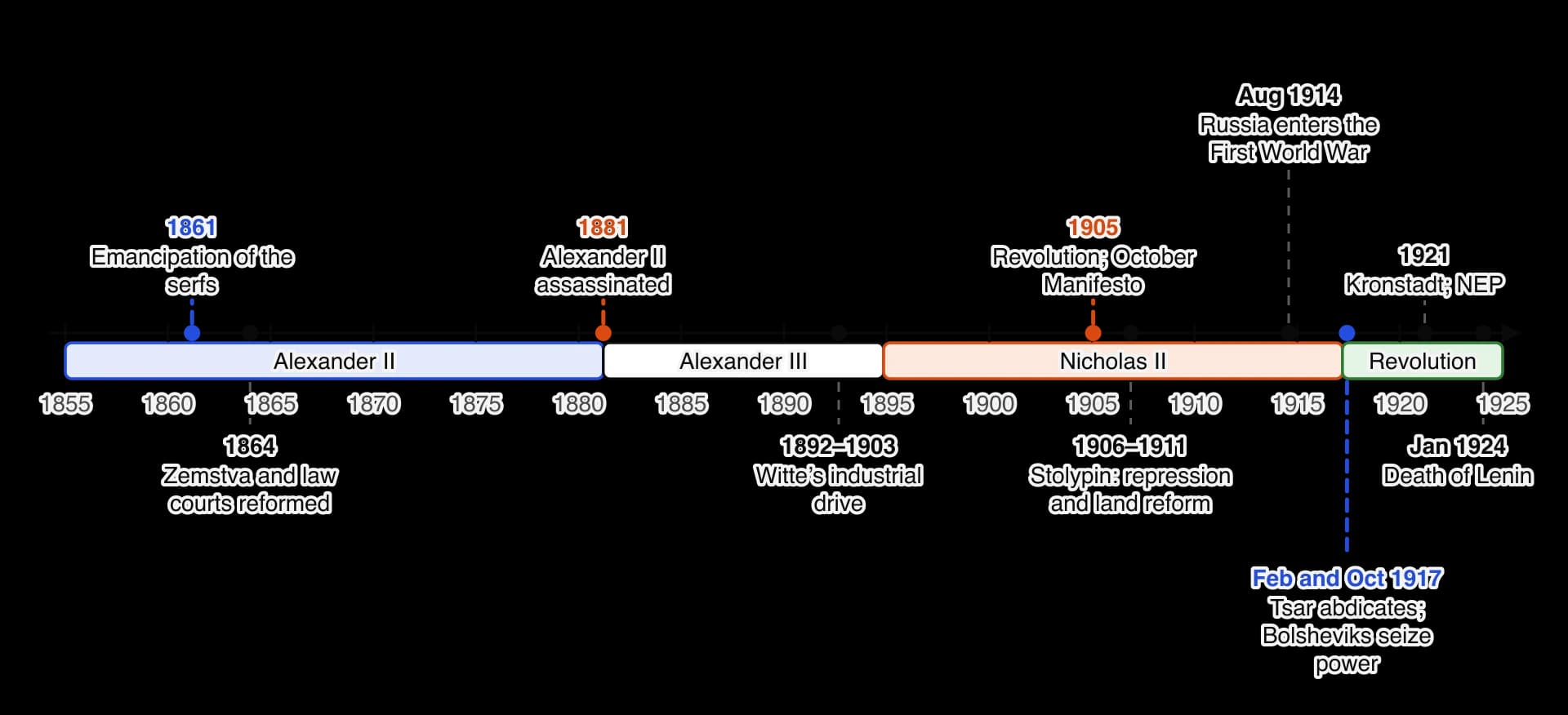
Russia in 1855: autocracy, serfdom and defeat
In 1855 the Russian Empire stretched from Poland to the Pacific and held about 70 million people. Russians made up less than half of them; the rest included Ukrainians, Poles, Finns, Baltic Germans, Jews, Georgians, Armenians and the Muslim peoples of the Caucasus and Central Asia. Most people of every nationality were peasants.
The empire was an autocracy: the tsar held unlimited power, issued laws by decree and appointed every minister, governor and senior officer. There was no parliament, no legal opposition and strict censorship. Under Nicholas I (1825–1855) the regime defined its ideology in three words proposed by his education minister, Sergei Uvarov: Orthodoxy, Autocracy and Nationality. The Russian Orthodox Church taught obedience to the tsar, the autocrat ruled as God’s representative, and the Russian people were presented as united behind both.
Russian society rested on serfdom. About 23 million peasants were serfs owned by nobles, who could buy and sell them with the land, demand labour or rent, punish them and send them into the army. A similar number of state peasants lived on crown land with somewhat more freedom. Most peasants lived in a village commune, the mir, which shared out the land in strips, organised farming and was collectively responsible for taxes.
The Crimean War and the case for reform
The Crimean War (1853–1856) exposed the weakness of this system. Britain and France landed an army in the Crimea in 1854 and besieged the naval base of Sevastopol, which fell in September 1855. Russia could not supply its own territory: it had about 1,000 km of railway, none of it reaching the south, and troops and supplies travelled by cart. Its serf soldiers, conscripted for 25 years, faced enemies with better rifles and steamships. Under the Treaty of Paris (March 1856) Russia lost the right to keep a fleet in the Black Sea.
Alexander II, who became tsar in February 1855 during the war, drew the lesson that Russia had to modernise to remain a great power. Serfdom stood in the way: it kept the army dependent on long-service serf conscripts, held back the movement of labour to industry, and threatened unrest. Peasant disturbances had become more frequent in the 1850s. In March 1856 Alexander told the marshals of the Moscow nobility that it was better for serfdom to be abolished from above than to wait until it began to abolish itself from below (the wording differs between translations). Fear of revolt, military weakness and economic backwardness together explain the reforms that followed.
Alexander II and the Great Reforms, 1855–1881
The emancipation of the serfs, 1861
After five years of discussion in committees of officials and provincial nobles, Alexander signed the Emancipation Statute on 19 February (3 March) 1861. The emancipation of the serfs gave about 23 million privately owned serfs personal freedom: they could marry, own property, trade and go to court without their lord’s permission. State peasants received similar terms in 1866.
Land was the difficult question. Peasants received allotments of land, but they had to pay for them. The state paid the nobles compensation in bonds, and the peasants repaid the state through redemption payments spread over 49 years at 6 per cent interest. In practice:
In much of central Russia peasants received less land than they had farmed before. Nobles kept the best fields, woods and meadows, and the strips cut off from peasant plots ("cut-offs") became a lasting grievance.
The price of the land was often set above its market value, so many households fell into arrears.
Ownership of the land passed to the commune, not to individuals. The mir decided who farmed which strips, collected the redemption payments and could refuse a member permission to leave. Peasants were free of the lord but still tied to the village.
Freed serfs remained a separate legal estate, with their own courts and the volost (a rural district run by peasant elders), and remained liable to corporal punishment until 1904.
Many peasants believed that the tsar had given them all the land and that nobles or officials had hidden the "real" decree. In the village of Bezdna, in Kazan province, a peasant named Anton Petrov read the statute this way to thousands of followers in April 1861; troops opened fire and killed dozens of people (estimates range from about 50 to over 90). There were more than a thousand disturbances in 1861 alone.
Local government, law and the army
Emancipation ended the noble’s role as police chief, judge and tax collector on his estate, so new institutions had to replace him. The table of the other Great Reforms shows how far each changed Russia.
Reform | What it did | Limits |
|---|---|---|
Zemstvo statute (1864) | Elected district and provincial councils ran roads, schools, health care and famine relief; by 1914 they employed thousands of teachers, doctors and agronomists | Elections weighted to give nobles most seats; no zemstvo at national level; governors could overrule them; only in 34 provinces of European Russia |
Judicial reform (1864) | Courts independent of the administration, judges appointed for life, trial by jury for serious crimes, public trials, trained lawyers | Political cases could be moved to special courts; peasants kept their own volost courts |
Municipal reform (1870) | Elected town councils (dumas) for local services | Vote based on property, so a small wealthy minority elected the councils |
Education and censorship (1863–1865) | University statute of 1863 restored autonomy to universities; censorship before publication eased for books and major periodicals | Tightened again after 1866 |
Military reform (Dmitry Milyutin, 1874) | Universal conscription at 20 for all classes; active service cut from 25 years to 6, with time in the reserve; education for recruits; military courts reformed | Many exemptions (only sons, the educated served less); officer corps still dominated by nobles |
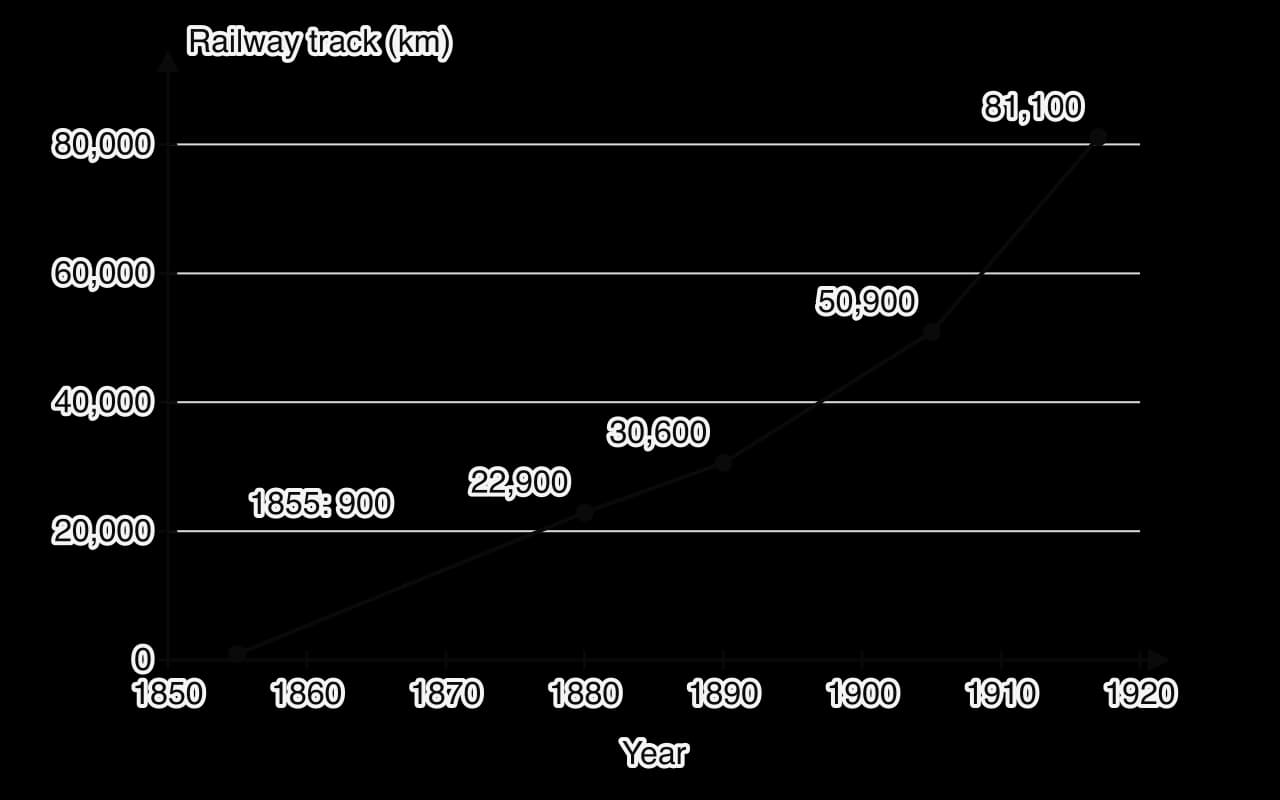
Mikhail Reutern, minister of finance from 1862 to 1878, reorganised the state budget and encouraged private railway building with state guarantees. The graph of railway track shows the result: from under 1,000 km in 1855 to almost 23,000 km by 1880.
Repression and the limits of reform
Alexander II changed institutions but rejected liberal politics. He refused every request for a national elected assembly, and his reforms were designed to make autocracy work better. Two events in the 1860s pushed him back towards repression. In January 1863 Poles rose in revolt against Russian rule; the rising was crushed by 1864 and followed by a policy of making Poland more Russian. In April 1866 a student, Dmitry Karakozov, tried to shoot the tsar. Alexander then appointed the conservative Dmitry Tolstoy as minister of education, who restricted the teaching of science and placed universities under closer control.
Reform also created its own critics. The new courts, zemstva and universities produced an educated, professional class that wanted more: liberals hoped to "crown the edifice" with a national assembly, while radical students wanted revolution. In 1878 a jury acquitted Vera Zasulich, a revolutionary who had shot and wounded the governor of St Petersburg, which showed how far educated society sympathised with the regime’s enemies.
The growth of opposition: Populism and terror
Most radicals of the 1860s and 1870s belonged to the intelligentsia, the small, educated class that saw itself as the conscience of the nation. Their main movement, Populism, held that Russia could pass straight to socialism through the peasant commune, without going through capitalism.
In the summer of 1874 some 2,000–3,000 students went "to the people", living in villages to spread socialist ideas. Peasants were suspicious, many handed them to the police, and well over a thousand were arrested. The failure led some radicals to form a secret organisation, Land and Liberty (1876), which split in 1879 over methods. Black Repartition, led by Georgy Plekhanov, rejected terror and later turned to Marxism; People’s Will set out to kill the tsar, believing that his death would shake the regime and spark a rising.
After several failed attempts, People’s Will assassinated Alexander II with a bomb in St Petersburg on 1 (13) March 1881. On the same day he had approved a plan by his interior minister, Mikhail Loris-Melikov, to bring elected representatives into commissions that would advise on legislation; his son abandoned it. The assassination brought no rising. The organisers were hanged and the movement was crushed.
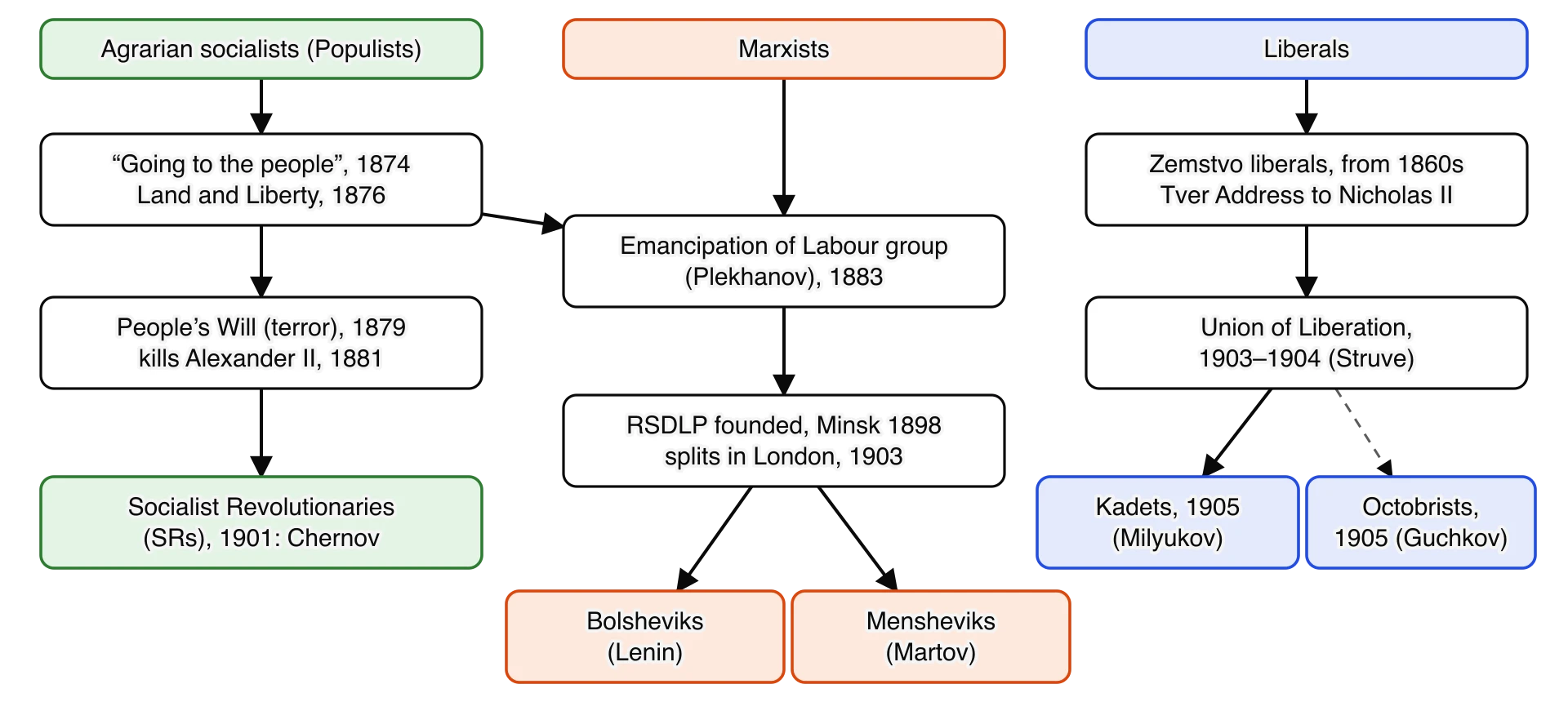
The family tree of the opposition shows how the movements of the 1870s led to the parties of 1917. Populism lived on in the Socialist Revolutionaries, Plekhanov’s break with it began Russian Marxism, and the zemstvo liberals formed the core of the Kadets.
How far did Alexander II reform Russia?
Historians judge the reforms by different measures. By the standard of what came before, they were the greatest changes since Peter the Great: legal freedom for half the peasantry, an independent judiciary, elected local government and a modern army. W. Bruce Lincoln, in The Great Reforms (1990), stresses the "enlightened bureaucrats" in the ministries who designed them and gave Russia a modern legal and administrative framework.
By the standard of their own aims, the results were mixed. The peasants remained poor, indebted and bound to the commune, and the land question became the central grievance of every revolution until 1917. The army was defeated by Japan in 1904–1905. Above all, the reforms modernised the institutions around the autocracy while leaving autocracy itself untouched. The new professional classes had nowhere to take their demands except into opposition.
Alexander III: reaction and Russification, 1881–1894
Alexander III (1881–1894) drew the opposite lesson from his father’s death: reform had encouraged revolution, so the state must restore order and authority. His closest adviser was Konstantin Pobedonostsev, his former tutor and from 1880 the Procurator of the Holy Synod (the lay official who ran the Orthodox Church for the tsar). Pobedonostsev rejected parliaments, a free press and trial by jury as Western imports unsuited to Russia, and saw the Church and the autocrat as the only foundations of order.
Strengthening the police state
A manifesto of 29 April 1881, drafted by Pobedonostsev, declared the tsar’s faith in the strength and truth of autocratic power and ended hopes of Loris-Melikov’s plan. Over the next decade the government cut back the Great Reforms without abolishing them:
Statute on State Security (August 1881): provinces could be placed under "reinforced" or "extraordinary" protection, which allowed governors to ban meetings, close newspapers, search homes and exile suspects without trial. Introduced as temporary, it was renewed until 1917.
Political police: the security sections known as the Okhrana expanded from 1881, using informers, censorship of letters and agents inside revolutionary groups.
Land captains (1889): officials chosen from the local nobility were given power over peasant communes and courts, including the right to overrule elected peasant officials and order punishments.
Zemstva and towns (1890 and 1892): new laws increased the nobles’ share of zemstvo seats, gave governors more control and restricted the town vote further.
Education: the university statute of 1884 ended university autonomy; the "cook’s children" circular of 1887 told secondary schools to exclude children of servants and small shopkeepers.
Revolutionary activity did not end. In 1887 a group of students was arrested for plotting to kill the tsar; five were hanged, among them Alexander Ulyanov, the elder brother of Vladimir Ulyanov, later known as Lenin.
Russification and the persecution of the Jews
Alexander III and his ministers identified the empire with the Russian nation and the Orthodox faith. Russification required the use of Russian in schools, courts and government in Poland, the Baltic provinces and elsewhere, restricted publishing in Ukrainian, and favoured the Orthodox Church over Catholics, Lutherans and Muslims. Under Nicholas II the policy was extended to Finland, whose autonomy was reduced from 1899, and to Armenia, where Church property was seized in 1903. Russification turned many loyal or passive minorities into opponents of the regime.
About five million Jews lived in the empire, most of them in the Pale of Settlement, the western provinces where they were legally allowed to live. After the assassination of Alexander II, false rumours blamed the Jews, and from April 1881 a wave of pogroms spread across Ukraine and southern Russia. The government blamed Jewish "exploitation" for the violence. The May Laws of 1882, issued as "temporary rules", banned Jews from settling in villages, even inside the Pale; quotas of 1887 limited Jewish entry to secondary schools and universities; and in 1891 about 20,000 Jews were expelled from Moscow. Between 1881 and 1914 about two million Jews left the Russian Empire, most for the United States. Others joined socialist movements, among them the Jewish Bund (1897) and the Russian Marxists.
The economy under Alexander III
Two finance ministers began the policies that Witte later made famous. Nikolai Bunge (1881–1886) set up a Peasant Land Bank (1883) to help peasants buy land, abolished the poll tax, and introduced the first factory laws limiting child labour (1882), with factory inspectors to enforce them. Ivan Vyshnegradsky (1887–1892) balanced the budget by raising taxes on peasants and pushing grain exports to pay for imports and foreign loans. When the harvest failed in 1891, peasants had no reserves; famine and the cholera and typhus that followed killed about 375,000–400,000 people in 1891–1892 (estimates vary). The government’s slow response, and the zemstvo doctors, teachers and writers such as Leo Tolstoy who organised relief, convinced many educated Russians that the regime could not be trusted.
Nicholas II and economic modernisation, 1894–1904
The last tsar
Nicholas II became tsar in October 1894 at the age of 26. He was devoted to his family, conscientious and devout, and convinced that God had entrusted him with autocratic power that he had no right to give away. In January 1895 he told zemstvo representatives, who had hoped for a voice in government, that their hopes were "senseless dreams" and that he would maintain autocracy as firmly as his father had. His coronation in May 1896 was marred when about 1,300 people were crushed to death at a festival on the Khodynka field in Moscow; the tsar attended a ball given by the French ambassador the same evening, which many took as a sign of indifference.
Historians differ over how far Nicholas himself was to blame for what followed. Dominic Lieven, in Nicholas II: Emperor of All the Russias (1993), presents a well-meaning ruler facing problems that would have defeated almost anyone. Orlando Figes, in A People’s Tragedy (1996), stresses Nicholas’s refusal to share power or trust able ministers. Both accept that the system placed huge weight on the personality of one man.
Witte and the "Great Spurt"
Sergei Witte, a former railway manager who served as minister of finance from 1892 to 1903, believed that Russia could remain a great power only if it industrialised rapidly, and that in a poor country only the state could make this happen. His policy, often called the "Great Spurt", had four parts:
State investment in railways, above all the Trans-Siberian Railway (begun 1891), which linked Moscow to Vladivostok. Railways created demand for coal, iron and steel.
Foreign capital. Witte borrowed heavily abroad, especially in France, and encouraged foreign firms to invest in Russian mines and factories. By 1900 a large share of the capital in Russian industry was foreign.
The gold standard (1897). Tying the rouble to gold made it a stable currency that foreign investors trusted.
Protective tariffs (from 1891) and high indirect taxes on goods such as vodka, sugar and kerosene. These protected new industries but raised prices for peasants, who paid much of the cost of industrialisation.
Growth was rapid. Industrial output rose by about 8 per cent a year in the 1890s, among the fastest rates in the world, according to the economic historian Alexander Gerschenkron. Coal and iron production in the Donbas region of Ukraine, oil in Baku on the Caspian Sea and textiles around Moscow and St Petersburg expanded. As the graph of railway track shows, the network grew by about two-thirds between 1890 and 1905. A slump from 1900 to 1903, when the international credit that funded the boom dried up, cut growth sharply and threw many workers out of work. Witte was dismissed in 1903.
Social consequences
The census of 1897 counted about 125 million people in the empire, more than 80 per cent of them peasants. Rapid industrialisation added new tensions to old ones:
Industrial workers, about 3 million by 1900 (estimates vary), were concentrated in very large factories in a few cities. Many lived in barracks or crowded rooms, worked days of 11 hours or more (the legal limit set in 1897 was 11.5 hours), and had no legal right to strike or form unions. Most kept links with their villages.
Peasants faced rising numbers and too little land. The rural population grew by about half between 1861 and 1900, allotments shrank, and many households fell into arrears with redemption payments and taxes.
The middle classes, including lawyers, doctors, engineers, teachers and businessmen, grew in number but had no political voice.
The regime tried to control the new working class without reform. From 1901 Sergei Zubatov, head of the Moscow Okhrana, set up police-sponsored trade unions to steer workers towards economic demands and away from politics. The experiment ended in 1903 when the unions joined strikes in Odessa. Vyacheslav Plehve, minister of the interior from 1902, relied on repression; he was also widely blamed for the Kishinev pogrom of April 1903, in which 49 Jews were killed.
The new opposition parties
By 1905 the three traditions of opposition shown in the family tree of the opposition had each formed a party or organisation.
The Socialist Revolutionaries
The Socialist Revolutionary Party (SRs), founded in 1901 and led by Viktor Chernov, inherited the Populist belief in a peasant socialism based on the commune. Its programme of "socialisation of the land" promised to transfer all land to those who worked it. A separate Combat Organisation continued the tradition of terror, killing two interior ministers, Dmitry Sipyagin (1902) and Plehve (1904). The SRs became the largest party in Russia in 1917 because they spoke for the peasants.
The Russian Social Democrats
Russian Marxists followed Karl Marx in believing that history moved through stages driven by class struggle: capitalism would create an industrial working class, the proletariat, which would overthrow it and build socialism. Plekhanov argued that Russia must first pass through capitalism, so the Populists’ hopes for the commune were mistaken. The Russian Social Democratic Labour Party (RSDLP) held its first congress in Minsk in 1898, but most of its delegates were arrested soon afterwards.
At the Second Congress, held in Brussels and London in July–August 1903, the party split. The argument began over a definition of party membership. Julius Martov wanted any supporter who worked under the party’s direction to count as a member; Vladimir Lenin wanted only those who took part personally in one of its organisations. Behind this lay Lenin’s view, set out in What Is to Be Done? (1902), that the party must be a small, centralised organisation of professional revolutionaries.
We have said that there could not have been Social-Democratic consciousness among the workers. It would have to be brought to them from without. The history of all countries shows that the working class, exclusively by its own effort, is able to develop only trade union consciousness, i.e., the conviction that it is necessary to combine in unions, fight the employers, and strive to compel the government to pass necessary labour legislation, etc.
Vladimir Lenin, What Is to Be Done?, chapter 2, pamphlet published in Stuttgart, 1902 (English translation in Lenin’s Collected Works, Marxists Internet Archive). Lenin wrote in exile, in a country where open political activity was illegal and the Okhrana had infiltrated revolutionary circles, and he was arguing against Marxists who wanted to support workers’ economic struggles. The passage explains why he believed that workers needed a vanguard of educated revolutionaries to lead them; critics then and since have seen in it the origin of a party that claimed to know the workers’ interests better than the workers did.
Lenin’s supporters won a vote on the editorial board of the party newspaper, Iskra, and called themselves Bolsheviks (from bolshinstvo, "majority"); Martov’s followers became the Mensheviks ("minority"), although they were often the larger faction. The Mensheviks expected a long period of bourgeois, liberal rule before socialism and were prepared to work with liberals and with open trade unions. The two factions remained formally in one party until 1912 and finally separated in 1917.
The liberals
Liberals wanted a constitution, an elected parliament and civil rights, achieved peacefully. Their base was in the zemstva and the professions. In 1902 Pyotr Struve, a former Marxist, began publishing the journal Liberation abroad, and in 1903–1904 liberals formed the Union of Liberation. In the autumn of 1904, during the war with Japan, they held a series of political banquets across Russia, modelled on the French campaign of 1847, demanding a constitution.
The revolution of 1905
The revolution of 1905 was a year of strikes, peasant risings, mutinies and national revolts that forced Nicholas II to grant an elected parliament. It was the first time all the groups opposed to the regime acted at the same time, and it showed both how weak the regime was and how it could survive.
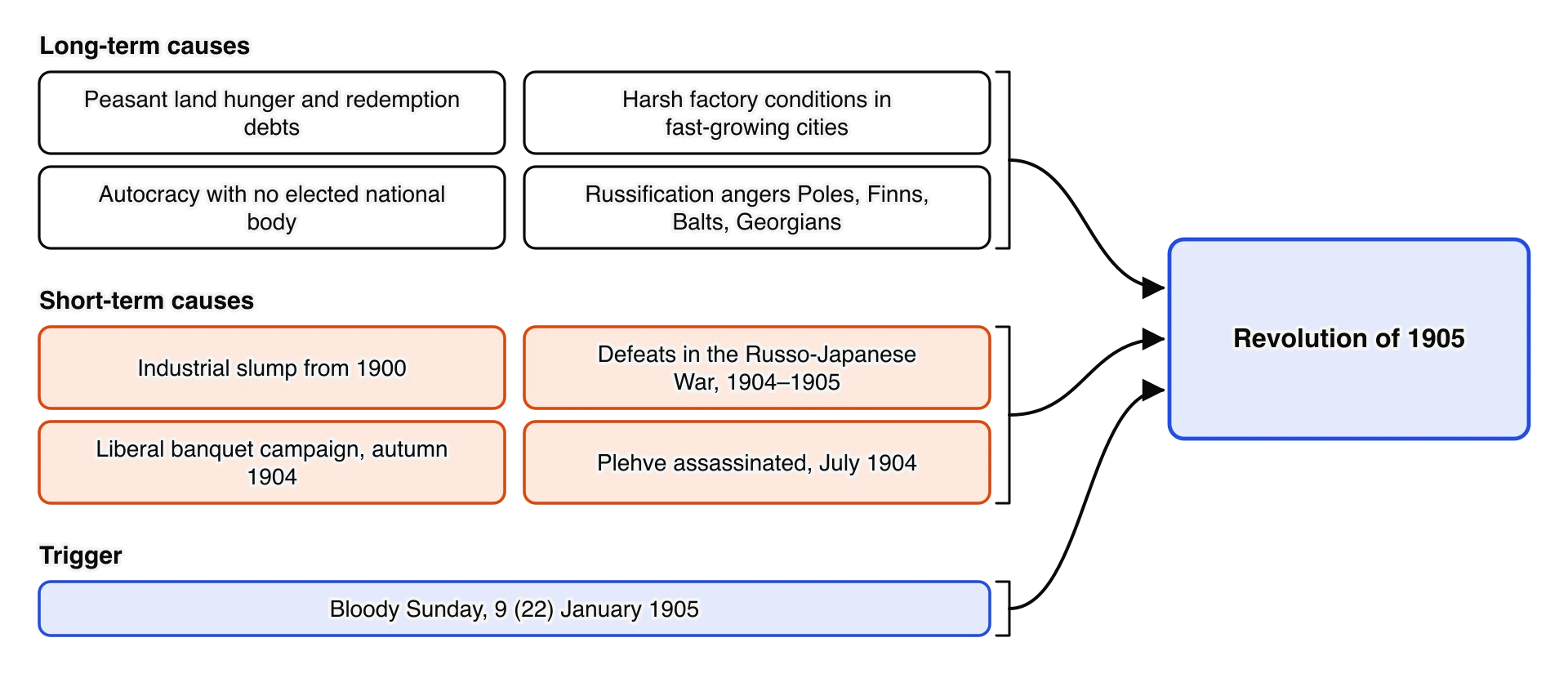
Social and economic causes
The diagram of the causes of 1905 groups them by timescale. Peasants wanted the landowners’ land and resented redemption payments and the authority of the land captains. Workers had grievances over hours, pay, fines and the ban on unions, and the slump of 1900–1903 added unemployment and wage cuts. These grievances were old, and on their own they had produced only local strikes and disturbances. What changed in 1904–1905 was that the government lost the authority that had kept them apart.
The role of ideas
Ideas gave scattered grievances a shared language. Liberals demanded a constitution and civil rights; the SRs promised the land to the peasants; Marxists told workers that their struggle was part of a class war. Each had built networks of activists before 1905: zemstvo liberals in the Union of Liberation, SR groups in the villages and Social Democratic circles in the factories. Yet the revolution was not planned by any party. Lenin was in Switzerland until November 1905, and the most influential leader of the first months was a priest who opposed revolution.
The significance of the Russo-Japanese War
Russia and Japan had competed for influence in Manchuria and Korea since the 1890s. In February 1904 Japan attacked the Russian fleet at Port Arthur without a declaration of war. Plehve is often said to have wanted "a small victorious war" to rally the people behind the tsar; the remark rests on later memoirs, but the government did expect an easy victory over an Asian power.
The war brought a series of defeats. Port Arthur surrendered in December 1904 after a five-month siege; the Russian army was driven back at Mukden in February 1905; and in May 1905 the Baltic Fleet, which had sailed halfway round the world, was destroyed in the Straits of Tsushima. The war mattered to the revolution in three ways. It humiliated the regime, which had justified autocracy as the guarantee of Russia’s power. It caused shortages and price rises at home. And it tied up the army in Manchuria, 9,000 km from St Petersburg along a single-track railway, at the moment the regime needed troops at home.
Bloody Sunday
Georgy Gapon was an Orthodox priest who led the Assembly of Russian Factory and Mill Workers, a legal organisation approved by the police in 1904. In early January 1905 a strike began at the Putilov engineering works in St Petersburg and spread across the city. Gapon’s assembly drew up a petition to the tsar and planned a peaceful march to the Winter Palace on Sunday 9 (22) January.
We working men of St. Petersburg, our wives and children, and our parents, helpless, aged men and women, have come to you, O Tsar, in quest of justice and protection. ... Refuse not to succour your people; give orders without delay to representatives of all classes in the land to meet together. ... Let all be free to elect whom they will, and for this purpose let the elections to the Constituent Assembly be organized on the principle of universal suffrage. This is our principal request, on which everything else depends.
Petition of the St Petersburg workers to Nicholas II, drawn up by Georgy Gapon’s assembly for the march of 9 (22) January 1905 (contemporary English translation, Marxists Internet Archive). The petition addresses the tsar as a father and protector, which shows how far workers still trusted the monarch himself. Its demands were political as well as economic: an eight-hour day, civil liberties and an elected Constituent Assembly. Socialist activists helped to draft the final version, which helps to explain why demands of the liberal and socialist programmes appear in a document written for a religious, loyalist march.
Nicholas was not in the city. Troops guarding the approaches to the palace fired on the processions at several points. The official figure was about 130 dead; other contemporary estimates ran into the hundreds, and revolutionaries claimed thousands. Gapon fled abroad and denounced the tsar. The image of the "little father" who protected his people from bad officials, which had survived centuries of peasant revolts, was badly damaged in a single day.
The revolution spreads
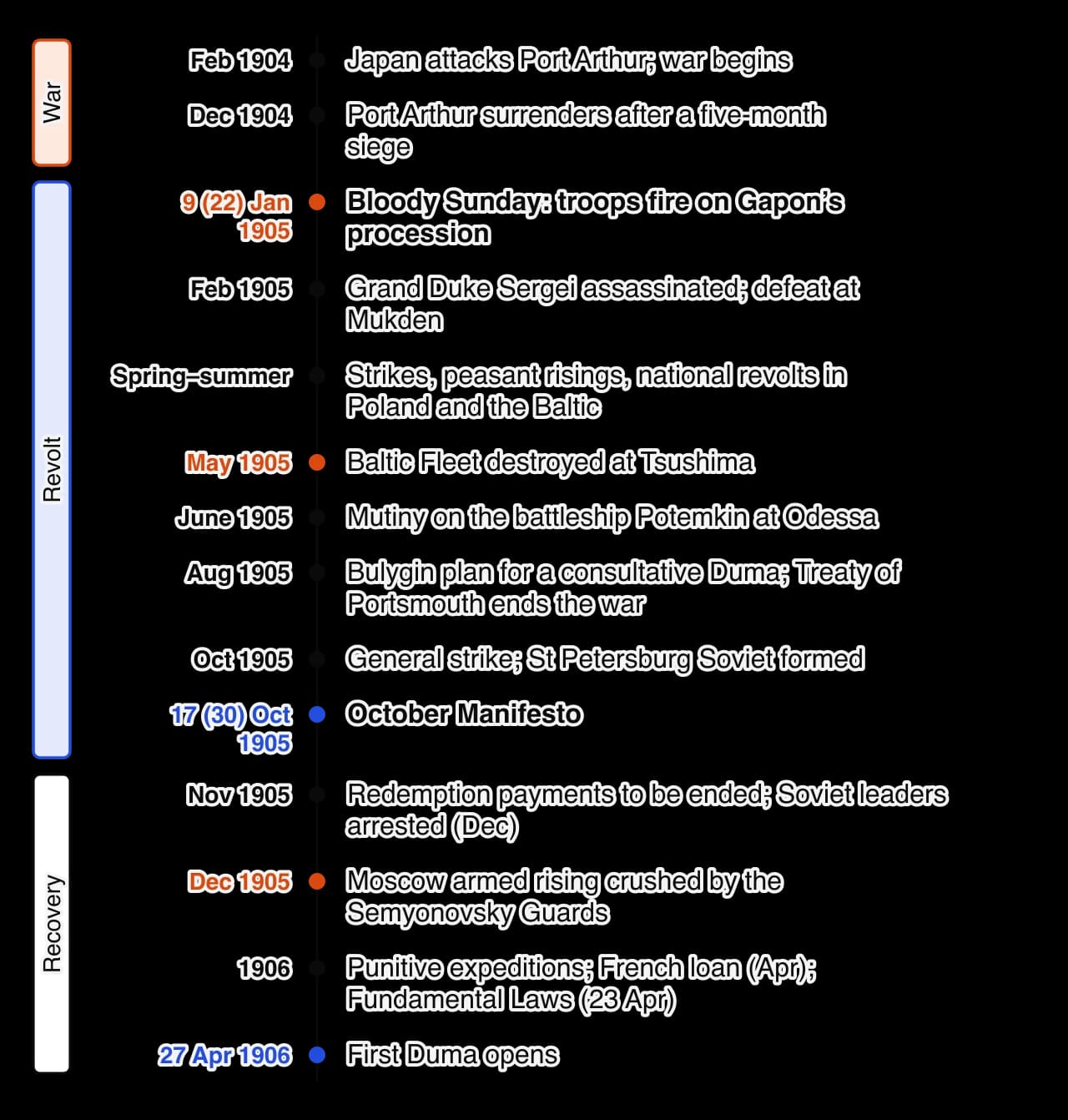
The timeline of 1905 shows how the revolution grew through the year. Strikes followed Bloody Sunday in almost every industrial city; students closed the universities; and from the spring peasants burned manor houses and seized estates, especially in the central black-earth provinces and the Volga region. Professional groups formed a Union of Unions under the liberal historian Pavel Milyukov, and an All-Russian Peasant Union met in the summer. National movements rose in Poland, the Baltic provinces, Finland and Georgia, where peasants in the district of Guria set up their own administration. In June the crew of the battleship Potemkin mutinied at Odessa.
In August the government offered a consultative assembly elected on a narrow franchise (the "Bulygin Duma"). It satisfied no one. In October a railway strike became a general strike that stopped transport, factories, banks and newspapers across the empire. In St Petersburg striking workers elected a soviet, a council of delegates from the factories, which organised the strike and published its own newspaper; one of its leaders was the young Marxist Leon Trotsky.
The October Manifesto
Witte, now the tsar’s chief adviser, told Nicholas that he had two choices: a military dictatorship or a constitution. With no reliable general willing to act as dictator, Nicholas signed the manifesto Witte proposed.
We require the government dutifully to execute our unshakeable will: (1.) To grant to the population the essential foundations of civil freedom, based on the principles of genuine inviolability of the person, freedom of conscience, speech, assembly and association. ... 3.) To establish as an unbreakable rule that no law shall take effect without confirmation by the State Duma and that the elected representatives of the people shall be guaranteed the opportunity to participate in the supervision of the legality of the actions of Our appointed officials.
Nicholas II, Manifesto on the Improvement of the State Order (the October Manifesto), Peterhof, 17 (30) October 1905 (translation by Daniel Field, Marxists Internet Archive). The manifesto was issued in the middle of the general strike to win back moderate opinion, and its language of the tsar’s "unshakeable will" presents the concessions as a gift of the autocrat, not a contract with the people. It promised civil liberties and a Duma with real power over legislation, but it said nothing about the tsar’s own powers, the army or the responsibility of ministers.
Why did the regime survive?
Unlike the revolution of February 1917, the revolution of 1905 did not overthrow the monarchy. Several factors explain why:
The manifesto split the opposition. Moderate liberals formed the Union of 17 October (the Octobrists), led by the Moscow industrialist Alexander Guchkov, which accepted the manifesto. The Constitutional Democrats (Kadets), led by Milyukov, demanded more but rejected armed revolt. Workers and socialists were left isolated.
The army stayed loyal. Mutinies affected some units, mostly in the navy and among reservists waiting to go home, but the Guards and most regiments obeyed orders. Peace with Japan at Portsmouth (August 1905) freed troops to return. The St Petersburg Soviet’s leaders were arrested on 3 December, and the Semyonovsky Guards crushed an armed rising in Moscow in December with artillery; over a thousand people died.
Concessions to the peasants. In November 1905 the government announced that redemption payments would be halved in 1906 and ended from January 1907.
Repression in 1906. Punitive expeditions restored order along the railways, in the Baltic provinces and in the villages, using summary executions and floggings.
Money. A French loan of over 2 billion francs in April 1906 allowed the government to pay its troops and officials without depending on the Duma.
Popular violence also came from the right. After the manifesto, monarchist gangs, later organised in the Union of the Russian People and known as the Black Hundreds, attacked Jews, students and socialists; in Odessa several hundred Jews were killed in October 1905.
The Fundamental Laws
Before the First Duma met, the government issued the Fundamental Laws of 23 April (6 May) 1906, the constitution under which Russia was governed until 1917. Article 4 described the emperor’s power as "supreme autocratic power". The tsar kept full control over ministers, the armed forces, foreign policy and the declaration of war, and could dissolve the Duma at will. Legislation needed the approval of both the elected Duma and a State Council, half of whose members the tsar appointed, as well as the tsar himself. Article 87 allowed the government to issue emergency decrees when the Duma was not sitting, and large parts of the budget were outside the Duma’s control.
Promise in the October Manifesto (Oct 1905) | Reality under the Fundamental Laws (Apr 1906) |
|---|---|
Civil freedoms of speech, assembly and association | Granted in law, but limited by the Statute on State Security, censorship and police powers |
No law without the consent of the Duma | Laws needed the Duma, the half-appointed State Council and the tsar; Article 87 allowed decrees between sessions |
Wider franchise | Indirect elections by estate (curiae), weighted towards landowners; changed again in 1907 to favour them further |
Oversight of officials | Ministers appointed by and responsible to the tsar alone |
Repression and reform, 1906–1914
The eight years between the First Duma and the First World War were Russia’s experiment with a limited parliament. They were also the years of Pyotr Stolypin, who tried to make the monarchy secure by crushing revolution and creating a class of prosperous, loyal peasant farmers.
The four Dumas
The Duma was elected indirectly, by separate colleges of landowners, townspeople, peasants and (in some cities) workers. The table of the four Dumas shows how the government reshaped it until it obtained a parliament it could work with.
Duma | Dates | Largest groups (seats) | What happened |
|---|---|---|---|
First | Apr–Jul 1906 | Kadets 184; Trudoviks (peasant deputies) 105 | Demanded compulsory purchase of landlords’ land, an amnesty and ministers responsible to the Duma; dissolved after 72 days. About 200 deputies signed the Vyborg Manifesto calling for refusal of taxes and conscripts, and were barred from standing again |
Second | Feb–Jun 1907 | Trudoviks 104; Kadets 98; Social Democrats 65; SRs 37 | More radical than the first, since the socialist parties now took part; dissolved on 3 June 1907 after the government accused Social Democratic deputies of plotting a mutiny |
Third | Nov 1907–Jun 1912 | Octobrists 154; Nationalists 97; Kadets 54; Rightists 50 | Elected under the new law of 3 June 1907; ran its full term and passed laws on schools and workers’ insurance, but clashed with the government in 1911 |
Fourth | Nov 1912–Oct 1917 | Nationalists 120; Octobrists 98; Rightists 65; Kadets 59; Progressists 48 | From August 1915 most deputies joined the Progressive Bloc, which demanded a government with public confidence; its committee formed the Provisional Government in March 1917 |
Data: seat numbers at the opening of each Duma, as compiled in standard reference works; figures differ slightly between sources because deputies changed groups during each Duma.
The electoral law of 3 June 1907 was issued by decree, although the Fundamental Laws said that the electoral system could be changed only with the Duma’s consent; critics called it "Stolypin’s coup". It greatly increased the weight of the landowners’ vote, reduced the representation of peasants, workers, Poles and the Caucasus, and removed it altogether from Central Asia. The result was a Duma dominated by the Octobrists and the right, which cooperated with the government on some reforms: a law of 1908 began a programme to bring primary schooling to every child within ten years, and laws of 1912 introduced sickness and accident insurance for workers.
Stolypin: repression
Pyotr Stolypin, a landowner and former governor of Saratov province, became minister of the interior in April 1906 and chairman of the Council of Ministers (prime minister) in July 1906. In August 1906 SR Maximalists bombed his villa, killing about 27 people and injuring two of his children. Within days a decree set up field courts-martial in areas under emergency rule: military officers tried civilians accused of violent crimes within 48 hours of the offence, without lawyers, and sentences were carried out within 24 hours. Before the decree lapsed in April 1907 these courts sentenced about 1,100 people to death. Executions by other military courts continued, and several thousand people were executed between 1906 and 1910 (estimates vary).
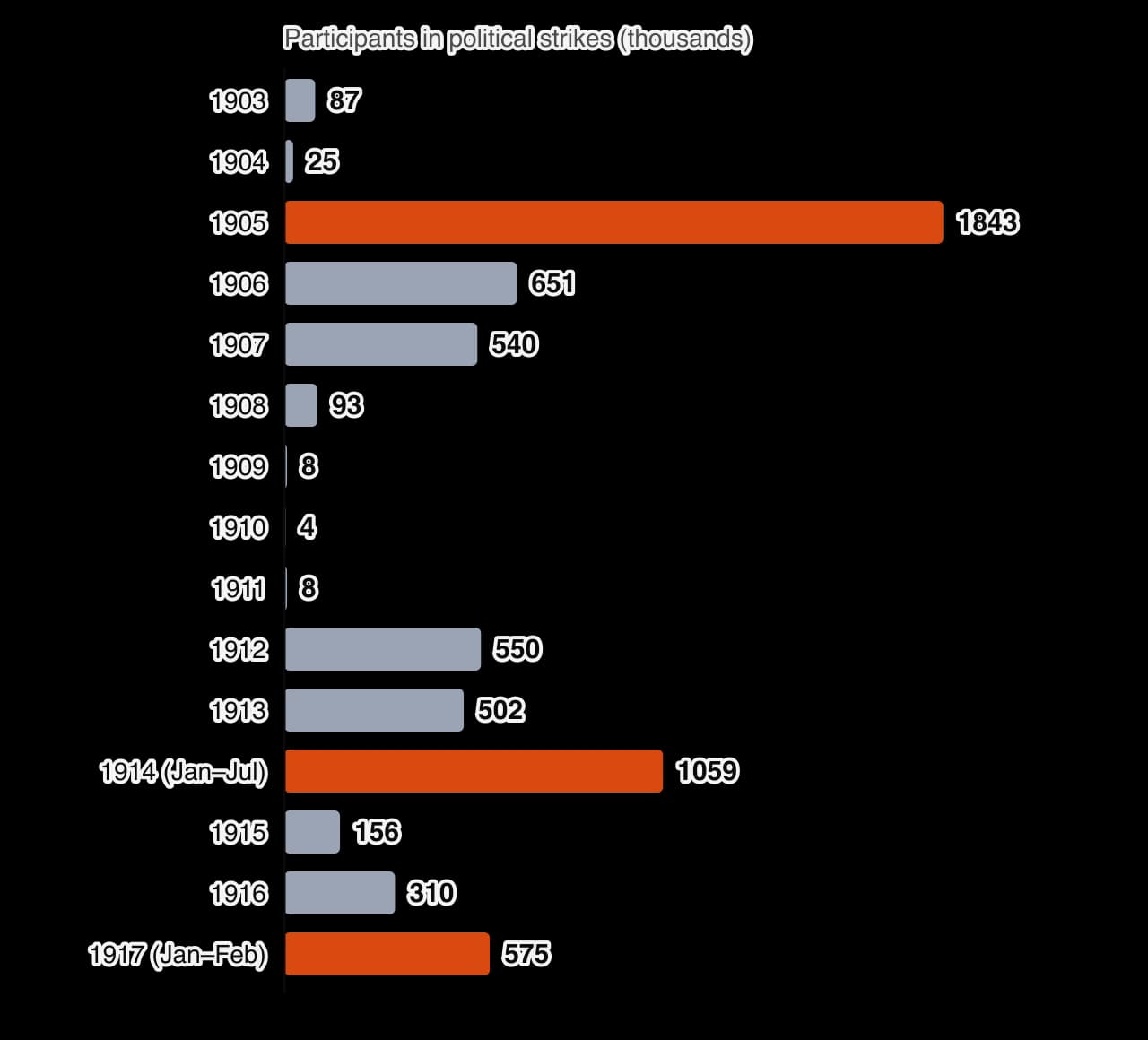
The gallows became known as "Stolypin’s necktie" after a Kadet deputy, Fyodor Rodichev, used the phrase in the Duma in November 1907. Tens of thousands of people were also exiled to Siberia, newspapers were fined or closed, and trade unions formed after 1905 were shut down. By 1908 the revolutionary parties had been driven underground or abroad, and the number of political strikes fell to almost nothing, as the chart of political strikes shows.
Stolypin: agrarian reform
Stolypin believed that the commune kept peasants poor, by dividing land into scattered strips and redistributing it, and that it bred revolution, by teaching peasants to think of land as something shared out by the community. His solution, often summarised as a "wager on the strong", was to create a class of independent, property-owning farmers with a stake in the existing order.
Decree of 9 November 1906 (issued under Article 87, confirmed by law in 1910): any head of household could leave the commune and claim his strips as private property, and could ask for them to be consolidated into a single farm.
The Peasant Land Bank sold land from noble and state estates to peasants on credit.
Resettlement: the state encouraged peasants to move to Siberia and Central Asia with grants and cheap rail fares. About three million people moved between 1906 and 1914, though several hundred thousand later returned.
Redemption payments were abolished from January 1907, as promised in 1905.
By 1915–1916 roughly 2 to 2.5 million households, about a fifth to a quarter of peasant households in European Russia depending on the measure used, had claimed their land as private property, but only about one household in ten had a consolidated farm. Many who left the commune were poorer peasants who sold their land and moved to the towns. Agricultural output rose in these years, helped by good harvests, and grain exports grew.
In an interview of 1909 Stolypin said that Russia needed twenty years of peace at home and abroad to be transformed. He had less than two. Nicholas, influenced by courtiers who resented Stolypin’s power, was losing confidence in him by 1911, when Stolypin forced through a law on zemstva in the western provinces by suspending both chambers for three days and passing it by decree, which turned even the Octobrists against him. On 1 (14) September 1911 Dmitry Bogrov, a revolutionary who was also a police informer, shot Stolypin at the opera in Kiev in front of the tsar; he died four days later.
Industry, the workers and the Lena goldfields
Industry recovered from about 1908 and grew rapidly until 1914, now led more by private banks and consumer demand than by the state. By 1914 Russia was one of the world’s five largest industrial producers, though output per head was far below that of Germany or Britain. Workers’ conditions improved little. On 4 (17) April 1912, troops fired on striking miners at the British-owned Lena goldfields in Siberia, killing between about 150 and 270 people (estimates vary). Protest strikes followed across Russia, and the chart of political strikes shows how strikes rose from 1912 to the summer of 1914, when barricades went up in St Petersburg days before the war began.
The Okhrana and the use of violence
The Okhrana remained the regime’s main weapon against revolutionaries. It opened letters, kept files on suspects and, above all, placed agents inside the revolutionary parties. Evno Azef, head of the SR Combat Organisation from 1903 to 1908, was a police agent who betrayed some plots while allowing others, including the killing of Plehve, to go ahead; his exposure in 1908 discredited both the SRs and the police. Roman Malinovsky, leader of the Bolshevik deputies in the Fourth Duma from 1912 and a trusted ally of Lenin, was also an Okhrana agent. Revolutionaries were sentenced to prison, hard labour or administrative exile in Siberia; Joseph Stalin, a Georgian Bolshevik, was arrested and exiled repeatedly between 1902 and 1913.
Rasputin and the court
Grigory Rasputin, a Siberian peasant who claimed to be a holy man, met the royal family in 1905. The tsar’s only son, Alexei, had haemophilia, and the Empress Alexandra believed that Rasputin’s prayers could stop his bleeding. The secrecy around Alexei’s illness meant that the public saw only a debauched peasant with access to the palace. Duma deputies and newspapers attacked his influence from 1911, and the scandal damaged the monarchy’s reputation long before the war gave him real influence over appointments.
War and the fall of the monarchy, 1914–February 1917
Russia entered the First World War in August 1914 in support of Serbia and its ally France. The causes of the war belong to the history of European diplomacy; here the war is treated as the strain that broke the tsarist state. At first it produced a wave of patriotism: strikes stopped, the Duma voted war credits, and St Petersburg was renamed Petrograd to sound less German.
The military impact
The Russian army was the largest in Europe, but it was short of officers, rifles, shells and transport. In August 1914 two Russian armies invaded East Prussia; at Tannenberg (26–30 August) the Germans destroyed one of them and took about 90,000 prisoners. Victories against Austria-Hungary in Galicia did not make up for this. In 1915 a German–Austrian offensive drove the Russians out of Poland, Lithuania and much of Belorussia in the "Great Retreat"; millions of refugees fled east into the Russian interior. The Brusilov offensive of June–September 1916 was the most successful Allied attack of the war, but it cost Russia around a million casualties and did not knock Austria-Hungary out of the war.
About 15 million men were mobilised during the war. Estimates of Russian military deaths range from about 1.7 to over 2 million, with millions more wounded or captured; the figures are uncertain because records broke down after 1917. By the winter of 1916–1917 desertion was rising and many soldiers no longer believed the war could be won.
The economic and social impact
The government paid for the war largely by printing money, and the ban on the sale of vodka in 1914 removed a large share of its tax revenue. Prices rose several times over between 1914 and early 1917, faster than wages. The railways, overloaded with military traffic and short of locomotives, could not bring enough grain and fuel to the cities, even though Russia as a whole had food. Peasants held back grain because there was little to buy with paper roubles; in December 1916 the government began compulsory grain quotas. In Petrograd, whose population had grown with war workers and soldiers, women spent hours in bread queues in the hard winter of 1916–1917.
The political impact
In August 1915 Nicholas took personal command of the army at headquarters in Mogilev, against the advice of almost all his ministers. Every later defeat was now his responsibility, and government in Petrograd was left to the Empress Alexandra, whose German birth made her the target of rumours of treason, and to Rasputin’s influence over appointments. Between 1915 and early 1917 Russia had four prime ministers and a rapid turnover of other ministers, which one right-wing deputy called "ministerial leapfrog".
Educated society tried to help the war effort and was rebuffed. Zemstva and town councils formed a joint organisation (Zemgor) to care for the wounded and supply the army, and businessmen set up war industries committees. In August 1915 a majority of the Duma’s deputies, from the Kadets to moderate conservatives, formed the Progressive Bloc, asking only for a government that had the confidence of the country. Nicholas suspended the Duma instead. In November 1916 Milyukov attacked the government in the Duma with a speech that asked of each failure whether it was "stupidity or treason". On the night of 16–17 December 1916 Rasputin was murdered by a group of aristocrats, including the tsar’s cousin, who hoped to save the monarchy. By then many generals, Duma leaders and members of the royal family believed that Nicholas had to go.
The February Revolution
On 23 February (8 March) 1917, International Women’s Day, women textile workers in Petrograd went on strike and marched to demand bread, joined by workers from the Putilov works, who had been locked out the day before. Within two days about 200,000 workers were on strike and crowds filled the centre of the city. Nicholas, at headquarters, ordered the military governor to end the disorders by force. On 26 February troops fired on crowds and killed dozens of people.
The decisive moment came on 27 February (12 March), when soldiers of the Volynsky and Pavlovsky Guards regiments refused to fire again, killed or drove off their officers and joined the crowds. The garrison of Petrograd, about 160,000 men, mostly young recruits and older reservists who did not want to go to the front, went over to the revolution within a day. Prisons and police stations were stormed. Most estimates put the number killed or wounded in Petrograd at more than a thousand.
Two new bodies appeared in the Tauride Palace on the same day. Members of the Duma formed a Provisional Committee, and socialists organised elections to a Soviet of Workers’ Deputies, soon of Workers’ and Soldiers’ Deputies. When Nicholas tried to return to Petrograd, his train was stopped. On 2 (15) March, after his senior generals told him that only abdication could keep the army fighting, he abdicated for himself and his son in favour of his brother Michael, who declined the throne the next day. The Romanov dynasty, which had ruled since 1613, fell within a week of the first strikes.
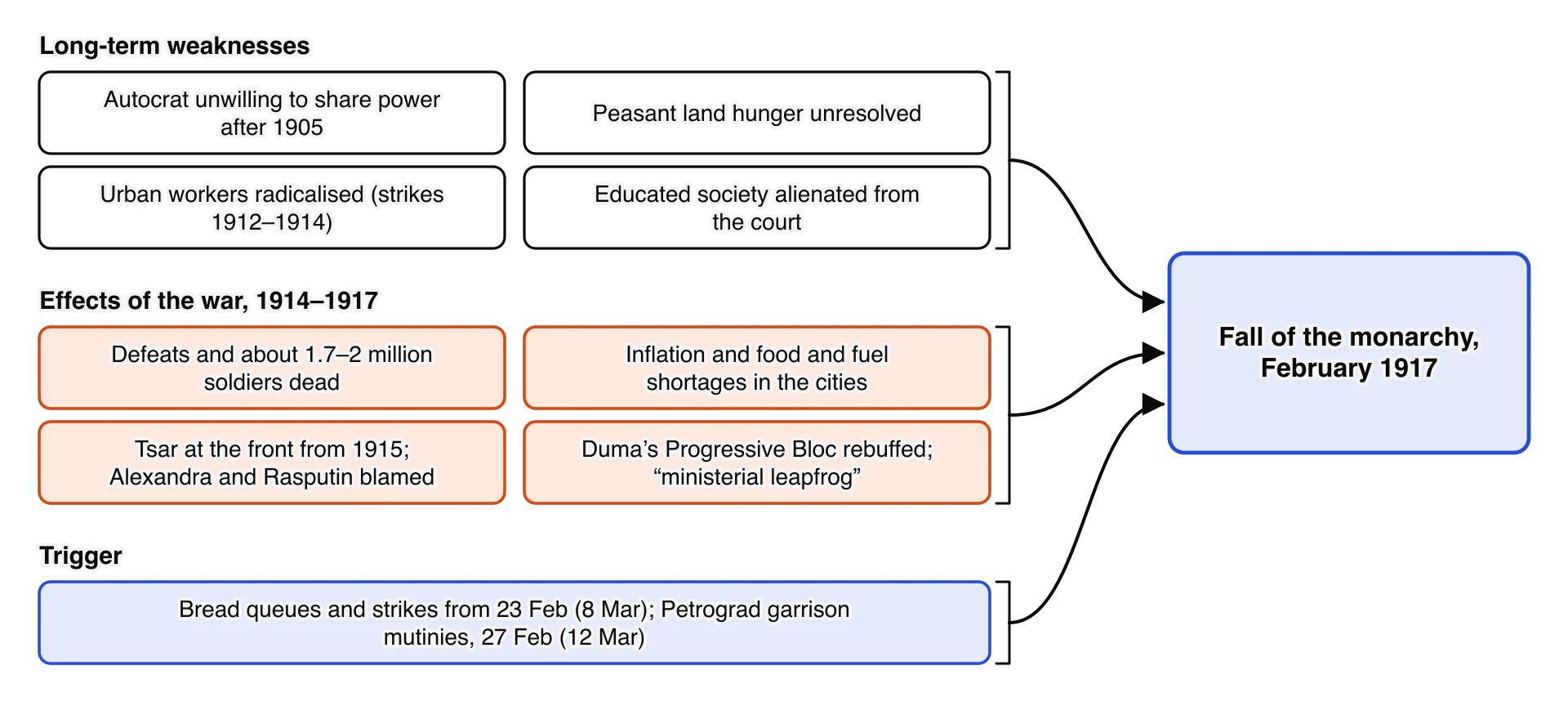
The diagram of the causes of the fall of the monarchy shows how the war turned long-term weaknesses into a crisis. Whether the monarchy could have survived without the war remains one of the main debates among historians of the revolution.
 YouTube
Order No. 1
On 1 (14) March the Petrograd Soviet issued an order to the soldiers of the Petrograd garrison that went far beyond its original purpose.
3. In all their political actions, units are subordinated to the Soviet of Workers' and Soldiers' Deputies and their own committees. 4. All orders issued by the Military Commission of the State Duma shall be carried out, except those which run counter to the orders and decrees issued by the Soviet of Workers' and Soldiers' Deputies. 5. All kinds of weapons ... shall be placed at the disposal and under the control of the company and battalion committees and shall by no means be issued to the officers, not even at their insistence.
Petrograd Soviet, Order No. 1, 1 (14) March 1917 (translation from An Illustrated History of the Great October Socialist Revolution, Moscow, 1988, Marxists Internet Archive). The order was drafted in a crowded meeting of soldiers who feared their officers would punish them for the mutiny, which explains its concern with weapons and saluting. Intended for the Petrograd garrison, it was copied across the whole army. It shows that from its first days the Soviet claimed authority over the armed forces that the new government needed, and that the soldiers’ loyalty lay with the Soviet.
Dual Power and the Provisional Government, March–October 1917
The Provisional Government was formed on 2 March 1917 from members of the Duma committee, mostly Kadets and Octobrists, with Prince Georgy Lvov, a respected zemstvo leader, as prime minister and Milyukov as foreign minister. Its only socialist member was Alexander Kerensky, a lawyer and Trudovik deputy who was also vice-chairman of the Petrograd Soviet. As its name said, the government saw itself as temporary: it would govern until a Constituent Assembly, elected by all adults, decided Russia’s future form of government.
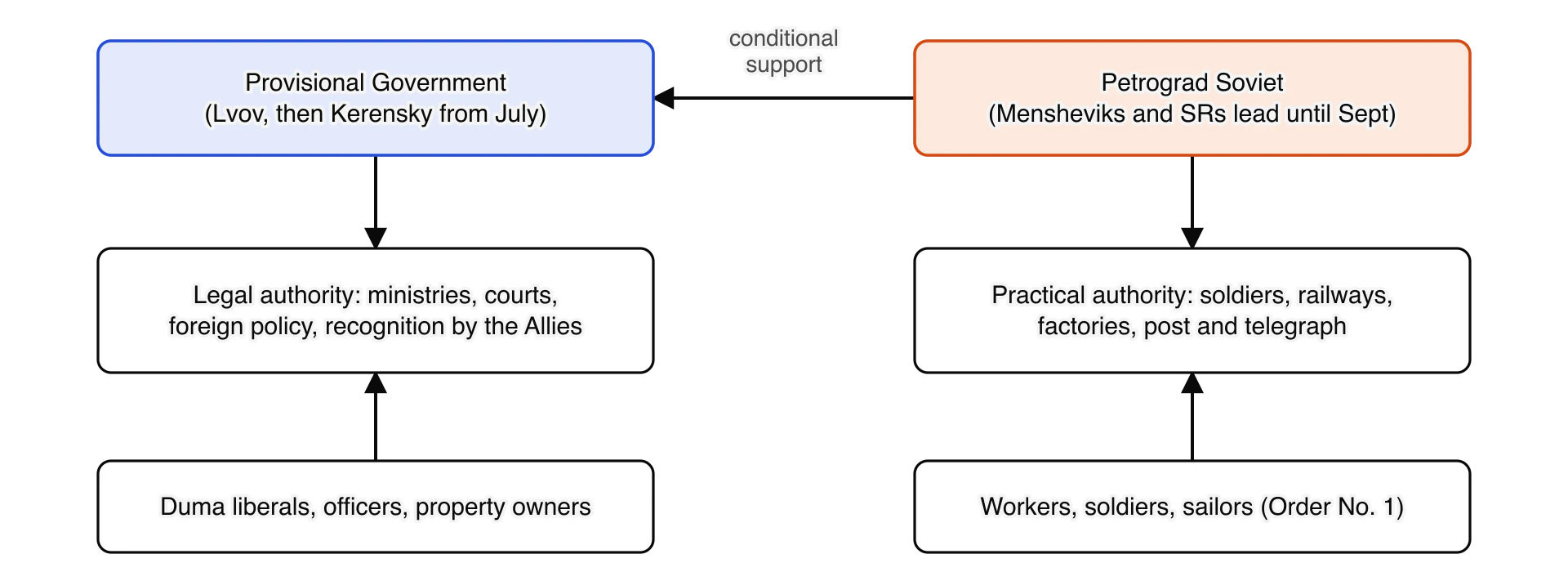
The diagram of Dual Power shows why the arrangement was unstable. The Soviet’s leaders, mostly Mensheviks and SRs, believed that Russia was having its bourgeois revolution and that socialists should not take power yet, so they supported the government only "insofar as" it carried out the revolution’s programme. The government had the right to rule but depended on the Soviet to have its orders obeyed.
Achievements of the Provisional Government
In its first weeks the Provisional Government made Russia, in Lenin’s words in the April Theses, "the freest of all the belligerent countries in the world". It released political prisoners, abolished the death penalty and the police of the old regime, granted freedom of speech, the press, assembly and religion, ended legal discrimination on grounds of religion and nationality, and recognised Polish independence in principle. In July 1917 it gave all adults, women included, the vote for the Constituent Assembly, making Russia the first great power to grant women the vote. Local government passed to elected bodies, and in the factories workers elected committees.
Failures and collapse
The government’s authority collapsed over the next eight months for reasons that were linked to one another:
The war. The government stayed loyal to Russia’s allies. On 18 April (1 May) Milyukov sent a note to the Allies promising to fight on to a "decisive victory"; when it was published, soldiers and workers demonstrated in Petrograd, and Milyukov and the war minister Guchkov resigned. The new coalition government of May included Mensheviks and SRs, with Kerensky as war minister and the SR leader Viktor Chernov as minister of agriculture. Kerensky’s offensive of June 1917 collapsed within weeks, and from then on soldiers deserted in large numbers, many going home to share in the division of the land.
Land. The government refused to allow the seizure of landlords’ estates and left land reform to the Constituent Assembly. Peasants did not wait. From the spring they cut landlords’ timber, grazed their animals on estate land and refused rents; by the autumn they were seizing and burning estates across central Russia. A government that could neither stop the seizures nor approve them lost the countryside.
Delay over the Constituent Assembly. Preparing an election for an empire at war took time, and the date was postponed until November. The delay allowed opponents to argue that the propertied classes were blocking the revolution.
The economy. Inflation accelerated, food supplies to the cities fell, and factory owners closed works or locked out workers who demanded higher pay and control over management. Workers’ committees and Red Guards, armed workers’ militias, grew in response.
The nationalities. Finns, Ukrainians and others demanded autonomy. When ministers agreed to recognise a Ukrainian regional government in July, the Kadet ministers resigned in protest.
Lenin returns: the April Theses
When the February Revolution broke out, Lenin was in Zurich. The German government, hoping that he would take Russia out of the war, allowed him and other exiles to cross Germany in a sealed railway carriage, and he arrived at the Finland Station in Petrograd on the night of 3 (16) April. Many historians accept that Germany also passed money to the Bolsheviks in 1917, but how much, and how much it mattered, is disputed. The next day Lenin presented his programme to a meeting of Bolsheviks and Mensheviks.
3) No support for the Provisional Government; the utter falsity of all its promises should be made clear, particularly of those relating to the renunciation of annexations. ... 5) Not a parliamentary republic—to return to a parliamentary republic from the Soviets of Workers' Deputies would be a retrograde step—but a republic of Soviets of Workers', Agricultural Labourers' and Peasants' Deputies throughout the country, from top to bottom.
Vladimir Lenin, "The Tasks of the Proletariat in the Present Revolution" (the April Theses), read on 4 April and published in Pravda, 7 (20) April 1917 (Lenin’s Collected Works, vol. 24, Marxists Internet Archive). Lenin had just returned from exile and was arguing against most of his own party’s leaders in Petrograd, including Kamenev and Stalin, who had offered conditional support to the government. The Theses are evidence of Lenin’s strategy of opposing every other party and making the soviets the instrument of power; they were not yet a popular programme, and Plekhanov dismissed Lenin’s speech as raving.
The Theses were turned into short slogans that answered what workers, soldiers and peasants wanted: "Peace, Land, Bread" and "All Power to the Soviets". Because the Bolsheviks were the only significant party that refused to join the government, they could promise everything and blame others for every failure. Party membership grew from about 24,000 in February to perhaps 200,000 or more by October (estimates vary widely), with strongholds in the factories of the Vyborg district of Petrograd, the Baltic Fleet at Kronstadt and some army units.
The July Days and the Kornilov affair
On 3–4 (16–17) July, after the failure of the June offensive, soldiers of a machine-gun regiment and sailors from Kronstadt marched into Petrograd with Bolshevik banners demanding that the Soviet take power. The Bolshevik leaders hesitated between leading and restraining the rising. Loyal troops dispersed the crowds, the government published documents accusing Lenin of being a German agent, and support for the Bolsheviks fell. Lenin fled to Finland; Trotsky, who had just joined the Bolsheviks, and Kamenev were arrested. Kerensky became prime minister on 8 (21) July.

Within two months the Bolsheviks recovered. Kerensky appointed General Lavr Kornilov as commander-in-chief to restore discipline. In late August Kornilov sent cavalry towards Petrograd; Kerensky, who had at first seemed to agree to troops being sent, then accused Kornilov of attempting a coup, dismissed him and appealed to the Soviet for help. The Soviet armed the Red Guards and released Bolshevik prisoners; railway workers blocked the lines and agitators persuaded Kornilov’s troops to stop. The coup collapsed without a battle.
The Kornilov affair was a turning point. Officers and the right blamed Kerensky for betraying Kornilov; workers and soldiers saw it as proof that the generals and the liberals wanted counter-revolution, and that only the Bolsheviks had warned against it. The Bolsheviks won a majority in the Petrograd Soviet on 31 August and in the Moscow Soviet in early September, and in late September Trotsky became chairman of the Petrograd Soviet.
The October Revolution
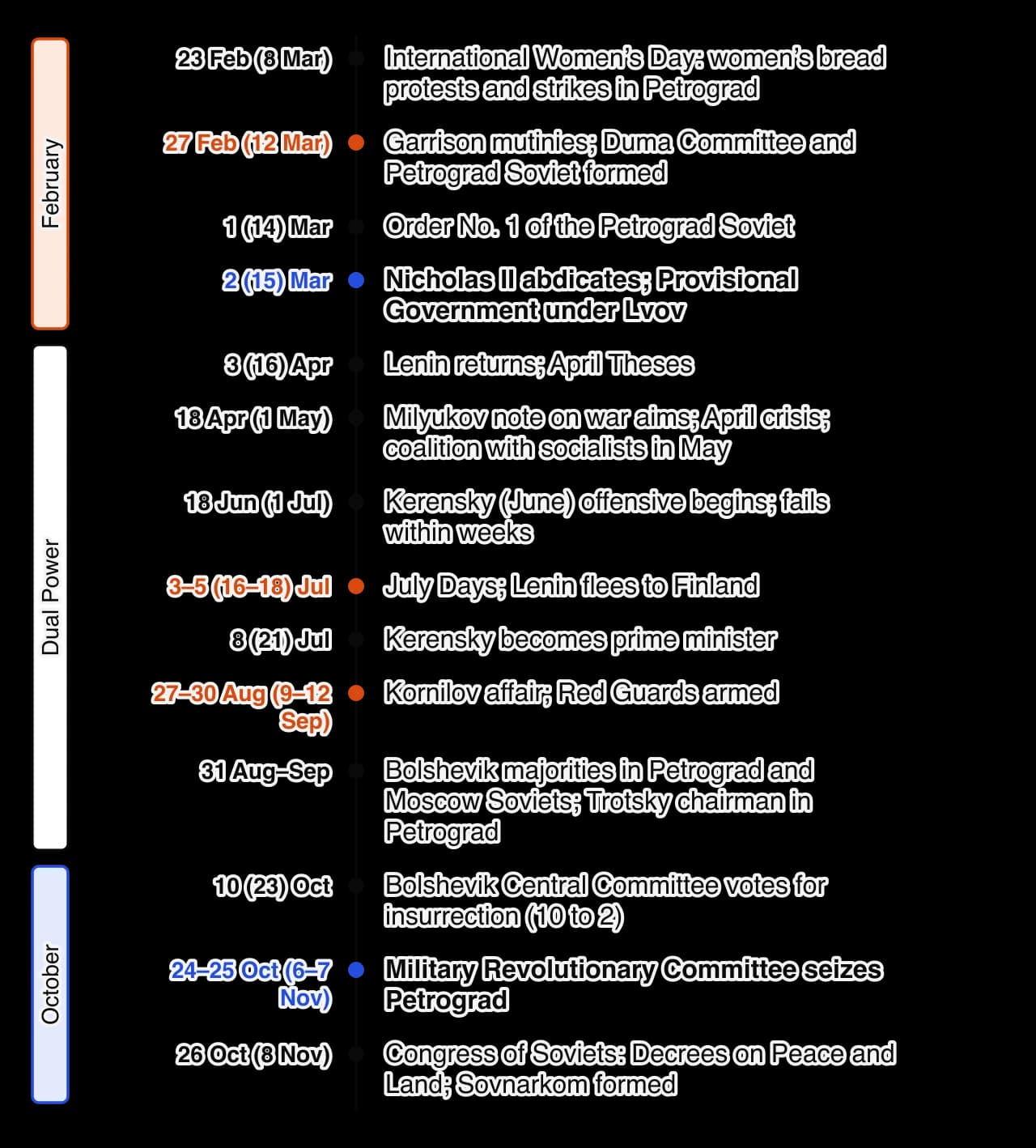
The decision to seize power
From Finland, Lenin sent letters to the Central Committee in September arguing that the Bolsheviks, now a majority in both capitals’ soviets, must take power at once, before Kerensky could surrender Petrograd to the Germans or the Constituent Assembly could meet. On 10 (23) October, at a secret meeting attended by Lenin in disguise, the Central Committee voted by ten to two for an armed rising. The two opponents, Grigory Zinoviev and Lev Kamenev, argued that the party should wait for the Constituent Assembly and the Second Congress of Soviets, due on 25 October, and they made their objections public in a non-party newspaper.
The rising was organised through the Soviet, not the party. On 16 (29) October the Petrograd Soviet set up a Military Revolutionary Committee (MRC), officially to defend the city against the Germans and a second Kornilov. Trotsky, as chairman of the Soviet, was its guiding figure. The MRC sent commissars to the units of the garrison, which agreed to obey its orders, and took control of the arsenal at the Peter and Paul Fortress. Presenting the rising as the defence of the Soviet against counter-revolution, and timing it to coincide with the Congress of Soviets, gave it a legitimacy that a party coup would have lacked.
The seizure of power, 24–26 October
On the morning of 24 October (6 November) Kerensky ordered the closure of Bolshevik newspapers and the raising of the bridges across the Neva, which handed the MRC the excuse it needed. That night Red Guards, soldiers and sailors occupied the bridges, railway stations, telephone exchange, post office and State Bank with almost no resistance. At 10 a.m. on 25 October the MRC announced that the Provisional Government had been deposed. Kerensky had already left the city by car to seek troops at the front. The Winter Palace, defended by officer cadets, a Cossack unit and a women’s battalion, was surrounded during the day and taken in the early hours of 26 October; the ministers inside were arrested. Only a handful of people died in Petrograd.
The Second All-Russian Congress of Soviets opened on the evening of 25 October. The Bolsheviks were the largest group but needed the Left SRs for a majority. When the Mensheviks and Right SRs walked out in protest against the seizure of power, Trotsky told them to go where they belonged, "into the dustbin of history". The remaining delegates approved the Decree on Peace, which called on all warring nations to make peace without annexations or indemnities, and the Decree on Land, and approved a new government, the Council of People’s Commissars (Sovnarkom), with Lenin as chairman, Trotsky as commissar for foreign affairs and Stalin as commissar for nationalities.
Outside Petrograd the transfer of power took longer. In Moscow a week of fighting between Red Guards and cadets left about a thousand dead. A small force of Cossacks sent by Kerensky was defeated outside Petrograd at the end of October, and the railway workers’ union demanded a coalition of all socialist parties. In most of the provincial cities soviets took power over the following weeks, often with little violence.
 YouTube
The roles of Lenin and Trotsky
Both men were essential to October, in different ways. Lenin set the strategy: in April he turned the party against the Provisional Government, and in September and October he forced a reluctant Central Committee to choose insurrection before the Congress of Soviets and the Constituent Assembly could settle Russia’s future without the Bolsheviks. Without him the party would probably have accepted a place in a socialist coalition. Trotsky, who had led the St Petersburg Soviet in 1905 and joined the Bolsheviks only in the summer of 1917, was the outstanding speaker of the revolution and the organiser of the rising: as chairman of the Petrograd Soviet he won over the garrison and directed the MRC.
Lenin | Trotsky | |
|---|---|---|
Before 1917 | Founder and leader of the Bolsheviks; author of What Is to Be Done? (1902) | Chairman of the St Petersburg Soviet, 1905; outside both factions until 1917 |
1917 | April Theses; pressed for insurrection in September–October; mostly in hiding from July | Chairman of the Petrograd Soviet from September; ran the MRC and the seizure of power |
1918–1921 | Head of Sovnarkom; insisted on peace at Brest-Litovsk; launched the Red Terror and War Communism | Negotiated at Brest-Litovsk; commissar for war from March 1918; built and led the Red Army |
1921–1924 | Introduced the NEP and the ban on factions; strokes from May 1922; died January 1924 | Proposed the militarisation of labour; increasingly isolated in the party leadership |
Trotsky himself, in The History of the Russian Revolution (1930), presented October as the work of the masses guided by the party, although in his diary of 1935 he wrote that October would still have happened without him if Lenin had been present, but not if neither of them had been in Petrograd. Soviet historians under Stalin wrote Trotsky out of the story. Most historians now see the two roles as complementary, with Lenin deciding that power must be taken and Trotsky organising the seizure.
Consolidating power, 1917–1918
In October 1917 few people, including many Bolsheviks, expected the new government to last. It controlled Petrograd, Moscow and some other cities; it faced a strike by civil servants and bank employees, an army that was falling apart and a war with Germany. Its first months combined popular decrees, the destruction of rival centres of power and the creation of a political police.
Decrees and the first opposition
Sovnarkom ruled by decree. In its first weeks it confirmed workers’ control over factory management (November 1917), nationalised the banks (December 1917), abolished the legal estates and titles, introduced an eight-hour day and announced the right of the peoples of Russia to self-determination. A Decree on the Press of 27 October closed newspapers that "called for resistance" to the new government; the Kadet party was outlawed as a party of "enemies of the people" at the end of November. In December a group of Left SRs, who had split from the main SR party, joined Sovnarkom, giving the government a coalition with the party of the peasants.
On 7 (20) December 1917 Sovnarkom set up the All-Russian Extraordinary Commission for Combating Counter-Revolution and Sabotage, the Cheka, under Felix Dzerzhinsky, a Polish Bolshevik who had spent more than ten years in tsarist prisons and exile. It was meant to be temporary and to investigate strikes by officials; within a year it had its own armed units and the power to arrest, try and shoot suspects without reference to the courts.
The Constituent Assembly
Lenin had attacked the Provisional Government for delaying the Constituent Assembly, and the elections went ahead in November 1917. They were the freest elections held in Russia until the end of the Soviet Union. The chart of the results shows why the Bolsheviks could not accept the outcome.

The Assembly opened in Petrograd on 5 (18) January 1918 and elected the SR leader Viktor Chernov as its chairman. When it refused to approve the decrees of Sovnarkom and to recognise the soviets as the supreme authority, the Bolshevik and Left SR delegates walked out. In the early hours of 6 January the commander of the guard, an anarchist sailor, told the remaining delegates to leave because the guard was tired. Red Guards had fired on a demonstration in support of the Assembly on the previous day, killing about a dozen people. When delegates returned later that day they found the building locked, and a decree dissolved the Assembly. A Third Congress of Soviets, with a Bolshevik majority, replaced it later in January.
Lenin justified the dissolution by arguing that soviets were a higher form of democracy than a "bourgeois" parliament, and that the SR lists had been drawn up before the SRs split, so the vote did not reflect the latest wishes of the peasants. His opponents saw the closure of the only national body ever elected by universal suffrage as the moment the Bolsheviks chose dictatorship. The SRs’ failure to rally real resistance in Petrograd also showed how little the voters were prepared to fight for the Assembly.
The Treaty of Brest-Litovsk, March 1918
The Decree on Peace was followed by an armistice with the Central Powers in December 1917 and peace talks at the fortress town of Brest-Litovsk. Germany demanded huge territories. The Bolshevik leadership divided three ways. Nikolai Bukharin and the Left Communists wanted a "revolutionary war" to spread revolution to Europe. Trotsky, who led the Soviet delegation, proposed "neither war nor peace": Russia would stop fighting but refuse to sign, in the hope that German workers would rise. Lenin argued that the army no longer existed and that the revolution had to survive, whatever the price.
In February 1918 Trotsky walked out of the talks. The German army advanced over 200 km in a few days, almost unopposed. Lenin threatened to resign unless the Central Committee accepted the German terms, which were now worse, and the treaty was signed on 3 March 1918.
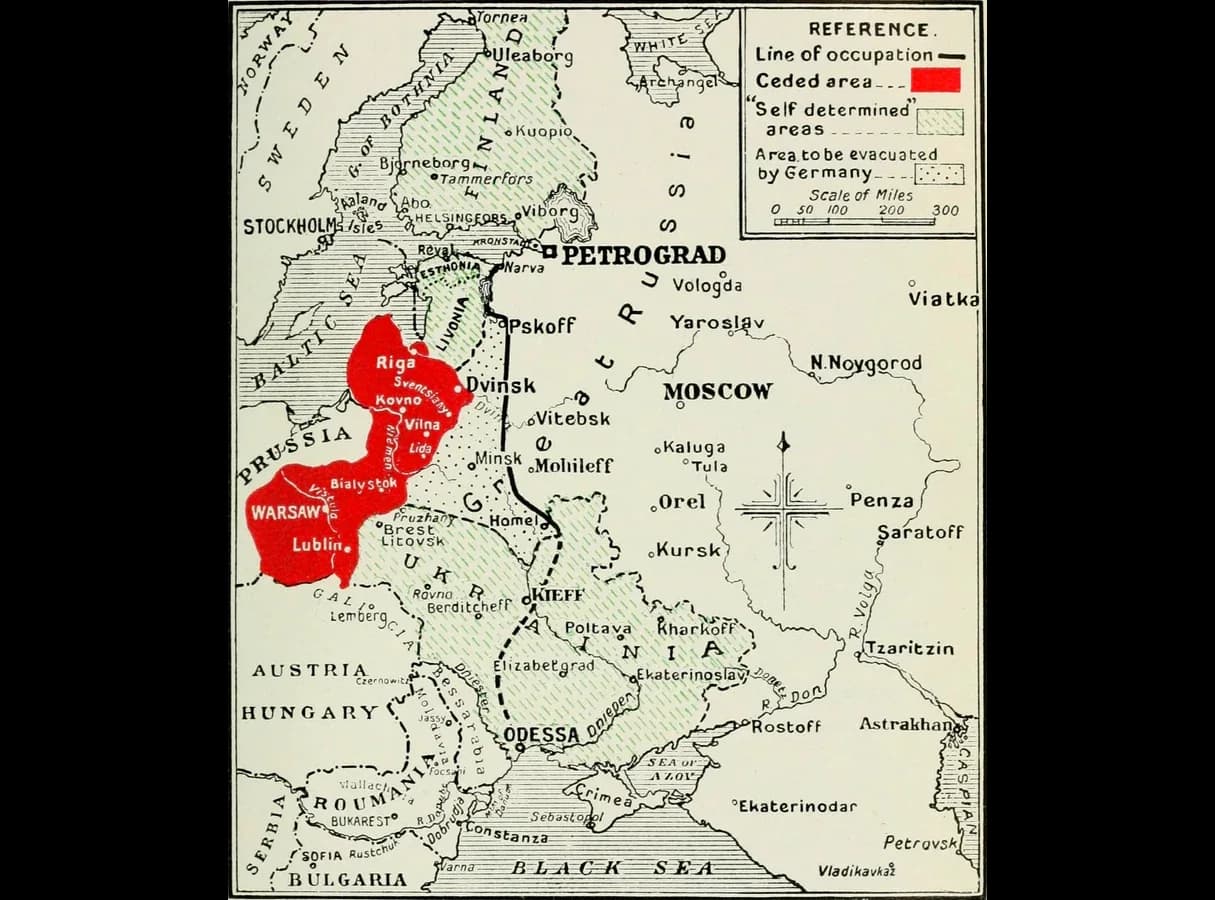
The map of the treaty’s terms shows what Russia gave up: Poland, Lithuania and Courland went to Germany and Austria-Hungary; Estonia and Livonia were occupied; Finland and Ukraine became independent under German protection; and the Ottoman Empire regained Kars, Ardahan and Batum in the Caucasus. The lost territories contained, by the usual estimates, about a third of the old empire’s population and farmland, more than half of its industry and most of its coal. A further agreement in August 1918 added a payment of six billion marks.
The treaty saved the Bolshevik government at a heavy price. It ended the war that had destroyed the Provisional Government and allowed the Bolsheviks to turn on their internal enemies. But it led the Left SRs to leave Sovnarkom in protest, divided the Bolshevik party, and convinced many officers and patriots that the Bolsheviks had sold Russia to Germany, which helped to bring on the Civil War. Fearing a German attack, the government moved the capital to Moscow in March 1918. Germany’s defeat in November 1918 allowed Soviet Russia to annul the treaty, and the Red Army moved back into Ukraine and the Baltic.
The Civil War, 1918–1921
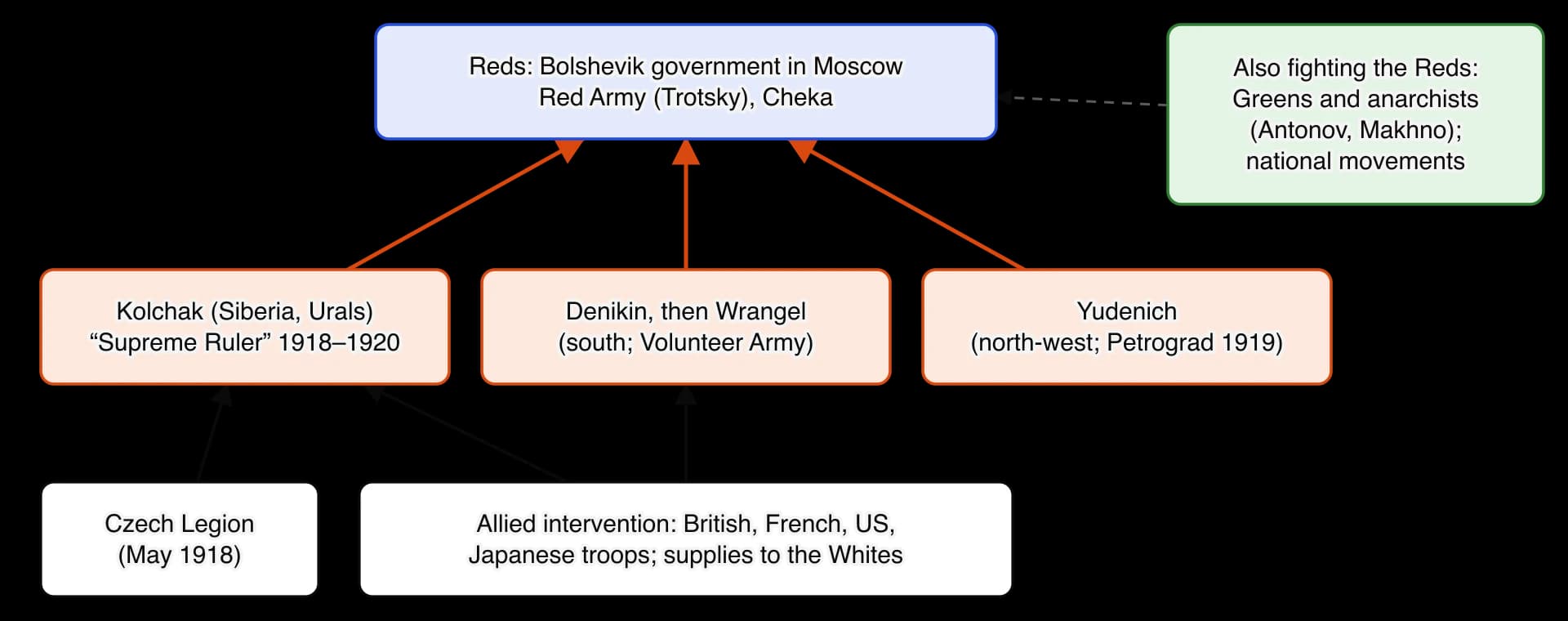
The Russian Civil War was a series of wars fought across the former empire from 1918 to the end of 1920, with risings and border wars continuing into 1922. It was fought between the Bolsheviks (the Reds) and a range of opponents: the Whites, led by former tsarist officers; moderate socialists; peasant armies known as the Greens; national movements; and foreign troops. It decided the survival of the Bolshevik state and shaped what kind of state it became.
The course of the war
The trigger was a revolt by the Czechoslovak Legion, about 40,000 former prisoners of war who were travelling along the Trans-Siberian Railway to Vladivostok to rejoin the Allies in France. When the Bolsheviks tried to disarm them in May 1918 they seized the railway from the Volga to Siberia. Under their protection SR deputies of the dissolved Constituent Assembly formed a government at Samara (Komuch), and anti-Bolshevik governments appeared across Siberia. In the south, generals Kornilov (killed in April 1918) and then Anton Denikin built the Volunteer Army among the Don Cossacks. In July the Left SRs, opposed to the Brest-Litovsk peace, murdered the German ambassador in Moscow and attempted a rising, which was crushed.
On the night of 16–17 July 1918, as Czech and White forces approached Ekaterinburg in the Urals, local Bolsheviks shot Nicholas II, Alexandra, their five children and four of their servants in the cellar of the house where they were held. Historians debate whether Lenin ordered the killings in advance or approved them afterwards; the government in Moscow announced only the death of Nicholas. Other members of the Romanov family were killed elsewhere in the following days.
The Whites came closest to victory in 1919. In the spring Admiral Alexander Kolchak, who had taken power in Omsk in November 1918 as "Supreme Ruler", advanced from Siberia towards the Volga before being driven back. In the autumn Denikin’s armies took Kharkov and Kiev and reached Orel, less than 400 km from Moscow, while General Nikolai Yudenich advanced from Estonia to the outskirts of Petrograd, where Trotsky organised its defence. All three offensives were defeated by the end of 1919. Kolchak was captured and shot in Irkutsk in February 1920. Baron Pyotr Wrangel, Denikin’s successor, held out in the Crimea until November 1920, when about 145,000 soldiers and civilians were evacuated by sea to Constantinople.
Foreign intervention and the war with Poland
Britain, France, the United States, Japan and other powers sent troops to Russia from 1918, at first to keep supplies out of German hands and to support the Czech Legion, then, after the German surrender, to help the Whites. British troops held Murmansk and Archangel, the French landed at Odessa, and Japan sent about 70,000 men to the Far East, staying until 1922. The intervention was never large enough to defeat the Reds, and war-weary Allied governments withdrew most of their troops in 1919–1920. Its main effect may have been propaganda: the Bolsheviks presented the war as the defence of Russia against foreign invaders and the Whites as their agents.
In April 1920 the new Polish state under Józef Piłsudski invaded Ukraine and took Kiev. The Red Army drove the Poles back and advanced on Warsaw, and Lenin hoped to carry revolution into Germany. The Poles defeated the Red Army outside Warsaw in August 1920, and the Treaty of Riga (March 1921) gave Poland a border far east of the line the Allies had proposed. It was the first great defeat of the revolution’s attempt to spread westward.
The Red Army
Trotsky, commissar for war from March 1918, built the Red Army from the remains of the Red Guards into a conscript army of about five million men by 1920, though most served in supply and garrison units. He insisted, against the objections of many Bolsheviks, on employing tens of thousands of former tsarist officers as "military specialists", watched by political commissars who countersigned their orders, and whose families could be taken as hostages. He travelled to the fronts in an armoured train with its own printing press, speakers and reserve troops. Deserters were shot, and units that retreated were punished by decimation on several occasions.
Terror and coercion
The Bolsheviks had used force since October, but the terror became systematic in the summer of 1918. On 30 August 1918 Fanny Kaplan, a former SR, shot and wounded Lenin in Moscow, and on the same day the head of the Petrograd Cheka, Moisei Uritsky, was assassinated. A decree of 5 September 1918 declared the Red Terror: class enemies were to be isolated in concentration camps, and anyone connected with White organisations, plots or risings was to be shot. In Petrograd alone the Cheka shot about 500 hostages in the following days.
Estimates of the number executed by the Cheka in the Civil War vary widely, from the Cheka’s own incomplete figure of about 12,700 for 1918–1920 to 100,000 or more in some historians’ estimates; the gap reflects missing records and different definitions. The Whites also carried out mass executions, and most of the pogroms against Jews were committed by Ukrainian nationalist, White and independent forces, though some Red Army units took part too. The terror targeted whole social groups, "former people" such as nobles, officers, priests and merchants, as well as political enemies, and set a precedent for using mass violence against categories of people defined by class. Camps for forced labour were established from 1918.
Why did the Reds win?
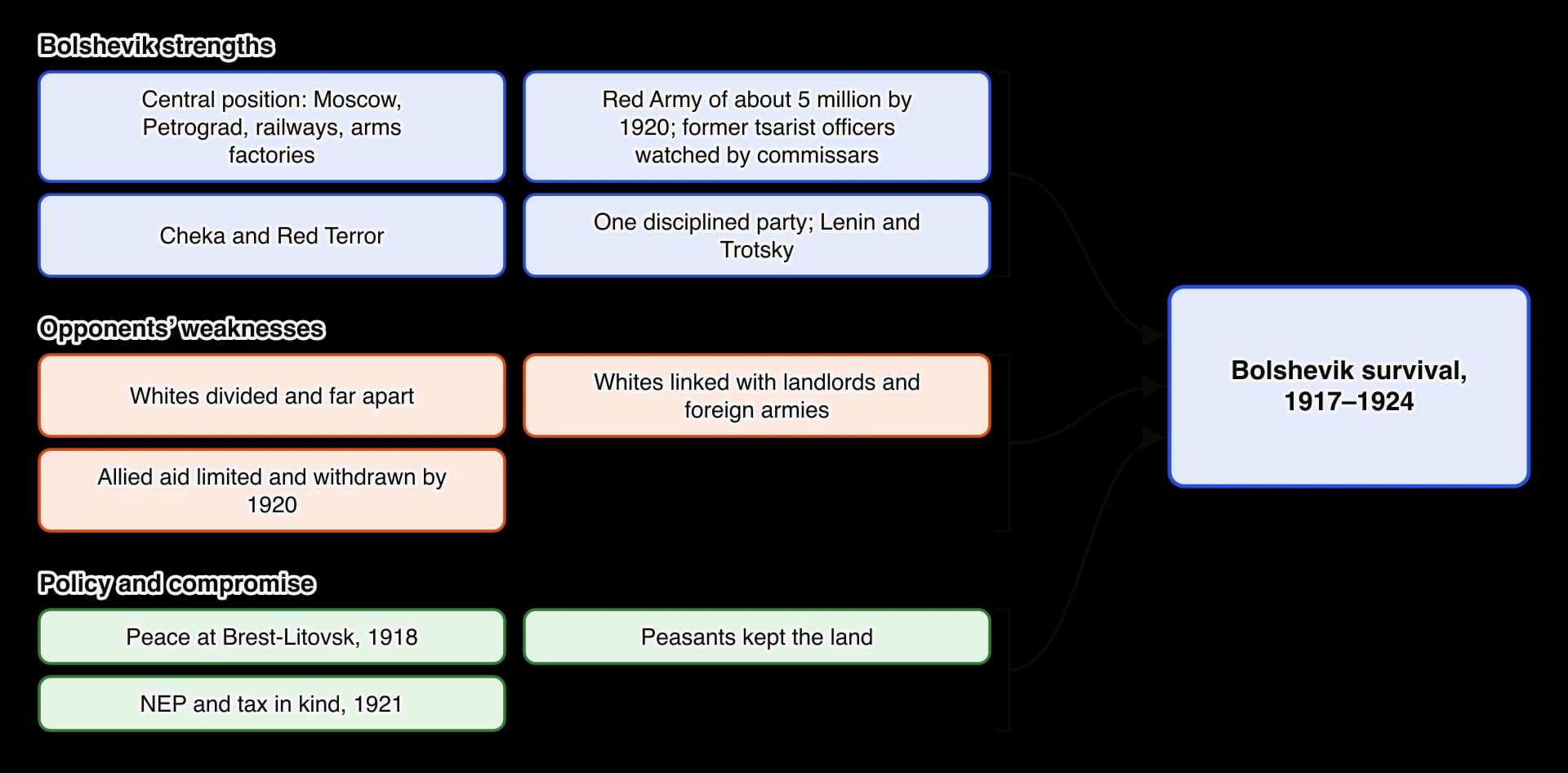
The diagram of the reasons for Bolshevik survival groups the explanations. Evan Mawdsley, in The Russian Civil War (1987), stresses the Reds’ central position: they held the heart of European Russia, with most of its population, its railway network and the arms factories of the old empire, and could move troops between fronts along interior lines. The Whites fought on the edges, thousands of kilometres apart, with poor communications, and never coordinated their offensives; Kolchak had been defeated before Denikin’s advance began.
Politics mattered as much as geography. The Whites were led by officers who had no programme beyond restoring "Russia, one and indivisible", which alienated the national minorities, and many of their supporters wanted the land returned to its owners, which alienated the peasants. Peasants disliked Bolshevik grain requisitioning, but they feared a White victory more, because it would mean the return of the landlords. The Reds also had a single leadership with a clear ideology, effective propaganda, and the willingness to use terror against their own side as well as the enemy.
War Communism, Kronstadt and the New Economic Policy
War Communism, 1918–1921
War Communism was the name later given to the economic policies of the Civil War years. Its main measures were:
Nationalisation. A decree of June 1918 nationalised large-scale industry; by 1920 even small workshops were taken over. Factories were run by state boards under the Supreme Council of the National Economy, and the workers’ control of 1917 gave way to appointed managers.
Grain requisitioning. Committees of poor peasants (kombedy, June–December 1918) and armed food detachments from the towns took grain from the villages. From January 1919 compulsory quotas, prodrazverstka, were assigned to each province and divided among the villages, often leaving peasants without seed or food.
A ban on private trade and the rationing of food by class, with the largest rations for workers and soldiers and the smallest for the "bourgeoisie".
Labour conscription. All adults were liable to compulsory work; in 1920 Trotsky proposed to "militarise" labour by turning army units into labour armies.
The collapse of money. The government printed roubles until they became almost worthless, and wages were increasingly paid in kind.
Historians disagree about whether War Communism was a response to the emergency of civil war or an attempt to leap straight to communism. E. H. Carr, in The Bolshevik Revolution 1917–1923 (1950–1953), saw it mainly as improvisation forced by war. Richard Pipes and others point out that many Bolsheviks celebrated the end of money and markets as the arrival of communism, and that the policies were extended in 1920, after the main White armies had been defeated. Both views find support: the war made the policies possible and seemed to make them necessary, while ideology shaped the form they took.
The results were disastrous. By 1920 large-scale industrial output had fallen to roughly a fifth of its 1913 level. Peasants sowed less land because any surplus would be taken, so the harvest shrank. Hungry workers left for the countryside, and the population of Petrograd fell from about 2.4 million in 1917 to well under a million in 1920 (estimates run from about 570,000 to 720,000). A black market supplied much of the food that people actually ate.
The crisis of 1921 and Kronstadt
With the Whites defeated, the regime faced revolts from the people in whose name it ruled. In Tambov province, south-east of Moscow, peasant armies led by the former SR Alexander Antonov fought the Red Army from 1920 until mid-1921; larger risings broke out in western Siberia. In February 1921 strikes and demonstrations spread through Petrograd over cuts in bread rations. Then the sailors of the naval base at Kronstadt, the heroes of 1917, turned against the government.
1. In view of the fact that the present soviets do not express the will of the workers and peasants, immediately to hold new elections by secret ballot, with freedom to carry on agitation beforehand for all workers and peasants; 2. To give freedom of speech and press to workers and peasants, to anarchist and left socialist parties; 3. To secure freedom of assembly for trade unions and peasant organizations; ... 11. To give peasants full freedom of action in regard to the land, and also the right to keep cattle, on condition that the peasants manage with their own means, that is, without employing hired labor.
Resolution of the general meeting of the crews of the battleships Petropavlovsk and Sevastopol, Kronstadt, 28 February 1921 (translation in Paul Avrich, The Anarchists in the Russian Revolution, 1973, Marxists Internet Archive). The sailors did not call for the return of the Provisional Government or of private industry; they demanded freely elected soviets, which in practice meant soviets not controlled by the Communists, together with freedom for the socialist parties and an end to requisitioning. The resolution is strong evidence that the regime had lost the support of some of its own core supporters, and of what they had understood the revolution to promise. The government presented the rising as a White plot organised from abroad, a claim for which there is little evidence.
The Red Army attacked across the ice of the Gulf of Finland and took the fortress on 18 March 1921 after heavy fighting. Thousands of rebels were killed in the attack or executed afterwards, and thousands more were sent to camps. The suppression of Kronstadt, carried out by the commander Mikhail Tukhachevsky with Trotsky as commissar for war, became for many socialists abroad the clearest sign that the regime would use force against workers and sailors who had supported it in 1917.
The Tenth Party Congress and the New Economic Policy
The Tenth Congress of the Communist Party (as the Bolsheviks had renamed themselves in 1918) met in Moscow from 8 to 16 March 1921, while the fighting at Kronstadt went on. It took two decisions that shaped the rest of Lenin’s life and the period after it.
The first was the New Economic Policy (NEP). Requisitioning was replaced by a tax in kind, a fixed share of the harvest; once peasants had paid it they could sell their surplus on the open market. Private trade was legalised, small firms (most with fewer than 20 workers) were returned to private owners or leased, and foreign firms were invited to take concessions. The state kept what Lenin called the "commanding heights" of the economy: heavy industry, banks, the railways and foreign trade. A new, stable currency, the chervonets, was introduced in 1922–1924. Lenin defended the NEP to a doubtful party as a necessary retreat, made to restore the alliance between workers and peasants, the smychka.
The second was the ban on factions. Organised groups inside the party with their own platforms, such as the Workers’ Opposition led by Alexander Shlyapnikov and Alexandra Kollontai, which wanted the trade unions to run industry, were forbidden on pain of expulsion. Economic freedom for the peasants was combined with tighter political discipline inside the one remaining party, and in 1922 leading Mensheviks and SRs were put on trial or exiled. The later use of the ban against Trotsky and his allies is part of the story of Stalin’s rise to power.
War Communism (1918–1921) | New Economic Policy (from 1921) | |
|---|---|---|
Peasants and grain | Compulsory requisitioning by quotas and armed detachments | Tax in kind (from 1924 in money); surplus sold freely |
Trade | Private trade banned; rationing; black market | Private trade legal; Nepmen traders |
Industry | All industry nationalised, run by state boards | Small firms private or leased; state keeps the commanding heights |
Money | Collapse of the rouble; wages in kind | Stable chervonets; money wages |
Labour | Compulsory labour, militarisation | Labour market and unemployment return |
Politics | Civil war, Red Terror | Ban on factions; other parties suppressed |
The NEP worked as a policy of recovery. By 1926 agricultural and industrial output had returned roughly to pre-war levels. Private traders, the "Nepmen", ran most retail trade, and restaurants, shops and markets reopened in the cities. Yet the NEP also produced problems that troubled the party. In 1923 industrial prices rose far above agricultural prices, so peasants could not afford manufactured goods and held back grain; Trotsky called this the "scissors crisis" after the shape of the two price lines on a graph. Many communists saw the Nepmen and the more prosperous peasants as a new bourgeoisie, and unemployment rose among workers.
The famine of 1921–1922
Drought in 1920 and 1921 struck a countryside already stripped by requisitioning. Famine spread across the Volga region, the southern Urals and Ukraine, and estimates of deaths from hunger and disease are commonly around five million. The government, after delay, accepted help from abroad: the American Relief Administration, led by Herbert Hoover, was feeding about ten million people a day at its peak in 1922, and the Norwegian explorer Fridtjof Nansen organised relief through the Red Cross.
Foreign relations and the formation of the USSR
The Bolsheviks expected revolution to spread across Europe. In March 1919 they founded the Communist International (Comintern) in Moscow, under Zinoviev, to lead communist parties abroad, and in 1920 it required member parties to accept twenty-one conditions of discipline. The defeat in Poland and the failure of risings in Germany and Hungary showed that world revolution was not coming soon. From 1921 Soviet Russia sought trade and recognition: an Anglo-Soviet Trade Agreement was signed in March 1921, and in April 1922, during an international conference at Genoa, Soviet and German diplomats signed the Treaty of Rapallo, which restored diplomatic relations, cancelled mutual claims, and opened the way to secret military cooperation between the two outcasts of the post-war order.
On 30 December 1922 the Russian republic joined with the Soviet republics of Ukraine, Belorussia and Transcaucasia to form the Union of Soviet Socialist Republics (USSR), with a constitution approved in January 1924. The union was federal in form, with a right of secession on paper, but the Communist Party, centralised in Moscow, ruled every republic. Lenin and Stalin disagreed over its design: Stalin first proposed to absorb the other republics into Russia, and Lenin criticised his rough treatment of the Georgian communists in 1922.
Lenin’s last years
Lenin suffered his first stroke in May 1922, a second in December 1922 and a third in March 1923, which left him unable to speak. In his last writings he criticised the party bureaucracy and assessed his possible successors, notes later known as his Testament; Stalin had been General Secretary of the party since April 1922. Lenin died on 21 January 1924, aged 53. His body was embalmed and placed in a mausoleum on Red Square, Petrograd was renamed Leningrad, and the party launched a cult of Lenin that the struggle to succeed him, and Stalin’s victory in it, would use.
The impact of Bolshevik rule to 1924
The Bolsheviks set out to remake society as well as the state. Their policies towards religion, the family, the nationalities and the old classes were driven by Marxist ideas about class, religion and equality, and shaped by civil war, famine and the needs of a one-party state. The results differed sharply between groups and between the promises of 1917–1918 and the realities of the early 1920s.
Religion
Marxists saw religion as a tool of the ruling class and expected it to disappear under socialism; the Orthodox Church had also been part of the tsarist state. A decree of 20 January (2 February) 1918 separated the Church from the state and schools. Churches lost the right to own property and their status as legal bodies; their buildings and lands were nationalised and lent back to congregations; religious teaching was banned in schools; and marriage, births and deaths were registered by the state. The Orthodox Church had restored its patriarchate in November 1917 and elected Tikhon as Patriarch; in January 1918 he condemned the persecution of the Church and those responsible for it.
During the Civil War thousands of priests, monks and nuns were killed by Red forces or the Cheka, often accused of supporting the Whites; many monasteries were closed and saints’ relics were publicly opened to discredit them. In February 1922 the government ordered the confiscation of Church valuables, officially to pay for famine relief. When believers resisted, as at Shuya in March 1922, troops fired on them, and Lenin urged that the opportunity be used to break the clergy. Show trials followed in Moscow and Petrograd, where Metropolitan Veniamin was executed. Tikhon was arrested in May 1922 and released in 1923 only after declaring his loyalty to the Soviet state. The secret police meanwhile supported a breakaway "Living Church" of reforming priests to divide the Orthodox.
Other faiths were also targeted. The Jewish sections of the party (the Yevsektsiya, from 1918) closed synagogues and religious schools and suppressed Hebrew and Zionism; Muslim institutions were treated more cautiously in the early 1920s, when the regime sought support in Central Asia. Yet faith survived, especially in the countryside. Organised atheist campaigns began with the newspaper The Godless in 1922 and became a mass movement only after 1925.
Women
The Bolsheviks promised women full equality. Marxists argued that the family based on private property made women dependent on men, and that socialism would free them by moving housework and childcare into public canteens, laundries and nurseries. Alexandra Kollontai, a leading Bolshevik who as commissar for social welfare in 1917–1918 was one of the first women anywhere to serve in a national government, argued that marriage should become a free union of equals.
Laws changed quickly:
Decrees of December 1917 made marriage a civil contract and allowed divorce at the request of either partner.
The Family Code of 1918 gave women equal rights in marriage, abolished the legal distinction between children born inside and outside marriage, and required fathers to pay maintenance.
The 1918 Constitution gave women the vote and the right to stand for office on the same terms as men, and equal pay for equal work was declared in principle.
In November 1920 abortion was legalised when carried out by doctors in hospitals, the first time any state had done so.
In 1919 the party set up the Zhenotdel, its women’s department, first led by Inessa Armand and, after her death in 1920, by Kollontai. Its organisers held "delegate meetings" of working and peasant women, ran literacy classes and campaigned against domestic violence and arranged marriages.
Reality lagged far behind the law. Civil war and famine destroyed the economic base for public canteens and nurseries, which reached only a small minority. Under the NEP, when state enterprises had to cover their costs, women were often the first to be dismissed, and many turned to domestic service or prostitution. Easy divorce often meant that men left wives and children with little support, and the courts struggled to enforce maintenance. Millions of homeless children, the besprizorniki, orphaned or abandoned in the years of war and famine, lived in gangs in the cities; estimates for 1922 run as high as seven million, though this figure is probably too high. In the villages, where most women lived, patriarchal family life changed slowly. The historian Wendy Goldman, in Women, the State and Revolution (1993), argues that the Bolsheviks’ vision of women’s liberation was genuinely radical but could not be achieved in a poor country, and that its failures in the 1920s prepared the way for Stalin’s return to traditional family values.
Marginalised groups
National minorities
The Declaration of the Rights of the Peoples of Russia (2 (15) November 1917) promised equality and sovereignty to all peoples, the right of self-determination up to secession, and the abolition of national and religious privileges. Sovnarkom recognised Finnish independence in December 1917, and Poland and the Baltic states became independent after 1918. But where nationalists rejected Soviet power, the Red Army intervened: Ukraine was reconquered in 1919–1920, Azerbaijan and Armenia were taken in 1920, and Georgia, ruled by Mensheviks, was invaded in February 1921. In Central Asia Muslim guerrillas, known to the Soviets as the Basmachi, resisted Soviet rule from 1918 into the late 1920s. From 1923 the policy of korenizatsiya ("rooting") promoted local languages and local communists in the non-Russian republics, while the party kept control from Moscow.
Jews
The Provisional Government abolished the Pale of Settlement and all legal restrictions on Jews in March 1917. During the Civil War Jews suffered the worst wave of violence in their history before the Holocaust: in Ukraine in 1918–1921, pogroms by Ukrainian nationalist forces, White armies, independent warlords and some Red units killed at least 50,000 and perhaps over 100,000 people (estimates vary). The Bolsheviks condemned antisemitism, and many Jews saw the Red Army as their protector; Jews were prominent among Bolshevik leaders such as Trotsky, Zinoviev and Kamenev, which White propaganda exploited. At the same time Jewish traders and shopkeepers were classed as bourgeois, and Jewish religious and communal life was suppressed.
"Former people" and the disenfranchised
The 1918 Constitution of the Russian republic took the vote away from people who employed hired labour or lived on unearned income, private traders, clergy and monks, former police officers and members of the former royal family. These lishentsy ("deprived ones") and their families lost access to rations, housing and higher education, and their children were barred from many careers. The same constitution weighted elections to the Congress of Soviets in favour of the towns (one deputy for every 25,000 voters in the cities, against one for every 125,000 inhabitants in the countryside).
Cossacks
The Cossacks of the Don and Kuban, who had served the tsars as frontier soldiers in return for land and privileges, formed the core of the southern White armies. In January 1919 the party leadership ordered mass terror against wealthy Cossacks and all who had actively fought against Soviet power, a policy known as de-Cossackisation. Executions and deportations followed before the directive was withdrawn in March 1919 after a rising on the upper Don; estimates of the victims range from thousands to tens of thousands.
The experiences of different classes
The table of social groups summarises what Bolshevik rule meant for each class by 1924.
Group | Gains | Losses | Position in 1924 |
|---|---|---|---|
Nobility | None | Estates, titles, homes; many killed in the terror; perhaps one to two million people of all classes emigrated after 1917 | Destroyed as a class; survivors were lishentsy or worked as "specialists" |
Middle classes and intelligentsia | Some professionals valued as "bourgeois specialists" in industry and the army | Property and savings; apartments shared with workers’ families; censorship; leading thinkers expelled abroad on the "philosophers’ ships" of 1922 | Tolerated where useful, distrusted, and under surveillance |
Industrial workers | Eight-hour day, social insurance, status as the ruling class, rapid promotion for party members | Hunger and flight to the villages (worker numbers roughly halved by 1920); factory committees replaced by one-man management; unions controlled by the party; unemployment under the NEP | Officially in power; in practice disciplined by the party-state |
Peasants | Landlords’ land shared out in 1917–1918; peasant farms and the commune strengthened; NEP freedom to sell | Requisitioning, conscription and the famine of 1921–1922; risings crushed; the "scissors crisis" of 1923 | Better off under the NEP than at any time since 1914, but distrusted as petty capitalists |
Nepmen | Freedom to trade and run small businesses from 1921 | Heavy taxes, no vote, social stigma | Prosperous but insecure |
Party members and officials | Power, privileges, better rations and housing | Party discipline; purges of "unreliable" members from 1921 | A new ruling elite taking shape |
For workers, the gap between ideology and practice was widest. The working class in whose name the revolution was made shrank by about half during the Civil War, as factories closed and workers left for the villages or the Red Army. Its independent organisations lost their power: in the trade union debate of 1920–1921 Lenin rejected both Trotsky’s plan to merge the unions into the state and the Workers’ Opposition’s demand that unions run industry, and the unions became channels for party policy. In 1924 the party recruited about 240,000 workers in the "Lenin enrolment", which strengthened the hand of the party apparatus.
Peasants made the biggest gains of 1917, when they took the land, and the commune they had defended against Stolypin regained its place in village life. They then bore most of the cost of the Civil War through requisitioning and famine. The NEP gave them a few years of relative prosperity, but the party continued to see the more successful peasants as kulaks, a class enemy in waiting.
Culture and education
Under the commissar for enlightenment, Anatoly Lunacharsky, the regime launched a campaign for mass literacy (likbez): a decree of December 1919 required everyone aged 8 to 50 who could not read to learn, and literacy rose from about a fifth of the empire’s population in 1897 to about half in the 1926 census. The early 1920s were also a period of artistic experiment. The poet Vladimir Mayakovsky designed propaganda posters for the Russian Telegraph Agency (ROSTA), agitation trains carried films and theatre to the fronts, and the Proletkult movement tried to create a new working-class culture. At the same time the state controlled what could be published: censorship was centralised in a new office, Glavlit, in 1922, and in the autumn of that year more than 160 leading philosophers, scholars and writers were expelled abroad.
Perspectives and debates
Few events have been argued over as fiercely as the Russian revolutions. For most of the twentieth century the debate was also a Cold War argument about communism: Soviet historians had to present October as the inevitable victory of the working class led by Lenin’s party, while many Western historians saw it as the seizure of power by a ruthless minority. The opening of Soviet archives after 1991 settled some factual questions but not the main disagreements, which are about how to weigh evidence and what to compare Russia with.
Could tsarism have survived? Optimists and pessimists
The first debate concerns the long-term causes of 1917. "Optimists" argue that Russia was modernising successfully before 1914 and that the war, not the system, destroyed the monarchy. Alexander Gerschenkron, in Economic Backwardness in Historical Perspective (1962), presented the state-led industrialisation of the 1890s as a successful strategy for a backward country that was turning into a private, market-driven economy by 1914. Paul Gregory’s statistical study Before Command (1994) found steady growth in national income, including in agriculture, which questions the picture of a stagnant, impoverished countryside. Optimists also point to the Dumas, the growth of education and the Stolypin reforms as signs of gradual change.
"Pessimists" argue that the regime was heading for crisis anyway. Leopold Haimson, in an influential article in Slavic Review (1964–1965), argued that urban Russia on the eve of war was polarised twice over: between the workers and the rest of society, and between educated society and the regime. The strike wave of 1912–1914, shown in the chart of political strikes, is his key evidence. Pessimists also stress Nicholas’s refusal to accept the Dumas as partners, the unresolved land question and the national minorities. Judith Pallot’s study of peasant responses to the Stolypin reforms (1999) showed how many villages resisted leaving the commune, which weakens the claim that the reforms would have created a stable peasant base given time.
The debate turns partly on counterfactual reasoning: what would have happened without the war. Optimists can show growth; pessimists can show conflict. Both can be true, since rapid growth often increases social tension. A balanced judgement is that the war was the immediate and probably necessary cause of the collapse in February 1917, but that it struck a regime whose ruler had already lost the confidence of almost every group capable of saving him.
February: spontaneous or led?
Soviet accounts gave the Bolsheviks the leading role in February. Western historians, notably Tsuyoshi Hasegawa in The February Revolution: Petrograd, 1917 (1981), showed that the rising began with women workers and spread without direction from any party, though worker activists of several parties helped to organise strikes and link factories with barracks. The decisive actors were the soldiers of the garrison, and the generals at headquarters who advised abdication.
October: coup or popular revolution?
This is the central debate. Historians who are often grouped as liberal or "totalitarian" in approach, such as Leonard Schapiro (The Origin of the Communist Autocracy, 1955) and Richard Pipes (The Russian Revolution, 1990), see October as a coup carried out by a conspiratorial party that exploited chaos and then imposed its will by terror; for Pipes the key actor is Lenin, and the regime’s violence followed from his ideology. Robert Service’s Lenin: A Biography (2000) also stresses Lenin’s ruthlessness and his central role.
Revisionist social historians from the 1970s looked at the revolution from below. Alexander Rabinowitch, in The Bolsheviks Come to Power (1976), found that the Bolshevik party in Petrograd in 1917 was flexible, internally divided and responsive to its members, and that it won real support among workers and soldiers by autumn 1917. Sheila Fitzpatrick (The Russian Revolution, 1982) and Stephen Smith (Red Petrograd, 1983; Russia in Revolution, 2017) stress the radicalisation of workers, soldiers and peasants, who pursued their own aims of land, peace and control of the factories. In this view the Bolsheviks rode a popular wave that they did not create.
Orlando Figes, in A People’s Tragedy (1996), combines the two. He accepts that the revolution began as a genuine popular movement, but argues that the people’s own political culture, with its distrust of authority and its violence against the privileged, was easily turned by the Bolsheviks into the basis of a new dictatorship, of which the people themselves became the victims.
Approach | Historians | Argument about 1917 | Evidence stressed |
|---|---|---|---|
Soviet (Marxist–Leninist) | Official histories, e.g. the Short Course (1938) | A proletarian revolution, inevitable and led by Lenin’s vanguard party | Class struggle; Lenin’s leadership; the masses’ support |
Liberal / totalitarian | Schapiro (1955), Pipes (1990), Service (2000) | A coup by a minority party, followed by dictatorship and terror | Lenin’s ideas and decisions; the Constituent Assembly vote and its dissolution; the Cheka |
Revisionist (social history) | Rabinowitch (1976), Fitzpatrick (1982), S. A. Smith (1983, 2017) | A popular revolution from below, with genuine support for soviet power by autumn 1917 | Soviet elections, factory committees, soldiers’ committees, peasant land seizures |
Synthesis | Figes (1996) | A popular revolution taken over by the Bolsheviks; a tragedy for the people who made it | Popular violence and political culture; the move to terror in 1918 |
The weight of evidence supports parts of each view. The Constituent Assembly result shows that the Bolsheviks were a minority in the country, and the planning of the seizure of power was the work of a small group. But the soviet elections of September 1917 and the ease of the seizure in Petrograd show that they had substantial support in the capitals, and the peasant land seizures had already destroyed the old order in the countryside. Many historians therefore describe October as a party’s seizure of power carried out in the name of, and with considerable support from, a popular revolution.
Lenin’s state: the road to Stalin?
The last debate concerns the regime Lenin built. Historians who stress continuity, such as Pipes and Service, argue that the one-party state, the Cheka, the Red Terror, the camps and the ban on factions created the machine that Stalin later used, so that Stalinism grew from Leninism. Others, among them Moshe Lewin in Lenin’s Last Struggle (1968) and Stephen Cohen, point to Lenin’s last writings against bureaucracy and against Stalin, and to the NEP’s compromise with the peasants, as evidence that other paths were possible in 1924. How Stalin used the institutions he inherited, and whether he was Lenin’s heir or a betrayer of his ideas, is examined in the study of his rise to power; the evidence from 1917–1924 shows that the institutions of dictatorship were in place by Lenin’s death, while the decision to use them for collectivisation and mass terror was taken later.
Applying the ideas in exam questions
Paper 3: the fall of the monarchy
Paper 3: the revolution of 1905
Paper 3: Bolshevik survival
Paper 3: the impact of Bolshevik rule
Self-check
- To do:
I can explain why the Crimean War led Alexander II to emancipate the serfs, and describe the terms of the emancipation and its limits.
- To do:
I can describe the zemstvo, judicial, military and other Great Reforms and judge how far they changed Russia.
- To do:
I can explain the growth of Populism, Land and Liberty and People’s Will, and the assassination of Alexander II.
- To do:
I can describe the repressive policies of Alexander III, Russification and the treatment of the Jews.
- To do:
I can explain Witte’s programme of industrialisation and its social consequences.
- To do:
I can explain the ideas and divisions of the SRs, the Bolsheviks, the Mensheviks and the liberals.
- To do:
I can weigh the causes of the revolution of 1905, including the Russo-Japanese War and Bloody Sunday.
- To do:
I can explain why the regime survived in 1905 and compare the October Manifesto with the Fundamental Laws.
- To do:
I can describe the four Dumas and explain the electoral law of June 1907.
- To do:
I can assess Stolypin’s repression and agrarian reform and the role of the Okhrana.
- To do:
I can explain the military, economic and political impact of the First World War on Russia.
- To do:
I can explain the events of February 1917, Order No. 1 and the establishment of Dual Power.