R4 Europe
The twelve HL regional studies of Europe, from the Carolingians to 2020: how they fit together, the themes that link them, and how two of them are chosen and examined.
- IB History
- HL only
What R4 covers
From the subject guide: what you need to know and be able to do.
Regional study: HL students study two of these twelve, examined in paper 3.
12 subtopics in Europe
Each one has its own page once something is published for it.
- R4.1Medieval kingdoms and empires (circa 750–1400)notes
- R4.2Renaissance and Reformation (circa 1350–1700)notes
- R4.3Enlightenment and absolutism (1600–1800)notes
- R4.4The French Revolution (1774–1815)notes
- R4.5Unification of Germany and Italy (1815–1871)notes
- R4.6Europe and the First World War (1871–1923)notes
- R4.7The Russian Revolution (1855–1924)notes
- R4.8European totalitarianism (1918–1941)notes
- R4.9Europe and the Second World War (1918–1949)notes
- R4.10Democracy, authoritarianism and conflict in Spain (circa 1920–2020)notes
- R4.11The USSR and post-Soviet Russia (1945–2020)notes
- R4.12Europe during and after the Cold War (1945–2020)notes
An overview of R4 Europe
Europe is one of the four regions of the HL regional studies. Its twelve studies run from the mid-eighth century to 2020: medieval kingdoms and empires, the Renaissance and Reformation, the Enlightenment and absolutism, the French Revolution and Napoleon, the unification of Germany and Italy, the First World War, the Russian Revolution, the interwar dictatorships, the Second World War, Spain from monarchy to democracy, the USSR and post-Soviet Russia, and Europe during and after the Cold War.
Twelve regional studies
Each regional study is a page of its own. The chart of the twelve studies places them on one time axis.
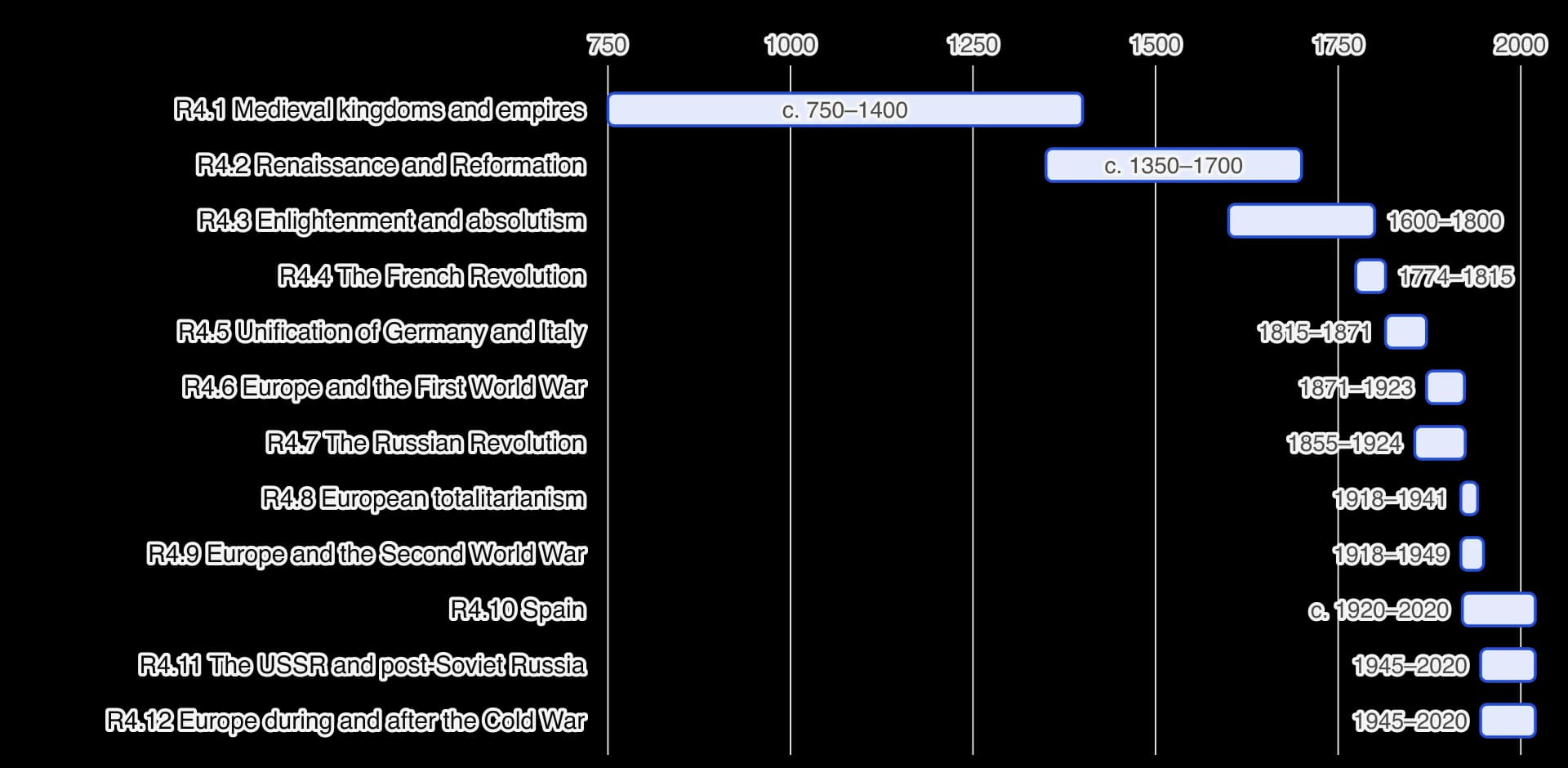
The studies after 1774 overlap closely, so the same events appear in several of them from different angles. The rise of Hitler, for example, is a case of totalitarianism in one study and a cause of the Second World War in another. The table of themes groups the studies by what they are mainly about.
Theme | Studies | What they cover |
|---|---|---|
Kingdoms, faith and ideas, 750–1800 | R4.1, R4.2, R4.3 | The Carolingian Empire, Norman and Angevin England and other medieval states (c. 750–1400); the Italian and northern Renaissance, Luther, Calvin and the Catholic response (c. 1350–1700); Enlightenment thinkers and the enlightened despots (1600–1800) |
Revolution and the making of nation-states | R4.4, R4.5, R4.7 | The ancien régime, the revolution of 1789, the Terror and Napoleon (1774–1815); the unification of Italy and Germany (1815–1871); the last three tsars, 1905, the revolutions of 1917 and Lenin's state (1855–1924) |
World wars and dictatorships | R4.6, R4.8, R4.9 | The alliance system, the causes, course and impact of the First World War and the peace treaties (1871–1923); Mussolini, Hitler and Stalin (1918–1941); the League of Nations, the causes and outcome of the Second World War and the Holocaust (1918–1949) |
Europe since 1945, and Spain | R4.10, R4.11, R4.12 | Spain from the Restoration monarchy through the Civil War and Franco to democracy (c. 1920–2020); the USSR from Stalin to Gorbachev and Russia under Yeltsin and Putin (1945–2020); the Cold War in Europe, German division and reunification, and European integration (1945–2020) |
Big ideas that run through the region
Religion and authority are linked from the first study to the last. Medieval kings drew legitimacy from the Church while the reformed papacy challenged them; the Reformation broke the unity of western Christendom; Enlightenment thinkers judged churches and monarchs by reason; the French Revolution attacked the Church and Napoleon made peace with it; and the Church's place was a source of conflict again in Spain in the 1930s.
Revolution, nationalism and the nation-state form a second thread. The revolutions of 1789, 1848 and 1917 each claimed to remake society, and each is judged by how much really changed. Nationalism helped to unify Germany and Italy, to bring about the First World War, and to break up empires in 1918 and 1991. The German question, how a large, powerful Germany could fit into Europe, runs from unification in 1871 through two world wars to the division of 1949 and reunification in 1990.
Dictatorship and democracy are a third. Absolute monarchy, Napoleon's empire, the dictatorships of Mussolini, Hitler and Stalin, Franco's regime and Putin's Russia can be compared for how they won, kept and lost power, while war appears again and again as a cause of change. These studies also contain some of the most contested debates in historical writing: responsibility for the First World War, whether October 1917 was a popular revolution or a coup, whether "totalitarianism" describes the interwar regimes, how the Holocaust happened, and who was responsible for the Cold War.
How the regional studies are studied and examined
The regional studies are taken by HL students only; SL students do not study them. Each school chooses one of the four regions (Africa and the Middle East, the Americas, Asia and Oceania, or Europe) and then two of its twelve studies, taught in about 90 hours. They are the part of IB History that builds skill in evaluating historical arguments.
The regional studies are assessed by Paper 3 (2 hours, 30 marks; 35 per cent of the HL grade). There is a separate paper for each region, with two essay questions on each of its twelve studies. Students answer two questions, each from a different study, and each essay is marked out of 15. Every question gives an argument to evaluate and asks "To what extent do you agree …?". The IB's published sample for this region is: "To what extent do you agree with the claim that papal patronage was the most significant factor in the development of the Italian Renaissance?" Some studies, or parts of them, are studied through one example chosen by the school: one medieval kingdom or empire, one enlightened despot, or one country for the impact of the Reformation, of Napoleonic rule or of a world war. Questions on these ask students to answer with reference to the example they have studied.
Carry on with R4 in Augment
With a free account, Augment remembers where you stopped and what you have practiced.