Notes on R4.8 European totalitarianism (1918–1941)
Between 1922 and 1941 three European states, Italy, Germany and the Soviet Union, came under dictatorships that went further than any earlier autocracy in trying to control what their citizens did, said and believed. Their history shows how democracies could fail, how dictators won and kept power, and what their rule meant for the people who lived under it.
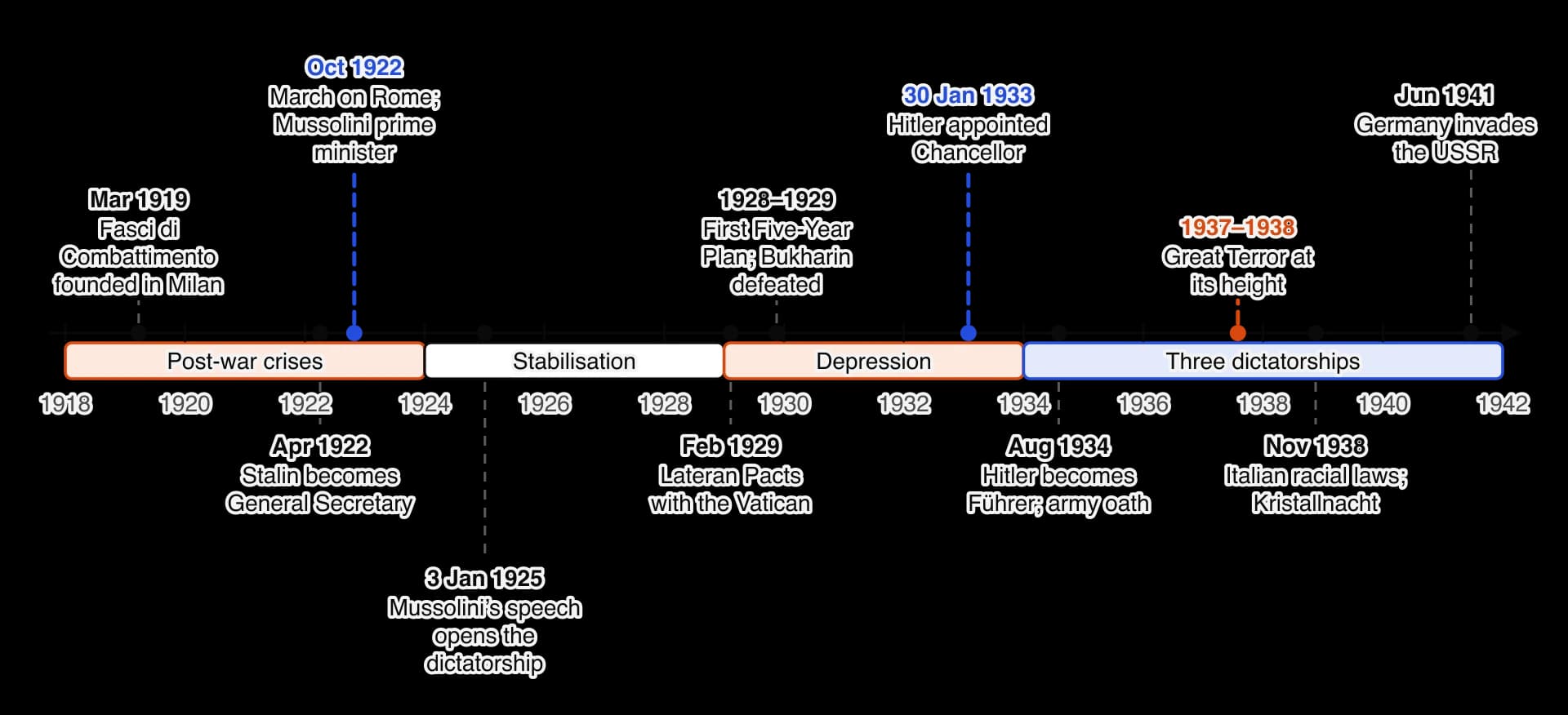
The timeline of the three regimes shows that they did not develop in isolation. Hitler admired Mussolini and modelled his Munich Putsch of 1923 on the March on Rome; Fascists and Nazis presented themselves as Europe’s defence against Bolshevism; and Soviet propaganda used the rise of fascism to justify its own emergency measures.
Totalitarianism, fascism and dictatorship: the key concepts
The word totalitarianism was first used in Italy in the early 1920s by opponents of Mussolini, as a criticism. Mussolini and the philosopher Giovanni Gentile then adopted it with pride: the Fascist state, they argued, should embrace every part of national life. Mussolini summed up the idea in the slogan "Everything in the State, nothing outside the State, nothing against the State".
After 1945 political scientists turned the word into a model for comparing Nazi Germany and the Soviet Union. Hannah Arendt, in The Origins of Totalitarianism (1951), argued that both regimes were something new: movements that used terror and ideology to destroy the independent ties between people (classes, churches, parties, families) and to dominate atomised individuals. Carl Friedrich and Zbigniew Brzezinski, in Totalitarian Dictatorship and Autocracy (1956), listed six features that such regimes shared.
Feature (Friedrich and Brzezinski) | What it means |
|---|---|
An official ideology | A complete doctrine about society and the future that everyone must accept |
A single mass party | Usually led by one man, organised hierarchically and fused with the state |
Terror | A secret police that uses physical and psychological terror against real and imagined enemies |
A monopoly of communications | Party control of the press, radio and cinema |
A monopoly of weapons | No independent armed force can exist |
Central direction of the economy | The state controls and plans economic life |
The six features of the totalitarian model provide a checklist against which each regime can be tested. Critics point out that the model describes what the regimes wanted more than what they achieved, and that it was shaped by the Cold War, when Western scholars wanted to show that communism was as bad as Nazism. The test of "the extent of totalitarian control" is therefore how far each regime matched its own ambitions.
Fascism and Nazism
Fascism takes its name from the fasces, the bundle of rods carried before magistrates in ancient Rome as a symbol of authority. As an ideology it was hard to define, because Mussolini changed his programme whenever it suited him, but its core was clear: an extreme nationalism that put the nation above the individual, hatred of liberal democracy and of Marxism, the glorification of violence, war and youth, and the cult of a leader who embodied the nation. The historian Roger Griffin describes its core as a myth of national rebirth after decline; Robert Paxton, in The Anatomy of Fascism (2004), argues that fascism is better understood by what fascists did, in stages from movement to power, than by their changing words.
Nazism, the ideology of Hitler’s National Socialist German Workers’ Party (NSDAP), shared the features of fascism but placed race at its centre. It held that humanity was divided into races locked in a struggle for survival, that the "Aryan" Germans were the highest race and the Jews its deadly enemy, and that Germany needed Lebensraum (living space) in the east. Italian Fascism was not officially antisemitic until 1938.
The ideology of Stalin’s USSR
Marxism–Leninism taught that history moved through class struggle towards communism, a classless society, and that a disciplined vanguard party had to lead the working class there. Under Stalin it was adapted in two important ways. Socialism in One Country (1924) held that the USSR could build socialism alone, without waiting for revolutions abroad. The claim that class struggle intensified as socialism advanced justified ever-harsher measures against "class enemies" in the 1930s.
The crisis of the liberal state in Italy, 1918–1922
Italy had been a unified kingdom only since 1861. It was a constitutional monarchy under the Statuto Albertino, the constitution of 1848, with a king, Victor Emmanuel III from 1900, an appointed Senate and an elected Chamber of Deputies. Until 1912 only about a quarter of adult men could vote, and the liberal politicians who ran the state came from a small educated elite.
Long-term weaknesses of the liberal state
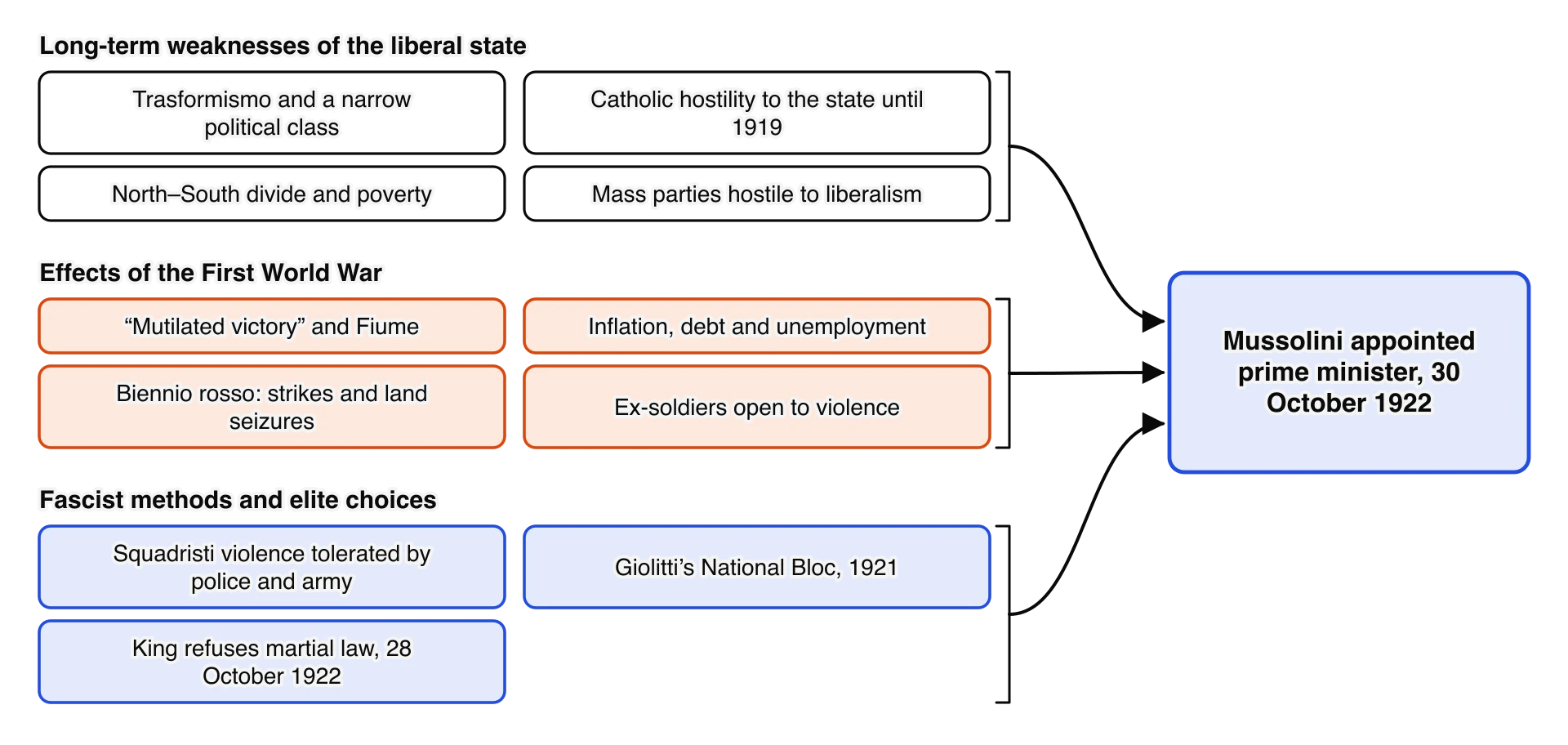
Liberal governments were formed by trasformismo, the practice of building majorities by "transforming" opponents into supporters through favours, posts and local deals, instead of through parties with clear programmes. It kept the same men in office for decades, above all Giovanni Giolitti, prime minister five times between 1892 and 1921, but it made politics look corrupt and remote to most Italians.
Large groups stood outside the liberal state. The Catholic Church had refused to recognise the kingdom since it took Rome in 1870, and the papal ban (non expedit) on Catholics taking part in national politics was lifted fully only in 1919. The South was much poorer than the industrial North, and millions of Italians emigrated. When universal male suffrage arrived (1912–1918) and proportional representation was introduced in 1919, two mass parties hostile to liberalism dominated the new Chamber: the Italian Socialist Party (PSI) and the Catholic Italian People’s Party (PPI, the Popolari).
The impact of the First World War
Italy entered the war in May 1915 on the side of Britain and France, after the secret Treaty of London promised it Austrian territory in the Trentino, South Tyrol, Istria and Dalmatia. Intervention was decided by the king and a few ministers against the wishes of the majority in parliament, and it divided the country. About 600,000–650,000 Italian soldiers died, and the defeat at Caporetto in October–November 1917 was a national humiliation.
At the Paris Peace Conference Italy received the Trentino, South Tyrol, Trieste and Istria, but not Dalmatia or the port of Fiume, which had a largely Italian population. The nationalist poet Gabriele D’Annunzio called the outcome a mutilated victory. In September 1919 he led about 2,000 former soldiers into Fiume and ruled it until the Italian government expelled him in December 1920. His rule, with its balcony speeches, uniforms, salutes and chants, was copied by Fascism, and the government’s weakness in tolerating it for fifteen months damaged its authority.
The war also left economic crisis. The government had paid for it by borrowing and printing money; prices rose several times over between 1915 and 1920, savings lost their value, and demobilised soldiers returned to unemployment. In the biennio rosso ("two red years") of 1919–1920, strikes spread across the industrial North, peasants occupied land in the South and the Po valley, and in September 1920 about 400,000 metalworkers and 100,000 other workers occupied their factories in Milan, Turin and other cities. Giolitti waited for the occupations to end on their own, which they did, but landowners and industrialists concluded that the liberal state would not protect them.
Party | Seats, Nov 1919 | Seats, May 1921 | Seats, Apr 1924 |
|---|---|---|---|
Italian Socialist Party (PSI) | 156 | 123 | 22 (plus 24 Unitary Socialists) |
Italian People’s Party (Popolari) | 100 | 108 | 39 |
Communist Party (founded Jan 1921) | – | 15 | 19 |
Fascists | 0 | 35 (within Giolitti’s National Blocs) | 374 for the government’s National List (64.9% of the vote) |
Total seats | 508 | 535 | 535 |
Data: official results of the Italian general elections of 1919, 1921 and 1924. The table of elections shows why governments were so unstable after 1919. No coalition could govern without either the Socialists, who refused to take part in "bourgeois" governments, or the Popolari, whose leader Luigi Sturzo distrusted Giolitti. Five governments fell between June 1919 and October 1922.
The rise of Fascism
Benito Mussolini, a former schoolteacher and journalist, had been one of the leaders of the Socialist Party and editor of its newspaper Avanti! until 1914, when he was expelled for demanding Italy’s entry into the war. He founded his own newspaper, Il Popolo d’Italia, served at the front and was wounded in 1917. On 23 March 1919 in Milan he founded the Fasci di Combattimento ("combat groups"), whose programme mixed nationalism with radical demands such as votes for women, a tax on war profits and workers’ participation in management. In the election of November 1919 the Fascists did not win a single seat, and Mussolini won fewer than 5,000 votes in Milan.
Fascism grew in 1920–1921 as a movement of violence against the left. Squadristi (armed squads), often led by ex-officers and students and paid by landowners, attacked Socialist town halls, peasant leagues, cooperatives and newspaper offices in the Po valley, Tuscany and Emilia. They beat opponents and forced them to drink castor oil. The local Fascist bosses, the ras, such as Italo Balbo in Ferrara, Roberto Farinacci in Cremona and Dino Grandi in Bologna, built their own power bases. Police, army officers and judges often looked away or helped, because they shared the squads’ hatred of socialism.
Giolitti tried to use the Fascists in the old way. In the election of May 1921 he included them in his National Blocs of government candidates, hoping to tame them and weaken the Socialists. Thirty-five Fascists, including Mussolini, were elected, which gave the movement respectability. In November 1921 Mussolini turned the movement into a party, the National Fascist Party (PNF), and dropped most of its radical programme to win the trust of business, the Church and the monarchy. When the unions called a general strike against Fascist violence in August 1922, the squads broke it, and Fascism could present itself as the force that had defeated the left.
The March on Rome, October 1922
By the autumn of 1922 the Fascists held power in many towns of the North by force. At a rally in Naples on 24 October Mussolini demanded office, and on 27–28 October about 25,000–30,000 Blackshirts began to converge on Rome. They were poorly armed and could easily have been stopped by the army. The prime minister, Luigi Facta, prepared a decree of martial law (a state of siege), but on the morning of 28 October King Victor Emmanuel III refused to sign it.
Historians still debate the king’s motives. He may have feared civil war, doubted the army’s loyalty, worried that his cousin the Duke of Aosta, who sympathised with Fascism, might replace him, or simply preferred Mussolini to a government that included the left. Conservative leaders, industrialists and senior officers advised him to bring Mussolini into government. On 29 October the king invited Mussolini, who had waited in Milan, close to the Swiss border, to form a government; he arrived in Rome by train and was appointed on 30 October. The Blackshirts paraded through the city on 31 October, after Mussolini was already in office.
 YouTube
Mussolini’s consolidation of power, 1922–1926
In October 1922 Mussolini was far from a dictator. His first cabinet was a coalition in which Fascists held only a minority of the ministries, with Popolari, liberals and nationalists in the others. The Fascists had 35 deputies in a Chamber of 535. The king could dismiss him, and the army, the Church and big business kept their independence. Mussolini’s task was to make himself independent of all of them without provoking a coalition against him.
Working within the system, 1922–1924
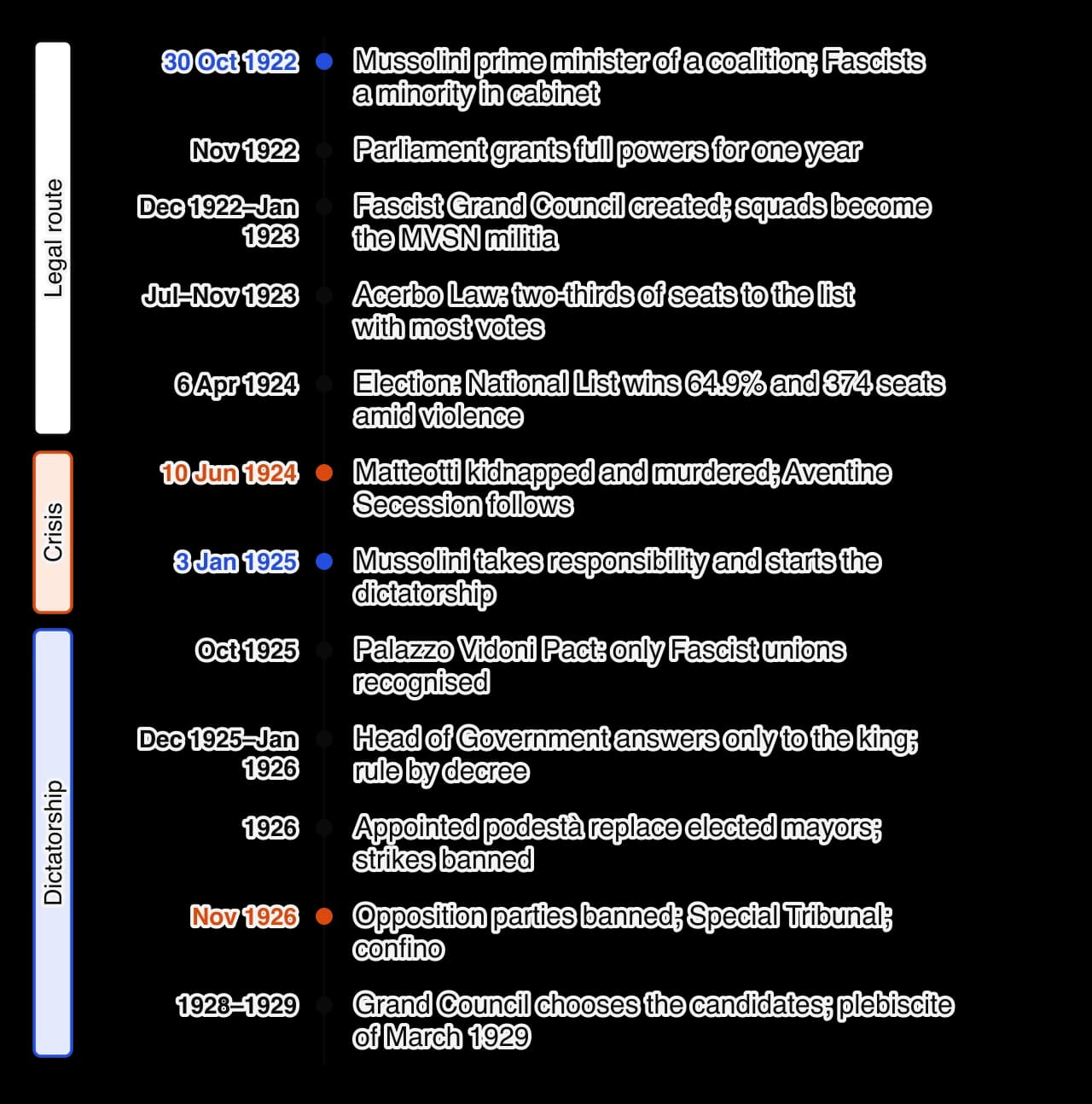
The timeline of consolidation shows a first phase in which Mussolini used legal methods. In November 1922 the Chamber, intimidated and hoping for order, gave him a vote of confidence by 306 votes to 116 and then full powers for a year to reform the administration and taxes. In December 1922 he created the Fascist Grand Council, a party body that became the real centre of policy, and in January 1923 he turned the squads into a state-paid militia, the MVSN (Voluntary Militia for National Security), loyal to him personally. In 1923 the Nationalist Association merged with the PNF, bringing in respectable conservatives.
The decisive legal step was the Acerbo Law, passed by the Chamber in July 1923 and enacted in November. It gave two-thirds of the seats to the list that won the most votes, provided it had at least 25 per cent. Many liberal and Catholic deputies voted for it, or abstained, because they believed it would bring stable government and hoped to be on the winning list. In the election of 6 April 1924 Mussolini’s National List, which included many liberals, won 64.9 per cent of the vote and 374 seats, so it would have had a majority even without the law. The campaign was marked by violence and fraud, especially in the North, where the left was strongest.
The Matteotti crisis, 1924
On 30 May 1924 Giacomo Matteotti, the leader of the Unitary Socialist Party, denounced the violence and fraud of the election in the Chamber and demanded that the results be annulled. On 10 June he was kidnapped in Rome by a squad led by Amerigo Dumini, a member of a secret Fascist police unit attached to Mussolini’s office, and stabbed to death. His body was found only on 16 August.
The murder caused the most serious crisis of the regime before 1943. Fascist membership fell, newspapers attacked Mussolini, and many expected the king to dismiss him. About 150 opposition deputies left parliament in protest in the Aventine Secession, named after the withdrawal of the plebeians of ancient Rome, and refused to return until the rule of law was restored. The secession was a moral protest, but it left the Chamber to the government and gave the king no parliamentary alternative. Victor Emmanuel III refused to act without a vote of parliament; the Vatican, which feared the Socialists more than Mussolini, kept its distance from the opposition; and industrialists still preferred order to a return of the left.
Pressure for decisive action came from the ras and the militia, who warned Mussolini at the end of December 1924 that they would act without him if he did not crush the opposition. On 3 January 1925 he spoke to the Chamber.
I declare here, before this assembly and before the whole Italian people, that I alone assume the political, moral and historical responsibility for everything that has happened. … If Fascism has been nothing but castor oil and the club, and not instead a superb passion of the best of Italian youth, the blame is mine!
Benito Mussolini, speech to the Chamber of Deputies, Rome, 3 January 1925 (translated from the Italian text of the speech). Mussolini spoke to deputies, most of them his own supporters, but his real audience was the king, the opposition and his own extremists, all of whom were waiting to see whether he would fall. By accepting responsibility without admitting any crime, and by daring parliament to remove him, he showed that no institution would do so. The speech is evidence of how the crisis was resolved, not of who ordered the murder, which historians still debate.
The "most Fascist laws", 1925–1926
In the following two years a series of laws, known as the leggi fascistissime ("most Fascist laws"), mostly drafted by the justice minister Alfredo Rocco, turned the government into a dictatorship:
The press was placed under the control of prefects, and opposition newspapers were closed or taken over (1925).
A law of December 1925 made Mussolini Head of Government, responsible to the king alone and no longer to parliament; from January 1926 the government could issue decrees with the force of law.
Elected mayors and councils were replaced by appointed officials, the podestà (1926).
After several attempts on Mussolini’s life (the last, by a fifteen-year-old in Bologna in October 1926), all opposition parties were dissolved in November 1926, the Aventine deputies were expelled from parliament, the death penalty was restored for attacks on the king or the head of government, and a Special Tribunal for the Defence of the State was set up to try political crimes.
Political opponents could be sentenced without trial to confino, internal exile in remote villages and islands.
Labour was brought under control at the same time. In the Palazzo Vidoni Pact of October 1925 the main employers’ organisation, Confindustria, agreed to recognise only Fascist unions, and in 1926 strikes and lockouts were banned. An electoral law of 1928 abolished competitive elections: the Grand Council drew up a single list of 400 candidates, which voters could accept or reject as a whole. In the plebiscite of March 1929, 98.4 per cent of votes were cast for the list.
By 1926 Mussolini had a one-party state, but not a totalitarian one. The monarchy survived, and the king kept the formal power to dismiss him, which he would use in July 1943. The army and the civil service remained in the hands of traditional elites. The Church remained independent. Mussolini also tamed his own party: the ras were brought under the control of the prefects, the representatives of the state, and party secretaries such as Augusto Turati purged tens of thousands of unruly members in the late 1920s. In Fascist Italy the state controlled the party, not the other way round.
Mussolini’s Italy: economic policies and the corporate state
Mussolini had no fixed economic ideas. His policies changed with his political needs: first reassuring business, then winning prestige through dramatic "battles", then rescuing banks and industry in the Depression, and finally preparing the economy for war. Throughout, the aim was national power and prestige more than the welfare of ordinary Italians.
From laissez-faire to the "battles", 1922–1927
Until 1925 the finance minister Alberto De Stefani followed liberal policies that pleased business: he cut public spending, reduced taxes on the wealthy, sold the telephone network to private companies and balanced the budget. The economy grew strongly in a period of European recovery. When inflation and a falling lira threatened in 1925, Mussolini replaced De Stefani and launched a series of campaigns presented in military language.
The Battle for Grain, announced in June 1925, aimed to make Italy self-sufficient in wheat. Tariffs were raised on imported grain, farmers received subsidies, better seed and fertiliser, and land was turned over to wheat. Wheat production rose substantially, by roughly a third to a half by the mid-1930s according to most estimates, and imports fell sharply, although Italy never became fully self-sufficient. The cost was high. Land in the South that suited olives, fruit and vines was put under wheat, livestock farming declined, and the tariff kept bread prices high, so that many Italians ate less well. Large landowners of the North gained most.
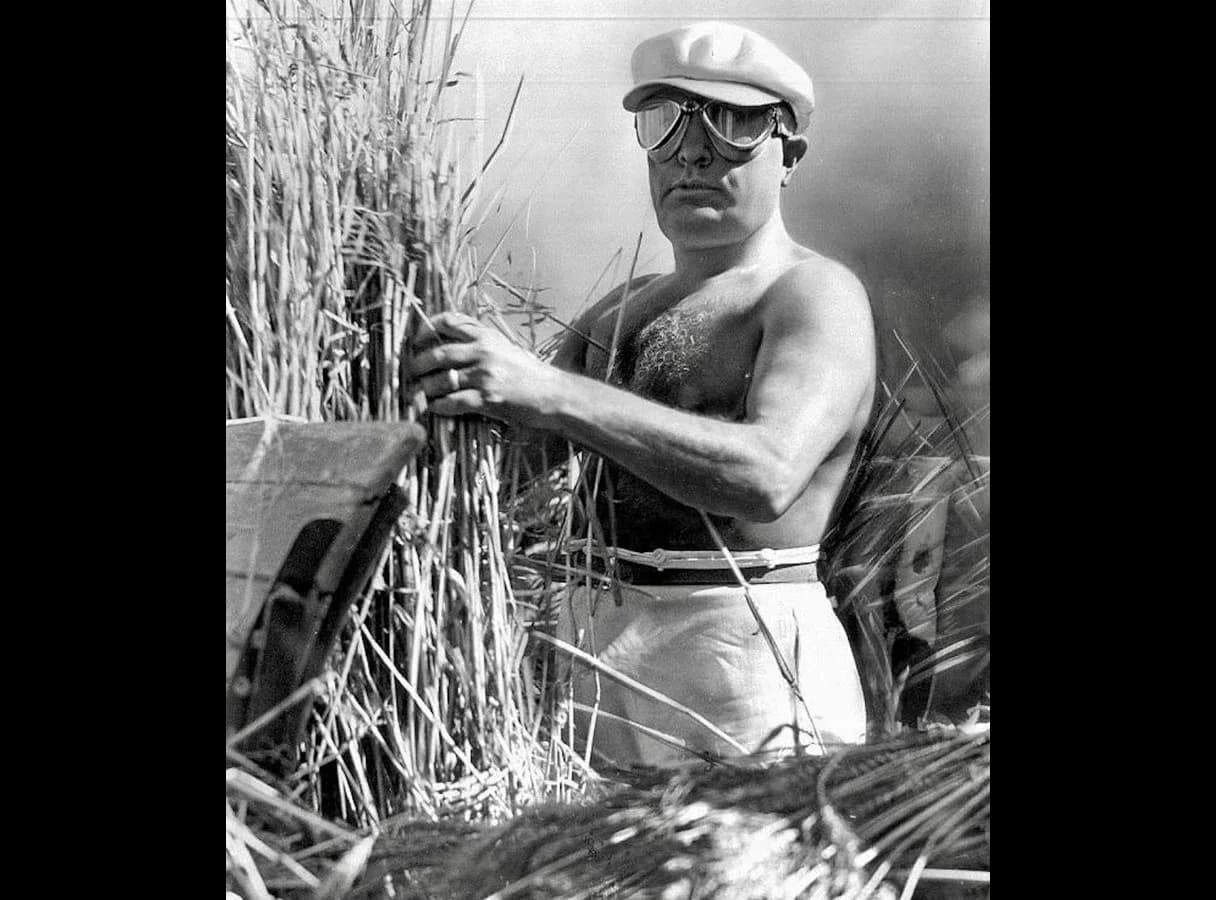
The photograph of Mussolini at the harvest shows that the Battle for Grain was a propaganda campaign as much as an economic one. Each summer newsreels showed the Duce harvesting, and prizes were given to the most productive farmers. The Battle for Land worked the same way: the draining of the Pontine Marshes south of Rome created farmland and new towns such as Littoria (1932) and Sabaudia (1934), shown to foreign visitors as proof of Fascist energy, although the area reclaimed nationally was far smaller than promised.
The Battle for the Lira began with a speech at Pesaro in August 1926 in which Mussolini promised to defend the currency. In December 1927 the lira was fixed at about 92 to the British pound, close to his target of 90 (quota novanta), against about 150 in 1926. A strong lira was a matter of prestige and protected the savings of the middle classes, but it made Italian exports expensive. Exporting industries such as textiles suffered, unemployment rose, and in 1927 the government ordered wage cuts of 10–20 per cent. Heavy industries that depended on imported raw materials and state orders, such as steel and chemicals, benefited.
The Depression and state intervention
The Great Depression hit Italy from 1930. Industrial production fell, and unemployment rose to over a million by 1933 by official counts. The main banks, which owned large shares in industry, faced collapse. The regime’s answer was rescue by the state: the Italian Securities Institute (IMI, 1931) lent to industry, and the Institute for Industrial Reconstruction (IRI, January 1933) took over the banks’ industrial shares. IRI was meant to be temporary but became permanent in 1937; by the end of the 1930s the Italian state owned a larger share of industry, including much of shipbuilding, steel and banking, than any other state in Europe except the USSR.
Public works, including roads, railway electrification and land reclamation, also expanded, and family allowances were introduced in 1934. After the League of Nations’ sanctions of November 1935, autarky became official policy: the state controlled foreign trade and currency, set up firms to produce substitutes such as synthetic fibres, and directed investment towards arms. The wars in Ethiopia (1935–1936) and Spain (1936–1939) strained the budget, and Italy entered the Second World War in June 1940 with an economy far weaker than Germany’s or Britain’s.
The corporate state
Fascism claimed to have found a "third way" between capitalism and socialism: the corporate state. Instead of class conflict, employers and workers in each branch of the economy were to be organised together in corporations that would settle wages and conditions in the national interest, under the guidance of the state. The diagram of the corporate state shows the structure built between 1926 and 1939.
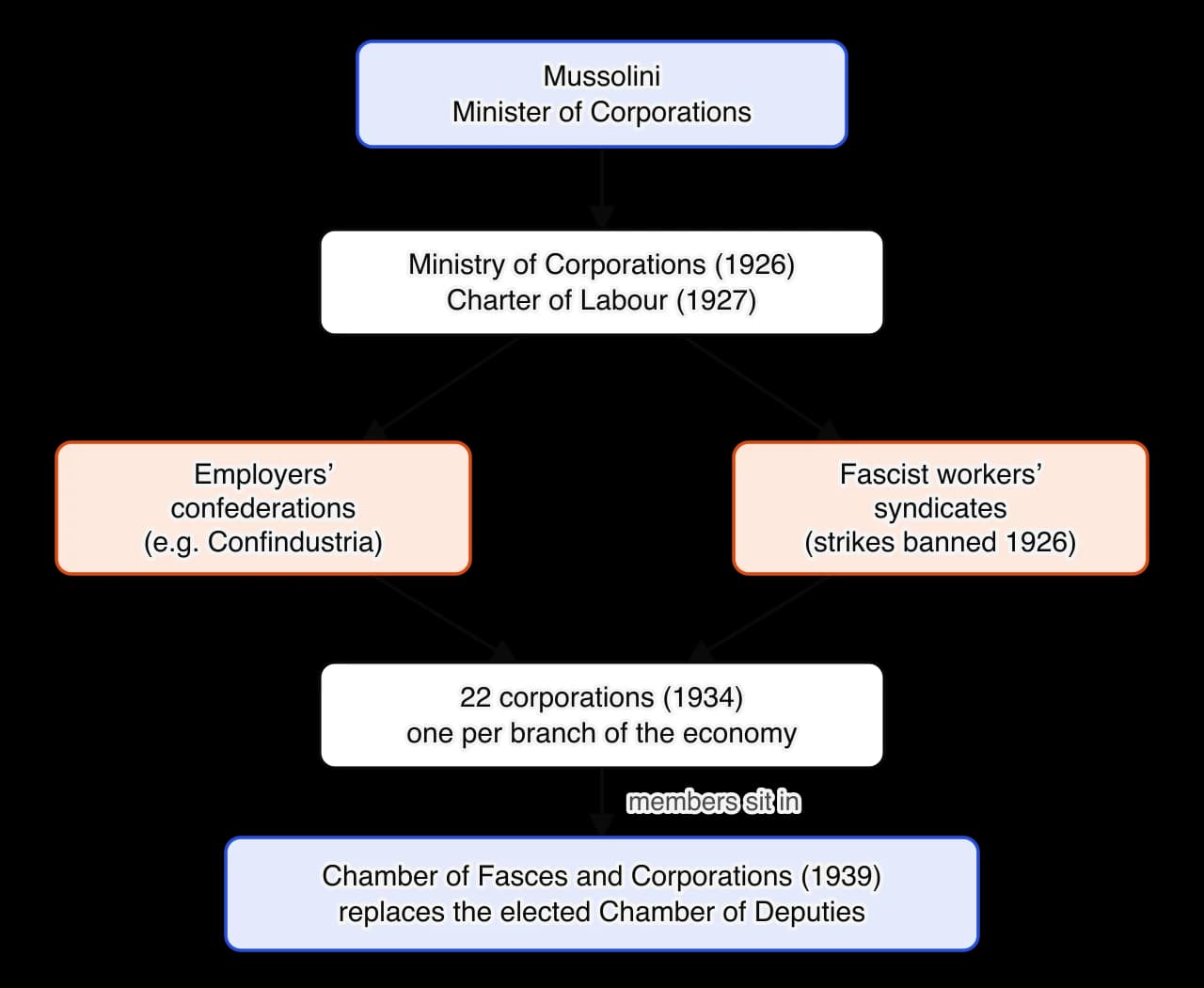
The Charter of Labour of April 1927 declared that labour was a social duty and that private enterprise was the most efficient way to serve the nation, with the state intervening only where private initiative failed. In 1928 the Fascist workers’ confederation, which under its leader Edmondo Rossoni had tried to defend wages, was broken into smaller federations. The 22 corporations created in 1934 met rarely and had little power, and the Chamber of Fasces and Corporations, which replaced the elected Chamber of Deputies in 1939, approved what the government decided.
The effects on living standards are debated. Real wages fell in the late 1920s and early 1930s, and Italians ate less meat and more bread and pasta than before. On the other hand, there was some growth in the late 1930s, welfare benefits and leisure organisations expanded, and the Depression in Italy was less severe than in Germany or the USA. The clearest winners were large industrialists and landowners; the clearest losers were southern peasants and industrial workers, who had lost their unions and their right to strike.
Policy | Aim | Results | Judgement |
|---|---|---|---|
Battle for Grain (1925) | Self-sufficiency in wheat; national prestige | Wheat output rose substantially; imports fell sharply | Success in its own terms, at the cost of other crops, livestock and dearer bread |
Battle for the Lira (1926–1927) | A strong currency as a symbol of national strength | Lira fixed at about 92 to the pound; exports and wages fell | Prestige bought at the cost of export industries and workers |
Battle for Land (from 1928) | Reclaim land for farming and settlement | Pontine Marshes drained; new towns founded | Impressive showpiece, much smaller in scale than promised |
IRI (1933) | Rescue banks and industry in the Depression | The state owned a large share of industry | Effective rescue; a lasting legacy in post-war Italy |
Autarky (from 1935) | Self-sufficiency for war | Substitutes and state direction of trade | Failed: Italy still depended on imported coal and oil |
Mussolini’s Italy: society, propaganda and repression
The Church and the Lateran Pacts
Mussolini, an atheist and once a fierce critic of the Church, understood that Catholicism was the strongest force in Italian life. After years of negotiation, the Lateran Pacts were signed on 11 February 1929. A treaty created the independent Vatican City and ended the "Roman question" that had divided Church and state since 1870; a concordat made Catholicism the state religion, made religious teaching compulsory in schools and gave Church marriages legal force; and a financial agreement compensated the papacy for the lands it had lost.
The pacts were Mussolini’s greatest domestic success. They won him the approval of Pope Pius XI, who called him a man sent by Providence, and of millions of Catholics. They also set a limit to Fascist control. The Church kept its own organisations, above all Catholic Action, with its youth groups. In 1931 the regime closed Catholic Action’s youth clubs, the Pope protested in the encyclical Non abbiamo bisogno, and a compromise allowed them to continue for religious purposes only. Relations worsened again over the racial laws of 1938.
Youth and education
Fascism claimed to be a movement of youth, and its official anthem was called Giovinezza ("Youth"). The Opera Nazionale Balilla (ONB, 1926) organised boys and girls from the age of eight in groups that combined sport, military drill and political teaching; in 1937 it was absorbed into the Italian Youth of the Lictor (GIL), run by the party. Membership was not formally compulsory for all, but by the late 1930s it was expected, especially in towns.
Schools were brought under control gradually. The education minister Giovanni Gentile’s reform of 1923 gave the state firm control of the curriculum and placed religious teaching at the centre of primary schooling, a step towards the Church. Teachers had to take an oath of loyalty, and from 1929 a single state textbook was used in elementary schools, praising the Duce and the regime. In 1931 university professors were required to swear loyalty to Fascism; only about a dozen of more than a thousand refused. The slogan "Believe, Obey, Fight" was taught alongside the claim that "Mussolini is always right". Yet the reach of education was limited: many children in the rural South left school early, and Catholic schools and Catholic Action offered an alternative world.
Workers, women and the "reform of custom"
Workers lost their independent unions in 1925–1926, but the regime tried to win them through leisure. The Opera Nazionale Dopolavoro (OND, "After Work", 1925) ran clubs, sports, excursions, theatres and cheap holidays, and became the most popular Fascist organisation, with millions of members by the late 1930s. Many joined for the benefits without becoming convinced Fascists.
Policies on women followed the regime’s concern with population. Mussolini believed that a great nation needed a growing population, and in 1927 he launched the Battle for Births with a target of 60 million Italians by 1950. Bachelors paid a special tax from 1927, mothers of large families received prizes, and contraception and abortion were punished. Laws of 1933 and 1938 limited the proportion of women employed in public offices and many private firms. The results were small: the birth rate kept falling through the 1930s, and women’s employment changed little because many families needed women’s wages.
From 1937–1938 the regime tried to make Italians more warlike and less "bourgeois". The reform of custom replaced the polite form of address Lei with voi, replaced the handshake with the Roman salute and introduced the goose-step into the army as the "Roman step". Many Italians found these measures absurd, and they show the limits of the regime’s ability to change everyday behaviour.
Race, empire and the racial laws of 1938
Fascist Italy practised racial violence in its colonies long before it adopted antisemitism at home. In Libya the "pacification" of Cyrenaica in 1929–1932 included the deportation of much of the population to camps, where tens of thousands died, and the hanging of the resistance leader Omar al-Mukhtar in 1931. In the invasion of Ethiopia (October 1935–May 1936) the army used poison gas, and after an attempt on the life of the viceroy, Rodolfo Graziani, in February 1937, Italian troops and Blackshirts killed thousands of civilians in Addis Ababa. Laws of 1937 banned marriage and sexual relations between Italians and Africans in the empire. Inside Italy’s borders, the Slovene and Croat minorities of Venezia Giulia, annexed in 1920, were subjected to forced Italianisation: their schools and newspapers were closed, their organisations banned and many surnames changed.
In July 1938 a group of scientists published the Manifesto of Race, which declared that Italians were an "Aryan" race and that Jews did not belong to it. The Italian racial laws followed between September and November 1938: Jewish children and teachers were expelled from state schools, Jews were dismissed from the civil service, the army, the party and many professions, marriages between Jews and "Aryan" Italians were banned, and foreign Jews were ordered to leave. Italy had only about 47,000 Jews, roughly one in a thousand of the population, and many had been loyal Fascists.
Historians disagree about why Mussolini introduced the laws. Some stress the influence of the alliance with Nazi Germany, which had grown closer since 1936; others, such as Michele Sarfatti, argue that they grew out of Fascism’s own racism, sharpened by the conquest of Ethiopia and Mussolini’s wish to harden Italians for war. The laws were unpopular with many Italians and condemned by the Pope, but they were enforced, and they prepared the way for the deportation of Italian Jews by the Germans after 1943.
Propaganda and the cult of the Duce
Mussolini was a former journalist who understood the press and new media. Newspapers were controlled through the press office of the head of government, which sent daily instructions on what to print, and from 1937 the Ministry of Popular Culture (MinCulPop) directed the press, radio, cinema, theatre and tourism. The Istituto LUCE (founded in 1924) produced newsreels that cinemas had to show before every film, and the state radio company, EIAR, broadcast the Duce’s speeches to loudspeakers in town squares. The Exhibition of the Fascist Revolution of 1932 presented the regime’s history as a heroic struggle.
At the centre stood the cult of il Duce ("the leader"). Mussolini was shown as a man of action and many talents: pilot, horseman, fencer, violinist, harvester, the tireless leader whose office light was left burning at night to show that he never slept. Slogans such as "Mussolini is always right" were painted on walls across Italy. The cult also drew on the memory of ancient Rome (romanità): the fasces, the salute, parades on the new roads through the Roman forum and, in May 1936, Mussolini’s proclamation of a new Roman empire after the capture of Addis Ababa.
Mussolini set out the regime’s view of the state in an article on "The Doctrine of Fascism", written with Gentile for the Italian Encyclopedia in 1932.
The foundation of Fascism is the conception of the State, its character, its duty, and its aim. Fascism conceives of the State as an absolute, in comparison with which all individuals or groups are relative, only to be conceived of in their relation to the State. … The Fascist State organizes the nation, but leaves a sufficient margin of liberty to the individual; the latter is deprived of all useless and possibly harmful freedom, but retains what is essential; the deciding power in this question cannot be the individual, but the State alone.
Benito Mussolini (with Giovanni Gentile), "The Doctrine of Fascism", Enciclopedia Italiana, 1932 (English translation in the Internet Modern History Sourcebook). Written ten years after the March on Rome for an official reference work, the text presents a coherent philosophy that Fascism had not had in 1922, so it shows how the regime wished to be understood more than how it had come to power. Its claim that the state decides which freedoms are "useless" is a definition of totalitarian ambition; whether the regime achieved it is another question.
Repression and resistance
Fascist repression was real but limited in scale compared with Germany and the USSR. The secret police, the OVRA (from 1927), used informers to watch opponents, and post and telephone calls were monitored. The Special Tribunal for the Defence of the State tried several thousand people between 1927 and 1943 and passed 42 death sentences, most of them during the Second World War. The usual punishment was prison or confino: between 12,000 and 15,000 people were sent into internal exile in remote villages of the South or on islands such as Lipari. The painter and writer Carlo Levi, exiled to Lucania in 1935–1936, described the poverty of the villages in Christ Stopped at Eboli (1945).
The organised opposition was destroyed inside Italy by 1926–1927. The Communist leader Antonio Gramsci was arrested in November 1926, sentenced to twenty years and died in 1937 soon after his release on health grounds; in prison he wrote the notebooks that made him one of the most influential Marxist thinkers of the century. The Communist Party kept small underground cells, and its members made up most of those sentenced by the Special Tribunal. Other opponents went into exile, mostly in France: the movement Giustizia e Libertà ("Justice and Liberty"), founded in Paris in 1929 by Carlo Rosselli, smuggled leaflets into Italy, until Rosselli and his brother Nello were murdered in France in June 1937 by French right-wing extremists working for the Italian secret services.
Most Italians neither resisted nor fully believed. Jokes about the regime, private grumbling about prices and the racial laws, and the avoidance of party activities were common. The police’s own reports on public opinion show growing discontent from 1938–1939, as the alliance with Germany and the threat of war became clear.
How totalitarian was Fascist Italy?
Mussolini described his state as totalitarian, but most historians argue that it remained an imperfect totalitarianism. The table weighs the evidence.
Area | Evidence of totalitarian control | Limits |
|---|---|---|
Political power | One-party state from 1926; elections replaced by plebiscites; Mussolini answerable only to the king | The king remained head of state and commander of the army, and dismissed Mussolini in July 1943 |
Repression | OVRA, Special Tribunal, confino; opposition destroyed inside Italy | Few executions; the regime relied on traditional police, prefects and courts |
Economy | State control of labour; IRI; autarky after 1935 | Private ownership and employers’ power remained; corporations were largely for show |
Religion | Lateran Pacts brought the Church into alliance with the regime | The Church kept its own schools, Catholic Action and moral authority |
Society and culture | Youth movements, Dopolavoro, propaganda, cult of the Duce, racial laws | Weak reach in the rural South; many joined organisations for benefits, not belief |
The balance of the table explains why Hannah Arendt excluded Fascist Italy from her study of totalitarianism, and why many historians describe it as an authoritarian regime with totalitarian ambitions. Mussolini had to share power with the monarchy, the Church, the army and big business, the forces that had brought him to power in 1922.
Weimar Germany: the challenges of 1918–1923
The Weimar Republic was born in defeat. In the autumn of 1918, with the German army in retreat on the Western Front, the High Command under Paul von Hindenburg and Erich Ludendorff told the Kaiser that the war was lost and asked for a new government that could seek an armistice. In early November a naval mutiny at Kiel spread into the November Revolution: workers’ and soldiers’ councils took over cities across Germany. On 9 November 1918 the Kaiser abdicated, a republic was proclaimed in Berlin, and the Social Democrat Friedrich Ebert became head of a provisional government. The armistice was signed on 11 November.
Revolution from the left and the Ebert–Groener pact
Ebert’s Social Democrats (SPD) wanted parliamentary democracy, not a Soviet-style revolution. On 10 November he agreed with General Wilhelm Groener, Ludendorff’s successor, that the army would support the government against the radical left, in return for the government leaving the officer corps alone. When the Spartacists, the new Communist Party (KPD) of Rosa Luxemburg and Karl Liebknecht, joined a rising in Berlin in January 1919, the government used the army and the Freikorps, volunteer units of nationalist ex-soldiers, to crush it. Luxemburg and Liebknecht were murdered by Freikorps officers on 15 January. A Soviet republic in Munich was destroyed in the same way in May 1919.
The pact saved the republic from the left at a lasting price. The old officer corps, the judges and the senior civil servants of the empire kept their posts, and many of them never accepted the republic. The bloodshed of 1919 also split the working-class movement: Communists never forgave the Social Democrats, and the division weakened the left until 1933.
The Weimar constitution
Elections to a National Assembly were held on 19 January 1919, with votes for all men and women over twenty. The three parties that supported the republic, the SPD, the Catholic Centre Party and the liberal German Democratic Party (DDP), won about three-quarters of the vote. The Assembly met in the small town of Weimar, away from the unrest in Berlin, and the new constitution came into force on 11 August 1919.
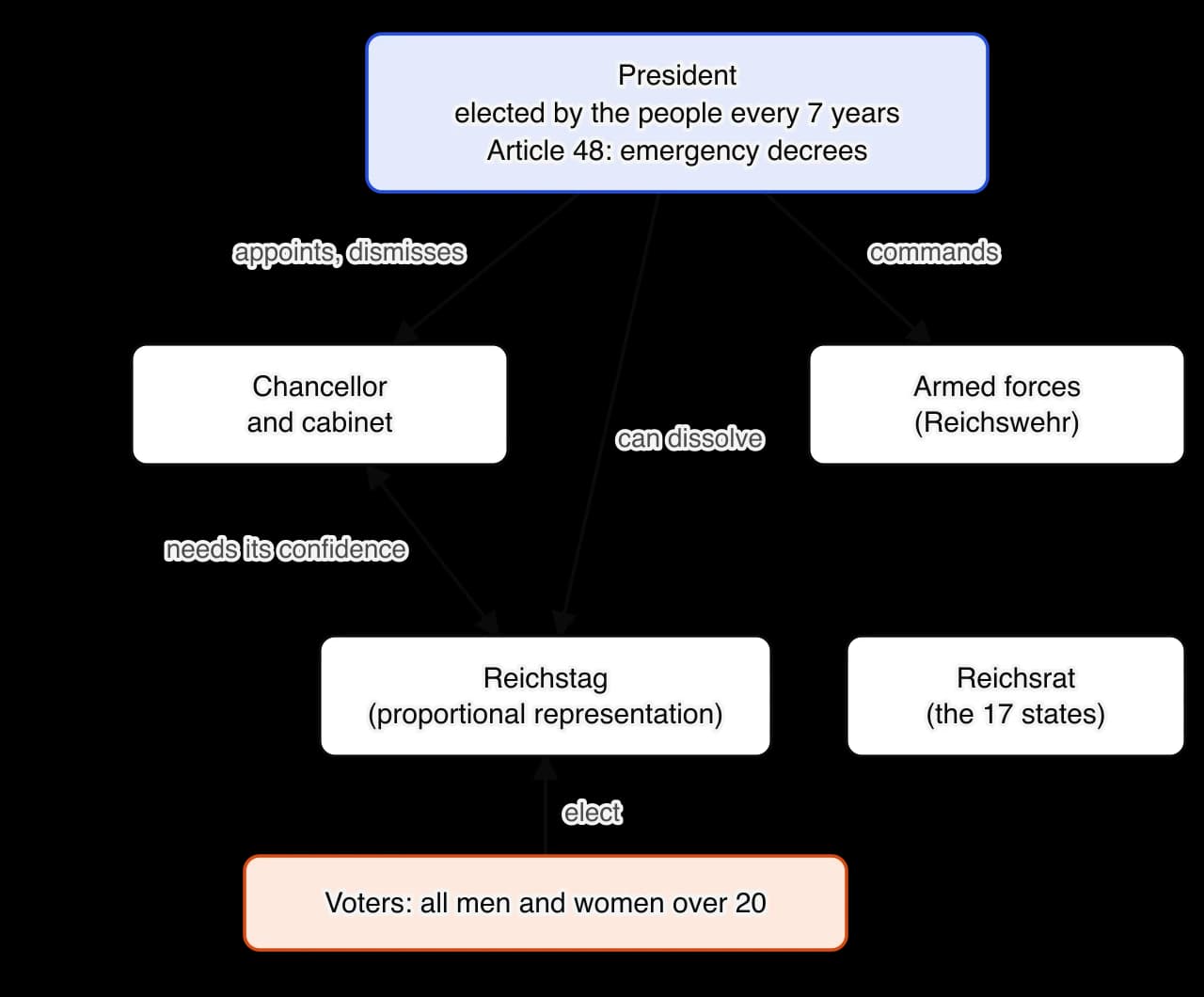
The diagram of the constitution shows a system with two sources of authority: the Reichstag, elected by proportional representation, and a president elected directly by the people. Proportional representation gave a fair share of seats to every party, but it allowed many parties into the Reichstag, so every government was a coalition; there were twenty cabinets between 1919 and 1933. Article 48 gave the president power to rule by decree in an emergency. Ebert used it more than a hundred times in 1919–1923, mostly to defend the republic. Hindenburg, elected president in 1925, later used it to govern without the Reichstag.
The Treaty of Versailles and the stab-in-the-back myth
The Treaty of Versailles, signed under protest on 28 June 1919, took about 13 per cent of Germany’s European territory, all its colonies, and most of its army and navy (the army was limited to 100,000 men), demilitarised the Rhineland and required Germany to pay reparations, fixed in 1921 at 132 billion gold marks. Article 231, the "war guilt" clause, became the most hated part. Almost all Germans saw the treaty as a Diktat, a dictated peace, and the republic’s politicians were blamed for signing it.
Many Germans could not understand the defeat, because German troops still stood on foreign soil in November 1918 and censorship had hidden the army’s collapse. The right offered an explanation: the army had been "stabbed in the back" by revolutionaries, socialists and Jews at home. In November 1919 Hindenburg gave it his authority before a parliamentary committee investigating the causes of the defeat.
The obedient troops who remained immune to revolutionary attrition suffered greatly from the behavior, in violation of duty, of their revolutionary comrades; they had to carry the battle the whole time. … Thus did our operations necessarily miscarry; the collapse was inevitable; the revolution only provided the keystone. … An English general said with justice: “The German army was stabbed in the back.”
Paul von Hindenburg, testimony before the parliamentary committee of inquiry, 18 November 1919 (translation from The Weimar Republic Sourcebook, 1994, in German History in Documents and Images). Hindenburg read a statement prepared with Ludendorff and the nationalist politician Karl Helfferich, so it was a defence of the High Command, which bore the real responsibility for the defeat, as much as testimony. The "English general" was never clearly identified. Coming from the most respected man in Germany, the claim turned a slander into an accepted explanation, and the stab-in-the-back myth became a weapon against the republic and the "November criminals" who had signed the armistice.
Threats from the right and political violence, 1920–1922
In March 1920 Freikorps units, angry at orders to disband them under the treaty, occupied Berlin in the Kapp Putsch, led by the nationalist official Wolfgang Kapp. The army commander, General Hans von Seeckt, refused to fire on them, and the government fled. The putsch collapsed after four days because of a general strike called by the unions and the refusal of civil servants to obey Kapp. Its leaders were treated leniently, while a Communist rising in the Ruhr that followed was crushed by the army and Freikorps with great brutality.
Political murder became common. The statistician Emil Julius Gumbel counted 376 political murders in 1919–1922, 354 of them by the right; right-wing killers usually received light sentences or none, while left-wing ones were punished severely. The victims included Matthias Erzberger, who had signed the armistice (August 1921), and the foreign minister Walther Rathenau, a Jew who had tried to fulfil the treaty (June 1922). The pattern showed how far the courts and police were from neutral.
The crisis of 1923: the Ruhr, hyperinflation and the Munich Putsch
Germany had financed the war by borrowing and printing money, and inflation continued after 1918 as governments printed money to pay for welfare, reconstruction and reparations. When Germany fell behind with deliveries of coal and timber, French and Belgian troops occupied the Ruhr, Germany’s industrial heartland, in January 1923. The government called on workers to resist passively by refusing to work and paid them for striking, which it could do only by printing still more money. The result was hyperinflation.
Date | Marks needed to buy one US dollar |
|---|---|
1914 | 4.2 |
End of 1918 | 7.9 |
Mid-1922 | 320 |
December 1922 | 7,400 |
November 1923 | 4,210,500,000,000 (4.2 trillion) |
Data: exchange rates of the German mark, 1914–1923, as given in standard economic histories. The table of exchange rates shows how money became worthless in 1923. Workers were paid twice a day and spent their wages at once, and prices in shops changed by the hour. Those with debts, including the state, large industrialists and mortgage holders, gained; those with savings, pensions or fixed incomes, especially the middle classes, lost almost everything. Many of them never forgave the republic.
In this crisis the republic faced threats from both sides. The Communists planned risings in Saxony, Thuringia and Hamburg in October 1923, and Bavaria was ruled by right-wing leaders who defied Berlin. On 8–9 November 1923 Hitler, the leader of the small Nazi Party in Munich, tried to use the Bavarian crisis to seize power in the Munich Putsch, with General Ludendorff at his side. The Bavarian police stopped the march with gunfire, killing sixteen Nazis. At his trial in early 1924 Hitler turned the courtroom into a platform, and the sympathetic judges gave him the minimum sentence of five years; he served about nine months in Landsberg prison, where he dictated Mein Kampf.
Why did the republic survive in 1919–1923?
The republic survived its first crises for several reasons. Its enemies were divided between left and right and never acted together. The army, whatever it thought of democracy, defended the state against the left and would not join the Kapp or Munich putsches. The unions and the working class defended the republic in March 1920. And in the autumn of 1923 a new government under Gustav Stresemann took decisive action: it ended passive resistance in September, and in November introduced a new currency, the Rentenmark, issued in strictly limited amounts. Inflation stopped almost at once.
The "Golden Era" under Stresemann, 1924–1929
Gustav Stresemann, the leader of the liberal German People’s Party (DVP), was chancellor for only a hundred days in 1923, but he remained foreign minister in every government until his death on 3 October 1929. A former monarchist and nationalist, he had become a "republican by reason" who believed that Germany could revise the Treaty of Versailles only by cooperating with the Western powers.
Stabilisation and foreign policy
The Dawes Plan of 1924, drawn up by a committee led by the American banker Charles Dawes, did not reduce the total of reparations but set payments that rose gradually with Germany’s ability to pay, and arranged a loan of 800 million gold marks, mostly from the United States. French and Belgian troops left the Ruhr in 1925. In the Locarno Treaties of October 1925 Germany accepted its western borders with France and Belgium, and in September 1926 it joined the League of Nations with a permanent seat on its Council. Germany signed the Kellogg–Briand Pact, renouncing war, in 1928. The Young Plan of 1929 reduced reparations and spread the payments until 1988, and the Allies agreed to leave the Rhineland by 1930, five years early.
Economy, society and culture
American loans poured into Germany, and industrial production regained its pre-war level by 1928. Cities built new housing estates, schools and swimming pools, and the welfare state expanded: unemployment insurance was introduced in 1927. Weimar culture flourished. The Bauhaus school of design, the theatre of Bertolt Brecht, the films of Fritz Lang and the cabarets of Berlin made Germany a centre of modern art, though conservatives saw the same culture as decadent and un-German.
Area | Achievements | Weaknesses |
|---|---|---|
Economy | Rentenmark and Reichsmark ended inflation; Dawes Plan; production back to 1913 level by 1928 | Recovery depended on short-term American loans; farm prices fell from 1927; unemployment over a million even in good years |
Politics | No attempted coups; support for the extreme parties fell (Nazis 2.6% in May 1928); the SPD back in government in 1928 | Coalitions remained short-lived; the Centre and DVP moved right; Hindenburg, a monarchist field marshal, elected president in 1925 |
Foreign policy | Locarno, League membership, Young Plan, early end to the Rhineland occupation | Nationalists attacked every agreement as acceptance of Versailles; the eastern borders were never accepted |
Society and culture | Welfare state and unemployment insurance; housing; artistic achievement | Middle classes had lost their savings in 1923; conservatives and rural Germans hated the new culture |
The table shows why historians argue about the label "Golden Era". In foreign policy and in the stabilisation of the currency the years 1924–1929 were a real recovery. But the prosperity rested on foreign loans that could be withdrawn at any moment, and the republic’s political weaknesses had not gone away. The election of Hindenburg in 1925 showed that many Germans still looked back to the empire, and the campaign of 1929 against the Young Plan, in which the press owner Alfred Hugenberg’s German National People’s Party (DNVP) joined with Hitler, gave the Nazis money, publicity and respectability just before the Depression began.
The Nazi Party before the Depression, 1919–1929
Adolf Hitler was born in Austria in 1889, failed to become an artist in Vienna, and served as a soldier in the German army throughout the First World War. In September 1919, working as an army informer in Munich, he joined the small German Workers’ Party. His talent as a speaker quickly made him its leading figure. In February 1920 the party, renamed the National Socialist German Workers’ Party (NSDAP), announced a programme of 25 points.
1. We demand the union of all Germans in a Great Germany on the basis of the principle of self-determination of all peoples. 2. We demand that the German people have rights equal to those of other nations; and that the Peace Treaties of Versailles and St. Germain shall be abrogated. 3. We demand land and territory (colonies) for the maintenance of our people and the settlement of our surplus population. 4. Only those who are our fellow countrymen can become citizens. Only those who have German blood, regardless of creed, can be our countrymen. Hence no Jew can be a countryman.
Programme of the National Socialist German Workers’ Party, 24 February 1920 (English translation in the Avalon Project, Yale Law School). The programme was written for a small Munich party competing for nationalist ex-soldiers and the lower middle class, and its later points promised to nationalise trusts and share profits, which the Nazis quietly dropped when they sought the support of business. Its first four points, however, stayed at the core of Nazism: the overthrow of Versailles, territorial expansion and the exclusion of Jews from the nation, which the Reich Citizenship Law of 1935 later put into effect.
In July 1921 Hitler became the party’s leader with almost unlimited powers, the first form of the Führerprinzip (leader principle). The party built up its stormtroopers, the SA, to protect its meetings and fight its opponents. After the failure of the Munich Putsch, Hitler refounded the party in February 1925 and committed it to winning power through elections, although the SA and the party’s contempt for democracy remained. In the relatively stable years the party built a national organisation of regional leaders (Gauleiter) and groups for youth, women, students and professions, but in May 1928 it won only 2.6 per cent of the vote and twelve seats.
The Great Depression and the years of crisis, 1929–1933
The economic collapse
The Wall Street Crash of October 1929 hit Germany harder than any other European country, because its recovery had depended on American short-term loans, which were now recalled. Banks failed (the Darmstädter und Nationalbank collapsed in July 1931), firms closed, and exports fell as world trade shrank. By early 1932 about six million Germans were registered as unemployed, about a third of the workforce, and many more were on short time. Farmers, already hit by falling prices, faced debt and foreclosure.
The collapse of parliamentary government
The political crisis came first. In March 1930 the "grand coalition" led by the Social Democrat Hermann Müller collapsed when the SPD and the DVP could not agree how to pay for unemployment insurance. Hindenburg and his advisers, especially the political general Kurt von Schleicher, had already planned to replace parliamentary government with a cabinet that would rule with the president’s backing. They appointed Heinrich Brüning of the Centre Party as chancellor of the first presidential cabinet. When the Reichstag rejected his budget in July 1930, Brüning passed it by Article 48 decree and then dissolved the Reichstag.
The election of September 1930 was a disaster for this strategy. The Nazis rose from 12 to 107 seats and the Communists from 54 to 77. Brüning now governed by decree, tolerated by the SPD, which feared something worse. His policy of deflation, cutting wages, salaries, unemployment benefits and public spending to balance the budget and to show that Germany could not pay reparations, deepened the slump and earned him the name of "hunger chancellor". In 1930 the Reichstag passed 98 laws and the president issued 5 emergency decrees; in 1932 the Reichstag passed 5 laws and the president issued 66 decrees.
Party | May 1928 | Sep 1930 | Jul 1932 | Nov 1932 | Mar 1933 |
|---|---|---|---|---|---|
Nazi Party (NSDAP) | 2.6% (12) | 18.3% (107) | 37.3% (230) | 33.1% (196) | 43.9% (288) |
German National People’s Party (DNVP) | 14.3% (73) | 7.0% (41) | 5.9% (37) | 8.3% (51) | 8.0% (52) |
Centre Party | 12.1% (61) | 11.8% (68) | 12.4% (75) | 11.9% (70) | 11.3% (73) |
Social Democratic Party (SPD) | 29.8% (153) | 24.5% (143) | 21.6% (133) | 20.4% (121) | 18.3% (120) |
Communist Party (KPD) | 10.6% (54) | 13.1% (77) | 14.3% (89) | 16.9% (100) | 12.3% (81) |
Data: official Reichstag election results (share of the vote, with seats in brackets). The table of elections shows the main parties side by side. The Centre Party’s Catholic vote barely moved, and the SPD lost slowly; the Nazis grew above all at the expense of the DNVP and the liberal and regional parties of the Protestant middle classes, which almost disappeared, and from new and previous non-voters. From July 1932 the Nazis and Communists together held a majority of seats, so no government could win a majority in the Reichstag without one of the two parties that wanted to destroy it.
The left was divided. Following orders from Moscow, the KPD attacked the SPD as social fascists and in 1931 even joined the Nazis in a referendum to remove the SPD-led government of Prussia. The SPD, for its part, stayed loyal to legality and would not risk civil war. Nazi and Communist street fighters fought battles across German cities; in the summer of 1932 the violence killed dozens of people a week.
Why did so many Germans vote for the Nazis?
Research on voting by historians such as Thomas Childers and Jürgen Falter shows that Nazi voters came from every class and region, but some groups supported the party much more than others. Protestants were far more likely than Catholics to vote Nazi; voters in small towns and the countryside more than those in big cities; the self-employed, farmers, civil servants and white-collar workers more than industrial workers, although about a quarter to a third of Nazi voters were workers, many of them outside the unions. Young people and first-time voters were drawn to a movement that seemed energetic and new.
Several reasons combined. The Nazis offered a promise of national unity, the Volksgemeinschaft, to a society divided by class and religion, and blamed Germany’s suffering on Versailles, the "November criminals", Marxists and Jews. They promised work and bread without saying how. Their propaganda, organised by Joseph Goebbels from 1930, targeted each social group with its own message, and Hitler’s speaking tours, by aeroplane in 1932, made him the best-known politician in Germany. The SA, with about 400,000 members in 1932, gave an impression of discipline and strength. And fear of communism, as the KPD vote rose with unemployment, drove middle-class voters to the party that seemed most determined to destroy it.
From Brüning to Hitler, 1932–1933
In the presidential election of March–April 1932 Hindenburg, now 84, was re-elected with the support of the SPD and the Centre against Hitler, who won 36.8 per cent in the second round. Hindenburg did not thank Brüning for his re-election, and when Brüning banned the SA and SS in April and proposed to settle bankrupt estates in the east with peasants, the landowners and the army turned against him. On 30 May 1932 Hindenburg dismissed him.
The next chancellor, Franz von Papen, led a "cabinet of barons" with almost no support in the Reichstag. He lifted the ban on the SA, and on 20 July 1932 removed the SPD government of Prussia by decree, which destroyed one of the last strongholds of the republic without resistance. After the July election made the Nazis the largest party, Hitler demanded the chancellorship; Hindenburg refused, offering him only the post of vice-chancellor. Papen lost a vote of no confidence by 512 votes to 42 in September and called another election. In November the Nazis lost two million votes, and in December Schleicher replaced Papen as chancellor.
Schleicher tried to build support by splitting the Nazis, offering office to Gregor Strasser, the head of the party’s organisation, and by approaching the unions. Both failed, and his plans alarmed landowners and industrialists. Meanwhile Papen, resentful at being pushed aside, negotiated with Hitler. On 28 January 1933 Schleicher resigned after Hindenburg refused him a dissolution of the Reichstag, and on 30 January Hindenburg appointed Hitler chancellor, with Papen as vice-chancellor and only two other Nazis, Wilhelm Frick and Hermann Göring, in a cabinet of eleven. Papen boasted that within two months they would have pushed Hitler into a corner.
Hitler’s consolidation of power, 1933–1934
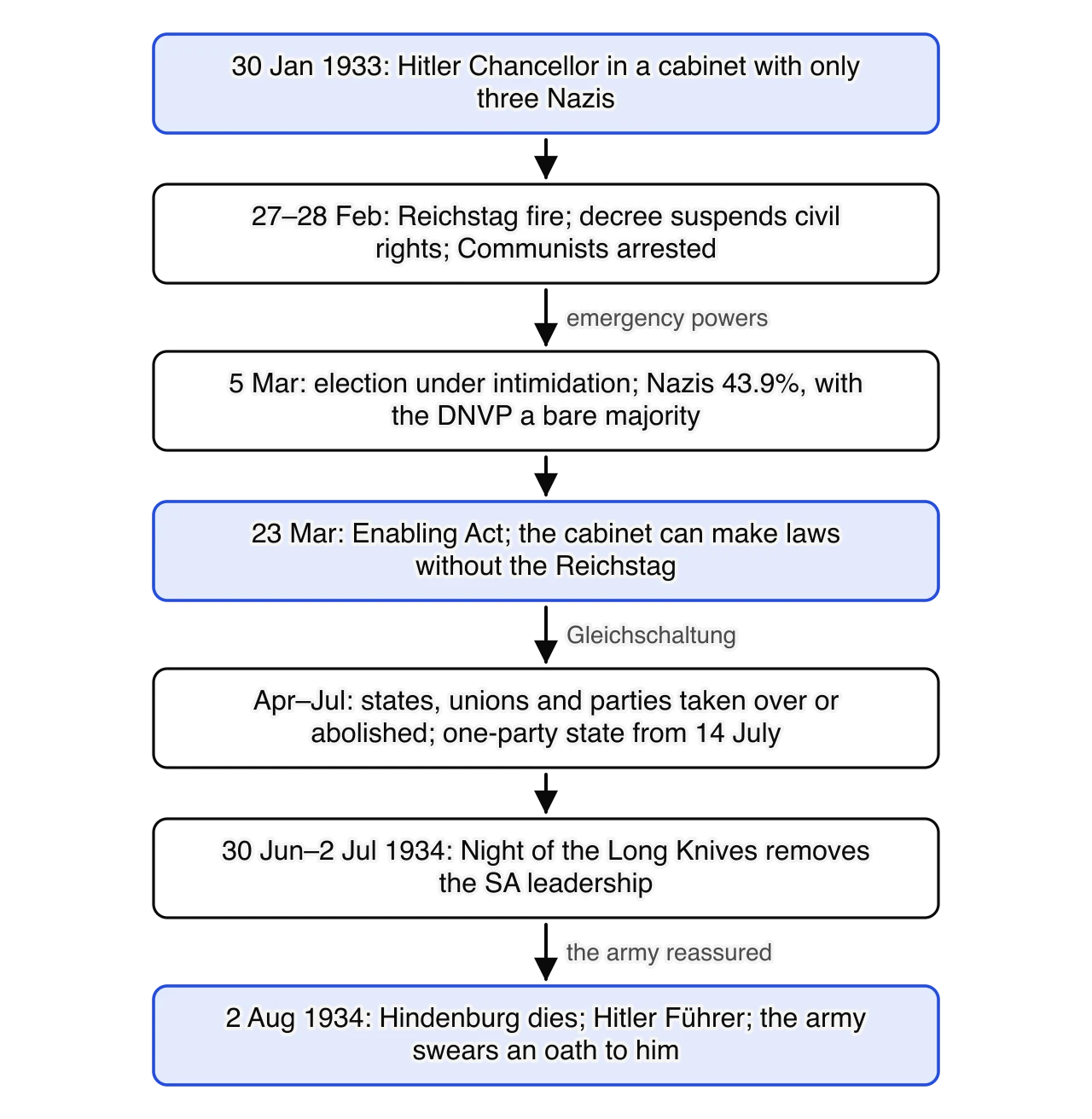
Hitler turned his appointment into a dictatorship in eighteen months. The chain of consolidation shows how each step built on the one before.
The Reichstag fire and the March election
On the night of 27 February 1933 the Reichstag building was set on fire. A young Dutch former Communist, Marinus van der Lubbe, was arrested inside and confessed. The Nazis claimed the fire was the signal for a Communist rising, and the next day Hindenburg signed the Decree for the Protection of People and State. It suspended the rights of free speech, assembly and the press, and the privacy of post and telephone, and allowed the government to take over the states; it was never lifted while the regime lasted. Thousands of Communists and other opponents were arrested in the following weeks, many of them held by the SA in improvised camps.
Who started the fire is still debated. Fritz Tobias argued in 1962 that van der Lubbe acted alone, and many historians, including Hans Mommsen, accepted this; Benjamin Carter Hett (Burning the Reichstag, 2014) has argued that the evidence points to Nazi involvement. What is not disputed is how the Nazis used the fire: within a day they had the legal basis for a police state.
In the election of 5 March 1933, held amid SA violence, arrests and Nazi control of the radio, the Nazis won 43.9 per cent. Only with their nationalist allies of the DNVP did they have a bare majority. On 21 March, the "Day of Potsdam", the new Reichstag was opened in the garrison church of Potsdam, where Hitler bowed to Hindenburg in a ceremony designed to link the new regime with the Prussian monarchy and army.
The Enabling Act and Gleichschaltung
The Enabling Act of 23 March 1933 allowed the cabinet to make laws for four years without the Reichstag, even laws that departed from the constitution. As a change to the constitution it needed a two-thirds majority. The 81 Communist deputies were in prison or hiding, and the Catholic Centre Party voted for the act after Hitler promised to respect the rights of the Church; SA and SS men filled the corridors of the Kroll Opera House, where the Reichstag now met. The act passed by 444 votes to 94, with only the Social Democrats voting against.
The process that followed, Gleichschaltung ("coordination"), brought German institutions under Nazi control:
The states (Länder) were taken over by Nazi-led governments in March 1933 and placed under Reich governors in April; their parliaments were abolished in January 1934.
On 2 May 1933, the day after a state-sponsored May Day celebration, the SA occupied trade union offices; the unions were replaced by the German Labour Front (DAF) under Robert Ley.
The KPD was already suppressed; the SPD was banned in June 1933, the other parties dissolved themselves, and the Law against the Formation of New Parties of 14 July 1933 made the NSDAP the only legal party.
Jews and political opponents were removed from the civil service by the Law for the Restoration of the Professional Civil Service of 7 April 1933.
Professional associations, clubs, youth groups and the press were taken over or closed.
Gleichschaltung was not only imposed from above. Many organisations, from sports clubs to universities, coordinated themselves, expelling Jewish members and electing Nazi leaders before they were told to. Some Germans joined the party in such numbers in the spring of 1933 that old members called them the "March casualties". The Concordat with the Vatican of 20 July 1933, which promised to protect the Catholic Church in return for the withdrawal of the clergy from politics, and Germany’s withdrawal from the League of Nations in October 1933, approved by 95 per cent in a plebiscite, added to the regime’s prestige.
The Night of the Long Knives and the army oath
By 1934 the main threat to Hitler came from inside his own movement and from the army. The SA, now about three million strong, wanted a "second revolution" against the old elites, and its leader Ernst Röhm wanted to merge the army into a people’s militia under his command. The army leaders, whose support Hitler needed for rearmament and to succeed the dying Hindenburg, demanded that the SA be curbed. Conservatives around Papen also hoped to restrain the regime: on 17 June 1934 Papen gave a speech at Marburg, written by his adviser Edgar Jung, that criticised the regime’s terror.
On 30 June 1934 Hitler struck at both. In the Night of the Long Knives (30 June–2 July), SS units arrested and shot Röhm and the SA leadership, and used the occasion to murder other enemies: General von Schleicher and his wife, Gregor Strasser, Edgar Jung, the Catholic leader Erich Klausener and Gustav von Kahr, who had crushed the Munich Putsch. The regime admitted to fewer than eighty deaths; historians’ estimates range from about 85 to about 200. A law of 3 July declared the killings legal as "self-defence of the state", and on 13 July Hitler told the Reichstag that in that hour he had been responsible for the fate of the German nation and had therefore acted as its supreme judge.
The army thanked Hitler for removing its rival. When Hindenburg died on 2 August 1934, the offices of president and chancellor were merged, and Hitler became Führer and Reich Chancellor. On the same day, on the initiative of the defence minister Werner von Blomberg, every soldier swore a new oath, later fixed in law.
I swear by God this sacred oath, that I will render unconditional obedience to Adolf Hitler, the Fuehrer of the German Reich and people, supreme commander of the armed forces, and will be ready as a brave soldier to risk my life at any time for this oath.
Oath of the soldiers of the armed forces, Law on the Oath of Officials and of Soldiers of the Armed Forces, 20 August 1934 (translation from Nazi Conspiracy and Aggression, 1946, document 2061-PS, Avalon Project). The oath was sworn to Hitler as a person, not to the constitution or the state as the Weimar oath had been, and it was the army leaders who proposed it, hoping to bind Hitler to the army. As a source it shows how the old elite tied itself to the dictator: in the plots of 1938–1944, many officers who opposed Hitler felt unable to break their oath.
A plebiscite on 19 August 1934 approved the merger of the offices with about 90 per cent of the vote. Hitler’s consolidation was complete: no institution in Germany could now legally remove him.
Hitler’s Germany: economic policies, 1933–1939
Hitler had two economic priorities: to end mass unemployment, which would secure the regime’s popularity, and to rearm Germany for the war of expansion he intended. He left the details to others. The result was a mixed economy in which private firms kept ownership and profits, but the state controlled wages, prices, trade, investment and raw materials, and directed production towards war.
Recovery and Schacht’s New Plan, 1933–1936
The regime built on job-creation schemes begun by Papen and Schleicher. The Reinhardt Programme of June 1933 funded public works, housing repairs and the new motorways (Autobahnen). Young men were drafted into the Reich Labour Service, compulsory from 1935, and conscription to the army was reintroduced in March 1935. Married women were encouraged to leave paid work with marriage loans. Registered unemployment fell from about six million in early 1933 to under 0.5 million by 1938, helped by the world recovery and by statistics that left out people in the Labour Service and many women.
Hjalmar Schacht, a banker who had helped end the inflation of 1923, became president of the Reichsbank in March 1933 and minister of economics in August 1934. He found ways to pay for rearmament without open inflation or a visible budget deficit. Mefo bills, credit notes issued by a dummy company and accepted by the Reichsbank, paid arms manufacturers secretly; about 12 billion marks of them were issued between 1934 and 1938. Schacht’s New Plan of September 1934 controlled imports to save foreign currency for raw materials, and arranged bilateral trade agreements, especially with countries in south-eastern Europe and Latin America, which were paid in German goods or in marks that could only be spent in Germany.
Göring’s Four-Year Plan, 1936–1939
By 1936 the economy faced a choice. Rearmament and the recovery had increased imports of raw materials and food, and Germany was running out of foreign currency. Schacht wanted to slow rearmament and increase exports. Hitler refused. In a secret memorandum of August 1936 he demanded that the army be ready for war and the economy fit for war within four years. In October 1936 Hermann Göring was put in charge of the Four-Year Plan, which aimed at autarky in strategic materials: synthetic oil and rubber from coal (produced largely by the chemical giant IG Farben), the use of low-grade German iron ore in the state-owned Reichswerke Hermann Göring (1937), and controls on prices, wages and labour.
Schacht, sidelined, resigned as minister of economics in November 1937 and was dismissed from the Reichsbank in January 1939. The plan missed most of its targets: in 1939 Germany still imported about a third of its raw materials, and synthetic oil met only a fraction of its needs. But military spending had risen more than tenfold since 1933, and Germany had the largest air force in Europe.
Schacht and the New Plan (1934–1937) | Göring and the Four-Year Plan (1936–1939) | |
|---|---|---|
Aim | Recovery and rearmament within the limits of foreign trade and a sound currency | Readiness for war by 1940 whatever the cost |
Methods | Mefo bills; import controls; bilateral trade agreements; deals with big business | Autarky: synthetic oil and rubber; state steelworks; controls on prices, wages, labour and investment |
Who gained | Heavy industry and arms firms; the unemployed who found work | Chemical and arms industries (IG Farben); party agencies; Göring’s own empire |
Problems | Shortage of foreign currency by 1936; rearmament limited | Targets missed; labour shortages; shortages of consumer goods and fats |
Workers, farmers and living standards
The fall in unemployment was the regime’s most popular achievement, but the price was high. Wages were frozen at their Depression level while working hours lengthened, so the average worker’s real earnings regained the level of 1928 only through longer hours; independent unions and the right to strike had gone. Food was dearer and of poorer quality, with shortages of fats and coffee by 1936; Göring’s phrase "guns or butter" summed up the choice. Farmers were organised in the Reich Food Estate (1933), and the Reich Entailed Farm Law of 1933 protected medium-sized farms from debt and sale; but controlled prices and the flight of young people to better-paid factory jobs left many farmers disappointed.
The historian Tim Mason argued in the 1970s that by 1938–1939 rearmament had produced an economic crisis of labour shortages, inflation and working-class discontent, which pushed Hitler towards war in 1939. Richard Overy replied that the economy was not in crisis and was being prepared for a major war around 1942–1943, so the war of 1939 came too early for it. Adam Tooze (The Wages of Destruction, 2006) stresses that rearmament was pursued at a pace and scale no peacetime economy had attempted, constrained above all by the shortage of foreign currency, and that the regime always intended war.
Hitler’s Germany: the Volksgemeinschaft and the racial state
The Nazis aimed to replace the divisions of class, religion and region with a Volksgemeinschaft, a people’s community united by race and loyalty to the Führer. Inclusion and exclusion were two sides of the same aim: "Aryan" Germans who conformed were offered work, leisure and status, while those defined as racially or socially alien were excluded, persecuted and, from 1939, murdered.
Workers and leisure
The German Labour Front (DAF), with more than 20 million members, replaced the unions. Its leisure organisation Strength through Joy (Kraft durch Freude, KdF, 1933) offered cheap theatre tickets, sports, hiking and holidays, including cruises to Norway and Madeira, and its office Beauty of Labour encouraged employers to improve canteens and washrooms. The Volkswagen ("people’s car") scheme invited workers to save five marks a week for a car; about 336,000 people paid in, but the factory was turned over to war production and no saver received a car. These schemes gave many workers a sense of rising status even when their wages did not rise.
Youth and education
The Hitler Youth and its girls’ branch, the League of German Girls (BDM), grew from about 100,000 members at the start of 1933 to several million by 1936, as other youth groups were banned or absorbed. A law of December 1936 made the Hitler Youth the official youth organisation of the state, and membership became compulsory in 1939. Schools taught "race science" and a nationalist history, teachers had to join the Nazi Teachers’ League, and elite boarding schools (Napolas and Adolf Hitler Schools) trained future leaders. Many young people enjoyed the camps, sport and sense of importance; others resented the drill and the loss of time for family and church, and by the late 1930s some formed groups such as the Edelweiss Pirates that rejected the Hitler Youth, and urban teenagers of the “Swing Youth” in cities such as Hamburg listened to banned jazz.
Women
The ideal for "Aryan" women was motherhood, summed up in the slogan Kinder, Küche, Kirche (children, kitchen, church). Marriage loans (1933), child allowances and the Mother’s Cross (from December 1938) rewarded large families, and women were pushed out of senior posts in the civil service, law and medicine. The SS also set up the Lebensborn association (1935), which ran maternity homes to raise the number of children born to “racially valuable” parents. Women were also excluded: those judged "hereditarily ill" or "asocial" were sterilised, and Jewish women lost everything. In practice the needs of rearmament pulled women back into work: the number of women in employment rose in the late 1930s. How these policies shaped women’s lives is explored as a theme in its own right in the study of how authoritarian rule affected people’s lives.
The churches
The regime tried to control the Protestant churches by creating a single Reich Church under a Nazi-supporting Reich Bishop, Ludwig Müller (1933), backed by the "German Christians", who wanted a Nazified Christianity without its Jewish roots. Many pastors refused. Led by Martin Niemöller, they formed the Pastors’ Emergency League and in May 1934 the Confessing Church, whose Barmen Declaration rejected state control of the Church’s teaching. Niemöller was arrested in 1937 and held in concentration camps until 1945. The Catholic Church, protected on paper by the Concordat of July 1933, saw its youth groups, schools and press closed one by one. In March 1937 Pope Pius XI’s encyclical Mit brennender Sorge ("With burning concern"), smuggled into Germany and read from Catholic pulpits, condemned the breaches of the Concordat and the worship of race and state. Both churches protested mainly when their own institutions were attacked; few clergy spoke out publicly against the persecution of the Jews before 1939.
The racial state
Racial policy aimed to "purify" the German people. It had two strands: the persecution of Jews, Roma and Black Germans as racial enemies, and the "racial hygiene" or eugenics that targeted Germans judged hereditarily unfit.
Exclusion, 1933–1934. A national boycott of Jewish shops (1 April 1933) and the Civil Service Law (7 April) began the removal of Jews from public life. The Law for the Prevention of Hereditarily Diseased Offspring (July 1933) ordered the compulsory sterilisation of people with conditions such as schizophrenia, epilepsy, "hereditary feeble-mindedness" and severe alcoholism; about 400,000 people were sterilised by 1945.
Legal separation, 1935. The Nuremberg Laws of September 1935 took citizenship from German Jews and banned marriage and sexual relations between Jews and "Germans", and the categories were extended to Roma and Black Germans. In 1937 about 400 children of German mothers and African soldiers of the French occupation of the Rhineland were secretly sterilised.
Expropriation and violence, 1938. Jewish businesses were forced into "Aryan" hands at low prices. In the pogrom of 9–10 November 1938 (Kristallnacht), synagogues were burned across Germany and Austria, about 90 Jews were killed and about 30,000 Jewish men sent to concentration camps; the Jewish community was then fined one billion marks.
Murder, from 1939. In October 1939 Hitler authorised, backdated to 1 September, the killing of disabled patients in the programme known as Aktion T4, the first mass murder of the regime.
Roma were persecuted under a decree by Himmler of December 1938 "for combating the Gypsy plague"; homosexual men were persecuted under a sharpened Paragraph 175 of the criminal code (1935); and "asocials", such as the homeless, beggars and the "work-shy", were sent to camps in large police raids in 1938. Of about 500,000 Jews in Germany in 1933, more than half had emigrated by the outbreak of war, leaving behind most of their property.
Hitler’s Germany: propaganda, terror and resistance
Propaganda and the Hitler myth
The Reich Ministry of Public Enlightenment and Propaganda was created in March 1933 under Joseph Goebbels. Through the Reich Chamber of Culture (September 1933), every writer, journalist, musician, artist and film-maker had to be a member to work, which excluded Jews and opponents. The Editors’ Law of October 1933 made editors responsible to the state. Cheap radio sets, the Volksempfänger ("people’s receiver"), brought Hitler’s speeches into most homes, and loudspeakers carried them into factories and streets. Books by Jewish, Marxist and liberal authors were burned by students on 10 May 1933.
Propaganda used spectacle. Leni Riefenstahl’s film Triumph of the Will (1935) presented the Nuremberg rally of 1934 as the union of leader and people; the Berlin Olympics of August 1936 showed foreigners a modern, orderly Germany, with antisemitic signs removed for the occasion; and the Degenerate Art exhibition of 1937 mocked modern art as the product of Jews and Bolsheviks. Goebbels’ ministry was careful to avoid open propaganda in entertainment: most films were comedies and romances, because Goebbels believed propaganda worked best when people did not notice it.
At the centre was the cult of the Führer. Ian Kershaw, in The "Hitler Myth" (1987), shows from reports of public opinion that Hitler himself was far more popular than the party or the regime. Germans who grumbled about corrupt local officials, food prices or attacks on the churches often believed that "if only the Führer knew" things would be put right, and his foreign policy successes (the Saar, rearmament, the Rhineland, Austria, the Sudetenland) won near-universal applause. The Hitler myth, Kershaw argues, was the main integrating force of the regime.
The SS police state
The instruments of terror developed rapidly. The Gestapo (secret state police) was founded in Prussia in April 1933; Heinrich Himmler, leader of the SS, took control of the political police in every German state by 1934 and became chief of all German police in June 1936. The first concentration camp run by the SS opened at Dachau, near Munich, in March 1933, and its model of discipline and punishment was copied in all later camps. Opponents could be held in "protective custody" without trial. A special People’s Court for treason cases was set up in 1934.
The scale of terror changed over time. In 1933 tens of thousands of Communists and Social Democrats were held in camps and SA cellars, and hundreds were killed. As the left was destroyed, numbers in the camps fell to a few thousand by 1935, then rose again from 1937–1938 as the police targeted "asocials", habitual criminals, Jehovah’s Witnesses, homosexuals and, after Kristallnacht, Jews. Most Germans who conformed had little contact with the Gestapo, which was small and relied heavily on information volunteered by ordinary people.
Opposition, dissent and conformity
Organised resistance to the regime before 1939 came from several directions, but none was able to threaten it:
The KPD kept underground cells and distributed leaflets, but its members were arrested in tens of thousands and its networks were repeatedly broken by the Gestapo.
The SPD leadership went into exile in Prague (Sopade), and gathered reports on the mood in Germany from underground members.
In the churches, the Confessing Church and Catholic bishops defended their institutions; the Jehovah’s Witnesses refused the Hitler salute and military service, and thousands were imprisoned.
Among the elites, General Ludwig Beck, chief of the army general staff, resigned in August 1938 over Hitler’s plans for war, and a group of officers around Hans Oster planned to arrest Hitler if he invaded Czechoslovakia; the Munich Agreement of September 1938 removed their chance.
Individuals acted alone: the carpenter Georg Elser’s bomb in a Munich beer hall on 8 November 1939 missed Hitler by minutes.
Much more common was dissent short of resistance: grumbling, jokes, avoiding the Hitler salute, listening to foreign radio, staying away from party events. Martin Broszat called this Resistenz, the limited non-conformity that shows the regime’s control was never complete. The reports of the exiled SPD captured this mood.
Among industrial workers there are many who do not give a damn about the successes of the Hitler system and have only scorn and contempt for the whole show. Others, however, say: “Well, there are a lot of things Adolf does not himself know about and which he does not want.” … They often complain about the fact that they earn much less now than in say 1929 but, at the end of the day, they always say: “It’s all the same to us; at least we have work.”
Report from central Germany, September 1938, in Deutschland-Berichte of the Social Democratic Party in exile (Sopade), vol. 5 (translation from J. Noakes and G. Pridham, Nazism 1919–1945, vol. 2, in German History in Documents and Images). The reports came from underground Social Democrats and were written for a party that wanted to find opposition, so they may exaggerate discontent; but because the authors wanted accurate information to plan their strategy, they also recorded support and indifference honestly. This extract shows both the limits of Nazi propaganda among workers and why discontent did not become resistance: jobs, fear and the Hitler myth kept it private.
A polycratic state
Behind the image of a disciplined, all-powerful state, the Nazi system of government was confused. Hitler disliked routine work, rarely held cabinet meetings (the cabinet last met in February 1938) and preferred to give tasks to trusted individuals. State ministries, party offices, the SS and new special agencies such as the Four-Year Plan competed for power over the same areas, as the diagram of the Nazi state shows.
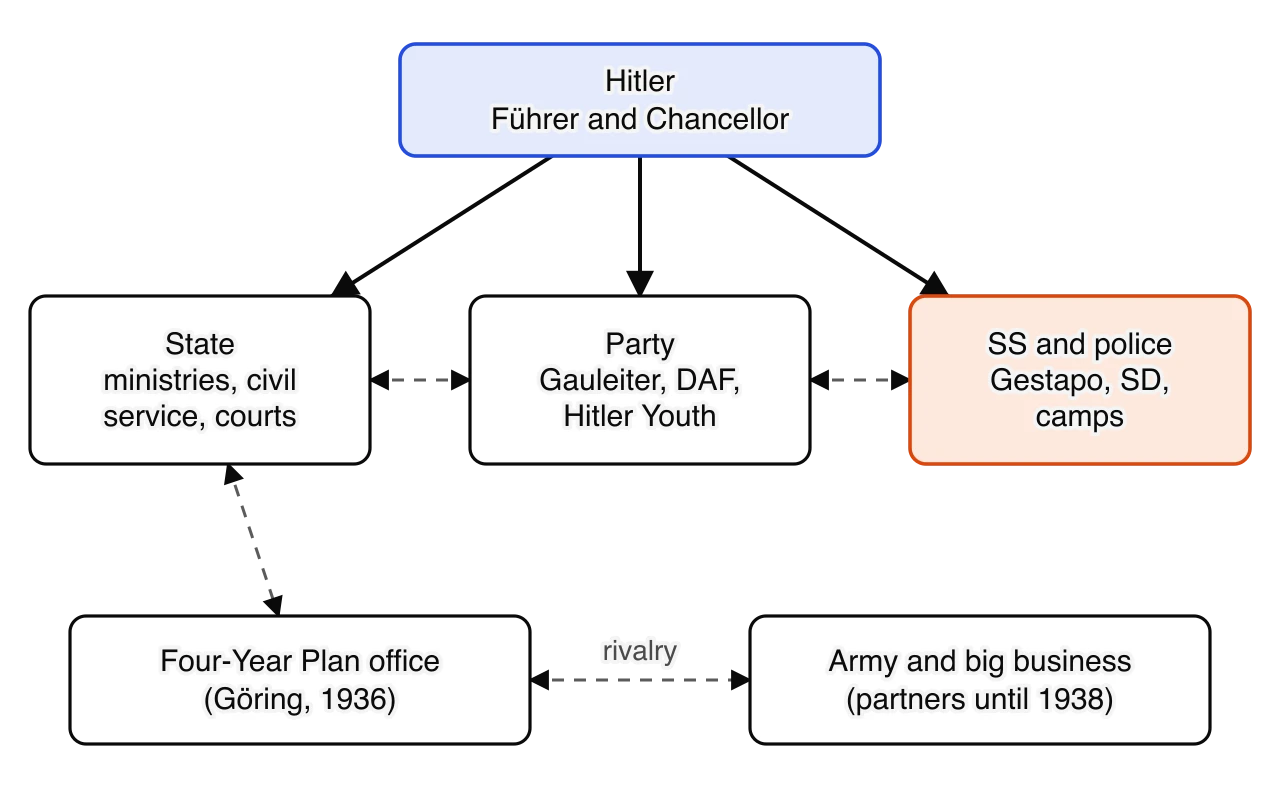
Historians disagree about what this means. Structuralist historians such as Martin Broszat and Hans Mommsen argue that the competition between agencies produced a "cumulative radicalisation", as rivals outbid each other in extreme measures, and that Hitler was in some respects a "weak dictator" who avoided decisions. Intentionalists such as Karl Dietrich Bracher and Eberhard Jäckel see the chaos as Hitler’s deliberate method of divide and rule, with his ideology setting the direction. Ian Kershaw’s idea of working towards the Führer joins the two: officials at every level took initiatives that they believed matched Hitler’s wishes, so his ideas drove policy without his needing to give detailed orders.
Stalin’s rise to power, 1922–1929
Unlike Mussolini and Hitler, Stalin did not have to destroy a democracy. By the time Lenin died in January 1924 the Bolsheviks had won the Civil War, banned all other parties and, at the Tenth Party Congress of March 1921, banned organised factions inside the Communist Party itself. The struggle to succeed Lenin was fought inside the leadership of a one-party state, by men who all agreed that the party must keep its monopoly of power. How it was fought, through committees, congresses and appointments, gave a great advantage to the man who controlled the party’s machinery.
The General Secretary
Joseph Stalin (Iosif Dzhugashvili), a Georgian revolutionary, had been Commissar for Nationalities since 1917 and sat on the Politburo and the Orgburo, which allocated party workers. In April 1922 he became General Secretary of the party, a post that other leaders regarded as administrative. Through the Secretariat he controlled appointments to party posts across the country, the nomenklatura system. Regional party secretaries chose the delegates to party congresses, which elected the Central Committee, so the officials whom Stalin appointed came to decide who led the party.
Stalin used Lenin’s death to present himself as his loyal heir. He gave a speech at the funeral in the form of an oath to follow Lenin’s teachings, and he backed the embalming of Lenin’s body and the cult around it, against the wishes of Lenin’s widow. The party admitted hundreds of thousands of new members, mostly young workers with little political education, in the "Lenin enrolment" of 1924; they owed their careers to the apparatus and voted with the leadership. Lenin’s notes criticising Stalin’s rudeness, his "Testament", were read only to delegations at the Thirteenth Congress in May 1924 and not published, because Zinoviev and Kamenev, then Stalin’s allies, defended him.
The rivals and their weaknesses
Stalin’s rivals were cleverer and better known than he was, and all of them underestimated him. The table of the rivals sets out what each brought to the struggle and why each failed.
Rival | Strengths | Weaknesses and mistakes | Fate by 1929 |
|---|---|---|---|
Leon Trotsky | Organiser of the October Revolution and the Red Army; brilliant writer and speaker | Joined the Bolsheviks only in 1917; arrogant and isolated; feared as a possible military dictator ("Bonaparte"); ill in 1923–1924; missed Lenin’s funeral; did not organise a following or use the Testament | Removed as Commissar for War Jan 1925; expelled from the party Nov 1927; exiled to Alma-Ata Jan 1928, deported Feb 1929 |
Grigory Zinoviev | Head of the Leningrad party and of the Communist International | Had opposed the seizure of power in October 1917; vain and unpopular; his Leningrad base was purged after the Fourteenth Congress (Dec 1925) | Removed from the Politburo 1926; expelled Nov 1927; readmitted after recanting, with no power |
Lev Kamenev | Head of the Moscow party; chaired the Politburo in Lenin’s absence | Also opposed October 1917; tied to Zinoviev; lost Moscow to Stalin’s supporters | Shared Zinoviev’s fate |
Nikolai Bukharin (with Alexei Rykov and Mikhail Tomsky) | Leading theorist; editor of Pravda; Rykov headed the government, Tomsky the trade unions | Defended the NEP just as the grain crisis discredited it; slow to organise; outvoted in the Central Committee that Stalin had filled | Removed from the Politburo Nov 1929; Rykov and Tomsky soon after |
Stalin defeated his rivals one group at a time, as the table of rivals shows. With Zinoviev and Kamenev he isolated Trotsky in 1923–1925; in the autumn of 1924 Trotsky’s essay Lessons of October reminded the party that both men had opposed the October rising, which drove them closer to Stalin. When Zinoviev and Kamenev turned on Stalin at the Fourteenth Congress in December 1925, he defeated them with the support of Bukharin and the Right, and Sergei Kirov was sent to take over the Leningrad party. Their alliance with Trotsky in the United Opposition of 1926–1927 came too late: under the ban on factions, any organised opposition could be presented as an attack on party unity, and a demonstration by the opposition on the tenth anniversary of the revolution, 7 November 1927, gave the excuse to expel Trotsky and Zinoviev.
The ideological debates
The power struggle was also a real debate about how to build socialism in a poor peasant country. Under the New Economic Policy (NEP) of 1921, peasants sold their grain on the market and small private trade was allowed. The Left, Trotsky and the economist Yevgeny Preobrazhensky, argued that the state should squeeze the peasantry to pay for rapid industrialisation, and Trotsky held that the revolution could survive only if it spread abroad (permanent revolution). Bukharin and the Right argued that the alliance with the peasants must be kept and that the country would grow into socialism slowly, at the pace the peasants could bear.
Stalin took the middle ground until 1927. His doctrine of Socialism in One Country (December 1924) appealed to party members who were tired of waiting for world revolution and proud of Soviet achievements. Then the grain procurement crisis of 1927–1928, when peasants held back grain because state prices were low and there were few goods to buy, gave him the opportunity to change course. In January 1928 he travelled to Siberia and ordered grain seized by force, using the criminal code against "speculators" (the "Ural-Siberian method"). The Right objected; Bukharin, in a secret meeting with Kamenev in July 1928, called Stalin a Genghis Khan who would destroy them all. Stalin adopted much of the Left’s programme of rapid industrialisation and attacked Bukharin as a "Right deviationist". By the end of 1929 Stalin had no rivals left in the leadership, and his fiftieth birthday on 21 December 1929 was celebrated as a national event.
Stalin’s consolidation of power: from Ryutin to the Great Terror, 1930–1941
In 1929 Stalin was the leading figure in the Politburo, not yet an autocrat. The upheaval of collectivisation and the famine produced doubts inside the party, and the leadership still included men with their own followings, such as Kirov in Leningrad. The Shakhty trial of 1928, in which engineers were accused of sabotage, had already taught the party to see enemies among the “bourgeois specialists”. Between 1932 and 1938 Stalin removed every possible challenge, ending with the Great Terror of 1936–1938, which destroyed much of the party elite he had himself promoted.
The Ryutin Platform and the Congress of Victors
In 1932 Martemyan Ryutin, a former Moscow party official, circulated a long document among party members, the Ryutin Platform, which blamed Stalin personally for the crisis in the countryside and called for his removal. Ryutin and his group were arrested, and Zinoviev and Kamenev, who had read the document without reporting it, were expelled from the party again. According to later accounts, Stalin wanted Ryutin shot but the Politburo did not agree; historians disagree about whether this story is true. Ryutin was sentenced to ten years in prison and shot in 1937.
The Seventeenth Party Congress of January–February 1934, the "Congress of Victors", celebrated the success of the First Five-Year Plan and of collectivisation, and Stalin’s former opponents, including Bukharin, Zinoviev and Kamenev, praised him from the platform. Later reports claimed that many delegates crossed Stalin’s name off their ballots in the election to the Central Committee and that some wanted Kirov to replace him, but the evidence for this is disputed. Of the 1,966 delegates, Khrushchev later reported, 1,108 were arrested in the following years.
The murder of Kirov, December 1934
On 1 December 1934 Sergei Kirov, the popular party leader in Leningrad and a member of the Politburo, was shot dead in the party headquarters at the Smolny Institute by Leonid Nikolaev, a disgruntled former party worker. The same evening a decree was issued, the "law of 1 December", which ordered that cases of terrorism be investigated within ten days, tried without defence lawyers and followed by immediate execution, with no appeal. Stalin went to Leningrad himself to lead the investigation.
Whether Stalin ordered the murder has been debated since Khrushchev hinted at it in 1956. Robert Conquest argued that he did; Amy Knight (Who Killed Kirov?, 1999) also suspects his involvement. Most historians who have worked in the Soviet archives since the 1990s, including Matthew Lenoe (The Kirov Murder and Soviet History, 2010) and Oleg Khlevniuk, have found no evidence that he did, and think Nikolaev acted alone. What is not disputed is that Stalin used the murder: the Leningrad opposition was blamed, thousands of "former people" were deported from Leningrad, and Zinoviev and Kamenev were sentenced in January 1935 for "moral responsibility".
The show trials and the Great Terror, 1936–1938
The terror developed in waves. The three Moscow show trials put the old Bolshevik leaders on public trial, where they confessed, after interrogation and threats against their families, to absurd charges of plotting with Trotsky, Germany and Japan to murder Soviet leaders and restore capitalism:
August 1936: Zinoviev, Kamenev and fourteen others were sentenced to death and shot.
January 1937: Georgy Pyatakov, Karl Radek and fifteen others; most were shot.
March 1938: Bukharin, Rykov, the former NKVD chief Genrikh Yagoda and eighteen others; most were shot. Tomsky had shot himself in August 1936.
In September 1936 Nikolai Yezhov replaced Yagoda as head of the NKVD, and the terror spread far beyond the old opposition. In June 1937 Marshal Mikhail Tukhachevsky and seven other senior commanders were tried in secret and shot. Three of the five marshals of the Soviet Union and most of the highest commanders were killed, and tens of thousands of officers were dismissed, though many were later reinstated. Party secretaries, managers, engineers, writers and foreign Communists living in the USSR were arrested in huge numbers.
From the summer of 1937 the terror became a mass operation against the population. Order No. 00447 of 30 July 1937, signed by Yezhov and approved by the Politburo, set quotas for each region.
a. To the first category belong all the most active of the above-mentioned elements. They are subject to immediate arrest and, after consideration of their case by the troikas, to be shot. b. To the second category belong all the remaining less active but nonetheless hostile elements. They are subject to arrest and to confinement in concentration camps for a term ranging from 8 to 10 years, while the most vicious and socially dangerous among them are subject to confinement for similar terms in prisons as determined by the troikas.
NKVD Order No. 00447, "On the operation to repress former kulaks, criminals and other anti-Soviet elements", 30 July 1937 (English translation by Benjamin Sher, in J. Arch Getty and Oleg Naumov, Yezhov: The Rise of Stalin’s “Iron Fist”, 2008). The order was top secret and was published only in 1992, so it shows what the leadership intended, without the propaganda of the show trials. Its bureaucratic language, its tables of quotas for each region (initially about 76,000 people to be shot and about 190,000 sent to camps) and the role of three-man troikas sentencing without trial show that the mass killing was planned and directed from the centre. Regional NKVD chiefs then asked for higher limits, which were granted, so that by November 1938 about 387,000 people had been shot under this order alone.
Parallel "national operations" targeted Poles, Germans, Latvians, Koreans and other nationalities suspected of links with foreign states; the Polish operation alone led to over 100,000 executions. Archival records show about 1.5 million arrests by the NKVD in 1937–1938 and about 680,000 executions. In November 1938 the Politburo halted the mass operations, Yezhov was replaced by Lavrenti Beria, and in 1939–1940 Yezhov was himself arrested and shot. The terror was blamed on his "excesses", the name Yezhovshchina ("the Yezhov times") encouraged the belief that Stalin had not known, and some prisoners were released. Trotsky, the last of Stalin’s great rivals, was murdered in Mexico by a Soviet agent in August 1940.
The political impact of the purges
The purges transformed the Soviet state. The generation of Old Bolsheviks who had made the revolution was almost wiped out, and with it any group that might have remembered the party as it was before Stalin or offered an alternative leader. Their places were taken by a new generation of officials, the vydvizhentsy, young men of worker and peasant origin trained in the 1930s, such as Leonid Brezhnev and Alexei Kosygin, who owed everything to Stalin and would lead the USSR until the 1980s. The Politburo stopped meeting regularly as a collective body; decisions were taken by Stalin with small groups of chosen colleagues. Fear made officials obedient but also cautious and unwilling to report bad news. The “Stalin Constitution” of December 1936 promised universal suffrage, a secret ballot and civil rights, and was announced as proof that socialism had been achieved, while the terror was about to reach its height; it shows the gap between the regime’s public claims and its practice.
The costs were also military. The purge of the officer corps weakened the Red Army just as war approached, which contributed to its poor performance against Finland in 1939–1940 and in the first months after the German invasion of June 1941. Abroad, the trials damaged the reputation of the USSR among Western sympathisers, while Stalin’s defenders presented them as justified by the danger of a "fifth column" in a coming war.
Stalin’s USSR: collectivisation and the famine
Stalin’s "revolution from above" of 1928–1932, which he called the Great Turn, had two parts that depended on each other: the forced collectivisation of agriculture and the Five-Year Plans for industry. Collectivisation was meant to give the state control of the grain harvest, so that it could feed the growing cities and export grain to pay for imported machinery, and to destroy the independent peasantry, which Bolsheviks saw as a petty-bourgeois class hostile to socialism.
The war against the kulaks, 1929–1930
In November 1929 Stalin announced a "great turn" towards mass collectivisation, and on 27 December 1929 he declared that the party had passed from restricting the kulaks, the supposedly rich peasants, "to the policy of eliminating the kulaks as a class". In practice anyone who resisted could be labelled a kulak, or a "sub-kulak". In early 1930 a Politburo commission divided kulaks into three categories: those to be shot or sent to camps, those to be deported with their families to remote regions, and those to be resettled on poor land nearby. About 1.8 million people were deported as kulaks in 1930–1931 to "special settlements" in the north, Siberia and Kazakhstan, where many died.
Party activists, OGPU troops and some 25,000 volunteer workers from the cities (the "twenty-five thousanders") were sent into the villages to force peasants into collective farms. The chart of collectivisation shows the speed of the campaign in its first months.
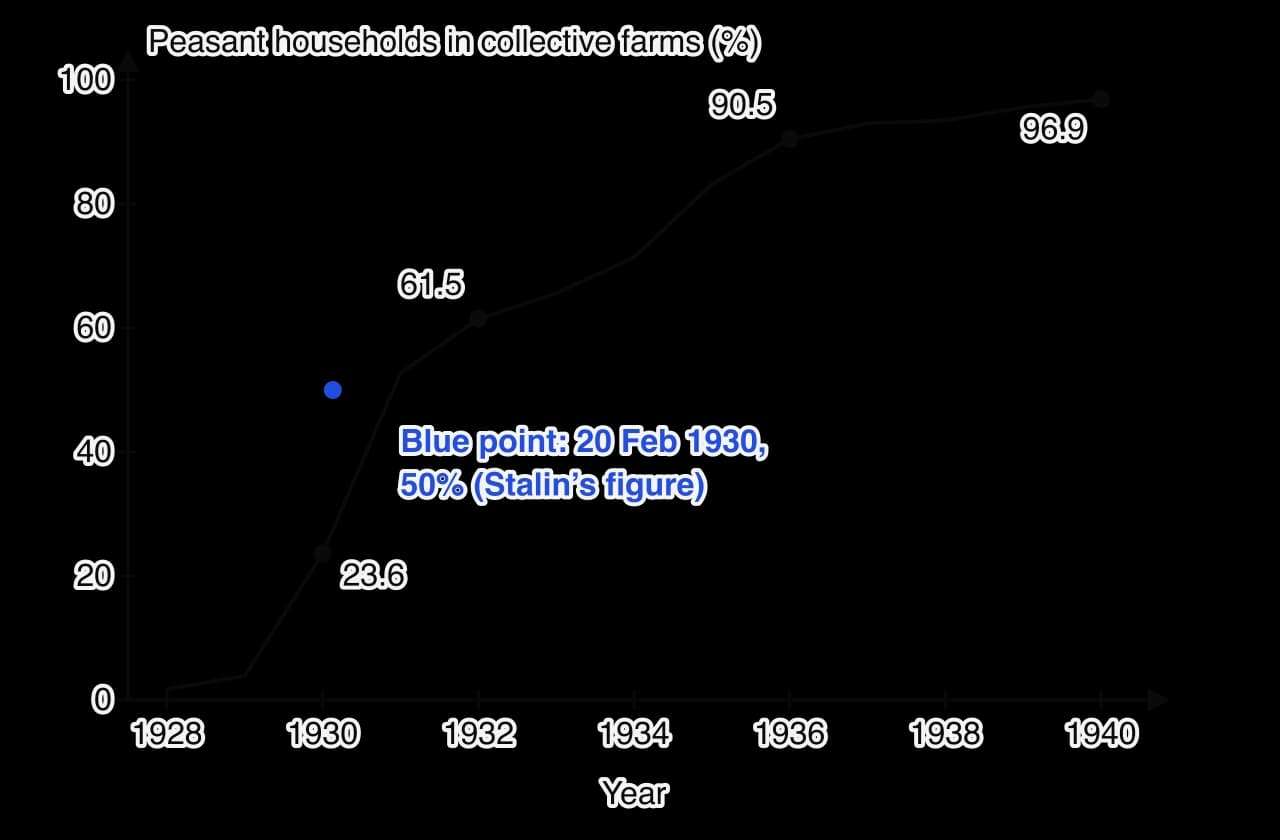
The peasants resisted. The secret police recorded about 13,000 mass disturbances in 1930, many led by women in the riots called babi bunty, and peasants slaughtered their animals rather than hand them over: the number of cattle fell by almost half between 1928 and 1933, and of horses, needed to pull ploughs, by about half. On 2 March 1930 Stalin published an article, "Dizzy with Success", blaming local officials for "excesses" and allowing peasants to leave the collective farms. Most did, as the fall in the chart for 1930 shows. The retreat was tactical: from the autumn of 1930 heavy taxes and procurement quotas on private farmers forced them back, and by 1937 more than nine in ten peasant households were in collective farms.
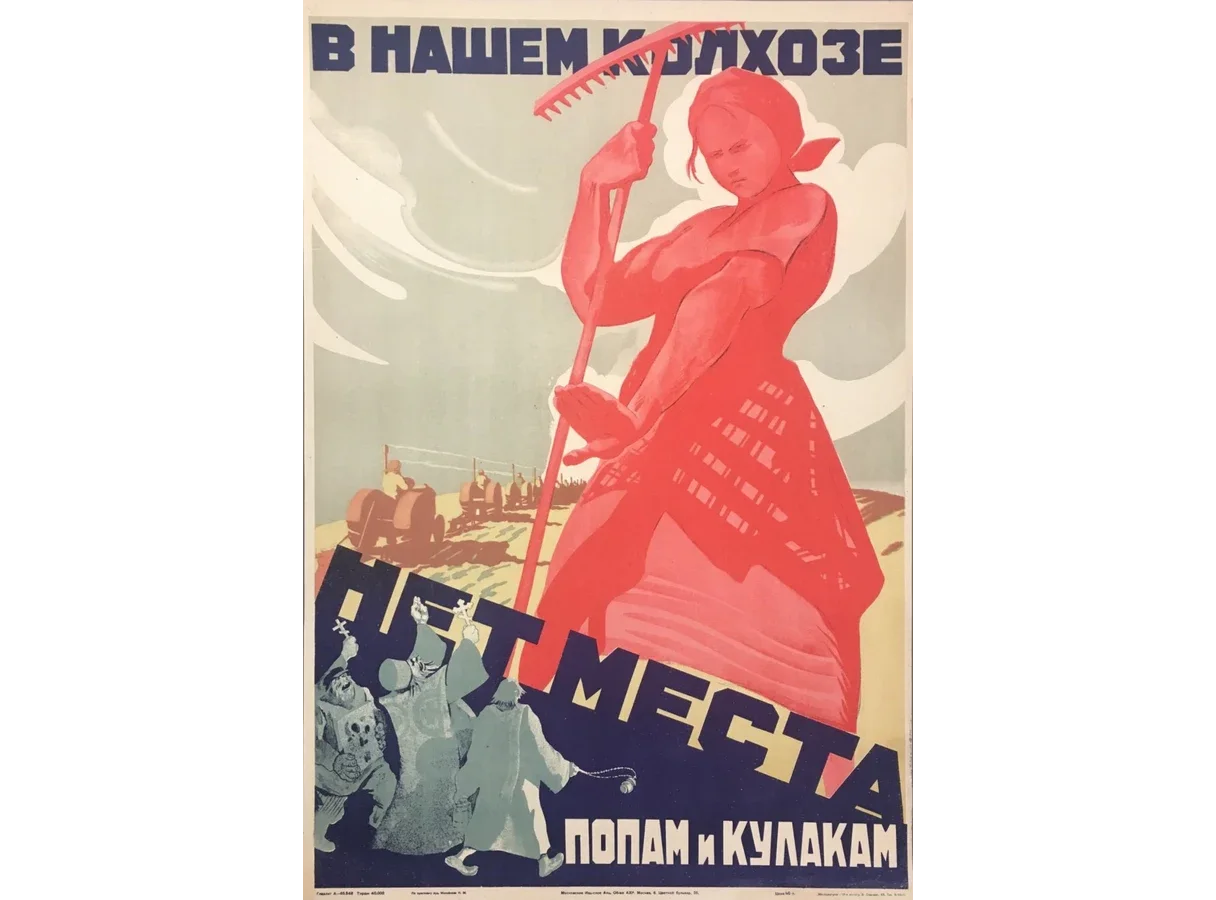
The poster of the kolkhoz shows how the regime presented the campaign: as a class struggle in which the peasants themselves, in the figure of a collective-farm woman, drove out their exploiters. Its pairing of the kulak with the priest reflects the reality that collectivisation was also an assault on village religion; in 1930 thousands of churches were closed and their bells melted down.
The famine of 1932–1933
Collectivisation did not increase the harvest; it fell. But the state took a much larger share of what was grown, and grain exports continued. When the harvest of 1932 was poor, procurement quotas were enforced in Ukraine, the North Caucasus (including the Kuban, with its large Ukrainian population), the Volga region and Kazakhstan by searching houses and seizing seed grain and food. The law of 7 August 1932 punished the theft of collective farm property, including gleaning a few ears of grain from the fields, with death or ten years in the camps. Villages that failed to meet their quotas were "blacklisted" and cut off from all goods. In December 1932 internal passports were introduced for town dwellers, which peasants were not given, and in January 1933 a directive signed by Stalin and Molotov ordered the police to stop peasants from Ukraine and the Kuban leaving in search of bread.
The famine of 1932–1933 killed between about 5.5 and 8.7 million people, according to most estimates, of whom about 3.5–5 million died in Ukraine and about 1.5 million in Kazakhstan, where the forced settlement of nomadic herders killed about 38 per cent of the Kazakh population. The regime denied that there was a famine and refused foreign aid. Whether the famine in Ukraine, the Holodomor, was genocide is debated. Robert Conquest (The Harvest of Sorrow, 1986) and Anne Applebaum (Red Famine, 2017) argue that Stalin used the famine deliberately against Ukrainians and Ukrainian national feeling; R. W. Davies and Stephen Wheatcroft (The Years of Hunger, 2004) argue that Stalin’s policies caused the famine and that he bears responsibility for the deaths, but that he did not intend it as an attack on Ukrainians as a nation. Ukraine and many other states recognise the Holodomor as a genocide (as of 2026).
The collective farm system after 1933
After the famine the regime made concessions. The model charter of 1935 allowed kolkhoz households a private plot of up to about half a hectare and a cow, and these tiny plots soon produced a large share of the country’s vegetables, milk and meat. Machine and Tractor Stations (MTS) rented machinery to the collective farms, took payment in kind and housed political departments that watched the villages. Grain production recovered slowly, and livestock numbers did not return to the level of 1928 until the 1950s. The collective farm system gave the state its grain but left Soviet agriculture inefficient for the rest of the century.
Stalin’s USSR: the Five-Year Plans
The First Five-Year Plan, drawn up by the state planning agency, Gosplan, began in October 1928 and was declared fulfilled in four years and three months, in December 1932. Its targets were raised repeatedly to impossible levels in 1929–1930, with the slogan "the Five-Year Plan in four years". Stalin explained the urgency in a speech to industrial managers in February 1931.
To slacken the tempo would mean falling behind. And those who fall behind get beaten. But we do not want to be beaten. No, we refuse to be beaten! … We are fifty or a hundred years behind the advanced countries. We must make good this distance in ten years. Either we do it, or we shall go under.
Joseph Stalin, "The Tasks of Business Executives", speech to the First All-Union Conference of Leading Personnel of Socialist Industry, 4 February 1931 (Works, vol. 13, Marxists Internet Archive). Stalin spoke to managers who were struggling with impossible targets, shortages and chaos, and his purpose was to justify the pace by appealing to patriotism as well as socialism: the speech lists the invaders who had "beaten" old Russia. Read with hindsight, the warning of ten years seems prophetic, which made the speech central to later Soviet claims that the plans saved the country in 1941; at the time it was a demand for faster work, and it says nothing of the costs.
The plans in practice
The plans gave priority to heavy industry: coal, iron and steel, oil, electricity, machinery and, increasingly, armaments. Giant projects became symbols of the age: the steel city of Magnitogorsk, built from nothing in the southern Urals; the Dnieper hydroelectric dam (completed in 1932); the tractor factories of Stalingrad and Kharkov; and the Moscow Metro (1935). The White Sea–Baltic Canal (1931–1933) was dug by Gulag prisoners with hand tools, and many of them died. The Second Five-Year Plan (1933–1937) was more realistic and paid more attention to transport and to finishing projects; the Third (from 1938) was turned increasingly to defence and was cut short by the German invasion of June 1941.
Product | 1927–28 | 1932 | 1937 | 1940 |
|---|---|---|---|---|
Coal (million tonnes) | 35.4 | 64.4 | 128.0 | 165.9 |
Steel (million tonnes) | 4.0 | 5.9 | 17.7 | 18.3 |
Oil (million tonnes) | 11.7 | 21.4 | 28.5 | 31.1 |
Electricity (billion kWh) | 5.0 | 13.5 | 36.2 | 48.3 |
Data: official Soviet output figures, as given in Alec Nove, An Economic History of the USSR (1969, revised 1992). The table of output shows heavy industry multiplying three to tenfold in twelve years, faster than any major economy had grown before. Official figures exaggerated growth, because managers inflated their results and prices were manipulated, but Western economists such as R. W. Davies and Mark Harrison accept that real growth was very large. By 1940 the USSR was one of the world’s leading industrial powers, and the factories built east of the Urals were out of reach when the Germans invaded.
Workers and the costs of industrialisation
The costs fell on the population. Real wages fell sharply in the early 1930s; bread was rationed from 1929 to 1935; housing in the new industrial cities was desperately overcrowded, with families sharing a room or living in barracks and tents. Consumer goods were scarce and of poor quality. The urban population rose from about 18 per cent of the total in the 1926 census to about 33 per cent in 1939, as millions of peasants fled the collective farms for factory jobs.
Labour discipline tightened as the plans demanded more. From 1932 workers who missed a day could lose their ration cards and housing; from December 1938 every worker had to carry a labour book recording their employment; and a decree of June 1940 made it a crime to be more than twenty minutes late or to change jobs without permission. Rewards went with the punishments. On 31 August 1935 the miner Alexei Stakhanov cut 102 tonnes of coal in one shift, fourteen times the norm, in a record arranged by local officials. The Stakhanovite movement that followed gave high wages, flats and medals to record-breakers and raised everyone else’s norms, which made the "Stakhanovites" unpopular with many workers.
 YouTube
Stalin’s USSR: social policies, propaganda and repression
Education and social mobility
The regime made great efforts in education, because industry needed skilled workers and engineers. The campaign against illiteracy (likbez) and the introduction of compulsory primary education in 1930 raised the literacy rate from about 51 per cent in 1926 to about 81 per cent in 1939, according to census figures. Millions of workers and peasants moved up into technical colleges, management and party posts, especially as the purges created vacancies. In the mid-1930s schools returned to traditional methods: examinations, uniforms, discipline and a patriotic history in which tsars such as Peter the Great reappeared as heroes. The sociologist Nicholas Timasheff later called this shift back to traditional values the "Great Retreat".
Women and the family
The revolution had given women legal equality, easy divorce and legal abortion. In the 1930s millions of women entered industry and the professions, and the share of women in the workforce rose steeply, but most also carried the full burden of housework and queuing: a "double burden". The women’s department of the party, the Zhenotdel, was closed in 1930 on the grounds that the "woman question" had been solved. The Family Law of June 1936 banned abortion except to save the mother’s life, made divorce more expensive, and offered payments to mothers of large families, as the regime worried about a falling birth rate.
Religion, culture and nationalities
The attack on religion intensified with collectivisation. The League of the Militant Godless spread atheist propaganda; a law of 1929 banned religious teaching and charity; most churches, mosques and synagogues were closed, and many clergy were shot in 1937–1938. Faith survived in private: in the census of 1937, about 57 per cent of adults declared themselves believers, and the census results were suppressed and its organisers arrested.
From 1932 all writers had to belong to a single Union of Soviet Writers, and the First Congress of Soviet Writers in 1934 made socialist realism the official style: art had to show Soviet life in an optimistic, heroic way that served the building of socialism. In January 1936 Pravda condemned Dmitri Shostakovich’s opera Lady Macbeth of Mtsensk, a warning to every artist. The policy of "indigenisation" of the 1920s, which had promoted the languages and cadres of the non-Russian nationalities, was replaced by an emphasis on Russian language and culture, and whole nationalities were deported as potentially disloyal, such as about 170,000 Koreans from the Far East to Central Asia in 1937.
Propaganda and the cult of Stalin
The cult of personality began with the celebrations of Stalin’s fiftieth birthday in December 1929 and grew through the 1930s. Stalin was presented as the "Lenin of today", the wise father of the peoples and the architect of every success; towns were named after him (Tsaritsyn became Stalingrad in 1925); his portrait appeared in every office, classroom and parade. History was rewritten to give him a leading role in 1917 and the Civil War, culminating in the History of the Communist Party of the Soviet Union (Bolsheviks): Short Course of 1938, which became the compulsory textbook of party history. Photographs were altered to remove purged leaders, including Yezhov.
The cult served several purposes. It gave a personal face to a distant and harsh state, as the tsar had been for peasants; it made Stalin the source of all achievements while local officials could be blamed for failures; and it made any criticism of policy an attack on the leader. Sheila Fitzpatrick and other social historians show that people responded in many ways: some believed, many used the official language to advance themselves, and others repeated it in public while telling jokes in private. Stephen Kotkin, in Magnetic Mountain (1995), calls this learning to "speak Bolshevik".
Repression, the Gulag and resistance
The political police, the OGPU, was merged into the NKVD in 1934. It ran the Gulag (Main Administration of Camps, from 1930), a network of labour camps and colonies that became a major part of the economy, felling timber, mining gold in Kolyma and building canals and railways. The chart of the Gulag shows its growth.

Behind the chart lie the special settlements, where well over a million deported peasants and their families lived in the early 1930s, the prisons, and the dead: Gulag records show over 67,000 deaths in the camps in 1933 alone, and recorded camp deaths are lower than the true figure because prisoners close to death were often released to die elsewhere.
Open resistance after 1930 was rare and quickly crushed. The peasant revolts of 1930 were the last mass challenge. Workers resisted by changing jobs, absenteeism and slow work, and the punishments of 1938–1940 show how widespread these were. Inside the party, Ryutin’s group was the last organised opposition. Private dissent survived in jokes, rumours, anonymous letters and diaries, and NKVD reports on public opinion, used by historians such as Sarah Davies (Popular Opinion in Stalin’s Russia, 1997), show widespread grumbling about shortages, privileges and the cult.
How totalitarian was Stalin’s USSR?
By the Friedrich–Brzezinski checklist, Stalin’s USSR came closest of the three regimes to the totalitarian model: an official ideology taught in every school; a single party fused with the state; terror on a vast scale; a monopoly of the media and weapons; and an economy almost wholly owned and planned by the state, with private trade and farming reduced to the margins. Unlike Mussolini and Hitler, Stalin faced no monarch, independent army, church or business class that could limit him after 1938.
Yet historians since the 1980s have shown the limits of control. J. Arch Getty (Origins of the Great Purges, 1985) described a weak, chaotic state in which the centre struggled to control regional party bosses, and in which the terror spiralled through local conflicts and denunciations as well as orders from above. Plans were constantly missed, peasants and workers evaded rules, and officials falsified reports. Archive-based historians such as Oleg Khlevniuk have shown, against Getty’s early view, that Stalin personally directed the mass operations and the purges. The best answer is that the USSR was totalitarian in ambition and in the reach of its terror, but that the chaos of implementation and the survival of private belief kept its control short of total.
Comparing the three regimes
The three dictatorships used similar methods, and both their admirers and their enemies compared them at the time. Setting them side by side shows how differently they came to power, how far each controlled its society and what each cost in human life.
Mussolini’s Italy | Hitler’s Germany | Stalin’s USSR | |
|---|---|---|---|
Route to power | Appointed by the king after the March on Rome (1922); dictatorship from 1925–1926 | Appointed by Hindenburg (1933); dictatorship by August 1934 | Rose inside an existing one-party state (1922–1929); unchallenged after 1938 |
Ideology | Fascism: nation, state, empire, anti-socialism; racism in the colonies and from 1938 at home | Nazism: race, antisemitism, Lebensraum, anti-Marxism | Marxism–Leninism and Socialism in One Country: class struggle, abolition of private property |
Single party | PNF, subordinated to the state and the prefects | NSDAP, in rivalry with the state and the SS | Communist Party, fused with the state and itself purged |
Terror | OVRA, confino, Special Tribunal; dozens of executions to 1940 | SS, Gestapo, camps; thousands of deaths before 1939; mass murder from 1939 | NKVD, Gulag, mass operations; about 680,000 executions in 1937–1938; famine deaths in millions |
Economy | Private ownership; corporate state; IRI; autarky | Private ownership under state direction; rearmament; Four-Year Plan | State ownership; central planning; collectivisation |
Limits on the leader | King, Church, army, big business | Army and business until 1938; churches; polycracy | Few formal limits after 1938; chaotic implementation |
The comparison suggests two conclusions. First, the two fascist regimes came to power with the help of conservative elites, and kept much of the old social order; their power rested on an alliance with those elites that Hitler broke in 1938 and Mussolini never broke. Stalin’s regime destroyed the old elites in the revolution and the Civil War, and in the 1930s it destroyed much of its own. Second, the scale of terror in the USSR before 1941 was far greater than in Germany before 1939 or in Italy at any time, but Nazi terror turned into genocide in the war that followed.
Perspectives and debates
Was "totalitarianism" a useful idea?
The totalitarian model of Arendt and of Friedrich and Brzezinski dominated Western writing in the 1950s and 1960s. In the 1970s and 1980s social historians challenged it. Historians of the USSR such as Sheila Fitzpatrick and J. Arch Getty, and of Germany such as Martin Broszat and Detlev Peukert (Inside Nazi Germany, 1982), studied everyday life and local administration and found chaos, negotiation, conformity for self-interest and areas of life the regimes never reached. Since the opening of the Soviet archives after 1991, and the comparison of the two regimes in works such as Ian Kershaw and Moshe Lewin’s Stalinism and Nazism: Dictatorships in Comparison (1997), many historians use "totalitarian" again, but for the regimes’ aims and methods more than for their achievement.
Mussolini: consensus or imperfect control?
Renzo De Felice’s biography of Mussolini (1965–1997) argued that the regime enjoyed broad popular consensus in the years 1929–1936, between the Lateran Pacts and the conquest of Ethiopia. His critics accused him of rehabilitating Fascism. Denis Mack Smith (Mussolini, 1981) portrayed Mussolini as an opportunist and showman whose regime was more propaganda than substance. Adrian Lyttelton (The Seizure of Power, 1973) showed how Fascism came to power through violence and the collusion of the liberal elites. R. J. B. Bosworth (Mussolini’s Italy, 2005) argues that Fascism never transformed Italians, who lived around the regime through family, patronage and the Church. Christopher Duggan (Fascist Voices, 2012), using letters and diaries, found more genuine emotional attachment to Mussolini than Bosworth allows, while showing that it centred on the Duce more than on the party.
Why did the Weimar Republic fail?
Historians weigh long-term structures against the crisis of 1929–1933 and the decisions of individuals. Karl Dietrich Bracher (1955) stressed the collapse of parliamentary government after 1930. Knut Borchardt (1979) argued that the economy was already "sick" before the Depression, because wages had risen faster than productivity, which left Brüning little room for any policy other than deflation; his critics, such as Carl-Ludwig Holtfrerich, replied that Brüning’s choices were political. Detlev Peukert (The Weimar Republic, 1987) saw Weimar as a crisis of "classical modernity", in which the welfare state and modern culture created expectations that the economy could not meet. Richard J. Evans (The Coming of the Third Reich, 2003) stresses the violence and the hostility of the elites to democracy from 1918, and Henry Ashby Turner (Hitler’s Thirty Days to Power, 1996) the contingency of January 1933.
Consent or coercion in Nazi Germany?
Robert Gellately (Backing Hitler, 2001) argues that the regime rested to a large degree on popular consent: the Gestapo was small, denunciations from the public drove much of its work, and the press openly reported the camps, which most Germans accepted as places for "asocials" and enemies. Götz Aly (Hitler’s Beneficiaries, 2005) adds that Germans were bought off with material benefits. Richard Evans (The Third Reich in Power, 2005) replies that consent was produced by terror: the destruction of the labour movement in 1933, when tens of thousands were imprisoned, the threat of the camps and the end of free expression meant that apparent consent cannot be taken at face value. Kershaw’s "Hitler myth" offers a middle position: genuine popularity of the leader coexisted with dislike of the party and fear of the police.
Stalin and the Terror
Robert Conquest (The Great Terror, 1968) presented the Terror as planned by Stalin to destroy every possible opposition and estimated its victims in many millions. In the 1980s "revisionists" such as J. Arch Getty (Origins of the Great Purges, 1985) argued that the Terror grew out of conflict between the centre and regional party bosses, bureaucratic chaos and pressure from below, and that Stalin was less in control than Conquest believed; some revisionists also argued that the numbers of victims had been greatly exaggerated. The archives opened after 1991 settled parts of the debate. The numbers of executions (about 680,000 in 1937–1938) were lower than Conquest’s highest estimates but enormous; documents such as Order No. 00447 and the lists of names Stalin signed for execution show that the mass operations were planned and directed from the top, as Oleg Khlevniuk (Stalin: New Biography of a Dictator, 2015) argues. Getty himself, with Oleg Naumov (The Road to Terror, 1999), accepted Stalin’s central role while stressing the fears of the whole leadership. Stephen Kotkin’s biography (2014–2017) presents Stalin as a convinced Marxist–Leninist who used terror to build socialism and to prepare for war, and Khlevniuk stresses his fear of a "fifth column" in a coming war.
Debate | Historians | Argument | Evidence stressed |
|---|---|---|---|
Totalitarianism | Arendt (1951), Friedrich and Brzezinski (1956) v. Fitzpatrick, Getty, Peukert | New regimes of total control v. limits, chaos and negotiation in practice | Ideology, terror and propaganda v. local records, everyday life, public opinion reports |
Fascist Italy | De Felice (1965–97), Mack Smith (1981), Bosworth (2005), Duggan (2012) | Consensus in 1929–1936 v. propaganda and opportunism v. a regime Italians lived around v. emotional attachment to the Duce | Plebiscites and police reports; diplomatic record; local and family life; letters and diaries |
Weimar’s failure | Bracher (1955), Borchardt (1979), Peukert (1987), Evans (2003), Turner (1996) | Collapse of parliament; a "sick" economy; crisis of modernity; hostile elites and violence; contingency | Decree government; wages and productivity; welfare state; political murders; the January 1933 intrigue |
Nazi state and society | Bracher, Jäckel v. Broszat, Mommsen; Kershaw (1993); Gellately (2001) v. Evans (2005) | Hitler’s intentions v. polycratic chaos; "working towards the Führer"; consent v. coercion | Hitler’s writings; rival agencies; Gestapo files and denunciations; the camps of 1933 |
Nazi economy | Mason (1970s), Overy (1994), Tooze (2006) | Crisis pushed Hitler to war v. planned for a later war v. rearmament at all costs | Labour shortages and wages; arms plans; foreign currency |
Stalin’s Terror | Conquest (1968), Getty (1985), Getty and Naumov (1999), Khlevniuk (2015), Kotkin (2014–17) | Planned from the top v. chaos and pressure from below v. directed by Stalin out of ideology and fear of war |
These debates concern how the dictators’ power worked. Historians who stress structures and society explain why the regimes were accepted and how policies became more extreme; those who stress leaders explain where the policies came from. Each kind of evidence, from police reports to the dictators’ own orders, tends to support one emphasis, so a balanced judgement uses both.
Applying the ideas in exam questions
The questions that follow cover the three regimes and both types of Paper 3 question: claims about the most significant factor, and statements about effects or the nature of a regime.
Paper 3: the causes of Mussolini’s rise
Paper 3: the Depression and Hitler’s appointment
Paper 3: the "Golden Era"
Paper 3: Stalin’s rise to power
Paper 3: the extent of totalitarian control
Self-check
- To do:
I can define totalitarianism, authoritarianism, fascism and Nazism, and explain Friedrich and Brzezinski’s six features and the criticisms of the totalitarian model.
- To do:
I can explain the long-term weaknesses of the Italian liberal state and the effects of the First World War, the mutilated victory and the biennio rosso.
- To do:
I can explain the rise of the Fascist squads and why the king appointed Mussolini after the March on Rome.
- To do:
I can explain how Mussolini consolidated power through the Acerbo Law, the Matteotti crisis, the speech of 3 January 1925 and the laws of 1925–1926.
- To do:
I can assess Mussolini’s economic policies: the battles for grain, the lira and land, the corporate state, IRI and autarky.
- To do:
I can explain Fascist social policies, the Lateran Pacts, the racial laws, propaganda and the cult of the Duce, and repression and resistance in Italy, and judge how totalitarian the regime was.
- To do:
I can explain the constitutional, political, economic and social challenges the Weimar Republic faced in 1918–1923 and why it survived them.
- To do:
I can weigh the achievements and weaknesses of the Stresemann years, 1924–1929.
- To do:
I can explain how the Depression, presidential government, Nazi support and the intrigue of January 1933 brought Hitler to power.
- To do:
I can explain each step of Hitler’s consolidation from the Reichstag fire to the army oath, and the role of popular support.
- To do: