Notes on R4.3 Enlightenment and absolutism (1600–1800)
The Enlightenment was a movement of ideas in seventeenth- and eighteenth-century Europe that tested religion, society and government against reason and evidence. It took shape in a continent ruled mostly by absolute monarchs, and many of those monarchs, from Berlin to Madrid, claimed to govern by its principles.
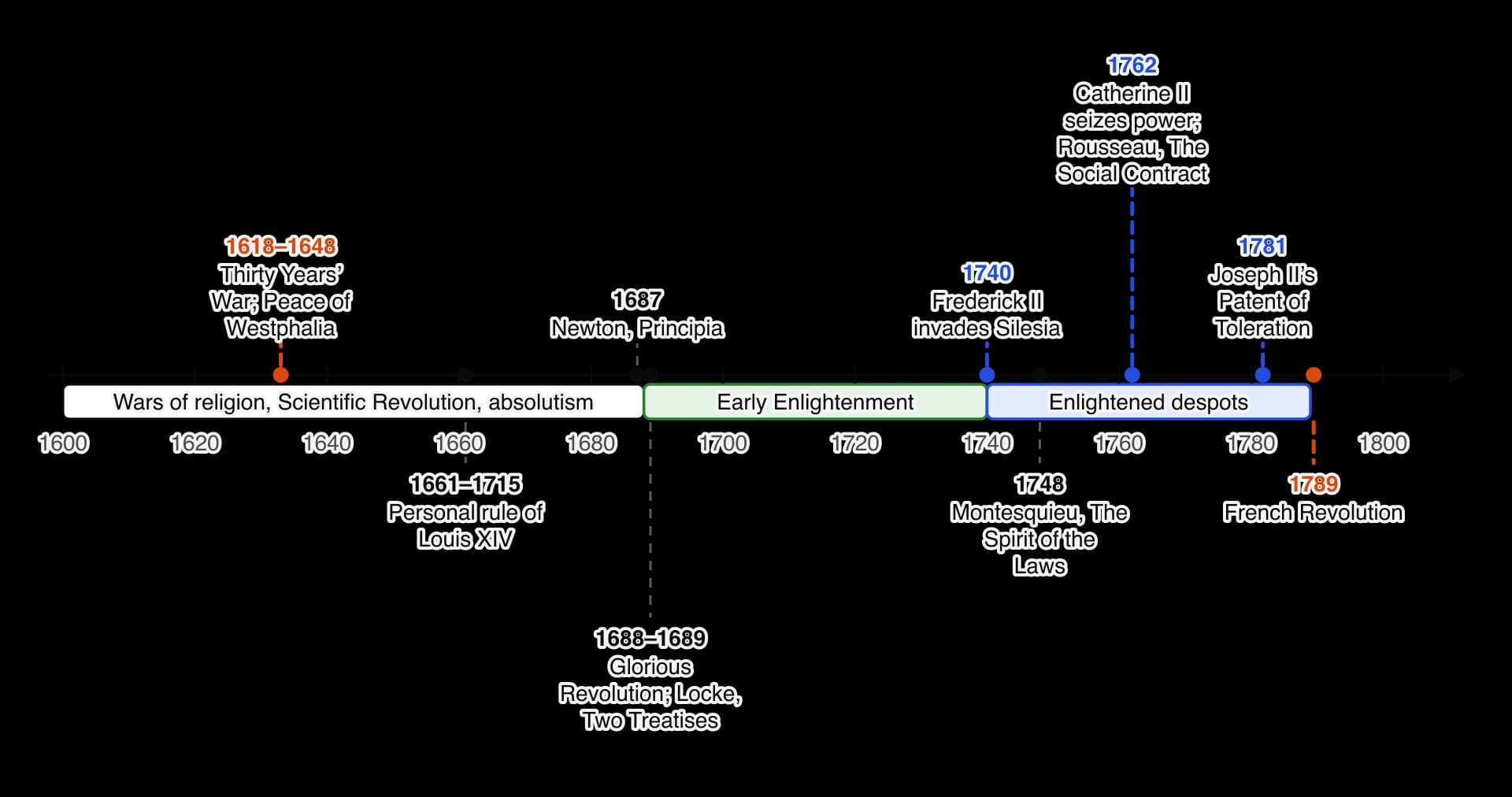
Absolute monarchy in seventeenth-century Europe
In 1600 most of Europe was ruled by hereditary monarchs who shared power with others: nobles in their estates, churches with their own courts and lands, towns with charters, and representative assemblies that voted taxes. Over the next century many rulers on the continent tried to free themselves from these limits. The result was a form of government that historians call absolutism.
The strongest justification for absolutism was the divine right of kings. Jacques-Bénigne Bossuet, bishop of Meaux and tutor to the heir of Louis XIV, argued in Politics Drawn from the Very Words of Holy Scripture (written in the 1670s, published 1709) that kings were God’s ministers on earth, answerable to God alone. Resistance to a king was therefore resistance to God. A second, more practical justification was raison d’état: the claim that the security and power of the state came before every private interest or moral rule.
The model of Louis XIV
Louis XIV of France (r. 1643–1715, personal rule from 1661) became the model of the absolute monarch. After the Fronde revolts of 1648–1653, in which nobles and the Parlement of Paris rose against the crown during his childhood, he set out to make royal authority unchallengeable. He governed without a chief minister, never called the Estates-General, and sent royal officials called intendants into the provinces to collect taxes, supervise justice and report back to Versailles.
Court: the palace of Versailles, where the court settled in 1682, turned the great nobles into courtiers who competed for the king’s favour instead of building power bases in the provinces.
Economy: Jean-Baptiste Colbert, controller-general of finances from 1665, practised mercantilism: tariffs on foreign goods, royal manufactures, trading companies and a navy, to build up the kingdom’s wealth at the expense of its rivals.
Army: the standing army grew to several hundred thousand men by the 1690s, one of the largest in Europe, and fought four major wars for territory and dynastic advantage.
Religion: in 1685 the Edict of Fontainebleau revoked the Edict of Nantes (1598), which had tolerated Protestants. Around 200,000 Huguenots fled abroad, many of them skilled craftsmen and merchants.
Other rulers copied the model. Frederick William, the “Great Elector” of Brandenburg-Prussia (r. 1640–1688), built a standing army and broke the tax-granting power of the estates; Peter the Great of Russia (r. 1682–1725) forced Western methods on his nobility and built St Petersburg; the Habsburgs in Vienna strengthened their hold over Bohemia after 1620. In England, by contrast, attempts at absolutism ended in civil war (1642–1651) and in the Glorious Revolution of 1688–1689, which left Parliament supreme.
Absolutism matters to the Enlightenment in two ways. It was the system that many Enlightenment thinkers attacked, above all for religious persecution, arbitrary arrest and the waste of war. It was also the system through which, in the second half of the eighteenth century, some rulers tried to put Enlightenment ideas into practice.
The emergence of Enlightenment ideas, c. 1600–1750
The Enlightenment had no founding date or single programme. Its thinkers disagreed with each other about religion, monarchy and equality. What they shared was a method (criticism based on reason and evidence) and a confidence that knowledge could make people freer and happier. Historians explain its emergence through four groups of factors: intellectual influences, political conditions, religious change and the work of particular individuals.
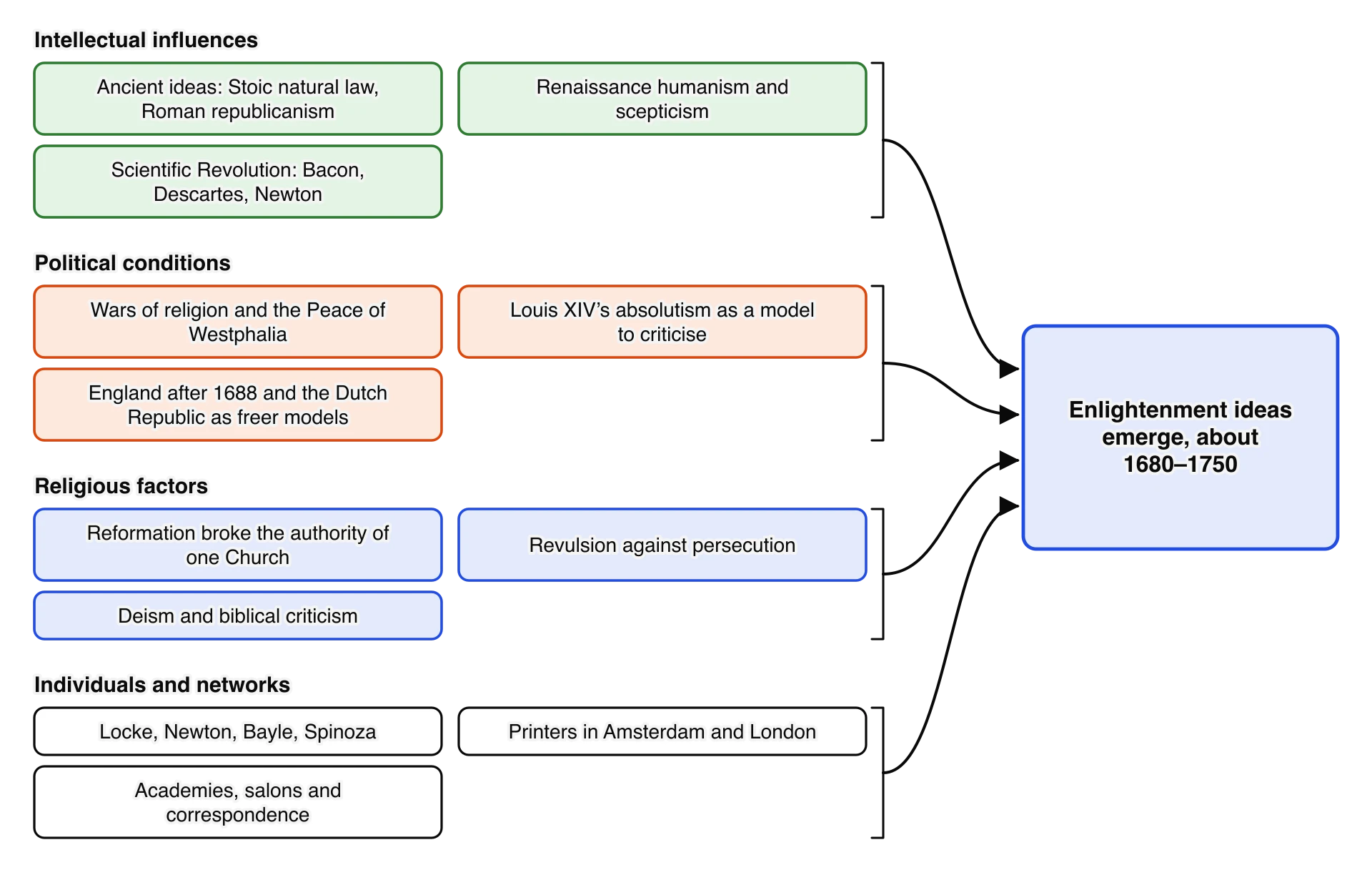
Intellectual influences: ancient ideas, the Renaissance and the Scientific Revolution
Enlightenment writers were educated in the classics. From the Stoic philosophers and Cicero they took the idea of a natural law that applied to all people and could be known by reason. From the Roman Republic they took a vocabulary of liberty, citizenship and civic virtue. Renaissance humanism added the habit of going back to original texts and checking them critically, and the essays of Michel de Montaigne (1580) showed how doubt could be turned against accepted beliefs. The Renaissance and Reformation are a regional study of their own; here they matter as the soil in which the new ideas grew.
The strongest single influence was the Scientific Revolution. Between the mid-sixteenth and the late seventeenth century, astronomers and natural philosophers overturned the picture of the universe inherited from Aristotle and the Church.
Date | Thinker | Contribution | Why it mattered to the Enlightenment |
|---|---|---|---|
1543 | Nicolaus Copernicus | On the Revolutions of the Heavenly Spheres: the Earth moves around the Sun | Showed that a belief held for over a thousand years could be wrong |
1609, 1619 | Johannes Kepler | Laws of planetary motion: the planets move in ellipses | Nature followed mathematical laws |
1620 | Francis Bacon | Novum Organum: knowledge built up from observation and experiment (empiricism) | A method for testing every claim against evidence |
1633 | Galileo Galilei | Tried by the Roman Inquisition and forced to recant his support for Copernicus | Became a symbol of reason persecuted by religious authority |
1637 | René Descartes | Discourse on Method: doubt everything that cannot be proved; build knowledge on reason (rationalism) | Gave thinkers the habit of questioning authority |
1628, 1660s | William Harvey; Robert Boyle | Circulation of the blood; experiments on gases | Experiment, not ancient texts, settled questions |
1687 | Isaac Newton | Principia Mathematica: one set of laws of motion and gravity explains the heavens and the Earth | If nature had rational laws, perhaps society did too |
New institutions supported the new science. The Royal Society of London received its charter in 1662 (it first met in 1660) and the French Académie des sciences was founded in 1666. Their members published their findings, repeated each other’s experiments and wrote to scholars abroad.
Newton’s achievement had the widest effect. To eighteenth-century readers his Principia showed that the universe was an orderly machine governed by simple laws that the human mind could discover. Writers such as Voltaire, who popularised Newton in France in the 1730s, drew the conclusion that the same method could be applied to politics, economics and morality: study society as Newton had studied nature, find its laws, and reform institutions that broke them.
Political conditions
The religious wars of the sixteenth and seventeenth centuries were the political background against which Enlightenment ideas took shape. The Thirty Years’ War (1618–1648) killed perhaps a fifth or more of the population of the German lands, and the Peace of Westphalia (1648) that ended it accepted that rulers, not popes or emperors, would decide the religion of their states. In England, civil war (1642–1651), the execution of Charles I in 1649 and the Glorious Revolution of 1688–1689 raised the question of where legitimate power came from.
Two English thinkers gave opposite answers. Thomas Hobbes, writing in Leviathan (1651) after the civil war, argued that without government people would live in a war of all against all, in which life would be “solitary, poore, nasty, brutish, and short”. To escape this, they must hand absolute power to a sovereign. John Locke reached a very different conclusion in his Two Treatises of Government (published 1689).
IF man in the state of nature be so free, as has been said; if he be absolute lord of his own person and possessions, equal to the greatest, and subject to no body, why will he part with his freedom? … the enjoyment of the property he has in this state is very unsafe, very unsecure. This makes him willing to quit a condition, which, however free, is full of fears and continual dangers: and it is not without reason, that he seeks out, and is willing to join in society with others, who are already united, or have a mind to unite, for the mutual preservation of their lives, liberties and estates, which I call by the general name, property.
John Locke, Second Treatise of Government, chapter 9, section 123, 1689. Locke published the work anonymously just after the Glorious Revolution, and it was read as a justification of Parliament’s removal of James II, although Locke had written much of it in the early 1680s, during the crisis over James’s exclusion from the succession. Its argument, that government exists by the consent of the governed to protect natural rights, and that a ruler who violates them can lawfully be resisted, became the foundation of the Enlightenment’s case against absolute monarchy. His “property” included land and possessions as well as life and liberty, and the political settlement he defended was one made by landowners.
Political conditions also decided where the new ideas could be published. The Dutch Republic, a federation of provinces without a king, had the freest press in Europe; Amsterdam printers published books banned in France, including works by Descartes, Spinoza and Bayle. England after 1695, when the Licensing Act lapsed, had no censorship before publication. The France of Louis XIV, with its persecution of Protestants and its costly wars, gave critics a ready example of what they opposed.
Religious factors
The Reformation of the sixteenth century broke the authority of a single Church in western Europe. Once Catholics, Lutherans and Calvinists each claimed the truth and persecuted each other, educated Europeans began to ask whether any church could be certain, and whether the state should enforce belief at all. Revulsion against the wars of religion and against persecution, such as the revocation of the Edict of Nantes in 1685, produced arguments for toleration.
John Locke, A Letter Concerning Toleration (1689): the state exists to protect life, liberty and property, not to save souls, so it should not force belief (although Locke excluded Catholics and atheists).
Pierre Bayle, a French Protestant exile in Rotterdam, Historical and Critical Dictionary (1697): a huge work that used footnotes to expose contradictions in religious and historical claims, and argued that even an atheist could be a good citizen.
Baruch Spinoza, a Dutch Jewish philosopher, Theological-Political Treatise (1670): the Bible was a human text to be read historically, and freedom of thought was necessary to a peaceful state.
Many Enlightenment thinkers became deists. They believed in a creator God who had made the universe as a rational machine and then left it to run by natural laws, but they rejected miracles, revelation and the authority of churches. Others remained believing Christians who wanted a more reasonable, tolerant religion. Within Catholicism, the Jansenists, a strict reforming movement condemned by the papacy, attacked the Jesuits and the power of Rome, and in France their quarrel with the bishops and the crown weakened respect for both.
Take a view of the Royal Exchange in London, a place more venerable than many courts of justice, where the representatives of all nations meet for the benefit of mankind. There the Jew, the Mahometan, and the Christian transact together, as though they all professed the same religion, and give the name of infidel to none but bankrupts. … If one religion only were allowed in England, the Government would very possibly become arbitrary; if there were but two, the people would cut one another’s throats; but as there are such a multitude, they all live happy and in peace.
Voltaire, Letters on the English, Letter VI, “On the Presbyterians”, 1733 (English edition). Voltaire wrote after nearly three years in England (1726–1728) for French readers, and the French edition of 1734 was condemned by the Parlement of Paris and burned. His praise of England is deliberately idealised: by describing a country where trade and toleration flourished together, he criticised France without naming it. The extract shows a key Enlightenment argument for toleration, that it was useful as well as just.
The role of individuals
A small number of writers, read across Europe, gave the Enlightenment its shape. Most were French, British, German or Italian; they wrote in French, the international language of the educated, or were quickly translated.
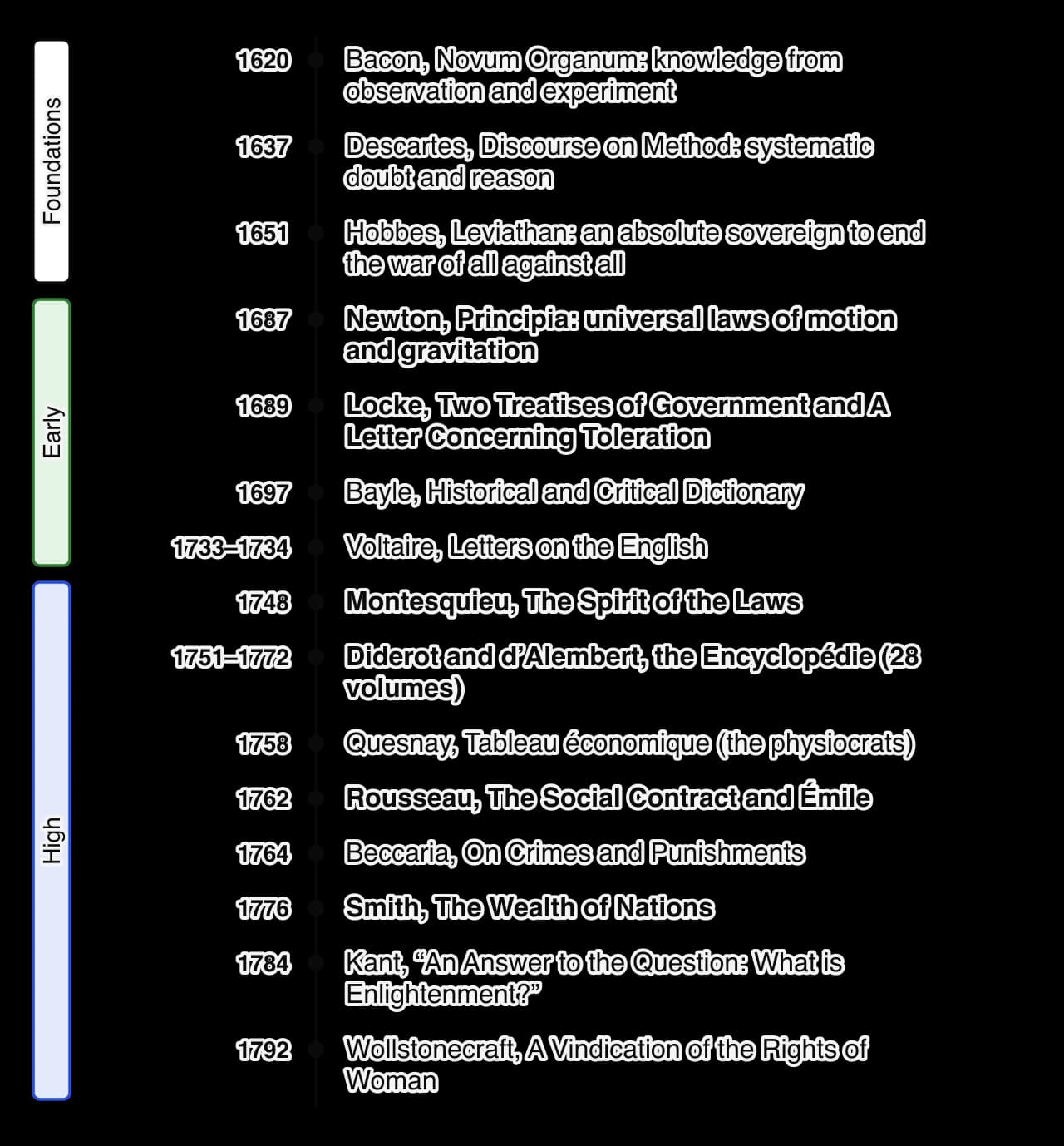
Charles de Montesquieu (1689–1755), a French noble and judge, mocked French society through the eyes of two Persian visitors in Persian Letters (1721) and compared the governments of the world in The Spirit of the Laws (1748).
Voltaire (François-Marie Arouet, 1694–1778), poet, historian and polemicist, campaigned against religious intolerance. In the Calas affair (1762–1765) he won the posthumous rehabilitation of Jean Calas, a Protestant merchant of Toulouse executed in 1762 for allegedly killing his son to stop him becoming a Catholic, and wrote the Treatise on Tolerance (1763). His satirical novel Candide (1759) mocked the belief that all is for the best.
Denis Diderot (1713–1784) and Jean d’Alembert (1717–1783) edited the Encyclopédie (1751–1772): 28 volumes of articles and plates on every subject from theology to trades, which presented knowledge as useful and open to criticism. The French government withdrew its licence in 1759 and the rest was printed in semi-secret.
Jean-Jacques Rousseau (1712–1778), from Geneva, argued in the Discourse on Inequality (1755) that civilisation and property had corrupted human beings, and in The Social Contract (1762) that legitimate authority comes from the general will of the people.
David Hume (1711–1776) and Adam Smith (1723–1790) led the Scottish Enlightenment, centred on Edinburgh and Glasgow, with its interest in human nature, history and economics.
Cesare Beccaria (1738–1794), a Milanese nobleman, condemned torture and the death penalty in On Crimes and Punishments (1764), translated into French in 1766 and read by rulers across Europe.
Immanuel Kant (1724–1804), professor at Königsberg in Prussia, gave the movement its best-known definition in 1784. Moses Mendelssohn (1729–1786), a Jewish philosopher in Berlin, led the Haskalah, the Jewish Enlightenment.
Enlightenment is man’s release from his self-incurred tutelage. Tutelage is man’s inability to make use of his understanding without direction from another. Self-incurred is this tutelage when its cause lies not in lack of reason but in lack of resolution and courage to use it without direction from another. Sapere aude! “Have courage to use your own reason!” – that is the motto of enlightenment.
Immanuel Kant, “An Answer to the Question: What is Enlightenment?”, Berlinische Monatsschrift, December 1784 (translated by Lewis White Beck). Kant wrote for an educated Prussian magazine audience, and later in the essay he praised Frederick II for allowing free public debate and called the age “the century of Frederick”. The essay shows that for Kant enlightenment was a process, not a finished state, and that he expected it to come through a tolerant monarch rather than through revolution.
How the ideas spread
Enlightenment ideas reached far beyond a handful of authors because of new places and networks for discussion. Together they created what historians call a public sphere.
Print: newspapers, journals, pamphlets and cheaper books multiplied. Forbidden books circulated through smugglers, often printed in the Dutch Republic or Switzerland.
Salons: regular gatherings in the Paris homes of wealthy women such as Marie-Thérèse Geoffrin and Marie du Deffand, where writers, nobles and foreign visitors read and discussed new work under the hostess’s direction.
Coffee houses: London alone had hundreds by 1700; anyone who could pay for a cup could read the newspapers and join the conversation.
Academies: learned societies in capital and provincial cities set essay competitions (Rousseau’s first Discourse, 1750, won the prize of the Academy of Dijon).
Freemasonry and reading clubs: Masonic lodges, which spread from London after 1717, brought men of different ranks together as equals under rules of reason and fraternity.
The Republic of Letters: the international network of scholars who wrote to each other across borders. Voltaire’s surviving correspondence alone runs to more than 15,000 letters, among them exchanges with Frederick II and Catherine II.
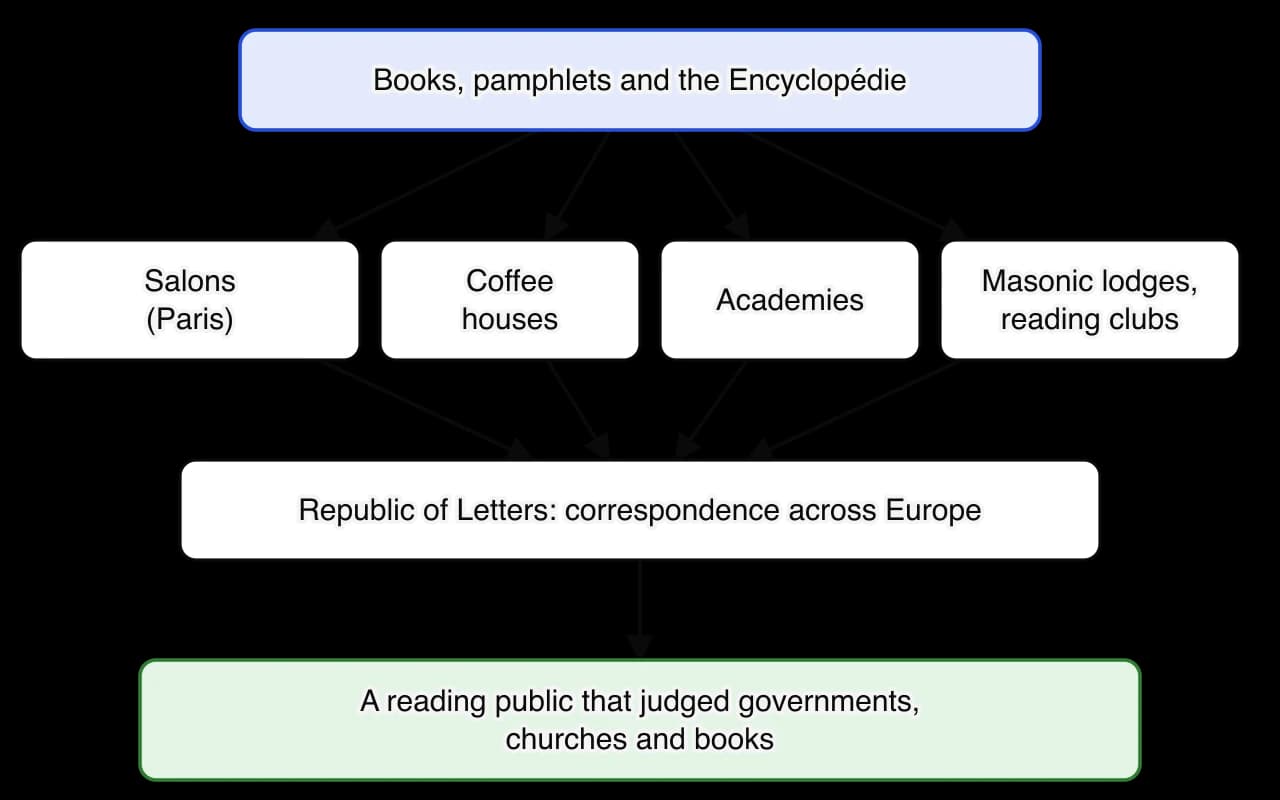
The philosophes, as the French writers called themselves, were therefore not isolated thinkers but public figures with a readership. That readership was still a minority: mostly urban, male, wealthy and literate. Most peasants, who were the great majority of Europeans, encountered the Enlightenment, if at all, through the reforms of their rulers.
 YouTube
Developments during the Enlightenment era
The Enlightenment was not only a movement of ideas. Between about 1680 and 1800 Europe’s economy, cities, science and farming changed in ways that gave the new ideas readers, subjects to discuss and practical tests. Change was uneven: fastest in Britain, the Dutch Republic and northern France, slowest in eastern Europe, where most peasants remained serfs.
Economic change
The fastest-growing part of the European economy was overseas trade. Sugar, tobacco, coffee, tea, cotton and dyes from the Americas and Asia became everyday goods for the middle ranks of society in Britain, France and the Dutch Republic. Much of this wealth rested on enslaved labour: over the whole history of the transatlantic slave trade about 12.5 million Africans were embarked for the Americas, about half of them in the eighteenth century. Atlantic ports such as Bristol, Liverpool, Nantes and Bordeaux grew rich on the trade.
New financial institutions served this trade and the wars of the great powers. The Bank of England (1694) lent to the government and gave Britain cheap and reliable credit. Speculation could also go badly wrong: in 1720 both John Law’s Mississippi Company in France and the South Sea Company in Britain collapsed after a frenzy of share buying, ruining thousands of investors and making the French crown distrust paper money for decades.
Proto-industry spread in Flanders, Silesia, northern England and other regions, giving peasant families a second income. In Britain from the 1760s it began to give way to machines and factories: James Hargreaves’ spinning jenny (about 1764), Richard Arkwright’s water frame (1769) and James Watt’s improved steam engine (patented 1769) were the first steps of the Industrial Revolution. Thomas Newcomen’s earlier steam engine (1712) was already pumping water out of mines. Joel Mokyr calls the culture of shared, useful knowledge behind these inventions the Industrial Enlightenment.
Social change and the growth of cities
Europe’s population grew from roughly 120 million in 1700 to about 190 million in 1800, after the plague disappeared from western Europe (the last major outbreak, in Marseille, was in 1720) and harvests improved. Most people still lived in villages, but the largest cities, especially capitals and ports, grew quickly.
City | Population c. 1700 | Population c. 1800 | Main reason for growth |
|---|---|---|---|
London | 575,000 | 865,000 | Capital, port and centre of Atlantic and Asian trade |
Paris | 510,000 | 581,000 | Capital of the most populous state in western Europe |
Naples | 216,000 | 427,000 | Capital of a kingdom ruled by Charles of Bourbon from 1734 |
Madrid | 110,000 | 167,000 | Seat of the Spanish court and government |
Berlin | 55,000 | 150,000 | Prussian capital, garrison and centre of state manufactures |
Data: Jan de Vries, European Urbanization 1500–1800 (1984). Figures are estimates, because few cities held censuses before 1800.
The figures show that court and capital cities grew fastest where a strong state concentrated officials, soldiers and the wealthy. Cities were where the new ideas circulated: they had printers, booksellers, coffee houses, theatres and the educated professionals who read the Encyclopédie. They also had crowded housing, high death rates and large numbers of poor migrants from the countryside.
Literacy rose, unevenly. A survey of French marriage registers made in the 1870s by the school inspector Louis Maggiolo found that the share of men able to sign their names rose from about 29 per cent in 1686–1690 to 47 per cent in 1786–1790, and of women from about 14 to 27 per cent. Signing a name is a rough measure, and the figures varied widely by region, but the direction of change is clear. Literacy was much higher in Protestant northern Europe, where reading the Bible was a religious duty, and much lower in Russia and southern Italy. Rising literacy, together with cheaper print, created the reading public on which the Enlightenment depended.
Scientific and technological developments
The eighteenth century turned the Scientific Revolution’s methods to new fields and to practical problems.
Classification: Carl Linnaeus, a Swedish botanist, created a system for naming and grouping plants and animals in Systema Naturae (1735), still the basis of scientific names.
Chemistry: Antoine Lavoisier showed in the 1770s and 1780s that combustion involves oxygen and established the conservation of mass.
Electricity: Benjamin Franklin’s experiments (1750s) showed that lightning is electrical and led to the lightning rod.
Navigation: John Harrison’s marine chronometer, tested at sea in 1761–1762, allowed ships to calculate longitude.
Flight: the Montgolfier brothers’ hot-air balloon carried people over Paris in 1783.
Medicine: inoculation against smallpox spread in Europe after the 1720s; Edward Jenner’s safer cowpox vaccination followed in 1796.
These advances strengthened the Enlightenment belief in progress: that knowledge accumulated and could be used to improve human life. Rulers took note. Catherine II was inoculated in 1768 to set an example to her subjects, and Charles III paid for botanical expeditions to Peru, Chile and New Spain to find useful plants.
Changes in agriculture
Most Europeans were peasants, so changes in farming affected more people than any other development of the age. The traditional open-field system, in which villagers farmed scattered strips and left a third of the land fallow each year, produced low yields. From the seventeenth century Dutch farmers and then English landowners developed more intensive methods, known together as the Agricultural Revolution.
New crops and rotations: turnips and clover, promoted in England by Viscount Townshend in the 1730s, replaced the fallow year in the Norfolk four-course rotation (wheat, turnips, barley, clover).
Tools: Jethro Tull’s seed drill (1701) sowed seed in rows, reducing waste.
Breeding: Robert Bakewell, from the 1760s, bred larger sheep and cattle by selecting the best animals.
Enclosure: in England, open fields and common land were fenced into compact private farms, increasingly through private Acts of Parliament after 1750.
The potato: a cheap and productive crop, encouraged by rulers in Prussia, France and elsewhere during the century.
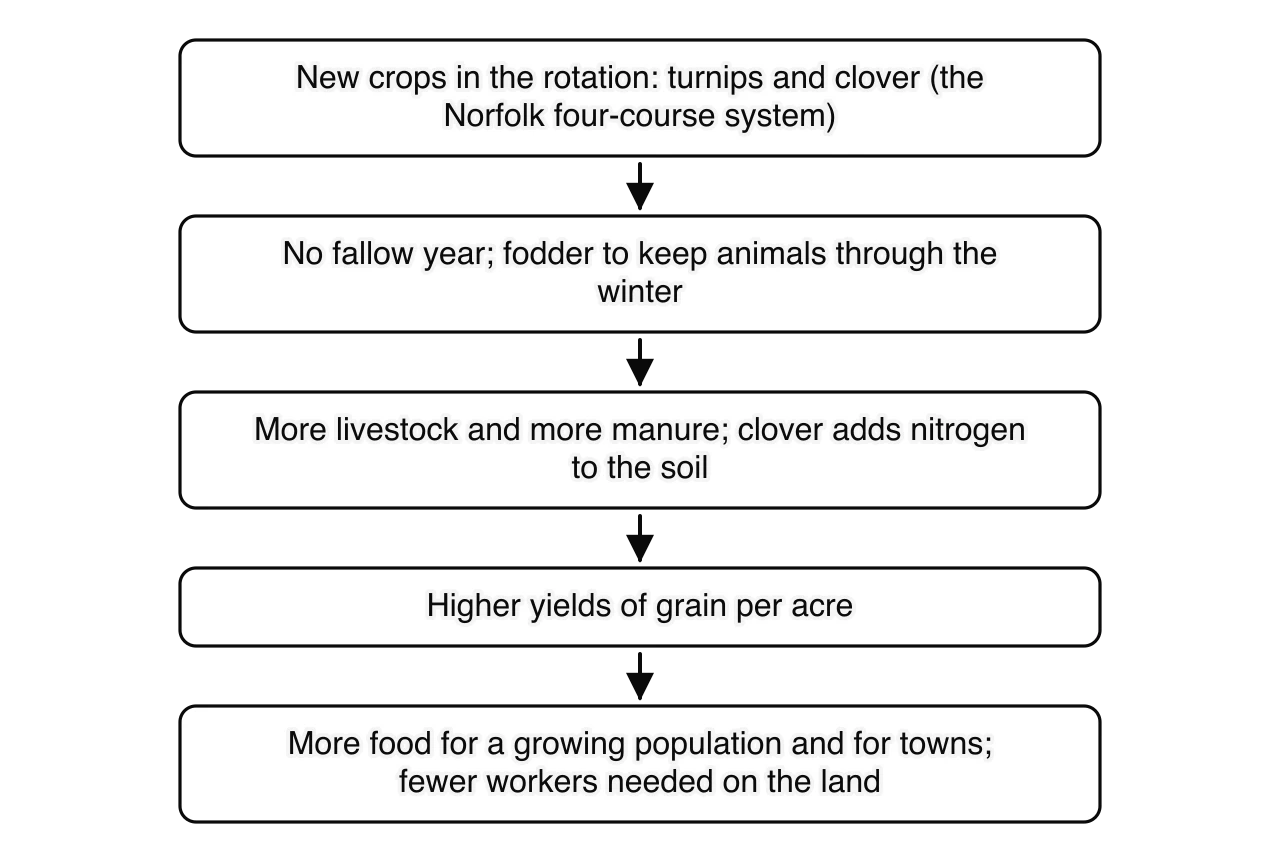
The gains were real but uneven. Enclosure raised the output of land, but small farmers and cottagers who lost their rights on the common often became landless labourers, and many moved to the towns. Writers such as Arthur Young, who toured England and France from the 1760s to the 1780s, publicised the new methods; the physiocrats in France argued that agriculture was the only true source of wealth. East of the Elbe, where landowners used serf labour on large estates, the new methods spread slowly, and higher grain prices often meant heavier labour services for peasants.
The impact of Enlightenment ideas
Enlightenment ideas affected politics, society, the economy and the position of women in different ways and to different degrees. In some places they inspired reforms by monarchs; in others, above all in North America and France, they were turned against monarchy itself.
Political ideas: opposition to absolute monarchy
The central political argument of the Enlightenment was that power must be limited and must serve the people it governs. Thinkers disagreed about how to achieve this.
When the legislative and executive powers are united in the same person, or in the same body of magistrates, there can be no liberty; because apprehensions may arise, lest the same monarch or senate should enact tyrannical laws, to execute them in a tyrannical manner. Again, there is no liberty, if the power of judging be not separated from the legislative and executive powers.
Montesquieu, The Spirit of the Laws, Book XI, chapter 6, 1748 (translated by Thomas Nugent, 1750). Montesquieu was a noble judge in the Parlement of Bordeaux, and his ideal of separation of powers drew on an idealised picture of the English constitution after his visit to England (1729–1731). His case for “intermediate powers”, such as noble courts, between king and people also defended his own class. The work was placed on the Catholic Index of Prohibited Books in 1751, yet Catherine II copied large parts of it into her Nakaz, which shows how the same text could serve both critics and rulers.
Rousseau went further. The Social Contract (1762) opens with the line “Man is born free; and everywhere he is in chains.” He argued that sovereignty belonged to the whole people and could not be handed to a king: laws were legitimate only if they expressed the general will, the common good that every citizen would choose if he thought as a member of the community. This idea of popular sovereignty was far more radical than Montesquieu’s balance of powers, and the French revolutionaries of 1789–1794 claimed it as their own.
Thinker | Key work | Political idea | Effect on absolute monarchy |
|---|---|---|---|
Thomas Hobbes | Leviathan (1651) | People give up their rights to an all-powerful sovereign to escape anarchy | Defended absolute power, but on the basis of a contract, not divine right |
John Locke | Two Treatises (1689) | Government by consent to protect life, liberty and property; a right to resist tyranny | Justified limiting or overthrowing kings |
Montesquieu | The Spirit of the Laws (1748) | Separation of legislative, executive and judicial power; laws suited to each country | Argued for checks on the monarch; used by both reformers and constitutionalists |
Voltaire | Letters on the English (1733–1734) | Toleration, free speech and reform, ideally by a strong enlightened ruler | Hoped kings would carry out reform; not a democrat |
Rousseau | The Social Contract (1762) | Sovereignty of the people; law as the general will | Denied that any king could hold sovereignty |
These ideas had their first great political test across the Atlantic. The American Declaration of Independence (1776) used Locke’s language of natural rights and consent, and the United States Constitution (1787) built in Montesquieu’s separation of powers. In France, Enlightenment ideas became one of the causes of the revolution of 1789; that story is a regional study of its own.
The idea of the enlightened despot
Many Enlightenment thinkers did not want democracy or even a parliament. They distrusted the uneducated majority and the privileged nobles and clergy alike, and hoped that a strong, well-informed monarch would sweep away privilege, superstition and inefficiency. Voltaire corresponded for decades with Frederick II and Catherine II in this hope. The physiocrat Pierre-Paul Le Mercier de la Rivière, in The Natural and Essential Order of Political Societies (1767), called for a “legal despotism” in which an absolute ruler would govern according to the natural laws of the economy; Catherine invited him to St Petersburg the same year.
The idea contained a contradiction that critics at the time already saw: reforms that were meant to free people from arbitrary power were imposed by a ruler with arbitrary power. A phrase later attributed to Joseph II, “everything for the people, nothing by the people”, sums up the approach.
Social ideas: equality and individual rights
Enlightenment social ideas started from the belief that all human beings share the same nature and reason, and that institutions should be judged by their effect on human happiness. In practice this led to campaigns on several fronts.
Equality before the law: thinkers attacked legal privilege, the different laws and courts for nobles, clergy and commoners. Few called for social or economic equality.
Criminal justice: Beccaria argued that punishment should be certain, proportionate and public, and that torture produced false confessions. Frederick II largely abolished judicial torture in 1740; Gustav III of Sweden in 1772; Maria Theresa in the Habsburg lands in 1776. Leopold of Tuscany, Joseph II’s brother, abolished the death penalty in 1786.
Religious toleration: Voltaire’s campaign for Calas and Locke’s Letter made toleration the most widely adopted Enlightenment cause. Joseph II’s Patent of Toleration (1781) and Louis XVI’s Edict of Versailles (1787), which gave French Protestants civil status, followed.
Jewish emancipation: the Prussian official Christian Wilhelm von Dohm argued in On the Civil Improvement of the Jews (1781) that Jews should have equal civil rights; Mendelssohn argued that Jews could keep their faith and share in German culture.
Slavery: Montesquieu satirised arguments for slavery (1748), and the Abbé Raynal’s History of the Two Indies (1770), with passages by Diderot, condemned colonial slavery. The Society for Effecting the Abolition of the Slave Trade was founded in London in 1787 and the Society of the Friends of the Blacks in Paris in 1788.
Education: Rousseau’s Émile (1762) argued that children should learn through experience, and several states introduced compulsory elementary schooling: Prussia in 1763, the Habsburg lands in 1774.
The commitment to universal rights had clear limits. Some leading thinkers, including Hume and Kant, wrote that Africans or other non-Europeans were naturally inferior, and the same century that produced the language of natural rights saw the Atlantic slave trade at its peak. Rights were usually imagined for property-owning men.
Economic ideas
Seventeenth-century governments followed mercantilism: they believed that the world’s wealth was fixed, that a state grew rich by exporting more than it imported, and that the government should protect industry with tariffs and monopolies. In the German and Habsburg lands this took the form of cameralism, a science of administration taught in universities from the 1720s that trained officials to increase the ruler’s revenue and population.
Two Enlightenment schools challenged mercantilism. The physiocrats, led by François Quesnay, physician to Louis XV, argued in the Tableau économique (1758) that land was the only source of new wealth, that the state should levy one single tax on land, and that trade in grain should be free. Their ally Anne-Robert-Jacques Turgot, controller-general of France from 1774 to 1776, freed the grain trade and abolished the guilds and the royal corvée (forced road labour), but privileged groups forced his dismissal and most of his reforms were reversed.
It is not from the benevolence of the butcher, the brewer, or the baker that we expect our dinner, but from their regard to their own interest. We address ourselves, not to their humanity, but to their self-love, and never talk to them of our own necessities, but of their advantages.
Adam Smith, An Inquiry into the Nature and Causes of the Wealth of Nations, Book I, chapter 2, 1776. Smith, a former professor of moral philosophy at Glasgow, wrote to persuade British statesmen to abandon mercantilist controls. The extract shows his central claim that the pursuit of self-interest in free markets, guided by competition, benefits society as a whole; elsewhere he called this the work of an “invisible hand”. He also argued that the division of labour raised productivity. The book became the foundation of the case for laissez-faire economics, though Smith himself accepted a role for government in defence, justice and public works.
Enlightened despots borrowed from all three traditions. Frederick II remained a mercantilist and cameralist who protected Prussian industries; Joseph II and Charles III freed some internal trade in physiocratic style; Catherine II welcomed physiocrats and economic societies but kept serfdom. Economic ideas were adopted where they promised more revenue, not as a complete system.
Women’s rights
Women took a visible part in the Enlightenment. The salonnières of Paris shaped which writers succeeded; Émilie du Châtelet translated Newton’s Principia into French (published 1759) with a commentary still used in France; Catherine II ruled the largest state in Europe and corresponded with its leading thinkers. Yet the movement’s ideas about women were mostly conservative.
Mary Astell, Some Reflections upon Marriage (1700), asked why, if absolute power was wrong in a state, it was right in a family.
Rousseau argued in Émile (1762) that women were naturally made to please men and run the home, and that a girl’s education (his character Sophie) should prepare her for that role. His views were widely admired.
The Marquis de Condorcet, in “On the Admission of Women to the Rights of Citizenship” (1790), argued that women had the same natural rights as men.
Olympe de Gouges answered the French revolutionaries’ Declaration of the Rights of Man with a Declaration of the Rights of Woman and of the Female Citizen (1791).
Mary Wollstonecraft, an English writer, published A Vindication of the Rights of Woman (1792).
“Educate women like men,” says Rousseau, “and the more they resemble our sex the less power will they have over us.” This is the very point I aim at. I do not wish them to have power over men; but over themselves.
Mary Wollstonecraft, A Vindication of the Rights of Woman, chapter 4, 1792. Wollstonecraft wrote in London during the French Revolution, in reply to French plans for a national education that would exclude girls, and she used the Enlightenment’s own standard of reason against Rousseau. Her claim that women were made inferior by education, not nature, was a minority view in her time. The extract shows that the Enlightenment gave women arguments for equal rights even when its leading men did not accept them.
Enlightened despotism: why rulers adopted Enlightenment ideas
In the second half of the eighteenth century several rulers presented themselves as pupils of the philosophes. They wrote to Voltaire and Diderot, quoted Montesquieu and Beccaria, and introduced reforms of law, religion, education and the economy. They also kept absolute power, fought long wars and used force against those who resisted them. Historians explain this combination in two main ways, shown in the diagram of the two drives behind enlightened despotism.
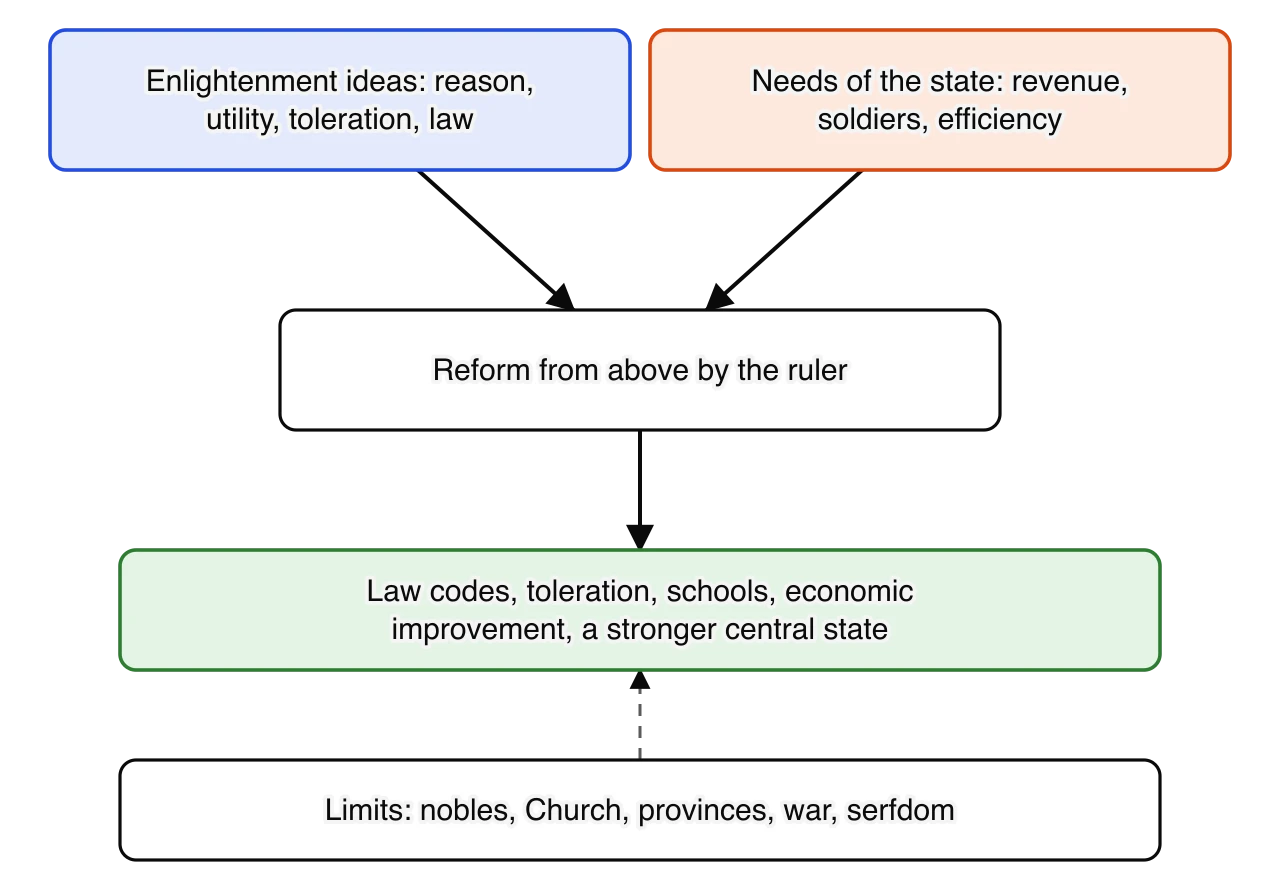
The first explanation stresses ideas: these rulers had read the philosophes and genuinely believed that rational reform would make their subjects happier. The second stresses the state: after the War of the Austrian Succession (1740–1748) and the Seven Years’ War (1756–1763), every great power needed more revenue, more soldiers and a more efficient administration, and Enlightenment ideas offered useful methods and a respectable justification. A third factor was the challenge from neighbours: Prussia’s seizure of Silesia in 1740 forced the Habsburgs to reform, and Russia’s defeats of the Ottomans pushed others to keep up. Most reforms show all three at work.
Frederick II of Prussia | Catherine II of Russia | Joseph II (Habsburg lands) | Charles III of Spain | |
|---|---|---|---|---|
Reign | 1740–1786 | 1762–1796 | Co-regent 1765–1780; sole ruler 1780–1790 | 1759–1788 (King of Naples 1734–1759) |
Route to power | Inherited from his father | Coup against her husband, Peter III | Inherited from his mother, Maria Theresa | Inherited from his half-brother, Ferdinand VI |
Enlightenment credentials | Anti-Machiavel; Voltaire at court; writer and musician | Nakaz; letters to Voltaire and Diderot | Toleration, abolition of serfdom; rationalist “Josephinism” | Reforming ministers; regalism; economic societies |
Main use of force | Army of up to 190,000; Junker officers | Guards; crushing of Pugachev’s rebellion | Army against the Austrian Netherlands and Hungary; police | Troops against the Madrid riots of 1766; colonial revolts |
Signature reform | Legal reform; toleration; schools (1763) | Provincial reform (1775); Charter to the Nobility (1785) | Patent of Toleration (1781); end of personal serfdom | Expulsion of the Jesuits (1767); free trade within the empire (1778) |
Main foreign aim | Seize and keep Silesia | Black Sea coast; Poland | Bavaria; Balkans; recover Silesia | Recover losses to Britain; secure the American empire |
 YouTube
Frederick II of Prussia (r. 1740–1786)
Frederick II, known as Frederick the Great, ruled Prussia for 46 years and turned a small, scattered kingdom into one of Europe’s great powers. He was also a philosopher-king by reputation: he wrote poetry and history in French, composed music for the flute, and invited Voltaire to his court. Both roles shaped his reign.
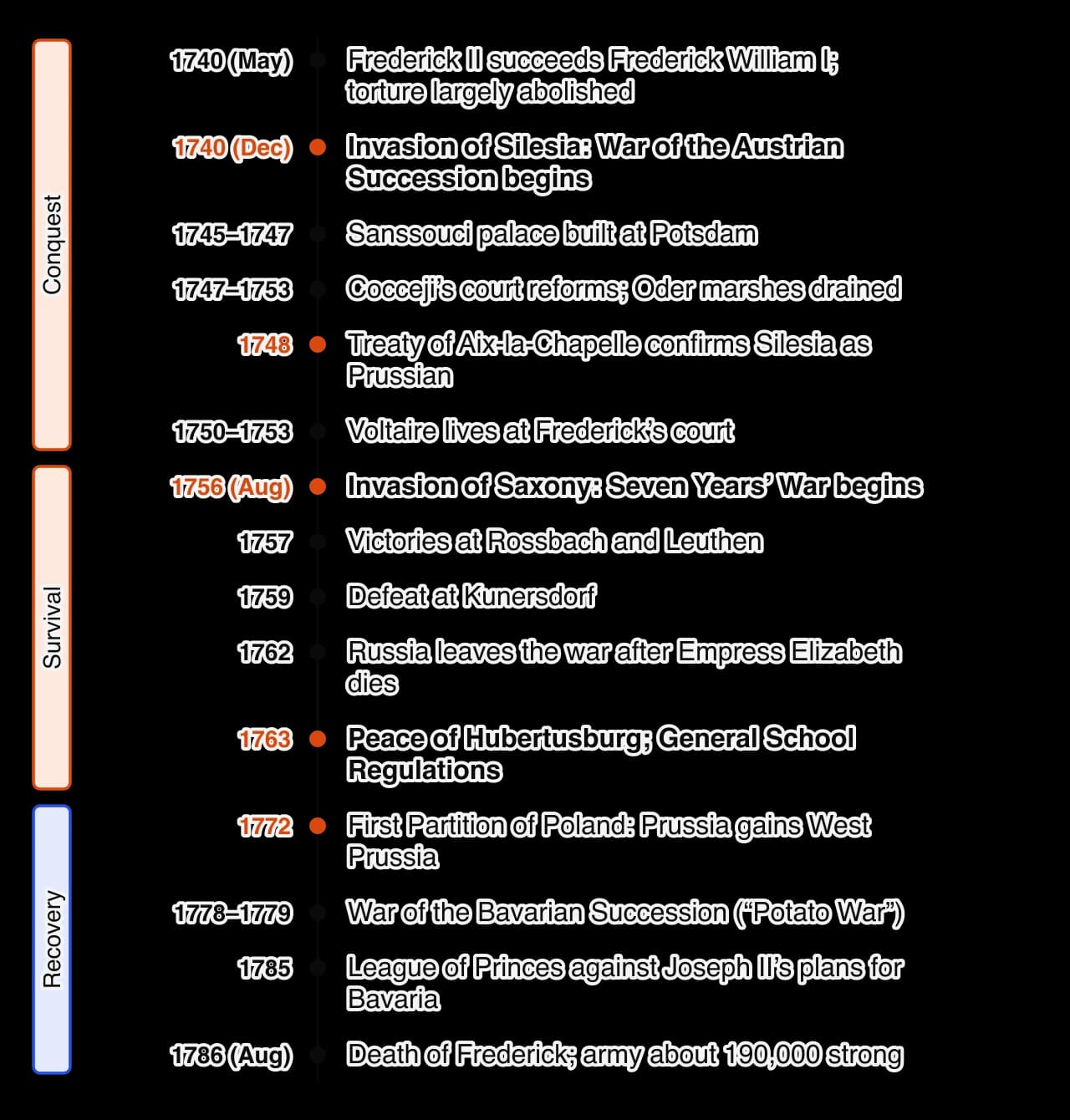
Prussia in 1740
Frederick inherited from his father, Frederick William I (r. 1713–1740), a state built for war. The kingdom’s lands were scattered from the Rhine to the Baltic, with about 2.2 million people, poor soil and no natural frontiers. Yet Frederick William had built an army of about 80,000 men, one of the largest in Europe for a state of its size, and a full treasury. The General Directory (1723) ran finances, the army’s supply and domestic administration from Berlin, and the cantonal system (1733) gave each regiment a district from which it recruited peasants. The Junkers, the landowning nobility, served as army officers and ruled their serfs as landlords; in return the crown left their estates largely alone.
Frederick’s youth had been unhappy. His father despised his love of music and French books, and in 1730, when the eighteen-year-old prince tried to flee abroad, he was imprisoned and forced to watch the execution of his friend and accomplice, Hans Hermann von Katte. Frederick emerged as a dutiful heir, but kept his intellectual interests.
Maintenance of power
Use of ideas to legitimise rule
Frederick justified his rule by duty, not divine right. In the Anti-Machiavel (1740), written as crown prince and edited for publication by Voltaire, he attacked Machiavelli’s advice that a prince should deceive and use cruelty. He described the king as the servant of the state, an idea he repeated throughout his life.
Rulers should always remind themselves that they are men like the least of their subjects. The sovereign is the foremost judge, general, financier, and minister of his country, not merely for the sake of his prestige. Therefore, he should perform with care the duties connected with these offices. He is merely the principal servant of the State.
Frederick II, Essay on the Forms of Government and on the Duties of Sovereigns, 1777 (translated by J. Ellis Barker in The Foundations of Germany, 1916). Frederick wrote the essay in French late in his reign, for an educated European readership and for his successors. As a source it shows how he legitimised absolute power through usefulness and service rather than divine right; it does not show that he shared power, since the “servant” still decided everything himself. Its value lies in showing the self-image he wanted to project.
Months after publishing the Anti-Machiavel, Frederick invaded Silesia without a declaration of war, an act Machiavelli would have recognised. Critics then and since have treated this as proof that his Enlightenment language was a cover for raison d’état; his defenders reply that he saw no contradiction, since a strong state was the precondition for any reform.
Centralisation of power
Frederick ruled through “cabinet government”. He rarely met his ministers; instead they sent written reports to his study at Potsdam, and he replied with brief written orders, often in the margin, drafted by his private secretaries. Every important decision passed through his hands, and he toured the provinces each year to inspect officials, fortresses and farms. This made the system efficient while he lived and dependent on his own energy, which was a weakness for his successors.
Use of force
The army was the foundation of Frederick’s power and took most of the state’s revenue. It grew from about 80,000 men in 1740 to about 190,000 by 1786, out of a population of around 5.5 million: among the largest armies in Europe in proportion to population. Discipline was brutal and many soldiers were foreign mercenaries or pressed men. Frederick tied the Junkers to the crown by reserving officer posts for them and by forbidding commoners to buy noble estates. Internally Prussia faced no serious revolt, and the army was used against foreign enemies rather than subjects.
Image and depiction
Frederick cultivated two images. One was the philosopher of Sanssouci (“without care”), the summer palace at Potsdam built in 1745–1747, where he played the flute, wrote in French and dined with Voltaire (who lived at his court from 1750 until their quarrel in 1753). The other was “Old Fritz”, the hard-working soldier-king in a worn blue uniform, who shared his soldiers’ hardships. After his death the second image dominated, and nineteenth-century German nationalists made him a hero of Prussian military power.
Domestic impact
Legal reform and modernisation
Three days after his accession, in June 1740, Frederick ordered that judicial torture be abolished except in cases of treason and mass murder; it was abolished entirely in the 1750s. His chancellor, Samuel von Cocceji, reformed the courts from 1747, cut the backlog of cases, and began work on a single law code for all Prussian lands. The code, the Allgemeines Landrecht (General Law Code), was completed only in 1794, after Frederick’s death. It recognised the rights of individuals before the law but also confirmed the separate legal status of nobles, burghers and peasants, so it modernised Prussian law without abolishing the society of orders.
The limits of the rule of law were shown in the Miller Arnold case of 1779. When a miller claimed that a noble landowner had cut off his water supply, the courts ruled against him; Frederick, convinced that the judges had favoured a noble, overturned the verdict and had the judges imprisoned. The king meant to protect the weak, but he did so by overriding his own courts.
Religious reform
Frederick, a sceptic in religion, practised toleration as both principle and policy. In a marginal note of June 1740 he declared that all religions must be tolerated and that each person should find salvation in his own way. He allowed a Catholic cathedral, St Hedwig’s, to be built in Protestant Berlin (1747–1773) for the Catholics of newly conquered Silesia, and welcomed religious refugees as settlers. Toleration had limits for Jews: the General Privilege of 1750 restricted their numbers, occupations and places of residence and taxed them heavily, while protecting wealthy Jewish merchants useful to the state.
Economic reform, agriculture and the environment
Frederick’s economic policy was cameralist and mercantilist, not physiocratic. The state founded or subsidised industries (silk in Berlin, porcelain, and the linen industry of Silesia), protected them with tariffs, and in 1772 set up the Seehandlung, a state trading company. After 1763 the treasury paid for rebuilding war-ravaged provinces, supplied seed and horses, and set up credit banks for noble landowners.
Frederick also changed the land itself. Between 1747 and 1753 engineers drained the marshes of the Oderbruch, the flood plain of the River Oder east of Berlin, by cutting a new river channel; the reclaimed land was settled with colonists from other German states and abroad. Frederick is reported to have said that he had conquered a province in peace. Similar projects drained the Warthe and Netze marshes, and the state settled tens of thousands of colonist families during the reign. The drainage turned wetlands rich in fish and birds into farmland, an environmental change historians such as David Blackbourn have described as the conquest of nature. In 1756 a royal order instructed officials to promote the cultivation of the potato, which helped Prussia survive the harvest failures of the 1770s.
These policies left the social structure untouched. Serfdom on Junker estates continued, and Frederick refused to abolish it because he needed noble officers and peasant soldiers. On crown lands he limited labour services, but on private estates peasants still owed heavy unpaid labour to their lords.
Education and the arts
The General School Regulations of 1763 required children aged 5 to 13 or 14 to attend school, although a shortage of teachers (often disabled veterans) and money meant rural schooling remained poor. Frederick revived the Berlin Academy of Sciences (1744) and brought French scholars to it, built an opera house in Berlin (opened 1742) and the New Palace at Potsdam (1763–1769). His patronage favoured French and Italian culture; the German writers who flourished in his reign, such as Gotthold Ephraim Lessing, did so with little help from him.
Foreign policy
Conflict and territorial disputes
Frederick’s reign began with an act of aggression. When Emperor Charles VI died in October 1740, his daughter Maria Theresa inherited the Habsburg lands under the Pragmatic Sanction of 1713, which Prussia had recognised. In December 1740 Frederick invaded Silesia, a rich Habsburg province of over a million people with a thriving linen industry, and the War of the Austrian Succession (1740–1748) followed. Prussian victories, beginning at Mollwitz in 1741, and the Treaty of Aix-la-Chapelle (1748) confirmed his conquest, increasing Prussia’s population by about half.
Maria Theresa’s determination to recover Silesia led to the Diplomatic Revolution of 1756, in which Austria, the old enemy of France, allied with France, while Prussia allied with Britain. Facing a coalition of Austria, France, Russia, Sweden and most of the Holy Roman Empire, Frederick struck first by invading Saxony in August 1756. The Seven Years’ War (1756–1763) brought brilliant victories (Rossbach and Leuthen, 1757) and near-destruction (Kunersdorf, 1759, after which Frederick wrote that all was lost; Russian troops briefly occupied Berlin in 1760). Prussia was saved when Empress Elizabeth of Russia died in January 1762 and her successor, Peter III, an admirer of Frederick, made peace. The Peace of Hubertusburg (1763) left Silesia in Prussian hands but the country devastated.
Diplomacy
After 1763 Frederick sought security through diplomacy rather than war. His alliance with Russia (1764) led to the First Partition of Poland in 1772, in which Prussia gained West Prussia (without the cities of Danzig and Thorn), joining Brandenburg to East Prussia. When Joseph II tried to acquire Bavaria in 1778, Frederick went to war to stop him: the War of the Bavarian Succession (1778–1779) involved almost no battles, and soldiers spent it foraging, which earned it the nickname “Potato War”. In 1785 Frederick formed the League of Princes (Fürstenbund) with other German rulers to block Joseph’s renewed plan to exchange the Austrian Netherlands for Bavaria, presenting Prussia as the protector of the smaller German states.
Commercial agreements, trade and colonial policy
Prussia had no overseas empire and Frederick showed little interest in one. He chartered an Asiatic Company at Emden (1751) to trade with China, which failed during the Seven Years’ War. His trade policy aimed at self-sufficiency, with tariffs to protect Prussian manufactures; the 1785 treaty of friendship and commerce with the new United States was among the first such treaties that country signed. The gain from Poland in 1772 had a commercial motive too, since it gave Prussia control of the lower Vistula, the route by which Polish grain reached the Baltic.
How far did Frederick’s reforms change Prussia? A summary of the evidence
Area | Change | Continuity |
|---|---|---|
Law | Torture ended; courts reformed; code begun (completed 1794) | Orders of society kept separate in law; king overrode judges (1779) |
Religion | Wide toleration for Christians; Catholic cathedral in Berlin | Jews restricted and heavily taxed |
Economy | Marshes drained; colonists settled; new industries; potatoes | Mercantilist controls; serfdom on noble estates |
Education and culture | Compulsory schooling (1763); Academy revived | Rural schools poor; patronage favoured French culture |
Power | A great power holding Silesia and West Prussia | Absolute rule; the army consumed most revenue |
Catherine II of Russia (r. 1762–1796)
Catherine II, known as Catherine the Great, was born Sophie of Anhalt-Zerbst, the daughter of a minor German prince. She came to Russia in 1744 to marry the heir to the throne, the future Peter III, converted to Orthodoxy and took the name Catherine. She ruled for 34 years, longer than any other woman in Russian history, and in that time the empire expanded to the Black Sea and deep into Poland.
Seizure of power and the problem of legitimacy
Peter III became emperor in January 1762 and quickly made enemies. He made peace with Prussia, giving up Russian conquests, prepared a war against Denmark for the sake of his German duchy of Holstein, and offended the Orthodox Church and the Guards regiments. On 28 June 1762 (Old Style; 9 July in the Western calendar), Catherine, with the help of the brothers Grigory and Alexei Orlov and officers of the Guards, had herself proclaimed empress in St Petersburg. Peter abdicated and was killed a week later in custody, officially of “colic”.
Catherine had no hereditary right to the throne: she was foreign-born and had a son, Paul, who had a stronger claim. Much of her reign can be read as an effort to build legitimacy by other means: through the support of the nobility and the Guards, through success abroad, and through a reputation as an enlightened lawgiver.
Maintenance of power
Use of ideas to legitimise rule
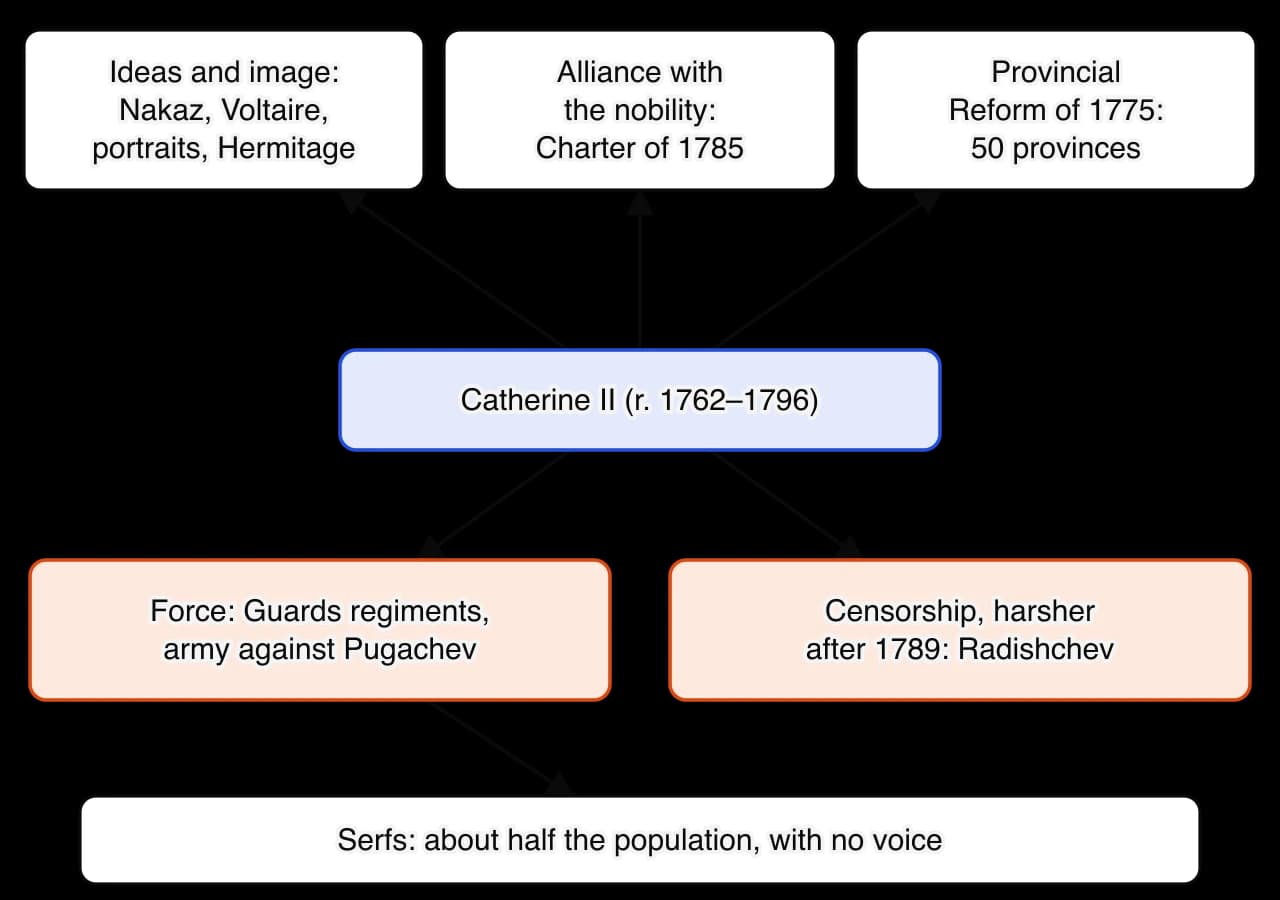
Catherine read Montesquieu, Voltaire and Beccaria, and corresponded with Voltaire from 1763 until his death in 1778. When Diderot needed money in 1765 she bought his library, let him keep it for life and paid him to look after it; he visited St Petersburg in 1773–1774. These philosophes in turn praised her across Europe as the “Semiramis of the North”, a reputation that helped a ruler who had seized the throne in a coup.
Her most ambitious use of Enlightenment ideas was the Nakaz (Instruction), a document of over 500 articles that she wrote herself in 1765–1767, borrowing heavily from Montesquieu and Beccaria. It was addressed to the Legislative Commission of 1767, an assembly of about 560 elected deputies (nobles, townspeople, state peasants, Cossacks and non-Russian peoples, but no serfs) called to draw up a new law code for the empire.
9. The Sovereign is absolute; for there is no other Authority but that which centers in his single Person, that can act with a Vigour proportionate to the Extent of such a vast Dominion. 10. The Extent of the Dominion requires an absolute Power to be vested in that Person who rules over it. … 123. The Usage of Torture is contrary to all the Dictates of Nature and Reason; even Mankind itself cries out against it, and demands loudly the total Abolition of it.
Catherine II, Instruction to the Legislative Commission (Nakaz), 1767, articles 9, 10 and 123 (English translation of 1768). The extract shows the two sides of Catherine’s rule in one document: Enlightenment principles taken from Beccaria sit beside a defence of absolute power, justified by Montesquieu’s argument that a vast empire needs one ruler. The Nakaz was published to impress Europe as much as to guide Russians; it was banned in France as too radical.
The Commission met in Moscow from July 1767 and held more than 200 sessions, but its members argued for the privileges of their own groups. Nobles wanted the exclusive right to own serfs; merchants wanted the same; no one spoke for the serfs. When war with the Ottoman Empire began in 1768 the Commission was adjourned, and the full assembly never met again. Catherine gained a great deal of information about her empire and a reputation for consulting her subjects, but no new code.
Image and depiction
Catherine was a skilful manager of her own image. She commissioned portraits that presented her as Minerva, goddess of wisdom, or as a lawgiver; she paid for the equestrian statue of Peter the Great by Étienne Falconet, unveiled in St Petersburg in 1782 and inscribed “To Peter the First from Catherine the Second”, which presented her as his heir in spirit if not by blood. Her art purchases from 1764 onwards, housed in the Hermitage next to the Winter Palace, made the Russian court a centre of European collecting.
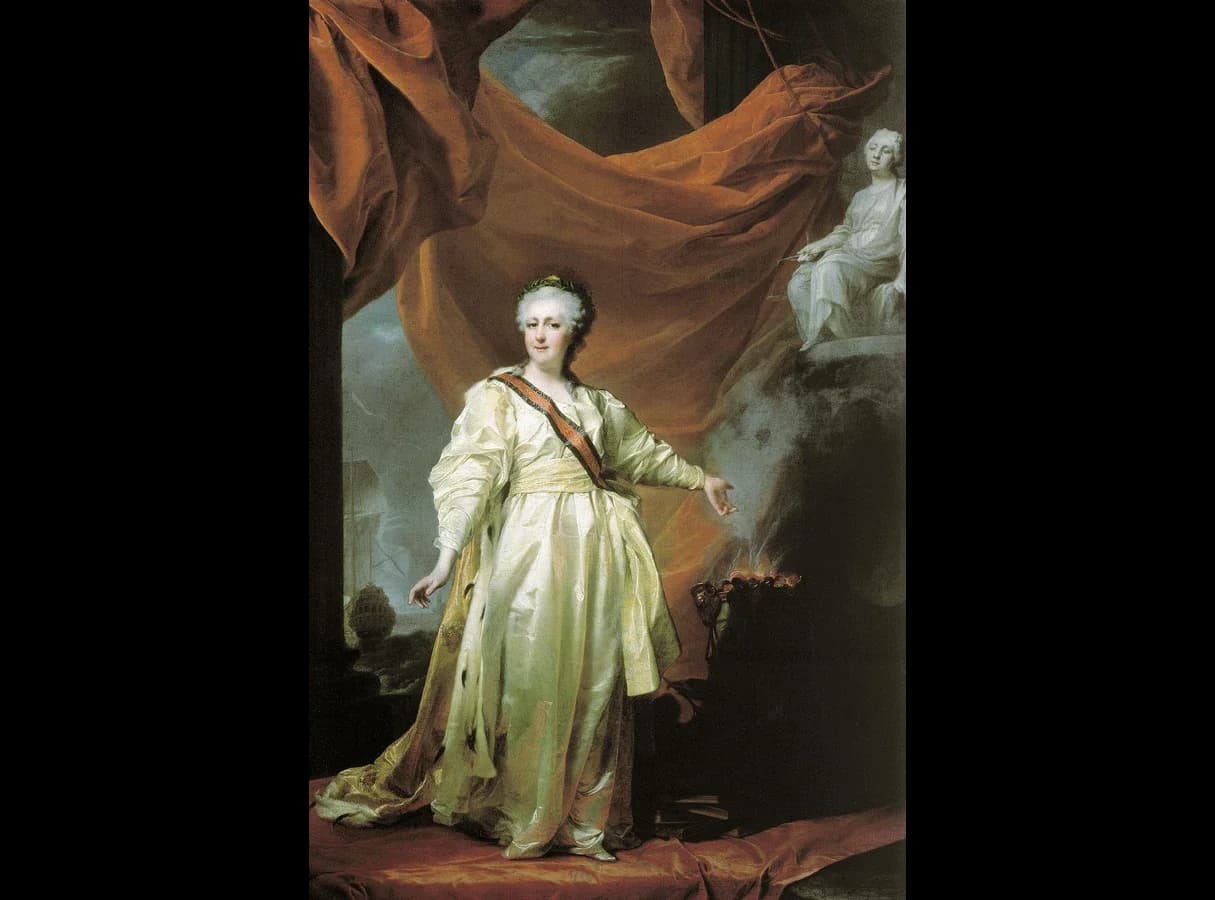
In 1787 she travelled to the newly annexed Crimea with foreign ambassadors and Joseph II, on a journey organised by her favourite and chief minister in the south, Grigory Potemkin. The later story that Potemkin built fake villages along the route to deceive her is largely a legend spread by his enemies, but the journey itself was a piece of political theatre meant to show Europe the success of her rule.
Centralisation of power
Catherine reorganised the Senate into departments in 1763 and kept the central government under her control through a small group of trusted officials. Her most important administrative reform came after Pugachev’s rebellion had shown how thinly Russia was governed. The Provincial Reform of 1775 divided the empire into provinces (guberniia) of 300,000–400,000 inhabitants, each split into districts, with about 50 provinces by the end of the reign. Each had a governor, courts and officials for finance, welfare and police, many of them filled by elected local nobles. The reform multiplied the number of officials and brought government closer to the provinces, but it relied on the nobility to run it.
The Charter to the Nobility of 1785 sealed this partnership. It confirmed that nobles were free from compulsory state service, personal taxation and corporal punishment, could be tried only by their peers, and could own land and serfs; it also organised them into district and provincial assemblies. A Charter to the Towns of the same year gave townspeople a limited form of self-government. Catherine strengthened the state by making the nobles its partners.
Use of force
Russia’s peasants paid for this partnership. In 1767, the same year as the Nakaz, a decree forbade serfs to petition the empress against their masters.
should make bold to submit unlawful petitions complaining of their landlords, and especially to petition Her Imperial Majesty personally, then both those who make the complaints and those who write up the petitions shall be punished by the knout and forthwith deported to Nerchinsk to penal servitude for life
Decree of the Governing Senate on serfs, 1767 (translated in G. Vernadsky, ed., A Source Book for Russian History, 1972). The decree was to be read aloud in every church, so it was aimed at peasants who could not read. Set beside the Nakaz, it shows the gap between the language Catherine used for European readers and the orders her government gave at home.
The greatest challenge to her rule came from Pugachev’s Rebellion (1773–1775). Emelian Pugachev, a Don Cossack and army deserter, claimed to be Peter III, miraculously saved, and promised freedom from serfdom, taxes and conscription. Cossacks of the Yaik River, Bashkirs and other non-Russian peoples, workers in the Ural ironworks and serfs of the Volga region joined him; his followers killed hundreds of landowners and officials and burned the city of Kazan in July 1774. Once peace with the Ottomans freed the army, regular troops defeated the rebels. Pugachev was betrayed by his own Cossacks, taken to Moscow in a cage and executed in January 1775. Catherine renamed the Yaik River the Ural, to erase its memory.
After the French Revolution of 1789, Catherine’s tolerance of criticism ended. Alexander Radishchev, a noble official, was sentenced to death in 1790 (commuted to exile in Siberia) for his Journey from St Petersburg to Moscow, which described the cruelty of serfdom. The publisher and Freemason Nikolai Novikov was imprisoned in 1792 without trial.
Domestic impact
Political, administrative and legal reform
Catherine’s administrative reforms of 1775 and 1785 lasted until the 1860s and gave Russia a more effective provincial government. Legal reform was more limited. Torture was restricted but not formally abolished until 1801; the law code promised in 1767 was never completed. Her government did, however, create courts for the separate estates (nobles, townspeople and state peasants) and “conscience courts” to settle disputes by conciliation.
Religious reform
In 1764 Catherine secularised the lands of the Orthodox Church: monasteries lost their estates, the peasants on them (about a million males) became state peasants paying dues to the treasury, and the clergy became salaried state employees. This continued Peter the Great’s subordination of the Church to the state. She tolerated the Old Believers, a dissident Orthodox group long persecuted, and in 1788 established the Orenburg Muslim Spiritual Assembly, an official body to govern the empire’s Muslims under state supervision. Jews, who came under Russian rule with the partitions of Poland, were restricted from 1791 to the western provinces, the origin of the later Pale of Settlement.
Social and economic reform, agriculture and the environment
Catherine encouraged economic improvement on Enlightenment lines. The Free Economic Society (1765) promoted modern farming methods and held essay competitions, including one on whether peasants should own property. She abolished most state monopolies, allowed anyone to set up small industries (1775), and issued Russia’s first paper money, the assignats, in 1769, which helped pay for the wars but caused inflation. A manifesto of 1763 invited foreign colonists; tens of thousands of Germans settled along the Volga. New lands in the south (“New Russia”) were opened for farming, and new towns such as Kherson (1778), Sevastopol (1783) and Odessa (1794) were founded. Ploughing up the steppe grasslands and settling them with farmers changed the environment of southern Ukraine permanently.
For the majority of Russians the reign meant more servitude, not less. Serfdom was extended to Ukraine in 1783, and Catherine gave hundreds of thousands of state peasants as gifts to her favourites and officials, which made them private serfs. Serfs made up about half the population, and landlords could sell them, punish them and send them to Siberia.
Education and the arts
In education Catherine founded the Smolny Institute for noble girls in 1764, Russia’s first state school for women, and the Statute of National Schools of 1786 set up schools in provincial and district towns, though by the end of her reign they taught only about 20,000 pupils in an empire of over 30 million. She set an example in public health by being inoculated against smallpox in 1768 by the English doctor Thomas Dimsdale. In the arts she built on a grand scale in the neoclassical style, collected paintings, wrote plays and satirical journals herself, and encouraged Russian literature.
Foreign policy
Conflict and territorial disputes
Catherine’s foreign policy was the most successful of any of the enlightened despots, measured by territory: Russia gained about 520,000 square kilometres (some 200,000 square miles). It had two main directions, south against the Ottoman Empire and west into Poland.
First Russo-Turkish War (1768–1774): Russian armies took Moldavia and Wallachia, and a Russian fleet sailed from the Baltic to destroy the Ottoman navy at Chesme in the Aegean (1770). The Treaty of Küçük Kaynarca (1774) gave Russia a foothold on the Black Sea coast, made the Crimean Khanate independent of the Ottomans, gave Russian merchant ships access to the Black Sea and the Straits, and allowed Russia to speak for Orthodox Christians in the Ottoman Empire.
Annexation of the Crimea (1783): Russia annexed the Crimean Khanate outright and built a naval base at Sevastopol. The same year the Treaty of Georgievsk made the Georgian kingdom of Kartli-Kakheti a Russian protectorate.
Second Russo-Turkish War (1787–1792): with Austria as ally from 1788, Russia captured Ochakov (1788) and Izmail (1790). The Treaty of Jassy (1792) moved the border to the River Dniester.
War with Sweden (1788–1790): Gustav III attacked while Russia was at war in the south; the Treaty of Värälä (1790) restored the pre-war borders.
In the west, Catherine first controlled Poland through influence, securing the election of her former lover Stanisław August Poniatowski as king in 1764. When Russian intervention provoked a Polish revolt and threatened war with Austria, she agreed with Frederick II and Maria Theresa on the First Partition of 1772, in which each power took a slice of Polish territory. The Second (1793, with Prussia) and Third (1795, with Prussia and Austria) Partitions followed the Polish reform Constitution of 3 May 1791 and the rising led by Tadeusz Kościuszko in 1794, and removed Poland from the map altogether.
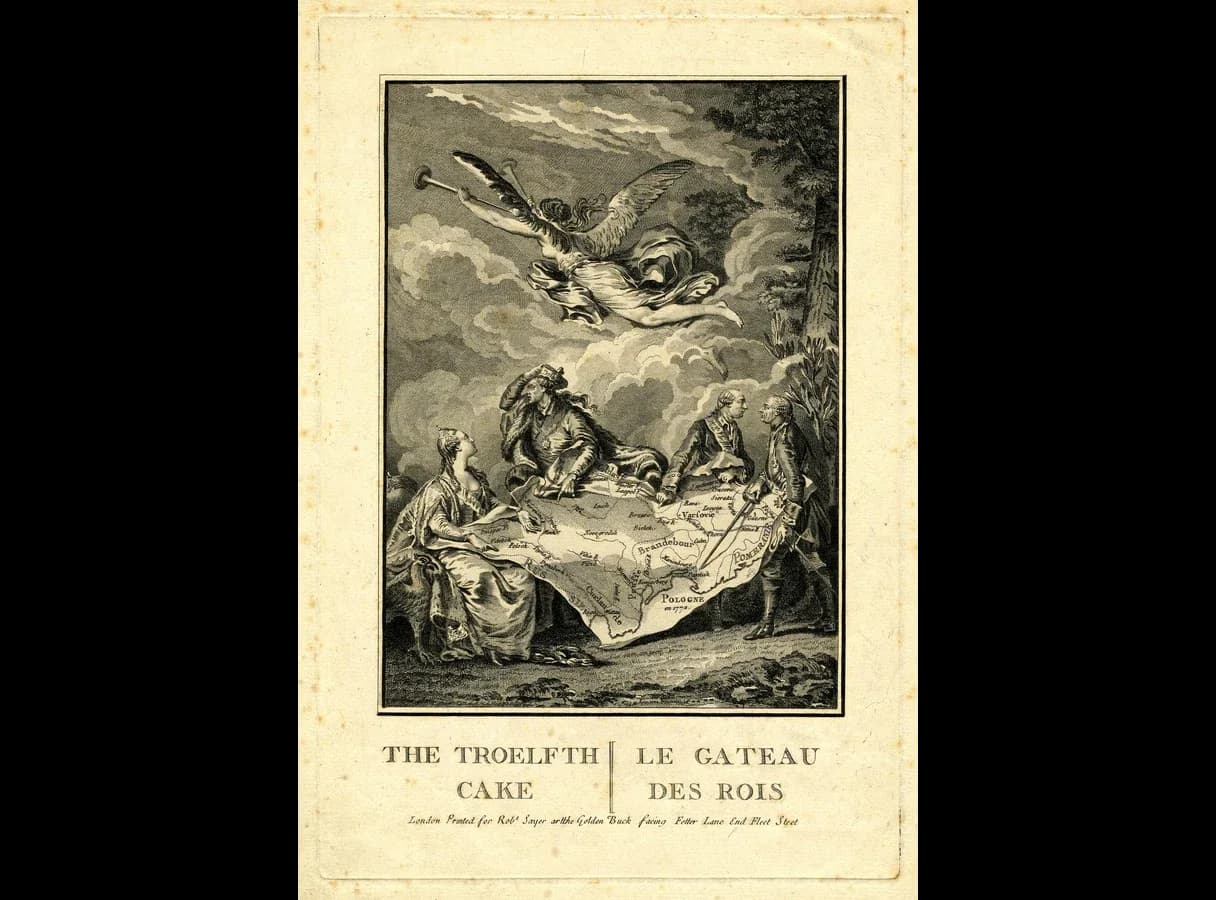
The table of the three partitions shows how each power took the lands nearest its own borders. Over the three partitions Russia’s share was by far the largest in area, while in 1772 Austria’s gain, Galicia, held the most people.
Partition | Russia | Prussia | Austria |
|---|---|---|---|
First (1772) | Eastern Belarus and Polish Livonia | West Prussia, except Danzig and Thorn | Galicia, with Lviv (Lemberg) |
Second (1793) | Central Belarus and Ukraine west of the Dnieper | Danzig, Thorn and Great Poland (Posen) | None |
Third (1795) | Lithuania, Courland and the rest of the east | Warsaw and the land around it | Kraków and the land around it |
Diplomacy, commerce and colonial policy
Catherine’s diplomacy combined alliances of convenience: with Prussia from 1764, with Austria from 1781 (through private letters with Joseph II), and the “Greek Project” of the early 1780s, a plan with Joseph to divide the Ottoman Balkans and restore a Greek empire at Constantinople under her grandson, named Constantine for the purpose. It came to nothing. During the American War of Independence she proclaimed the League of Armed Neutrality (1780), which Denmark, Sweden and later others joined, to protect neutral shipping from British searches, a step that raised Russia’s standing as a European power.
A commercial treaty with Britain (1766) secured Russia’s main market for timber, hemp, flax and iron, and a treaty with France followed in 1787. The Black Sea gains opened a southern grain trade through Kherson and later Odessa. Russia’s only overseas colony was on the far side of the Pacific: the merchant Grigory Shelikhov founded a permanent settlement on Kodiak Island in Alaska in 1784, the beginning of Russian America.
Joseph II of the Habsburg Monarchy (co-regent 1765–1780; sole ruler 1780–1790)
Joseph II is often seen as the purest example of an enlightened despot: the ruler who tried hardest to govern by reason, and who failed most visibly. He ruled the lands of the Habsburg Monarchy, a collection of territories with different laws, languages and assemblies: the Austrian lands, Bohemia and Moravia, Hungary, Galicia, the Austrian Netherlands (modern Belgium) and Lombardy. He was also Holy Roman Emperor from 1765, a title with prestige but little power.
The inheritance of Maria Theresa
Joseph’s mother, Maria Theresa (r. 1740–1780), had already begun reform, driven by the loss of Silesia to Prussia. Her minister Friedrich Wilhelm von Haugwitz centralised the administration and taxation of the Austrian and Bohemian lands from 1749; the General School Ordinance of 1774 made elementary schooling compulsory; patents of the 1770s limited the robot, the unpaid labour that peasants owed their lords, after a peasant revolt in Bohemia in 1775. She was a devout Catholic who disliked the philosophes, so historians usually call her a reformer rather than an enlightened ruler. From 1765 Joseph was co-regent, responsible mainly for the army, and often frustrated by his mother’s caution. When she died in November 1780 he was free to act.
Maintenance of power
Use of ideas to legitimise rule
Joseph shared the Enlightenment’s faith in reason and utility more than its interest in liberty. He saw himself as the first official of the state, bound to serve the general welfare, and justified his reforms by their usefulness to the state and to his subjects. Unlike Frederick and Catherine he had little interest in winning praise from the philosophes, and on his journey through France in 1777 he passed Voltaire’s home at Ferney without stopping to call on him. His legitimacy rested on his hereditary right; he used Enlightenment ideas less to justify holding power than to justify how he used it.
Centralisation of power
Joseph aimed to turn his varied lands into one centralised state, governed by uniform laws through a single bureaucracy in Vienna. He refused to be crowned King of Hungary, which would have required him to swear to respect the rights of the Hungarian nobility, and in 1784 had the Holy Crown of Hungary taken to Vienna. In the same year he made German the language of administration throughout his lands, including Hungary, where Latin had been used. Provincial diets lost most of their powers, and new districts run by royal officials replaced the old county administration in Hungary. To Joseph, these measures were rational simplification; to Hungarian and Belgian nobles, they were attacks on ancient constitutional rights.
Use of force and surveillance
Joseph relied on the army and the bureaucracy rather than on terror, but he expanded state surveillance. A police network directed by Count Johann Anton Pergen watched officials and reported on public opinion, and became more important as opposition grew in the late 1780s. When the Austrian Netherlands revolted in 1789, imperial troops were sent against the rebels and were driven out.
Image and depiction
Joseph rejected the splendour of Versailles. He dressed in a simple military uniform, cut court ceremonial, opened the imperial parks of the Prater (1766) and the Augarten (1775) in Vienna to the public, and travelled widely under the name “Count Falkenstein” so that he could inspect his lands and meet ordinary people informally. He received petitions from subjects in person. The image was of a hard-working, accessible servant of the state, though many of his subjects found him cold and impatient.
Domestic impact
Religious reform
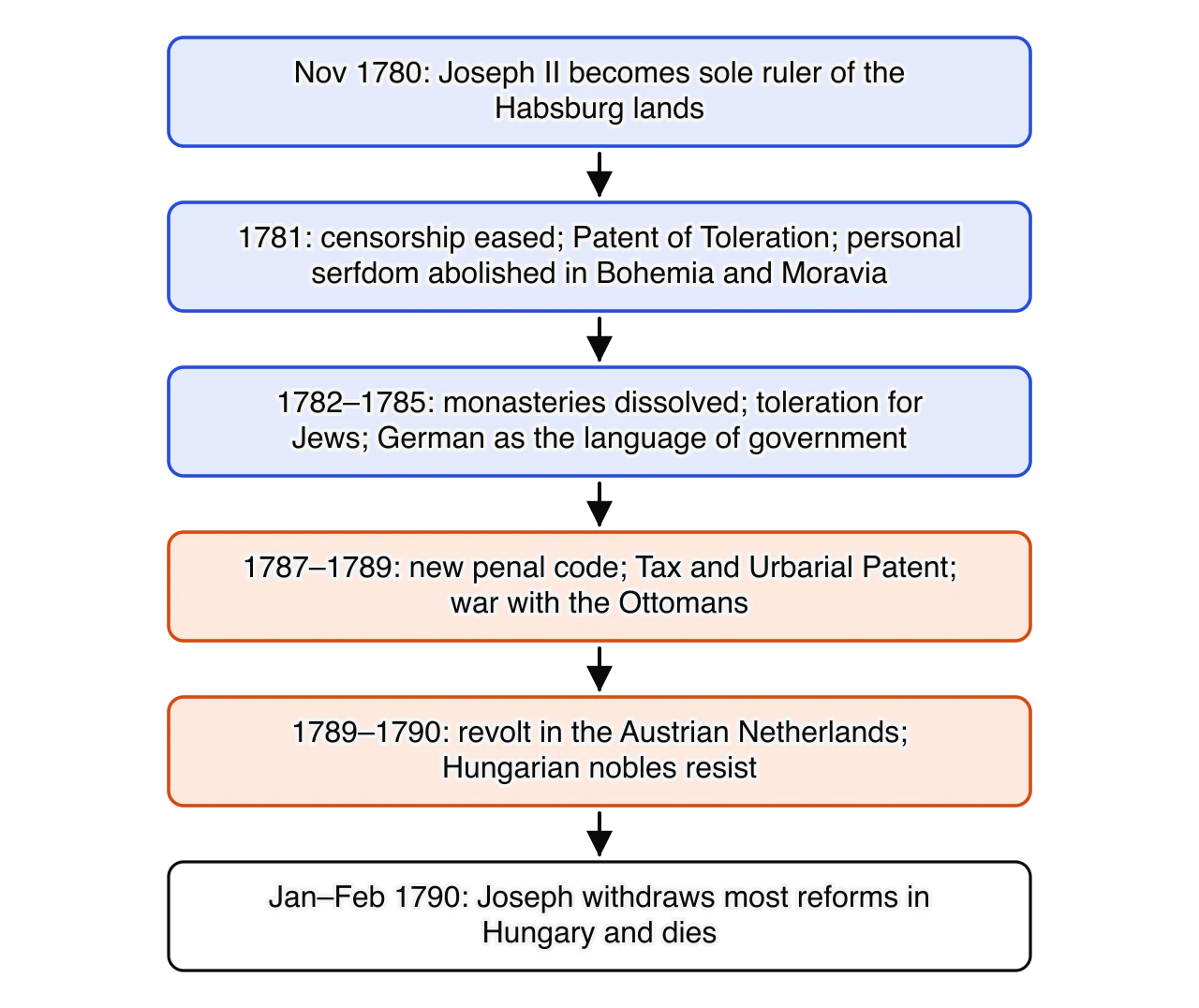
Joseph’s religious reforms were the boldest of any Catholic ruler of the century. The Censorship Patent of June 1781 relaxed censorship, and in October 1781 came the Patent of Toleration.
Being convinced, on the one hand, that all violence to conscience is harmful, and, on the other, of the great benefit accruing to religion and to the State from a true Christian tolerance, We have found Ourselves moved to grant to the adherents of the Lutheran and Calvinist religions, and also to the non-Uniat Greek religion, everywhere, the appropriate private practice of their faith … The Catholic religion alone shall continue to enjoy the prerogative of the public practice of its faith.
Joseph II, Patent of Toleration, 13 October 1781 (translated by C.A. Macartney). The patent was a public decree addressed to Joseph’s subjects (“My dear Lieges!”), and its language is practical as well as principled: it justifies toleration by its “benefit” to the state as well as by conscience. Later clauses limited it: Protestant churches could have no bells, towers or street entrances, and Catholicism stayed the ruling faith. Even so, it let Protestants and Orthodox Christians buy property, enter the guilds and hold public office, and tens of thousands of hidden Protestants declared themselves.
Edicts of Toleration for Jews followed for Bohemia (1781) and for Vienna and Lower Austria (January 1782). Jews could now attend schools and universities, enter trades and wear ordinary clothing instead of the distinguishing marks required before; but they had to use German in business records, and limits on their numbers in Vienna remained.
Joseph also reshaped the Catholic Church to make it useful to the state. From 1782 he dissolved monasteries of the purely contemplative orders, which did not teach, nurse or preach: about 700 houses, roughly a third of the total by contemporary counts, were closed. Their wealth went into a Religious Fund that paid for hundreds of new parishes so that no one lived more than an hour’s walk from a church. State-run General Seminaries (1783) replaced diocesan seminaries for training priests, so that the clergy would learn obedience to the state. Joseph regulated church services down to the number of candles, and the Marriage Patent of 1783 made marriage a civil contract. Pope Pius VI travelled to Vienna in 1782 to plead with him, without success.
Social, legal and economic reform, agriculture and the environment
The Serfdom Patent of November 1781 abolished personal serfdom (Leibeigenschaft) in Bohemia and Moravia, later extended to the other lands and in 1785 to Hungary. Peasants could now marry, move, learn a trade and send their children to school without their lord’s permission, though they still owed labour services for their land. The Tax and Urbarial Patent of February 1789 went further: it abolished the robot for peasants who paid the land tax and set a single tax on all land, noble or peasant, based on a new land survey.
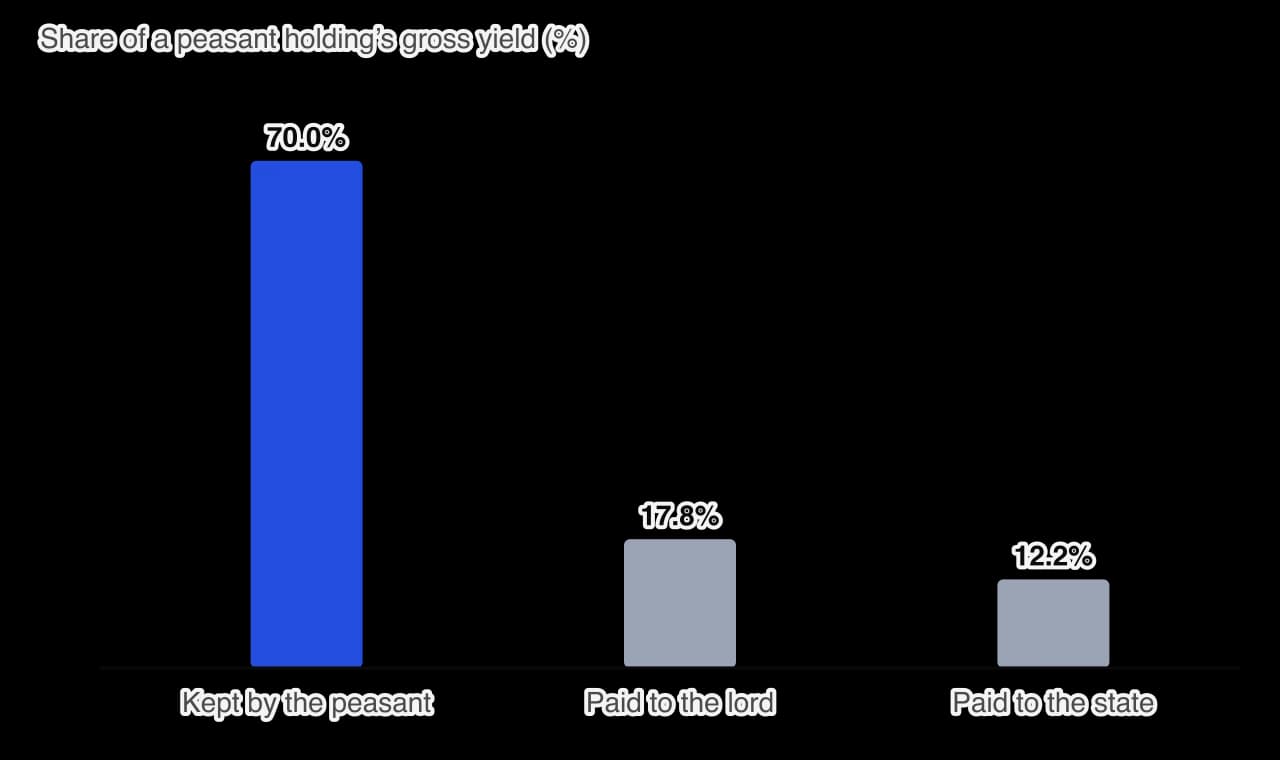
The Tax and Urbarial Patent would have transferred a large share of income from lords to peasants and the state, as the chart of the division of a peasant holding’s yield shows. Nobles across the monarchy protested, many peasants found the money payments harder to meet than labour, and the patent was withdrawn by Joseph’s successor Leopold II in 1790. It was the most radical attempt by any eighteenth-century monarch to change the relationship between lords and peasants.
Joseph’s other reforms followed the same rational, centralising pattern. His penal code of 1787 abolished the death penalty in ordinary criminal cases, though it replaced it with punishments such as hauling barges along the Danube, which killed many convicts. He founded the General Hospital in Vienna (1784), with a separate tower for the mentally ill, and a medical academy for army surgeons. In the economy he removed internal tariffs between his Austrian and Bohemian lands, raised tariffs against foreign goods (1784), and weakened guild monopolies. Encouraging trade through Trieste and settling colonists on newly drained or uncultivated land in Hungary and Galicia continued his mother’s population policy.
Developments in the arts
Joseph was a keen musician and made the Burgtheater in Vienna a national theatre (1776) for German-language plays and, from 1778, German opera. Mozart’s The Abduction from the Seraglio (1782) was written for it, and Joseph allowed The Marriage of Figaro (1786), based on a play banned in France, to be performed once its political speeches were cut. Vienna under Joseph became the musical capital of Europe, but his cost-cutting also closed court institutions and reduced patronage.
Resistance and the collapse of 1789–1790
By 1789 Joseph faced resistance in almost every part of his lands. Catholics resented the attack on monasteries and pilgrimages; nobles resented the tax and robot reforms and the loss of provincial rights; Hungarians resented German and centralisation. In the Austrian Netherlands, where Joseph had abolished the old provincial institutions in 1787, the Brabant Revolution of late 1789 expelled the Austrian army and proclaimed the United Belgian States in January 1790. Hungary was close to revolt. On 28 January 1790, dying of tuberculosis, Joseph withdrew almost all his reforms in Hungary except the Patent of Toleration, the abolition of serfdom and the reforms affecting the parish clergy. He died on 20 February 1790.
Foreign policy
Conflict and territorial disputes
Joseph wanted to restore Habsburg power after the loss of Silesia, and he looked for territory to make his lands more compact. He took part with his mother, who disapproved, in the First Partition of Poland (1772), which gave the Habsburgs Galicia with over two million people. In 1778 he tried to acquire much of Bavaria when its ruling line died out, but Frederick II went to war to stop him, and the Peace of Teschen (1779) gave Austria only the small Innviertel. A second plan in 1784–1785, to exchange the distant Austrian Netherlands for Bavaria, was blocked by Frederick’s League of Princes.
His alliance with Catherine II drew him into her second war against the Ottoman Empire in 1788. The Austrian army of about 250,000 suffered heavily from disease in the Danube marshes, and the war went badly at first, though Field Marshal Laudon captured Belgrade in October 1789. The war drained the treasury and forced the government to demand more taxes and recruits just as opposition to the reforms peaked. Joseph’s successor made peace at Sistova (1791) and returned Belgrade.
Diplomacy
Joseph’s diplomacy rested on the alliance with France (since 1756), sealed by the marriage of his sister Marie Antoinette to the future Louis XVI in 1770, and from 1781 on a secret alliance with Russia, arranged through private letters with Catherine. The Russian alliance gave him a partner against Prussia but tied him to Russian ambitions in the Balkans.
Commercial agreements, trade and colonial policy
Joseph tried to use trade to strengthen his lands. In 1784 he demanded that the Dutch reopen the River Scheldt, closed to shipping since 1648, so that Antwerp in the Austrian Netherlands could revive as a port; when the Dutch fired on an imperial ship, the dispute, known as the Kettle War, ended with a payment from the Dutch and the river still closed (Treaty of Fontainebleau, 1785). Habsburg colonial ventures were small: an Imperial Asiatic Company based at Trieste sent ships to India and China, and an expedition under William Bolts, sailing under the imperial flag, set up short-lived trading posts on the Nicobar Islands and at Delagoa Bay in south-east Africa in the late 1770s.
Charles III of Spain (r. 1759–1788)
Charles III came to the Spanish throne in 1759, aged 43, with long experience of government. A son of Philip V, the first Bourbon king of Spain, he had ruled the Duchy of Parma and then, from 1734, the Kingdom of Naples and Sicily, where he built the Teatro San Carlo (1737) and the palace of Caserta (begun 1752) and sponsored the excavations at Herculaneum and Pompeii. When his half-brother Ferdinand VI died childless, he left Naples to his son and became king of Spain and its vast American and Philippine empire.
Maintenance of power
Use of ideas to legitimise rule
Charles was a pious Catholic, a creature of routine who spent much of his day hunting, and no philosopher. His enlightened reputation came from his ministers, whom he chose and supported: the Italian Marquis of Esquilache (finance, from 1759), the Count of Aranda (president of the Council of Castile, 1766–1773), the lawyer Pedro Rodríguez de Campomanes, and the Count of Floridablanca (chief minister from 1777). They believed in reform from above to make Spain prosperous and powerful again, and justified it by utility and the authority of the crown.
Centralisation of power
Charles’s government strengthened the crown’s control over Spain’s regions and over the Church. Royal intendants, restored in the Spanish provinces from 1749, supervised taxation and the economy; the Council of Castile became the chief instrument of reform; and royal officials reformed town councils by adding elected representatives of the commoners after 1766. In the empire, the same aims produced the Bourbon reforms described under foreign and colonial policy.
Use of force
Reform provoked one serious revolt in Spain. In March 1766, after a poor harvest had pushed up the price of bread and Esquilache had banned long capes and wide-brimmed hats (which, the government claimed, hid criminals), crowds in Madrid rioted for several days. The king fled to Aranjuez and dismissed Esquilache, but then restored order with troops and gave Aranda wide powers. Disturbances spread to dozens of other towns. The government blamed the Jesuits for stirring up the riots, which became one reason for their expulsion the following year.
Image and depiction
Charles presented himself as a father of his people and an improver. He was later remembered as “the best mayor of Madrid” for transforming his capital: paved and lit streets, a sewage system, the Puerta de Alcalá (1778), the botanical garden (1781) and the building begun in 1785 for a natural history museum that later became the Prado. Painters such as Anton Raphael Mengs, Giovanni Battista Tiepolo, who decorated the ceilings of the new royal palace, and later Francisco Goya, who painted Charles in hunting dress in the 1780s, served the court. The image was of a modest, hard-working and devout king, not of a philosopher.
Domestic impact
Religious reform
The most dramatic act of the reign was the expulsion of the Jesuits. A royal decree of February 1767, published as a Pragmatic Sanction on 2 April, ordered all members of the Society of Jesus out of Spain and its empire; the king said only that he kept his reasons to himself. About 5,000 Jesuits, roughly half of them from the Americas, were shipped to the Papal States. Spanish ministers saw the order as loyal to the pope rather than the crown, powerful in universities and missions, and behind the riots of 1766. Spain then joined France and Portugal, which had already expelled the Jesuits, in pressing Pope Clement XIV, who dissolved the order in 1773.
Charles’s ministers also limited the Inquisition, which could no longer ban books without a hearing or act without royal approval, and reduced the number of clergy and religious houses. They did not abolish it: the Inquisition tried and condemned Pablo de Olavide, the reforming official in charge of the Sierra Morena colonies, in 1778. Spain under Charles III remained an officially Catholic state without religious toleration.
Economic reform, agriculture and the environment
Campomanes argued that Spain’s decline came from idleness, privilege and restrictions on trade. The government:
freed the internal trade in grain from price controls (1765), a physiocratic measure that also contributed to the price rises of 1766;
encouraged the founding of Economic Societies of Friends of the Country, local associations of nobles, clergy and professionals that promoted better farming, crafts and schools, starting with the Basque society (1765) and the Madrid society (1775);
declared in 1783 that manual trades were honourable and did not prevent a man from holding office or a noble title;
founded the Banco de San Carlos (1782), Spain’s first national bank, and built roads and canals such as the Imperial Canal of Aragon;
settled around 6,000 German and Flemish Catholic colonists in new villages in the empty Sierra Morena of Andalusia from 1767, under Olavide, to bring uncultivated land into production;
sponsored scientific expeditions to study the plants and natural resources of the Americas.
Spain’s population grew to about 10.4 million by the census of 1787, and trade and some industries expanded. But the great estates of the nobility and Church, and the privileges of the sheep-farmers’ guild, the Mesta, were barely touched, and attempts at land reform in Andalusia and Extremadura achieved little. Historians such as John Lynch judge that the reforms improved administration and revenue more than they changed Spanish society.
Foreign and colonial policy
Conflict, territorial disputes and diplomacy
Charles’s foreign policy was shaped by rivalry with Britain, which threatened Spain’s American empire and held Gibraltar and Minorca. In 1761 he signed the Third Family Compact with Bourbon France and entered the Seven Years’ War in 1762, too late to help. The British captured Havana and Manila in 1762; to recover them at the Treaty of Paris (1763) Spain gave up Florida, while France compensated it with Louisiana. Later conflicts included a crisis with Britain over the Falkland Islands (1770), when France refused to support Spain and Charles backed down; a failed attack on Algiers (1775); and a war with Portugal over the Río de la Plata settled by the Treaty of San Ildefonso (1777).
The American War of Independence gave Charles his revenge. Spain entered the war against Britain in 1779 as France’s ally, though it never formally allied with the rebellious colonies, fearing the example they set to its own. Bernardo de Gálvez, governor of Louisiana, captured British posts along the Mississippi and Pensacola (1781); a Franco-Spanish force took Minorca (1782); but the great siege of Gibraltar (1779–1783) failed. The Treaty of Versailles (1783) returned Florida and Minorca to Spain.
Colonial policy and commerce
Charles’s ministers set out to make the American empire pay. These measures, known as the Bourbon reforms, were driven by José de Gálvez, who carried out an inspection of New Spain (Mexico) in 1765–1771 and was Minister of the Indies from 1776 to 1787.
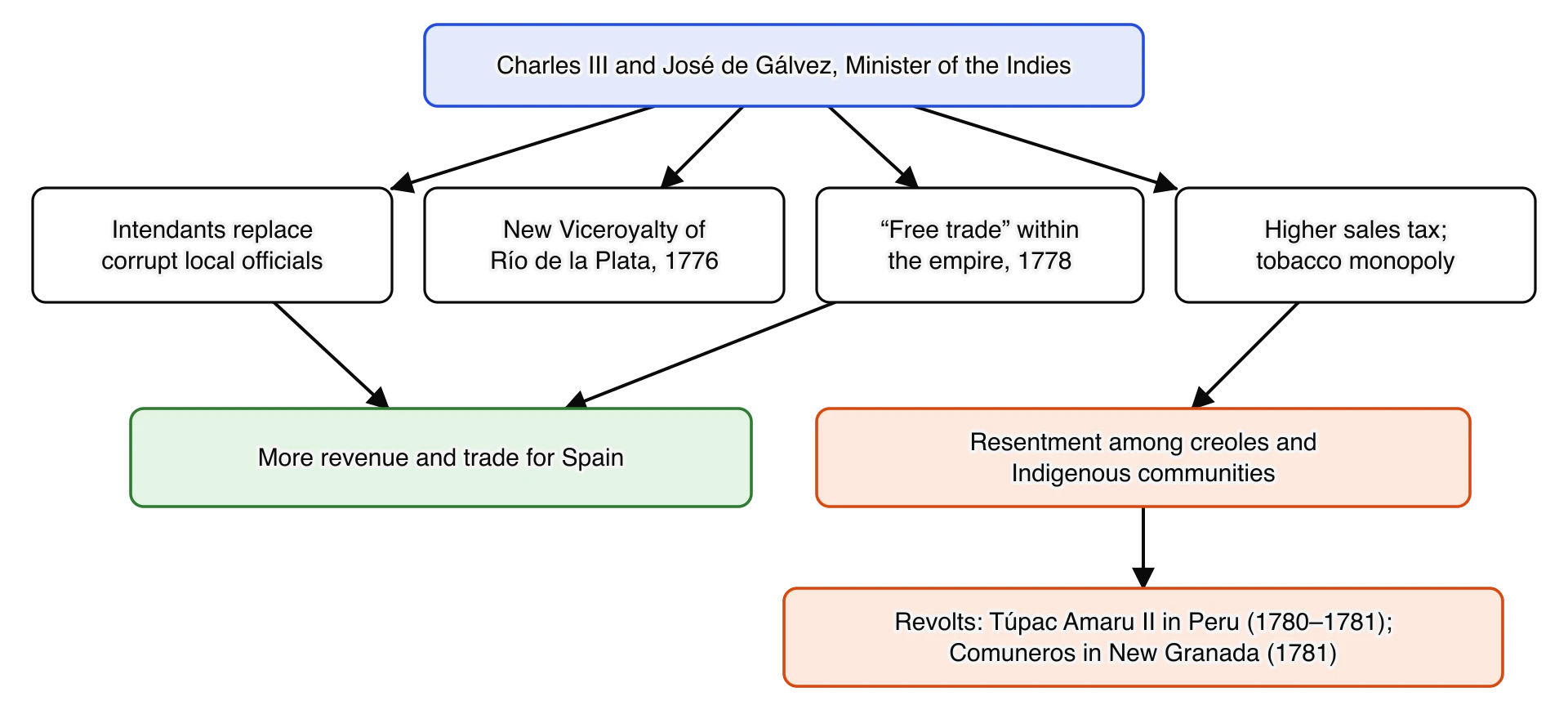
Administration: intendants replaced local officials who had bought their posts, and more Spanish-born officials (peninsulares) were appointed in place of American-born creoles. A new Viceroyalty of the Río de la Plata (1776), centred on Buenos Aires, strengthened defence against Portugal and Britain.
Trade: the decree of comercio libre (1778) ended the monopoly of Cádiz and allowed more Spanish and American ports to trade with each other, still within the empire. Trade between Spain and America grew sharply in the following decade.
Taxes and defence: higher sales taxes, more efficient collection and royal monopolies on tobacco and spirits raised revenue; colonial militias were expanded.
Frontier expansion: to block Russian and British advances on the Pacific coast, Spain founded missions and forts in Alta California from 1769, beginning at San Diego.
Revenue from the Americas rose substantially, but the reforms alienated colonial subjects. In Peru, the rebellion of Túpac Amaru II (1780–1781), a descendant of the Inca rulers, drew tens of thousands of Indigenous people into a revolt against forced labour, tax collection and the abuses of local officials; it was crushed with great loss of life on both sides. In New Granada the Comuneros revolt of 1781 opposed new taxes. Many historians see creole resentment at the reforms as one long-term cause of Spanish American independence; that story belongs to the independence movements of the Americas.
Comparing the enlightened despots
The four rulers faced different problems and chose different paths, but the comparison shows common patterns. Each kept absolute power; each adopted the parts of the Enlightenment that strengthened the state; each went furthest where reform brought revenue, soldiers or efficiency, and stopped where it threatened the groups on whom the throne depended.
Question | Frederick II | Catherine II | Joseph II | Charles III |
|---|---|---|---|---|
How did ideas legitimise rule? | “First servant of the state”; philosopher-king image | Lawgiver of the Nakaz; praise of the philosophes made up for a weak claim | Duty and utility; little interest in the philosophes’ praise | Reforming ministers; Catholic piety; regalism |
Relationship with nobles | Partnership: officer corps, serfdom kept | Partnership: Charter of 1785, serfdom extended | Confrontation: tax, robot, provincial rights | Accommodation: great estates untouched |
Religious policy | Wide toleration (limited for Jews) | Church lands secularised; toleration of Old Believers and Muslims | Toleration for Protestants, Orthodox, Jews; monasteries dissolved | Jesuits expelled; Inquisition limited, not abolished |
Most lasting reform | Legal code (1794); a great-power state | Provincial government (1775) | Toleration; end of personal serfdom | Administrative and colonial reform |
Foreign policy outcome | Silesia and West Prussia gained | Black Sea coast, Crimea, most of eastern Poland | Galicia; costly Ottoman war; Bavaria blocked | Florida and Minorca regained; empire tightened, then shaken by revolt |
The table suggests a general judgement. Rulers who worked with their nobles, such as Frederick and Catherine, kept their thrones secure and made selective changes; the ruler who confronted the privileged orders, Joseph II, attempted the most and saw much of it collapse. Enlightened despotism was therefore most successful where it was least radical.
Perspectives and debates: what was the Enlightenment?
Historians have long disagreed about the nature of the Enlightenment: whether it was one movement or many, who took part, and how radical it was.
Historian | Work | Argument | Evidence stressed |
|---|---|---|---|
Peter Gay | The Enlightenment: An Interpretation (2 vols, 1966–1969) | A single, unified movement, a “party of humanity” of philosophes who combined classical learning with science to free people from religion | The writings of the leading French, British and German thinkers |
Roy Porter and Mikuláš Teich (eds) | The Enlightenment in National Context (1981) | Many Enlightenments, each shaped by its own country’s religion and politics; in Protestant and Catholic states it was often moderate and religious | Scottish, German, Italian and other national movements |
Robert Darnton | The Literary Underground of the Old Regime (1982); The Forbidden Best-Sellers of Pre-Revolutionary France (1995) | The ideas reached readers mainly through cheap, scandalous and illegal books, written by poor “Grub Street” hacks rather than famous philosophes | Records of publishers, smugglers and police |
Jürgen Habermas | The Structural Transformation of the Public Sphere (1962) | A new bourgeois public sphere of print, coffee houses and clubs allowed public opinion to judge rulers | Coffee houses, newspapers, reading societies |
Dena Goodman | The Republic of Letters (1994) | Women who ran salons governed the Republic of Letters, giving discussion its rules | The Paris salons of Geoffrin, Lespinasse and Necker |
Jonathan Israel | Radical Enlightenment (2001) and later volumes | A “radical” current from Spinoza, which rejected religion and monarchy, mattered more than the moderate mainstream |
These views are partly complementary. Gay describes the ideas of the leading thinkers; Darnton, Habermas and Goodman show how the ideas reached people and who shaped them; Porter and Teich show that the movement varied from country to country, which matters for understanding why enlightened despots could adopt it. Israel’s thesis remains controversial: critics argue that he overstates the influence of Spinoza and underestimates the moderate, religious Enlightenment.
Perspectives and debates: absolutism and enlightened despotism
How absolute was absolutism?
Older histories took absolute monarchs at their word. From the 1980s historians questioned this. William Beik, in Absolutism and Society in Seventeenth-Century France (1985), showed that Louis XIV ruled in Languedoc through a partnership with provincial elites, who gained offices, pensions and protection in return for cooperation. Nicholas Henshall, in The Myth of Absolutism (1992), went further and argued that the label misleads: continental monarchs governed through consultation and consent much like the English kings. Others reply that the claim to sole sovereignty, the standing army and the absence of representative assemblies made these monarchies genuinely different from Britain.
Was there such a thing as enlightened despotism?
The term itself was coined in the nineteenth century; the German economist Wilhelm Roscher popularised “enlightened absolutism” in 1847 as the last stage in the development of monarchy. Since then three main interpretations have emerged.
Interpretation | Historians | Argument | Evidence stressed |
|---|---|---|---|
Ideas mattered | Derek Beales (Joseph II, 1987 and 2009); Isabel de Madariaga (Russia in the Age of Catherine the Great, 1981) | Rulers such as Joseph II and Catherine II genuinely tried to apply Enlightenment ideas, within the limits of their societies | Joseph’s toleration and serfdom reforms; Catherine’s Nakaz and education policy |
Power politics | H.M. Scott (ed.), Enlightened Absolutism (1990); T.C.W. Blanning (Joseph II and Enlightened Despotism, 1970; Joseph II, 1994) | Reform was driven above all by the needs of war and the fiscal-military state; Enlightenment ideas supplied language and methods | Reforms that followed defeat (Austria after 1748 and 1763; Spain after 1763); army budgets |
Continuity | John Lynch (Bourbon Spain 1700–1808, 1989); historians of Prussian state-building | Much “enlightened” reform continued earlier state-building by absolutist rulers, and results were limited by nobles, churches and provinces | Prussian state-building since 1640; Maria Theresa’s reforms; Spanish reforms since 1700 |
Each interpretation fits some rulers better than others. The power-politics view explains Frederick II and Charles III well: their reforms raised revenue and strengthened the army and administration, and they ignored Enlightenment ideas that threatened their allies. The ideas view fits Joseph II best, since many of his reforms (toleration, the tax and robot patent) cost him support and money. Catherine II sits between them. Most historians now accept that ideas and state power were intertwined: the Enlightenment itself prized useful, efficient government, so a reform could be both enlightened and in the interest of the state.
Applying the ideas in exam questions
Paper 3: the emergence of Enlightenment ideas
Paper 3: maintenance of power by one enlightened despot
Paper 3: domestic impact of one enlightened despot
Paper 3: foreign policy of one enlightened despot
Paper 3: developments in the Enlightenment era
Self-check
- To do:
I can define absolutism and divine right, and explain how Louis XIV ruled and why historians debate how absolute he was.
- To do:
I can explain how ancient ideas, the Renaissance and the Scientific Revolution influenced Enlightenment thought.
- To do:
I can explain the political and religious conditions in which Enlightenment ideas emerged, including the wars of religion, the English revolutions and the demand for toleration.
- To do:
I can identify the leading Enlightenment thinkers, their main works and dates, and how their ideas spread through print, salons, coffee houses and the Republic of Letters.
- To do:
I can describe the economic, social, scientific and agricultural developments of the eighteenth century and judge how far they changed Europe.
- To do:
I can explain the political, social and economic ideas of the Enlightenment and their impact, including opposition to absolute monarchy and the idea of the enlightened despot.
- To do:
I can assess what the Enlightenment meant for women, using Astell, Rousseau, Condorcet, de Gouges and Wollstonecraft.
- To do:
I can explain how one enlightened despot maintained power through ideas, centralisation, force and image.
- To do:
I can assess the domestic impact of one enlightened despot in law and administration, religion, the economy, agriculture and the environment, and the arts.
- To do:
I can assess the foreign policy of one enlightened despot: wars and territorial disputes, diplomacy, commerce and colonial policy.