Notes on R4.11 The USSR and post-Soviet Russia (1945–2020)
In 1945 the Soviet Union emerged from the Second World War as one of two superpowers, ruled by a single party and a dictator. Over the next 75 years it rebuilt, reformed, stagnated, collapsed and gave way to a Russian Federation that tried democracy and then returned to authoritarian rule. The story raises some of the central questions of modern history: how one-party states keep power, why they reform, and why reform can bring them down.

The timeline of 1945–2020 shows the six leaders who dominated the period. Andropov (1982–1984) and Chernenko (1984–1985), whose short rule linked Brezhnev to Gorbachev, are treated with the Brezhnev era.
The USSR in 1945: the cost of victory
The Soviet Union bore the heaviest losses of any country in the Second World War, which Soviet people called the Great Patriotic War (1941–1945). The figure usually cited today is about 27 million Soviet dead, soldiers and civilians together, about one in seven of the pre-war population. Earlier official totals were far lower: Stalin admitted 7 million, and Khrushchev raised the figure to 20 million. The higher number comes from demographic studies published after 1990.
Area | The damage in 1945 |
|---|---|
People | About 27 million dead; about 25 million homeless; millions disabled |
Population balance | A huge shortage of men: the census of 1959 still counted about 20 million more women than men |
Towns and villages | Official Soviet figures: 1,710 towns and about 70,000 villages destroyed |
Industry and transport | Factories, mines and railways of the occupied west wrecked; the Dnieper dam blown up; much industry moved east to the Urals and Siberia in 1941–1942 |
Agriculture | Livestock herds and farm machinery devastated; collective farms short of men, horses and tractors |
Data: Soviet Extraordinary State Commission (1945) for destruction; population figures from post-1990 Russian demographic studies.
Victory also brought power and prestige. The Red Army stood in Berlin, Vienna and Prague, and the USSR gained territory in the Baltic, eastern Poland, Bessarabia and the Far East. Many Soviet citizens hoped that the sacrifices of the war would be rewarded with a more relaxed regime, an end to collective farms or more freedom to speak. Stalin’s response to these hopes shaped the years from 1945 to 1953.
Post-war reconstruction under Stalin, 1945–1953
The Fourth Five-Year Plan, 1946–1950
Stalin set out his priorities in a speech to voters in Moscow in February 1946, during elections to the Supreme Soviet. He told them that the war had been no accident of mistakes by individual statesmen.
Actually, the war was the inevitable result of the development of world economic and political forces on the basis of modern monopoly capitalism.
Joseph Stalin, speech to the voters of the Stalin electoral district of Moscow, 9 February 1946 (translation in For Peaceful Coexistence: Post War Interviews, 1951). The argument was standard Leninism, but its domestic message was clear to listeners: if capitalism made war inevitable, the USSR had to rebuild heavy industry and defence first and could not relax. Consumers would again come second.
The Fourth Five-Year Plan (1946–1950) did exactly this. Investment went into coal, steel, electricity, railways and armaments. The Dnieper dam and the steelworks of the Donbas were rebuilt, and official figures claimed that industrial output passed its 1940 level by 1948 and exceeded the plan by 1950. Western economists accept that heavy industry recovered fast, though the official claims were exaggerated.
Reconstruction drew on three sources beyond the labour of ordinary workers:
Reparations. Whole factories were dismantled in the Soviet occupation zone of Germany, in Austria, Hungary, Romania and Manchuria and shipped east, along with machinery, rails and raw materials. Much of this equipment rusted in sidings because it arrived without plans or spare parts.
Forced labour. Prisoners of the Gulag, deported “special settlers” and enemy prisoners of war built canals, railways, mines and the new cities of the far north.
The countryside. Collective farms were made to deliver grain at fixed low prices, and peasants received little or nothing in return. Agriculture got a small share of investment.
The famine of 1946–1947
In 1946 drought struck Ukraine, Moldavia and the Volga region, on top of wartime losses of men, horses and machinery. The state kept collecting grain for its reserves and for export to Eastern Europe, and it cut the number of people entitled to ration cards. The result was the last great famine in Soviet history. The economist Michael Ellman estimates that about 1 to 1.5 million people died of hunger and related disease in 1946–1947. As in 1932–1933, the famine was never acknowledged in public.
Peasants were the losers of reconstruction. A decree of September 1946 took back land that collective farmers had added to their private plots during the war, and taxes on private plots and livestock rose. Grain output did not reach its pre-war level until the early 1950s, and in 1953 there were fewer cattle in the USSR than in 1928.
Currency reform and the end of rationing
In December 1947 the government ended rationing and carried out a currency reform. Cash was exchanged at ten old roubles for one new one, while savings bank deposits were exchanged on better terms. The reform wiped out the cash savings of peasants and of traders who had done well on wartime markets. Prices in state shops fell in a series of cuts from 1947 to 1954, which the regime advertised loudly, but shops often had little to sell.
Forced labour at its peak
The Gulag reached its largest size in the years after the war, as the chart of the camp population shows. Hundreds of thousands were sentenced under the decrees of June 1947, which gave terms of seven to twenty-five years for theft of state or collective property, even of small amounts of grain. Others came from the newly annexed western borderlands, from among returning prisoners of war and from the national resistance movements.
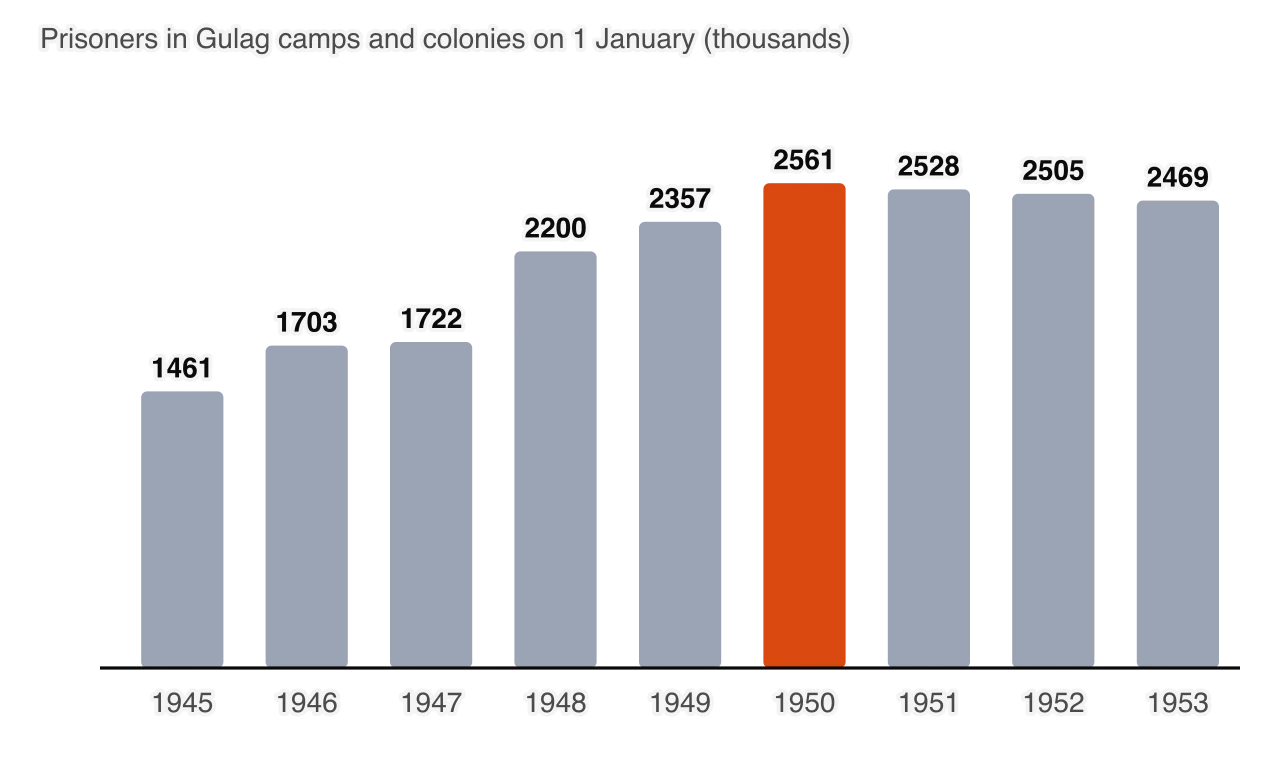
By 1950 more than 2.5 million people were held in labour camps and colonies, and by 1953 another 2.75 million deported people lived as special settlers under police control, among them the Chechens, Crimean Tatars, Volga Germans and Balts deported during and after the war. Forced labour built the Volga–Don Canal (opened in 1952) and many of the mines and railways of the north. Camp managers and some ministers knew by the early 1950s that it was expensive and inefficient, and prisoners in the new “special camps” for political prisoners became harder to control.
The atomic bomb
The most important technological project of the period was the atomic bomb. Directed by the security chief Lavrenty Beria, with the physicist Igor Kurchatov as scientific head, it used Soviet scientists, prisoner labour, uranium from Eastern Europe and intelligence from spies in the American programme. The first Soviet bomb was tested on 29 August 1949 in Kazakhstan, years earlier than the United States had expected. The project showed both the strength of the system, which could concentrate resources on a priority, and its methods.
Domestic political developments, 1945–1953
Stalin’s personal rule
After 1945 Stalin was at the height of his power and prestige, celebrated as the leader who had won the war. He was also in his late sixties and often unwell, and spent months each year at his dachas on the Black Sea. The formal institutions of the party barely functioned: no party congress met between 1939 and 1952, the Central Committee met rarely, and the full Politburo was replaced by small groups of leaders whom Stalin summoned, often late at night, to his dacha at Kuntsevo.
Stalin kept his lieutenants (Molotov, Malenkov, Beria, Zhdanov, Khrushchev, Bulganin, Mikoyan, Kaganovich) insecure. He humiliated Molotov and Mikoyan, had Molotov’s wife arrested in 1949, and played the others off against each other. Yet the government ministries worked in a more routine way than in the 1930s, run by experts and committees of the Council of Ministers. The historians Yoram Gorlizki and Oleg Khlevniuk describe this combination of personal despotism at the top and bureaucratic routine below as a “neo-patrimonial” state.
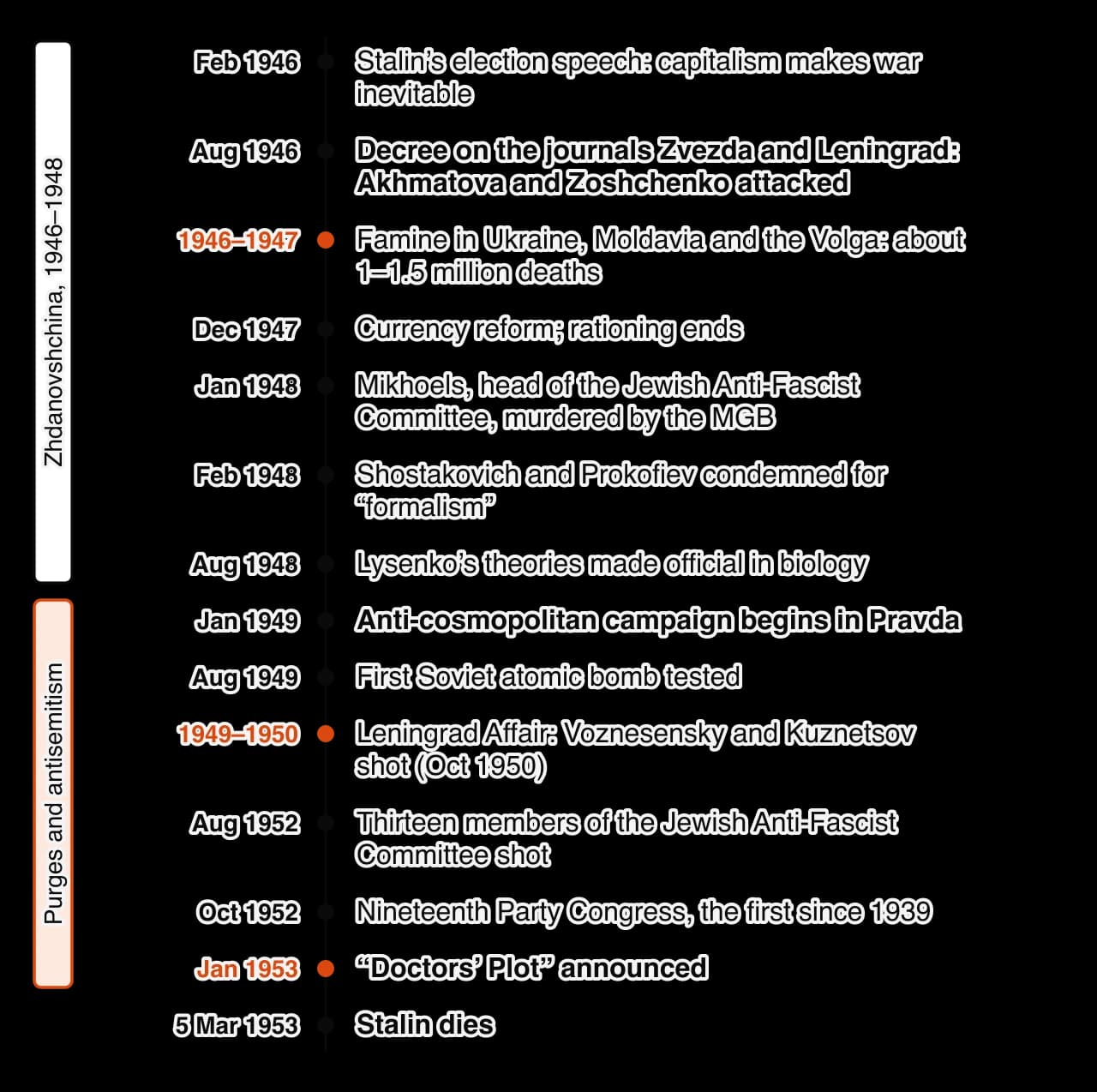
The vertical timeline of 1946–1953 shows two phases of repression. In the first, the target was culture; in the second, members of the party leadership and Soviet Jews.
The Zhdanovshchina, 1946–1948
The campaign for ideological discipline in culture after the war is called the Zhdanovshchina, after Andrei Zhdanov, the Central Committee secretary in charge of ideology. Its aim was to end the relative freedom of the war years, when writers and composers had been allowed to appeal to patriotism and personal feeling, and to cut Soviet culture off from Western influence at the start of the Cold War.
Literature (August 1946). A Central Committee decree condemned the Leningrad journals Zvezda and Leningrad for publishing the poet Anna Akhmatova and the satirist Mikhail Zoshchenko. Both were expelled from the Union of Writers, which cut them off from publication and income.
Theatre and film (1946). Decrees attacked theatre repertoires and films, including the second part of Sergei Eisenstein’s Ivan the Terrible, whose portrait of a tormented tsar was read as a comment on Stalin.
Music (February 1948). Shostakovich, Prokofiev and Khachaturian were condemned for “formalism”, meaning music too modern and too Western for ordinary listeners.
Science (August 1948). At a session of the agricultural academy, the agronomist Trofim Lysenko, with Stalin’s backing, had genetics declared a “bourgeois” science. Geneticists lost their posts, and Lysenkoism set back Soviet biology and agriculture for a generation.
The anti-cosmopolitan campaign
In January 1949 Pravda attacked a group of theatre critics as “rootless cosmopolitans”, most of them with Jewish surnames. The anti-cosmopolitan campaign that followed accused intellectuals of bowing down before the West, and in practice it targeted Jews. Jewish officials, scientists, doctors and journalists lost their jobs, Jewish theatres and publications were closed, and Soviet propaganda claimed that Russians had invented almost everything from the radio to the aeroplane.
The campaign hit hardest at the Jewish Anti-Fascist Committee, set up in 1942 to win Western support for the Soviet war effort. Its chairman, the actor Solomon Mikhoels, was murdered by the security police in January 1948 in a killing staged as a road accident. Its other leaders were arrested, and thirteen of them were shot in August 1952 after a secret trial. Historians link the change of policy to the foundation of Israel in May 1948, which Stalin had first supported. When Soviet Jews welcomed Golda Meir, Israel’s first envoy, in Moscow in autumn 1948, Stalin came to see them as a community with loyalties outside the USSR.
The Leningrad Affair, 1949–1950
The Leningrad Affair was a purge of the leaders of the Leningrad party organisation, the protégés of Zhdanov, who had died in August 1948. Nikolai Voznesensky, the head of the state planning agency Gosplan, and Aleksei Kuznetsov, a Central Committee secretary, were accused of plotting to set up a separate Russian party based in Leningrad. They were shot in October 1950 with other Leningrad leaders, and about two thousand officials were dismissed or arrested. Malenkov and Beria, rivals of the Leningrad group, gained most from the purge. Khrushchev later told the party that the case had been fabricated.
A similar purge in Georgia, the Mingrelian Affair of 1951–1952, removed officials linked to Beria, who was himself a Mingrelian Georgian. It showed that Stalin was preparing to turn on Beria as well.
The Doctors’ Plot and the death of Stalin
At the Nineteenth Party Congress in October 1952, the first since 1939, Stalin enlarged the Politburo into a 25-member Presidium and attacked Molotov and Mikoyan in front of the Central Committee. Many historians read this as preparation for a purge of the old leadership.
On 13 January 1953 Pravda announced the discovery of a “plot” by a group of eminent Kremlin doctors, most of them Jewish, to murder Soviet leaders on the orders of American and Zionist intelligence. The Doctors’ Plot set off a wave of antisemitic hostility, and rumours spread of plans to deport Soviet Jews to the east. Historians still debate whether such plans existed; no deportation order has been found. On 1 March 1953 Stalin suffered a stroke at his dacha, and he died on 5 March. In April the new leadership announced that the doctors were innocent and that their confessions had been obtained by force.
Resistance in the borderlands
The newly annexed territories of the western USSR fought Soviet rule for years after 1945. In western Ukraine the Ukrainian Insurgent Army, and in Lithuania, Latvia and Estonia the “forest brothers”, waged guerrilla wars into the early 1950s. The Soviet response was mass deportation: in Operation Priboi in March 1949 alone, more than 90,000 people were deported from the Baltic republics to Siberia, and collectivisation was imposed on the region. These conflicts, and the earlier wartime deportations of whole peoples, left bitter memories that resurfaced when the national movements of the late 1980s challenged the USSR.
Soviet and Axis prisoners of war
Soviet prisoners of war and the returnees
About 5.7 million Soviet soldiers were captured by Germany and its allies between 1941 and 1945, and about 3.3 million of them died in captivity, most from deliberate starvation, exposure and disease in the camps of 1941–1942. Nazi racial policy treated Soviet prisoners as subhuman, and they died at a far higher rate than British or American prisoners.
Their own government also treated them with suspicion. Order No. 270 of 16 August 1941 declared officers who surrendered to be traitors and made their families liable to arrest. After the war Soviet prisoners, together with millions of civilians taken to Germany as forced labourers (Ostarbeiter), were brought home under the Yalta agreement of February 1945, by force where necessary. Western Allied soldiers handed over Cossacks and members of General Andrei Vlasov’s Russian Liberation Army, which had fought for Germany, at Lienz in Austria in 1945 and in later operations in 1946–1947. Many of those handed over were shot or sent to camps.
Returnees passed through filtration camps run by the security services, where officials questioned them about their conduct in captivity. The table of results shows that former prisoners of war were treated far more harshly than civilians.
Outcome of filtration (by 1946) | Civilian returnees | Former prisoners of war |
|---|---|---|
Allowed to go home | About 80% | About 20% |
Called up again into the army | About 5% | About 43% |
Sent to labour battalions | About 10% | About 22% |
Handed to the NKVD (camps, trials, special settlements) | About 2% | About 15% (226,127 of 1,539,475) |
Data: V. N. Zemskov, from Soviet repatriation records (Istoriya SSSR, 1990, no. 4). In all, about 4.2 million Soviet citizens had been repatriated by 1946; about 58 per cent were sent home and about a third went into the army or labour battalions.
Even those released carried a stigma for decades. Former prisoners were often barred from good jobs, higher education and party membership, and had to declare their captivity on every form. An amnesty of September 1955 freed many still in camps, and some were formally cleared in 1956, but the stigma lasted into the 1980s, and Russia recognised former prisoners of war as veterans with equal rights only in 1995.
Axis prisoners of war in the USSR
The USSR held between about 2.4 million (Soviet records) and 3 million (West German estimates) German prisoners of war, plus Hungarians, Romanians, Austrians and Italians, and after August 1945 more than half a million Japanese soldiers captured in Manchuria. They were organised in camps run by a separate administration and used as labour for reconstruction: they rebuilt towns, cleared rubble, worked in mines and built roads and railways.
Death rates were high, especially in 1945–1946. Soviet records count about 380,000 deaths among German prisoners, while a West German commission estimated more than a million; the difference comes partly from prisoners who died before being registered and from soldiers missing on the battlefield. Of the Japanese held in Siberia, about 60,000 died. Most Axis prisoners went home by 1949–1950, but tens of thousands convicted of war crimes, often after hasty trials, were kept longer. The last German prisoners were released after the West German chancellor Konrad Adenauer visited Moscow in September 1955 and agreed to open diplomatic relations; they returned by January 1956.
The struggle for succession, 1953–1957
Stalin left no named successor. His lieutenants agreed on a collective leadership: Georgy Malenkov became chairman of the Council of Ministers (premier), Lavrenty Beria took charge of a merged Ministry of Internal Affairs (MVD) and its police, and Nikita Khrushchev ran the party Secretariat, becoming First Secretary in September 1953. Molotov returned as foreign minister.
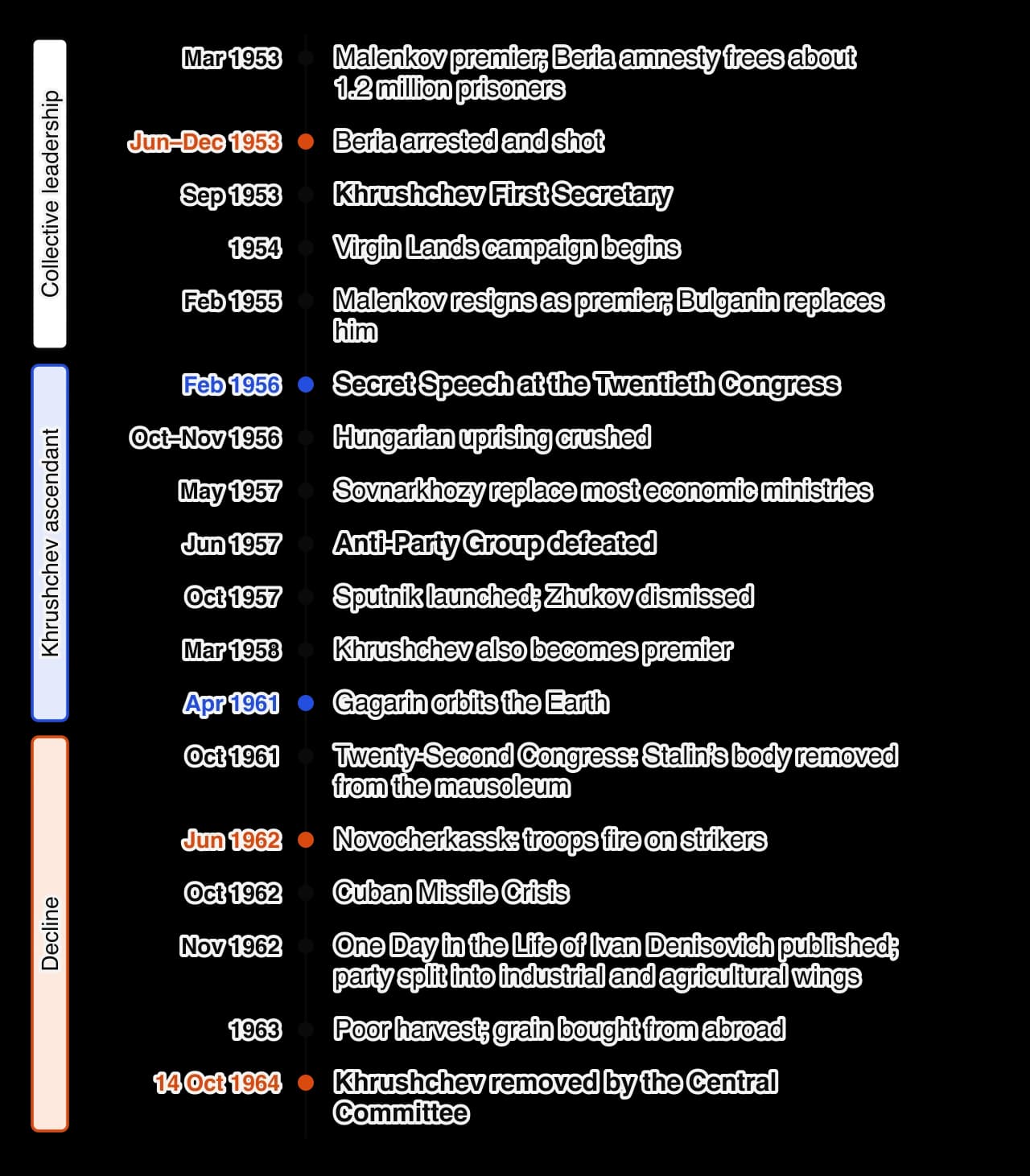
The vertical timeline of the Khrushchev years shows how quickly the balance changed. Beria moved first. In March 1953 his amnesty freed about 1.2 million prisoners, mostly criminals serving short sentences; he ended the Doctors’ Plot and proposed concessions to the non-Russian republics and even to East Germany. His rivals feared that the man who controlled the police would destroy them. In June 1953, with the help of army officers led by Marshal Georgy Zhukov, Khrushchev and Malenkov had Beria arrested at a meeting of the Presidium. He was shot in December 1953, the last Soviet leader to be executed after a power struggle.
Malenkov then promoted a New Course, which shifted investment towards consumer goods and light industry. Khrushchev attacked it as a threat to heavy industry and defence and used his control of party appointments to build support among regional party secretaries, who formed the largest bloc in the Central Committee. In February 1955 Malenkov resigned as premier, admitting “inexperience”, and was replaced by Nikolai Bulganin, an ally of Khrushchev. Unlike in the 1920s and 1930s, the losers were demoted, not killed.
The Secret Speech and de-Stalinisation
The speech of 25 February 1956
On the last night of the Twentieth Party Congress, in a closed session from which foreign communists were excluded, Khrushchev spoke for about four hours on On the Cult of Personality and Its Consequences, the Secret Speech. He read Lenin’s “Testament” of 1922–1923, which had criticised Stalin and asked for his removal as General Secretary, and he described the torture and execution of loyal communists in the purges of the 1930s.
After Stalin’s death, the Central Committee began to implement a policy of explaining concisely and consistently that it is impermissible and foreign to the spirit of Marxism-Leninism to elevate one person, to transform him into a superman possessing supernatural characteristics, akin to those of a god. Such a man supposedly knows everything, sees everything, thinks for everyone, can do anything, is infallible in his behavior.
Nikita Khrushchev, On the Cult of Personality and Its Consequences, closed session of the Twentieth Congress of the CPSU, 25 February 1956 (translation in the Congressional Record, 1956, from the text obtained by the US State Department). The speech blamed the cult of personality of one man, which allowed Khrushchev to condemn Stalin’s crimes while presenting the party, Leninism and the system as sound. It said nothing about collectivisation, the famine or the deportation of peasants, and it protected the leaders who had served Stalin, Khrushchev among them. It also blamed Stalin for military disasters in 1941 and for wartime deportations of whole nationalities.
Khrushchev had several motives. He believed that the terror had been a crime and that it had to be ruled out for the future, so that leaders, including himself, could feel safe. Hundreds of thousands of political prisoners were already returning from the camps, and the leadership needed an explanation for their release. Attacking Stalin also weakened Molotov, Malenkov and Kaganovich, who had been closer to Stalin’s worst crimes, and gave Khrushchev a claim to be the leader who restored Lenin’s principles.
 YouTube
The consequences of de-Stalinisation
Although the speech was secret, it was read out at party meetings across the USSR within weeks, and its text reached the West, where the New York Times published it in June 1956. Its effects reached far beyond the leadership.
The camps. Special commissions reviewed cases in the camps in 1956, and the population of the camps fell sharply after the amnesty of 1953 and the reviews of 1956. The Gulag administration was dissolved in 1960, though labour colonies for criminal and political prisoners remained. Hundreds of thousands of victims were rehabilitated, many of them after their deaths. Peoples deported in the war, such as the Chechens and Ingush, were allowed home from 1957, though the Crimean Tatars and Volga Germans were not.
Unrest. In Tbilisi, Georgian students who saw the attack on Stalin as an insult to their nation demonstrated in March 1956, and troops fired on the crowds, killing at least fifteen people; some estimates are much higher. In Eastern Europe the speech encouraged reform communists in Poland and the uprising in Hungary, crushed by Soviet tanks in November 1956.
The Thaw. In culture, a period of greater openness called the Thaw, after Ilya Ehrenburg’s novel of 1954, allowed writers to treat the camps and the abuses of the past. Its high point was the publication in November 1962, with Khrushchev’s approval, of Aleksandr Solzhenitsyn’s One Day in the Life of Ivan Denisovich, a story of one day in a labour camp.
The Thaw had firm limits. When Boris Pasternak’s novel Doctor Zhivago was published abroad in 1957 and won him the Nobel Prize for Literature in 1958, he was attacked in the press and forced to refuse the prize. In December 1962 Khrushchev denounced abstract painting at an exhibition at the Manege in Moscow. Censorship, the KGB (formed in 1954 from the former security ministry) and the party’s monopoly all remained.
The Anti-Party Group and the second attack on Stalin
In June 1957 a majority of the Presidium, led by Malenkov, Molotov and Kaganovich and joined by Bulganin and others, voted to remove Khrushchev. He refused to accept the vote and insisted that only the Central Committee, which had elected him, could remove him. With Zhukov’s help, military aircraft flew Central Committee members to Moscow, and the plenum backed Khrushchev and condemned his opponents as the Anti-Party Group. They were sent to minor posts: Molotov as ambassador to Mongolia, Malenkov to run a power station in Kazakhstan. Khrushchev then removed Zhukov as defence minister in October 1957, fearing his influence, and replaced Bulganin as premier in March 1958.
At the Twenty-Second Congress in October 1961 Khrushchev went further than in 1956, attacking Stalin in public. Stalin’s body was removed from the mausoleum on Red Square, and towns named after him were renamed: Stalingrad became Volgograd in November 1961.
Khrushchev’s economic and social policies
Khrushchev believed that Soviet socialism could outproduce capitalism and give ordinary people a better life, and that the obstacles were bureaucracy and bad management, not the system itself. His policies tried to raise food output and living standards quickly, often through mass campaigns announced with great fanfare.
Agriculture: Virgin Lands and maize
The Virgin Lands campaign, launched in 1954, ploughed up the steppes of northern Kazakhstan, western Siberia and the Altai to grow wheat. Hundreds of thousands of young volunteers, many recruited through the Komsomol, went east to new state farms, and by 1956 more than 30 million hectares had been brought under the plough. The harvest of 1956 was a record, and the campaign made Khrushchev’s reputation.
The success did not last. The new lands had little rain, the same crop was sown year after year, and wind erosion turned large areas into dust bowls by the early 1960s. Khrushchev also pushed maize (corn) across the country after seeing American farming, including in regions far too cold for it, and launched a campaign in 1957 to overtake the United States in meat and milk production. In Ryazan province the party chief, Aleksei Larionov, promised to triple meat deliveries in a year, slaughtered breeding stock and bought meat from other regions to meet the target; when the fraud was exposed in 1960 he shot himself. After the poor harvest of 1963 the USSR had to buy grain from Canada, Australia and the United States, a humiliation for a leader who had promised abundance.
Peasants themselves gained more from the period than from any time since collectivisation. Prices paid for farm deliveries were raised sharply in 1953–1958, taxes on private plots were cut, and collective farmers began to receive regular cash payments. The Machine Tractor Stations were abolished in 1958, and collective farms had to buy their machinery, which strained their finances.
Industry and planning
In 1957 Khrushchev abolished most of the industrial ministries in Moscow and transferred their powers to about 105 regional economic councils, the sovnarkhozy. He hoped to cut bureaucracy and coordinate industry in each region, and the reform also weakened the Moscow ministers who had backed the Anti-Party Group. In practice regional councils favoured their own regions, and Moscow re-created central committees to coordinate them. The Seven-Year Plan (1959–1965) shifted some investment towards chemicals, plastics, fertiliser and consumer goods.
Living standards and welfare
Khrushchev’s most lasting achievements were in social policy:
Housing. A decree of July 1957 launched a mass building programme of cheap five-storey prefabricated blocks, later nicknamed khrushchevki. Tens of millions of people moved from communal flats, barracks and basements into separate family flats for the first time.
Welfare. A pensions law of 1956 greatly raised and extended state pensions; the minimum wage rose, the working week was shortened from 48 to about 41 hours by 1960, and tuition fees for secondary and higher education were abolished in 1956.
Labour. The harsh labour laws of 1940, which made leaving a job or arriving late a criminal offence, were repealed in 1956.
Education. A school reform of 1958 tried to combine study with productive work, which many parents resented because it made entry to university harder.
In 1961 the Twenty-Second Congress adopted a new Party Programme which promised that the USSR would build “in the main” a communist society by 1980, with free housing, transport and meals. The promise showed Khrushchev’s confidence, and it later made the gap between propaganda and daily life obvious to everyone.
Novocherkassk, 1962
On 1 June 1962 the government raised the prices of meat by about 30 per cent and butter by about 25 per cent, to pay farms more. At the same time the electric locomotive works in Novocherkassk, in southern Russia, cut piece rates. Workers struck, and on 2 June troops fired on a crowd marching to the town’s party headquarters. Twenty-six people were killed, and seven protesters were later sentenced to death. The events were kept secret until 1989. The Novocherkassk massacre showed the limits of de-Stalinisation: the regime still used force against workers, but it also learned to fear food price rises, which Brezhnev avoided for the next two decades.
Technology and the Space Race
The space programme grew out of the missile programme. Sergei Korolev, a rocket designer who had survived the Gulag, led the design of the R-7, the first intercontinental ballistic missile, tested in August 1957. Its rocket put Sputnik, the first artificial satellite, into orbit on 4 October 1957, and a month later Sputnik 2 carried the dog Laika. Luna 2 hit the Moon in 1959. On 12 April 1961 Yuri Gagarin became the first human in space, orbiting the Earth once in Vostok 1, and in June 1963 Valentina Tereshkova became the first woman in space.
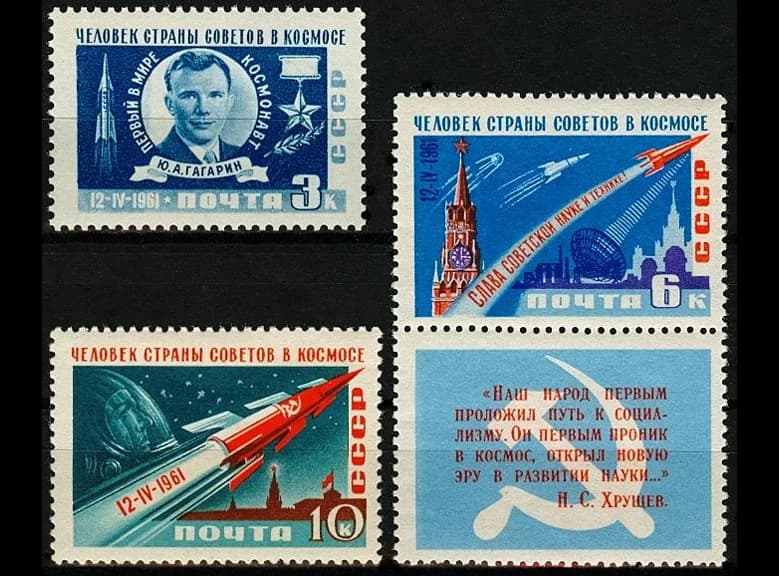
The stamps of 1961 show how the regime used these firsts. Gagarin toured the world as a smiling hero of socialism, and Khrushchev used Sputnik to claim that the USSR had overtaken the West in science and was turning out missiles in large numbers. In the United States, fear of a “missile gap” led to large increases in spending on science, education and rockets.
The successes had real foundations: strong mathematics and physics education, the concentration of resources on priority projects and talented designers. They also hid weaknesses. The USSR had far fewer missiles than Khrushchev implied, failures were kept secret (in October 1960 a missile explosion at the Baikonur launch site killed dozens of people, including Marshal Mitrofan Nedelin), and the cost of competing with American spending drew resources from housing and consumer goods. By the mid-1960s the United States had overtaken the USSR in the race to the Moon.
Khrushchev’s removal from power, 1964
By 1964 Khrushchev had made enemies in every part of the elite. In November 1962 he split regional party committees into separate industrial and agricultural organisations, which doubled the number of party bosses and halved the power of each. Party rules adopted in 1961 required a regular turnover of members of party committees, which threatened the careers of officials. The army resented cuts in conventional forces, and the KGB and the ministries resented the reorganisations.
Foreign policy added to the charges. Khrushchev had promoted peaceful coexistence with the West, but he also took risks: the shooting down of an American U-2 spy plane over the USSR in May 1960 wrecked a summit in Paris, the Berlin crisis of 1958–1961 ended only with the building of the Berlin Wall, and in October 1962 he placed nuclear missiles in Cuba and then withdrew them under American pressure. The Cuban Missile Crisis looked to his colleagues and to the Chinese like a humiliating retreat, and the split with China became open in the early 1960s. These events are covered in the study of the Cold War in Europe; inside the USSR they counted as evidence of reckless leadership.
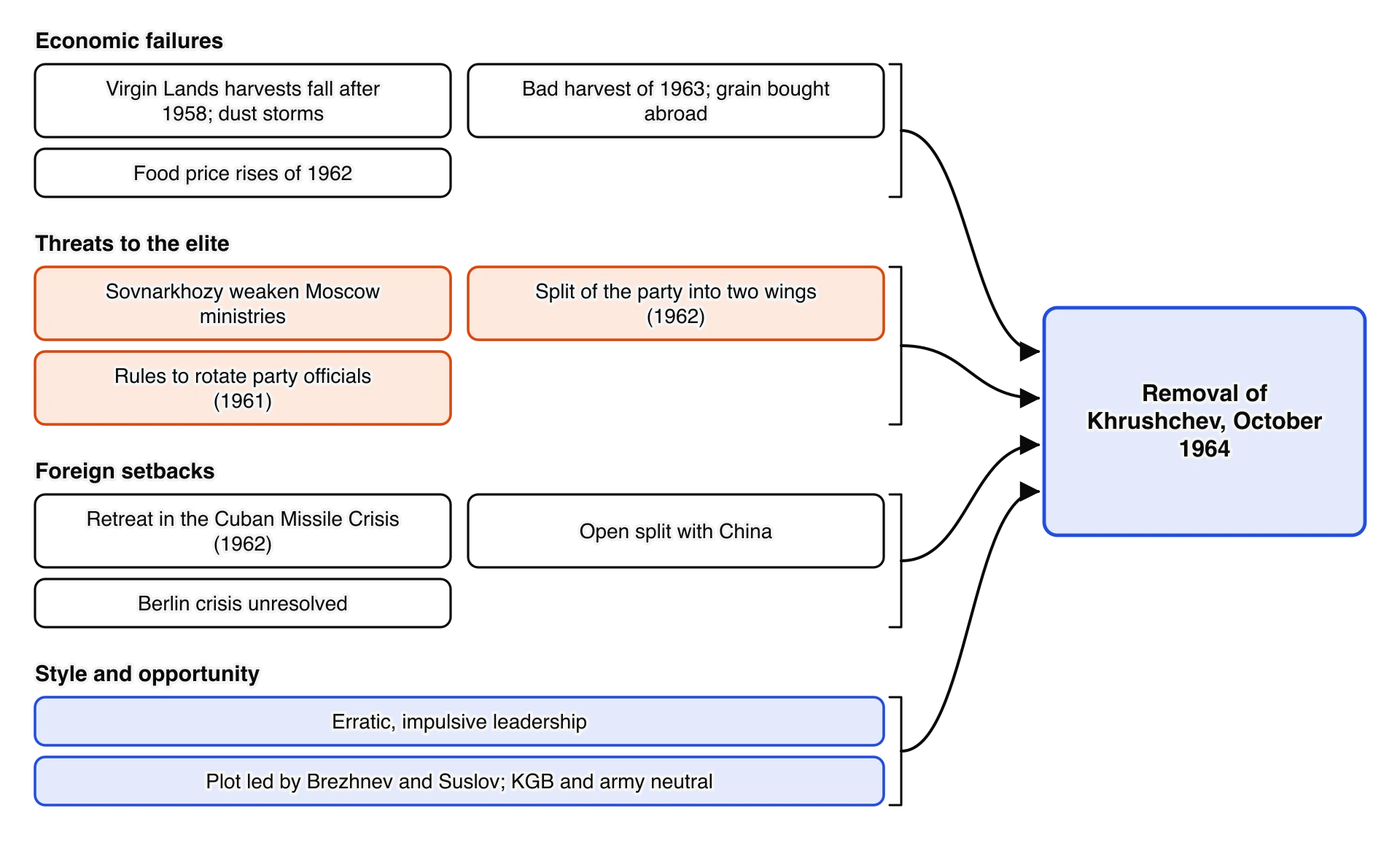
The diagram of causes groups the reasons for Khrushchev’s fall. Leonid Brezhnev, a Central Committee secretary and former protégé of Khrushchev, organised the plot with Mikhail Suslov, the party’s chief ideologist, and others, with the support of the KGB chairman, Vladimir Semichastny, who made sure that Khrushchev’s security guards would not resist. On 13 October 1964 Khrushchev was called back from holiday on the Black Sea to a meeting of the Presidium, where his colleagues criticised him for hours. On 14 October the Central Committee accepted his “request” to retire on grounds of age and health. Pravda then condemned, without naming him, “hare-brained scheming”, hasty decisions and boasting.
Khrushchev retired to a dacha near Moscow with a pension, and dictated memoirs that were smuggled to the West. His peaceful removal was itself a result of de-Stalinisation: a leader could now be voted out by the Central Committee and survive. His son Sergei Khrushchev reports that Khrushchev himself counted this among his achievements.
Collective leadership and Kosygin’s reforms, 1964–1970
The men who removed Khrushchev promised a return to “collective leadership” and an end to “subjectivism”, by which they meant his personal, impulsive decisions. Power was divided: Leonid Brezhnev became First Secretary of the party (General Secretary from 1966), Alexei Kosygin became chairman of the Council of Ministers, Nikolai Podgorny became head of state in 1965, and Mikhail Suslov remained in charge of ideology. Within a few years Brezhnev emerged as the leading figure, but he ruled by consulting and balancing interests, not by command.
The new leaders quickly reversed Khrushchev’s reorganisations. The party was reunited in November 1964, the sovnarkhozy were abolished in 1965 and the central ministries restored, and the rules on rotating officials were dropped.
The Kosygin reform of 1965
Kosygin, an experienced economic manager, launched the economic reform announced at a Central Committee plenum in September 1965. It drew on the ideas of the economist Evsei Liberman, who had argued in Pravda in 1962 that enterprises should be judged by their profits and sales, not only by the quantity they produced.
Enterprises received fewer targets from above, and the main measures of success became sales (goods actually sold, not just produced) and profitability.
Part of the profit went into incentive funds for bonuses, housing and investment chosen by the enterprise.
Some prices were revised, and wholesale prices raised in 1967 to make enterprises profitable.
The Eighth Five-Year Plan (1966–1970) was the most successful of the Brezhnev years, with industrial growth close to its targets, though historians disagree how much of this was due to the reform. After 1968 the reform faded. Three reasons stand out. The ministries restored in 1965 wanted their power back and kept issuing detailed orders. The Prague Spring in Czechoslovakia, where economic reform had led to demands for political freedom, convinced Brezhnev and Suslov that market reforms threatened the party. And the oil revenues of the 1970s made reform seem less urgent. Kosygin remained premier until 1980, but he lost influence to Brezhnev.
Brezhnev’s economic and political policies, 1970–1982
Stability of cadres and “developed socialism”
Brezhnev’s guiding principle in politics was stability of cadres: officials were left in their posts for years, sometimes decades, unless they committed a serious offence. After the purges of Stalin and the reorganisations of Khrushchev, this was popular with the party elite, and it explains why Brezhnev stayed in power for eighteen years. Its cost was an ageing leadership. By 1980 the average age of the Politburo was about seventy, and many regional leaders had run their regions as personal fiefs since the 1960s.
In ideology the party claimed that the USSR had reached a stage of developed socialism, a long phase before full communism. The term quietly dropped Khrushchev’s promise of communism by 1980. The Constitution of 1977 described the USSR as a “developed socialist society” and its Article 6 set out the Communist Party’s role as the “leading and guiding force” of society more fully than any earlier constitution. In 1977 Brezhnev also replaced Podgorny as head of state.
The economy: growth, oil and slowdown
The Brezhnev years brought real gains for many Soviet citizens. Real wages rose, collective farmers received guaranteed wages from 1966 and internal passports from 1974, and ownership of televisions, refrigerators and washing machines spread. The Volga car factory at Togliatti, built with the Italian firm Fiat and opened in 1970, put the first mass-produced cars within reach of better-off families. Retail prices of basic foods stayed frozen, paid for by growing state subsidies.
The economy, however, grew more and more slowly, as the table of estimates shows. The planning system was good at mobilising labour and capital to build heavy industry, but by the 1970s the supply of new workers was running out and the system could not raise productivity or adopt new technology fast enough.
Period | GNP growth a year (CIA estimate) | Net material product growth a year (G. I. Khanin) | Net material product growth a year (official Soviet figures) |
|---|---|---|---|
1960–1965 | 4.8% | 4.4% | 6.5% |
1965–1970 | 4.9% | 4.1% | 7.7% |
1970–1975 | 3.0% | 3.2% | 5.7% |
1975–1980 | 1.9% | 1.0% | 4.2% |
1980–1985 | 1.8% | 0.6% | 3.5% |
Data: CIA, G. I. Khanin and the Soviet Central Statistical Administration, as compiled in E. Bacon and M. Sandle (eds), Brezhnev Reconsidered (2002), p. 40. The three series measure output in different ways. Khanin was a Soviet economist who recalculated the official figures in the late 1980s; all three show the same slowdown, but the official series hides how severe it was.
Several developments hid the slowdown for a time:
Oil and gas. The great oil fields of western Siberia, such as Samotlor (discovered in 1965), came into production, and the rise in world oil prices after 1973 and 1979 brought the USSR large earnings in hard currency.
Imports. These earnings paid for imports of Western machinery and of grain. Poor harvests made the USSR a regular grain importer from 1972, much of it bought from the United States.
Prestige projects. Huge projects such as the Baikal–Amur Mainline (BAM) railway, restarted in 1974, absorbed vast investment for slow returns.
The military absorbed a large share of resources. The USSR reached rough nuclear parity with the United States around 1970, which made the arms control agreements of the period of détente possible (SALT I in 1972, the Helsinki Final Act in 1975). Western estimates of Soviet defence spending ranged from about 12 to more than 15 per cent of GNP, several times the American share. The invasion of Afghanistan in December 1979 added a long war to these burdens.
Corruption, the shadow economy and social problems
Stability of cadres allowed corruption to flourish. In Uzbekistan the party leader Sharaf Rashidov, in power from 1959 to his death in 1983, presided over the “cotton affair”, in which the republic was paid for millions of tonnes of cotton that had never been grown. A large shadow economy of goods and services traded privately, often using materials stolen from the state, supplied what the official economy could not. A popular saying of the period summed up the attitude to work: they pretend to pay us, and we pretend to work.
Social indicators worsened. Alcohol consumption roughly doubled between the 1960s and the early 1980s, and male life expectancy fell from about 66 years in the mid-1960s to about 62 by around 1980, an unusual fall for an industrial country. Infant mortality rose in the 1970s, and the government stopped publishing some statistics.
The Brezhnev cult
As Brezhnev aged and his health declined after strokes in the mid-1970s, a modest personality cult grew up around him. He awarded himself the title of Hero of the Soviet Union four times, the rank of Marshal in 1976 and the Order of Victory in 1978, and he received the Lenin Prize for Literature in 1979 for ghost-written memoirs that exaggerated his war record. Unlike Stalin’s cult, it inspired jokes rather than fear.
 YouTube
The term “stagnation” was a political label used to justify Gorbachev’s reforms. Some historians argue that it fits the economy after the mid-1970s but not Soviet society as a whole, which experienced the Brezhnev years as a time of security and modest prosperity.
The growth of the nomenklatura
The nomenklatura was the system by which the party controlled appointments to every important post in the USSR, and also the name for the class of people who held those posts. It had existed since the 1920s, but under Brezhnev it became more secure, more privileged and more self-perpetuating than ever.
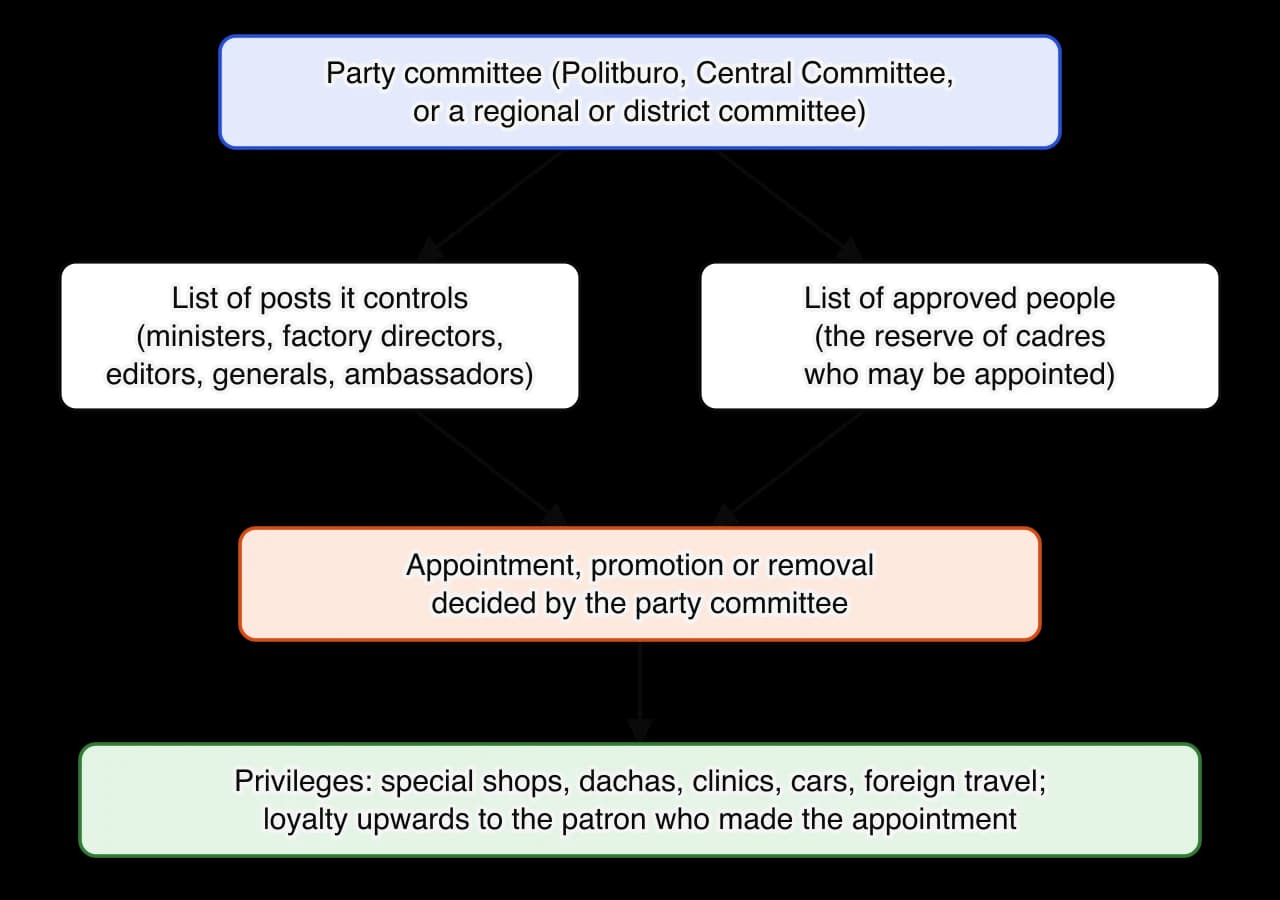
The diagram of the nomenklatura system shows how it worked. Each party committee, from the Politburo down to the district level, kept lists of the posts it controlled and of the people approved to fill them. By one estimate, that of Mikhail Voslensky, the nomenklatura of all levels numbered about 750,000 people. Appointment brought access to privileges that ordinary citizens could not buy: special shops stocked with scarce or imported goods, dachas, better hospitals, cars with drivers, holiday resorts and travel abroad. Children of the elite went to the best schools and universities.
Two writers made the idea famous. The Yugoslav communist Milovan Djilas argued in The New Class (1957) that communist bureaucrats had become a new ruling class that owned the state collectively. Voslensky, a Soviet historian who defected to the West, described the Soviet elite in detail in Nomenklatura (1980). Both books circulated secretly in the USSR.
The nomenklatura explains both the stability of the Brezhnev years and their stagnation. Officials who owed everything to their patrons had no reason to take risks or to accept reforms that threatened their positions, which is why Kosygin’s reform faded and why Gorbachev later found the party apparatus such an obstacle. After 1991 many members of the nomenklatura turned their control of state property into private wealth.
Dissidents and their treatment, 1965–1985
After 1964 the leadership stopped publishing criticism of Stalin, and in the late 1960s it partly restored his reputation as a war leader. Some members of the intelligentsia who had been encouraged by the Thaw refused to accept this, and a small movement of dissidents emerged. They never numbered more than a few thousand active members, but they attracted great attention abroad and posed a moral challenge the regime could not ignore.
The Sinyavsky–Daniel trial and the birth of the movement
In February 1966 the writers Andrei Sinyavsky and Yuli Daniel were tried for publishing satirical stories abroad under pen names. They were sentenced to seven and five years in labour camps for “anti-Soviet agitation”. It was the first show trial of writers since Stalin, and the protests and petitions it provoked are usually seen as the start of the human rights movement. The dissidents’ central tactic was to demand that the authorities obey their own constitution, which promised freedom of speech and assembly.
Unofficial writing circulated in two ways. Samizdat (“self-publishing”) meant texts typed with carbon copies and passed from hand to hand; tamizdat (“published there”) meant works smuggled abroad, printed in the West and smuggled back. From April 1968 the samizdat bulletin A Chronicle of Current Events recorded arrests, trials and conditions in the camps in a neutral, factual style; it appeared, with interruptions, until 1983.
On 25 August 1968 eight people unfurled banners on Red Square against the invasion of Czechoslovakia, including one reading “For your freedom and ours”. They were beaten and arrested within minutes, and most were sentenced to exile, labour camps or psychiatric detention.
Sakharov and Solzhenitsyn
Two figures dominated the movement. Andrei Sakharov, a physicist who had helped build the Soviet hydrogen bomb, wrote Reflections on Progress, Peaceful Coexistence and Intellectual Freedom in 1968, an essay calling for convergence between socialism and capitalism, an end to censorship and cooperation to prevent nuclear war. It circulated in samizdat and was published in the West. He co-founded a Human Rights Committee in 1970 and won the Nobel Peace Prize in 1975. After he condemned the invasion of Afghanistan, he was exiled without trial to the closed city of Gorky in January 1980, where he stayed until Gorbachev released him in December 1986.
Aleksandr Solzhenitsyn, whose labour camp story had been published under Khrushchev, was refused publication after 1964 and expelled from the Writers’ Union in 1969. He won the Nobel Prize for Literature in 1970. In December 1973 the first volume of The Gulag Archipelago, his history of the camp system based on the testimony of 227 former prisoners, was published in Paris. He was arrested on 12 February 1974 and deported to West Germany the next day, the first prominent Soviet figure to be expelled since Trotsky in 1929. On the day of his arrest his essay Live Not by Lies was released in samizdat.
And therein we find, neglected by us, the simplest, the most accessible key to our liberation: a personal nonparticipation in lies! Even if all is covered by lies, even if all is under their rule, let us resist in the smallest way: Let their rule hold not through me!
Aleksandr Solzhenitsyn, Live Not by Lies, dated 12 February 1974 (translation by Yermolai Solzhenitsyn, 2006). Solzhenitsyn wrote for Soviet readers who feared open protest, and he asked them only to stop repeating the official lies in which they did not believe. The essay shows the dissidents’ moral rather than political strategy. It also shows the gulf between Solzhenitsyn, a Russian nationalist and Orthodox believer, and Sakharov’s liberal, Western-oriented camp: dissidents agreed on what they opposed, not on what should replace it.
Helsinki groups, refuseniks and national movements
The Helsinki Final Act of 1975, signed by the USSR to win recognition of post-war borders in Europe, also committed the signatories to respect human rights. In May 1976 the physicist Yuri Orlov founded the Moscow Helsinki Group to monitor Soviet compliance; similar groups appeared in Ukraine, Lithuania, Georgia and Armenia. By the early 1980s nearly all their members had been arrested, exiled or forced to emigrate. Orlov was sentenced in 1978 to seven years in a labour camp and five in exile.
Jewish emigration. Many Soviet Jews applied to emigrate to Israel, and about 250,000 left in the 1970s. Those refused permission, the refuseniks, often lost their jobs. The most famous, Natan (Anatoly) Shcharansky, was sentenced in 1978 to thirteen years for “treason”. The United States linked trade with the USSR to emigration in the Jackson–Vanik amendment of 1974.
National movements. Ukrainian intellectuals were arrested in waves in 1965 and 1972; the Crimean Tatars campaigned to return to their homeland; in Lithuania the samizdat Chronicle of the Catholic Church in Lithuania appeared from 1972, and in Georgia protests in 1978 forced the government to keep Georgian as the republic’s official language.
Religious dissent. Baptists, Pentecostals and Orthodox believers who rejected state control of their churches faced arrest and harassment.
How the regime treated dissent
Under Yuri Andropov, chairman of the KGB from 1967 to 1982, repression was targeted and calculated. Andropov wanted to control dissent at the lowest possible cost to the USSR’s image abroad during détente. The KGB used a range of methods, from mild to severe:
Method | How it worked | Example |
|---|---|---|
“Prophylaxis” | Official warnings and talks with people who were not yet dissidents, threatening their careers | More than 60,000 people “warned” in 1971–1974 alone, according to a KGB report |
Loss of job, study or housing | Dismissal, expulsion from university or the Writers’ Union | Solzhenitsyn expelled from the Writers’ Union, 1969 |
Trial and labour camp | Articles 70 (“anti-Soviet agitation and propaganda”) and 190-1 (“slandering the Soviet system”) of the criminal code | Sinyavsky and Daniel, 1966; Orlov and Shcharansky, 1978 |
Psychiatric detention | Dissent diagnosed as mental illness, often “sluggish schizophrenia”; detention in special psychiatric hospitals | Pyotr Grigorenko; Vladimir Bukovsky, who exposed the practice |
Internal exile | Removal to a closed city or remote region without trial | Sakharov in Gorky, 1980–1986 |
Expulsion or loss of citizenship | Forcing critics abroad, where they had less influence at home | Solzhenitsyn, 1974; Bukovsky exchanged for a Chilean communist, 1976 |
These methods worked in the sense that the dissident movement was largely broken by the early 1980s. Most Soviet citizens never read samizdat, and many saw dissidents as privileged intellectuals. Yet the dissidents had lasting effects: they created a language of rights and legality, foreign broadcasts such as the BBC, Voice of America and Radio Liberty carried their words back into the USSR, and many of their demands became official policy under Gorbachev.
Andropov and Chernenko, 1982–1985
Brezhnev died on 10 November 1982. His successor, Yuri Andropov, came from fifteen years at the head of the KGB, and he knew better than other leaders how serious the country’s problems were. He launched a campaign for labour discipline, in which police checked shops, cinemas and bathhouses for people absent from work, and an anti-corruption drive that removed many of Brezhnev’s regional bosses. He also promoted younger officials, among them Mikhail Gorbachev and Nikolai Ryzhkov. But Andropov was seriously ill with kidney disease and died in February 1984.
The Politburo then chose Konstantin Chernenko, aged 72, a long-time aide of Brezhnev and himself in poor health. His thirteen months in office brought no new policies. When he died on 10 March 1985, the third leader to die in less than three years, the Politburo turned to its youngest member, Gorbachev, aged 54.
Reform and transformation under Gorbachev, 1985–1991
The years from 1985 to 1999 are also a focused study of their own, The Russian Federation (1985–1999), which treats the causes of the transition, how it was achieved and the challenges that followed in depth, with its sources. In the longer story of the USSR and Russia from 1945, the emphasis falls on how Gorbachev’s reforms related to the problems inherited from the Brezhnev years.
Aims
Gorbachev was a convinced communist who believed that the system had been distorted by Stalin and stalled under Brezhnev, and that it could be renewed by returning to Lenin’s ideas, as Khrushchev had tried to do. He did not set out to introduce capitalism or to end the party’s rule. His aims changed as each stage of reform failed to produce the results he expected, which is why historians often divide his rule into phases.
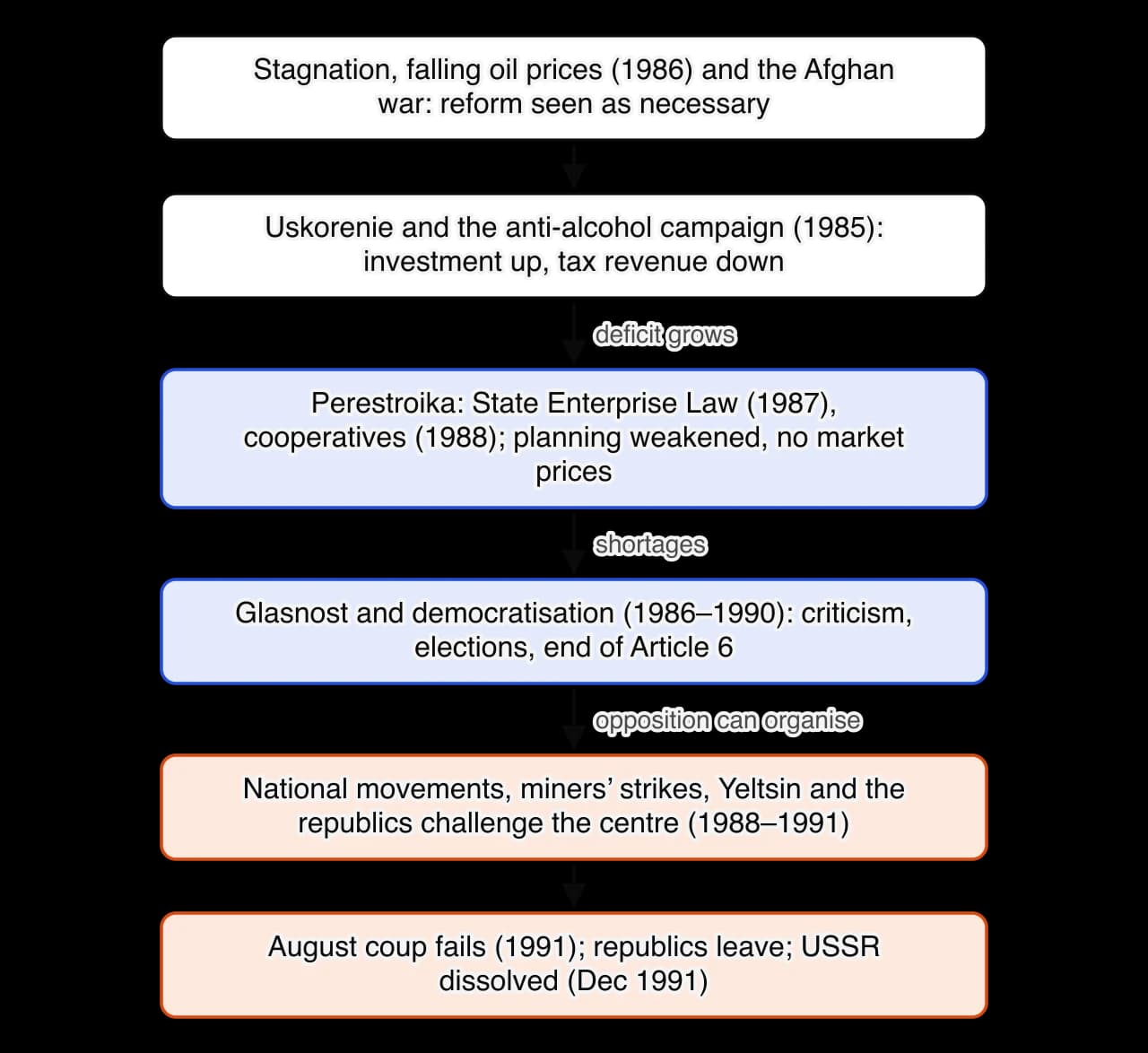
The chain of reform and collapse summarises the sequence.
Economic policies and perestroika
Gorbachev began in 1985 with uskorenie (“acceleration”): more investment in machine-building and stricter discipline, in the spirit of Andropov. The anti-alcohol campaign of May 1985 cut alcohol sales and improved health for a time, but it cost the state a large part of its tax revenue, while the fall in world oil prices in 1986 cut its export earnings. The Chernobyl nuclear disaster of April 1986 added huge costs.
From 1987 perestroika (“restructuring”) went further than any reform since the 1920s. A Law on Individual Labour Activity (1986) had already legalised some private work by individuals and families. The Law on State Enterprise (1987) gave factories the right to set much of their own output and wages, the Law on Cooperatives (1988) allowed private businesses in all but name, and joint ventures with foreign firms were permitted. But prices remained fixed by the state and enterprises could not go bankrupt, so managers raised wages without raising output. The result was a growing budget deficit, a flood of money chasing too few goods, and shortages worse than under Brezhnev. By 1990–1991 rationing of basic goods had returned in many cities, and Gorbachev rejected the radical “500 Days” programme for a fast move to a market.
Aspect | Kosygin reform (1965) | Perestroika (1987–1990) |
|---|---|---|
Aim | Make planning more efficient | Restructure the economy while keeping socialism |
Enterprise freedom | Fewer plan targets; profit and sales measured | Enterprises set much of their output and wages; cooperatives and joint ventures allowed |
Prices | Set by the state; revised in 1967 | Still mostly set by the state |
Political context | Party monopoly unquestioned; reform halted after the Prague Spring | Glasnost and elections allowed criticism of the system |
Outcome | Faded by the early 1970s; the system survived | Planning broke down without a working market; shortages and inflation |
The comparison of the two reforms shows a continuity in Soviet economic policy: both tried to give enterprises incentives without freeing prices. The difference lay in the political context. In 1965 the party could stop the reform when it threatened its control; by 1989 Gorbachev’s political reforms had removed that brake.
Glasnost and democratisation
Glasnost (“openness”) began as a way to expose corruption and mobilise support for reform against the party apparatus. After the official silence over Chernobyl in April 1986, it widened into the publication of banned books, frank reporting of social problems and an open reckoning with the Stalinist past. Sakharov was released from Gorky in December 1986, Bukharin was rehabilitated in 1988, and in 1990 the USSR admitted responsibility for the Katyn massacre of Polish officers in 1940.
Demokratizatsiya (democratisation) followed. The Nineteenth Party Conference of 1988 approved a new parliament, the Congress of People’s Deputies, whose elections in March 1989 were the first with a real choice of candidates since 1917. Its televised debates, in which Sakharov and Yeltsin attacked the leadership, were watched by tens of millions. In March 1990 Article 6 of the constitution was amended to end the party’s legal monopoly of power, and the Congress elected Gorbachev to a new post of President of the USSR. In foreign policy, Gorbachev’s “New Thinking” ended the war in Afghanistan (withdrawal completed in February 1989) and allowed the countries of Eastern Europe to leave Soviet control in 1989, a policy a Soviet spokesman nicknamed the Sinatra Doctrine.
The growth of opposition
Glasnost and democratisation allowed opposition to organise, and it came from several directions at once:
Opposition | Who and what | Key events |
|---|---|---|
National movements | Popular fronts in the Baltic republics, Georgia, Armenia, Azerbaijan, Ukraine and Moldova; demands first for sovereignty, then independence | Alma-Ata riots (Dec 1986); Nagorno-Karabakh conflict (from Feb 1988); Baltic Way (Aug 1989); troops kill protesters in Tbilisi (Apr 1989) and Vilnius (Jan 1991); Lithuania declares independence (Mar 1990) |
Radical reformers | Inter-Regional Deputies Group (1989) of Sakharov, Yeltsin and others; demanded faster reform and an end to the party’s monopoly | Yeltsin chairman of the Russian parliament (May 1990), leaves the party (Jul 1990), elected president of Russia with 57% (12 Jun 1991) |
Workers | Miners in the Kuzbass, the Donbas and Vorkuta | Mass strikes of July 1989 and spring 1991 |
Conservatives | Party officials, the military and KGB leaders who saw reform destroying the state | Nina Andreyeva’s letter defending Stalin (Mar 1988); the August coup (1991) |
By 1990 the republics were declaring sovereignty, and Russia itself, led by Yeltsin, claimed that its laws took priority over those of the Union. In the referendum of March 1991 about 76 per cent of those who voted in nine participating republics supported a “renewed federation”, and Gorbachev negotiated a new Union Treaty that would have given the republics wide powers. It was due to be signed on 20 August 1991.
The August coup and its aftermath
On 19 August 1991 a group of senior officials, among them the vice-president Gennady Yanayev, the KGB chairman Vladimir Kryuchkov, the defence minister Dmitry Yazov and the prime minister Valentin Pavlov, formed a State Committee on the State of Emergency (GKChP), held Gorbachev at his holiday home in Crimea and sent tanks into Moscow. Yeltsin rallied resistance at the Russian parliament building, the White House; troops refused to storm it, and the coup collapsed within three days. The detailed course of the coup is treated in the focused study of the Russian Federation.
Date (1991) | Aftermath of the coup |
|---|---|
23–24 Aug | Yeltsin suspends the Communist Party in Russia; Gorbachev resigns as General Secretary; Ukraine declares independence |
Sep | The USSR recognises the independence of Estonia, Latvia and Lithuania |
6 Nov | Yeltsin bans the Communist Party of the Soviet Union in Russia |
1 Dec | About 90 per cent of voters in Ukraine’s referendum support independence |
8 Dec | Belovezha Accords: the leaders of Russia, Ukraine and Belarus declare that the USSR has ceased to exist and form the Commonwealth of Independent States |
21 Dec | Eight more republics join the Commonwealth at Alma-Ata |
25–26 Dec | Gorbachev resigns as Soviet president; the Soviet flag is lowered over the Kremlin; the USSR is formally dissolved |
The coup, meant to save the Union and the party, discredited the forces that could have held the USSR together, the army, the KGB and the party; it made Yeltsin the dominant figure in Moscow; and it convinced the republics, above all Ukraine, that they had to leave. Without Ukraine, Yeltsin had little interest in a Union headed by Gorbachev.
The challenges of transition: Russia under Yeltsin, 1991–1999
The Russian Federation began independent life in 1992 with a president elected by popular vote, a parliament elected under Soviet rules in 1990, no new constitution, a collapsing economy and a large part of its population living in poverty. The focused study of the Russian Federation follows the economic reforms, the constitution and the crises of 1991 and 1993 in detail; the emphasis in this longer story falls on why democracy failed to take root, on the return of the communists, on Yeltsin’s own role and on the war in Chechnya.
Economic policies and the rise of the oligarchs
In January 1992 Yeltsin’s government, led on economic policy by Yegor Gaidar, freed most prices overnight. This was shock therapy, a rapid move to a market economy on the advice of Western economists, intended to end shortages and make the change irreversible. Shortages did end, but prices rose about 26 times in 1992, wiping out savings. Voucher privatisation (1992–1994), run by Anatoly Chubais, gave every citizen a voucher to exchange for shares, but most factories passed to their managers or to buyers who bought up vouchers cheaply.
The loans-for-shares scheme of 1995–1996 then handed some of the most valuable companies in the country, including Norilsk Nickel, Yukos and Sibneft, to a few bankers at very low prices in return for loans to the government. These men, the oligarchs (Boris Berezovsky, Vladimir Gusinsky, Mikhail Khodorkovsky, Vladimir Potanin, Roman Abramovich, Mikhail Fridman and others), also owned the main television channels and newspapers. Output fell by about 40 per cent during the decade, wages and pensions went unpaid for months, and male life expectancy dropped from about 64 years in 1990 to about 58 in 1994. In August 1998 the government defaulted on its debts and devalued the rouble; the government of Yevgeny Primakov (September 1998 to May 1999) then steadied the budget, and the cheaper rouble began the recovery that followed.
The economic collapse is the background to every political development of the decade. It discredited the liberal reformers and the word “democracy”, which many Russians came to associate with poverty, crime and the enrichment of a few.
The failure to establish democracy
Russia held competitive elections throughout the 1990s, and the press was freer than at any time before or since. Yet by 1999 most observers described a weak and corrupt democracy, or a system in which elections were held but power lay elsewhere. Five developments explain this:
The October crisis of 1993. Yeltsin’s conflict with the Supreme Soviet over economic reform and the powers of the president ended when he dissolved parliament by decree in September 1993 and, after armed supporters of parliament attacked the Moscow mayor’s office and the Ostankino television centre, had tanks shell the White House on 4 October. The official death toll of the crisis was about 150. The use of force against a parliament set a precedent.
The constitution of December 1993. Approved by referendum, it created a super-presidential system: the president appointed the government, could issue decrees with the force of law and could dissolve the Duma, which had little power over him.
Weak parties and the oligarchs’ media. Parties were small and personal, apart from the communists; the oligarchs’ newspapers and television channels served their owners’ interests.
The 1996 election. Yeltsin won re-election by using state resources, the backing of the oligarchs’ money and media, and a campaign that presented the choice as democracy or a return to communism.
Regional bosses. Governors and the presidents of the ethnic republics ran their regions with little interference, often controlling local elections and media, in return for supporting Yeltsin.
The re-emergence of the Communist Party
Yeltsin banned the Communist Party of the Soviet Union in November 1991, but the ban was challenged in the Constitutional Court. In November 1992 the court upheld the dissolution of the party’s central bodies but ruled that local party organisations could not be banned. In February 1993 a founding congress created the Communist Party of the Russian Federation (KPRF), led by Gennady Zyuganov, a former official of the Soviet party’s ideology department.
The KPRF combined nostalgia for Soviet social security and great-power status with Russian nationalism and respect for Orthodoxy; it accepted elections and a mixed economy. It drew its votes mainly from pensioners, rural voters and the regions hit hardest by the economic collapse, and it had the largest membership and best organisation of any party in Russia.
Election | Result for the Communist Party (KPRF) | Other leading parties or candidates |
|---|---|---|
Duma, December 1993 | About 12% of the party-list vote; third | Zhirinovsky’s nationalist Liberal Democratic Party (LDPR) about 22%, first; Gaidar’s Russia’s Choice about 15% |
Duma, December 1995 | About 22%; 157 seats, the largest party | LDPR about 11%; Our Home is Russia (Chernomyrdin) about 10% |
Presidential, June–July 1996 | Zyuganov 32% in the first round, 40% in the run-off | Yeltsin 35% in the first round, 54% in the run-off |
Duma, December 1999 | About 24%; the largest party | Unity (the Kremlin’s new party, backing Putin) about 23%; Fatherland–All Russia about 13% |
Data: Central Electoral Commission of the Russian Federation; shares rounded. In the Duma elections half the seats were filled from party lists and half in single-member districts.
The KPRF’s strength shows that much of the electorate rejected the reforms of the 1990s. It also shows the limits of that rejection: the communists never won a majority, and in 1996 enough voters feared a return to the Soviet past to re-elect a deeply unpopular president. After 2000 the KPRF survived as part of the tolerated “systemic” opposition.
The role of Yeltsin
Boris Yeltsin dominated Russian politics from 1990 to 1999, and judgements of the decade depend largely on judgements of him.
Achievements claimed for Yeltsin | Failures charged against him |
|---|---|
Led the resistance that defeated the August coup in 1991 | Used tanks against parliament in October 1993 |
Ended the party’s monopoly and allowed a free press and competitive elections | Built a super-presidential constitution and let the oligarchs capture the state |
Accepted the independence of the other republics peacefully | Launched the First Chechen War in 1994 |
Created the legal basis of a market economy | Presided over economic collapse, mass poverty and the 1998 default |
Handed over power without a coup or civil war | Chose a successor from the security services and resigned to secure his election |
Yeltsin’s health declined sharply after heart attacks in 1995 and heart surgery in November 1996, and in his second term he was often absent. Power passed to a circle around him that Russians called “the Family”: his daughter Tatyana Dyachenko, his aides Valentin Yumashev and Alexander Voloshin, and the oligarch Berezovsky. He changed prime ministers four times between March 1998 and August 1999 (Sergei Kiriyenko, Yevgeny Primakov, Sergei Stepashin and Vladimir Putin) as the Family looked for a successor who would protect them.
The wars in Chechnya
Chechnya, a mainly Muslim republic in the North Caucasus whose people had been deported by Stalin in 1944, declared independence under General Dzhokhar Dudayev in November 1991. Russia did not recognise it. In December 1994 Yeltsin sent in the army, expecting a quick victory. The First Chechen War (1994–1996) was instead a disaster: the bombardment of the capital, Grozny, killed thousands of civilians, the poorly trained Russian army suffered heavy losses, and Chechen fighters took hostages inside Russia. In August 1996 the Chechens retook Grozny, and the Khasavyurt Accord ended the fighting while postponing a decision on Chechnya’s status until 2001. Estimates of the dead vary widely, from about 35,000 to more than 50,000 civilians and several thousand Russian soldiers, because no reliable count was made.
Between the wars Chechnya slid into lawlessness, with kidnappings for ransom and the growing influence of radical Islamist commanders such as Shamil Basayev and the Arab fighter Khattab. In August 1999 they led an armed incursion into neighbouring Dagestan. In September 1999 bombs destroyed apartment buildings in Buynaksk, Moscow and Volgodonsk, killing about 300 people. The government blamed Chechen terrorists, and several men linked to North Caucasus Islamist groups were later convicted. Critics, including the former FSB officer Alexander Litvinenko and the journalist Anna Politkovskaya, alleged that the FSB had been involved, pointing to an incident in Ryazan on 22 September 1999, when local police found explosives in an apartment block and the FSB later called it a training exercise. The allegation has never been proved, and the full truth remains unknown.
The bombings turned public opinion behind a new war. The Second Chechen War began in October 1999 under the new prime minister, Vladimir Putin, whose tough language made him popular almost overnight. On 31 December 1999 Yeltsin resigned and named Putin acting president.
Putin’s political reforms and the re-emergence of an authoritarian state, 2000–2020
Putin’s rise and programme
Vladimir Putin had served in the KGB from 1975, including five years in East Germany (1985–1990), then worked for the reformist mayor of St Petersburg, Anatoly Sobchak, before moving to the Kremlin in 1996. He headed the FSB, the KGB’s main successor, from 1998, and was appointed prime minister in August 1999 with almost no public profile. Days before Yeltsin’s resignation he published a programme article.
Our state and its institutions and structures have always played an exceptionally important role in the life of the country and its people. For Russians a strong state is not an anomaly which should be got rid of. Quite the contrary, they see it as a source and guarantor of order and the initiator and main driving force of any change.
Vladimir Putin, “Russia at the Turn of the Millennium”, Nezavisimaya gazeta, 30 December 1999 (translation in Putin, First Person, 2000). Written as a manifesto for the coming presidential election, the article promised voters exhausted by the 1990s order, a strong state and the defence of Russia as a great power, while also praising democracy and the market. As a source it shows the idea of the state that guided Putin’s reforms, though it says nothing about the methods he would use.
Putin won the presidential election of March 2000 in the first round with about 53 per cent of the vote, helped by the popularity of the Chechen war and the support of the main television channels. He was re-elected in 2004. Because the constitution allowed only two consecutive terms, he became prime minister in 2008 under President Dmitry Medvedev, his close ally, in what was called the “tandem”; a constitutional amendment of 2008 lengthened the presidential term to six years, and Putin returned as president in 2012 and was re-elected in 2018.
Presidential election | Winner and share of the vote | Runner-up |
|---|---|---|
March 2000 | Putin, about 53% | Zyuganov (KPRF), about 29% |
March 2004 | Putin, about 71% | Nikolai Kharitonov (KPRF), about 14% |
March 2008 | Medvedev, about 70% | Zyuganov, about 18% |
March 2012 | Putin, about 64% | Zyuganov, about 17% |
March 2018 | Putin, about 77% | Pavel Grudinin (KPRF), about 12% |
Data: Central Electoral Commission of the Russian Federation; shares rounded. International observers from the OSCE reported unequal media access and the misuse of state resources in these elections, and statisticians found patterns in the official returns consistent with ballot-stuffing in some regions.
Building the power vertical
Putin’s first reforms aimed to restore the authority of the centre over the regions and over the oligarchs, which he described as building a power vertical and a “dictatorship of the law”.
Federal districts (May 2000). Russia’s 89 regions were grouped into seven federal districts, each supervised by a presidential envoy, five of them generals or security officers in the first appointments. Regional laws that contradicted federal law were struck down.
The Federation Council (2000). Governors lost their seats in the upper house of parliament, which was filled instead with appointed representatives.
Governors (2004). After the Beslan school siege in September 2004, Putin ended the direct election of governors; from 2005 they were nominated by the president and confirmed by regional assemblies. Direct elections returned in 2012, with filters that let the Kremlin screen candidates.
Parties and elections. The party of power, United Russia, was formed in 2001 from the merger of Unity and Fatherland–All Russia, and won control of the Duma in 2003. New laws on parties raised membership requirements, the threshold for Duma seats rose from 5 to 7 per cent, and single-member districts were abolished for the elections of 2007 and 2011. Independent parties found it hard to register or to reach voters.
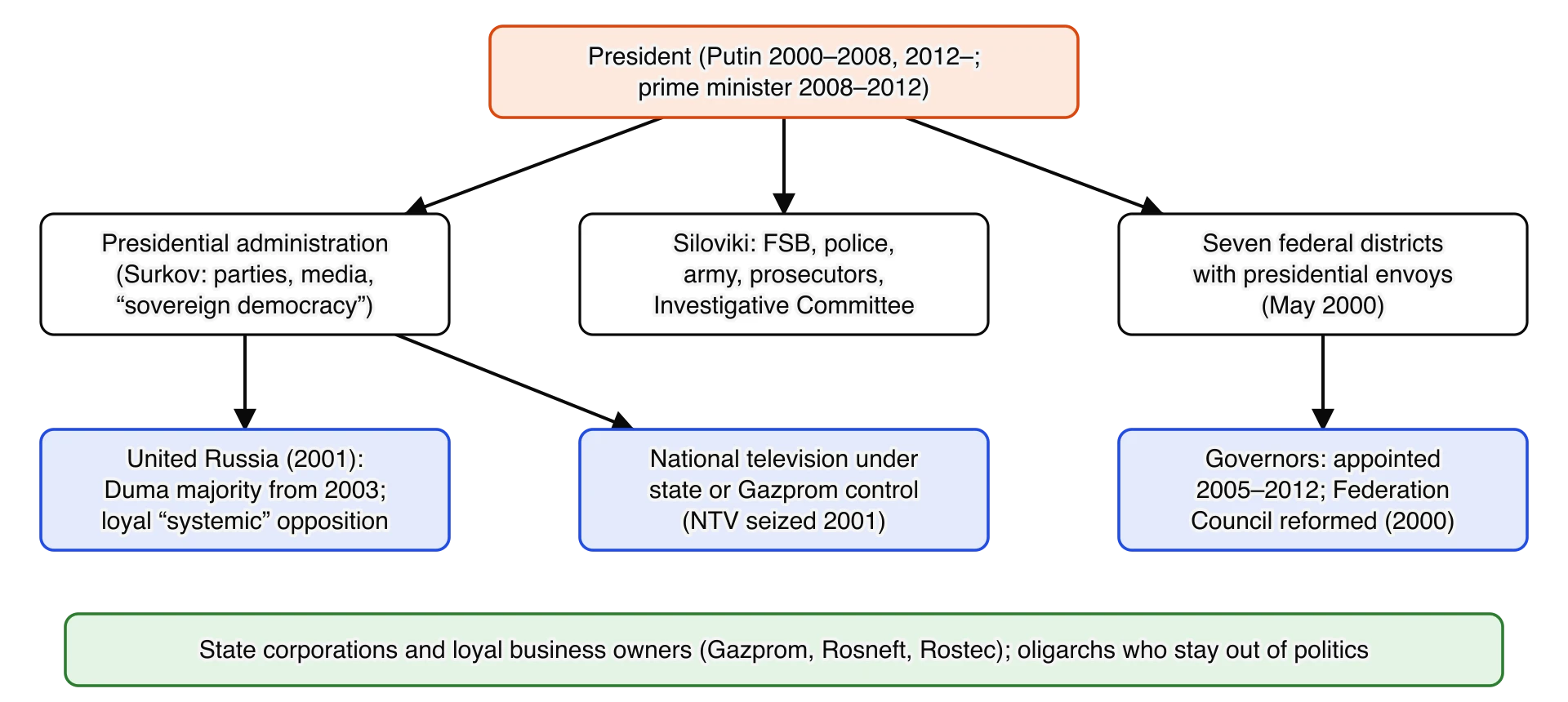
The diagram of the power vertical shows the system that emerged by about 2008. Its key figures were the siloviki, men from the security services, the military and the police who filled many senior posts under Putin, among them Nikolai Patrushev, Sergei Ivanov and Igor Sechin. Its ideologist was Vladislav Surkov, deputy head of the presidential administration, who coined the term sovereign democracy in 2006: Russia would be a democracy, but one whose form was decided in Russia, without foreign interference. Western political scientists more often call the system managed democracy or competitive authoritarianism.
Protest and the turn to repression, 2011–2020
In September 2011 Putin and Medvedev announced that they would swap posts again. The Duma election of 4 December 2011, in which United Russia’s share fell to about 49 per cent, was followed by evidence of fraud recorded by observers on mobile phones. Tens of thousands protested in Moscow on Bolotnaya Square on 10 December and on Sakharov Avenue on 24 December, the largest demonstrations since the early 1990s.
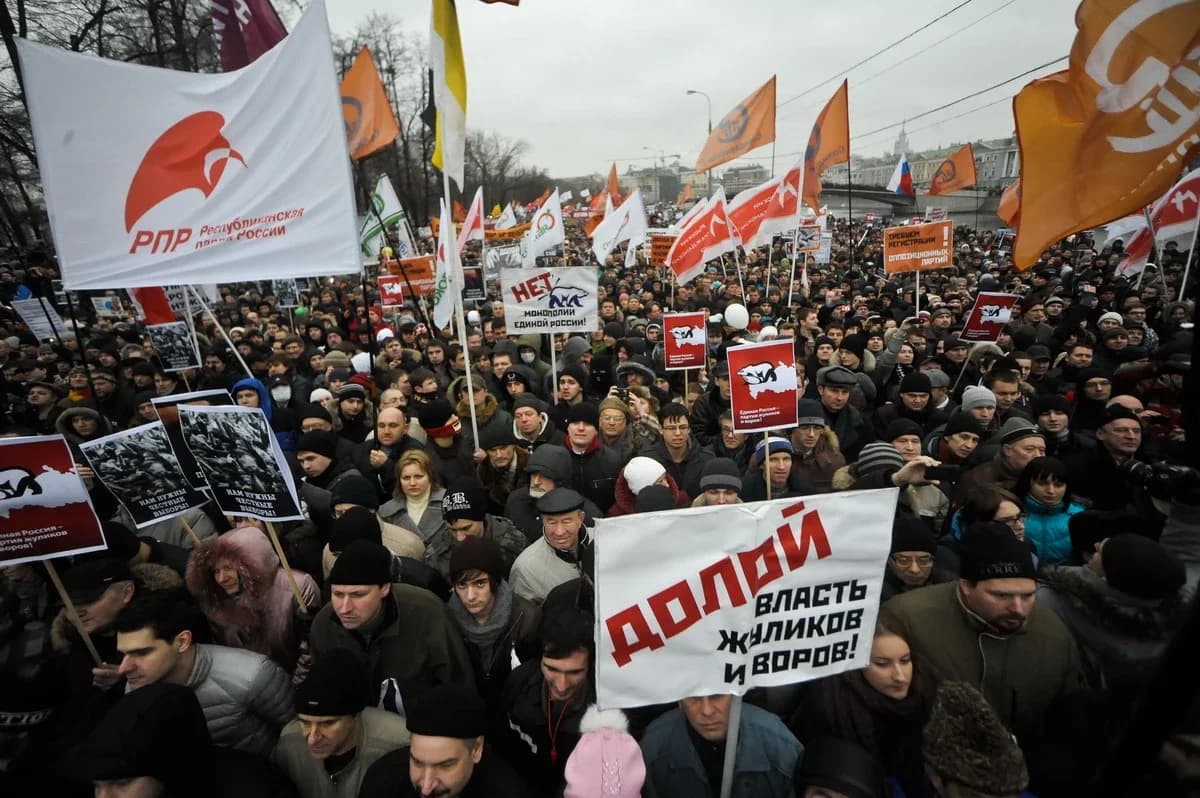
The Bolotnaya photograph shows the size of the movement in the capital, which drew on a growing urban middle class with access to the internet. It had little support in the provinces. After clashes with police at a rally on 6 May 2012, the day before Putin’s inauguration, dozens of protesters were prosecuted in the “Bolotnaya case”. A series of laws in 2012 raised fines for unauthorised protests, required non-governmental organisations receiving foreign funding to register as “foreign agents”, widened the definition of treason and allowed websites to be blocked without trial. In 2015 a law on “undesirable organisations” allowed foreign NGOs to be banned.
The constitutional amendments of 2020 completed the process. A package of more than 200 changes, approved in a national vote held over a week ending on 1 July 2020 with about 78 per cent in favour, reset Putin’s count of presidential terms to zero, which would allow him to remain president until 2036. The amendments also wrote “traditional values”, a definition of marriage as a union of a man and a woman, and the priority of the Russian constitution over international rulings into the basic law.
Putin’s economic and social policies
Bringing the oligarchs to heel
In July 2000 Putin met the leading businessmen in the Kremlin. What he offered, as both sides later described it, was an informal bargain: the oligarchs could keep the property they had acquired in the 1990s if they paid their taxes and stayed out of politics. Those who refused were broken.
Vladimir Gusinsky, whose television channel NTV had criticised the Chechen war and Putin, was briefly arrested in June 2000 and left Russia; NTV was taken over by the state gas company Gazprom’s media arm in April 2001.
Boris Berezovsky, once the most powerful member of the Family, fell out with Putin in 2000, sold his stake in the main television channel, ORT, and went into exile in Britain.
Mikhail Khodorkovsky, head of the oil company Yukos and Russia’s richest man, funded opposition parties and NGOs and publicly criticised corruption. He was arrested in October 2003, convicted of fraud and tax evasion in 2005 and kept in prison until 2013. Yukos was broken up with huge tax claims, and its main production unit passed to the state oil company Rosneft in 2004.
The Yukos affair showed the remaining business elite that property in Russia depended on loyalty to the Kremlin. Officials from the security services moved onto the boards of the largest companies, and state control of the economy grew through national champions such as Gazprom and Rosneft and state corporations such as Rostec (2007). Western analysts often describe the result as state capitalism, and some, such as Karen Dawisha, as a kleptocracy.
Growth, oil and stagnation
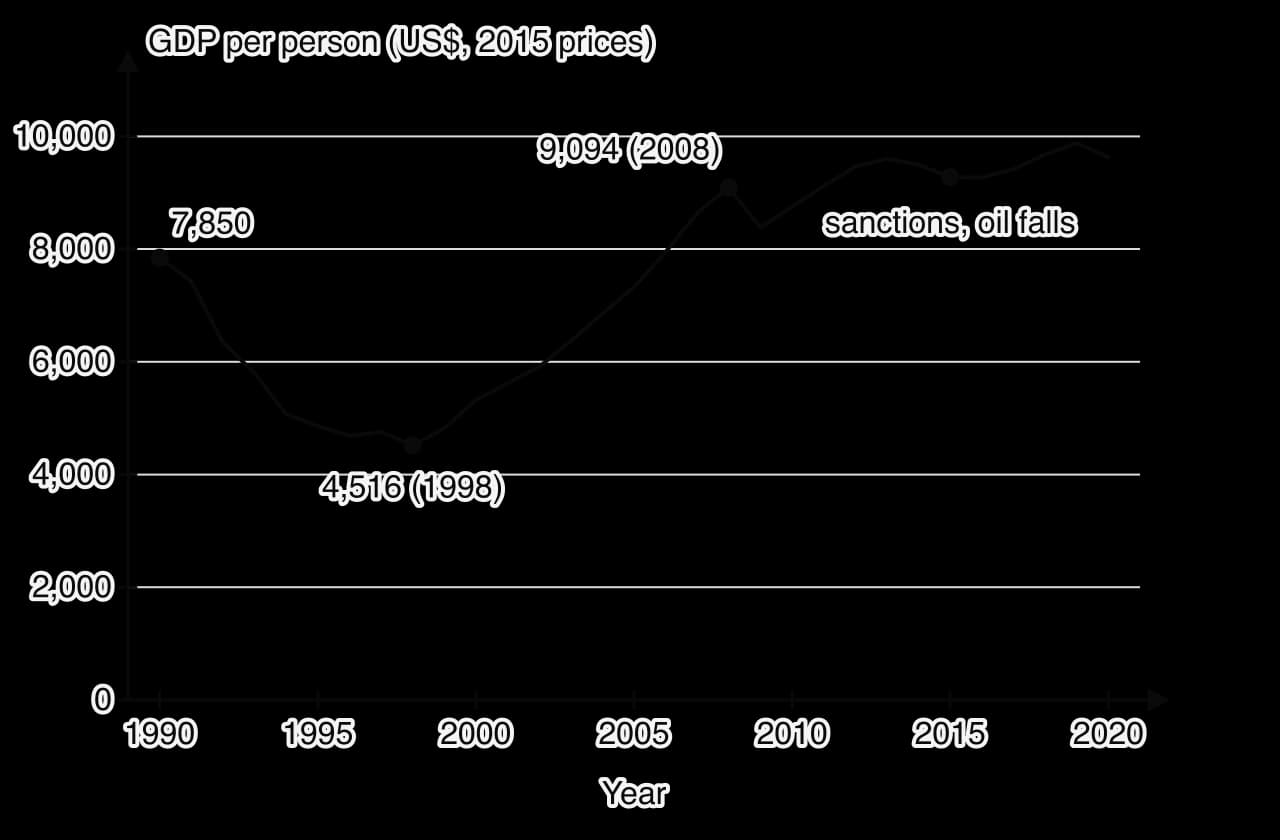
The chart of GDP per person shows three phases. From 1999 to 2008 the economy grew by about 7 per cent a year. Several causes worked together: the devaluation of 1998 made Russian goods competitive; spare capacity left by the 1990s could be brought back into use; reforms of Putin’s first term introduced a flat income tax of 13 per cent (2001), cut profit taxes and improved tax collection; and, above all, world oil prices rose from under 30 US dollars a barrel around 2000 to more than 100 dollars in 2008. Oil and gas supplied about half of federal budget revenue.
The government saved part of the windfall in a Stabilisation Fund (2004), paid off Russia’s debts to the IMF and other creditors early, and raised wages and pensions. The share of Russians living below the official subsistence minimum fell from about 29 per cent in 2000 to about 11 per cent in 2012, according to the state statistics service. For many Russians this recovery was the most important fact of the Putin years, and it explains much of his popularity.
The global financial crisis brought a fall in output of almost 8 per cent in 2009, the worst of any large economy that year. Growth resumed but slowed to under 2 per cent by 2013, as investment stayed low and the economy depended on energy exports. After the annexation of Crimea in 2014 Western sanctions and a collapse in oil prices at the end of the year cut the value of the rouble by about half against the dollar, and real incomes fell for four years running. Russia joined the World Trade Organization in 2012, but it answered the sanctions with a ban on food imports from the West and a policy of import substitution.
Social policy, the Church and “traditional values”
Putin’s social policy combined material benefits with a growing emphasis on national tradition:
Demography. Alarmed by a falling population, the government introduced maternity capital in 2007, a payment of about 250,000 roubles to families on the birth of a second child, usable for housing, education or pensions. The birth rate rose until 2015, although historians of population debate how much of this was due to the policy.
Pensions. In 2018 the government raised the pension age, in stages, from 60 to 65 for men and from 55 to 60 for women. The reform provoked protests across the country and the sharpest fall in Putin’s approval ratings for years.
The Orthodox Church. The Russian Orthodox Church, led from 2009 by Patriarch Kirill, became a close partner of the state, and religious education entered schools.
“Traditional values”. After the protests of 2011–2012 the regime presented itself as the defender of Russian and Christian values against a decadent West. Laws of 2013 banned the “propaganda of non-traditional sexual relations” to minors and made offending religious feelings a crime.
National prestige. Major sporting events, the Winter Olympics in Sochi (2014) and the football World Cup (2018), were used to show Russia’s return as a great power, although investigations from 2016 revealed state-backed doping of Russian athletes, and Russia was banned from competing under its own flag.
Propaganda, repression and resistance
Control of information
The Putin regime relied far less than the Soviet state on terror, and far more on control of information. By the mid-2000s the three national television channels, from which most Russians got their news, were owned by the state or by state companies, and their news programmes followed guidance from the presidential administration. Independent newspapers, radio stations and websites (Novaya gazeta, Ekho Moskvy, the internet channel Dozhd) continued to work, but with small audiences and under growing pressure.
Abroad: the international channel Russia Today, later RT, was launched in 2005 to present Russia’s view to foreign audiences.
Youth: after the “colour revolutions” in Georgia (2003) and Ukraine (2004), the Kremlin created the youth movement Nashi (2005) to mobilise young people against a similar revolution in Russia.
The internet: from 2012 a series of laws allowed websites to be blocked, required data on Russian users to be stored in Russia, and, in the “sovereign internet” law of 2019, gave the state the technical means to isolate the Russian internet.
Repression of critics
Repression under Putin was selective. It fell on journalists, opposition leaders and activists who crossed lines the regime set, not on the population as a whole. Several high-profile critics were killed, and in each case the Russian state denied involvement.
Case | What happened | Findings and responses |
|---|---|---|
Anna Politkovskaya | Journalist of Novaya gazeta who reported abuses in Chechnya; shot in Moscow, 7 October 2006 | Five men, including the gunman, convicted in 2014; who ordered the killing was never established in court |
Alexander Litvinenko | Former FSB officer and critic of the Kremlin; poisoned with polonium-210 in London, November 2006 | A UK public inquiry (2016) concluded that the killing was “probably approved” by Putin and the FSB director Nikolai Patrushev; Russia rejected the finding |
Boris Nemtsov | Former deputy prime minister and opposition leader; shot near the Kremlin, 27 February 2015 | Five Chechen men convicted in 2017; the organiser of the murder was not identified |
Sergei Skripal | Former Russian intelligence officer who had spied for Britain; poisoned with the nerve agent Novichok in Salisbury, March 2018 | The UK government attributed the attack to Russian military intelligence (GRU); Russia denied it |
Alexei Navalny | Leading opposition politician; poisoned with Novichok on a flight in Siberia, 20 August 2020 | Laboratories in Germany, France and Sweden and the OPCW confirmed a Novichok-type agent; Russia denied involvement and refused to open a criminal case |
The courts were used against opponents more often than violence. Members of the punk group Pussy Riot were sentenced to two years in a prison colony in 2012 for a protest performance in Moscow’s main cathedral, and Navalny was given suspended sentences in cases that the European Court of Human Rights later found to be unfair, which barred him from standing for president in 2018. Human rights organisations such as Memorial and the Levada Center, an independent polling agency, were labelled “foreign agents”.
Resistance
Opposition never disappeared. Navalny, a lawyer, founded the Anti-Corruption Foundation in 2011 and used YouTube investigations to reach millions of viewers: his film of March 2017 accusing Prime Minister Medvedev of secretly owning palaces and vineyards set off protests in dozens of cities. His “smart voting” strategy urged voters to back whichever candidate had the best chance of beating United Russia. Election monitors such as the Golos association documented fraud, and there were local protests over landfill sites, pensions and regional politics, such as the mass protests in Khabarovsk in July 2020 after the arrest of a popular governor. But opposition remained divided, concentrated in the big cities and kept off national television.
The extent of control
Measuring support in an authoritarian state is difficult, because people may hide their real views from pollsters. Surveys by the Levada Center show Putin’s approval rating above 60 per cent for almost all of 2000–2020, rising to more than 80 per cent after the war with Georgia in 2008 and after the annexation of Crimea in 2014, and falling to about 60 per cent after the pension reform of 2018. Political scientists such as Daniel Treisman link these movements to the economy and to patriotic rallies around the flag in times of conflict.
The evidence suggests that the regime rested on a combination of real but conditional popularity, especially among older and provincial Russians who remembered the 1990s; control of television and elections; co-option of the elite through access to wealth; and selective repression of those who resisted. Unlike the Soviet state, it did not try to control people’s private lives or beliefs, as long as they stayed out of politics.
Above all, we should acknowledge that the collapse of the Soviet Union was a major geopolitical disaster of the century. As for the Russian nation, it became a genuine drama. Tens of millions of our co-citizens and compatriots found themselves outside Russian territory.
Vladimir Putin, Annual Address to the Federal Assembly, 25 April 2005 (official English translation, kremlin.ru). The first sentence is often quoted on its own as evidence that Putin wanted to restore the USSR. In context, the passage is about the fate of ethnic Russians left outside Russia in 1991 and the chaos of the 1990s, and the same speech praised democracy. The address shows how Putin used the memory of Soviet greatness and post-Soviet humiliation to build support, and its theme of Russians abroad returned in the justification of the annexation of Crimea in 2014.
Conflicts with neighbouring states
Putin’s foreign policy aimed to restore Russia’s status as a great power and to keep the former Soviet republics, which Moscow called the “near abroad”, within its sphere of influence. The vertical timeline of conflicts shows that the wars of the period moved from inside Russia’s borders to beyond them. Russia’s relations with the West as a whole, and the wider history of Europe after the Cold War, belong to the study of Europe during and after the Cold War; the conflicts are treated for what they show about Putin’s Russia.
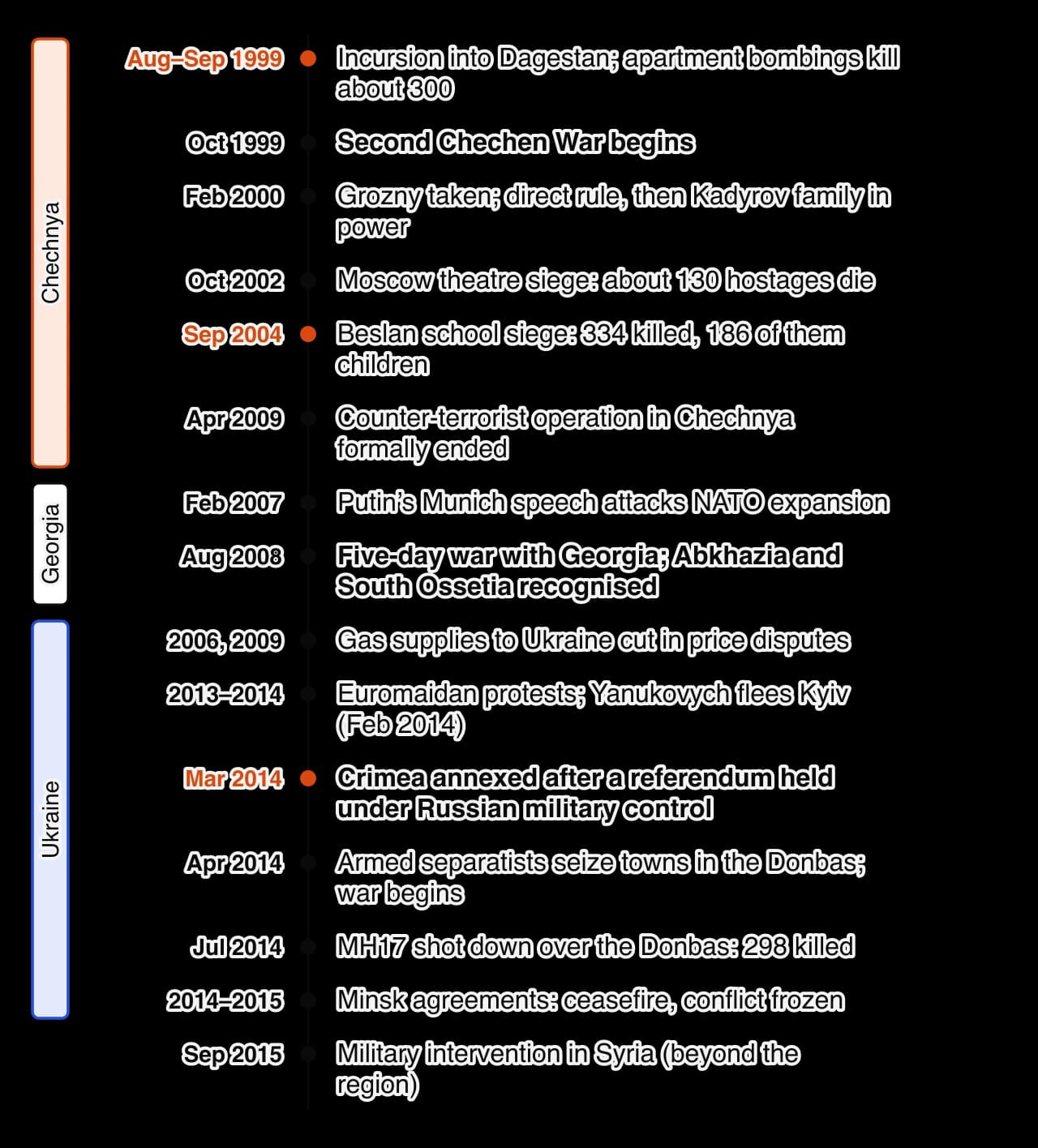
The Second Chechen War
The Second Chechen War, launched in October 1999, was fought with overwhelming force. Grozny was largely destroyed by bombing and artillery and taken in February 2000. Human rights groups, among them Memorial and Human Rights Watch, documented mass detentions in so-called filtration camps, torture, disappearances and the killing of civilians by Russian forces, and Chechen fighters also committed abuses. Casualty estimates range widely; tens of thousands of civilians died, and hundreds of thousands fled.
Moscow turned the war into a policy of “Chechenisation”: it handed power to the former rebel mufti Akhmad Kadyrov and, after his assassination in 2004, to his son Ramzan, whose forces ruled the republic with great brutality in return for loyalty to Putin and large federal subsidies. The counter-terrorist operation was formally ended in April 2009. The war was popular in Russia at first, and it was presented as a fight against international terrorism, especially after 11 September 2001.
Chechen and other North Caucasus militants carried the war into Russia. In October 2002 they seized a Moscow theatre during a performance of the musical Nord-Ost; about 130 hostages died, most of them from the gas that special forces pumped into the building. In September 2004 militants took more than 1,100 people hostage, most of them children and parents, at a school in Beslan in North Ossetia. When the siege ended in explosions and a storming on 3 September, 334 hostages had been killed, 186 of them children. Putin used Beslan to justify the end of elected governors, arguing that the state needed more central control to fight terrorism.
The war with Georgia, 2008
Georgia’s “Rose Revolution” of 2003 brought to power Mikheil Saakashvili, who sought membership of NATO and the European Union and wanted to restore control over two breakaway regions, Abkhazia and South Ossetia, which had been protected by Russian peacekeepers since the early 1990s. At its Bucharest summit in April 2008 NATO declared that Georgia and Ukraine would one day become members, without setting a date.
After weeks of skirmishes, Georgian forces attacked Tskhinvali, the capital of South Ossetia, on the night of 7–8 August 2008. Russian forces, already prepared nearby, drove them out and advanced into Georgia proper before a ceasefire mediated by the French president Nicolas Sarkozy. On 26 August Russia recognised Abkhazia and South Ossetia as independent states, and it kept troops in both. An inquiry commissioned by the European Union (the Tagliavini report, 2009) found that Georgia had started the war, but that Russia’s response went far beyond reasonable self-defence. The conflicts became frozen conflicts, like that of Transnistria in Moldova.
Putin had set out his complaints against the West in a speech to Western leaders and defence officials at the Munich Security Conference in February 2007.
I think it is obvious that NATO expansion does not have any relation with the modernisation of the Alliance itself or with ensuring security in Europe. On the contrary, it represents a serious provocation that reduces the level of mutual trust. And we have the right to ask: against whom is this expansion intended?
Vladimir Putin, speech at the Munich Conference on Security Policy, 10 February 2007 (official English translation, kremlin.ru). The speech was addressed to a Western audience and attacked the “unipolar world” led by the United States. It is valuable evidence of how the Russian leadership saw NATO enlargement into Eastern Europe and the Baltic states, which had joined NATO in 2004. Critics answer that the countries of Eastern Europe chose to join NATO because of their own fear of Russia, so the speech shows Russia’s perspective, not an agreed account of the causes of the conflict.
Ukraine, 2004–2020
Ukraine mattered more to Russia than any other former republic, because of their shared history, the millions of Russian speakers in the east and south, the Black Sea Fleet’s base at Sevastopol in Crimea, and the gas pipelines to Europe that crossed it. The Orange Revolution of 2004–2005, in which mass protests overturned a fraudulent presidential election won by the Moscow-backed Viktor Yanukovych, alarmed the Kremlin. Gas price disputes in 2006 and 2009 led Russia to cut supplies to Ukraine, which also reduced supplies to the European Union.
Yanukovych won the presidency in 2010. In November 2013, under Russian pressure and with the offer of a Russian loan, he suspended the signing of an association agreement with the EU. The protests that followed on Kyiv’s Independence Square, the Euromaidan, grew after police violence and ended in February 2014, after about 100 protesters and more than a dozen police officers had been killed, with Yanukovych fleeing to Russia. The Russian government called these events an illegal coup backed by the West; the new Ukrainian authorities and Western governments treated them as a popular revolution followed by a lawful change of government by parliament.
The annexation of Crimea
In late February 2014 armed men in unmarked uniforms seized the Crimean parliament and key sites on the peninsula. A referendum held on 16 March, under the control of these forces and without independent international observers, produced an official result of about 97 per cent for joining Russia. Russia signed a treaty incorporating Crimea and Sevastopol on 18 March. Putin at first denied that the armed men were Russian soldiers, then said in April 2014 that Russian servicemen had backed the local self-defence forces.
Perspective | The main arguments |
|---|---|
The Russian government | Crimea had been part of Russia since 1783 and was transferred to Ukraine only in 1954, by an internal Soviet decision; its population, mostly Russian speakers, exercised its right to self-determination after an unconstitutional coup in Kyiv; Russia protected them and its Black Sea Fleet; Western recognition of Kosovo’s independence in 2008 was a precedent |
Ukraine and most Western governments | Russia annexed part of a sovereign state by force, breaking the UN Charter and the Budapest Memorandum of 1994, in which it had promised to respect Ukraine’s borders in return for Ukraine giving up its nuclear weapons; the referendum was held under military occupation and was neither free nor fair |
The UN General Assembly | Resolution 68/262 of 27 March 2014, passed by 100 votes to 11 with 58 abstentions, called the referendum invalid and asked all states not to recognise any change in Crimea’s status |
Crimean Tatars | Most of this Muslim people, deported by Stalin in 1944 and allowed to return only from 1989, boycotted the referendum; their representative body, the Mejlis, was banned in 2016, and many activists were prosecuted |
The table of perspectives shows why the annexation remains contested. Opinion polls suggested that a majority of Crimea’s population, a majority of whom were ethnic Russians, welcomed joining Russia, although none were conducted in free conditions. In Russia itself the annexation was hugely popular, and Putin’s approval rating rose above 80 per cent.
The war in the Donbas
In April 2014 armed separatists, led at first by Russian citizens such as the former FSB officer Igor Girkin, seized government buildings in the Donetsk and Luhansk regions of eastern Ukraine and declared “people’s republics”. Ukraine launched a military operation against them. Russia supplied the separatists with weapons, volunteers and money, and Ukraine, NATO and independent journalists produced evidence that regular Russian army units fought in decisive battles at Ilovaisk in August 2014 and Debaltseve in February 2015. Russia denied that its regular forces were involved, describing the conflict as a civil war in Ukraine. The combination of deniable forces, local proxies, cyber attacks and propaganda led Western analysts to describe Russian tactics as hybrid warfare.
On 17 July 2014 Malaysia Airlines flight MH17 was shot down over separatist-held territory, killing all 298 people on board. A Dutch-led Joint Investigation Team concluded in 2016 and 2018 that it was destroyed by a Buk missile brought from Russia from the Russian army’s 53rd Anti-Aircraft Missile Brigade, and returned to Russia afterwards. Russia rejected the findings.
The Minsk agreements of September 2014 and February 2015, negotiated with France and Germany, set out a ceasefire and a plan for the separatist regions to return to Ukraine with special status, but neither side carried out their political terms. The fighting fell to a lower level and the conflict was frozen. By the end of 2020, according to the UN human rights office, about 13,000 people had been killed, more than 3,000 of them civilians, and more than a million had been displaced.
Russia’s military intervention in Syria from September 2015, in support of President Bashar al-Assad, lay outside the region but showed the same aims: to be treated as a great power and to prevent the fall of a friendly government to a Western-backed uprising. In February 2022, after the end of this study, Russia launched a full-scale invasion of Ukraine.
Perspectives and debates
Historians have argued about every period of this study, and the arguments have changed as archives opened after 1991 and as events after 2000 changed what the earlier decades seemed to lead to. Six debates matter most.
How did late Stalinism work?
Older accounts, written before the archives opened, described the post-war years as a simple return to the totalitarian terror of the 1930s. Archival research has produced a more complex picture. Yoram Gorlizki and Oleg Khlevniuk, in Cold Peace: Stalin and the Soviet Ruling Circle, 1945–1953 (2004), argue that Stalin’s personal despotism over his inner circle coexisted with an increasingly routine, committee-based government below, which made a smooth transition possible after his death. Elena Zubkova, in Russia after the War (1998), focuses on society: she traces the hopes for a freer life that victory raised and the disappointment and quiet withdrawal from politics that followed when Stalin tightened control.
Was Khrushchev a reformer?
Historian | Argument | Evidence stressed |
|---|---|---|
William Taubman, Khrushchev: The Man and His Era (2003) | A genuine reformer whose instinct to undo Stalin’s crimes and improve lives was undermined by his own impulsiveness, ignorance and inconsistency, and by a system he never questioned | The Secret Speech and releases from the camps; the housing and welfare reforms; the Virgin Lands and maize campaigns; Novocherkassk |
Critics on the left and later Soviet reformers | De-Stalinisation stopped half-way: it blamed one man and protected the party, so the system could slip back under Brezhnev | The silence on collectivisation; the treatment of Pasternak; the re-centralisation after 1964 |
Critics who stress power | De-Stalinisation was a weapon in a power struggle as much as a moral choice | The timing of the Secret Speech and the attack on the Anti-Party Group (1957) |
These views can be combined. Khrushchev’s motives were mixed, but his reforms had consequences that went beyond his aims: the end of mass terror was never reversed, and the generation formed by the Thaw, Gorbachev among them, later drove the reforms of the 1980s.
Was the Brezhnev era a period of stagnation?
The label of “stagnation” came from Gorbachev’s supporters, who needed to show why reform was urgent, and many Western economists accepted it, pointing to the falling growth rates in the table of estimates and to the ageing leadership. Revisionist historians have challenged how far it describes the period as a whole. The contributors to Edwin Bacon and Mark Sandle (eds), Brezhnev Reconsidered (2002), argue that the period brought stability, rising consumption and welfare for most citizens, and that it was remembered fondly by many Russians in the 1990s. The anthropologist Alexei Yurchak, in Everything Was Forever, Until It Was No More (2005), shows that the last Soviet generation lived meaningful lives inside the system, repeating official rituals while creating their own worlds, which explains both why the system seemed permanent and why it collapsed so suddenly when the rituals lost their force.
A balanced judgement distinguishes economy from society and early from late: growth was respectable until the mid-1970s and slowed sharply after it, while social security and living standards improved for most people even as health indicators worsened.
Why did the USSR collapse?
Historian | Main argument | Evidence stressed |
|---|---|---|
Archie Brown, The Gorbachev Factor (1996) | Gorbachev’s leadership and choices transformed the system; another leader would not have reformed | Gorbachev’s political reforms of 1988–1990; New Thinking |
Stephen Kotkin, Armageddon Averted (2001) | The system was already failing economically and ideologically; Gorbachev’s reforms exposed this, and the elite chose to give up rather than fight | Economic decline; the elite’s loss of faith; the peaceful end |
Mark Beissinger, Nationalist Mobilization and the Collapse of the Soviet State (2002) | Waves of nationalist protest, each encouraging the next, broke the Union apart | The Baltic, Caucasian and Ukrainian movements of 1988–1991 |
Chris Miller, The Struggle to Save the Soviet Economy (2016) | Gorbachev tried market reforms but was blocked by powerful interest groups in industry, the military and agriculture | The fate of perestroika’s economic laws; budget deficits |
Serhii Plokhy, The Last Empire (2014) | The decisive actors were Yeltsin and the Ukrainian leadership in late 1991; the United States wanted the USSR to survive | The Ukrainian referendum; the Belovezha Accords |
Vladislav Zubok, Collapse (2021) | The collapse was not inevitable; Gorbachev’s reforms and his refusal to use force destroyed the state’s finances and authority | Economic policy 1988–1990; the loss of control over the republics |
The historians differ above all on whether the collapse was caused by long-term structural weakness (Kotkin), by the choices of leaders (Brown, Zubok, Plokhy) or by pressure from below (Beissinger). Most now combine them: decline made reform necessary, Gorbachev’s choices made it destabilising, and nationalism and Yeltsin turned destabilisation into collapse.
How should the 1990s be judged?
Critics of the decade, such as Stephen F. Cohen in Failed Crusade (2000), argue that Western-backed shock therapy was a disaster that impoverished most Russians and discredited democracy. The journalists Chrystia Freeland (Sale of the Century, 2000) and David Hoffman (The Oligarchs, 2002) show how privatisation created an oligarchy that captured the state. Against this, Andrei Shleifer and Daniel Treisman argued in “A Normal Country” (Foreign Affairs, 2004) that by 2000 Russia had become a typical middle-income country with a flawed but real democracy and market economy, no worse than others at its level of income. Timothy Colton’s biography Yeltsin: A Life (2008) presents Yeltsin as a flawed leader who nonetheless broke the communist system and refused to restore it.
Putin’s Russia: what kind of regime, and why conflict?
Historian or analyst | Argument | Evidence stressed |
|---|---|---|
Fiona Hill and Clifford Gaddy, Mr. Putin: Operative in the Kremlin (2013; 2nd ed. 2015) | Putin is a KGB-trained statist and survivalist who sees politics as an operation to manage threats | His career; the use of compromising information; the system of personal loyalty |
Karen Dawisha, Putin’s Kleptocracy (2014) | From the start the regime was built by Putin’s circle to enrich itself and protect its wealth | The St Petersburg years; the business careers of Putin’s associates |
Daniel Treisman, The Return (2011) | Putin’s popularity rose and fell with the economy; his support was largely genuine | Opinion polls compared with incomes and growth |
Steven Levitsky and Lucan Way, Competitive Authoritarianism (2010) | Russia became a competitive authoritarian regime, and by the late 2000s close to full authoritarianism | Elections held on an uneven playing field; control of media and courts |
Richard Sakwa, Frontline Ukraine (2015); John Mearsheimer, “Why the Ukraine Crisis Is the West’s Fault” (Foreign Affairs, 2014) | Western policy, especially NATO and EU enlargement, provoked Russia’s actions in Ukraine | The Bucharest summit (2008); the EU association agreement (2013) |
Critics of this view (for example Serhii Plokhy and Anne Applebaum) | Russia’s actions came from imperial ambitions and the regime’s fear of democracy spreading from Ukraine, not from Western provocation | Putin’s statements on Ukraine and on Russians abroad; the choices of Eastern Europeans to join NATO |
The debate on Ukraine is the most heated in the study, and the historians’ views are themselves shaped by when they wrote and by their own perspectives on Russia and the West. A balanced answer sets the arguments against the evidence: the timing of Russia’s actions after Euromaidan supports the claim that Russia reacted to events in Ukraine, while the methods used, and Putin’s repeated statements that Russians and Ukrainians are one people, support the argument that the regime was not willing to accept Ukraine as a fully independent state.
Applying the ideas in exam questions
The questions cover five of the six periods and use both kinds of claim that Paper 3 sets.
Paper 3: post-war reconstruction
Paper 3: the fall of Khrushchev
Questions on Khrushchev often ask about one cause of his fall, and the best answers explain how the causes worked together.
Paper 3: the Brezhnev era
A question on the Brezhnev era as a whole tests the claim across the economy, politics and society.
Paper 3: democracy in the 1990s
The next question asks about the failure of democracy, so the evidence must come from 1991–1999, not from the Gorbachev years.
Paper 3: Putin’s control of Russia
Questions on Putin ask about the period to 2020 only, and the strongest answers weigh several methods of control against each other.
Self-check
- To do:
I can describe the human and material cost of the war to the USSR and how Stalin carried out reconstruction under the Fourth Five-Year Plan.
- To do:
I can explain the causes and scale of the famine of 1946–1947 and the growth of the Gulag after the war.
- To do:
I can explain the Zhdanovshchina, the anti-cosmopolitan campaign, the Leningrad Affair and the Doctors’ Plot, and what they show about late Stalinism.
- To do:
I can explain how Soviet prisoners of war and forced labourers were treated on their return, and how Axis prisoners were used in the USSR.
- To do:
I can explain how Khrushchev won the struggle for succession after Stalin’s death.
- To do:
I can explain the content, motives, limits and consequences of the Secret Speech and de-Stalinisation.
- To do:
I can assess Khrushchev’s agricultural, industrial and social policies, including Virgin Lands, the sovnarkhozy, housing and Novocherkassk.
- To do:
I can explain the achievements, propaganda value and costs of the Soviet space programme.
- To do:
I can weigh the causes of Khrushchev’s removal in 1964.
- To do:
I can explain Kosygin’s reform of 1965 and why it faded.
- To do:
I can describe Brezhnev’s political and economic policies and assess whether “stagnation” describes the period.
- To do: