Notes on R4.2 Renaissance and Reformation (circa 1350–1700)
The Renaissance was a movement in learning and the arts that began in Italy in the fourteenth century and looked to ancient Greece and Rome as models. The Reformation was the religious upheaval that began with Martin Luther in 1517 and split western Christianity into Catholic and Protestant churches. Together they reshaped how Europeans thought about knowledge, authority, religion and the state.
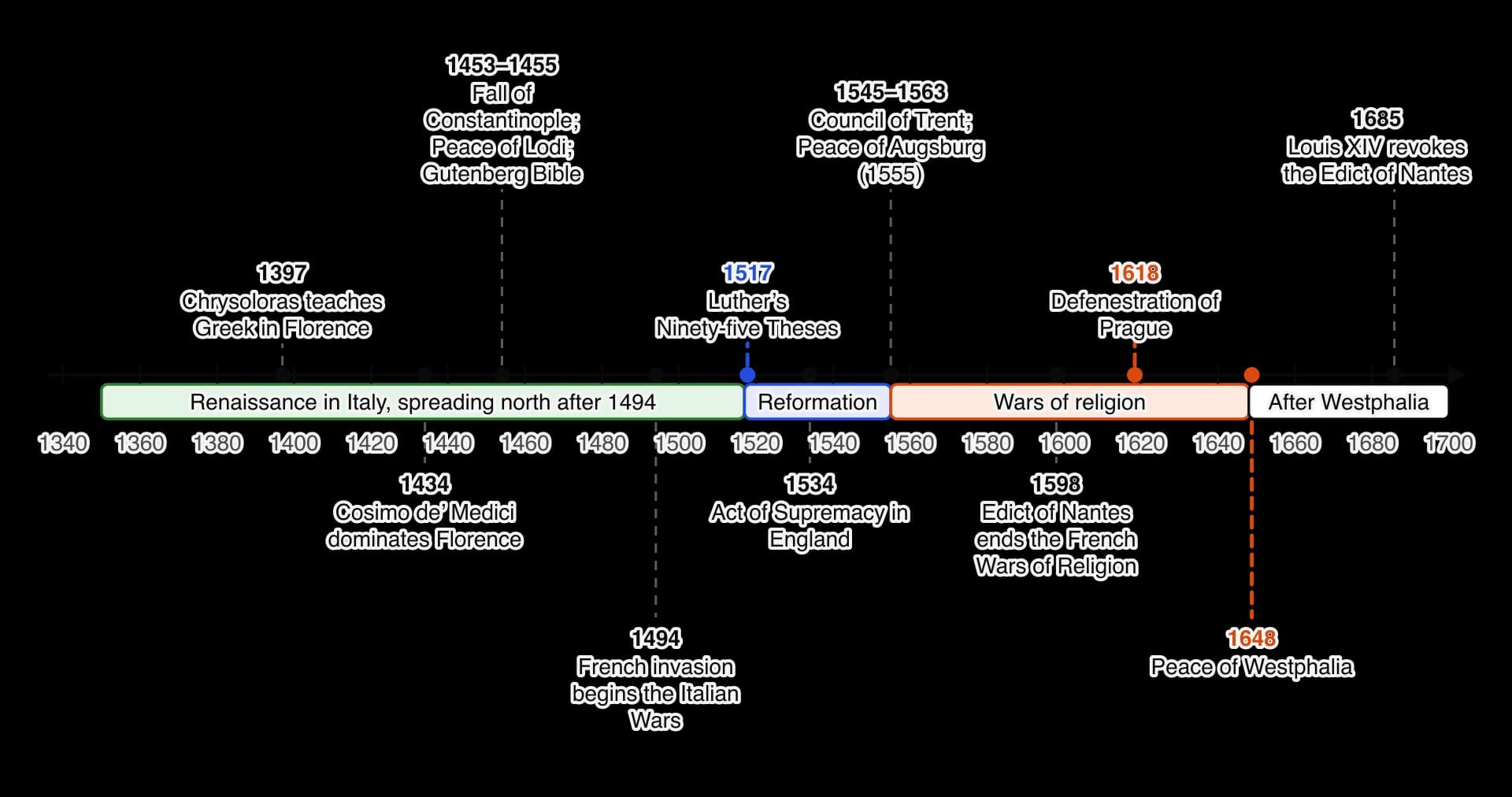
The timeline of the whole period shows two overlapping stories. The Renaissance began first and lasted longest; the Reformation grew partly out of it, through humanist scholarship, printing and anger at the cost of Renaissance Rome. The religious division that followed was settled for the Holy Roman Empire only in 1648.
What was the Renaissance?
The word "Renaissance" is French for "rebirth". Italians of the time used similar language. The painter and writer Giorgio Vasari, in his Lives of the Most Excellent Painters, Sculptors and Architects (1550), described the history of the arts as one of "perfection, ruin, and restoration, or rather resurrection", and he used the Italian word rinascita for the revival of the arts that he dated from Giotto (c. 1267–1337). The idea of a rebirth implied a judgement that the centuries between the fall of Rome and the writer's own time had been an age of decline, which later writers called the "Middle Ages".
At the heart of the movement was humanism. Humanists studied the studia humanitatis: grammar, rhetoric, poetry, history and moral philosophy, read in classical Latin and, increasingly, Greek. They searched monastery libraries for lost ancient texts, tried to write Latin as Cicero had written it, and believed that this education produced eloquent, virtuous citizens and rulers. Humanism was a programme of education and a way of reading texts, not a rejection of Christianity: almost all humanists were Christians, and many used their skills to study the Bible and the early Church Fathers.
Italy in the fourteenth and fifteenth centuries: social and political conditions
Northern and central Italy was the most urbanised part of Europe. Florence, Venice, Milan and Genoa were among the largest cities in the West, and dozens of smaller towns governed themselves. The Holy Roman Emperor still claimed overlordship of the north and the pope ruled the Papal States in the centre, but neither could control the region, so cities and the families that ran them acted as independent states.

The map of Italy in 1494 shows the result: five larger powers and many small ones. The city-state was the basic unit of Italian politics. Each was governed in one of two broad ways. Republics such as Florence and Venice were run by councils drawn from the merchant elite; signorie such as Milan, Mantua and Ferrara were ruled by one family whose head held power for life and passed it to his heirs.
Five states
State | Government | Key developments, c. 1350–1500 |
|---|---|---|
Florence | Republic run by the guilds: a Signoria of nine priors, chosen by lot for two months from bags of approved names | Ciompi revolt of the wool workers (1378); rule of a merchant oligarchy (the Albizzi); Medici dominance from 1434 to 1494 |
Venice | Oligarchic republic: an elected Doge for life, a Great Council closed to new families in 1297, the Senate and the Council of Ten | Maritime trading empire in the eastern Mediterranean; conquest of a mainland territory (Padua, Verona) after 1404; famous for stability |
Milan | Duchy (a signoria): the Visconti family, dukes from 1395, then the Sforza from 1450 | Short-lived Ambrosian Republic (1447–1450); the condottiere Francesco Sforza made duke (1450); Ludovico "il Moro" ruled from 1480 |
Papal States and Rome | Ruled by the pope as a territorial prince | Popes at Avignon (1309–1377) and the Great Schism (1378–1417); Martin V re-established the papacy in Rome (1420) |
Naples | Kingdom | Conquered by Alfonso V of Aragon (1442), whose court patronised humanists such as Lorenzo Valla |
In Florence power was in principle widely shared among guild members, but in practice a small group of wealthy families managed the lists from which officials were drawn. The Ciompi revolt of 1378, when unskilled wool workers seized the government for a few weeks and demanded their own guilds, frightened the elite and was followed by four decades of firmer oligarchy.
War, diplomacy and the balance of power
The Italian states fought each other constantly in the early fifteenth century, mostly with hired condottieri. Florence's survival against Giangaleazzo Visconti of Milan, who died suddenly in 1402 while his armies surrounded Tuscany, became part of the Florentines' image of their city as a defender of liberty. After Milan and Venice made the Peace of Lodi in 1454, followed by the Italian League of 1455, the five main states kept a rough balance of power for forty years. Resident ambassadors, an Italian invention of this period, kept rulers informed of each other's plans.
The balance ended in 1494, when Charles VIII of France invaded to claim the Kingdom of Naples. The Italian Wars (1494–1559) turned Italy into a battlefield of France, Spain and the Holy Roman Empire. The Medici were expelled from Florence (1494), the Sforza lost Milan to Louis XII of France (1499), and in 1527 the unpaid troops of Emperor Charles V sacked Rome. By the peace of Cateau-Cambrésis (1559) Spain dominated most of Italy.
Society
Italian cities were run by merchants, bankers and guildsmen rather than by a landed military nobility, although the two increasingly merged as rich families bought estates and titles. The guild system organised work and politics: in Florence there were seven major guilds (among them wool, cloth finishing, banking and silk) and fourteen minor ones. Wealth, education and public reputation mattered more than ancient lineage, which made culture a way for families to display and justify their position.
The Renaissance was the culture of a small minority. Most Italians were peasants or urban workers who could not read, and women, even in rich families, were largely excluded from public life and from humanist education. A few exceptions, such as the scholar Isotta Nogarola (1418–1466) or the patron Isabella d'Este of Mantua, show what was possible for women of the elite and also how unusual it was.
Economic factors: the wealth of Italian cities
Italian merchants dominated European trade in the late Middle Ages. Venice and Genoa carried spices, silk and cotton from the eastern Mediterranean to the West, and Florence made and finished high-quality woollen cloth and later silk. Italian bankers developed bills of exchange, double-entry bookkeeping and branch banking, and lent to kings and popes. The gold florin of Florence, first minted in 1252, was accepted across Europe.
Banking was risky. The great Florentine houses of the Bardi and Peruzzi collapsed in the 1340s, partly because Edward III of England did not repay his war loans. Their place was taken in the next century by the Medici bank, founded by Giovanni di Bicci de' Medici in 1397. It became the bank of the papacy, collecting and transferring Church revenues, and opened branches in Rome, Venice, Geneva, Bruges, London and Avignon.
The Black Death and the wealth of survivors
The Black Death of 1347–1351 killed perhaps half the population of many Italian cities, and plague returned every decade or two. Florence may have had 90,000–120,000 inhabitants in the 1330s (estimates vary); the tax survey of 1427, the catasto, counted about 38,000. Fewer people meant higher wages for survivors and more inherited wealth per head, so a smaller but richer urban elite had money to spend.
Historians have debated what this meant. Robert Lopez argued in the 1950s that the Renaissance happened in "hard times": with trade depressed, the rich invested in culture because there were fewer profitable alternatives. Richard Goldthwaite, in Wealth and the Demand for Art in Italy, 1300–1600 (1993), argues the reverse: Italian wealth was large and growing, and a new culture of consumption, in which families competed through buildings, furnishings and religious art, created a market for artists.
Spending as display
Italian elites spent on palaces, family chapels, altarpieces, tombs and books because these brought honour to the family and, in religious works, spiritual benefit. Lorenzo de' Medici noted in his private memoranda that his family had spent 663,755 florins on buildings, charity and taxes between 1434 and 1471, and judged the money well spent. Guilds also commissioned art. The cloth merchants' guild ran the competition of 1401 for the bronze doors of Florence's Baptistery, won by Lorenzo Ghiberti against Filippo Brunelleschi, and the wool guild oversaw the building of Brunelleschi's great dome for the cathedral (1420–1436).
Intellectual and religious influences
Petrarch and the first humanists
Francesco Petrarca, known in English as Petrarch (1304–1374), is usually seen as the founder of humanism. He collected manuscripts of classical authors, found Cicero's letters to his friend Atticus in Verona in 1345, and wrote letters addressed to dead Roman writers as if they were friends. Petrarch contrasted the brilliance of ancient Rome with the "darkness" of the centuries since, an idea that shaped the later notion of a Renaissance. His friend Giovanni Boccaccio (1313–1375), author of the Decameron, helped to bring a teacher of Greek to Florence.
In Florence humanism became the training of the city's political class. Coluccio Salutati, chancellor of the republic from 1375 to 1406, used classical rhetoric in the city's letters and propaganda and invited the Byzantine scholar Manuel Chrysoloras to teach Greek there in 1397. Leonardo Bruni, chancellor from 1427, praised Florence in his Panegyric to the City of Florence (c. 1403–1404) as the heir of republican Rome and wrote a history of the Florentine people. Historians call this blend of classical learning and republican patriotism civic humanism.
Greek learning and Neoplatonism
Knowledge of Greek, almost lost in the medieval West, returned through contact with the Byzantine Empire. Chrysoloras's pupils translated Plato, Plutarch and other Greek writers into Latin. The Council of Ferrara–Florence (1438–1439), called to reunite the Latin and Greek Churches, brought Greek churchmen and scholars such as Gemistos Plethon and Basilios Bessarion to Florence. After the Ottoman conquest of Constantinople in 1453, more Greek scholars and manuscripts moved to Italy, although the movement had begun decades earlier.
Cosimo de' Medici supported Marsilio Ficino (1433–1499), who translated all of Plato's dialogues into Latin (printed in 1484) and led an informal circle later called the Platonic Academy. Ficino's Neoplatonism taught that the soul rises towards God through the contemplation of beauty, and it influenced artists and poets. His younger associate Giovanni Pico della Mirandola wrote the Oration on the Dignity of Man (1486), which argued that God had given human beings the freedom to shape their own nature.
Critical scholarship
Humanist methods could be turned against established authorities. Lorenzo Valla, working for Alfonso V of Naples, who was then in conflict with the pope, showed in 1440 that the Donation of Constantine, a document in which the Roman emperor supposedly gave the pope rule over the western empire, was a forgery: its Latin used words and forms that did not exist in the fourth century. Valla also compared the Latin Vulgate Bible with Greek manuscripts. Such textual criticism later shaped Erasmus and, through him, the Reformation.
Religion and the Renaissance
Most Renaissance art was religious, commissioned for churches, chapels and devotional use, and lay piety was strong. Italian cities had hundreds of confraternities, lay religious brotherhoods that organised processions, charity and burials and commissioned art. Patrons paid for chapels and altarpieces to win prayers for their souls as well as to display their wealth.
Religion could also turn against the new culture. Girolamo Savonarola, a Dominican friar and prior of San Marco in Florence, preached that God would punish Italy for its luxury and the corruption of the Church. After the Medici were expelled in 1494 he became the dominant voice in the restored republic. His followers held "bonfires of the vanities" in 1497 and 1498, burning mirrors, cosmetics, books and paintings. Pope Alexander VI excommunicated him in 1497, and in 1498 the Florentine government had him hanged and burned.
Individuals and patronage: the Medici, the Sforza and the popes
Patronage paid for most Renaissance art and scholarship. A patron commissioned a work, set its subject, size and materials in a contract, and often expected his coat of arms or portrait to appear in it. Patrons had several motives at once: piety, family honour, political legitimacy and the enjoyment of beauty.
The Medici in Florence
Cosimo de' Medici (1389–1464) was exiled by his rivals in 1433 but returned in triumph in 1434. He held no permanent office, yet for thirty years his supporters filled the government and controlled the bags from which officials were drawn. Cosimo rebuilt the friary of San Marco, with a library open to scholars, paid for the church of San Lorenzo designed by Brunelleschi, and built the Medici palace. He supported Donatello, whose bronze David (probably 1440s) was the first free-standing nude statue since antiquity, and Ficino's Platonic studies.
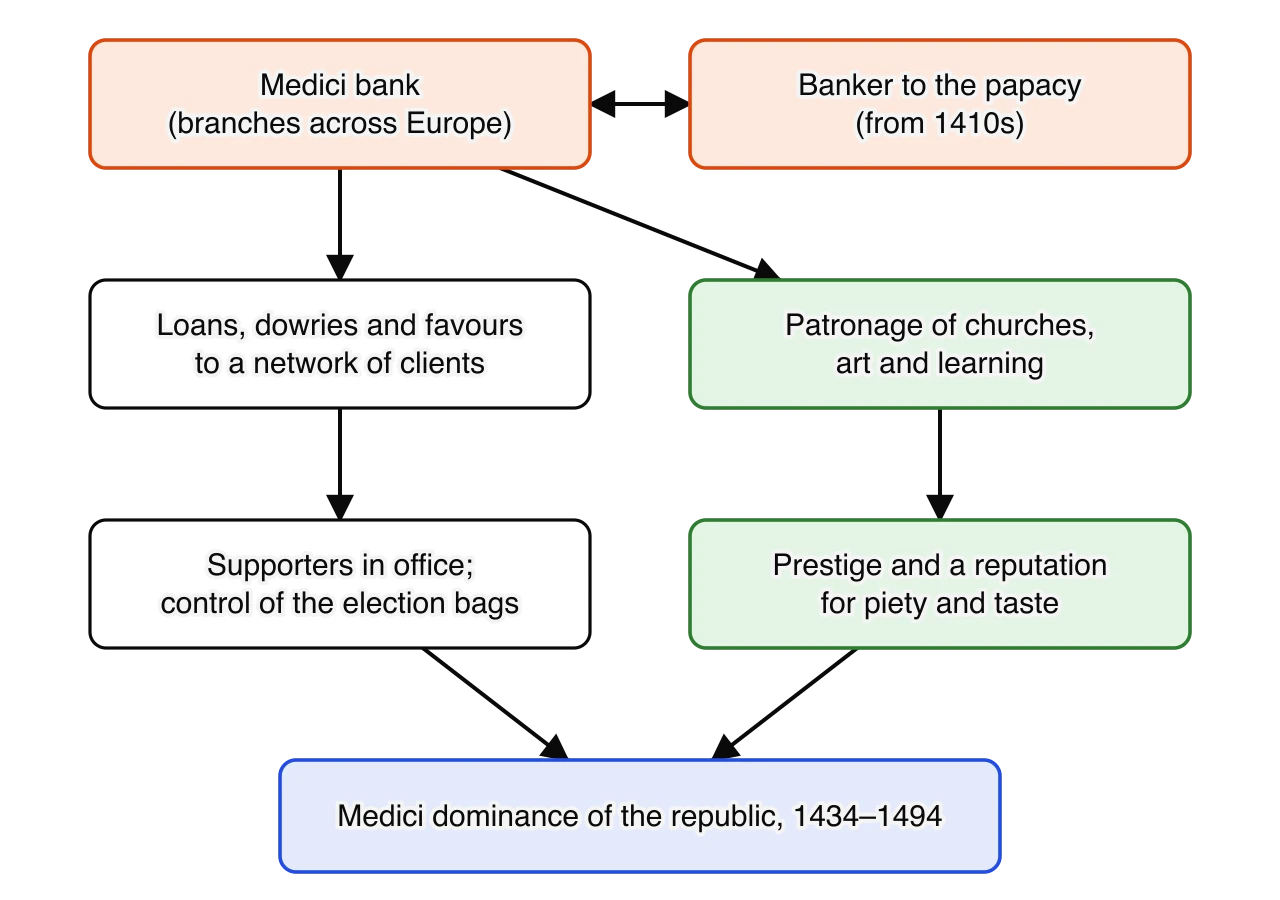
The flow diagram of Medici power shows why patronage and politics cannot be separated. Banking wealth bought both a network of political clients and buildings and art that presented the family as pious, generous servants of the city, so that they did not appear as tyrants.
Cosimo's grandson Lorenzo "the Magnificent" (1449–1492) faced the Pazzi conspiracy of 1478, when a rival banking family, with the support of Pope Sixtus IV, tried to murder Lorenzo and his brother Giuliano during Mass in the cathedral. Giuliano was killed; Lorenzo escaped and his supporters executed the plotters. Lorenzo was a poet and a patron of humanists, kept a sculpture garden where the young Michelangelo trained, and used Florentine artists as diplomatic gifts to other rulers. The Medici bank, however, declined under his management.
The Sforza in Milan and other princely courts
Francesco Sforza (1401–1466), a condottiere who married the heiress of the last Visconti duke, became duke of Milan in 1450. Patronage helped to make a mercenary's dynasty look legitimate: Francesco began the great hospital, the Ospedale Maggiore, and his son Ludovico "il Moro" (regent from 1480, duke 1494–1499) brought Leonardo da Vinci and the architect Donato Bramante to Milan. Leonardo painted The Last Supper (c. 1495–1498) for the friary church of Santa Maria delle Grazie, where Ludovico planned a family mausoleum, and modelled a giant bronze horse in honour of Francesco that was never cast, because the bronze was used for cannon.
Smaller courts competed too. Federico da Montefeltro (1422–1482), another condottiere, built a palace and a famous library at Urbino. At Mantua Isabella d'Este (1474–1539), wife of the Gonzaga marquis, commissioned paintings from Andrea Mantegna and Pietro Perugino for her private study and wrote detailed instructions to the artists, which makes her one of the best-documented patrons of the period.
Papal patronage and Renaissance Rome
Rome in the early fifteenth century was a run-down city, much smaller than Florence or Venice, whose ancient ruins were used as quarries. After the return of the papacy from Avignon and the end of the Great Schism, the popes set out to make Rome a capital worthy of the head of the Church, and to restore papal prestige after a century of crisis.
Pope | Reign | Main patronage | Purpose and context |
|---|---|---|---|
Nicholas V | 1447–1455 | Collected manuscripts that formed the Vatican Library; plans to rebuild St Peter's and the Vatican | A humanist scholar who wanted Rome to show the authority of the restored papacy |
Sixtus IV | 1471–1484 | Built the Sistine Chapel (1473–1481); its walls painted by Botticelli, Perugino and Ghirlandaio; opened the Vatican Library (1475) | Also a builder of roads and bridges; notorious for nepotism and his part in the Pazzi conspiracy |
Julius II | 1503–1513 | Laid the foundation stone of Bramante's new St Peter's (1506); Michelangelo's Sistine Chapel ceiling (1508–1512); Raphael's rooms in the Vatican | The "warrior pope", who led armies to recover the Papal States; art proclaimed papal power |
Leo X | 1513–1521 | Raphael, who became architect of St Peter's; music, theatre and humanist scholars | Son of Lorenzo de' Medici; financed St Peter's partly through the indulgence that Luther attacked in 1517 |
Papal patronage was decisive for the "High Renaissance" in Rome between about 1500 and the Sack of Rome in 1527. No other patron could command Michelangelo, Raphael and Bramante at the same time or fund a project on the scale of the new St Peter's. Its limits are equally clear. The popes mostly drew artists who had trained in Florence, Umbria and Milan, so the movement already existed before Rome became its centre. Papal spending also had costs: the money raised through Church taxes and indulgences fed the anger that Luther voiced in 1517.
Artists and the new style
Patrons' demand met a generation of artists who changed the way the world was represented. Brunelleschi demonstrated linear perspective in Florence around 1415, and Leon Battista Alberti explained it to painters in On Painting (1435). Masaccio's Holy Trinity fresco (c. 1427) in Santa Maria Novella was among the first paintings to use it systematically. Artists studied anatomy, light and Roman ruins and statues, and their status rose from craftsman towards that of an educated, even inspired, individual.
Artist | Dates | Works and contribution |
|---|---|---|
Giotto | c. 1267–1337 | Frescoes in the Arena Chapel, Padua: solid, naturalistic figures; seen by Vasari as the start of the revival |
Filippo Brunelleschi | 1377–1446 | Dome of Florence Cathedral (1420–1436); San Lorenzo; perspective demonstrations |
Donatello | c. 1386–1466 | Bronze David; statues for the guild church of Orsanmichele |
Sandro Botticelli | c. 1445–1510 | Primavera and The Birth of Venus, mythological paintings for the Medici circle |
Leonardo da Vinci | 1452–1519 | The Last Supper; Mona Lisa; notebooks on anatomy and engineering; worked in Florence, Milan, Rome and France |
Michelangelo Buonarroti | 1475–1564 | Marble David (1501–1504) for the Florentine republic; Sistine ceiling; Last Judgement (1536–1541); dome of St Peter's |
Raphael | 1483–1520 | The School of Athens (1509–1511) in the Vatican: ancient philosophers in a classical building |
Titian | c. 1488–1576 | Leading Venetian painter, famous for colour and portraits of popes, emperors and kings |
 YouTube
Weighing the causes of the Italian Renaissance
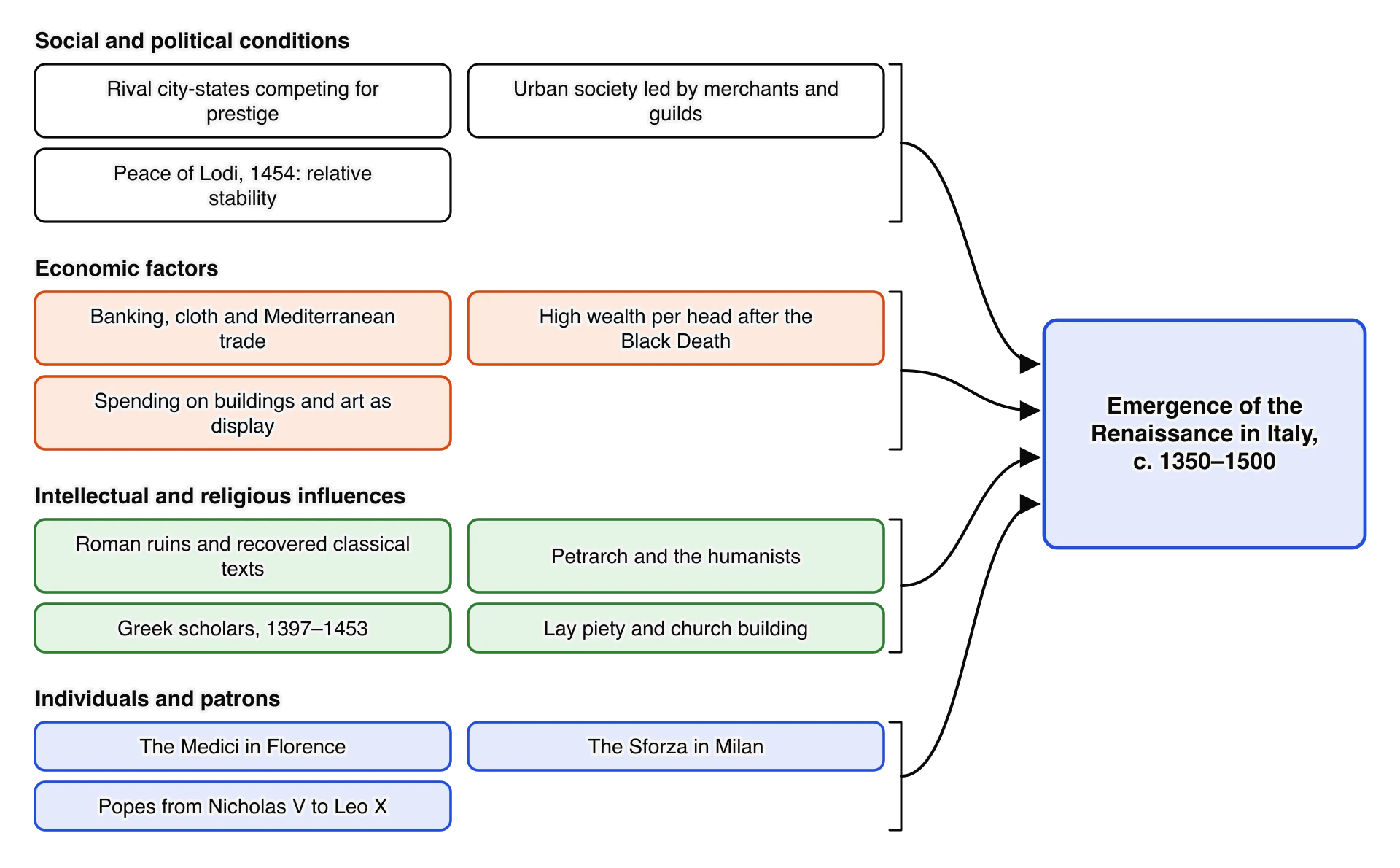
The diagram of the factors behind the Italian Renaissance shows four groups of cause that depended on each other. Wealth made patronage possible; competition between city-states and families gave patrons a reason to spend; humanism supplied the classical models; and individual patrons decided which artists and scholars were supported and what they produced.
Historians weigh these differently. Jacob Burckhardt stressed the political conditions of the city-states, in which rulers had to justify power through their own abilities. Economic historians such as Goldthwaite stress demand. Intellectual historians stress the humanist movement that began with Petrarch before the great age of patronage. Papal patronage was important later, mainly after 1450 and above all after 1500, and it built on a movement that Florence and the princely courts had already created.
The emergence of the Renaissance outside Italy
From about 1450 Italian humanism and art began to spread across Europe. The movement did not simply travel north unchanged: each country adapted Italian models to its own institutions, languages and religious concerns. Historians often call the result the "Northern Renaissance", although it reached Spain, Hungary and Poland as well.
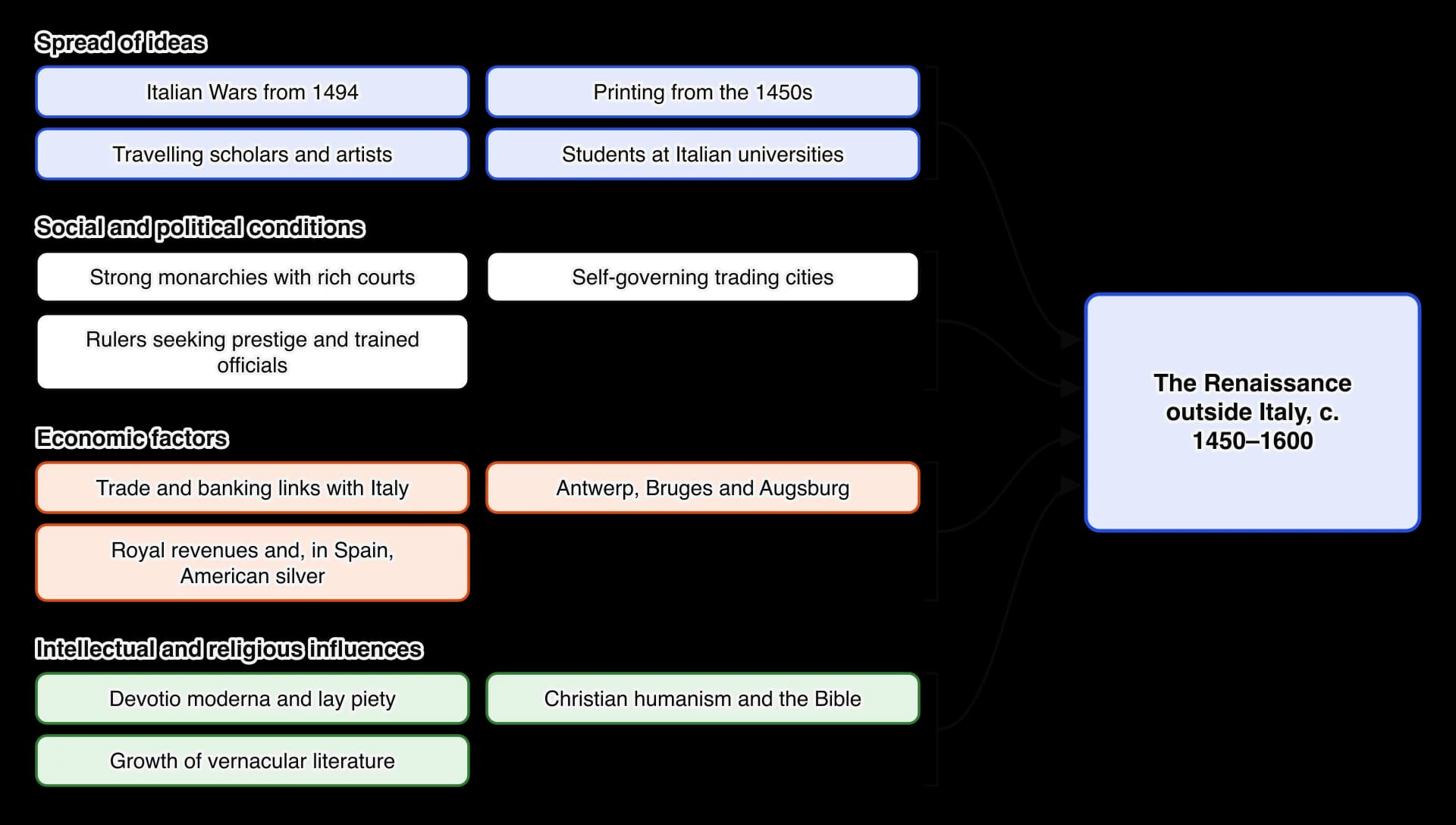
The diagram of the spread of the Renaissance shows the main channels. Scholars from across Europe studied law and medicine at Italian universities such as Padua and Bologna. Italian bankers and merchants lived in Bruges, London and Lyon. Printing, which developed in Mainz in the 1450s, multiplied classical and humanist texts. From 1494 the Italian Wars brought French, Spanish and German kings, nobles and soldiers into Italy, where they saw its cities and art and took artists and objects home.
Northern humanism was usually more religious than Italian humanism. In the Netherlands the devotio moderna ("modern devotion") of Geert Groote (died 1384) and the Brethren of the Common Life encouraged personal, inward piety and education, and influenced Thomas à Kempis's The Imitation of Christ (c. 1418–1427). Their schools educated Erasmus. Christian humanism became a programme of church reform through better scholarship and education.
France, England, the Burgundian Netherlands and the German lands are the fullest examples of the Renaissance outside Italy. For each, the same four questions apply: how ideas arrived, what social and political conditions made people receptive, what economic resources paid for the movement, and what intellectual and religious concerns shaped it.
France
Spread of ideas. France was the first northern country to experience Italy at first hand. Charles VIII (1494–1495), Louis XII (who held Milan from 1499 to 1512) and Francis I (who won it back at Marignano in 1515) led armies into Italy and brought back Italian craftsmen, books and works of art. Francis I invited Leonardo da Vinci to France; Leonardo lived at Amboise from 1516 until his death in 1519.
Social and political conditions. France was a large, centralised monarchy, and the king's court was the main patron. The Concordat of Bologna (1516) gave Francis I the right to nominate bishops and abbots, so he could reward scholars and artists with Church income. Royal châteaux in the Loire valley, such as Chambord (begun 1519), and the palace of Fontainebleau, decorated from the 1530s by the Italians Rosso Fiorentino and Francesco Primaticcio, displayed the monarchy's power in an Italian style.
Economic factors. France was the richest and most populous kingdom in western Europe, with perhaps 15–16 million people around 1500, and royal taxation paid for court culture. Lyon, a banking and printing centre with many Italian merchants, was an important channel for Italian books and ideas.
Intellectual and religious influences. French humanists such as Guillaume Budé, the leading Greek scholar of his generation, persuaded Francis I to found the royal lecturers in 1530 (the origin of the Collège de France) to teach Greek and Hebrew outside the conservative theology faculty of the University of Paris. Jacques Lefèvre d'Étaples applied humanist methods to the Bible and translated the New Testament into French (1523). The king's sister, Marguerite of Navarre, protected reform-minded scholars until the "Affair of the Placards" in 1534, when posters attacking the Mass turned Francis I against religious dissent.
England
Spread of ideas. Italian humanism reached England slowly, through churchmen and scholars who studied in Italy. Humphrey, Duke of Gloucester, gave his library of classical and humanist books to Oxford in the 1430s and 1440s. William Grocyn and Thomas Linacre learned Greek in Italy and taught it at Oxford; John Colet lectured on St Paul's epistles at Oxford from 1496 using humanist methods. William Caxton set up the first English printing press at Westminster in 1476.
Social and political conditions. After the Wars of the Roses, Henry VII (1485–1509) and Henry VIII (1509–1547) used Renaissance culture to give the new Tudor dynasty prestige. Henry VII employed the Italian humanist Polydore Vergil to write a history of England, and the Florentine sculptor Pietro Torrigiano made his tomb in Westminster Abbey. Henry VIII, educated as a humanist, welcomed Erasmus and later employed the German painter Hans Holbein the Younger, whose portraits record the Tudor court.
Economic factors. England was smaller and poorer than France. Its wealth came largely from wool and cloth sold through Antwerp, which tied London closely to the Low Countries. Royal and noble patronage was on a smaller scale than in Italy, and after the Reformation religious art largely disappeared.
Intellectual and religious influences. English humanism was strongly Christian and practical. Colet founded St Paul's School in London (1509) to teach classical Latin and Greek with Christian piety. Erasmus stayed in England several times between 1499 and 1514 and taught at Cambridge. His friend Thomas More, a lawyer and later Lord Chancellor, wrote Utopia (1516), which described an imaginary island society to criticise the greed and injustice of Europe.
The Burgundian Netherlands
The Low Countries (modern Belgium and the Netherlands) were ruled in the fifteenth century by the dukes of Burgundy, whose court at Bruges and Brussels was the most splendid in northern Europe. Bruges, and after about 1500 Antwerp, were the great trading centres of the north, with Italian banks (including a Medici branch) and German and English merchants.
Painting there developed largely independently of Italy. Jan van Eyck, court painter to Duke Philip the Good, perfected oil painting, which allowed fine detail and glowing colour; the Ghent Altarpiece (completed 1432) and the Arnolfini Portrait (1434) show a close realism. Influence ran both ways: Tommaso Portinari, head of the Medici bank in Bruges, sent Hugo van der Goes's altarpiece to Florence in the 1480s, where Italian painters studied it. The devotio moderna and the schools of the Brethren of the Common Life gave the Netherlands its distinctive religious humanism, best represented by Erasmus of Rotterdam.
The German lands
The Holy Roman Empire had no single court to act as patron. Instead, rich imperial cities such as Nuremberg and Augsburg, the court of Emperor Maximilian I (1493–1519) and new universities sponsored the new learning. Augsburg was the home of the Fugger family, the greatest bankers of the age, who lent to Maximilian and financed the election of Charles V in 1519.
Germany's major contribution was printing, which spread from Mainz along trade routes to about 60 German towns by 1500. Albrecht Dürer of Nuremberg visited Venice in 1494–1495 and 1505–1507, studied Italian perspective and proportion, and made woodcuts and engravings that sold across Europe. German humanists such as Conrad Celtis, crowned poet laureate by the emperor in 1487, used the rediscovered Germania of the Roman historian Tacitus to praise the ancient Germans, which gave German humanism a patriotic and sometimes anti-Italian edge. Johann Reuchlin's defence of Hebrew scholarship against the Dominicans of Cologne (1510–1520) united many humanists against what they saw as ignorant theologians.
Spain, Hungary and Poland show the same pattern of royal and ecclesiastical patronage. In Spain Antonio de Nebrija published the first grammar of Castilian (1492) and Cardinal Cisneros founded the University of Alcalá and sponsored the Complutensian Polyglot Bible (printed 1514–1517). In Hungary Matthias Corvinus (1458–1490) employed Italian humanists and built a great library; in Poland Sigismund I and his Italian queen, Bona Sforza, rebuilt Wawel Castle in the Italian style.
Country | Main channel of ideas | Main patrons | Distinctive features |
|---|---|---|---|
France | Italian Wars; Lyon's Italian merchants | The king and court (Francis I) | Royal châteaux, Fontainebleau, Greek scholarship; later vernacular literature |
England | Scholars trained in Italy; Erasmus; printing | Tudor monarchs, churchmen, lawyers | Christian humanism (Colet, More); education; later Elizabethan literature |
Burgundian Netherlands | Trade with Italy; own traditions | Dukes of Burgundy, merchants, towns | Oil painting (Van Eyck); devotio moderna; Erasmus |
German lands | Printing; study in Italy; trade | Imperial cities, the emperor, universities, the Fuggers | Print and woodcut (Dürer); patriotic humanism; Hebrew studies |
Spain | Church and court; Italian scholars; Erasmus's writings | Monarchs and reforming churchmen (Cisneros) | Biblical scholarship; Castilian language; later the Golden Age (Cervantes, El Greco) |
Hungary and Poland | Royal marriages and Italian humanists | Kings (Matthias Corvinus; Sigismund I and Bona Sforza) | Court libraries and Italian-style palaces; Copernicus studied at Kraków |
The impact of the Renaissance
The impact of the Renaissance can be measured in four areas: literature, political ideas, science and the arts. In each, the questions are who was affected (mostly the educated elite), how quickly, and how much older ideas continued alongside the new ones.
Literature
Humanists first wrote in Latin, but the Renaissance also raised the status of vernacular languages. Dante, Petrarch and Boccaccio had shown that Italian could be a literary language, and in the sixteenth century writers in other countries set out to do the same for theirs. Printing made the new literature available to a wider, though still small, reading public, and helped to fix spelling and grammar.
Political ideas
Renaissance political writing drew on Roman history and on the writers' own experience of government. The most influential, and the most controversial, was Niccolò Machiavelli (1469–1527), secretary to the Florentine republic from 1498 until the Medici returned in 1512. Dismissed, imprisoned and tortured, he wrote The Prince in 1513 and dedicated it to a Medici ruler in the hope of employment. It circulated in manuscript and was printed only in 1532.
But, it being my intention to write a thing which shall be useful to him who apprehends it, it appears to me more appropriate to follow up the real truth of the matter than the imagination of it; for many have pictured republics and principalities which in fact have never been known or seen, because how one lives is so far distant from how one ought to live, that he who neglects what is done for what ought to be done, sooner effects his ruin than his preservation.
Niccolò Machiavelli, The Prince, chapter 15, written 1513, in the translation by W. K. Marriott (1908). Machiavelli wrote for a ruler of a small state in a peninsula overrun by foreign armies, and he wanted a job; both help to explain his stress on survival. The passage shows his break with the medieval "mirror for princes" tradition, which described how an ideal Christian ruler ought to behave: he claims to describe how politics actually works.
Other writers took different directions. Baldassare Castiglione's The Book of the Courtier (1528), set at the court of Urbino, described the ideal courtier: skilled in arms, letters and conversation, and graceful without apparent effort. It became a guide to elite behaviour across Europe. Erasmus's Education of a Christian Prince (1516), written for the young Charles of Habsburg, argued the opposite of Machiavelli: a ruler should be guided by Christian morality and should avoid war. Thomas More's Utopia (1516) used an imaginary society without private property to criticise his own. In France, Jean Bodin's Six Books of the Commonwealth (1576), written during the Wars of Religion, defined sovereignty as the absolute and perpetual power of the state, an idea that later supported absolute monarchy.
Science
Humanists recovered ancient scientific texts, including Ptolemy's Geography and the works of Archimedes and Galen, and printing allowed accurate diagrams and tables to be copied. At first this reinforced ancient authority; in time, close study of the texts and of nature exposed their errors. In 1543 two books challenged ancient authorities directly. Nicolaus Copernicus's On the Revolutions of the Heavenly Spheres placed the Sun, not the Earth, at the centre of the universe. Andreas Vesalius, professor at Padua, published On the Fabric of the Human Body, based on his own dissections, which corrected many of Galen's errors about human anatomy.
These works began what is often called the Scientific Revolution. Galileo Galilei used a telescope to observe the moons of Jupiter and published The Starry Messenger (1610); his support for Copernicus led to his trial by the Roman Inquisition in 1633. Johannes Kepler showed that the planets move in ellipses. The longer story of the Scientific Revolution and its links to the Enlightenment belongs to the period after 1600; it appears here as an effect of Renaissance scholarship. Much traditional thinking continued: astrology and alchemy were taught alongside astronomy and chemistry, and Copernicus himself kept perfect circular orbits.
The arts
The arts showed the clearest break with medieval styles. Painters used linear perspective, studied anatomy and light, and painted portraits and classical myths as well as religious scenes. Sculptors made free-standing statues and portrait busts. Architects revived the classical orders (Doric, Ionic and Corinthian columns), domes and symmetrical plans; Andrea Palladio's Four Books of Architecture (1570) spread this style to the rest of Europe. Artists also gained status: Michelangelo and Titian were treated as honoured companions by popes and emperors.
The impact of the Renaissance in one country: worked examples
The table of the impact of the Renaissance in three countries applies the four areas to France, England and Italy itself.
Area | France | England | Italy |
|---|---|---|---|
Literature | François Rabelais, Pantagruel (1532) and Gargantua (1534); the Pléiade poets (Pierre de Ronsard; Joachim du Bellay's Defence and Illustration of the French Language, 1549); Michel de Montaigne's Essays (1580) | Thomas Elyot, The Book Named the Governor (1531); Edmund Spenser, The Faerie Queene (1590); Christopher Marlowe and William Shakespeare, whose plays used classical and Italian sources | Ludovico Ariosto, Orlando Furioso (1516); Pietro Bembo's rules for literary Italian (1525); Torquato Tasso, Jerusalem Delivered (1581) |
Political ideas | Ordinance of Villers-Cotterêts (1539) made French the language of law; Bodin's theory of sovereignty (1576) | More's Utopia (1516); humanist-trained officials such as Thomas Cromwell; ideas of the "commonwealth" | Machiavelli, The Prince (1513) and Discourses; Francesco Guicciardini's History of Italy; Castiglione's Courtier (1528) |
Science | Royal lecturers in mathematics from 1530; Ambroise Paré's surgery | Francis Bacon's programme of experimental knowledge (The Advancement of Learning, 1605); William Harvey on the circulation of the blood (1628) | Anatomy at Padua (Vesalius); Galileo's telescope (1610) and trial (1633) |
The arts | Châteaux of the Loire; Fontainebleau and its Italian painters; Leonardo at Amboise | Holbein's court portraits; Torrigiano's tomb of Henry VII; Elizabethan "prodigy houses" such as Longleat | The High Renaissance in Rome; Venetian painting; Palladio's villas |
In France the Renaissance served the monarchy: the court sponsored the arts and scholarship, the French language was made the language of law, and Bodin gave the crown a theory of sovereignty. In England the impact was slower and more literary; the Reformation destroyed much religious art, and the greatest achievements, in drama and poetry, came under Elizabeth I, a century after Italy's. In both countries the Renaissance touched mainly the court, the universities and the towns, while most people's lives changed little.
The Catholic Church at the start of the sixteenth century
In 1500 almost all western Europeans belonged to one Church, headed by the pope in Rome. The Church baptised, married and buried them, ran most schools, hospitals and universities, owned perhaps a fifth or more of the land in many regions, and had its own courts and taxes. Its teaching was that salvation came through God's grace, received through the seven sacraments administered by priests.
A weakened papacy
The papacy had lost prestige in the fourteenth and fifteenth centuries. From 1309 to 1377 the popes lived at Avignon, under strong French influence. From 1378 to 1417, during the Great Schism, two and then three rival popes claimed authority. The Council of Constance (1414–1418) ended the Schism, and many churchmen argued that a general council of the Church was superior to the pope, a view called conciliarism. The popes defeated this movement by the 1440s, but its idea that a council could judge a pope survived.
Earlier critics had attacked the wealth and authority of the Church. The Oxford theologian John Wyclif (died 1384) argued that the Bible, not the pope, was the supreme authority and inspired the Lollards, who were persecuted in England. Jan Hus of Prague was burned as a heretic at Constance in 1415, despite a promise of safe conduct, and his followers, the Hussites, fought off crusades and kept their own church in Bohemia. Their survival showed that a challenge to Rome could succeed with local political support.
Criticism of the clergy
Critics attacked several abuses. Simony was the buying and selling of Church offices. Pluralism meant holding several offices at once, and absenteeism meant collecting their income without living in the parish or diocese. Many parish priests were poorly educated, and some lived with women despite their vow of celibacy. Bishops were usually nobles, appointed for family reasons, and some were children: Leo X was made a cardinal at thirteen.
The Renaissance popes added to the criticism. Alexander VI (Rodrigo Borgia, 1492–1503) openly practised nepotism, the favouring of relatives, by advancing his children, including Cesare Borgia; Julius II led his armies in person; Leo X spent heavily on art, hunting and entertainment. Their spending in Rome depended on income from the whole of Christendom, collected through Church taxes, fees for appointments and dispensations, and indulgences. Many Germans, whose land had no strong central government to bargain with Rome, believed they paid more than others. Lists of "grievances of the German nation" against Rome were presented at imperial diets from the 1450s onwards.
Indulgences rested on the doctrine of purgatory. The Church taught that the pope could grant remission of the punishment due for sins from the "treasury of merits" built up by Christ and the saints. In 1476 Sixtus IV extended indulgences to souls already in purgatory, so they could be bought for dead relatives. By 1500 the sale of indulgences was a major source of papal and local Church income.
A Church in decline? The problem of popular piety
It is easy to read the Church's problems backwards from the Reformation. Much evidence shows that late medieval religion was popular and vigorous. People paid for new churches, chapels, stained glass and Masses for their souls; joined confraternities; went on pilgrimages; and bought devotional books, which were among the best-sellers of early printing. Calls for reform came from inside the Church: the Fifth Lateran Council (1512–1517) discussed reform, though it achieved little, and humanists such as Erasmus wanted a purer Church, not a separate one.
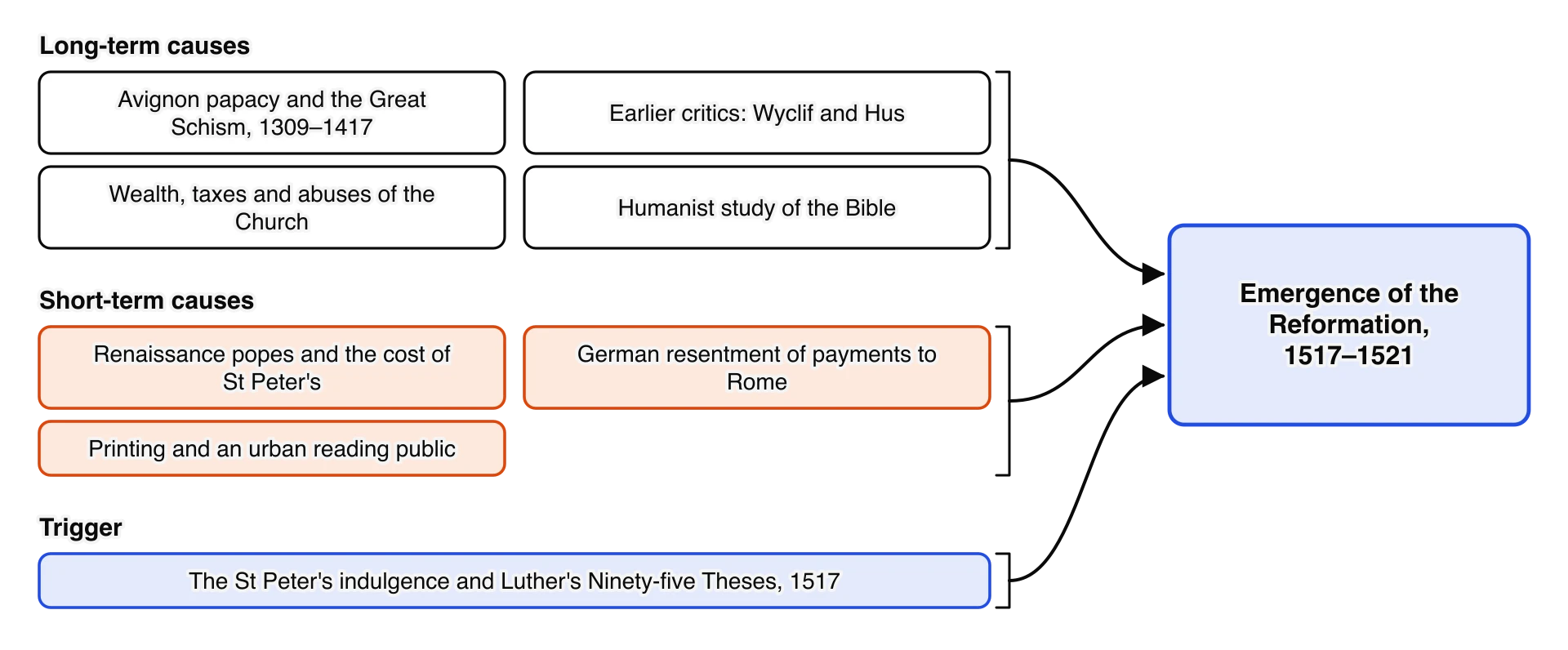
The diagram of the causes of the Reformation separates three timescales. The long-term causes had weakened papal authority and spread criticism for a century or more without producing a break. What was new after 1517 was the combination of a theologian whose ideas went far beyond attacking abuses, a printing industry able to spread them, and German political conditions that protected him.
Martin Luther and the indulgence controversy, 1517–1521
Martin Luther (1483–1546) was the son of a mine owner in Saxony. He became an Augustinian friar in 1505, after a vow made in a thunderstorm, and from 1512 was professor of theology at the new University of Wittenberg in Electoral Saxony. Luther suffered deep anxiety about whether he could ever do enough to be saved. Studying St Paul's Letter to the Romans, he came to believe that God's righteousness was a gift received through faith, not a reward earned by good works. Luther later described this as a sudden discovery (his "tower experience"), but historians date it anywhere between 1513 and 1519.
The St Peter's indulgence
In 1515 Leo X announced an indulgence to pay for the rebuilding of St Peter's. In Germany it was preached in the lands of Albrecht of Brandenburg, archbishop of Magdeburg and of Mainz, who had borrowed heavily from the Fugger bank to pay Rome for permission to hold both archbishoprics; half the proceeds in his lands went to repay that debt. The Dominican friar Johann Tetzel preached it near Wittenberg in 1517 with dramatic promises. Luther's own ruler, Frederick the Wise of Saxony, banned it from his lands, because he wanted his subjects to visit his own collection of relics.
On 31 October 1517 Luther sent Archbishop Albrecht a letter with his Ninety-five Theses, Latin propositions for academic debate about the power of indulgences. They did not reject indulgences entirely, but they attacked the way they were sold and questioned the pope's power over purgatory.
27. They preach only human doctrines who say that as soon as the money clinks into the money chest, the soul flies out of purgatory. … 50. Christians are to be taught that if the pope knew the exactions of the indulgence preachers, he would rather that the basilica of St. Peter were burned to ashes than built up with the skin, flesh, and bones of his sheep. … 86. Again, "Why does not the pope, whose wealth today is greater than the wealth of the richest Crassus, build this one basilica of St. Peter with his own money rather than with the money of poor believers?"
Martin Luther, Ninety-five Theses, theses 27, 50 and 86, 31 October 1517, in the translation by C. M. Jacobs, revised by Harold J. Grimm. Luther wrote for an academic debate in Latin, and in thesis 50 he still presents the pope as a victim of greedy preachers. Thesis 86 is put as a question asked by lay people, which lets Luther voice popular resentment of Rome's demands while keeping some distance from it. The extract shows how a theological dispute connected with the cost of Renaissance Rome.
From indulgences to authority
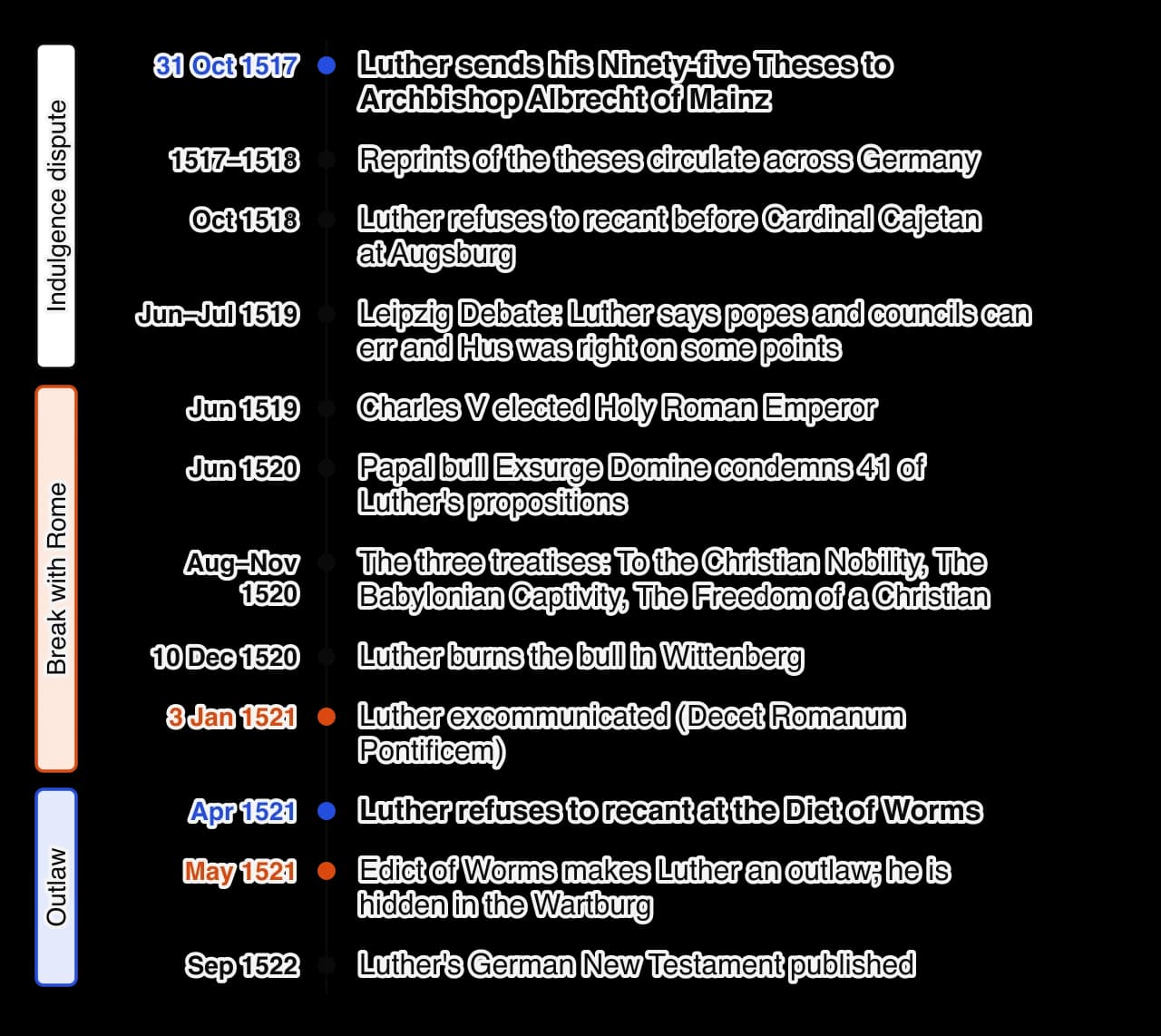
The timeline of 1517–1522 shows how quickly the dispute escalated. Albrecht reported Luther to Rome. Called before the papal legate Cardinal Cajetan at Augsburg in 1518, Luther refused to recant. At the Leipzig Debate of 1519 the theologian Johann Eck led him to admit that general councils, as well as popes, could err and that Hus had been right on some points. Once Luther denied that popes and councils were final authorities, only the Bible remained.
In 1520 he set out his ideas in three treatises that were printed in many editions. To the Christian Nobility of the German Nation called on the German princes to reform the Church, because the clergy would not. The Babylonian Captivity of the Church reduced the sacraments to two (baptism and the Eucharist, with penance treated at first as a possible third) and attacked the Mass as a sacrifice. The Freedom of a Christian explained justification by faith. In June 1520 the papal bull Exsurge Domine gave him sixty days to recant; on 10 December he burned it publicly in Wittenberg, and in January 1521 he was excommunicated.
Luther's idea | Meaning | Challenge to the Catholic Church |
|---|---|---|
Justification by faith alone (sola fide) | Sinners are saved by God's grace, received through faith; good works follow from faith but do not earn salvation | Made indulgences, pilgrimages and Masses for the dead useless |
Scripture alone (sola scriptura) | The Bible is the only final authority in religion | Denied the authority of popes, councils and Church tradition |
Priesthood of all believers | All baptised Christians are equal before God; clergy differ only in their office | Removed the special status of priests, monks and nuns; justified lay rulers in reforming the Church |
Two sacraments | Only baptism and the Eucharist were instituted by Christ | Rejected five of the seven sacraments; attacked the Mass as a sacrifice |
Real presence | Christ's body and blood are truly present "in, with and under" the bread and wine | Rejected the Catholic explanation of transubstantiation, but kept the presence of Christ |
The Diet of Worms, 1521
The new emperor, Charles V, aged twenty-one, summoned Luther to the imperial Diet at Worms under a safe conduct. On 18 April 1521 Luther refused to recant unless he was shown from Scripture to be wrong. The famous words "Here I stand; I can do no other" appear in early printed versions of his speech, but are not in the official record, so historians treat them as uncertain. The Edict of Worms (May 1521) declared him an outlaw and banned his writings. On his way home Frederick the Wise had him seized and hidden in the Wartburg castle, where he translated the New Testament into German.
Responses to Luther from the Church and the Emperor
The papacy
Rome first treated the affair as a quarrel between friars and a matter of discipline. Leo X was more concerned with Italian politics and with the imperial election of 1519, in which he wanted the support of Luther's protector, Frederick the Wise, an elector. This delayed the trial and gave Luther time. When Rome acted, it condemned Luther's propositions without answering his arguments in detail, and it left the refutation to theologians such as Eck, Cajetan and Sylvester Prierias.
Later popes were also slow to respond. Adrian VI (1522–1523), a reforming Dutchman, admitted through his envoy to the Diet of Nuremberg in 1522–1523 that the Church's troubles had begun in Rome, but he died within months. Clement VII (1523–1534), a Medici, was absorbed by the Italian Wars and the Sack of Rome in 1527, and feared that a general council, which many Germans demanded, would revive conciliarism. No council met until 1545, by which time the Protestant churches were established.
Charles V and the princes
Charles V (1500–1558) inherited Spain and its American empire, the Netherlands, Austria, and Naples and Sicily, and was elected emperor in 1519. He was a sincere Catholic who regarded Luther as a heretic, and he never wavered in that view. Yet for more than twenty years he could not enforce the Edict of Worms.
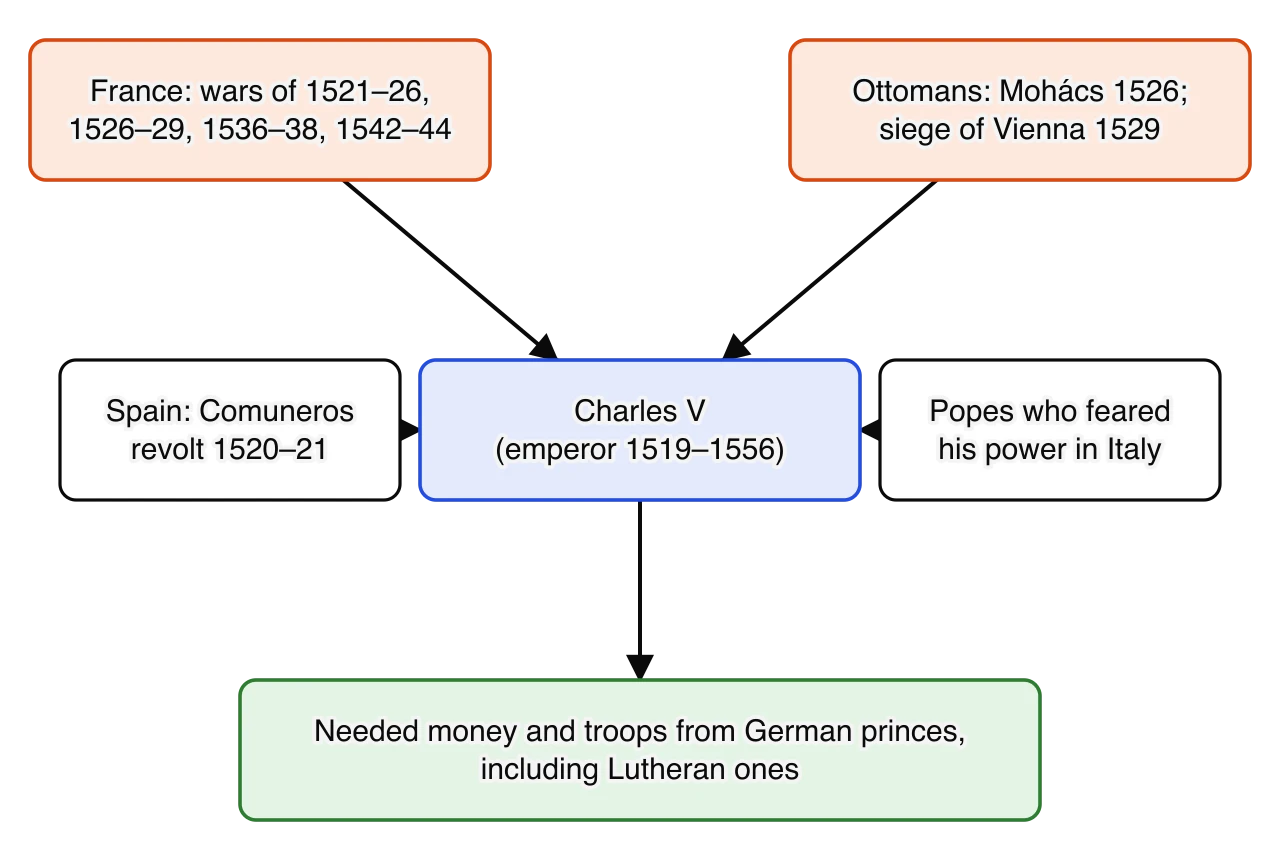
The diagram of Charles V's commitments explains the delay. Charles fought four wars with France between 1521 and 1544. The Ottoman sultan Suleiman the Magnificent destroyed the Hungarian army at Mohács in 1526 and besieged Vienna in 1529, so Charles needed German troops and taxes, which the Lutheran princes granted in return for toleration. The first Diet of Speyer (1526) left each ruler to act on religion as he would answer to God and the emperor, which Lutheran princes treated as permission to reform their churches. When the second Diet of Speyer (1529) reversed this, six princes and fourteen cities issued a formal protest, which gave the reformers the name "Protestants".
In 1530, at the Diet of Augsburg, the Lutherans presented the Augsburg Confession, a statement of their beliefs drafted by Luther's colleague Philipp Melanchthon in a deliberately moderate tone. Charles rejected it. The Protestant princes and cities, led by Elector John Frederick of Saxony and Landgrave Philip of Hesse, formed the defensive Schmalkaldic League in 1531. Because of a new Ottoman threat, Charles granted them a truce in 1532, and talks at Regensburg in 1541 almost reached agreement on justification before failing on the Mass and papal authority.
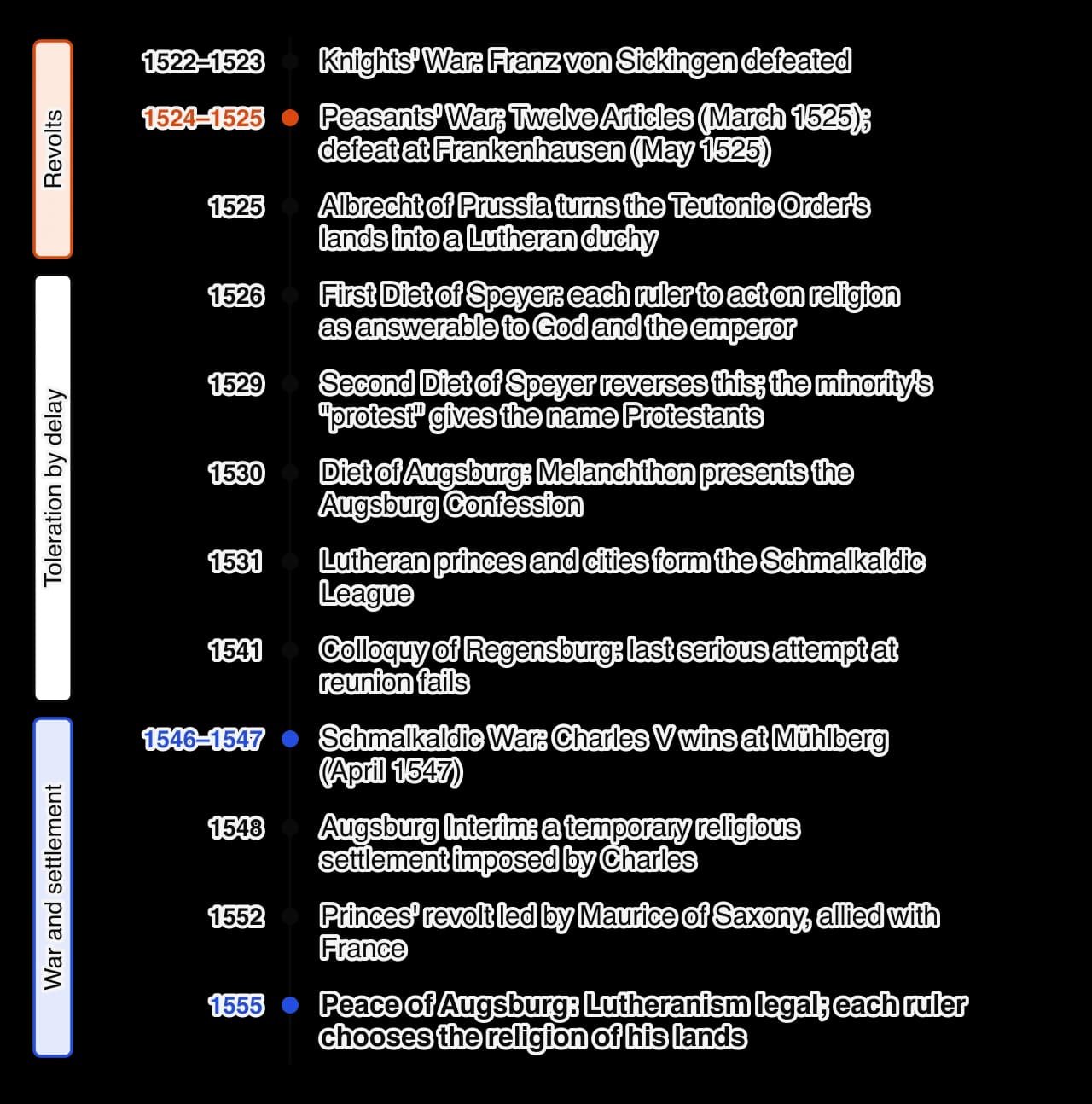
The timeline of the Reformation in Germany shows that when Charles finally fought, he won the battle but lost the peace. After peace with France in 1544 he defeated the Schmalkaldic League at Mühlberg in 1547 and captured John Frederick, with the help of the Protestant Maurice of Saxony. His attempt to impose a compromise, the Augsburg Interim (1548), was resisted by both sides. In 1552 Maurice changed sides, allied with Henry II of France and drove Charles out of southern Germany. Charles left the settlement to his brother Ferdinand and abdicated in 1555–1556.
The Peace of Augsburg, 1555
The Peace of Augsburg (September 1555) recognised Lutheranism as a legal religion in the Empire alongside Catholicism. Each prince and imperial city could choose either faith for its lands, a principle later summed up as cuius regio, eius religio ("whose realm, his religion"). Subjects who would not conform could emigrate. The "ecclesiastical reservation" required Catholic bishops and abbots who became Protestant to give up their lands. Calvinists, Anabaptists and other groups were excluded.
The peace ended open religious war in the Empire for more than sixty years. It also built division into the constitution: it made religion a matter for princes, not individuals; it left disputes over Church lands unresolved; and it gave no place to Calvinism, which spread after 1555.
Why did Lutheranism spread?
Ideas and preaching
Luther's teaching answered real anxieties about salvation with a simple message: faith in Christ, not paid-for rituals, saved sinners. It appealed to clergy who had trained in humanist methods, to townspeople who resented clerical privileges and Church taxes, and to Germans who felt exploited by Rome. Most people heard the new ideas rather than read them: sermons by reforming preachers, many of them former friars, were the main way the message reached towns, along with songs, plays and discussions in inns and guild halls.
The printing press
Printing made the Reformation the first mass media campaign in European history. Wittenberg, a small town with one modest press in 1517, became a major printing centre because of Luther's writings. Luther wrote short, cheap pamphlets (Flugschriften) in lively German, and printers across Germany reprinted them because they sold.
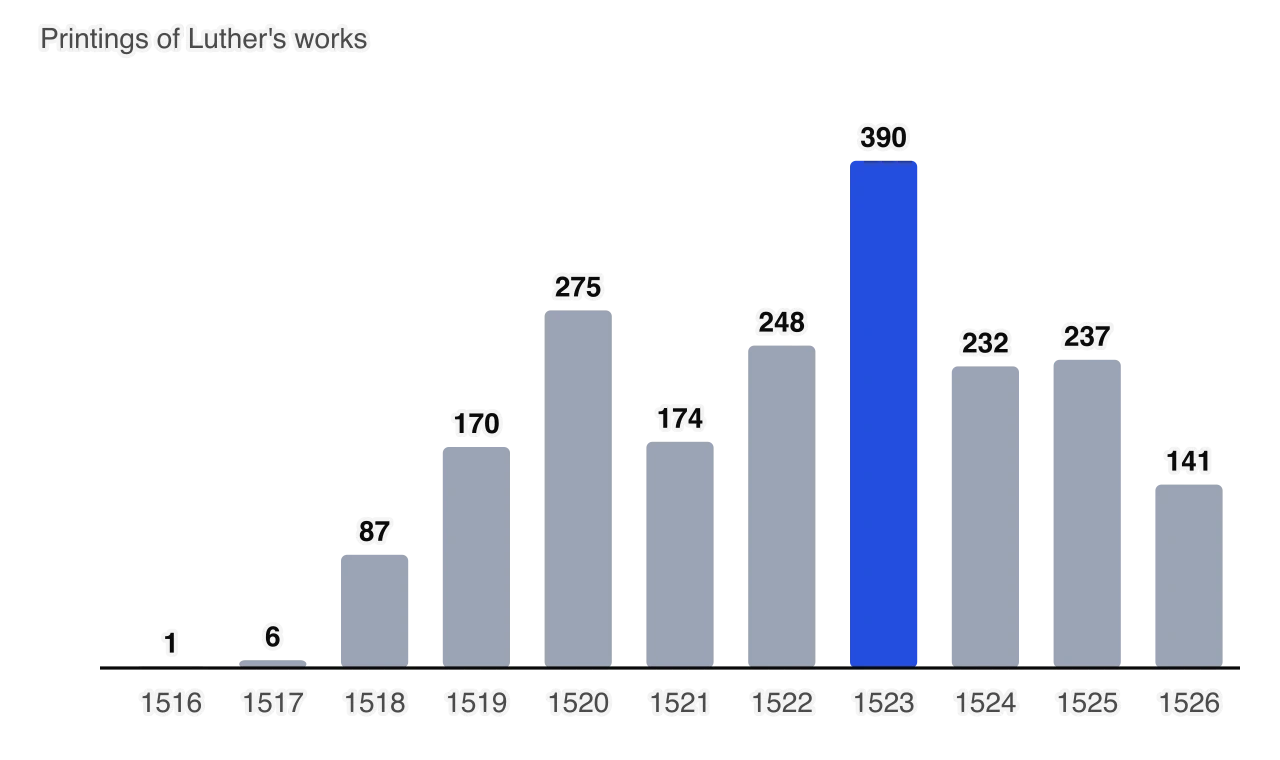
The chart of printings of Luther's works shows the scale. In 1518 there were 87 printings; in 1523 there were 390, mostly in German. Mark Edwards, using the estimates of Hans-Joachim Köhler, reports that Luther alone accounted for about 20 per cent of the roughly 10,000 pamphlet editions printed in German-speaking lands between 1500 and 1530, and in a sample of German pamphlets he finds about five works by Luther for every one by a Catholic author. Luther's German New Testament of September 1522, printed in a run of 3,000–5,000 copies despite its high price, was reprinted so often that about 87 High German and 19 Low German editions had appeared by 1534, when Luther's complete Bible was published.
Print had limits. Perhaps 5 per cent of Germans could read, though far more in the towns, so pamphlets worked by being read aloud and discussed. Catholic writers also used print, though less effectively. And the same press that spread Luther's ideas spread those of his opponents and of more radical reformers, so print helped to divide the Reformation as well as to spread it. The control of printing by Church and state, and the Index of Forbidden Books, belong to the history of censorship, which is part of the story of resistance to printing.
Princes and cities
Political support decided where the Reformation survived. Frederick the Wise protected Luther without openly joining him. Rulers such as Philip of Hesse and the electors of Saxony introduced Lutheran church orders in the later 1520s. In 1525 Albrecht of Brandenburg-Ansbach, Grand Master of the Teutonic Knights, turned the order's lands into the secular Duchy of Prussia and made it Lutheran. Princes gained a great deal: control of the Church in their territories, the lands and income of monasteries and bishoprics, and an end to payments to Rome.
In the imperial cities, which governed themselves under the emperor, the Reformation often began "from below". Preachers won followings among artisans; councils, under pressure from citizens, organised public disputations and then introduced reform, as in Nuremberg (1525) and Strasbourg. Bernd Moeller argues in Imperial Cities and the Reformation (1962) that the communal values of these cities made them especially receptive: most of the free and imperial cities adopted the Reformation at some point.
Social revolt: the Knights' War and the Peasants' War
Luther's message was taken further than he intended. In 1522–1523 imperial knights led by Franz von Sickingen attacked the archbishop of Trier in the name of the Gospel and were crushed by the princes. Far larger was the Peasants' War of 1524–1525, a series of risings across southern and central Germany by peasants and townspeople against rising dues, the loss of common rights and serfdom. In March 1525 the peasant bands of Upper Swabia adopted the Twelve Articles, which were printed and circulated widely.
It has been the custom hitherto for men to hold us as their own property, which is pitiable enough, considering that Christ has delivered and redeemed us all, without exception, by the shedding of His precious blood, the lowly as well as the great. Accordingly, it is consistent with Scripture that we should be free and wish to be so.
The Twelve Articles of the Peasants of Swabia, Third Article, March 1525, in the translation by James Harvey Robinson (1906). The articles were drafted at Memmingen by a furrier, Sebastian Lotzer, probably with the preacher Christoph Schappeler, and they justified economic grievances from the Bible. They show how the Reformation's appeal to Scripture gave ordinary people a new language for old demands, while the next sentences of the article insist that the peasants still accept lawful authority.
Luther at first blamed the lords for provoking the revolt. When the risings turned violent and the radical preacher Thomas Müntzer joined the rebels in Thuringia, he published Against the Robbing and Murdering Hordes of Peasants (May 1525).
Therefore let everyone who can, smite, slay and stab, secretly or openly, remembering that nothing can be more poisonous, hurtful or devilish than a rebel. It is just as when one must kill a mad dog; if you do not strike him, he will strike you, and a whole land with you.
Martin Luther, Against the Robbing and Murdering Hordes of Peasants, pamphlet, May 1525, in E. G. Rupp and Benjamin Drewery, Martin Luther (1970). Luther wrote as the risings spread and feared that rebellion would discredit the Gospel; the pamphlet appeared after the princes had already defeated the peasants at Frankenhausen (15 May 1525), which made it look like approval of a massacre. Between 70,000 and 100,000 peasants were killed. The episode tied Lutheranism firmly to princely authority and lost it much popular support among peasants.
Other reformers: Zwingli, the Anabaptists and Calvin
The Reformation was never a single movement. In Zürich the priest Huldrych Zwingli, a humanist influenced by Erasmus, led a reform from 1519 that went further than Luther: the city council removed images from churches and abolished the Mass in 1525. At the Marburg Colloquy of 1529 Luther and Zwingli agreed on most points but split over the Eucharist, which Zwingli saw as a memorial. Zwingli was killed in battle against the Catholic Swiss cantons at Kappel in 1531.
Some of Zwingli's followers went further still and formed the first Anabaptist congregations in 1525. In 1534–1535 radical Anabaptists seized the city of Münster in Westphalia and proclaimed a "New Jerusalem", with shared property and polygamy, until a Catholic and Lutheran army retook it. Münster confirmed rulers' fears that religious change led to social revolution, and Anabaptists were persecuted everywhere; Menno Simons later led a peaceful movement, the Mennonites.
The second great wave of Protestantism came from John Calvin (1509–1564), a French humanist lawyer. His Institutes of the Christian Religion (1536, much expanded by 1559) set out a systematic theology stressing God's sovereignty and predestination. From 1541 Calvin shaped the church of Geneva, whose Ecclesiastical Ordinances created a church run by pastors, teachers, elders and deacons, with a consistory to enforce moral discipline. Geneva trained ministers for France, the Netherlands and Scotland, where John Knox helped to establish a Calvinist national church in 1560, and Calvinism became an international movement that could organise even against a hostile ruler.
Catholic Church | Luther | Zwingli | Calvin | Anabaptists | |
|---|---|---|---|---|---|
Authority | Scripture and Church tradition, interpreted by the pope and councils | Scripture alone | Scripture alone | Scripture alone | Scripture, often with the inner guidance of the Spirit |
Salvation | Grace through faith and works, sacraments | Faith alone | Faith alone | Faith alone; predestination | Faith and a changed life |
Eucharist | Transubstantiation; the Mass a sacrifice | Real presence of Christ | A memorial | Spiritual presence | A memorial |
Church and state | Church independent of rulers | Princes protect and govern the Church | City council governs the Church | Church disciplines its members, works with the state | Separation from the state; no oaths or arms |
Main areas | Southern Europe; Bavaria; Austria; Poland | Northern Germany; Scandinavia | Zürich and other Swiss cities | Geneva, France, Netherlands, Scotland, Palatinate | Small groups across Germany, Switzerland, Netherlands |
The table of beliefs shows how far the reformers differed. These divisions weakened the Protestant cause politically, but they also allowed Protestantism to take root in very different societies: princely states, city republics and, through Calvinism, communities that had to survive under Catholic rulers.

 YouTube
The impact of the Reformation on one country
The Reformation affected every European state, but in different ways. Each country can be examined under four headings: religious changes, social and political developments, economic developments and, where it applies, the Thirty Years' War. The Holy Roman Empire and England are treated in full, with France and the Dutch Republic for comparison.
The Holy Roman Empire: religious changes
In Lutheran territories the prince became the head of the territorial church. Monasteries and convents were closed, the Mass was replaced by a German service centred on the sermon, and clergy married; Luther himself married the former nun Katharina von Bora in 1525. Church visitations in Saxony in 1527–1528 found ignorant clergy and laity, and Luther responded with his Small Catechism and Large Catechism (1529) for teaching households and pastors. His complete German Bible (1534) and his hymns shaped German religious life and the German language.
After 1555 religious divisions hardened. Lutheran theologians quarrelled among themselves until the Formula of Concord (1577). Some princes, above all the Elector Palatine Frederick III, adopted Calvinism, and the Heidelberg Catechism (1563) became a Reformed standard, although Calvinism was not legal under the Peace of Augsburg. Catholic rulers such as the dukes of Bavaria and, later, the Habsburgs in Austria used the Jesuits to restore Catholicism. This process of confessionalisation made each territory's religion part of its identity and its government.
The Holy Roman Empire: social and political developments
The Reformation strengthened the princes. They took over Church lands, appointments and courts, and used church ordinances and consistories to supervise the morals and beliefs of their subjects. Marriage moved from Church courts to new marriage courts controlled by princes or councils. The closure of convents removed one of the few respected careers outside marriage for women, while Protestant teaching praised the household and the authority of the father within it.
Poor relief was reorganised: towns such as Leisnig (1523) set up a "common chest" funded by former Church income to support the deserving poor, and begging was restricted. Schools and universities were founded to train pastors and officials, and education was encouraged so that people could read the catechism. Politically the Empire became more divided. Protestant and Catholic princes formed rival alliances, and the institutions of the Empire, such as the Diet and the imperial courts, became deadlocked over religious disputes in the decades before 1618.
The Holy Roman Empire: economic developments
The sale and transfer of Church property was the biggest immediate economic change, enriching princes and some nobles and townspeople. The end of many holy days and pilgrimages, of payments to Rome and of the trade in indulgences changed local economies. Printing grew into a major industry. Max Weber argued in The Protestant Ethic and the Spirit of Capitalism (1905) that Calvinist ideas of calling and discipline encouraged capitalism. R. H. Tawney and many later historians criticised the thesis, pointing to Catholic capitalists such as the Fuggers and to Catholic commercial centres such as Antwerp and Venice. The heaviest economic effect came later, from the destruction of the Thirty Years' War.
The Holy Roman Empire: the Thirty Years' War, 1618–1648
The Peace of Augsburg left three problems: Calvinists had no legal rights; Protestant rulers continued to take over Church lands, which Catholics said broke the ecclesiastical reservation; and the Diet could no longer settle disputes. In 1608–1609 rival alliances formed, the Protestant Union led by the Calvinist Elector Palatine and the Catholic League led by Duke Maximilian of Bavaria.
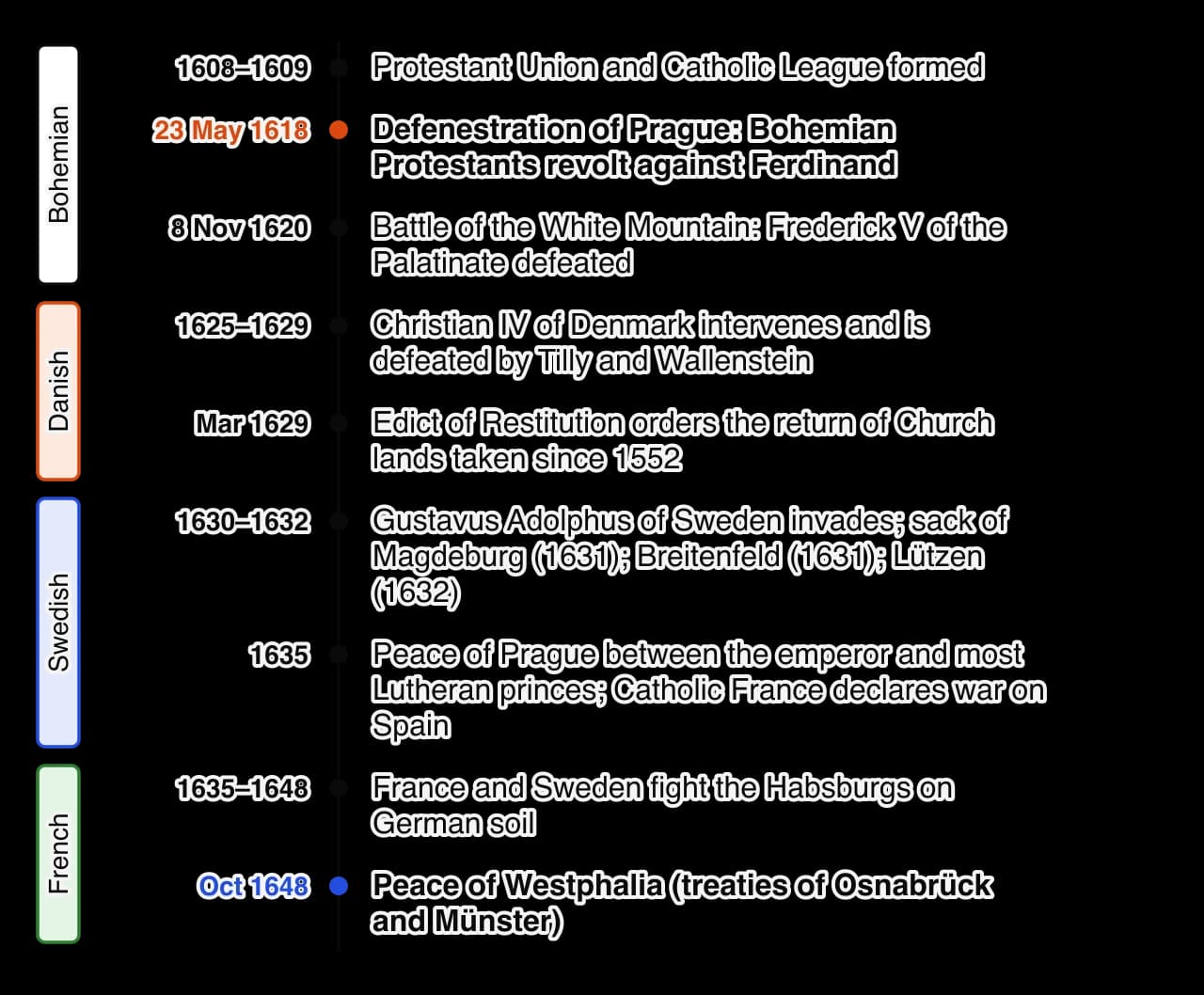
The war began in Bohemia, where Protestant nobles feared that their new king, the devout Catholic Habsburg Ferdinand of Styria, would cancel their religious rights. On 23 May 1618 they threw two royal governors and a secretary out of a window of Prague Castle (the "Defenestration of Prague"), and in 1619 they offered the crown to the Calvinist Frederick V of the Palatinate. Ferdinand, now emperor, defeated Frederick at the White Mountain in 1620. In Bohemia, Protestant leaders were executed in 1621, Protestant nobles' lands were confiscated, and by 1627 Catholicism was the only permitted religion: tens of thousands of Protestants, including many nobles, went into exile, and a Catholic aristocracy loyal to the Habsburgs took over.
Catholic victories led to the Edict of Restitution (1629), which ordered the return of all Church lands secularised since 1552 and threatened the whole Protestant settlement. This brought Sweden into the war in 1630. Gustavus Adolphus won at Breitenfeld (1631) and was killed at Lützen (1632). After the Peace of Prague (1635) reconciled the emperor with most Lutheran princes, the war became a struggle between the Habsburgs on one side and France and Sweden on the other. Catholic France, led by Cardinal Richelieu, fought against the Catholic Habsburgs, which shows that by then the balance of power mattered more than religion.
The war devastated the Empire. Armies lived off the land, and plague, famine and the flight of peasants killed far more people than battles. When imperial and League troops stormed Protestant Magdeburg in May 1631, the city burned and about 20,000 people died. Population losses varied greatly by region, from little in the north-west to more than half in parts of Württemberg, Pomerania and Mecklenburg. Recent estimates put the total loss for the Empire at about a fifth to a quarter of its population; nineteenth-century claims of two-thirds or more are now regarded as exaggerated.
The Peace of Westphalia, 1648
The Peace of Westphalia, negotiated for five years at Osnabrück and Münster, settled the religious question in the Empire. Calvinism was recognised alongside Lutheranism and Catholicism. Church property was to be held as it had been on 1 January 1624 (the "normative year"), which protected most Protestant gains. Religious questions in the Diet were to be decided by agreement between the Catholic and Protestant bodies, not by majority vote. The princes gained the right to make alliances with foreign powers; Sweden and France gained territory; and the independence of the Dutch Republic and of the Swiss Confederation was recognised.
That there shall be on the one side and the other a perpetual Oblivion, Amnesty, or Pardon of all that has been committed since the beginning of these Troubles, in what place, or what manner soever the Hostilitys have been practis'd, in such a manner, that no body, under any pretext whatsoever, shall practice any Acts of Hostility, entertain any Enmity, or cause any Trouble to each other.
Treaty of Münster between the Holy Roman Emperor and France, Article II, 24 October 1648, in an early eighteenth-century English translation (original spelling). The article is a standard legal amnesty clause, written by diplomats for rulers rather than for their subjects. Its demand that thirty years of violence be "bury'd in eternal Oblivion", as the article ends, shows that the peacemakers saw forgetting, not judgement, as the way to restore order.
England: religious changes
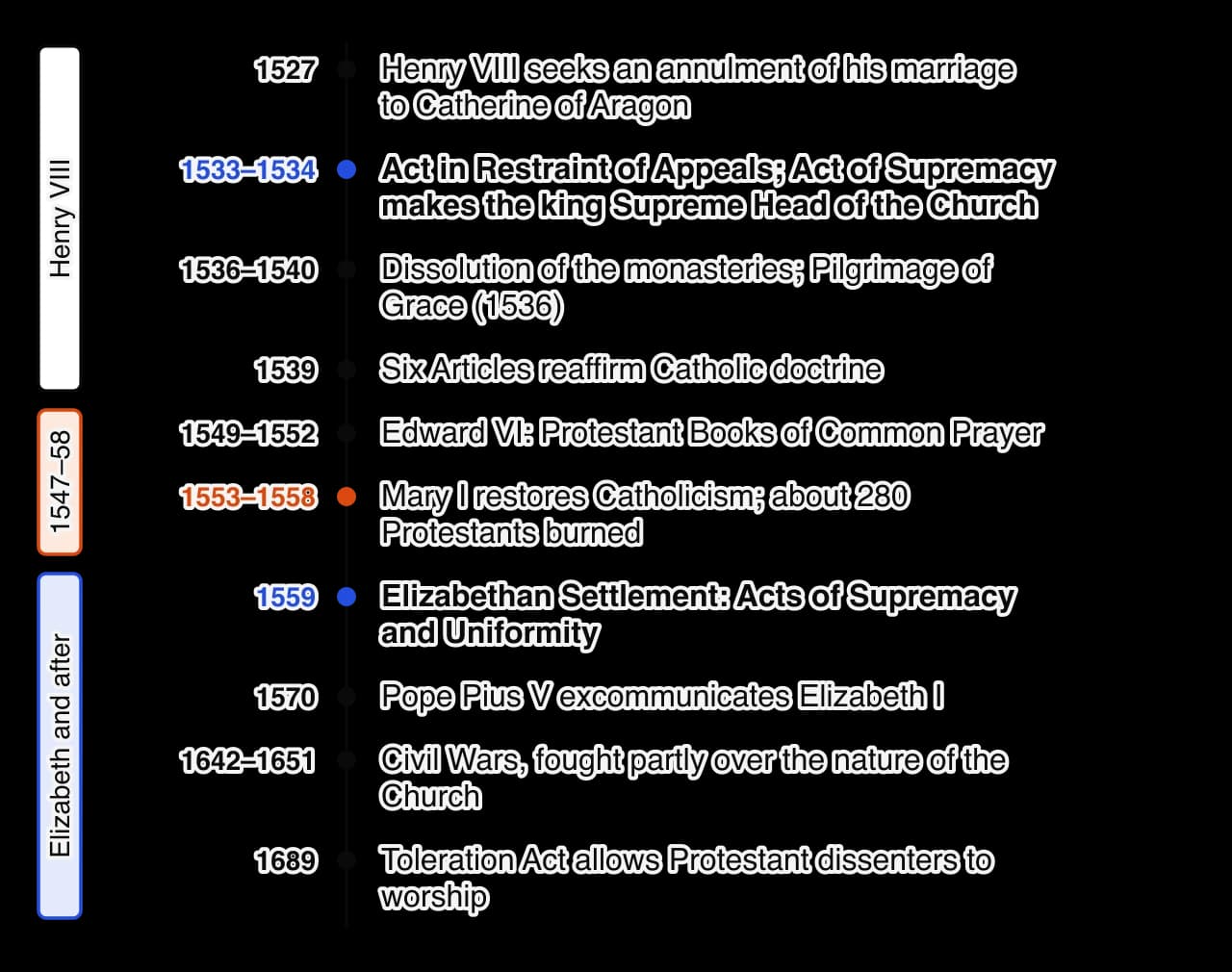
The timeline of the English Reformation shows a reformation made by the state, in which policy changed with each monarch. Henry VIII (1509–1547) had attacked Luther in a book of 1521, for which the pope gave him the title "Defender of the Faith". His break with Rome began with his "Great Matter": his wish to annul his marriage to Catherine of Aragon, who had no surviving son, and marry Anne Boleyn. When Pope Clement VII, under the control of Catherine's nephew Charles V after the Sack of Rome, would not grant the annulment, Henry used Parliament to cut England off from papal authority. The Act of Supremacy (1534) declared the king "the only supreme head in earth of the Church of England".
Henry's Church was not Protestant in doctrine: the Six Articles (1539) reaffirmed transubstantiation and clerical celibacy. But Thomas Cromwell and Archbishop Thomas Cranmer moved it in a reformed direction, with an English Bible in every parish church (1538–1539). Under Edward VI (1547–1553) the Church became clearly Protestant: images were removed, chantries were dissolved, and Cranmer's English Books of Common Prayer (1549, 1552) replaced the Mass. Mary I (1553–1558) restored papal authority and Catholic worship, and about 280 Protestants, including Cranmer, were burned as heretics. Elizabeth I's settlement of 1559 restored a Protestant Church with the monarch as "Supreme Governor", kept bishops and some traditional ceremonies, and required attendance at the parish church.
England: social and political developments
The Reformation greatly increased the power of the crown and of Parliament, which passed every stage of the break with Rome. Opposition was punished: Thomas More and Bishop John Fisher were executed in 1535 for refusing to accept the royal supremacy. The Pilgrimage of Grace of 1536, a rising of tens of thousands in the north against the closing of monasteries and religious change, was the largest rebellion of the Tudor period; it was broken up by promises and then punished with about 200 executions.
Religious identity became tied to national identity. John Foxe's Acts and Monuments (1563), the "Book of Martyrs", told the story of the Marian burnings and was placed in many churches. After Pope Pius V excommunicated Elizabeth in 1570 and Catholic powers plotted against her, Catholics were treated as potential traitors, and nearly 200 Catholics, including Jesuit missionaries, were executed in her reign. Within Protestantism, Puritans pressed for further reform. In the seventeenth century disputes over the Church contributed to the Civil Wars (1642–1651); the Toleration Act of 1689 finally allowed most Protestant dissenters to worship, though not Catholics.
England: economic developments
The dissolution of the monasteries (1536–1540) closed about 800 religious houses and transferred their large estates to the crown. To pay for wars, the crown sold most of it within a generation to nobles, gentry and merchants, who therefore had a strong interest in preventing any return to Catholicism. Monastic charity, schools and hospitals were lost in many places, and the Elizabethan Poor Laws later had to take over some of their role. The chantries were dissolved in 1547, and the plate and treasures of parish churches were seized under Edward VI.
Country | Religious changes | Social and political developments | Economic developments |
|---|---|---|---|
France | Calvinist (Huguenot) churches grew rapidly in the 1550s; Catholicism remained the faith of the crown and most of the people | Wars of Religion (1562–1598); St Bartholomew's Day Massacre (24 August 1572); Henry IV converted to Catholicism (1593) and issued the Edict of Nantes (1598), giving Huguenots limited toleration; Louis XIV revoked it (1685) | Civil war damaged trade and royal finances; after 1685 about 150,000–200,000 Huguenots, many of them skilled artisans and merchants, emigrated |
Dutch Republic | Calvinism spread in the 1560s; the Reformed Church became the public church, but other faiths were tolerated in private | Iconoclastic riots (1566) and revolt against Philip II of Spain from 1568; Union of Utrecht (1579); independence recognised in 1648 | Amsterdam replaced Antwerp as the commercial centre of northern Europe, helped by Protestant refugees from the south |
The table of France and the Dutch Republic shows two contrasting outcomes. In France Calvinism split the nobility and the kingdom and was finally suppressed by an absolute monarchy; in the Netherlands it became part of a successful revolt and a new state that combined an official church with practical toleration.
The Catholic response and the Counter-Reformation
The Catholic Church's response to the Reformation had two sides. One was internal renewal, which had begun before Luther: new religious orders, reforming bishops and humanist scholarship. The other was a direct response to Protestantism: defining doctrine, enforcing discipline and repressing heresy. Historians use the terms Counter-Reformation for the second and "Catholic Reformation" for the first.
The role of Erasmus
Desiderius Erasmus of Rotterdam (c. 1466–1536) was the most famous scholar in Europe in the 1510s. A priest educated by the Brethren of the Common Life, he wanted to reform Christianity by returning to its sources. His Handbook of the Christian Soldier (1503) taught an inward piety, and his Greek New Testament with a new Latin translation (1516) corrected errors in the Vulgate; Luther used it for his German translation. In The Praise of Folly (1511), Folly herself praises the follies of the world, including those of theologians, monks and popes.
And for popes, that supply the place of Christ, if they should endeavor to imitate His life, to wit His poverty, labor, doctrine, cross, and contempt of life, or should they consider what the name pope, that is father, or holiness, imports, who would live more disconsolate than themselves? or who would purchase that chair with all his substance? or defend it, so purchased, with swords, poisons, and all force imaginable?
Desiderius Erasmus, The Praise of Folly, 1511, in the translation by John Wilson (1668). Erasmus wrote as a satirist, putting the words into the mouth of Folly so that he could deny that they were his own opinions. The passage, written while Julius II was leading papal armies, shows how widely the worldliness of the Renaissance papacy was mocked by loyal Catholics before 1517.
Critics in the 1520s claimed that Erasmus had prepared the way for Luther. Erasmus at first defended Luther's right to be heard, but he would not break with Rome, and in On Free Will (1524) he attacked Luther's view that human beings could do nothing towards their own salvation; Luther replied with The Bondage of the Will (1525). Erasmus's significance is double. His scholarship and satire weakened respect for the clergy and supplied tools to the reformers, yet his ideal of a reformed, united Church inspired Catholic reformers such as Gasparo Contarini. After his death the Church turned against him: Paul IV placed all his works on the Index in 1559.
Renewal before Trent
Reform began in several places before 1540. In Spain Cardinal Cisneros reformed the religious orders and founded the University of Alcalá. In Italy the Oratory of Divine Love, a brotherhood of clergy and lay people founded in Genoa and Rome, encouraged prayer and charity. New orders were founded: the Theatines (1524), priests living under a strict rule, co-founded by Gian Pietro Carafa; the Capuchins (1528), a strict branch of the Franciscans, who became popular preachers; and the Ursulines (1535), founded by Angela Merici at Brescia, which became an important order for the education of girls.
Paul III, Paul IV and Pius IV
Pope | Reign | Main actions | Assessment |
|---|---|---|---|
Paul III (Alessandro Farnese) | 1534–1549 | Made reformers cardinals (Contarini, Carafa, Pole); commissioned the report Consilium de emendanda ecclesia on abuses (1537); approved the Jesuits (1540) and the Ursulines (1544); set up the Roman Inquisition (1542); called the Council of Trent (opened 1545); commissioned Michelangelo's Last Judgement | A Renaissance prince who practised nepotism, yet the pope who turned the papacy towards reform |
Paul IV (Gian Pietro Carafa) | 1555–1559 | Strengthened the Inquisition; issued the first Roman Index of Forbidden Books (1559); confined Rome's Jews to a ghetto by the bull Cum nimis absurdum (1555); fought a war against Spain (1556–1557); imprisoned the reforming Cardinal Morone on suspicion of heresy | Severe and uncompromising; did not reconvene Trent; at his death crowds attacked the Inquisition's offices in Rome |
Pius IV (Giovanni Angelo Medici, not related to the Florentine family) | 1559–1565 | Reconvened Trent (1562) and brought it to a conclusion with the help of Morone, whom he released; confirmed its decrees (1564); issued the Tridentine Index and the profession of faith (1564); promoted his nephew Carlo Borromeo, who became the model reforming archbishop of Milan | A skilled diplomat who turned the council's work into papal policy |
The Consilium of 1537 is striking evidence of Catholic self-criticism: a commission of cardinals told Paul III that many of the Church's problems came from the papacy itself, through the sale of offices and dispensations. Leaked and printed, it was mocked by Luther in a German edition of 1538.
The Roman Inquisition of 1542 and the Index were the repressive side of the response; their role in censoring print is part of the history of resistance to printing. In Italy they broke the small Protestant groups, and leading Italian reformers such as Bernardino Ochino fled north.
The Council of Trent, 1545–1563
A general council was the remedy that Luther, Charles V and many Catholics had demanded since the 1520s, but popes delayed it, fearing conciliarism, and France feared it would strengthen the emperor. It met finally at Trent, a city in the Empire but on the Italian side of the Alps, in three periods: 1545–1547 (under Paul III), 1551–1552 (under Julius III) and 1562–1563 (under Pius IV). Attendance was small at first, with fewer than thirty bishops at the opening, and most members were Italian; more than 200 signed its decrees at the end. Voting was by individual bishops, not by nations, which helped the papacy to control it.
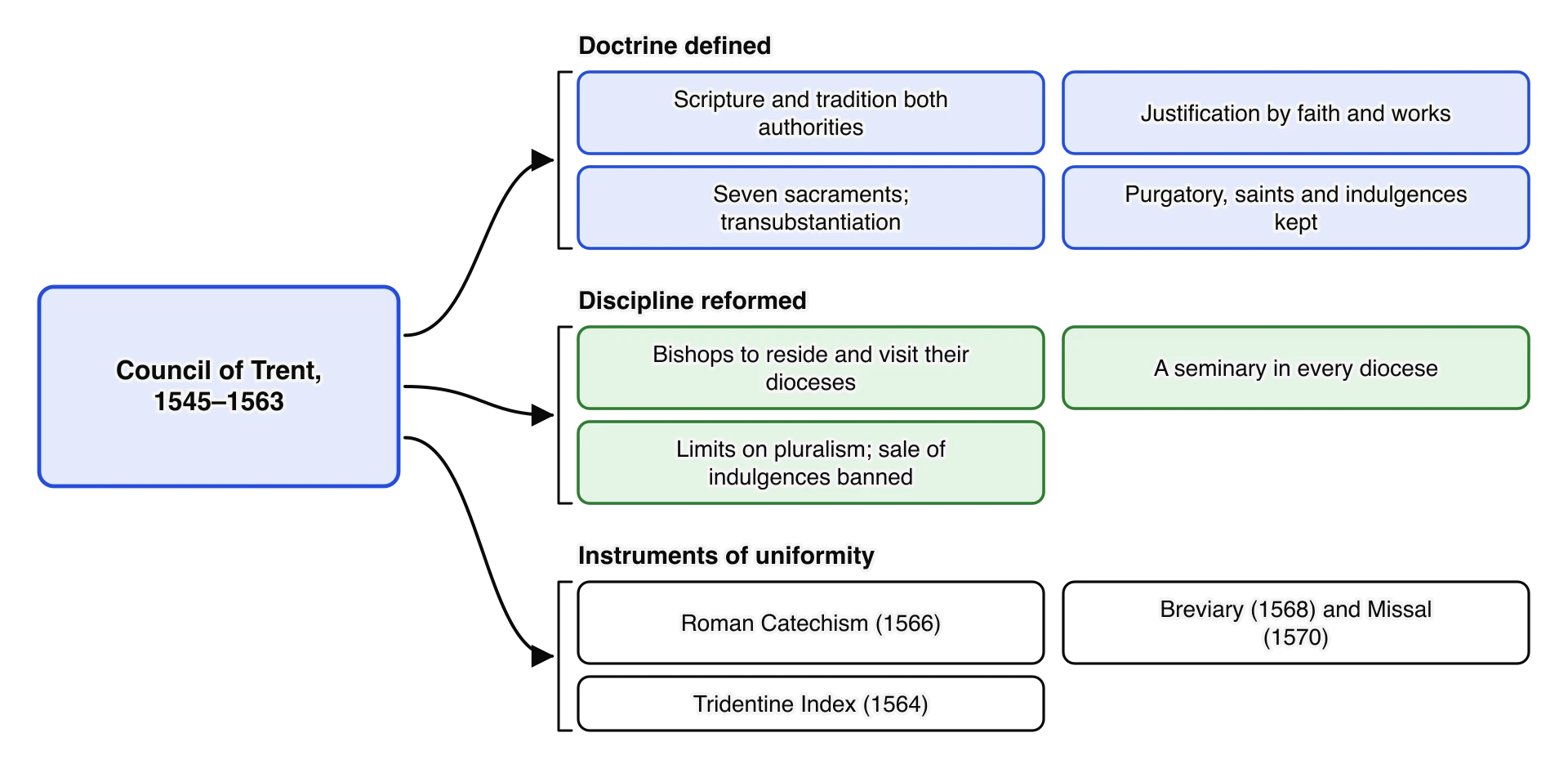
The diagram of Trent's decisions shows its two sides. In doctrine it made no concessions to Protestants: Scripture and Church tradition were both authorities, the Latin Vulgate was the authentic Bible, people were justified by faith and works together, and all seven sacraments and transubstantiation were confirmed. In discipline it accepted much of the reformers' criticism. Bishops had to live in their dioceses and visit their parishes, every diocese was to have a seminary to train priests, and the abuses connected with indulgences were condemned.
It ordains generally by this decree, that all evil gains for the obtaining thereof,—whence a most prolific cause of abuses amongst the Christian people has been derived,—be wholly abolished.
Council of Trent, Decree concerning Indulgences, session 25, 4 December 1563, in the translation by J. Waterworth (1848). The same decree insists that indulgences are "most salutary" and condemns those who call them useless. Written in the council's final session, it shows Trent's typical method: it defended the doctrine that Protestants attacked while banning the abuse that had started the controversy in 1517.
The decrees took decades to implement, and some rulers resisted those that limited their control of their churches: the French crown never formally registered them. But the council gave Catholicism a clear identity. The Roman Catechism (1566), the Breviary (1568) and the Missal (1570), issued by Pope Pius V, standardised teaching and worship for four centuries.
The Jesuits
Ignatius Loyola (1491–1556), a Basque soldier, turned to religion while recovering from a wound received at the siege of Pamplona in 1521. His Spiritual Exercises, a month-long programme of prayer and meditation, became the basis of a new order. With six companions from the University of Paris he founded the Society of Jesus, which Paul III approved in 1540. Its members took a special vow of obedience to the pope regarding missions.
Thirteenth Rule. To be right in everything, we ought always to hold that the white which I see, is black, if the Hierarchical Church so decides it, believing that between Christ our Lord, the Bridegroom, and the Church, His Bride, there is the same Spirit which governs and directs us for the salvation of our souls.
Ignatius Loyola, Spiritual Exercises, "Rules for thinking with the Church", rule 13, written in the 1520s–1540s and approved in 1548, in the translation by Elder Mullan (1914). The rules were written for people making the Exercises, as a guide to obedience at a time when Protestants appealed to private judgement of Scripture. The historian John O'Malley argues that the rule concerns formal definitions of doctrine by the Church, so it is less extreme than it sounds when it is quoted alone.
The Jesuits grew rapidly, from about 1,000 members at Ignatius's death in 1556. They became famous for three activities. Education: their colleges, free to pupils, taught a humanist curriculum to the sons of the elite; there were 373 by 1615. Missions: Francis Xavier preached in India and Japan in the 1540s, and Jesuits later worked in China and the Americas. Reconversion: in Germany Peter Canisius wrote catechisms and founded colleges; in Poland, Bavaria and Austria Jesuit schools and Jesuit confessors to rulers, such as Ferdinand II, helped to win back territories for Catholicism.
How successful was the Catholic response?
By 1600 Protestant expansion had stopped, and Catholicism had won back much of southern Germany, Austria, Bohemia (after 1620), Poland and parts of Hungary. Catholic clergy were better trained, bishops more active, and new devotions, Baroque art and saints such as Teresa of Ávila gave Catholicism a confident culture; Baroque art and architecture, such as Bernini's work in Rome, put its claims on show. But the response came late, too late to save northern Europe, and its success in many places depended on Catholic rulers and their armies as much as on the Church: Bohemia was re-Catholicised by force after the White Mountain. The repression of the Inquisition and the Index also had costs, which the trial of Galileo later came to symbolise.
Perspectives and debates
Was there a Renaissance?
The modern idea of the Renaissance owes most to the Swiss historian Jacob Burckhardt. In The Civilization of the Renaissance in Italy (1860) he argued that in the Italian states, where power depended on ability rather than inherited right, a new consciousness emerged: Italians became the first "modern" individuals, aware of themselves as persons rather than members of a group. The Renaissance in this view was a sharp break with the Middle Ages.
Twentieth-century historians challenged this. Johan Huizinga's The Waning of the Middle Ages (1919) described the culture of the Burgundian court in the fifteenth century as the late flowering of medieval civilisation, not the dawn of a new one. Charles Homer Haskins, in The Renaissance of the Twelfth Century (1927), showed that earlier periods had also revived classical learning, which made the fifteenth-century revival less unique. Peter Burke's social history of Italian culture (first published 1972) studied artists as workers in a market shaped by patrons and contracts. Lisa Jardine's Worldly Goods (1996) presented the Renaissance as a culture of trade, luxury and consumption.
Joan Kelly's essay "Did Women Have a Renaissance?" (1977) asked whose Renaissance it was. She argued that for women of the elite the period brought a loss of freedom and influence compared with the courtly culture of the Middle Ages, because the new ideal of the lady made her a decorative, dependent figure. Others answer with examples of educated women and female patrons, such as Isabella d'Este, though they were exceptional.
Historian | Work | Argument | Evidence stressed |
|---|---|---|---|
Jacob Burckhardt | The Civilization of the Renaissance in Italy (1860) | A sharp break: Italian states produced the modern individual | Self-made rulers and condottieri; biography and portraiture; humanist ideals of fame |
Johan Huizinga | The Waning of the Middle Ages (1919) | Fifteenth-century northern culture was the end of the medieval, not a rebirth | Burgundian court ritual, chivalry, religious imagery |
Hans Baron | The Crisis of the Early Italian Renaissance (1955) | Civic humanism grew from Florence's struggle for liberty against Milan c. 1400 | Bruni's writings; the Visconti wars |
Richard Goldthwaite | Wealth and the Demand for Art in Italy (1993) | Growing wealth and a culture of consumption created demand for art | Building and spending records of Florentine families |
Joan Kelly | "Did Women Have a Renaissance?" (1977) | No: elite women lost influence and independence | Courtly literature and ideals of the lady; Castiglione |
Each view captures part of the evidence. The Renaissance did produce new forms in art, scholarship and political thought, but it grew gradually out of medieval culture, reached a small elite, and had different meanings for different groups. Hans Baron's thesis has also been criticised: later scholars, such as the contributors to James Hankins's Renaissance Civic Humanism (2000), question his dating and argue that humanists served princes as readily as republics.
The Reformation: from above or from below?
Historians disagree about whether the Reformation was a popular movement or one imposed by rulers. For England, A. G. Dickens, in The English Reformation (1964), argued that anticlericalism, the survival of Lollardy and the spread of Protestant books made the Reformation popular and quick. Revisionists answered that late medieval Catholicism was vigorous: J. J. Scarisbrick, in The Reformation and the English People (1984), and Eamon Duffy, in The Stripping of the Altars (1992), used wills, churchwardens' accounts and parish records to show that people kept paying for traditional religion until the state stopped them. Christopher Haigh, in English Reformations (1993), described several slow, political reformations rather than one.
For Germany, Bernd Moeller and Peter Blickle stressed the movement from below. Moeller showed how urban communities adopted the Reformation; Blickle, in The Revolution of 1525 (1975) and later work, described a "communal Reformation" in which villages and towns used the Gospel to claim control over their own churches, until the defeat of 1525 handed the movement to the princes. Andrew Pettegree's Brand Luther (2015) and Mark Edwards's Printing, Propaganda, and Martin Luther (1994) show how Luther used print to reach a mass public.
Interpretation | Historians | Argument | Evidence stressed |
|---|---|---|---|
Reformation from below | A. G. Dickens; Bernd Moeller; Peter Blickle | Popular anticlericalism and communal demands drove reform | Urban disputations; the Twelve Articles; spread of Protestant books |
Reformation from above | J. J. Scarisbrick; Eamon Duffy; Christopher Haigh | Catholicism was popular; rulers imposed change | Wills, parish accounts; the role of Parliament and the crown |
Print and media | Elizabeth Eisenstein; Mark Edwards; Andrew Pettegree | Print turned a local dispute into a mass movement | Numbers of pamphlet editions; Wittenberg's printing industry |
Confessionalisation | Heinz Schilling; Wolfgang Reinhard | After 1550 all confessions built disciplined states | Catechisms, visitations, church ordinances |
The two approaches are easier to combine than they first appear. The early Reformation in German towns had strong popular support, but its survival and its form were decided by rulers, and in England the state led from the start. Where rulers stayed Catholic, as in Bavaria, Spain and Italy, Protestantism failed despite some popular support.
Counter-Reformation or Catholic Reformation?
Protestant historians of the nineteenth century spoke of a "Counter-Reformation", a reaction to Protestantism. Catholic historians stressed the "Catholic Reformation", a renewal that began before Luther. The German historian Hubert Jedin proposed in 1946 that both were true: there was "Catholic Reformation and Counter-Reformation", self-renewal and defence. John O'Malley, in Trent and All That (2000), argued that both labels are too narrow and proposed "Early Modern Catholicism", to include missions, education and new forms of piety that had little to do with Protestantism.
The Thirty Years' War: a religious war?
C. V. Wedgwood's The Thirty Years War (1938) presented the war as a pointless catastrophe driven by religious and dynastic ambition. Peter H. Wilson's Europe's Tragedy (2009) argues that it was mainly a conflict over the constitution of the Holy Roman Empire and the balance of power, in which religion was one factor among several, important to some actors (Ferdinand II, the Bohemian rebels) and much less to others (Richelieu). Geoffrey Parker and others stress that confessional fears made compromise harder even when the war's aims were political.
Applying the ideas in exam questions
Paper 3: the Italian Renaissance
Paper 3: the Renaissance outside Italy
Paper 3: the spread of Lutheranism
Paper 3: the Catholic response
Paper 3: the impact of the Reformation
Self-check
- To do:
I can define the Renaissance, humanism, civic humanism and Neoplatonism and give examples of each.
- To do:
I can describe the government and society of Florence, Venice, Milan, the Papal States and Naples, and explain how the city-state system encouraged the Renaissance.
- To do:
I can explain the economic factors behind the Italian Renaissance, including banking, trade and the Black Death, and outline the debate between Lopez and Goldthwaite.
- To do:
I can explain the intellectual and religious influences on the Renaissance, from Petrarch and Greek learning to Valla, lay piety and Savonarola.
- To do:
I can explain the role of the Medici, the Sforza and papal patronage, with named works and dates, and weigh papal patronage against other factors.
- To do:
I can explain how the Renaissance spread to and emerged in at least two countries outside Italy, under the four headings of spread of ideas, social and political conditions, economic factors and intellectual and religious influences.
- To do:
I can assess the impact of the Renaissance on literature, political ideas, science and the arts in one country, including Machiavelli, More, Bodin, Copernicus and Vesalius.
- To do:
I can describe the state of the Catholic Church around 1500 and explain why abuses alone do not explain the Reformation.
- To do:
I can explain Luther's main ideas and the events from the Ninety-five Theses to the Edict of Worms.
- To do:
I can explain the responses of the papacy and Charles V to Luther, and why Charles could not enforce the Edict of Worms.