Notes on TS3.3 How did authoritarian rule affect people’s lives?
Authoritarian regimes changed the lives of everyone they ruled, not only their political opponents. In the Soviet Union of the 1930s, the same policies that turned millions of peasants into factory workers and sent their children to school also caused a famine that killed between 5.5 and 8.7 million people.
Analysing the impact of authoritarian rule on people’s lives
An authoritarian regime concentrates power in a leader, party, army or colonial administration that cannot be removed through free elections, and it limits political opposition and civil liberties. How such regimes came to power and how they kept it are distinct from the question of what life was like for the people they ruled, and how and why it changed.
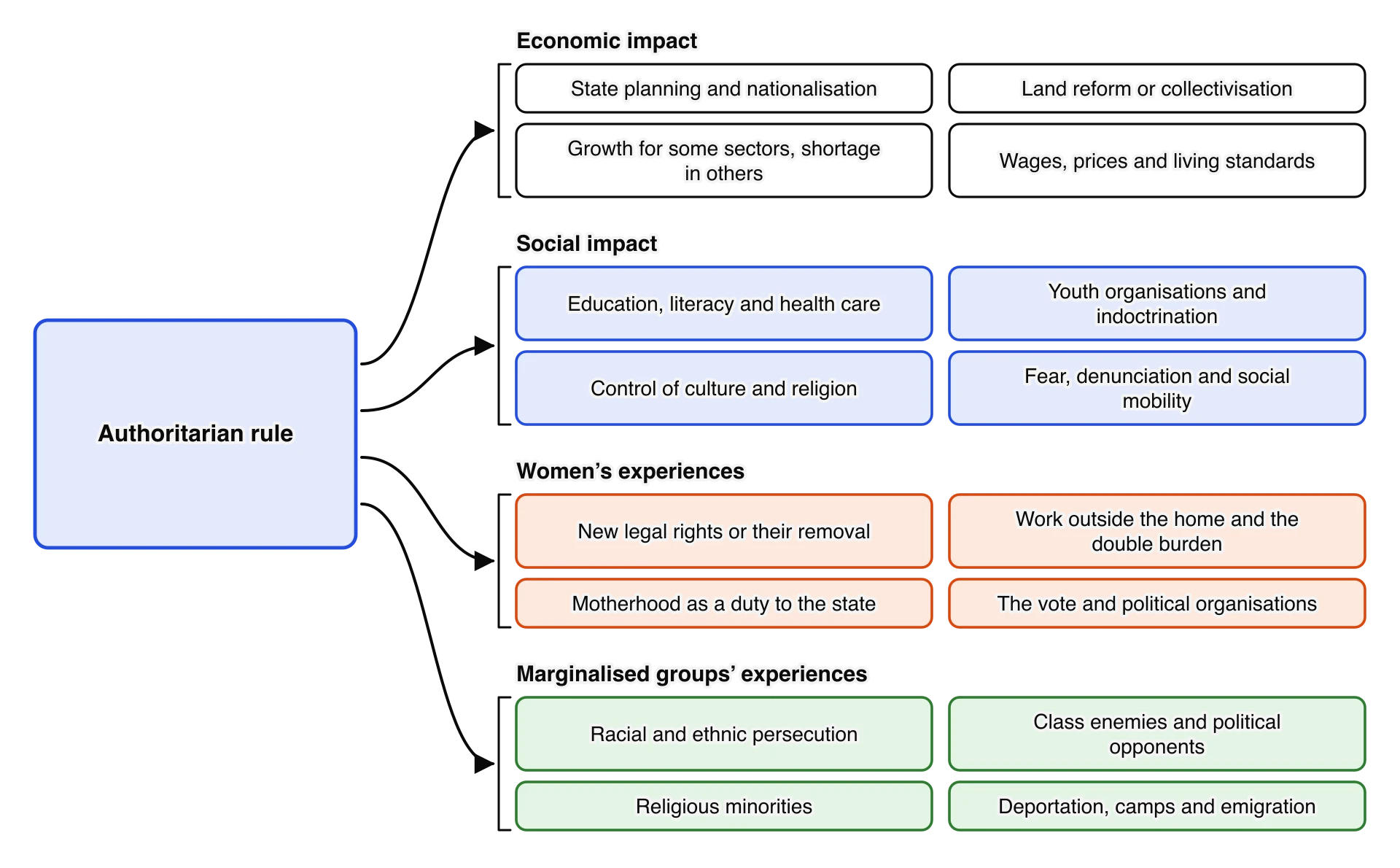
The diagram of the impact of authoritarian rule groups its effects in four ways. Economic impact covers work, income, property, food and the goods people could buy. Social impact covers education, health, family life, youth, culture, religion and the atmosphere of fear or enthusiasm in daily life. The experiences of women and of marginalised groups cut across both, because regimes treated these groups in distinctive ways.
Aims and results
Most authoritarian regimes had a programme for transforming society, so a useful starting point is to compare what a policy was meant to do with what it actually did. The Nazi regime wanted women to leave paid work and have more children, yet by 1939 more German women were in paid employment than in 1933. Stalin’s collectivisation was meant to produce cheap grain for the growing cities and for export, but it destroyed much of Soviet agriculture for a generation.
Results that differed from aims had several causes. Some aims contradicted one another, such as rearmament and higher living standards in Nazi Germany. Some policies were based on ideology rather than evidence, such as the agricultural theories of Trofim Lysenko, which shaped farming in both the USSR and China. Officials under pressure to meet targets also reported success that had not happened, so the regime itself often did not know what its policies were doing.
Winners and losers
No authoritarian regime affected all its subjects in the same way. Each one chose groups to reward and groups to exclude, and the choice followed from its ideology. Communist regimes favoured industrial workers and poor peasants and attacked landlords, "kulaks" and the old middle class; the Nazi regime favoured "Aryan" Germans of the national community and persecuted those it defined as racially or biologically unfit; populist regimes such as Perón’s raised the wages of urban workers at the expense of landowners and exporters.
Distinction | What it asks | Example |
|---|---|---|
Aims and results | Did the policy do what the regime intended? | Nazi Germany wanted women out of paid work, but female employment rose in the late 1930s as rearmament created labour shortages. |
Winners and losers | Which groups gained and which lost? | Egyptian land reform (from 1952) gave land to more than 300,000 families but cut the estates of the great landowners. |
Short-term and long-term | Did the effect last? | Cuba’s Literacy Campaign of 1961 had a lasting effect; Perón’s wage rises of 1946–1949 were largely eroded by inflation after 1949. |
Material gains and lost freedoms | What was the price of any improvement? | Soviet workers gained free schooling and job security but lost the right to strike or change jobs freely. |
Official and lived experience | Does the evidence show what people really experienced? | Chinese harvest statistics for 1958–1959 were inflated by local officials, hiding the famine from the leadership and later from historians. |
Measuring the impact
Historians face three problems in measuring how authoritarian rule affected lives. First, official statistics were tools of propaganda. Soviet and Chinese production figures were inflated, while death rates were hidden: the Soviet census of 1937, which revealed a population millions below the expected total, was suppressed and its organisers arrested. Second, people living under censorship did not say what they thought in public, so outward conformity may hide private dissent, and silence may hide fear. Third, the people who suffered most, such as famine victims and those murdered in camps, often left no records of their own.
Historians therefore combine sources. They compare official figures with internal reports that became available when archives opened (in the former USSR from the early 1990s), with census data analysed by demographers, and with diaries, letters, memoirs and oral history. Each kind of source has its own perspective: a memoir written in exile after escaping a regime is shaped by that experience, just as an official report is shaped by the need to please superiors.
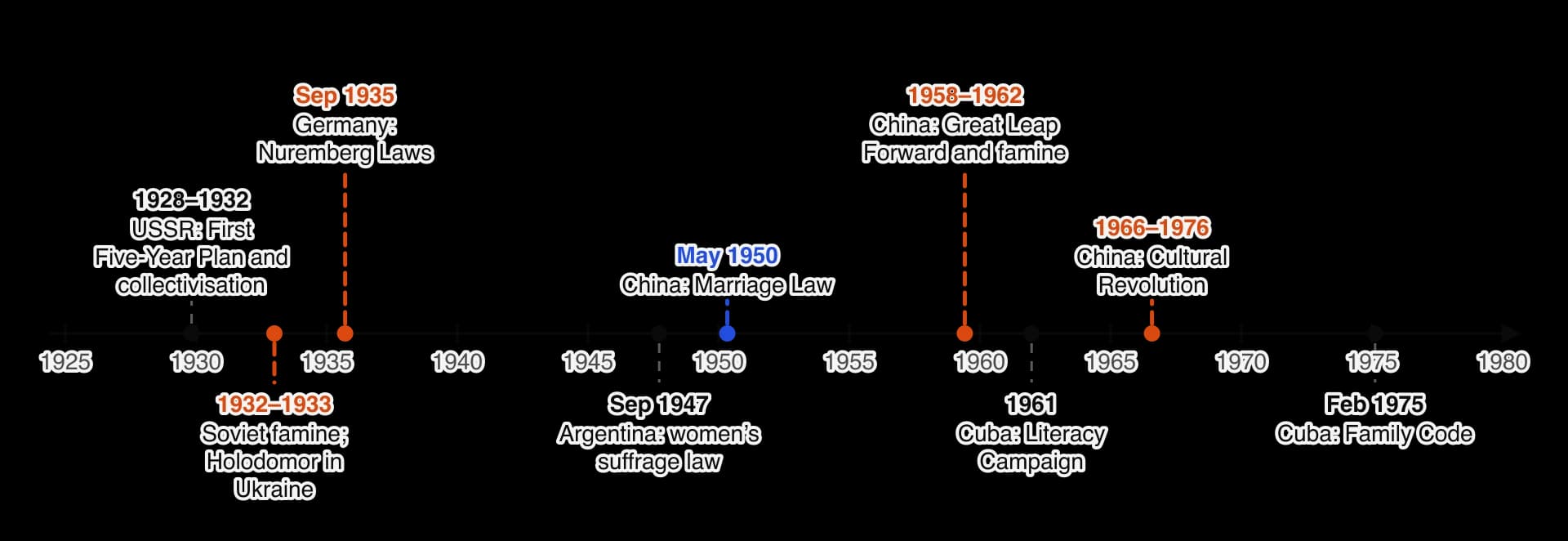
The timeline of policies shows that the six main regimes changed people’s lives in very different periods and settings, from the USSR of the 1930s to Cuba in the 1970s. Any comparison between them therefore has to take account of context: a regime’s economic choices depended on whether it ruled an agrarian or an industrial society, and on the help or hostility it faced from abroad.
The economic impact of authoritarian rule
Authoritarian regimes usually took far more control of the economy than the governments they replaced. The extent varied. Communist regimes abolished private ownership of land and industry almost entirely; the Nazi regime left businesses in private hands but directed them towards rearmament; Perón and Nasser built mixed economies with large state sectors. In every case the state, not the market or elected politicians, decided whose interests came first.
Stalin’s USSR: industrialisation at the expense of consumption
From October 1928 Stalin’s Five-Year Plans set targets for rapid growth in heavy industry: coal, iron, steel, oil, electricity and machinery. Stalin justified the speed by the threat of war, arguing in 1931 that the USSR was fifty to a hundred years behind the advanced countries and had to close the gap in ten years. New industrial cities were built from nothing, the most famous being Magnitogorsk in the Urals, a steel town built on open steppe from 1929 that had about 146,000 inhabitants by the census of 1939.
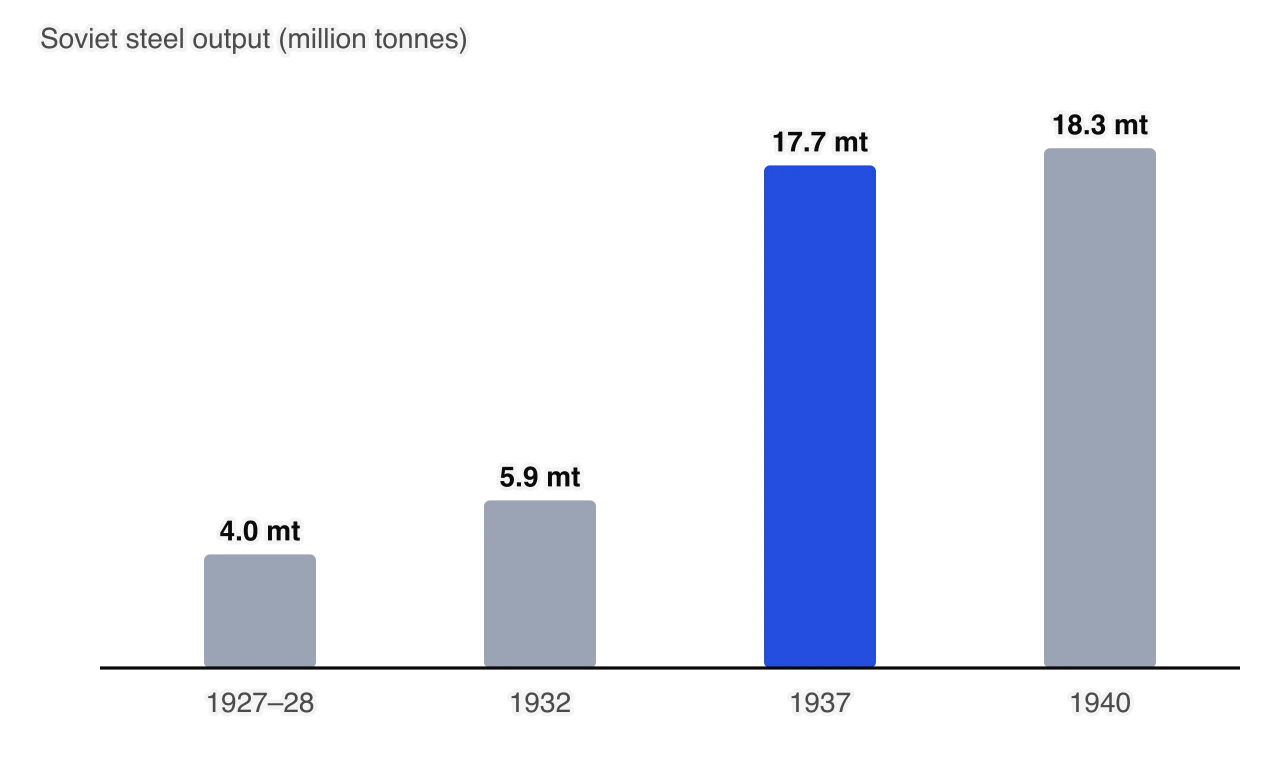
The chart of Soviet steel output shows the scale of growth. By 1940 the USSR was one of the world’s leading industrial powers, and this industrial base helped it survive the German invasion of 1941. The cost fell on consumers. Investment went to factories and dams, not housing, clothing or food, so families in the new cities lived in barracks, tents and shared apartments, queued for basic goods and faced bread rationing from 1929 to 1935. Most historians estimate that real wages in 1937 were below their level of 1928.
The plans also changed who worked and how. About 12 million peasants moved to towns in the First Five-Year Plan alone, and women entered industry in large numbers. Labour discipline was harsh: a decree of December 1938 required every worker to carry a labour book, and a law of June 1940 made lateness of more than twenty minutes and changing jobs without permission criminal offences. At the same time a minority did well: the Stakhanovite movement from 1935 rewarded record-breaking workers with higher pay, better flats and consumer goods, and engineers, managers and party officials formed a privileged new elite.
Collectivisation and famine
Collectivisation forced the peasants, who made up about four-fifths of the Soviet population, into collective farms (kolkhozy) from late 1929. The state could then take grain at low fixed prices to feed the cities and pay for imported machinery. Peasants who resisted were labelled kulaks (rich peasants) whatever their wealth; in 1930–1931 about 1.8 million people were deported in the campaign of dekulakisation to labour settlements in Siberia, the Urals and Kazakhstan, where many died. Peasants slaughtered their animals rather than hand them over: the number of cattle fell by almost half between 1929 and 1933.
Grain procurement continued as harvests fell. The famine of 1932–1933 killed an estimated 5.5 to 8.7 million people across the USSR, most of them in Ukraine, Kazakhstan, the north Caucasus and the Volga region. In Ukraine, where it is known as the Holodomor ("death by hunger"), estimates of deaths range from about 3.5 to 5 million. Kazakhstan suffered proportionally even more: forced settlement of nomadic herders and the loss of their animals killed about 1.5 million people, around 40 per cent of the Kazakh population. The death tolls are estimates because the regime denied the famine at the time and hid the evidence; historians reconstruct them from later census and archival data, and the range reflects different assumptions about births and migration.
Hitler’s Germany: recovery, rearmament and "guns or butter"
The Nazi regime came to power in January 1933 with about 6 million Germans registered as unemployed. By 1938 unemployment had almost disappeared. Public works such as the motorways (Autobahnen), state credit arranged by Hjalmar Schacht, the president of the Reichsbank and later economics minister, and above all rearmament created jobs. Schacht’s New Plan (1934) controlled imports and made bilateral trade deals with countries in south-eastern Europe and Latin America, and Göring’s Four-Year Plan (1936) aimed to make Germany self-sufficient (autarky) and ready for war within four years.
For workers, a job was the most important gain, and many remembered the 1930s as a time of security after the Depression. The price was the loss of independent organisation. Trade unions were abolished on 2 May 1933 and replaced by the German Labour Front (DAF), which represented employers and workers together under party control; wages were frozen at Depression levels, while working hours rose. Real weekly earnings recovered to their 1928 level only by the late 1930s, and mainly because people worked longer. Food was expensive and sometimes scarce, because imports of raw materials for rearmament took priority over imports of food: in 1936 Göring summed up the choice as one between guns and butter.
The regime tried to compensate with leisure and status. Strength through Joy (Kraft durch Freude, KdF), a DAF organisation, offered cheap theatre tickets, sports, holidays and cruises; millions took part in its trips, though the cruises were mostly used by better-paid workers and the middle class. The Volkswagen scheme invited workers to save for a "people’s car", but none was delivered to a civilian saver before the war. Farmers were promised protection through the Reich Food Estate and the Hereditary Farm Law (1933), which stopped medium-sized farms from being sold or divided, but rural incomes stayed low and many farm workers left for better-paid jobs in industry.
Populist and developmental regimes: Perón and Nasser
Perón and Nasser presented themselves as champions of ordinary people against landowning elites and foreign capital, and both delivered real material gains to their supporters in their first years. Both also ran into economic limits that their policies had helped to create.
Perón’s Argentina
Perón came to power in 1946 with Argentina rich from wartime food exports. Building on measures he had introduced as Secretary of Labour from 1943, his government raised wages and extended paid holidays, a bonus of an extra month’s pay (the aguinaldo), pensions and protection against dismissal to most urban workers. Real wages of industrial workers rose sharply between 1946 and 1949, by roughly 40 to 50 per cent according to different estimates, and the share of national income going to wage earners rose from about 40 per cent in 1946 to between about 47 and 49 per cent by 1949–1950. The state bought the British-owned railways in 1948, nationalised the telephone system and the central bank, and paid off the foreign debt.
The money came largely from agriculture. The state trading agency, the IAPI (Argentine Institute for the Promotion of Trade), bought crops from farmers at low fixed prices and sold them abroad at high world prices, using the profit for industry and welfare. Farmers responded by planting less; combined with droughts in 1949–1952 and falling world prices, this cut exports. Inflation rose to about 30 per cent in 1949 and nearly 40 per cent in 1951, and in 1952 the government froze wages and asked Argentines to eat less meat so that more could be exported. Later research suggests that the gains were concentrated among industrial workers, while rural, domestic and some public-sector workers gained much less.
Nasser’s Egypt
Nasser’s economic policy rested on land reform, nationalisation and state-led industrialisation. The land reform law of September 1952 limited the land any one person could own to 200 feddans (a feddan is about 0.4 hectares), later cut to 100 feddans (1961) and 50 (1969). Land above the limit was taken and sold on easy terms to tenants and small farmers. Over the whole Nasser period about 700,000–860,000 feddans, roughly an eighth of Egypt’s cultivated land, went to more than 300,000 families, and rents for the much larger number of tenants were capped.
Nasser nationalised the Suez Canal Company in July 1956, then British and French businesses after the Suez Crisis, and in the July Laws of 1961 most banks, insurance companies and large firms. The Aswan High Dam, built between 1960 and 1970 with Soviet loans, controlled the Nile flood, expanded irrigation and produced electricity. Gains were real but limited. Most rural Egyptians still owned no land at all; population growth of about 2.5 per cent a year absorbed much of the economic growth; and the war in Yemen (1962–1967) and defeat by Israel in 1967 drained resources.
Castro’s Cuba: redistribution and dependence
The Cuban revolution redistributed wealth more completely than either Perón or Nasser. The Agrarian Reform Law of May 1959 broke up large estates, many of them US-owned; rents were cut by up to half; and in 1960 the government nationalised US and Cuban-owned businesses, banks and sugar mills. In the Revolutionary Offensive of 1968 even small private businesses, down to street stalls and barber shops, were taken over by the state.
Redistribution gave poor Cubans more security, but the economy struggled. The US trade embargo, imposed in stages from 1960 and made almost total in February 1962, cut Cuba off from its main market and supplier. Rationing through the libreta (ration book) began in March 1962 and has continued in some form ever since. After an early attempt at rapid industrialisation failed, the regime returned to sugar, and the campaign for a harvest of 10 million tonnes in 1970, for which much of the workforce was mobilised, fell short at about 8.5 million tonnes and disrupted the rest of the economy. Cuba then depended on Soviet subsidies, through high prices for its sugar and cheap oil, until the collapse of the USSR in 1991 caused a deep crisis, the Special Period.
The social impact of authoritarian rule
Authoritarian regimes wanted more than obedience. Most aimed to create a new kind of person: the "new Soviet man", the racially aware member of the German national community, the revolutionary Cuban of Che Guevara’s "new man". Schools, youth movements, the arts, the media and even sport were used for this purpose. The social impact of authoritarian rule therefore combined real improvements in education and health with control over what people learned, believed and said.
Education and literacy
Education was the area in which several regimes achieved their most lasting gains. In the USSR, the share of the population able to read and write rose from about half in the census of 1926 to more than four-fifths in 1939, and free secondary and higher education opened careers to the children of workers and peasants. Tens of thousands of these promoted workers, the vydvizhentsy, became engineers, managers and party officials in the 1930s, replacing the old educated class, many of whose members were purged. Leonid Brezhnev and Alexei Kosygin, later leaders of the USSR, were among them.
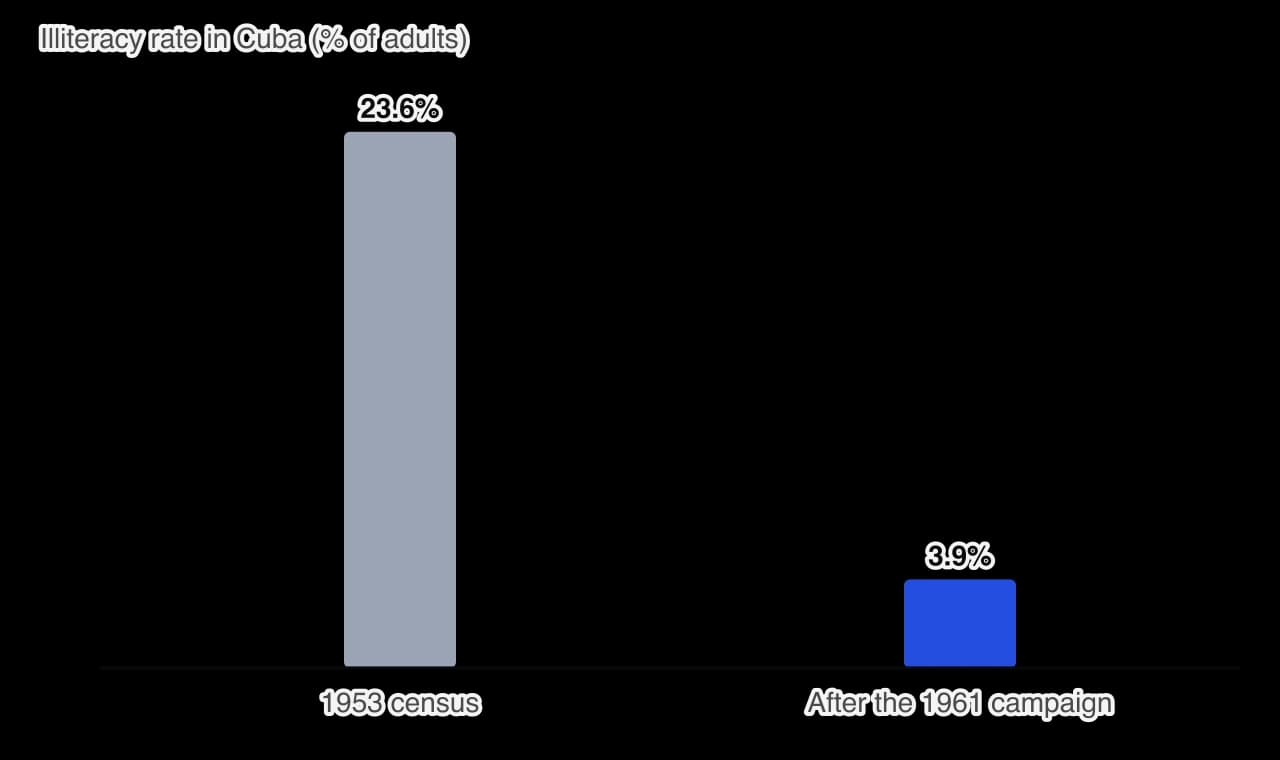
Cuba’s Literacy Campaign of 1961 is the best-known example of a mass literacy drive. Schools closed for eight months, and about 250,000 volunteers, more than 100,000 of them school students (brigadistas), many of them teenage girls, went to live with rural families and teach adults to read. On 22 December 1961 Castro declared Cuba a "territory free of illiteracy". The chart of Cuban illiteracy shows the official result; the figures are the government’s own, but independent observers, including a UNESCO mission of 1964, accepted that the fall was very large.
In Egypt, Nasser’s government built schools across the countryside, made education free up to and including university in 1962, and guaranteed graduates a job in the state sector. School and university enrolment rose rapidly, and many children of peasant families became teachers, engineers and officials. The guarantee of state jobs, however, swelled an inefficient bureaucracy, and the quality of teaching fell as classes grew.
Education was always political. Soviet history textbooks were rewritten after the publication in 1938 of the Short Course history of the Communist Party, which presented Stalin as Lenin’s closest comrade. In Nazi Germany the curriculum was changed to stress race, German history and physical fitness; Jewish teachers were dismissed in 1933; and about 97 per cent of teachers joined the National Socialist Teachers’ League. Cuban and Chinese schools taught that the revolution was the culmination of national history, so the new readers created by literacy campaigns were also readers of the regime’s own message.
Health and welfare
Communist and populist regimes extended health care and welfare to people who had had little or none. Cuba built a national health service free at the point of use, sent doctors to rural areas, and by 1990 had an infant mortality rate of about 11 deaths per 1,000 live births, among the lowest in Latin America and comparable with far richer countries; around 1960 it had been somewhere between about 35 and 60, depending on the estimate. The achievement came despite the emigration of about half of Cuba’s 6,000 doctors in the early 1960s. In Argentina the Eva Perón Foundation (1948) built hospitals, schools, children’s homes and holiday camps, and distributed sewing machines, food and toys, often personally through Eva Perón herself. Welfare of this kind was real, but it was also patronage: help was presented as a gift from the leader, not a right.
Nazi welfare was racial. The National Socialist People’s Welfare organisation (NSV) and the Winter Relief campaign helped poor "Aryan" families, but health policy aimed to strengthen the race as a whole, which meant excluding those defined as unfit. The same doctors and public health officials who promoted mothers’ health and fitness carried out about 400,000 compulsory sterilisations under the law of July 1933.
Youth: organisation and indoctrination
Every regime tried to win the young, who would carry the new society forward and who could be taught to see their parents’ beliefs as old-fashioned. In the USSR, the Young Pioneers (aged 10–14) and the Komsomol (14–28) organised millions of young people; the boy Pavlik Morozov, who was said to have denounced his father to the authorities and to have been murdered by relatives in 1932, was made a hero for putting the state before his family, although historians now doubt much of the official story.
In Germany the Hitler Youth and its girls’ section, the League of German Girls (Bund Deutscher Mädel, BDM), grew from about 2.3 million members at the end of 1933 to about 8.7 million by 1939, when membership became compulsory. They offered sport, camping and a sense of belonging, and many former members later remembered them with affection. Others resented the drill and the loss of time with family and church, and by the late 1930s some young people formed groups such as the Edelweiss Pirates that rejected the Hitler Youth altogether.
Culture, religion and belief
Authoritarian regimes controlled culture because they saw it as a means of shaping people. From 1934 Soviet writers and artists had to follow socialist realism, which portrayed life as it should become under socialism; the poet Osip Mandelstam died in the Gulag in 1938 after writing a poem mocking Stalin. Nazi Germany burned "un-German" books in May 1933 and staged an exhibition of "degenerate art" in 1937 to ridicule modern painting. Many writers, scientists and artists, including Albert Einstein and Thomas Mann, left Germany.
Religion was a rival source of loyalty. The Soviet regime closed churches, mosques and synagogues, arrested clergy and promoted atheism through the League of the Militant Godless; by 1939 only a few hundred of the tens of thousands of Orthodox churches open before 1917 were still functioning. Stalin allowed a partial revival of the Orthodox Church from 1943 to support the war effort. The Nazi regime signed a Concordat with the Vatican in July 1933 but then restricted Catholic schools, youth groups and newspapers, and tried to unite Protestants in a pro-Nazi Reich Church. In Cuba, the Catholic Church lost its schools in 1961 and believers were barred from Communist Party membership until 1991.
Fear, denunciation and opportunity
Life under the harshest regimes was shaped by fear. In the USSR during the Great Terror of 1936–1938, about 680,000 people were executed and more than a million sent to the Gulag; nearly every family knew someone who had been arrested. People learned to watch what they said, and denunciations by neighbours, colleagues and even relatives, sometimes to settle personal disputes or to gain a flat, fed the terror. Beyond its political purpose, the terror damaged everyday life by destroying trust between neighbours, colleagues and family members.
Yet fear existed alongside opportunity and, for some, real belief. The same years that saw the Terror also saw mass promotion, new schools, parks of culture and rest, and a cult of achievement. Stalin captured the official mood in a speech to record-breaking workers in November 1935.
Life has improved, comrades. Life has become more joyous. And when life is joyous, work goes well.
Joseph Stalin, Speech at the First All-Union Conference of Stakhanovites, Moscow, 17 November 1935 (translation from Stalin’s Works, vol. 14). Stalin spoke to an audience of rewarded workers in the year bread rationing ended, and the phrase became a slogan printed on banners across the USSR. As evidence it shows how the regime wanted the improvement in living standards to be seen; it cannot show whether ordinary workers agreed, and it was spoken months before the Great Terror began.
The experiences of women
Women’s experiences under authoritarian rule depended above all on the regime’s ideology and its economic needs. Communist regimes believed that women would be freed by paid work and legal equality, so they abolished many legal inequalities and drew women into factories and offices. Fascist and conservative regimes saw women’s main duty as motherhood and the family. Populist regimes such as Perón’s and Nasser’s gave women political rights and organised them as supporters, while leaving much of family life unchanged. In practice the needs of the economy often overrode ideology in every type of regime.
Stalin’s USSR: equality in law, the "Great Retreat" in the family
The Bolsheviks had given Soviet women some of the most advanced rights in the world. The Family Code of 1918 made marriage a civil matter and divorce easy, and abortion was legalised in 1920. A party women’s department, the Zhenotdel, campaigned for literacy and against practices such as the veiling of women in Central Asia, until Stalin closed it in 1930 on the grounds that the "woman question" had been solved.
Industrialisation drew women into paid work on a huge scale. Women made up about 40 per cent of industrial workers by 1940, and many trained as doctors, teachers, engineers and tractor drivers, jobs presented in posters and films as symbols of the new society. Most, however, worked in lower-paid jobs, and they still did nearly all the queuing, cooking, cleaning and childcare in cramped housing with few consumer goods, so the double burden was the normal experience of Soviet working women.
In the mid-1930s the regime changed course on the family, in what the sociologist Nicholas Timasheff called the Great Retreat (1946). Worried by a falling birth rate and by family breakdown, the government banned abortion in June 1936 (except on medical grounds), made divorce more expensive and difficult, and praised motherhood and stable marriage. A law of 1944 introduced medals for mothers of large families, up to the title "Mother Heroine" for ten or more children. Women were now expected to be both productive workers and prolific mothers.
Hitler’s Germany: motherhood as a duty to the race
Nazi ideology assigned "Aryan" women to the home, summed up in the older phrase Kinder, Küche, Kirche (children, kitchen, church). Hitler set out this view to the National Socialist Women’s League at the Nuremberg party rally of 1934.
If the man’s world is said to be the State, his struggle, his readiness to devote his powers to the service of the community, then it may perhaps be said that the woman’s is a smaller world. For her world is her husband, her family, her children, and her home. But what would become of the greater world if there were no one to tend and care for the smaller one?
Adolf Hitler, speech to the National Socialist Women’s League, Nuremberg, 8 September 1934 (translation from Noakes and Pridham, Nazism 1919–1945). Hitler spoke to an audience of loyal party women, so he presented the domestic role as an honour, not a restriction. The speech shows the regime’s ideal, which explains policies such as marriage loans and the Mother’s Cross; it does not show how far German women accepted it or how far policy followed it.
Policy did follow the ideal at first. From June 1933 couples could receive a marriage loan of up to 1,000 Reichsmarks if the wife gave up her job, and a quarter of the loan was cancelled for each child born. Women were barred from becoming judges and lawyers from 1936, and their numbers at university were limited. The Mother’s Cross, introduced in December 1938, was awarded in bronze, silver and gold to mothers of four, six and eight or more children. The birth rate rose from about 15 per 1,000 in 1933 to about 20 per 1,000 in 1939, although historians attribute much of this to economic recovery, which also raised marriage rates, rather than to propaganda.
Rearmament then pulled policy the other way. From 1937 a wife no longer had to leave work to qualify for a marriage loan, and the number of women in paid employment rose. Even so, the regime hesitated to conscript women for war work until January 1943, when women aged 17–45 had to register, and it relied heavily on foreign forced labour instead. Women who did not fit the "Aryan" ideal were treated very differently: Jewish, Roma and disabled women were excluded from all the benefits, and many were forcibly sterilised.
Perón’s Argentina: the vote and organised women
Argentine women won the vote under Perón. A suffrage law, Law 13.010, was passed on 9 September 1947 and promulgated on 23 September at a mass rally at which Eva Perón, Perón’s wife, claimed the victory as her own; women had campaigned for the vote for decades, but earlier bills had failed. In 1949 Eva Perón founded the Female Peronist Party, which organised women through thousands of local centres (unidades básicas) that offered classes, health care and welfare as well as political education.
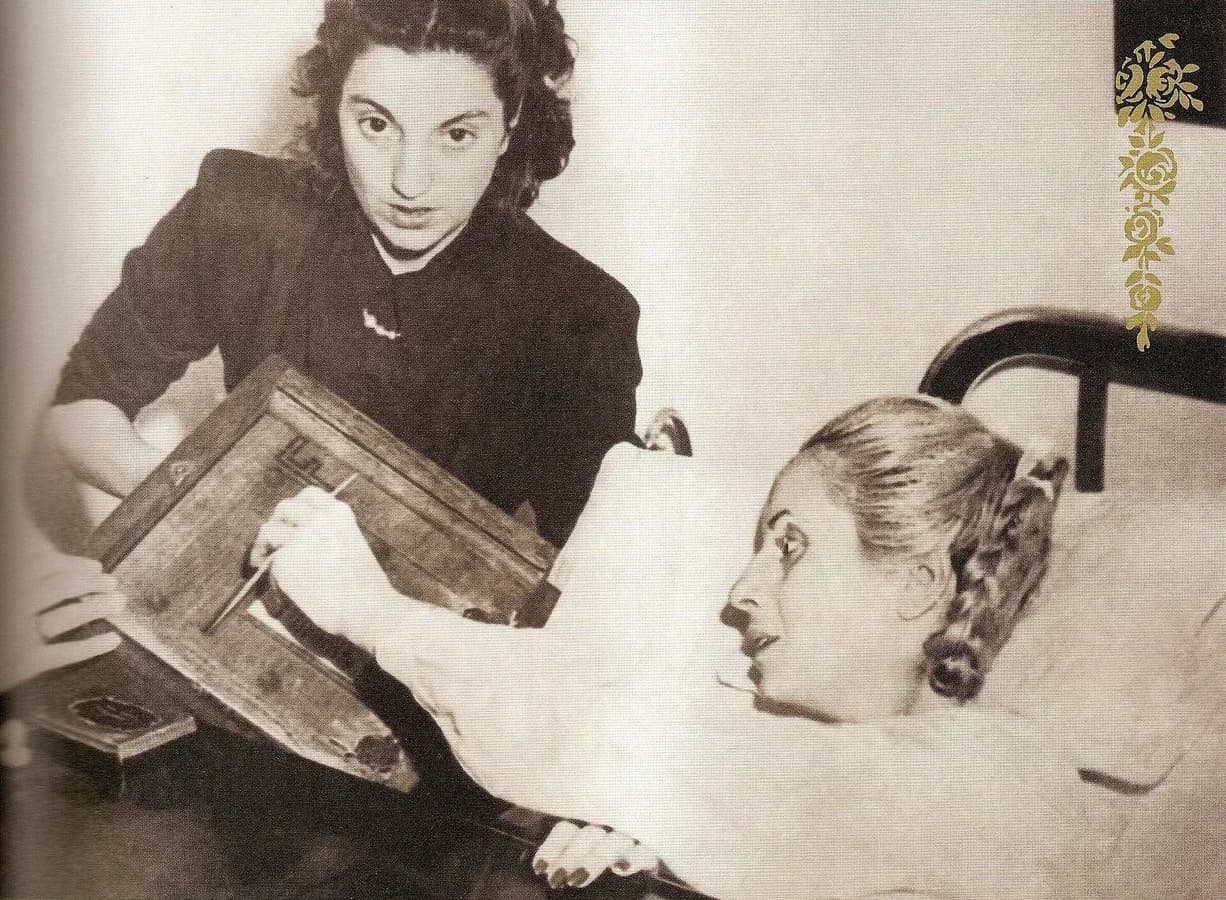
The photograph of Eva Perón voting from a hospital bed shows how closely women’s new political rights were tied to the cult of the Peróns. In the election of November 1951, the first in which women voted nationally, about 90 per cent of registered women voted, a large majority of them for Perón, and 23 women deputies and 6 women senators were elected, a higher share of women legislators than in most democracies of the time. Women’s rights were real, but they came as part of a movement that demanded loyalty to its leaders: Eva Perón’s autobiography, La razón de mi vida (1951), presented women’s highest calling as service to Perón and the nation.
Nasser’s Egypt: state feminism and its limits
Nasser’s regime practised what historians call state feminism: the state granted women rights and opportunities from above, while banning independent women’s organisations. The constitution of 1956 gave Egyptian women the vote and the right to stand for election, and in 1957 Rawya Ateya and Amina Shukri became the first women elected to the National Assembly. Free education brought women into universities and professions in growing numbers, and in 1962 Hikmat Abu Zayd became Egypt’s first woman minister, responsible for social affairs.
The limits were clear. The Personal Status Law, which governed marriage, divorce and custody under religious law, was left unchanged: men could still divorce their wives unilaterally and take more than one wife. Independent feminists were silenced. Doria Shafik, who had led the campaign for women’s suffrage, went on hunger strike in February 1957 in protest against Nasser’s dictatorship, was placed under house arrest and spent her remaining years isolated from public life.
Castro’s Cuba: mobilisation and the Family Code
The Cuban regime founded the Federation of Cuban Women (FMC) in August 1960, led by Vilma Espín, a veteran of the guerrilla war and the wife of Raúl Castro. The FMC organised women for the Literacy Campaign, vaccination drives and voluntary labour, and ran training schools, including for former domestic servants and sex workers, whose trades the revolution set out to abolish. Abortion was made freely available in the public health system from the mid-1960s, and women’s share of the paid workforce rose from about 13 per cent in 1953 to more than 30 per cent by the early 1980s.
The double burden remained. Under the Family Code of 1975 husbands and wives had a legal duty to share housework and childcare equally if both worked, a pioneering law, but surveys in the 1980s found that women still did most domestic work, and few women reached the top of the Communist Party.
Regime | Main aim for women | Rights and roles gained | Limits and losses |
|---|---|---|---|
Stalin’s USSR | Workers and, from 1936, mothers | Equality in law; mass entry into industry and professions | Abortion banned 1936; divorce restricted; double burden |
Hitler’s Germany | Mothers of the race | Marriage loans, Mother’s Cross, welfare for "Aryan" families | Excluded from senior professions; non-"Aryan" women persecuted |
Mao’s China | Equal comrades in production | Marriage Law 1950: free choice of partner, divorce; land in women’s names | Rural resistance to the law; double burden; famine fell hardest on families |
Castro’s Cuba | Revolutionary workers and citizens | FMC; literacy; abortion access; Family Code 1975 | Double burden; few women in top leadership |
Nasser’s Egypt | Educated citizens within the family | Vote 1956; first women MPs 1957; free education | Personal Status Law unchanged; independent feminism banned |
Perón’s Argentina | Loyal Peronist citizens | Vote 1947; Female Peronist Party; women legislators 1951 | Rights tied to loyalty to the Peróns; little change in family law until 1954 |
The table of women’s experiences shows that the most important variable was not whether a regime was authoritarian but what its ideology said about women, and how much it needed their labour. Communist and populist regimes gave women formal rights that democracies in the same period often had not; fascist rule narrowed women’s public roles; and in every case the gap between law and household life was wide.
The experiences of marginalised groups
A marginalised group is a group pushed to the edge of a society, with less power, fewer rights and less protection than the majority. Authoritarian regimes marginalised groups for two main reasons. Their ideologies defined some people as enemies of the new society: "class enemies" for communist regimes, racial and biological "aliens" for the Nazis. And because these regimes allowed no legal opposition, anyone outside the official community, including religious believers, political opponents and minorities seen as disloyal, had no means of defending themselves.
Persecution of such groups also served the regime. It gave a scapegoat for problems, united the majority against an outsider, and in some cases transferred property from the persecuted to the regime’s supporters. The experience of marginalised groups ranged from discrimination and exclusion, through deportation and imprisonment, to mass murder.
Nazi Germany: racial persecution and genocide
Nazi ideology divided humanity into races of unequal value and defined Jews as the enemy of the German people. Germany’s Jewish community of about 500,000 people in 1933, less than 1 per cent of the population, was excluded from public life step by step. The vertical timeline of Nazi persecution shows the stages.
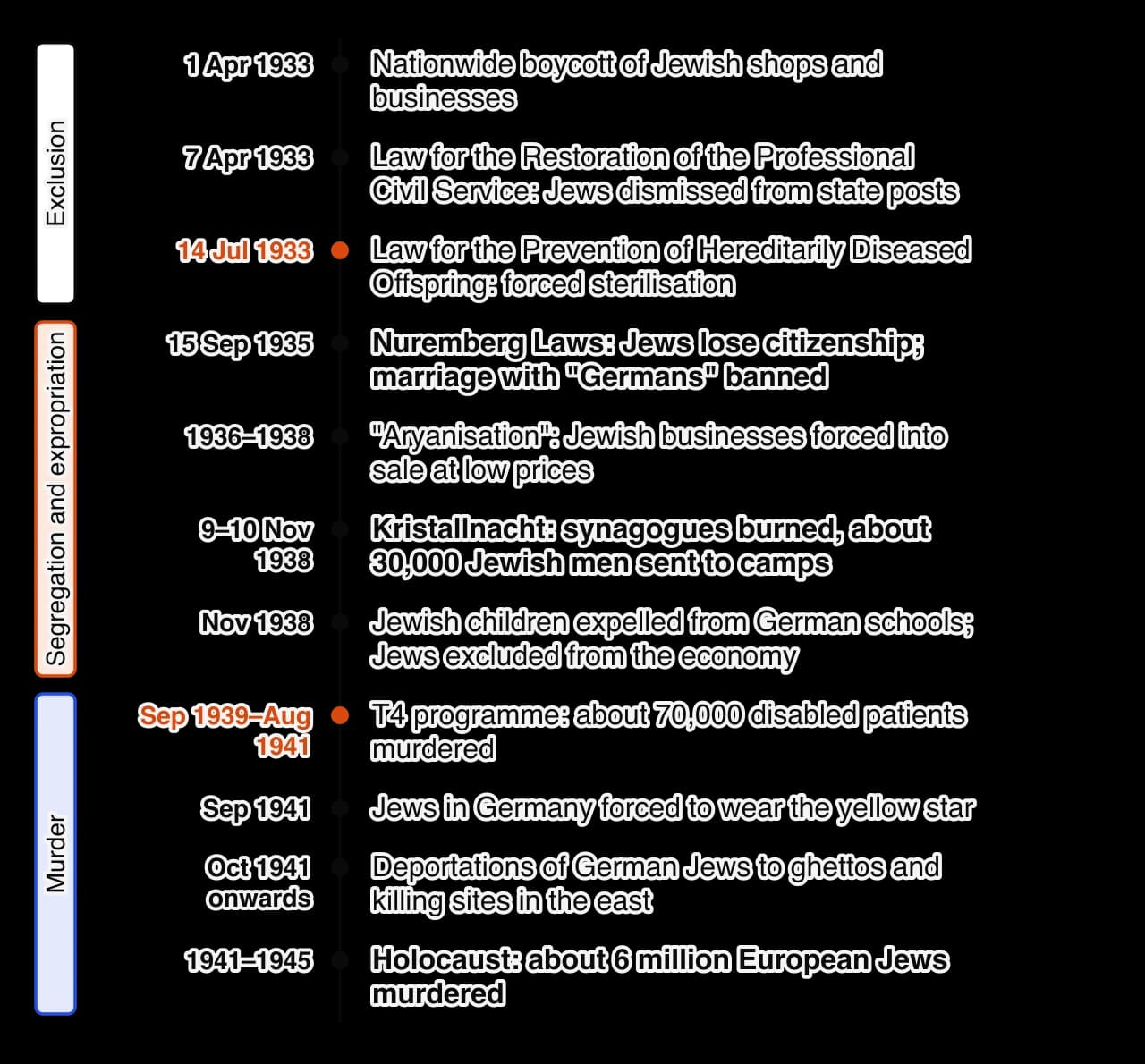
The Nuremberg Laws of 15 September 1935 were the legal turning point. The Reich Citizenship Law made Jews "subjects" rather than citizens, and the Law for the Protection of German Blood and German Honour banned marriage and sexual relations between Jews and other Germans.
Entirely convinced that the purity of German blood is essential to the further existence of the German people, and inspired by the uncompromising determination to safeguard the future of the German nation, the Reichstag has unanimously resolved upon the following law … Section 1. 1. Marriages between Jews and citizens of German or kindred blood are forbidden. Marriages concluded in defiance of this law are void, even if, for the purpose of evading this law, they were concluded abroad. … Section 2. Sexual relations outside marriage between Jews and nationals of German or kindred blood are forbidden.
Law for the Protection of German Blood and German Honour, 15 September 1935, passed by the Reichstag at the Nuremberg party rally (translation from the Jewish Virtual Library). The preamble presents persecution as protection of the nation, in the language of science and law; the word "unanimously" reflects a Reichstag in which only Nazis now sat. As evidence of people’s lives, the law shows how the regime reached into the most private decisions: whom people could marry, love or employ. A decree of November 1935 applied the same rules to Roma and Black Germans.
Exclusion became expropriation and violence. Jewish businesses were forced into sale at low prices (Aryanisation), so that ordinary Germans as well as firms profited from persecution. In the Kristallnacht pogrom of 9–10 November 1938, synagogues across Germany and Austria were burned, Jewish shops wrecked, about 90 people killed and about 30,000 Jewish men sent to concentration camps. By 1939 more than half of Germany’s Jews had emigrated, often losing most of their property to emigration taxes. Of those who remained, most were deported from October 1941 and murdered in the Holocaust, the genocide of about 6 million European Jews.
 YouTube
Other targets of Nazi racial and social policy
The same ideology targeted other groups. The Roma and Sinti were registered, sent to special camps and, from 1942, deported to Auschwitz and other killing sites; historians estimate that between 200,000 and 500,000 European Roma were murdered in the Porajmos, a range that reflects poor records. Disabled people were forcibly sterilised under the law of July 1933 and, from 1939, murdered in the T4 programme: about 70,000 patients were killed in gas chambers by August 1941, and many more by starvation and lethal injection afterwards. Gay men were persecuted under Paragraph 175 of the criminal code, which was tightened in 1935: about 50,000 were convicted and between 5,000 and 15,000 sent to concentration camps. Jehovah’s Witnesses, who refused military service and the Hitler salute, were imprisoned in large numbers. Political opponents, above all communists and social democrats, had been the first inmates of the camps in 1933. In wartime, Slavs were treated as racially inferior: millions of Polish and Soviet civilians were brought to Germany as forced labourers, the Ostarbeiter, and lived under separate, harsher rules than German workers.
Stalin’s USSR: class enemies, nationalities and believers
Soviet persecution was based mainly on class and political loyalty, and from the 1930s increasingly on nationality. "Kulaks", priests, former nobles and "bourgeois specialists" lost the right to vote, ration cards and places at university; their children carried the stigma for years. In the late 1930s the NKVD carried out "national operations" against Poles, Germans, Latvians, Koreans and other groups with links to foreign states; about 172,000 Koreans were deported from the Soviet Far East to Central Asia in 1937.
During and after the Second World War, Stalin deported whole nationalities accused of collaboration with Germany: about 400,000 Volga Germans in 1941, about 500,000 Chechens and Ingush in February 1944, and about 190,000 Crimean Tatars in May 1944, among others. They were sent in cattle trucks to Kazakhstan, Central Asia and Siberia, where many died of hunger and disease in the first years; the deported peoples were not allowed to return home until after Stalin’s death, and the Crimean Tatars not until the late 1980s.
The famine of 1932–1933 raises the most debated question. In Ukraine, grain quotas were enforced with special severity, villages that failed to meet them were blacklisted, and peasants were forbidden to leave the republic in search of food. Robert Conquest (The Harvest of Sorrow, 1986) and Anne Applebaum (Red Famine, 2017) argue that Stalin used the famine to break Ukrainian peasant resistance and national feeling, and Ukraine recognised the Holodomor as a genocide in 2006, followed by many other states. R. W. Davies and Stephen Wheatcroft (The Years of Hunger, 2004) accept that Stalin’s policies caused the famine and that he refused to relieve it, but argue that the evidence does not show an intention to destroy Ukrainians as a nation. The debate turns on intent; there is no disagreement that the regime’s policies caused millions of deaths.
Cuba, Egypt and Argentina
In Cuba, the revolution formally ended racial discrimination: beaches, clubs and schools were opened to Afro-Cubans, and Castro declared in 1962 that the problem of racism had been solved. Afro-Cubans gained much from free education and health care, yet they remained under-represented in the leadership, and the regime’s claim that racism had ended made it hard to discuss the inequality that remained. Gay men, Jehovah’s Witnesses, Catholic activists and others labelled "anti-social" were sent to the labour camps of the UMAP (Military Units to Aid Production) between 1965 and 1968; the writer Reinaldo Arenas described the persecution of gay Cubans in his memoir Before Night Falls (1992). Opponents of the regime, and many who simply rejected it, emigrated: about 250,000 Cubans left by 1962, and about 125,000 in the Mariel boatlift of 1980, whom the regime called escoria ("scum").
In Egypt, the groups that suffered most were political and foreign. Thousands of members of the Muslim Brotherhood and of the communist parties were imprisoned in camps such as Tura and the desert camp of al-Wahat, many of them tortured. After the Suez Crisis of 1956, many British and French nationals and Jews were expelled or pressured to leave, and Egypt’s Jewish community, about 75,000–80,000 people in the late 1940s, fell to a few thousand by the late 1960s. The nationalisations of 1961 also led most of Egypt’s long-established Greek and Italian communities to leave. Coptic Christians, about a tenth of the population, kept freedom of worship, and Nasser had a good relationship with the Coptic Pope Cyril VI, but Copts were few in senior government posts and land reform and nationalisation hit Coptic landowners and businessmen hard.
In Argentina, Perón’s nationalism largely ignored Indigenous peoples. In 1946 Kolla people from the north-west marched about 2,000 kilometres to Buenos Aires in the Malón de la Paz to demand the return of their lands; they were received by Perón, then forcibly put on a train home. In October 1947, at Rincón Bomba in Formosa province, the national gendarmerie killed hundreds of Pilagá people, including women and children; the massacre was hidden for decades and was recognised by an Argentine court as a crime against humanity in 2019. Political opponents, from socialists to conservative newspaper owners, faced arrest, censorship and, in some cases, torture by the police. In 1954–1955 the regime turned on the Catholic Church, which it saw as a rival for loyalty: it legalised divorce, ended religious education in state schools and arrested priests, a conflict that helped turn Catholics against Perón before the coup of September 1955.
Regime | Groups marginalised | How they were treated | Why (according to the regime) |
|---|---|---|---|
Hitler’s Germany | Jews; Roma and Sinti; disabled people; gay men; Jehovah’s Witnesses; political opponents | Exclusion, expropriation, sterilisation, camps, genocide | Racial and biological ideology; the "national community" |
Stalin’s USSR | "Kulaks"; clergy and believers; deported nationalities; political suspects | Deportation, Gulag, famine, execution | Class war; suspected disloyalty; security |
Mao’s China | Landlords and "rightists"; Tibetans; religious believers; intellectuals | Public struggle sessions, labour camps, violence; Tibet uprising crushed (1959) | Class struggle; national unity |
Castro’s Cuba | Political opponents; gay men; religious believers; emigrants | Prison, UMAP camps, exclusion, emigration | Defence of the revolution; the "new man" |
Nasser’s Egypt | Muslim Brotherhood; communists; Jews and foreign communities | Imprisonment, torture, expulsion, emigration | National security; Arab nationalism |
Perón’s Argentina | Political opponents; Indigenous peoples | Arrest, censorship; massacre at Rincón Bomba (1947) | Loyalty to the "new Argentina"; neglect |
The table of marginalised groups shows a pattern common to all six regimes: the definition of who belonged to the nation or the revolution decided who was persecuted. It also shows a clear difference of degree. Only the Nazi regime set out to murder entire peoples on racial grounds, while Soviet and Chinese policies caused deaths on a comparable scale through famine and terror justified by class and security. Perón’s and Nasser’s regimes persecuted opponents and neglected or expelled minorities, but on a much smaller scale.
Case study: life in Mao’s China, 1949–1976
Mao’s China shows all four kinds of effect in one regime, and shows how the same state could transform people’s lives for the better and for the worse within a few years. When the Chinese Communist Party (CCP) proclaimed the People’s Republic on 1 October 1949, China was a poor, overwhelmingly rural country of about 540 million people, exhausted by decades of civil war and Japanese invasion. Average life expectancy was around 35–40 years, and perhaps four in five adults could not read.
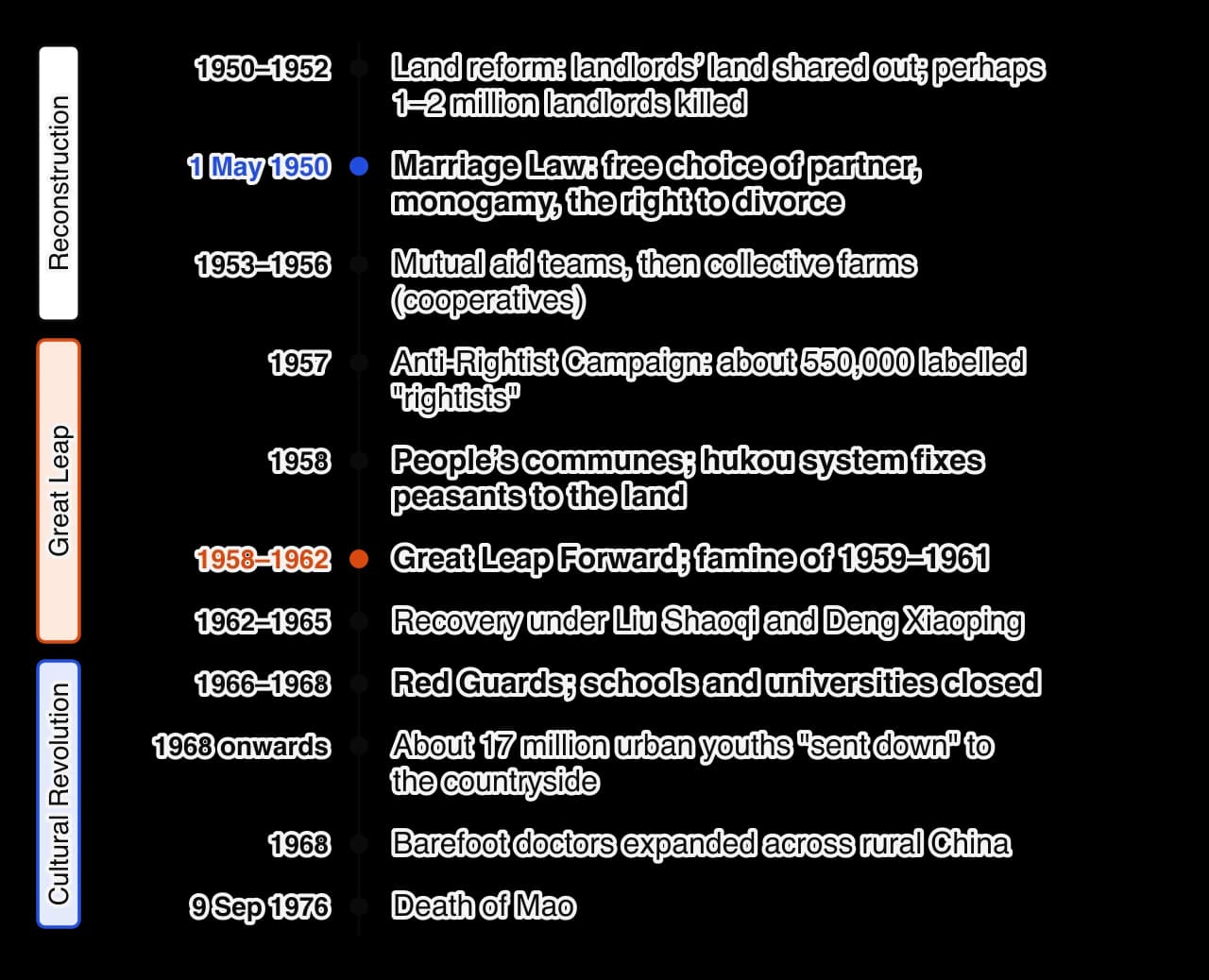
The vertical timeline of life in Mao’s China divides the period into three phases. In each, policies made in Beijing reached every village and household, because the party built an organisation that extended, for the first time in Chinese history, down to the level of the street and the village.
Land reform and the end of the landlords, 1950–1952
The Agrarian Reform Law of June 1950 took land from landlords and richer peasants and gave it to poor and landless peasants; roughly 40 per cent of China’s cultivated land changed hands. Women received land in their own names, for the first time in Chinese history. For hundreds of millions of poor peasants, land reform was the greatest material gain of the revolution and the main reason for the CCP’s popularity in the countryside.
Land reform was also violent. Party work teams organised villagers to denounce landlords at "speak bitterness" meetings and mass trials, and many landlords were beaten to death or executed. Estimates of the dead range from about 1 to 2 million or more. The survivors and their families were classified as "landlords" or "rich peasants" and carried that label, which affected their children’s schooling, jobs and marriage prospects, for the next three decades. The new class labels created a new marginalised group in every village.
The Marriage Law of 1950
The Marriage Law, which came into force on 1 May 1950, was the first major law of the new state. Its first article abolished the "feudal" marriage system and replaced it with one based, in the words of the law, "on free choice of partners, on monogamy, on equal rights for both sexes, and on the protection of the lawful interests of women and children". It banned arranged and forced marriages, concubinage, child betrothal and the payment of money or gifts to obtain a wife; it set minimum ages for marriage of 18 for women and 20 for men; and it gave women the right to divorce and to own and inherit property.
Many women used the law. Hundreds of thousands of divorces were granted in the first years, most of them requested by women escaping arranged or abusive marriages, and the early 1950s became known as a "divorce wave". The law met strong resistance in rural areas, where marriage was an economic arrangement between families and many local cadres were themselves husbands who had paid for their wives. Official reports at the time recorded tens of thousands of women each year who were killed or took their own lives in disputes over marriage and divorce. In 1953 the party ran a national campaign to enforce the law, then quietly scaled it back to avoid alienating male peasants during collectivisation.
Collectivisation and the communes
Land reform did not last. From 1953 peasants were organised into mutual aid teams, then into cooperatives, and by 1956 almost all were in collective farms in which land was pooled. In 1958 these were merged into about 26,000 people’s communes, each with an average of about 5,000 households, that ran farming, industry, schools, militia and local government together. Many communes set up communal canteens and abolished private plots, so that families no longer cooked or farmed for themselves.
The same year the hukou system of household registration, introduced in January 1958, tied every person to their place of birth and divided the population into rural and urban residents. Urban residents received ration coupons, housing and jobs through their work unit (danwei); rural residents did not, and could not move to a city without permission. The hukou system made China’s rural–urban divide one of the sharpest in the world, and it meant that when famine came, peasants could not escape it.
The Great Leap Forward and the famine, 1958–1962
The Great Leap Forward was Mao’s attempt to industrialise China in a few years by mobilising its huge labour force. In November 1957 he announced that China would overtake Britain in steel output within fifteen years, and targets were then raised repeatedly. Tens of millions of peasants were taken from the fields to build dams and irrigation works and to smelt iron and steel in small backyard furnaces.
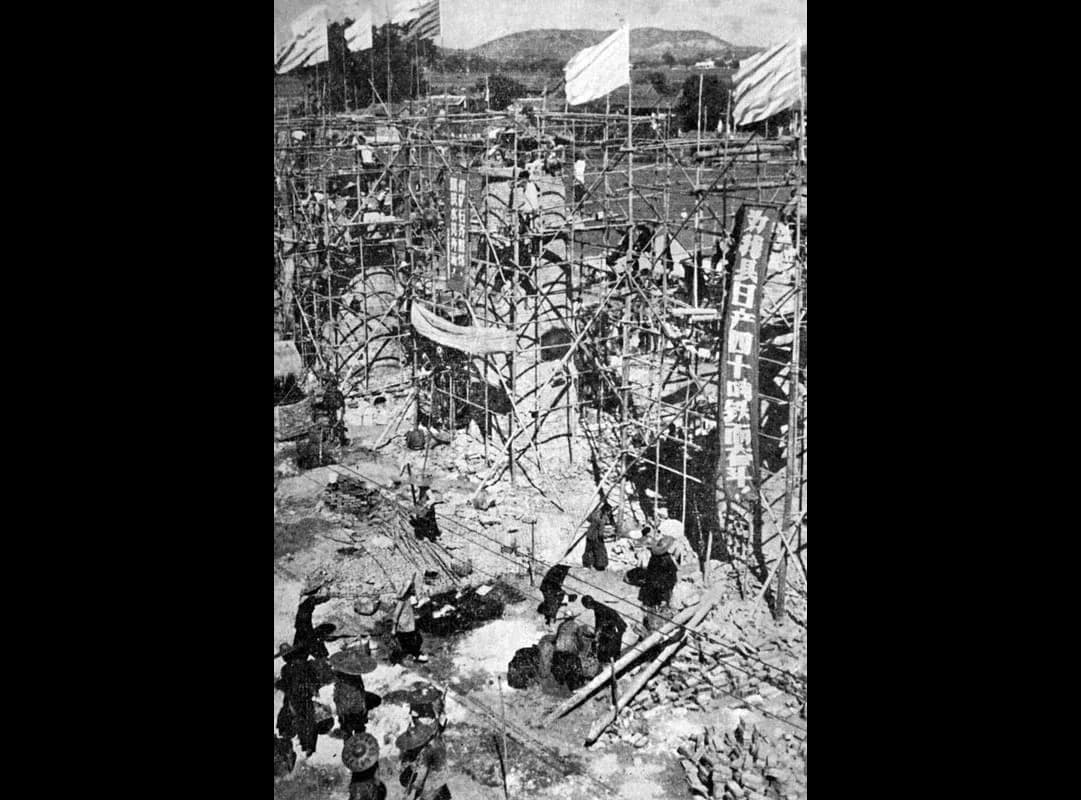
The photograph of furnace building shows the campaign’s priorities. While peasants smelted pots and tools into unusable lumps of iron, harvests were left in the fields. The chain of causation from targets to famine shows how political pressure turned a failed policy into mass death.
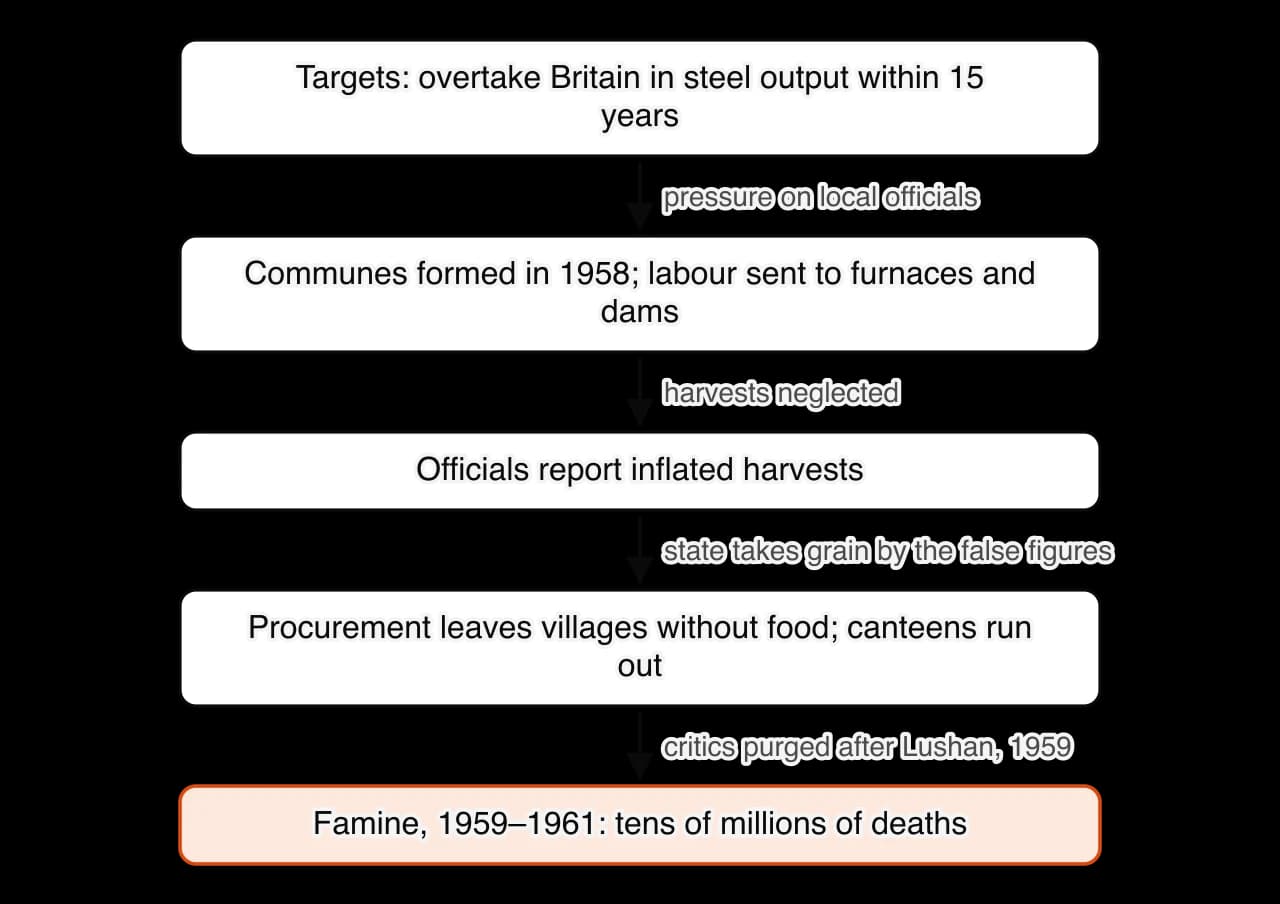
Local officials, afraid of being labelled "rightists", reported impossible harvests, and the state took grain for the cities and for export on the basis of the false figures. In the communal canteens food ran out during 1959. When the defence minister, Peng Dehuai, criticised the policy at the party conference at Lushan in July 1959, Mao purged him and launched a campaign against "right opportunists", so officials pressed even harder. China continued to export grain in 1959 and 1960.
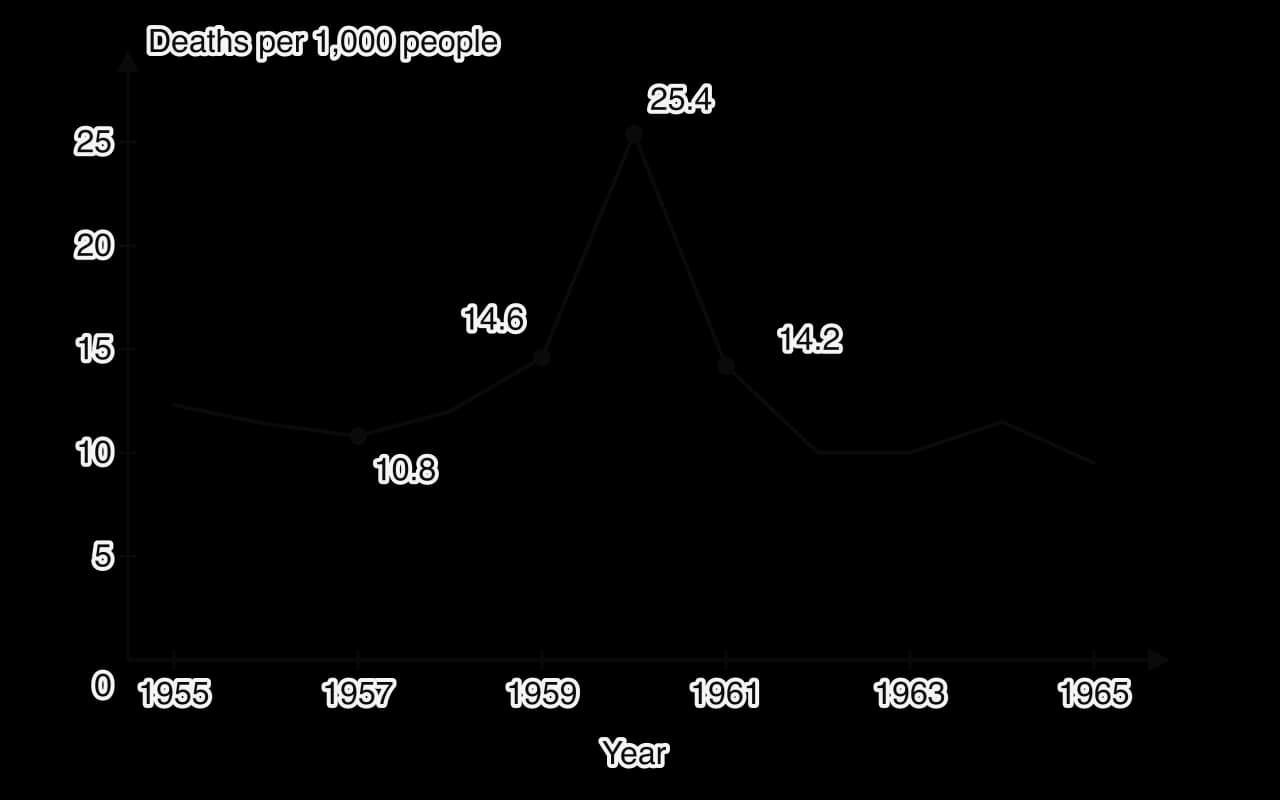
The graph of China’s official death rate shows the result even in the regime’s own figures, which were kept secret until the 1980s. Historians’ estimates of the excess deaths in 1959–1961 range from about 15 million to 45 million, most commonly about 30–36 million. The difference comes from the method. The journalist Yang Jisheng (Tombstone, 2008 in Chinese, 2012 in English) used provincial records and interviews to reach about 36 million; Frank Dikötter (Mao’s Great Famine, 2010) used party archives in several provinces to reach at least 45 million, a figure some demographers consider too high. The worst-hit areas, such as Xinyang in Henan and the provinces of Anhui and Sichuan, lost a large share of their population. Reports from the period describe deaths from starvation and from beatings of peasants accused of hiding grain.
 YouTube
The CCP’s own verdict, in its Resolution on Certain Questions in the History of Our Party of 1981, admitted that the Great Leap caused "serious losses", but blamed "natural calamities" and errors of leadership as well as Mao, and gave no death toll. In China the famine is still officially called the "three years of difficulty". The difference between the official narrative, survivors’ accounts and historians’ estimates is itself an example of how perspective shapes what a society remembers.
Health, education and women in the communes
Alongside the catastrophe, the regime made gains in health and education that most historians accept. Mass campaigns against disease ("Patriotic Health Campaigns"), vaccination and clean water reduced infectious disease, and from 1968 the barefoot doctors, peasants given a few months’ medical training, brought basic care to villages; there were more than a million of them by the mid-1970s. Life expectancy rose from about 35–40 years in 1949 to about 65 by the mid-1970s, one of the fastest rises recorded anywhere. Primary schooling spread to most villages, and adult literacy rose from perhaps a fifth in 1949 to about two-thirds by the census of 1982.
For women, collectivisation meant work outside the home on a scale never seen before. Mao’s slogan that "women hold up half the sky" became official language, and during the Great Leap women were mobilised in huge numbers for farm work as men went to the furnaces and dams. Communal canteens and nurseries were meant to free women from housework. In practice women were usually paid fewer work points than men for a day’s labour, they still did the domestic work when the canteens closed in 1961, and the famine fell heavily on mothers and children.
The Cultural Revolution, 1966–1976
The Cultural Revolution was launched by Mao in 1966 to attack his rivals in the party and to revive revolutionary spirit. Its effect on everyday life was enormous. Schools and universities closed in 1966; universities admitted no new students until 1970, and then only by political recommendation, until entrance examinations were restored in 1977. Students formed Red Guard units that attacked teachers, officials, intellectuals and anyone with a "bad" class label, destroyed temples, books and art as relics of the "four olds" (old customs, culture, habits and ideas), and fought each other in armed factional battles.
From 1968, to end the chaos and spread revolutionary values, about 17 million urban young people, the sent-down youth, were sent "up to the mountains and down to the countryside" to live and work with peasants, many for ten years or more. Families were divided, and many of this "lost generation" never completed their education. Historians’ estimates of deaths in the Cultural Revolution vary widely; Andrew Walder’s research on official county histories suggests about 1.1–1.6 million. Writers and scholars, including the historian Wu Han and the writer Lao She, died after persecution.
Marginalised groups in Mao’s China
Beyond the class enemies, Mao’s China marginalised ethnic and religious minorities. The People’s Liberation Army entered Tibet in 1950; after an uprising was crushed in March 1959, the Dalai Lama fled to India, followed by tens of thousands of Tibetans, and during the Cultural Revolution most of Tibet’s monasteries were destroyed or closed. Religious life was brought under state-controlled bodies such as the Three-Self Patriotic Movement for Protestants (1954) and the Catholic Patriotic Association (1957); believers who refused to join were imprisoned. Muslim communities, including the Uyghurs of Xinjiang and the Hui, saw mosques closed in the Cultural Revolution.
What the case study shows
Mao’s China shows that one regime could produce both some of the largest gains in health and literacy of the twentieth century and the deadliest famine in recorded history. It also shows how experience depended on identity: a poor peasant woman in 1952 had land and legal rights for the first time, but her family may have starved in 1960; a landlord’s son was excluded from university whatever his grades; an urban hukou could decide whether a person lived or died in the famine. Finally, the case shows the gap between aims and results: policies meant to liberate peasants and women were bent by political pressure, false statistics and fear.
Comparing the impact of authoritarian rule across six regimes
Comparing the six regimes shows which effects were common to authoritarian rule in general and which depended on a regime’s ideology, its economic base and its period. The comparative table of the six regimes sets out the main evidence for each line of inquiry.
Regime (region) | Economic impact | Social impact | Women’s experiences | Marginalised groups |
|---|---|---|---|---|
Stalin’s USSR, 1928–1953 (Europe) | Steel output more than quadrupled 1928–1940; real wages fell; collectivisation and famine (5.5–8.7 million dead, 1932–1933) | Literacy from about half to over four-fifths; upward mobility; terror and denunciation | Mass entry into work; abortion banned 1936; double burden | 1.8 million "kulaks" deported; deported nationalities; Holodomor |
Hitler’s Germany, 1933–1945 (Europe) | Unemployment from 6 million to almost none; wages frozen; no unions; KdF | Hitler Youth and BDM; racial schooling; welfare for "Aryans" only | Motherhood policy (marriage loans, Mother’s Cross); employment rose after 1936 | Persecution and genocide of Jews; Roma, disabled people, gay men |
Mao’s China, 1949–1976 (Asia) | Land reform, then communes; Great Leap famine (about 30–45 million dead) | Life expectancy about 35–40 to about 65; Cultural Revolution closed schools | Marriage Law 1950; work in the communes; double burden | Landlords and rightists; Tibetans; believers |
Castro’s Cuba, 1959–2008 (Americas) | Nationalisation; rationing from 1962; sugar dependence; Soviet subsidies | Literacy Campaign 1961; free health care | FMC; Family Code 1975; women in paid work | UMAP camps; exile of opponents; Afro-Cubans’ partial gains |
Nasser’s Egypt, 1954–1970 (Africa and the Middle East) | Land reform (about an eighth of farmland); nationalisation; Aswan High Dam | Free education to university; guaranteed state jobs | Vote 1956; first women MPs 1957; family law unchanged | Brotherhood and communists jailed; Jews and foreign communities left |
Data in the table are rounded; death tolls and other contested figures are given as ranges for the reasons explained in each section.
Which effects were common?
Every one of the six regimes claimed to rule for the people and every one improved the lives of some of them, usually the groups whose support it needed most: industrial workers for Perón, poor peasants for Mao in 1950–1952, tenant farmers for Nasser, the rural poor for Castro. Every regime also removed independent organisations, such as trade unions, churches’ youth groups and women’s associations, and replaced them with state or party organisations. And every one defined some people as outsiders and persecuted them. The combination of benefits for insiders and exclusion of outsiders is perhaps the most consistent feature of authoritarian rule across regions and periods.
What made the difference?
Three factors explain most of the differences. Ideology decided who the outsiders were (racial enemies, class enemies or political opponents) and what women were for. The economic base decided what a regime could deliver: Perón and Nasser could redistribute existing wealth for a time, while Stalin and Mao chose to squeeze peasants to build industry. The scale of ambition decided the scale of disaster: the two regimes that tried to transform their economies fastest, Stalin’s and Mao’s, caused the two largest famines.
Other authoritarian regimes
Other regimes from the period after 1750 show the same patterns and help to test them. In Mussolini’s Italy, the Battle for Births (from 1927) taxed bachelors and rewarded large families, yet the birth rate kept falling, and the racial laws of 1938 expelled Jews from schools, universities and public employment. In Franco’s Spain (1939–1975), the Labour Charter of 1938 promised to "free" married women from the workshop and the factory, women lost the legal equality of the Second Republic, and the Catalan and Basque languages were banned from public life. In German South West Africa, colonial rule led to the genocide of the Herero and Nama peoples in 1904–1908, in which tens of thousands died in war, in the desert and in concentration camps; Germany acknowledged it as genocide in 2021. In Pinochet’s Chile (1973–1990), free-market reforms by economists trained in Chicago brought growth in the late 1970s but unemployment above 20 per cent in the crisis of 1982–1983, while thousands of opponents were killed or "disappeared".
Perspectives and debates
Victims, participants or beneficiaries?
The central debate about life under authoritarian rule concerns how far ordinary people were passive victims of the state. The same historians who argue over whether these regimes rested on terror or consent also disagree about everyday experience. In the totalitarian model of Hannah Arendt (1951) and of Carl Friedrich and Zbigniew Brzezinski (1956), society was atomised: isolated individuals faced an all-powerful state and had little room to shape their own lives.
Social historians writing history "from below" since the 1970s describe a more varied experience. For the USSR, Sheila Fitzpatrick (Everyday Stalinism, 1999) reconstructs the daily routines of shortage and queuing, and the networks of friends and patrons (blat) through which city dwellers obtained flats, jobs and scarce goods; Stephen Kotkin (Magnetic Mountain, 1995) shows the workers of Magnitogorsk learning to use the regime's language to claim housing and rewards. Neither denies the terror, but both show people as actors who adapted and negotiated, which matters for any judgement on how far regimes changed lives as they intended.
For Nazi Germany, David Schoenbaum (Hitler’s Social Revolution, 1966) argued that the regime changed how Germans saw their society, creating a sense of a classless national community even though real class differences remained. Detlev Peukert (Inside Nazi Germany, 1987) stressed the everyday mix of conformity, grumbling and withdrawal into private life. Götz Aly (Hitler’s Beneficiaries, 2005) went further, arguing that the regime bought the loyalty of ordinary Germans with welfare, low taxes for workers and goods plundered from Jews and occupied Europe; critics reply that he underestimates the role of ideology and coercion.
Historian | Argument | Evidence stressed |
|---|---|---|
Hannah Arendt (1951); Friedrich and Brzezinski (1956) | Totalitarian regimes atomised society and controlled every area of life | Terror, ideology, the single party, propaganda |
Sheila Fitzpatrick (1999) | Soviet citizens adapted to and worked the system in daily life | Letters, petitions, denunciations, police reports |
Stephen Kotkin (1995) | People learned to "speak Bolshevik" and many took on the regime’s values | Magnitogorsk archives, workers’ biographies |
David Schoenbaum (1966) | Nazism changed how Germans saw their social status more than real class structure | Social mobility, propaganda of the national community |
Götz Aly (2005) | Ordinary Germans were bought with material benefits, often taken from the persecuted | Tax and welfare policy, Aryanisation, plunder |
Women: victims or accomplices?
Historians of women in Nazi Germany have debated whether "Aryan" German women were mainly victims of a male regime or shared responsibility for it. Claudia Koonz (Mothers in the Fatherland, 1987) argued that women who embraced their separate domestic sphere helped to sustain the regime, providing the stable family life that allowed men to carry out its crimes. Gisela Bock, who studied compulsory sterilisation (1986), argued that Nazi policy was anti-natalist as well as pro-natalist: it encouraged some women to have children while forbidding others, so women’s experience depended above all on whether the regime classed them as racially "valuable". Most historians now accept that women were both victims and participants, and that race divided German women more deeply than sex united them.
For communist regimes the debate is about whether legal equality amounted to liberation. Soviet and Chinese official histories presented the 1918 Family Code and the 1950 Marriage Law as freeing women. Western feminist historians such as Wendy Goldman (Women, the State and Revolution, 1993, on the USSR) and Kay Ann Johnson (on China) argue that both states put economic and political priorities ahead of women’s interests whenever the two conflicted, and that the double burden showed the limits of liberation from above.
Achievements and costs: how should they be weighed?
The record of regimes such as Mao’s and Castro’s raises the question of whether achievements in health and education can be set against famine and repression. The economists Jean Drèze and Amartya Sen (Hunger and Public Action, 1989) compared China with democratic India and argued that China’s better basic health care meant that, over the long run, fewer people died of ordinary poverty-related causes in China than in India; but they also argued that India’s free press and elections had prevented a famine like China’s in 1959–1961, because a government that faces criticism cannot easily ignore mass starvation. Critics of the Cuban regime, including many exiles, argue that its health and literacy record cannot justify the absence of political freedom; its defenders point to the same record as proof of the revolution’s success.
These debates are shaped by sources. Official statistics favour the regime’s view; memoirs and testimony from exiles and survivors, such as Reinaldo Arenas for Cuba or Yang Jisheng for China, emphasise suffering; and the opening of archives, in the former USSR from the 1990s and partially in some Chinese provinces in the 2000s, has allowed historians to measure what regimes hid. Weighing these perspectives means asking whose experience each source records, and whose it leaves out.
Applying the ideas in exam questions
Section A: a concept question on change
Section B Part A: the experiences of women
Section B Part A: a marginalised group
Section B Part B: living standards
Self-check
- To do:
I can explain the four kinds of effect: economic impact, social impact, women’s experiences and marginalised groups’ experiences.
- To do:
I can distinguish aims from results, winners from losers, short-term from long-term effects, and living standards from freedoms.
- To do:
I can explain why official statistics and outward conformity make the impact of authoritarian rule hard to measure.
- To do:
I can explain the economic impact of Stalin’s Five-Year Plans and collectivisation, including the famine of 1932–1933, with figures given as ranges.
- To do:
I can explain the gains and losses of German workers under Nazi rule (jobs, DAF, KdF, frozen wages).
- To do:
I can explain how Perón, Nasser and Castro redistributed wealth, and the economic limits each met.
- To do:
I can explain how authoritarian regimes changed education, health, youth, culture and religion, with examples from at least three regimes.
- To do:
I can compare women’s experiences in communist, fascist and populist regimes, and define the double burden.
- To do:
I can explain the policies of Nazi Germany towards "Aryan" women and how rearmament changed them.
- To do:
I can explain how women gained the vote under Perón and Nasser, and the limits of state feminism.
- To do:
I can explain how and why the Nazi regime persecuted Jews, Roma, disabled people and gay men, and the stages from exclusion to genocide.