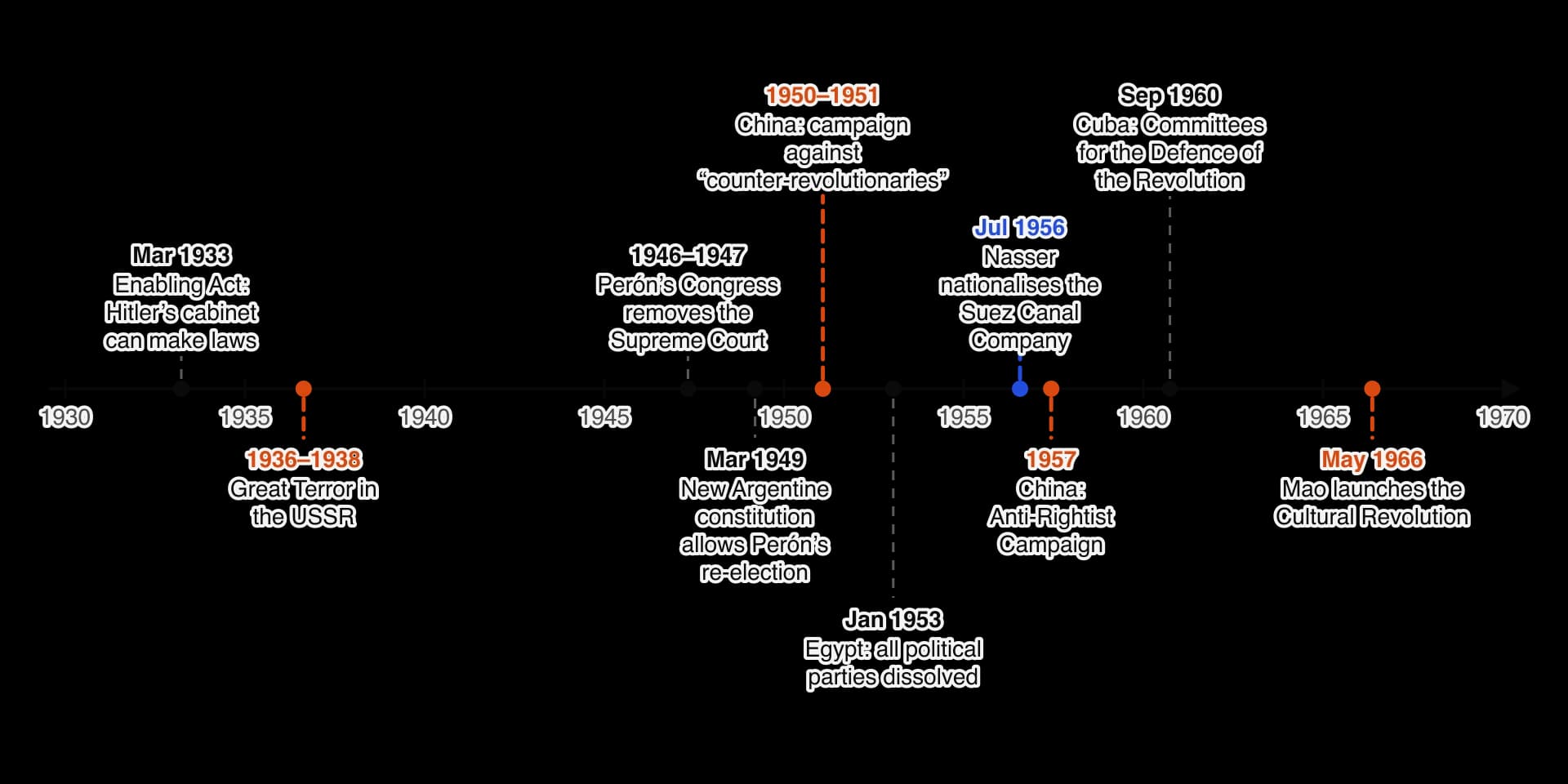
Explain how authoritarian regimes from Stalin and Hitler to Castro, Nasser and Perón kept power through legal methods, force, propaganda and popular support, and weigh the methods.
Each is in the History glossary, with every other term in the subject.
The middle ground between support and resistance under a dictatorship: outward conformity, such as joining organisations or attending rallies, for safety, career or lack of an alternative.
The thirteenth month's pay introduced for Argentine workers under Perón, one of the benefits that built working-class support.
The Chinese campaign of 1957 that followed the Hundred Flowers, in which about 550,000 critics were labelled "rightists" and lost their jobs or were sent to labour camps.
Egypt's single official political organisation from 1962, which followed the Liberation Rally (1953) and the National Union (1957).
The article of the Soviet criminal code (from 1927) that defined "counter-revolutionary" crimes so broadly that it could be used against almost any criticism of the regime.
The failed invasion of Cuba by CIA-trained Cuban exiles in April 1961, which strengthened Castro's position and his alliance with the USSR.
The Chinese Communist campaign of 1950–1951 against former Guomindang officials, secret societies and alleged enemies of the new regime, in which hundreds of thousands were executed.
Authoritarian rule means power held by a leader, party, army or foreign administration that cannot be removed through free elections. Once such a regime had taken power, it faced the problem of keeping it: winning over or neutralising elites, the army and the population, and preventing any rival from taking power in turn. Some regimes lasted only a few years; others, such as Castro's Cuba, lasted half a century.
With a free account, Augment remembers where you stopped and what you have practiced.
Argentina's General Confederation of Labour, the trade union federation that became the organised base of Peronism.
A regime's practice of winning over potential opponents or key groups by giving them jobs, influence or privileges, so that they have a stake in its survival.
Obedience obtained by force or the threat of force, such as arrest, imprisonment, violence or the loss of a job or home.
Cuban neighbourhood committees founded on 28 September 1960 to organise community work and rallies and to watch residents for political disloyalty.
A camp where civilians or political prisoners are held without trial in harsh conditions, such as the British camps for Boer and African civilians in the South African War (1899–1902) and the camps run by the SS in Nazi Germany from 1933.
Obedience given willingly, because people agree with a government, benefit from it or accept its right to rule.
The process by which a new regime secures control after taking office by removing rivals, taking over state institutions and silencing opposition.
The use of propaganda, ceremony and the arts to present a leader as an exceptional, almost superhuman figure who embodies the nation or the revolution.
Mao's campaign of 1966–1976 to renew revolutionary spirit and remove rivals, in which Red Guards attacked party officials, teachers and "class enemies".
The work unit in Mao's China, through which urban workers received jobs, housing, rations and welfare, and through which the party watched and organised them.
A Spanish legal term for disrespect towards public officials; a 1949 law under Perón widened and toughened the offence, which was used against opposition politicians and journalists.
The charitable foundation set up in 1948 and led by Eva Perón, which built hospitals, schools and homes and gave aid directly to the poor.
The Nazi secret state police, which arrested political opponents and others the regime targeted; it was small and relied heavily on denunciations from the public.
The Nazi "coordination" of German institutions in 1933–1934, bringing state governments, parties, unions, the civil service, the press and clubs under Nazi control.
The Nazi party's youth organisation for boys (with the League of German Girls for girls), made the official youth organisation in 1936 and compulsory in 1939.
China's household registration system, formalised in 1958, which tied each person to a place of residence and controlled movement, especially from countryside to city.
Mao's invitation in 1956–1957 for intellectuals to criticise the Chinese Communist Party, which ended when the criticism became too sharp.
The Chinese system of "reform through labour" camps, in which prisoners, many of them political, did forced labour and underwent political re-education.
Quotations from Chairman Mao Zedong, compiled by the army's political department under Lin Biao in 1964 and printed in vast numbers during the Cultural Revolution.
The emigration of about 125,000 Cubans by boat from the port of Mariel to the United States in 1980, allowed by the Castro regime.
The Arabic term for intelligence services; in Nasser's Egypt, the security and intelligence agencies that watched and arrested the regime's opponents.
The transfer of a private company or industry into state ownership.
The Soviet People's Commissariat of Internal Affairs, which from 1934 included the political police and ran the Gulag; it carried out the Great Terror.
The secret order of 30 July 1937 that launched the mass operation against "former kulaks", criminals and other "anti-Soviet elements", with regional quotas for shooting and camp sentences.
A three-person panel of local NKVD, party and prosecuting officials that sentenced people in the mass operations of 1937–1938 without trial or the accused being present.
The Nazi special court set up in 1934 to try treason and other political cases, which passed thousands of death sentences, most of them during the Second World War.
Detention without trial by the Nazi police, made possible by the Reichstag Fire Decree; prisoners were often sent to concentration camps.
The use of legal forms, such as laws, decrees, referendums and court rulings, to remove the legal limits on a regime's power while claiming that everything it does is lawful.
The removal of people regarded as disloyal from an organisation such as a party, army or civil service, by expulsion, imprisonment or execution.
A member of the student and youth groups mobilised by Mao in the Cultural Revolution from 1966 to attack party officials, intellectuals and "class enemies".
The Nazi body founded in September 1933 that every writer, journalist, musician, artist and actor had to join to work, allowing the regime to exclude Jews and opponents.
A police force whose main task is to protect a regime against its opponents through surveillance, informers, arrest and interrogation, usually outside the control of the courts.
Khrushchev's speech to a closed session of the Twentieth Party Congress on 25 February 1956, which condemned Stalin's cult of personality and his purges of party members.
A public trial staged for propaganda, in which the verdict is decided in advance and defendants usually confess to invented crimes, such as the Moscow trials of 1936–1938.
The official style required of Soviet art and literature from 1934, showing heroic workers and leaders building a socialist future and serving the party's aims.
The Soviet campaign, named after the miner Alexei Stakhanov's record shift of August 1935, that rewarded workers who exceeded their output norms and was used to raise norms for all.
The leisure organisation of the German Labour Front, founded in 1933, which offered workers cheap holidays, cruises, concerts and sport.
The crisis that followed Nasser's nationalisation of the Suez Canal Company in July 1956, in which Britain, France and Israel invaded Egypt but were forced to withdraw.
The deliberate use of mass and often arbitrary violence by a state against its own population to create fear and compel obedience.
The interpretation, developed by Arendt and by Friedrich and Brzezinski in the 1950s, that Nazi and Soviet rule were maintained from above by ideology, a single party, terror and total control of society.
Cuban forced-labour camps of 1965–1968 that held men judged unfit for military service, including gay men and religious believers.
The union of Egypt and Syria under Nasser from 1958 to 1961, when Syria left.
The Egyptian radio station launched in 1953 that broadcast Arab nationalist programmes and Nasser's speeches across the Arab world.
The cheap "people's receiver" radio sold in Nazi Germany from 1933 so that Hitler's speeches and the regime's broadcasts could reach most homes.
Soviet workers and peasants promoted in the late 1920s and 1930s into education, management and party and state posts, who formed a loyal new elite under Stalin.
Scope. This study asks how authoritarian regimes from 1750 onwards maintained their power, through four lines of inquiry: legal methods, the use of force, propaganda and popular support. It draws on the core regimes of Stalin, Hitler, Mao, Castro, Nasser and Perón, from four regions, with shorter examples from other regimes, and treats Stalin's USSR in most depth.
Every government, democratic or not, needs most people to obey it most of the time. Authoritarian regimes lacked the legitimacy that comes from winning free elections, so they had to secure obedience in other ways. Historians usually describe these as a mixture of coercion and consent.
In practice, most people in authoritarian states lived somewhere between the two. They conformed outwardly, attended rallies and joined organisations, because it was safer, because it helped their careers, or because there seemed to be no alternative. Historians call this middle ground accommodation or conformity. It matters because it makes the outward signs of support, such as huge rallies and 99 per cent plebiscite results, hard to read as evidence of real belief.
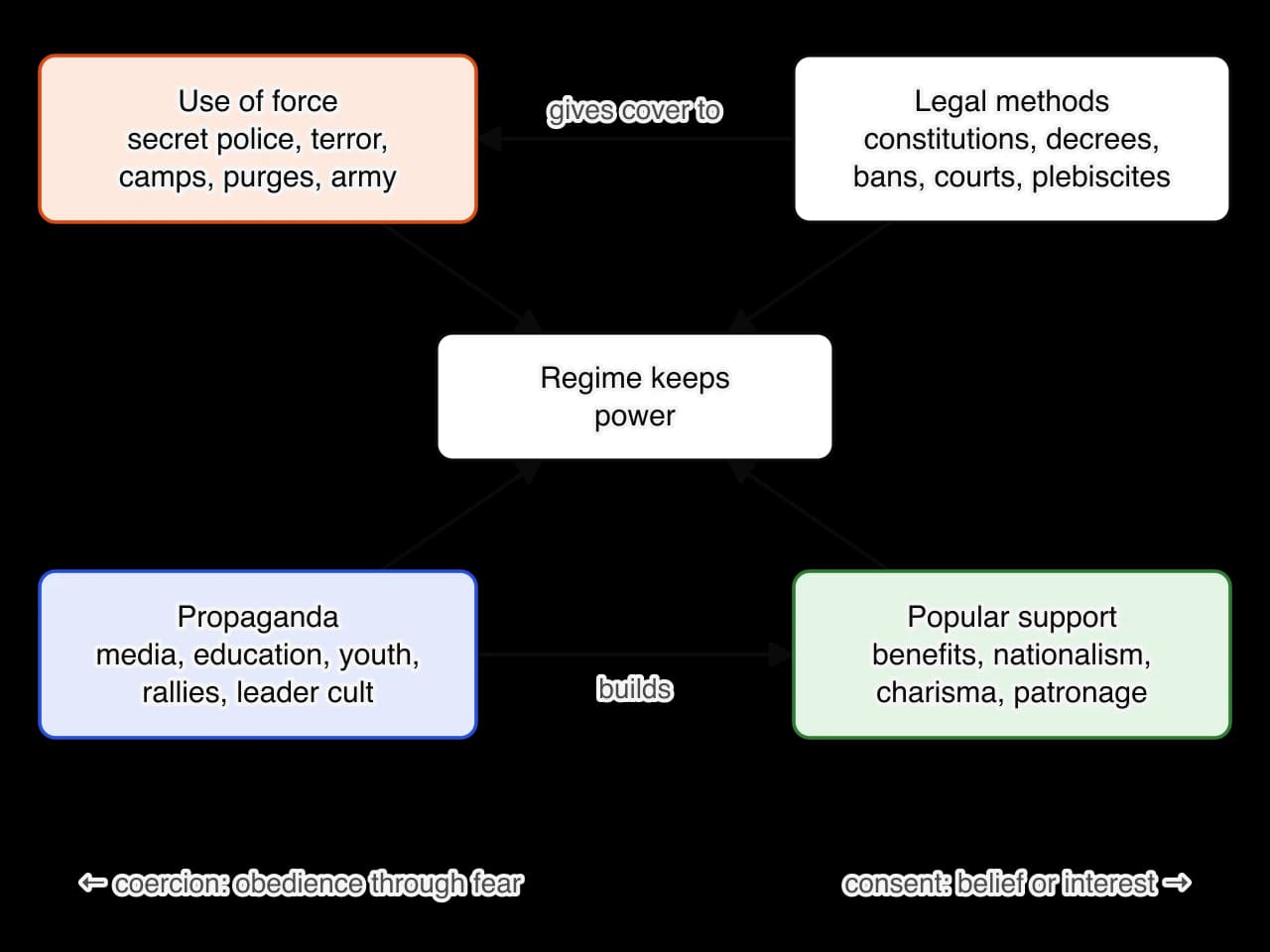
The diagram of the four methods shows how they worked together. Legal methods gave the use of force a cover of legality, so that arrests and bans appeared to be the normal work of the state. Propaganda tried to turn material benefits and foreign successes into loyalty to the leader. Fear and consent also fed each other: people who believed in a regime were more willing to denounce its "enemies", and the knowledge that others might denounce them made everyone more careful.
Historians distinguish the consolidation of power, the first months or years in which a new regime destroys or absorbs its rivals, from the longer-term maintenance of power. In consolidation, regimes usually acted fast and violently and changed the law to suit themselves: Hitler's "legal revolution" of 1933–1934, the Egyptian Free Officers' abolition of the parties and the monarchy in 1953, and Castro's revolutionary tribunals of 1959 are examples. Maintenance depended more on routine institutions (the party, the police, schools, the media) and on keeping enough people satisfied.
Methods changed over time. Stalin's worst terror came in 1936–1938, not in the first years of his rule. Mao turned to mass mobilisation against his own party in the Cultural Revolution of 1966–1976. Perón became more repressive after 1949 as the economy weakened and support fell. A regime's methods therefore have to be explained by its circumstances at each stage, not described as a fixed system.
Authoritarian rule could rest on institutions (a ruling party, the army, the bureaucracy) or on one person, and most regimes combined the two. Stalin, Hitler, Mao and Castro were personal dictators who stood above their own parties. Nasser's power rested on the army officers who had made the 1952 coup, and Perón's on the trade unions and the army. A regime that depended on one group had to keep that group loyal, so control of the army, the party and the economy was a central part of maintaining power everywhere.
Institution | Why it mattered | How regimes controlled it |
|---|---|---|
The army | The only force able to overthrow the regime quickly | Oaths of loyalty (Germany, 1934), purges (USSR, 1937–1938), political commissars, promotions for loyal officers, rewards |
The ruling party | Ran the state and supplied officials; could produce rivals | Appointments from the centre (nomenklatura), purges, bans on factions, the leader's cult |
The bureaucracy and courts | Applied the law and could restrain the regime | Purges of officials and judges, new special courts, party members in key posts |
The economy | Supplied jobs, food and resources for rewards and for force | State planning, nationalisation, land reform, control of unions and wages |
Most authoritarian regimes took care to rule through law, even when the law had been written to give them unlimited power. Legal methods included emergency decrees, enabling laws that transferred power from parliaments to the executive, new constitutions, laws banning other parties, the purging and packing of courts, and elections and plebiscites with only one real choice. They are sometimes called pseudo-legal methods, because they kept the forms of legality while destroying its purpose of limiting power.
Legal methods served several purposes. They reassured conservative elites, civil servants, judges and army officers, who were used to obeying the law and might have resisted an open seizure of power. They made opposition look like law-breaking. They gave the regime a claim to legitimacy at home and abroad. And they turned the state's ordinary machinery, its police, courts and civil service, into instruments of the regime without the need to build new ones.
Hitler became Chancellor legally in January 1933, and his first moves to make his position permanent used the Weimar constitution against itself. The Reichstag Fire Decree of 28 February 1933, signed by President Hindenburg under Article 48 after the burning of the parliament building, suspended the rights to free speech, a free press, assembly and privacy of post. It was never withdrawn, so for twelve years the Nazi state rested on a "state of emergency". The police could hold people in "protective custody" without trial.
The Enabling Act of 23 March 1933 then transferred the power to make laws from the Reichstag to Hitler's cabinet. It passed by 444 votes to 94, with only the Social Democrats voting against; the Communist deputies had already been arrested or had fled, and SA and SS men lined the hall. Because it changed the constitution, it needed a two-thirds majority, which the Nazis won with the votes of the Catholic Centre Party and the other conservative parties.
Article 1. National laws can be enacted by the Reich Cabinet as well as in accordance with the procedure established in the Constitution. … Article 2. The national laws enacted by the Reich Cabinet may deviate from the Constitution as long as they do not affect the institution of the Reichstag and the Reichsrat. The powers of the President remain unaffected.
Law to Remove the Distress of the People and the State (the Enabling Act), 24 March 1933, as published in the official gazette; translation in German History in Documents and Images. The dry legal language is itself the point: the law presented a revolution as an amendment to the constitution, and its promise to keep the Reichstag and the president helped persuade the Centre Party to vote for it. It was meant to last four years, but it was renewed in 1937 and 1939 and extended by decree in 1943.
With law-making power in its hands, the cabinet carried out Gleichschaltung, the "coordination" of German institutions under Nazi control. State governments were taken over in March and April 1933. The trade unions were dissolved on 2 May 1933 and replaced by the German Labour Front. The other parties were banned or dissolved themselves, and the Law against the Formation of New Parties of 14 July 1933 made Germany a one-party state. When Hindenburg died on 2 August 1934, a law passed the day before merged the offices of president and chancellor, and the army swore a personal oath of loyalty to Hitler.
The regime also used votes to show public approval. Plebiscites in November 1933 (on leaving the League of Nations), August 1934 (on Hitler's new position as Führer) and April 1938 (on the union with Austria) produced official majorities of about 90 to 99 per cent. They were not free: there was only one choice, voting was watched, and refusing to vote could be noted. Courts were brought into line as well; the People's Court, set up in 1934 for treason cases, became a political tribunal that sentenced thousands to death, most of them during the war.
Other regimes wrote new constitutions to give their rule a legal shape. In Egypt the Free Officers dissolved all political parties in January 1953 and abolished the monarchy in June 1953. Nasser's constitution of 1956 created a strong presidency and was approved by referendum on the same day that he was elected president as the only candidate, with an official 99.9 per cent of the vote. The regime then created a series of official mass organisations to replace the parties: the Liberation Rally (1953), the National Union (1957) and the Arab Socialist Union (1962).
Perón worked through Argentina's existing institutions, because he had won a free election in 1946 and controlled Congress. Congress impeached and removed four of the five judges of the Supreme Court in 1946–1947, after the court had challenged laws passed under the military government. A constitutional assembly dominated by Peronists approved a new constitution in March 1949, which added workers' and social rights and allowed the president to be re-elected immediately. A 1949 law widened and toughened the existing crime of desacato (disrespect towards public officials), and it was used against opposition politicians and journalists. After a failed military coup in September 1951, the government declared a "state of internal war", which allowed arrests without trial.
Communist regimes also wrote constitutions that promised rights while placing the party above the law. The Soviet constitution of 1936, the "Stalin Constitution", guaranteed freedom of speech and the press and protection from arrest without a court order. It was published while the Great Terror was beginning. China's first constitution (1954) and Cuba's constitution of 1976 similarly gave citizens rights on paper; Cuba's Article 5 named the Communist Party of Cuba, founded in its current form in 1965, as the leading force of society and the state.
ARTICLE 125. In conformity with the interests of the working people, and in order to strengthen the socialist system, the citizens of the U.S.S.R. are guaranteed by law: freedom of speech; freedom of the press; freedom of assembly, including the holding of mass meetings; freedom of street processions and demonstrations. … ARTICLE 127. Citizens of the U.S.S.R. are guaranteed inviolability of the person. No person may be placed under arrest except by decision of a court or with the sanction of a procurator.
Constitution (Fundamental Law) of the Union of Soviet Socialist Republics, adopted 5 December 1936 (official English translation, 1936). The constitution was written partly for foreign audiences, at a time when the USSR sought allies against Nazi Germany, and partly to claim that socialism had been built. Its value as a source lies in the gap between its promises and practice: within a year of its adoption the NKVD was arresting hundreds of thousands of people without trial, sentenced by three-person "troikas" under the criminal code's Article 58 on "counter-revolutionary" crimes.
Regimes also used ordinary criminal law to define their opponents as criminals. Stalin's regime used Article 58 of the criminal code against "counter-revolutionary" activity, a category broad enough to cover a careless joke. China's Regulations for the Punishment of Counter-revolutionaries (February 1951) set out death sentences for a wide range of offences, and the household registration (hukou) system of 1958 tied every person to a place and made movement without permission illegal. Laws like these meant that repression was carried out through the courts and the police as normal state business.
Plebiscites were an older device. Napoleon III, after his coup of December 1851 in France, asked voters to approve it and won about 7.4 million votes to 640,000, and he used further plebiscites in 1852 and 1870. The method had limits, however. In Chile, Augusto Pinochet's 1980 constitution laid down a plebiscite in 1988 on whether he should continue; he lost it, with about 56 per cent voting "No", and stood down in 1990, which shows that a regime's own legal rules could also limit it.
Regime | Main legal methods | Legal façade or real constraint? |
|---|---|---|
Hitler (Germany, Europe) | Reichstag Fire Decree (Feb 1933); Enabling Act (Mar 1933); ban on new parties (Jul 1933); merger of president and chancellor (Aug 1934); plebiscites | Façade: emergency powers became permanent; the cabinet stopped meeting after 1938 |
Stalin (USSR, Europe) | Article 58 of the criminal code; the 1936 constitution; ban on factions inherited from 1921 | Façade: constitutional rights ignored; NKVD troikas sentenced without trial |
Mao (China, Asia) | Regulations against counter-revolutionaries (1951); 1954 constitution; hukou (1958) | Mostly façade: the 1954 constitution was ignored in the Cultural Revolution |
Castro (Cuba, Americas) | Fundamental Law (Feb 1959) gave the cabinet law-making power; elections postponed; one-party state (1965); 1976 constitution | Façade, but the 1976 constitution created lasting institutions |
Nasser (Egypt, Africa and the Middle East) | Parties dissolved (Jan 1953); republic (Jun 1953); 1956 constitution and referendum; single official organisations | Façade: a single candidate and official mass organisations |
Perón (Argentina, Americas) | Majority in Congress; Supreme Court removed (1947); 1949 constitution; desacato law; state of internal war (1951) | Partly real: elections were contested, and opposition parties survived |
All authoritarian regimes used force or the threat of it. The main instruments were a political or secret police, paramilitary groups loyal to the ruling party, special courts, prisons and labour camps, and in the last resort the army. Force was used in two ways. Targeted repression aimed at known opponents: rival politicians, organised parties, unions or religious groups. Terror was broader and less predictable, striking people for who they were or what they might do, so that everyone felt at risk.
Force could remove opponents, deter others and create obedience, but it had costs. It needed a loyal police and army, which could themselves become a threat. Mass terror disrupted the economy and the state by removing skilled people. And repression could create the opposition it was meant to prevent. Regimes therefore varied greatly in how much force they used, from Stalin's mass killings to Perón's more selective arrests and torture of opponents.
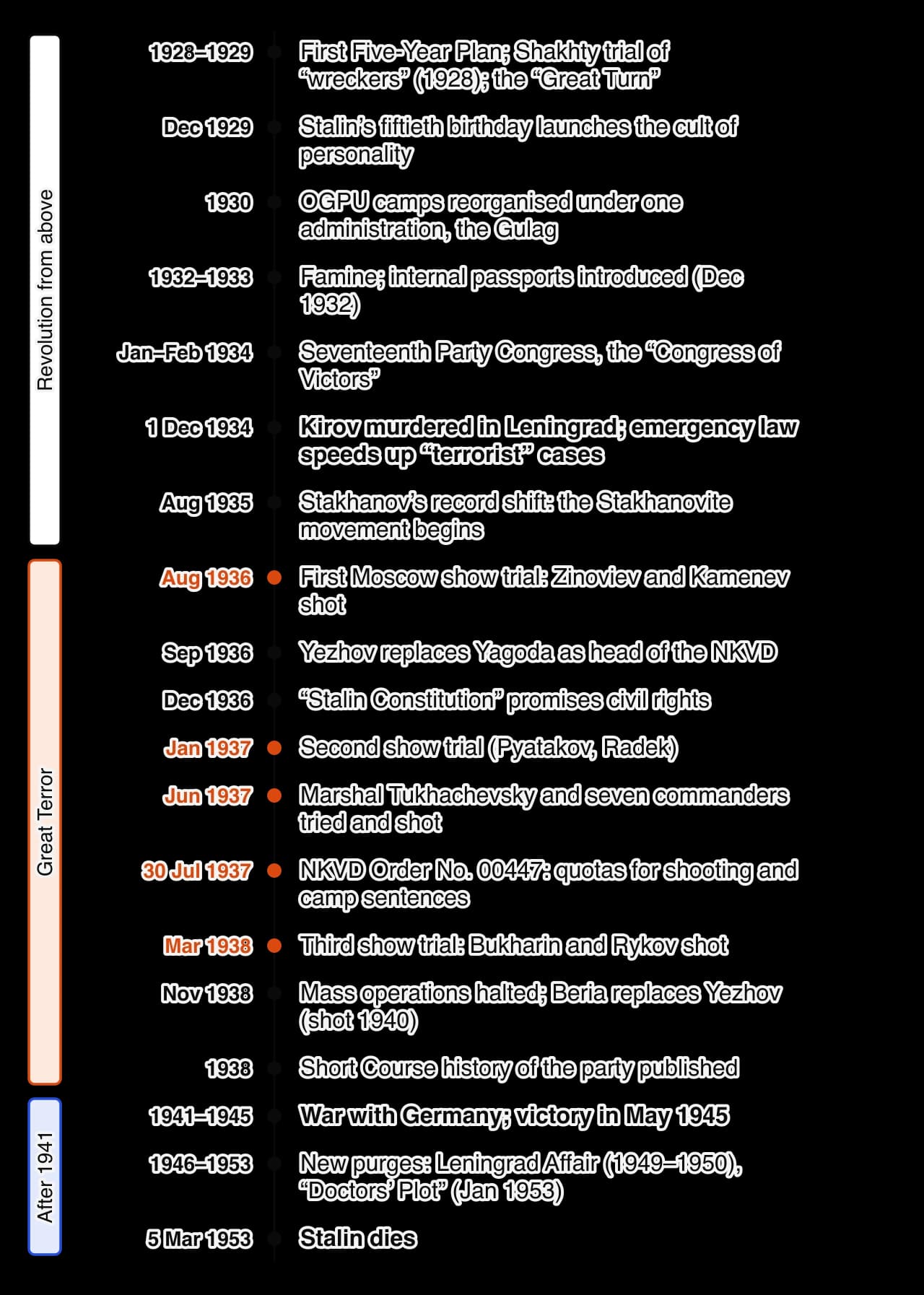
Stalin's USSR is the most extreme case of a regime maintained by force, but terror was only one part of a wider system. Stalin had won power in the 1920s through his control of the Communist Party's machine, and he kept it through that machine, the political police and propaganda, and through the support of officials and workers who owed their careers to him. The timeline of his rule shows how these methods were combined over twenty-five years.
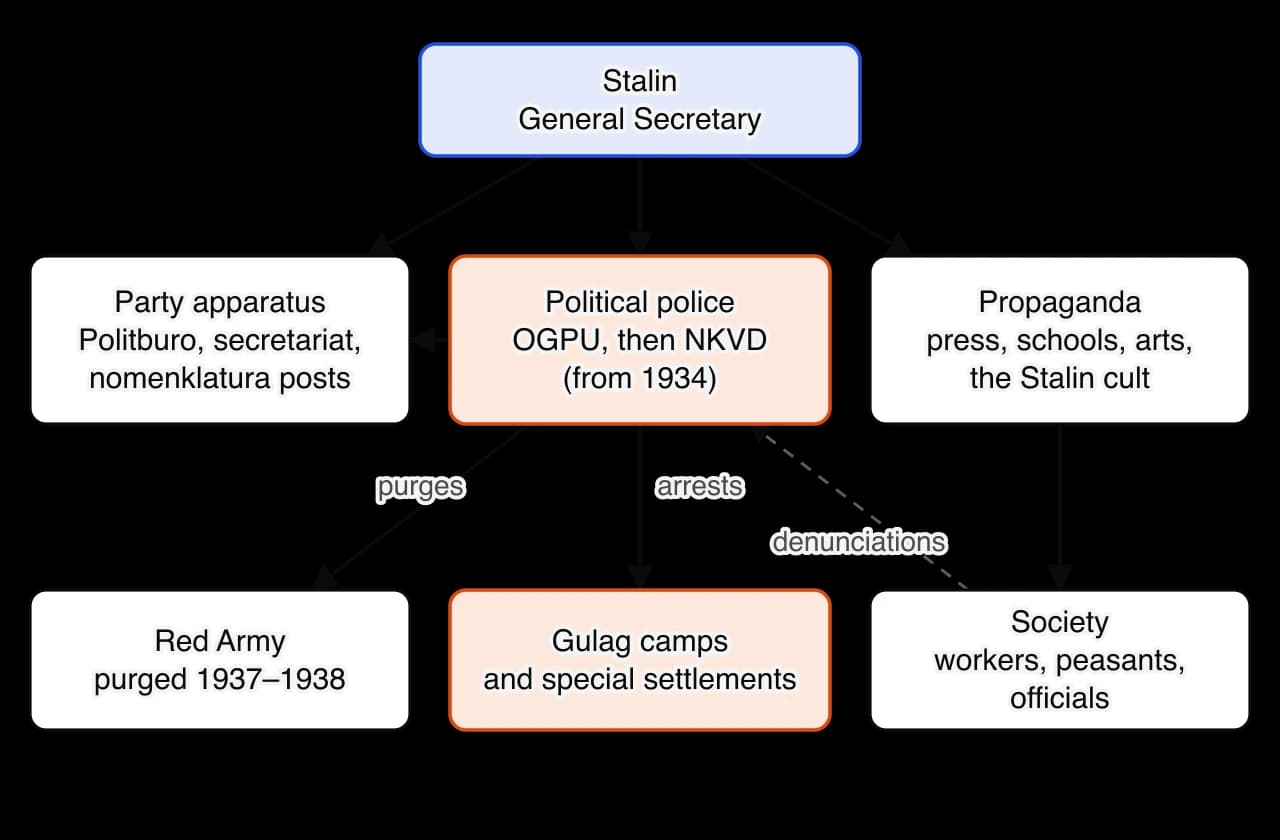
As General Secretary from 1922, Stalin controlled appointments to party posts across the country. The system of nomenklatura lists, under which important jobs in the party, state and economy were filled from the centre, meant that local party leaders owed their positions to him. The Politburo, the small committee that ran the party, met less and less often in the 1930s, and decisions were increasingly taken by Stalin with a few close colleagues such as Vyacheslav Molotov and Lazar Kaganovich.
The political police, founded by Lenin in 1917 as the Cheka, became the OGPU in the 1920s and was absorbed into the People's Commissariat of Internal Affairs (NKVD) in 1934. It ran its own troops, prisons and labour camps. In 1930 the camps were placed under one administration, the Gulag (Main Administration of Camps). Stalin controlled the police through a series of loyal chiefs, Genrikh Yagoda (1934–1936), Nikolai Yezhov (1936–1938) and Lavrenti Beria (from 1938), and he had the first two shot when they were no longer useful. The diagram of Stalin's system shows how neither the party nor the police could act as a check on him, because each was used to purge the other.
Sergei Kirov, the popular party leader in Leningrad, was shot dead on 1 December 1934 by a disaffected party member. The same day a decree ordered that "terrorist" cases be completed within ten days, without defence lawyers or appeal, and death sentences carried out at once. Stalin blamed the murder on supporters of his former rivals, and whether he arranged it himself is still debated; most historians who have worked in the Soviet archives think the evidence does not show that he did, but all agree that he used it.
Between 1936 and 1938 three great show trials in Moscow put Stalin's former rivals on public trial. In August 1936 Grigory Zinoviev and Lev Kamenev, once Lenin's closest colleagues, confessed to plotting with the exiled Leon Trotsky to murder Kirov and Stalin. In January 1937 Georgy Pyatakov and Karl Radek were tried, and in March 1938 Nikolai Bukharin and Alexei Rykov, the leaders of the former "Right Opposition". Almost all were shot. The defendants' confessions, obtained by threats against their families, sleep deprivation and beatings, were printed in the press as proof of a vast conspiracy against the state.
The show trials were the public face of a much wider terror. In June 1937 Marshal Mikhail Tukhachevsky and seven other senior commanders were tried in secret and shot; three of the five marshals of the Soviet Union and most army and corps commanders were arrested in 1937–1938, and nearly all of them were shot or died in custody by early 1939. On 30 July 1937 the NKVD issued Order No. 00447, which set quotas, region by region, for the arrest of "former kulaks", criminals and other "anti-Soviet elements", divided into a first category to be shot and a second to be sent to camps. Regional officials often asked for their quotas to be raised. Other "national operations" targeted Poles, Germans, Koreans and other groups with links to foreign states.
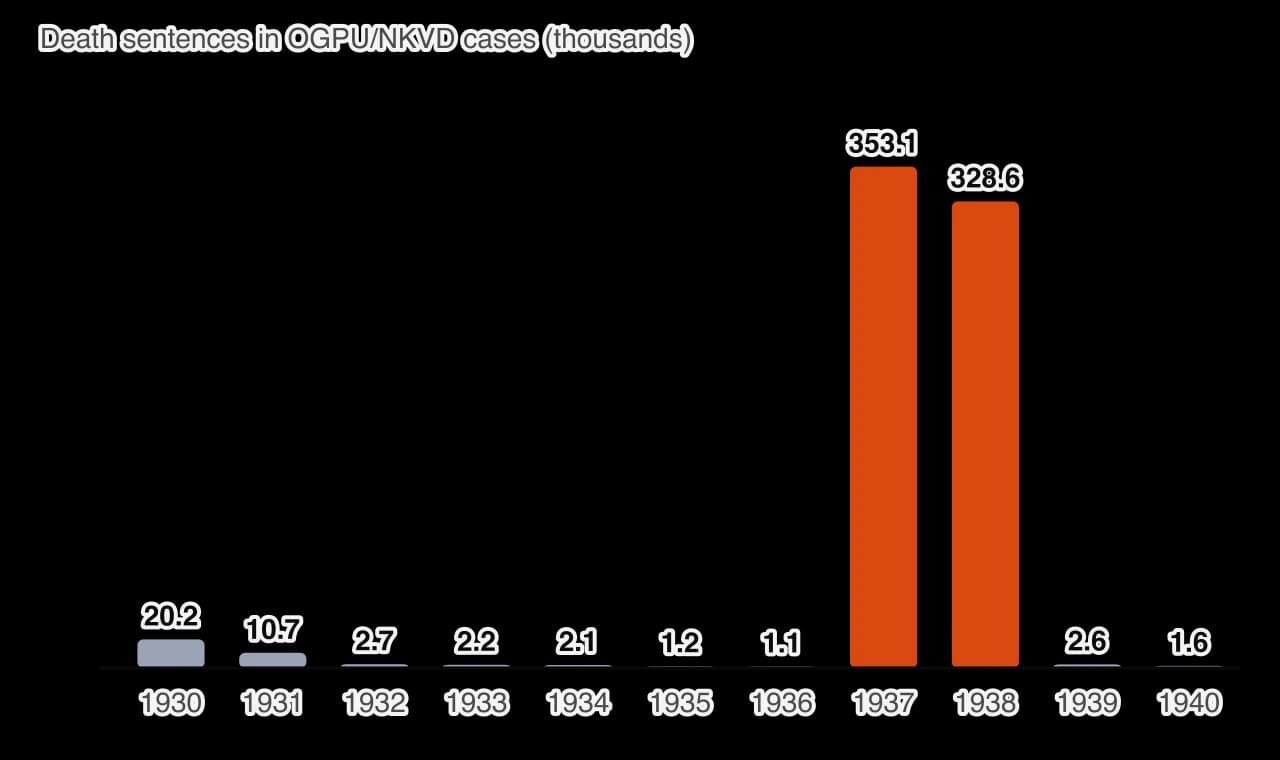
Cases were decided by troikas, three-person panels of local NKVD, party and prosecuting officials, in minutes and without the accused present. Archival figures show that about 1.5 million people were arrested by the political police in 1937–1938 and 681,692 were sentenced to be shot. The bar chart of death sentences shows how sharply the terror rose and how suddenly it stopped: in November 1938 Stalin and Molotov halted the mass operations, and Yezhov was replaced by Beria and later shot.
The labour camps held criminals as well as political prisoners, and they were also part of the economy: prisoners cut timber, mined gold and coal and built canals and railways in the far north and east. Archival records show about 1.7 million people in the camps and labour colonies in January 1939, and close to 3 million if prisons and the "special settlements" for deported peasants are included. Numbers rose again after the war, to about 2.5 million in camps and colonies around 1950. Hundreds of thousands died in the camps, above all in the famine years of the war.
Khrushchev, Stalin's successor as party leader, later described the terror to a closed session of the Twentieth Party Congress.
Stalin originated the concept "enemy of the people." This term automatically rendered it unnecessary that the ideological errors of a man or men engaged in a controversy be proven. … It was determined that of the 139 members and candidates of the party's Central Committee who were elected at the 17th congress, 98 persons, that is, 70 percent, were arrested and shot (mostly in 1937-38).
Nikita Khrushchev, On the Cult of Personality and Its Consequences (the "Secret Speech"), Twentieth Congress of the Communist Party of the Soviet Union, 25 February 1956 (English text released by the US State Department in June 1956). Khrushchev had the evidence of the party's own investigation and was an insider who had taken part in the purges himself. His purpose was to blame Stalin personally and to separate the party from the terror, so the speech concentrates on the purge of loyal communists and says little about the far larger number of ordinary people killed in the mass operations or about the victims of collectivisation.
 YouTube
Terror destroyed every possible alternative leadership: the old Bolsheviks who might have replaced Stalin, the army high command, and many of the regional party leaders who had their own followings. It made public criticism almost impossible, and it created a generation of officials who rose to replace the purged, many of them young workers and peasants promoted through the new technical schools, who owed everything to the system. Leonid Brezhnev and Nikita Khrushchev both rose in these years.
Terror also had costs and limits. The purge of the army weakened Soviet forces before the German invasion of June 1941, and the mass arrests disrupted industry and administration. Terror cannot by itself explain why millions of Soviet citizens fought for the state in 1941–1945, or why many mourned Stalin in 1953. Historians who stress terror point out that it made genuine opinion impossible to know; those who stress support point to the real opportunities and beliefs that tied people to the system.
In 1933 force came first from the Nazi party's own paramilitaries. The SA (stormtroopers) beat, imprisoned and murdered thousands of communists, socialists and trade unionists in improvised "wild" camps, and the first permanent concentration camp opened at Dachau, near Munich, in March 1933. By 1934, however, the SA, with about three million members and demands for a "second revolution", worried the army and big business. In the Night of the Long Knives (30 June–2 July 1934) the SS killed the SA leader Ernst Röhm and dozens of others, including conservative critics and the former chancellor Kurt von Schleicher. The murders removed a rival power within the party and won Hitler the army's support; within weeks it swore its oath to him.
After 1934 repression was organised by the SS under Heinrich Himmler, who became chief of all German police in 1936. The Gestapo, the secret state police, arrested political opponents, and the SS ran the concentration camps. The number of camp prisoners fell to a few thousand by 1935, as most of the 1933 detainees were released after being frightened into silence, and then rose again as the regime turned on groups it called "asocials", "habitual criminals", Jehovah's Witnesses and gay men, and after November 1938 on Jews. Courts, including the People's Court, worked alongside the police.
Research since the 1990s has changed the picture of the Gestapo. Robert Gellately showed in The Gestapo and German Society (1990) that it was a small organisation: the Würzburg office, for example, covered the whole of Lower Franconia, a mainly rural region of over 800,000 people, with a staff of only a few dozen. It relied heavily on denunciations from ordinary Germans, many of them made for personal reasons such as quarrels with neighbours, so its reach depended on the cooperation of the population.
Mao Zedong saw armed force as the basis of political power, and the Chinese Communist Party kept the People's Liberation Army under party control.
Every Communist must grasp the truth, "Political power grows out of the barrel of a gun." Our principle is that the Party commands the gun, and the gun must never be allowed to command the Party.
Mao Zedong, "Problems of War and Strategy", speech to the Central Committee of the Chinese Communist Party, 6 November 1938 (Selected Works, official English translation). Mao spoke during the war against Japan, to justify the party's concentration on building its own army. The second sentence shows the principle the party applied after 1949: the army was the regime's ultimate guarantee, but it was always to be controlled by the party, which is why Mao's choice of the loyal Lin Biao to lead it in 1959 mattered so much.
After 1949 the new regime used a series of mass campaigns. During land reform (1950–1952), village "struggle meetings" denounced landlords, and estimates of the number killed range from under one million to two million or more. The Campaign to Suppress Counter-revolutionaries (1950–1951) targeted former Guomindang officials, secret societies and "bandits"; Mao later said that about 700,000 people had been executed. The Three-Antis and Five-Antis campaigns (1951–1952) turned against corrupt officials and private businessmen. The laogai ("reform through labour") camps held millions over the following decades.
Force was also turned on critics within the regime's own supporters. In the Hundred Flowers campaign of 1956–1957, Mao invited intellectuals to criticise the party; the criticism was sharper than expected, and the Anti-Rightist Campaign of 1957 labelled about 550,000 people "rightists", who lost their jobs or were sent to labour camps. In the Cultural Revolution, from 1966, Mao used student Red Guards outside the party's control to attack party officials, teachers and "class enemies". Liu Shaoqi, head of state and Mao's designated successor, was expelled from the party and died in custody in 1969.
The three other core regimes used less violence than Stalin, Hitler or Mao, but each relied on a political police. In Cuba, revolutionary tribunals in 1959 tried and executed several hundred officials and police of the Batista regime, with wide public support. The new security service, the Department of State Security (known as G2, later part of the Interior Ministry, MININT), and from 1960 the Committees for the Defence of the Revolution (CDRs) watched for opponents. Thousands of political prisoners were held in the 1960s, and between 1965 and 1968 the UMAP labour camps (Military Units to Aid Production) held tens of thousands of men judged unfit for military service, among them gay men, Jehovah's Witnesses and other religious believers.
Cuba's regime also allowed, and at times encouraged, its opponents to leave. Hundreds of thousands of Cubans emigrated to the United States in the 1960s, many after the regime opened the port of Camarioca to boats from Florida in 1965, and in the Mariel boatlift of 1980 about 125,000 left in six months. Emigration acted as a safety valve: those most likely to oppose the regime left instead of resisting it.
In Egypt, Nasser's regime built a large intelligence service, the Mukhabarat, and used military courts against opponents. After a member of the Muslim Brotherhood fired at Nasser at a rally in Alexandria on 26 October 1954, the Brotherhood was banned again, six of its members were hanged and thousands were imprisoned. Communists were jailed in large numbers in 1959–1964. The Brotherhood's leading thinker, Sayyid Qutb, who developed his most radical ideas in prison, was executed in 1966.
Perón's Argentina was the least violent of the six. Opposition parties, newspapers and the Church survived until his final years, but the police tortured opponents, a special police section watched political activity, and opponents such as the labour leader Cipriano Reyes, who had helped to bring Perón to power, were imprisoned. Repression increased after the failed coup of 1951 and in the conflict with the Catholic Church in 1954–1955.
Regime | Main instruments of force | Scale and targets |
|---|---|---|
Stalin | OGPU/NKVD, troikas, show trials, Gulag, army purge | Mass terror: 681,692 death sentences in 1937–1938; party members, officers, peasants, national minorities |
Hitler | SA (1933–1934), SS, Gestapo, concentration camps, People's Court | Targeted at political opponents in 1933, then at "racial" and social outsiders; dependent on denunciations |
Mao | Mass campaigns, struggle meetings, laogai, the army, Red Guards | Landlords and "counter-revolutionaries" (1950–1952); intellectuals (1957); party officials (1966–1976) |
Castro | Revolutionary tribunals, G2, CDRs, prisons, UMAP camps | Batista officials (1959), active opponents, "anti-social" groups; emigration as an alternative |
Nasser | Mukhabarat, military courts, prison camps | Muslim Brotherhood (1954, 1965–1966) and communists (1959–1964) |
Perón | Federal police, torture, desacato law, state of internal war | Selective: opposition politicians, journalists, rival union leaders |
Propaganda is the organised spreading of information and ideas to shape what people think and do. Authoritarian regimes combined it with censorship, so that the regime's message faced no competition. They used it to explain and justify their policies, to build a cult of personality around the leader, to name enemies who could be blamed for problems, and to raise a new generation loyal to the regime.
Propaganda also gave people someone to blame: Jews and "Marxists" in Nazi Germany, "wreckers", kulaks and Trotskyists in the USSR, landlords and "imperialists" in China and Cuba. Scapegoats explained failures, such as food shortages, without blaming the regime, and turned frustration into support for repression. Propaganda worked through every channel a modern state controlled: newspapers, radio, film and later television; schools and textbooks; youth organisations; the arts; and mass rallies and festivals. It was most effective when it built on beliefs and hopes that people already had, such as national pride, resentment of a foreign power or the wish for order and work, and least effective when it contradicted what people could see for themselves.
A Reich Ministry for Popular Enlightenment and Propaganda was created for Joseph Goebbels on 13 March 1933. Through the Reich Chamber of Culture, founded in September 1933, it controlled who could work as a journalist, writer, musician, actor or artist; Jews and political opponents were excluded. On 10 May 1933 students burned books by Jewish, socialist and other "un-German" authors in university towns across Germany. Newspapers that were not taken over received daily instructions on what to print.
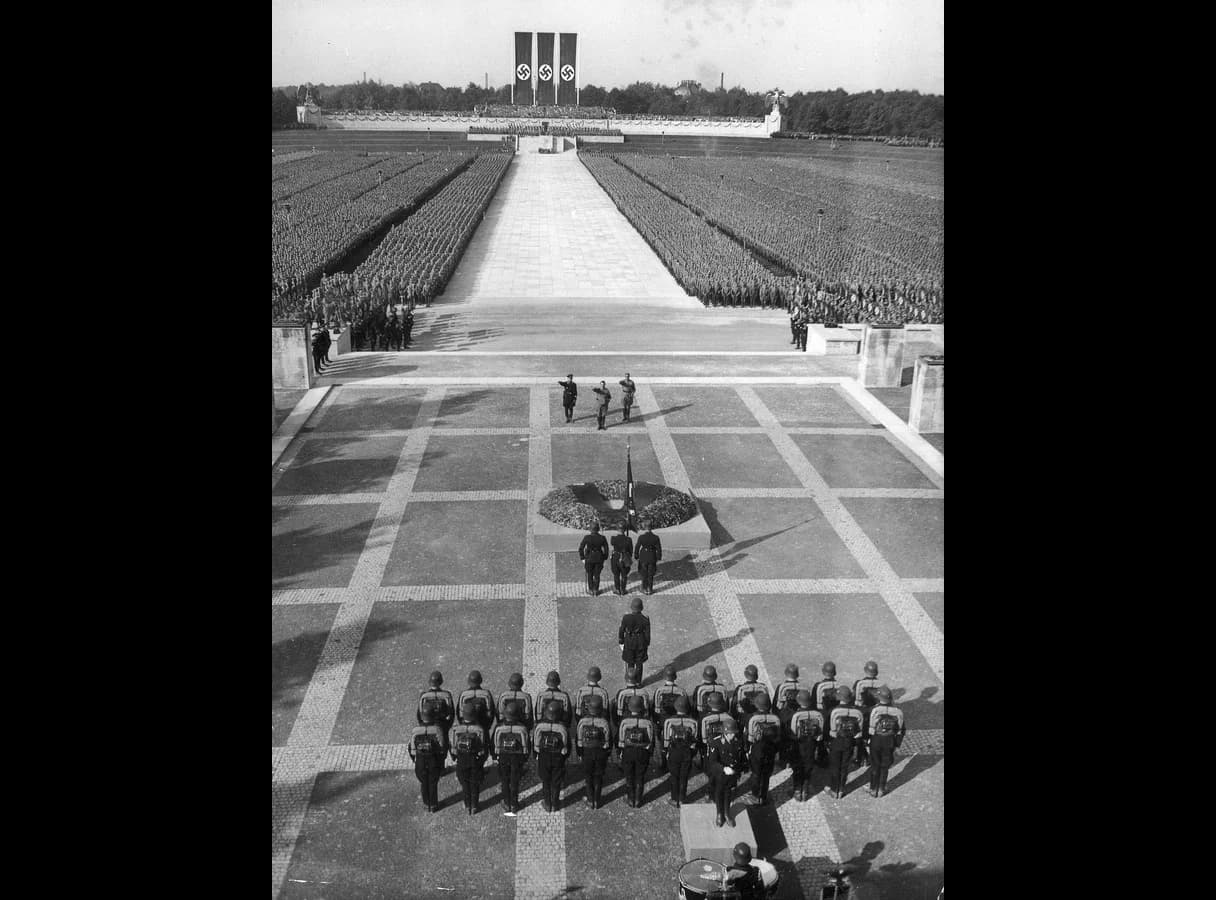
Radio was the regime's most modern tool. The cheap Volksempfänger ("people's receiver"), sold from 1933 for 76 Reichsmarks, put Hitler's speeches into millions of homes, and loudspeakers carried them into workplaces and squares. Film was used both for open propaganda, such as Leni Riefenstahl's Triumph of the Will (1935) about the Nuremberg rally of 1934, and for entertainment that carried the regime's values more quietly. The annual Nuremberg rallies were staged to display the unity and discipline of the nation.
Education and youth were central to the Nazi aim of a lasting regime. Teachers had to join the National Socialist Teachers' League, and textbooks were rewritten around race, the nation and the leader. The Hitler Youth for boys and the League of German Girls became the only legal youth organisations; a law of December 1936 made the Hitler Youth the official organisation for all young Germans, and membership became compulsory in 1939, by which time it had about 8 million members.
The historian Ian Kershaw, in The "Hitler Myth" (1987), shows that the most effective propaganda centred on Hitler himself. Many Germans who disliked the party, its corrupt local officials and its attacks on the churches still believed that the Führer stood above these problems and would put them right if he knew about them. The myth was strongest in 1936–1940, when Hitler appeared to have restored jobs and national pride without war, and it weakened as the war turned against Germany after 1942.
The Stalin cult began with the celebrations of his fiftieth birthday on 21 December 1929. Through the 1930s his portraits filled public spaces, and newspapers, poems and songs called him the "leader of peoples" and the father of the nation. Towns such as Stalingrad and Stalinabad carried his name. The Short Course history of the Communist Party (1938) presented Stalin as Lenin's true heir, and became compulsory reading for party members and students; tens of millions of copies were printed.
All writers and artists had to follow socialist realism, adopted at the First Congress of Soviet Writers in 1934, which demanded that art show life as it should become under socialism, with positive heroes and an optimistic message. History was rewritten to remove purged leaders, and photographs were altered to erase them. The Stakhanovite movement used the record shift of the miner Alexei Stakhanov in August 1935, who was reported to have cut 102 tonnes of coal in under six hours, as propaganda for higher work norms.
The Chinese Communist Party organised propaganda down to village and workplace level, through posters, wall newspapers, loudspeakers, study sessions and "thought reform" for intellectuals. The cult of Mao grew in the early 1960s, after the failure of the Great Leap Forward had weakened his position. Lin Biao, the defence minister, had the army's political department compile Quotations from Chairman Mao Zedong, the "Little Red Book", in 1964. During the Cultural Revolution it was printed in hundreds of millions of copies and carried and recited by Red Guards, and Mao badges, portraits and "loyalty dances" spread across the country. Mao used the cult to mobilise young people against party leaders he distrusted, which shows that propaganda could be used to attack parts of a regime as well as to defend it.
Fidel Castro governed through public speech. His television broadcasts and rallies in Havana's Plaza de la Revolución often lasted for hours, and they explained policy directly to the people. Independent newspapers were closed or taken over in 1960, and in 1965 Granma became the party's official daily. At a meeting with writers and artists at the National Library in June 1961, Castro set the limits of free expression in a phrase that became the cultural policy of the regime: "within the Revolution, everything; against the Revolution, nothing" (in Spanish, dentro de la Revolución, todo; contra la Revolución, nada). The state alone decided what counted as "against the Revolution".
Nasser's most powerful instrument was radio. The Sawt al-Arab ("Voice of the Arabs") station, launched in July 1953, broadcast Arab nationalist programmes and Nasser's speeches across the Middle East and North Africa, and cheap transistor radios carried them to villages and refugee camps. In 1960 the Egyptian press was nationalised and handed to the Arab Socialist Union's predecessor, the National Union. Nasser's own book, The Philosophy of the Revolution (1954), presented the 1952 coup as the act of an army serving the nation.
Perón's regime built a large state information office under Raúl Apold, took over most radio stations, and in 1951 expropriated the leading opposition newspaper La Prensa, which it handed to the Peronist trade union confederation, the CGT. The regime's propaganda centred on two figures: Perón as the protector of the workers, and his wife Eva Perón ("Evita") as their champion. Her autobiography La razón de mi vida (1951) was made compulsory reading in schools, and after her death from cancer in July 1952 she was mourned as a near-saint.
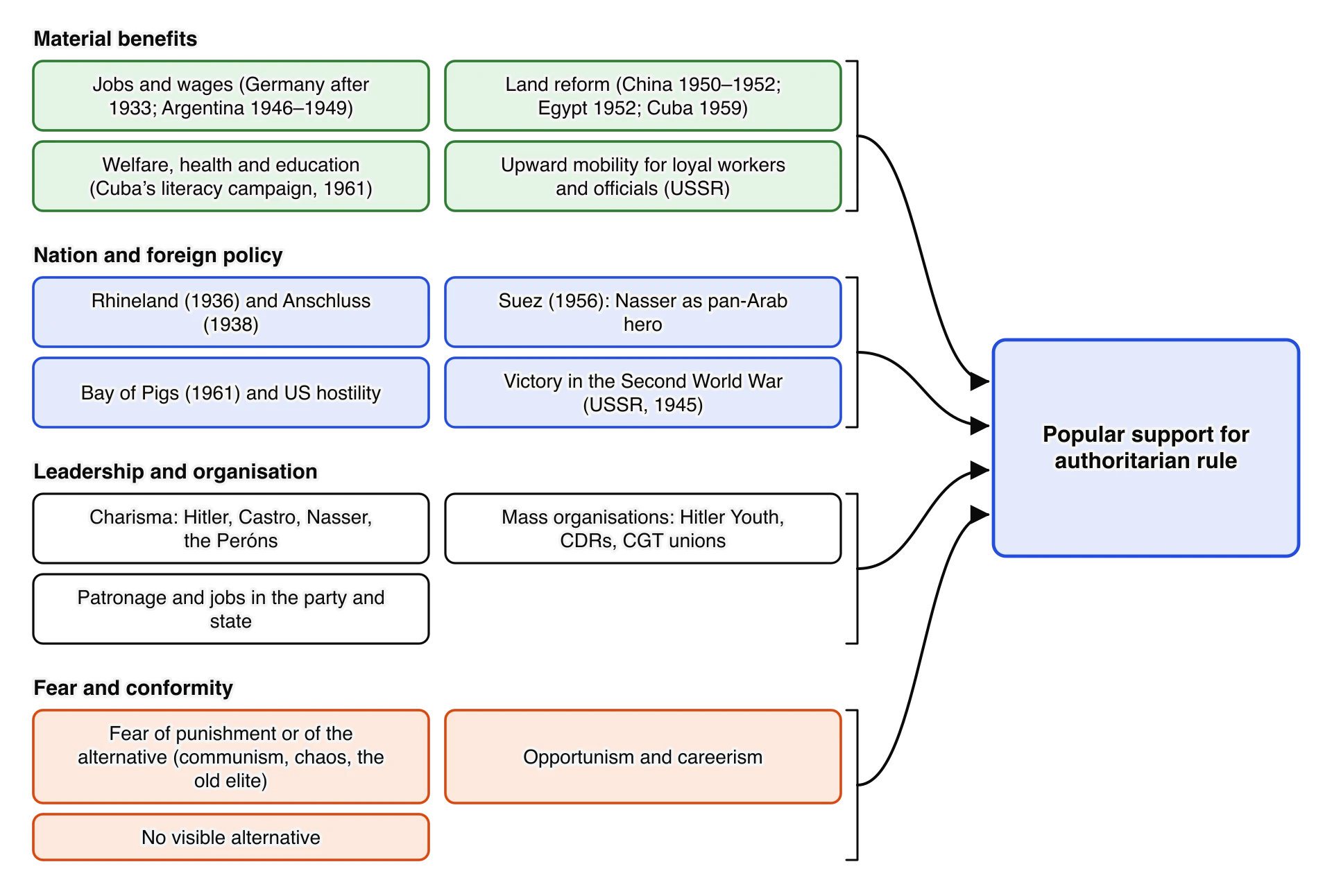
Authoritarian regimes were not held up by force and lies alone. Many enjoyed the support of large parts of their populations, at least for some of the time. Support could come from real improvements in people's lives, from pride in national success, from belief in an ideology or a leader, and from the opportunities that a regime offered to those who served it. It could also be outward conformity, given out of fear or self-interest. Regimes also co-opted powerful groups: Hitler left the army, the civil service and big business largely in the hands of their existing leaders in 1933–1937, Nasser gave army officers posts running ministries and nationalised companies, and Perón gave union leaders seats in Congress and posts in the Peronist Party. The diagram of the sources of support groups these.
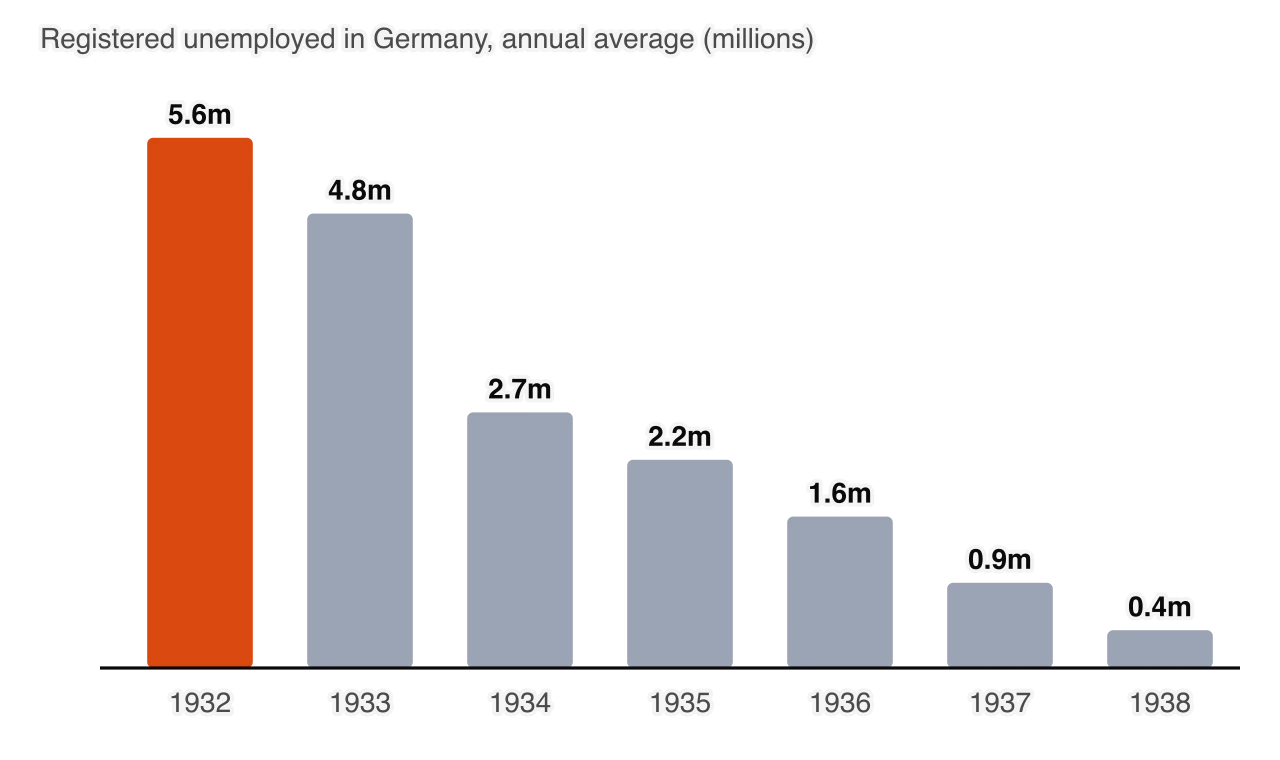
Regimes that came to power in an economic crisis could win support simply by ending it. In Germany registered unemployment fell from an average of 5.6 million in 1932 to under one million in 1937, through public works, rearmament, conscription (from 1935) and the removal of many women and Jews from the labour market. The bar chart of German unemployment shows the fall, though the official figures overstate it. The German Labour Front's Strength through Joy (Kraft durch Freude) organisation, founded in November 1933, offered workers cheap holidays, cruises, concerts and sport, presenting the regime as the champion of a united "people's community" (Volksgemeinschaft). Real hourly wages, however, stayed at or below their 1928 level, working hours grew, and workers had lost their unions.
In Argentina, Perón's support came above all from the industrial working class. As Secretary of Labour (1943–1945) and as president he raised wages, introduced the aguinaldo (a thirteenth month of pay), paid holidays, pensions and courts for labour disputes, and helped the unions of the CGT to grow from about half a million members to several million. Most estimates put the rise in industrial workers' real wages between 1946 and 1949 at around a quarter or more. The Eva Perón Foundation, set up in 1948, built hospitals, schools and homes and distributed goods directly to the poor in Evita's name. Women won the vote in 1947, and many voted for Perón in 1951.
Land was the most valuable benefit in rural societies. China's land reform of 1950–1952 gave land taken from landlords to hundreds of millions of peasants, which tied them to the new state even as it destroyed the rural elite. Egypt's Agrarian Reform Law of September 1952 limited holdings to 200 feddans (about 84 hectares) and redistributed land to small farmers, and Cuba's Agrarian Reform Laws of May 1959 and 1963 broke up the large estates and then nationalised most farmland. From the early 1960s Soviet subsidies, above all purchases of Cuban sugar at favourable prices and supplies of cheap oil, paid for much of Cuba's welfare spending. Nasser also made education free and guaranteed government jobs to graduates, and Castro's regime cut rents, built schools and clinics and, in the literacy campaign of 1961, sent about 100,000 young volunteers into the countryside to teach adults to read.
In the USSR, Stalin's revolution from above offered opportunities as well as dangers. Industrialisation created millions of new jobs, and hundreds of thousands of workers and peasants were promoted into management and administration as vydvizhentsy (people "pushed up"). Stakhanovite workers received higher pay, better flats and medals. For these groups the system meant real advancement, and many of them believed the regime was building a better society.
Success abroad was one of the strongest sources of support, because it appealed to national pride across social classes. Hitler's remilitarisation of the Rhineland (March 1936) and the union with Austria (March 1938) undid parts of the hated Treaty of Versailles without war, and Kershaw finds that they raised his popularity to its height. Stalin's legitimacy after 1945 rested heavily on the Soviet victory over Germany in what was called the Great Patriotic War.
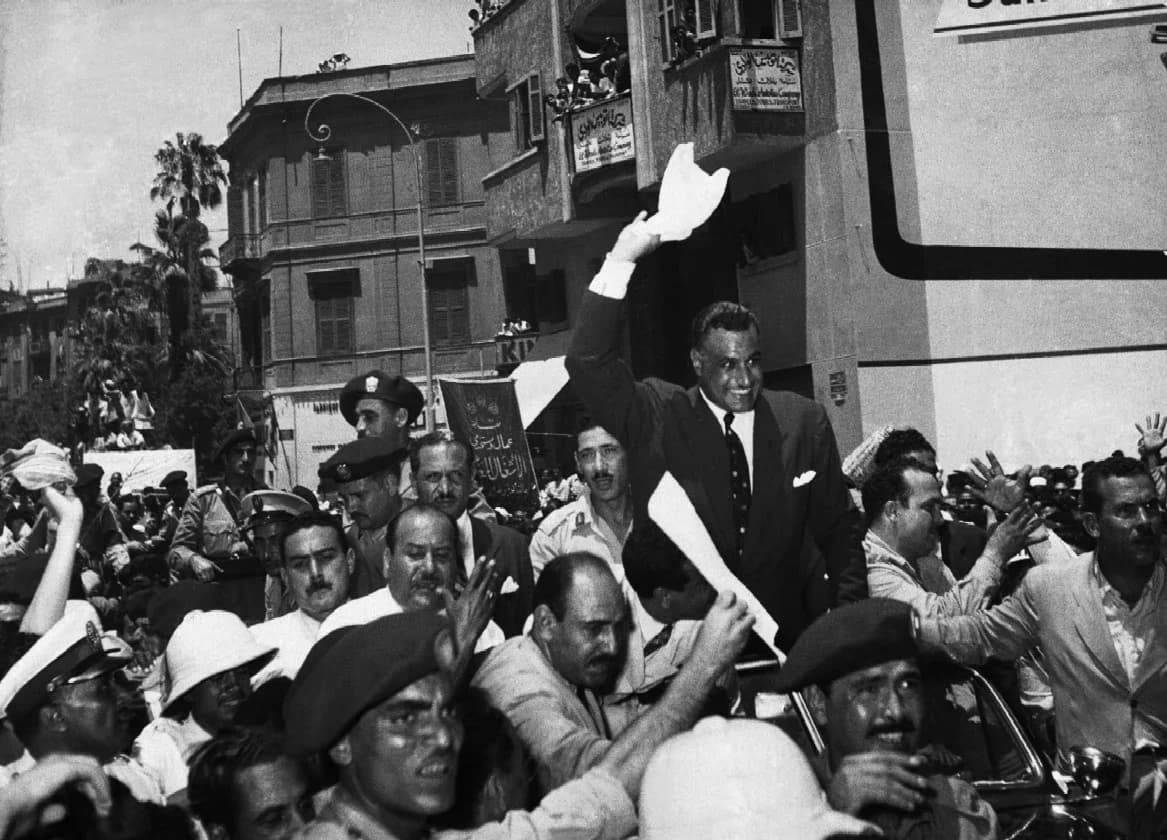
Nasser became the hero of the Arab world in 1956. On 26 July he announced the nationalisation of the Suez Canal Company, owned mainly by British and French shareholders, to pay for the Aswan High Dam after the United States and Britain withdrew their offer of loans. When Britain, France and Israel invaded in the Suez Crisis of October–November 1956, they were forced to withdraw by American and Soviet pressure, and Nasser turned a military defeat into a political victory. The union with Syria as the United Arab Republic (1958–1961) followed from this prestige. The depth of his support was shown in June 1967: after Egypt's crushing defeat by Israel he announced his resignation, and mass demonstrations in Cairo called on him to stay, which he did.
Castro used hostility from the United States in the same way. The defeat of the CIA-backed invasion by Cuban exiles at the Bay of Pigs in April 1961 was presented as a victory of a small nation over an empire, and the US trade embargo (from 1960–1962) allowed the regime to blame economic problems on the enemy. In China, the Korean War (1950–1953) and the campaign to "Resist America, Aid Korea" rallied national feeling behind the new regime, which presented itself as ending a "century of humiliation" by foreign powers.
Hitler, Castro, Nasser and Juan and Eva Perón all had what the sociologist Max Weber called charismatic authority: their followers believed in them personally. Charisma was reinforced by mass organisations that brought people into the regime's activities: the Hitler Youth and the Labour Front in Germany, the CGT unions and the Peronist Women's Party in Argentina, the Committees for the Defence of the Revolution in Cuba, and the Communist Youth League and work units (danwei) in China. Membership gave people a sense of belonging and access to benefits, and it also drew them into watching and reporting on their neighbours.
Cuba's CDRs, founded on 28 September 1960 after bombs exploded during a speech by Castro, show both sides. They organised vaccination drives, blood donations, rallies and neighbourhood clean-ups, and they reported on residents' political loyalty. Millions of Cubans joined, some from conviction and some because a poor CDR report could cost them a job or a university place.
 YouTube
Outward support did not always mean belief. People joined parties and organisations to keep or improve their jobs, attended rallies because absence would be noticed, and voted "yes" in plebiscites they knew were watched. Where there was no visible alternative, many simply adapted. Support was also uneven: industrial workers in Germany and many peasants in the USSR and China were less enthusiastic than the regimes' propaganda claimed, and support tended to fall when the economy failed, as it did in Argentina after 1949, when inflation and drought ended the rise in wages.
The six core regimes all used all four methods, but in very different proportions. The comparative table summarises the main evidence for each line of inquiry and the method that historians generally see as most important to each regime's survival.
Regime | Legal methods | Use of force | Propaganda | Popular support | Main basis of power |
|---|---|---|---|---|---|
Stalin, USSR (1928–1953), Europe | 1936 constitution as façade; Article 58 | NKVD, Great Terror, Gulag, army purge | Stalin cult, Short Course, socialist realism | Vydvizhentsy, Stakhanovites, victory in 1945 | Control of party and police; terror |
Hitler, Germany (1933–1945), Europe | Reichstag Fire Decree, Enabling Act, one-party law, plebiscites | SA (1933–1934), SS, Gestapo, camps | Goebbels' ministry, radio, rallies, Hitler Youth, "Hitler myth" | Jobs, KdF, foreign-policy successes 1936–1938 | Consent from most Germans, terror for outsiders |
Mao, China (1949–1976), Asia | Counter-revolutionary regulations, 1954 constitution, hukou | Mass campaigns, laogai, Red Guards, the army | Little Red Book, posters, thought reform, Mao cult | Land reform, national unity, Korean War | Party and army control; mass mobilisation |
Castro, Cuba (1959–2008), Americas | Fundamental Law (1959), one-party state (1965), 1976 constitution | Tribunals, G2, prisons, UMAP camps | Speeches, television, Granma, "Words to the Intellectuals" | Land and urban reform, literacy, health, anti-US nationalism | Charisma, social benefits, emigration of opponents |
Nasser, Egypt (1954–1970), Africa and the Middle East | Parties dissolved, 1956 constitution, official single organisations | Mukhabarat, military courts, repression of the Brotherhood and communists | Voice of the Arabs, nationalised press | Land reform, Suez (1956), free education, graduate jobs | Army support and nationalist prestige |
Perón, Argentina (1946–1955), Americas | Election victories, purge of Supreme Court, 1949 constitution, desacato law | Police torture, arrests of opponents (limited) | Evita cult, control of radio, La Prensa seized | Wages, welfare, unions, women's vote | Working-class support through the unions |
Three patterns stand out. First, force and legal manipulation mattered most during consolidation. Hitler's regime used the SA, Dachau and the Enabling Act in 1933–1934; Nasser dissolved the parties and crushed the Brotherhood in 1953–1954; Castro's tribunals and the takeover of the press came in 1959–1960. Once rivals were removed, the regimes could rely more on routine control and on support.
Second, the regimes that attempted total control of society, Stalin's USSR, Hitler's Germany and Mao's China, used force on a much larger scale than the others, and directed much of it against groups defined by class, race or political suspicion rather than against active opponents. The more limited regimes of Nasser and Perón relied more on support, and Perón's regime allowed real elections and an opposition press for most of its life. This supports the distinction between totalitarianism and more limited authoritarianism, though historians debate how far any regime achieved total control.
Third, the methods depended on each other. Propaganda was more credible when the regime delivered jobs, land or national victories; force was more effective when citizens supplied denunciations; and legal methods made both look legitimate. A regime that lost one support, as Perón did when the economy declined after 1949 and when he quarrelled with the Catholic Church in 1954–1955, became more dependent on the others.
How historians explain the survival of authoritarian regimes has changed as new evidence has become available, especially after the Soviet and East German archives opened in the early 1990s, and as historians' questions have shifted from the leaders to ordinary people.
In the early Cold War, political scientists and historians developed the totalitarian model. Hannah Arendt's The Origins of Totalitarianism (1951) argued that Nazism and Stalinism were a new form of rule that used ideology and terror to atomise society, breaking every independent social bond so that individuals faced the state alone. Carl Friedrich and Zbigniew Brzezinski, in Totalitarian Dictatorship and Autocracy (1956), listed its features: an official ideology, a single mass party, terroristic police control, a monopoly of the media and of weapons, and central control of the economy. Robert Conquest's The Great Terror (1968) placed Stalin's personal will at the centre of the purges. In this view, regimes were maintained from above, by terror and propaganda.
From the 1970s "revisionist" social historians questioned this picture of the USSR. J. Arch Getty, in Origins of the Great Purges (1985), argued that the terror grew partly out of conflicts between the centre and regional party bosses and out of chaos in the system, not only from a plan by Stalin. Sheila Fitzpatrick, in Everyday Stalinism (1999), studied how ordinary city dwellers survived and adapted, using connections, petitions and denunciations for their own purposes, and stressed the support of those who rose under Stalin. Stephen Kotkin, in Magnetic Mountain (1995), showed how workers in the new steel city of Magnitogorsk learned to "speak Bolshevik": they adopted the regime's language and values, whether or not they fully believed them.
The archives have shown both sides to be partly right. They confirmed that Stalin personally directed the terror: Oleg Khlevniuk, in Master of the House (2009) and his biography of Stalin (2015), shows Stalin signing lists of people to be shot and approving quotas. They also show that local officials and ordinary citizens took part, by raising quotas and denouncing others, and that the regime had real supporters among the new elite.
A similar debate concerns Nazi Germany. Ian Kershaw's The "Hitler Myth" (1987) showed how popularity centred on Hitler personally, and Robert Gellately, in Backing Hitler (2001), argued that the regime rested to a large extent on consent: most Germans approved of its policies, including the persecution of outsiders, which was reported openly in the press, and the Gestapo depended on their denunciations. Götz Aly, in Hitler's Beneficiaries (2005), stresses material benefits paid for by plunder and the persecution of Jews.
Richard Evans, in his lecture "Coercion and Consent in Nazi Germany" (2006), argues against overstating consent. He points out that the regime first destroyed the parties and unions that represented about half of German voters through terror in 1933, so that the "consent" of later years existed only because alternatives had been crushed, and that fear of the Gestapo and the camps remained real for everyone. In this view, consent and coercion cannot be separated: one was built on the other.
Debates about Perón ask whether his support was manipulated or genuine. The sociologist Gino Germani, writing in the 1950s and 1960s, argued that Perón won over new migrants to the cities who lacked political experience and were open to a demagogue, a view close to liberal critics of the time who saw Peronism as an Argentine form of fascism. Daniel James, in Resistance and Integration (1988), argues instead that workers supported Perón because his rule gave them real gains, dignity and a political voice, which is why Peronism survived his overthrow in 1955 and his long exile.
Perspective | Historians and works | Main argument | Evidence stressed |
|---|---|---|---|
Totalitarian model | Arendt (1951); Friedrich and Brzezinski (1956); Conquest (1968) | Regimes kept power from above through ideology, terror and total control | Show trials, the Gulag, the camps, propaganda monopoly |
Social history ("revisionist") | Getty (1985); Fitzpatrick (1999); Kotkin (1995) | Power was also shaped from below; many people adapted, took part or benefited | Petitions, denunciations, upward mobility, workers' language |
Post-archival synthesis | Khlevniuk (2009, 2015) | Stalin directed the terror personally, but it relied on many participants | Signed execution lists, NKVD quotas and requests to raise them |
Dictatorship by consent | Kershaw (1987); Gellately (2001); Aly (2005) | Most Germans supported Hitler, for belief and for benefits | Popular reports, denunciations, the Hitler myth, material gains |
Coercion as foundation | Evans (2006) | Consent rested on the prior destruction of the opposition and continued fear | Terror of 1933, camps, Gestapo powers, plebiscite pressure |
Populism and dignity | James (1988), against Germani | Workers backed Perón for real material and symbolic gains | Wages, unions, workers' testimony, loyalty after 1955 |
These perspectives are easier to weigh than they first appear. Terror and support were not alternatives: the same regime could win real enthusiasm from some groups while terrorising others, and the balance shifted over time. The most convincing explanations ask who supported a regime, who was coerced, and how the two were connected.
A second Part A question on this guiding question could ask: Explain how propaganda was used to maintain authoritarian rule. Use one example from your thematic study in your response. [4] Nasser's Voice of the Arabs and the nationalised press, or Goebbels' ministry with radio and the Hitler Youth, make strong examples; a top answer explains two uses (for instance, building the leader's image and turning young people into loyal citizens) and links each to the regime's survival.
I can explain the difference between coercion, consent and accommodation, and between consolidation and maintenance of power.
I can explain how regimes controlled the army, the party, the bureaucracy and the economy.
I can explain how legal methods (emergency decrees, enabling laws, constitutions, bans on parties, courts, plebiscites) maintained power, using Hitler, Perón, Nasser and Stalin.
I can analyse the Enabling Act and the 1936 Soviet constitution as sources for legal methods.
I can explain how Stalin used the party machine, the NKVD, the show trials, Order No. 00447 and the Gulag to maintain power, and assess how far terror explains his survival.
I can compare the use of force by Hitler, Mao, Castro, Nasser and Perón, including the role of denunciations and emigration.
I can explain how propaganda, censorship, education, youth movements and the cult of personality worked in at least four of the core regimes, and why propaganda had limits.
I can explain how benefits, nationalism and foreign-policy success, charisma and mass organisations created popular support, and why outward support is hard to interpret.
I can compare the six core regimes and explain which methods mattered most to each.
I can outline and weigh the totalitarian and social-history perspectives, and the debate on consent and coercion in Nazi Germany and Perón's Argentina.
I can plan a Part B essay on the methods of maintaining authoritarian rule, using regimes from two regions and reaching a judgement.