Notes on R3.8 Emergence of modern China (1910–1949)
Between 1910 and 1949 China passed from the last years of the Qing dynasty, through a failed republic, the rule of warlords, a Nationalist government and an eight-year war with Japan, to the founding of the People’s Republic of China under the Chinese Communist Party. The struggle between the two great revolutionary parties of the period, the Guomindang and the CCP, decided what kind of modern state China would become.
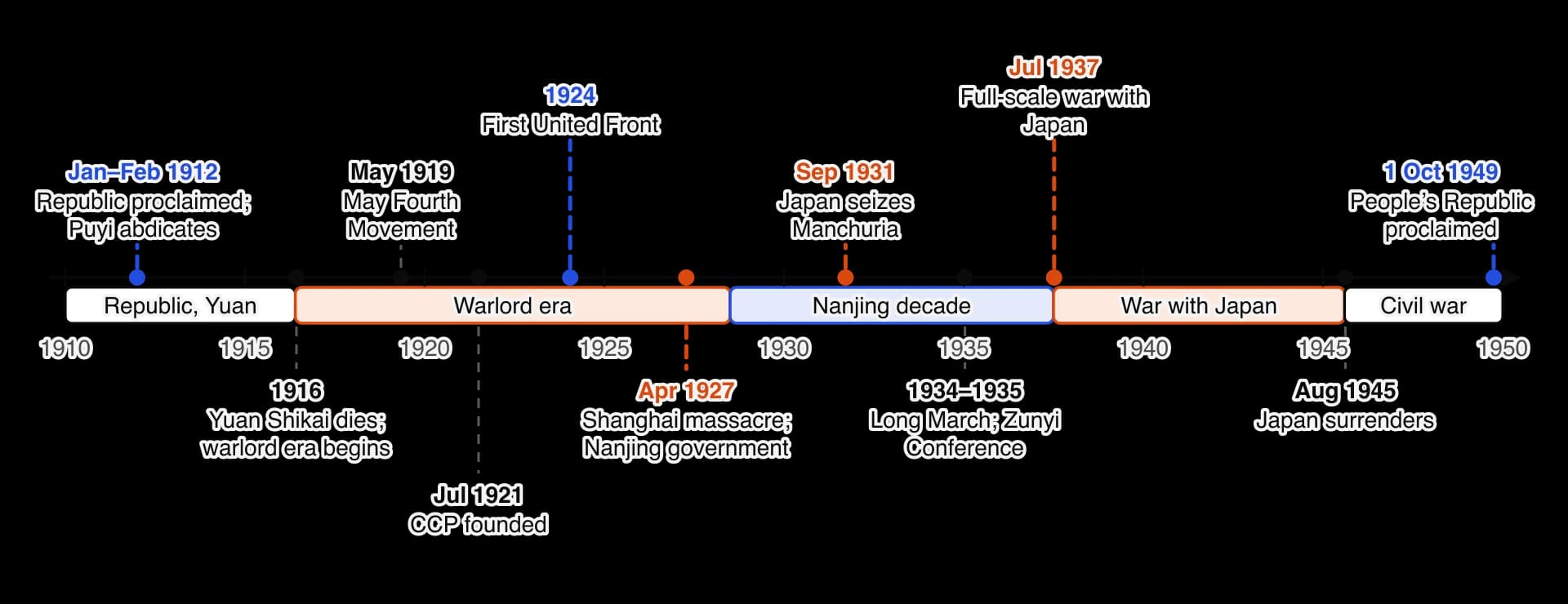
The timeline of 1910–1950 shows five periods: the early Republic under Yuan Shikai, the warlord era, the Nanjing decade of Guomindang rule, the war with Japan and the civil war. The fall of the Qing and the revolution of 1911 are a regional study of their own; here the story begins with the Republic those events created.
The founding of the Republic and Yuan Shikai, 1912–1916
A republic born of compromise
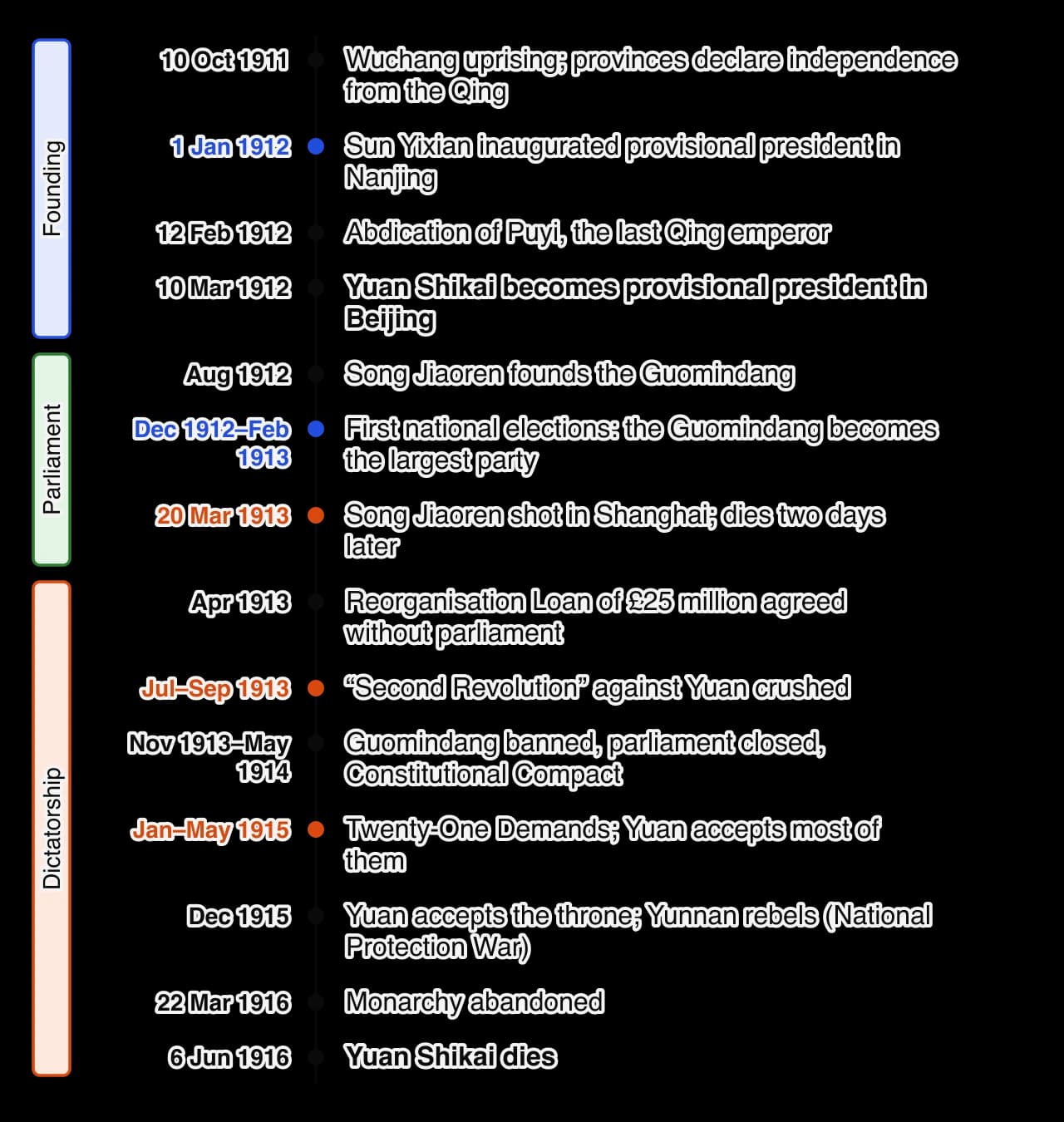
The Republic of China was born from a revolt by army units in the city of Wuchang on 10 October 1911. Within two months most provinces of central and southern China had declared their independence from the Qing dynasty. Delegates from these provinces met at Nanjing and on 1 January 1912 inaugurated Sun Yixian (Sun Yat-sen), the best-known revolutionary leader, as provisional president of the Republic of China.
The revolutionaries did not control the north, where the most modern army in China, the Beiyang Army, was loyal to its creator, Yuan Shikai. Yuan was a former Qing general and reforming official who had trained the army in the 1890s and 1900s. The court recalled him to crush the revolt, but he chose to negotiate instead. In return for persuading the court to abdicate, Yuan was promised the presidency. The six-year-old emperor Puyi abdicated on 12 February 1912, Sun resigned, and Yuan was inaugurated as provisional president in Beijing on 10 March 1912.
The deal ended two thousand years of imperial rule with relatively little bloodshed, but it gave power to a man who had no commitment to the revolutionaries’ ideas. The revolutionaries tried to limit him through the Provisional Constitution of March 1912, which created a cabinet responsible to an elected parliament. The president could not rule without ministers who had the parliament’s confidence.
Elections, Song Jiaoren and the Second Revolution
In August 1912 Song Jiaoren, a young organiser of the revolutionary movement, merged Sun’s Tongmenghui (Revolutionary Alliance) with several smaller parties to form the Guomindang (Kuomintang), the Nationalist Party. Song’s aim was to win the coming elections and govern through a parliamentary cabinet, which would turn Yuan into a figurehead. China’s first national elections, held between December 1912 and February 1913, gave the vote to men who met property and education requirements: about 40 million voters, roughly a tenth of the population. The Guomindang became the largest party in both houses of the new parliament.
On 20 March 1913 Song was shot at Shanghai railway station as he set out for Beijing to lead the parliament; he died two days later. The investigation traced the killing to agents linked to Yuan’s government, and most historians accept that Yuan or his close associates ordered it. In April 1913 Yuan signed the Reorganisation Loan of £25 million from a consortium of British, French, German, Russian and Japanese banks without the parliament’s approval, which gave him the money to pay his army.
Sun and the southern military governors rose against Yuan in July 1913, in what became known as the “Second Revolution”. The Beiyang Army crushed the revolt within two months, and Sun fled to Japan. Yuan then dismantled the constitutional system step by step: he outlawed the Guomindang in November 1913, closed the parliament in January 1914 and in May 1914 replaced the Provisional Constitution with a Constitutional Compact that gave the president almost unlimited powers.
The Hongxian monarchy and Yuan’s fall
Yuan’s dictatorship pursued real aims. He wanted a strong, centralised state that could collect taxes, build an army and resist foreign pressure, and the American historian Ernest Young argues that he should be understood as a modernising centraliser, not only as a reactionary. But his government was weakened in 1915 by its acceptance of most of Japan’s Twenty-One Demands, a humiliation that damaged his standing with patriotic Chinese.
In late 1915 Yuan’s supporters organised petitions and a hand-picked “national convention” that asked him to become emperor. Frank Goodnow, an American constitutional adviser, had written a memorandum in August 1915 arguing that a monarchy suited China’s conditions better than a republic, and Yuan’s followers used it as support. Yuan accepted the throne in December 1915 and named his reign Hongxian, to begin on 1 January 1916.
The monarchy united Yuan’s opponents. On 25 December 1915 the province of Yunnan, led by the general Cai E, declared independence and began the National Protection War. Other southern provinces followed, Japan and the Western powers withheld support, and Yuan’s own Beiyang generals refused to fight for an emperor. On 22 March 1916 Yuan abandoned the monarchy, and on 6 June 1916 he died of kidney failure.
Yuan’s rule had a lasting effect on national identity. It showed that a republic needed more than a constitution, and it discredited both monarchy and parliamentary politics in the eyes of many young Chinese. His death also left no one able to hold the army together.
Warlordism and its effects, 1916–1928
After Yuan’s death central authority collapsed. The Beijing government survived as the government that foreign powers recognised, with a president, a cabinet and, at times, a parliament, but real power passed to regional military commanders, the warlords. The period from 1916 to 1928 is known as the warlord era.
The cliques and the struggle for Beijing
The most powerful warlords formed cliques, loose alliances based on regional origin and personal loyalty, often formed among former Beiyang officers. The Anhui clique of Duan Qirui dominated the Beijing government from 1916 to 1920 with the help of Japanese loans. The Zhili clique, led by Feng Guozhang, then Cao Kun and the general Wu Peifu, defeated it in 1920. Zhang Zuolin’s Fengtian clique, based in Manchuria and backed by Japan, fought the Zhili clique in 1922 and again in 1924.
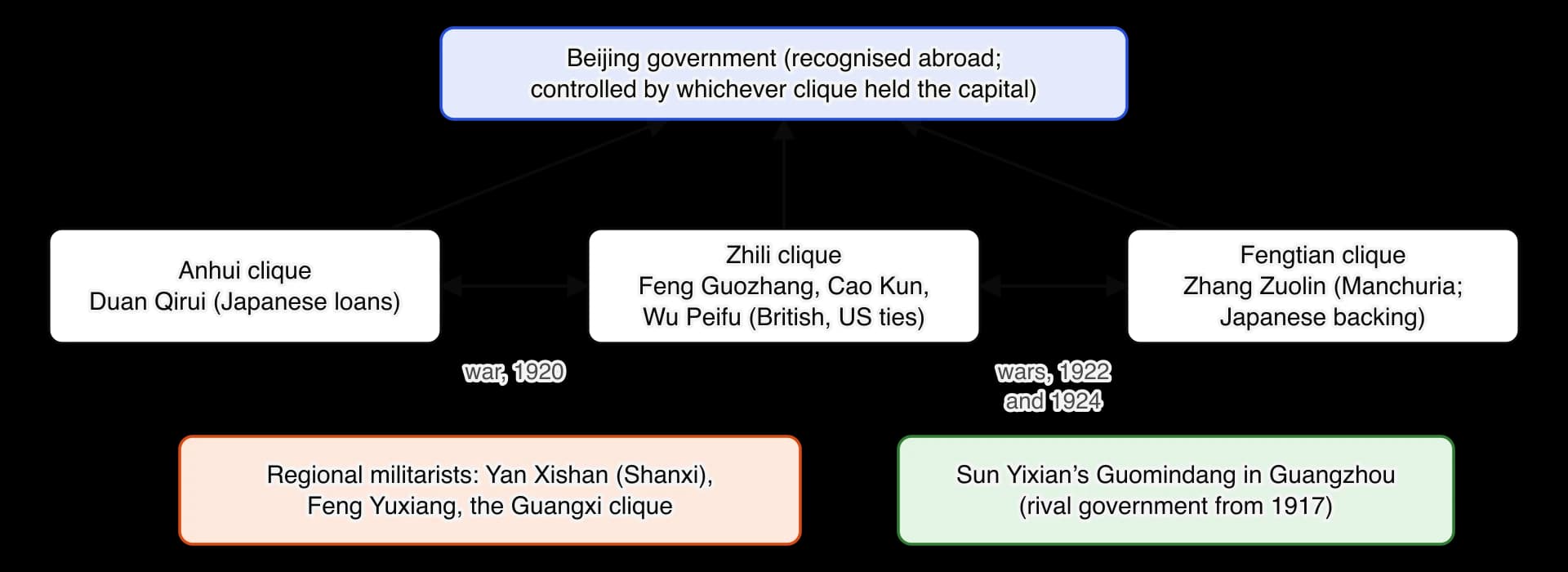
The diagram of the cliques shows why the wars were fought. Control of Beijing gave a clique international recognition, the right to borrow abroad and a share of the customs revenue collected by foreign-run services. Outside the north, regional militarists such as Yan Xishan in Shanxi and the Guangxi clique ruled their provinces with little reference to Beijing. Feng Yuxiang, known in the Western press as the “Christian General”, switched sides several times, most decisively in his coup in Beijing in October 1924. A short-lived restoration of Puyi as emperor by the general Zhang Xun in July 1917 lasted twelve days.
Clique or warlord | Base | Leading figures | Foreign links and fate |
|---|---|---|---|
Anhui | Anhui, Beijing (1916–1920) | Duan Qirui | Japanese loans; defeated by the Zhili clique in 1920 |
Zhili | Hebei (Zhili), central Yangzi | Feng Guozhang, Cao Kun, Wu Peifu | Closer to Britain and the USA; defeated in 1924 when Feng Yuxiang changed sides; destroyed by the Northern Expedition, 1926 |
Fengtian | Manchuria | Zhang Zuolin, then Zhang Xueliang | Backed by Japan; Zhang Zuolin killed by Japanese officers in June 1928; his son joined the Nanjing government |
Shanxi | Shanxi | Yan Xishan | A “model governor” who ruled Shanxi, with short interruptions, from 1911 to 1949 |
Guominjun | North-west | Feng Yuxiang | Soviet aid from 1925; joined the Northern Expedition |
 YouTube
Effects of warlordism
The effects of warlord rule fell hardest on the countryside. Armies had to be paid, so warlords collected land tax years in advance (by the early 1930s some districts of Sichuan had paid land tax decades ahead), imposed new levies on trade and forced peasants to grow opium as a cash crop to be taxed. Soldiers were recruited by force, lived off the land and looted when unpaid. Banditry spread, because defeated soldiers became bandits and bandits were recruited as soldiers.
The scale of militarisation was enormous. Estimates of the number of warlords, large and small, run to well over a thousand. The political scientist Ch'i Hsi-sheng (Warlord Politics in China, 1916–1928, 1976) calculated that the number of men under arms grew from about half a million in late 1916 to more than a million by 1918 and about two million by 1928. Wars between cliques disrupted railways and trade, and famine relief often failed because grain could not be moved across warlord borders.
Politically, warlordism made China weaker against foreign powers. Warlords borrowed abroad and gave concessions in return; the Nishihara Loans of 1917–1918, about 145 million yen from Japanese banks to Duan Qirui’s government, were secured on Chinese railways and mines. Foreign powers kept their foreign concessions, extraterritoriality and control of the customs because no Chinese government was strong enough to challenge them.
The picture was not entirely negative. Some warlords built roads, schools and industries; Yan Xishan promoted education and banned foot-binding in Shanxi. During the First World War, when European imports fell, Chinese-owned industry grew rapidly, especially textiles and flour milling in Shanghai, in what has been called the golden age of Chinese capitalism (about 1914–1922). The weakness of central government also allowed a freedom of publishing and debate that made the New Culture Movement possible.
Sun Yixian and the Three Principles of the People
Sun Yixian (1866–1925) was a doctor trained in Hong Kong who had spent most of his adult life organising revolts against the Qing from abroad. After the failure of the Second Revolution he founded a new, tightly disciplined Chinese Revolutionary Party in Tokyo in 1914, whose members swore personal loyalty to him. In 1917 he set up a rival military government in Guangzhou (Canton), claiming to defend the constitution against the northern warlords, and in October 1919 he renamed his party the Zhongguo Guomindang, the Nationalist Party of China.
For years Sun had little real power. In Guangzhou he depended on southern warlords who used him for their own ends, and in June 1922 the local commander Chen Jiongming drove him out of the city. Sun returned in early 1923. His importance lay less in the territory he controlled than in his programme, which gave the nationalist movement its ideology.
The Three Principles
Sun had first set out the Three Principles of the People (Sanmin zhuyi) before 1911. He gave them their final form in a series of lectures in Guangzhou in 1924, after his alliance with the Soviet Union, and they became the official ideology of the Guomindang.
Principle | Meaning before 1911 | Meaning in the 1924 lectures |
|---|---|---|
Nationalism (minzu) | Overthrow of the Manchu Qing dynasty | Unity of the peoples of China (Han, Manchu, Mongol, Hui, Tibetan) and an end to foreign imperialism and the unequal treaties |
Democracy (minquan, the people’s power) | A republic in place of the monarchy | A five-power constitution and four popular rights, reached through three stages of revolution |
People’s livelihood (minsheng) | Equalisation of land rights | Equal land rights, regulation of private capital and, later, “land to the tiller”; Sun insisted this was not communism |
After China has established a powerful government, we must not be afraid, as Western people are, that the government will become too strong and that we will be unable to control it. For it is our plan that the political power of the reconstructed state be divided into two parts. One is the power over the government; that great power will be placed entirely in the hands of the people … The other power is the governing power; that great power will be placed in the hands of the government organs, which will be powerful and will manage all the nation’s business.
Sun Yixian, “The Principle of Democracy”, lecture, Guangzhou, 1924 (translation in de Bary and Lufrano, Sources of Chinese Tradition, 2000). Sun spoke when China was divided among warlords and his own government held only part of one province, so his first concern was a state strong enough to unify the country. The extract shows that his idea of democracy put a powerful government first; the people’s control over it (through election, recall, initiative and referendum) was to come once the nation was rebuilt.
The democracy Sun described was to be reached in three stages: a period of military government to defeat the warlords, a period of political tutelage in which the party would govern and train the people in self-government, and finally constitutional government. The government itself would have five branches, adding to the Western executive, legislative and judicial powers two from the Chinese tradition: a branch to select officials by competitive tests and a control branch to supervise them.
Sun died of cancer in Beijing on 12 March 1925 and was honoured by the Guomindang as the “Father of the Nation”. His legacy was double-edged. The Three Principles gave the nationalist movement a programme that linked national unity, anti-imperialism and social reform, and gave China a modern national identity that both parties claimed. But his idea of tutelage also gave later leaders a justification for postponing democracy indefinitely.
The New Culture Movement, c. 1915–1923
The failure of the Republic convinced a group of young intellectuals that political change was not enough. China, they argued, was weak because its culture, above all Confucianism, kept people obedient, superstitious and unable to think for themselves. The New Culture Movement set out to transform Chinese thought and society through new ideas, a new literature and a new kind of citizen.
New Youth and Peking University
In September 1915 Chen Duxiu, a radical writer who had studied in Japan, founded a magazine in Shanghai that from 1916 was called New Youth (Xin Qingnian). Its first issue called on the young to be independent, progressive, outward-looking and scientific. In 1917 the new president of Peking University, the educator Cai Yuanpei, made Chen dean of the faculty of letters and opened the university to scholars of every view. Peking University (Beida) became the centre of the movement.
A constitutional republic which does not derive from the conscious realization and voluntary action of the majority of the people is a bogus republic and bogus constitutionalism. It is political window-dressing, in no way like the republican constitutionalism of the countries of Europe and America, because there has been no change in the thought or the character of the majority of the people.
Chen Duxiu, “Our Final Awakening”, New Youth, 1916 (English translation). Chen wrote in the months when Yuan Shikai had tried to make himself emperor, and the article explains that failure by the absence of a change in popular thinking, not by the actions of one man. It shows the central claim of the New Culture Movement, that a cultural transformation had to come before a working republic; as a radical editor arguing a case to young readers, Chen gives a deliberately sweeping picture of popular backwardness.
Science, democracy and the attack on Confucianism
Chen summed up the movement’s aims in two figures, “Mr Science” and “Mr Democracy”. Science meant reason, evidence and doubt in place of tradition and superstition; democracy meant equality and the rights of the individual, not only elections. Confucianism, with its stress on obedience to parents, rulers and husbands, was attacked as the ideology of a dead society, and the slogan “Down with Confucius and sons” became a rallying cry of the period.
Language was a key battlefield. Literature and official writing used classical Chinese (wenyan), which few people could read. In January 1917 Hu Shi, a student of the American philosopher John Dewey, published his “Tentative Proposals for Literary Reform” in New Youth, calling for writing in baihua, the vernacular language people actually spoke. Lu Xun’s short story “Diary of a Madman” (1918), written in baihua, presented Chinese history as a record of people eating people behind words of benevolence and virtue; his True Story of Ah Q (1921–1922) mocked a peasant who turned every humiliation into an imagined victory, a satire of national self-deception.
The movement also championed the emancipation of women. Writers attacked arranged marriage, foot-binding and the ideal of the chaste widow, and translations of Henrik Ibsen’s play A Doll’s House, in which Nora leaves her husband, set off a long debate about women’s independence. Peking University began admitting women students in 1920.
Debate and division
The movement was never united. Liberals such as Hu Shi believed in gradual reform through education and science; Dewey lectured across China from 1919 to 1921. Others turned to Marxism: the Beida librarian Li Dazhao welcomed the Bolshevik Revolution in 1918 as the beginning of a new world, and by 1920 Chen Duxiu had become a Marxist too. Defenders of Chinese tradition replied; the philosopher Liang Shuming argued in 1921 that Chinese civilisation, with its moral and spiritual depth, still had much to offer the world.
The movement’s significance for national identity was large but uneven. It created a new idea of the Chinese citizen, a national language for modern writing and an educated public of students and readers in the cities. But it reached only a small urban elite; most of China’s people were peasants who could not read. Its most important political effect was to prepare a generation of students who, in May 1919, turned cultural criticism into mass protest.
China and the First World War, 1914–1918
Neutrality and the loss of Qingdao
When war broke out in Europe in August 1914, China declared itself neutral. Its main concern was the German leased territory of Jiaozhou Bay, with the port of Qingdao, and the German railway and mining rights in Shandong province, taken in 1898. Japan, allied to Britain since 1902, declared war on Germany on 23 August 1914, landed troops in Shandong and, with a small British force, took Qingdao in November 1914. Japanese troops then occupied the Shandong railway far inland, ignoring China’s neutrality.
The Twenty-One Demands, 1915
With the European powers absorbed in the war, Japan pressed for more. On 18 January 1915 the Japanese minister in Beijing secretly presented Yuan Shikai with the Twenty-One Demands, arranged in five groups.
Group | Demands | Outcome |
|---|---|---|
1 | China to accept whatever Japan agreed with Germany about Shandong; no cession of Shandong territory to any other power | Accepted |
2 | Extension of Japan’s leases in South Manchuria (Port Arthur, Dalian, the South Manchuria Railway) to 99 years; rights to live, trade and own land in South Manchuria and eastern Inner Mongolia | Accepted |
3 | Joint Sino-Japanese control of the Hanyeping iron and steel company in central China | Accepted |
4 | No harbour, bay or island on China’s coast to be ceded or leased to any other power | Accepted |
5 | Japanese political, financial and military advisers in the Chinese government; joint Sino-Japanese police in key places; Japanese supply of arms | Dropped “for later discussion” after Yuan leaked it |
Group 5 would have made China a Japanese protectorate. Yuan’s government delayed and leaked the demands to the press and to foreign governments, and British and American objections persuaded Japan to drop Group 5 for the time being. On 7 May 1915 Japan issued an ultimatum on the rest; Yuan accepted it on 9 May, and the treaties were signed on 25 May. Patriotic groups declared 9 May National Humiliation Day, and boycotts of Japanese goods spread through the cities.
The Chinese Labour Corps and the declaration of war
China’s main contribution to the Allied war effort was labour. Beginning in 1916, France and then Britain recruited Chinese workers, mostly peasants from Shandong, under contracts arranged with the Chinese government. About 140,000 served in France and Belgium, about 94,000 of them in the British Chinese Labour Corps, digging trenches, unloading ships and repairing roads and tanks behind the lines. Several thousand died from shellfire, accidents and disease; official counts give about 2,000, and some historians estimate considerably more. Many more Chinese worked in Russia. The scheme was promoted by the official Liang Shiyi, who hoped that labour, not soldiers, would earn China a place at the peace conference.
The question of entering the war divided the government. Premier Duan Qirui wanted to declare war, partly to win a seat at the peace talks and partly because Japanese loans would fund his army. President Li Yuanhong and the parliament resisted, and the dispute led to Duan’s dismissal and the brief restoration of Puyi in July 1917. Duan returned to power, and on 14 August 1917 China declared war on Germany and Austria-Hungary. No Chinese troops fought in Europe.
Duan’s government also signed secret agreements with Japan in return for the Nishihara Loans. In September 1918 it exchanged notes accepting Japanese arrangements for the Shandong railway, a concession that the Japanese would use at the peace conference to argue that China had already agreed to Japan’s position in Shandong.
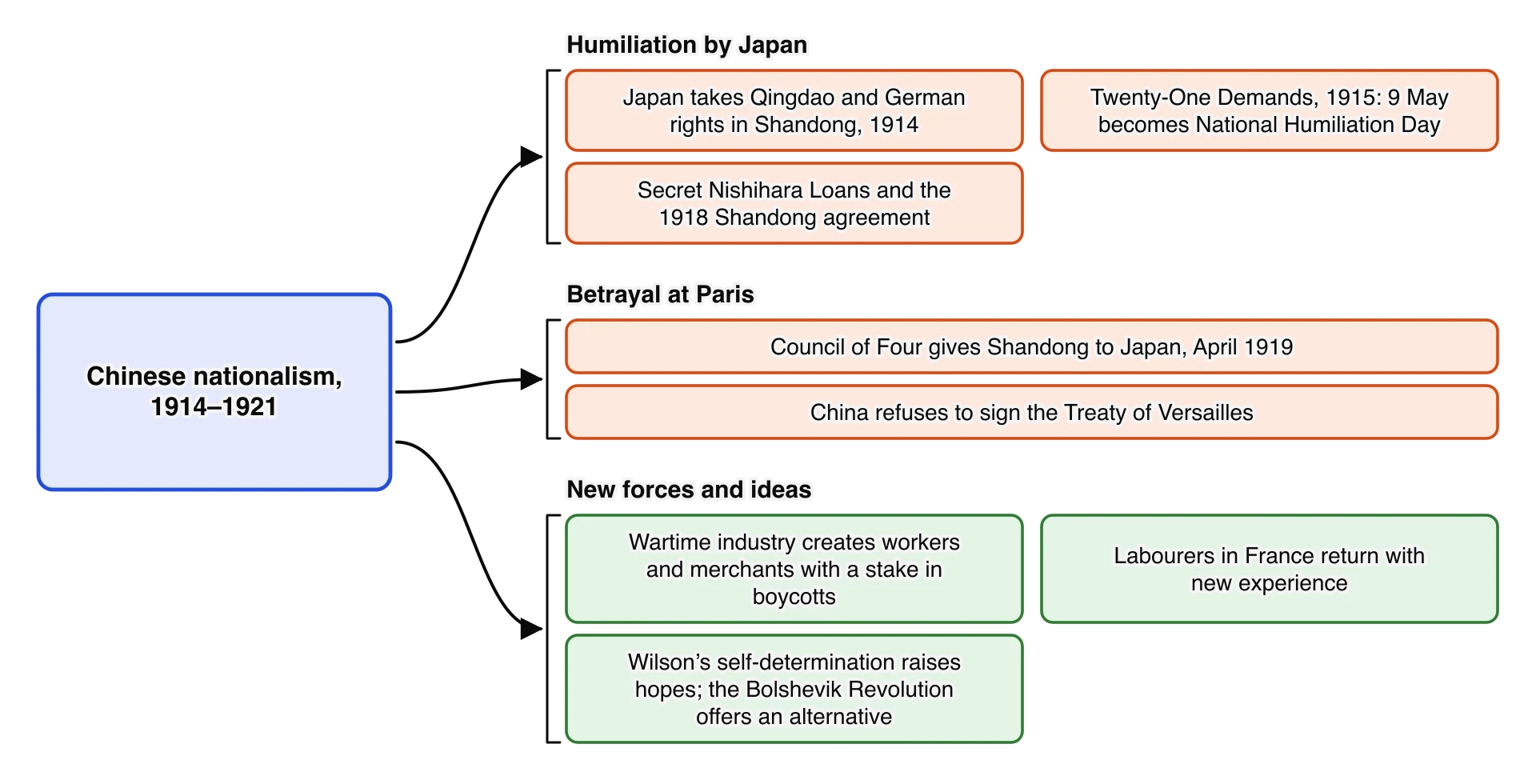
The diagram of the war’s effects shows that the First World War worked on Chinese nationalism in two ways. Japan’s actions created a sense of humiliation that every political group shared. At the same time, wartime economic growth created new urban groups (factory workers, merchants, students) who could act on that feeling through strikes and boycotts. Ideas from abroad, above all Woodrow Wilson’s language of self-determination and the example of the Bolshevik Revolution, gave nationalists new hopes and new models.
The Paris Peace Conference, Versailles and the League of Nations
China went to the Paris Peace Conference in January 1919 with high hopes. As one of the Allied powers, its delegation, led by the foreign minister Lu Zhengxiang and the young diplomat Wellington Koo (Gu Weijun), asked for the return of the German rights in Shandong directly to China and raised the wider question of ending unequal treaties, foreign spheres of influence and extraterritoriality.
Japan’s claims were stronger in the eyes of the great powers. Britain, France and Italy had promised in secret agreements in early 1917 to support Japan’s claim to Shandong in return for Japanese naval help, and Japan could point to Duan Qirui’s notes of September 1918. Japan’s proposal to write racial equality into the Covenant of the League of Nations had been rejected in April, and its delegates threatened to leave the conference and stay out of the League if they also lost Shandong. President Wilson, anxious to keep Japan in the League, gave way. On 30 April 1919 the Council of Four (Wilson, Lloyd George, Clemenceau and Orlando) agreed to transfer Germany’s Shandong rights to Japan, which promised to return the territory to China at some later date.
The decision was written into Articles 156–158 of the Treaty of Versailles. After the May Fourth protests, and when its request to sign with a reservation on Shandong was refused, the Chinese delegation refused to sign the treaty on 28 June 1919. It was the only Allied state to do so. China nevertheless became a founding member of the League of Nations by signing the Treaty of Saint-Germain with Austria in September 1919, and it ended the state of war with Germany separately in 1921.
Issue | Chinese aim at Paris | Result |
|---|---|---|
German rights in Shandong | Direct return to China | Transferred to Japan (Articles 156–158); China refused to sign |
Unequal treaties, extraterritoriality, tariff control | Abolition or revision | Not considered by the conference |
League of Nations | A voice among the nations | Founding member through the Treaty of Saint-Germain |
Shandong after 1919 | Return of the territory | Returned under the Shandong Treaty at the Washington Conference, February 1922 |
Shandong was not lost permanently. At the Washington Conference of 1921–1922, under American and British pressure, Japan agreed in the Shandong Treaty of 4 February 1922 to return Jiaozhou to China, which bought back the railway. The Nine-Power Treaty of February 1922 committed the powers to respect China’s independence and territorial integrity and the Open Door principle of equal trading rights. These gains were real, but they came from great-power diplomacy, and Chinese nationalists drew the lesson that China could not rely on Western promises or on the League.
The May Fourth Movement, 1919
The protest of 4 May and its spread
News of the Shandong decision reached China at the end of April 1919. On the afternoon of Sunday 4 May about 3,000 students from thirteen colleges in Beijing gathered at Tiananmen, the gate in front of the former imperial palace, to protest. A manifesto written by the Beida student Luo Jialun was handed out, declaring that the Chinese people would never accept the loss of their territory and would resist to the end. The students marched towards the Legation Quarter, then turned on officials they blamed for the secret deals with Japan: they burned the house of Cao Rulin, the minister of communications, and beat Zhang Zongxiang, China’s former minister to Japan. Police arrested 32 students.
The arrests turned the protest into a national movement. Students in Beijing went on strike, formed student unions and gave street speeches to win over the public. When the government arrested hundreds more students in early June, the movement spread to Shanghai, where from 5 June merchants closed their shops and tens of thousands of workers went on strike. Boycotts of Japanese goods spread across the country.
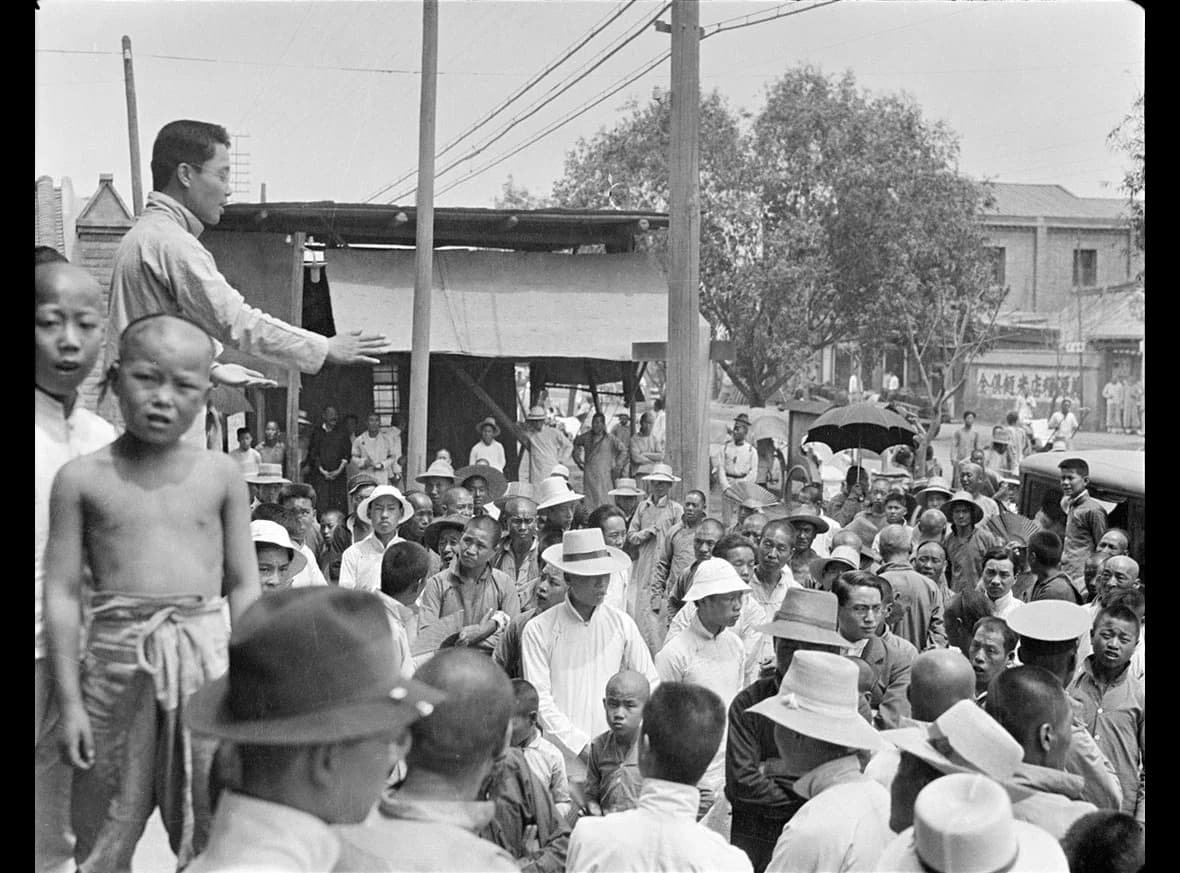
Gamble’s photograph of students speaking in a Beijing street shows the new method of the movement: educated young people taking their cause directly to the urban public. In mid-June the government dismissed Cao Rulin, Zhang Zongxiang and Lu Zongyu, the third official blamed for the Japanese loans, and released the students, and on 28 June the delegation in Paris refused to sign the treaty.
Why the May Fourth Movement mattered
The movement’s immediate achievements were limited: three officials dismissed and a treaty left unsigned. Its long-term significance was far greater, for four reasons.
Mass nationalism. For the first time, nationalism reached beyond a small elite to students, merchants and workers across many cities, acting together through strikes and boycotts.
New political actors. Students became a permanent force in Chinese politics, and the Shanghai strikes showed the potential of organised urban workers.
Anti-imperialism. Disillusion with the Western democracies after Paris, contrasted with the Soviet government’s offer in the Karakhan Manifesto (dated July 1919, published in China in March 1920) to give up tsarist privileges in China, turned many radicals against the West and towards the Soviet model.
From culture to politics. Many New Culture intellectuals concluded that cultural change alone was too slow and that China needed organised political parties; both the reorganised Guomindang and the CCP drew recruits from the May Fourth generation.
The emergence of the Chinese Communist Party, 1920–1923
In 1919 Marxism was barely known in China. The Bolshevik Revolution and the disappointment of Paris changed that. Li Dazhao led a Marxist study society at Peking University, and Chen Duxiu, who had moved to Shanghai, organised a communist group there in 1920. The Comintern (Communist International), founded by the Bolsheviks in Moscow in 1919 to spread revolution, sent the agent Grigori Voitinsky to China in 1920 to help these groups organise.
The First Congress of the Chinese Communist Party opened in the French Concession in Shanghai in July 1921. Thirteen delegates, among them the young Hunan teacher Mao Zedong, represented about fifty members in a handful of cities, with two Comintern representatives, including the Dutch communist Henk Sneevliet (known as Maring). When police raided the meeting, the delegates finished it on a boat on South Lake at Jiaxing. Chen Duxiu, who was not present, was elected the party’s leader; he remained general secretary until 1927.
The early party concentrated on the cities and the working class, as Marxist theory taught. Communist organisers led a successful miners’ strike at Anyuan in Jiangxi in 1922, but on 7 February 1923 the warlord Wu Peifu crushed a strike on the Beijing–Hankou railway, killing dozens of workers. The lesson the Comintern drew was that the tiny CCP was too weak to act alone and needed an ally with an army.
The Sun–Joffe Manifesto and the First United Front, 1923–1927
Why the alliance was made
By 1922 Sun Yixian had failed to win help from Britain, the USA or Japan, and he had lost Guangzhou to a warlord. The Soviet government, for its part, wanted an ally in China against the Western powers and Japan, and judged that the Guomindang, with its national reputation and its base in the south, had far more potential than the tiny CCP. Each side needed the other.
On 26 January 1923 Sun and the Soviet envoy Adolf Joffe issued a joint statement in Shanghai, the Sun–Joffe Manifesto. In it Sun stated his view that neither communism nor the Soviet system could be introduced into China, because the conditions for them did not exist, and Joffe agreed; China’s most urgent tasks were national unification and full independence, and the Soviet Union promised its support for them. The manifesto allowed Sun to accept Soviet help without accepting communism.
Reorganising the Guomindang
In October 1923 the Comintern adviser Mikhail Borodin arrived in Guangzhou. He reorganised the Guomindang on the model of the Bolshevik party, as a Leninist organisation with cells, a central executive committee and strict discipline. The First National Congress of the Guomindang in January 1924 adopted what were later called the Three Great Policies: alliance with the Soviet Union, cooperation with the communists and support for workers and peasants.
The United Front took an unusual form. CCP members joined the Guomindang as individuals while keeping their membership of the Communist Party, a “bloc within” arrangement insisted on by the Comintern. Communists held posts in the Guomindang’s organisation and propaganda departments; Mao Zedong ran the Guomindang’s Peasant Movement Training Institute in Guangzhou in 1926.
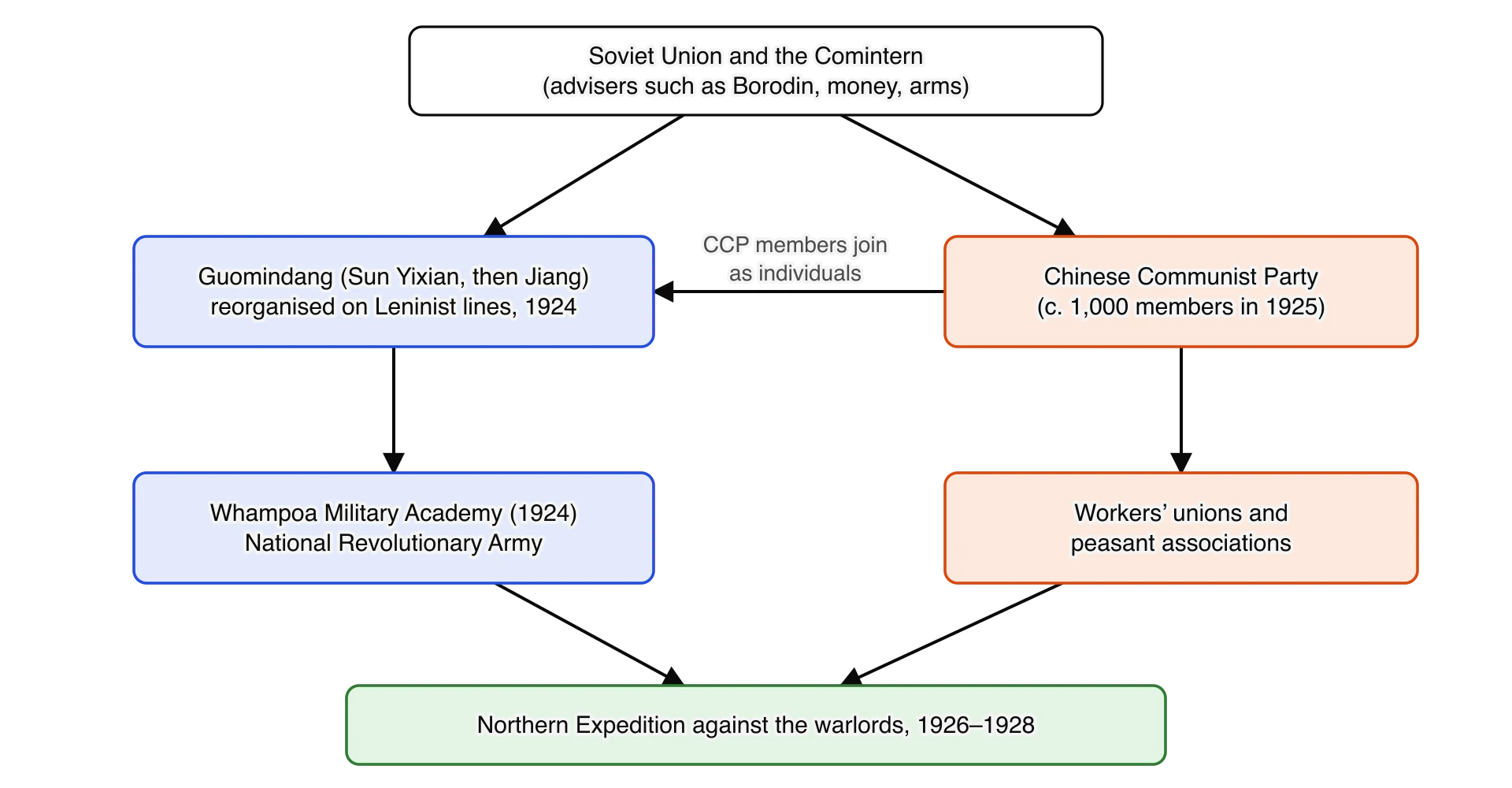
The most important result was an army. The Whampoa Military Academy, opened near Guangzhou in June 1924 with Soviet money and instructors, trained officers for a party army loyal to the Guomindang, the National Revolutionary Army. Its commandant was Jiang Jieshi (Chiang Kai-shek), a young officer trained in Japan who had just visited Moscow for Sun; the communist Zhou Enlai served in its political department. The diagram of the United Front shows how Soviet aid supported both parties, and how the Guomindang’s army and the communists’ mass organisations were meant to work together against the warlords.
Growth and tension, 1925–1926
Both parties grew quickly. On 30 May 1925 police of the foreign-run International Settlement in Shanghai, under a British officer, shot dead protesters demonstrating against the killing of a Chinese worker at a Japanese-owned mill. The May Thirtieth Movement that followed brought strikes and boycotts across China, and a strike and boycott against Hong Kong that lasted from June 1925 to October 1926. CCP membership rose from under a thousand in early 1925 to about 58,000 by April 1927 (party figures).
Sun’s death in March 1925 removed the one leader who could hold the alliance together. The Guomindang split into a left wing, led by Wang Jingwei, which supported the alliance, and a right wing hostile to the communists. Jiang used his control of the army to rise. In March 1926, in the Zhongshan Incident, he arrested communist officers and Soviet advisers after claiming that the gunboat Zhongshan was part of a plot against him, then limited communists’ posts in the party. The Soviet advisers, on Stalin’s orders, chose to accept this and keep the alliance.
The Northern Expedition, 1926–1928
In July 1926 the National Revolutionary Army, about 100,000 strong, launched the Northern Expedition from Guangzhou to defeat the warlords and unify China. It advanced quickly, helped by propaganda teams, peasant associations and workers’ unions organised largely by communists, and by warlord armies that changed sides. By early 1927 it had reached the Yangzi, taking Wuhan, Nanchang and Shanghai.
Success divided the alliance. The left-wing Guomindang and the communists set up a government at Wuhan, while Jiang made his headquarters at Nanchang and then Nanjing. In the countryside of Hunan and Hubei, peasant associations were seizing landlords’ land and punishing local elites, which alarmed the Guomindang officers, many of whom came from landowning families. Shanghai’s bankers and businessmen, and the foreign powers, looked to Jiang to stop the revolution going further.
The Shanghai massacre and the collapse of the First United Front, 1927
Shanghai was taken in March 1927 after communist-led workers rose against the warlord garrison. Jiang then struck at the communists. Before dawn on 12 April 1927 gunmen of the Green Gang, Shanghai’s largest criminal society, led by Du Yuesheng, attacked the headquarters of the communist-led unions, and Jiang’s troops disarmed the workers’ pickets. When workers marched in protest the next day, soldiers fired on them. Hundreds were killed in Shanghai in the first days and thousands more in the White Terror that followed in other cities controlled by Jiang and his allies in 1927–1928; the total is uncertain.
On 18 April 1927 Jiang set up his own Nationalist government at Nanjing. For a few months the Wuhan government stayed allied to the communists, but in June it learned that Stalin had instructed the CCP to build its own army and confiscate land, and in July 1927 the Wuhan leaders expelled the communists too. Borodin returned to Moscow, and the two Guomindang governments soon merged under Jiang’s leadership.
The communists’ failed uprisings
The CCP answered with armed revolt. On 1 August 1927 communist officers in the Nationalist army, including Zhou Enlai and Zhu De, rose at Nanchang; the date is still celebrated as the founding of the Red Army. In September Mao led the Autumn Harvest Uprising in Hunan, and in December communists seized Guangzhou for three days in the Guangzhou Commune. All three were crushed. Party membership, about 58,000 in April 1927, fell to around 10,000 by the end of the year (party figures).
The party leadership blamed Chen Duxiu, who was removed in August 1927, though the strategy of staying in the Guomindang had been Moscow’s. Under his successors the party continued to try to win the cities: in 1930 the leader Li Lisan ordered attacks on Changsha and other cities, which failed with heavy losses. From 1931 the party was led by the Returned Students (also called the “28 Bolsheviks”), young Moscow-trained leaders such as Wang Ming and Bo Gu, backed by the Comintern.
Jiang Jieshi and Guomindang rule
Reunification, 1928
After the breach with the communists, Jiang resumed the Northern Expedition in 1928 with the support of the northern warlords Feng Yuxiang and Yan Xishan. In June 1928 Zhang Zuolin abandoned Beijing; as his train returned to Manchuria on 4 June, officers of Japan’s Kwantung Army blew it up and killed him. Nationalist forces entered Beijing, which was renamed Beiping (“Northern Peace”), and the capital moved to Nanjing. In December 1928 Zhang’s son, Zhang Xueliang, known as the “Young Marshal”, raised the Nationalist flag over Manchuria. For the first time since 1916, China was united under one recognised government.
The unity was largely nominal. Many warlords had joined the Guomindang without giving up their armies, and in 1930 Feng Yuxiang, Yan Xishan and the Guangxi clique, with Wang Jingwei’s political support, rose against Jiang in the Central Plains War. Jiang won when Zhang Xueliang sided with him, but the war cost perhaps 300,000 casualties (estimates vary). For most of the decade Jiang’s government directly controlled only the provinces of the lower Yangzi around Nanjing and Shanghai.
Jiang Jieshi
Jiang Jieshi (1887–1975) came from a salt merchant’s family in Zhejiang. He trained as an officer in China and Japan, where he served in the Japanese army, joined Sun’s revolutionary movement and rose through his control of the Whampoa Academy and the army. In December 1927 he married Song Meiling, a sister of Sun’s widow and of the financier T. V. Song (Soong), which tied him to Sun’s family and to Shanghai banking; he was baptised a Methodist in 1930.
Jiang’s ideas combined several traditions. He saw himself as Sun’s heir and used the Three Principles, but he stressed national unity and order over democracy and social reform. He admired Confucian discipline and loyalty, the military efficiency of Japan and, in the 1930s, the apparent success of Fascist Italy and Nazi Germany in mobilising nations. German military advisers trained his best divisions from 1928 to 1938.
One-party rule: tutelage and its instruments
The Organic Law of October 1928 declared that China had entered the period of political tutelage. The Guomindang would rule on behalf of the people, through a government of five branches (yuan) as Sun had designed. In practice power lay with Jiang, who held the key military and party posts, and elections, a free press and opposition parties were not allowed.
The party was divided into factions that competed for Jiang’s favour. The CC Clique, led by the brothers Chen Guofu and Chen Lifu, controlled the party organisation. The Blue Shirts, a secret society of Whampoa graduates founded in 1932, admired fascism and promoted loyalty to Jiang as leader. A secret police under Dai Li hunted communists and critics. The army, landlords in the countryside and Shanghai bankers were the regime’s main supports.
The New Life Movement aims at the promotion of a regular life guided by the four virtues, namely, li [ritual/decorum], yi [rightness or duty], lian [integrity or honesty], and chi [sense of shame]. Those virtues must be applied to ordinary life in the matter of food, clothing, shelter, and action. … We must preserve order, emphasize organization, responsibility and discipline, and be ready to die for the country at any moment.
Jiang Jieshi, “Essentials of the New Life Movement”, speech, 1934 (translation in de Bary and Lufrano, Sources of Chinese Tradition, 2000). Jiang launched the New Life Movement in February 1934 at Nanchang, his headquarters for the campaigns against the Jiangxi Soviet. The extract shows his answer to China’s problems: moral and physical discipline drawn from Confucian virtues, joined to military-style order. Its audience was urban and official; it says nothing about land, rent or poverty, which is why critics saw it as a substitute for social reform.
Domestic policy in the Nanjing decade, 1927–1937
The ten years from the founding of the Nanjing government to the Japanese invasion of 1937 are known as the Nanjing decade. Judgements of Guomindang rule depend heavily on this period, because it was the only time Jiang’s government governed without full-scale war, although it fought the communists and rival militarists throughout.
Achievements
The government had real successes in rebuilding the state and recovering sovereignty. It won tariff autonomy between 1928 and 1930, which allowed it to raise customs duties and made the customs its largest source of revenue. It abolished lijin, the internal transit tax on goods, in 1931. Some foreign concessions were returned, including the British concessions at Hankou and Jiujiang (1927) and the naval base of Weihaiwei (1930), though extraterritoriality remained.
In finance, the Central Bank of China was founded in 1928, and in November 1935 a currency reform replaced silver with a managed paper currency, the fabi (“legal tender”), which ended the deflation caused by rising world silver prices. The government built roads, completed the Guangzhou–Hankou railway in 1936, started airlines and a national telegraph network, and expanded universities and secondary schools. A new Civil Code (1929–1931) gave women equal rights to inherit property, at least on paper, and the Academia Sinica, a national research academy, was founded in 1928. Shanghai became one of the great modern cities of Asia.
Failures
The countryside, where about four in five Chinese lived, saw little change. The Land Law of 1930 limited rents to 37.5 per cent of the main crop, but the government, which relied on landlords for local order, did not enforce it. Famine in the north-west in 1928–1930 killed millions, and the Yangzi and Huai floods of 1931 killed hundreds of thousands at the least. Peasants paid most of the cost of local government through land taxes and surcharges collected by local elites.
The army consumed most of the budget. Military spending and debt payments together took the large majority of central government expenditure, estimated at about 40–50 per cent for the military alone, because Jiang fought communists, rival warlords and, from 1931, faced Japan. The government borrowed heavily from Shanghai banks. Corruption and nepotism were widespread, especially around the families of Jiang’s in-laws, T. V. Song and H. H. Kong (Kung). Dissent was repressed: five young writers of the League of Left-Wing Writers were among communists executed in Shanghai in February 1931.
Area | Successes | Failures and limits |
|---|---|---|
Political | National government recognised abroad; unification of 1928; Organic Law and five-yuan system | One-party rule; factions; control limited to the lower Yangzi; Central Plains War (1930); repression |
Economic | Tariff autonomy; lijin abolished; Central Bank; fabi (1935); railways and roads; growth of modern industry | Little industry outside the coast; dependence on borrowing; silver crisis of 1934–1935; heavy military spending |
Social | Expansion of schools and universities; Civil Code; public health administration; New Life Movement | No effective land reform; famine and floods; New Life campaign remote from rural poverty |
Foreign relations | Recovery of some concessions; tariff autonomy; foreign advisers and investment | Extraterritoriality kept; loss of Manchuria (1931); appeasement of Japan in north China |
The table of successes and failures shows a pattern: the government did most where it could act from above, in finance, communications and diplomacy, and least where reform required confronting its own supporters, above all the landlords. The economic historian Thomas Rawski (Economic Growth in Prewar China, 1989) argues that modern industry and the wider economy grew faster in the 1930s than older accounts allowed; Lloyd Eastman (The Abortive Revolution, 1974) argues that the regime was too corrupt, factional and isolated from the people to transform China.
The Japanese occupation of Manchuria and its impact, 1931–1937
On 18 September 1931 officers of the Kwantung Army staged an explosion on the Japanese-owned South Manchuria Railway near Mukden (Shenyang) and used it as a pretext to occupy all of Manchuria. How Japan’s army made the decision is part of the story of Japan’s road to war; for China the questions are why the government did not resist, and what the loss did to the Nationalist regime.
Zhang Xueliang, whose armies held Manchuria, withdrew south of the Great Wall without serious fighting. The responsibility for this “non-resistance” is debated: Zhang later said he acted on his own judgement, while others blamed orders from Nanjing. Jiang’s government appealed to the League of Nations instead of declaring war. In March 1932 Japan set up the puppet state of Manchukuo with the former emperor Puyi as head of state.
Fighting spread south. In January 1932 Japanese forces attacked the Chinese districts of Shanghai, where the Nineteenth Route Army resisted for five weeks before a truce. The League’s Lytton Commission reported in October 1932 that Japan’s action was not legitimate self-defence and that Manchukuo was not a genuine independent state; when the League adopted the report in February 1933, Japan announced its withdrawal from the League. Japanese troops then took the province of Rehe (Jehol), and the Tanggu Truce of 31 May 1933 created a demilitarised zone south of the Great Wall, leaving north China open to further pressure. By 1935 Japan had forced Chinese troops out of Hebei and sponsored an autonomous regime in the east of that province.
The impact on the Guomindang
Economic loss. Manchuria held much of China’s heavy industry, coal and iron, and its soybean exports were a large part of China’s foreign trade. Their loss weakened the national economy and the government’s revenue.
Loss of legitimacy. Jiang’s policy of avoiding war with Japan while fighting the communists looked to many Chinese like a betrayal of nationalism, the principle on which the Guomindang claimed to rule.
Student protest. On 9 December 1935 students in Beiping demonstrated against Japanese encroachment and the government’s passivity; the December Ninth Movement spread to other cities and drew many students towards the communists.
Political opportunity for the CCP. The communists called for a united front against Japan from 1935, which made them appear the more patriotic party and prepared the ground for the Xi’an Incident of December 1936.
The occupation of Manchuria therefore weakened the Guomindang in a way that did not depend on battles: it forced the government into a policy that was militarily reasonable but politically damaging. Historians such as Hans van de Ven argue that Jiang was buying time to build an army able to fight Japan; his critics at the time saw only appeasement.
Mao Zedong and the turn to the countryside, 1927–1931
Mao Zedong (1893–1976) was the son of a prosperous peasant in Hunan. He trained as a teacher, worked in the Peking University library under Li Dazhao in 1918–1919, and became a founding member of the CCP. In the 1920s he worked in the Guomindang as well as the CCP and became the party’s leading expert on the peasants.
In a very short time, in China’s central, southern and northern provinces, several hundred million peasants will rise like a mighty storm, like a hurricane, a force so swift and violent that no power, however great, will be able to hold it back. They will smash all the trammels that bind them and rush forward along the road to liberation.
Mao Zedong, Report on an Investigation of the Peasant Movement in Hunan, March 1927 (text from the official Selected Works of Mao Tse-tung). Mao wrote after thirty-two days touring five counties of Hunan, to answer critics in both parties who thought the peasant associations had gone “too far”. The report argues that the peasants, not the urban workers, would be the main force of the Chinese revolution, a view that broke with orthodox Marxism and with the party leadership of the time. The Selected Works version was edited after 1949, when Mao was in power, so its confident prophecy reads more clearly than the original did; it remains good evidence of how Mao understood rural revolution before the breach of 1927.
Jinggangshan and the Red Army
After the failure of the Autumn Harvest Uprising, Mao led about a thousand survivors to Jinggangshan, a mountain area on the border of Hunan and Jiangxi, in October 1927. In April 1928 he was joined by the forces of Zhu De, a former warlord officer who had become a communist. Together they formed the Fourth Red Army, with Zhu as commander and Mao as political leader. In January 1929 they moved to the hills of southern Jiangxi and western Fujian, where they built a larger base.
Mao and Zhu developed a new kind of army and a new kind of war. The Red Army recruited peasants, redistributed land taken from landlords and won support through discipline: soldiers were ordered to pay for what they took, return what they borrowed and not mistreat civilians, rules later fixed as the “Three Rules of Discipline and Eight Points for Attention”. At the Gutian Conference in December 1929 the party resolved that the party must control the army and that soldiers were to be politically educated. In battle the Red Army avoided fighting stronger forces head-on.
“Divide our forces to arouse the masses, concentrate our forces to deal with the enemy.” “The enemy advances, we retreat; the enemy camps, we harass; the enemy tires, we attack; the enemy retreats, we pursue.” “To extend stable base areas, employ the policy of advancing in waves; when pursued by a powerful enemy, employ the policy of circling around.”
Letter of the Front Committee of the Fourth Red Army to the CCP Central Committee, 5 April 1929, quoted by Mao in “A Single Spark Can Start a Prairie Fire”, 5 January 1930 (Selected Works). Mao quoted the letter to answer pessimists in the party who doubted that small rural bases could survive. The slogans show the principles of guerrilla warfare that defeated the first encirclement campaigns, and their link to the masses: the army was meant to spread revolution as well as fight. Mao wrote as a leader defending his own methods against the party centre, so the extract presents them as more tested and agreed than they were.
Mao’s rise inside the party involved violence. In December 1930, in the Futian Incident, a purge of supposed members of the anti-communist “AB Corps” among the Jiangxi communists led to the torture and execution of thousands of party members and soldiers, with Mao’s approval. Historians disagree about how far it was a genuine security campaign and how far a struggle for control of the base area.
The Jiangxi Soviet and the encirclement campaigns, 1930–1934
The Chinese Soviet Republic
On 7 November 1931, the anniversary of the Bolshevik Revolution, the communists proclaimed the Chinese Soviet Republic at Ruijin in southern Jiangxi, with Mao as chairman of its government. At its height the Jiangxi Soviet governed perhaps three million people. It carried out land reform, redistributing land from landlords and rich peasants, issued a marriage law in 1931 that allowed free choice of partner and divorce, set up schools and literacy classes, printed its own money and stamps, and organised a government on the Soviet model.
The Soviet showed that the CCP could govern, but its policies also caused resentment. Land redistribution was often violent, rich peasants as well as landlords lost land, and heavy grain levies and conscription were needed to feed and man the Red Army. In October 1932, at the Ningdu Conference, the Returned Students’ leadership, now in Ruijin, removed Mao from military command, criticising his guerrilla methods as too cautious.
The five encirclement campaigns
Jiang launched five encirclement campaigns to destroy the Jiangxi Soviet between late 1930 and 1934. The first four failed: the Red Army drew government columns deep into the base area, cut them off and destroyed them one at a time.
Campaign | Dates | Government forces (approx.) | Outcome |
|---|---|---|---|
First | Dec 1930–Jan 1931 | About 100,000 | Defeated; the Red Army lures columns inland and destroys them |
Second | Apr–May 1931 | About 200,000 | Defeated by mobile warfare |
Third | Jul–Sep 1931 | About 300,000, under Jiang himself | Halted; troops withdrawn after the Mukden incident |
Fourth | Early 1933 | About 250,000–400,000 | Defeated by Zhou Enlai and Zhu De |
Fifth | Sep 1933–Oct 1934 | Often given as 500,000–700,000 or more | Blockhouses and blockade; the Red Army abandons the base |
Numbers in the table of campaigns are approximate, and accounts vary widely. The fifth campaign was different. On the advice of German officers, including Hans von Seeckt, Jiang built thousands of fortified blockhouses linked by roads, advancing a few kilometres at a time and tightening an economic blockade that cut off salt and other goods. The communist leaders, Bo Gu and the Comintern’s military adviser Otto Braun, chose to meet the attack with positional warfare, defending territory head-on. The Red Army lost heavy battles, and by October 1934 the base could no longer be held.
The Long March and the Zunyi Conference, 1934–1935
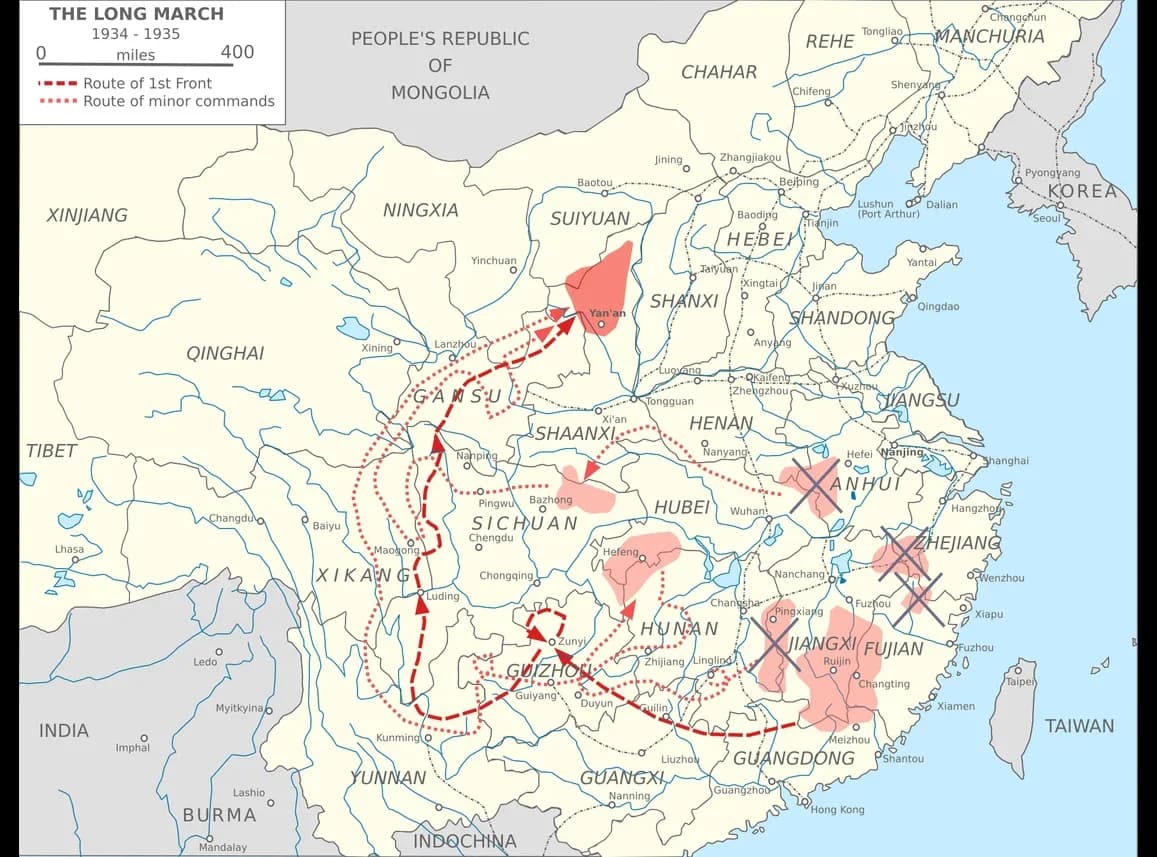
In mid-October 1934 about 86,000 men of the First Front Army broke out of the encirclement and marched west. They had no clear destination beyond joining other communist forces. At the crossing of the Xiang River in Guangxi in late November and early December 1934 they lost more than half their strength to Nationalist and provincial armies, partly because the column was slowed by porters carrying heavy equipment.
The Zunyi Conference
In January 1935 the army took the town of Zunyi in Guizhou. At an enlarged meeting of the Politburo there on 15–17 January 1935, the Zunyi Conference, the leadership examined the defeat. Mao, supported by Zhang Wentian, Wang Jiaxiang and finally Zhou Enlai, blamed the military strategy of Bo Gu and Otto Braun. Mao joined the standing committee of the Politburo, Braun lost his influence, and in the following weeks Zhang Wentian replaced Bo Gu as the party’s leader and Mao joined a small group directing military affairs with Zhou Enlai and Wang Jiaxiang.
Zunyi began Mao’s rise to the leadership but did not complete it: he was not made party chairman, and his position depended on military success in the months that followed. Its significance was that the CCP’s leaders, for the first time, chose a strategy without waiting for Moscow, whose radio contact with the party had been lost, and chose the advocate of mobile warfare and rural revolution.
From Zunyi to Shaanxi
Under Mao’s direction the army crossed and recrossed the Chishui River to confuse its pursuers, then crossed the Jinsha (upper Yangzi) and, in May 1935, the Dadu River at Luding. The official account describes a heroic charge across the chains of the Luding Bridge under fire; Jung Chang and Jon Halliday (Mao: The Unknown Story, 2005) claim that no battle took place, while other historians accept that there was fighting but think the episode was exaggerated. The marchers then crossed the Great Snowy Mountains and the swampy grasslands of the Tibetan borderlands.
In June 1935 Mao’s army met the larger Fourth Front Army of Zhang Guotao, a founding member of the party. The two leaders disagreed over where to go and who should command, and in September 1935 they split: Zhang went south-west, where his army was badly defeated, while Mao led a small force north. On 19 October 1935 it reached Wuqi in northern Shaanxi and joined the local base built by the communist Liu Zhidan. Perhaps 8,000 of those who had left Jiangxi arrived, after a journey later claimed as 25,000 li (about 12,500 km) and probably about 6,000–10,000 km.
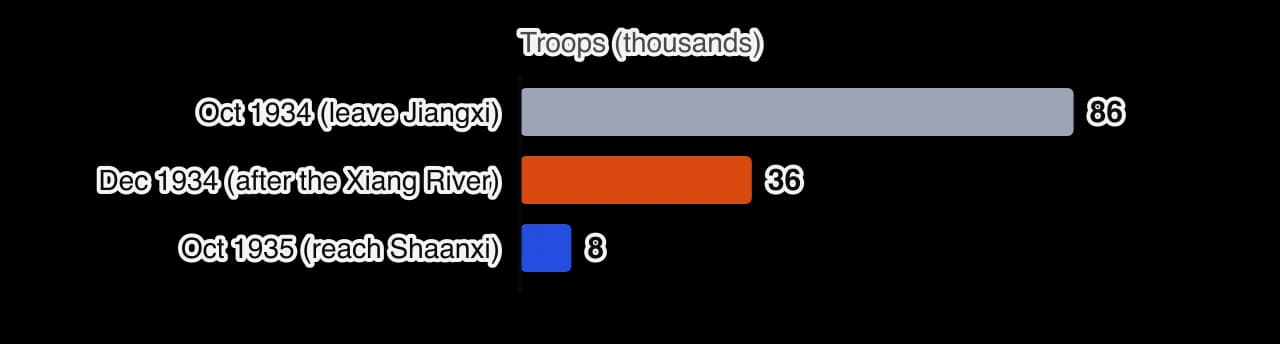
The chart of the army’s strength shows the Long March as a disastrous retreat. Yet the CCP turned it into a founding legend. In a speech of December 1935 Mao described it as a manifesto, a propaganda force and a seeding machine, which had shown the world the Red Army’s endurance and spread revolutionary ideas along its route. The march also gave the party a leadership that had survived together, and placed it in the north-west, where it could present itself as ready to fight Japan.
Yan’an and the leadership of Mao to 1936
The communists’ new base in northern Shaanxi was poor, thinly populated and mountainous, but it was secure. The party’s headquarters were at Wayaobao and then Bao’an in 1936, before moving to the town of Yan’an in January 1937, which gave its name to the whole period of communist rule in the north-west until 1947.
Three developments in 1935–1936 strengthened the party. First, at the Wayaobao Conference in December 1935, following the Comintern’s new policy of popular fronts against fascism, the CCP called for a national united front against Japan, including the Guomindang. The appeal for Chinese to stop fighting each other and fight Japan won sympathy in the cities, especially after the December Ninth Movement. Second, Mao consolidated his leadership: Zhang Guotao’s defeat removed his main rival, and the arrival of other Red Army units in 1936 put Mao at the head of a reunited army.
Third, the CCP gained a new image abroad and in China’s cities. In 1936 the American journalist Edgar Snow spent four months in the communist areas and interviewed Mao at length. His book Red Star over China (1937) presented the communists as honest, patriotic agrarian reformers led by a remarkable man, and it was translated into Chinese in 1938. Snow wrote what he saw and was told, under the guidance of his hosts, so the book is better evidence of how the CCP wished to be seen than of life in the base areas.
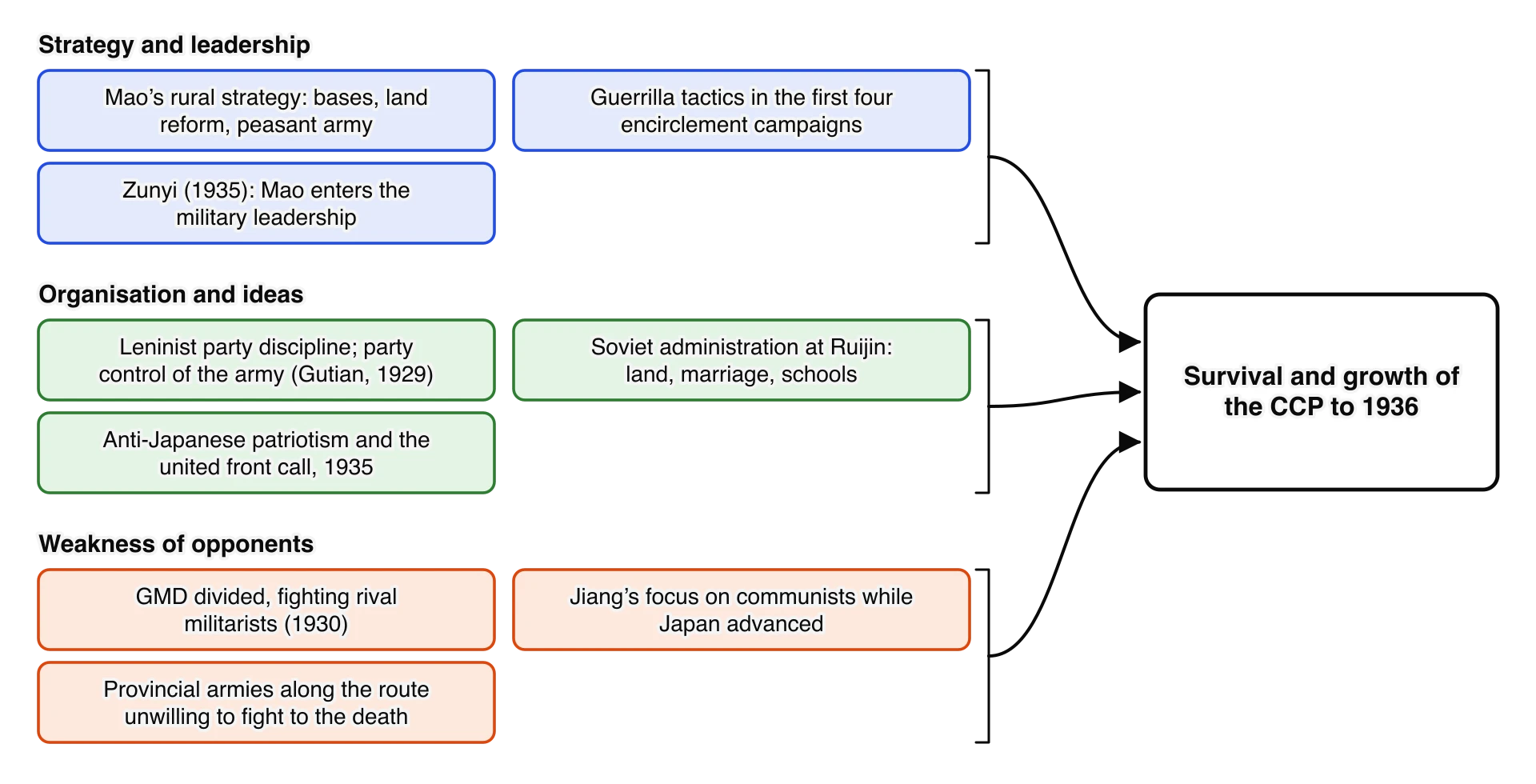
The diagram of the reasons for the CCP’s survival shows that by the end of 1936 its rise had depended on several factors acting together. Mao’s rural strategy and guerrilla tactics explain how the party rebuilt after 1927 and defeated the first four campaigns; party organisation and land reform explain how it governed; the weakness and divisions of its enemies explain why it survived the disasters of 1934–1935. In 1936 the CCP was still small, with only a few tens of thousands of troops in the north-west, and Jiang was preparing a final campaign against it.
The Xi’an Incident and the Second United Front, 1936–1941
By late 1936 Jiang believed that one more campaign would destroy the communists in the north-west. The troops he had sent to fight them, however, were mostly Zhang Xueliang’s Manchurian army, driven from its homeland by Japan, and the local north-western army of Yang Hucheng. Many of these soldiers wanted to fight Japan, not other Chinese, and Zhang had been in secret contact with the communists since early 1936.
When Jiang flew to Xi’an to order a new offensive, Zhang and Yang arrested him at the Huaqing hot springs outside the city on 12 December 1936, in the Xi’an Incident. They demanded an end to the civil war, a united front against Japan and political reform. Zhou Enlai came to Xi’an to negotiate for the CCP. Stalin, who wanted a strong China to tie down Japan and saw Jiang as the only leader who could unite it, pressed the communists to secure Jiang’s release. Jiang was freed on 25 December, apparently after giving verbal assurances, and returned to Nanjing with Zhang Xueliang, who was arrested and kept under house arrest for more than fifty years.
Full-scale war with Japan in July 1937 turned the promises into an alliance. In September 1937 the CCP and the Guomindang announced the Second United Front. The communists accepted the Three Principles, gave up armed revolt and land confiscation, and placed the Red Army nominally under the national government as the Eighth Route Army in the north; communist guerrillas left behind in the south became the New Fourth Army. The government recognised the communist Shaan-Gan-Ning Border Region around Yan’an.
The alliance was never a merger. The CCP kept its own command, territory and party organisation and expanded wherever the Japanese advance left a vacuum; the Guomindang saw this expansion as a threat and blockaded the border region from 1939. Clashes grew until January 1941, when government troops ambushed the headquarters column of the New Fourth Army in southern Anhui, killing or capturing several thousand men. After the New Fourth Army Incident, the united front survived in name only.
First United Front (1923–1927) | Second United Front (1937–1941/45) | |
|---|---|---|
Purpose | Defeat the warlords and unify China | Resist the Japanese invasion |
Form | CCP members join the Guomindang as individuals | Alliance of two separate parties, each with its own army and territory |
Outside backing | Soviet advisers, money and arms | Soviet aid to the national government (1937–1941); US aid from 1941 |
How it ended | Shanghai massacre (April 1927) and Wuhan expulsion (July 1927) | New Fourth Army Incident (January 1941); open civil war from 1946 |
Who gained most | The Guomindang, which won an army and national power | The CCP, which grew from a small regional force to a rival state |
The Second Sino-Japanese War, 1937–1945
On the night of 7 July 1937 Japanese and Chinese troops exchanged fire near the Marco Polo Bridge (Lugouqiao), south-west of Beiping. Unlike earlier incidents this one was not settled locally: Jiang decided that further retreat would destroy his government’s authority, and the Japanese government sent reinforcements. Beiping and Tianjin fell by the end of July.
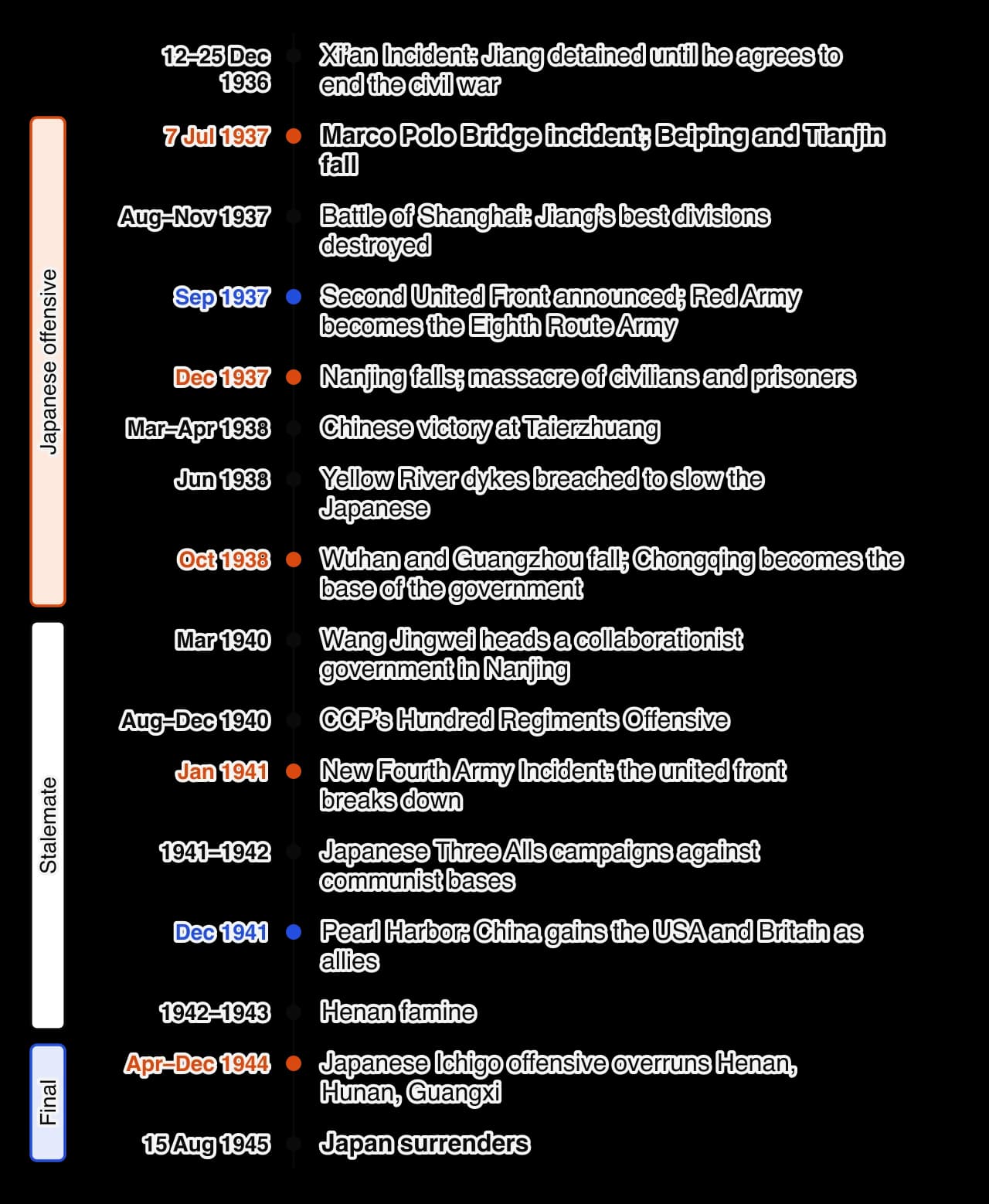
The timeline of the war shows that its first sixteen months decided its shape. In August 1937 Jiang opened a second front at Shanghai, partly to draw foreign attention and intervention. His best German-trained divisions fought for three months, and Chinese casualties are estimated at about 250,000. When the line broke, the Japanese pursued the retreating army to the capital. Nanjing fell on 13 December 1937, and Japanese troops killed prisoners and civilians and raped women on a vast scale over the following weeks; estimates of the dead range from tens of thousands to over 300,000, with the Tokyo war crimes tribunal finding over 200,000.
The government left Nanjing for Wuhan and made Chongqing in Sichuan, beyond the Yangzi gorges, its wartime capital; after the fall of Wuhan in October 1938 it was based there for the rest of the war. Chinese armies won a victory at Taierzhuang in Shandong in spring 1938, and in June 1938 Jiang ordered the dykes of the Yellow River to be breached at Huayuankou to slow the Japanese advance on Wuhan. The flood delayed the Japanese for some months, at a cost of several hundred thousand civilian dead and millions of refugees in Henan, Anhui and Jiangsu. Wuhan and Guangzhou fell in October 1938.
Political impact
From the end of 1938 the war became a stalemate. Japan held the north-east, the coastal provinces, the great cities and the railways; the Guomindang held the south-west and west from Chongqing; the CCP built bases in the countryside behind Japanese lines in the north. China was in effect divided into three.
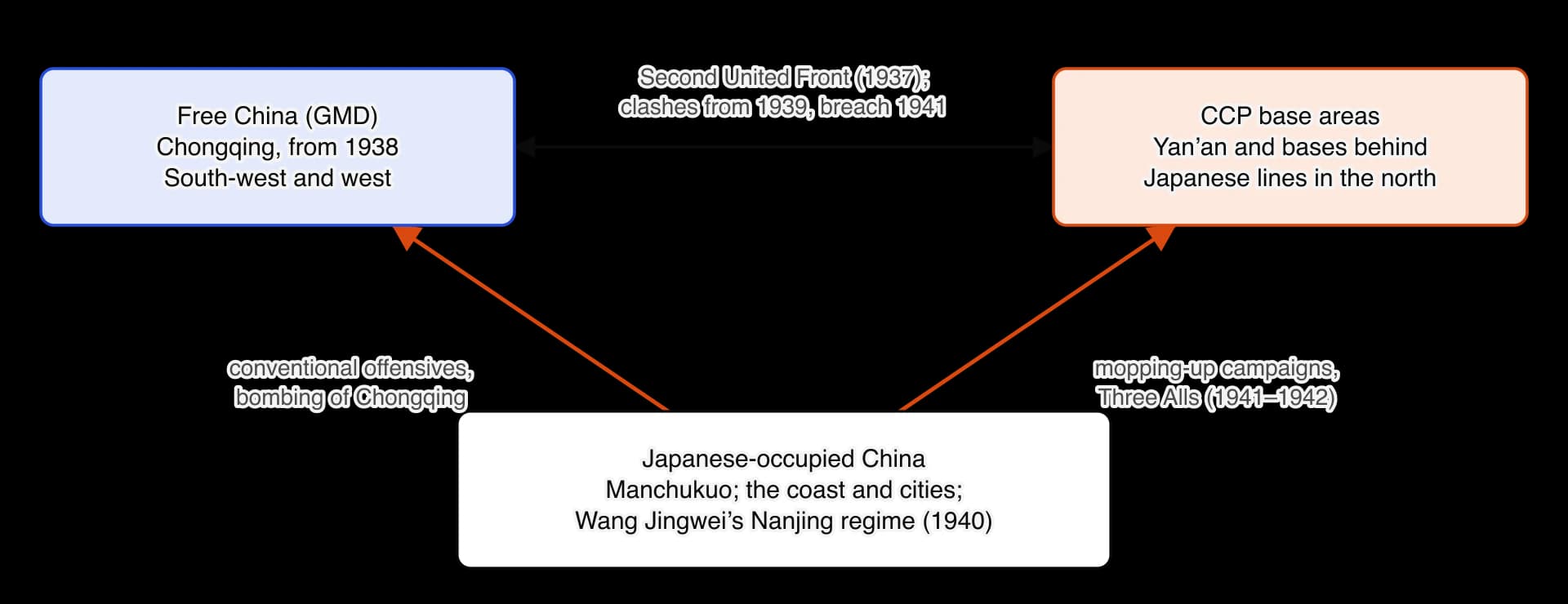
The diagram of China in three parts shows a central political fact of the war: each Chinese party faced the Japanese, but also watched the other. In March 1940 Wang Jingwei, Sun Yixian’s former deputy and Jiang’s long-time rival, became head of a collaborationist “Reorganised National Government” at Nanjing under Japanese protection, claiming to be the true heir of the Guomindang. His defection showed how deeply the war divided the Nationalist elite.
Japan’s attack on Pearl Harbor in December 1941 transformed China’s position. China became one of the Allies, received American Lend-Lease aid flown over the Himalayas (“the Hump”) after Japan cut the Burma Road in 1942, and recovered its full sovereignty when Britain and the USA gave up extraterritoriality in January 1943. At the Cairo Conference in November 1943 Jiang met Roosevelt and Churchill as one of the leaders of the great powers, and they agreed that Manchuria and Taiwan would be returned to China.
These diplomatic gains hid military weakness. Relations between Jiang and the American general Joseph Stilwell, his chief of staff from 1942, broke down over Stilwell’s demands for reform of the army and command of Chinese forces, and Stilwell was recalled in October 1944. In 1944 Japan’s Ichigo offensive, its largest land campaign of the war, overran Henan, Hunan and Guangxi and destroyed American air bases, and the Nationalist armies collapsed in front of it. When Japan surrendered on 15 August 1945, after the atomic bombings and the Soviet invasion of Manchuria, Jiang’s government was internationally recognised as one of the victors but exhausted at home.
Japanese military rule and the Three Alls Policy
Japan ruled occupied China through Chinese collaborators wherever it could, both because it lacked the manpower to govern directly and to present its conquest as a partnership against Western imperialism and communism. Manchukuo under Puyi, a Provisional Government at Beiping from December 1937, a Reformed Government at Nanjing from 1938 and Wang Jingwei’s regime from 1940 were all puppet regimes, with Japanese advisers and the Japanese army holding real power.
Japanese military rule combined economic exploitation with terror. Mines, railways and factories were taken over to supply Japan’s war economy, labourers were conscripted, and Chinese and Korean women were forced into military brothels (“comfort stations”). Japan’s secret biological warfare research facility, Unit 731 near Harbin, experimented on prisoners and spread plague in attacks on Chinese towns in Zhejiang and elsewhere in 1940–1942.
The Three Alls Policy
In August 1940 the Eighth Route Army, under the general Peng Dehuai, launched the Hundred Regiments Offensive against railways, roads and Japanese garrisons across north China. It did serious damage, but it also showed the Japanese how strong the communist bases had become. From 1941 the North China Area Army under General Okamura Yasuji answered with campaigns to destroy the bases, known in Chinese as the Three Alls Policy (“kill all, burn all, loot all”).
The campaigns hit the CCP hard. According to communist estimates, the population of the bases behind Japanese lines fell from about 44 million to about 25 million, and the Eighth Route Army lost many men and much territory. The party survived by dispersing its forces, cutting back open warfare and concentrating on political work and food production. In the longer term the brutality of the occupation drove many villagers towards the communists, who were often the only organised force resisting it locally.
Trading space for time and guerrilla warfare
Jiang’s strategy
Jiang’s strategy after 1938 is usually summed up as trading space for time. China could not defeat Japan’s modern army in battle, but it was vast. By retreating into the interior, keeping the core of the army in being and refusing to make peace, the government could exhaust Japan and wait for the international situation to change, above all for war between Japan and the Western powers. The fighting at Shanghai in 1937 and the breaching of the Yellow River dykes in 1938 belonged to the same logic: to make every advance costly, even at enormous cost to China.
Our resistance is a united effort of government and people. … Concord between government and people is the first essential to victory. … The hearts of our people are absolutely united.
Jiang Jieshi, “China Cannot Be Conquered”, speech at the opening of the Fifth Plenary Session of the Guomindang Central Executive Committee, Chongqing, 26 January 1939 (translation in Patricia Ebrey, Chinese Civilization: A Sourcebook, 1993). Jiang spoke a few weeks after the fall of Wuhan and Guangzhou and the defection of Wang Jingwei, at the moment when the war turned into a long stalemate. The speech presents resistance as a joint effort of government and people and insists on unity because unity was in doubt: Wang had just left the government, and the alliance with the communists was already strained. It is evidence of how the government wanted the war understood, not of the state of popular morale.
The strategy kept China in the war for eight years and tied down a large part of the Japanese army, which kept more than half a million troops in China south of the Great Wall for most of the war. But it had a heavy price. The government lost the coastal provinces that had provided most of its taxes and industry, its best divisions were destroyed in 1937–1938, and the army that survived was poorly supplied and increasingly reliant on forced conscription. Hans van de Ven argues that the strategy was rational and that American critics such as Stilwell misjudged it; others see a government more concerned to save its forces for the coming struggle with the communists.
The communists’ guerrilla war
Mao set out the communists’ strategy in a series of lectures in Yan’an in May 1938, published as On Protracted War.
Since the Sino-Japanese war is a protracted one and final victory will belong to China, it can reasonably be assumed that this protracted war will pass through three stages. The first stage covers the period of the enemy’s strategic offensive and our strategic defensive. The second stage will be the period of the enemy’s strategic consolidation and our preparation for the counter-offensive. The third stage will be the period of our strategic counter-offensive and the enemy’s strategic retreat.
Mao Zedong, On Protracted War, lectures at Yan’an, May 1938 (text from the Selected Works). Mao wrote after the fall of Nanjing, against those in both parties who expected either a quick defeat or a quick victory. The extract shows how the CCP placed guerrilla warfare inside a long-term plan in which irregular forces would grow into regular armies; it also served Mao’s purpose inside the party, against leaders such as Wang Ming who wanted the CCP to fight alongside the government in conventional battles.
In practice, the CCP sent its forces into the countryside behind Japanese lines, where Japanese garrisons held the towns and railways but could not control the villages. Small units ambushed convoys and attacked outposts, while party workers built local governments, militias and peasant associations. The communists generally avoided large battles after the Hundred Regiments Offensive and concentrated on expanding their territory and organisation.
How the CCP built support during the war
In the base areas the party moderated its social policy to fit the united front. Instead of confiscating land, it enforced rent and interest reduction (rents were limited to 37.5 per cent of the crop, the level the Guomindang had promised but not enforced) and gave landlords as well as peasants a place in local government. Production campaigns made the bases more self-sufficient: from 1941 the 359th Brigade reclaimed farmland at Nanniwan near Yan’an.
The party also tightened its own discipline. In the Yan’an Rectification Movement of 1942–1944, party members studied Mao’s writings and criticised themselves, and those suspected of disloyalty were investigated, sometimes brutally. Mao became chairman of the Politburo in 1943, and the Seventh Party Congress (April–June 1945) wrote “Mao Zedong Thought” into the party’s constitution. By 1945 the CCP claimed about 1.2 million members, armies of around 900,000 and base areas with a population of tens of millions.
Guomindang (Chongqing) | CCP (Yan’an and the bases) | |
|---|---|---|
Main strategy | Trading space for time; positional defence of the interior | Protracted war; guerrilla warfare behind Japanese lines |
Major battles | Shanghai, Taierzhuang, Wuhan (1937–1938), Changsha (1939–1942), defence against Ichigo (1944) | Pingxingguan (1937), Hundred Regiments Offensive (1940) |
Losses | Most of the war’s Chinese military dead; best divisions destroyed in 1937–1938 | Heavy losses in 1941–1942 from the Three Alls campaigns |
Political result | International recognition; domestic exhaustion and loss of support | Rapid growth of territory, party and army |
The table of strategies shows why the war affected the two parties so differently. The Guomindang, as the national government, bore the main weight of Japan’s conventional offensives; the CCP, fighting a different kind of war in the countryside, could grow in the spaces the Japanese advance had emptied of government.
Economic and social impact of the war
Hyperinflation
The loss of the coast deprived the government of its main revenues, the customs and the taxes on modern industry, while military spending rose. It covered the gap by printing money, which led to hyperinflation. Prices in “Free China” rose slowly at first and then exponentially: the government’s American financial adviser Arthur Young calculated a market price index that rose from 1 on the eve of the war to about 2,600 by August 1945. The fabi lost almost all its value.
Inflation reshaped society. People with fixed salaries, the officials, teachers, professors and junior officers on whom the state depended, were impoverished, while those who held goods or land, speculators and well-connected officials, could profit. Corruption spread as officials and officers sold supplies and took bribes to survive. Conscription fell hardest on poor peasants, who were seized by press gangs; many recruits died of hunger and disease before reaching the front.
Famine, refugees and displacement
Tens of millions of people fled the fighting, and universities, factories and government offices moved hundreds of kilometres inland. In Henan in 1942–1943 drought, locusts and the government’s continued requisition of grain for the army caused a famine in which about two to three million people died (estimates vary widely). The American journalist Theodore White, whose reports for Time magazine described the famine, blamed the provincial and national authorities for the requisitions; when Henan was overrun in the Ichigo offensive of 1944, some peasants turned on retreating Nationalist soldiers.
The war’s total cost to China was immense. Estimates of Chinese deaths range from about 14 million to 20 million or more, and Chinese official figures cite far higher totals of casualties. These numbers are uncertain because records in wartime China were incomplete and the totals have long carried political meaning in both China and Japan.
Weighing the impact on the two parties
Historians broadly agree that the war weakened the Guomindang and strengthened the CCP, but disagree about which effect mattered more. Rana Mitter (China’s War with Japan, 1937–1945, 2013) argues that the Nationalists’ eight-year resistance was central to the Allied victory and explains their exhaustion by 1945: the war, not only corruption, destroyed the government’s army, finances and support. Chalmers Johnson (Peasant Nationalism and Communist Power, 1962) emphasised the other side: the invasion gave the CCP the chance to lead peasants in national resistance. The war also changed the balance of armed force: a party that had a few tens of thousands of troops in 1936 ended the war with an army of around a million.
The Chinese Civil War, 1946–1949
From Japanese surrender to civil war, 1945–1946
Japan’s surrender in August 1945 began a race for territory. The Japanese armies in China were ordered to surrender only to the national government, and American aircraft and ships moved several hundred thousand Nationalist troops to the cities of the north and east, while about 50,000 US Marines held Beiping, Tianjin and the railways between them. Communist forces moved into the countryside around these cities and into Manchuria.
Manchuria, the most industrialised region of China, was occupied by the Soviet army, which had invaded on 9 August 1945. Under the Sino-Soviet Treaty of Friendship and Alliance of 14 August 1945, Stalin recognised Jiang’s government and promised to withdraw. But the Soviet forces removed much of Manchuria’s industrial equipment as war booty, delayed the arrival of Nationalist troops, and allowed communist forces under Lin Biao to take over large stocks of captured Japanese weapons before they left in spring 1946.
At the same time both sides negotiated. Mao flew to Chongqing in August 1945 for six weeks of talks with Jiang, which produced a vague agreement on 10 October. In December 1945 President Truman sent General George Marshall to mediate. The Marshall Mission arranged a ceasefire in January 1946 and a Political Consultative Conference of all parties, but neither side trusted the other enough to merge armies or share power. Fighting resumed in Manchuria in the spring, and by the summer of 1946 China was in full civil war. Marshall left in January 1947, declaring that extremists on both sides had wrecked his efforts.
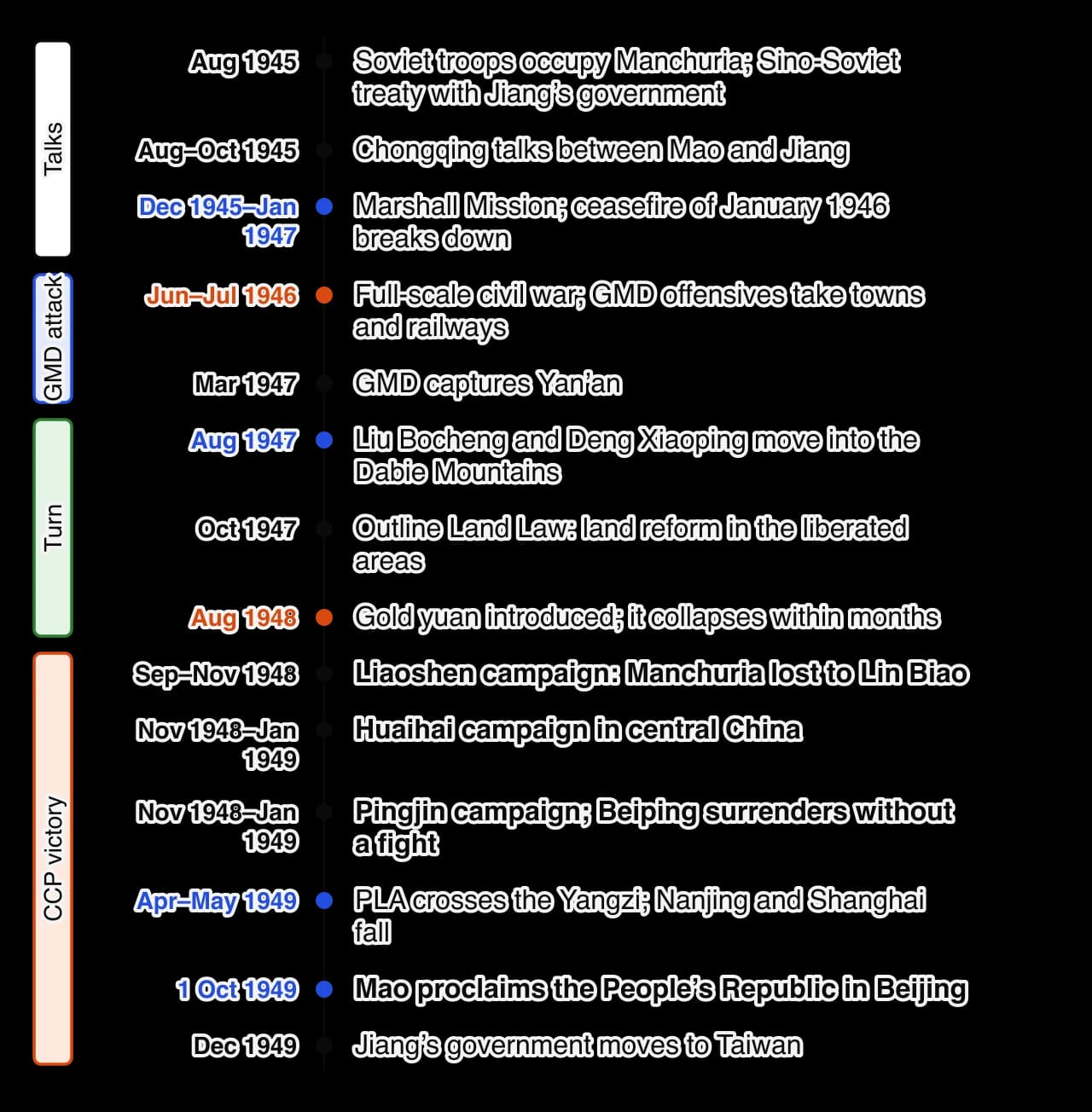
The course of the war
The timeline of the civil war shows three phases. From mid-1946 to mid-1947 the Nationalists attacked. With larger, better-equipped armies they took cities and railways in north China and Manchuria and, in March 1947, captured the communist capital of Yan’an, which the CCP abandoned without a fight. The communists, now called the People’s Liberation Army (PLA), gave up territory, avoided defending cities and concentrated their forces to destroy isolated Nationalist units.
In the second half of 1947 the initiative passed to the communists. In August armies under Liu Bocheng and Deng Xiaoping crossed the Yellow River into the Dabie Mountains of central China, threatening the Yangzi valley, while Lin Biao’s forces in Manchuria cut the Nationalist garrisons off from one another. Nationalist commanders, ordered to hold the cities, were increasingly besieged in them.
The war was decided in three great campaigns between September 1948 and January 1949.
Campaign | Dates | Where | Result |
|---|---|---|---|
Liaoshen | Sep–Nov 1948 | Manchuria (Liaoning) | Lin Biao takes Jinzhou, then Changchun and Shenyang; about 470,000 Nationalist troops killed, captured or defected; Manchuria lost |
Huaihai | Nov 1948–Jan 1949 | Central China, around Xuzhou, north of Nanjing | Largest battle of the war; Nationalist armies surrounded and destroyed (about 550,000 men lost); supplied by millions of peasant porters on the communist side |
Pingjin | Nov 1948–Jan 1949 | Beiping and Tianjin | Tianjin taken by storm; Fu Zuoyi surrenders Beiping without a battle on 31 January 1949 |
Figures in the table of campaigns are those usually given in Chinese accounts; they include men who surrendered or changed sides. In January 1949 Jiang resigned as president, leaving his deputy Li Zongren to seek peace terms, while he prepared to move the government’s gold reserves and best remaining units to Taiwan. Peace talks failed, and on 20–21 April 1949 the PLA crossed the Yangzi on a broad front. Nanjing fell on 23 April and Shanghai on 27 May. On 1 October 1949 Mao proclaimed the People’s Republic of China in Beijing, again the capital. In December 1949 Jiang’s government moved to Taiwan, followed by perhaps one to two million soldiers and civilians.
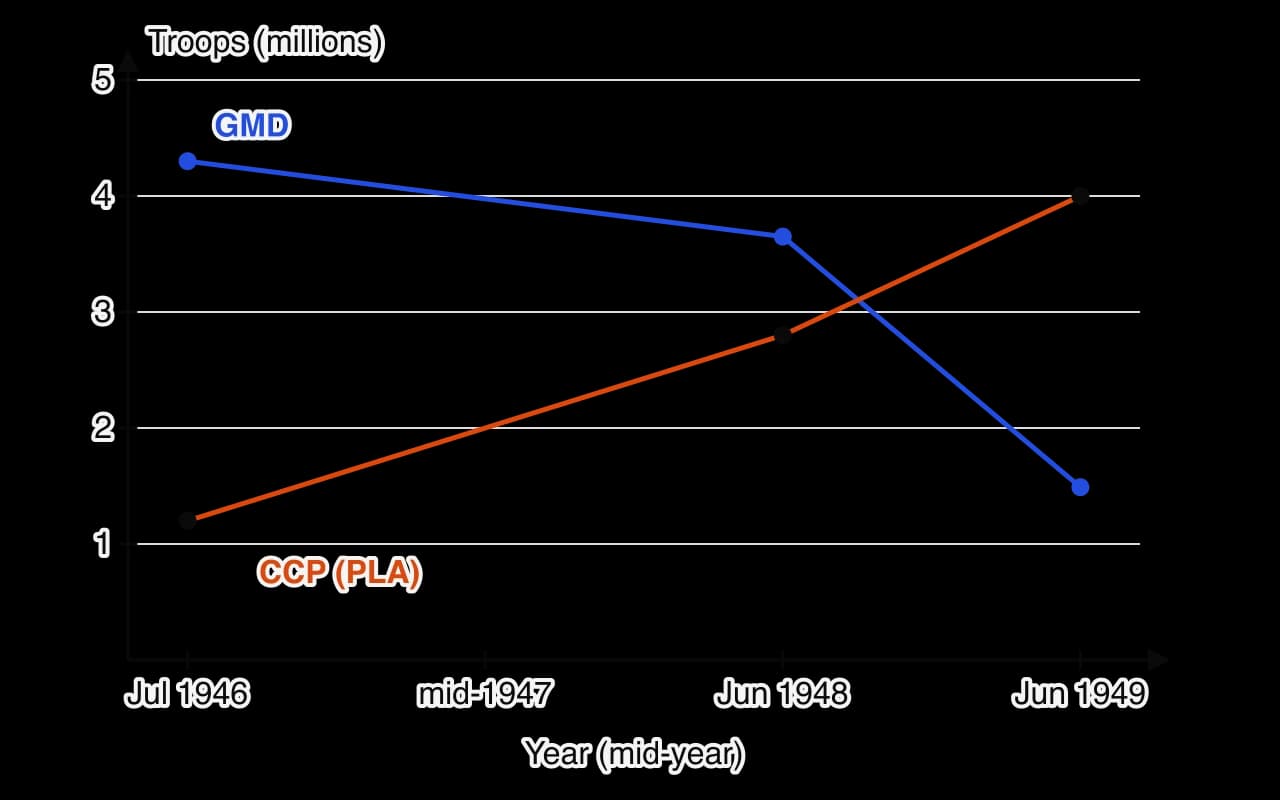
The line graph of the two armies’ strength shows how quickly the balance changed. The communists began the war with far fewer soldiers than the Nationalists and won by destroying or absorbing Nationalist armies, so that each victory both weakened the enemy and strengthened the PLA.
 YouTube
Reasons for the outcome of the civil war
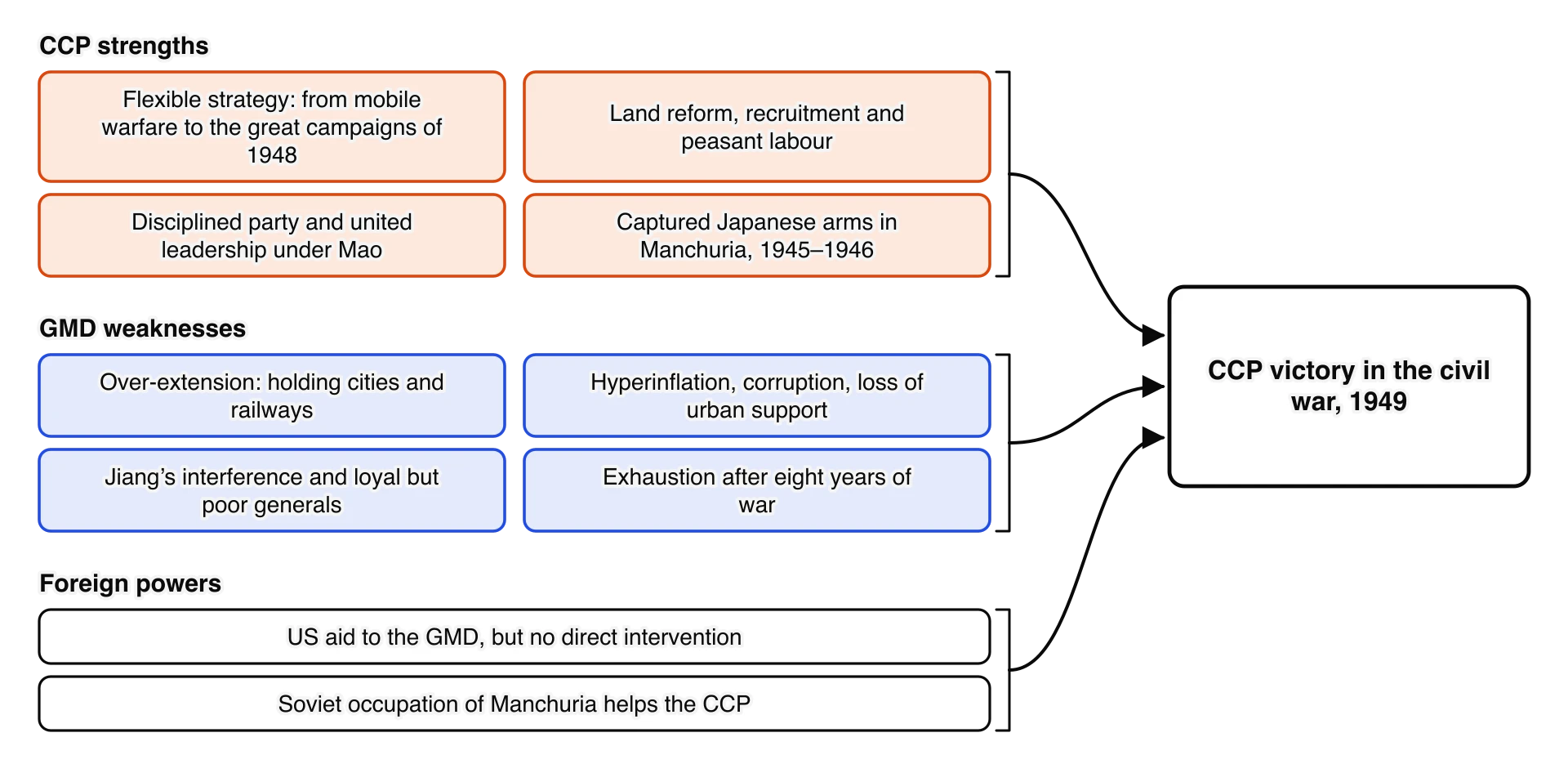
The diagram of reasons for the communist victory groups the explanations historians give into communist strengths, Nationalist weaknesses and the role of foreign powers. The main debate is about how they should be weighed.
Military strategies: guerrilla and conventional warfare
The PLA’s strategy changed as the war went on. In 1946–1947 it fought a war of movement, giving up cities and concentrating far superior force against isolated enemy units, a method summed up by Mao as destroying the enemy’s effective strength rather than holding places. From late 1947, and decisively in 1948, it shifted to large-scale conventional warfare, besieging cities and fighting set-piece battles with artillery, much of it captured from the Japanese and the Nationalists. Its commanders, especially Lin Biao, Su Yu and Liu Bocheng, had years of experience and considerable freedom to act within Mao’s general plans.
Nationalist strategy, by contrast, tied its armies to the defence of cities and railways across a vast area. Jiang insisted on holding Manchuria, the richest region of China and a symbol of national recovery, and lost his best American-trained divisions there in 1948. He often issued orders directly to divisional commanders, bypassing their superiors, and promoted generals for loyalty more than ability. Whole Nationalist units surrendered or changed sides, especially in 1948–1949, and their soldiers were retrained and incorporated into the PLA.
Peasant support for the CCP
Peasant support gave the PLA its soldiers, food and transport. In the Huaihai campaign the communists mobilised several million civilian labourers (the party’s figure is about five million) who carried supplies by shoulder pole and wheelbarrow. The CCP won this support partly through land reform. In May 1946 the party abandoned wartime rent reduction in favour of confiscating landlords’ land, and the Outline Land Law of October 1947 ordered the equal redistribution of all land in a village. Peasants who received land had a stake in a communist victory, and young men were recruited into the PLA to defend it.
Land reform was violent. Work teams organised “speak bitterness” meetings at which peasants accused landlords, many of whom were beaten or killed, and in 1947–1948 attacks spread to richer peasants until the party leadership restrained them. Historians disagree about why peasants supported the CCP: land and material gain, protection and nationalism, the party’s organisation and its capacity to compel, or a mixture varying by region. Recent regional studies stress that support was often built through the party’s control of the village as much as through enthusiasm.
The roles of Mao Zedong and Jiang Jieshi
Mao’s role lay in strategy and in the unity of the party. He set the general plan of the war, including the decision to fight for Manchuria and to seek decisive battles in 1948, and he presided over a leadership that, after the Rectification Movement, was disciplined and largely united. His political judgement, in particular the moderation of land reform in 1948 and the promise of a “new democracy” that would include the middle classes, helped the CCP win or neutralise groups beyond the peasantry.
Jiang’s role is harder to judge. He held the Nationalist cause together through eight years of war and kept the international recognition of his government, but in 1946–1949 his decisions repeatedly contributed to defeat: the over-extension into Manchuria, interference in field command, reliance on loyal but incompetent generals and refusal to tolerate rivals such as the Guangxi generals Li Zongren and Bai Chongxi. His government suppressed critics, among them the poet and professor Wen Yiduo, who was assassinated in Kunming in July 1946, which alienated intellectuals and students.
Economic collapse and the loss of urban support
Inflation, already severe during the war, became uncontrollable. The government financed the civil war by printing money, and in August 1948 it replaced the fabi with a new gold yuan at a rate of three million old dollars to one, with a strict price freeze enforced in Shanghai by Jiang’s son Jiang Jingguo. Citizens were ordered to exchange their gold, silver and foreign currency for the new notes. When the freeze was abandoned at the end of October, prices rose again faster than ever, and the savings of the middle classes were wiped out. The student protests of the Anti-Hunger, Anti-Civil War Movement of May 1947 and the collapse of the gold yuan turned much of the urban population, the Guomindang’s natural base, against the government.
The involvement of the USA and USSR
The United States supported the Nationalist government throughout, but within limits. It transported Nationalist armies in 1945, provided aid worth about 2 billion dollars in grants and credits between 1945 and 1949 by its own count, and under the China Aid Act of April 1948 gave a further package of about 460 million dollars authorised. But it imposed an arms embargo from July 1946 to May 1947 to press Jiang towards a settlement, never sent combat troops, and from 1947 gave priority to Europe under the Truman Doctrine and the Marshall Plan.
The Soviet Union’s role was also limited and ambiguous. Its occupation of Manchuria in 1945–1946 gave the CCP a decisive start in the region where the war was won, and it supplied captured Japanese arms. But Stalin signed his treaty with Jiang, kept diplomatic relations with the Nationalist government until 1949 and doubted that the CCP could win quickly; according to later Chinese accounts he advised Mao in 1949 not to cross the Yangzi, which Mao ignored.
The Nationalist armies did not have to be defeated; they disintegrated. History has proved again and again that a regime without faith in itself and an army without morale cannot survive the test of battle. … The unfortunate but inescapable fact is that the ominous result of the civil war in China was beyond the control of the government of the United States. Nothing that this country did or could have done within the reasonable limits of its capabilities could have changed that result; nothing that was left undone by this country has contributed to it. It was the product of internal Chinese forces, forces which this country tried to influence but could not.
Dean Acheson, US Secretary of State, letter of transmittal to President Truman, 30 July 1949, published with United States Relations with China (the China White Paper), August 1949. The White Paper was issued while the Truman administration was under attack from Republicans and the “China Lobby” for having “lost China”. Its purpose was to show that the Nationalists had lost through their own failings, which made it a defence of American policy as much as an analysis. The judgement that the outcome was decided by “internal Chinese forces” is supported by much later research, but the document is weak evidence on the effects of US decisions such as the 1946 arms embargo, which its critics blamed for weakening Jiang.
The White Paper did not end the argument. In the United States the question “who lost China?” fed the rise of McCarthyism in the early 1950s, as diplomats who had reported critically on the Nationalists were accused of disloyalty. For the history of the civil war, the balance of evidence suggests that foreign powers shaped where and how the war was fought, especially in Manchuria, but that the outcome was decided in China.
Factor | Evidence that it was decisive | Limits |
|---|---|---|
CCP military strategy | Liaoshen, Huaihai and Pingjin destroyed the main Nationalist armies in five months; flexible shift to conventional war | Depended on Nationalist mistakes and on the defection of whole units |
Peasant support and land reform | Recruits, porters and food; the Huaihai campaign | Land reform was violent and sometimes cost support; support was partly organised or compelled |
GMD weaknesses | Hyperinflation, corruption, loss of urban support, poor generalship, collapse of morale | Many weaknesses were caused or worsened by eight years of war with Japan |
Leadership | Mao’s strategy and a united party; Jiang’s errors in Manchuria and in command | Leaders worked within the conditions created by the war and the economy |
Foreign powers | Soviet occupation of Manchuria; US aid without intervention | Neither superpower was willing to fight for its Chinese ally |
Perspectives and debates
The history of China between 1910 and 1949 was written for decades by the winners and the losers of the civil war. Official histories in the People’s Republic presented the period as the story of the CCP’s inevitable rise; Nationalist histories on Taiwan blamed Soviet subversion and the Japanese invasion; American writers argued over “who lost China”. Since the 1980s, the opening of archives in China, Taiwan, Russia and Japan and the publication of Jiang’s diaries have allowed historians to test these older views.
The early Republic: chaos or openness?
The traditional view sees 1912–1928 as a time of failure in which Yuan Shikai betrayed the revolution and warlords tore the country apart. Ernest Young (The Presidency of Yuan Shih-k’ai, 1977) presents Yuan as a modernising centraliser whose aims, a strong state able to resist foreign pressure, were shared by many Chinese. Edward McCord (The Power of the Gun, 1993) explains warlordism as the product of constitutional conflict, and Arthur Waldron (From War to Nationalism, 1995) argues that the warlord war of 1924 itself transformed Chinese politics and helped create the mass nationalism of the mid-1920s. Frank Dikötter (The Age of Openness, 2008) goes furthest, presenting the Republic as a time of open borders, free debate and cultural vitality that the later one-party states closed down.
May Fourth and the origins of modern nationalism
Chow Tse-tsung’s The May Fourth Movement (1960) established the movement as the turning point of modern Chinese intellectual history. Official CCP history dates the beginning of the “new democratic revolution” from 4 May 1919, which links the party to the movement’s patriotism. Vera Schwarcz (The Chinese Enlightenment, 1986) stresses the intellectuals’ commitment to reason and individual freedom, a legacy that was later suppressed, and Rana Mitter (A Bitter Revolution, 2004) traces how May Fourth ideas shaped every later Chinese political movement, including both the CCP and its critics.
The Nanjing decade: failure or interrupted success?
Lloyd Eastman’s The Abortive Revolution (1974) and Seeds of Destruction (1984) argue that the Guomindang was doomed by its own nature: factional, corrupt, dependent on the army and the landlords, and cut off from the people. Others argue that the regime’s record was better than its reputation and that Japan cut its progress short. Thomas Rawski (1989) shows faster economic growth than earlier writers assumed; William Kirby (Germany and Republican China, 1984) describes a developmental state planning industry and defence with German help; and Jay Taylor (The Generalissimo, 2009), using Jiang’s diaries, presents Jiang as a nationalist moderniser whose achievements were destroyed by war.
Why did the CCP rise?
Historians have explained the CCP’s growth in different ways. Some stress nationalism and the war: the invasion gave the communists the chance to lead resistance in the countryside. Others stress the party’s social programme (Mark Selden, The Yenan Way, 1971), its organisation and military strategy (Tetsuya Kataoka, Resistance and Revolution in China, 1974), or its skill in adapting to local conditions and controlling villages (Chen Yung-fa, Making Revolution, 1986). These views are now usually combined, with regional studies showing that the balance differed from place to place.
A different debate concerns Mao himself. Jung Chang and Jon Halliday (Mao: The Unknown Story, 2005) present Mao as ruthless and self-serving from the start, argue that heroic episodes such as the battle at the Luding Bridge were invented, and claim that Jiang allowed the Long March to escape. Many specialists, for example in Was Mao Really a Monster? (2010), edited by Gregor Benton and Lin Chun, accept that Mao’s rise involved violence such as the Futian purge, but criticise the book’s use of sources and reject its claims about the Long March.
The war and the civil war
Rana Mitter (China’s War with Japan, 2013) and Hans van de Ven (War and Nationalism in China, 1925–1945, 2003) restore the Nationalist war effort to the centre of the story. They argue that eight years of resistance, which American wartime critics such as Stilwell and Theodore White dismissed, exhausted the government and explain much of its later collapse. Diana Lary (The Chinese People at War, 2010) shows the social cost for ordinary people, which undermined the government’s support.
For the civil war itself, Suzanne Pepper (Civil War in China, 1978) argues that the Nationalists lost the political struggle in the cities, through inflation, corruption and repression, before they lost on the battlefield. Steven Levine (Anvil of Victory, 1987) shows how the CCP built its power in Manchuria. Odd Arne Westad (Decisive Encounters, 2003) stresses that the war was won militarily, and that the outcome was not inevitable: Nationalist strategic errors in 1947–1948 and the CCP’s ability to fight conventional campaigns were decisive. Tang Tsou (America’s Failure in China, 1963) argues that the USA pursued large aims in China with limited means and could not have changed the result without a commitment it was never willing to make.
Debate | Historian (work, year) | Argument | Evidence stressed |
|---|---|---|---|
Early Republic | Ernest Young (1977); Frank Dikötter (2008) | Yuan as moderniser; the Republic as an age of openness | Yuan’s centralising reforms; publishing, trade and travel in the 1920s |
Nanjing decade | Lloyd Eastman (1974, 1984) | The GMD failed because of its own corruption, factions and lack of reform | Blue Shirts; neglect of land reform; corruption |
Nanjing decade | Thomas Rawski (1989); Jay Taylor (2009) | Real economic and state-building progress, cut short by Japan | Growth data; infrastructure; Jiang’s diaries |
Rise of the CCP | Mark Selden (1971); Chen Yung-fa (1986); Tetsuya Kataoka (1974) | Reform programme, organisation and strategy explain communist growth | Rent reduction; mass mobilisation; the second united front |
Mao | Jung Chang and Jon Halliday (2005); Benton and Lin Chun (eds., 2010) | Mao’s rise built on ruthlessness and myth; critics dispute the evidence | Futian; Luding Bridge; the use of sources |
War with Japan | Rana Mitter (2013); Hans van de Ven (2003) | The war of resistance exhausted the Nationalists and decided their fate | Losses of 1937–1938; Ichigo; inflation |
Civil war | Suzanne Pepper (1978) | The GMD lost the cities politically before it lost the war | Inflation; student movements; repression |
Civil war |
The table of interpretations shows that the main division is between explanations that stress the Nationalists’ failures and those that stress the communists’ strengths, with a third group stressing the war with Japan as the force that changed the balance between them. These are not exclusive. A strong judgement can show how they connected: the war weakened the Nationalists and enlarged the CCP, but it took the CCP’s strategy and the Nationalists’ errors in 1946–1949 to turn that change into victory.
Applying the ideas in exam questions
The five practice questions are in the style of the IB, not past questions. Each guidance note gives what the question requires, indicative content that is neither prescriptive nor exhaustive, and what a top-band answer does; marks are awarded on a best-fit basis against seven levels (14–15 for the top level).
Paper 3: national identity, 1912–1928
Paper 3: the First World War
Paper 3: Guomindang rule
Paper 3: the rise of communism to 1936
Paper 3: the outcome of the civil war
Self-check
- To do:
I can explain how the Republic was established in 1912 and how Yuan Shikai turned it into a dictatorship, including the Song Jiaoren assassination, the Second Revolution and the Hongxian monarchy.
- To do:
I can describe the warlord cliques and explain the political, economic and social effects of warlordism.
- To do:
I can explain Sun Yixian’s Three Principles of the People, the three stages of revolution and the idea of political tutelage.
- To do:
I can explain the aims and significance of the New Culture Movement, including New Youth, baihua and the attack on Confucianism.
- To do:
I can describe the nature of Chinese involvement in the First World War, including the Chinese Labour Corps and the declaration of war in 1917.
- To do:
I can explain the Twenty-One Demands and why they mattered for Chinese nationalism.
- To do:
I can explain the decision on Shandong at Paris, why China refused to sign the Treaty of Versailles, and China’s place in the League of Nations.
- To do:
I can explain the causes, events and significance of the May Fourth Movement and the founding of the CCP.
- To do:
I can explain the Sun–Joffe Manifesto, how the First United Front worked and why it collapsed in 1927.
- To do:
I can describe Guomindang ideology and Jiang Jieshi’s leadership, including the New Life Movement.
- To do:
I can weigh the successes and failures of domestic policy in the Nanjing decade.