R3 Asia and Oceania
The twelve HL regional studies of Asia and Oceania, from Asian kingdoms after 750 to 2020: how they fit together, the themes that link them, and how two of them are chosen and examined.
- IB History
- HL only
What R3 covers
From the subject guide: what you need to know and be able to do.
Regional study: HL students study two of these twelve, examined in paper 3.
12 subtopics in Asia and Oceania
Each one has its own page once something is published for it.
- R3.1Asian kingdoms and empires (750 CE–1500 CE)notes
- R3.2The Mughal Empire and the British East India Company (1526–1858)notes
- R3.3Challenges to imperial rule in China (1736–1911)notes
- R3.4Indigenous societies and national identity in Australia and New Zealand (circa 1770–2020)notes
- R3.5Korea (1840–1945)notes
- R3.6Independence of India (1857–1964)notes
- R3.7The emergence of independent states in Southeast Asia (1900–1990)notes
- R3.8Emergence of modern China (1910–1949)notes
- R3.9Politics and economy in Japan (1912–2020)notes
- R3.10The emergence of Central Asian republics (1917–2020)notes
- R3.11The Cold War in Asia (1949–2002)notes
- R3.12The People’s Republic of China (1949–2020)notes
An overview of R3 Asia and Oceania
Asia and Oceania is one of the four regions of the HL regional studies. Its twelve studies run from 750 to 2020 and cover East, South, Southeast and Central Asia, Australia and New Zealand: medieval kingdoms and empires, the Mughal Empire and the British East India Company, the late Qing empire, colonial rule and the struggles for independence, the revolutions and modern states of China, Japan and Korea, the Central Asian republics and the Cold War in Asia.
Twelve regional studies
Each regional study is a page of its own. The chart of the twelve studies places them on one time axis.
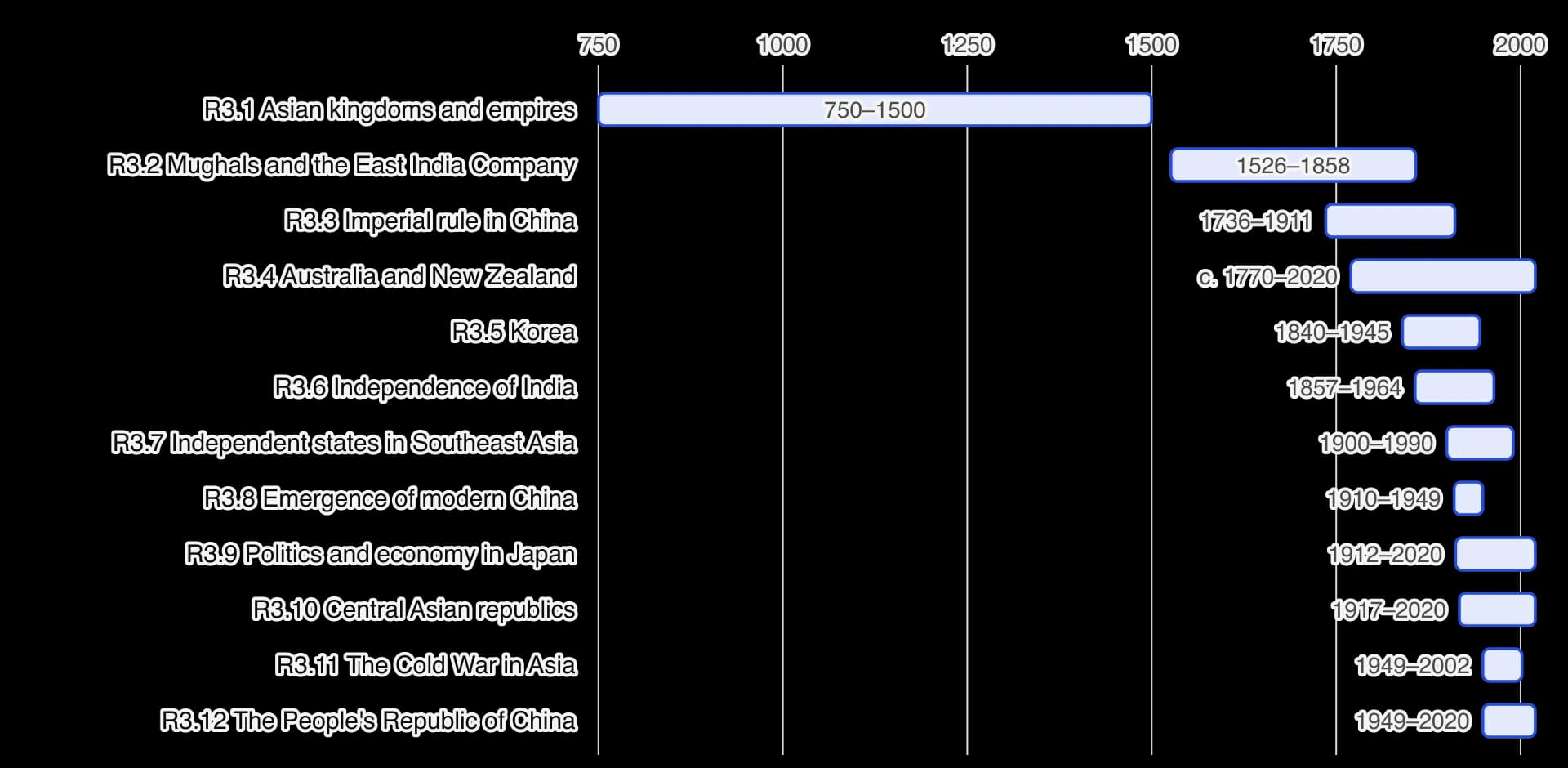
Several studies continue directly from one another, so events at the end of one form the starting point of the next. The Xinhai Revolution of 1911 ends the study of imperial China and opens the study of modern China, which ends with the founding of the People's Republic in 1949, where the last study of China begins. The table of themes groups the studies by what they are mainly about.
Theme | Studies | What they cover |
|---|---|---|
Kingdoms and empires and their challengers | R3.1, R3.2, R3.3 | Five states taught in full, including the Kamakura shogunate, the Mongol Empire and Angkor (750–1500); the Mughal Empire and the rise of the East India Company (1526–1858); the Qing empire from Qianlong to the revolution of 1911, including the Opium Wars and the unequal treaties (1736–1911) |
Colonial rule, nationalism and independence | R3.4, R3.5, R3.6, R3.7 | Indigenous peoples, colonisation and national identity in Australia and New Zealand (c. 1770–2020); Korea from the late Joseon dynasty to Japanese rule and liberation (1840–1945); Indian nationalism, independence, Partition and Nehru's India (1857–1964); colonial rule and the new states of Southeast Asia (1900–1990) |
Revolution and the modern states of East Asia | R3.8, R3.9, R3.12 | The Republic, the warlords, the Guomindang and the Communist victory in China (1910–1949); Japan from Taishō democracy through militarism, war and occupation to the economic miracle and after (1912–2020); the People's Republic under Mao, Deng and their successors (1949–2020) |
Soviet rule and the Cold War | R3.10, R3.11 | The making of the five Central Asian republics under Soviet rule and after 1991 (1917–2020); the wars in Korea, Vietnam, Cambodia and Afghanistan (1949–2002) |
Big ideas that run through the region
Imperial power and its decline is the first thread. The Mughal and Qing empires were among the largest and richest states in the world, and historians debate how far their difficulties came from internal problems such as succession disputes, rebellion and population pressure, and how far from the Western impact of trade, opium, warships and treaties. Japan stands out because it answered Western pressure by building its own empire, which shaped the history of Korea, China and Southeast Asia until 1945.
Nationalism and the struggle for independence form a second thread, from the Indian National Congress and the March First Movement in Korea to the new states of Southeast Asia. Independence came by very different routes (negotiation, war, partition) and often left divided countries: Partition in 1947, two Korean states by 1948 and two Vietnams in 1954. In Australia and New Zealand the comparable story is the place of Aboriginal and Torres Strait Islander peoples and of Māori in national identity, from terra nullius and the Treaty of Waitangi to land rights and treaty settlements.
Revolution, communism and the Cold War are the third. The Chinese Communist Party won power in 1949 and rebuilt China twice, under Mao and under Deng; Soviet rule created the Central Asian republics; and the Cold War became a series of hot wars in Korea, Vietnam and Afghanistan in which local leaders and outside powers both shaped the outcome. Perspectives matter greatly: national narratives differ sharply over colonial rule in Korea, the responsibility for Partition, Mao's record and frontier violence in Australia, and new archives keep changing historians' views.
How the regional studies are studied and examined
The regional studies are taken by HL students only; SL students do not study them. Each school chooses one of the four regions (Africa and the Middle East, the Americas, Asia and Oceania, or Europe) and then two of its twelve studies, taught in about 90 hours. They are the part of IB History that builds skill in evaluating historical arguments.
The regional studies are assessed by Paper 3 (2 hours, 30 marks; 35 per cent of the HL grade). There is a separate paper for each region, with two essay questions on each of its twelve studies. Students answer two questions, each from a different study, and each essay is marked out of 15. Every question gives an argument to evaluate and asks "To what extent do you agree …?". The IB's published sample for this region is: "'The main reason for the outbreak of war in Korea in 1950 was contrasting views on free elections.' To what extent do you agree with this claim?" Some studies cover several states, such as the kingdoms of R3.1, the states of Southeast Asia and the Central Asian republics; questions on these can ask students to answer with reference to one state they have studied.
Carry on with R3 in Augment
With a free account, Augment remembers where you stopped and what you have practiced.