Notes on R3.1 Asian kingdoms and empires (750 CE–1500 CE)
Between 750 and 1500 much of Asia was ruled by kingdoms and empires that built some of the largest cities, temples and trading networks of the medieval world. Their history explains how states could be founded, held together and lost without modern bureaucracies or armies, and why the Mongol conquests of the thirteenth century affected almost every part of the continent.
Kingdoms and empires of Asia, 750–1500: ideas for comparison
The states in this study differed in almost every way. Japan under the Kamakura shogunate was an island country of rice farmers ruled by a warrior government. The Mongols were pastoral nomads from the steppe who built the largest land empire in history. Angkor was an agricultural kingdom organised around temples and water management, Đại Việt a rice-growing state of the Red River delta modelled partly on China, and Srivijaya a trading power that controlled the sea lanes between India and China.

The chart of the kingdoms' lifespans shows that the five main states overlapped in the thirteenth century, when the Mongol Empire was at its height. This is why the Mongols appear in the history of three of the others: Japan and Đại Việt defeated Mongol invasions, and the Mongol expedition to Java in 1292–1293 helped bring a new Javanese state, Majapahit, to power just as Srivijaya's influence was ending.
Kinds of state
Historians use several models to describe these states. Some were bureaucratic states on the Chinese pattern, ruled through salaried officials chosen by written tests of classical learning. Đại Việt moved in this direction under the Trần. Others were held together by personal ties between a ruler and lesser lords.
The mandala model fits Srivijaya and, to a lesser extent, Angkor. The anthropologist Stanley Tambiah described a similar "galactic polity". Both models explain why a strong king could rapidly extend his power, and why it could fall away just as quickly under a weak successor.
Victor Lieberman calls Pagan (Burma), Angkor and Đại Việt charter states: the first large states in their regions, whose capitals, religious institutions and forms of kingship set a pattern for later rulers. All of them faced a crisis between about 1250 and 1450.
Legitimacy and religion
Every ruler needed legitimacy: a widely accepted claim that he had the right to rule. In China and the states influenced by it, the emperor ruled under the Mandate of Heaven, which could be lost through misrule. In Southeast Asia, Hindu and Buddhist ideas presented the king as a chakravartin (universal ruler) or as a ruler with a special link to a god. The Mongol khans claimed a mandate from Tengri, the Eternal Heaven of steppe religion, to rule the world.
In Japan, real power and formal authority were separated. The emperor in Kyoto kept the highest status, while the shogun ruled the warriors with a title granted by the emperor. This dual structure lasted, in different forms, from 1185 to 1868.
Tribute and the Chinese world order
China was the largest economy and the leading cultural power of East Asia throughout the period, and its rulers expected neighbours to recognise their superiority. Under the tributary system, foreign rulers sent missions with gifts to the Chinese court, and received gifts, titles and the right to trade in return. Many states, including Srivijaya, Angkor and Đại Việt, sent tribute while remaining fully independent. For them tribute was a diplomatic and commercial arrangement more than real submission. Japan under the Kamakura shogunate sent no official missions, although private trade with China flourished.
Environment and climate
Environmental conditions shaped every state. Rice cultivation depended on the monsoon rains and, in the deltas, on dikes and canals. Climate historians identify a Medieval Climate Anomaly (about 950–1250), followed by cooler, less stable conditions from about 1300, the start of the Little Ice Age. Tree-ring records from Mongolia and Vietnam let historians date droughts and wet periods, although their effect on people is harder to establish.
Six questions to ask of any kingdom or empire
Theme | Questions to ask | Typical evidence |
|---|---|---|
Emergence | What military, economic, political and environmental factors created the state? Which mattered most? | Founding wars, alliances, control of land or trade, climate data |
Leaders | How did founders establish power, and how did later rulers consolidate it, succeed at home and abroad, and respond to challenges? | Reigns of key rulers, reforms, wars, crises |
Domestic developments | What were the social structure, culture and arts, religion, science and technology? | Law codes, temples and art, inscriptions, literature |
Foreign relations | How did alliances, diplomacy, exchange of ideas, trade and conflict shape the state? | Embassies and tribute, travellers, trade goods, wars |
Maintenance of power | What political, social, military and religious methods kept rulers in power? | Offices and officials, vassal ties, armies, religious patronage |
Challenges and decline | How far did factionalism, social and economic problems, conflict and rebellion, and environmental factors cause decline? | Succession disputes, debt and inflation, invasions, revolts, droughts and floods |
The table of the six questions gives the structure used for each state that follows. Each state is a complete case study, so a student who chooses one of them can answer a question on any of the six themes.
The Kamakura shogunate in Japan, 1185–1333
The Kamakura shogunate was Japan's first warrior government. It was founded by Minamoto no Yoritomo at the end of a civil war in 1185 and took its name from his headquarters at Kamakura, in eastern Japan, far from the imperial capital at Kyoto. For almost 150 years it ruled Japan's warriors alongside the imperial court, defeated two Mongol invasions, and then collapsed in 1333.
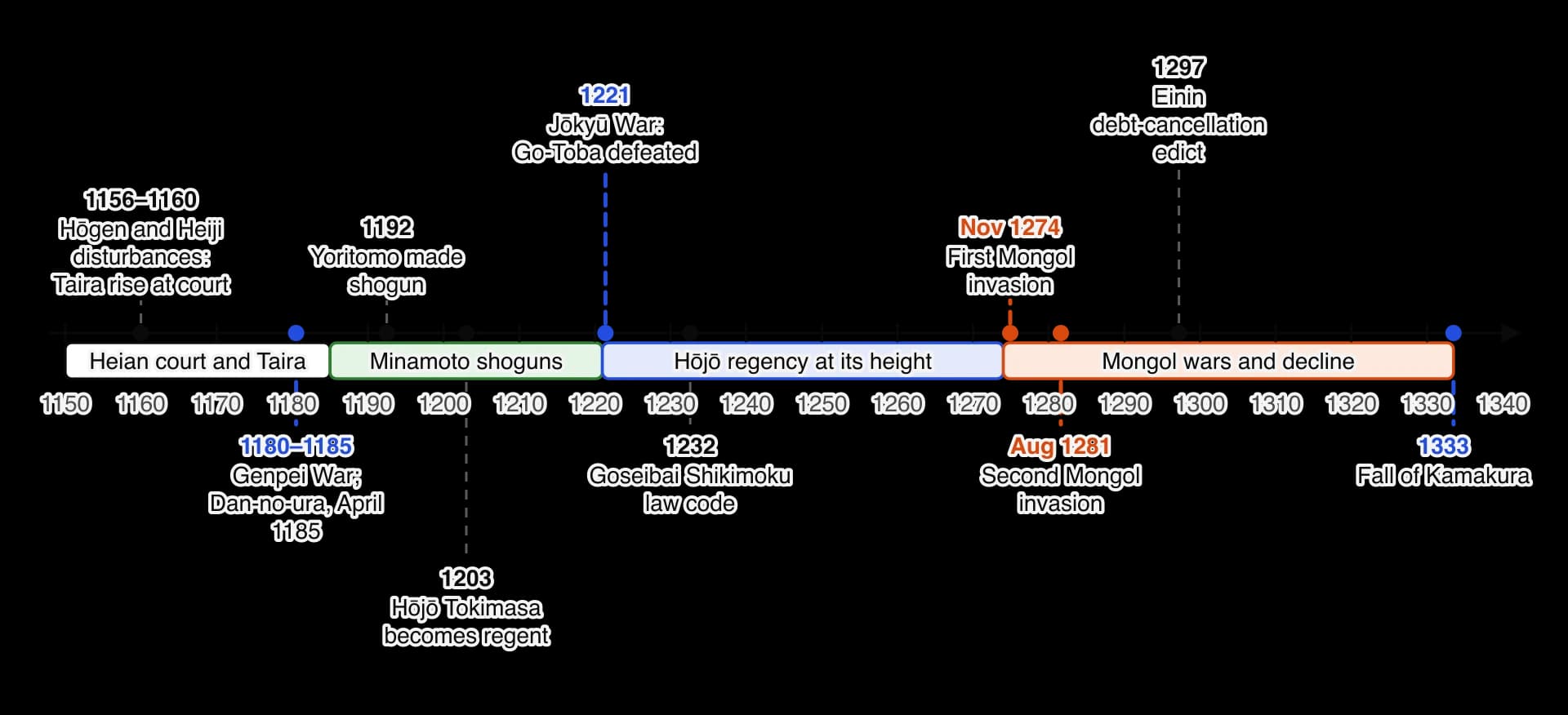
The timeline of the shogunate shows its four phases: the rise of warrior power at court in the 1150s and 1160s, the founding war of 1180–1185, a century of Hōjō rule, and the strains that followed the Mongol invasions of 1274 and 1281.
Emergence: the Heian court and the rise of the warriors
From 794 Japan was governed from Heian-kyō (Kyoto) by an emperor and a small court aristocracy. In practice the Fujiwara family dominated the court for most of the tenth and eleventh centuries as regents for child emperors. From 1086 retired emperors took control instead: by abdicating, an emperor could escape court ritual and rule through his own household, a system called insei ("cloister government").
Real power in the provinces was moving away from the court. Much of the farmland had been turned into shōen, private estates owned by court nobles and temples, which paid dues to their owners rather than taxes to the state. The estates were managed and defended by local warrior families, the bushi or samurai. The most powerful warrior houses, the Taira and the Minamoto, were descended from junior branches of the imperial family.
In the Hōgen (1156) and Heiji (1160) disturbances, succession quarrels at court were settled by warrior armies. The winner, Taira no Kiyomori, became the first warrior to dominate the court. He took the highest court office in 1167 and made his infant grandson emperor (Antoku) in 1180. His success turned the other court factions, and the defeated Minamoto, against the Taira.
The Genpei War, 1180–1185
In 1180 Prince Mochihito, a son of the retired emperor Go-Shirakawa, called on the Minamoto to rise against the Taira. Minamoto no Yoritomo, who had lived in exile in eastern Japan since 1160, raised an army there and made Kamakura his base. The Genpei War (from the Chinese readings of the names Minamoto and Taira) lasted five years.
Several factors explain the Minamoto victory:
Military. Yoritomo's half-brother Minamoto no Yoshitsune was an outstanding commander who won the battles of Ichi-no-Tani (1184), Yashima (1185) and the decisive sea battle of Dan-no-ura (April 1185), where the Taira fleet was destroyed and the child emperor Antoku drowned.
Political. Yoritomo won over the warrior houses of eastern Japan by confirming their land rights and promising new lands taken from the Taira. Many joined him less for loyalty to the Minamoto than to secure their own holdings.
Economic. The east was a region of horse-breeding and new rice land, which supported large forces of mounted archers. The Taira depended on the west and on court revenues.
Environmental. The Yōwa famine of 1180–1182 struck western Japan and Kyoto, the Taira heartland, and made it hard for them to feed armies. Kamo no Chōmei, a court poet, recorded in his Hōjōki (An Account of My Hut, 1212) that more than 42,000 bodies were counted in the streets of part of the capital in two months.
Yoshitsune's victories decided the battles, but the famine had weakened the Taira before the main campaigns, and Yoritomo's eastern alliances gave him a base that survived defeats. Yoritomo himself stayed in Kamakura building a government.
Leaders: Yoritomo and the Hōjō regents
Minamoto no Yoritomo (1147–1199)
Yoritomo built the institutions that turned a war coalition into a government. In 1180 he created the Samurai-dokoro (Board of Retainers) to manage his vassals, followed by an administrative office (Kumonjo, later the Mandokoro) and a board of inquiry for lawsuits (Monchūjo, 1184). In late 1185, using the excuse of hunting down Yoshitsune, who had fallen out with him, he obtained the court's permission to appoint two kinds of officials across the country.
Shugo (constables): one for each province, in charge of the military police, arresting rebels and murderers, and organising the vassals of the province for guard duty in Kyoto.
Jitō (stewards): appointed to individual estates, where they collected dues, kept order and took a share of the income.
These posts went to Yoritomo's vassals, the gokenin ("housemen"). They let the new government reach into estates owned by court nobles without abolishing those owners' rights. In 1189 Yoritomo destroyed the Northern Fujiwara of Ōshū, who had sheltered Yoshitsune, and so brought the whole of Japan under his control. In 1192 the court appointed him sei-i taishōgun ("barbarian-subduing generalissimo"), usually shortened to shogun.

The chart of Kamakura government shows its dual structure. The emperor and court continued to rule the capital, hold their estates and grant titles; the bakufu ruled the warriors and settled their disputes. Neither replaced the other.
Document 24: The bakufu confirms a woman as jitō, 1215. The chancellery of the shogun's house orders: to the residents of three gō within Nitta Estate, Kōzuke Province … In accord with the last will [yuzurijō] of the husband, Yoshikane, his widow shall forthwith be jitō. …
Document 138: Koyama Tomomasa is appointed shugo of Harima, 1199. … Tomomasa's authority is limited to rebels and murderers; …
Orders of the Kamakura shogunate, 1199 and 1215, translated by Jeffrey P. Mass in The Kamakura Bakufu: A Study in Documents (1976). These are working documents, written to be obeyed by local people, not to impress, which makes them good evidence of how the shogunate actually ruled. They show a government that worked through written orders and precedent, limited its officials' powers carefully, and accepted that a woman could inherit and hold a steward's post.
Hōjō Masako and the regency
Yoritomo died in 1199 after a fall from his horse. His sons were weak and both died violently: Yoriie was deposed and killed (1203–1204) and Sanetomo was assassinated in 1219 by a nephew. Power passed to the family of Yoritomo's widow, Hōjō Masako (1157–1225). Her father, Hōjō Tokimasa, became the first regent (shikken) in 1203, and her brother Hōjō Yoshitoki succeeded him in 1205 with her support. Masako, who had become a Buddhist nun after Yoritomo's death, was so influential that she was called the "nun shogun". After 1219 the Hōjō brought in child shoguns from the Fujiwara family and later from the imperial family, who held the title while the regents ruled.
The Jōkyū War, 1221
The retired emperor Go-Toba tried to destroy the Hōjō in 1221 by declaring Yoshitoki an outlaw and calling on warriors to rise. According to the shogunate's own chronicle, Masako appealed to the assembled vassals to remember what they owed Yoritomo, and they stayed loyal. A Kamakura army took Kyoto within a month. In the Jōkyū War Go-Toba and two other retired emperors were exiled, and about 3,000 estates belonging to the court's supporters were confiscated and given to Kamakura vassals as new stewardships.
The war was a turning point. The shogunate now chose emperors' successors, set up a permanent office at Rokuhara in Kyoto to watch the court (the Rokuhara tandai), and extended its stewards into western Japan. Kamakura became the stronger of Japan's two centres of power.
Hōjō Yasutoki and the law
Yasutoki (regent 1224–1242) turned Hōjō rule into government by council and law. In 1225 he set up a Council of State (Hyōjōshū) of senior vassals, and in 1232 he issued the Goseibai Shikimoku, a code of 51 articles for deciding warriors' disputes. It was based on Kamakura's own precedents and on what Yasutoki called common sense (dōri), not on Chinese-style court law. It set rules for the duties of shugo and jitō, for inheritance, and for land held without challenge for twenty years. It recognised women's right to inherit, hold and bequeath land. An appeals court (Hikitsuke) followed in 1249.
Domestic developments
Social structure
Kamakura society was organised around ties between lords and vassals. A gokenin received the shogun's favour (go'on), above all confirmation of land rights and new appointments as steward, and owed service (hōkō) in return: fighting in war, guard duty in Kyoto and Kamakura, and contributions to building projects. Beneath the gokenin were their own followers and the cultivators of the estates. The court nobility kept its rank and much of its income, but no longer controlled the warriors.
Women of warrior families had considerable rights in the early Kamakura period. Daughters inherited land under the custom of divided inheritance, widows managed estates and some held posts as jitō, as the order of 1215 shows. As repeated division left holdings too small, families increasingly gave daughters land only for life and passed the main estate to one heir.
Religion: new Buddhist schools
The Kamakura period saw the most important change in Japanese religion since Buddhism arrived. New schools offered salvation through simple practices open to everyone, not only to monks and nobles:
Pure Land Buddhism: Hōnen (from 1175) and his disciple Shinran taught that sincere repetition of the name of Amida Buddha (the nembutsu) would bring rebirth in Amida's paradise. It spread rapidly among commoners.
Zen Buddhism: Eisai brought Rinzai Zen from Song China in 1191 and Dōgen founded the Sōtō school after 1227. Zen stressed meditation and discipline. The Hōjō regents patronised it and invited Chinese monks to lead the great Zen temples of Kamakura, Kenchō-ji (1253) and Engaku-ji (1282).
Nichiren (from 1253) taught devotion to the Lotus Sutra alone. In 1260 he presented the regent with a treatise warning that Japan would suffer foreign invasion unless it abandoned other sects; after 1274 his followers saw the Mongol attacks as proof.
Zen's appeal to warriors is often exaggerated: most Kamakura warriors followed Pure Land teachings or the older schools, and the link between Zen and a warrior ethic was developed mainly later.
Culture, the arts, science and technology
Warrior patrons favoured a realistic style: the sculptors Unkei and Kaikei carved the giant guardians of the Great South Gate of Tōdai-ji (1203), and the bronze Great Buddha of Kamakura was begun in 1252. War tales such as the Heike Monogatari (The Tale of the Heike), recited by blind storytellers, told the story of the Genpei War through the Buddhist idea that all power is temporary.
Warfare rested on the mounted archer in heavy lamellar armour (ō-yoroi) with a long curved sword (tachi); Japanese swordsmiths of the period were among the most skilled in the world. In agriculture, double-cropping of rice and wheat spread in the west, iron tools and draft animals became more common, and periodic markets grew. Large imports of Chinese copper coins from the Song made money widely used in Japan for the first time.
Foreign relations: trade with China and the Mongol invasions
Japan had no official relations with China after the ninth century, but private trade grew in the twelfth and thirteenth centuries. Merchants brought Song coins, ceramics, silk, books and medicines to the port of Hakata in northern Kyūshū; Japanese monks travelled to study in Song monasteries and Chinese Chan (Zen) masters came to Kamakura. This exchange explains the rapid growth of Zen and of a money economy.
Khubilai's demands, 1266–1274
In 1266 Khubilai Khan, ruler of the Mongol Empire and soon of China, sent a letter to the "king of Japan" through Korea, which the Mongols had made a vassal. The letter reached Japan in 1268.
From time immemorial, rulers of small states have sought to maintain friendly relations with one another. We, the Great Mongolian Empire, have received the Mandate of Heaven and have become the master of the universe. … Japan is located near Koryo and since its founding has on several occasions sent envoys to the Middle Kingdom. However, this has not happened since the beginning of my reign. … From now on, let us enter into friendly relations with each other. Nobody would wish to resort to arms.
Khubilai Khan, letter to the ruler of Japan, 1266, translated in The Cambridge History of Japan, volume 3 (1990). The letter was written in the language of Chinese diplomacy, in which "friendly relations" meant that Japan should send tribute and accept the khan's superiority. It was intended to be polite but firm; its last sentence was read in Japan as a threat. Khubilai was at war with the Southern Song, which traded with Japan, and may have wanted to cut that trade or to gain an ally.
The court in Kyoto was inclined to send a reply, but the shogunate, led by the young regent Hōjō Tokimune, refused to answer this or later letters. It ordered the vassals of Kyūshū to prepare for war. In 1275 and again in 1279 it executed Mongol envoys.
The invasions of 1274 and 1281
First invasion (Bun'ei), 1274 | Second invasion (Kōan), 1281 | |
|---|---|---|
Forces (Yuan records) | About 900 ships; about 15,000 Mongol, Chinese and Jurchen troops and 8,000 Korean troops, with 6,700 sailors | Eastern Route Army from Korea: about 40,000 men, 900 ships. Southern Route Army from former Song China: about 100,000 men, 3,500 ships |
Course | Tsushima and Iki taken; landing at Hakata Bay, 19 November; one day of fighting; fleet withdraws and is damaged by a storm | Landings blocked by the stone wall at Hakata; weeks of fighting, with Japanese night raids on ships; a typhoon on about 15 August wrecks much of the combined fleet |
Outcome | Invaders withdraw to Korea | Heavy losses; survivors captured or killed; no further invasion, although Khubilai planned one until his death in 1294 |
Data: figures from the Yuan shi (official Yuan history) and Korean records, as given in Thomas Conlan, In Little Need of Divine Intervention (2001). The numbers are those recorded by the invaders and are probably inflated, especially for 1281; historians agree only that the second invasion was much larger than the first.
Between the invasions the shogunate built a stone wall about 20 km long around Hakata Bay (1276) and kept vassals on guard in Kyūshū. It also took the right to command warriors who were not its own vassals, which extended its power over the whole warrior class.
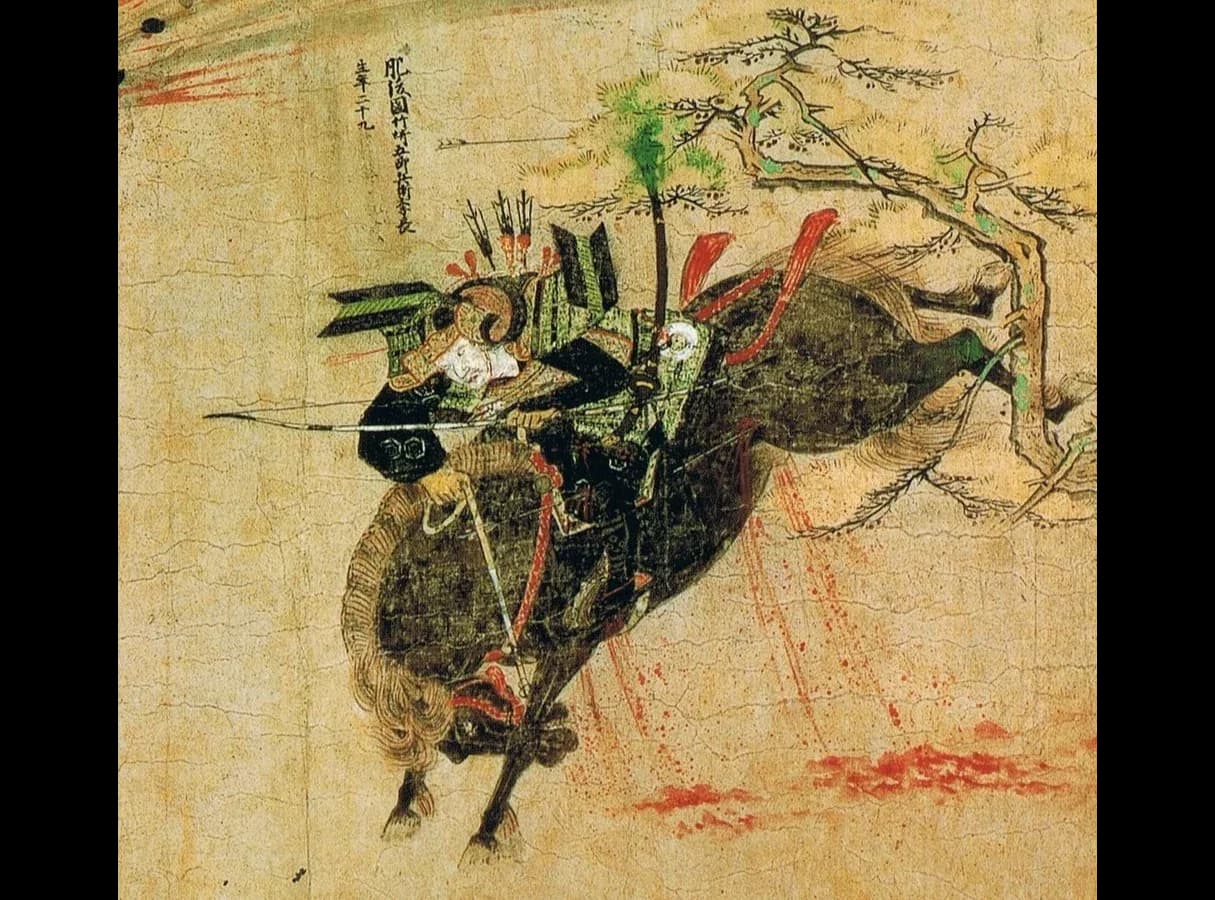
The scroll of Takezaki Suenaga is the main Japanese eyewitness source for the fighting. It shows that warriors fought for recognition and reward: Suenaga made sure others saw his charge, and later travelled to Kamakura to win a reward from the official in charge, Adachi Yasumori. The Mongols' explosive bombs, massed archery and fighting in formation were new to the Japanese, who were used to individual combat between mounted warriors.
Why did the invasions fail?
Japanese religious institutions credited victory to the gods, who were said to have sent a kamikaze ("divine wind") in answer to temple and shrine prayers. Storms did damage the fleet in 1274 and destroy it in 1281, but other factors mattered too: the effective Japanese defence at the wall, poorly built invasion ships, divided Mongol, Korean and Chinese forces that failed to coordinate in 1281, and the difficulty of using cavalry after a sea crossing.
Maintenance of power
The Kamakura shogunate held power for almost 150 years with a small central government and no standing army. Several methods worked together:
Method | How it worked | Evidence |
|---|---|---|
Political: law and courts | Disputes between warriors, and between warriors and estate owners, were settled in Kamakura's courts by written law and precedent | Goseibai Shikimoku (1232); appeals court (1249); thousands of surviving judgements |
Political: the regency | The Hōjō ruled through child or puppet shoguns, so the office of shogun could never be used against them | Fujiwara shoguns from 1226, princely shoguns from 1252 |
Social: vassal ties | Gokenin received land rights and appointments in return for service; their loyalty depended on rewards continuing | Favour and service; confiscated lands after 1185 and 1221 handed out as stewardships |
Military | Warriors were called up when needed; shugo organised guard duty and arrested rebels | Victories of 1221 and 1274–1281; Rokuhara office in Kyoto |
Religious | Patronage of shrines and temples, especially Zen and the Tsurugaoka Hachiman shrine at Kamakura, linked the regime to the gods and Buddhas | Kenchō-ji (1253) and Engaku-ji (1282); prayers ordered against the Mongols |
The table of methods suggests that law and land rights mattered more than force. The historian Jeffrey Mass argued that warriors accepted Kamakura rule because its courts protected their property, and that the bakufu was as much a judicial regime as a military one. Its weakness was the same as its strength: it needed a continuing supply of land and offices to reward its vassals.
Challenges and decline, 1281–1333
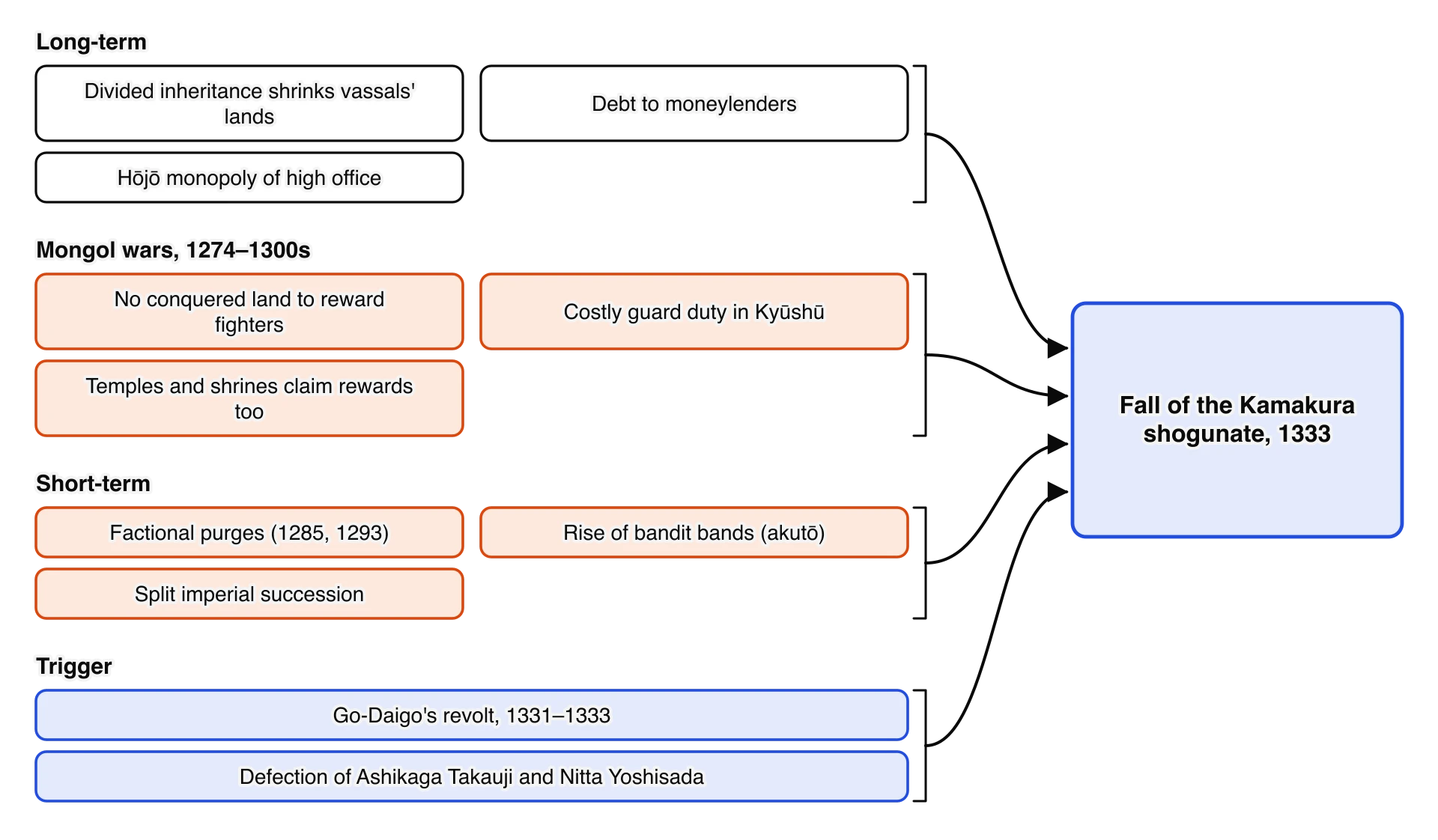
The diagram of the causes of the shogunate's fall groups them by timescale. The Mongol wars are central because they combined great costs with no gains. After 1281 there was no conquered land to distribute, yet vassals had fought, paid for their own equipment and continued to stand guard in Kyūshū until the early fourteenth century. Temples and shrines that claimed to have brought the divine wind also demanded rewards.
Social and economic problems
Many gokenin were already poorer than their grandfathers because divided inheritance had cut estates into smaller and smaller pieces. Some sold or pawned land to moneylenders. In 1297 the shogunate issued the Einin tokusei ("virtuous government") edict, which cancelled gokenin debts and returned land they had sold. It helped briefly, but lenders stopped lending and much of it was withdrawn in 1298. Outlaw bands (akutō, "evil bands") seized estate income in central and western Japan beyond the shogunate's control.
Factionalism
Power was concentrated in the head of the main Hōjō line (the tokusō) and his personal retainers, who held more and more provincial posts. This alienated other great families. In 1285 the Adachi family, led by the same Adachi Yasumori who had rewarded Takezaki Suenaga, was destroyed by the tokusō's chief retainer, Taira no Yoritsuna; in 1293 Yoritsuna was himself killed on the regent's orders. These purges weakened the bonds between the Hōjō and the rest of the warrior class.
The imperial family was also divided. After 1272 two branches, the Jimyōin and Daikakuji lines, competed for the throne, and the shogunate arranged for them to take turns. This made Kamakura responsible for imperial quarrels and gave the losing side a grievance.
Conflict and rebellion: Go-Daigo and the fall of Kamakura
Emperor Go-Daigo (r. 1318–1339) wanted to rule in person and to keep the throne in his own line. After two failed plots (1324 and 1331) he was exiled to the Oki Islands in 1332, but his supporters, led by local warriors such as Kusunoki Masashige, kept fighting. In 1333 Go-Daigo escaped. The shogunate sent Ashikaga Takauji, a leading gokenin, to crush the rising; instead he changed sides and destroyed the Rokuhara office in Kyoto. In July 1333 another eastern warrior, Nitta Yoshisada, captured Kamakura itself, and the last Hōjō regent, Takatoki, killed himself with several hundred followers.
Go-Daigo then tried to restore direct imperial rule in the Kenmu Restoration (1333–1336). It failed within three years because he did not reward the warriors who had won his war. Ashikaga Takauji turned against him, set up a rival emperor and founded a new shogunate, confirming that warrior government had come to stay.
The Mongol Empire, 1206–1368
The Mongol Empire was founded in 1206 when the leaders of the peoples of the Mongolian steppe proclaimed Temüjin their ruler as Chinggis Khan. Within seventy years his descendants ruled from Korea to Iraq and from Russia to southern China, the largest continuous land empire in history. After 1260 it divided into four states, and the last of them to rule China, the Yuan dynasty, fell in 1368.
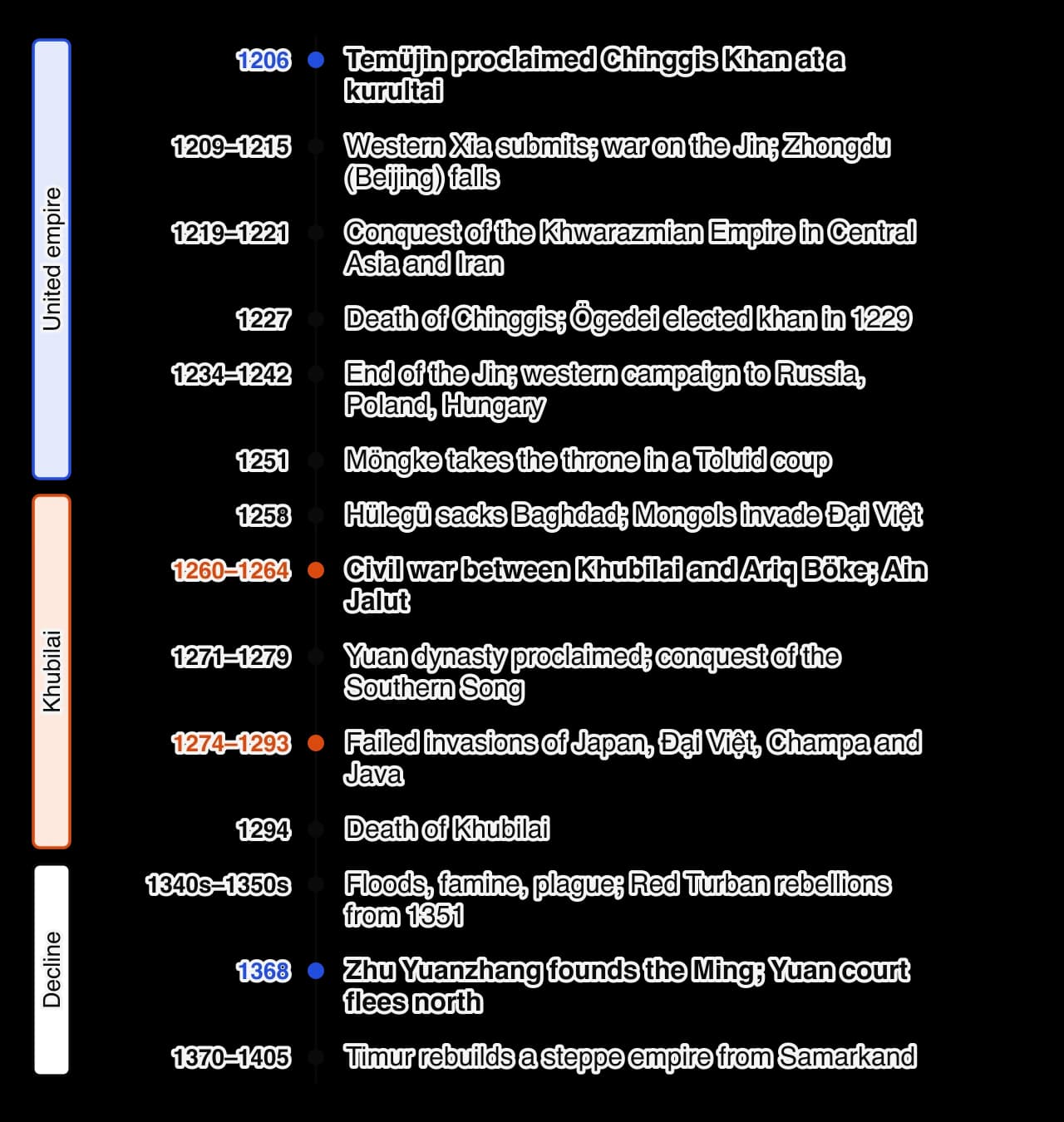
The chronology of the Mongol Empire shows how fast expansion came under a single khan, and how the succession war of 1260–1264 marked the end of the united empire. The conquest of the Southern Song (1235–1279) is a thematic case of its own; here it is treated only as part of the empire's wider history.
Emergence: from steppe chief to Chinggis Khan
The Mongols were one of many pastoral peoples of the eastern steppe, who herded horses, sheep, cattle and camels and moved between seasonal pastures. Steppe society was organised into clans and tribes led by aristocratic families. Wealth in animals rose and fell with the weather, and the steppe peoples depended on the settled states around them, above all China, for grain, metal goods and textiles, which they obtained by trade, tribute or raiding.
Temüjin was born in about 1162, the son of a minor chief who was poisoned when Temüjin was a boy, leaving his family poor and abandoned by their followers. He rose through personal alliances: with Toghrul, khan of the Kereit people, who had been his father's sworn brother, and with his own sworn brother Jamukha, who later became his rival. Between 1202 and 1205 he defeated the Tatars, then his former patron Toghrul, then the Naiman and Jamukha. In 1206 a kurultai, an assembly of steppe nobles, proclaimed him Chinggis Khan, probably meaning "fierce" or "universal" ruler.
Factors in the rise of the Mongols
Factor | Evidence |
|---|---|
Military | Every adult man was a mounted archer, with several horses each so armies could cover long distances quickly. Chinggis reorganised his army into units of ten, a hundred, a thousand and ten thousand (the last called a tümen), and placed men from different tribes together in new units under commanders he chose, which broke old tribal loyalties. A personal guard (keshig) of about 10,000 men trained future commanders. From 1211 the Mongols recruited Chinese and Muslim engineers to build siege engines. |
Economic | Conquest brought plunder, animals and captives that Chinggis shared with his followers; the need to keep rewarding them pushed the empire to keep expanding. Control of trade mattered: the war against the Khwarazmian Empire began after its governor at Otrar killed a Mongol-sponsored trading caravan in 1218. |
Political | Chinggis promoted followers for loyalty and ability rather than birth. Alliances and voluntary submissions, such as that of the Uighur kingdom in 1209, added skilled administrators and a script for the Mongol language. Rival states were divided: the Jin, Western Xia and Song distrusted each other. |
Ideological | Chinggis claimed that Tengri (Eternal Heaven) had given him the right to rule the world; resisting him was resisting Heaven. |
Environmental | Tree-ring evidence shows unusually warm, wet years on the Mongolian steppe from 1211 to 1225, which produced rich grass for horses at the time of the first great campaigns. Its importance as a cause is debated. |
The table of factors shows that the Mongols' rise depended on Chinggis's reorganisation of steppe society as much as on military skill. By breaking up the tribes and binding commanders to himself, he turned a loose confederation into a state built for war.
Leaders: from Chinggis to Khubilai
Ruler | Reign | Main achievements and problems |
|---|---|---|
Chinggis Khan | 1206–1227 | United the steppe; defeated Western Xia, took Zhongdu (Beijing) from the Jin in 1215; destroyed the Khwarazmian Empire (1219–1221) with great slaughter at Bukhara, Samarkand, Merv and Nishapur |
Ögedei | 1229–1241 | Built Karakorum as capital (1235); ended the Jin (1234); sent Batu and Sübedei west to Russia, Poland and Hungary (1236–1242); set up a tax system and relay posts |
Töregene (regent) | 1241–1246 | Ögedei's widow ruled during a long succession dispute |
Güyük | 1246–1248 | Short reign; quarrel with his cousin Batu nearly caused civil war |
Möngke | 1251–1259 | Took power in a coup by the family of Chinggis's youngest son, Tolui; ordered an empire-wide census; sent Hülegü against Iran and Baghdad and Khubilai against the Song; died on campaign in Sichuan |
Khubilai | 1260–1294 | Won the civil war against his brother Ariq Böke (1260–1264); proclaimed the Yuan dynasty (1271); built Dadu (Beijing); conquered the Southern Song (1279); failed invasions overseas |
Establishment and consolidation under Chinggis and Ögedei
Chinggis established the empire by conquest, but he also laid down the rules that held it together. He divided the people and lands among his family, appointed his own commanders over the units of a thousand, and set the principle that his descendants alone could rule.
Ögedei began turning a conquering army into a government. The Khitan adviser Yelü Chucai, who had served the Jin, is said to have persuaded him not to turn north China into pasture but to tax its farmers, arguing that taxes would yield far more silver, grain and silk each year. His death in December 1241 halted the western campaign, as the princes returned to elect a successor.
Möngke and Khubilai
Möngke restored central control after the disputes of the 1240s. He ordered a census of the empire for taxation and conscription, limited the abuse of relay stations by nobles, and launched two great campaigns: Hülegü against the Ismailis and the Abbasid caliphate (Baghdad fell in 1258; the advance was halted by the Mamluks of Egypt at Ain Jalut in 1260), and against the Southern Song, on which Möngke died in 1259.
Khubilai responded to the challenge of the succession by holding his own kurultai in north China in 1260 and defeating Ariq Böke, who had been chosen at Karakorum. He then ruled as a Chinese-style emperor: he adopted the dynastic name Yuan ("origin") in 1271, built a new capital at Dadu, and used Chinese officials, ritual and court institutions alongside Mongol ones. His domestic success, the conquest and integration of all China, contrasts with his failures abroad, where invasions of Japan, Đại Việt, Champa and Java were defeated or achieved little at great cost.
 YouTube
Domestic developments
Social structure and the role of women
Mongol society was led by the "golden lineage" of Chinggis's descendants and the commanders (noyan) of the army units. Ordinary herders owed military service and animals. Conquered peoples were counted, taxed and often moved: skilled craftsmen were spared in sacked cities and sent to work in Mongolia or wherever the khans needed them. In Yuan China the government ranked subjects in four groups, with Mongols and the semu ("various kinds", mainly Central Asians and Muslims) above northern and southern Chinese, which kept the conquered majority out of the highest posts.
Women of the ruling family had great political influence. Sorghaghtani Beki, the widow of Tolui, managed her family's lands in north China, protected its peasants and arranged for her sons Möngke, Khubilai, Hülegü and Ariq Böke to rise; all four became rulers. Töregene and later Oghul Qaimish ruled as regents. Mongol women managed households and herds when men were at war, and some rode and fought.
Religion and law
The Mongols' own religion centred on Tengri and on shamans who communicated with spirits. The khans tolerated, and exempted from taxes, the clergy of all the religions they met, partly because they wanted the prayers of every religion for the khan and partly because toleration reduced resistance. The court at Karakorum had Buddhist temples, mosques and Nestorian Christian churches. The Franciscan friar William of Rubruck, who visited Möngke in 1253–1254, recorded the khan's explanation of his view of religion.
"We Mo'al," he said, "believe that there is only one God, by whom we live and by whom we die, and for whom we have an upright heart." … Then he added: "But as God gives us the different fingers of the hand, so he gives to men divers ways. God gives you the Scriptures, and you Christians keep them not."
William of Rubruck, report to King Louis IX of France on his mission to Möngke Khan, 1255, translated by W. W. Rockhill (1900). Rubruck was a missionary who hoped to convert the Mongols and wrote for a Christian king, so he recorded the khan's criticism of Christians with some care. The passage shows a ruler who accepted many religions as different paths to one God, and who used that idea to stand above all of them.
In the successor states, rulers came to adopt the religions of their subjects. Khubilai made the Tibetan lama Phagpa his Imperial Preceptor and patronised Tibetan Buddhism; Phagpa designed a new script for writing all the empire's languages (1269). The Ilkhan Ghazan converted to Islam in 1295, as did the khans of the Golden Horde in the fourteenth century. A body of rules and decrees attributed to Chinggis, the Yasa, governed the army and the conduct of the Mongol elite, although no complete text survives and historians debate how far it was a written code.
Culture, science and technology
Mongol rule moved experts as well as goods across Asia. Hülegü founded an observatory at Maragha in Iran (1259) under Nasir al-Din al-Tusi; in China, Guo Shoujing produced the Shoushi calendar (1280) and a Persian astronomer brought Islamic instruments to the Yuan court. Rashid al-Din, a minister of the Ilkhans, compiled the Jami' al-tawarikh (Compendium of Chronicles, about 1307), the first history of the whole known world. In Yuan China musical drama (zaju) flourished, partly because educated Chinese shut out of office turned to writing.
Foreign relations: the Pax Mongolica
Historians use the term Pax Mongolica ("Mongol peace") for the period of about 1250 to 1350, when Mongol rule over most of the overland routes across Eurasia made long-distance travel and trade safer than before or after. The term describes conditions on the trade routes, not an absence of war: the Mongols fought each other and their neighbours throughout.
Three institutions made this exchange possible. The yam was a network of relay stations providing horses, food and lodging to officials and envoys. A paiza, a tablet of gold, silver or wood, gave its holder the khan's protection and the right to use the stations. Merchants, especially Muslims and Uighurs, formed partnerships (ortogh) with Mongol princes, who lent them capital to trade.
The messengers of the Emperor in travelling from Cambaluc, be the road whichsoever they will, find at every twenty-five miles of the journey a station which they call Yamb, or, as we should say, the "Horse-Post-House." … At some of these stations, moreover, there shall be posted some four hundred horses standing ready for the use of the messengers.
Marco Polo, The Travels of Marco Polo, about 1298, translated by Henry Yule (revised by Henri Cordier, 1903). Polo, a Venetian merchant, lived in Yuan China from about 1275 to 1292 and dictated his book in prison in Genoa to a writer of romances, so some details and numbers are exaggerated. His account of the relay system agrees with Chinese records, and shows why European readers came to see the khan's empire as rich and well ordered.
Travellers and the exchange of ideas
Envoys and missionaries: John of Plano Carpini (1245–1247) and William of Rubruck (1253–1255) went to Karakorum for the pope and the king of France.
From east to west: Rabban Bar Sauma, a Nestorian monk born near Beijing, reached Rome and Paris in 1287–1288 as an envoy of the Ilkhan.
Goods and techniques: silk and porcelain moved west; Persian cobalt was used for Chinese blue-and-white porcelain; gunpowder weapons, printing, medicine and map-making moved in both directions.
Alliances, diplomacy and conflict
The Mongols used diplomacy as a step towards submission. They sent demands to rulers to come in person, send hostages and pay tribute, and treated refusal as rebellion. Where rulers submitted, as Goryeo Korea did after decades of war (1259), they kept their thrones: Goryeo kings married Mongol princesses and became part of the imperial family. The Ilkhans sought an alliance with the pope and European kings against the Mamluks, without result. Overseas expeditions under Khubilai mostly failed: against Japan (1274, 1281), Đại Việt (1285, 1287–1288), Champa (1283–1285) and Java (1292–1293). Only Pagan in Burma, whose kingdom broke up after a Mongol invasion in 1287, suffered lasting damage.
Maintenance of power
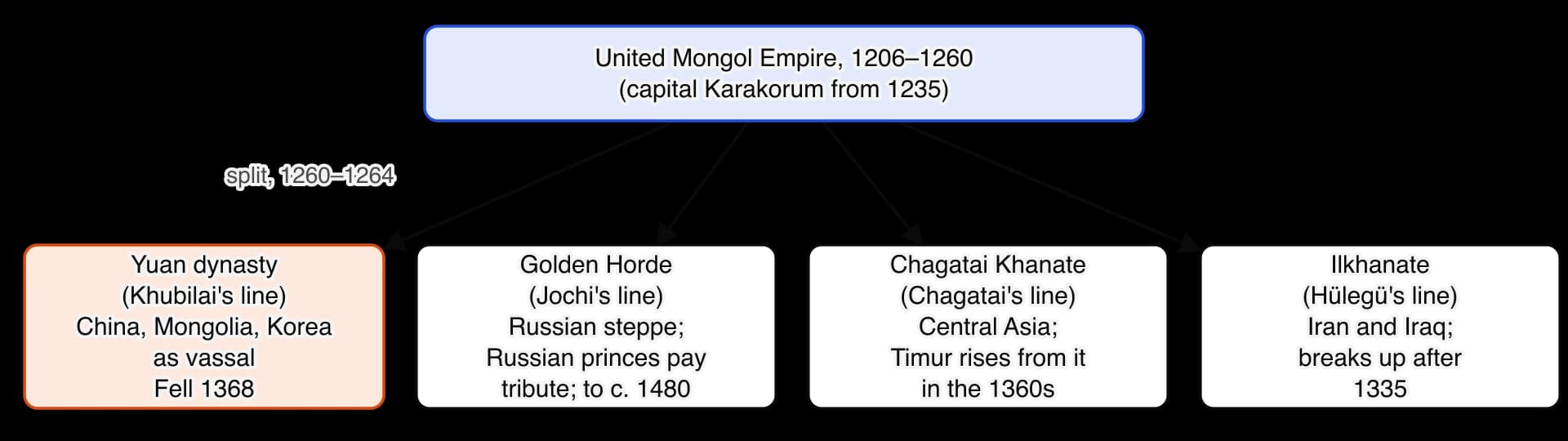
A people of perhaps one million ruled over a hundred million subjects. The diagram of the four successor states shows how the empire was divided among Chinggis's descendants, and each of them used similar methods to hold power:
Military: the threat of overwhelming force, and the example of cities that had resisted, such as Nishapur and Merv, whose populations were massacred in 1221. Garrisons of Mongol and allied troops were stationed in conquered lands.
Political: local rulers and officials were kept where they submitted, but watched by Mongol overseers (darughachi) who collected taxes and reported to the khan. Censuses, the relay system and passports allowed the khans to know their resources and move orders quickly.
Use of foreign experts: Uighur scribes, Khitan and Chinese administrators such as Yelü Chucai, Persian ministers such as Rashid al-Din, and Muslim financial officials in China ran much of the government.
Social and religious: marriage alliances with submitted dynasties; toleration and tax exemptions for clergy, which gained the support of religious leaders; later, adoption of subjects' religions (Islam in Iran, Buddhism in China) to strengthen legitimacy.
Challenges and decline
Political factors: succession and division
The Mongol Empire had no fixed rule of succession. Any male descendant of Chinggis could claim the throne, and each election by kurultai could take years and end in violence. The disputes of the 1240s, Möngke's coup of 1251 and the civil war of 1260–1264 split the family into rival branches. After 1260 the Golden Horde, the Chagatai Khanate and the Ilkhanate recognised Khubilai only in name, and the Golden Horde and Ilkhanate fought each other over the Caucasus. Kaidu, a grandson of Ögedei, waged war against the Yuan in Central Asia until 1301.
In China, the Yuan court was weakened by factional struggles. Between Khubilai's death in 1294 and 1333 there were nine emperors, and a civil war in 1328 between rival factions based in Dadu and Shangdu. The last Yuan emperor, Toghon Temür (r. 1333–1370), faced a court divided between reforming and conservative ministers.
Social, economic and environmental factors
The Yuan relied on paper money, which lost value as the government printed more to pay for wars and gifts to princes. Heavy taxes and service obligations fell on the Chinese peasantry, and the exclusion of Chinese from high office left the educated elite with little loyalty to the dynasty. A series of disasters struck in the 1340s: the Yellow River broke its dikes in 1344 and changed course, flooding large areas of north China; famine and disease followed. In 1351 the government conscripted about 150,000 labourers to repair the river, and among them rebellion broke out.
In the west, plague (the Black Death) spread through the lands of the Golden Horde in the 1340s, reaching the Black Sea port of Kaffa during a Mongol siege in 1346, and from there to the Mediterranean. The epidemic and the disorder that followed weakened the western khanates and disrupted overland trade.
Conflict and rebellion: the Red Turbans and the Ming
The Red Turban rebellions (from 1351) were a set of risings in central and southern China, inspired partly by a Buddhist belief in the coming of Maitreya, the future Buddha. One rebel leader, Zhu Yuanzhang, a former monk from a poor peasant family, defeated his rivals and in 1368 proclaimed the Ming dynasty. The Yuan court fled to Mongolia, where Chinggis's descendants continued to rule the steppe.
The other khanates also fragmented. The Ilkhanate broke up after the death of Abu Sa'id in 1335 left no heir. The Chagatai Khanate split, and from its western part the Turkic-Mongol commander Timur (Tamerlane, r. 1370–1405) built a new empire from his capital at Samarkand. Timur defeated the Golden Horde (1395), sacked Delhi (1398) and defeated the Ottomans at Ankara (1402), but his empire divided among his sons after he died in 1405 on his way to attack Ming China. The Golden Horde declined slowly; in 1480 the grand prince of Moscow stopped paying tribute.
The Khmer Empire of Angkor, 802–c. 1431
The Khmer Empire, named after its capital region of Angkor in north-west Cambodia, was the largest state of mainland Southeast Asia for more than four centuries. At its height in the twelfth century its kings ruled or received tribute from much of present-day Cambodia, Thailand, Laos and southern Vietnam. Its capital, with Angkor Wat and the Bayon at its centre, was one of the largest pre-industrial urban areas in the world.

The timeline of Angkor shows that the empire's greatest period came between about 1000 and 1220, under three kings in particular: Suryavarman I, Suryavarman II and Jayavarman VII. Most of what is known comes from about 1,200 stone inscriptions in Sanskrit and Old Khmer, from the temples themselves, from Chinese records and from archaeology. There are no surviving chronicles, and almost nothing written by ordinary people.
Emergence: Jayavarman II and the Tonle Sap
Before Angkor, the lower Mekong had been ruled by smaller states that Chinese records called Funan and Zhenla (Chenla). In the eighth century the region was divided among rival lords. Jayavarman II, a prince who had spent time at a court described in the inscriptions as "Java" (perhaps Java, perhaps a Malay or Cham state), fought and allied his way to power over several of these lordships. In 802, on the sacred mountain of Phnom Kulen, north of Angkor, he held a ceremony that declared his independence from Java and made him chakravartin, universal ruler.
Several factors made the region around Angkor the base of a great state:
Environmental and economic: the Tonle Sap, a great lake that swells to several times its size in the monsoon floods, left fertile silt for rice and supported one of the richest freshwater fisheries in the world.
Political: Jayavarman II and his successors built alliances with local lords, married into their families and granted them land and titles in return for loyalty.
Military: the early kings fought for decades to unify the region, and the inscriptions celebrate their victories over rivals.
Religious: Hindu kingship, Brahmin priests and the devaraja cult gave the new rulers a claim to divine support that local lords could not match.
Later kings built the capital. Indravarman I (r. 877–c. 889) dug the Indratataka reservoir and built the Bakong temple at Hariharalaya, and his son Yasovarman I founded Yasodharapura, the first city at Angkor itself, around the hill of Phnom Bakheng, with the East Baray reservoir (about 7.5 km long).
Leaders: building and expanding the empire
King | Reign | Achievements |
|---|---|---|
Jayavarman II | 802–c. 835 | Founded the kingdom; devaraja cult at Phnom Kulen (802) |
Yasovarman I | 889–c. 910 | First city at Angkor (Yasodharapura); East Baray; temple on Phnom Bakheng |
Rajendravarman II | 944–968 | Returned the court to Angkor after a period at Koh Ker; campaigns against Champa |
Suryavarman I | c. 1006–1050 | Seized the throne after a civil war; about 4,000 officials swore an oath of loyalty (1011); expanded into the Chao Phraya valley (central Thailand) |
Suryavarman II | 1113–c. 1150 | Built Angkor Wat; sent embassies to the Song (1116, 1120); attacked Đại Việt and occupied Champa |
Jayavarman VII | 1181–c. 1218 | Drove out the Cham; built Angkor Thom, the Bayon, Ta Prohm and Preah Khan; made Mahayana Buddhism the state religion; built hospitals and rest houses; conquered Champa |
Two features stand out in the table of kings. Many of the most successful rulers, including Suryavarman I and Suryavarman II, were usurpers who won the throne by force, so their temples and inscriptions were partly a way of claiming legitimacy. And expansion went in waves: each strong reign was followed by contraction.
Suryavarman II and Angkor Wat
Suryavarman II built Angkor Wat, the largest religious monument in the world, as a temple to Vishnu and probably as his own funerary temple. Its five towers represent Mount Meru, home of the gods, and its galleries carry nearly a kilometre of carved reliefs, including scenes from Hindu epics and a procession of Suryavarman's army with troops from subject peoples. Suryavarman was also an aggressive war leader: he attacked Đại Việt several times without success and occupied the Cham capital, Vijaya, in 1145.
Jayavarman VII: crisis and recovery
In 1177 a Cham fleet sailed up the Mekong and across the Tonle Sap and sacked Angkor, killing the king. Jayavarman VII, a prince who had been in Champa, organised resistance, defeated the Cham, including in a naval battle on the Tonle Sap, and was crowned in 1181. He then rebuilt the state on a new scale. His capital, Angkor Thom, was enclosed by a moat and a wall 3 km on each side, with the Bayon, a Buddhist temple of towers carved with giant faces, at its centre. He built temples to his mother (Ta Prohm, 1186) and father (Preah Khan, 1191), and later conquered Champa.
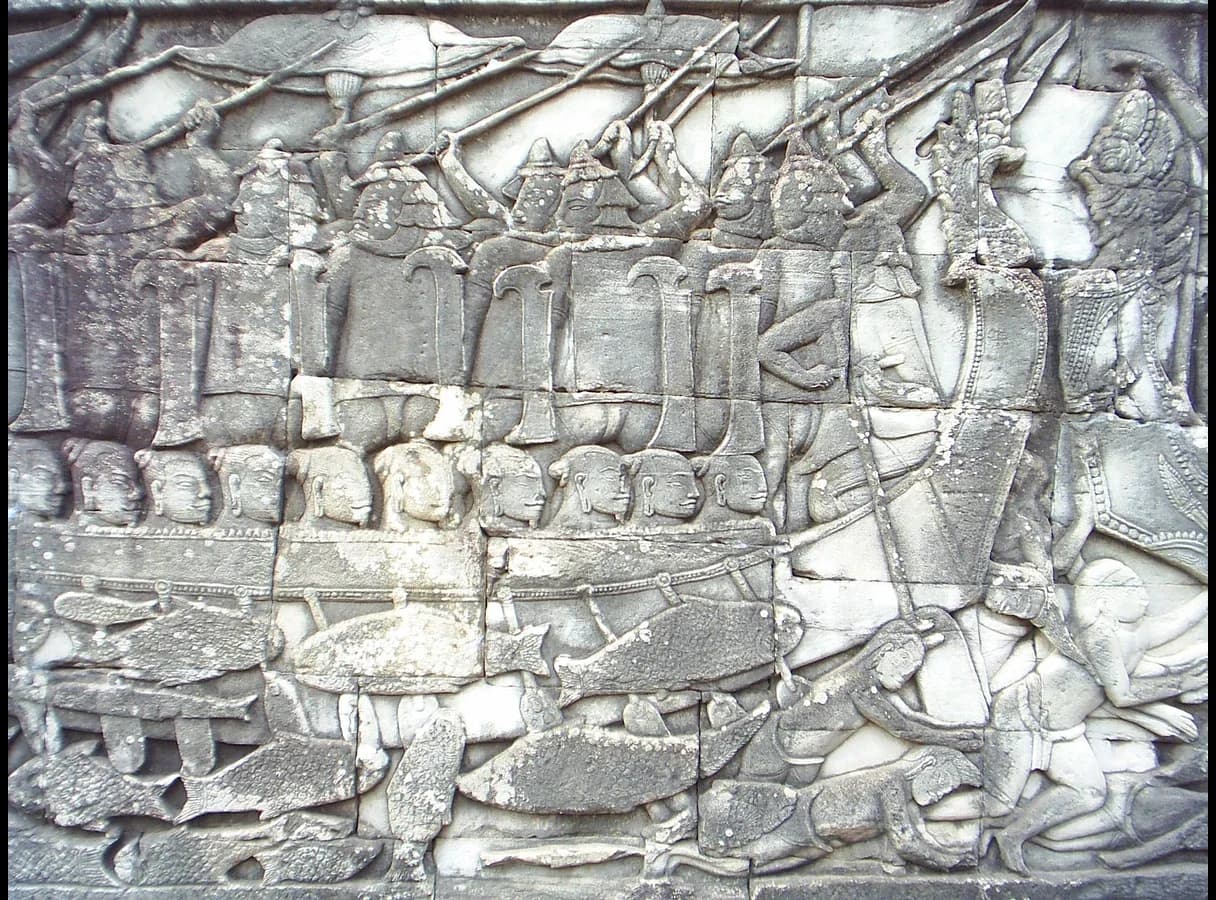
The Bayon relief of the war with Champa is both a record and propaganda. It shows the Cham as enemies of the gods and Jayavarman's forces as victorious, and was carved to remind visitors of the king who had saved the kingdom.
Jayavarman VII presented himself as a compassionate Buddhist king. According to his inscriptions he founded 102 hospitals across the empire and 121 rest houses along the royal roads. The inscription of a hospital at Say Fong, near Vientiane in present-day Laos, explains why.
Once people have the disease of body, his (i.e. king's) disease of mind is more painful. For the suffering of people is the suffering of masters, not only the suffering of people themselves. … Here the labourers should not be urged to pay tax etc., nor to do any other forced labour.
Stela of the hospital at Say Fong (K. 368), dated 1186, stanzas 13 and 44, in the English translation of the DHARMA project edition (based on Louis Finot's 1903 French translation). The inscription was set up by the king's order in a provincial hospital and written in Sanskrit for priests and officials, so it presents the ideal of a Buddhist ruler who shares his subjects' suffering. It is evidence of what Jayavarman VII wanted his officials to believe about him and of the reach of his building programme, which extended hundreds of kilometres from Angkor, more than proof of how the hospitals worked.
 YouTube
Domestic developments
Society and the temple economy
Khmer society was strongly hierarchical. At the top were the king and royal family, then families of Brahmin priests and high officials, many of whom held land and positions by inheritance. Most people were rice farmers who owed produce and labour to temples and to the state. Inscriptions also record khnum, people bound to serve temples; historians debate whether they should be called slaves, serfs or temple servants, since their status varied.

The diagram of the temple economy shows how the system fitted together. Temples were not only places of worship: they owned land, stored rice and cloth, employed thousands of people and redistributed goods. The founding inscription of Ta Prohm, set up by Jayavarman VII, lists the resources assigned to that one temple.
Resources assigned to the temple of Ta Prohm (1186) | Number |
|---|---|
Villages supplying the temple | 3,140 |
People living at the temple (priests, officials, assistants) | 12,640, including 615 dancers |
Men and women in the service of the gods | 66,620 |
Total people assigned, including Burmese and Cham | 79,365 |
Hospitals across the provinces | 102 |
Villages and people assigned to the service of the hospitals | 838 villages; 81,640 people |
Data: Ta Prohm stela (K. 273), stanzas 62–67 and 117–119, in the French translation of George Cœdès (1906), as edited by the DHARMA project. The figures were recorded by the temple's founders and may be idealised, but they show the scale of the labour and produce the king could command.
Women appear in the inscriptions as landholders, temple donors and palace officials, and the Chinese envoy Zhou Daguan, at Angkor in 1296–1297, noted that local trade was carried on by women.
Religion, culture and the arts
The Khmer kings were Hindu, mostly worshippers of Shiva and, under Suryavarman II, of Vishnu, but Mahayana Buddhism was also present and became the state religion under Jayavarman VII. Temples were built as models of the universe, rising in terraces to a central tower representing Mount Meru. Sculpture and relief carving reached a very high standard, from the narrative reliefs of Angkor Wat, such as the Churning of the Ocean of Milk, to the serene faces of the Bayon.
Science and technology
Angkor's engineers built reservoirs, canals, embankments and roads on an enormous scale, using earth and sandstone without mortar. Airborne laser scanning (LiDAR) since 2012 has shown that Greater Angkor was a low-density urban landscape of about 1,000 square kilometres, with houses, ponds and fields laid out on a grid around the temples. Estimates of its population at its height range from about 700,000 to 900,000, although all such figures are uncertain.
Foreign relations
Conflict: wars with Champa, the Cham kingdoms of central and southern Vietnam, were the main foreign conflict, from Suryavarman II's occupation of Vijaya (1145) to the Cham sack of Angkor (1177) and Jayavarman VII's conquest of Champa (from 1190). Khmer kings also fought Đại Việt in the twelfth century without success.
Diplomacy and tribute: Khmer kings sent missions to the Song court; Suryavarman II's embassies of 1116 and 1120 brought recognition and trading contacts. Under the Yuan, Angkor sent tribute after Mongol envoys arrived in the 1280s, but it was not invaded.
Trade: rice, fish, aromatic woods, ivory, rhinoceros horn and kingfisher feathers were exported, mostly through Chinese merchants, in exchange for Chinese ceramics, silk and metal goods.
Exchange of ideas: Hindu and Buddhist texts, Sanskrit learning and styles of temple building came from India, but were adapted to local forms; in the thirteenth century Theravada Buddhism spread from Sri Lanka and the Mon lands of Burma and Thailand.
Zhou Daguan's A Record of Cambodia (written after his return in 1297) is the only detailed eyewitness description of Angkor. He described royal processions, markets and Theravada monks in yellow robes, and noted that recent wars with the Siamese had devastated parts of the country.
Maintenance of power
Method | Examples |
|---|---|
Religious | Devaraja cult and royal temples identified the king with the gods or with the Buddha; temple foundations earned merit and bound priestly families to the king |
Political | Provincial governors and local lords, often related to the king by marriage; oaths of loyalty (1011); inscriptions recording royal land grants |
Economic | Control of rice surpluses through temples; corvée labour for building and water works |
Military | Large armies of infantry and war elephants, shown on the reliefs of Angkor Wat and the Bayon; naval forces on the Tonle Sap |
Infrastructure | Royal roads, bridges and rest houses linking the provinces to the capital; hospitals as a sign of royal care |
The table of methods shows that Khmer kings relied on religion and the temple economy more than on a professional bureaucracy. Royal power was therefore personal and needed constant renewal through new foundations; the cost of Jayavarman VII's building may have exhausted the state.
Challenges and decline
Angkor was not abandoned suddenly. The empire stopped expanding after Jayavarman VII, lost its outer provinces during the thirteenth and fourteenth centuries, and moved its political centre south towards Phnom Penh in the fifteenth century. Several groups of factors are involved:
Religious and political change: Theravada Buddhism, spread by monks among ordinary people, emphasised personal merit and monastic communities rather than royal temples. It undermined the ideological basis of the temple economy. Jayavarman VIII (r. 1243–1295) turned back to Hinduism and had many Buddhist images defaced, which suggests conflict at court. The first royal inscription in Pali, the language of Theravada, dates from 1309, and no great stone temples were built after the early fourteenth century.
Conflict: Thai kingdoms grew in the former Khmer provinces: Sukhothai in the thirteenth century and Ayutthaya, founded in 1351. Ayutthaya attacked Angkor several times; Cambodian and Thai chronicles date a decisive capture of the city to 1431.
Economic: maritime trade with China grew in the fourteenth and fifteenth centuries, favouring capitals near the coast and the Mekong such as Phnom Penh over inland Angkor.
Environmental: tree-ring evidence from southern Vietnam shows decades of weak monsoons in the mid to late fourteenth and early fifteenth centuries, broken by years of extreme rain. Archaeologists of the Greater Angkor Project argue that this damaged Angkor's ageing water system: canals silted up, channels eroded and the network could no longer be managed.
Đại Việt under the Trần dynasty, 1225–1400
Đại Việt ("Great Viet") was the kingdom of the Vietnamese in the Red River delta of northern Vietnam. It had been ruled by China for about a thousand years until independence in 938, and its rulers combined Chinese models of government with local traditions. The Trần dynasty ruled it from 1225 to 1400, defeated three Mongol invasions, and is remembered in Vietnam as a golden age.
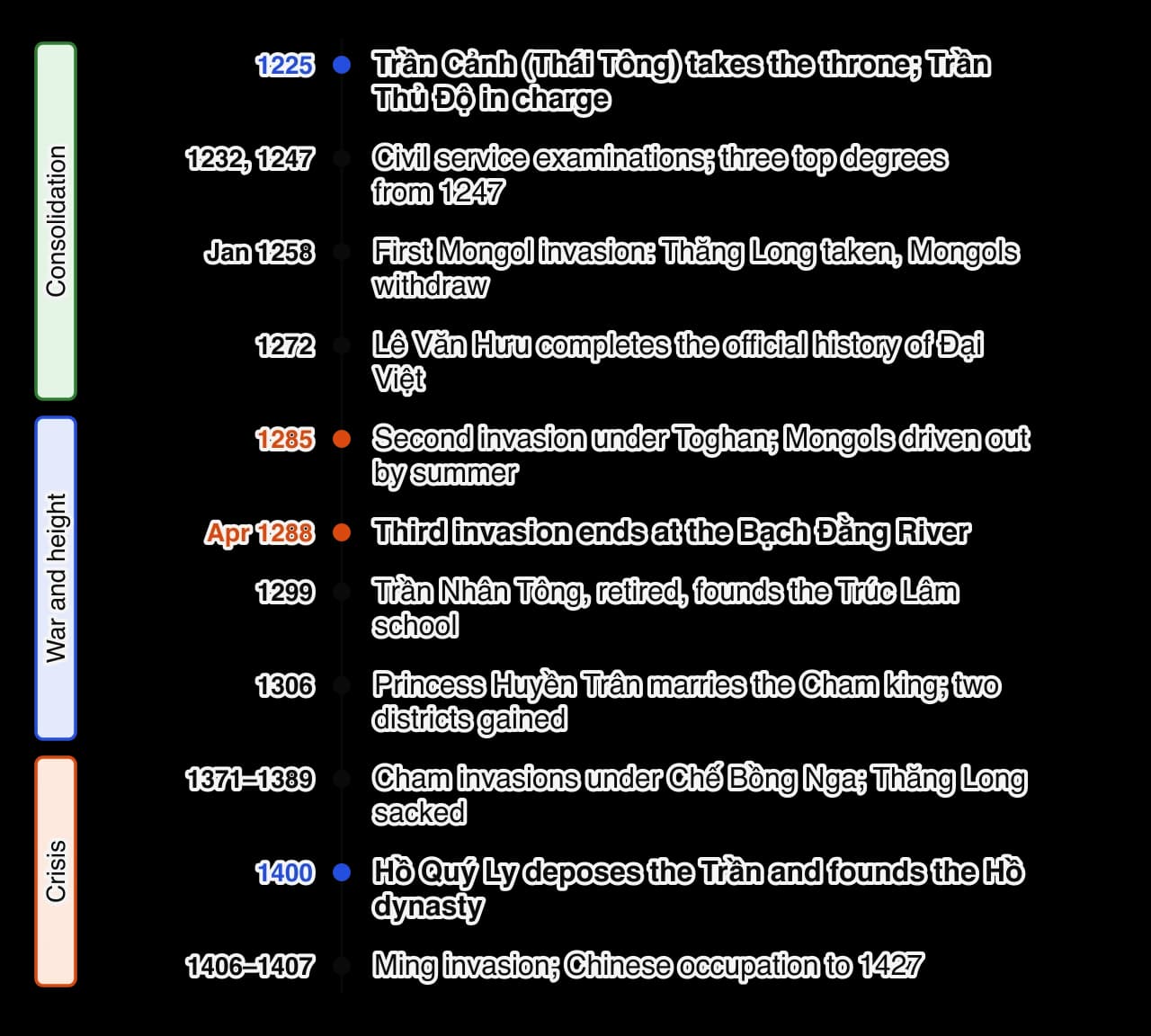
The chronology of the Trần shows three phases: consolidation of the new dynasty, the Mongol wars and the cultural height that followed, and a long crisis in the later fourteenth century that ended with the dynasty's overthrow.
Emergence: from Lý to Trần
The Lý dynasty (1009–1225) had built the first lasting Vietnamese state, with its capital at Thăng Long (Hanoi) from 1010, Buddhist temples and the first examinations. By about 1200 it was failing: the kings were weak or ill, provinces rebelled, and powerful families fought for control of the court. The Trần were one of these families, from the coastal district of Thiên Trường (Nam Định) in the lower delta, which had grown rich from fishing and coastal trade with Song China.
The Trần came to power by alliance and manipulation more than by conquest:
Political (marriage alliance): the Trần supplied troops to the Lý court during its civil wars, and a Trần daughter became the queen of the Lý king Huệ Tông.
Military: Trần Thủ Độ, the commander of the palace guard, controlled the capital. In 1224 the sick Huệ Tông gave the throne to his young daughter, Lý Chiêu Hoàng. Thủ Độ married her to his eight-year-old nephew, Trần Cảnh, and in 1225 she handed the throne to her husband, who reigned as Trần Thái Tông (r. 1225–1258).
Coercion: according to later chronicles, Thủ Độ forced the former king to kill himself in 1226 and later had many members of the Lý family killed.
Economic: the Trần base in the coastal lowlands gave them wealth from trade and newly drained land, and their rise united the upper and lower parts of the delta.
Leaders
Leader | Role | Significance |
|---|---|---|
Trần Thủ Độ (1194–1264) | Chief minister and real ruler in the early years | Engineered the change of dynasty; purged rivals; organised the defence of 1258 |
Trần Thái Tông (r. 1225–1258) | First Trần king | Introduced examinations and the system of retired kings; led the army in 1258 |
Trần Thánh Tông (r. 1258–1278) | King, then retired king | Strengthened Confucian learning; prepared for the Mongol threat |
Trần Nhân Tông (r. 1278–1293) | King during the invasions of 1285 and 1287–1288 | Led resistance; later a monk and founder of the Trúc Lâm school of Zen |
Trần Hưng Đạo (Trần Quốc Tuấn, c. 1228–1300) | Prince and supreme commander | Planned the strategy that defeated the Mongols in 1285 and 1288; national hero in Vietnam |
Trần Minh Tông (r. 1314–1329) | King, then retired king to 1357 | Last strong Trần ruler; Buddhist poet; balanced Buddhist and Confucian advisers |
The table of leaders shows that the Trần depended on a group of princes and ministers more than on one individual. Kings regularly gave up the throne to their sons while still young and, as retired emperors (thái thượng hoàng), continued to guide them. This prevented succession disputes, because the heir was installed before his father's death, and gave each new king years of training under supervision.
Trần Hưng Đạo and the defeat of the Mongols
The defeat of the Mongol invasions is the dynasty's most famous achievement, and Trần Hưng Đạo, a nephew of Thái Tông, is its central figure. Before the invasion of 1285 he issued a Proclamation to the Officers (Hịch tướng sĩ), which described the Mongol envoys as arrogant and greedy, scolded officers who cared more for hunting and gambling than for the country, and offered them his military manual. Written to shame and inspire, it is still taught in Vietnamese schools.
His strategy was to avoid pitched battles against the Mongol cavalry, abandon the capital, remove food from the invaders' path and attack their supply lines, then counter-attack when the enemy was weakened by heat, disease and hunger. In 1288 he lured a Mongol fleet into the Bạch Đằng River, where wooden stakes had been driven into the riverbed; at low tide the ships were stranded on them and destroyed or captured. The same tactic had been used on the same river in 938.
Domestic developments
Social structure
The royal clan dominated society. Trần princes usually married within the clan, which kept power in the family and prevented in-laws from rising as the Trần themselves had done. Princes held large private estates (điền trang), worked by dependants and bonded labourers, and raised their own armies from them. Below them were officials, Buddhist monks, village communities of free peasants who owed taxes and labour, and slaves, many of them prisoners of war. Village elders and communal lands were the base of rural life.
Confucian learning and government
The Trần expanded the Chinese-style institutions begun by the Lý. Examinations for office were held in 1232, and from 1247 the top three graduates received special titles; a national academy was founded in 1253. A Bureau of Dikes was set up in 1248 to build and repair the embankments along the Red River, whose floods could destroy the harvest. In 1272 the scholar Lê Văn Hưu completed the Đại Việt sử ký (Historical Records of Đại Việt), the first official history of the kingdom, which presented its rulers as equals of the emperors of China. Officials trained in Confucian learning became more numerous in the fourteenth century, but the princes still held the highest posts.
Religion, culture and literature
Buddhism was the religion of the court. Trần Nhân Tông, after giving up the throne in 1293, became a monk and in 1299 founded the Trúc Lâm ("Bamboo Grove") school of Zen (Thiền in Vietnamese) on Mount Yên Tử, the first Vietnamese school of Buddhism with Vietnamese founders. His successors used it to unite the realm around a shared religious practice. Poetry by kings and monks was written in classical Chinese, and the period also saw the first literature in chữ Nôm, a script that adapted Chinese characters to write spoken Vietnamese.
The sutras! Do not read them. The "Buddha nature" is not delineated there. … When a visitor comes and one asks who he is, he is simply a man. To recognize by sight depends on the past, which is entirely unreal.
Trần Minh Tông, "A Chant on the Mustard Hut", fourteenth century, translated by O. W. Wolters in Two Essays on Đại-Việt in the Fourteenth Century (1988). The poem was written by a retired king who practised Zen, for an audience of courtiers and monks, and teaches the Zen idea that enlightenment comes from direct experience rather than texts. It shows how closely kingship and Buddhism were linked at the Trần court.
Science and technology
The Trần state's main technical achievements were in water management, shipbuilding and river warfare. In 1390 Trần forces killed the Cham king in battle using firearms, an early use of gunpowder weapons in Southeast Asia.
Foreign relations
The three Mongol invasions
Invasion | Mongol forces and plan | Trần response | Result |
|---|---|---|---|
1258 | Army under Uriyangkhadai from Yunnan, which the Mongols had conquered in 1253–1254 | Court abandoned Thăng Long; counter-attack after the Mongols took the city | Mongols withdrew within weeks; Đại Việt agreed to send tribute every three years |
1285 | Large army under Prince Toghan (Khubilai's son) from the north; second army under Sogetu from Champa in the south | Withdrawal and scorched earth; counter-attacks in May–June at Hàm Tử and Chương Dương | Sogetu killed; Toghan retreated |
1287–1288 | Toghan again, with a fleet carrying supplies | Supply fleet destroyed at Vân Đồn; Mongol fleet trapped on the stakes at Bạch Đằng, April 1288 | Mongols driven out; admiral Omar captured; no further invasion |
After each victory, the Trần sent envoys to the Yuan court to apologise and offer tribute. This was deliberate diplomacy: by accepting the forms of the Chinese world order, the kings made it easier for the Yuan to stop fighting without losing face. Khubilai planned a fourth invasion but died in 1294, and his successor made peace.
Champa and the south
Relations with Champa, the Cham kingdom to the south, swung between alliance and war. The two states had cooperated against the Mongols, whose southern army had marched through Champa in 1285. In 1306 Trần Nhân Tông married his daughter, Princess Huyền Trân, to the Cham king Jaya Simhavarman III in return for two districts around present-day Huế. This was the start of a long Vietnamese expansion southwards. When the Cham king died, Đại Việt rescued the princess rather than let her follow him in death, and relations broke down into war.
Đại Việt also traded with China and Southeast Asian merchants through the port of Vân Đồn, a port on the north-east coast that had been opened to foreign traders under the Lý in 1149.
Maintenance of power
Political: the retired-king system secured peaceful successions for over a century; the royal clan monopolised the highest offices.
Social: clan marriage and princely estates bound the nobility to the throne; village communities were left to manage their own affairs in return for taxes and labour.
Military: princely armies drawn from estates, a royal guard and, in emergencies, the mobilisation of the whole population. Tradition holds that in 1284 the retired king called village elders to the Diên Hồng conference, where they voted to fight rather than submit.
Religious: patronage of Buddhism, and later of the Trúc Lâm school, linked the dynasty to merit and to a shared religious identity, while Confucian scholarship gave it officials and a written history that justified its rule.
Challenges and decline, 1340–1400
The dynasty's crisis began in the mid-fourteenth century. Several pressures combined:
Environmental, social and economic: repeated floods, droughts and famines struck the delta from the 1340s; peasant and slave revolts followed, the largest led by Ngô Bệ from 1344 to 1360. The growth of princely estates had reduced the land that paid taxes to the state.
Political and factional: King Trần Dụ Tông (r. 1341–1369) was regarded as extravagant and weak, and after his death an outsider, Dương Nhật Lễ, briefly seized the throne (1369–1370). Court factions of princes, Confucian officials and favourites competed for power.
Conflict: under King Chế Bồng Nga, Champa invaded repeatedly and sacked Thăng Long in 1371, 1377 and 1378. In 1377 the Trần king Duệ Tông was killed while attacking the Cham capital. The attacks ended only when Chế Bồng Nga was killed in 1390.
These crises brought to power Hồ Quý Ly, a minister related to the royal family by marriage. From the 1370s he dominated the court, and in the 1390s he introduced radical reforms: paper money (1396), limits on the land that nobles could hold and, later, on the number of their slaves, and new examinations. In 1400 he deposed the last Trần king and founded his own dynasty. The Ming emperor Yongle used the overthrow of the Trần as a reason to invade in 1406–1407, and China occupied Đại Việt until a rising led by Lê Lợi restored independence in 1427.
Historians disagree about Hồ Quý Ly. The Vietnamese chronicles, written under later dynasties, condemned him as a usurper. John K. Whitmore presents him as a reformer who tried to build a stronger, Confucian-style state to solve a real crisis, but whose reforms alienated the nobility and the Buddhist establishment and left the country divided when the Ming attacked.
Srivijaya and the Sailendras, c. 670–c. 1300
Srivijaya was a maritime kingdom based at Palembang in south-east Sumatra, which from the late seventh century to the eleventh dominated the sea routes through the Strait of Malacca and the Sunda Strait. It is the best example in this study of a thalassocracy, a state whose power rested on control of the sea. The Sailendra dynasty, which ruled central Java in the eighth and ninth centuries and built Borobudur, was closely connected to it and later supplied one of its kings.
Srivijaya is hard to study. It left few buildings, because its capital was built of wood and lay on a river, and only a handful of inscriptions. Its very existence was forgotten until the French scholar George Cœdès identified it in 1918 from inscriptions and Chinese records, which called it Shilifoshi under the Tang and Sanfoqi under the Song. Much of its history therefore comes from foreign sources: Chinese, Arab, Indian and Javanese.
Emergence
Srivijaya was already powerful before 750, and its rise explains its later strength. A group of Old Malay inscriptions from the 680s, the oldest known texts in a Malay language, record its expansion. The Kedukan Bukit inscription (682) describes a sacred expedition by a ruler called Dapunta Hyang, with an army said to number 20,000, which ended in the founding of a settlement; others record oaths imposed on conquered areas and an expedition against Java (686).
Four factors explain its emergence:
Geographical and environmental: ships sailing between India and China depended on the monsoon winds, which reverse direction twice a year. They had to wait in the straits for the wind to change, so a port there could supply, shelter and tax them.
Economic: the decline of earlier ports and the growth of the Tang economy increased trade through the straits; Srivijaya also controlled valuable forest products from the Sumatran interior, such as camphor and resins.
Military: its rulers allied with the orang laut ("sea people"), seafaring groups of the islands who provided fleets and could either protect shipping or attack it.
Political: rulers bound the chiefs of conquered ports and river valleys to them by oaths and shared trade profits, building a mandala of dependent ports.
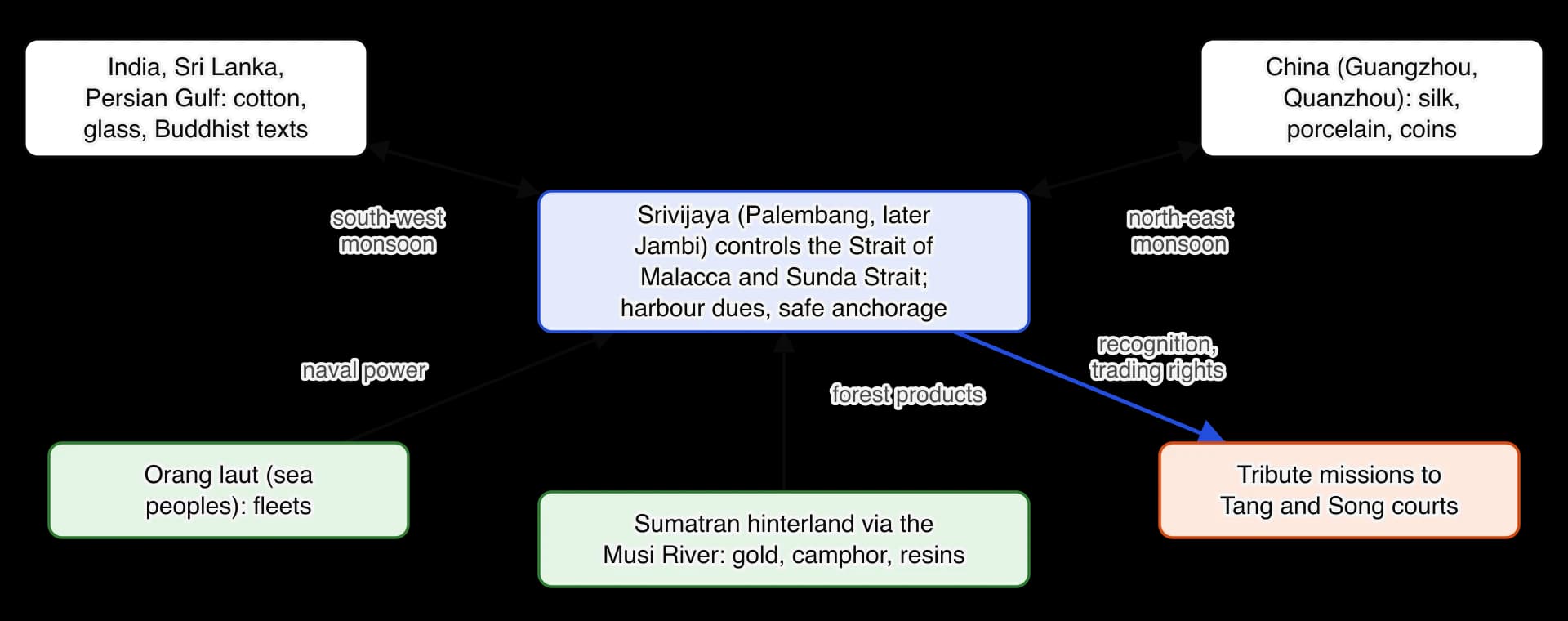
The diagram of Srivijaya's trade shows why control of the straits mattered more than control of land. A Chinese official at the port of Quanzhou, Zhao Rugua, described Srivijaya's position in a guide to foreign countries.
This country, lying in the ocean and controlling the straits through which the foreigners' sea and land traffic in either direction must pass, in olden times used an iron chain as a barrier to keep the pirates of other countries in check. … If a merchant ship passes by without entering, their boats go forth to make a combined attack, and all are ready to die (in the attempt). This is the reason why this country is a great shipping centre.
Zhao Rugua, Zhu fan zhi (Description of Foreign Peoples), 1225, translated by Friedrich Hirth and W. W. Rockhill (1911). Zhao was a customs official who gathered information from merchants, not a visitor, and he wrote when Srivijaya's power was already fading, so his "olden times" may describe its past. His account shows clearly how Chinese traders understood its power: it used force to make ships call at its ports.
Leaders
Few individual rulers are known. Dapunta Hyang Sri Jayanasa, the ruler of the 680s inscriptions, established the kingdom by expedition and oath. In the eighth century Srivijaya extended its influence to the Malay Peninsula: an inscription of 775 at Ligor (Nakhon Si Thammarat in southern Thailand) praises the king of Srivijaya and also names a Sailendra ruler.
The Sailendras of Java
The Sailendra ("Lord of the Mountain") dynasty ruled the rice plains of central Java from about the mid-eighth century to the mid-ninth. Unlike Srivijaya, its wealth came from farming the volcanic soils of Java. The Sailendras were Mahayana Buddhists and built Borobudur (about 780–830), a stepped monument of nine terraces with more than 2,600 carved relief panels and over 500 Buddha statues, designed as a path that pilgrims walked from the world of desire to enlightenment. A rival Hindu dynasty, often called the Sanjaya line or the kings of Mataram, built the temple complex of Prambanan, dedicated in 856.
A Sailendra prince, Balaputradewa, lost a struggle for power in Java in the mid-ninth century and became king of Srivijaya, probably through his mother, a Srivijayan princess. A copper-plate inscription of the Pala king Devapala of Bengal (about 860) records that "the king of Suvarnadvipa" (Sumatra), Balaputradewa, had founded a monastery at the great Buddhist university of Nalanda in India, and that Devapala granted villages to support it. This shows a ruler using Buddhist patronage abroad to build prestige.
Responding to challenges
In the late tenth century Java, under a revived Hindu kingdom in the east, attacked Srivijaya: Srivijayan envoys who reached China in 992 reported that their country was at war with Java. The next king, Sri Cudamanivarmadeva, sent a mission to the Song court in 1003 announcing that he had built a temple to pray for the emperor's long life, and in about 1006 his son, Sri Maravijayottungavarman, built a Buddhist monastery at Nagapattinam in the Chola kingdom of south India, with the Chola king's permission. In 1016 the Javanese capital was destroyed in an attack by a Javanese vassal, which many historians think was backed by Srivijaya. These were the responses of rulers who used diplomacy with the two great powers on either side, China and the Cholas, while dealing with a nearby rival by war.
Domestic developments
Srivijaya's capital was a port city on the Musi River. Zhao Rugua reported that many people lived on rafts on the river and that the king travelled by boat under a silk umbrella. Society was led by the king and princes, officials, merchants and religious teachers; the inscriptions name royal officials, ship captains, merchants and the chiefs of dependent ports.
Srivijaya was a major centre of Buddhist learning. The Chinese pilgrim Yijing stopped there on his way to India in 671 and returned to study and translate texts from 687 to 695.
Many kings and chieftains in the islands of the Southern Ocean admire and believe (Buddhism), and their hearts are set on accumulating good actions. In the fortified city of Bhoga Buddhist priests number more than 1,000, whose minds are bent on learning and good practices. … If a Chinese priest wishes to go to the West in order to hear (lectures) and read (the original), he had better stay here one or two years and practise the proper rules and then proceed to Central India.
Yijing, A Record of the Buddhist Religion as Practised in India and the Malay Archipelago, written about 691, translated by J. Takakusu (1896). Bhoga is Yijing's name for Srivijaya's capital. Yijing was a Buddhist monk writing for other monks, so he stressed the kingdom's piety and learning, but as a long-term resident his evidence of a large community of scholars is valuable. Three centuries later the Indian teacher Atiśa studied in Sumatra for about twelve years before travelling to Tibet in 1042, which shows that the tradition continued.
Culture combined Indian and local elements. The court used Sanskrit and Old Malay, and Buddhist images in the Srivijayan style have been found from southern Thailand to Java. The reliefs of Borobudur, showing outrigger ships, markets and court scenes, are among the best evidence for daily life in the region. The main technologies of Srivijaya were maritime: large ocean-going ships built by lashing planks together with fibre, navigation by monsoon winds and stars, and the organisation of ports.
Foreign relations
Diplomacy and tribute: Srivijaya sent missions to the Chinese court from the 670s; under the Song (from 960) missions came regularly and brought trading privileges. Tribute recognised the emperor's superiority while securing Chinese markets for Srivijayan goods.
Economic relations: Srivijaya was an entrepôt: goods from the Arab world, India, Southeast Asia and China were exchanged in its ports. Zhao Rugua lists camphor, aromatic woods, cloves and sandalwood, and Arab goods such as frankincense, rose-water and glass, exchanged for Chinese gold, silver, porcelain and silk.
Exchange of ideas: Buddhist teachers, texts and art moved between Srivijaya, Nalanda and China; Indian scripts and Sanskrit came with them.
Conflict: wars with Javanese kingdoms (686, the 990s and probably 1016) and, most seriously, with the Chola empire of south India.
Maintenance of power
Srivijaya maintained power through four main methods. Politically, rulers bound the chiefs of dependent ports with oaths. The Telaga Batu inscription from Palembang, carved on a stone over which water was poured and then drunk, lists the officials and chiefs who swore loyalty and curses them with death if they betrayed the king. Economically, the profits of trade were shared with allies, and harbour dues were collected from foreign ships. Militarily, the orang laut fleets protected ships that called at Srivijaya and attacked those that did not. Religiously, the kings presented themselves as Buddhist rulers, patrons of monasteries at home and abroad, which gave them prestige with the trading peoples who shared that faith.
Challenges and decline
Srivijaya declined over two centuries, from the Chola raid of 1025 to the Javanese conquests of the late thirteenth century.
Conflict: in 1025 the Chola king Rajendra I sent a naval expedition that sacked Palembang and Kadaram (Kedah) and captured the king. Chola inscriptions list more than a dozen ports that were attacked. The reasons are debated; the most common explanation is a dispute over trade and Srivijaya's tolls on Chola merchants. The raid did not create a Chola empire, but it broke the image of Srivijayan control.
Political: after 1025 the centre of the kingdom shifted to Jambi (Malayu), further north, and dependent ports became more independent. Chinese records of the late eleventh century show Jambi sending missions in Sanfoqi's name.
Economic: from the eleventh century Chinese merchants increasingly sailed their own ships to Southeast Asia and traded directly with many ports. Merchants no longer needed to call at one entrepôt, which undermined the basis of Srivijaya's power.
Conflict with Java: the Javanese kingdom of Singhasari sent an expedition to Malayu in 1275, and its successor, Majapahit (founded in 1293), claimed the former Srivijayan ports as its own.
Religious change: Muslim merchants settled in the ports of northern Sumatra, and the first Muslim kingdom, Samudra-Pasai, appeared in the late thirteenth century. In about 1400 a prince from Palembang, Parameswara, founded Melaka on the Malay Peninsula, which became the new great entrepôt of the straits and whose rulers converted to Islam.
Srivijaya's decline shows the weakness of a power built on trade. Its control depended on merchants having no better choice; once ships could trade directly, and rivals could attack its ports, its network of loyalties came apart.
Comparing the kingdoms and empires
Each state has to be studied on its own terms, but comparison shows which explanations are general and which are particular to one case.
Theme | Kamakura shogunate | Mongol Empire | Angkor | Trần Đại Việt | Srivijaya |
|---|---|---|---|---|---|
Main base of power | Land rights of warrior vassals | Steppe cavalry; tribute and taxes of conquered lands | Rice, fish and temple economy | Rice of the Red River delta; royal clan | Control of the straits and sea trade |
How it emerged | Civil war (1180–1185) and alliances of eastern warriors | Unification of the steppe (1206) and wars of conquest | Alliances and wars of Jayavarman II; Hindu kingship (802) | Marriage and palace control (1225) | Expeditions, oaths and naval alliances (680s) |
Legitimacy | Title of shogun granted by the emperor | Mandate of Eternal Heaven; descent from Chinggis | Devaraja; Hindu and Buddhist kingship | Inheritance from the Lý; Confucian and Buddhist kingship | Buddhist kingship; oaths |
Response to the Mongols | Refused submission; defeated invasions of 1274 and 1281 | (the Mongols themselves) | Sent tribute; not invaded | Defeated three invasions; then sent tribute | (had already declined); Java defeated the 1292–1293 expedition |
Main causes of decline | No land to reward vassals; Hōjō factionalism; Go-Daigo's revolt | Succession disputes and division; rebellion in China; plague and floods | Theravada Buddhism; Thai attacks; shift of trade; droughts and floods | Famine and revolts; Cham invasions; usurpation; Ming invasion |
The comparison table shows a basic contrast between states built on land and states built on trade. Kamakura, Angkor and Đại Việt rested on rice and on rulers' ability to reward followers with land or its produce; Srivijaya rested on ships and harbour dues; the Mongols combined the military power of the steppe with the tax base of settled lands.
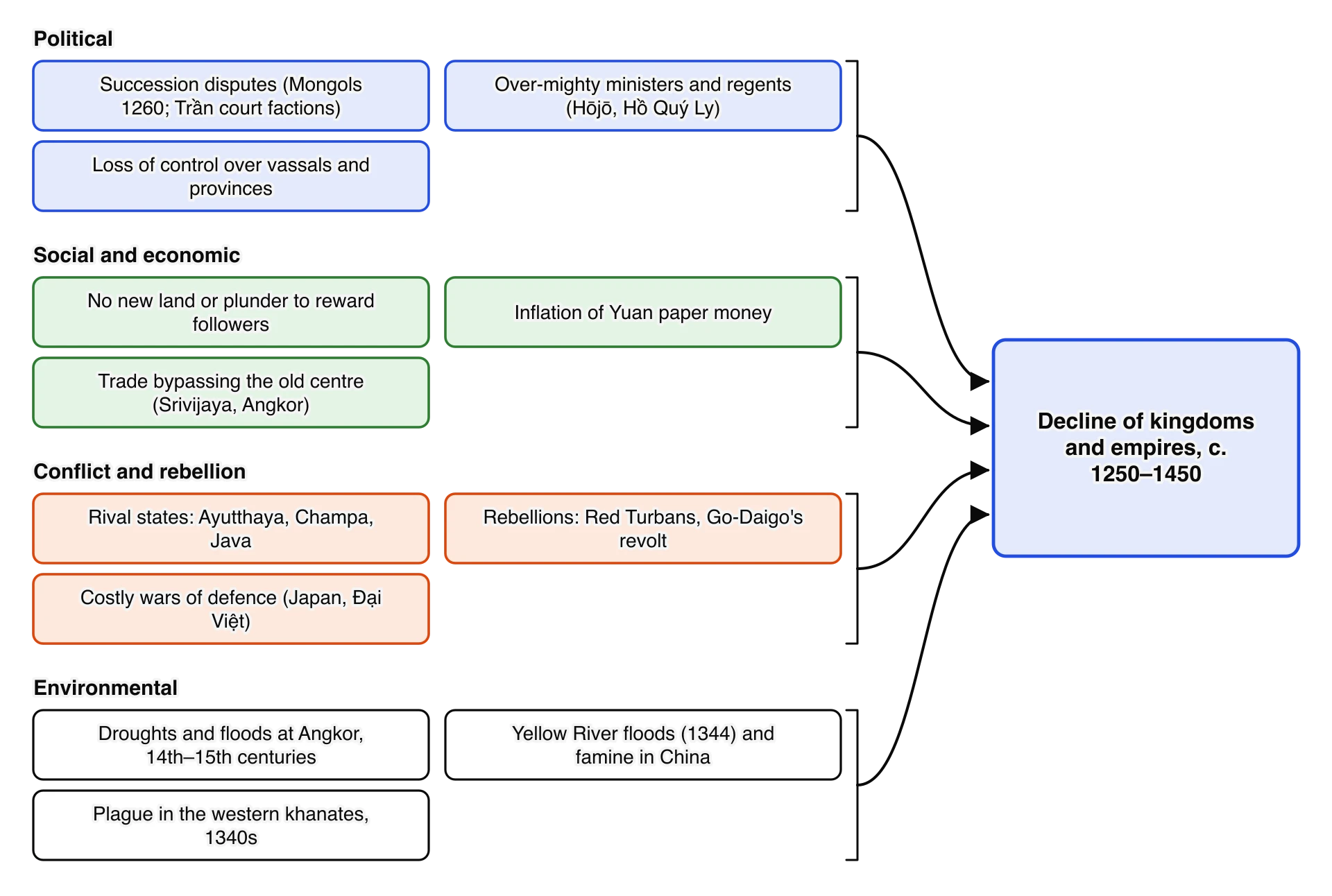
The diagram of factors in decline shows that no state fell for one reason. In each case a shock, whether invasion, drought, flood or rebellion, struck a state whose political system was already under strain. The question for any one case is how the factors interacted: whether the shock was the cause, or only the occasion, of decline.
Perspectives and debates
Warriors, law and the "divine wind"
Older Western and Japanese accounts described the Kamakura shogunate as the beginning of Japanese "feudalism", similar to that of medieval Europe, and the samurai as men following a fixed code of honour, bushidō. Jeffrey P. Mass (Warrior Government in Early Medieval Japan, 1974) argued that the shogunate should instead be understood through its documents: it was a government of courts and land rights that shared power with the imperial court, and the European label hides how it worked. Karl Friday (Samurai, Warfare and the State in Early Medieval Japan, 2004) shows that Kamakura warriors fought pragmatically for reward and survival, and that bushidō as a code was largely a creation of the seventeenth to nineteenth centuries.
On the Mongol invasions, the "divine wind" explanation was promoted by temples and shrines at the time and revived by Japanese nationalists in the twentieth century. Thomas Conlan (In Little Need of Divine Intervention, 2001), using the Takezaki Suenaga scrolls and warriors' petitions, argues that Japanese defence was effective and that both the temples and the defeated Mongols had reasons to stress the weather.
The Mongols: destroyers or connectors?
For centuries the dominant image of the Mongols, drawn from Persian, Chinese and Russian chroniclers whose societies they had conquered, was of destruction and massacre. Since the 1980s many historians have stressed the empire's role in connecting Eurasia. Janet Abu-Lughod (Before European Hegemony, 1989) describes a thirteenth-century "world system" of linked trading regions held together partly by Mongol rule, which broke apart after the Black Death. Thomas Allsen (Culture and Conquest in Mongol Eurasia, 2001) shows the khans actively choosing and moving experts, foods, medicine and knowledge between China and Iran. Jack Weatherford (Genghis Khan and the Making of the Modern World, 2004) goes furthest, presenting Chinggis as the founder of a modern world of free trade, religious tolerance and international law.
Other historians warn against replacing one stereotype with another. David Morgan (The Mongols, 1986, 2nd edition 2007) and Timothy May (The Mongol Conquests in World History, 2012) accept the importance of exchange, which May calls the "Chinggis Exchange", but stress that it came at the cost of enormous destruction and loss of life in north China, Central Asia and Iran, and that the Mongols promoted exchange mainly to serve their own interests.
Angkor: water, religion and decline
The French archaeologist Bernard-Philippe Groslier (1979) argued that Angkor was a "hydraulic city" whose power rested on the barays' irrigation of rice fields, and whose decline followed the breakdown of this system. W. J. van Liere (1980) and others replied that the barays could not have irrigated much land and were mainly religious monuments. The Greater Angkor Project, led by Roland Fletcher, used radar and LiDAR mapping to show a vast, interconnected water network managing flood and drought; together with the tree-ring study of Brendan Buckley and others (PNAS, 2010), this has revived an environmental explanation of decline, though one in which human management, not just climate, failed. Historians who stress the spread of Theravada Buddhism and the rise of Ayutthaya see these as at least as important.
Indian influence or local agency?
George Cœdès (The Indianized States of Southeast Asia, French edition 1944, English 1968) explained the rise of states such as Angkor and Srivijaya through the spread of Indian religion, kingship and language: "Indianization". O. W. Wolters (History, Culture and Region in Southeast Asian Perspectives, 1982) argued that Southeast Asians selected and adapted Indian ideas to suit their own purposes, which he called "localization", and that local patterns, such as the mandala of personal power, mattered more. Victor Lieberman (Strange Parallels, volume 1, 2003) compares the "charter states" of Pagan, Angkor and Đại Việt and finds that all of them collapsed or were transformed between about 1250 and 1450, for reasons that included climate change, new religious movements and the shift of trade to the coast.
Đại Việt and the nationalist narrative
Modern Vietnamese national history presents the Trần victories over the Mongols as one episode in a continuous tradition of resistance to Chinese invasion, from the Trưng sisters in the first century to the twentieth-century wars, with Trần Hưng Đạo as a national hero. Keith W. Taylor (A History of the Vietnamese, 2013) argues that this reads modern nationalism into the past, and stresses the regional divisions, court politics and contingency of events, as well as the close cultural ties between Đại Việt and China. John K. Whitmore's work on Hồ Quý Ly reinterprets the end of the Trần as a crisis of reform rather than a simple story of usurpation.
Historian | Work | Argument | Evidence stressed |
|---|---|---|---|
Jeffrey P. Mass | Warrior Government in Early Medieval Japan (1974) | The Kamakura bakufu ruled through law and land rights alongside the court | Shogunal orders and judgements on jitō and estates |
Thomas Conlan | In Little Need of Divine Intervention (2001) | Japanese defence, not the storms, defeated the Mongols | Takezaki Suenaga's scrolls; warriors' petitions for reward |
Jack Weatherford | Genghis Khan and the Making of the Modern World (2004) | The Mongols created a connected, tolerant, trading world | Pax Mongolica, religious toleration, trade networks |
David Morgan; Timothy May | The Mongols (1986); The Mongol Conquests in World History (2012) | Exchange was real but came with great destruction and served Mongol interests | Massacres and depopulation; chronicles from conquered peoples |
Janet Abu-Lughod | Before European Hegemony (1989) | A thirteenth-century world system collapsed after the Black Death | Trade circuits from Europe to China |
B.-P. Groslier; Roland Fletcher; Brendan Buckley | Groslier (1979); Greater Angkor Project; PNAS (2010) | Angkor depended on water management; climate shocks broke the system | Barays and canals; LiDAR; tree rings |
George Cœdès; O. W. Wolters | The Indianized States (1968); History, Culture and Region |
The table of historians shows that most debates turn on the type of evidence used. Inscriptions and court records show what rulers claimed; chronicles of conquered peoples stress destruction; archaeology and climate science show long-term conditions but not decisions.
Applying the ideas in exam questions
The four questions that follow cover both kinds of Paper 3 question: claims that one factor was the most important, and claims about the character or effect of a development.
Paper 3: reasons for emergence
Paper 3: the role of leaders
Paper 3: maintenance of power
Paper 3: challenges and decline
Self-check
- To do:
I can explain the ideas of mandala, tributary system, legitimacy, devaraja and charter state, and apply them to a kingdom or empire.
- To do:
I can explain the military, economic, political and environmental reasons for the emergence of the Kamakura shogunate, the Mongol Empire, Angkor, Trần Đại Việt and Srivijaya.
- To do:
I can assess the importance of leaders such as Yoritomo, the Hōjō regents, Chinggis Khan, Ögedei, Khubilai, Suryavarman II, Jayavarman VII, Trần Thủ Độ and Trần Hưng Đạo.
- To do:
I can describe the social structure, culture and arts, religion, and science and technology of each state.
- To do:
I can explain how alliances, diplomacy and tribute, the exchange of ideas, trade routes and war shaped each state's foreign relations.
- To do:
I can explain why the Mongol invasions of Japan and Đại Việt failed, and weigh the role of the storms and of the defenders.
- To do:
I can explain the political, social, military and religious methods each state used to maintain power.
- To do:
I can explain the causes of decline of each state, including factionalism, social and economic problems, conflict and rebellion, and environmental factors.
- To do:
I can use primary sources such as Kamakura documents, Khubilai's letter, Rubruck, Marco Polo, the Say Fong inscription, Trần Minh Tông's poem, Yijing and Zhao Rugua, with attention to their provenance.
- To do:
I can outline the debates about Kamakura warrior government, the impact of the Mongols, the decline of Angkor, Indianization and the Vietnamese national narrative.