Notes on R3.3 Challenges to imperial rule in China (1736–1911)
The Qing dynasty ruled China from 1644 to 1912, and at its height in the eighteenth century it governed about a third of the world's population. Between 1736 and 1911 it faced rebellion from within and war and economic pressure from Western powers and Japan, and its failure to meet these challenges ended more than two thousand years of imperial rule in China.
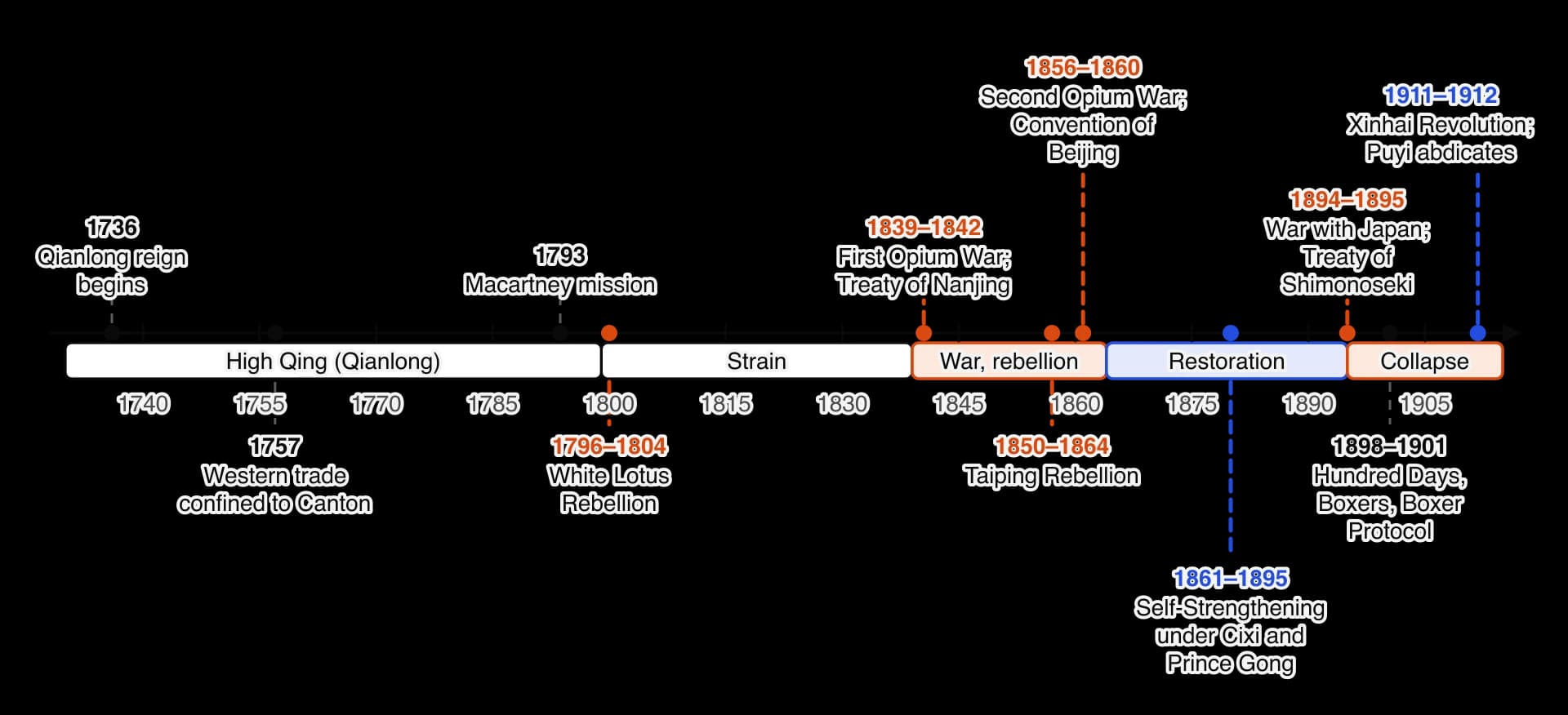
The timeline of the period shows a pattern that runs through the whole study. Internal rebellion (the White Lotus, the Taiping) and foreign war (the Opium Wars, the war with Japan, the Boxer war) came in waves, and each wave cost the dynasty money, territory or authority. Periods of renewal followed each crisis, but none restored the strength the empire had possessed in the 1750s.
The Qing state under the Qianlong Emperor
The Qing were not Han Chinese. They were Manchus, a people from the north-east beyond the Great Wall, who founded the Qing dynasty in 1636 and conquered China after the fall of the Ming dynasty in 1644. A small conquering minority (perhaps 2 per cent of the population) ruled a Han Chinese majority, and much of Qing political practice was designed to make this possible.
The military basis of Manchu power was the Eight Banners, hereditary military units of Manchu, Mongol and Han bannermen who lived in garrisons in Beijing and the main provincial cities and were paid by the state. All Han Chinese men had to wear the queue, shaving the front of the head and braiding the rest, as a sign of submission. In government the Qing practised a dyarchy: many senior posts in Beijing were held jointly by a Manchu and a Han official.
The Qianlong Emperor (Hongli, born 1711) came to the throne in October 1735 and ruled from 1736. He reigned for sixty years and abdicated in 1796 so as not to rule longer than his grandfather, the Kangxi Emperor, but he kept real power as "Retired Emperor" until his death in February 1799. His reign is often seen as the high point of the dynasty: the empire was larger, richer and more populous than at any earlier time.
Political structure
The emperor was the Son of Heaven, ruling by the Mandate of Heaven. In theory his power was unlimited, and Qianlong worked hard to make it so in practice: he read and annotated thousands of reports each year. Officials sent him confidential palace memorials directly, so that the emperor could check one official's account against another's.
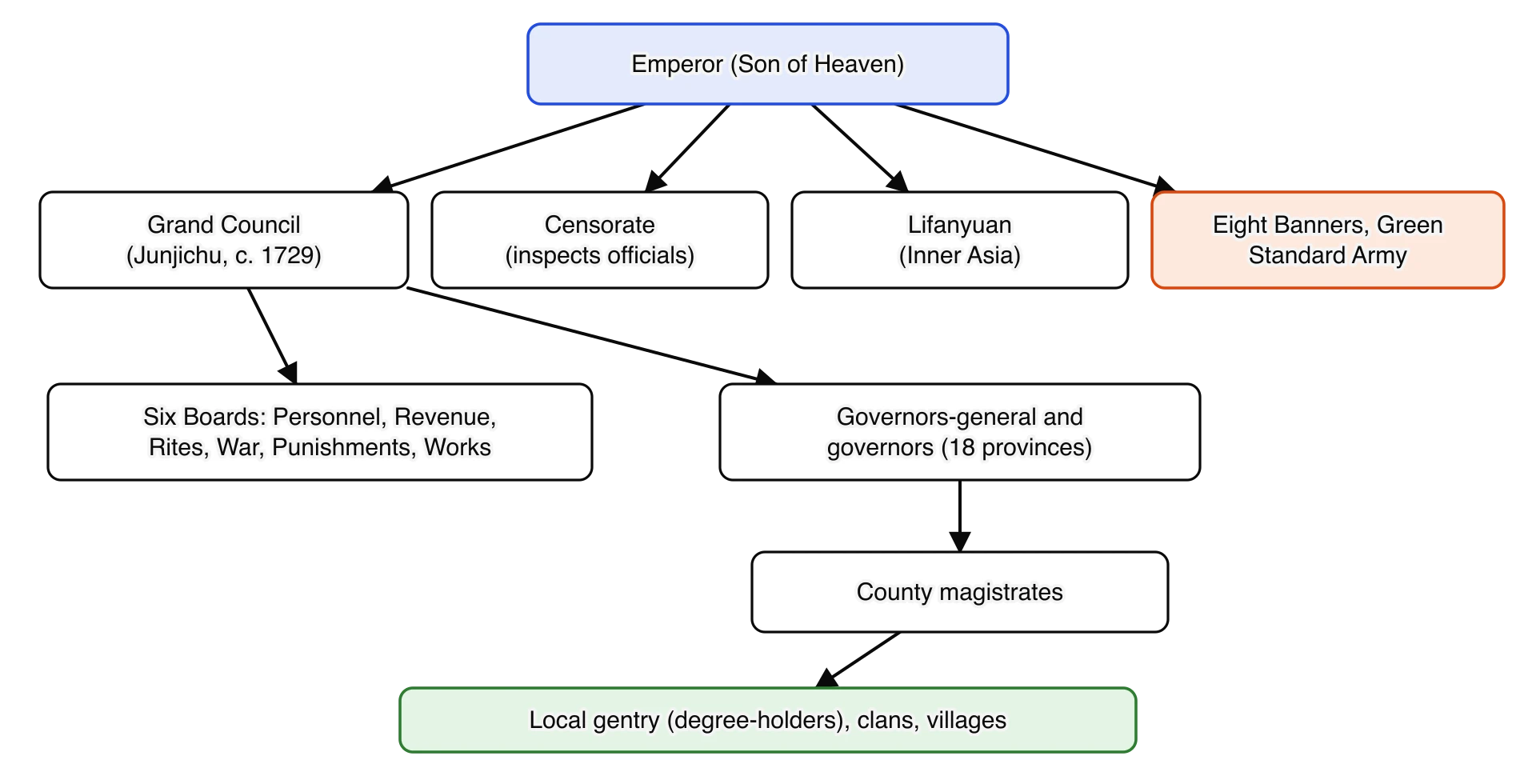
The diagram of Qing government shows the main institutions. The Grand Council, created by the Yongzheng Emperor around 1729, was a small group of trusted advisers who drafted edicts and handled military and urgent business. The Six Boards (Personnel, Revenue, Rites, War, Punishments and Works) ran the routine administration. The Censorate investigated officials and could criticise policy. The Lifanyuan managed relations with Mongolia, Tibet and the other Inner Asian territories, which were not governed like the Chinese provinces.
The eighteen provinces of China proper were ruled by governors and governors-general, and below them by about 1,300 county magistrates. A magistrate might govern 200,000 people or more with a few clerks and runners, so the state depended on the local gentry: men who held degrees from the civil service examinations, owned land and led their clans and villages. The gentry organised famine relief, schools, water control and local defence, and their loyalty was the real foundation of Qing rule.
Social factors: Confucianism and the social order
Qing society was organised around Confucianism, the teachings of Confucius (551–479 BCE) as developed by later scholars. The official form was Neo-Confucianism, which stressed moral cultivation, hierarchy and proper relationships: ruler and subject, father and son, husband and wife, elder and younger brother, friend and friend. Filial piety, the duty of children to obey and honour their parents, was the model for the subject's loyalty to the emperor.
Confucian theory ranked society in four orders: scholars, peasants, artisans and merchants. Scholar-officials stood at the top because their learning was thought to make them morally fit to govern. Merchants, however rich, were placed last because they lived by profit, although in practice many wealthy merchant families bought degrees and ranks. Women were legally subordinate to men, and foot-binding was widespread among Han Chinese families who could afford it (the Manchus did not practise it).
The state used Confucian education to keep order. The Sacred Edict, sixteen moral maxims issued by the Kangxi Emperor in 1670 and expanded by the Yongzheng Emperor in 1724, was read aloud and explained in villages twice a month. The examination system tested candidates on the Confucian classics, so the whole educated class was trained in the same orthodoxy.
Qianlong also controlled thought by force. Between 1773 and 1782 he sponsored the Siku Quanshu ("Complete Library of the Four Treasuries"), the largest collection of books in Chinese history, with about 3,400 works copied by hand. The same search for books was used to find works considered anti-Manchu or disloyal, and more than 2,000 titles were banned or destroyed. This literary inquisition shows both the cultural confidence and the insecurity of a minority dynasty.
The tributary system
The Qing presented China as the centre of civilisation, the "Middle Kingdom", and the emperor as ruler of "all under Heaven". Foreign relations were managed through the tributary system. Rulers who wished to trade with China or receive its recognition sent missions to Beijing with gifts (tribute). Their envoys performed the kowtow before the emperor, and they received gifts in return and permission to trade.
Korea, the Ryukyu kingdoms, Vietnam, Siam and Burma all sent tribute missions. For them the system often brought real benefits: legitimacy, profitable trade and Chinese non-interference. Relations with Inner Asia (Mongols, Tibetans, the peoples of Xinjiang) were handled differently, through the Lifanyuan, marriage alliances, Tibetan Buddhist patronage and military force. Historians of the New Qing History school stress that the Qing presented themselves as Confucian emperors to the Chinese, as khans to the Mongols and as patrons of Buddhism to the Tibetans.
The growth of the empire and its costs
Qianlong doubled the territory of the Qing state compared with that of the Ming. The decisive conquest was that of the Zunghars, a western Mongol confederation that had fought the Qing for seventy years. In campaigns between 1755 and 1759 Qing armies destroyed the Zunghar state. Its people died in huge numbers from the fighting, deliberate massacre and smallpox, and historians such as Peter Perdue describe the campaign as an extermination. The Qing then conquered the oasis cities of the Tarim basin and named the whole region Xinjiang ("New Frontier").
Tibet had come under Qing protection in 1720, and Qing residents (ambans) were stationed in Lhasa from the 1720s. After Qing armies drove a Gurkha invasion out of Tibet in 1792, Qianlong introduced the Golden Urn in 1793, a lottery under Qing supervision for choosing the reincarnations of senior lamas, which gave the emperor a say in Tibetan religious succession.
Qianlong called himself the "Old Man of the Ten Completes", after his Ten Great Campaigns. The list flattered him. It included the conquest of the Zunghars and Xinjiang, but also two very costly wars against the Jinchuan hill peoples of western Sichuan (1747–1749 and 1771–1776), four failed invasions of Burma (1765–1769) and an intervention in Vietnam (1788–1789) that ended in defeat. The wars of the second half of the reign cost far more than they gained and drained the large treasury surplus that Qianlong had inherited.
Area | Achievement | Strain |
|---|---|---|
Territory | Zunghars destroyed and Xinjiang conquered (1755–1759); Tibet a protectorate; empire at its largest extent | Wars in Jinchuan, Burma and Vietnam were costly failures or near-failures |
Economy | Population and trade grew; internal peace for most of the reign; large treasury surplus in the 1770s | Land per person fell; migrants moved into fragile highlands; surplus spent on war and suppression of revolt |
Government | Strong personal control by the emperor; palace memorials and Grand Council worked well | Corruption spread from the 1770s under Heshen; administration did not grow with the population |
Culture | Siku Quanshu; patronage of painting, scholarship and architecture | Literary inquisition; intellectual conformity |
Population growth
The most important long-term change of the Qianlong era was the growth of population. The chart of China's population shows that it roughly doubled during the eighteenth century. Long internal peace, new crops from the Americas (maize and sweet potatoes, which grew on hillsides unsuitable for rice) and the Qing policy of low land taxes all contributed.
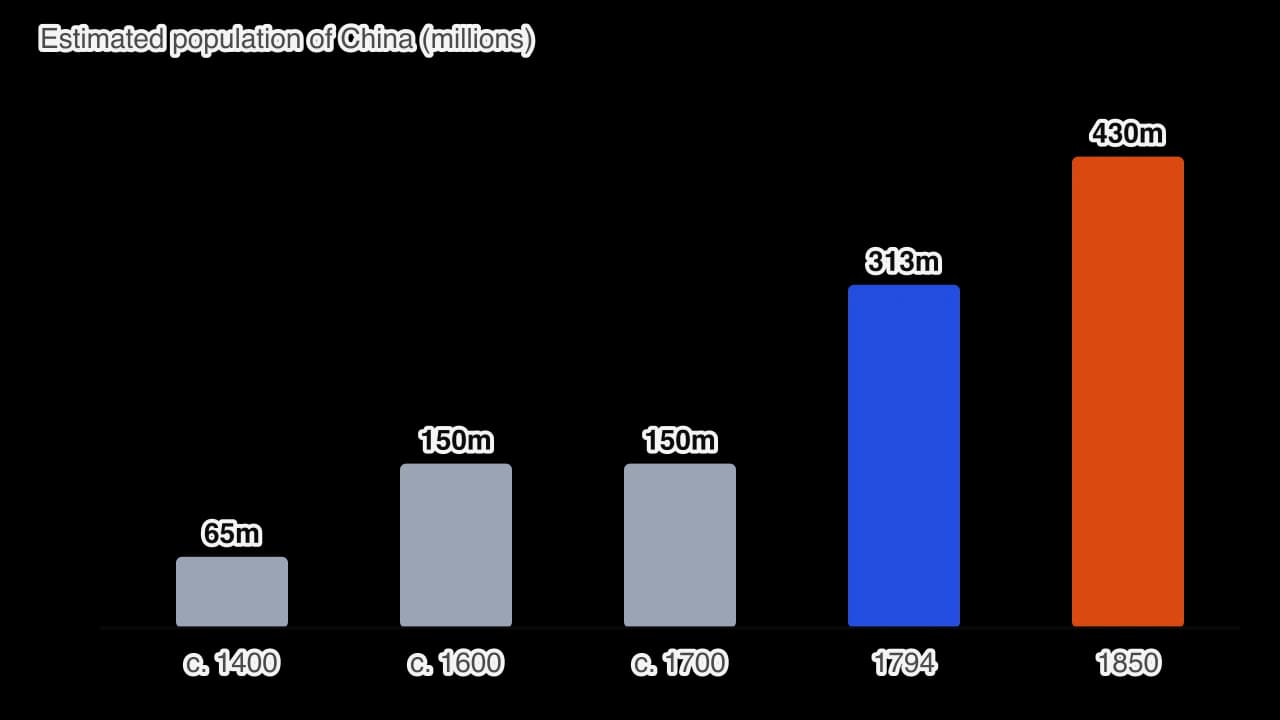
Farmland did not grow at the same rate, so land per person fell and many families became landless tenants or labourers. Migrants moved into the hills of central China, onto the frontiers and to Taiwan, where they cleared forests and came into conflict with older inhabitants. The administration did not grow at all: the number of county magistrates stayed almost the same while the number of people they governed more than doubled. Hong Liangji, a scholar who served in the 1790s, warned that population was growing faster than the means to support it, a point later historians have often developed.
Corruption: Heshen
In the last two decades of the reign, power at court passed to Heshen (1750–1799), a young Manchu guards officer who became the elderly emperor's favourite from about 1775. Heshen held many offices at once, controlled appointments and built a network of officials who paid him for their posts and recovered the money from the public. Military commanders fighting the rebellions of the 1790s padded their expenses, and the cost of suppression rose accordingly.
Days after Qianlong died in February 1799, the Jiaqing Emperor had Heshen arrested and allowed him to commit suicide. His confiscated property was huge; later stories that it equalled many years of state revenue are exaggerated, but the case showed how far corruption had spread. Jiaqing could punish one man, but he could not rebuild a public finance and administration that had fallen behind the size of the country.
Rebellion at the end of the eighteenth century
The last decades of the Qianlong reign saw a series of revolts. In 1774 Wang Lun, the leader of a sect that practised healing and martial arts, rose in Shandong and briefly captured towns on the Grand Canal. In 1786–1788 the Lin Shuangwen rising on Taiwan, organised through the Heaven and Earth Society, a secret society, took more than a year and a large army to put down. These risings were small compared with those of the 1790s, but they showed how sects and secret societies could mobilise discontented people.
The Miao Rebellion, 1795–1806
The Miao are a non-Han people of the hills of Hunan and Guizhou in south-west China. During the eighteenth century Han settlers, merchants and moneylenders moved into their lands, often with the help of local officials, and Miao families lost land through debt and fraud. In 1795 Miao leaders rose with the aim of driving out the Han settlers and recovering their land. The Miao Rebellion tied down large Qing forces, and two senior commanders died during the campaigns. It was suppressed by 1797, although resistance and the building of a fortified frontier line continued until 1806.
The Miao rising shows a challenge that the growth of the empire itself created: Han migration into the frontiers produced ethnic conflict, and officials who took the settlers' side turned local disputes into rebellion.
The White Lotus Rebellion, 1796–1804
The White Lotus Rebellion broke out in 1796 in the mountains where the provinces of Hubei, Sichuan and Shaanxi meet. The White Lotus was a tradition of popular Buddhist sects with millenarian beliefs. Members believed that the world would soon enter a time of disaster, after which the Maitreya Buddha (the Buddha of the future) would come and the faithful would be saved. Some leaders also spoke of restoring the Ming dynasty, which gave the movement an anti-Manchu character.
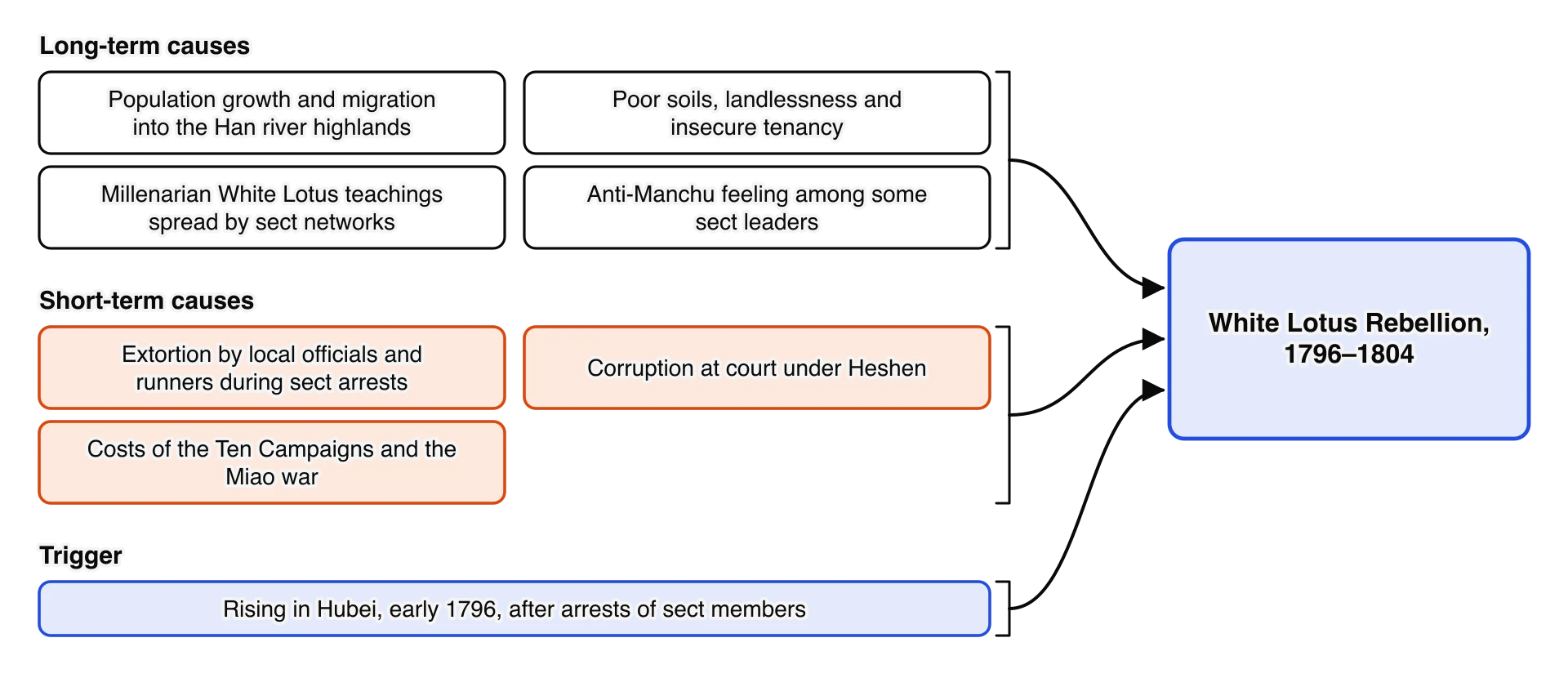
The diagram of the causes of the rebellion shows how distress and religion combined. The highlands had filled with poor migrants since the 1770s, living on thin soils as tenants, labourers or charcoal burners. When officials launched campaigns to arrest sect members in the 1790s, local runners used the arrests to extort money from anyone they could accuse. The rebels' phrase that "officials force the people to rebel" summed up their grievance, and the Jiaqing Emperor himself later admitted in edicts that official extortion had caused the revolt.
The rebellion was fought as a guerrilla war across the mountains. The Banners and the Green Standard Army, the Qing's regular Han Chinese army, performed badly, and their commanders, many of them Heshen's clients, wasted money. After Heshen's fall, Jiaqing appointed new commanders who changed strategy. Villagers were moved into walled stockades so that the rebels could not draw food and recruits from them, and local gentry raised tuanlian (local militia) to defend their districts. By 1804 the rebellion was over. Its cost is usually put at about 200 million taels of silver, several years of state revenue, and the treasury surplus of the Qianlong years was gone.
The significance of the White Lotus Rebellion lies less in its danger to the dynasty than in what it revealed. The regular armies could not defeat a rebellion of poor mountain farmers, the treasury was emptied, and the dynasty learned to rely on gentry-led militia. Philip Kuhn sees in these methods the beginning of the militarisation of local society that later produced the regional armies of the Taiping era.
Efforts to "open up" China: the Canton system and the British missions
The Canton system, 1757–1842
European ships had traded at several Chinese ports, but in 1757 the Qianlong Emperor ordered that Western trade be confined to Canton (Guangzhou) in the far south. The order followed attempts by the British East India Company to trade at Ningbo, closer to the silk and tea districts. When the Company's interpreter James Flint sailed north to Tianjin in 1759 to complain directly to the emperor about corruption at Canton, he was imprisoned in Macao for three years, and the Chinese man who had helped write his petition was executed. New regulations in 1760 completed what is called the Canton system.
Foreign merchants could trade only with the Cohong, a guild of about a dozen licensed Chinese merchant houses (the hong merchants), which was responsible for the foreigners' good behaviour and for their customs duties. The richest hong merchant, Wu Bingjian (known to foreigners as Howqua), was among the wealthiest men in the world.
Foreigners lived and worked in the Thirteen Factories, a row of warehouses and offices on the riverbank outside the city walls, and only during the trading season (roughly October to March). They spent the rest of the year at Macao.
They could not enter the city of Canton, bring women, learn Chinese from Chinese teachers or petition officials directly. All contact with the government went through the hong merchants.
Customs were supervised by the Hoppo, an official appointed by the emperor, who along with other officials collected large irregular fees on top of the official duties.
For the Qing, the Canton system kept foreigners far from the capital, confined them in one place, made a group of Chinese merchants responsible for them and gave the court a rich source of revenue. For the British, it was a set of humiliating restrictions that blocked the expansion of their trade, and changing it became the aim of every mission they sent.
The Macartney mission, 1792–1794
In 1792 the British government sent George Macartney, an experienced diplomat, on the first official British embassy to China. Officially the mission came to offer belated congratulations on Qianlong's eightieth birthday, celebrated in 1790. Its real aims were to open more ports for trade (including Ningbo, Zhoushan and Tianjin), to obtain a small island near Zhoushan where British traders could live and store goods, to fix fair and published tariffs, and to station a permanent British ambassador in Beijing.
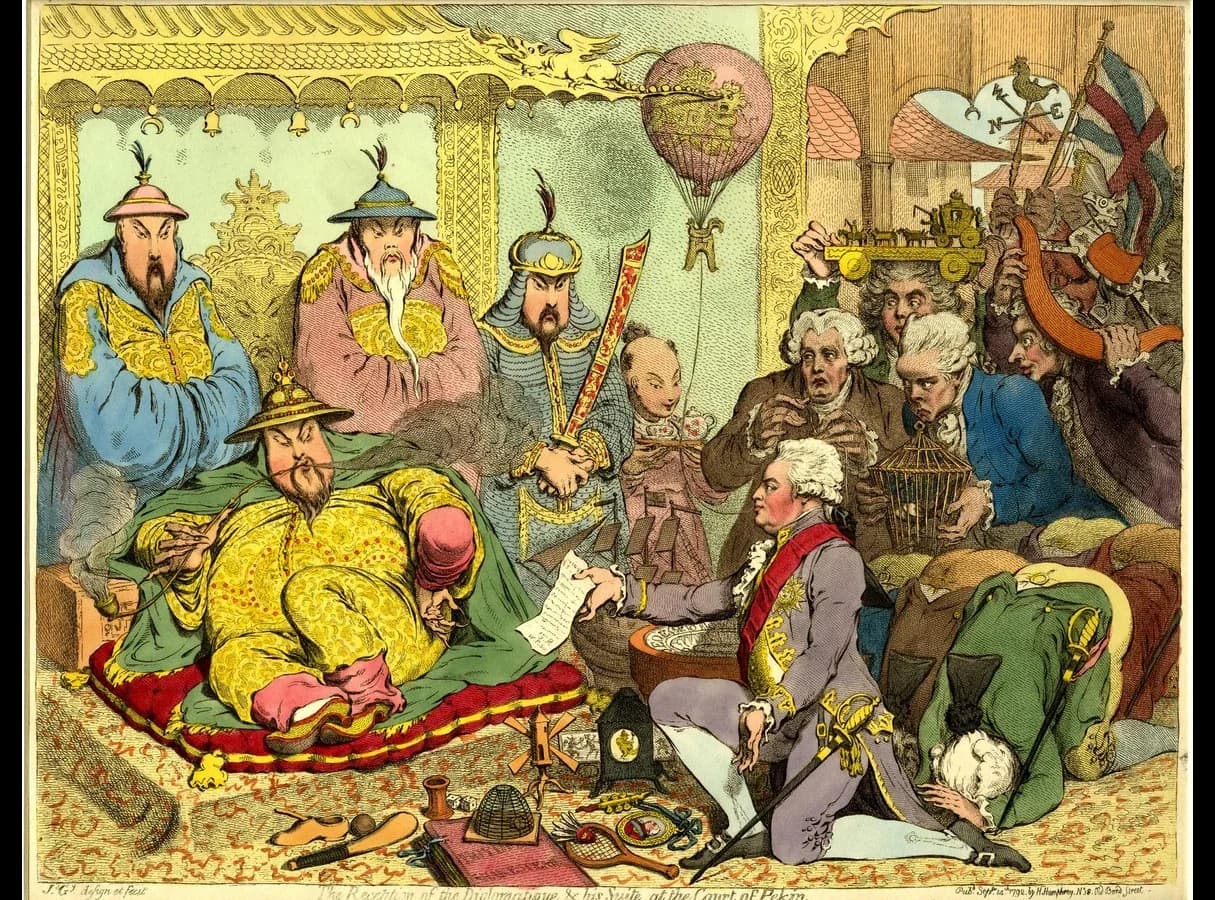
Gillray's cartoon was published in London before Macartney even reached China. It shows how the embassy was imagined at home: the emperor as idle and arrogant, the British as eager salesmen offering trinkets. It cannot show what happened in China, but it shows that British opinion already expected both sides to misunderstand each other.
Macartney reached the coast in the summer of 1793 and was treated as a tribute envoy: the boats that carried his party bore flags describing it as bearing tribute from England. The famous dispute was over the kowtow. Macartney refused to perform it unless a Chinese official of equal rank kowtowed to a portrait of George III. In the end he knelt on one knee, as he would before his own king, at his audience with Qianlong at the summer residence at Chengde (Jehol) on 14 September 1793. The emperor received him courteously, but the gifts the British had brought to impress the court, including a planetarium, scientific instruments and models of warships, were treated as tribute.
Qianlong replied to George III in two edicts, which rejected every request.
Swaying the wide world, I have but one aim in view, namely, to maintain a perfect governance and to fulfil the duties of the State: strange and costly objects do not interest me. … As your Ambassador can see for himself, we possess all things. I set no value on objects strange or ingenious, and have no use for your country's manufactures.
The Qianlong Emperor, edict to King George III, 1793 (translated in Edmund Backhouse and J. O. P. Bland, Annals and Memoirs of the Court of Peking, 1914). The edict was a formal reply written within the conventions of the tributary system, for a court audience as much as for the British king, so its claims of self-sufficiency are as much a statement of the emperor's position as a description of China's economy. The translation was made more than a century later, at a time when Westerners used the document as evidence of Chinese arrogance, which also shapes how it has been read.
The Macartney mission has been read in very different ways. For a long time it was seen as a meeting of a modern, commercial Britain with a proud but ignorant China that refused to learn. Alain Peyrefitte's The Immobile Empire (1989) presented it as a clash of civilisations. James Hevia's Cherishing Men from Afar (1995) argues that the encounter was a clash of two ritual systems, each with its own idea of sovereignty, and not a matter of Chinese ignorance. Henrietta Harrison (2017, 2021) has shown that the Qing court was well informed about Britain and its expansion in India, that Qianlong took the military threat seriously (he ordered coastal defences strengthened after the mission), and that the edict became famous as proof of Chinese backwardness only in the early twentieth century.
The Amherst and Napier missions
A second embassy, led by William Pitt Amherst, arrived in 1816, during the reign of the Jiaqing Emperor. Its aims were similar to Macartney's. When Amherst arrived at the imperial residence near Beijing after an exhausting overnight journey, he was pressed to see the emperor at once and to perform the kowtow, which he had refused to promise. He pleaded illness, and the emperor, taking this as an insult, ordered the embassy to leave without an audience. The failure showed that the Qing would not change the terms of contact, and that Britain could not change them by diplomacy alone.
In 1833 Parliament ended the East India Company's monopoly of British trade with China, from April 1834. The Company had accepted the Canton rules for the sake of its profits; now private traders, who wanted the trade opened, became the main British voice in China, and the British government appointed a Superintendent of Trade to represent them. The first, William John Napier, arrived in July 1834 with orders to deal directly with the governor-general at Canton instead of going through the hong merchants. The governor-general, Lu Kun, refused to accept his letter and stopped all trade. Napier brought two frigates up the river and exchanged fire with the forts, but after the merchants complained of losses he withdrew to Macao, where he died of fever in October 1834. British traders, led by William Jardine, now argued that only force would open China.
Mission | Date | Aims | Outcome |
|---|---|---|---|
George Macartney | 1792–1794 | More ports, an island depot, fixed tariffs, a resident ambassador | Audience with Qianlong without the full kowtow; every request refused |
William Pitt Amherst | 1816 | Similar to Macartney's; better conditions at Canton | Refused to kowtow; dismissed without an audience by Jiaqing |
William John Napier | 1834 | Direct official contact with the governor-general; equal status for the British superintendent | Trade stopped; brief armed clash; Napier withdrew and died; calls for force grew |
The opium trade and its impact
Why opium?
From the early eighteenth century Britain imported growing amounts of Chinese tea, and by the late century tea had become a national drink. The Company paid largely in silver, because few British goods sold in China. To end this drain of silver, the Company turned to opium. After it took control of Bengal, it established a monopoly of opium production there (from 1773), centred on Patna and Benares, and later taxed opium from Malwa in western India.
Because importing opium was illegal in China, the Company did not carry it itself. It sold the opium at auction in Calcutta to private "country traders" such as Jardine, Matheson & Co. (founded 1832) and Dent & Co., who shipped it to receiving ships anchored off Lintin island, near the mouth of the Pearl River. Chinese smugglers in fast armed boats took it ashore, often with the help of bribed officials. The silver they paid went to the country traders, who exchanged it with the Company in Canton for bills payable in London or India; the Company used the silver to buy tea.
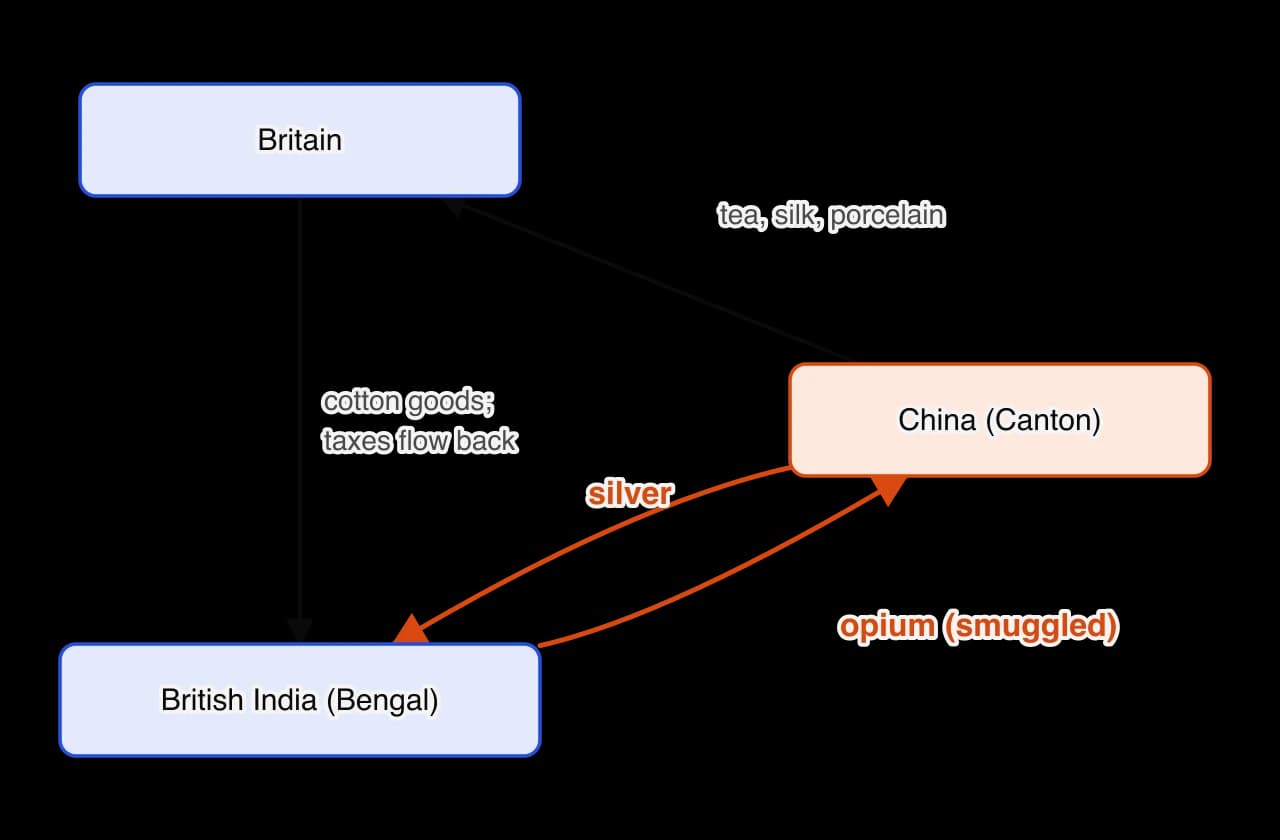
The diagram of the triangular trade shows why opium mattered so much to Britain. Opium paid for China's tea, and duties on tea brought in about a tenth of British government revenue. The opium monopoly provided a substantial share of the revenue of British India. The trade linked three economies, and the illegal part of it, the smuggling of opium into China, held the system together.
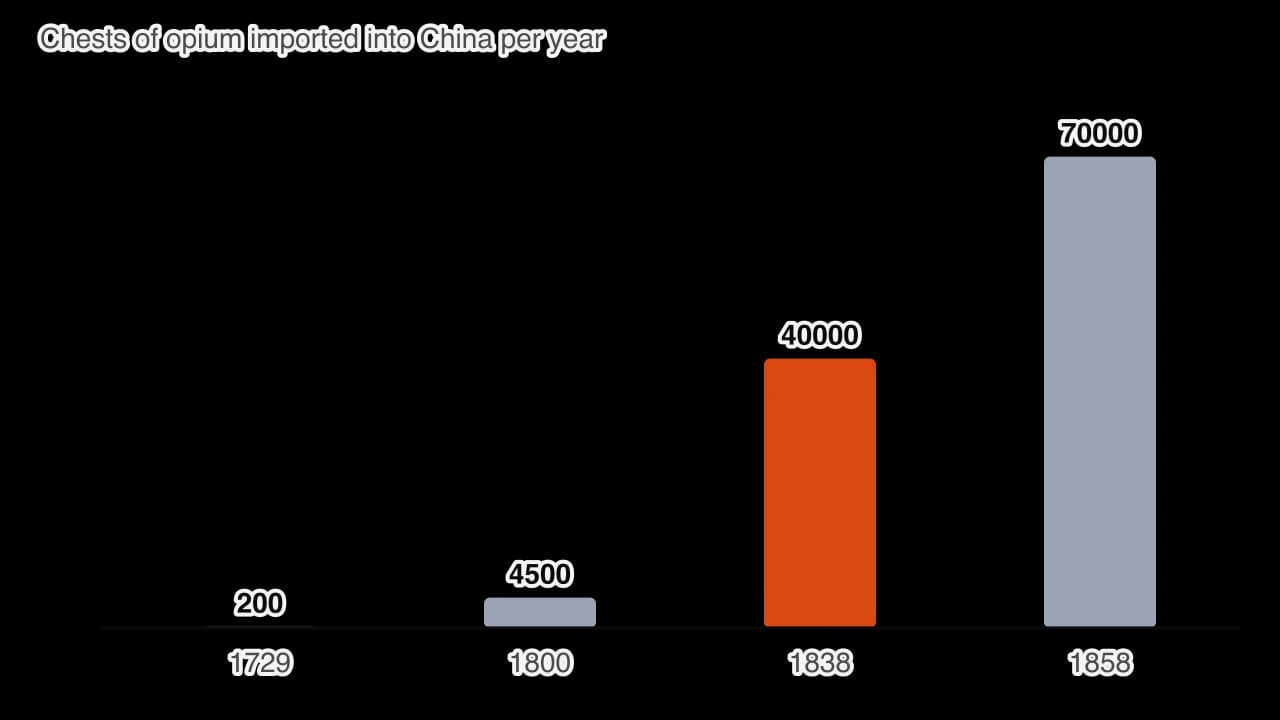
The chart of opium imports shows the scale of growth. About 4,500 chests a year arrived around 1800; by 1838 the figure was about 40,000. The end of the Company monopoly in 1834 increased competition and lowered prices, and opium from Malwa joined Bengal opium on the market.
The social and economic impact of opium
Opium smoking spread from the coast to the interior and from the wealthy to every class. Estimates of the number of habitual smokers by the 1830s vary widely, from a few million upwards, but contemporaries reported smokers among officials, clerks, merchants, soldiers, eunuchs at court and labourers. Habitual use was expensive and harmful, and Qing officials saw it as a threat to public morals and to the efficiency of government and the army.
The economic effect that most alarmed the court was the outflow of silver. Opium imports turned China's trade with the West from a surplus into a deficit, and silver left the country. The Qing economy used two currencies: silver for large transactions and taxes, copper coins (cash) for everyday purchases. As silver became scarce its value rose, from about 1,000 copper cash per tael (an ounce of silver) around 1800 to about 1,600 by the late 1830s. Peasants earned copper but paid their land tax in silver, so their real tax burden rose sharply.
The Qing had banned opium for smoking in 1729 and banned its import and domestic cultivation in 1796 and 1800, but the bans were not enforced. In 1836 an official named Xu Naiji proposed to legalise and tax opium imports, to stop the silver drain and the corruption that smuggling produced. Others, such as Zhu Zun and Huang Juezi, argued for strict prohibition, and in 1838 Huang proposed the death penalty for smokers who did not give up within a year. The Daoguang Emperor (r. 1821–1850) chose prohibition, and in December 1838 he appointed Lin Zexu, governor-general of Hubei and Hunan and a successful anti-opium official, as imperial commissioner to end the trade at Canton.
The Opium Wars, 1839–1860
Lin Zexu and the prohibition of opium, 1839
Lin Zexu (1785–1850) arrived at Canton in March 1839. He was an able and honest official from Fujian with a record of fighting opium as governor-general in central China. He acted against both sides of the trade: Chinese dealers and smokers were arrested, opium pipes were confiscated, and the foreign merchants were ordered to hand over all their opium and to sign bonds promising never to bring more, on pain of death.
When the merchants delayed, Lin stopped trade and blockaded the foreign factories, holding about 350 foreigners inside for six weeks. The British Superintendent of Trade, Captain Charles Elliot, ended the standoff by ordering the merchants to surrender their opium to him, promising that the British government would compensate them. This step turned the merchants' private losses into a claim of the British state against China. In June 1839 more than 20,000 chests, over 1,000 tonnes, were destroyed at Humen by mixing the opium with lime and salt and flushing it into the sea.
Lin also wrote a letter to Queen Victoria, asking her to stop the trade. It was published in English in the Chinese Repository at Canton in 1840, but there is no evidence that it reached the queen.
We have heard that in your own country opium is prohibited with the utmost strictness and severity:—this is a strong proof that you know full well how hurtful it is to mankind. Since then you do not permit it to injure your own country, you ought not to have the injurious drug transferred to another country, and above all others, how much less to the Inner Land!
Lin Zexu, letter to Queen Victoria, 1839 (English translation in the Chinese Repository, February 1840). Lin argued as a Confucian official, appealing to the queen's conscience and to the principle of not doing to others what one would not want done to oneself. His claim that opium was banned in Britain was wrong: it was sold freely there until the Pharmacy Act of 1868. The error shows the limits of Qing information about Britain, while the moral argument shows how the court saw the trade as a question of right and wrong, not of commerce.
The conflict escalated during the summer of 1839. In July, drunken British sailors killed a villager, Lin Weixi, at Kowloon. Elliot held a trial of his own and refused to hand any suspect over to Chinese justice. Lin then cut off food supplies and had the British expelled from Macao, and they took refuge on ships in the harbour of Hong Kong. Clashes between British warships and Chinese war junks followed at Kowloon in September and at Chuenpi in November 1839.
European reactions
In Britain the China traders, led by William Jardine, lobbied for war. They argued that Lin had seized British property and imprisoned British subjects, and that the Canton system denied free trade. The Foreign Secretary, Lord Palmerston, decided in late 1839 to send an expeditionary force. Its aims were to obtain compensation for the surrendered opium, to secure equal diplomatic treatment and to open more ports, under British protection, to British trade.
The war was controversial. In April 1840 the Conservative opposition moved a motion censuring the government's handling of China, and the young William Gladstone attacked the war as a defence of the opium trade.
… a war more unjust in its origin, a war more calculated in its progress to cover this country with permanent disgrace, I do not know, and I have not read of.
William Gladstone, speech in the House of Commons, 8 April 1840 (Hansard). Gladstone spoke for the opposition in a debate on a motion of censure, so the speech was partly an attack on the Whig government; its moral case nevertheless shows that British opinion was divided about opium. The motion was defeated by 271 votes to 262, and the government continued the war. Supporters of the war described it as a defence of free trade and national honour and rarely mentioned opium.
The First Opium War, 1839–1842
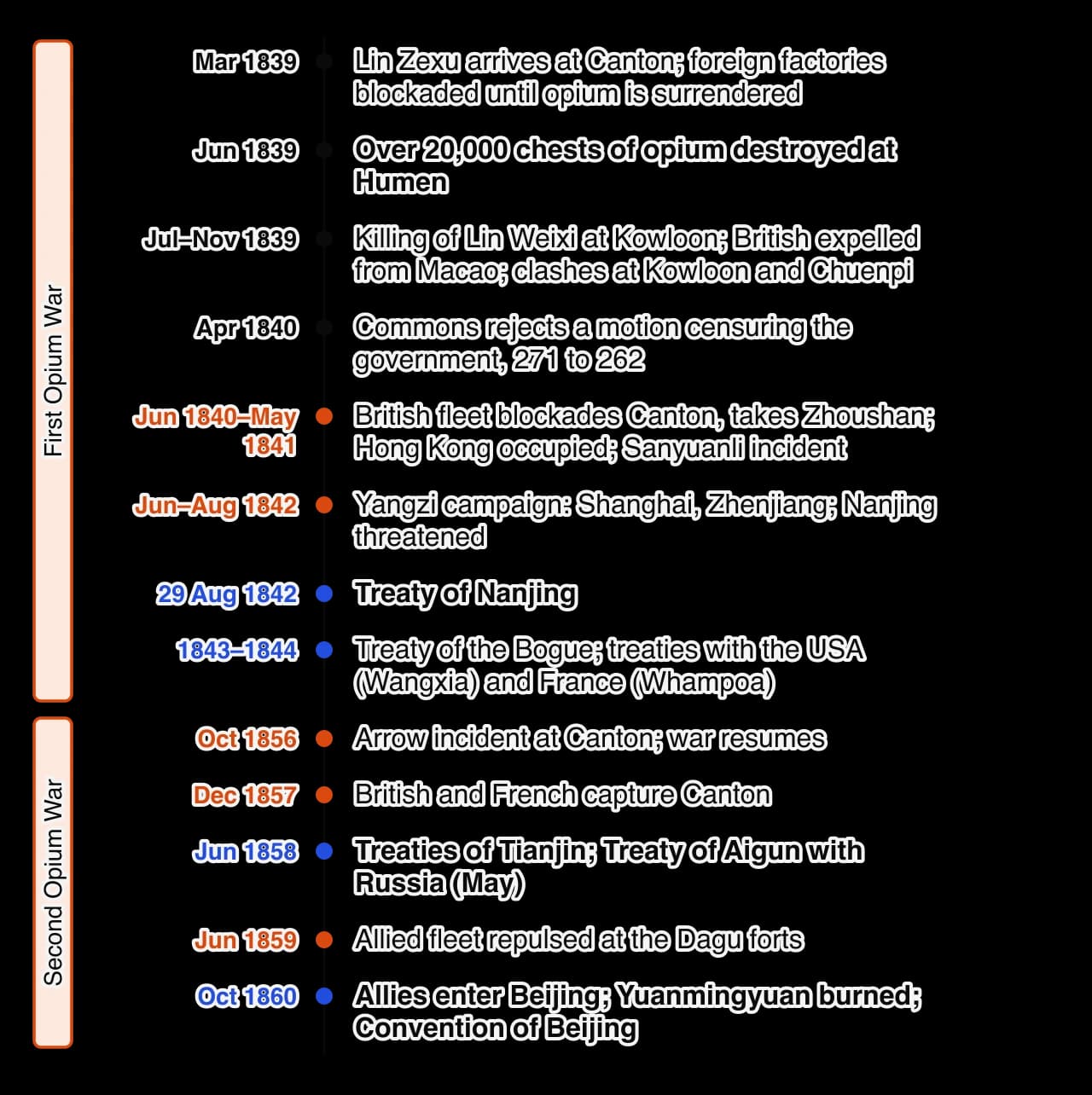
The timeline of the two wars, the First Opium War and its sequel, shows how quickly the conflict moved from Canton to the heart of the empire. The British expedition arrived in June 1840. Rather than fight at Canton, where Lin had strengthened the defences, it blockaded the river, seized the island of Zhoushan and sailed north to the mouth of the Beihe, close to Beijing. The alarmed Daoguang Emperor dismissed Lin and sent Qishan to negotiate. Qishan's agreement of January 1841, which ceded Hong Kong, was rejected by both governments, and fighting resumed.
British naval power was decisive. The iron steamship Nemesis, which could move against the wind and in shallow rivers, destroyed Chinese war junks and towed warships up rivers. British forces took the forts below Canton in 1841 and occupied the coastal cities of Xiamen (Amoy) and Ningbo. Qing forces fought bravely in many places but with older guns, poor supplies and divided command, and coastal defences were designed for pirates, not for a modern navy.
Popular resistance appeared too. At Sanyuanli, near Canton, in May 1841, villagers and local militia surrounded a British force after reports of looting and the violation of graves and women. A rainstorm made the British muskets useless, and the troops were rescued only after the Qing officials at Canton ordered the militia to disperse. Sanyuanli had little effect on the war, but it was later celebrated as an early example of popular resistance to imperialism.
In 1842 the British moved up the Yangzi River, the empire's main trade artery. They took Shanghai and then Zhenjiang, where the Manchu garrison fought to the end and many bannermen killed their families and themselves rather than surrender. With the Grand Canal cut and British ships off Nanjing, the Qing government agreed terms.
The Treaty of Nanjing and the supplementary treaties, 1842–1844
The Treaty of Nanjing, signed on 29 August 1842 on board HMS Cornwallis, was the first of what Chinese nationalists later called the unequal treaties. It opened five treaty ports (Canton, Xiamen, Fuzhou, Ningbo and Shanghai) to British residence and trade, abolished the Cohong, required equal forms of correspondence between officials, fixed a "fair and regular tariff" and made China pay an indemnity of 21 million silver dollars (for the destroyed opium, the debts of the hong merchants and the cost of the war). It also ceded Hong Kong.
His Majesty the Emperor of China cedes to Her Majesty the Queen of Great Britain, etc., the Island of Hong-Kong, to be possessed in perpetuity by Her Britannic Majesty, Her Heirs and Successors, and to be governed by such Laws and Regulations as Her Majesty the Queen of Great Britain, etc., shall see fit to direct.
Treaty of Nanjing, Article III, 29 August 1842. The legal language of the treaty presents the cession as a practical arrangement for a port where British ships could be repaired, but the words "in perpetuity" show that Britain intended permanent sovereignty. The treaty says nothing about opium, which remained illegal in China: the British government did not want to defend the trade openly, and the Qing would not legalise it.
The supplementary Treaty of the Bogue (October 1843) added two principles with large long-term effects. Extraterritoriality meant that British subjects accused of crimes in China would be tried by British consuls under British law. The most-favoured-nation clause meant that any privilege China granted to another power would automatically extend to Britain. The tariff was set at about 5 per cent on most goods, and China could not change it without British agreement, so it lost tariff autonomy. The United States (Treaty of Wangxia, 1844) and France (Treaty of Whampoa, 1844) soon gained the same rights.
The Qing at first saw the treaties as a way of managing the barbarians, a familiar technique: giving trading privileges to keep foreigners quiet and confined to the coast. Officials did not yet see them as a fundamental change in China's place in the world. Canton itself resisted the treaty; local gentry and militia prevented the British from entering the walled city throughout the 1840s, which became a lasting grievance.
The Second Opium War (Arrow War), 1856–1860
By the 1850s Britain wanted more: access to the interior and the Yangzi, legal opium and a diplomat resident in Beijing. The treaty of 1842 was due for revision, but the Qing refused to negotiate. In October 1856 Canton officials arrested the Chinese crew of the Arrow, a Chinese-owned ship whose British registration had expired, and allegedly hauled down its British flag. Harry Parkes, the British consul, used the incident to demand an apology, and the Royal Navy bombarded Canton. France joined Britain, using as its reason the execution of a French missionary, Auguste Chapdelaine, in Guangxi in February 1856.
This was the Second Opium War. In Parliament the government was defeated over the bombardment in March 1857, but Palmerston called an election and won it. British and French troops took Canton at the end of 1857 and captured the governor-general, Ye Mingchen, who died in exile in Calcutta. In 1858 the allies sailed north, took the Dagu forts guarding the approach to Tianjin and forced the Qing to sign the Treaties of Tianjin (June 1858) with Britain, France, Russia and the United States.
The Qing tried to resist the terms, and in June 1859 the Dagu forts beat back the British and French fleet that came to exchange ratifications. In 1860 a larger Anglo-French force returned, took the forts and Tianjin, and marched on Beijing. When Qing forces seized members of a British negotiating party, some of whom died in captivity, the British envoy Lord Elgin ordered the burning of the Yuanmingyuan, the emperor's great palace and garden complex north-west of Beijing, in October 1860. The Xianfeng Emperor had fled to Chengde, and his half-brother Prince Gong signed the Convention of Beijing (October 1860).
Russia used the crisis to gain territory without fighting. By the Treaty of Aigun (1858) and its own Convention of Beijing (1860), Russia took the land north of the Amur River and east of the Ussuri River to the Pacific, about a million square kilometres, and founded Vladivostok there in 1860.
Treaty | Date and powers | Main terms |
|---|---|---|
Treaty of Nanjing | August 1842; Britain | Hong Kong Island ceded; five treaty ports; Cohong abolished; indemnity of 21 million dollars; fixed tariff; equal official correspondence |
Treaty of the Bogue; Wangxia; Whampoa | 1843–1844; Britain, USA, France | Extraterritoriality; most-favoured-nation clause; tariff of about 5 per cent; the same rights for the USA and France |
Treaties of Tianjin | June 1858; Britain, France, Russia, USA | Ten more treaty ports, including Yangzi ports such as Hankou; foreign ships on the Yangzi; foreign legations in Beijing; freedom to travel inland; protection of missionaries and Chinese Christians; indemnities; opium legalised and taxed (tariff agreement, November 1858) |
Convention of Beijing | October 1860; Britain, France (and Russia) | Tianjin treaties ratified; Tianjin opened; Kowloon peninsula ceded to Britain; indemnities raised to 8 million taels each to Britain and France; emigration of Chinese labourers allowed; to Russia: the Ussuri territory |
The table of the unequal treaties shows how each settlement built on the last. Because of the most-favoured-nation clause, every new privilege won by one power passed automatically to all the others.
The impact of the Opium Wars and the unequal treaties
The effects of the wars and treaties can be grouped as political, economic and cultural. The same three headings work for the Taiping Rebellion, which overlapped the Second Opium War and interacted with it.
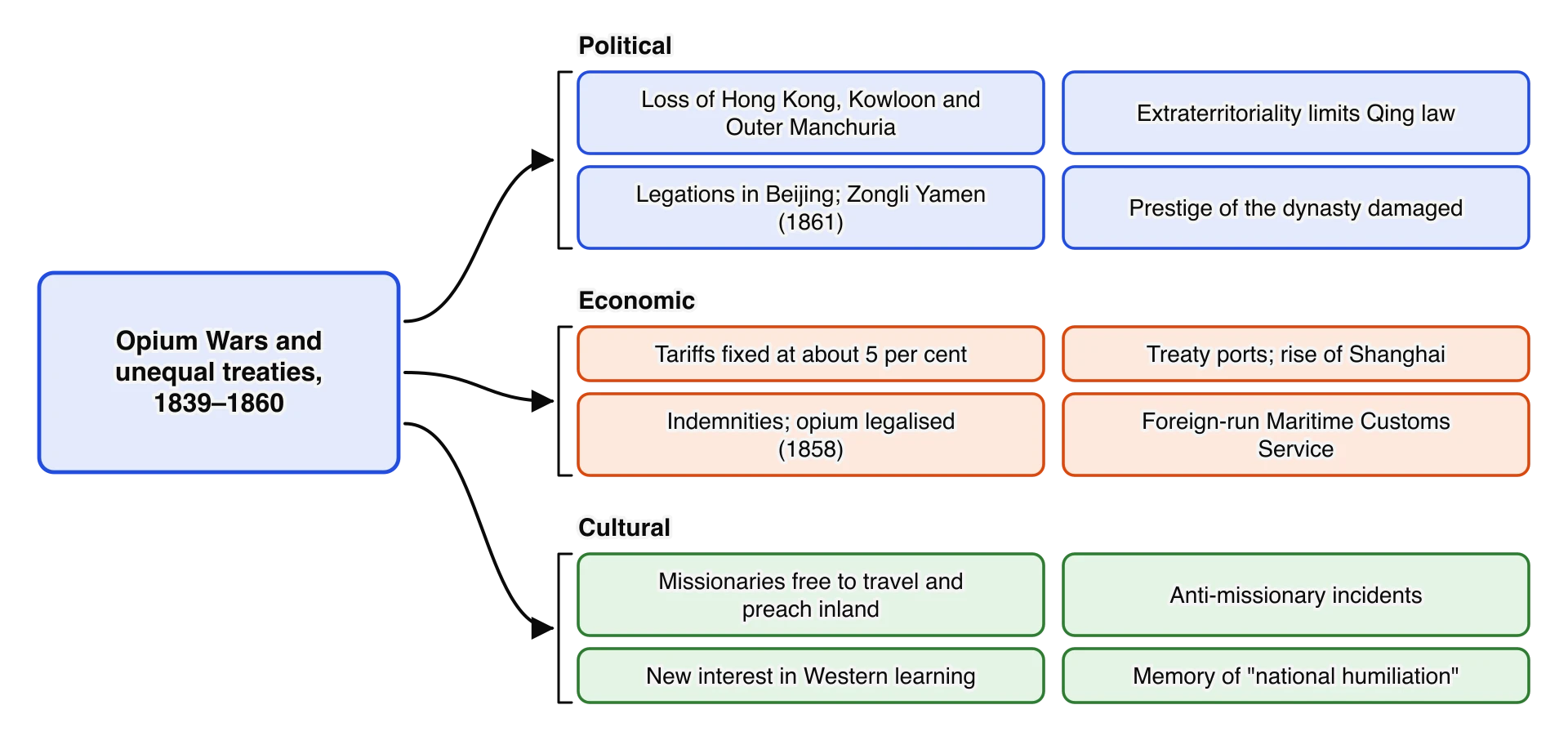
Political impact
The treaties ended the Qing claim that Western states were tributaries. After 1860 foreign ministers lived in Beijing and dealt with the court as equals, and in 1861 the Qing created the Zongli Yamen, an office for foreign affairs, the first new central institution in more than a century. China lost territory (Hong Kong, Kowloon and the lands taken by Russia) and part of its legal sovereignty, because foreigners and, in practice, their Chinese employees and converts were outside Qing jurisdiction.
Defeat by a small foreign force also damaged the dynasty's prestige at the moment when it faced the Taiping Rebellion. The flight of the emperor from Beijing in 1860 and the burning of the Yuanmingyuan were deep humiliations. Yet the immediate political effect was mixed: once the treaties were signed, Britain and France preferred a weak but stable Qing government that honoured its treaties to a rebel victory, and from 1860 they helped it against the Taiping.
Economic impact
China lost control of its tariffs, which stayed at around 5 per cent until the Guomindang government recovered tariff autonomy in 1928–1930, so the government could neither protect Chinese producers nor raise much revenue from foreign trade. The indemnities added to the burden on the treasury. Opium imports, legal from 1858, kept rising, to about 70,000 chests a year by the late 1850s.
The treaty ports created new economic centres. Shanghai, a modest county town in 1842, became China's largest port and commercial city, with foreign-run settlements governed by their own municipal councils. Chinese compradors grew rich as middlemen for foreign firms. The Maritime Customs Service, created at Shanghai in 1854 when rebels had driven out the Qing customs officials, was run by foreign inspectors under Qing authority. Under Robert Hart, Inspector-General from 1863 to 1911, it became an efficient, honest service that provided the Qing with a growing and reliable income, which shows that the treaty system could strengthen the Qing state as well as weaken it.
Cultural impact
The treaties of 1858–1860 allowed missionaries to travel, preach, and (by the French text of the Convention of Beijing) buy land in the interior. Catholic and Protestant missions spread, and Chinese converts gained the protection of foreign consuls, who sometimes intervened in lawsuits on their behalf. Rumours about missionaries, especially about Catholic orphanages, led to violence; in the Tianjin massacre of June 1870 a crowd killed the French consul, ten nuns and other foreigners and Chinese Christians. Such incidents continued until the Boxer Uprising of 1900.
The wars also prompted some scholars to study the West. Wei Yuan's Illustrated Treatise on the Maritime Kingdoms (1844) collected information on Western countries and argued for learning the foreigners' superior techniques in order to control them. For most officials, however, Western countries remained a military problem, not a model, until the 1860s. Much later, Chinese nationalists of the twentieth century made the Opium War the beginning of a "century of humiliation", and both the Guomindang and the Chinese Communist Party used it to explain China's weakness.
The Taiping Rebellion, 1850–1864
The Taiping Rebellion was the largest of a wave of revolts that shook the Qing in the 1850s and 1860s. Its leaders aimed to destroy the dynasty and to build a new society based on their own version of Christianity, and for eleven years they ruled much of the richest part of China from Nanjing. The war that followed is usually estimated to have caused 20 to 30 million deaths, through fighting, massacre, famine and disease, which makes it the most destructive civil war of the nineteenth century. Some estimates are higher; the uncertainty comes from the lack of reliable population records for the devastated provinces.
Environmental and economic causes
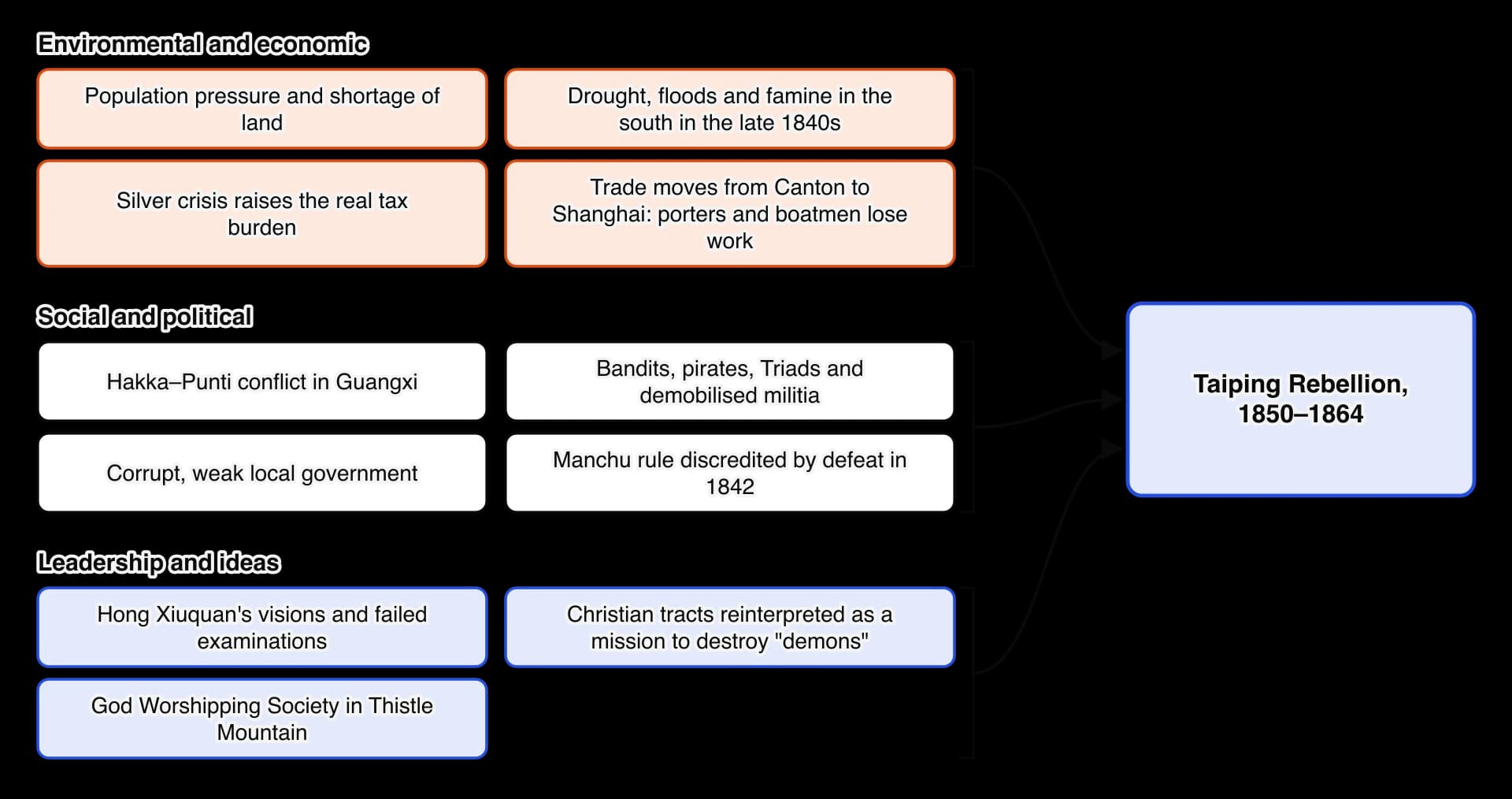
The diagram of the causes of the rebellion shows why it began in Guangxi, a poor province in the south. Population had grown faster than farmland, and many families lived on the edge of subsistence. The late 1840s brought drought and famine in parts of the south. The silver crisis meant that peasants, who earned copper cash, had to pay more for the silver in which their taxes were assessed.
The Opium War added a specific economic shock. Before 1842 the tea and silk that Western merchants bought had to be carried overland to Canton, along routes through Jiangxi, Hunan and northern Guangdong that employed tens of thousands of porters and boatmen. After the Treaty of Nanjing opened Shanghai, much of this trade moved there, and many of these men lost their livelihood. Militia raised during the war were disbanded, and piracy on the coast pushed bandits inland when the British navy attacked pirate fleets.
Guangxi was also divided by ethnic conflict between the Hakka, a Han Chinese group whose ancestors had migrated from the north and who spoke their own dialect, and the older-settled "Punti" (local) population. Hakka families often farmed the poorer hill land, and feuds between the two groups were common. Local government was too weak to keep order, and villages armed themselves.
Hong Xiuquan and the God Worshipping Society
Hong Xiuquan (1814–1864) was a Hakka from a farming family near Canton. He tried four times to pass the lowest level of the civil service examinations and failed each time. In 1836 he was given a Christian tract, Good Words to Admonish the Age, written by Liang Fa, a Chinese convert of a Protestant missionary. After his failure in 1837 he fell ill and had visions: he was taken to heaven, where an old man with a golden beard gave him a sword to kill demons and a middle-aged man helped him.
In 1843, after a fourth failure, Hong read Liang Fa's tract properly and decided that it explained his visions. The old man was God the Father, the middle-aged man was Jesus, and Hong himself was God's younger son, the younger brother of Jesus, sent to destroy the demons who had led China into idolatry. The demons came to mean the Manchus and their officials, as well as Confucian, Buddhist and Daoist idols. Hong studied briefly with an American Baptist missionary, Issachar Roberts, in Canton in 1847, but his theology remained his own.
Hong's friend and relative Feng Yunshan built a community of followers, the God Worshipping Society, in the Thistle Mountain area of Guangxi, mainly among poor Hakka farmers, charcoal burners and miners. Yang Xiuqing, a charcoal burner, became one of its leaders by claiming that God the Father spoke through him in trances. The society destroyed temples, clashed with local militia and drew in men and women who needed protection, until by 1850 it had become an army of about 20,000 people.
The course of the rebellion
In January 1851, at the village of Jintian, Hong proclaimed the Taiping Tianguo, the Heavenly Kingdom of Great Peace, and took the title of Heavenly King. His chief lieutenants became kings of the East (Yang Xiuqing), West, South (Feng Yunshan) and North, and an Assistant King (Shi Dakai). The Taiping army broke out of Guangxi in 1852 and marched north through Hunan to the Yangzi, gathering hundreds of thousands of recruits. It took Wuchang in January 1853 and, in March 1853, Nanjing, the old Ming capital, where most of the Manchu population was killed. Nanjing became Tianjing, the Heavenly Capital.
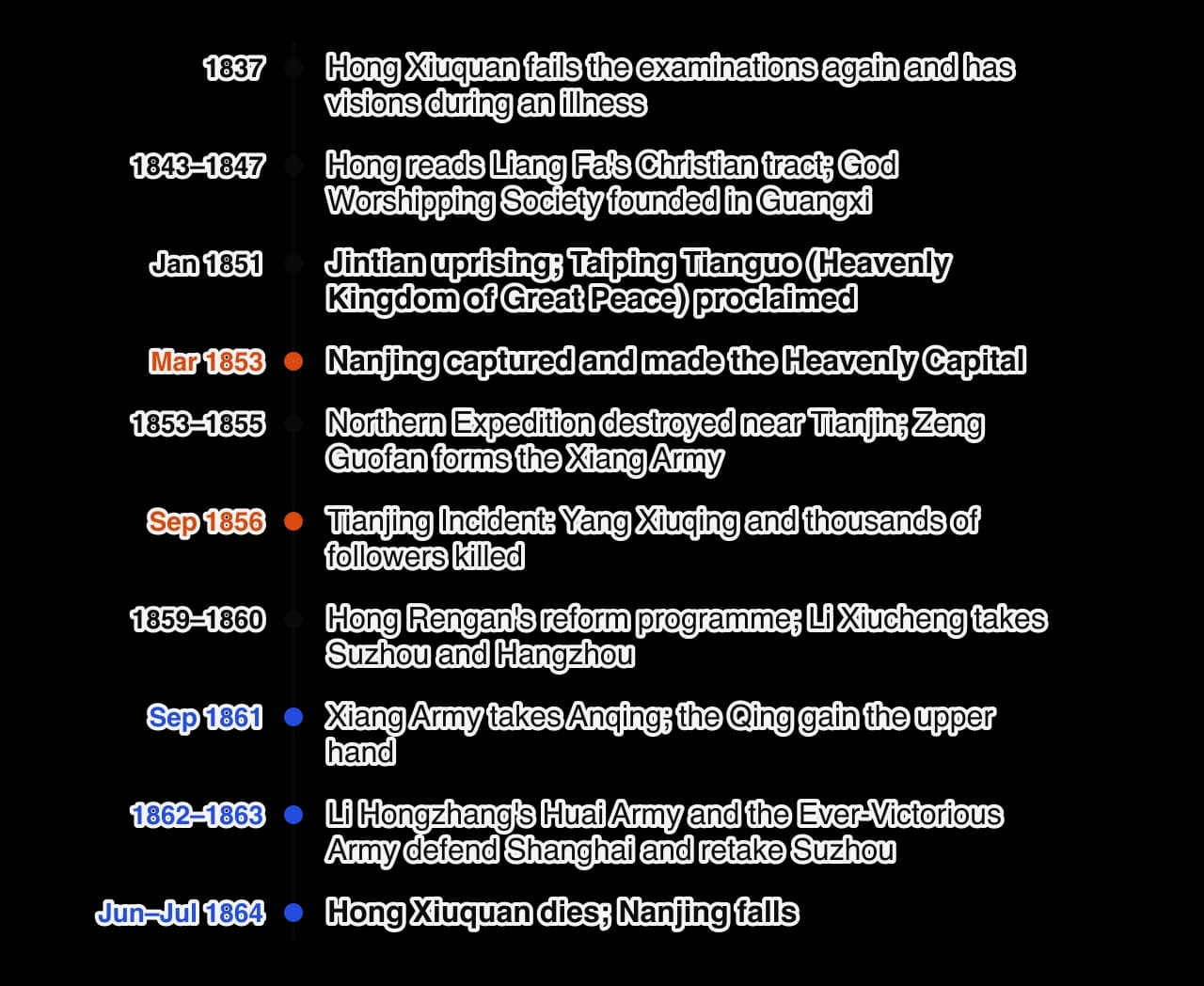
The timeline of the rebellion shows that the Taiping never again came so close to overthrowing the dynasty. A Northern Expedition sent towards Beijing in 1853 was too small; it reached the outskirts of Tianjin but was destroyed by 1855. The leaders then turned on each other. In September 1856, in the Tianjing Incident, the Northern King Wei Changhui, with Hong's approval, killed Yang Xiuqing, who had claimed authority over Hong himself, along with thousands of Yang's followers. Hong later had Wei executed, and the able general Shi Dakai left Nanjing with his army in 1857.
The kingdom revived under new leaders. Hong Rengan, Hong Xiuquan's cousin, who had lived among missionaries in Hong Kong, arrived in 1859 and proposed a modernising programme, A New Treatise on Aids to Government, with railways, banks, newspapers and patents. The general Li Xiucheng (the Loyal King) captured Suzhou and Hangzhou in 1860 and twice threatened Shanghai. But the Xiang Army took the key city of Anqing in September 1861, and from 1862 Qing forces closed in on Nanjing. Hong Xiuquan died, probably of illness, on 1 June 1864, and Nanjing fell in July 1864, followed by a massacre of its defenders.
The Taiping Heavenly Kingdom: programme and society
The Taiping set out a radical vision of society. Its fullest statement, The Land System of the Heavenly Dynasty (1853), described a society organised in units of twenty-five families with a common treasury and a church.
The land is for all to till, the food for all to eat, the clothes for all to wear, and money for all to spend. Inequality shall exist nowhere; none shall suffer from hunger or cold. … all people under Heaven are of one family belonging to the Heavenly Father, the Supreme Ruler, the Lord God-on-High. Nobody should keep private property.
The Land System of the Heavenly Dynasty, Taiping document, 1853 (translated in de Bary and Lufrano, Sources of Chinese Tradition, 2000). The document is a statement of ideals, written to justify the kingdom's claim to rule and to win the support of the poor, and it was never put into practice; in the areas they held, the Taiping mostly collected land tax through existing landlords. Its value is as evidence of the movement's religious egalitarianism and of why the landowning gentry saw it as a threat to the whole social order.
Equality of the sexes in principle. Land was to be given to women as well as men; women served in separate women's units of the army and as officials; foot-binding was banned.
Strict morality. Opium, alcohol, tobacco, gambling and prostitution were banned. In the early years men and women were separated, even husbands and wives, on pain of death; the rule was relaxed in 1855.
Religious iconoclasm. Temples, idols and Confucian texts were destroyed, and the examinations were set on Taiping texts instead of the Confucian classics.
A new calendar and new forms of language and ceremony.
In practice the leaders lived in palaces with many wives while ordinary followers were held to strict rules, and the egalitarian programme stayed largely on paper. The communist government of China later presented the Taiping as a peasant revolution; most historians today, following Jonathan Spence, stress that it was first of all a religious movement.
Reasons for the failure of the rebellion
Factor | Evidence | How important? |
|---|---|---|
Leadership | Hong withdrew into religious life after 1853; the Tianjing Incident of 1856 destroyed the original leadership; Shi Dakai left in 1857 | Very important: after 1856 the kingdom lacked unified command and lost much of its appeal |
Failure to win the gentry | Iconoclasm and the attack on Confucianism and private property drove landowners and scholars to the Qing side | Very important: it gave the Qing the leaders, money and local support for the regional armies |
Strategy | The Northern Expedition was too small; no alliance with the Nian or the Triads; little attention to winning over the countryside | Important, above all in 1853, when Beijing was vulnerable |
The regional armies | Zeng Guofan's Xiang Army and Li Hongzhang's Huai Army were better led, paid and motivated than the Banners | Decisive militarily: they won the war between 1861 and 1864 |
Western intervention | After 1860 Britain and France defended Shanghai, sold arms to the Qing and allowed officers to serve in the Ever-Victorious Army | Important around Shanghai (1860–1863); Stephen Platt argues it was decisive |
The Western powers had been neutral in the 1850s, and some missionaries had hoped for a Christian China. After the Convention of Beijing (1860), however, Britain and France had a stake in the survival of the Qing government, which now had to honour treaties that the Taiping had never signed. The Ever-Victorious Army, a force of Chinese soldiers under Western officers, led first by the American Frederick Townsend Ward and from 1863 by the British officer Charles Gordon, fought alongside Li Hongzhang's army around Shanghai. Platt's Autumn in the Heavenly Kingdom (2012) argues that British intervention tipped the balance; other historians give most of the credit to the Xiang Army, which captured Nanjing.
The regional armies: Zeng Guofan and Li Hongzhang
The Banners and the Green Standard Army failed against the Taiping, and the dynasty turned to Han Chinese officials. Zeng Guofan (1811–1872), a Confucian scholar and official from Hunan, was at home mourning his mother in 1852 when the court asked him to organise local defence. He built the Xiang Army (Hunan Army) from 1853. Its officers were scholars and gentry who recruited peasant soldiers from their own districts, paid them well and trained them hard; soldiers were loyal to their officers and officers to Zeng. Zeng presented the war as a defence of Confucian civilisation against a foreign religion, which won him the support of the gentry.
To pay for his army Zeng relied on provincial revenues and on a new tax, lijin, a levy on goods in transit introduced in 1853. Li Hongzhang (1823–1901), Zeng's former student, raised the Huai Army (Anhui Army) in 1862 on the same model; British ships carried it to Shanghai, where it fought alongside the Ever-Victorious Army and used Western weapons. Zuo Zongtang (1812–1885) led a third army, the Chu Army, that retook Zhejiang, and later reconquered Xinjiang (1876–1878).
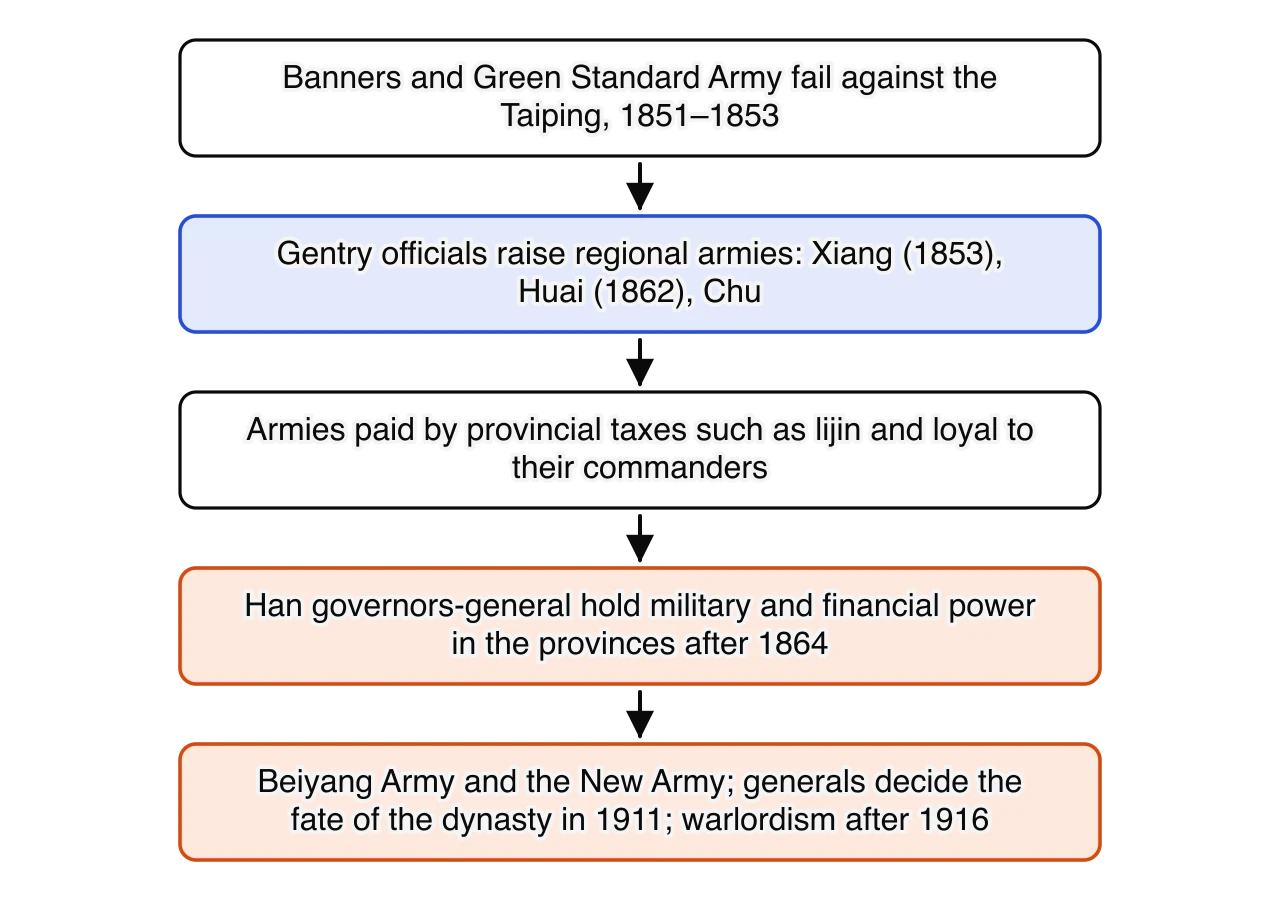
The chain of consequences shows why historians see the regional armies as a turning point. They saved the dynasty, but they were personal armies, raised and paid in the provinces. After 1864 Han Chinese governors-general such as Zeng and Li held more military and financial power than any officials had held under the high Qing, and the court in Beijing depended on them. Philip Kuhn (Rebellion and Its Enemies in Late Imperial China, 1970) traces the militarisation of local society from the gentry militia of the White Lotus campaigns to this new provincial power. Others warn against drawing too straight a line: Zeng disbanded most of his army in 1864 and remained loyal, and the court kept the power of appointment.
Other revolts of the mid-nineteenth century
The Taiping were not alone. The Nian Rebellion (1851–1868), a movement of mounted bands in the plains between the Huai and Yellow rivers, was fed by the Yellow River's change of course in 1855, which flooded large areas of the north. Muslim rebellions broke out in the south-west (the Panthay Rebellion in Yunnan, 1856–1873, led by Du Wenxiu) and in the north-west (the Dungan revolts in Shaanxi and Gansu, 1862–1877), and Yakub Beg set up an independent state in Xinjiang (1865–1877). All were suppressed by the regional armies, often with great brutality. Together these revolts show that the crisis of the mid-century was empire-wide.
The impact of the Taiping Rebellion
Impact | |
|---|---|
Political | The dynasty survived, but power shifted to Han Chinese officials and the provinces; the "Tongzhi Restoration" revived Qing government; regional armies became a model for later military forces |
Economic | The lower Yangzi, the richest region of China, was devastated; cities such as Nanjing, Suzhou and Hangzhou lost much of their population; lijin and new provincial taxes; refugees poured into foreign-protected Shanghai, which boomed |
Social and cultural | Tens of millions died; Confucian orthodoxy was reasserted by the victors; Christianity was associated with rebellion in the minds of many officials and gentry; later revolutionaries, including Sun Yixian, admired Hong as an anti-Manchu hero |
The table of the impact of the rebellion shows a paradox. The Qing won, but the way they won (relying on Han gentry, regional armies and foreign help) changed the balance of power within the empire. Tobie Meyer-Fong's What Remains (2013) reminds historians that for most people in the war zones the experience was not of ideology but of loss: flight, famine, and the deaths of family members on both sides.
Restoration and Self-Strengthening, 1861–1895
Cixi, Prince Gong and the regency
The Xianfeng Emperor died at Chengde in August 1861, leaving a five-year-old son. A council of eight conservative regents took power, but in November 1861 the boy's mother, Cixi (1835–1908), the emperor's widow Ci'an and the emperor's half-brother Prince Gong (Yixin, 1833–1898) overthrew them in the Xinyou coup. The two empresses dowager ruled as regents for the Tongzhi Emperor (r. 1861–1875), and Prince Gong, who had negotiated with the British and French in 1860, became head of the Grand Council and of the new office for foreign affairs.
Cixi became the most powerful figure in China for almost half a century. When the Tongzhi Emperor died in January 1875, she arranged for her three-year-old nephew to become the Guangxu Emperor (r. 1875–1908), against the normal rules of succession, so that she could remain regent. She formally retired in 1889, when Guangxu began to rule in person, but officials continued to consult her. Prince Gong, a supporter of cautious reform, was dismissed for a time in 1865 and lost his offices in 1884, after defeats in the war with France.
Cixi's reputation has changed a great deal. Western writers of the early twentieth century, relying on sources later shown to include forgeries by Edmund Backhouse, portrayed her as a cruel, extravagant reactionary who blocked every reform. Many Chinese nationalists and communists also blamed her for the dynasty's weakness. Later historians have presented her as a skilful politician who balanced court factions and supported practical modernisation when it did not threaten her power, while some recent biographers, notably Jung Chang (Empress Dowager Cixi, 2013), go further and see her as a moderniser, a view most specialists find overstated.
The Tongzhi Restoration
After the defeat of the Taiping, the court and officials such as Zeng Guofan tried to restore the Confucian order. This Tongzhi Restoration (c. 1862–1874) remitted taxes in devastated areas, resettled refugees, revived the examinations and schools, and appointed able officials. Mary Wright (The Last Stand of Chinese Conservatism, 1957) argues that it was a real revival that came close to success, but that Confucian values (agrarian, anti-commercial, focused on harmony) were incompatible with the needs of a modern state. Her thesis remains the starting point for debate about whether the Qing could have modernised.
The Self-Strengthening Movement
The defeats of 1860 convinced some officials that China needed Western weapons and techniques. The Self-Strengthening Movement (c. 1861–1895) was a series of projects to acquire them. Its central idea was expressed by the scholar Feng Guifen, an adviser to Zeng Guofan and Li Hongzhang.
What could be better than to take Chinese ethical principles of human relations and Confucian teachings as the foundation, and supplement them with the techniques of wealth and power of the various nations?
Feng Guifen, On the Adoption of Western Learning, c. 1861 (translated in J. Mason Gentzler, Changing China, 1977). Feng wrote as a classically trained scholar addressing other scholars, so he presented Western learning as a supplement that would protect, not replace, Confucian values. This argument made borrowing acceptable to officials, but it also set the limits of the movement: technology could be imported, institutions could not. Zhang Zhidong later summed up the principle as "Chinese learning as the essence, Western learning for practical use" (zhongti xiyong, often shortened to ti–yong).
The projects fell into three overlapping phases. The first concentrated on arms and diplomacy, the second on profitable enterprises to pay for them, the third on a modern navy and industry.
Date | Project | Leader | Significance |
|---|---|---|---|
1861 | Zongli Yamen (office for foreign affairs) | Prince Gong | First central institution for dealing with Western states |
1862 | Tongwen Guan (school of foreign languages), adding science in 1867 | Prince Gong | Trained interpreters and diplomats; opposed by conservatives led by Woren |
1865 | Jiangnan Arsenal, Shanghai | Zeng Guofan, Li Hongzhang | Made rifles, guns and ships; its translation bureau published Western science |
1866 | Fuzhou Navy Yard and naval school | Zuo Zongtang | Built warships with French help; destroyed by the French in 1884 |
1872 | China Merchants' Steam Navigation Company | Li Hongzhang | Competed with foreign shipping on the coast and the Yangzi; "official supervision, merchant management" |
1872–1881 | Chinese Educational Mission: 120 boys sent to study in the USA | Yung Wing, Zeng Guofan | Recalled early by conservatives; several students later became engineers and officials |
1878–1881 | Kaiping coal mines; Imperial Telegraph Administration | Li Hongzhang | Fuel for steamships; a national telegraph network |
1888 | Beiyang Fleet formally established | Li Hongzhang | Asia's largest navy on paper; no new ships bought after 1888 |
Many enterprises followed the model of guandu shangban, "official supervision, merchant management": merchants supplied capital and ran the business, while officials protected it and took a share of control and profit. This model attracted investment, but officials often treated enterprises as sources of patronage and revenue, and profits were taken out instead of reinvested.
The limits of Self-Strengthening
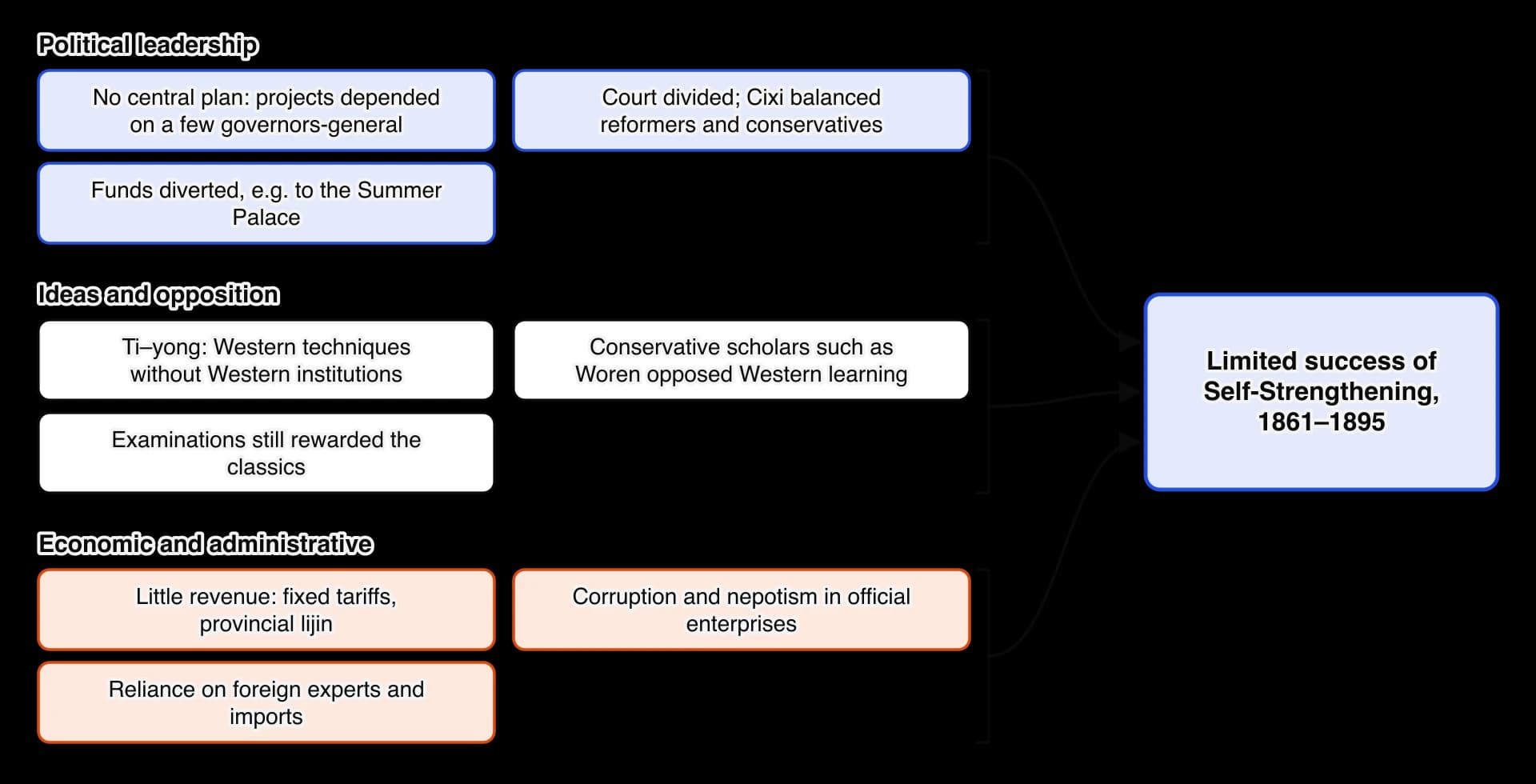
The diagram of the limits of Self-Strengthening groups the reasons why the movement achieved less than its leaders hoped. There was no national plan or ministry: each project depended on the energy and provincial resources of one official, above all Li Hongzhang, whose Beiyang (northern) fleet and army were in effect his own. The central government had little revenue to invest, because tariffs were fixed by treaty and lijin stayed in the provinces.
Conservative opposition was strong. In 1867 the Grand Secretary Woren, a leading Neo-Confucian scholar, argued against teaching astronomy and mathematics at the Tongwen Guan, saying that a nation was strengthened by propriety and righteousness, not by techniques. Officials who worked with foreigners were attacked as traitors, and the examination system still rewarded mastery of the classics, so the ablest young men had little reason to study engineering or science.
Funds were also diverted. From 1888 Cixi rebuilt the Summer Palace (Yiheyuan) outside Beijing, partly with money raised for the navy; the marble boat in its lake became a symbol of misused naval funds. Historians debate how much money was involved and how much difference it made, but the Beiyang Fleet received no new ships after 1888, while Japan's navy continued to expand.
Elman (On Their Own Terms, 2005) argues that the arsenals and schools of the period trained a generation of engineers and translated a large body of Western science, so the movement was less of a failure than the defeat of 1895 makes it appear. A comparison with Japan, where the Meiji government replaced the old political order itself, shows what Self-Strengthening lacked: central leadership with the power to change institutions, not only to buy machines. The Meiji Restoration is a focused study of its own; here it serves only as a point of comparison.
 YouTube
Foreign pressure, 1871–1885
Self-Strengthening was tested by a series of crises on the frontiers. Russia occupied the Ili valley in Xinjiang in 1871, and only after Zuo Zongtang's reconquest of Xinjiang did the Treaty of St Petersburg (1881) return most of it. Japan annexed the Ryukyu Islands, a Qing tributary, in 1879. In the Sino-French War (1884–1885) over Vietnam, the French navy destroyed the Fujian fleet and the Fuzhou Navy Yard in less than an hour in August 1884. Qing land forces won some victories in northern Vietnam, but the peace of 1885 recognised French control of Vietnam and ended Chinese suzerainty there. In Korea, Qing and Japanese influence competed, and in 1885 the Convention of Tianjin allowed both to send troops if they informed the other.
The First Sino-Japanese War and the scramble for concessions
In 1894 a peasant rebellion in Korea, the Donghak rebellion, led both China and Japan to send troops. Japan used the crisis to drive out Chinese influence. Its navy sank a British-owned transport carrying Chinese troops in July, and war was declared on 1 August 1894. The First Sino-Japanese War is treated from Korea's side in the regional study of Korea; here its significance lies in what it revealed about the Qing.
The war was a disaster for China. Japanese forces defeated the Qing army at Pyongyang (15 September 1894). Two days later, at the battle of the Yalu, the Beiyang Fleet lost five ships, partly because of shortages of shells and poor maintenance. Japan took Port Arthur in November, where its troops killed thousands of civilians, and Weihaiwei in February 1895, where the rest of the Beiyang Fleet was captured and its commander, Ding Ruchang, killed himself. Only the northern forces of Li Hongzhang really fought; the southern fleets and most provinces stayed out of the war, which shows how regional the Self-Strengthening forces had become.
Li Hongzhang negotiated the Treaty of Shimonoseki (17 April 1895). China recognised the independence of Korea, ending the last important tributary relationship; ceded Taiwan, the Pescadores and the Liaodong peninsula; paid an indemnity of 200 million taels; opened four more ports; and allowed Japanese subjects to build factories in the treaty ports, a right that all the other powers then gained through the most-favoured-nation clause. Within days Russia, France and Germany forced Japan, in the Triple Intervention, to return Liaodong to China in exchange for a further 30 million taels.
The scramble for concessions, 1897–1898
China paid the indemnities with large loans from European banks, secured on customs revenues. Russia gained the right to build the Chinese Eastern Railway across Manchuria (1896). Then, in November 1897, after two German missionaries were killed in Shandong, Germany seized Jiaozhou Bay. The other powers followed in what became known as the scramble for concessions.
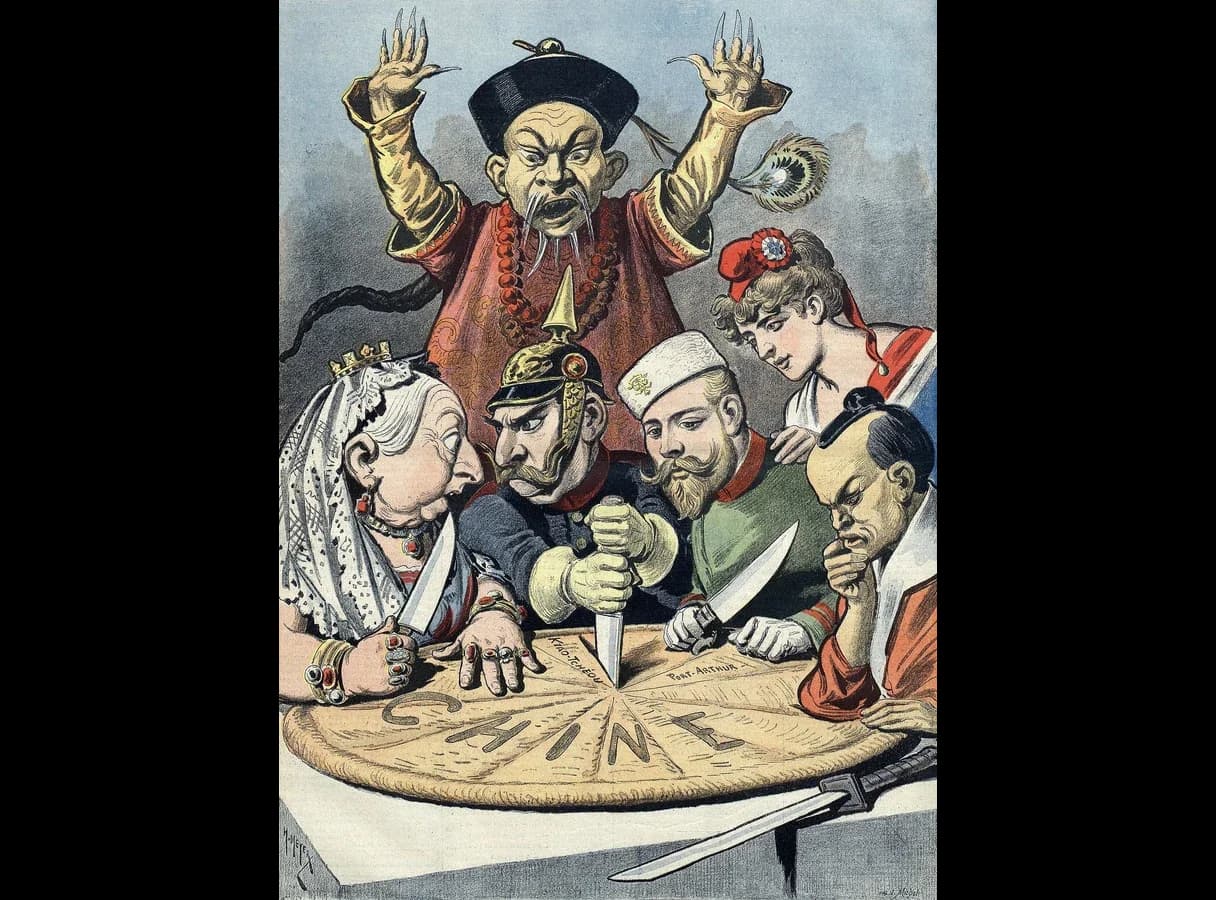
Meyer's cartoon presents China as a cake for the powers to divide. The powers took leased territories, areas that remained formally Chinese but were run by a foreign power for a fixed term, along with rights to build railways and open mines in surrounding spheres of influence.
Power | Leased territory (1898) | Sphere of influence |
|---|---|---|
Germany | Jiaozhou Bay (Qingdao), 99 years | Shandong |
Russia | Port Arthur and Dalian (Liaodong), 25 years | Manchuria |
Britain | Weihaiwei; the New Territories next to Kowloon, 99 years | Yangzi valley |
France | Guangzhouwan, 99 years | Yunnan, Guangxi and parts of Guangdong |
Japan | None (Taiwan already annexed in 1895) | Fujian |
The United States, which held no leased territory, issued the Open Door notes in 1899 and 1900, asking the powers to respect equal trading rights in their spheres and, in 1900, China's territorial integrity. The notes had little practical force, but they reflected a shared interest among the powers in keeping China as a single market rather than partitioning it outright. To Chinese reformers, however, the scramble looked like the first step towards the partition of China, as Africa was being partitioned at the same time.
The Hundred Days' Reform, 1898
The defeat of 1895 produced a new reform movement among younger scholars. In May 1895 Kang Youwei (1858–1927), a scholar from Guangdong, led more than a thousand examination candidates in Beijing in a petition (the gongche shangshu) against the Treaty of Shimonoseki and for reform. Kang reinterpreted Confucius himself as a reformer (Confucius as a Reformer, 1897), which allowed him to argue for institutional change in Confucian terms. With his student Liang Qichao (1873–1929), a brilliant journalist, and the radical thinker Tan Sitong (1865–1898), he set up study societies and newspapers to spread reform ideas.
In January 1898 Kang submitted a memorial to the Guangxu Emperor arguing for a complete change of institutions.
If Your Majesty, with your discerning brilliance, observes the trends in other countries, you will see that if we can change, we can preserve ourselves; but if we cannot change, we shall perish. Indeed, if we can make a complete change, we shall become strong, but if we only make limited changes, we shall still perish.
Kang Youwei, Comprehensive Consideration of the Whole Situation, memorial to the Guangxu Emperor, January 1898 (translated in de Bary and Lufrano, Sources of Chinese Tradition, 2000). Writing in the months of the scramble for concessions, Kang aimed to persuade a young emperor that limited, Self-Strengthening-style reform had failed; later in the memorial he urged the emperor to take Peter the Great and the Meiji Restoration as models. As a reformer seeking power for himself, Kang had reason to make the danger seem as great as possible and his own programme the only answer.
The Guangxu Emperor, now twenty-six, received Kang in June 1898. From 11 June to 21 September 1898, the "Hundred Days", the emperor issued a stream of reform edicts. They ordered the abolition of the "eight-legged essay" (the rigid style of the examination essays) in favour of questions on current affairs; the founding of the Imperial University of Peking (the forerunner of Peking University) and modern schools in every province; the abolition of sinecure posts and some redundant offices; modernisation of the army; support for railways, mining, commerce and agriculture; a state budget; and the right of junior officials and ordinary people to send memorials to the throne.
The coup of September 1898 and the reasons for failure
The reforms threatened thousands of officials whose posts or qualifications were abolished, and many provincial officials simply ignored the edicts. Senior Manchu officials and conservatives appealed to Cixi. When the emperor dismissed officials who blocked his edicts, the reformers feared a counter-attack, and Tan Sitong approached Yuan Shikai, the commander of a modern army near Tianjin, asking him to act against Ronglu, the Manchu commander loyal to Cixi. Yuan informed Ronglu. In what became known as the Wuxu coup, on 21 September 1898 Cixi resumed power as regent and had the emperor confined to a pavilion on an island in the palace lakes of Zhongnanhai, beside the Forbidden City, where he remained in effect a prisoner until his death in 1908. Historians debate whether Yuan's betrayal caused the coup or only made it harsher, since Cixi was already acting.
Kang Youwei and Liang Qichao escaped to Japan with foreign help. Tan Sitong refused to flee and was executed with five others (the "Six Gentlemen") on 28 September 1898. Almost all the edicts were cancelled, although the Imperial University survived.
Reason for failure | Explanation |
|---|---|
Conservative and Manchu opposition | Officials whose posts and status depended on the old system resisted; Manchu nobles feared that Kang's programme threatened Manchu privilege; Cixi was the focus of their appeals |
Military power | The army around Beijing was commanded by Ronglu, loyal to Cixi; the reformers had no armed force of their own, and Yuan Shikai would not provide one |
Weakness of the emperor | Guangxu had been raised under Cixi's control, depended on her approval for senior appointments and had no independent base of support |
Narrow base and haste | The reformers were a small group of scholars without administrative experience; dozens of edicts in a few weeks alarmed officials and could not be put into effect |
Kang's ideas | His reinterpretation of Confucius offended orthodox scholars, including reformers such as Zhang Zhidong, who supported change but not Kang |
The table of reasons for failure shows that the Hundred Days failed above all because the reformers had no power base in a system where power lay with Cixi, the Manchu nobility and the army. Conservative opposition was the most important single factor, but it was decisive because the emperor could not overrule it.
The Boxer Uprising and the Boxer Protocol, 1899–1901
Causes of the uprising
The Boxers (Yihequan, "Fists of Righteousness and Harmony") emerged in north-west Shandong in 1898–1899. They were young men, many of them poor peasants and labourers, who practised martial arts and rituals of spirit possession that they believed made them invulnerable to swords and bullets. Groups of young women, the Red Lanterns, joined the movement. Westerners called them "Boxers" because of their martial-arts exercises, and the movement and the war it led to are known as the Boxer Uprising.
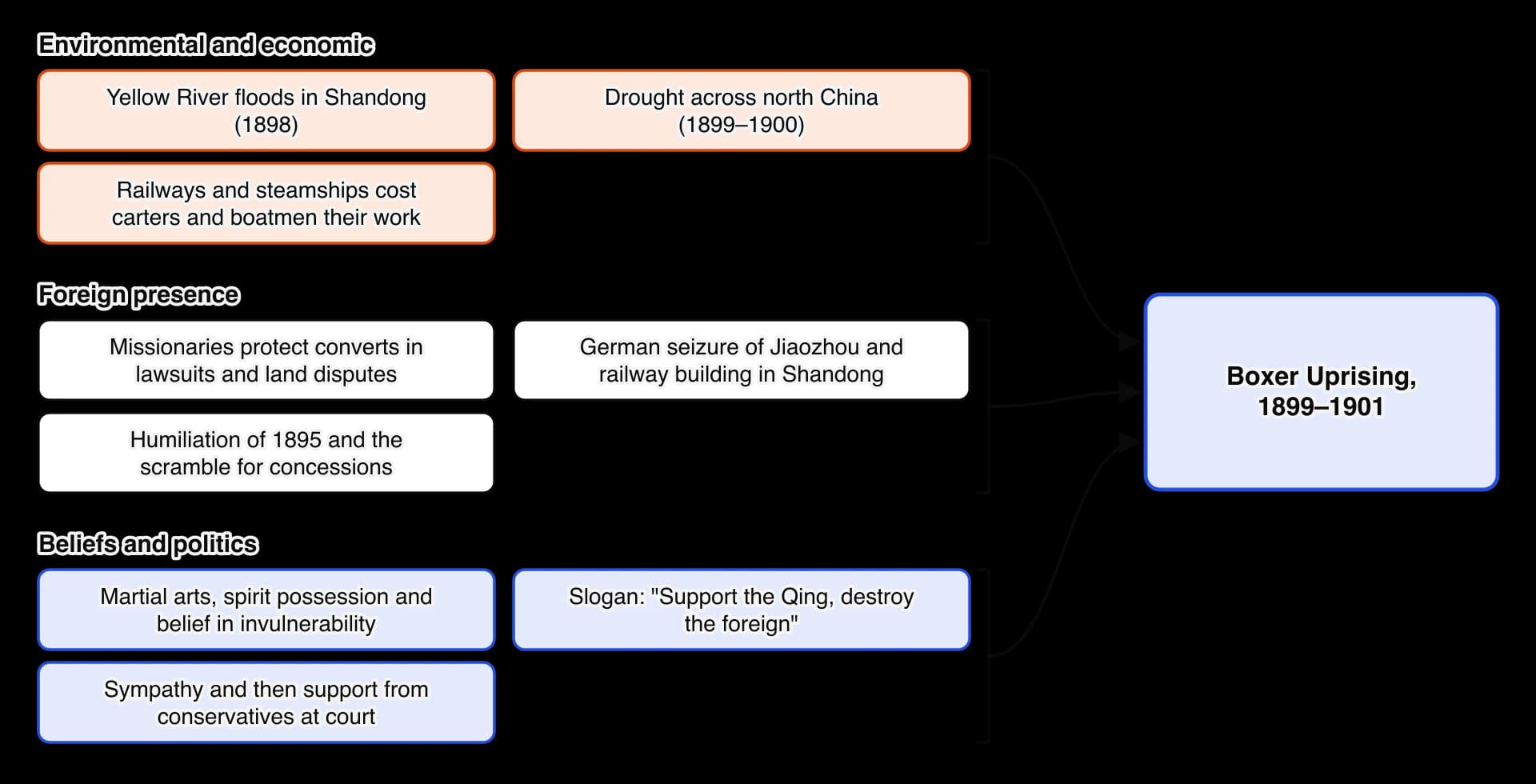
The diagram of the causes of the uprising shows several strands. The Yellow River flooded large parts of Shandong in 1898, and drought followed across north China in 1899 and 1900, leaving many young men idle and hungry. Railways and steamships, built under the treaties, threatened the work of carters and canal boatmen. Resentment focused on Christianity: missionaries and their Chinese converts, protected by foreign consuls, often won lawsuits and land disputes against their neighbours, and Catholic missions in Shandong were especially assertive. Germany's seizure of Jiaozhou and its railway and mining projects in Shandong added a direct foreign presence.
The Boxers' early slogans attacked both the Qing and the foreigners, but by 1899 the most common slogan was "Support the Qing, destroy the foreign". Yuan Shikai, governor of Shandong from December 1899, suppressed them there, and the movement spread into Zhili, the province around Beijing, where it burned churches, killed Chinese Christians and tore up railways and telegraph lines.
The war of 1900
Conservatives at court, including Manchu princes such as Prince Duan, saw the Boxers as a loyal popular force that could drive out the foreigners. In June 1900 the foreign powers sent troops towards Beijing, a first relief force was turned back, and allied ships seized the Dagu forts. On 21 June 1900 Cixi issued an edict declaring war on the powers. The German minister, Clemens von Ketteler, had been killed in the street the day before, and Boxers and Qing troops besieged the foreign legations in Beijing from 20 June to 14 August 1900.
Across north China, Boxers and some officials killed foreign missionaries and their families (about 200 people) and many thousands of Chinese Christians; estimates for Chinese Christians are around 30,000 or more. The worst massacre of foreigners took place at Taiyuan in Shanxi in July 1900, ordered by the governor, Yuxian. Many Boxers and ordinary villagers were then killed by Qing and foreign troops.
The war showed the decentralisation of Qing power. The leading governors-general of the south and centre, including Li Hongzhang, Zhang Zhidong and Liu Kunyi, refused to obey the declaration of war. They agreed with the foreign consuls to keep order in their provinces, an arrangement known as the Southeast Mutual Protection, and declared that the edict had been issued without the court's real consent. The war was confined to the north.
An international force of about 20,000 troops from eight powers, the Eight-Nation Alliance (Japan, Russia, Britain, France, the United States, Germany, Italy and Austria-Hungary) relieved the legations on 14 August 1900. Cixi and the emperor fled in disguise to Xi'an. Foreign troops looted Beijing and carried out punitive expeditions in the surrounding countryside, and Russia occupied Manchuria.
The Boxer Protocol, 1901
The Boxer Protocol, signed on 7 September 1901 by the Qing and eleven powers, was the harshest of all the treaties imposed on China.
An indemnity of 450 million taels, about one tael for every person in China, to be paid over 39 years with interest (almost 1,000 million taels in all), secured on the customs and salt revenues.
A Legation Quarter in Beijing under foreign control, with permanent foreign garrisons, and foreign troops posted along the railway from Beijing to the sea.
Destruction of the Dagu forts; a ban on arms imports for two years.
Punishment of officials who had supported the Boxers (some executed, others ordered to commit suicide or exiled); the examinations suspended for five years in towns where foreigners had been killed.
Missions of apology to Germany and Japan; the Zongli Yamen replaced by a Ministry of Foreign Affairs (Waiwubu).
The Protocol left the Qing government in place, because the powers preferred a weak central government that could pay the indemnity to the risks of partition. Its effects were heavy: the indemnity took a large share of revenue for decades, and the dynasty had shown itself unable either to control a popular movement or to defend the capital. Paul Cohen (History in Three Keys, 1997) shows that the Boxers were later remembered in contradictory ways, as superstitious fanatics by Western writers and early Chinese reformers, and as patriotic anti-imperialists by later nationalists and communists.
The Late Qing Reforms, 1901–1911
Even before returning to Beijing, the court in exile announced a new programme of reform in an edict of 29 January 1901.
We have now received Her Majesty's decree to devote ourselves fully to China's revitalization, … and to blend together the best of what is Chinese and what is foreign. The root of China's weakness lies in harmful habits too firmly entrenched, in rules and regulations too minutely drawn, in the overabundance of inept and mediocre officials and in the paucity of truly outstanding ones …
Reform Edict of the Qing imperial government, issued in the name of the Guangxu Emperor at Xi'an, 29 January 1901 (translated in de Bary and Lufrano, Sources of Chinese Tradition, 2000). Issued months after the flight from Beijing, the edict had to justify reform while defending Cixi, who had crushed the reforms of 1898; elsewhere it calls Kang Youwei's programme "lawlessness" and insists that the empress dowager had never opposed change. Its value is in showing how the court tried to take over the reform agenda as its own, and its silence on the court's responsibility for the Boxer disaster is part of the evidence.
The Late Qing Reforms, also called the New Policies (Xinzheng), went far beyond Self-Strengthening and in some areas beyond the Hundred Days. They were directed by Cixi until her death in 1908 and carried out by officials such as Zhang Zhidong, Liu Kunyi and Yuan Shikai.
Area | Reforms | Effects |
|---|---|---|
Military | A New Army trained on Western and Japanese lines, planned at 36 divisions; Yuan Shikai's Beiyang Army in the north (six divisions by 1905); military schools | A more effective army, but officers trained in modern schools and in Japan were open to nationalist and revolutionary ideas; the Beiyang Army was loyal to Yuan |
Education | Modern schools; the civil service examinations abolished in 1905; thousands of students sent to Japan (about 8,000 there by 1905–1906) | Ended the link between the Confucian gentry and the state; students abroad met revolutionaries |
Government | Ministry of Foreign Affairs (1901); new ministries of commerce, police, education (1903–1906); legal reforms | More modern administration, but Manchu princes held many new posts |
Constitution | Study missions abroad (1905–1906); Outline of a Constitution (1908) with nine years of preparation; provincial assemblies (1909); National Assembly (1910); timetable shortened to 1913 after petitions | Gave the gentry and merchants elected bodies through which to organise and challenge the court |
Social | Campaign against opium (1906 edict; agreement with Britain in 1907 to reduce Indian imports); discouragement of foot-binding | Opium production and imports fell sharply by 1911; local resentment at enforcement |
Why the reforms weakened the dynasty
The reforms were expensive, and the government also had to pay the Boxer indemnity, so taxes and levies rose. Rice riots broke out in Changsha in 1910, and there were many local protests against new taxes and schools. More fundamentally, the reforms created new elites with their own organisations and expectations: New Army officers, students educated abroad, and gentry and merchants in the provincial assemblies. The abolition of the examinations removed the main reason for the gentry's attachment to the dynasty.
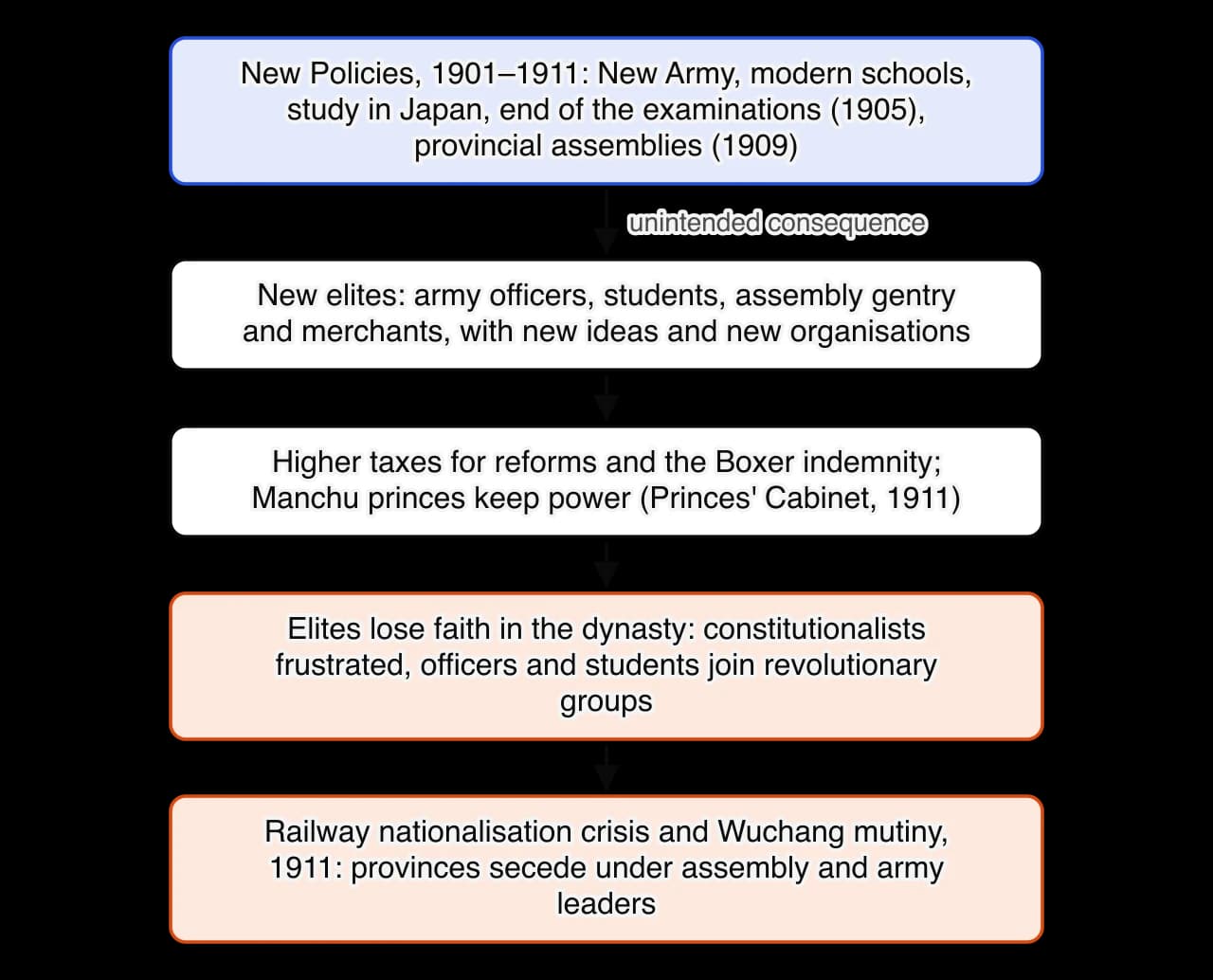
The chain of unintended consequences shows how these groups turned against the court. In November 1908 the Guangxu Emperor died, one day before Cixi (a forensic study published in 2008 found arsenic in his remains, suggesting that he was poisoned). The new emperor, Puyi, was two years old, and his father, Prince Chun (Zaifeng), became regent. Prince Chun dismissed Yuan Shikai in January 1909 and concentrated power in Manchu hands. The Princes' Cabinet appointed in May 1911 had thirteen members, nine of them Manchu, seven of them from the imperial clan, which convinced many constitutionalists that the court would never share power.
Sun Yixian and the revolutionary movement
Sun Yixian (Sun Yat-sen, 1866–1925) was born to a farming family near Macao and educated in Honolulu and Hong Kong, where he trained as a doctor. Unlike Kang Youwei he had no classical degree and moved among overseas Chinese, students and secret societies more than among officials. In 1894 he founded the Revive China Society (Xingzhonghui) in Honolulu, and in 1895 its plan for a rising in Guangzhou was discovered and its members arrested or executed. Sun fled abroad. In 1896 he was detained in the Chinese legation in London, and his release after a newspaper campaign made him internationally famous.
In August 1905 in Tokyo, Sun joined with other groups, among them Huang Xing's Hunan revolutionaries, to found the Tongmenghui (Revolutionary Alliance). Its programme called for expelling the Manchus, restoring Chinese rule, founding a republic and equalising land rights. Sun summed up his ideas as the Three Principles of the People (Sanmin zhuyi), set out in the Tongmenghui's journal in 1905:
Nationalism (minzu): at first above all the overthrow of the Manchus, seen as foreign rulers; later also resistance to imperialism.
Democracy or people's rights (minquan): a republic with a constitution and elected government.
People's livelihood (minsheng): social and economic welfare, especially "equalisation of land rights", by which the state would take the increase in land values.
The Guomindang (Nationalist Party), which developed the Three Principles into a party ideology, was founded only in August 1912, after the end of the dynasty; its later history belongs to the study of modern China from 1910.
Other revolutionaries spread anti-Manchu ideas. Zou Rong's pamphlet The Revolutionary Army (1903) called for a war of revenge against the Manchus; Zou died in prison in Shanghai in 1905. The feminist revolutionary Qiu Jin was executed in 1907 after a failed rising in Zhejiang. The Tongmenghui organised a series of uprisings in the south, often with secret-society support, and all failed; the last, at Guangzhou in April 1911, cost the lives of more than seventy revolutionaries, later honoured as the Huanghuagang martyrs. Its members also worked within the New Army, especially in Hubei.
Revolutionaries were not the only opposition. Constitutionalists such as Liang Qichao and the industrialist Zhang Jian wanted a constitutional monarchy, not a republic, and many of them led the provincial assemblies. Their loss of faith in the court in 1910–1911 mattered as much to the outcome as the revolutionaries' plots.
The Xinhai Revolution, 1911–1912
The revolution of 1911 is called the Xinhai Revolution after the name of the year 1911 in the Chinese sixty-year calendar cycle. Its immediate cause was a dispute over railways.
The railway crisis and the Wuchang uprising
Provincial gentry and merchants had raised money to build railways in Sichuan, Hubei, Hunan and Guangdong under their own control. In May 1911 the government announced that the main lines would be nationalised and built with a loan from a consortium of British, French, German and American banks. Investors in Sichuan lost much of their money, and the decision seemed to hand Chinese railways to foreigners. The Railway Protection Movement organised strikes and protests across Sichuan; on 7 September troops fired on protesters in Chengdu, and the province rose in revolt. Troops were sent from Hubei to restore order, weakening the garrison at Wuchang.
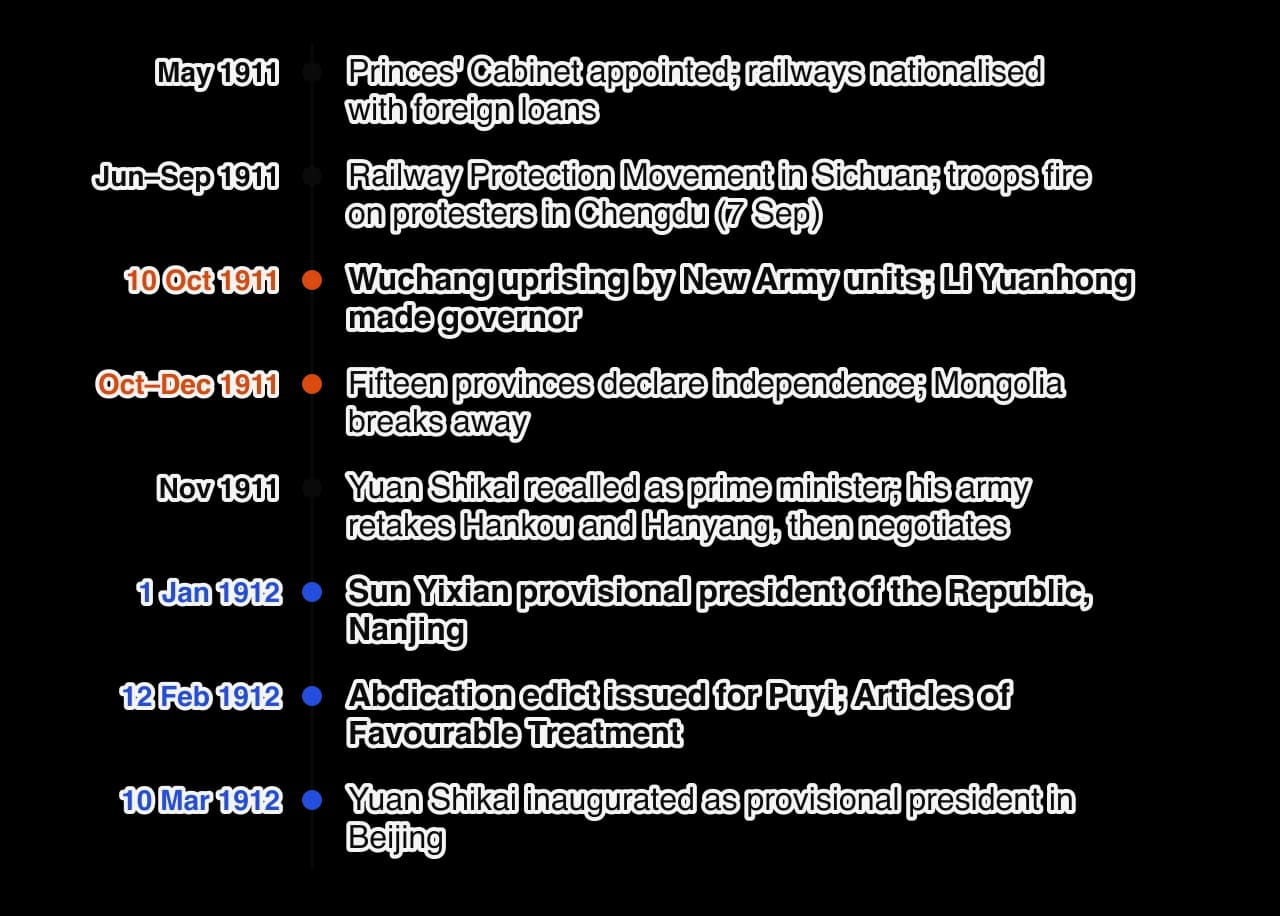
The timeline of 1911–1912 shows how quickly the dynasty collapsed. On 9 October 1911 a bomb exploded by accident in a revolutionary workshop in the Russian concession at Hankou, and the police found lists of revolutionaries in the New Army. Facing arrest, New Army units in Wuchang rose on 10 October and seized the city. Their leaders were junior officers; they persuaded, or forced, a brigade commander, Li Yuanhong, to become military governor of Hubei. Sun Yixian was in the United States raising money and learned of the rising from a newspaper.
Within two months fifteen provinces declared independence from the Qing. In most of them the provincial assemblies and New Army commanders took control, often with little fighting; in some cities, such as Xi'an and Wuchang, thousands of Manchus were killed. Outer Mongolia declared independence in December 1911, and Tibet expelled Qing troops in 1912.
Yuan Shikai and the abdication
The court recalled Yuan Shikai (1859–1916), the only man with the loyalty of the Beiyang Army, and made him prime minister in November 1911. Yuan's troops retook Hankou and Hanyang, showing that he could defeat the revolution, but he then stopped and negotiated. He used the revolution to put pressure on the court and the court to put pressure on the revolutionaries.
Sun Yixian returned to China in December and was inaugurated in Nanjing on 1 January 1912 as provisional president of the Republic of China. But the revolutionaries had little military strength or money, and the foreign powers favoured Yuan. A bargain followed: Yuan would arrange the end of the monarchy, and Sun would hand him the presidency. On 12 February 1912 the Empress Dowager Longyu issued an edict of abdication on behalf of the six-year-old Puyi. The Articles of Favourable Treatment allowed the emperor to keep his title and live in the Forbidden City with a state allowance. Sun resigned, and Yuan Shikai was inaugurated as provisional president in Beijing on 10 March 1912. The history of his presidency belongs to the study of modern China from 1910.
Why did the Qing fall, and how far did the revolution succeed?
Factor | Contribution to the fall of the Qing in 1911–1912 |
|---|---|
Long-term decline | Rebellion, defeat and indemnities since 1839 had drained the dynasty's resources and prestige; power had shifted to the provinces since the Taiping war |
Late Qing Reforms | Created New Army officers, students and assembly elites who abandoned the dynasty; abolition of the examinations cut the gentry's tie to the throne; higher taxes |
Manchu leadership after 1908 | A child emperor and a weak regent; the Princes' Cabinet; dismissal of Yuan Shikai; refusal to share power with the constitutionalists |
Foreign influence | Foreign loans triggered the railway crisis; anti-Manchu nationalism grew from humiliation by the powers; the powers stayed neutral and then favoured Yuan |
Revolutionaries | Spread anti-Manchu and republican ideas and infiltrated the New Army; their rising at Wuchang began the revolution, but they did not control its course |
Yuan Shikai | Controlled the strongest army and chose to bargain for the abdication instead of crushing the revolution |
The revolution succeeded in ending the monarchy, but it did not create a stable republic. Power passed to Yuan Shikai and the military, and the provincial elites who had made the revolution were more interested in local self-government than in Sun's programme. For this reason the revolution is often called a failure: Chinese communist historians described it as a "bourgeois-democratic" revolution that the bourgeoisie was too weak to complete, and many liberal historians stress how quickly republican institutions gave way to military rule. Yet the end of more than two thousand years of monarchy was itself a fundamental change, and no later attempt to restore an emperor (Yuan Shikai in 1915–1916, the brief restoration of Puyi in 1917) lasted.
 YouTube
Perspectives and debates
Western impact or internal crisis?
The oldest debate concerns what drove the history of late imperial China. In China's Response to the West (1954), John K. Fairbank and Ssu-yu Teng presented the period as one of Western impact and Chinese response: a stable, inward-looking Confucian civilisation was disrupted by the expanding West and failed to respond effectively. Joseph Levenson (Confucian China and Its Modern Fate, 1958–1965) argued that Confucian values could not be adapted to the modern world, so that modernisation required abandoning them.
Paul Cohen (Discovering History in China, 1984) criticised this approach as Western-centred. He called for a "China-centred" history that starts from Chinese problems as Chinese people experienced them: population growth, ecological stress, rebellion, the rising power of local elites. From this angle, the White Lotus and Taiping rebellions, the regional armies and the provincial assemblies matter more than the Opium War, and the West appears as one force among several.
Economic historians add a further angle. Kenneth Pomeranz (The Great Divergence, 2000) argues that the richest parts of China were economically comparable to the richest parts of Europe as late as 1750, so the great divergence between them after about 1800 needs explaining by specific factors, such as Britain's coal and colonies, not by a long-term Chinese failure.
A Chinese or an Inner Asian empire?
The New Qing History of the 1990s and 2000s, associated with Evelyn Rawski, Mark Elliott (The Manchu Way, 2001) and Peter Perdue (China Marches West, 2005), uses Manchu and Mongol sources to argue that the Qing kept a distinct Manchu identity and ruled as an Inner Asian empire, not simply as a Chinese dynasty that had been absorbed by Chinese culture. Ping-ti Ho (1998) defended the older view that sinicisation was the key to Qing success. The debate matters for this study because it affects how Qianlong's conquests, Manchu privilege and the anti-Manchu nationalism of 1911 are understood.
The causes of the First Opium War
Contemporaries disagreed sharply. Lin Zexu and the Qing court saw the war as a defence of the opium trade, and so did British critics such as Gladstone. Supporters of the war in Britain presented it as a defence of free trade and diplomatic equality. In a lecture of 1841, the former US president John Quincy Adams argued that the real cause was not opium but the kowtow, that is, China's refusal to deal with other states as equals.
Modern historians mostly agree that both commercial and diplomatic causes mattered but disagree about their weight. Hsin-pao Chang (Commissioner Lin and the Opium War, 1964) and Peter Ward Fay (The Opium War, 1840–1842, 1975) emphasise the opium trade and the clash between Lin's enforcement and British commercial interests. Julia Lovell (The Opium War, 2011) gives weight to both trade and British ideas of national honour, and studies how the war was later turned into a founding myth of Chinese nationalism.
Reform: was success possible?
Historian | Argument | Evidence stressed |
|---|---|---|
Mary Wright (1957) | The Tongzhi Restoration was a genuine Confucian revival, but Confucianism and modernisation were incompatible | Restoration policies after 1862; limits of Self-Strengthening |
Albert Feuerwerker (1958) | The guandu shangban enterprises were held back by bureaucratic control, patronage and the lack of a central government programme | Records of the China Merchants' company and other official enterprises |
Benjamin Elman (2005) | Self-Strengthening was more successful in science and technology than the 1895 defeat suggests | Translations and training at the Jiangnan Arsenal and the Fuzhou Navy Yard |
Jung Chang (2013) | Cixi was a moderniser held back by others; most specialists find this overstated | Cixi's support for many projects and for the New Policies after 1901 |
These views can be weighed by asking what "success" means. If the test is military security, reform failed in 1895 and 1900. If the test is the training of new elites and the building of modern institutions, much was achieved, especially after 1901, but those achievements helped to destroy the dynasty that sponsored them.
The Taiping and the rise of regional power
Communist historians such as Luo Ergang interpreted the Taiping as a peasant revolution against feudal landlords, a forerunner of the Chinese revolution. Jonathan Spence (God's Chinese Son, 1996) stresses Hong Xiuquan's religious vision as the core of the movement. On its defeat, Stephen Platt (2012) emphasises Western intervention, while Philip Kuhn (1970) and Franz Michael emphasise the gentry-led regional armies and argue that their rise began a long shift of power from the centre to the provinces.
The revolution of 1911
Interpretation | Historians | Main argument |
|---|---|---|
Revolutionary | Guomindang historians; early accounts of Sun Yixian | Sun and the Tongmenghui led a national revolution against the Manchus |
Marxist | Historians in the People's Republic of China | A "bourgeois-democratic" revolution that failed because the Chinese bourgeoisie was weak and compromised with Yuan Shikai and the imperialists |
Elite and reform | Mary Wright (ed., China in Revolution, 1968); Joseph Esherick (Reform and Revolution in China, 1976) | The revolution grew out of the Late Qing Reforms; urban reformist elites in the provinces made it and gained most from it |
Ethnic | Edward Rhoads (Manchus and Han, 2000) | Anti-Manchu feeling, and the court's failure to end Manchu privilege, were central to the revolution |
Biographical revision | Marie-Claire Bergère (Sun Yat-sen, 1994) | Sun's role in 1911 was much smaller than later Guomindang and communist myth suggested |
The interpretations are not mutually exclusive. The elite interpretation explains who took power in the provinces, the ethnic interpretation explains why the dynasty, not only its policies, was rejected, and the revolutionary and Marxist views explain the ideas and the limits of the republic that followed.
Applying the ideas in exam questions
Question 1: the opium trade and the First Opium War (with a full essay plan)
Question 2: challenges under Qianlong
Question 3: the failure of the Taiping Rebellion
Question 4: Cixi and the failure of reform
Question 5: the fall of the dynasty
Self-check
- To do:
I can describe the political structure of the Qing state under Qianlong, including the Grand Council, the Six Boards, the Censorate, the Lifanyuan, the Banners and the role of the gentry.
- To do:
I can explain how Confucianism, the examination system and the Sacred Edict supported the social order, and how the literary inquisition controlled ideas.
- To do:
I can explain the tributary system and why it clashed with British ideas of trade and diplomacy.
- To do:
I can explain the growth of the empire under Qianlong (the Zunghars, Xinjiang, Tibet, the Ten Great Campaigns) and its costs.
- To do:
I can explain the causes and significance of the Miao and White Lotus rebellions.
- To do:
I can describe the Canton system and the aims and outcomes of the Macartney, Amherst and Napier missions.
- To do:
I can explain how the opium trade worked and its social and economic impact on China, including the silver crisis.
- To do:
I can explain Lin Zexu's actions in 1839 and the British reactions to them, including the debate in Parliament.
- To do:
I can outline the course of both Opium Wars and the terms of the treaties of Nanjing, the Bogue, Tianjin and Beijing.
- To do:
I can analyse the political, economic and cultural impact of the Opium Wars and the unequal treaties.
- To do:
I can explain the environmental, economic, social and religious causes of the Taiping Rebellion and the role of Hong Xiuquan.