Notes on R3.5 Korea (1840–1945)
Between 1840 and 1945 Korea went from a kingdom that kept almost all foreigners out, to an independent empire, to a Japanese colony. Its history in these years shows how an East Asian state responded to Western and Japanese imperialism, how colonial rule changed a society, and why Korea entered the Cold War as a divided nation.
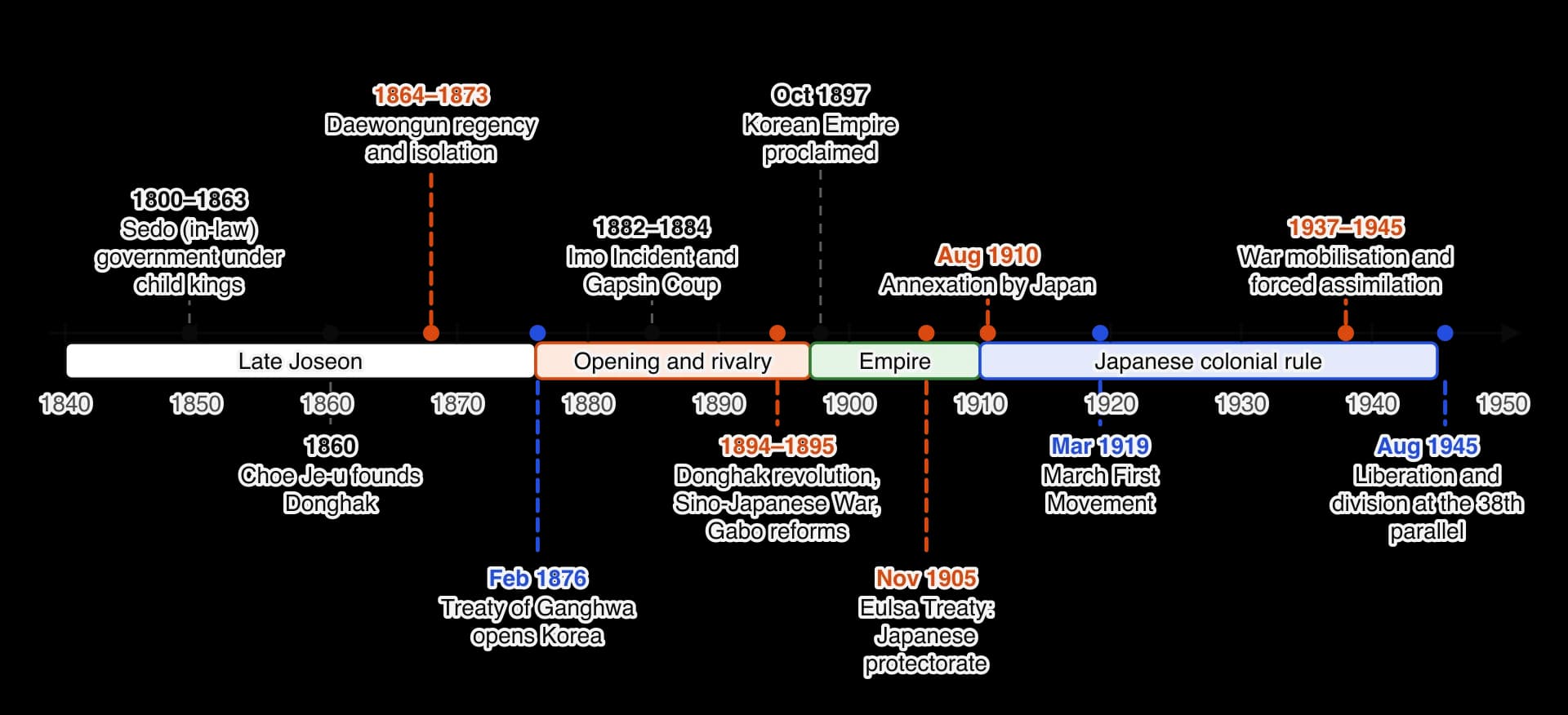
The timeline of Korea from 1840 to 1948 shows four periods. Each turning point was shaped as much by events outside Korea (the Opium Wars in China, the Meiji Restoration in Japan, wars between Japan and its rivals, the Second World War) as by decisions in Seoul.
Joseon Korea in the mid-nineteenth century
The Joseon dynasty had ruled Korea since 1392. Its kings governed a centralised, agrarian state built on Neo-Confucianism: the belief that a moral order of hierarchy, loyalty and family duty, taught through classical learning and ritual, kept society in harmony. Officials were recruited through the civil service examinations, and the king was expected to rule through ministers and to listen to criticism from scholars.
A society of status
Korean society was divided into hereditary status groups. The privileges of the top group and the burdens of the bottom one became central issues in every reform movement of the century.
Status group | Who they were | Position in society |
|---|---|---|
Yangban | Aristocratic scholar-official families | Monopolised high office and the examinations; owned much of the land; largely exempt from military service and the military cloth tax |
Jungin ("middle people") | Hereditary technical specialists: interpreters, doctors, accountants, clerks | Educated and often wealthy but barred from high office; many later supported reform |
Sangmin (commoners) | Most peasants, artisans and merchants | Paid the land tax, military cloth tax and grain-loan interest; the main victims of tax abuse |
Cheonmin ("base people") | Hereditary slaves (nobi), butchers, entertainers, shamans | Legally and socially despised; slaves could be bought, sold and inherited |
Slavery was in decline by the 1840s: in 1801 the government freed the slaves owned by state agencies, but privately owned slaves remained until the 1890s. Yangban status was also becoming harder to define, as wealthy commoners bought titles and many yangban families grew poor.
Korea in the Chinese world order
In foreign affairs Joseon was part of the Chinese tributary system. Korean kings received investiture from the Qing emperor, sent regular embassies to Beijing and used the Chinese calendar. Koreans called this relationship sadae, "serving the great". In return China recognised the king and left Korea to govern itself. Relations with Japan were conducted through the Tsushima domain, whose merchants were allowed to trade only at a walled post in Busan.
Because Korea refused contact with the West and limited contact with Japan, Western writers called it the "Hermit Kingdom". The label is misleading if it suggests ignorance. Korean envoys to Beijing brought back news, books and, from the late eighteenth century, Catholic writings, and the court knew that Britain and France had defeated China in the Opium War (1839–1842) and sacked Beijing in 1860.
Mid-century challenges to the Korean monarchy
Sedo politics and the weakening of royal authority
After the death of King Jeongjo in 1800, three kings came to the throne in succession who were children or political outsiders: Sunjo (r. 1800–1834), who became king at ten; Heonjong (r. 1834–1849), who became king at seven; and Cheoljong (r. 1849–1863), a distant royal relative who had been living as a farmer on Ganghwa Island. Real power passed to the families of their queens and mothers, above all the Andong Kim clan and, under Heonjong, the Pungyang Jo clan.
Sedo politics weakened the monarchy in three ways. First, the consort clans placed their relatives in the top offices and excluded rival factions, so the court no longer balanced competing groups. Second, offices were sold, and officials who had paid for their posts recovered the cost from the people they governed. Third, the king became a figurehead, so there was no strong ruler to discipline the bureaucracy or respond to foreign threats.
The burden fell most heavily on the countryside through the three administrations: the land tax, the military cloth tax (paid by commoners instead of military service) and the state grain-loan system. Officials and clerks added illegal surcharges, registered dead men and infants for the military tax, and forced peasants to borrow grain at high interest.
Hong Gyeong-nae Rebellion (1811–1812): a rising in Pyeongan province in the north-west, led by a fallen yangban and supported by merchants, miners and peasants who resented the region’s exclusion from office. The rebels held the town of Jeongju for about four months before they were crushed.
Imsul peasant uprisings (1862): a wave of risings that began at Jinju in the south and spread to dozens of counties, directed against corrupt magistrates and clerks. The government promised to reform the three administrations but achieved little.
The spread of Christianity
Catholicism reached Korea as Seohak ("Western Learning") through Chinese-language books brought back from Beijing. In 1784 Yi Seung-hun, a young scholar, was baptised in Beijing and began a lay Catholic community on his return. The faith spread among some yangban scholars, jungin and commoners, and among women, who were drawn by its teaching that all souls are equal before God.
The state saw Catholicism as subversive for two reasons. Catholics refused to perform the ancestral rites at the heart of Confucian family life, which looked like an attack on filial piety and so on the whole social order. They also looked to foreigners: in 1801 a convert’s secret letter asking for Western warships to protect the Church was intercepted. Persecutions followed in 1801, 1839 (when three French priests were executed), 1846 (when Kim Dae-geon, the first Korean priest, was executed) and, most severely, in 1866.
Conservative Confucian scholars justified the persecutions with a view of civilisation in which Chinese learning stood at the centre and Western teaching was a form of barbarism. Yi Hang-no (1792–1868), the leading conservative thinker of the period, wrote:
Europeans do have a remarkable talent for technology. They easily surpass the Chinese in that area. But that achievement makes them arrogant, and they think that they can convert the whole world to their way of thinking. They need to think again!
Yi Hang-no, Hwaseo seonsaeng munjip (collected writings), on "Sinifying the Western Barbarians", mid-nineteenth century; translated by Donald Baker in Sources of Korean Tradition, vol. 2 (2000). Yi wrote as a teacher of Confucian orthodoxy, for scholars who shared his assumptions. His admission of Western technical skill matters: the conservative case against the West was moral and cultural, not a result of ignorance, and his pupils led the later movement to "defend orthodoxy and reject heterodoxy" against the opening of the country.
The threat of Donghak
In 1860 Choe Je-u, a member of an impoverished yangban family near Gyeongju, began to preach a new religion after a mystical experience. He called it Donghak ("Eastern Learning") to set it against Western Learning. It combined Confucian ethics, Buddhist and Daoist ideas and Korean popular religion, and it taught that Heaven dwells within every person, so that all people, whatever their status, deserve respect.
I was born in the East and received the truth in the East. Therefore, the Way is the Heavenly Way and the doctrine is the Eastern Learning (Tonghak).
Choe Je-u, "On Learning Truth", in the Donghak scriptures (Cheondogyo gyeongjeon), early 1860s; translated by Yong Choon Kim in Sources of Korean Tradition, vol. 2 (2000). Choe wrote for his followers, and the passage defines the new faith against Christianity and the military power of the West, which he had heard was destroying China. It shows that Donghak was both a religious answer to social crisis and an early expression of Korean anti-foreign feeling.
The government treated Donghak as dangerous. Its egalitarian teaching threatened the status order, its rapid spread among poor peasants in the south looked like the beginning of rebellion, and officials suspected it of being Catholicism under another name. Choe Je-u was arrested and executed in 1864 for misleading the people with false teaching. His successor, Choe Si-hyeong, kept the religion alive underground and built a network of congregations across the southern provinces, which in 1894 became the organisation of a peasant revolution.
The Heungseon Daewongun, 1864–1873
When Cheoljong died without an heir in January 1864, the dowager queen of the Pungyang Jo clan chose as king an eleven-year-old boy of a minor royal line, Yi Myeong-bok, who became King Gojong (r. 1864–1907). Real power passed to his father, Yi Ha-eung, who received the title Heungseon Daewongun, given to the living father of a king who had not reigned himself. For ten years he governed as regent, and he used that power to restore the authority of the throne against the consort clans and the yangban.
Domestic reforms
The Daewongun’s reforms aimed to restore the strong Confucian monarchy of the early Joseon kings, not to change the system. He wanted a solvent treasury, a disciplined bureaucracy and a loyal yangban class.
Reform | What it did | Result |
|---|---|---|
Curbing the consort clans | Removed many Andong Kim officials; appointed men from excluded factions and regions on merit; restored the State Council as the chief organ of government | Royal authority recovered; the regent made enemies among powerful families |
Closing the seowon | Closed private Confucian academies, which were tax-exempt and served as bases for factions; by 1871 only 47 of several hundred remained | More revenue and less factional power; fury among provincial scholars, who saw an attack on Confucian learning |
Tax reform | Extended the military cloth tax to yangban households as a household tax (1871); reformed grain loans through village granaries | Fairer burden on commoners; yangban resented losing an ancient privilege |
Rebuilding Gyeongbokgung | Rebuilt the main royal palace, in ruins since it burned during the Japanese invasion of 1592, between 1865 and 1868 | A symbol of restored royal power, paid for by forced "contributions", labour levies and a debased coin that caused inflation |
Military strengthening | Expanded and re-equipped coastal defences and garrisons, especially on Ganghwa Island | Helped repel the French in 1866 and the Americans in 1871 |
The table of the Daewongun’s reforms shows a pattern. Each measure strengthened the state against privilege, but each also offended a powerful group. The yangban lost tax exemptions and academies, and the palace project burdened everyone. By 1873 the regent had few friends left among the elite.
The isolation policy
In foreign policy the Daewongun was determined to keep Korea closed. China’s defeat in 1860 seemed to prove that any opening would be followed by invasion, and he regarded Catholicism as the advance guard of Western power. His policy of isolation produced a series of confrontations in 1866–1871.
The Byeongin persecution (1866): in early 1866 the regent ordered a renewed persecution of Catholics. Nine of the twelve French missionaries in Korea were executed, and Korean Catholic deaths are usually estimated at about 8,000 over the following years.
The General Sherman incident (August 1866): an armed American merchant ship sailed up the Taedong River to Pyongyang to demand trade, took a Korean official hostage and fired on crowds; it ran aground and was burned, and its crew were killed.
The French expedition (October–November 1866): in reprisal for the priests, a French squadron under Admiral Roze occupied Ganghwa town. Korean troops defeated French landing parties at two mountain fortresses, and the French withdrew, carrying off royal archives.
The Oppert affair (1868): a German merchant, Ernst Oppert, tried to dig up the remains of the Daewongun’s father to bargain with them; the attempt confirmed Korean views of Western barbarism.
The American expedition (June 1871): a US squadron sent to investigate the General Sherman and open trade captured the forts on Ganghwa Island, killing about 240 Korean soldiers, but withdrew when the court refused to negotiate.
After 1871 the Daewongun had stone tablets set up across the country. Their inscription (洋夷侵犯 非戰則和 主和賣國) means, roughly, that when Western barbarians invade, failing to fight means seeking peace, and urging peace means betraying the country. They show how the regent turned two limited foreign withdrawals into proof that resistance worked.
The fall of the Daewongun, 1873
In late 1873 the Confucian scholar Choe Ik-hyeon sent a memorial to the throne attacking the regent’s policies, especially the closure of academies and the palace levies. Gojong, now 21, used the attack to take personal rule in December 1873. The Daewongun retired to his estate, but he remained a rival centre of power and returned to politics in 1882 and 1894–1895.
Gojong’s queen, from the Yeoheung Min clan, had built a faction against her father-in-law and played a large part in his removal. Known to history as Queen Min and after her death as Empress Myeongseong (1851–1895), she and her relatives dominated the court for the next twenty years. The return of a consort clan to power showed the limits of the Daewongun’s achievement.
The opening of Korea and the role of Japan, 1873–1882
Gunboat diplomacy and the Treaty of Ganghwa
Japan’s new Meiji government wanted Korea to recognise it and open to trade. When the Daewongun’s officials refused letters that used imperial language reserved, in Korean eyes, for the Chinese emperor, some Japanese leaders called for an invasion. This debate of 1873, the seikanron, ended with the war party’s defeat, but Japan’s aim of a foothold in Korea remained.
In September 1875 the Japanese gunboat Un’yō sailed close to Ganghwa Island, provoked fire from a Korean fort, shelled it in return and landed troops on nearby Yeongjong Island. Early in 1876 Japan sent a fleet and an envoy, Kuroda Kiyotaka, to demand a treaty. Gojong’s government, divided and without the Daewongun’s will to resist, agreed. Japan was copying the methods the United States had used to open Japan in 1853–1854.
Main terms of the Treaty of Ganghwa | Significance |
|---|---|
Article 1 described Korea (Chosen) as "an independent state" that "enjoys the same sovereign rights as does Japan" (Japanese Foreign Ministry’s English text) | Aimed at China: if Korea was independent, China had no right to speak for it. The Chinese-language text used a term (jaju jibang) that can also be read as "autonomous state", a reading that suited a tributary of China |
Busan to be opened, and two more ports (Wonsan in 1880, Incheon in 1883) | Japanese merchants gained bases on the east and west coasts, close to Seoul |
Japanese allowed to survey the Korean coast | Gave Japan naval and strategic knowledge |
Extraterritoriality: Japanese in the ports tried by Japanese consuls | Korean law no longer applied to foreigners; a sign of reduced sovereignty |
Trade regulations agreed later in 1876 let Japanese goods in without customs duties | Korea lost a source of revenue and a means of protecting its producers |
The treaty’s first article was a weapon against China, but in 1876 most Korean officials did not see it that way. For them the agreement renewed an old relationship with Japan in a new form, and Korea continued to send tribute to Beijing. The gap between Western legal language and the East Asian idea of suzerainty would be exploited by Japan and contested by China for the next twenty years.
Gojong’s reforms and the role of Queen Min
With the Daewongun gone, Gojong and the Min faction moved cautiously towards "self-strengthening", the policy China had adopted in the 1860s: adopting Western military and industrial techniques while keeping Confucian institutions. Their measures were small in scale but marked a clear break with isolation.
Missions to Japan (1876 and 1880): the second envoy, Kim Hong-jip, brought back A Strategy for Korea, written by the Chinese diplomat Huang Zunxian in Tokyo. It advised Korea to stay close to China, ally with Japan and make ties with the United States as protection against Russia.
A new office for foreign and military affairs (1880–1881), modelled on the Chinese Zongli Yamen, to manage diplomacy, trade and new weapons.
The Special Skill Force (Byeolgigun, 1881): a small modern unit trained by a Japanese officer, paid and equipped better than the old army.
Study missions (1881): a group of officials toured Japanese ministries, factories and schools for several months, and students went to Tianjin to learn arms manufacture.
Treaties with the West: the United States (May 1882, brokered by China’s Li Hongzhang), then Britain and Germany (1883), Italy and Russia (1884) and France (1886).
Queen Min’s role in these policies is debated. Japanese writers at the time and later portrayed her as a scheming woman who controlled the king; Korean nationalist memory turned her into a martyr. Historians now see her as a skilled politician who promoted her Min relatives to key posts, favoured cautious reform under Chinese protection and, after 1894, looked to Russia to balance Japan. Gojong himself was more active in policy than either image allows.
Opposition came from Confucian conservatives. In 1881 scholars from Gyeongsang province led by Yi Man-son presented a mass memorial denouncing A Strategy for Korea and the new contacts as betrayals of orthodoxy. This "defend orthodoxy, reject heterodoxy" (wijeong cheoksa) movement saw any compromise with Japan or the West as the first step to Korea’s ruin.
The Imo Incident and the return of the Daewongun, 1882
The tensions of the opening exploded in July 1882. Soldiers of the old army units, unpaid for over a year, received a rice ration that was short and mixed with sand. They rioted, attacked officials of the Min clan and the new Special Skill Force, killed its Japanese instructor and burned the Japanese legation; the minister escaped to a British ship. Queen Min fled the palace in disguise.
The mutineers turned to the Daewongun, who returned to power and announced that the queen was dead. His restoration lasted about a month. China, invited by Korean officials and determined to stop Japan using the crisis, sent about 3,000 troops. Their commanders lured the Daewongun to their camp and carried him off to China, where he was held until 1885. The queen returned and the Min regained power, now dependent on Chinese protection.
Agreement after the Imo Incident | Terms | Effect |
|---|---|---|
Treaty of Chemulpo with Japan (August 1882) | Korea paid an indemnity and allowed Japanese troops to guard the legation in Seoul | Japanese troops were now stationed in the capital |
Regulations for Maritime and Overland Trade with China (October 1882) | Stated that Korea was China’s dependent state; gave Chinese merchants the right to trade in Seoul and the interior | China turned traditional suzerainty into modern commercial and political influence |
China also sent advisers, including the German Paul Georg von Möllendorff to run Korea’s customs and foreign affairs, and Chinese troops stayed in Seoul under the young officer Yuan Shikai. After 1882 both China and Japan had soldiers in the Korean capital.
The Gapsin Coup and the Chinese decade, 1884–1894
The Enlightenment Party and the Gapsin Coup, 1884
A small group of young yangban officials believed that Korea needed far deeper change than the court’s cautious reforms. The Enlightenment Party (Gaehwapa), led by Kim Ok-gyun with Pak Yeong-hyo, Hong Yeong-sik and Seo Jae-pil, admired Meiji Japan and its thinkers, especially Fukuzawa Yukichi. They wanted to end dependence on China, abolish yangban privilege and build a modern state, and they came to believe they could only do so by seizing power.
In August 1884 China withdrew half its troops from Seoul to fight France in Vietnam. The reformers saw their chance and secured the support of the Japanese minister, Takezoe Shin’ichirō, who promised the help of the legation guard. On 4 December 1884, at a banquet for the opening of the new post office, the plotters attacked conservative ministers. They took control of the king, killed several Min-clan officials and announced a new government.
The programme they proclaimed, as recorded in Kim Ok-gyun’s later account, included ending tribute to China and bringing the Daewongun home, abolishing the privileges of the yangban and establishing equal rights for all, appointing officials by ability, and reforming the land tax and the finances of the state. It was the most radical reform plan Korea had seen.
The coup collapsed within three days. On 6 December about 1,500 Chinese troops under Yuan Shikai attacked the palace; the small Japanese guard withdrew, and crowds in Seoul, angry at Japanese involvement, attacked the Japanese quarter. Hong Yeong-sik was killed. Kim Ok-gyun, Pak Yeong-hyo and Seo Jae-pil escaped to Japan, and many of their relatives were executed. Kim was assassinated in Shanghai in 1894 by an agent of the Korean court.
The coup failed for several reasons. The reformers were a tiny elite with no popular base; their dependence on Japan discredited them in the eyes of Koreans who distrusted Japan more than China; and the Japanese government had not committed itself to backing them with force. Its main long-term effect was to tarnish reform with the label of treason and to strengthen China’s grip.
The Convention of Tianjin, 1885
China and Japan both wished to avoid war in 1885. Japan obtained an apology and compensation from Korea in the Treaty of Hanseong (January 1885). In April 1885 Itō Hirobumi and Li Hongzhang signed the Convention of Tianjin: both countries would withdraw their troops from Korea, neither would train the Korean army, and each would notify the other in writing before sending troops in future. The convention kept the peace for nine years, but it gave Japan an equal right to intervene in Korea, which China would discover in 1894.
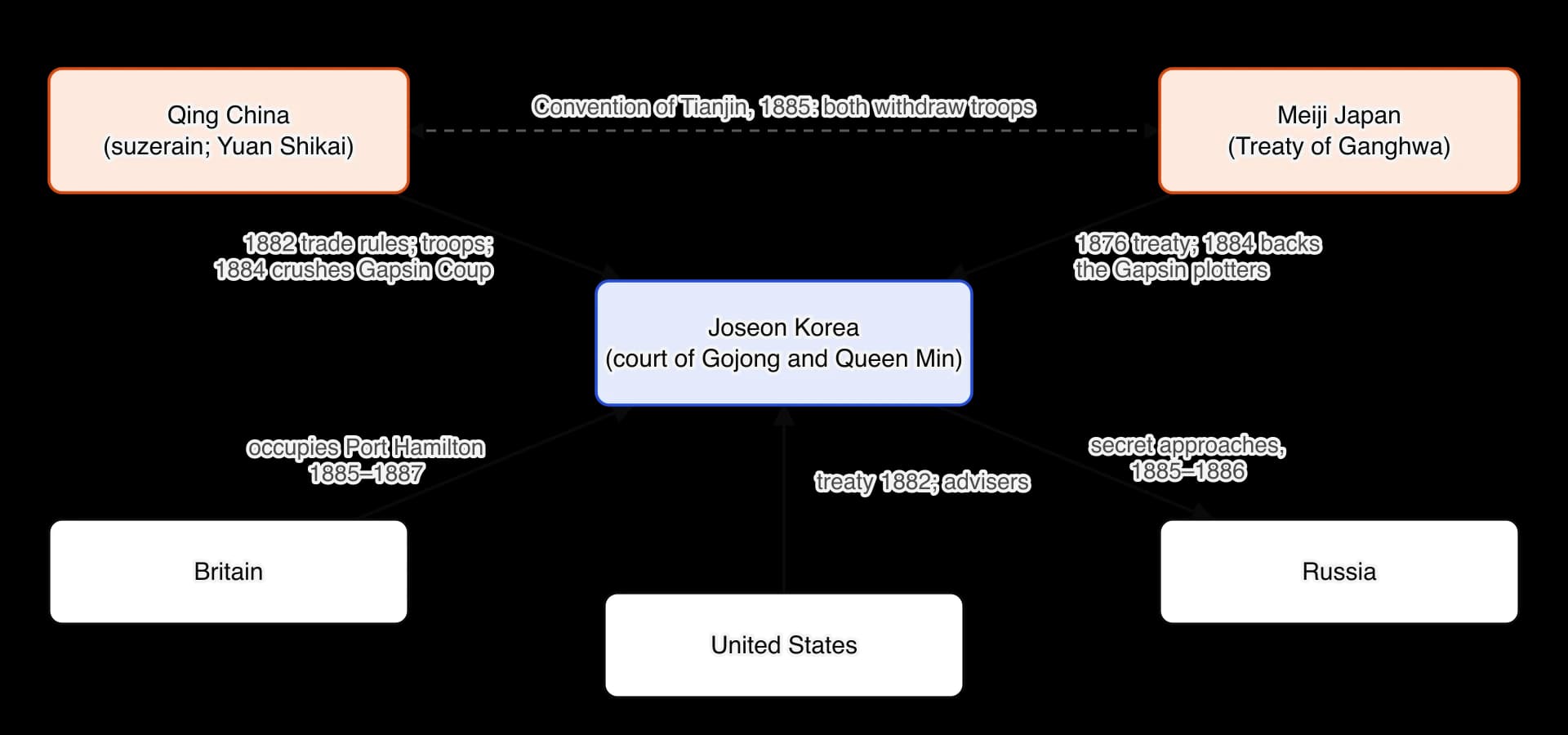
The Chinese decade, 1885–1894
The diagram of the contest for Korea shows how many powers were involved after 1882. In practice, the decade after the Gapsin Coup was dominated by China. Yuan Shikai returned to Seoul in late 1885 with the title of Director-General of Diplomatic and Commercial Relations, acting as a resident who advised, warned and sometimes threatened the king. In 1887 he tried to prevent Korea sending a minister to Washington and, when that failed, insisted that the Korean envoy defer to the Chinese minister there.
China’s influence was economic as well as political. Chinese merchants, protected by the 1882 regulations, spread through Seoul and the interior; China built and ran the telegraph line linking Seoul to Incheon and to China; and Chinese loans and customs officials gave Beijing a say in Korean finances. By the early 1890s Chinese merchants had narrowed Japan’s lead in Korea’s import trade. The historian Kirk Larsen argues that this was a modern, multilateral form of imperialism, not simply traditional suzerainty.
The Korean court tried to escape Chinese control by balancing the powers. Gojong made secret approaches to Russia in 1885 and 1886, asking for military instructors and protection. These approaches alarmed Britain, which occupied Port Hamilton (Geomundo), a group of islands off the south coast, from 1885 to 1887 to block the Russian navy, and alarmed China, which threatened to depose the king. American advisers such as Owen Denny, who published a pamphlet in 1888 arguing that Korea was legally independent, encouraged the court to resist.
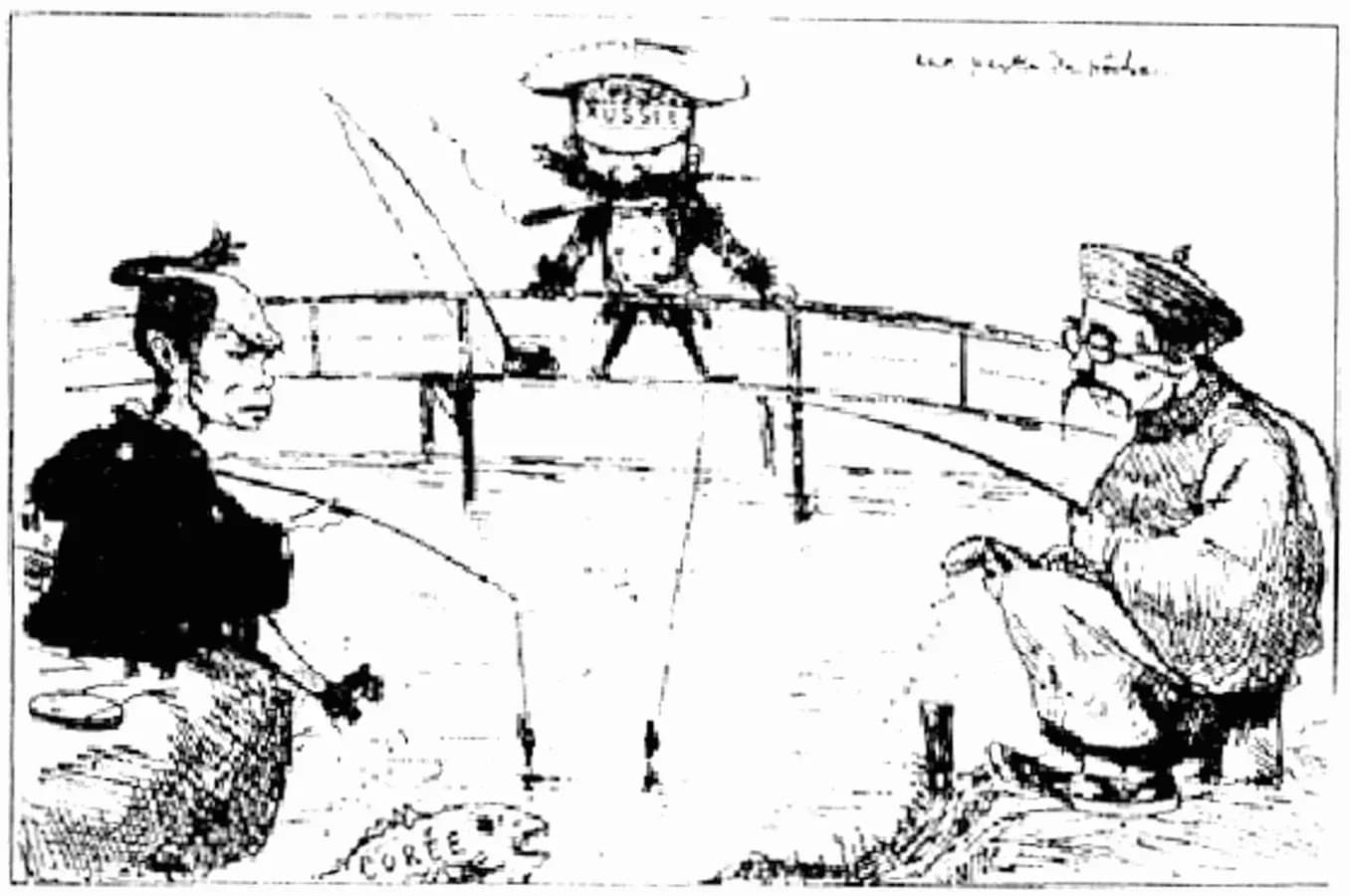
Japanese economic influence grew too. Japanese merchants bought large quantities of Korean rice and beans for Japan’s growing cities, which raised food prices in Korea. When the governor of Hamgyeong province banned grain exports after a bad harvest in 1889, Japan demanded and eventually received compensation for its merchants’ losses. For Korean peasants, the opening of the ports increasingly meant higher prices and foreign buyers in their markets.
The Donghak Peasant Revolution, 1894
In 1894 the largest peasant rising in Korean history broke out in Jeolla, the rice-growing south-west. Korean historians call it the Donghak Peasant Revolution; older works call it the Tonghak Rebellion. The change of name reflects a judgement that the rising had a revolutionary programme, not just local grievances.
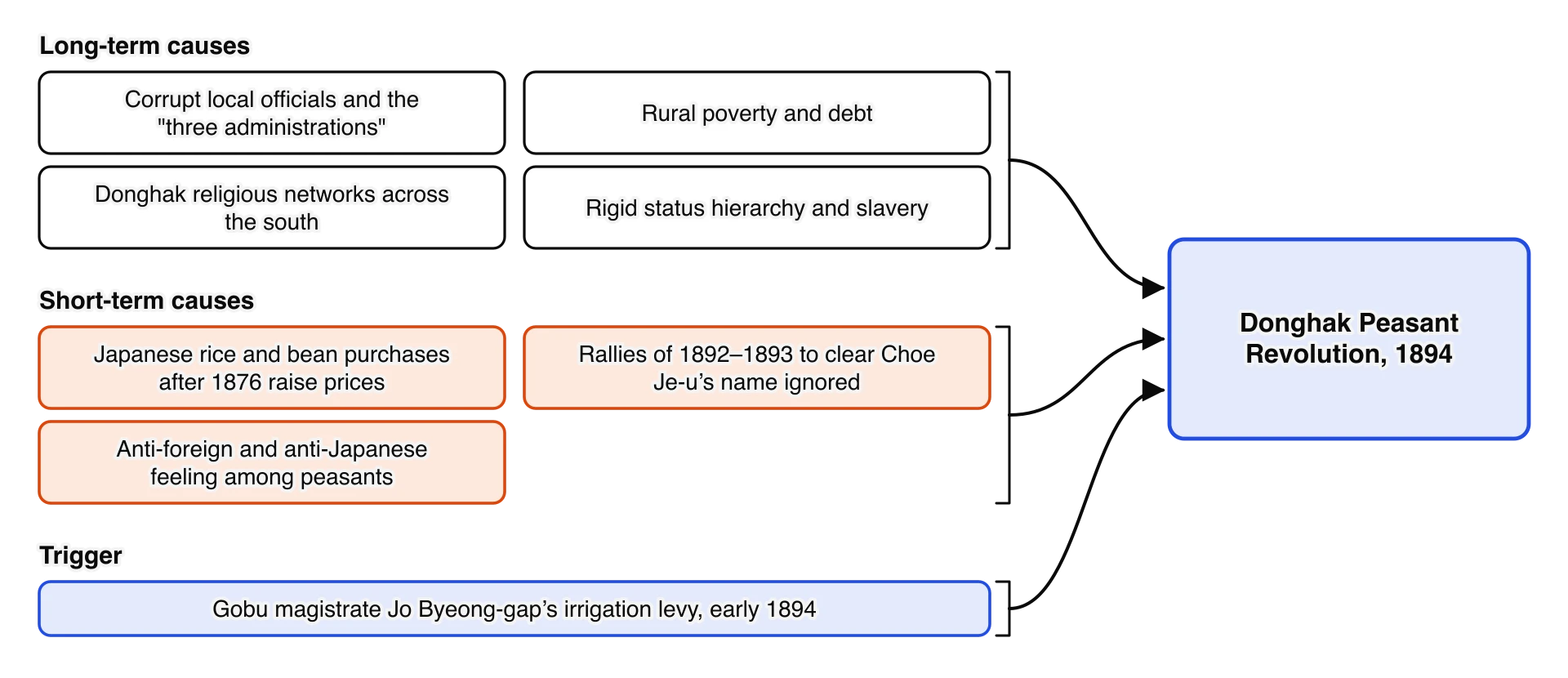
Causes
The diagram of the causes of the revolution shows three layers. The long-term causes were the abuses of the three administrations, the debts and poverty of the peasantry, and a rigid status order that still kept slaves and despised groups at the bottom. The opening of Korea added new pressure: Japanese merchants’ purchases of rice and beans drove up prices, and many peasants associated foreigners with hardship.
Donghak supplied organisation and a sense of purpose. From 1892 its followers held mass rallies, the largest at Boeun in the spring of 1893, demanding that the government clear the name of their executed founder, end persecution and expel Westerners and Japanese. The government dispersed them with promises it did not keep.
The trigger came at Gobu county in Jeolla. The magistrate, Jo Byeong-gap, forced peasants to build a new reservoir and then charged them a heavy fee for its water, on top of other illegal levies. In early 1894 Jeon Bong-jun, a local Donghak leader and village teacher whose father had reportedly died after a flogging ordered by the magistrate, led an attack on the county office.
The first uprising, spring 1894
When a government inspector punished the Gobu rebels instead of the magistrate, Jeon raised a larger army in the spring. Its proclamation called for the punishment of corrupt officials and the protection of the people. The peasant army defeated provincial troops at Hwangtohyeon in May and government forces sent from Seoul soon afterwards, and on 31 May 1894 it took Jeonju, the provincial capital.
Jeon was known as the "Green Bean General", supposedly because of his small size. The peasant army was disciplined: it forbade looting and the killing of ordinary people, and it targeted officials, clerks and abusive landlords. Its demands, drawn up in the months that followed, went far beyond tax relief.
5. Slave registry documents shall be burned.
7. A young widow shall be allowed to remarry.
10. Persons who are in league with foreign enemies shall be severely punished.
12. Farmland shall be equitably redistributed for cultivation.
From the twelve reforms proclaimed by the Donghak overseer’s office in Jeolla, 1894, as recorded in a later history of the movement (Donghak sa); translated by Han-Kyo Kim in Sources of Korean Tradition, vol. 2 (2000). The list was produced by the rebels in an area they controlled, so it records their own aims, though it survives through a later Donghak account and its exact wording may have been shaped by the movement’s memory. It combines social revolution (freeing slaves, land redistribution, widows’ rights) with anti-foreign feeling and loyalty to the king, whom the rebels did not try to overthrow.
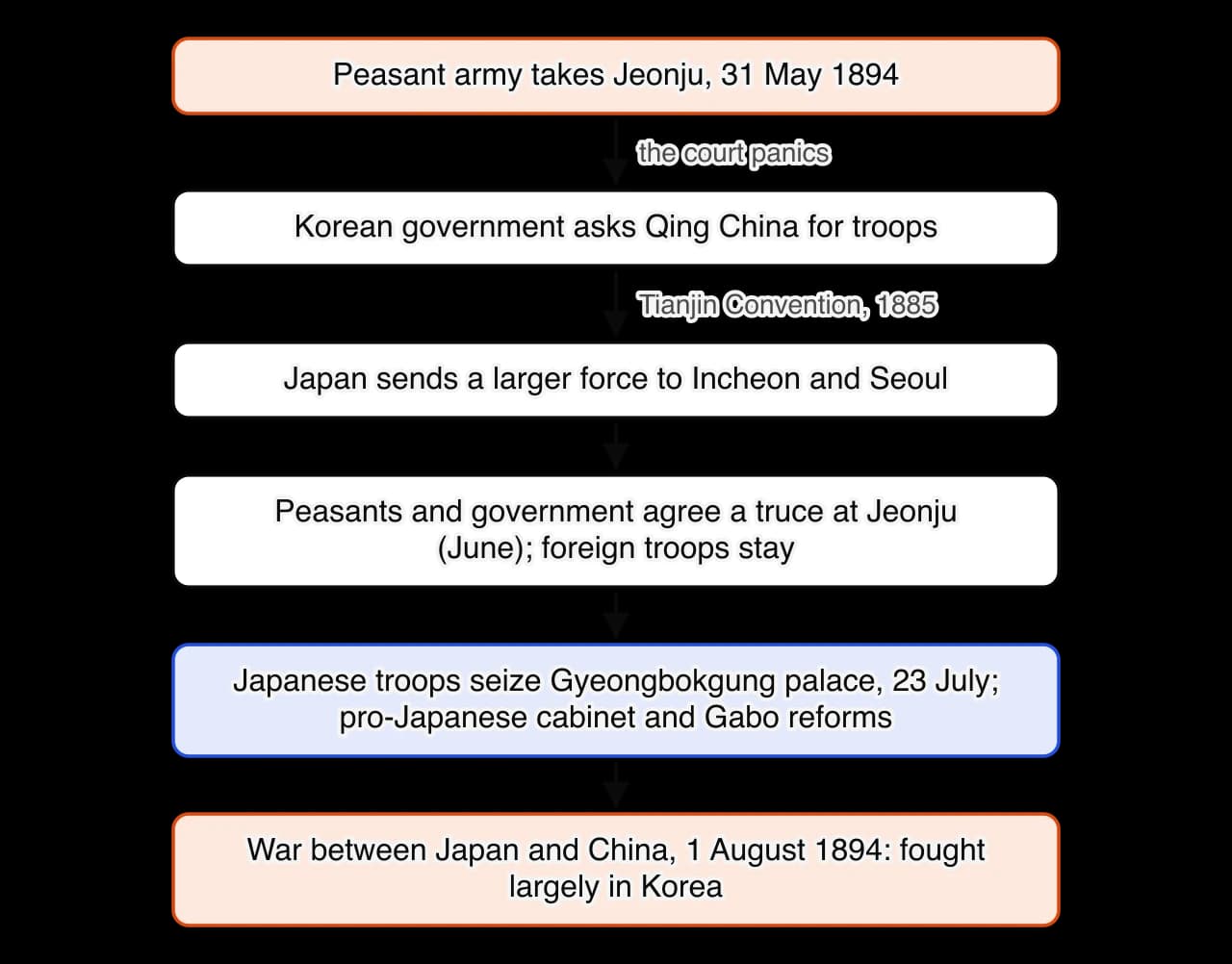
The fall of Jeonju threw the court into panic. The government asked China for troops in early June, and China landed about 2,500 men at Asan. Under the Convention of Tianjin, China notified Japan, and Japan responded by sending a much larger force to Incheon and Seoul. Alarmed by the foreign armies, the peasants and the government agreed a truce at Jeonju in June. The rebels withdrew and set up local directorates (jipgangso) in which Donghak leaders shared the running of the Jeolla counties with officials.
The second uprising and its defeat, autumn 1894
The chain from the fall of Jeonju to war shows how the rising gave Japan its opportunity. Once Japanese troops had seized the palace in July and war with China had begun, the peasants rose again in October 1894, this time against the Japanese and the pro-Japanese government. The northern Donghak congregations under Choe Si-hyeong, which had held back in the spring, now joined Jeon’s forces.
The peasant army marched north towards Seoul. At the Ugeumchi pass near Gongju, in November and December 1894, it met Japanese troops with modern rifles and artillery fighting alongside Korean government soldiers. In repeated attacks up the slopes, the peasant army was destroyed. Japanese and government forces then hunted down rebels across the south. Jeon Bong-jun was betrayed, captured in December and executed in April 1895.
The number killed in the revolution and its suppression cannot be known. Estimates range from tens of thousands to several hundred thousand, because records were incomplete, many deaths came in the scattered killings after the battles, and later counts were shaped by national memory.
The First Sino-Japanese War and the Gabo reforms, 1894–1896
The war and the Treaty of Shimonoseki
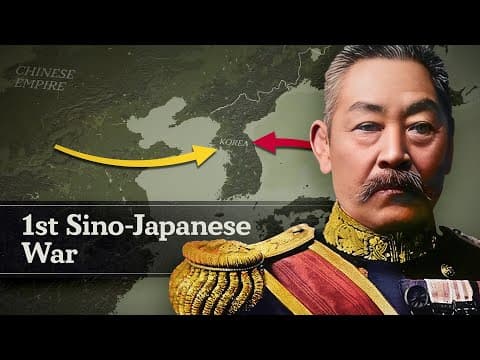
Japan used its troops in Korea to force the issue with China. It proposed joint Sino-Japanese reform of the Korean government, knowing China would refuse. On 23 July 1894 Japanese troops occupied Gyeongbokgung palace, took control of Gojong, brought the Daewongun back as a figurehead and installed a pro-Japanese cabinet under Kim Hong-jip. Two days later Japanese warships sank a British-registered steamer carrying Chinese troops off Pungdo, and war was declared on 1 August.
The war was fought largely on Korean soil and in Korean waters. The Japanese army defeated the Chinese at Seonghwan (July) and Pyongyang (September 1894), and the Japanese navy won the Battle of the Yalu (17 September 1894). Japan then invaded Manchuria, took Port Arthur and destroyed China’s northern fleet at Weihaiwei in February 1895. Koreans were forced to provide labour, food and transport for the Japanese army. The war’s causes and Chinese consequences belong to the study of the challenges to imperial rule in China and to Meiji Japan; for Korea, its result was decisive.
 YouTube
China recognizes definitively the full and complete independence and autonomy of Korea, and, in consequence, the payment of tribute and the performance of ceremonies and formalities by Korea to China, in derogation of such independence and autonomy, shall wholly cease for the future.
Treaty of Shimonoseki between Japan and China, Article 1, signed 17 April 1895. The first article of the peace treaty concerned Korea, which shows what the war had been fought over. Korea was not a party to the treaty: its "independence" was settled by two other states, and in practice it meant independence from China, which left Japan as the dominant power.
The Gabo reforms, 1894–1896
While the war was being fought, the Kim Hong-jip cabinet, under Japanese supervision, carried out the most sweeping reforms in Joseon history. A Deliberative Council passed over two hundred measures in its first months. In January 1895 Gojong swore to a fourteen-article "Great Charter" (Hongbeom) at the royal ancestral shrine, which declared Korea independent of China and promised constitutional and financial reform. Pak Yeong-hyo, the exiled leader of the Gapsin Coup, returned to join the government.
Area | Main Gabo reforms |
|---|---|
Social | Abolition of the legal distinction between yangban and commoners; abolition of slavery and the trade in persons; widows allowed to remarry; minimum marriage ages; end of punishment of relatives for a person’s crimes |
Government | Civil service examinations abolished; a cabinet and Western-style ministries created; the royal household separated from the government; Chinese reign titles replaced by a Korean calendar |
Economic | All taxes to be paid in money, not goods; one ministry to control all revenue; a new silver-based currency; standard weights and measures |
Military and police | New army units trained by Japanese officers; a modern police force |
Customs (late 1895) | Adoption of the solar calendar (from 1 January 1896); the topknot decree ordering men to cut their hair |
The table of the Gabo reforms shows that they met many of the demands of the Enlightenment Party and even of the Donghak rebels. Their association with Japan, however, damaged them. They were introduced by a government installed by Japanese troops, at the same time as those troops were killing Donghak peasants. Japanese advisers sat in the ministries, and Inoue Kaoru, the Japanese minister from late 1894, pressed for measures that also served Japanese interests, such as loans and railway concessions.
The topknot decree of December 1895 provoked the most anger. For Confucian men, the topknot was a mark of adulthood and filial duty, since the body came from one’s parents. Conservative scholars raised righteous army (uibyeong) units in early 1896 and attacked officials and Japanese troops. Many Koreans who accepted that reform was needed rejected reform imposed in this way.
The Triple Intervention and the murder of Queen Min
Japan’s victory soon looked less complete. On 23 April 1895, six days after the treaty was signed, Russia, France and Germany jointly "advised" Japan to return the Liaodong peninsula to China. Japan, too weak to resist three European powers, gave way in exchange for a larger indemnity. The Triple Intervention showed the Korean court that Japan could be checked, and Queen Min turned to Russia, removing pro-Japanese ministers and reversing parts of the reform programme.
Japan’s new minister in Seoul, Miura Gorō, a retired general, responded with violence. Before dawn on 8 October 1895, Japanese soldiers, police and armed civilians, with Korean troops trained by Japan, broke into Gyeongbokgung palace, killed Queen Min and burned her body. A new pro-Japanese cabinet was installed. Miura and the others accused were tried in Hiroshima and released for lack of evidence, although the court found that they had planned the attack.
The murder was a political disaster for Japan. It turned the queen into a national symbol and fed the righteous army risings of 1895–1896. In February 1896 Gojong escaped from the palace in a woman’s palanquin and took refuge in the Russian legation, where he stayed for a year. This move, known in Korean as agwan pacheon, brought down the pro-Japanese cabinet. Kim Hong-jip was killed by a crowd in the street, and the other ministers fled.
Russian influence, 1896–1898
With the king under its protection, Russia became the leading power in Seoul. Russian officers trained the palace guard, a Russian financial adviser was appointed, and Russian subjects received timber and mining concessions. Americans, Britons and others received railway, mining and tram concessions in the same years, so Korea’s resources were being divided among foreigners. Japan and Russia avoided war by agreements in 1896 and in April 1898, when Russia recognised Japan’s commercial interests in Korea while both promised not to interfere in its internal affairs.
The Independence Club, 1896–1898
The years of Russian protection opened space for a new kind of politics. Seo Jae-pil, one of the Gapsin plotters, had fled to the United States, qualified as a doctor and become an American citizen under the name Philip Jaisohn. He returned to Korea at the end of 1895 and, with government funds, founded a newspaper and then a political association.
The first issue of The Independent (Dongnip sinmun) appeared on 7 April 1896, with pages in Korean and English. It was the first newspaper printed entirely in the Korean alphabet (hangeul), which yangban scholars had long looked down on as unsuited to serious writing, and it was cheap enough for ordinary people to buy.
Our platform is ― Korea for the Koreans, clean politics, the cementing of foreign friendships, the gradual though steady development of Korea, resources with Korean capital, as far as possible, under expert foreign tutelage, the speedy translation of foreign text-books into Korean […] and long life to HIS MAJESTY, THE KING.
The Independent (Dongnip sinmun), English-language editorial in its first weeks, April 1896. The editors addressed "the whole people of every class and grade", an idea of the nation that cut across the old status order. Yet the platform also shows the limits of their programme: loyalty to the king, gradual change, and openness to "foreign tutelage". It was written by an elite for a public it hoped to create.
The club’s best-known project was the Independence Gate in Seoul, completed in 1897 on the site of the gate where Korean kings had once welcomed Chinese envoys. Its location shows that "independence" in 1896 meant above all independence from China. The club’s weekly debates trained a generation of young men, among them Syngman Rhee, in public speaking and political argument.
In 1898 the club turned to mass politics. Its open-air meetings in Seoul, the "ten-thousand people’s assemblies" (Manmin Gongdonghoe), attacked Russian demands for a naval coaling station and a Russian-run bank, and the Russian advisers were withdrawn in March 1898. In October a joint meeting of officials and citizens adopted six proposals asking the emperor to consult his ministers and a council before acting, and to manage finances openly. Gojong agreed to reorganise the Privy Council so that half its members would be elected, the first step towards a representative body in Korea.
Conservatives at court then spread rumours that the club planned to abolish the monarchy and found a republic. In November 1898 Gojong had its leaders arrested. When crowds protested, the government used the Peddlers’ Guild, a loyalist organisation of travelling merchants, to break up the meetings by force, and in December the club was dissolved. Syngman Rhee spent the next five years in prison.
The Korean Empire and the Gwangmu reforms, 1897–1904
In February 1897 Gojong left the Russian legation for the nearby Gyeongun palace (later called Deoksugung). On 12 October 1897, at a new altar to Heaven in Seoul, he was crowned emperor, and the country was renamed the Korean Empire (Daehan Jeguk). An emperor could not be the vassal of another emperor, so the title was a claim to equality with China and Japan. His reign name, Gwangmu ("illustrious and martial"), gave the reform programme of the following years its name.
The empire was an absolute monarchy. Its constitution of August 1899, the Law of the Great Han State (Daehan Gukje), declared the emperor’s power unlimited and gave the people no rights to elect anyone. Gojong had crushed the Independence Club, and he now aimed to modernise Korea from the throne. The guiding principle of the Gwangmu reforms was to take the old as the foundation and add the new, a Korean version of the Chinese and Japanese formulas for combining traditional values with Western methods.
Area | Gwangmu reforms | Limits |
|---|---|---|
Land and taxation | A national land survey (from 1898) and the issue of modern title deeds (from 1901) to fix ownership and raise land-tax revenue | Only part of the country was surveyed before the war of 1904 stopped it |
Royal finances | The Royal Household Ministry took over mines, the ginseng monopoly and other revenues | Money flowed to the palace, not to the government ministries or the army |
Infrastructure and technology | Telephone in the palace (1898); electric trams in Seoul (1899, with American partners); the Seoul–Incheon railway (1899–1900); telegraph lines; electric street lighting | Built mostly by foreign firms under concessions; the railway passed to a Japanese company |
Industry and banking | Korean-owned banks (1897, 1899); government support for textile, shipping and mining companies | Small scale; little capital; foreign competition |
Education | State primary and normal schools, foreign-language schools, technical and medical schools; private and missionary schools also grew | Limited reach outside Seoul |
Military | A Board of Marshals under the emperor (1899); the army expanded and re-equipped | Far too small and badly funded to deter Japan or Russia |
How far did the Gwangmu reforms modernise the state?
The table of the Gwangmu reforms shows real change. Seoul had electric trams before Tokyo did, and the land survey was an ambitious attempt to give the state an accurate tax base. Some South Korean historians since the 1970s have argued that these reforms prove Korea was capable of modernising itself, and that only Japanese aggression prevented it.
Other historians stress the limits. The reforms concentrated power and money in the emperor’s hands rather than building a modern administration accountable to anyone. Gojong treated state revenue as the property of the palace, and favourites such as his finance chief Yi Yong-ik ran it with little oversight. Much of the modernisation depended on foreign concessions, and there was no political base outside the court: the one group that had mobilised public support, the Independence Club, had been crushed. Above all, the reforms did not create an army capable of defending Korea.
A balanced judgement is that the Gwangmu reforms modernised parts of the state’s infrastructure and finances but did not modernise its politics, and that seven years was too short a time, in too dangerous an international setting, for them to change Korea’s position.
From protectorate to annexation, 1904–1910
The Russo-Japanese War and Japan’s claim to Korea
Rivalry between Japan and Russia over Korea and Manchuria grew after Russia occupied Manchuria during the Boxer crisis in China in 1900. Japan, allied with Britain from 1902, offered to recognise Russian dominance in Manchuria if Russia recognised Japan’s in Korea; Russia refused to give up all interest in Korea. In January 1904 Korea declared itself neutral. In February 1904 Japan attacked the Russian fleet and landed troops at Incheon, ignoring Korean neutrality.

The timeline of 1904–1910 shows how quickly Japan turned military occupation into legal control. The Japan–Korea Protocol (February 1904) gave Japan the right to use Korean territory for its war. The First Japan–Korea Agreement (August 1904) placed Japanese-appointed advisers in charge of Korea’s finances and foreign affairs. The finance adviser, Megata Tanetarō, replaced Korea’s currency in 1905 on terms that ruined many Korean merchants.
By the time the war ended in 1905, the great powers had accepted Japan’s claim. In the Taft–Katsura memorandum (July 1905) a US envoy and the Japanese prime minister set out an understanding that the United States would not oppose Japanese control of Korea while Japan respected American rule in the Philippines. The renewed Anglo-Japanese Alliance (August 1905) recognised Japan’s right to guide, control and protect Korea. In the Treaty of Portsmouth (5 September 1905), Russia recognised Japan’s "paramount political, military and economic interests" in Korea.
The Eulsa Treaty, 1905
Two months later, Itō Hirobumi arrived in Seoul with a treaty that would make Korea a protectorate. With Japanese troops surrounding the palace, he pressed the cabinet to sign. On 17 November 1905, five ministers, led by Education Minister Yi Wan-yong, agreed; the prime minister, Han Gyu-seol, refused. Gojong never formally approved the treaty with his seal.
Under the treaty, Japan took over Korea’s diplomacy; foreign legations left Seoul, and the Residency-General opened in February 1906 with Itō as the first Resident-General. Korea became a protectorate: still formally an empire with its own emperor and cabinet, but no longer able to deal with other states.
Korean resistance to the Eulsa Treaty
Korean responses to the treaty took several forms, from protest and suicide to diplomacy and war.
Protest in the press. On 20 November 1905 Jang Ji-yeon, editor of the Hwangseong sinmun, published an editorial titled "Today we wail aloud", condemning the ministers who had signed. He was arrested and the paper suspended.
Suicide in protest. Min Yeong-hwan, a senior official and former envoy to Russia and Britain, killed himself on 30 November 1905, leaving letters urging Koreans to resist. Several other officials followed his example.
Righteous armies. In 1905–1906 Confucian scholars such as the elderly Choe Ik-hyeon and Min Jong-sik, and the commoner Sin Dol-seok, raised guerrilla bands. Choe was captured and died in Japanese custody on Tsushima.
Diplomacy. In June 1907 Gojong secretly sent three envoys, Yi Sang-seol, Yi Jun and Yi Wi-jong, to the Second Hague Peace Conference to declare the treaty invalid. The powers refused to admit them, because Korea no longer had the right to conduct foreign relations.
The Hague affair gave Japan its pretext. In July 1907 Japan forced Gojong to abdicate in favour of his son, Sunjong. A new Japan–Korea Treaty (July 1907) placed Korea’s internal administration under the Resident-General, with Japanese vice-ministers in each ministry. On 1 August 1907 the Korean army was disbanded. Some soldiers fought Japanese troops in Seoul that day, and many more joined the righteous armies.
The righteous army war of 1907–1910 was the largest armed resistance to Japanese rule before 1945. Former soldiers brought training and weapons, and commoners such as hunters and peasants led many bands. In early 1908 an allied army tried to march on Seoul but was driven back. In 1909 a Japanese campaign swept the south-western province of Jeolla. Japanese military records are usually cited as giving about 17,000 righteous army fighters killed between 1907 and 1910, a count made by the side that fought them; survivors fled to Manchuria and the Russian Far East.
Others resisted through education and economic self-help. This patriotic enlightenment movement included the New People’s Association (Sinminhoe, 1907) of An Chang-ho, which founded schools and businesses; the National Debt Repayment Movement (1907), in which Koreans gave money, and some women gave jewellery, to pay off the government’s loans from Japan; and the Korea Daily News, published by the British journalist Ernest Bethell, whose foreign status protected it from Japanese censorship for several years.
On 26 October 1909 Ahn Jung-geun, a Catholic educator who had fought with the righteous armies, shot and killed Itō Hirobumi at the railway station in Harbin, Manchuria. Ahn saw himself as a soldier, and he wrote in prison of a peace for East Asia based on cooperation among equal nations. He was executed by the Japanese in March 1910. In Korea he is honoured as a national hero; in Japan, Itō is remembered as a founder of the modern state.
Annexation, 1910
Itō’s death strengthened the hand of those in Tokyo who wanted full annexation. In 1909–1910 Korea’s courts and police were placed under Japanese control. The new Resident-General, General Terauchi Masatake, negotiated an annexation treaty with Prime Minister Yi Wan-yong, which was signed on 22 August and proclaimed on 29 August 1910.
Article 1. His Majesty the Emperor of Korea makes the complete and permanent cession to His Majesty the Emperor of Japan of all rights of sovereignty over the whole of Korea.
Treaty of Annexation between Japan and Korea, Article 1, signed 22 August 1910 by Terauchi Masatake and Yi Wan-yong, English text. The treaty presents annexation as a voluntary gift by the Korean emperor. Its language hides the conditions in which it was signed: Korean diplomacy, internal government, army and police were already under Japanese control, and the Korean signatory was the leading collaborator of the protectorate years.
Korea was renamed Chōsen (the Japanese reading of Joseon) and became a colony governed from Seoul, which the Japanese called Keijō. The Korean royal family was given Japanese titles and allowances. Many Koreans regard the Eulsa and annexation treaties as void from the start; Japan has maintained that they were legal when concluded, a disagreement that the two states left unresolved when they normalised relations in 1965.
Colonial government and military rule, 1910–1919
The Government-General of Korea
Japan ruled Korea through the Government-General of Korea, based in Seoul. The governor-general was always a senior army or navy officer, appointed by and responsible only to the Japanese emperor, not to the Japanese parliament. He could issue decrees with the force of law, and until 1919 he also commanded the Japanese army in Korea. Koreans had no elected assembly and no representation in the Japanese parliament.
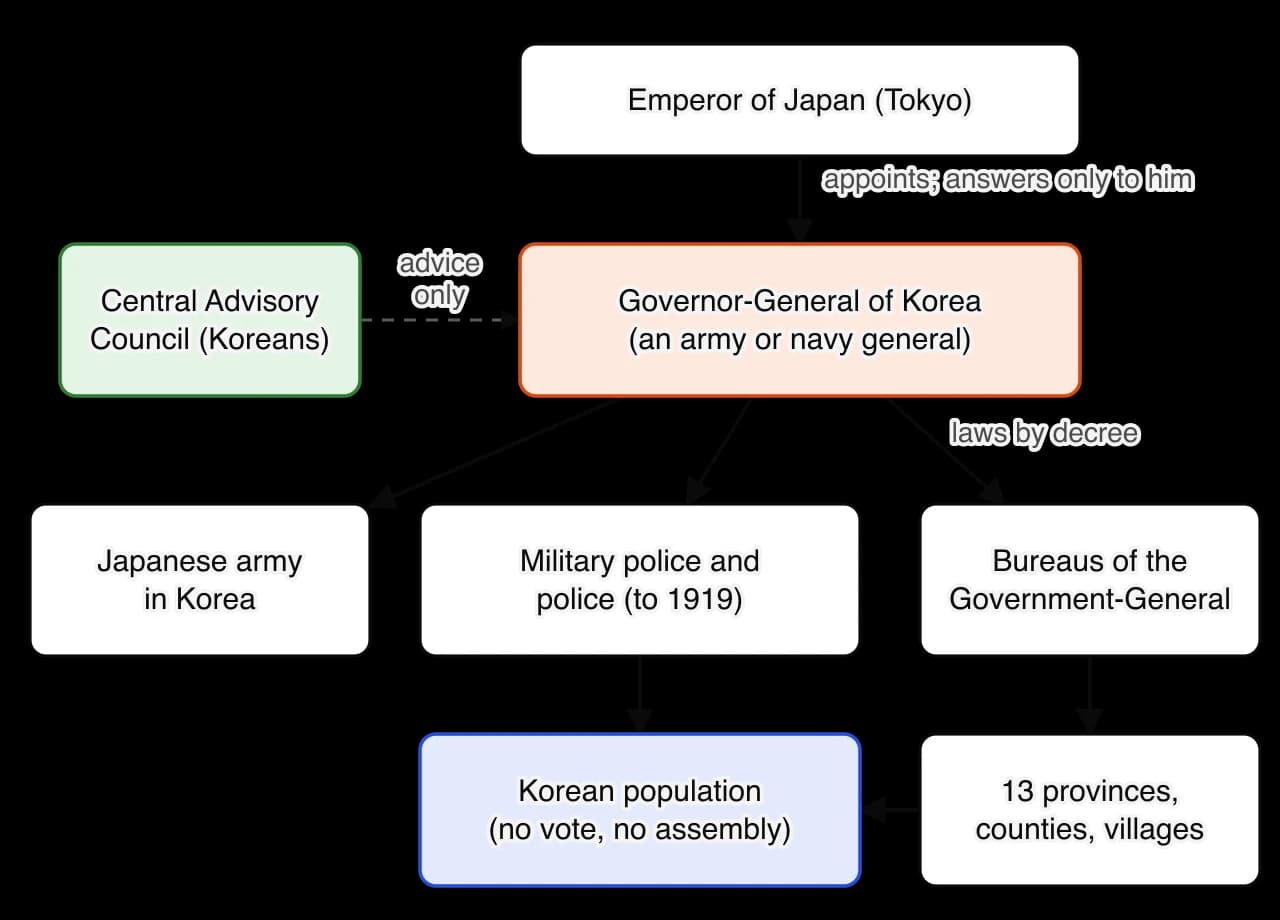
The diagram of colonial government shows a chain of command with no Korean voice. Japanese officials filled the senior posts; Koreans served as clerks, village heads and lower police. The former royal family and about seventy Korean aristocrats who had supported annexation received Japanese peerages and pensions, and some sat on the Central Advisory Council, which had no power.
Military police rule
The first two governors-general, Terauchi Masatake (1910–1916) and Hasegawa Yoshimichi (1916–1919), governed through what Koreans call military police rule (budan seiji, "military rule"). The Japanese military police (kempeitai) served as the ordinary police across most of the country. They could judge minor offences on the spot, and a flogging ordinance of 1912 allowed beating as a punishment for Koreans only. Even schoolteachers and civil officials wore uniforms and carried swords.
Korean political life was shut down. Korean newspapers were closed, leaving only a government organ in Korean; political associations were banned; and the patriotic schools of the protectorate years were brought under control. In 1911 the police claimed to have uncovered a plot to assassinate Terauchi and arrested hundreds of people, many of them Christians and members of the New People’s Association. In this "105-person incident" (named after the number convicted in 1912) many prisoners were tortured, and most were later acquitted on appeal.
Colonial officials justified annexation with arguments from history and progress. Komatsu Midori, a Japanese foreign ministry official in Seoul, told resident foreign members of the Royal Asiatic Society in a talk published in 1912:
The recent annexation of Korea by Japan is therefore not the incorporation of two different countries inhabited by different races, but, it may rather be said to be the reunion of two sections of the one and same nation after a long period of separation. Indeed it is nothing more nor less than the old state of things restored.
Komatsu Midori, "The Old People and the New Government", Transactions of the Korea Branch of the Royal Asiatic Society, vol. 6 (1912). Komatsu spoke to an audience of mainly British and American residents, whose acceptance of Japanese rule mattered to Tokyo. His claim rested on readings of ancient history that Korean historians rejected then and since. Its purpose was to present colonisation as a natural reunion, an idea that later became the basis of the assimilation policy.
The March First Movement, 1919
Causes and preparation
By 1919 Koreans had experienced nine years of military police rule, land registration that cost some peasants their customary rights, and discrimination in jobs and schools. Three events in 1918–1919 turned resentment into action.
Self-determination. In January 1918 US President Woodrow Wilson’s Fourteen Points called for a peace settlement that took account of the wishes of peoples, and the Paris Peace Conference of 1919 seemed to offer a stage on which small nations could be heard. Koreans in exile sent representatives to Paris.
The death of Gojong. The former emperor died suddenly on 21 January 1919, and rumours spread that the Japanese had poisoned him. His funeral, set for 3 March, would bring huge crowds to Seoul.
The 8 February Declaration. Korean students in Tokyo issued a declaration of independence on 8 February 1919, which showed that open protest was possible.
Leaders of the three religious communities that still had legal organisations, Cheondogyo (the successor of Donghak), Protestant Christianity and Buddhism, prepared a declaration of independence. Thirty-three national representatives signed it: 16 Christians, 15 Cheondogyo followers and 2 Buddhists. The historian and writer Choe Nam-seon drafted it. The religious networks were essential, because they could print and distribute the declaration across the country in secret.
The declaration and the demonstrations
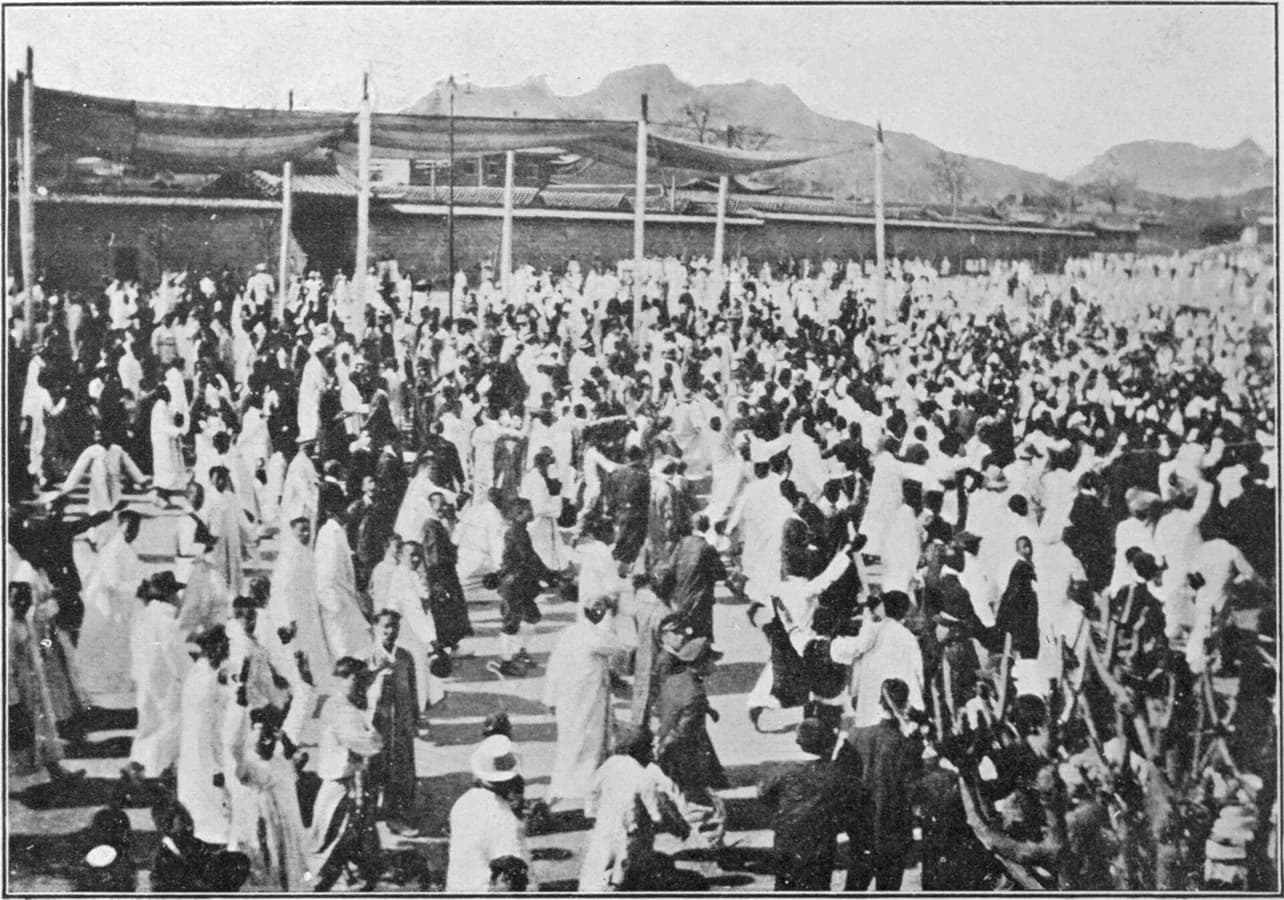
On 1 March 1919 most of the signatories met at a restaurant in central Seoul, read the declaration and then informed the police, who arrested them. At the same time, students read the declaration to a crowd in Tapgol (Pagoda) Park, and thousands marched through the city shouting "Long live Korean independence" (Daehan dongnip manse).
We hereby declare that Korea is an independent state and that Koreans are a self-governing people. We proclaim it to the nations of the world in affirmation of the principle of the equality of all nations, and we proclaim it to our posterity, preserving in perpetuity the right of national survival.
Korean Declaration of Independence, read in Seoul on 1 March 1919; translated by Han-Kyo Kim in Sources of Korean Tradition, vol. 2 (2000). The declaration was written for two audiences: Koreans, to inspire non-violent protest, and the powers at Paris, to show that Korea was a civilised nation entitled to self-determination. This explains its moderate tone. It refuses to blame Japan, calls for friendship between the two nations, and ends with three pledges, one of them to uphold public order.
The protests spread from Seoul to every province and lasted into May. Students, Christians, Cheondogyo followers, merchants who closed their shops, workers and above all peasants in market towns joined in. Women and schoolgirls took part in large numbers. Estimates of the total number of demonstrations run to about 1,500, and of participants to between about 800,000 and two million, out of a population of under 20 million.
Repression
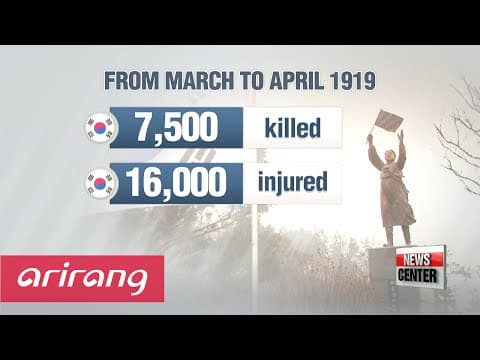
The authorities answered with force. Troops and military police fired on crowds, and in some villages they burned houses and churches. At Jeam-ri, near Suwon, on 15 April 1919, soldiers gathered the Christian and Cheondogyo men of the village in the church, opened fire and set it alight; more than twenty people were killed. A Canadian missionary, Frank Schofield, photographed the ruins and helped make the massacre known abroad. A sixteen-year-old schoolgirl, Yu Gwan-sun, who organised a demonstration in her home town, was imprisoned and died in Seodaemun Prison in 1920 from the treatment she received; she became the best-known symbol of the movement.
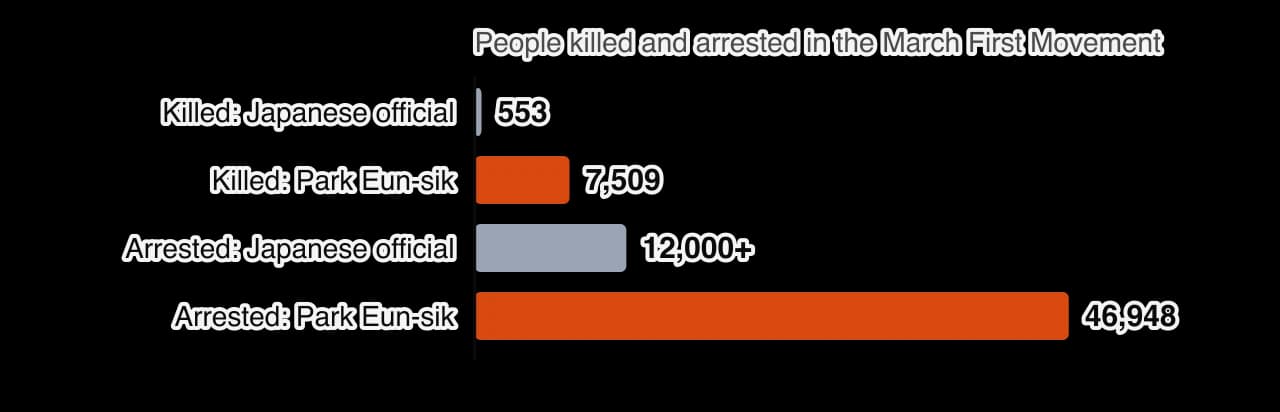
The bar chart of the two counts of casualties shows how far the figures differ. The Japanese authorities reported 553 Koreans killed and more than 12,000 arrested by 11 April 1919. The nationalist historian Park Eun-sik, writing in exile in Shanghai in 1920, gave 7,509 killed and 46,948 arrested. Most historians think the official figures too low, since many deaths went unreported, but the exact toll cannot be established.
Consequences
The movement did not win independence. The powers at Paris ignored the Korean delegates, since Japan was an ally and a victor, and the principle of self-determination was applied mainly to the defeated empires in Europe. Inside Korea, however, the movement had three lasting results.
A change in Japanese methods. The scale of the protests and the foreign criticism convinced Tokyo that military police rule had failed. A new governor-general introduced "cultural rule".
The Provisional Government. In April 1919 nationalists in exile founded the Provisional Government of the Republic of Korea in Shanghai, with a constitution that declared Korea a democratic republic. Syngman Rhee became its first president. It claimed to speak for the nation until 1945, though it never ruled any territory.
A national identity across classes. For the first time Koreans of every class and region had acted together for independence. The movement became the founding event of modern Korean nationalism, and the preamble of the South Korean constitution still refers to it.
 YouTube
Cultural rule and the divided independence movement, 1919–1937
Cultural rule
Admiral Saitō Makoto, governor-general from 1919 to 1927 and again in 1929–1931, announced a policy of cultural rule (bunka seiji). The military police were replaced by an ordinary civilian police force; the flogging ordinance was abolished; officials stopped wearing swords; and Koreans were allowed to publish newspapers and form associations. Two Korean-language daily newspapers, the Dong-a Ilbo and the Chosun Ilbo, were founded in 1920. Local advisory councils, partly elected by wealthy residents, were set up.
The change was one of method more than aim. The number of police and police stations increased, so surveillance became more thorough. Newspapers were censored, and issues were regularly confiscated or suspended. The Peace Preservation Law of 1925, which made it a crime to organise against the imperial system or private property, was applied to Korea and used against both communists and nationalists. Historians often see cultural rule as a policy of divide and rule: it allowed moderate Koreans to work within the system, which separated them from radicals.
Divisions in the independence movement
After 1919 the independence movement split along several lines. Moderate nationalists, many of them Christians or businessmen, argued for gradual self-strengthening through education, enterprise and culture. The writer Yi Gwang-su set out this programme of "national reconstruction" in an essay of 1922, which critics saw as accepting colonial rule. Radical nationalists in exile wanted armed struggle. Socialists and communists, inspired by the Russian Revolution, linked independence to social revolution.
Our national emancipation movement is merely a step toward the ultimate purpose of social revolution. We are striving for the complete elimination of all the classes of our present society.
Manifesto of the Korean Communist Party in Shanghai, 1921; translated by Dae-Sook Suh in Sources of Korean Tradition, vol. 2 (2000). The manifesto was written by exiles seeking recognition from the Comintern, the Moscow-led organisation of communist parties, which helps to explain its stress on world revolution and its scorn for the League of Nations. It shows why communists and nationalists found cooperation hard: for the communists, independence under a Korean capitalist class would not be liberation.
Inside Korea a Korean Communist Party was founded in 1925 and repeatedly broken up by the police under the Peace Preservation Law. Communist ideas spread among students, workers and tenant farmers, who organised a growing number of tenancy disputes and strikes in the 1920s and 1930s.
In 1927 moderate nationalists and socialists joined in a united organisation, the Singanhoe ("New Korea Society"), which built a network of local branches across Korea. In November 1929 a clash between Korean and Japanese students in Gwangju grew into a student movement across the country, and the Singanhoe tried to turn it into a mass protest; its leaders were arrested. Divided between left and right, and under orders from the Comintern for communists to abandon alliances with "bourgeois" nationalists, the Singanhoe dissolved itself in 1931.
Armed resistance abroad
Korean armed groups operated from Manchuria and the Russian Far East, where many Koreans had settled. In 1920 independence forces under Hong Beom-do and Kim Jwa-jin defeated Japanese units at Fengwudong (June) and Cheongsanri (October). The Japanese army replied with punitive operations in the Jiandao (Gando) region of Manchuria in which thousands of Korean civilians were killed.
The Provisional Government in Shanghai, weakened by quarrels that led to Rhee’s removal as president in 1925, turned to dramatic acts under Kim Gu. His Korean Patriotic Organisation was behind an unsuccessful grenade attack on Emperor Hirohito in Tokyo in January 1932 and, in April 1932, a bombing in Shanghai by Yun Bong-gil that killed a Japanese general. The second attack won the Provisional Government the support of Jiang Jieshi (Chiang Kai-shek) and the Chinese Nationalist government.
The social impact of assimilation: education, language and religion
Japanese policy towards Korean society rested on a contradiction. Officials claimed that Koreans and Japanese were one people who would eventually become fully equal subjects of the emperor; in practice Koreans were treated as a separate and inferior group. The aim of assimilation was to make Koreans loyal Japanese subjects, but not to give them the same rights as Japanese citizens.
Education
Education was the main tool of assimilation. Four education ordinances set the rules for Korean schools, and each one tightened the link between schooling and loyalty to Japan.
Ordinance | Main features | Effect on Koreans |
|---|---|---|
First (1911) | Separate schools for Koreans and Japanese; Korean "common schools" of four years (Japanese primary schools had six); stress on practical and vocational training and on the Japanese language | Koreans educated to be loyal workers, not leaders; private and mission schools tightly controlled |
Second (1922) | Korean common schools extended to six years, nominally on the Japanese model; Korean language kept as a subject; a university planned | More Korean children enrolled; Keijō Imperial University opened (preparatory course 1924), but most of its students were Japanese |
Third (1938) | Korean and Japanese schools given the same names and curriculum; Korean language made an optional subject, then dropped in practice | Schools used for wartime indoctrination and the "Japan and Korea as one" policy |
Fourth (1943) | Education organised around war needs; military training in schools | Students mobilised for labour and, from 1943–1944, as soldiers |
School enrolment grew substantially under colonial rule, and by the early 1940s roughly half of Korean children of primary-school age attended school, by most estimates. Access remained unequal. Japanese children in Korea had far more places in secondary schools in proportion to their numbers, and few Koreans could reach higher education except by going to Japan. Literacy in Korean rose slowly, and many Koreans who did learn to read did so through private schools, night schools, newspapers and churches, not the state system.
Language
Japanese was the "national language" (kokugo) of the empire and the language of government, the courts and advancement. Until the late 1930s Korean was still taught in schools and used in the Korean press, and the 1920s and 1930s saw a flowering of Korean-language literature and scholarship. The Korean Language Society published a unified system of hangeul spelling in 1933 and began a dictionary. Defending the language became a form of cultural nationalism: if Korea could not be a state, Koreans could at least preserve the nation through its language and history.
Religion
The colonial government promoted State Shinto, the Japanese cult that honoured the emperor as divine. It built shrines across Korea, the largest being Chōsen Jingū (the Korea Shrine) on Namsan in Seoul, completed in 1925. From the mid-1930s students and teachers were required to attend shrine ceremonies, which the government insisted were patriotic, not religious.
Christianity, which had grown quickly since the 1880s, was the religion most affected. Many Korean Christians and Western missionaries saw shrine worship as idolatry. Several Presbyterian mission schools closed in the late 1930s rather than comply; the Presbyterian Church in Korea accepted shrine worship under police pressure in 1938; and pastors who refused, such as Ju Gi-cheol, were imprisoned, and some, including Ju, died in prison. Christianity’s association with resistance, from the March First Movement to the shrine controversy, helps to explain its later strength in South Korea.
Discrimination and everyday life
Koreans faced discrimination in pay, promotion and justice. Japanese settlers, who numbered about 700,000 by the early 1940s, held most senior posts in government and business and lived largely in their own districts of Seoul, Busan and other cities. Korean candidates competed for a fixed, smaller share of places and were often paid less than Japanese colleagues in the same posts.
The bank planned to select forty people ― thirty Japanese and ten Koreans. So regardless of how qualified the Koreans might be, only ten could expect jobs. And though unqualified, thirty Japanese would be chosen. More than a thousand Koreans applied.
Kang Pyeong-ju, interviewed in Hildi Kang, Under the Black Umbrella: Voices from Colonial Korea, 1910–1945 (2001), describing his application to a government agricultural bank in 1932. As an oral history recorded decades later, the account may be shaped by memory and by post-war attitudes to colonial rule. Its detail is still valuable: it shows that colonial rule offered educated Koreans some opportunities, but on unequal terms set by quota.
Economic developments under colonial rule, 1910–1937
Japan developed Korea’s economy to serve the needs of the empire: first as a supplier of rice, later as a base for industry and war. Korea’s economy grew substantially between 1910 and 1940, by about 3–4 per cent a year according to recent estimates, which remain contested. Who benefited from that growth is the central question of the debate about colonial rule.
Land
The Government-General’s Land Survey of 1910–1918 measured every plot and registered its owner. Owners had to report their land within a deadline. Land that was not reported, or that had belonged to the royal household, the state or villages in common, became the property of the Government-General, which became the largest landowner in Korea. Much of it was sold cheaply to the Oriental Development Company, a state-backed Japanese company founded in 1908, and to Japanese settlers.
Korean nationalist historians long argued that the survey was a deliberate seizure of Korean land. Later research has shown that most Korean owners did register their land, so dispossession was less widespread than once claimed. The survey’s deeper effect was to turn landlords’ customary rights into full private property and to remove the customary rights of cultivators, which strengthened landlords against tenants. By the 1930s most Korean farm households rented some or all of the land they farmed, often paying half or more of the harvest as rent.
Rice and agriculture
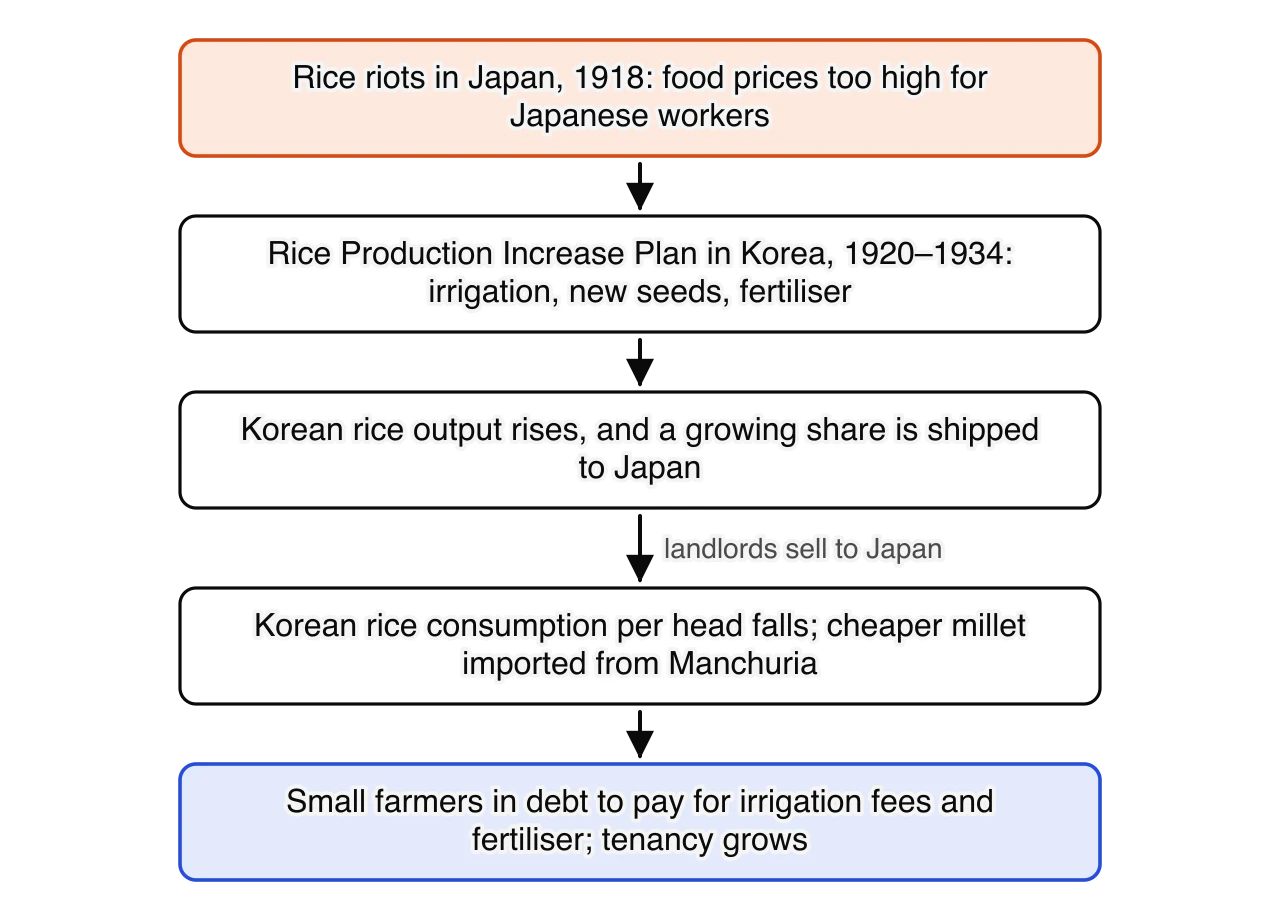
The chain of effects of the Rice Production Increase Plan shows how Korean agriculture was tied to Japan. After rice riots in Japan in 1918, the Government-General invested in irrigation, improved seeds and fertiliser to raise output for export. Production rose, but a growing share of the harvest was shipped to Japan, and Korean rice consumption per head fell; many poor Koreans ate millet imported from Manchuria instead. Irrigation fees and fertiliser costs drove indebted small owners into tenancy. The plan was suspended in 1934, when cheap colonial rice was hurting Japanese farmers.
Banking
Colonial finance was built around state banks. The Bank of Chōsen (founded as the Bank of Korea in 1909 and renamed in 1911) issued Korea’s currency and financed Japanese expansion into Manchuria. The Chōsen Industrial Bank (1918) lent to agriculture and industry, and cooperative financial associations reached into the villages. These institutions gave the Government-General control of credit and tied Korea’s money to the yen.
Industry
In the 1910s the Company Law required official permission to found any company, which held back Korean business; it was abolished in 1920. Korean entrepreneurs then founded firms such as the Gyeongseong Spinning and Weaving Company (1919) of the Kim Seong-su family, which became the leading Korean-owned industrial firm. The historian Carter Eckert has shown that it grew through subsidies, loans from the Chōsen Industrial Bank and cooperation with Japanese firms and markets.
From the early 1930s, after Japan seized Manchuria, the Government-General promoted heavy industry, especially in the north, where there were coal, iron and hydroelectric power. Noguchi Shitagau’s Chōsen Nitrogenous Fertiliser Company built a vast chemical complex at Hŭngnam from the late 1920s. Japanese firms owned the great majority of industrial capital, and Koreans worked mostly as labourers, often in harsh conditions, while managers and engineers were Japanese.
Infrastructure
Japan built railways, ports, roads, telegraph lines and dams. The Seoul–Busan line (1905) and the Seoul–Sinuiju line (1906), both built by Japan during the protectorate, formed the backbone of a network that linked Korea’s ports to Manchuria. Later lines reached the south-west and north-east, and the Supung dam on the Yalu River, begun in 1937, was one of the largest hydroelectric projects in Asia. The pattern of the network, running from the ports to the Manchurian border, shows that it was designed for Japanese trade and strategy.
Area | Development | Who benefited |
|---|---|---|
Land | Land Survey (1910–1918); Oriental Development Company | The Government-General, Japanese settlers and Korean landlords; tenants lost customary rights |
Agriculture | Rice Production Increase Plan (1920–1934) | Japanese consumers and rice-selling landlords; Korean diets worsened |
Banking | Bank of Chōsen; Chōsen Industrial Bank | Japanese firms and expansion into Manchuria; some Korean business |
Industry | Light industry in the 1920s; heavy industry in the north from the 1930s | Mainly Japanese capital; a small Korean business class; new jobs for Korean workers |
Infrastructure | Railways, ports, roads, dams | Japanese trade and military needs; also a lasting base for post-war growth in both Koreas |
The table of colonial economic developments shows real growth, much of it in the interest of Japan. Whether the industry and infrastructure left behind in 1945 helped later growth, especially in South Korea, is debated: the heavy industry was mostly in the north, and much of it was destroyed in the Korean War of 1950–1953.
The impact of the Second Sino-Japanese War, 1937–1945
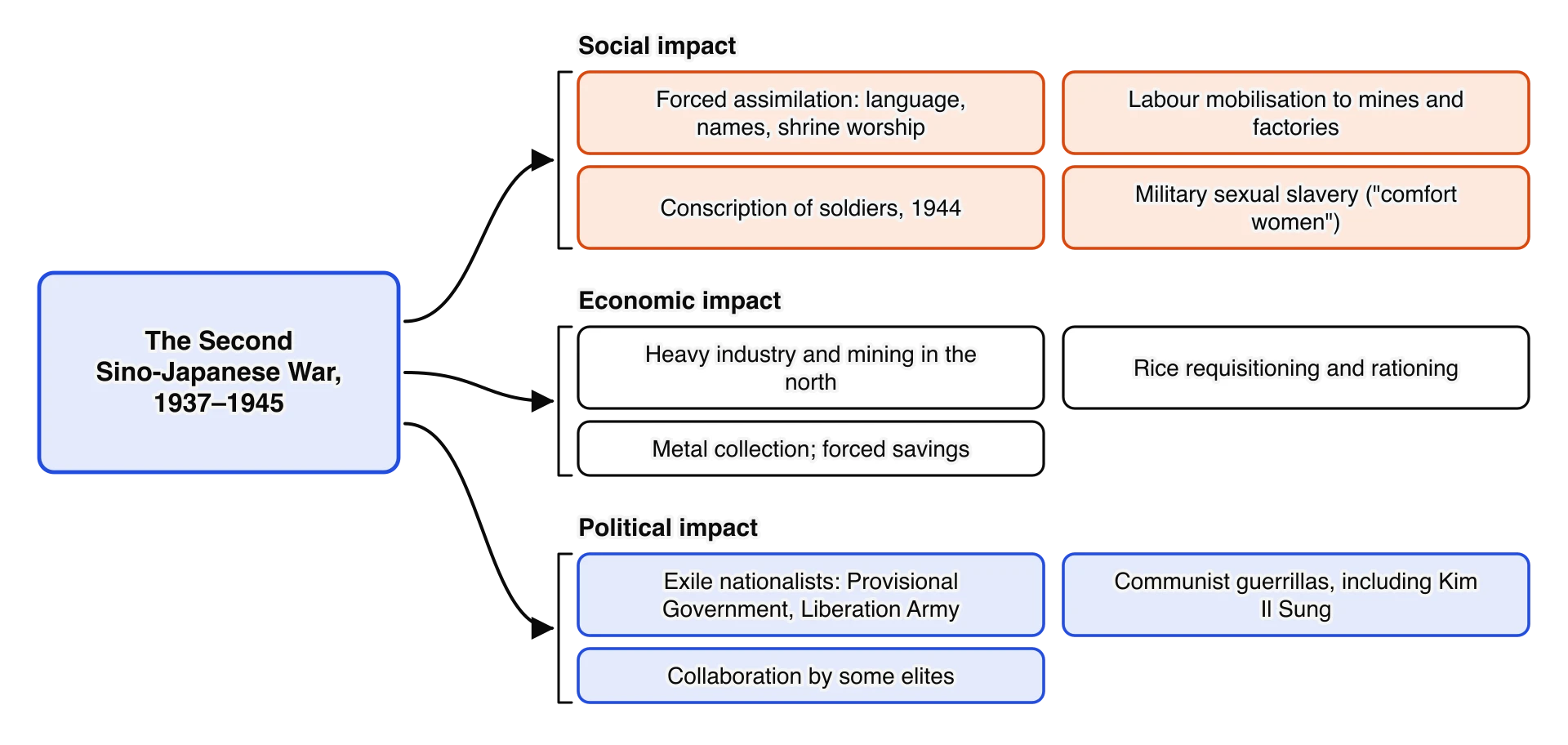
Japan’s full-scale war with China from July 1937, and its war with the United States and Britain from December 1941, changed colonial policy. Korea became a supply base for the war on the Asian mainland, and Koreans were to be turned into imperial subjects who would work, fight and die for the emperor. The diagram of the war’s impact groups the consequences.
Forced assimilation: the kōminka policy
Governor-General Minami Jirō (1936–1942) launched the kōminka ("making imperial subjects") campaign under the slogan naisen ittai, "Japan and Korea as one body". Its measures reached into every part of Korean life.
The Pledge of Imperial Subjects (1937): a short oath of loyalty to the emperor that schoolchildren, workers and officials had to recite at assemblies.
Compulsory shrine worship: attendance at Shinto ceremonies for schools, officials and, increasingly, all residents; small shrines in homes were encouraged.
Language: the 1938 education ordinance made Korean optional, and in practice it disappeared from schools; pupils could be punished for speaking it. The two main Korean newspapers were closed in August 1940, and in 1942 members of the Korean Language Society were arrested and two died in prison.
The name-change order (sōshi-kaimei, February 1940): Korean families were "permitted" to register Japanese-style surnames. Officials used heavy pressure, and by August 1940 about 80 per cent of households had registered one.
The name-change order struck at the core of Korean family identity, since a Korean surname marked descent from a lineage. Families who refused could find their children excluded from school, their rations cut or their applications refused. A farmer recalled the pressure:
I got beaten up many times by the Japanese because I resisted changing my name to Japanese. Everybody around me changed theirs, but I had lost my grandfather and then my father, and had taken over the responsibility of eldest son. That is why I tried not to change my name. But I got tired of being so badly beaten.
Pak Seong-pil, a farmer and fisherman born in 1917 in South Gyeongsang province, interviewed in Hildi Kang, Under the Black Umbrella (2001). He eventually chose a Japanese name whose characters referred to his birthplace and his family home, a quiet way of keeping his identity. The account shows the role of coercion behind a policy that was officially voluntary, and the small strategies Koreans used to resist it.
Forced labour and conscription
The National General Mobilisation Law of 1938, applied to Korea as well as Japan, gave the state power over labour, materials and prices. Korean labour was mobilised in three stages: company "recruitment" from 1939, "official mediation" through local government from 1942, and outright conscription of labour from 1944. In practice the line between recruitment and compulsion was thin from the beginning, since officials had quotas to fill.
Korean workers were sent to coal mines, metal mines, factories, construction sites and military installations in Japan, Sakhalin and the Pacific islands, as well as within Korea. Many worked long hours under guard, for little or withheld pay, and in dangerous conditions; deaths in mines and from Allied bombing were common. Tens of thousands of Koreans working in Hiroshima and Nagasaki were among the victims of the atomic bombs in August 1945.
Military service followed the same path from "volunteering" to compulsion. A special volunteer system for the army began in 1938; Korean students were pressed to volunteer in 1943; and conscription was introduced in 1944. Koreans also served as civilian employees of the military, including as guards in prisoner-of-war camps, a role for which some were later tried as war criminals.
Group | Estimates | Why figures differ |
|---|---|---|
Labour sent to Japan, Sakhalin and the Pacific, 1939–1945 | About 700,000–800,000 (Japanese official figures and South Korean government investigations) | Records were incomplete and some destroyed; categories (recruited, mediated, conscripted) overlap |
All wartime labour mobilisation, including within Korea | Several million by South Korean government estimates | Includes short-term local mobilisation and counts some people more than once |
Soldiers and military civilian employees | Over 200,000 soldiers and over 100,000 civilian employees | Volunteer and conscript figures come from different sources |
"Comfort women" of all nationalities | About 20,000 to 200,000 in most historians’ estimates; some estimates are higher | Few records survive; estimates depend on assumed ratios of women to soldiers and replacement rates |
Data: Japanese government and South Korean government figures as reported by historians; ranges, not exact counts. The table of mobilisation estimates shows why historians give ranges. The forced labour issue remains a live dispute: in 2018 South Korea’s Supreme Court ordered Japanese companies to compensate former workers, while Japan holds that all claims were settled by the 1965 treaty between the two states.
The "comfort women"
From the early 1930s, and on a large scale after 1937, the Japanese military set up "comfort stations", brothels for soldiers, across occupied China and later South-East Asia and the Pacific. The women held in them are known by the military’s euphemism, comfort women; most historians describe the system as military sexual slavery. Women came from Korea, China, Taiwan, the Philippines, Indonesia and other occupied territories, as well as Japan, and Korean women formed a large share.
Many Korean women were recruited by deception, with promises of factory or nursing work, by Korean and Japanese brokers working on behalf of the military; others were coerced or abducted. Many were teenagers from poor families. A survivor, Kim Deok-jin, later described how she was recruited in 1937, at the age of seventeen:
All I knew ― all I thought I knew ― was that I was going to work in a factory to earn money. I never dreamed that this could involve danger.
Kim Deok-jin, testimony in Keith Howard (ed.), True Stories of the Korean Comfort Women (1995), translated by Young Joo Lee. The testimony was recorded more than fifty years after the events, for a collection intended to make the survivors’ experience known. Its value lies in showing how recruitment through deception worked and why survivors stressed that they had not consented; its account of the stations themselves, like other testimonies, describes repeated rape under military control.
For almost fifty years survivors were silent, held back by shame, by Korean society’s attitudes to sexual violence, and by governments in Seoul and Tokyo that did not want the issue raised. On 14 August 1991 Kim Hak-sun became the first Korean survivor to testify publicly. The historian Yoshimi Yoshiaki then found Japanese military documents that showed the army’s involvement. In 1993 the Japanese government’s Chief Cabinet Secretary issued a statement:
The then Japanese military was, directly or indirectly, involved in the establishment and management of the comfort stations and the transfer of comfort women. The recruitment of the comfort women was conducted mainly by private recruiters who acted in response to the request of the military.
Statement by Chief Cabinet Secretary Kōno Yōhei on the result of the study on the issue of "comfort women", 4 August 1993. As an official statement after a government study, it carries the weight of an admission by the Japanese state, and it apologised to the survivors. Its careful wording, "directly or indirectly", and its stress on private recruiters, reflect the political limits on what the government would accept, which is why survivors and later Japanese governments have both contested its meaning.
Economic exploitation for the war effort
Korea was designated a military supply base for the war on the continent. Heavy industry expanded fast in the north: chemicals, metals, explosives and munitions, powered by new dams. Mines worked to capacity for coal, iron, gold, tungsten and other strategic minerals. Industrial output and the number of Korean factory workers rose sharply.
For most Koreans the war economy meant hardship. Rice was compulsorily purchased from farmers at fixed prices and shipped to Japan or the army, and food was rationed. Metal goods, from temple bells to household brass bowls and spoons, were collected for the war industries. Koreans were pressed to buy war bonds and to save through official associations, and neighbourhood associations of about ten households were used to enforce quotas, rationing and surveillance.
Political developments: nationalism and communism
Inside Korea open political opposition became almost impossible after 1937, and some prominent Koreans collaborated. The writer Yi Gwang-su took a Japanese name and urged Koreans to support the war; Choe Nam-seon, who had drafted the 1919 declaration, gave pro-Japanese lectures; and businessmen and landlords contributed to war funds. After 1945 these chinilpa ("pro-Japanese" collaborators) became a bitter political issue, and historians still debate how far individuals acted from conviction, ambition or pressure.
Outside Korea, the independence movement grew in organisation if not in power:
The Provisional Government in Chongqing. Under Kim Gu, it followed the Chinese Nationalist government to its wartime capital. In September 1940 it founded the Korean Liberation Army, under Ji Cheong-cheon, and in December 1941 it declared war on Japan. The army was small, a few hundred to a few thousand men, and depended on Chinese support; some of its men trained with the American Office of Strategic Services in 1945 for operations in Korea that the surrender pre-empted. The Allies never recognised the Provisional Government.
Communist guerrillas in Manchuria. Koreans formed a large part of the communist-led Northeast Anti-Japanese United Army. One commander, Kim Il Sung, became known in Korea after his unit raided the town of Pochonbo on the Korean side of the border in June 1937. Under Japanese pressure, his group crossed into the Soviet Union in 1940–1941, where Kim served as a captain in a Soviet brigade until 1945.
The Yan’an group. Korean communists in north China fought alongside the Chinese Communists and formed the Korean Independence League and the Korean Volunteer Army.
The underground at home. In 1944 Yeo Un-hyeong, a moderate leftist, secretly founded the Korean Independence League (Geonguk Dongmaeng) to prepare for liberation.
The war therefore strengthened Korean nationalism in some ways and weakened it in others. Forced assimilation deepened Korean hostility to Japan, and the war gave exile groups military experience and contacts with the Allied powers. Yet the movement emerged in 1945 more divided than ever, between right and left, between exiles and those who had stayed, and between those who had resisted and those who had collaborated.
Liberation and the establishment of two Korean governments, 1945–1948
Allied plans and the 38th parallel
The Allies had promised Korea independence, but with a delay. At Cairo in November 1943, the United States, Britain and China declared:
The aforesaid three great powers, mindful of the enslavement of the people of Korea, are determined that in due course Korea shall become free and independent.
Cairo Declaration, issued 1 December 1943 by Roosevelt, Jiang Jieshi and Churchill. The phrase "in due course" reflected the American view, held by Roosevelt, that Koreans needed a period of international trusteeship before self-government. Koreans read the declaration as a promise of independence; the qualification would cause bitter conflict in 1945–1946.
The Soviet Union declared war on Japan on 8 August 1945 and its troops entered north-east Korea within days. On the night of 10–11 August two American officers, Colonel Charles Bonesteel and Colonel Dean Rusk, working with a small map, proposed the 38th parallel as the line dividing the zones in which Soviet and American forces would accept the Japanese surrender. It placed Seoul in the American zone. Stalin accepted. The line was meant as a temporary military arrangement, not a political border.
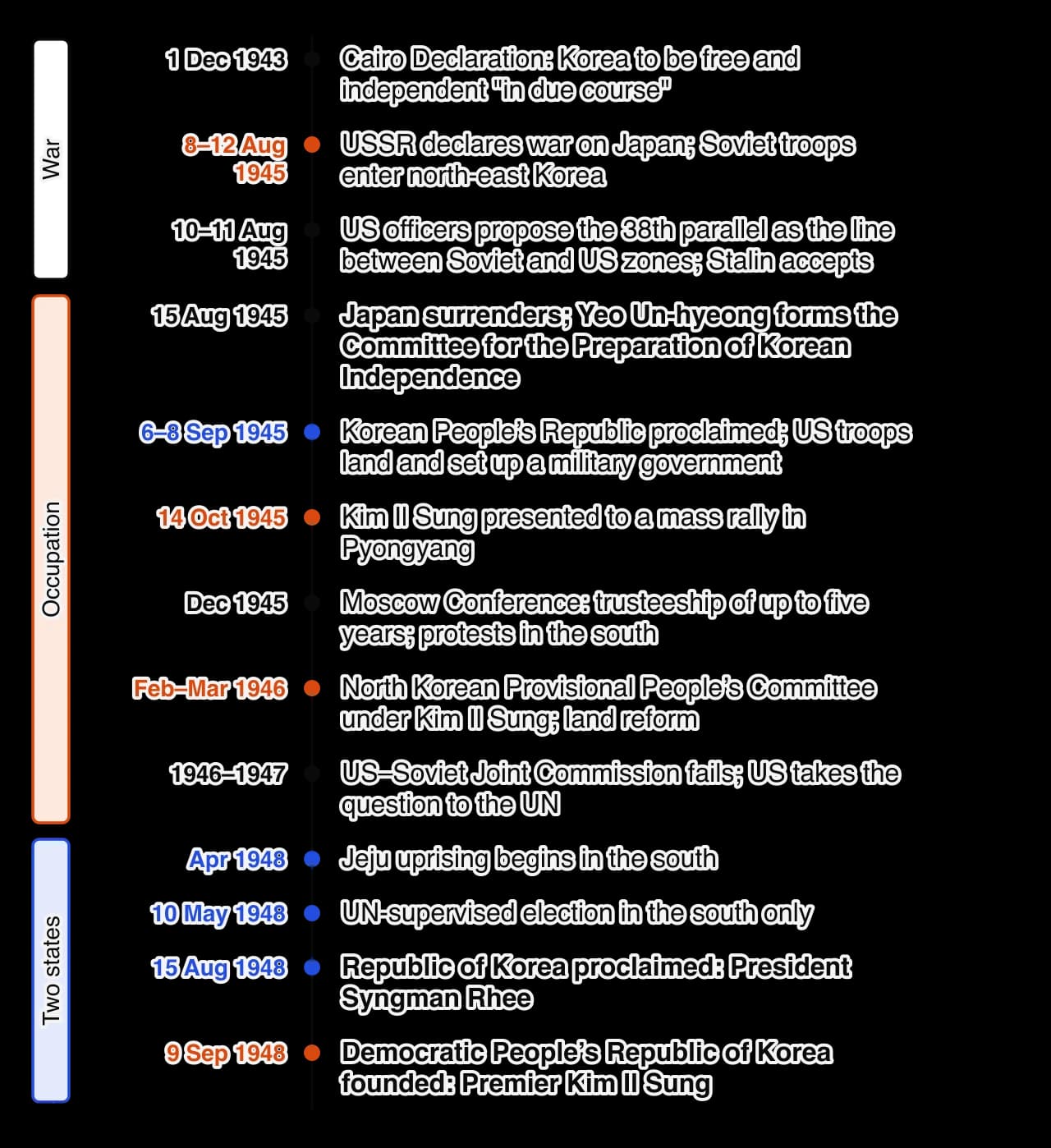
Korean initiatives in August–September 1945
The timeline of 1943–1948 shows that Koreans acted before the occupiers arrived. When Japan surrendered on 15 August 1945, the Japanese colonial authorities asked Yeo Un-hyeong to help keep order. Yeo formed the Committee for the Preparation of Korean Independence, and people’s committees sprang up across the country to run local government. On 6 September a meeting in Seoul proclaimed a Korean People’s Republic, with a cabinet that included both leftists and absent right-wing leaders such as Syngman Rhee.
The American occupation of the south
US troops under Lieutenant General John R. Hodge landed at Incheon on 8 September 1945 and set up the US Army Military Government in Korea. The Americans refused to recognise either the Korean People’s Republic, which they regarded as communist-influenced, or the Provisional Government, whose leaders were allowed to return only as private individuals. They briefly kept Japanese officials in office and then relied on Korean officials and police who had served the colonial government, and on conservative landowners and businessmen of the Korean Democratic Party. Syngman Rhee, who returned from the United States in October 1945, gained American support as a strongly anti-communist leader.
The Soviet occupation of the north
In the north the Soviet authorities worked through the people’s committees, gradually placing communists in control. Kim Il Sung, who had returned with Soviet forces, was presented to a mass rally in Pyongyang on 14 October 1945 as a national hero. The leading non-communist nationalist in the north, the Christian Cho Man-sik, was placed under house arrest in January 1946 after he opposed trusteeship. In February 1946 a North Korean Provisional People’s Committee was formed under Kim Il Sung. It carried out a sweeping land reform in March 1946, confiscating land from Japanese owners and Korean landlords without compensation and giving it to tenants, and nationalised major industries in August 1946. Many landlords, Christians and others fled south.
Trusteeship and the failure of joint government
At the Moscow Conference in December 1945 the American, British and Soviet foreign ministers agreed that a US–Soviet Joint Commission would help form a provisional Korean government, which would be placed under a trusteeship of up to five years. The decision caused an explosion of protest in the south. The right, led by Kim Gu and Rhee, denounced trusteeship as a new colonialism; the communists, after first opposing it, followed Moscow’s line and supported it. The trusteeship issue split Korean politics along the line of the Cold War.
The Joint Commission met in 1946 and 1947 but deadlocked, mainly over which Korean parties should be consulted: the Soviets wanted to exclude the groups that opposed trusteeship, which meant most of the southern right. In the south, conflict turned violent. Strikes and an uprising in the autumn of 1946 were put down by the police; Yeo Un-hyeong, who had tried to build a coalition of the centre, was assassinated in July 1947.
Two states, 1948
In September 1947 the United States took the Korean question to the United Nations, which in November 1947 called for elections across Korea under a UN commission. The Soviet Union refused to let the commission enter the north. The UN then approved elections in the south alone. Kim Gu and other nationalists opposed separate elections because they would make division permanent, and went to Pyongyang in April 1948 for talks with northern leaders, without result.
Violence accompanied the elections. On Jeju Island an uprising led by the island’s communist party began on 3 April 1948, and its suppression by the police, right-wing youth groups and the army in 1948–1949 killed an estimated 14,000 to 30,000 people (the upper figures amount to about a tenth of the island’s population), most of them civilians. A South Korean government commission reported on the killings in 2003, and the president apologised.
The election of 10 May 1948, boycotted by the left and by Kim Gu, produced a National Assembly that elected Syngman Rhee president. The Republic of Korea was proclaimed on 15 August 1948, the third anniversary of liberation. In the north, the Democratic People’s Republic of Korea was founded on 9 September 1948, with Kim Il Sung as premier. Each state claimed to be the only legitimate government of all Korea. Kim Gu was assassinated in Seoul in June 1949. The war that followed in 1950 belongs to the study of the Cold War in Asia.
Syngman Rhee (1875–1965) | Kim Il Sung (1912–1994) | |
|---|---|---|
Background | Yangban family; Independence Club; imprisoned 1899–1904; PhD from Princeton; first president of the Provisional Government (removed 1925) | Born near Pyongyang to a Protestant family; grew up in Manchuria; communist guerrilla leader in the 1930s; Soviet army officer 1941–1945 |
Years before 1945 | Lobbied for Korean independence in the United States | Fought Japan in Manchuria; in the Soviet Union from 1940–1941 |
Support in 1945–1948 | US military government; conservatives, landlords, the police; anti-trusteeship nationalists | Soviet occupation authorities; the people’s committees; communists; beneficiaries of land reform |
Policies to 1948 | Anti-communism; separate southern state; delayed land reform | Land reform and nationalisation; one-party control under Soviet guidance |
Office in 1948 | President of the Republic of Korea (15 August 1948) | Premier of the Democratic People’s Republic of Korea (9 September 1948) |
Perspectives and debates
The history of Korea between 1840 and 1945 is contested by historians and is also part of present-day politics between South Korea, North Korea and Japan. Each of the main debates turns on a question of agency: how far Koreans shaped their own history, and how far outside powers shaped it for them.
Late Joseon: a failure of reform or a dynasty overwhelmed?
An older view, found in Japanese colonial scholarship, presented late Joseon as stagnant and factional, unable to reform and therefore destined to be taken over. Korean historians after 1945 rejected this as a justification for colonialism. In Politics and Policy in Traditional Korea (1975), James Palais argued that the Daewongun’s reforms were limited above all by the power of the yangban, whose control of land and office the state could not break: Korea’s problem was a strong aristocracy and a weak monarchy, not simple backwardness. Martina Deuchler’s Confucian Gentlemen and Barbarian Envoys (1977) showed how carefully the court managed the opening of 1875–1885 within the limits of Confucian politics.
Kirk Larsen, in Tradition, Treaties, and Trade (2008), challenged the view that China’s role in the 1880s was merely traditional. He argues that Qing China practised a modern, multilateral imperialism in Korea, with treaty-port privileges, merchants, telegraphs and customs control, much like the Western powers. This shifts some of the responsibility for Korea’s loss of autonomy from Japan alone to the wider imperialist system.
Why did Japan take Korea?
Historians disagree about the motives of Japanese expansion. Hilary Conroy, in The Japanese Seizure of Korea, 1868–1910 (1960), stressed strategic and political motives: Japanese leaders saw Korea, so close to Japan, as a danger if it fell under the control of a hostile power, and economic interests were secondary. Peter Duus, in The Abacus and the Sword (1995), argues that strategy and economics worked together: Japanese merchants, settlers, railway builders and bankers created interests in Korea that pushed the government towards control, and the government used them to justify it. Andre Schmid’s Korea Between Empires, 1895–1919 (2002) looks from the Korean side, showing how Korean intellectuals in the press built the idea of a Korean nation while caught between China and Japan.
Colonial rule: exploitation or "colonial modernity"?
This is the largest and most political debate. Korean nationalist historiography, dominant in South Korea after 1945 and in North Korea in a Marxist form, presents colonial rule as exploitation: Japan seized land, drained rice, suppressed Korean enterprise and culture, and destroyed the "sprouts of capitalism" that historians such as Kim Yong-sop found in late Joseon agriculture and commerce.
From the 1990s other historians complicated this picture. Carter Eckert’s Offspring of Empire (1991) traced South Korean capitalism to Korean firms such as the Gyeongseong Spinning Company that grew through collaboration with the colonial state. Gi-Wook Shin and Michael Robinson’s edited volume Colonial Modernity in Korea (1999) argued that colonialism and modernity came together: cities, mass media, consumer culture, new identities for women and workers all developed under, and were shaped by, colonial rule. In 1994 the political scientist Atul Kohli argued that the colonial state created the model for South Korea’s later developmental state; Stephan Haggard, David Kang and Chung-in Moon replied in 1997 that he overstated continuity and ignored the break of 1945–1960.
A group of South Korean economic historians, sometimes called the "new right", among them Lee Young-hoon and Kim Nak-nyeon, used statistics to argue that the colonial economy grew substantially and that Koreans shared in some of the growth. Their critics answer that growth figures say little about who gained, and that the most rapid industrial growth came in the war years, built on forced labour. Lee’s Anti-Japan Tribalism (2019), which questioned the coercion of comfort women and forced labourers, provoked fierce criticism from historians in South Korea.
The comfort women
Yoshimi Yoshiaki’s Comfort Women (Japanese edition 1995, English 2000), based on Japanese military documents, established that the army planned, regulated and supplied the comfort stations, and he estimated the number of women at between about 45,000 and 200,000. C. Sarah Soh’s The Comfort Women (2008) accepted military responsibility but stressed the variety of experiences and the role of Korean brokers and of patriarchal attitudes in Korean society. Park Yu-ha’s Comfort Women of the Empire (2013) went further in discussing collaboration and varied experiences; she was prosecuted in South Korea for defaming survivors; the Supreme Court overturned her conviction in 2023, and a retrial acquitted her in 2024. At the other end, Japanese nationalist writers such as Hata Ikuhiko argued that most women were recruited by private brokers and denied that the state forced them, a view rejected by most historians and by the Kono Statement.
The division of Korea
Bruce Cumings, in The Origins of the Korean War, vol. 1 (1981), argued that the American occupation suppressed the people’s committees and the left, restored colonial-era police and officials and backed Rhee, which made division and civil war likely; the conflict, in his view, began as a Korean civil war over the legacy of colonialism. Orthodox and post-revisionist historians, such as Allan Millett in The War for Korea, 1945–1950 (2005), place more weight on Soviet policy in the north and on communist aims. Charles Armstrong, in The North Korean Revolution, 1945–1950 (2003), used captured North Korean documents to argue that the northern revolution had strong Korean roots and was not simply a Soviet imposition.
Debate | Historian (work, year) | Argument | Evidence stressed |
|---|---|---|---|
Late Joseon | James Palais (Politics and Policy in Traditional Korea, 1975) | Yangban power limited royal reform | The Daewongun’s tax and academy reforms and the resistance to them |
The 1880s | Kirk Larsen (Tradition, Treaties, and Trade, 2008) | Qing China practised modern imperialism in Korea | Trade regulations of 1882, Chinese merchants, Yuan Shikai’s role |
Japanese motives | Hilary Conroy (1960); Peter Duus (1995) | Strategy first (Conroy); strategy and economics together (Duus) | Policy debates in Tokyo; Japanese merchants, railways and settlers |
Colonial economy | Kim Yong-sop; Carter Eckert (1991); Shin and Robinson (1999); Lee Young-hoon and Kim Nak-nyeon | Exploitation destroyed Korean development; Korean capitalism grew within colonialism; colonial modernity; measurable growth | Land and rice policy; the Gyeongseong Spinning Company; urban culture; output statistics |
Comfort women | Yoshimi Yoshiaki (1995); C. Sarah Soh (2008); Park Yu-ha (2013) | Military-run system of sexual slavery; complex system with Korean brokers and patriarchy; varied experiences and collaboration | Military documents; survivors’ testimony |
Division | Bruce Cumings (1981); Allan Millett (2005); Charles Armstrong (2003) | US policy made division likely; Soviet and communist aims mattered more; northern revolution had Korean roots | US military government records; Soviet and North Korean documents |
The table of historians’ views shows that the debates are linked. Historians who stress Korean agency tend to see late Joseon as capable of reform, the colonial period as a break, and the division as a Korean civil conflict shaped by outsiders; those who stress structures and outside powers see continuity from the 1880s to 1948. Each view explains some of the evidence, and the strongest judgements weigh internal and external factors together.
Applying the ideas in exam questions
Paper 3: the opening of Korea
Paper 3: the Korean Empire
Paper 3: the impact of Japanese rule
Paper 3: the Second Sino-Japanese War
Paper 3: liberation and division
Self-check
- To do:
I can explain how sedo politics, tax abuses and peasant revolts weakened the Joseon monarchy before 1864.
- To do:
I can explain why the state persecuted Catholicism and Donghak, and what Donghak taught.
- To do:
I can assess the Daewongun’s domestic reforms and isolation policy, using the events of 1866 and 1871.
- To do:
I can explain the terms and significance of the Treaty of Ganghwa (1876).
- To do:
I can describe Gojong’s reforms and assess the role of Queen Min.
- To do:
I can explain the causes and consequences of the Imo Incident and the Gapsin Coup, and the Convention of Tianjin.
- To do:
I can describe China’s influence in Korea during the Chinese decade, 1885–1894.
- To do:
I can explain the causes, aims, course and defeat of the Donghak Peasant Revolution, and how it led to war.
- To do:
I can explain the Gabo reforms and why they were resented, and the effects of the Treaty of Shimonoseki and the Triple Intervention.
- To do:
I can explain the murder of Queen Min and Gojong’s flight to the Russian legation.
- To do:
I can assess the Independence Club and the Gwangmu reforms of the Korean Empire.
- To do:
I can explain how Japan made Korea a protectorate (1905) and annexed it (1910), and how Koreans resisted the Eulsa Treaty.