Notes on R3.6 Independence of India (1857–1964)
Between 1857 and 1947 India moved from a great rebellion against British rule, through decades of constitutional and mass protest, to independence and partition into two states. The Indian independence movement was the largest anti-colonial movement of the twentieth century, and the end of British rule in South Asia began the wider decolonisation of Asia and Africa.
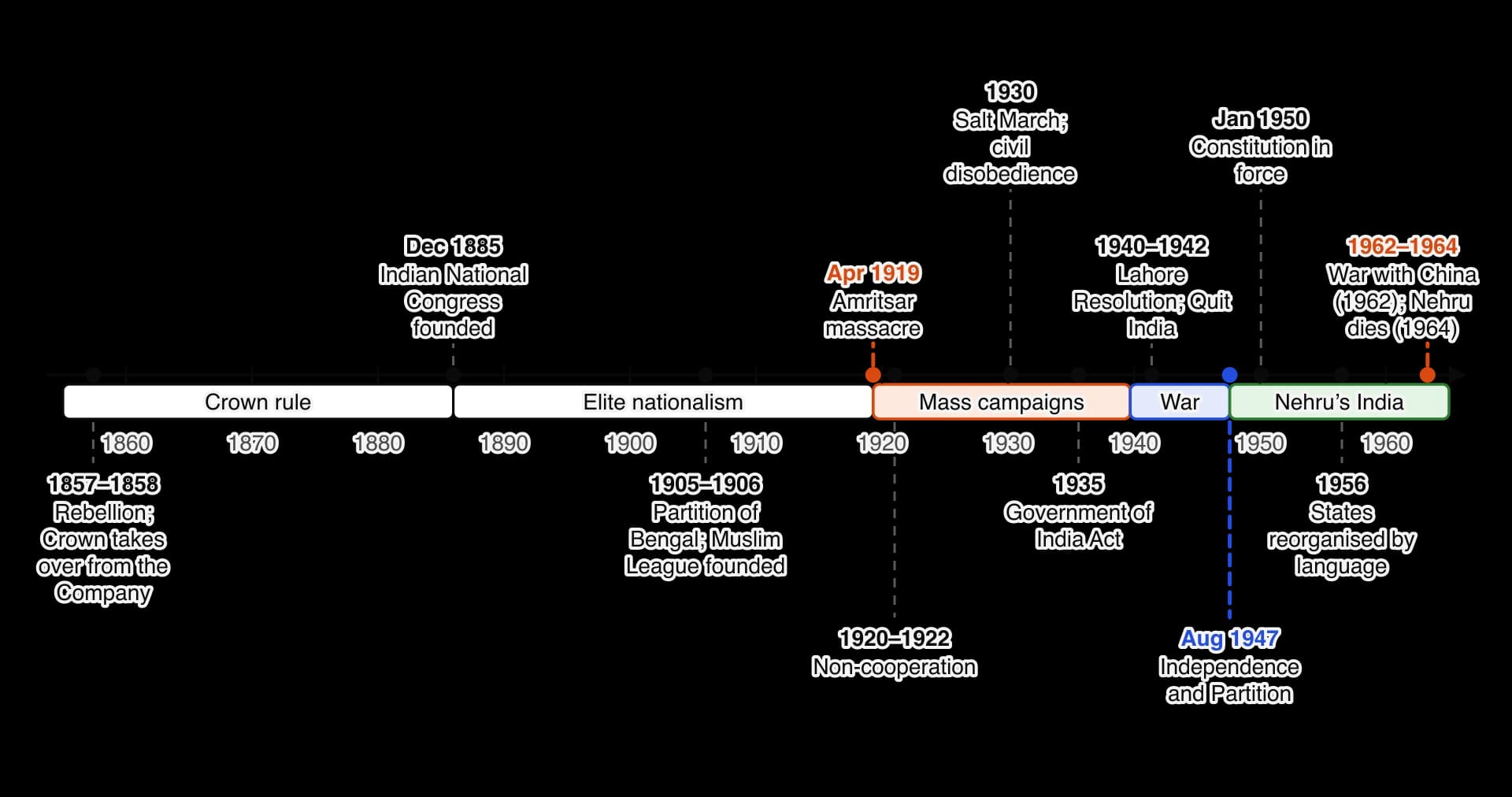
The timeline of 1857–1964 shows five phases. Crown rule after 1858 produced an educated critique of British government; Congress and the League gave it organised form; after 1919 Gandhi turned it into mass campaigns; the Second World War brought the endgame and division; and after 1947 Nehru led the new state through its first seventeen years.
The legacy of 1857 and the Raj after 1858
The rebellion of 1857–1858 began as a mutiny of Indian soldiers (sepoys) of the East India Company's Bengal Army at Meerut and spread across much of northern and central India. Its causes and course belong to the history of Company rule; what matters for nationalism is what it left behind. The Indian Rebellion of 1857 ended the Mughal dynasty and Company rule, and it shaped British and Indian attitudes for the next ninety years.
1857 in memory
For the British, 1857 became a story of Indian treachery and British heroism, centred on the killings of British women and children at Kanpur (Cawnpore) and the siege of Lucknow. It left a lasting fear of another rising and a belief that Indians could not be trusted with arms or power. The army was reorganised so that there was about one British soldier for every two or three Indians, artillery stayed in British hands, and recruitment shifted towards groups the British called "martial races", such as Sikhs, Punjabi Muslims and Gurkhas, who had mostly stayed loyal.
The rebellion also widened the social distance between rulers and ruled. British officials and their families increasingly lived apart in cantonments and hill stations, belonged to whites-only clubs and treated educated Indians with suspicion. The brutality of the British reprisals of 1857–1858, including mass hangings and the execution of rebels blown from cannon, was remembered in Indian families and villages even when it was not discussed in print.
Nationalists later reinterpreted the rebellion as the first national struggle against foreign rule. In 1909 Vinayak Damodar Savarkar, a young revolutionary living in London, published The Indian War of Independence of 1857, which the British banned in India. Many historians argue that the rebels of 1857 fought for local rulers, religion and land more than for an idea of India. Later nationalists found in 1857 a symbol of resistance that they could claim as their own.
How the Raj was governed
The Government of India Act 1858 transferred power from the East India Company to the Crown. A new Cabinet minister, the Secretary of State for India, ruled from London with an advisory Council of India. In India the Governor-General, now also called the viceroy, governed with an Executive Council of senior officials. Queen Victoria's Proclamation of 1 November 1858 promised religious toleration, respect for the princes and their lands, and that her subjects of every race and creed would be admitted to offices for which their education and ability qualified them.
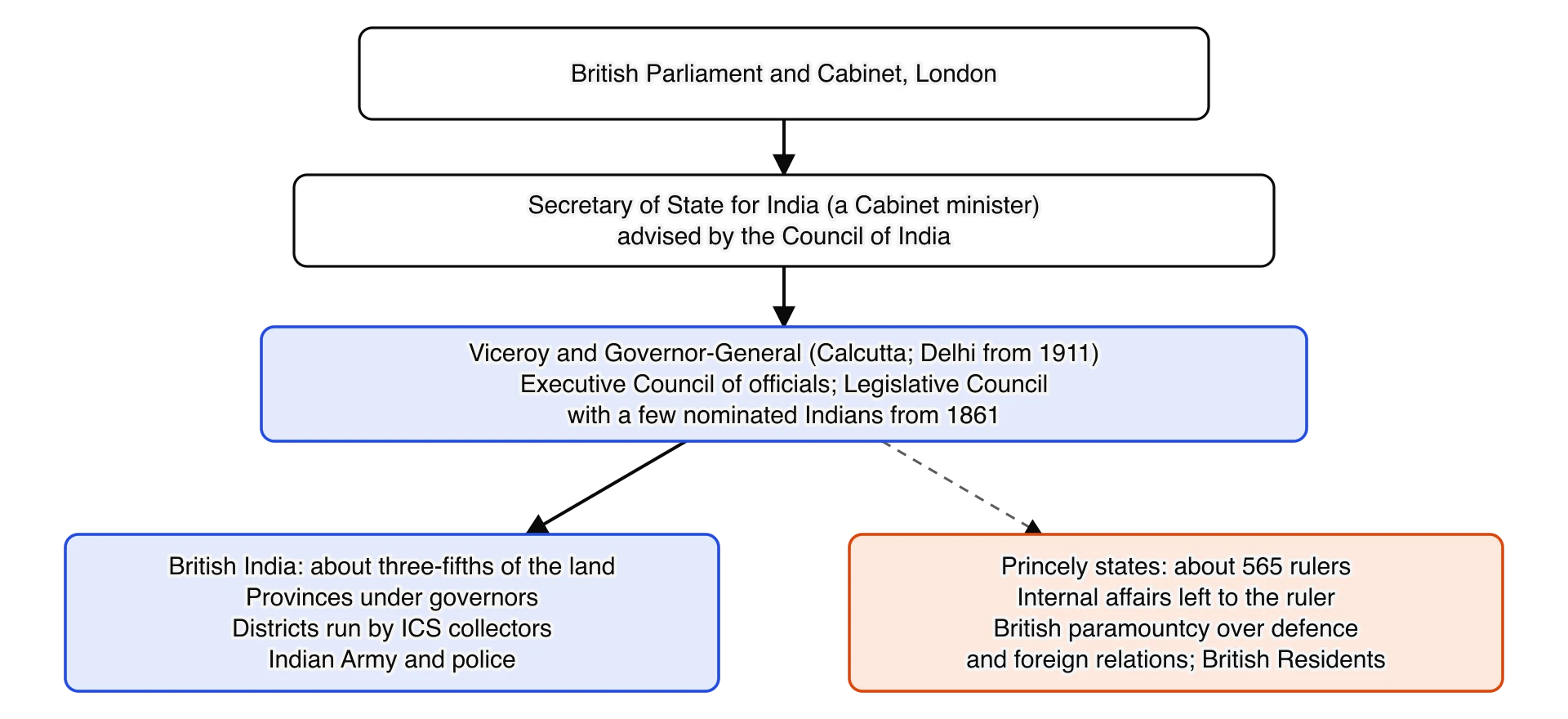
The diagram of the structure of the Raj shows that every level of power lay with British officials. The British Raj ruled about three-fifths of the subcontinent directly. The rest was divided into about 565 princely states of very different sizes, from Hyderabad, about the size of England and Scotland together, to estates of a few villages. Their rulers kept control of internal affairs but accepted British paramountcy, so that Britain controlled their defence and foreign relations and could depose a ruler for misgovernment. The princes became loyal allies of the Crown.
Indians gained only a small place in this system. The Indian Councils Act 1861 allowed the viceroy to nominate a few non-officials, including Indians, to his Legislative Council, which could discuss laws but not control the executive. The senior posts were reserved in practice for the Indian Civil Service (ICS), recruited by a competitive test held in London. Satyendranath Tagore became the first Indian member in 1864, but only a handful of Indians had joined a service of about a thousand men by the 1880s.
British policies, 1858–1885
Policy in these years combined administrative modernisation with measures that educated Indians saw as racial and economic injustice. The railway network grew from about 1,350 kilometres in 1860 to about 14,000 by 1880 and nearly 40,000 by 1900; it moved troops and cotton, but also carried newspapers, pilgrims and politicians, and gave Indians a new sense of the subcontinent as one unit. Western-style universities opened at Calcutta, Bombay and Madras in 1857, and their graduates read about British liberalism and Italian and Irish nationalism.
The viceroyalty of Lord Lytton (1876–1880) gave educated Indians a list of grievances. On 1 January 1877 he held an imperial assembly (durbar) at Delhi to proclaim Queen Victoria Empress of India, at great expense, while famine was killing millions in the south and west. Official estimates put deaths in the famine of 1876–1878 at about 5.5 million, and some historians give much higher figures. In 1878 the Vernacular Press Act allowed the government to censor newspapers in Indian languages but not those in English, and the Arms Act made Indians, but not Europeans, obtain licences for weapons. In 1879 Lytton removed most import duties on British cotton goods, which helped Lancashire manufacturers while the treasury was paying for a war in Afghanistan.
Lytton's successor, Lord Ripon (1880–1884), a Liberal, repealed the Vernacular Press Act in 1882 and passed a resolution in favour of elected local boards. His government then supported the Ilbert Bill (1883), which would have allowed Indian magistrates in country districts to try Europeans. The protest by British residents was so fierce that a compromise in 1884 gave Europeans tried by an Indian judge the right to a jury of which at least half were Europeans. The lesson that Indian professionals drew was that the promise of equality in the Proclamation of 1858 would not be honoured when Europeans objected, and that organised agitation worked.
Policy or event | Date | Why it mattered to educated Indians |
|---|---|---|
Proclamation of Queen Victoria | 1 Nov 1858 | Promised office regardless of race or creed: a standard against which later practice was judged |
Indian Councils Act | 1861 | A few nominated Indians on legislative councils, with no power over the executive |
Maximum age for the ICS entrance test cut from 21 to 19 | 1876 | Made it even harder for Indians to travel to London and pass in time |
Delhi Durbar and the Royal Titles Act | 1876–1877 | Imperial display during a famine that killed millions |
Vernacular Press Act and Arms Act | 1878 | Discrimination by language and race; censorship of the Indian-language press |
Most cotton import duties abolished | 1879 | Indian revenue sacrificed to British manufacturing interests |
Ripon's local self-government resolution; repeal of the press act | 1882 | Showed that reform was possible under a Liberal viceroy |
Ilbert Bill controversy | 1883–1884 | European protest forced a retreat on equality before the law |
The table of British policies between 1858 and 1885 shows why the period produced organised opposition. No single measure caused nationalism, but together they taught educated Indians that their status depended on race, that their economic interests were subordinated to Britain's, and that the government could be moved by organised pressure.
Economic critique and social reform
Educated Indians also built an economic case against British rule. The best-known version, the drain theory of Dadabhai Naoroji, argued that India's wealth was transferred to Britain through salaries, pensions, interest and other "home charges". Later nationalist economists, such as Romesh Chunder Dutt, added that Indian handicrafts had been ruined by British manufactured imports and that high land revenue left peasants defenceless against famine. Historians still debate how far British rule caused deindustrialisation, but the argument gave nationalists a way to connect political rights with poverty.
Religious and social reform movements gave many Indians new confidence in their own traditions and new forms of organisation. The Brahmo Samaj, founded in Calcutta by Rammohan Roy in 1828, sought a reformed, monotheistic Hinduism. The Arya Samaj, founded by Dayananda Saraswati in Bombay in 1875 and strongest in Punjab, called for a return to the Vedas, rejected idol worship and caste by birth, and ran schools and campaigns to reconvert people to Hinduism. In western India Jyotirao Phule's Satyashodhak Samaj (1873) attacked the domination of Brahmins over lower castes, showing that some Indians saw caste oppression as a more urgent injustice than British rule.
Among Muslims, Sir Sayyid Ahmad Khan, a former Company judge who had stayed loyal in 1857, argued that his community, which had lost power with the Mughals, must recover through Western education and loyalty to the British. In 1875 he founded the Muhammadan Anglo-Oriental College at Aligarh, which trained a generation of Muslim leaders. In speeches at Lucknow in 1887 and Meerut in 1888 he urged Muslims not to join the new Congress, arguing that elections would put a Hindu majority over them. His position foreshadowed later Muslim demands for separate representation.
New political associations appeared in the presidency cities: the Indian Association of Calcutta, founded in 1876 by Surendranath Banerjea, campaigned against the ICS age limit and held an all-India conference in 1883. These bodies were the immediate ancestors of the Indian National Congress.
Congress, Bengal and the Muslim League, 1885–1914
The founding of the Indian National Congress
The Indian National Congress first met in Bombay in December 1885. Its delegates were lawyers, journalists, teachers and merchants from all the provinces, and its first president, W. C. Bonnerjee, was a Calcutta barrister. Allan Octavian Hume, a retired British ICS officer, did much of the organising and won the approval of the viceroy, Lord Dufferin. For its first twenty years Congress met for a few days each December, passed resolutions and sent petitions to the government and to Parliament.
Hume's role produced a long-running debate. The safety-valve theory, put forward by some nationalists in the 1910s and repeated by later writers, held that Hume founded Congress on official advice to give educated Indians a harmless outlet and so prevent another 1857. Historians such as Bipan Chandra reject this: the provincial associations and the conference of 1883 show that Indians were already moving towards a national body, and they used Hume, a sympathetic Briton, as a "lightning conductor" to avoid official hostility. Dufferin himself soon turned against Congress, calling it in 1888 the voice of a "microscopic minority".
The early Congress leaders, later called the Moderates, believed that British rule had brought India peace, law and modern education, and that it could be persuaded to share power gradually. Their demands were for more elected Indians on the councils, simultaneous ICS examinations in India and Britain, cuts in military spending and lower land revenue. They won one concession: the Indian Councils Act 1892 allowed local bodies and associations to recommend members of the legislative councils, a first, indirect form of election. Gopal Krishna Gokhale, the leading Moderate of the 1900s, used his seat on the Imperial Legislative Council to criticise the budget in detail.
By the 1890s critics within Congress, called Extremists by their opponents, argued that petitions had achieved little. Bal Gangadhar Tilak in Maharashtra, Lala Lajpat Rai in Punjab and Bipin Chandra Pal and Aurobindo Ghose in Bengal wanted swaraj (self-rule), drew on Hindu religious symbols to reach ordinary people, and were ready to use boycotts and mass protest. The partition of Bengal in 1905 gave them their opportunity.
The partition of Bengal, 1905–1911
Lord Curzon, viceroy from 1899 to 1905, was an energetic reformer who believed that British rule was a moral duty and that educated Indians were unfit to share it. The province of Bengal, with about 78 million people, was too large to govern efficiently, and plans to divide it had existed for years. Curzon's scheme, announced in July 1905, created a new province of Eastern Bengal and Assam, with its capital at Dacca (Dhaka) and a Muslim majority, and left a western Bengal in which Bengali speakers would be outnumbered by speakers of Hindi and Oriya.
Official notes show that administrative efficiency was not the only motive. In 1904 the Home Secretary of the Government of India, Herbert Risley, wrote in an internal minute that "Bengal united is a power; Bengal divided will pull in several different ways", and that this was one of the merits of the scheme. Curzon hoped to weaken the Calcutta-based, mostly Hindu, educated class that led Congress, and to win Muslim support by offering eastern Bengal's Muslims a province of their own.
The partition came into force on 16 October 1905. In Calcutta the day was kept as one of mourning; the poet Rabindranath Tagore led a procession in which Hindus and Muslims tied rakhi threads on each other's wrists as a sign of brotherhood. The swadeshi ("of one's own country") movement that followed boycotted British cloth, salt and sugar, set up Indian-owned textile mills, banks and soap factories, and in 1906 founded a National Council of Education to run schools outside government control. The song Bande Mataram ("I bow to thee, Mother") became its anthem.
The government met the movement with arrests, bans on processions and the deportation of leaders. A minority of young Bengalis turned to revolutionary violence through secret societies such as the Anushilan Samiti and Jugantar. In April 1908 Khudiram Bose, aged 18, threw a bomb at a carriage in Muzaffarpur that killed two British women; he was hanged. The movement exposed a division over methods: at the Surat session in December 1907 Congress split, and the Moderates expelled the Extremists. In 1908 Tilak was sentenced to six years in Mandalay jail for articles defending the revolutionaries.
Swadeshi also had limits. Many Muslim peasants in eastern Bengal, whose landlords were often Hindu, did not support it and some welcomed the new province, and communal riots broke out in Mymensingh and Comilla in 1906–1907. On 12 December 1911, at an imperial durbar in Delhi, King George V announced that the partition would be reversed and that the capital would move from Calcutta to Delhi. Hindu nationalists saw this as a victory for agitation; many Muslim leaders saw it as proof that the British would abandon Muslim interests when Hindus protested.
The All-India Muslim League and separate electorates
In 1906 the Liberal government in London announced that it would consider reform of the legislative councils. On 1 October 1906 a deputation of 35 Muslim notables, led by the Aga Khan III, the leader of the Ismaili Muslims, met the viceroy, Lord Minto, at Simla. They asked that Muslims should elect their own representatives and should have a share of seats greater than their numbers, because of their "political importance" and their role in the empire's defence. Minto replied that Muslim political rights would be safeguarded.
On 30 December 1906, at a meeting of Muslim leaders at Dacca hosted by Nawab Salimullah of Dacca, the All-India Muslim League was founded. Its first aims were to promote Muslim loyalty to the British government, to protect and advance Muslim political rights, and to avoid hostility to other communities. Like early Congress, it was a small body of landowners, lawyers and notables.
The Morley–Minto reforms, made law as the Indian Councils Act 1909, enlarged the central and provincial legislative councils and allowed more of their members to be elected, though officials kept a majority at the centre. They also gave Muslims separate electorates: Muslim voters, who had to meet lower property qualifications than Hindus, elected Muslim members to reserved seats. In the same year S. P. Sinha became the first Indian member of the viceroy's Executive Council.
Historians disagree about the purpose of separate electorates. Nationalist historians see them as a deliberate policy of divide and rule, and point to letters in which Minto and his officials welcomed the Simla deputation as a counterweight to Congress. Others argue that Muslim leaders had asked for them, that Muslims really did fear being outvoted, and that the British were responding to divisions that already existed. Either way, the reforms made religion a basis of political representation, and every later constitution kept and extended the principle.
The First World War and the crisis of 1919
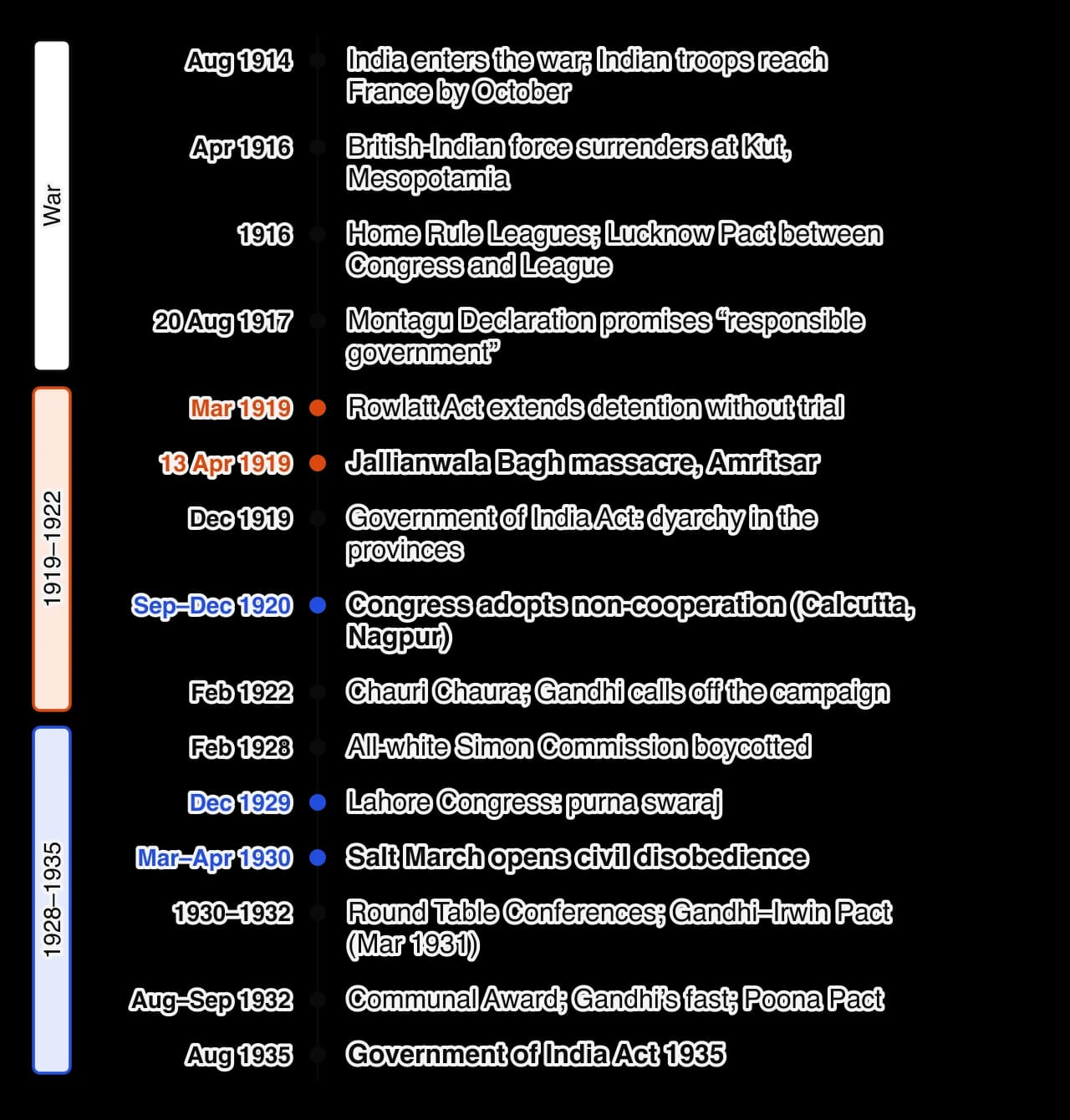
The timeline of 1914–1935 shows a pattern that ran through the inter-war years: British offers of reform came together with new repression, and each was answered by an Indian campaign. The pattern began with the First World War, which raised Indian expectations of self-government at the same time as it imposed new burdens.
India's war
When Britain declared war in August 1914, the viceroy declared war for India without consulting any Indian body. Most Indian politicians, including Gandhi, supported the war effort in the expectation that loyalty would be rewarded. Indian divisions reached France in the autumn of 1914 and fought at Ypres and Neuve Chapelle, before most were moved to the Middle East. The Indian Army carried the main burden of the war against the Ottoman Empire in Mesopotamia, where a British-Indian force of about 13,000 men surrendered at Kut in April 1916, and served in Egypt, Palestine, Gallipoli and East Africa.
Commonly cited figures put the number of Indians who served overseas, as soldiers and labourers, at about 1.3 to 1.5 million, and Indian war dead at about 74,000. Punjab supplied a large share of the combatant troops, and its lieutenant-governor, Sir Michael O'Dwyer, used heavy pressure on villages to meet recruitment targets. India also gave Britain a "gift" of £100 million towards the cost of the war in 1917, raised through loans and taxes. Prices roughly doubled between 1914 and 1920, and the influenza pandemic of 1918 killed somewhere between about 12 and 17 million Indians, the largest death toll of any country.
The war also produced new grievances among Muslims and new forms of revolutionary politics. Britain was at war with the Ottoman sultan, whom many Indian Muslims regarded as caliph, the spiritual head of the Muslim world, and the peace terms of 1919–1920 threatened to dismember his empire. The Ghadar Party, founded by Indian migrants in California in 1913, tried to start a rising among troops in Punjab in February 1915; it was crushed, and dozens of its members were executed after the Lahore conspiracy trials.
Cooperation between Congress and the League, 1916
The war brought the two main parties together. Muhammad Ali Jinnah, a Bombay lawyer who was a member of both Congress and the League, worked for an agreement between them. In the Lucknow Pact of December 1916 Congress accepted separate electorates and agreed that Muslims would have about one-third of the elected seats in the central legislature and more seats than their share of the population in provinces where they were a minority; in return Muslims accepted less than a majority of seats in Punjab and Bengal, where they were a majority. Both parties demanded self-government within the empire. The same session reunited the Moderates and Extremists, who had been divided since 1907.
Two Home Rule Leagues were founded in 1916, one by Tilak in western India in April and one by Annie Besant, the British leader of the Theosophical Society, in September. Modelled on the Irish home rule movement, they held meetings, distributed pamphlets and set up branches in small towns that Congress had never reached. When the government of Madras interned Besant in June 1917, the protests helped persuade London to make a public statement on India's future.
The Montagu Declaration and the Government of India Act 1919
On 20 August 1917 the new Secretary of State for India, Edwin Montagu, told the House of Commons that British policy was the gradual development of self-governing institutions, leading to responsible government in India as part of the empire, to be achieved in stages that Britain would decide. Montagu toured India with the viceroy, Lord Chelmsford, and their report of 1918 became the Government of India Act 1919.
The Act introduced dyarchy, or "dual government", in the provinces. "Transferred" subjects, such as education, public health, agriculture and local government, were given to Indian ministers responsible to elected provincial councils. "Reserved" subjects, including police, justice, land revenue and finance, stayed with the British governor and his officials, who also controlled the budget. At the centre a two-chamber legislature with an elected majority was created, but the viceroy kept full control of the executive and could pass laws the legislature rejected. The vote was given to about five million people, around 2 per cent of the population, and separate electorates were extended to Sikhs, Indian Christians, Europeans and Anglo-Indians. A commission would review the system after ten years.
Dyarchy gave Indian ministers responsibility without money: they ran the departments that cost the most and earned the least, while the governor controlled taxation. Moderates, now organised as the Liberal Federation, accepted the reforms and took office. Most Congress members regarded them as inadequate, coming as they did with a law that revived wartime repression.
The Rowlatt Act and the Amritsar massacre
A committee chaired by the judge Sir Sidney Rowlatt recommended that the government keep its wartime powers against revolutionaries. The Rowlatt Act, passed in March 1919 against the votes of every elected Indian member of the central legislature, allowed political cases to be tried by judges without juries and suspects to be detained without trial. Gandhi called for a hartal, a day of fasting and closed shops, which was held across India on 6 April 1919. In some cities, especially in Punjab, it led to riots.
In Amritsar, the holy city of the Sikhs, the arrest of two local leaders, Saifuddin Kitchlew and Satyapal, on 10 April led to riots in which five Europeans were killed and an English missionary teacher, Marcella Sherwood, was beaten in a narrow street. Brigadier-General Reginald Dyer took command of the city and banned public meetings, though the order was not announced in all parts of it. On 13 April, the spring festival of Baisakhi, a crowd of perhaps 15,000 to 20,000 people, many of them villagers visiting for the festival, gathered in the Jallianwala Bagh, a walled garden with narrow exits. Dyer arrived with about 90 Gurkha and Baluchi soldiers and ordered the 50 riflemen among them to fire without warning. They fired about 1,650 rounds over some ten minutes.
The government's inquiry counted 379 dead and about 1,200 wounded; the inquiry committee of Congress estimated about 1,000 dead, and some Indian accounts give higher figures. Dyer left the wounded where they lay. Under the martial law that followed in Punjab, Indians were flogged in public, students were made to march miles to salute the flag, and Dyer ordered that Indians passing along the street where Sherwood had been attacked must crawl on their bellies. Dyer explained his reasoning to the government and to the committee of inquiry.
I think it quite possible that I could have dispersed the crowd without firing but they would have come back again and laughed. … It was no longer a question merely of dispersing the crowd; but one of producing a sufficient moral effect, from a military point of view, not only on those who were present but more specially throughout the Punjab.
Brigadier-General Reginald Dyer, evidence to the Hunter Committee and his report to the General Staff of 25 August 1919, as combined in an extract in Kim Wagner, Amritsar 1919 (2019). Dyer was defending himself to his superiors and the inquiry, and he did not deny the killing; he justified it as a deliberate lesson to the whole province. The statements are therefore strong evidence of his intentions, and they explain why Indians, and many British officials, saw the massacre as a calculated act of terror and not a panic in the face of a mob.
The Hunter Committee, appointed by the government in October 1919, reported in 1920. Its British majority condemned Dyer for firing without warning and for continuing to fire after the crowd began to disperse, but called his action an error of judgement; its three Indian members wrote a stronger minority report. Dyer was removed from his command and retired. In July 1920 the House of Commons supported the government's decision, and the Secretary for War, Winston Churchill, condemned the massacre as without precedent in modern British history; but the House of Lords passed a motion in Dyer's support, and a fund opened by the Morning Post collected about £26,000 for him. In March 1940 Udham Singh, a Punjabi revolutionary, shot dead Sir Michael O'Dwyer in London; he was hanged.
Indian reaction was immediate. Rabindranath Tagore, who had won the Nobel Prize for Literature in 1913, wrote to the viceroy to give up the knighthood he had received in 1915.
The time has come when badges of honour make our shame glaring in the incongruous context of humiliation, and I for my part wish to stand, shorn of all special distinctions, by the side of those of my countrymen, who, for their so-called insignificance, are liable to suffer degradation not fit for human beings.
Rabindranath Tagore, letter to Lord Chelmsford, viceroy of India, 31 May 1919, published in The Statesman on 3 June 1919. Tagore was the most famous Indian in the world and had kept his distance from nationalist politics; his letter was written to be published, at a time when censorship kept news of Punjab out of the press. Its value lies in showing how the massacre and martial law turned loyal, moderate Indians against British claims to rule by consent.
 YouTube
The significance of Amritsar lay as much in the response as in the killing. For Gandhi, the Hunter majority report, the Lords vote and the fund for Dyer showed that the British system would excuse violence against Indians. In 1920 he returned the medals he had won for ambulance work in South Africa and turned from cooperation with the reforms to non-cooperation.
Gandhi and non-cooperation, 1920–1922
Gandhi's ideas and his rise
Mohandas Karamchand Gandhi (1869–1948), a lawyer trained in London, had spent twenty years in South Africa leading the Indian community against racial laws, where he developed satyagraha, non-violent resistance that breaks unjust laws openly and accepts punishment. He returned to India in 1915 and won a national reputation through local campaigns for indigo cultivators in Champaran (1917), peasants in Kheda and mill workers in Ahmedabad (1918), and through the Rowlatt hartal of 1919.
Gandhi's politics rested on a set of linked ideas. Ahimsa (non-violence) was for him a moral principle, not only a tactic. Swaraj meant self-rule in a double sense: Indian control of government, and each person's control over his or her own desires. In Hind Swaraj (1909) he rejected modern industrial civilisation and argued that India should rebuild its self-sufficient villages; hand-spinning and the wearing of khadi (hand-woven cloth) were the practical form of this swadeshi. He also made Hindu–Muslim unity and the abolition of untouchability conditions of swaraj. These ideas let him appeal to peasants, traders and women in religious language that the Western-educated leaders could not use.
Khilafat and the programme of non-cooperation
In 1919–1920 Gandhi linked the Punjab grievances to the Khilafat movement, led by the brothers Muhammad Ali and Shaukat Ali and the scholar Abul Kalam Azad, which demanded that the Allies preserve the Ottoman sultan's position as caliph. Supporting Khilafat gave Gandhi Muslim allies and the chance of a united Hindu–Muslim campaign. At a special session in Calcutta in September 1920 Congress adopted his programme of non-cooperation, and the annual session at Nagpur in December confirmed it. Gandhi promised swaraj within a year if the programme was followed.
The Nagpur session also gave Congress a new constitution: a Working Committee of about fifteen members to lead it, Provincial Congress Committees based on language regions, and a membership fee of four annas a year that peasants could afford. Jinnah, who opposed mass agitation and Gandhi's use of religion in politics, spoke against the programme at Nagpur and left Congress soon afterwards. Tilak, the one leader with a mass following comparable to Gandhi's, had died on 1 August 1920.
The campaign and its end
Non-cooperation was planned in stages: first the return of titles and the boycott of the new councils, law courts, government schools and foreign cloth, with civil disobedience and refusal to pay taxes to follow. Its national shape was broken by local movements that went further than Congress wanted. In Malabar on the south-west coast, the Mappila (Moplah) rising of August 1921, in which Muslim tenants attacked Hindu landlords and the state, turned into communal violence, forced conversions and harsh military repression; estimates of deaths run into the thousands. When the Prince of Wales landed in Bombay in November 1921, the boycott of his visit became a riot.
On 4 February 1922, at Chauri Chaura in the United Provinces, a crowd of Congress and Khilafat volunteers, provoked by police beatings, set fire to the police station; 22 policemen died. Gandhi suspended the whole campaign on 12 February, against the wishes of most Congress leaders, who were in prison. He was arrested in March and tried at Ahmedabad for sedition. He pleaded guilty and explained to the court why he had changed from a loyal subject into an opponent of British rule.
I have no personal ill-will against any single administrator, much less can I have any disaffection towards the King's person. But I hold it to be a virtue to be disaffected towards a Government which in its totality has done more harm to India than any previous system. India is less manly under the British rule than she ever was before. Holding such a belief, I consider it to be a sin to have affection for the system.
M. K. Gandhi, statement at his trial for sedition, Ahmedabad, 18 March 1922. Gandhi spoke to a British judge but addressed India and the world, and he asked for the heaviest penalty, a tactic of satyagraha that turned the courtroom into a moral contest. The statement is valuable evidence of how Amritsar, the Khilafat question and economic grievances had turned a loyalist into a non-cooperator; as a defence speech, it presents his conversion as more complete and consistent than his record of 1914–1919 suggests. He was sentenced to six years and released on health grounds in 1924.
Results and divisions in the 1920s
Non-cooperation did not bring swaraj in a year, and British rule was never in serious danger. It did transform Congress into a mass party with branches across India, made Gandhi its unchallenged leader and spread nationalist politics to small towns and villages. Imports of British cloth fell by about half between 1920–1921 and 1921–1922. The historian Shahid Amin, in Event, Metaphor, Memory (1995), shows that peasants around Chauri Chaura understood "Gandhi" and "swaraj" in their own terms, as a promise of the end of rents and police power, which is one reason why the movement escaped Gandhi's control.
The Hindu–Muslim alliance collapsed. When the new Turkish Republic abolished the caliphate in March 1924, the Khilafat movement lost its purpose. The 1920s saw serious communal riots, at Kohat in 1924 and Calcutta in 1926, over issues such as music played outside mosques and the slaughter of cows. Hindu nationalist bodies grew: the Hindu Mahasabha, founded in 1915, and the Rashtriya Swayamsevak Sangh (RSS), founded at Nagpur in 1925 by K. B. Hedgewar to train Hindu volunteers. Within Congress, C. R. Das and Motilal Nehru formed the Swaraj Party in 1923 to contest elections and obstruct the councils from inside, while Gandhi worked on his "constructive programme" of spinning, village work and campaigns against untouchability.
Simon, purna swaraj and civil disobedience, 1927–1934
The Simon Commission and the Nehru Report
The review promised in 1919 came early. In November 1927 the Conservative government appointed a statutory commission under Sir John Simon to report on India's constitution. All seven members were British MPs; no Indian was included. Almost every Indian party boycotted the Simon Commission, which was met with black flags and the slogan "Simon, go back" when it landed in Bombay in February 1928. At a demonstration in Lahore in October 1928, Lala Lajpat Rai was beaten by police and died a few weeks later. To avenge him, Bhagat Singh and his comrades of the Hindustan Socialist Republican Association shot dead a police officer, John Saunders, in December 1928.
The British challenged Indians to agree a constitution among themselves. A committee of the All-Parties Conference chaired by Motilal Nehru produced the Nehru Report in August 1928. It proposed dominion status, the self-governing status of Canada or Australia, with a strong central government, and the end of separate electorates in favour of joint electorates with seats reserved for Muslims where they were a minority. Jinnah asked for one-third of the central seats for Muslims and for residuary powers to lie with the provinces; when these amendments were rejected in December 1928, he answered with his "Fourteen Points" (March 1929), which demanded a federal constitution with strong provinces, separate electorates and Muslim majorities in Punjab and Bengal. The failure to agree in 1928 was one of the first open breaks between Congress and the League.
Purna swaraj
On 31 October 1929 the viceroy, Lord Irwin, declared that the natural goal of India's constitutional progress was dominion status and announced a Round Table Conference in London. Conservative protests in Britain, led by Churchill, made clear that no date would be set. At its Lahore session in December 1929, presided over by the 40-year-old Jawaharlal Nehru, Congress declared purna swaraj (complete independence) as its goal and authorised civil disobedience. On 26 January 1930 Congress supporters across India took a pledge of independence.
We believe that it is the inalienable right of the Indian people, as of any other people, to have freedom and to enjoy the fruits of their toil and have the necessities of life, so that they may have full opportunities of growth. We believe also that if any government deprives a people of these rights and oppresses them the people have a further right to alter it or to abolish it.
Indian National Congress, Declaration of Independence (the purna swaraj pledge), read at meetings across India on 26 January 1930. The wording deliberately echoes the American Declaration of Independence of 1776, placing India's claim within a universal language of rights that British and American readers would recognise. The pledge went on to list economic, political, cultural and spiritual harms of British rule, so it is also evidence of how Congress joined the drain argument to the demand for freedom. 26 January was later chosen as the day the Constitution of India came into force in 1950.
The Salt March and civil disobedience, 1930–1931
Gandhi first sent Irwin eleven demands, including the halving of land revenue, cuts in military spending and the abolition of the salt tax. When Irwin refused to meet him, he began the Salt March from his ashram at Sabarmati to the sea at Dandi (12 March–6 April 1930) and broke the salt law. The choice of salt and the conduct of the march are a classic case of the method of non-violent protest; the important questions are who joined the Civil Disobedience Movement that followed, and how the British responded.
Civil disobedience reached further than non-cooperation. Women joined in large numbers for the first time, picketing liquor and cloth shops and making salt; the poet Sarojini Naidu led the raid on the Dharasana salt works in May 1930. Peasants in Gujarat, the United Provinces and Bengal refused to pay land revenue or rent, and forest dwellers in the Central Provinces broke forest laws. In the North-West Frontier Province, Khan Abdul Ghaffar Khan's Khudai Khidmatgar ("Servants of God"), a non-violent movement of Pashtun Muslims, joined the campaign. On 23 April 1930 troops fired on a crowd in the Qissa Khwani Bazaar in Peshawar, killing scores of people, and a platoon of Hindu soldiers of the Garhwal Rifles refused to fire on the Muslim crowd. In Sholapur in Maharashtra, textile workers briefly took over the city.
There were also important gaps. Most Muslims stayed away, apart from the Frontier and some Congress Muslims; the League and many religious leaders saw the movement as Hindu-led. Business support was strong in 1930 but faded as trade suffered. The government arrested about 60,000 people in 1930, banned Congress organisations and censored the press, but it did not crush the movement, and Irwin chose to negotiate.
The Round Table Conferences, 1930–1932
The three Round Table Conferences in London were Britain's attempt to make a new constitution by negotiation with all Indian interests: princes, Liberals, the League, Hindu Mahasabha, Sikhs, Christians, Europeans, landowners, business and the "Depressed Classes", led by B. R. Ambedkar. The first conference (November 1930–January 1931) met without Congress, whose leaders were in prison. Its main result was that the princes declared themselves willing to join an all-India federation, which made a federal constitution possible.
In the Gandhi–Irwin Pact of 5 March 1931 Gandhi agreed to suspend civil disobedience and attend the second conference; Irwin agreed to release prisoners not convicted of violence and to allow coastal villagers to make salt. Many younger nationalists criticised Gandhi for not making the release of Bhagat Singh a condition; he was hanged on 23 March 1931. At the second conference (September–December 1931) Gandhi was the only Congress delegate and claimed to speak for all Indians, including Muslims and untouchables. The other delegates rejected that claim, and the conference deadlocked over the representation of minorities.
Gandhi returned to a new viceroy, Lord Willingdon, who arrested him and the Congress leaders in January 1932 and banned Congress. In August 1932 the British prime minister announced the Communal Award, which gave separate electorates to the Depressed Classes as well as to religious minorities. Gandhi's fast against it in Yerwada prison led to the Poona Pact with Ambedkar in September 1932, which replaced separate electorates for the Depressed Classes with reserved seats in joint electorates. The third conference (November–December 1932) was small and achieved little. Civil disobedience faded under repression and was formally ended in 1934.
Conference | Dates | Congress present? | Main outcome |
|---|---|---|---|
First | Nov 1930–Jan 1931 | No (leaders in prison) | Princes accept an all-India federation; agreement on provincial self-government |
Second | Sep–Dec 1931 | Gandhi as sole delegate | Deadlock over minorities; Gandhi's claim to speak for all Indians rejected |
Third | Nov–Dec 1932 | No | Detailed work on the federal scheme; basis for the 1935 Act |
The table of the Round Table Conferences shows why they are often judged a failure, but they did shape the Government of India Act 1935. They also showed that Congress could not alone speak for "India" in negotiations, because the British could always bring the princes and the minorities to the table, which was a lasting advantage for the government and a problem for Congress.
The Government of India Act 1935 and the elections of 1937
The Act
The Government of India Act 1935 was the longest act the British Parliament had passed. It gave the eleven provinces of British India "provincial autonomy": dyarchy was abolished in the provinces, and all departments, including police and finance, were placed under Indian ministers responsible to elected assemblies. Governors kept "special responsibilities" and emergency powers to take over a provincial government. The Act separated Burma from India (from 1937) and created the new provinces of Sind and Orissa.
At the centre the Act proposed an all-India federation of the provinces and the princely states, with dyarchy at federal level: defence and foreign affairs would stay with the viceroy, while other subjects went to ministers answerable to a federal legislature. The princes were given about a third of the seats in the lower house and two-fifths in the upper house, appointed by themselves, not elected. The federation was to begin only when enough princes had joined; they never did, so the centre continued to be run under the 1919 system until 1947. The franchise was widened to about 30–35 million people, about a sixth of the adult population, and separate electorates were kept and extended.
Congress condemned the Act. Nehru compared it to a machine with strong brakes but no engine: the safeguards, the nominated princes and the viceroy's reserved powers seemed designed to stop any nationalist majority from controlling India. The League also criticised the federal scheme. For British Conservatives such as Churchill, on the other hand, the Act went too far. The historian Carl Bridge, in Holding India to the Empire (1986), argues that British ministers designed the federation to keep the centre in the hands of the princes, the minorities and the Raj while letting Indians govern the provinces.
Reform | Central government | Provinces | Franchise and electorates | Indian response |
|---|---|---|---|---|
Morley–Minto, 1909 | Larger legislative council; official majority; first Indian on Executive Council | Larger councils, elected non-official majorities in some | Very small, indirect election; separate Muslim electorates | Moderates accepted; the League welcomed separate electorates |
Montagu–Chelmsford, 1919 | Two chambers with elected majority, but viceroy keeps full executive power | Dyarchy: transferred and reserved subjects | About 5 million voters; separate electorates extended to Sikhs and others | Liberals took office; Congress boycotted the first elections (1920) |
Government of India Act, 1935 | Proposed federation with princes; dyarchy at the centre (never implemented) | Provincial autonomy under Indian ministers; governors' emergency powers | About 30–35 million voters; separate electorates kept; Communal Award and Poona Pact applied | Congress and League both critical, but both contested the 1937 elections |
The table comparing the three reforms shows the continuities in British policy: each widened Indian participation in the provinces while keeping control of the centre, the army and finance, and each kept or extended separate electorates. It also shows the change: by 1937 Indians governed most provinces, and the question had moved from whether Indians would rule to which Indians would rule.
The elections of 1937 and the Congress ministries
Despite its criticism, Congress contested the provincial elections of early 1937 and won a large victory. It won about 707 of the 1,585 seats, with clear majorities in five provinces (Madras, the United Provinces, the Central Provinces, Bihar and Orissa), and formed governments in eight of the eleven provinces by 1938. The Muslim League did badly: it won only about 108 of the 482 seats reserved for Muslims and formed no government. In Punjab the cross-communal Unionist Party of Sikandar Hayat Khan governed, and in Bengal Fazlul Huq's Krishak Praja Party led a coalition.
The way Congress used its victory had large consequences. In the United Provinces the League had expected to share power, but Congress offered it places in the government only if League members merged into the Congress party, which the League refused. Congress ministries introduced Bande Mataram at official events, promoted Hindi in Devanagari script and ran a mass contact campaign among Muslims. League reports, such as the Pirpur Report of 1938, accused the ministries of discrimination against Muslims. Many historians judge that the charges were exaggerated, but they were widely believed and helped Jinnah rebuild the League as the defender of Muslims against "Congress raj". Between 1937 and 1944 League membership grew rapidly, and the Unionist and Bengal leaders moved closer to it.
Congress divisions: Subhas Chandra Bose, 1938–1939
Congress was also divided internally. Subhas Chandra Bose, a Bengali who had passed the ICS entrance test in 1920 but resigned in 1921 to join the movement, led its left wing with Nehru. He was elected Congress president at Haripura in 1938 and, in January 1939, re-elected against Gandhi's candidate, Pattabhi Sitaramayya. Gandhi treated the defeat as his own, and his supporters on the Working Committee refused to cooperate with Bose, who resigned in April 1939 and founded the Forward Bloc. The episode showed both Gandhi's hold over Congress and the frustration of younger nationalists with his caution.
The Second World War, 1939–1945
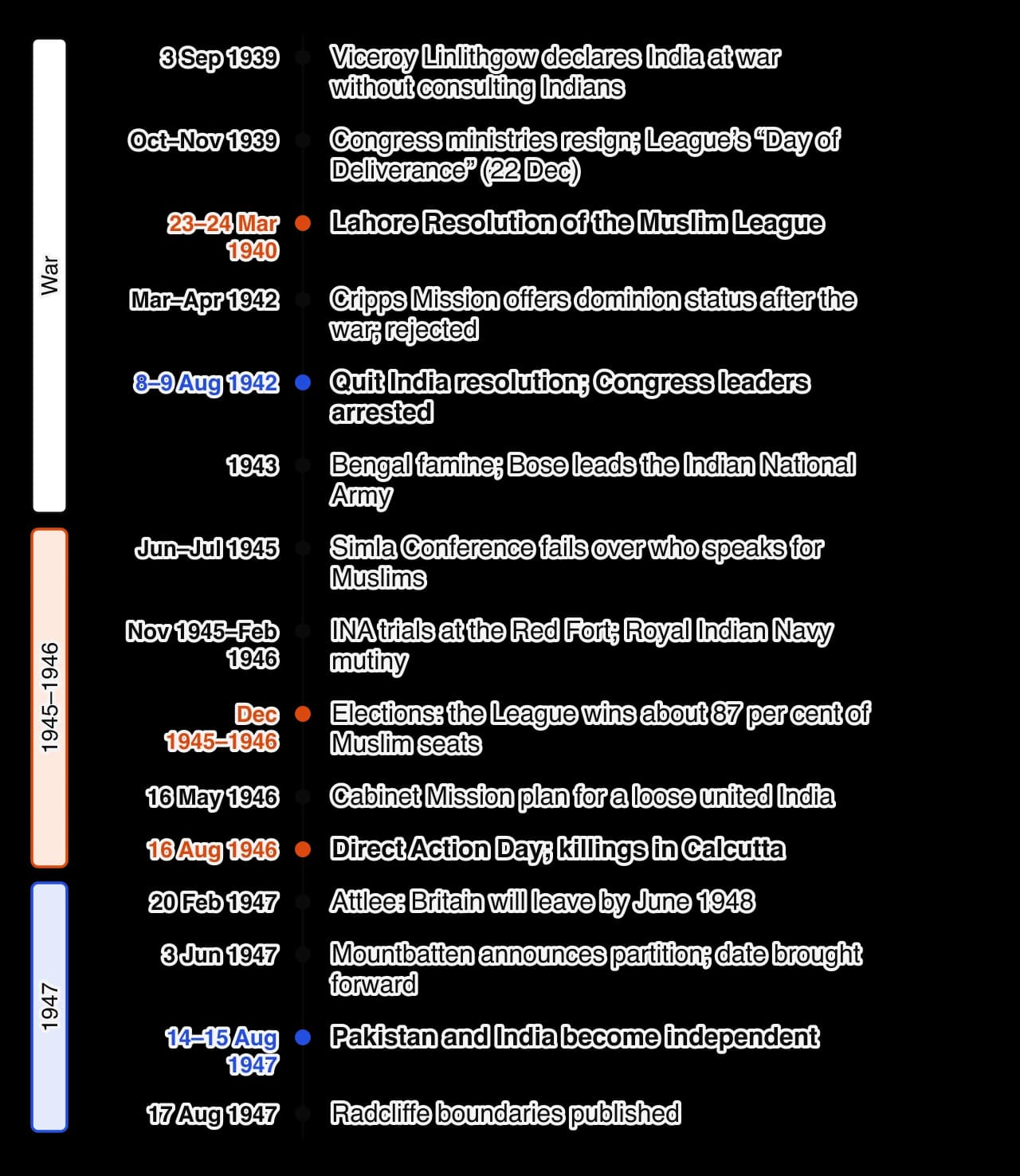
The timeline of 1939–1947 shows how the war changed the balance between the three main players. At its start Congress governed most provinces and the League was weak; by its end Congress had spent three years in prison, the League had become the voice of most Muslims, and Britain had decided that it could not keep India.
War without consultation
On 3 September 1939 the viceroy, Lord Linlithgow, announced that India was at war with Germany. He had the legal power to do so, but he consulted no Indian leader. Congress offered support if Britain declared that India would be independent after the war and gave Indians real power at the centre at once. Linlithgow would promise only consultations after the war, and in October–November 1939 the Congress ministries resigned. Jinnah called on Muslims to celebrate 22 December 1939 as a "Day of Deliverance" from Congress rule.
The resignations were a serious mistake by Congress in the view of many historians, because they handed the field to the League and to the British. The government's "August Offer" of 1940 promised dominion status as the eventual aim, an expanded Executive Council and a constitution-making body after the war, and assured minorities that power would not be transferred to a government whose authority they rejected. This last promise gave the League a veto over any settlement. Gandhi replied with a limited campaign of "individual satyagraha" (1940–1941), in which chosen Congress members, beginning with Vinoba Bhave, made anti-war speeches and were arrested; about 25,000 were imprisoned.
The Lahore Resolution and the Two-Nation theory
The idea of a separate Muslim political unit had several sources. In his presidential address to the Muslim League at Allahabad in December 1930, the poet and philosopher Muhammad Iqbal proposed a Muslim state in the north-west.
I would like to see the Punjab, North-West Frontier Province, Sind and Baluchistan amalgamated into a single State. Self-government within the British Empire, or without the British Empire, the formation of a consolidated North-West Indian Muslim State appears to me to be the final destiny of the Muslims, at least of North-West India.
Muhammad Iqbal, presidential address to the All-India Muslim League, Allahabad, 29 December 1930. Iqbal spoke to a small League session, and the proposal attracted little attention at the time; it did not include Bengal, and Iqbal still spoke of the new unit possibly remaining inside the British Empire and an Indian federation. The source shows that the idea of a Muslim homeland existed a decade before the League adopted it, but its later fame owes much to Pakistan's need for a founding text.
In 1933 Choudhry Rahmat Ali, a student at Cambridge, coined the name "Pakistan" in a pamphlet, Now or Never, from the initials of Punjab, Afghania (the Frontier), Kashmir and Sind with the ending of Baluchistan; it also means "land of the pure". Most Muslim leaders dismissed the idea at first. The experience of Congress rule in 1937–1939 changed this. Jinnah now argued the Two-Nation theory: that Hindus and Muslims were not two communities within one nation but two separate nations.
Jinnah set out the argument in his presidential address to the League at Lahore on 22 March 1940.
The Hindus and Muslims belong to two different religious philosophies, social customs, and literature[s]. They neither intermarry nor interdine together, and indeed they belong to two different civilisations which are based mainly on conflicting ideas and conceptions. … To yoke together two such nations under a single state, one as a numerical minority and the other as a majority, must lead to growing discontent, and final destruction of any fabric that may be so built up for the government of such a state.
Muhammad Ali Jinnah, presidential address to the All-India Muslim League, Lahore, 22 March 1940. Jinnah was speaking to a mass rally of League supporters and, through the press, to the British, who had just promised the minorities a veto. The speech is evidence of the League's new ideology. It is less clear evidence of Jinnah's final aim, because he was a secular-minded, Westernised lawyer who was not personally observant, and historians such as Ayesha Jalal argue that he used the demand to win the strongest possible bargaining position for Muslims.
The Lahore Resolution, moved on 23 March and adopted on 24 March 1940, stated that no constitutional plan would be acceptable to Muslims unless "geographically contiguous units are demarcated into regions" so that the areas in which Muslims were a majority, in the north-west and east of India, were grouped to form "Independent States", with safeguards for minorities. The resolution did not use the word "Pakistan", did not define the borders and spoke of "States" in the plural. Its vagueness allowed Muslims with very different hopes, Punjabi landlords, Bengali peasants, religious scholars and Muslims in Hindu-majority provinces who would never live in Pakistan, to support it.
The Cripps Mission, 1942
Japan entered the war in December 1941 and took Singapore in February 1942 and Rangoon in March. With Japanese forces on India's border and the United States pressing Britain to win Indian support, Churchill's War Cabinet sent Sir Stafford Cripps, a Labour minister with Indian friends, to Delhi in March 1942. The Cripps Mission offered dominion status after the war, with the right to leave the Commonwealth; an elected constitution-making body; and the right of any province to stay out of the new union. During the war, defence would stay under British control.
Congress rejected the offer because it gave no real power during the war and because the right of provinces to opt out opened the way to partition. Gandhi's criticism was summed up in a phrase usually attributed to him, a "post-dated cheque" on a failing bank. The League rejected it because it did not openly accept Pakistan, though it welcomed the principle of opting out. Cripps's offer mattered later: it was the first British statement that India could leave the empire, and it accepted that Muslim-majority provinces might form a separate state.
Quit India, 1942
After Cripps, Gandhi argued that the British presence invited a Japanese attack and that a free India would be better able to resist one. On 8 August 1942, at a session in Bombay, the All-India Congress Committee passed the Quit India resolution demanding an immediate end to British rule and authorising a mass struggle under Gandhi's leadership. Gandhi told the meeting what he expected.
Here is a mantra, a short one, that I give you. You may imprint it on your hearts and let every breath of yours give expression to it. The mantra is: 'Do or Die'. We shall either free India or die in the attempt; we shall not live to see the perpetuation of our slavery.
M. K. Gandhi, speech to the All-India Congress Committee, Gowalia Tank, Bombay, 8 August 1942. The speech was delivered in Hindustani and English to Congress delegates, and Gandhi expected to have time to negotiate with the viceroy before launching any campaign. Its language, much more urgent than in 1930, shows how far the war had changed his judgement; but because he was arrested within hours, it cannot show what kind of campaign he would have led.
Before dawn on 9 August the government arrested Gandhi and the entire Congress leadership and banned Congress. Without leaders, the movement became a spontaneous rising, strongest in Bihar, eastern United Provinces, Bengal, Orissa and Maharashtra. Students, peasants and workers attacked railway stations, telegraph lines and police stations. In Ballia (United Provinces), Tamluk in Midnapore district (Bengal) and Satara (Maharashtra), local activists set up "parallel governments" that lasted from days to years. The Raj used 57 battalions of troops, collective fines and in places machine-gunning from aircraft. By official figures about 1,000 people were killed by the end of 1942; nationalist estimates are much higher.
Some groups stayed out. The League called on Muslims to keep away, and League ministries took office in Sind, Bengal and the North-West Frontier Province during the war. The Communist Party of India, which since the German invasion of the Soviet Union in June 1941 called the war a "people's war", opposed the movement and was legalised by the government. The Hindu Mahasabha and the princes supported the war effort. Quit India was crushed in military terms by early 1943, but it showed that British rule now rested on force, and in the view of historians such as Sumit Sarkar it made clear to the British that India could not be held for long after the war.
Subhas Chandra Bose and the Indian National Army
Bose believed that India should use Britain's war to win freedom by force, with help from Britain's enemies. Placed under house arrest in Calcutta, he escaped in January 1941 and reached Germany through Afghanistan and the Soviet Union. In 1943 he travelled by submarine to Japanese-held Southeast Asia, where he took over the Indian National Army (INA, Azad Hind Fauj), formed in 1942 from Indian prisoners of war under Captain Mohan Singh. On 21 October 1943 in Singapore he proclaimed the Provisional Government of Free India, which declared war on Britain and the United States.
The INA grew under Bose, known to his followers as the leader (Netaji), to about 40,000 soldiers, recruited mainly from prisoners and Indian civilians in Malaya and Burma, and included a women's regiment named after the Rani of Jhansi, a heroine of 1857. His best-known slogan, from a speech in Burma in July 1944, is usually translated as "Give me blood, and I will give you freedom". INA units fought with the Japanese in the Imphal and Kohima campaign of 1944, which ended in a heavy defeat, and the army surrendered in 1945. Bose died of burns after a plane crash in Taiwan on 18 August 1945. Official Indian inquiries in 1956 and 1970 confirmed his death; a third, the Mukherjee Commission (2005), disagreed, and theories that he survived remain popular in India, though most historians accept the crash.
The Bengal famine of 1943
In 1943 between about 2.1 and 3 million people died in the Bengal famine of 1943. A cyclone in October 1942 damaged the rice crop, and the loss of rice imports from Japanese-occupied Burma reduced supply. But the economist Amartya Sen, in Poverty and Famines (1981), showed that the total food available in Bengal in 1943 was not much lower than in earlier years without famine. People starved because wartime inflation, hoarding and speculation put rice beyond the reach of labourers and fishermen, who lost their "entitlement" to food. Government policies made this worse: the "denial policy" of 1942 removed rice and boats from coastal areas expected to face Japanese invasion, the government of Bengal was slow to declare a famine, and the War Cabinet in London refused or delayed requests for food imports.
Historians disagree about responsibility. Madhusree Mukerjee, in Churchill's Secret War (2010), stresses decisions in London and Churchill's hostility to India; others, such as the economic historian Tirthankar Roy, put more weight on the failures of the provincial government, the market and the war situation. The famine discredited British claims to govern India in its people's interest and fed the bitterness of 1945–1947.
How the war weakened British power
The war transformed the economic relationship between Britain and India. India paid for much of its own defence and supplied goods and services to Britain on credit, so by 1945 Britain owed India about £1.3 billion in sterling balances: India had gone from debtor to creditor. The Indian Army grew to about 2.5 million men, the largest volunteer army in history, which raised Indian expectations and made Britain dependent on its loyalty. The ICS had stopped recruiting British officers during the war and was exhausted. The United States, Britain's essential ally, was openly hostile to empire, and the Atlantic Charter of 1941 had proclaimed the right of peoples to choose their own government. In July 1945 the Labour Party, which had long supported Indian self-government, won the British general election, and Clement Attlee became prime minister.
Methods of the independence movement compared
The movement used four broad kinds of method: mass non-violent campaigns, political negotiation and participation in British institutions, revolutionary and military violence, and constructive work in villages and communities. Leaders argued bitterly about which to use, but in practice Congress moved between them, alternating phases of mass struggle with phases of truce, negotiation and work inside the institutions.
Non-cooperation, 1920–1922 | Civil disobedience, 1930–1934 | Quit India, 1942–1943 | |
|---|---|---|---|
Aim | Swaraj within a year; redress of Punjab and Khilafat wrongs | Purna swaraj; Gandhi's eleven demands | Immediate British withdrawal |
Main methods | Boycott of councils, courts, schools, titles and foreign cloth | Breaking the salt and forest laws; tax refusal; boycott and picketing | Strikes, demonstrations, sabotage of communications; parallel governments |
Who took part | Urban middle class, students, peasants in some regions; many Muslims through Khilafat | Wider rural support; women on a large scale; few Muslims except on the Frontier | Students, peasants, workers; leaderless; League, Communists and princes stayed out |
Non-violent? | Mostly, but Malabar and Chauri Chaura | Mostly, despite heavy police violence | No: widespread sabotage and attacks on police |
British response | Arrests (about 30,000); Gandhi jailed | About 60,000 arrests in 1930; negotiation (Gandhi–Irwin Pact); then repression from 1932 | Leaders jailed for the rest of the war; troops, fines, firing; about 1,000 killed (official) |
Outcome | Called off by Gandhi; Congress became a mass party | Suspended for talks, then crushed; led into the 1935 Act | Crushed by 1943; showed rule rested on force |
The table comparing the three great campaigns shows a growth in scale and radicalism, but none of them forced the British to leave. Each ended in suspension or defeat, yet each left Congress larger and British claims to rule by consent weaker. Their main effect was cumulative: they made Indian opinion nationalist and made the cost of rule rise.
Political negotiation and participation
Negotiation was as constant as protest. Congressmen sat in the councils as Swarajists in the 1920s, negotiated at the Round Table Conferences, governed eight provinces in 1937–1939 and, in 1945–1947, negotiated the transfer of power at Simla, with the Cabinet Mission and with Mountbatten. The League worked almost entirely through negotiation and elections until Direct Action Day in August 1946. Independence came through a negotiated Act of Parliament, and the final decisions of 1946–1947 were made by a small number of leaders around a table.
Negotiation and mass action depended on each other. The campaigns gave Congress leaders the authority to bargain, because they could show that the British could not govern without them; negotiation gave the campaigns a goal, and Gandhi always ended campaigns with talks. Elections, especially in 1937 and 1945–1946, measured each party's support in a form the British accepted.
Revolutionary violence and the military challenge
Revolutionary groups, from the Bengal societies of 1905–1910 and the Ghadar Party to Bhagat Singh in Punjab and Surya Sen's raid on the Chittagong armoury in 1930, never threatened British rule militarily. Their importance was political: they kept alive the idea of armed struggle, attracted young people impatient with Gandhi, and forced the government to keep up its machinery of repression. The INA was a larger challenge. Its military record was poor, but after the war the trials of its officers and the mutiny in the Royal Indian Navy in February 1946 showed that the loyalty of Indian servicemen, the foundation of British power, could no longer be assumed.
Leaders and their importance
Mohandas Gandhi (1869–1948)
Gandhi's importance lies above all in turning Congress into a mass movement. Before 1919 nationalism was largely a politics of educated men in the presidency cities; Gandhi brought in peasants, traders, women and, for a time, Muslims, through methods anyone could join and symbols anyone could understand: the spinning wheel, khadi, the handful of salt. He gave Congress its modern organisation in 1920 and, through satyagraha, a way to challenge the Raj morally that British governments, dependent on opinion at home and abroad, found difficult to answer. For millions of Indians he was the Mahatma, "great soul", a title he disliked.
His limits are also clear. He called off campaigns when they turned violent, as in 1922, which frustrated colleagues and showed that he could not always control what he started. He failed to keep Muslims within the movement after 1922, and his religious language, however inclusive he meant it to be, made Congress look Hindu to many Muslims. Ambedkar, in What Congress and Gandhi Have Done to the Untouchables (1945), argued that Gandhi's opposition to separate electorates for the Depressed Classes kept them under upper-caste control. In 1947 Gandhi opposed Partition but could not prevent it. His last months, spent walking through the villages of Noakhali and fasting in Calcutta and Delhi to stop communal killing, are often judged his greatest moral achievement. On 30 January 1948 he was shot dead in Delhi by Nathuram Godse, a Hindu nationalist who blamed him for Partition and for concessions to Muslims and Pakistan.
Jawaharlal Nehru (1889–1964)
Nehru, the son of Motilal Nehru, was educated at Harrow and Cambridge and became Gandhi's chosen political heir. He brought to Congress a modern, secular and socialist outlook that differed from Gandhi's village ideals: as Congress president in 1929 he presided over the Lahore session that declared purna swaraj, and in 1936–1937 he led Congress to its election victory. He spent nearly nine years in British prisons, where he wrote Glimpses of World History and The Discovery of India (1946), an account of India's history as a single civilisation that shaped how a generation of Indians saw their country.
Nehru's importance before 1947 lay in linking Indian nationalism to the left-wing youth and to anti-colonial movements worldwide, and in keeping Congress committed to a secular idea of the nation. Critics, including Jalal and Seervai, argue that his insistence on a strong central government, and his statement of July 1946 that Congress was not bound by the Cabinet Mission plan, helped make Partition inevitable. From 1947 to 1964 he was India's first prime minister.
Muhammad Ali Jinnah (1876–1948)
Jinnah, a Bombay lawyer trained in London, began his career as a Congress Moderate and a believer in Hindu–Muslim unity; he negotiated the Lucknow Pact of 1916. He left Congress in 1920 because he rejected Gandhi's mass agitation, spent the early 1930s practising law in London, and returned in 1934–1935 to lead a weak Muslim League. After 1937 he rebuilt the League into a mass party, using the grievances of the Congress ministries, the Two-Nation theory and the demand for Pakistan.
Jinnah's achievement was to make himself, as the title of Ayesha Jalal's book puts it, the "sole spokesman" for India's Muslims, confirmed by the League's victory in the Muslim seats in 1945–1946. Without him there might have been no Pakistan, or no Pakistan in 1947. To Pakistanis he is Quaid-i-Azam, "great leader", and the founder of the nation; in Indian nationalist accounts he is often the man who divided India. Historians disagree about whether he wanted a sovereign Pakistan or used the demand to win parity for Muslims in a loose Indian federation. He became Governor-General of Pakistan and died on 11 September 1948.
Subhas Chandra Bose (1897–1945)
Bose represented the alternative to Gandhi's non-violence: he wanted a disciplined mass struggle and, from 1941, armed liberation with the help of Germany and Japan. His alliance with fascist powers, whose crimes he played down, and the INA's military failure make him controversial. Yet the INA trials of 1945–1946 made him and his soldiers national heroes, and many historians, including his relative Sugata Bose in His Majesty's Opponent (2011), argue that his greatest impact came after his death, when the British saw that Indian soldiers sympathised with men who had fought against them.
Leader | Aims | Main methods | Importance | Main criticisms |
|---|---|---|---|---|
Gandhi | Swaraj as self-rule for India and for each person; village self-reliance; Hindu–Muslim unity; end of untouchability | Satyagraha; mass campaigns; constructive work; fasts; negotiation | Made Congress a mass movement; destroyed the moral basis of British rule | Lost control of campaigns; alienated many Muslims and Dalit leaders; could not prevent Partition |
Nehru | Complete independence; a secular, socialist, modern India | Congress organisation, elections, negotiation, writing | Linked nationalism to youth, the left and world opinion; led the new state | Insisted on a strong centre; his July 1946 statement damaged the Cabinet Mission plan |
Jinnah | Safeguards for Muslims; from 1940 Muslim states (Pakistan) | Constitutional negotiation; elections; mass mobilisation from 1937; Direct Action Day (1946) | Made the League the voice of most Muslims; created Pakistan | Divided the national movement; Direct Action Day led to mass violence |
Bose | Immediate, complete independence; a strong, socialist state | Mass struggle within Congress; then armed force with Axis help | INA showed the army's loyalty could not be relied on | Allied with Nazi Germany and imperial Japan; INA failed militarily |
The end of British rule, 1945–1947
Simla and the elections of 1945–1946
As the war in Europe ended, the viceroy, Lord Wavell, released the Congress leaders and called a conference at Simla (June–July 1945) to form a new Executive Council of Indians, with equal numbers of Muslims and caste Hindus. It broke down when Jinnah insisted that the League alone should nominate every Muslim member, which Congress, whose president was the Muslim scholar Maulana Abul Kalam Azad, could not accept. Wavell allowed the League's refusal to end the conference, which strengthened Jinnah's position further.
The new Labour government called elections to the central and provincial legislatures for the winter of 1945–1946. They were in effect a vote on Pakistan. The League won all 30 Muslim seats in the central assembly and about 430 of the 492 Muslim seats in the provinces, roughly 87 per cent, compared with under a quarter in 1937. Congress won almost all the general (non-Muslim) seats. Each party could now claim to speak for its community, which made any settlement depend on agreement between the two.
The INA trials and the naval mutiny
In November 1945 the army put three INA officers on trial at the Red Fort in Delhi for waging war against the King: Shah Nawaz Khan, a Muslim, Prem Sahgal, a Hindu, and Gurbaksh Singh Dhillon, a Sikh. Congress, which had condemned Bose's alliance with Japan, now organised their defence, and Nehru put on his lawyer's gown for the first time in decades. Demonstrations in Calcutta, Bombay and other cities turned violent, and the Commander-in-Chief, General Auchinleck, remitted the sentences of transportation for life in January 1946, aware that Indian officers and men sympathised with the accused.
On 18 February 1946 ratings (ordinary sailors) of the Royal Indian Navy at the signals training establishment HMIS Talwar in Bombay struck over food, pay and racial insults. Within two days the mutiny had spread to about 20,000 sailors on ships and shore bases from Karachi to Calcutta, who flew Congress, League and Communist flags together, and Bombay workers struck in support. Patel for Congress and Jinnah for the League persuaded the sailors to surrender on 23 February; neither party wanted to encourage a revolt in the armed forces it expected to inherit. The episode confirmed British fears that the armed forces could not be relied on.
The Cabinet Mission plan, 1946
In March 1946 Attlee sent three Cabinet ministers to India: Lord Pethick-Lawrence, the Secretary of State, Sir Stafford Cripps and A. V. Alexander. After failing to get Congress and the League to agree, the Cabinet Mission published its own plan on 16 May 1946. It rejected a sovereign Pakistan, on the grounds that a Pakistan of the six Muslim-majority provinces would contain huge non-Muslim minorities and a smaller one would mean dividing Punjab and Bengal, which neither the League nor the Sikhs wanted.
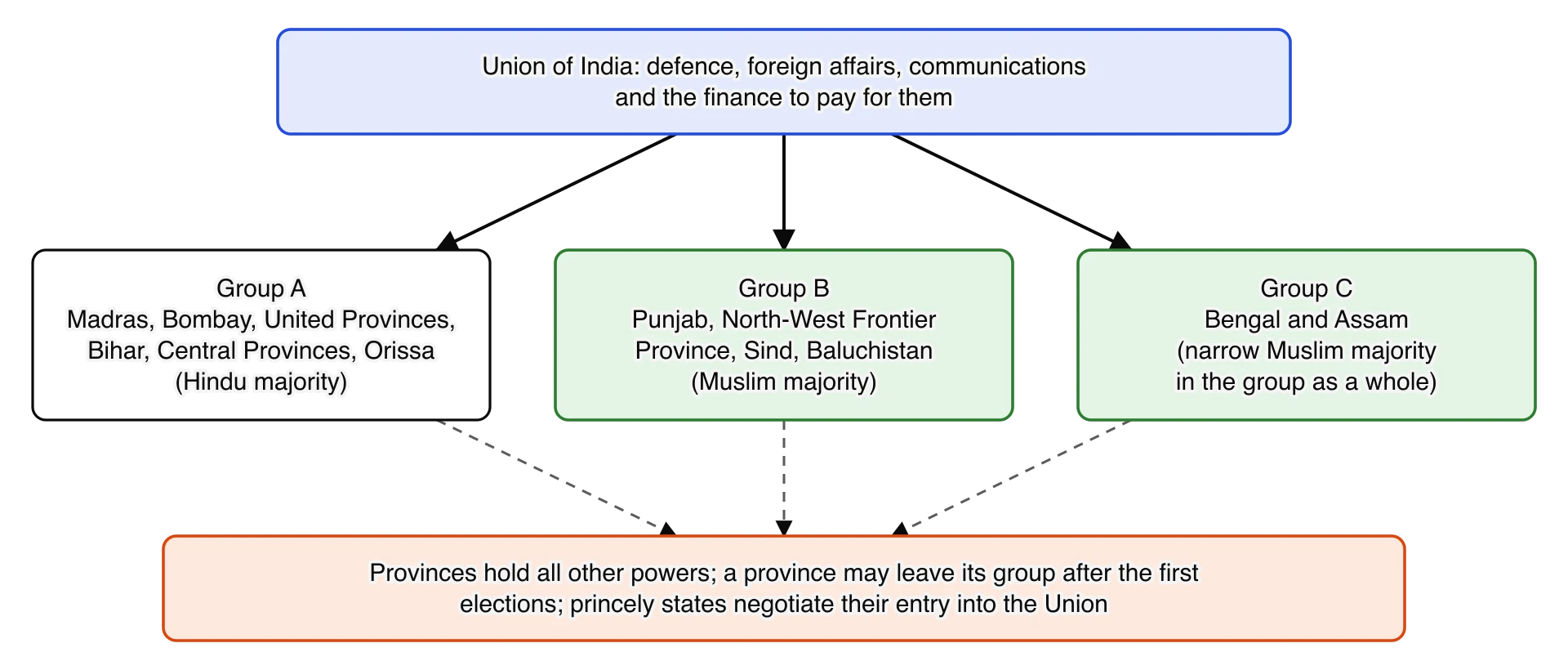
The diagram of the Cabinet Mission plan shows its structure. A Union government would control only defence, foreign affairs and communications. The provinces would form three groups, each of which could write a constitution for its provinces, and after the first elections a province could vote to leave its group. A constituent assembly would be elected by the provincial assemblies. The plan gave the League most of the substance of Pakistan, Muslim-majority groups with wide powers in the north-west and east, without a separate state.
The League accepted the plan on 6 June 1946, describing it as a step towards Pakistan. Congress accepted the constituent assembly but objected to compulsory grouping, since Assam and the North-West Frontier Province, which had Congress governments, would be placed in Muslim-majority groups. On 10 July 1946 Nehru, the new Congress president, told a press conference in Bombay that Congress had agreed only to enter the constituent assembly, where it would be free to change the plan, and that the grouping scheme would probably not survive. On 29 July the League withdrew its acceptance and called for "direct action" to achieve Pakistan.
Direct Action Day and the spread of violence
The League declared 16 August 1946 "Direct Action Day". In Calcutta, the capital of Bengal, where the League's Huseyn Shaheed Suhrawardy was chief minister and had declared a public holiday, League rallies were followed by attacks on Hindus, and Hindu and Sikh gangs replied with attacks on Muslims. In the "Great Calcutta Killings" of 16–19 August, at least 4,000 people were killed and about 100,000 left homeless; some estimates are much higher. Violence spread in a chain of reprisals: against Hindus in the Noakhali district of eastern Bengal in October 1946, against Muslims in Bihar in October–November 1946, where several thousand were killed, at Garhmukteshwar in the United Provinces in November, and in the Rawalpindi district of Punjab in March 1947, where Sikh and Hindu villagers were attacked.
Meanwhile an Interim Government headed by Nehru took office on 2 September 1946. The League joined it in October, with Liaquat Ali Khan as finance minister, but used its position to obstruct: Liaquat's budget of 1947, which taxed business profits heavily, was seen by Congress as an attack on its Hindu business supporters. The constituent assembly met on 9 December 1946 without the League, which boycotted it. By early 1947 the government of India was paralysed, and many Congress leaders, including Patel, began to accept that partition would be better than a weak union in which the League could block everything.
Attlee's deadline and Mountbatten
On 20 February 1947 Attlee announced that Britain would leave India by June 1948, and that Wavell would be replaced by Lord Louis Mountbatten, a cousin of the King and a wartime commander in Southeast Asia. The deadline was meant to force the Indian parties to agree; it also told every party that the British would soon be gone, which encouraged them to seize territory and prepare for conflict. Mountbatten arrived in March 1947 with wide authority from Attlee.
Mountbatten quickly concluded that a united India was impossible. His first plan, known as "Plan Balkan", would have handed power to the provinces, which could then form unions as they chose; Nehru rejected it in May 1947 when Mountbatten showed it to him privately at Simla, because it could have broken India into many states. The plan finally announced on 3 June 1947, drafted with the help of the civil servant V. P. Menon, transferred power to two dominions. The legislators of Punjab and Bengal would vote, sitting in separate Hindu-majority and Muslim-majority sections, on whether to divide their provinces; both voted for division. Referendums were held in Sylhet district of Assam, which joined East Bengal, and in the North-West Frontier Province, where the Khudai Khidmatgar boycotted the vote and the result was for Pakistan. Mountbatten also brought the date forward from June 1948 to 15 August 1947.
The Indian Independence Act, passed by the British Parliament in July 1947, created the dominions of India and Pakistan from 15 August 1947. Pakistan celebrated its independence on 14 August, India on 15 August. Mountbatten stayed on as Governor-General of India at Nehru's invitation; Jinnah became Governor-General of Pakistan.
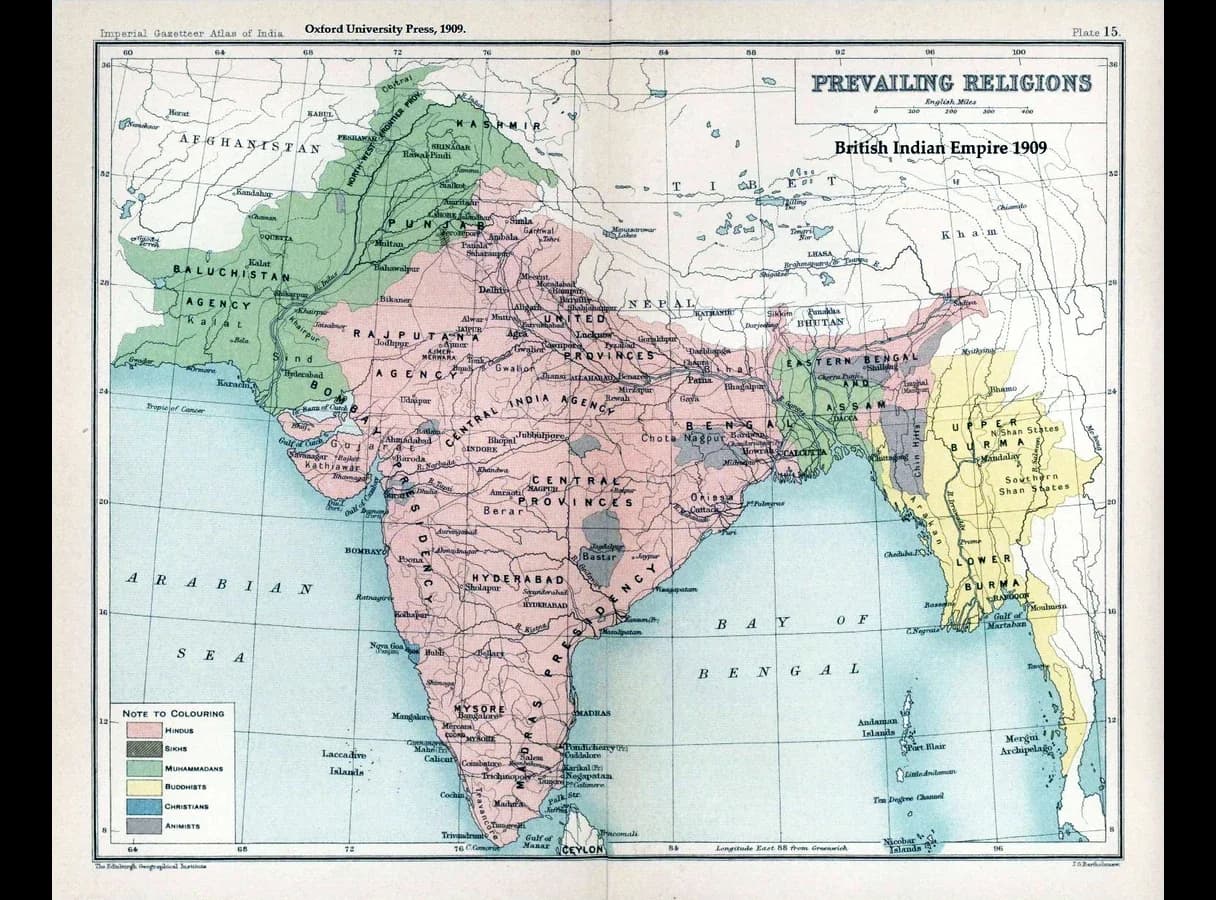
The map of the prevailing religions of 1909 shows the problem the boundary-makers faced: the Muslim-majority areas lay in two zones separated by the Hindu-majority Gangetic plain, and in Punjab and Bengal majorities changed from district to district. Sir Cyril Radcliffe, a London lawyer who had never been to India, arrived on 8 July 1947 and was given five weeks to chair the two boundary commissions, whose Indian members split on community lines and left the decisions to him. The Radcliffe Line gave Lahore to Pakistan and Calcutta to India, and divided Punjab's canal colonies and Sikh holy places. The awards were ready by 12 August but were published only on 17 August, two days after independence, so that millions of people did not know in which country they lived on the day of independence.
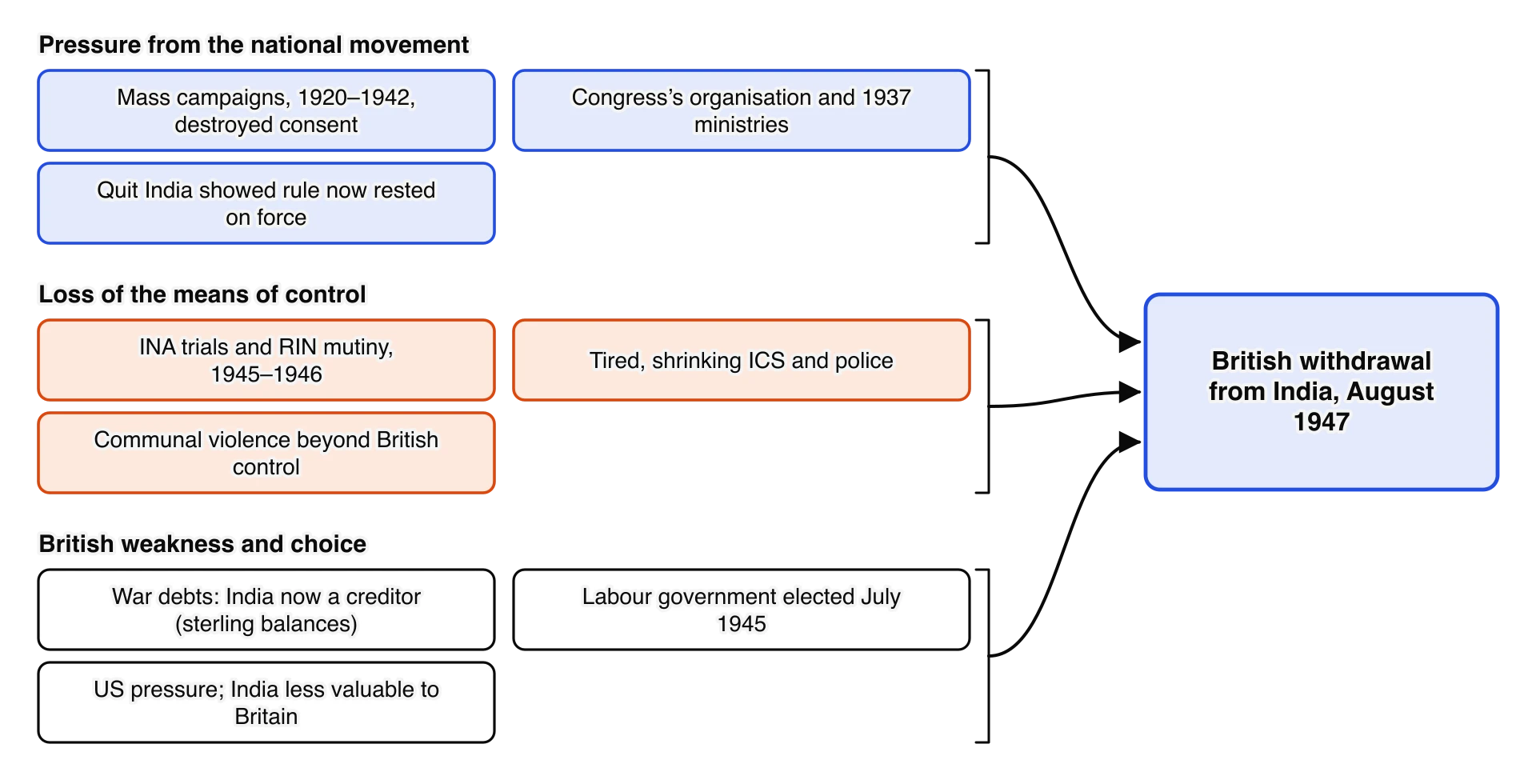
Why did Britain leave in 1947?
The diagram of the causes of British withdrawal groups them into three kinds. Indian nationalist historians stress the national movement, which after 1920 made India ungovernable without the cooperation of Congress. Imperial historians such as John Darwin and R. J. Moore stress British weakness after 1945 and the calculation that India was no longer worth its cost: B. R. Tomlinson shows that India's economic value to Britain had declined since the 1920s, and by 1945 Britain owed India money. Historians of the army and of popular politics, such as Sumit Sarkar, stress the collapse of the means of control in 1945–1946.
These explanations fit together better than they first appear. By 1945 the British still had the will to decide when to leave, but they no longer had the means to stay against Indian opposition: Wavell told London in 1946 that Britain could not hold India by force without large reinforcements that it could not afford to send. The national movement had created that opposition over twenty-five years; the war had destroyed the resources to resist it; and the Labour government chose to leave quickly and on good terms rather than fight. A strong argument identifies which factor made withdrawal unavoidable and which determined its timing.
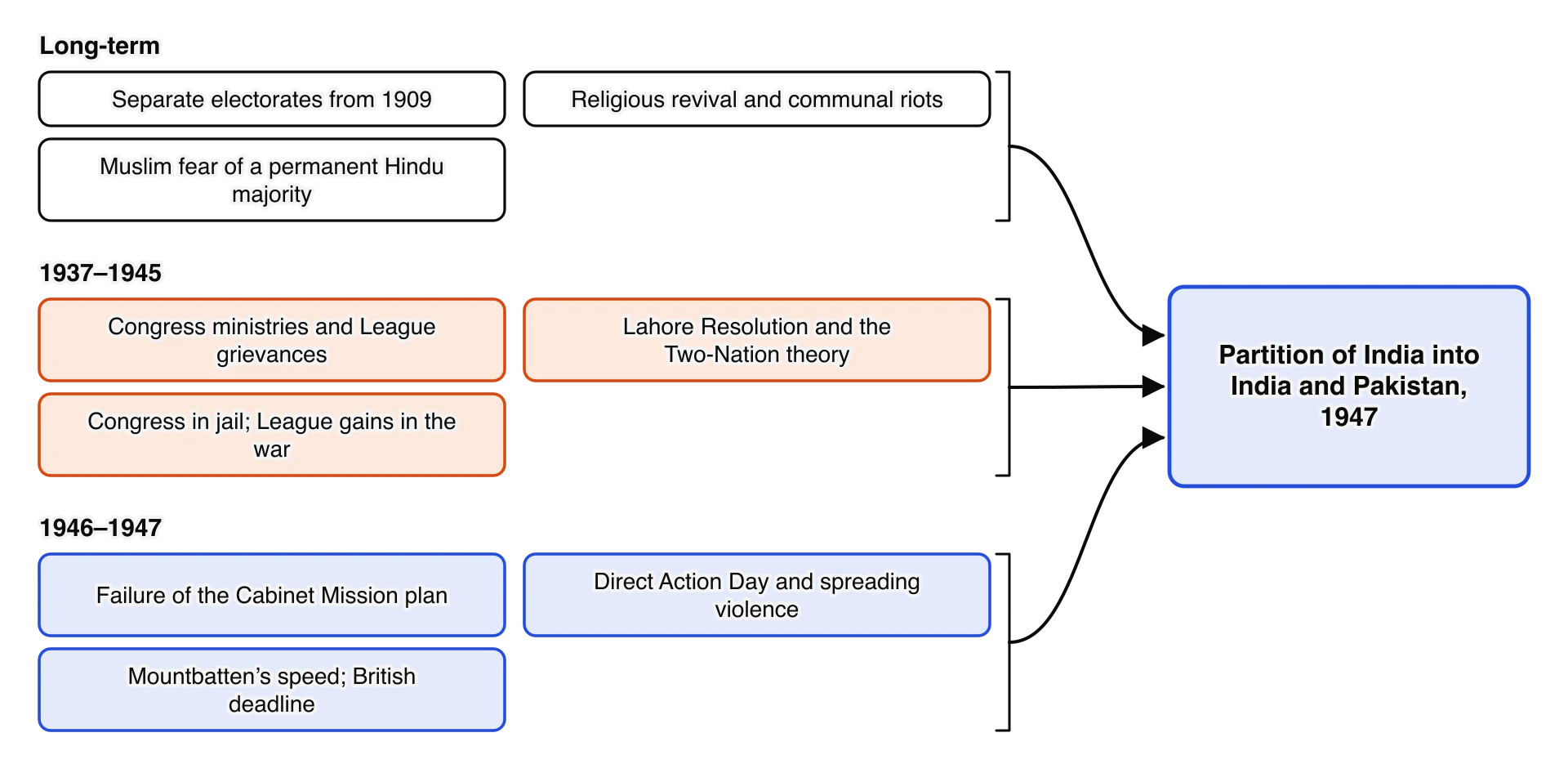
Why was India partitioned?
The diagram of the causes of Partition groups them by period. Long-term causes made religion a political category: separate electorates from 1909, religious revival on both sides, communal riots and the fear among many Muslims of permanent rule by a Hindu majority. Between 1937 and 1945 the Congress ministries, the Lahore Resolution and Congress's absence in prison during the war allowed the League to become a mass party. In 1946–1947 the failure of the Cabinet Mission plan, the violence that followed Direct Action Day and the speed of the British withdrawal made a negotiated, united India seem impossible to Congress, League and British leaders alike.
Responsibility is one of the most contested questions in modern South Asian history, and it is bound up with national identity in India and Pakistan. Most historians now agree that Partition was not inevitable until late 1946 or early 1947, and that no leader in 1947 expected the scale of violence that followed.
The role of Mountbatten
Mountbatten's role is judged very differently. Admirers, including his official biographer Philip Ziegler (Mountbatten, 1985), argue that he understood that British authority was collapsing, that delay would have meant more violence, and that his speed and charm won agreement from Nehru and Jinnah and kept both dominions in the Commonwealth. Critics, such as Andrew Roberts in Eminent Churchillians (1994), argue that bringing the date forward by ten months left no time to prepare the boundary or protect the Punjab, that the delay in publishing the Radcliffe award was irresponsible, and that his closeness to Nehru, and his wife Edwina's friendship with him, made him partial to India, for example over Kashmir. Most historians judge that the decisions for partition were made before he arrived, but that the speed and manner of the British exit worsened the violence.
Partition: migration and violence
Independence was celebrated in Delhi and Karachi as communities in Punjab were already fleeing and fighting. At midnight on 14–15 August Nehru spoke to the Constituent Assembly in Delhi.
Long years ago we made a tryst with destiny, and now the time comes when we shall redeem our pledge, not wholly or in full measure, but very substantially. At the stroke of the midnight hour, when the world sleeps, India will awake to life and freedom. A moment comes, which comes but rarely in history, when we step out from the old to the new, when an age ends, and when the soul of a nation, long suppressed, finds utterance.
Jawaharlal Nehru, speech to the Constituent Assembly of India, New Delhi, 14–15 August 1947. Nehru wrote for the Assembly, the radio audience and posterity, and the speech presents independence as the fulfilment of a single national story. Its phrase "not wholly or in full measure" is a rare acknowledgement of loss; the speech says nothing directly about the division of the country or the killing then under way in Punjab, which shows how leaders chose to frame the moment.
Three days earlier Jinnah had addressed Pakistan's Constituent Assembly in Karachi, and his words are still argued over by Pakistanis who want a secular state and those who want an Islamic one.
You are free; you are free to go to your temples, you are free to go to your mosques or to any other place of worship in this State of Pakistan. You may belong to any religion or caste or creed — that has nothing to do with the business of the State.
Muhammad Ali Jinnah, presidential address to the Constituent Assembly of Pakistan, Karachi, 11 August 1947. Jinnah spoke as the founder of a state created in the name of Muslims, and he was trying to reassure the millions of Hindus and Sikhs who remained in it, and perhaps India's Muslims too. The speech seems to contradict the Two-Nation theory; it shows that for Jinnah, Pakistan was a homeland for Muslims, not necessarily a religious state, a distinction that later Pakistani governments did not always keep.
The scale of the violence
Violence in Punjab, which had begun in Rawalpindi in March 1947, became a war of communities in August and September. Armed bands of Sikhs (jathas), Hindus and Muslims, often led by demobilised soldiers and supported by local officials and princely rulers, attacked villages and refugee columns to drive out the other community. Trains crossing the border were stopped and their passengers killed. The Punjab Boundary Force of about 50,000 troops, set up to keep order, was too small for an area of 17,000 villages and was disbanded on 1 September. In Delhi in September 1947 several thousand Muslims were killed, and tens of thousands sheltered in camps in the Purana Qila and Humayun's tomb.
The number of deaths is unknown and fiercely contested. Contemporary British estimates were about 200,000; Indian and Pakistani estimates and later scholars range up to 2 million, and many historians give a figure of between 500,000 and 1 million. The difficulty comes from the breakdown of record-keeping, the movement of whole populations and the political use of the figures by both states. Between about 10 and 20 million people were displaced; the figure most often cited is about 14–15 million, which made Partition one of the largest forced migrations of the twentieth century.
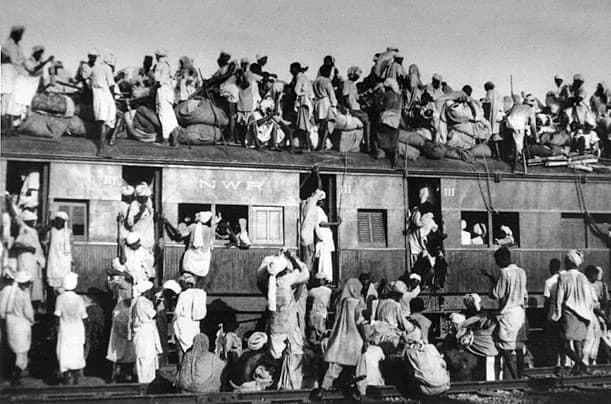
Photographs such as the refugee train were published in newspapers in India, Pakistan and abroad, and they shaped how the world saw Partition. The census of 1951 gives a more systematic picture of the movement.
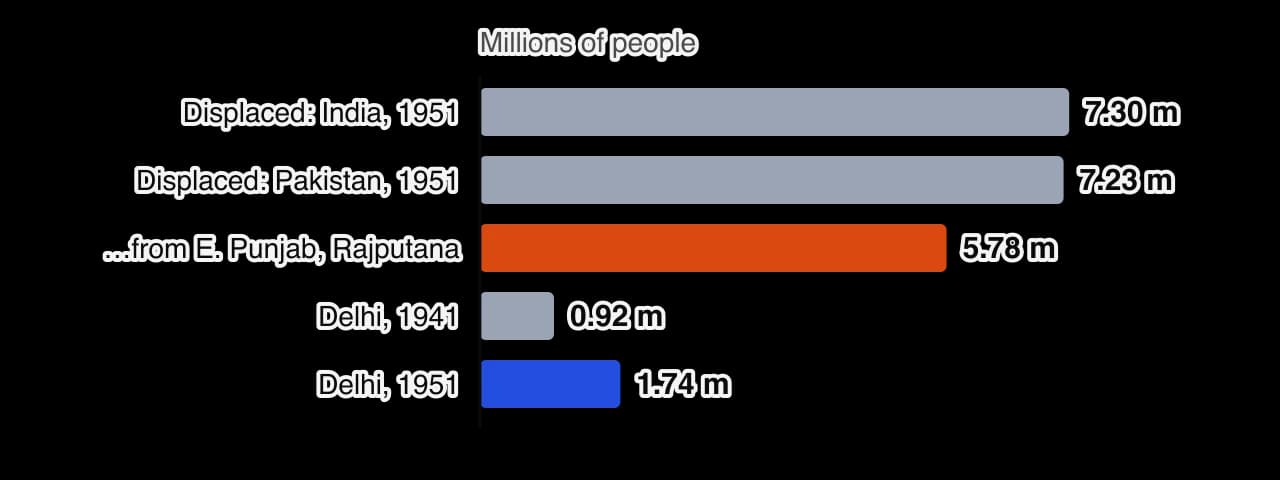
The bar chart of the census figures of 1951 shows the scale of the movement. Punjab, divided down the middle, saw a rapid, almost complete exchange of population within a few months: Hindus and Sikhs left West Punjab and Muslims left East Punjab. Bengal's partition produced a slower, longer migration, as Hindus left East Pakistan in waves after riots in 1950 and later, while many Muslims stayed in West Bengal. Delhi almost doubled in size, and new refugee towns, such as Faridabad and Ulhasnagar in India, were built for the newcomers. A study of the censuses by the economists Prashant Bharadwaj, Asim Khwaja and Atif Mian (2008) estimated that about 1.3 million Muslims who left the Indian side of the Punjab region did not appear in Pakistan's census, one indicator of the death toll.
Leaders tried, with limited success, to stop the killing. Gandhi spent independence day in Calcutta, where his fast in September 1947 helped end riots in the city; Mountbatten called him a "one-man boundary force". In January 1948 he fasted in Delhi for communal peace, and the Indian government ended the fast partly by paying Pakistan its share of the cash balances of undivided India, 550 million rupees, which it had withheld because of the war in Kashmir. Nathuram Godse, who had links with the RSS and the Hindu Mahasabha, shot him on 30 January 1948. The government banned the RSS until 1949, and Gandhi's death helped end the worst communal violence in northern India.
 YouTube
Experiences of women
Women suffered in particular ways, because each community treated women's bodies as symbols of its honour. Tens of thousands of women were abducted, raped, forcibly converted and married by men of the other community; the governments' estimates, made for their recovery programmes, were about 50,000 Muslim women in India and about 33,000 Hindu and Sikh women in Pakistan, and many historians think the true figure was higher, perhaps 75,000–100,000. Other women were killed by their own families, or killed themselves, to avoid capture. In the village of Thoa Khalsa in the Rawalpindi district in March 1947, about ninety Sikh women jumped into a well; such deaths were later honoured in their communities as martyrdom, which made it hard to ask whether they had been chosen freely.
In December 1947 the two governments agreed to recover abducted women and return them to their families, and India's Abducted Persons (Recovery and Restoration) Act of 1949 gave the police power to remove women from their new homes. By the mid-1950s about 30,000 women had been "recovered". Social workers led by Mridula Sarabhai ran the programme, but many women did not wish to return to families who might reject them, or to leave children born after abduction, and the state decided for them. The oral histories collected by Urvashi Butalia in The Other Side of Silence (1998) and by Ritu Menon and Kamla Bhasin in Borders and Boundaries (1998) brought these experiences into history for the first time, fifty years later.
Partition also changed women's lives in less violent ways. Refugee women who had lost husbands and fathers had to earn a living; many entered paid work, schools and offices for the first time, especially in Delhi and Lahore. In Pakistan Fatima Jinnah and the All-Pakistan Women's Association, and in India women social workers and politicians, became prominent through refugee relief.
Experiences of different communities
Sikhs lost more, in proportion, than any other community. Punjab was their homeland, and the Radcliffe Line left a large part of the community, many of their richest canal-colony lands and the birthplace of Guru Nanak at Nankana Sahib in Pakistan. Almost all Sikhs in West Punjab moved to India, and Sikh leaders such as Master Tara Singh later campaigned for a Punjabi-speaking state in which Sikhs would be the majority.
Muslims of north India faced a choice. Many from Punjab, Delhi and the United Provinces went to Pakistan, where the muhajirs became a powerful, Urdu-speaking group in Karachi and Sindh, but tens of millions stayed in India, where some were suspected of disloyalty. Hindus and Sikhs of Sindh left in large numbers for Bombay and Gujarat, losing a homeland with no Indian province to return to. Bengali Hindus from East Pakistan migrated over many years and received less help than Punjabi refugees, settling in camps and colonies around Calcutta and, later, in the Andaman Islands and central India.
Dalit and lower-caste refugees often fared worst in resettlement; Ambedkar complained that Dalits in Pakistan were prevented from leaving because they were needed as labourers. Christian, Parsi and Anglo-Indian minorities, and tribal peoples such as those of the Chittagong Hill Tracts, which Radcliffe awarded to East Pakistan although most of the people were Buddhist, found that a partition designed around Hindus and Muslims took little account of them.
The governments of India and Pakistan spent their first years resettling refugees: India built camps such as Kurukshetra (now in Haryana), which held about 300,000 people, distributed evacuee property and created new towns, while Pakistan made Karachi, swollen by refugees, its first capital. Partition left a legacy of mistrust between the two states, the unresolved question of Kashmir, and memories that both national histories long preferred to leave out.
Integration of the princely states
The Indian Independence Act ended British paramountcy over the princely states on 15 August 1947 without passing it to either dominion. In law, the rulers of about 565 states, covering about two-fifths of the subcontinent and a quarter of its people, could join India or Pakistan or try to stay independent. Mountbatten advised them to join the dominion to which their geography and population tied them.
The task fell to Vallabhbhai Patel, deputy prime minister and minister for the states, and his secretary V. P. Menon. They offered the rulers an Instrument of Accession that surrendered only defence, external affairs and communications to India, together with generous privy purses (annual payments) and the right to keep their titles and palaces. Patriotic appeals, the pressure of popular movements in the states and the threat that India would not protect rulers who stayed out persuaded almost all of the states within India's borders to accede by 15 August. In 1948–1949 Patel and Menon went further and persuaded the rulers to merge their states into provinces or new unions, such as Rajasthan, so that by 1950 the princely states had disappeared as political units. Three cases did not fit the pattern.
Junagadh | Hyderabad | Jammu and Kashmir | |
|---|---|---|---|
Ruler and people | Muslim nawab; about 80 per cent Hindu population | Muslim nizam, Osman Ali Khan; about 85 per cent Hindu population | Hindu maharaja, Hari Singh; about 77 per cent Muslim population |
Geography | On the Kathiawar coast, surrounded by Indian territory; Pakistan only by sea | Large state in the Deccan, entirely surrounded by India | Bordered both India and Pakistan, and China |
What the ruler did | Acceded to Pakistan (announced 15 Aug 1947; accepted by Pakistan in September) | Sought independence; signed a Standstill Agreement with India (Nov 1947) | Delayed; signed a standstill agreement with Pakistan only |
What happened | Indian blockade; nawab fled to Pakistan; Indian administration from 9 Nov 1947; plebiscite of Feb 1948 voted almost unanimously for India | Razakar militia attacked opponents; Indian army invaded in Operation Polo, 13–17 Sep 1948; violence killed tens of thousands | Revolt in Poonch; Pashtun tribal invasion (22 Oct 1947); maharaja acceded to India (26 Oct); war with Pakistan until 1 Jan 1949 |
Principle India used | The will of the people (a plebiscite) | Geography and the will of the people | The ruler's accession, with a promised plebiscite |
The table comparing the three states shows that India used different principles in each: the people's wishes against a Muslim ruler in Junagadh and Hyderabad, and the ruler's accession against a Muslim majority in Kashmir. Pakistan argued the reverse in each case. Each side's inconsistency left a legacy of grievance.
Hyderabad
Hyderabad was the largest and richest princely state, with about 16 million people. Its ruler, the Nizam, wanted independence, and his government came under the influence of the Razakars, a militia of the Muslim political party Majlis-e-Ittehadul Muslimeen led by Qasim Razvi, which attacked Hindu villagers and opponents of the Nizam. At the same time, in the Telangana region, a communist-led peasant rising (1946–1951) took over thousands of villages from their landlords. After a year of failed negotiations, Indian troops invaded on 13 September 1948 in what the government called a "police action", Operation Polo; the Nizam's forces surrendered within five days. In the violence that followed, Muslims were killed in large numbers by Hindu mobs and some Indian troops. A government inquiry, the Sunderlal Committee, estimated 27,000–40,000 deaths; its report was kept secret until 2013, and some estimates are higher.
Kashmir
Maharaja Hari Singh of Jammu and Kashmir hoped to remain independent. In the autumn of 1947 Muslims in Poonch rebelled against his rule, and on 22 October thousands of armed Pashtun tribesmen from Pakistan's North-West Frontier Province, supported by Pakistani officials, invaded the state and advanced towards Srinagar. The maharaja asked India for help. India insisted on accession first, and the maharaja signed the Instrument of Accession; India dates it to 26 October 1947, though the historian Alastair Lamb has argued that it was signed after Indian troops were already landing on 27 October. Mountbatten accepted the accession on condition that the people's wishes would be tested once order was restored.
The first Indo-Pakistani War of 1947–1948 followed, with Pakistan's regular army joining the fighting in 1948. India took the dispute to the United Nations on 1 January 1948. A UN-arranged ceasefire came into effect on 1 January 1949, leaving India in control of about three-fifths of the state, including the Kashmir valley, and Pakistan in control of the rest. UN resolutions of 1948 and 1949 called for a plebiscite after Pakistani withdrawal and Indian troop reductions, but the two sides never agreed the conditions and it was never held.
Within India, Kashmir received special status under Article 370 of the Constitution, which limited the central government's powers to defence, foreign affairs and communications unless the state agreed. Sheikh Abdullah, the popular leader of the National Conference, became prime minister of the state but was dismissed and arrested in 1953 when he appeared to favour independence, and was held almost continuously until 1964. Kashmir became the most lasting conflict between India and Pakistan, and the cause of further wars in 1965 and later.
The French and Portuguese territories
Small European enclaves remained on India's coasts. France transferred Chandernagore in 1950–1951 and Pondicherry and its other settlements in 1954. Portugal's dictator Salazar refused to negotiate over Goa, Daman and Diu, arguing that they were provinces of Portugal. After years of failed diplomacy and non-violent protest marches that Portuguese police met with fire, Nehru sent the army into Goa on 18 December 1961 (Operation Vijay), and the Portuguese surrendered the next day. Western governments criticised the use of force by the leading advocate of peaceful methods; in India and much of Asia and Africa the annexation was welcomed as the end of colonial rule.
Nehru and nation-building, 1947–1964
Nehru was prime minister from 15 August 1947 until his death on 27 May 1964. He faced the task of turning a country divided by Partition, by caste, language and religion, by princely and British territories, and by extreme poverty into a single democratic state. His closest colleague and rival, Patel, ran the home ministry and the integration of the states until his death in December 1950, after which Nehru dominated both Congress and the government.
A democratic, secular and federal constitution
The Constituent Assembly, elected by the provincial assemblies in 1946, drafted the Constitution of India, with B. R. Ambedkar as chair of its drafting committee. Adopted on 26 November 1949, it came into force on 26 January 1950, when India became a republic. It created a parliamentary democracy with universal adult suffrage, a federal system with a strong centre (the centre could reorganise states and take over a state government in an emergency), fundamental rights enforceable by the courts, the abolition of untouchability and reserved seats and jobs for the Scheduled Castes and Scheduled Tribes. India was secular in the sense that the state had no official religion and treated all religions equally; separate electorates were abolished.
India held its first general election between October 1951 and February 1952. About 173 million people, most of them unable to read, were registered to vote, and parties were given symbols so that illiterate voters could recognise them. Congress won 364 of the 489 seats in the Lok Sabha (the lower house of Parliament).
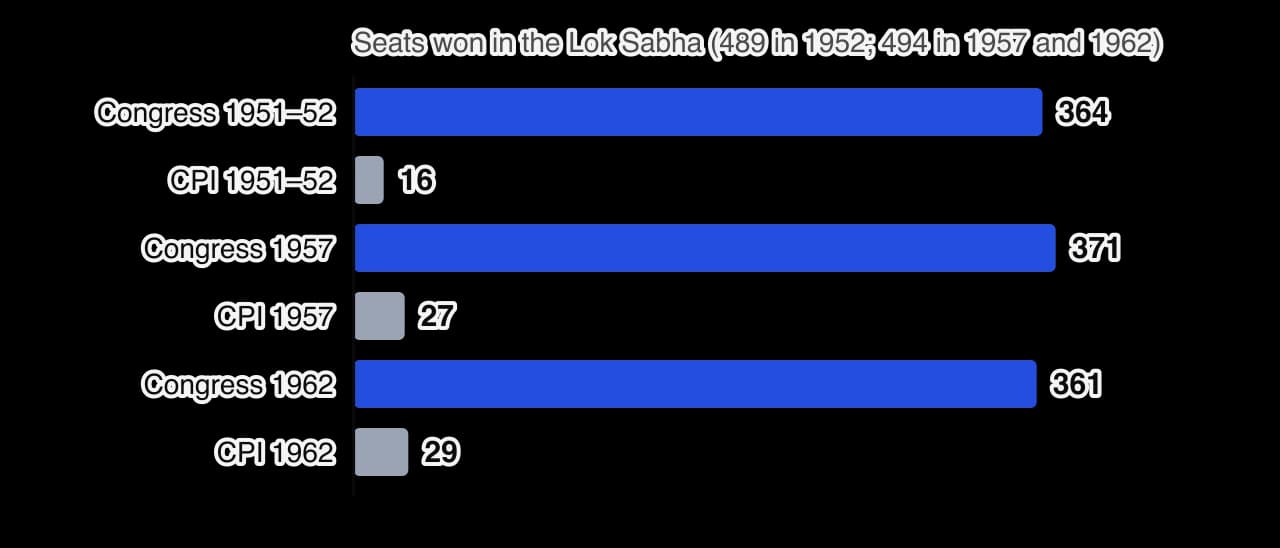
The bar chart of the first three general elections shows Congress's dominance under Nehru. Political scientists call this the "Congress system": Congress was a broad coalition of regional leaders, landowners, business and professionals that absorbed most opposition from within, while small parties of the left (the Communists and Socialists) and the right (the Hindu nationalist Jana Sangh, founded in 1951, and the free-market Swatantra Party, 1959) competed at the edges. In 1957 Kerala elected a Communist government, the first in India; Nehru's government dismissed it in 1959 using the emergency powers of the Constitution, which critics saw as an abuse of central power.
Planning and the mixed economy
Nehru believed that India could escape poverty only through rapid industrialisation directed by the state, an idea shaped by Fabian socialism and by the Soviet five-year plans. The Planning Commission, set up in 1950 with Nehru as its chairman, drew up a series of five-year plans. The First Plan (1951–1956) concentrated on agriculture, irrigation and recovery from Partition. The Second Plan (1956–1961), designed by the statistician P. C. Mahalanobis, gave priority to heavy industry: three state steel plants were built at Bhilai, Rourkela and Durgapur, with Soviet, West German and British help. The Industrial Policy Resolution of 1956 reserved key industries for the state and controlled private industry through licences.
Large irrigation and power projects, such as the Bhakra–Nangal dam in Punjab, which Nehru described as one of the new temples of India, were symbols of this vision. So were the Atomic Energy Commission (1948) and the first Indian Institute of Technology at Kharagpur (1951). Industrial output grew by about 7 per cent a year between 1951 and 1965, and the economy as a whole by about 3.5–4 per cent, much faster than under British rule, though barely twice the rate of population growth.
Agriculture lagged. The zamindari system of large landlords collecting rent was abolished by state laws in the early 1950s, which removed the great intermediaries but generally benefited tenants with secure rights more than landless labourers; laws limiting the size of landholdings were widely evaded. The Community Development Programme (1952) and elected village councils (panchayati raj, from 1959) aimed to modernise village life with mixed results. By the early 1960s India depended on American wheat supplied under the PL-480 programme, a sign that planning had not solved the food problem.
Social reform
Nehru also pushed through the Hindu Code Bills, a set of laws of 1955–1956 that reformed Hindu family law. The Hindu Marriage Act (1955) made monogamy compulsory and allowed divorce; the Hindu Succession Act (1956) gave daughters a share of their father's property. Conservative Hindus, including the President, Rajendra Prasad, opposed them, and Ambedkar resigned as law minister in 1951 when the first, more ambitious version was delayed. Muslim personal law was left unreformed, which secularists criticised and Hindu nationalists called discrimination. Reservations brought Dalits into universities and government service, but caste discrimination in everyday life continued.
How successful was Nehru at home?
Area | Achievements by 1964 | Failures and limits |
|---|---|---|
Democracy | Three free general elections; independent courts and press; civilian control of the army | Congress dominance; dismissal of Kerala's Communist government (1959); detention of Sheikh Abdullah |
Unity | Integration of the princely states; linguistic states reorganised peacefully in most areas | Kashmir unresolved; Naga insurgency; language riots |
Economy | Heavy industry, dams, steel, science institutions; growth faster than under British rule | Slow agricultural growth; food imports; licensing bureaucracy; widespread poverty |
Society | Untouchability abolished in law; Hindu Code Bills; reservations | Land reform limited; caste and gender inequality persisted; adult literacy about 28 per cent in 1961 |
The table of Nehru's record shows why historians judge him so differently. Ramachandra Guha, in India After Gandhi (2007), stresses that India stayed united and democratic against the predictions of many observers, while most new states of the period fell to dictatorship. Economists such as Jagdish Bhagwati and Padma Desai, in India: Planning for Industrialization (1970), argued that controls and licences wasted resources and held back growth. Both perspectives accept that Nehru's state laid foundations, in democracy, science and heavy industry, that later governments built on.
Ethnic and religious conflict after independence
Communal tension and the minorities
Partition left India with about 35 million Muslims, about one-tenth of the population, many of them poorer and less educated than before because the professional and landowning classes had gone to Pakistan. Nehru insisted that India was a state for all its citizens, and the murder of Gandhi discredited Hindu nationalism for a time: the RSS was banned from February 1948 to July 1949. Communal riots continued on a smaller scale, and the relationship between Hindus and Muslims was strained by every crisis with Pakistan, such as the anti-Hindu riots in East Pakistan and anti-Muslim riots in West Bengal in 1950, which were eased by the Nehru–Liaquat Pact on the protection of minorities (April 1950).
Language and the reorganisation of states
The most serious conflicts of the 1950s were over language. Congress had promised before independence to organise provinces by language, but after Partition Nehru feared that linguistic states would encourage separatism. In the Telugu-speaking areas of Madras state, the Gandhian activist Potti Sriramulu fasted for a separate Andhra state and died on 15 December 1952; riots followed, and the government created Andhra State in October 1953.
A States Reorganisation Commission recommended redrawing the map, and the States Reorganisation Act 1956 created 14 states and 6 union territories, mostly on linguistic lines. Bombay state remained bilingual until a mass movement for a Marathi-speaking state, the Samyukta Maharashtra movement, in which police firing killed dozens in 1956, led to its division into Maharashtra and Gujarat in May 1960. Punjab was not divided until 1966, after Sikh leaders' campaign for a Punjabi-speaking state (Punjabi Suba), which the government suspected of religious separatism.
Language also divided north and south. The Constitution made Hindi in the Devanagari script the official language, with English to continue for fifteen years, until 1965. In Madras the Dravidian movement, led by C. N. Annadurai's Dravida Munnetra Kazhagam (DMK), opposed Hindi as a form of northern domination; Nehru promised in 1959 that English would remain an associate language as long as non-Hindi speakers wanted it. The violent anti-Hindi riots of January 1965 came after his death.
The north-east
In the hills of the north-east, the Naga peoples, many of them Christian and with no historic connection to Indian nationalism, demanded independence under A. Z. Phizo of the Naga National Council, which declared independence in 1947. From 1955 a guerrilla war followed, and the Indian army fought a counter-insurgency campaign that included the burning of villages. In 1963 the government created the state of Nagaland within India, which satisfied some Nagas but not the armed movement. The conflict showed the limits of Nehru's nation-building among peoples who had never been part of the national movement.
Foreign policy and cross-border conflicts
Non-alignment
Nehru was his own foreign minister throughout his time in office. His central idea was non-alignment: India would join neither the American-led nor the Soviet-led bloc in the Cold War, would judge each issue on its merits, and would work with other new states of Asia and Africa for decolonisation, disarmament and peace. Non-alignment protected India's newly won independence, allowed it to take aid from both sides (the Soviet Union built the Bhilai steel plant, the United States supplied food) and gave a poor country influence beyond its military strength.
India stayed in the Commonwealth even after becoming a republic: under the London Declaration of April 1949, the Commonwealth accepted that a republic could be a member and recognise the British monarch only as its symbolic head. Nehru played a mediating role in the Korean War, and India chaired the Neutral Nations Repatriation Commission that handled prisoners of war after the armistice of 1953. With Zhou Enlai, Sukarno and Nasser he was a leading figure at the Bandung Conference of Asian and African states in April 1955, and with Tito, Nasser and Sukarno he helped found the Non-Aligned Movement at Belgrade in 1961.
Critics, then and since, pointed to inconsistencies. Nehru condemned the Anglo-French invasion of Egypt in 1956 strongly but criticised the Soviet invasion of Hungary in the same weeks only mildly and late, because India valued Soviet support over Kashmir. Western governments saw non-alignment as leaning to the Soviet side; Indian defenders argued that it reflected India's anti-colonial experience.
Pakistan
Relations with Pakistan were shaped by Partition and above all by Kashmir. Besides the war of 1947–1948, the two states quarrelled over refugee property, the division of assets and the waters of the Indus, whose rivers flowed through Indian Punjab and Kashmir into Pakistan. After years of negotiation brokered by the World Bank, Nehru and Pakistan's military ruler, Ayub Khan, signed the Indus Waters Treaty in Karachi in September 1960, which gave the three eastern rivers to India and the three western rivers mainly to Pakistan. It is one of the few India–Pakistan agreements that lasted through later wars. Pakistan's alliance with the United States from 1954, through the South-East Asia Treaty Organization and the Baghdad Pact, brought American arms to India's border and pushed India closer to the Soviet Union, which from 1955 supported India's position on Kashmir.
China and the war of 1962
Nehru hoped that India and China, the two great Asian states, could lead Asia together. India recognised the People's Republic in 1949 and accepted Chinese rule in Tibet when China occupied it in 1950. In the Panchsheel agreement of 29 April 1954, which regulated trade with Tibet, the two states set out five principles of peaceful coexistence: mutual respect for territory and sovereignty, non-aggression, non-interference, equality and mutual benefit, and peaceful coexistence. The slogan Hindi–Chini bhai bhai ("Indians and Chinese are brothers") became popular.
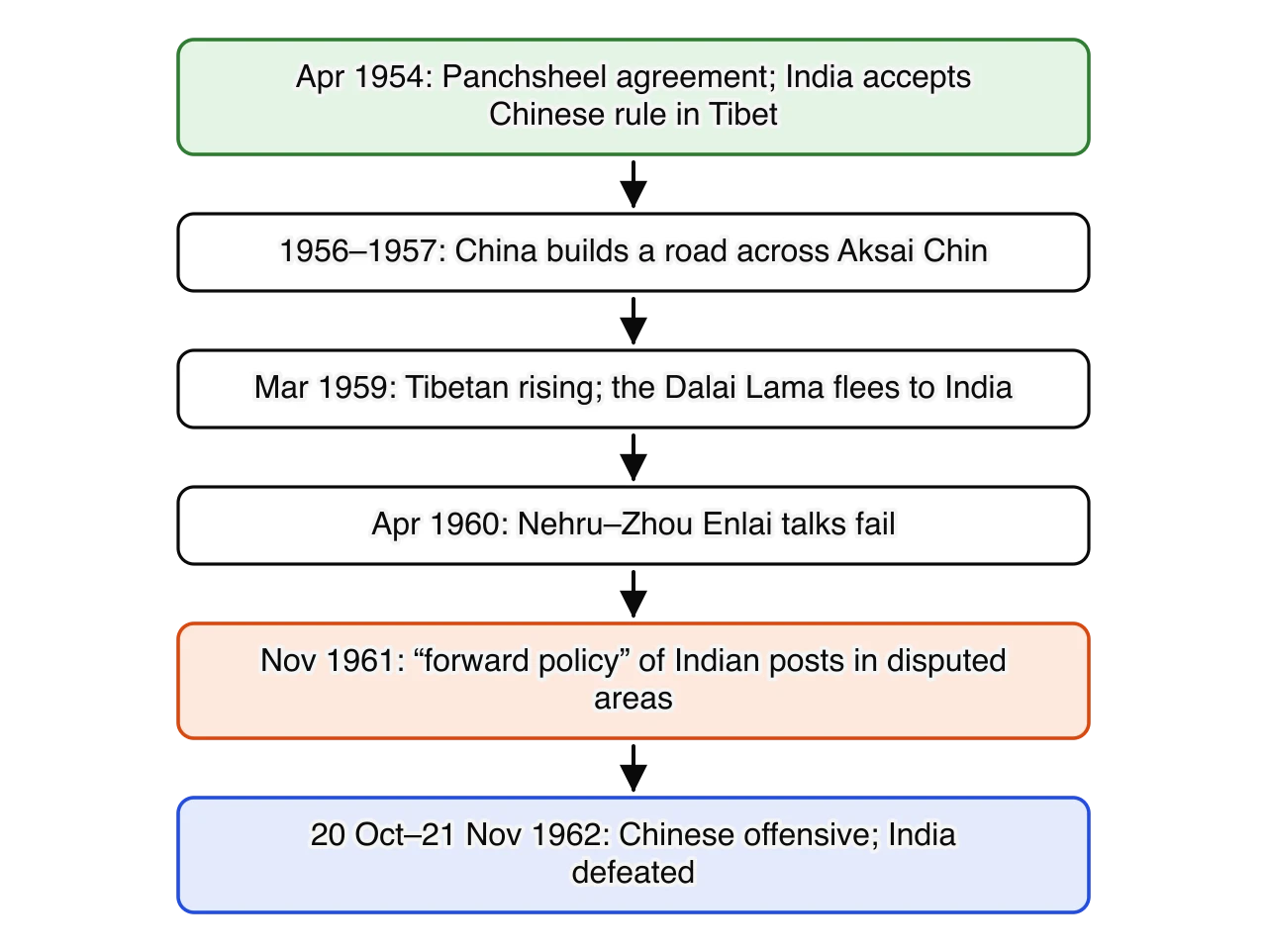
The chain of events from 1954 to 1962 shows how friendship broke down over the border, which had never been agreed. In the west, India claimed the high plateau of Aksai Chin, through which China built a road linking Xinjiang and Tibet in 1956–1957; India discovered the road only in 1957–1958. In the east, India held the McMahon Line, agreed by British and Tibetan representatives at Simla in 1914, which China had never accepted. After the Dalai Lama fled to India during the Tibetan rising of March 1959 and armed clashes followed, Zhou Enlai visited Delhi in April 1960 and appeared to suggest that China would accept the McMahon Line if India accepted Chinese control of Aksai Chin. Nehru refused, partly because Indian opinion and Parliament would not accept giving up territory.
From late 1961 India followed a "forward policy" of setting up small military posts in disputed areas, assuming that China would not fight. On 20 October 1962 Chinese forces attacked in both sectors. In the North-East Frontier Agency they broke through Indian positions and advanced close to the plains of Assam; in Ladakh they took the areas China claimed. On 21 November China declared a unilateral ceasefire and withdrew in the east to positions 20 kilometres behind the line of actual control, while keeping Aksai Chin. Indian official figures gave about 1,400 killed, 1,700 missing and nearly 4,000 captured.
The defeat was a humiliation for Nehru. The defence minister, V. K. Krishna Menon, resigned in November 1962. Nehru appealed to the United States and Britain for military help, which they gave, a sharp departure from non-alignment, and India began a large rearmament programme. The war damaged Nehru's health and reputation in his last eighteen months. The journalist Neville Maxwell, in India's China War (1970), blamed the forward policy and Nehru's refusal to negotiate, a view accepted by many in China and the West; Indian historians such as Srinath Raghavan, in War and Peace in Modern India (2010), present a more careful account in which Nehru tried to balance negotiation and firmness under strong domestic pressure but misjudged China's response.
Perspectives and debates
Indian independence is written about by historians in India, Pakistan, Bangladesh and Britain, each with a national story at stake, so perspectives differ sharply. Five debates matter most.
Elite politics or national movement?
The Cambridge School of historians, beginning with Anil Seal's The Emergence of Indian Nationalism (1968) and the essays in Locality, Province and Nation (1973), edited by John Gallagher, Gordon Johnson and Seal, argued that Indian politics was driven by local and provincial elites competing for the jobs, seats and patronage that British reforms made available. Nationalism was the language these groups used, not the cause of their actions. Nationalist and Marxist historians, led by Bipan Chandra, replied that this ignored the real exploitation of India and the ideals that moved millions. From 1982 the Subaltern Studies group, founded by Ranajit Guha, argued that both schools wrote history from the top: peasants, workers and tribal people acted on their own understanding, as Shahid Amin's study of Chauri Chaura shows. Partha Chatterjee, in Nationalist Thought and the Colonial World (1986), argued that Indian nationalism borrowed its idea of the nation-state from colonial thought even while opposing colonial rule.
How important was Gandhi?
Nationalist historians and Gandhi's biographers present him as the maker of the mass movement. Judith Brown, in Gandhi's Rise to Power (1972) and Gandhi and Civil Disobedience (1977), shows that he rose through networks of local "sub-contractors" who brought their own followers and interests, and that his campaigns often failed in their immediate aims. Ambedkar's critique from the perspective of the untouchables, and Muslim criticism of his religious politics, show that his inclusive nationalism did not look inclusive to all. Ramachandra Guha's two-volume biography (2013, 2018) restores his central role while recording these limits.
Why did Britain leave?
Some British accounts, from Attlee's own memoirs onwards, presented independence as the planned fulfilment of a policy of preparing India for self-government. Nationalist historians see it as a victory won by the national movement. R. J. Moore, in Escape from Empire (1983), shows the Attlee government seeking an exit that would protect British strategic and economic interests; John Darwin, in Britain and Decolonisation (1988), places India in the general weakening of British power after 1945; and B. R. Tomlinson, in The Political Economy of the Raj (1979), argues that India had become less valuable to Britain economically since the 1920s. Sumit Sarkar and Sugata Bose stress the upheavals of 1945–1946, the INA trials and the naval mutiny, which destroyed confidence in the loyalty of the forces.
Who was responsible for Partition?
Indian nationalist historians stress the League's separatism, the Two-Nation theory and British divide and rule; Anita Inder Singh, in The Origins of the Partition of India, 1936–1947 (1987), stresses how British wartime policy, such as the August Offer and the Cripps opt-out, built up the League. Pakistani national history presents Partition as the achievement of a Muslim nation led by the Quaid-i-Azam. Ayesha Jalal, in The Sole Spokesman (1985), argued that Jinnah used the Pakistan demand as a bargaining counter to win parity for Muslims within a loose federal India, and that Congress's insistence on a strong centre, by Nehru and Patel, forced a partition that Jinnah had not wanted; the Indian jurist H. M. Seervai, in Partition of India: Legend and Reality (1989), also placed much responsibility on Congress leaders. Venkat Dhulipala, in Creating a New Medina (2015), challenges Jalal by showing that Pakistan was widely and seriously discussed as an Islamic state by League supporters in the United Provinces, not just a bargaining chip.
Social historians shift the focus from leaders to people. Gyanendra Pandey, in Remembering Partition (2001), Yasmin Khan, in The Great Partition (2007), and the oral histories of Butalia, Menon and Bhasin show how violence was organised locally, how the state broke down, and how women and marginalised groups experienced a division planned by men at the top. These approaches do not settle who caused Partition, but they explain why it was so violent.
Nehru's record
Guha and Granville Austin, in The Indian Constitution: Cornerstone of a Nation (1966), see Nehru's great achievement in building a democratic, secular and united India. Critics on the right argue that his socialism held back growth and that his secularism favoured Muslims; critics on the left that he did too little for land reform and the poor; foreign-policy critics, following Maxwell, blame him for the war with China. The debate is still political in India, where Nehru's reputation has risen and fallen with the fortunes of the Congress party.
Debate | Historian or school | Argument | Evidence stressed |
|---|---|---|---|
Origins of nationalism | Anil Seal; the Cambridge School | Elite competition for power created by British reforms | Narrow social base of early Congress; regional rivalries |
Origins of nationalism | Bipan Chandra; Ranajit Guha and Subaltern Studies | A genuine anti-imperialist movement; peasants acted on their own terms | Drain theory, mass campaigns; peasant risings such as Chauri Chaura |
Gandhi | Judith Brown | A skilled politician working through local allies; limited immediate success | Regional networks; outcomes of 1922 and 1931–1934 |
Why Britain left | John Darwin; R. J. Moore; B. R. Tomlinson | British weakness and calculation after 1945 | War debts, sterling balances, Labour policy, India's declining value |
Why Britain left | Sumit Sarkar; Sugata Bose | Popular upheaval and the loss of the army's loyalty | Quit India, INA trials, naval mutiny |
Partition | Ayesha Jalal; H. M. Seervai | Jinnah bargained for parity; Congress centralism made partition | Cabinet Mission plan, Nehru's July 1946 statement |
Partition | Venkat Dhulipala; Anita Inder Singh | Pakistan was a popular religious-political goal; British wartime policy built up the League | League propaganda in the United Provinces; August Offer, Cripps |
Mountbatten |
The table of historians' views shows that most debates set an explanation from above (leaders, governments, elites) against one from below or from structural forces (popular action, economics, the collapse of authority). The strongest arguments use both: the leaders' decisions of 1946–1947 make sense only against the pressure of violence and the weakness of the British state, and the mass campaigns mattered because leaders turned them into bargaining power.
Applying the ideas in exam questions
The questions that follow cover five areas of the study: the emergence of nationalism, methods, Partition, leaders and India after independence. Each has guidance on what a top-band answer does; the question on Partition has a full essay plan.
Paper 3: the emergence of nationalism
Paper 3: methods
Paper 3: Partition
Paper 3: leaders
Paper 3: India after independence
Self-check
- To do:
I can explain how the rebellion of 1857 was remembered and reinterpreted, and how the Raj was governed after 1858.
- To do:
I can explain how British policies between 1858 and 1885 created grievances, using specific examples from Lytton and Ripon.
- To do:
I can explain the role of Western education, the press, the drain theory and religious reform movements in the emergence of nationalism.
- To do:
I can explain the founding and early aims of Congress and the safety-valve debate.
- To do:
I can explain the causes and effects of the partition of Bengal (1905–1911) and the swadeshi movement.
- To do:
I can explain why the Muslim League was founded and the significance of separate electorates in the Morley–Minto reforms.
- To do:
I can explain the impact of the First World War on India, including the Lucknow Pact, Home Rule and the Montagu Declaration.
- To do:
I can describe the Government of India Acts of 1919 and 1935 and judge whether they strengthened or weakened British rule.
- To do:
I can explain the Rowlatt Act and the Jallianwala Bagh massacre, give the range of casualty figures and explain the significance of the massacre.
- To do:
I can explain Gandhi's ideas and compare the aims, methods, support and results of non-cooperation, civil disobedience and Quit India.
- To do:
I can explain the Simon Commission, the Nehru Report, purna swaraj, the Round Table Conferences, the Gandhi–Irwin Pact and the Poona Pact.