Notes on R1.3 The African slave trade (1500–1900)
The African slave trades were the forced movement of millions of Africans to the Americas, North Africa, the Middle East and the islands of the Indian Ocean. They shaped the economies of four continents, transformed African states and societies, and produced one of the first mass humanitarian movements in history, the campaign to abolish the trade.
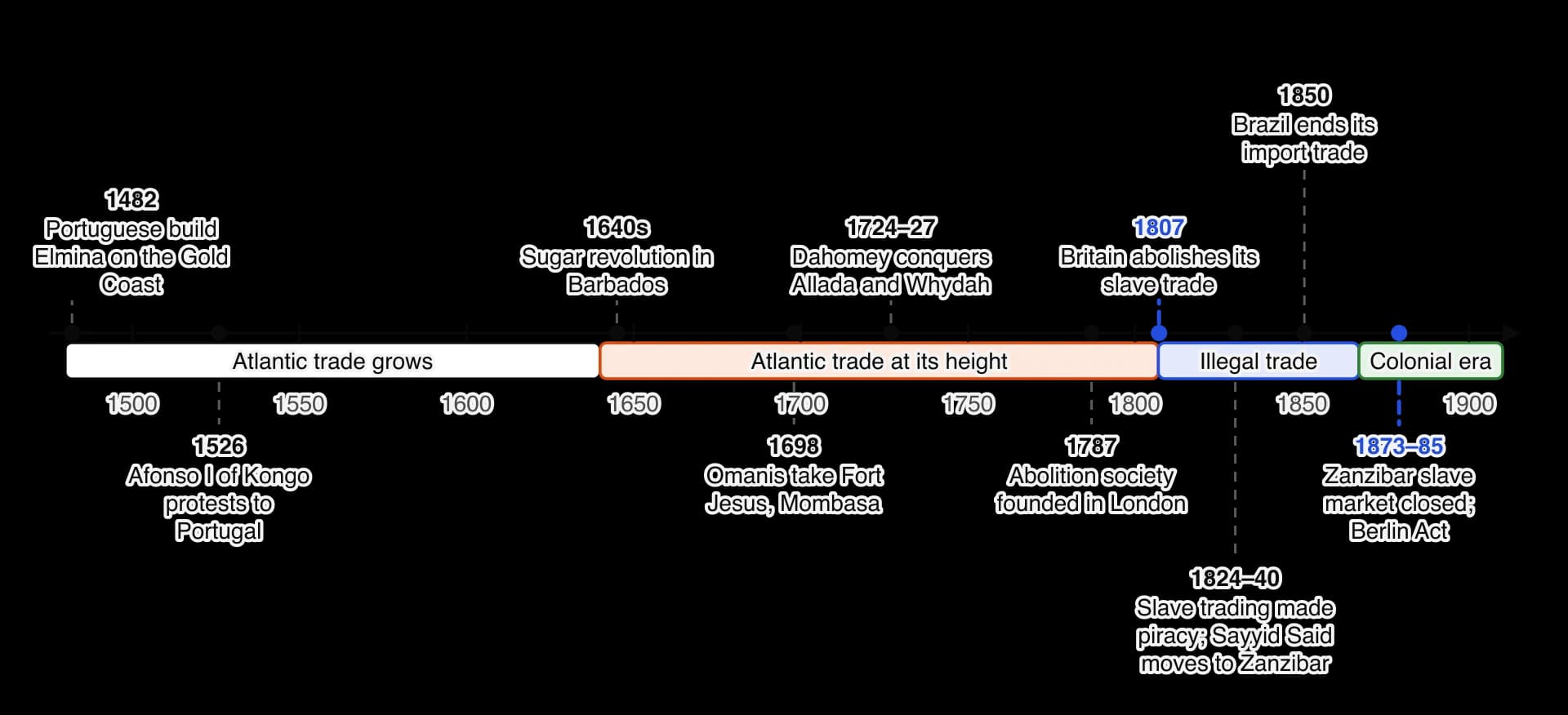
The African slave trades: scale and routes
Four overlapping trades carried enslaved Africans out of the continent. The transatlantic slave trade, which began in the fifteenth century and lasted until the 1860s, took captives from the west coast and West Central Africa to the Americas. Three older trades, often called the "eastern" or "Islamic" trades because most of their buyers were in Muslim societies, ran across the Sahara to North Africa, across the Red Sea to Arabia, and from the Swahili coast of East Africa to Arabia, the Persian Gulf and India.
Slavery existed in many African societies before 1500, as it did in Europe, the Middle East and Asia. Its forms varied. In many West and West Central African states, wealth and power were measured in people more than land, and rulers and lineage heads acquired dependants (wives, clients, pawns and slaves) to farm, fight and build a following. Some enslaved people were gradually absorbed into the owning family over a generation or two; others, especially in the courts and armies of larger states, held positions of trust. This range of practices is one reason historians debate how far African slavery made the Atlantic trade possible.
How many people were taken?
The best estimates for the Atlantic trade come from the Trans-Atlantic Slave Trade Database (SlaveVoyages), which records more than 36,000 individual voyages. Its editors, David Eltis and David Richardson, estimate that about 12.5 million people were embarked in Africa between 1501 and 1866 and about 10.7 million arrived in the Americas. The difference, about 1.8 million people, died during the Middle Passage, the crossing of the Atlantic, which typically took one to three months. Mortality on board averaged about 12 to 15 per cent and fell over time, but it was much higher on some voyages.
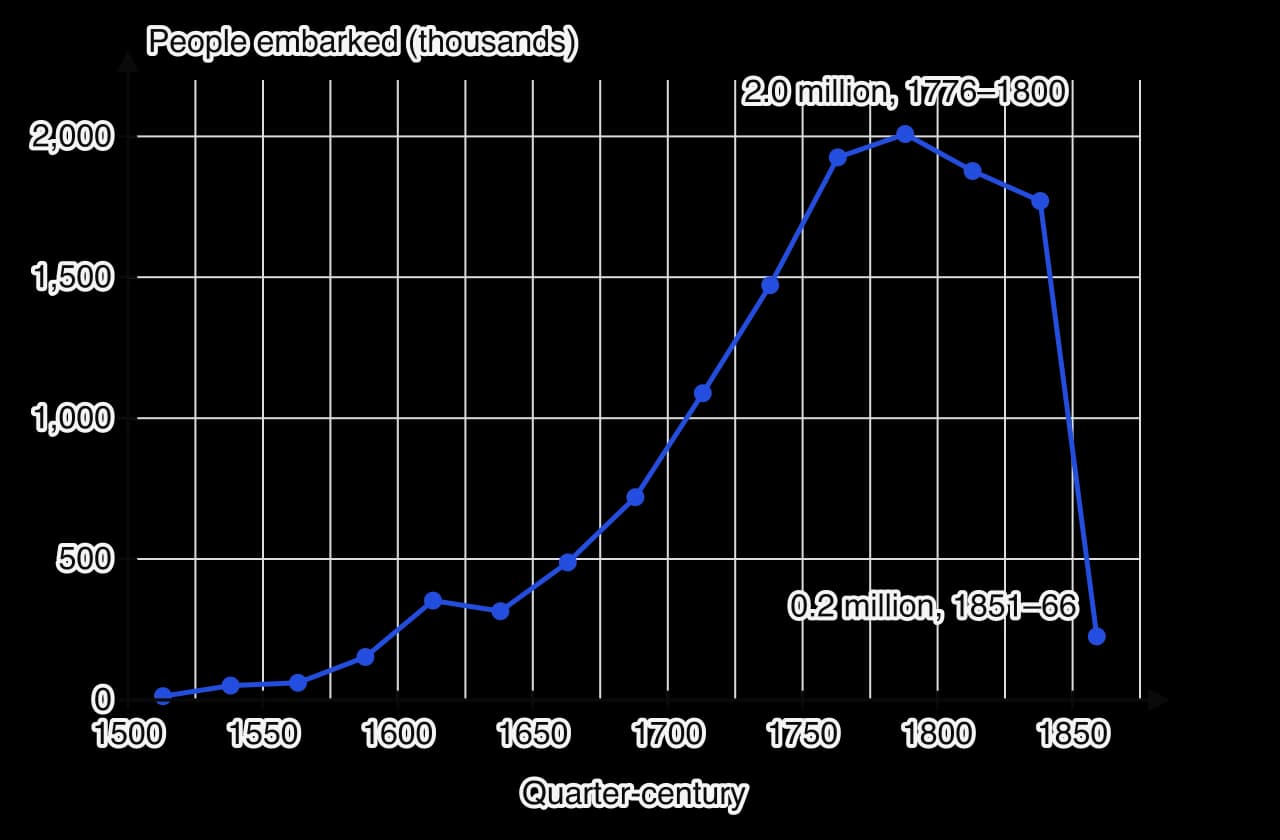
The graph of embarkations shows that the trade was small in the sixteenth century and grew rapidly from the middle of the seventeenth, when sugar plantations spread across the Caribbean. Almost three-quarters of all captives were taken after 1725. About 3.9 million people were embarked after 1800, most of them in a trade that was by then illegal for British and US ships, and most were carried to Brazil and Cuba.
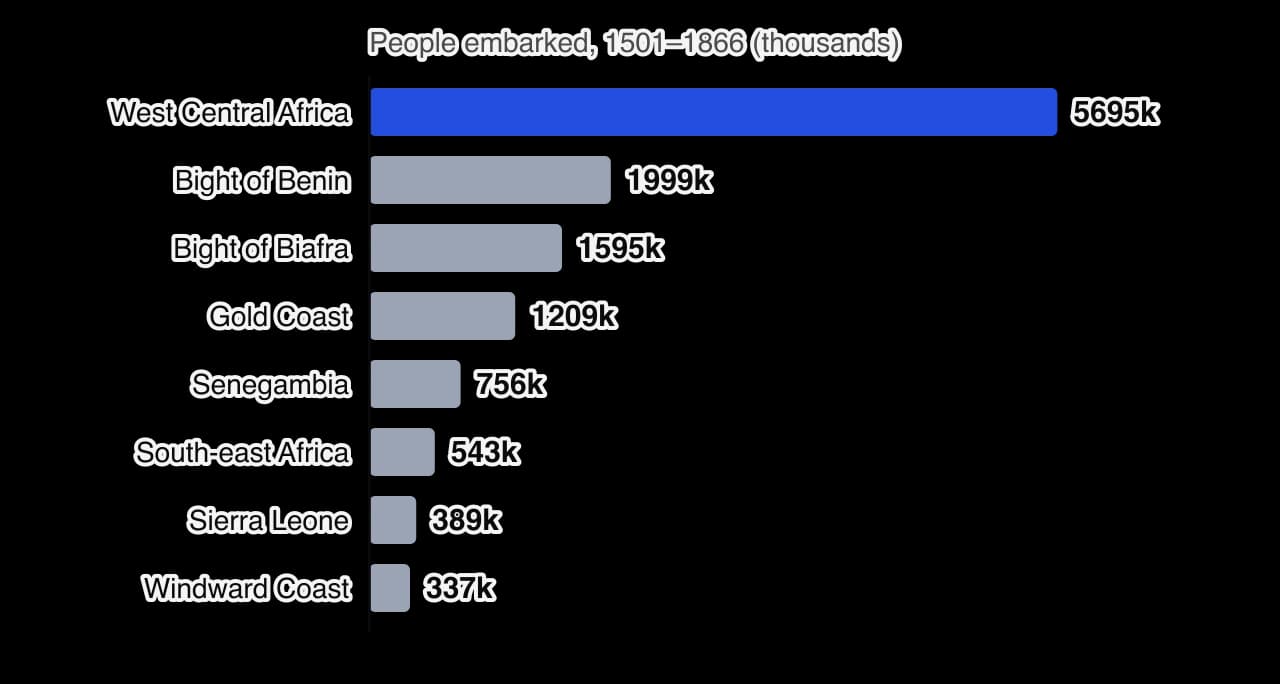
The chart of embarkation regions shows that the Atlantic trade drew on the whole western coast of Africa but unequally. West Central Africa, the region of the Kongo kingdom and Portuguese Angola, supplied about 5.7 million people, close to half of the total. The Bight of Benin (the "Slave Coast", in present-day Togo, Benin and western Nigeria) and the Bight of Biafra (the Niger Delta and the Cross River) were the next largest sources.
Carrier (flag of the ship) | People embarked, 1501–1866 | Main destinations |
|---|---|---|
Portugal and Brazil | 5.85 million | Brazil; Spanish America in the early period |
Britain | 3.26 million | Jamaica, Barbados and the British Caribbean; North America |
France | 1.38 million | Saint-Domingue, Martinique, Guadeloupe |
Spain and Uruguay | 1.06 million | Cuba, Puerto Rico and Spanish America (mostly after 1800) |
Netherlands | 0.55 million | Suriname, Curaçao, Dutch Brazil |
USA | 0.31 million | United States, then Cuba |
Denmark and the Baltic | 0.11 million | Danish West Indies |
Data: SlaveVoyages, "Estimates" (figures rounded). Of those who arrived, about 45 per cent landed in Brazil and more than 40 per cent in the Caribbean; mainland North America received only about 390,000 people, under 4 per cent of the total.
The trans-Saharan, Red Sea and Indian Ocean trades
The eastern trades are much harder to count, because there are no ship records like those of the Atlantic. Historians such as Ralph Austen and Paul Lovejoy have built estimates from travellers' accounts, customs records and the size of slave populations in North Africa and Arabia. They agree that these trades were older than the Atlantic trade, carried more women and children, and grew sharply in the nineteenth century.
Period | Across the Sahara | Red Sea | East African coast (Muslim and Swahili traders) |
|---|---|---|---|
1500–1600 | 550,000 | 100,000 | 100,000 |
1600–1700 | 700,000 | 100,000 | 100,000 |
1700–1800 | 700,000 | 200,000 | 400,000 |
1800–1900 | 1,200,000 | about 200,000 | 347,000 |
Data: Paul E. Lovejoy, Transformations in Slavery, 3rd edition (2012). All figures are estimates and are rounded; they exclude captives from eastern Africa taken by European traders to the Mascarene Islands and the Americas, and the many people enslaved within East Africa itself.
Why the Atlantic slave trade expanded, 1500–1800
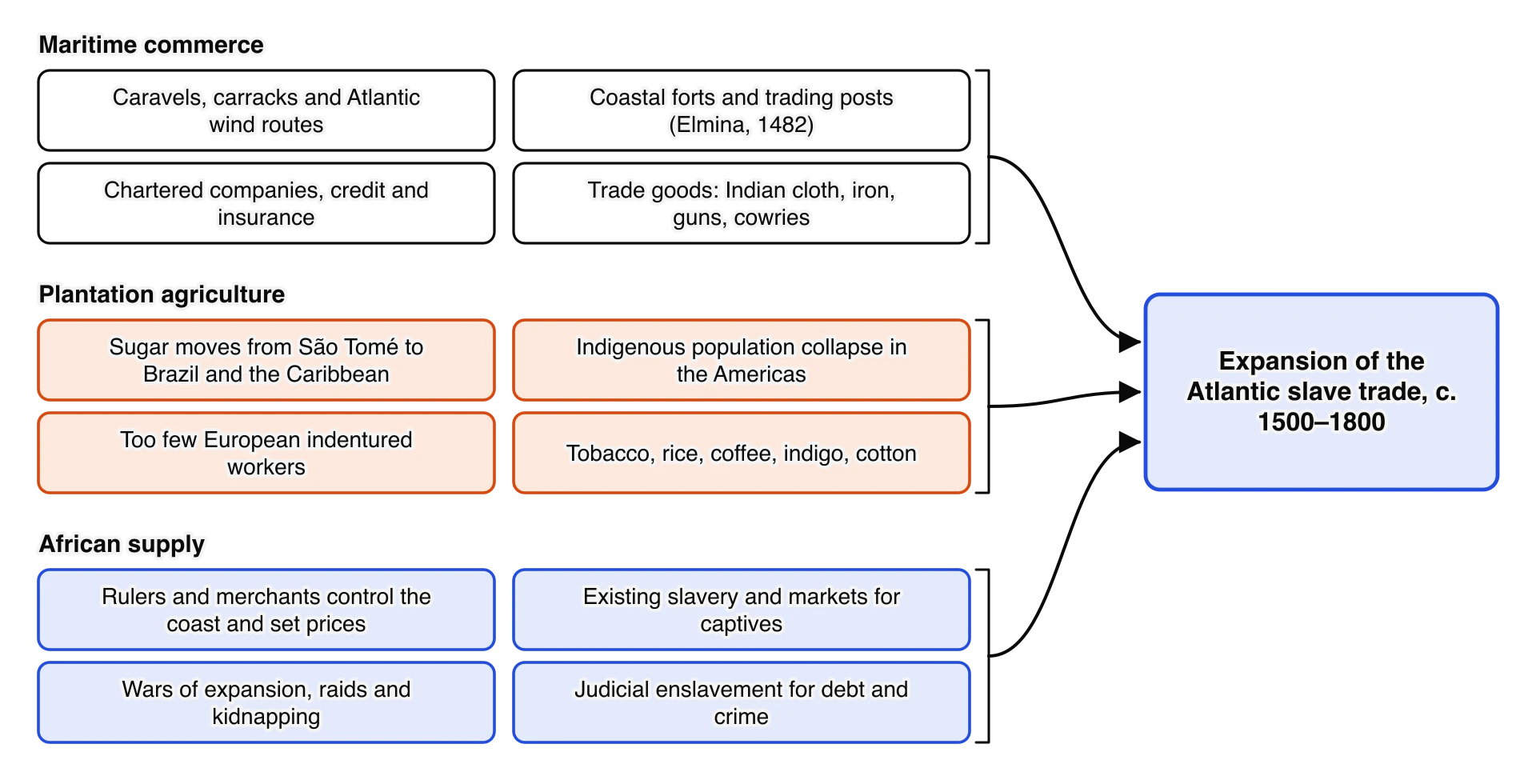
Portuguese ships reached the coast of West Africa in the 1440s, and the first captives were shipped to Portugal in 1444. For the rest of the fifteenth century the Portuguese bought gold, pepper and a few thousand captives a year, many of them resold within Africa or taken to Portugal, Madeira and the sugar island of São Tomé. The first direct voyages from Africa to the Americas were made in the 1520s. From these small beginnings the trade grew into the largest forced migration in history, for four connected reasons: the growth of maritime commerce, the development of plantation agriculture, European demand met by African supply, and rivalries and warfare inside Africa.
The growth of maritime commerce
The Atlantic trade depended on ships that could sail far from land and come back. The Portuguese caravel, a small, manoeuvrable ship with triangular (lateen) sails, could sail close to the wind, and larger carracks and later purpose-built slave ships could carry hundreds of people and months of supplies. Navigators learned to use the Atlantic wind system, swinging far out into the ocean on the return from Africa, and to fix their position with the compass, the astrolabe and tables of the sun's height.
Europeans did not conquer the West African coast in this period. Instead they built fortified trading posts with the permission of local rulers, to whom they often paid rent. The Portuguese fort of São Jorge da Mina (Elmina) on the Gold Coast, built in 1482, was the first and most famous; by the eighteenth century about sixty forts and lodges stood along the Gold Coast alone. In West Central Africa the Portuguese went further, founding the colony of Angola at Luanda in 1576 and waging wars inland.
The trade was organised by state-backed companies and, increasingly, by private merchants. The Dutch West India Company (founded 1621) seized Elmina in 1637. In England the Royal African Company, chartered in 1672, held a monopoly of the English trade until it was opened to private traders in 1698. By the late eighteenth century Liverpool, Bristol and London in Britain, Nantes in France, and Lisbon, Rio de Janeiro and Salvador in the Portuguese world were the main slaving ports. Merchants raised capital in partnerships, insured voyages and extended long lines of credit to traders on the African coast.
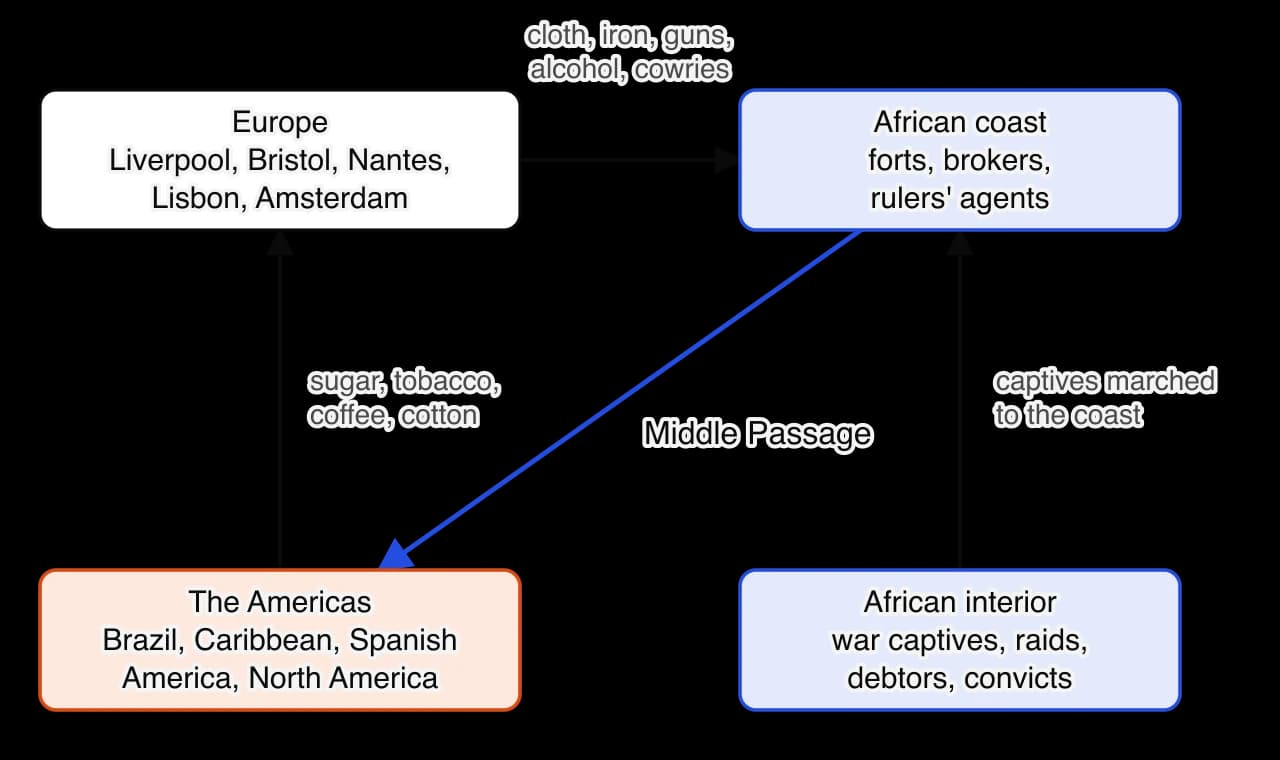
The diagram of the Atlantic system shows why historians speak of a "triangular trade". British and French ships carried manufactured goods to Africa, captives to the Americas and plantation produce home. The goods that bought captives were mostly not European, however. Indian cotton cloth was often the largest single item, alongside iron and copper bars, brass pans, alcohol, tobacco, beads, cowrie shells from the Maldives (used as money in the Bight of Benin) and firearms. Brazilian merchants ran a separate, two-way trade, exchanging Brazilian tobacco and rum directly for captives in Angola and the Bight of Benin.
The development of plantation agriculture
The main reason for the scale of the trade was the demand for labour on plantations in the Americas. A plantation was a large estate producing a single crop for export, worked by a large labour force under close supervision. Sugar was the crop that created the system. Sugar cane had to be cut and crushed within a day or two of ripening, so plantations combined farm and factory and needed many workers at a punishing pace.
The Portuguese developed slave-worked sugar plantations on the Atlantic islands of Madeira and São Tomé in the late fifteenth century and carried the model to north-eastern Brazil, where sugar boomed in Pernambuco and Bahia from the 1570s. In the 1640s English planters on Barbados switched from tobacco to sugar, with Dutch help; this "sugar revolution" replaced European indentured servants with enslaved Africans within a generation. The system then spread to Jamaica, the French islands, above all Saint-Domingue, and to the tobacco and rice colonies of North America.
Planters turned to Africa because the alternatives failed. The Indigenous population of the Caribbean and Brazil collapsed after contact with Europeans, from epidemic disease, warfare and forced labour. European indentured labour (workers who sold several years of their labour in return for their passage) never supplied enough workers, and fewer came as wages rose in Europe. Africans were available in large numbers through an existing trade, and many came from farming societies with immunity to some tropical diseases that killed Europeans. Racist ideas that Africans were suited to slavery developed alongside the system and were used to justify it.
The scale of the demand followed from the conditions on the plantations themselves. On Caribbean and Brazilian sugar estates deaths regularly exceeded births, because of overwork, poor food and disease and because planters bought more men than women. Planters therefore relied on continual imports to keep up their workforces, and each expansion of sugar production produced a new rise in the trade.
European demand and the responses of African states
European traders could not simply take the people they wanted. Along most of the coast African rulers and merchants controlled access to captives, charged customs duties, set prices and decided where and when Europeans could trade. Europeans who raided the coast early on soon found it more profitable to buy. As a result, African states responded to European demand in different ways, from regulation and refusal to deliberate expansion of the trade.
Kongo: an attempt at regulation
The kingdom of Kongo, south of the Congo River, was the first African state to form a close alliance with Portugal. Its king Afonso I (Mvemba a Nzinga, r. 1509–1542) became a Catholic, sent young nobles to study in Lisbon and bought Portuguese goods with captives taken in wars on his borders. By the 1520s Portuguese traders, many based on São Tomé, were buying captives from anyone who would sell, including Kongo's own free subjects. Afonso protested in a series of letters to King João III of Portugal.
… the mentioned merchants are taking every day our natives, sons of the land and the sons of our noblemen and vassals and our relatives … our country is being completely depopulated … it is our will that in these Kingdoms there should not be any trade of slaves nor outlet for them.
Afonso I of Kongo, letter to King João III of Portugal, 6 July 1526 (English translation as published by Basil Davidson in The African Past, 1964). Afonso wrote to a fellow Christian king whose help he needed, so he stressed the threat to order and to the Church in Kongo. He did not oppose the trade in principle: later in 1526 he set up officials to check that every captive sold was legally enslaved, and Kongo continued to export war captives. The letter shows an African ruler trying to control the terms of the trade, and the limits of his power to do so.
Benin, Ndongo and Angola
Other states set their own limits. The kingdom of Benin, in what is now southern Nigeria, sold some captives to the Portuguese in the early sixteenth century but from the middle of the sixteenth century until about 1700 it banned the export of male slaves, preferring to sell pepper, cloth and ivory. In Angola, by contrast, the Portuguese colony made war itself a source of captives. Its governors fought the kingdom of Ndongo and hired Imbangala mercenaries, and Queen Nzinga of Ndongo and Matamba (r. 1624–1663) resisted them for decades by diplomacy, alliances with the Dutch and war, before making her own state a supplier to the trade on her terms.
States built on the trade
In the eighteenth century several West African states grew powerful by controlling the supply of captives. The cavalry empire of Oyo dominated the routes to the Bight of Benin. Dahomey conquered the coastal ports of Allada and Whydah in the 1720s to trade directly with Europeans. Asante, founded around 1700 in the forest of the Gold Coast, sold captives from its wars of expansion and tribute from northern peoples. In the Bight of Biafra, where there were no large kingdoms, the Aro, a network of Igbo traders, supplied captives through markets and through the judgements of their oracle at Arochukwu, which could sentence people to be sold. The Efik merchants of Old Calabar used the Ekpe society, a secret association of leading men, to enforce debts and contracts with European captains.
The terms of trade show that African sellers were not cheated in any simple sense. Prices for captives rose several times over in the eighteenth century, and coastal brokers demanded specific goods, refusing cloth of the wrong pattern or iron bars of the wrong size. European captains depended on credit from African merchants, and on the Gold Coast and in the Bight of Biafra they often left goods, or even crew members, as security. The profits, however, went to a narrow group of rulers and traders, while the costs fell on the people who were captured.
 YouTube
Internal rivalries and warfare
Most captives were not born slaves. They became slaves through warfare, raiding, kidnapping or legal judgements. Wars of expansion and wars between rival states produced the largest numbers. Some were fought for other reasons and their prisoners were then sold; others, especially in the eighteenth century, seem to have been fought largely to take captives. Smaller-scale raiding and kidnapping by bandits and traders produced a steady flow. Courts and religious authorities increasingly punished crimes such as theft, adultery and witchcraft with enslavement, and people who could not pay their debts could be pawned and then sold.
Olaudah Equiano, who said he was kidnapped as a boy from an Igbo village in the 1750s, described how warfare and trade fed each other.
When a trader wants slaves, he applies to a chief for them, and tempts him with his wares. It is not extraordinary, if on this occasion he yields to the temptation with as little firmness, and accepts the price of his fellow creatures liberty with as little reluctance as the enlightened merchant. Accordingly he falls on his neighbours, and a desperate battle ensues.
Olaudah Equiano, The Interesting Narrative of the Life of Olaudah Equiano, or Gustavus Vassa, the African, London, 1789. Equiano wrote as a free man in Britain to support the abolition campaign, so he stressed the corrupting effect of European demand; his comparison with "the enlightened merchant" was aimed at British readers. The literary scholar Vincent Carretta (Equiano, the African, 2005) found records suggesting Equiano may have been born in South Carolina, which would mean his account of Africa drew on others' memories. Most historians still treat it as a valuable description of how captives were taken in the Bight of Biafra.
Muslim reform movements added another source of captives. In Senegambia and the western Sudan, a series of jihads from the 1720s created new Islamic states such as Futa Jallon and Futa Toro. The wars of these states produced captives for sale, but Islamic law also forbade the enslavement of free-born Muslims. In the 1780s the ruler of Futa Toro, Almamy Abdul Kader Kan (r. 1776–1806), forbade French traders on the Senegal River to buy his Muslim subjects or to carry captives through his territory, though slavery itself remained legal in his state.
Weighing the reasons for expansion
Each of the four reasons was necessary, but they worked at different levels. Plantation agriculture created the demand, and its expansion explains the timing of the trade's growth. Maritime commerce created the means: without ships, forts and credit no trade on this scale was possible. The responses of African states and the warfare between them explain how supply was produced, and why it came from some regions more than others. Historians who stress demand, such as Walter Rodney, argue that the Atlantic market pulled Africa into a trade it did not choose; those who stress supply, such as John Thornton, argue that African rulers acted as independent partners who could not be forced to sell.
The expansion of slavery in East Africa from the late eighteenth century
While the Atlantic trade was being challenged in the decades after 1807, the trade in enslaved people on the eastern side of Africa grew to its greatest size. By the 1860s tens of thousands of people a year were being captured in the interior of East and Central Africa, and many were kept as plantation workers on the coast and islands instead of being shipped overseas. Four developments explain this expansion: an existing trade with the Middle East, the expansion of Omani power, the rise of the Zanzibar Sultanate and its clove plantations, and the weakness of British anti-slavery control in the Indian Ocean.
An existing trade between the Middle East and the Swahili coast
The Swahili coast, the string of Muslim trading towns from Mogadishu in the north to Kilwa and Sofala in the south, had traded with Arabia, the Persian Gulf and India for centuries, sending gold, ivory, timber and some captives in return for cloth, beads and ceramics. Enslaved East Africans were used in Iraq as early as the ninth century, when thousands of them, known as Zanj, rose in the Zanj rebellion (869–883) in the salt marshes near Basra. Enslaved Africans served as soldiers, guards and household servants across the Islamic world and in India, where their descendants, the Siddis, still live in Gujarat and Karnataka.
Before 1750 this trade was small compared with the Atlantic trade: Paul Lovejoy's estimates suggest about 100,000 people a century from the East African coast in the sixteenth and seventeenth centuries. Demand in the Middle East was mainly for domestic servants, concubines and eunuchs, so the trade took more women and children than the Atlantic trade. In Islamic law a slave could be freed as an act of piety, and the children of a free man and an enslaved concubine were born free, so slave populations in the Middle East did not reproduce themselves and needed new imports.
The expansion of the Sultanate of Oman into East Africa
The Portuguese took control of much of the Swahili coast in the sixteenth century, but their power declined in the seventeenth. The rulers of Oman, in south-eastern Arabia, expelled the Portuguese from Muscat in 1650 and then sent fleets to East Africa, where Swahili towns asked for help against them. In 1698 Omani forces captured Fort Jesus at Mombasa after a siege of almost three years, ending Portuguese power north of Mozambique. For most of the eighteenth century Omani control was loose: the Mazrui family, Omani governors of Mombasa, ruled almost independently.
Demand from outside the region grew from the 1770s. French planters on the Indian Ocean islands of Île de France (Mauritius) and Bourbon (Réunion) needed workers for coffee and sugar and bought captives at Kilwa, which became the main slave port of the coast. In the early nineteenth century Portuguese Mozambique also began to send captives to Brazil, as British pressure closed parts of the West African coast.
The rise of the Zanzibar Sultanate and the clove plantations
The decisive change came under Sayyid Said bin Sultan (r. 1806–1856), ruler of Oman. Said saw greater opportunities in Africa than in Arabia. He defeated the Mazrui of Mombasa in 1837 and from 1840 made the island of Zanzibar his main residence. He encouraged Indian merchants, mostly Gujaratis, to settle there, signed commercial treaties with the USA (1833), Britain (1839) and France (1844), and made Zanzibar the main market of the western Indian Ocean for ivory, cloves, gum copal and captives. After his death in 1856 his sons divided his lands, and the Canning Award of 1861, an arbitration by the British Viceroy of India, confirmed Zanzibar as a separate sultanate.
Clove trees, from the Moluccas in Indonesia, were planted on Zanzibar in the early nineteenth century, probably from the French islands, and Said encouraged Omani landowners to grow them. By the middle of the century Zanzibar and Pemba produced most of the world's cloves, on plantations worked by enslaved Africans. On the mainland, around Malindi and Mombasa, Omani and Swahili landowners used enslaved labour to grow grain, sesame and coconuts for export. According to the historian Frederick Cooper (Plantation Slavery on the East Coast of Africa, 1977), this was a new kind of slavery for the coast: large gangs of field workers producing crops for the world market, closer to the plantation slavery of the Americas than to the older household slavery of the region.
Estimates of the numbers are uncertain. The historian Abdul Sheriff estimates that in the 1860s nearly 20,000 captives a year passed through the island, of whom roughly three-fifths stayed on Zanzibar and Pemba while the rest were sent on, mainly to the Kenyan coast. Historians estimate that by the 1850s about two-thirds of the population of the two islands were enslaved.

The caravan trade into the interior
The growth of Zanzibar transformed the interior. The chain diagram of the trade shows how it worked. Demand for ivory was rising fast in Europe, North America and India, for piano keys, billiard balls, combs and bangles. Indian financiers in Zanzibar advanced cloth, beads, brass wire and guns on credit to Arab and Swahili traders, who led caravans of hundreds of porters inland. Nyamwezi traders from what is now western Tanzania ran caravans of their own, and the Nyamwezi ruler Mirambo (c. 1840–1884) built a powerful state on the profits. Yao traders carried captives from around Lake Malawi to Kilwa.
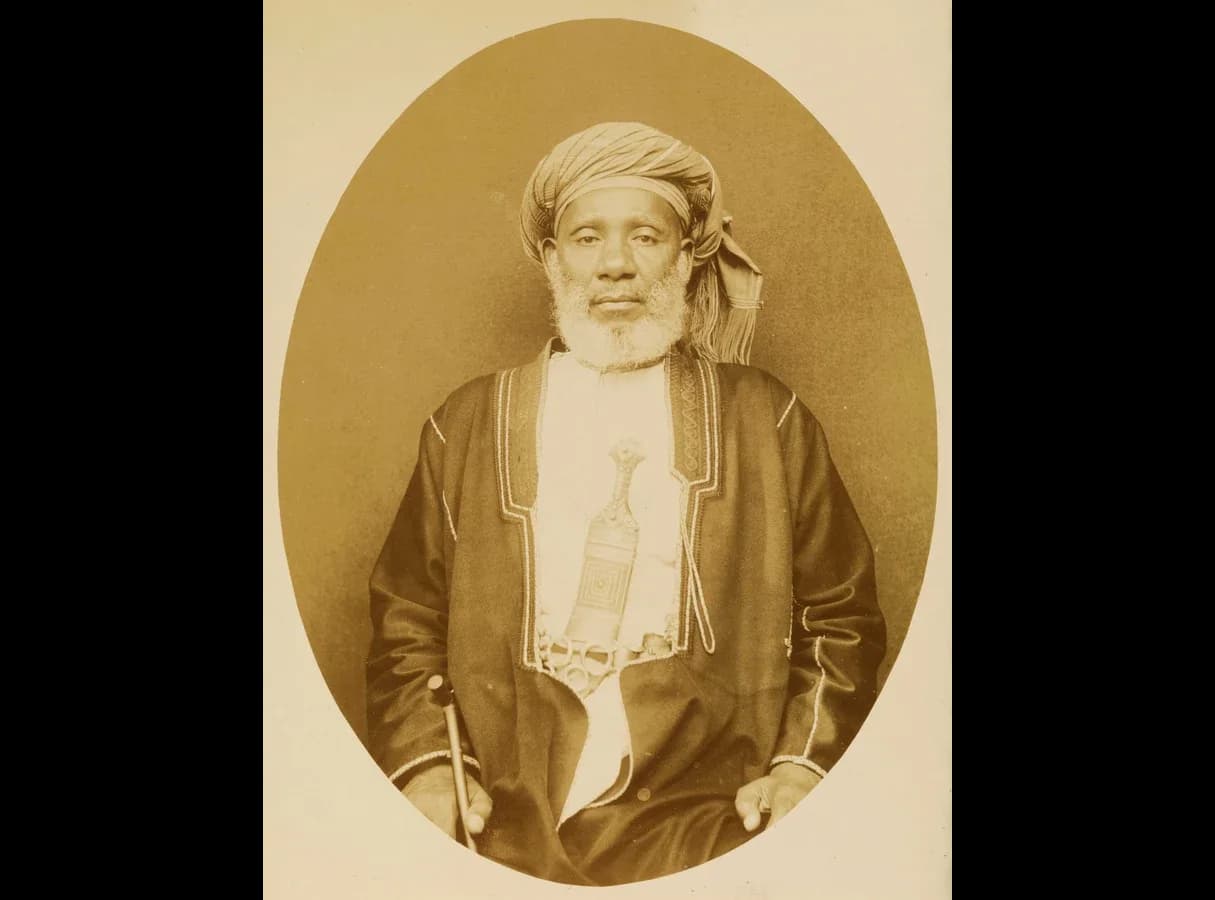
By the 1870s caravans had reached the eastern Congo. Tippu Tip (Hamed bin Muhammed, c. 1837–1905), the trader in the photograph, became the most powerful of the Zanzibari traders, ruling a large area around Nyangwe and Kasongo through armed followers and alliances with local chiefs. Captives were taken in raids or bought, used as porters to carry ivory to the coast and then sold. The British explorer and missionary David Livingstone described raids and massacres in the region, and his reports, published after his death in 1873, helped turn British opinion against the East African trade.
Escape from British anti-slavery control in the Atlantic
The East African trade also expanded because it was harder to stop. After 1807 the Royal Navy concentrated its anti-slavery patrols on the west coast of Africa and the Atlantic. In the Indian Ocean Britain relied on treaties with the rulers of Oman and Zanzibar, whose friendship it needed to protect the sea routes to India.
The Moresby Treaty (1822) banned the sale of slaves by Said's subjects to Christian powers and allowed British ships to stop vessels beyond a line east of his dominions, but the trade within his territories and to Arabia stayed legal.
The Hamerton Treaty (1845) banned the export of slaves from Said's African dominions to Arabia and the Gulf, but still allowed the trade along the coast between his own ports, from Kilwa to Lamu, which made smuggling easy.
These treaties pushed the trade into channels that the British could not police. Dhows carrying captives "for Zanzibar" sailed on to Arabia, and the Royal Navy had only a few ships in the region until the 1860s. At the same time the closing of the Atlantic trade cut prices for captives on the coast and made enslaved labour cheaper for plantation owners in East Africa itself, so more people were kept on the coast instead of being exported. Brazilian and Cuban demand also drew captives from Mozambique and Madagascar into the Atlantic trade until about 1850.
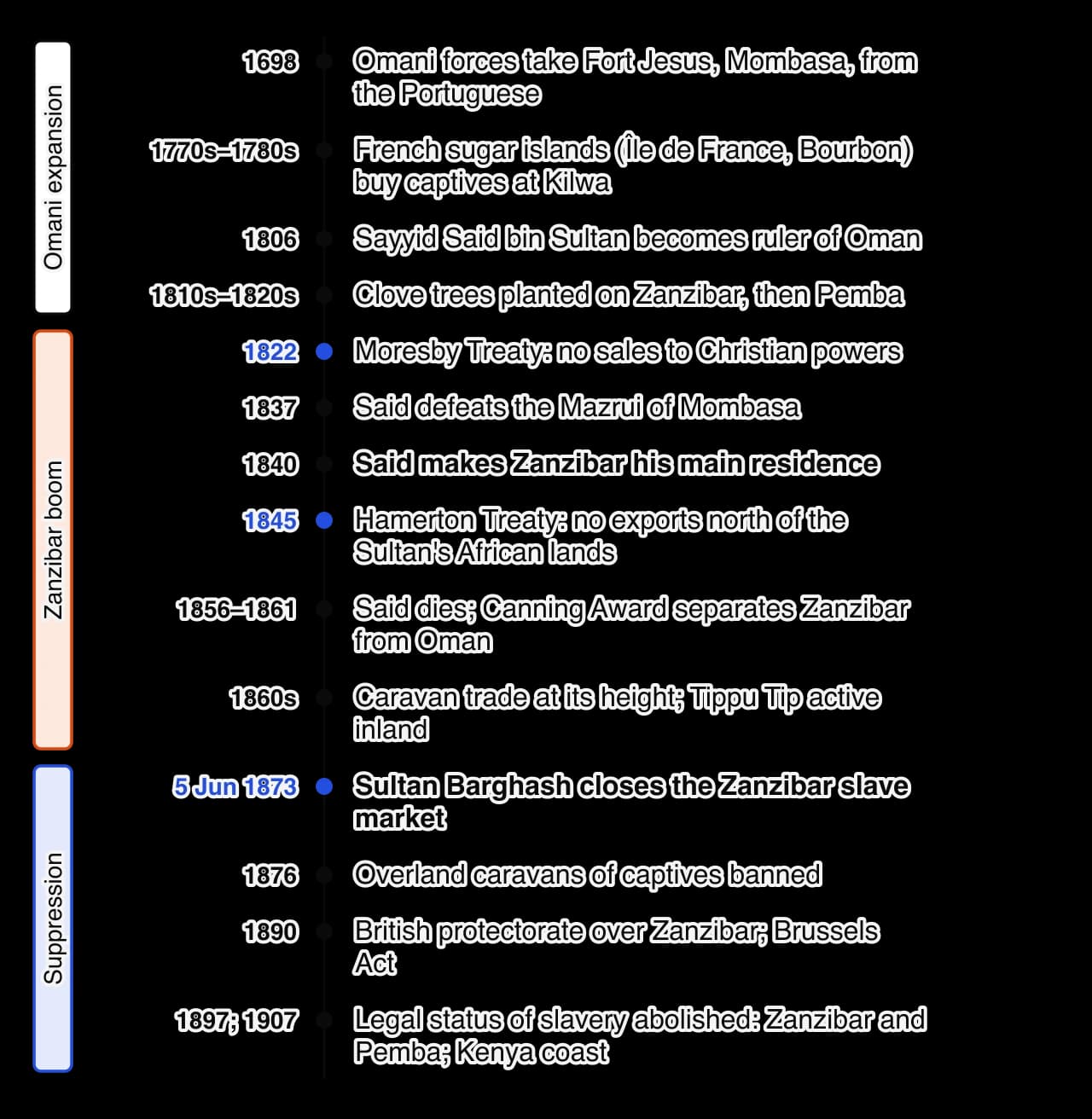
The trade was ended in stages. In 1873 the British envoy Sir Bartle Frere demanded a new treaty, and when Sultan Barghash (r. 1870–1888) hesitated, the British threatened a naval blockade. On 5 June 1873 Barghash signed a treaty closing the Zanzibar slave market and banning the export of slaves from the mainland by sea. An Anglican cathedral was later built on the site of the market. Overland caravans of captives were banned in 1876, but the trade continued by land and in smaller boats into the 1880s, and the legal status of slavery was not abolished on Zanzibar and Pemba until 1897, or on the Kenyan coast until 1907.
 YouTube
Feature | Atlantic trade (peak c. 1700–1850) | East African trade (peak c. 1810–1880) |
|---|---|---|
Main buyers | Planters in Brazil, the Caribbean and North America | Clove and grain planters on Zanzibar, Pemba and the coast; households in Arabia, the Gulf and India; French island planters |
Who was taken | About two men for every woman; mostly young adults | More women and children for overseas markets; men for plantations and porterage |
Carriers | European and American ships | Arab, Swahili and Indian dhows; caravans led by Zanzibari, Swahili and Nyamwezi traders |
Linked trade | Plantation produce: sugar, tobacco, coffee, cotton | Ivory, cloves, gum copal |
How it was ended | Abolition laws, naval patrols, treaties; Brazil 1850, Cuba 1867 | Treaties of 1822, 1845 and 1873; colonial conquest; legal abolition 1897–1907 |
The table compares the two systems at their height. The East African trade was smaller in total, but in the nineteenth century it grew while the Atlantic trade declined, and it was ended only when colonial rule replaced the Sultan's authority on the mainland.
The impact of the slave trades on Africa
The slave trades affected African societies very unevenly. Some regions lost a large share of their young people over two centuries; others were barely touched. Some rulers and merchants grew rich, and some states became more powerful than ever, while their neighbours were raided and destroyed. The diagram of consequences groups the main effects; historians agree on most of them but disagree about how large they were and how long they lasted.
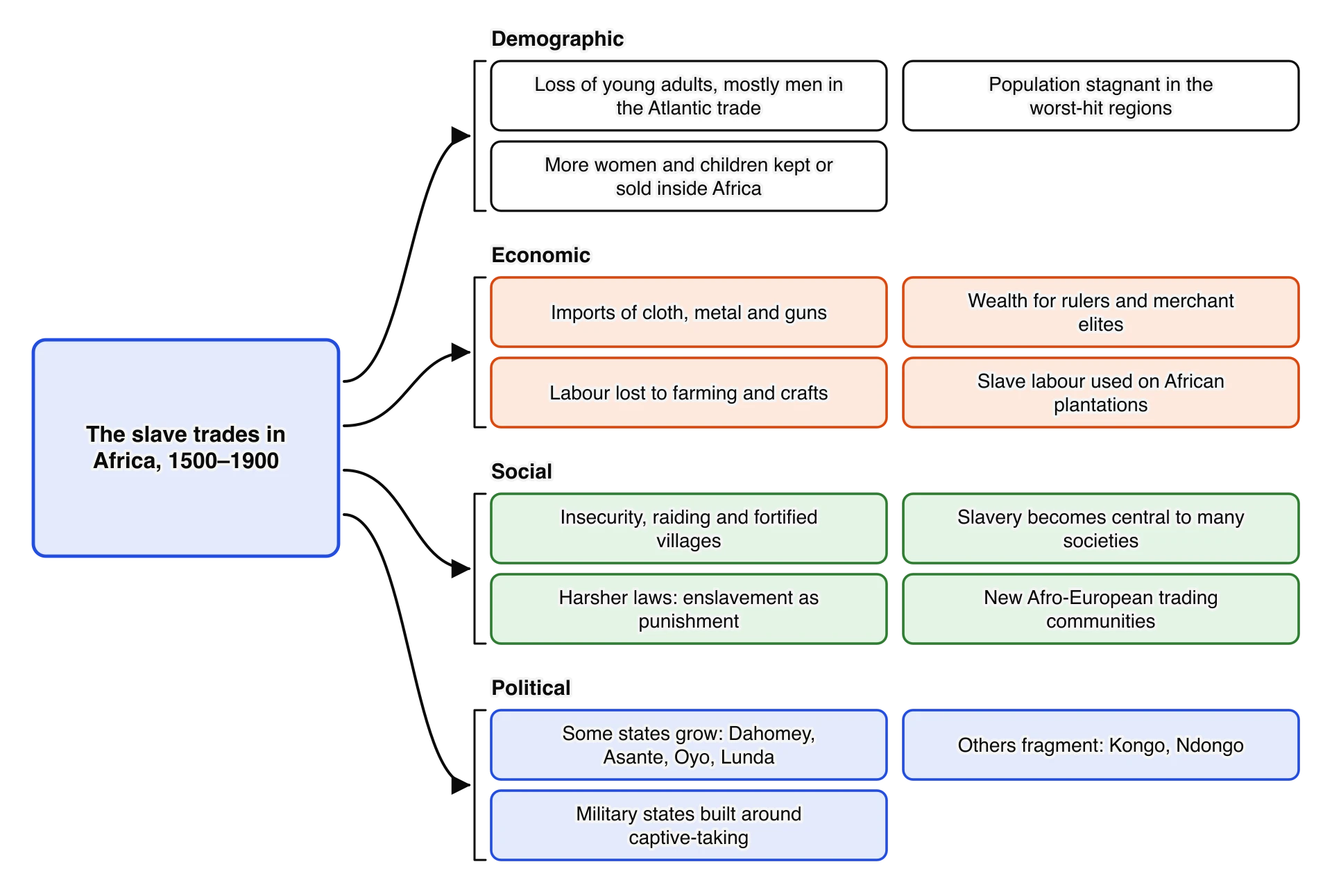
Demographic changes
The Atlantic trade took mostly young adults, and about two men for every woman, because planters in the Americas paid higher prices for men. The eastern trades took more women and girls. As a result, the regions that supplied the Atlantic trade lost the people most able to work and to have children, while the captives kept inside Africa, the majority of whom were women, were absorbed into African households and farms.
Historians disagree about the size of the effect. In 1969 J. D. Fage argued that West Africa's population probably kept growing slowly despite the trade, because losses were spread over a large population and a long period. Later work found the losses more serious. Patrick Manning (Slavery and African Life, 1990) used a computer simulation of births, deaths and exports to argue that the population of western and west-central Africa stopped growing, or fell, between about 1730 and 1850, and that by 1850 it may have been only half of what it would otherwise have been. The heaviest losses were in the hinterland of Angola and the Bight of Benin.
The imbalance between men and women also changed social life. In parts of Angola and the Bight of Benin, women came to outnumber men among adults, did more of the farm work and were more often married as junior wives in polygynous households. Societies that lost people in war and raiding also lost the labour needed to clear land and maintain irrigation and terraces.
Economic impact
In return for captives, African societies imported textiles, metals, guns, alcohol, tobacco and cowrie shells. These goods were valued and widely used; Indian and later British cloth reached markets far inland. Historians disagree about the effect. Walter Rodney (How Europe Underdeveloped Africa, 1972) and Joseph Inikori argued that cheap imports undermined local crafts such as weaving and iron smelting and that the trade turned African economies towards exporting people instead of producing goods. John Thornton and David Eltis point out that the value of imports per head of population was small, that African cloth industries survived and even grew, and that most Africans continued to farm for themselves and for local markets.
The benefits went to small groups. Rulers took captives as tribute and charged duties on trade; merchant families on the coast, such as the Afro-Portuguese traders of the Upper Guinea coast and the leading houses of Old Calabar and Bonny, built fortunes. Credit systems that bound coastal brokers to European captains, and pawnship, the practice of handing over a person as security for a debt, spread with the trade. In the Bight of Benin, huge imports of cowries from the Maldives created a currency that tied local markets to the Atlantic economy.
Economists have also measured the long-term effects. Nathan Nunn ("The Long-Term Effects of Africa's Slave Trades", Quarterly Journal of Economics, 2008) found that the African countries from which the most people were taken, relative to their area, are among the poorest today. He explains this through the weakening of states and the growth of mistrust between communities, as neighbours and even relatives sold each other. His findings are debated, because many other factors, including colonial rule, shaped modern incomes, but they gave new support to the view that the trade had lasting economic costs.
Social impact
The trade spread violence and fear. Communities moved to hilltops, marshes and forests that were easier to defend, or built walls and stockades; Equiano described how children in his village kept watch from the trees for kidnappers while the adults worked in the fields. Legal systems changed as rulers and elders used enslavement as a punishment for an ever-wider range of offences, from theft and adultery to witchcraft and debt, because the condemned could be sold.
The trade also changed slavery inside Africa. Paul Lovejoy (Transformations in Slavery, 1983; 3rd edition 2012) argues that the export trades turned slavery from one form of dependency among many into a central institution of the economy and politics of many African societies. By the nineteenth century enslaved people made up a large part of the population in parts of West Africa, working on farms and plantations, in armies and as porters. This growth of internal slavery continued, and even accelerated, after the export trade ended.
New communities formed at the meeting points of Africa and Europe. Afro-Portuguese traders (often called lançados and their descendants) lived along the rivers of Senegambia and Upper Guinea, in Luanda and on the islands of Cape Verde and São Tomé; in Saint-Louis and Gorée in Senegal, wealthy African and mixed-race women traders, the signares, ran businesses and households. These creole communities spoke Portuguese-based languages, were often Catholic, and acted as brokers between African and European traders.
The expanding power of African states involved in the trade
The trade strengthened states that could control the supply of captives or the routes to the coast. It weakened or destroyed states that were raided by their neighbours or could not control their own traders. Dahomey shows both sides of the trade's political effects.
Case study: Dahomey and the slave trade, 1724–1863
Dahomey was a kingdom of the Fon people, based at Abomey about 100 kilometres inland in what is now the Republic of Benin. Under King Agaja (r. 1718–1740) it conquered the coastal kingdoms of Allada in 1724 and Whydah (Ouidah) in 1727, which controlled access to European traders. Historians disagree about Agaja's motive. The Nigerian historian I. A. Akinjogbin (Dahomey and Its Neighbours, 1967) argued that Agaja wanted to stop the slave raids that disrupted his region; most historians now argue, with Robin Law, that he wanted to control the trade himself and take its profits.
Conquest made Dahomey one of the largest suppliers of captives in West Africa. The king controlled the trade through officials: the yovogan ("chief of the whites") supervised European traders at Whydah, and the king had first choice of buyers and set prices. Captives came from annual wars against neighbouring peoples. Dahomey's army included a corps of women soldiers, the Mino, recruited from the palace women. Each year, at the ceremonies known as the Annual Customs, the king distributed goods to his people and some war captives were sacrificed, displaying royal power.
Dahomey's power had limits. The cavalry of the much larger Oyo empire invaded repeatedly in the 1720s, and from 1730 Dahomey paid Oyo a heavy annual tribute that lasted until King Gezo (r. 1818–1858) ended it in the 1820s, as Oyo began to collapse. Gezo came to power with the help of a Brazilian slave trader, Francisco Félix de Souza, whom he made his agent at Whydah. Under Gezo Dahomey kept selling captives to Brazilian and Cuban traders long after Britain had abolished its own trade.

From the 1840s Britain pressed Gezo to abolish the trade. When the British consul John Beecroft visited Abomey in 1850, Gezo said that his revenue from the slave trade was too large to give up at once, and asked that the trade first be stopped at the neighbouring ports. He was offered compensation of £3,000 a year for five years. The British Foreign Secretary, Lord Palmerston, replied with a warning.
… as you have declined to consent to what the British Government has asked you to do, the British Government will be obliged to employ its own means to accomplish its purpose, and as England is sure to succeed in any object which it is determined to attain, the result will be, that the Slave Trade from Dahomey will be put an end to by the British cruisers …
Viscount Palmerston, British Foreign Secretary, letter to King Gezo of Dahomey, 11 October 1850 (printed in Robin Law, ed., Dahomey and the Ending of the Trans-Atlantic Slave Trade, 2012). Written for an African ruler whom Britain still hoped to persuade, the letter mixes diplomatic courtesy with a threat of force, and it goes on to promise that profits from "legal commerce" would soon replace the revenue lost. It shows how British abolition policy moved from persuasion to coercion: a naval blockade of Dahomey began on 1 January 1852, and Gezo signed a limited treaty abolishing the export trade on 13 January.
The treaty did not end the trade at once. Captives were still smuggled from the Dahomey coast, and the last known transatlantic shipment left in 1863. Dahomey turned increasingly to palm oil, much of it produced by enslaved people on royal and private plantations. Robin Law describes the 1850s as a crisis for the monarchy, which had built its revenue and its army around the sale of captives and now depended on a trade that many small producers could enter. The kingdom survived the end of the Atlantic trade, but it was conquered by France in 1892–1894.
The case shows the strengthening effect of the trade at its clearest: a state built a centralised monarchy, a professional army and a royal monopoly on the profits of selling people. It also shows the costs: permanent warfare against neighbours, dependence on a single export, vulnerability to Oyo, and a crisis when British pressure closed the market.
Other states
State or group | Effect of the trade | Evidence |
|---|---|---|
Asante (Gold Coast) | Strengthened | Expansion from c. 1700 produced captives sold at the coast; guns and wealth supported a centralised kingdom that dominated its neighbours until the 1870s |
Oyo (Yoruba region) | Strengthened, then collapsed | Cavalry empire grew rich on the trade through Porto-Novo; civil wars and a jihad from the north destroyed it by the late 1830s, and its wars supplied captives to Brazil and Cuba |
Aro (Bight of Biafra) | Strengthened a trading network | Aro traders and the Arochukwu oracle dominated the supply of captives in Igboland without forming a centralised state |
Lunda and Kasanje (West Central Africa) | Strengthened | Lunda expanded by conquest and tribute; Kasanje controlled the trade route between the interior and Portuguese Angola |
Kongo | Weakened | Defeat by Portuguese Angola at Mbwila (1665) was followed by decades of civil war; rival factions sold captives taken from each other |
Ndongo | Destroyed | Wars with Portuguese Angola from 1579, joined by Imbangala mercenaries from the 1610s, broke the kingdom; Nzinga moved her state east to Matamba |
Segu (upper Niger) | Strengthened | Bambara state founded c. 1712 by Biton Kulibali; its army of tonjon, warriors of captive origin, raided neighbours and sold captives to Senegambian and Saharan traders |
The table shows a pattern. States with strong central authority that controlled routes to the coast, such as Asante and Dahomey, could use the trade to grow, at least for a time. Societies on the receiving end of raids, and states whose own nobles and traders competed to sell captives, such as Kongo after 1665, were weakened. Even the strongest states were exposed when the trade ended or when their neighbours grew stronger, as Oyo's collapse shows.
The Middle East and the Indian Ocean
Enslaved Africans taken by the eastern trades lived in a wide range of conditions. In the Ottoman Empire and Egypt most worked as household servants, many of them women, and a small number of eunuchs held powerful positions in the imperial palace. In Arabia and the Gulf, enslaved Africans worked on date plantations and as divers in the pearl fisheries. Because many were freed and absorbed into families, fewer distinct African communities survived than in the Americas, although there are exceptions such as the Siddis of India and Afro-Iraqi and Afro-Turkish communities.
Resistance to slavery by enslaved people
Enslaved people resisted at every stage, from capture in Africa to life on plantations in the Americas and in Africa itself. Their resistance took many forms, from quiet refusals in daily life to armed revolt. Historians once wrote about the slave trade mainly from the records of traders and abolitionists; since the 1960s they have used court records, shipping logs, oral traditions and the testimony of the enslaved to recover how enslaved people fought back.
Day-to-day resistance
Most resistance was not dramatic. Enslaved workers slowed down, broke tools, pretended to be ill, stole food and played on their owners' ignorance. They preserved their languages, music, names, religious practices and memories of Africa, and created new cultures that their owners did not control, such as Vodou in Saint-Domingue and Candomblé in Brazil. Muslims from West Africa kept their faith and literacy in Arabic. Such acts did not end slavery, but they protected a sense of identity and set limits on how far owners could push.
On slave ships, captives refused to eat, and crews force-fed them with instruments made for the purpose; Equiano described being flogged for refusing food. Some captives jumped overboard, which is why many ships had netting along their sides. These acts were the most extreme form of refusal: the choice of death over enslavement, in some cases with the belief that the dead would return to their homeland.
Inside Africa, enslaved people on plantations in the Sokoto Caliphate, Dahomey and Zanzibar used similar methods. They worked their own plots, bargained over tasks and time, and used ties of kinship, marriage and religion to improve their position. In many African societies the children and grandchildren of the enslaved could claim a place in their owners' lineage, and pressing that claim was itself a form of resistance.
The nature and impact of rebellions
Revolts were most likely at moments of transition: on the march to the coast, in the coastal barracoons where captives waited for ships, and on board ship while it was still near the African coast and the captives could hope to return home. Studies based on the SlaveVoyages database suggest that roughly one voyage in ten experienced a revolt. Most were crushed, with many deaths, but some succeeded. In 1839 Mende captives led by Sengbe Pieh (Joseph Cinqué) seized the Cuban schooner Amistad; after the US Supreme Court ruled in 1841 that they had been illegally enslaved, the survivors returned to Sierra Leone.
The historian David Richardson argues that the threat of revolt had a large economic effect. Ships carrying captives needed bigger crews, more guns and stronger barricades, which raised the cost of every voyage. Traders also avoided parts of the coast where captives had a reputation for rebellion, such as the Upper Guinea coast. Resistance therefore probably reduced the number of people taken, although it is impossible to measure exactly how many.
In the Americas, large rebellions such as Tacky's revolt in Jamaica (1760), the revolution in Saint-Domingue (from 1791), which created the state of Haiti in 1804, the Demerara rising (1823), the Baptist War in Jamaica (1831–1832) and the Malê revolt of African Muslims in Bahia, Brazil (1835) frightened slave-owners and governments. Many of their leaders had been born in Africa, and the Malê rebels were mostly Yoruba and Hausa Muslims, some of them captured in the wars that destroyed Oyo. These revolts also affected the debates in Europe: the Haitian Revolution convinced some British politicians that the trade was dangerous, and the Jamaican rising of 1831–1832 strengthened the case for the abolition of slavery in 1833.
Revolts also broke out in Africa. In the 1780s, according to Walter Rodney's research on Futa Jallon (in present-day Guinea), enslaved farm workers in this Muslim state rose against their masters and held out in a fortified settlement for some years before they were defeated. In the nineteenth century, as plantation slavery grew in West and East Africa, owners faced repeated flight and occasional revolts, and the fear of rebellion shaped how plantations were organised.
Escape and communities of escaped enslaved people
Flight was the most common form of open resistance. In the Americas, people who escaped formed maroon communities in mountains, forests and swamps. Palmares in north-eastern Brazil (c. 1605–1694), a federation of settlements with perhaps several thousand inhabitants, resisted Portuguese and Dutch attacks for most of a century; in Jamaica the Maroons fought the British to a standstill and won treaties recognising their freedom in 1739.
In Africa, escape was also widespread. On the East African coast, people who fled the plantations of the Zanzibar Sultanate, known in Swahili as watoro (runaways), founded settlements in the hinterland of the Kenyan coast in the nineteenth century, such as Fuladoyo, and defended them against their former owners. Others fled to the Christian missions that were established on the coast from the 1840s; Freretown near Mombasa, founded in 1875 by the Church Missionary Society for freed captives, attracted runaways, which caused conflict between missionaries and coastal slave-owners.
Two West African colonies were founded as homes for people freed from slavery. Freetown in Sierra Leone was settled from 1787 by Black Londoners and from 1792 by Black loyalists from Nova Scotia who had escaped slavery in the American War of Independence; after 1808 it became the base where the Royal Navy landed tens of thousands of "recaptives" freed from slave ships. Liberia was founded from 1822 by the American Colonization Society for free Black Americans. Both colonies were shaped by their founders' Christian and anti-slavery ideas, and both came into conflict with the African peoples around them.
Legal and political resistance in Africa
Some resistance took the form of legal and political argument. Rulers such as Afonso I of Kongo (1526) and the Almamy of Futa Toro (1780s) tried to stop the enslavement of their own subjects or co-religionists. In Islamic West Africa, scholars argued over who could lawfully be enslaved. In Mi'raj al-Su'ud (1615), the Timbuktu scholar Ahmad Baba ruled that free-born Muslims could not be enslaved whatever their colour, and rejected the claim that Black Africans were destined for slavery. His argument did not challenge slavery itself, but it gave Muslims captured in war a legal basis to claim their freedom.
In the nineteenth century, enslaved Africans used British and colonial institutions. Captives taken off slave ships appeared before courts of mixed commission at Freetown (from 1819), set up under Britain's treaties with Spain, Portugal and the Netherlands, which could declare them free. After Britain abolished the legal status of slavery in the Gold Coast Colony in 1874, many enslaved people left their owners or bargained for better terms. In Zanzibar after 1897, enslaved people could apply to the courts for their freedom, although the procedure was slow and many chose instead to negotiate with their owners or simply leave.
Form of resistance | Examples in Africa | Examples at sea, in the Americas and in Britain | Impact |
|---|---|---|---|
Day-to-day | Bargaining over tasks on Sokoto and Zanzibar plantations; claims to kinship | Slowdowns, sabotage; refusing food on ships; preserving religion and language | Limited exploitation; preserved identity; rarely changed the system |
Rebellion | Futa Jallon (1780s); revolts on coastal and East African plantations | Shipboard revolts (about one voyage in ten); Amistad (1839); Saint-Domingue (1791); Bahia (1835) | Raised the costs of the trade; shaped abolition debates; Haiti destroyed a slave system |
Escape | Watoro settlements on the Kenyan coast; flight to missions | Palmares (c. 1605–1694); Jamaican Maroons (treaties 1739) | Freedom for some; forced owners to bargain; seldom threatened the trade |
Legal and political | Afonso I (1526); Ahmad Baba (1615); Futa Toro (1780s); courts after 1874 and 1897 | Freedom suits; Somerset case (1772); recaptive courts at Freetown | Freed individuals; set limits on enslavement; supported abolitionist arguments |
The table of forms of resistance shows that escape and legal action freed more individuals than revolt, but revolts had the larger effect on the trade as a whole, by raising its costs and, in Saint-Domingue and Jamaica, by changing the politics of abolition.
Economic reasons for the decline of the slave trade
The Atlantic trade did not end because demand for slaves in the Americas disappeared. Brazil and Cuba imported more Africans in the 1820s–1840s than in almost any earlier period. Economic change in Europe and Africa nevertheless made the trade less important to the countries that ended it, created new forms of trade to replace it, and gave both European governments and African producers reasons to accept its end. Four economic developments were involved: industrialisation and new technology, the rise of "legitimate commerce", the need for labour in Africa, and arguments about the productivity of enslaved labour.
Industrialisation and new technology
Britain, the leading slave-trading nation of the eighteenth century, became the first industrial economy. Its new factories needed raw materials and markets more than they needed slave-grown sugar. In Capitalism and Slavery (1944), the Trinidadian historian Eric Williams argued that profits from the slave trade and the plantations had helped to finance the Industrial Revolution, and that once industry was established, British capitalists turned against the protected, monopolistic plantation system and supported free trade. In his view, Britain abolished the trade when it no longer needed it.
Industrialisation also created demand for African goods. Palm oil was used to make soap and candles and to lubricate machinery, and later for tinplate manufacture; groundnut (peanut) oil was used for soap and cooking, especially in France. New technology made trade in these bulky, low-value goods possible. Regular steamship services between Britain and West Africa began in 1852, cutting freight costs and allowing small traders to compete. Quinine, used from the 1850s against malaria, made it easier for Europeans to live and trade on the coast and travel up the rivers.
The rise of legitimate commerce in West Africa
Palm oil exports grew fastest in the Niger Delta and the Bight of Biafra, which became known to the British as the "Oil Rivers". According to the historian Martin Lynn (Commerce and Economic Change in West Africa, 1997), British imports of palm oil from West Africa rose from about 160 tonnes a year in the late 1790s to more than 30,000 tonnes a year by the early 1850s. Groundnut exports from Senegambia grew from the 1830s, carried mainly to France. On the Gold Coast, palm oil and later cocoa replaced the export of people.
The palm oil trade was organised by the same coastal states and merchant houses that had run the slave trade. In Bonny, Old Calabar and the other ports of the delta, trading "houses" (large firms built around a leading merchant, his family and many enslaved dependants) bought oil from inland producers and sold it to European ships, using the same system of credit ("trust"). Successful traders could rise from slavery to power. Jaja, born in Igboland and sold as a boy into slavery in Bonny, rose to head one of the leading houses and in 1869 founded his own state, Opobo, which controlled the inland oil markets until the British deported him in 1887. In the western delta, Nana Olomu of the Itsekiri built a similar commercial power before the British defeated him in 1894.
Historians debate how much legitimate commerce changed West African economies. A. G. Hopkins (An Economic History of West Africa, 1973) argued that it caused a "crisis of adaptation" for the ruling elites. Palm oil and groundnuts could be produced by ordinary farmers with little capital, so large-scale warrior states that had depended on selling captives lost their advantage, while small producers gained. Later research, collected by Robin Law in From Slave Trade to "Legitimate" Commerce (1995), found more continuity: in many places the same rulers and merchants controlled the new trade, and they used enslaved labour to produce it.
Continuity with the slave trade | Change | |
|---|---|---|
Who traded | The same coastal states, houses and brokers (Bonny, Old Calabar, Whydah) | New men such as Jaja rose; small producers and traders entered the market |
How trade was organised | Credit ("trust") from European firms; coastal middlemen | Steamships and smaller European firms; more direct dealing with producers |
Labour | Enslaved people produced and carried much of the oil and groundnuts | Free peasant farmers grew a growing share of exports, especially groundnuts |
State power | Dahomey and Asante kept their armies and used slave labour | Warrior states lost their monopoly of the main export; British consuls and navies intervened more |
The table of continuity and change shows why the "crisis of adaptation" is debated. Change was real, but it was gradual and uneven, and the most striking continuity was the use of enslaved labour.
The need for a labour force on African plantations
The end of the Atlantic export trade did not end slavery in Africa; in many places it increased it. Once captives could no longer be sold to European ships, their price on the coast fell, and African rulers and merchants put them to work producing the new exports. Enslaved people worked palm oil plantations in Dahomey and the Yoruba states, grew grain and cotton on the plantations of the Sokoto Caliphate, and grew groundnuts in Senegambia. In East Africa the clove plantations of Zanzibar and the grain estates of the Kenyan coast absorbed tens of thousands of captives.
This is one of the paradoxes of the period. Legitimate commerce helped to end the export trade, but because it needed labour, it also expanded slavery within Africa. Paul Lovejoy estimates that by the late nineteenth century enslaved people made up a very large part of the population of the Sokoto Caliphate, perhaps a quarter to a half in some regions, and colonial governments found slavery deeply embedded when they arrived.
The reduced productivity of enslaved labour
Some contemporaries argued that slavery was economically inefficient. In The Wealth of Nations (1776), Adam Smith argued that work done by slaves was in the end more expensive than work done by free labourers, because slaves had no interest in working harder than they were forced to. Later historians such as Lowell Ragatz (1928) and Eric Williams argued that the British Caribbean sugar colonies were in decline by the late eighteenth century, with exhausted soils, rising debts and competition from Saint-Domingue, Cuba and Brazil, so the slave system was losing its value to Britain.
This argument was challenged by Seymour Drescher in Econocide (1977). He showed that the British slave colonies were more important to the British economy around 1800 than ever before, and that Britain conquered new sugar colonies such as Trinidad and Demerara in the wars against France. If the slave economy was booming, abolition in 1807 was economic suicide, an "econocide", and needs a political and moral explanation. The continued profitability of slavery in Brazil, Cuba and the US South until the 1860s also suggests that enslaved labour remained highly productive where planters had fresh land.
The prices of enslaved people point in the same direction. After Britain and the USA withdrew from the trade, prices for enslaved people rose in the Americas but fell on the African coast, because the supply of ships was reduced. The profits of the illegal trade remained high enough for Brazilian, Portuguese, Spanish and US traders to continue it for another half-century, despite the risk of capture.
Why the slave trade was abolished
Between 1792 and 1890 every state that had taken part in the Atlantic trade outlawed it, and the trades of the Middle East and East Africa were restricted by treaty and then ended by colonial rule. Britain, the largest slave-trading nation in the late eighteenth century, became the main enforcer of abolition in the nineteenth. Historians explain this change through ideas, an organised abolitionist movement, political and legal action, and the expansion of European colonialism. The economic explanations of Eric Williams and his critics form the other side of the debate.
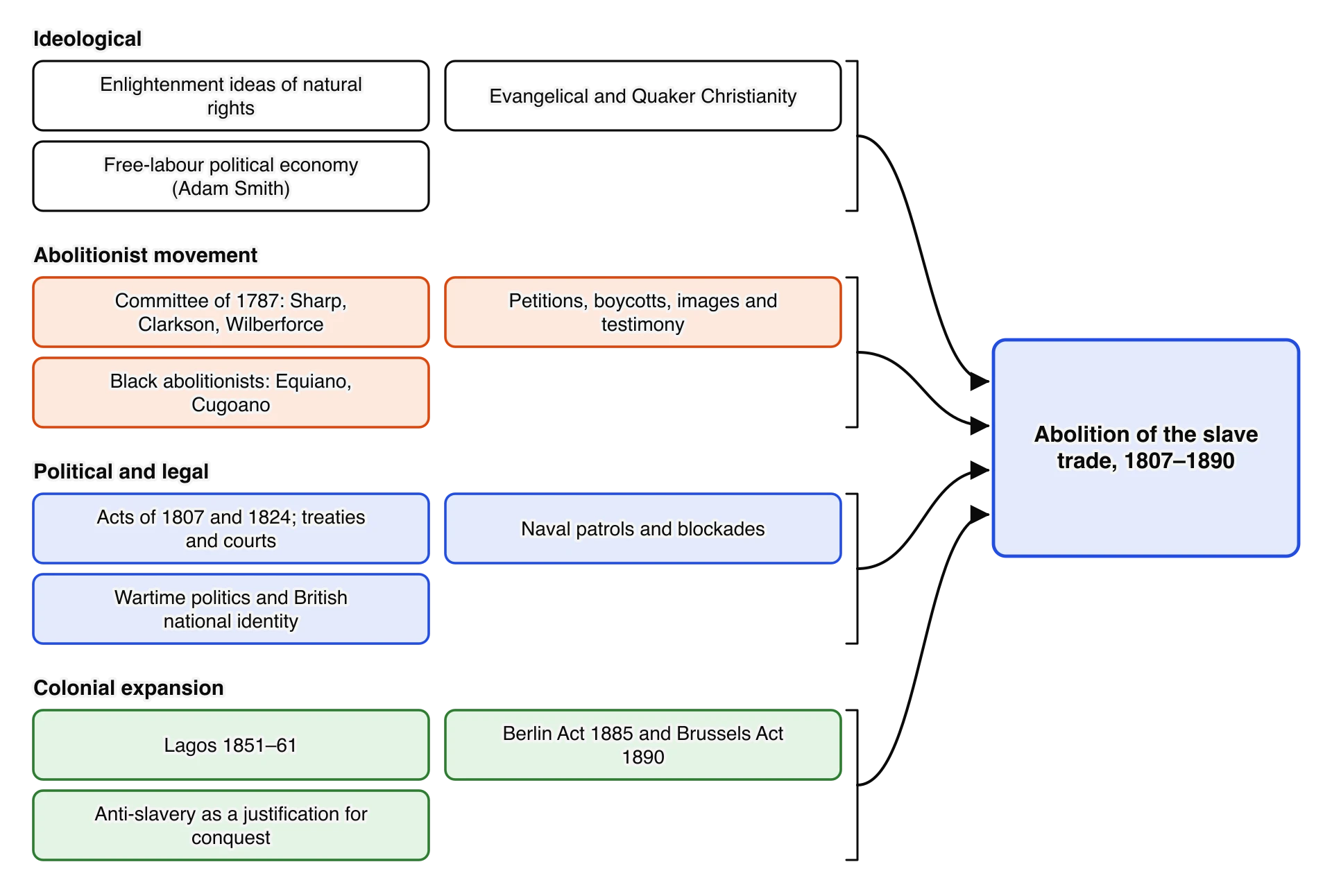
Ideological factors
Before the mid-eighteenth century few Europeans questioned the slave trade. Three sets of ideas changed this. Enlightenment writers such as Montesquieu (The Spirit of the Laws, 1748) attacked slavery as contrary to reason and natural rights, and the revolutions in America (1776) and France (1789) declared that all men were born free and equal, which made the contradiction with slavery harder to ignore. In France the Société des Amis des Noirs (1788) campaigned against the trade.
Religion was even more important in Britain and North America. Quakers, who believed in the spiritual equality of all people, were the first organised opponents: Pennsylvania Quakers disowned members who traded in slaves from 1758, and London Quakers petitioned Parliament against the trade in 1783. In the 1780s evangelical Anglicans, including William Wilberforce, who underwent a religious conversion in 1785, came to see the trade as a national sin for which Britain would be judged. Methodists, led by John Wesley (Thoughts upon Slavery, 1774), took the same view.
A third strand was economic and legal. Adam Smith's argument that free labour was more efficient than slave labour suggested that abolition need not ruin Britain. In the Somerset case of 1772, the judge Lord Mansfield ruled that James Somerset, an enslaved man brought to England from Boston, could not be forcibly taken out of England to be sold. The ruling was narrower than many believed, but it was widely understood to mean that slavery had no basis in English law, and it encouraged campaigners such as Granville Sharp, who had brought the case.
The role of the abolitionist movement
On 22 May 1787 twelve men, nine of them Quakers, founded the Society for Effecting the Abolition of the Slave Trade in London. They chose to campaign against the trade, not slavery itself, because they believed it was more likely to win support and that ending the supply of new captives would force planters to treat the enslaved better. Granville Sharp chaired the committee; Thomas Clarkson travelled to Bristol and Liverpool to gather evidence from sailors, ship's surgeons and customs records; William Wilberforce, MP for Yorkshire, led the campaign in Parliament.
The movement was one of the first national campaigns of public opinion. Local committees organised petitions: more than 100 reached Parliament in 1788, and in 1792 more than 500 petitions carried an estimated 400,000 signatures. In 1791–1792 many families stopped buying slave-grown sugar. Campaigners used images and testimony to make the suffering of the trade visible to people who never saw it.
Campaigners also mass-produced images. The emblem designed for the potter Josiah Wedgwood in 1787, a kneeling African in chains asking "Am I not a man and a brother?", and the plan of the Liverpool slave ship Brookes, packed with rows of captives, were reproduced on posters, in books and on household objects. They won mass sympathy, but both presented Africans as passive sufferers waiting for British rescue, not as people who resisted.
Black writers and activists added testimony that white campaigners could not. Ottobah Cugoano, kidnapped from the Gold Coast, published Thoughts and Sentiments on the Evil and Wicked Traffic of the Slavery and Commerce of the Human Species (1787), which demanded the abolition of slavery itself. Olaudah Equiano's Interesting Narrative (1789) went through nine editions in his lifetime, and he toured Britain speaking against the trade. Together with other Black Londoners they wrote public letters as the "Sons of Africa".
Parliamentary success came slowly. Wilberforce's first motion was debated in 1789, and in 1791 the Commons rejected abolition by 163 votes to 88. In 1792 the Commons voted for "gradual" abolition, but the House of Lords delayed it, and the war with revolutionary France from 1793 made reform look dangerous: the slave revolution in Saint-Domingue and the radicalism of the French Revolution allowed opponents to link abolition with disorder. The Dolben Act of 1788, which limited the number of captives a ship could carry relative to its size, was the only early gain.
Political and legal factors: the Acts of 1807 and 1824
The breakthrough came in 1806–1807, through political tactics as much as moral argument. In 1806 the lawyer James Stephen proposed a bill to ban British ships from supplying captives to foreign colonies and to territories conquered from France, which could be presented as a patriotic war measure. Its passage showed that abolition could win a majority. After the death of the Prime Minister, William Pitt, a new government under Lord Grenville, with Charles James Fox as Foreign Secretary, both committed abolitionists, brought in a full bill. It passed the Commons by 283 votes to 16 and received royal assent on 25 March 1807.
That from and after the First Day of May One thousand eight hundred and seven, the African Slave Trade, and all and all manner of dealing and trading in the Purchase, Sale, Barter, or Transfer of Slaves … is hereby utterly abolished, prohibited, and declared to be unlawful …
An Act for the Abolition of the Slave Trade (47 Geo. III, c. 36), section 1, 1807. The wording is a legal prohibition, not a statement of principle: the Act does not mention the rights of Africans or end slavery in the colonies. Its value as evidence lies in its scope, which covered every dealing in slaves "in, at, to or from" Africa by British subjects, and in what it omits, since enslaved people in the British Caribbean remained enslaved until 1834.
The 1807 Act punished offenders only with fines and the confiscation of ships, so some British traders continued under foreign flags. Parliament made slave trading a felony punishable by transportation in 1811. The Slave Trade Act of 1824 (royal assent 24 June 1824, in force from 1 January 1825) consolidated the laws and declared that British subjects who traded in slaves at sea were guilty of piracy, a crime punishable by death. The death penalty was replaced by transportation for life in 1837, and no British slave trader is known to have been executed under it, but its significance was symbolic and diplomatic: Britain now treated slave trading as a crime against all humanity, like piracy, and pressed other states to do the same.
Abolition in 1807 led to the abolition of slavery itself within a generation. Campaigners found that ending the trade had not improved conditions on the plantations, and the Anti-Slavery Society, founded in 1823, campaigned for emancipation. After the Jamaican rising of 1831–1832 and the reform of Parliament in 1832, the Slavery Abolition Act of 1833 freed enslaved people in most British colonies from 1 August 1834, subject to a period of "apprenticeship" that ended in 1838, and paid £20 million in compensation to slave-owners, nothing to the enslaved.
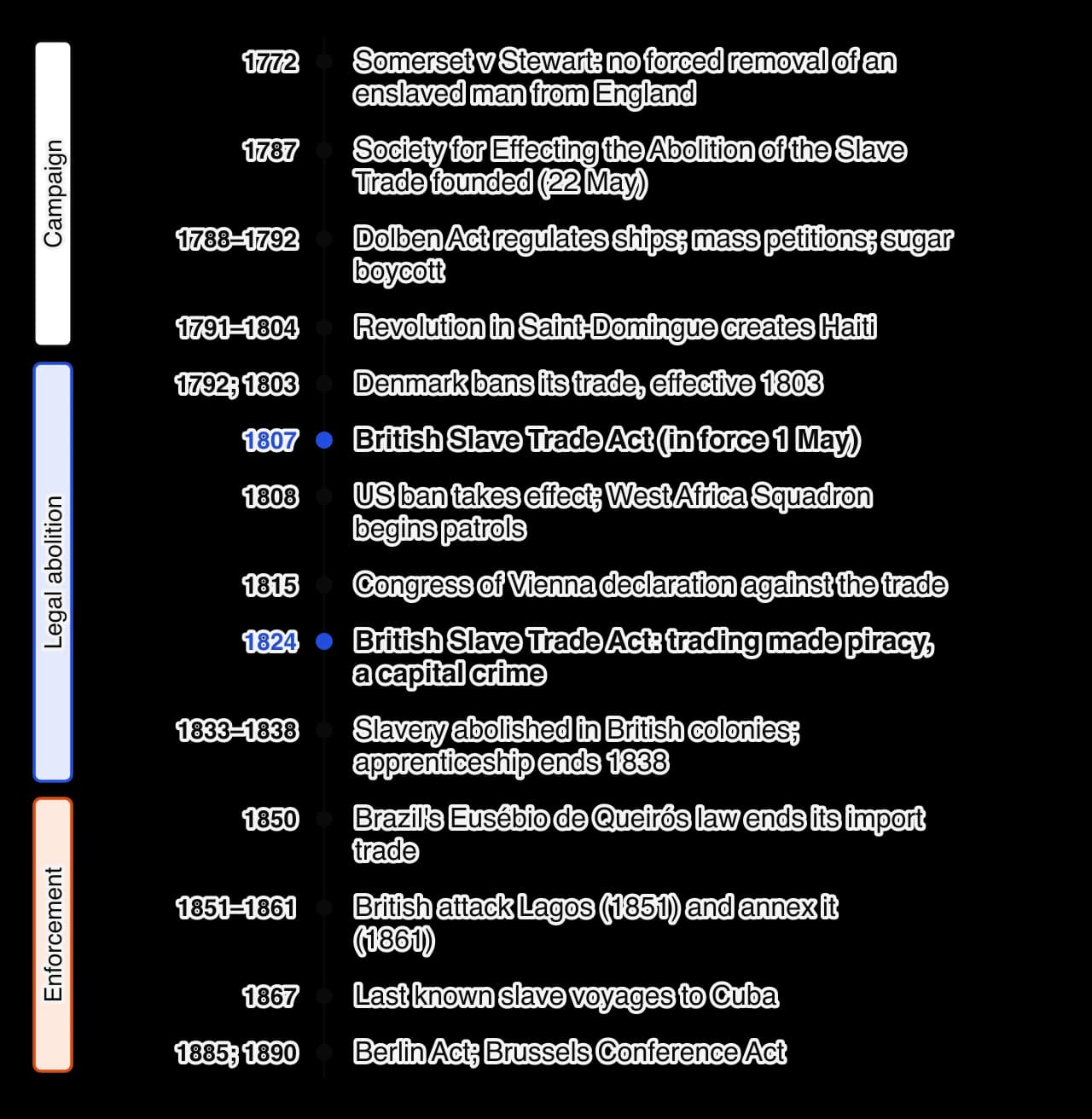
Enforcing abolition: treaties, courts and navies
Britain then tried to end the trade of other nations. Denmark had banned its trade in 1792 (effective 1803) and the USA from 1808, but Portugal, Spain, France and Brazil continued. British governments used diplomacy, money and force. At the Congress of Vienna in 1815 the great powers declared the trade "repugnant to the principles of humanity", but they agreed no means of enforcing this. Britain signed bilateral treaties instead: Spain agreed in 1817 to end its trade by 1820 in return for £400,000; Portugal agreed to limit its trade to the south of the equator. Later treaties allowed British warships to search and seize suspected slave ships, and "equipment clauses", such as the one in the Anglo-Spanish treaty of 1835, allowed ships to be seized if they carried shackles, extra water casks or slave decks, even with no captives on board.
The West Africa Squadron of the Royal Navy, based at Freetown from 1808, patrolled the coast. By 1860, on the figures usually cited from Royal Navy records, it had captured about 1,600 slave ships and freed about 150,000 Africans, who were taken before the courts at Freetown. This was a small share of the people carried in the same period, and the squadron was often short of ships, but its presence raised the risks and costs of the trade. The decisive step was the closing of the Brazilian market. In 1850, after the Royal Navy began seizing slave ships inside Brazilian ports, Brazil passed the Eusébio de Queirós law and enforced it; imports to Brazil collapsed within two years. Cuba's trade ended in the late 1860s, after the USA agreed to joint searches of US-flagged ships in 1862.
The trades of the Ottoman Empire and Egypt were restricted later and less completely. The Ottoman government banned the Black Sea trade in Circassian and Georgian captives in 1854–1855 and the trade in Black Africans across most of the empire by a decree (ferman) of 1857, though not in the Hejaz, the province containing Mecca and Medina, where opposition was strong. Britain signed slave-trade conventions with Egypt in 1877 and with the Ottoman Empire in 1880, and an Ottoman law of 1889 laid down penalties for slave trading. Domestic slavery remained legal.
The expansion of European colonialism
From the 1850s the suppression of the slave trade became linked to the expansion of European power in Africa. In December 1851 the Royal Navy attacked Lagos, removed its ruler Kosoko, a supporter of the slave trade, and installed his rival Akitoye, who signed an anti-slave-trade treaty; in 1861 Britain annexed Lagos as a colony. The intervention was justified as anti-slavery, but it also served British trading interests and opened the route inland to the palm oil producers.
During the European partition of Africa (the "Scramble for Africa") in the 1880s and 1890s, anti-slavery became one of the main arguments for colonial rule. The General Act of the Berlin Conference (1885) committed the colonial powers to help suppress the slave trade, and the Brussels Conference Act of 1890 set out a full programme against the trade in Africa and the Indian Ocean, including restrictions on the import of firearms. Campaigns against "Arab slavers" in East and Central Africa, such as the Congo Free State's war against Zanzibari traders in 1892–1894, served colonial conquest as well as abolition. In the history of the slave trade, the partition mattered as the means by which the trades were finally ended.
Once in power, colonial governments ended the slave trade but often moved slowly against slavery itself, because they relied on the cooperation of slave-owning chiefs and feared the economic disruption of mass emancipation. In Zanzibar the legal status of slavery was abolished only in 1897, on the Kenyan coast in 1907, in Northern Nigeria in 1901 (with slavery itself outlawed only in 1936) and in the Sierra Leone protectorate in 1928. For many enslaved people in Africa, freedom came through their own decisions to leave their masters, often decades after the export trade had ended.
Perspectives and debates
The history of the African slave trades has been argued over since the trade itself: slave traders, abolitionists, African rulers and the enslaved all described it differently. Since the 1940s, historians have debated four main questions: how many people were taken, who was responsible, what the trade did to Africa, and why it was abolished.
How many people were taken?
Until the 1960s, writers gave figures of 15 to 50 million people taken in the Atlantic trade, often without evidence. Philip Curtin (The Atlantic Slave Trade: A Census, 1969) built the first careful estimate from published shipping and import records and concluded that about 9.6 million Africans had landed in the Americas. Joseph Inikori and others argued that Curtin had missed much of the illegal and undocumented trade and that the true figure was higher. The Trans-Atlantic Slave Trade Database, first published in 1999 and expanded online since 2008, confirmed that Curtin was close in method but low in total: its estimate of about 12.5 million embarked and 10.7 million landed is now the standard figure. The debate shows how new evidence, in this case tens of thousands of individual voyage records, changes historians' conclusions.
Who was responsible, and how much power did Africans have?
Walter Rodney, a Guyanese historian who taught in Tanzania, argued in How Europe Underdeveloped Africa (1972) that the trade was imposed on Africa by European capitalism. African rulers who took part did so on unequal terms, and the trade drained Africa's labour, distorted its economies and benefited Europe. John Thornton (Africa and Africans in the Making of the Atlantic World, 1992) argued instead that African states were militarily and politically strong in the sixteenth and seventeenth centuries, that Europeans could not force them to sell, and that African elites chose to trade in captives because slavery was already a legal and widespread institution in their societies.
Paul Lovejoy's transformation thesis takes a middle position: slavery existed before the Atlantic trade, but the trade transformed it. Most historians now accept that African rulers and merchants controlled supply on most of the coast, while stressing that this does not make "Africa" responsible as a whole. The people who were captured, and the communities that were raided, had no say in the trade, and European demand, credit and shipping created a market on a scale that had never existed before.
What was the impact on Africa?
J. D. Fage (1969) argued that the demographic and economic effects of the trade were limited and that some West African states benefited. Rodney and Inikori argued that the trade was the main cause of Africa's economic backwardness relative to Europe. Patrick Manning's demographic model (1990) supported a large population loss in the worst-affected regions, and Nathan Nunn's statistical study (2008) linked the intensity of slave exports to lower incomes today. Critics of the "underdevelopment" view, such as David Eltis, argue that Africa's Atlantic trade was small relative to the size of its economies and that internal factors and later colonial rule mattered more.
Why was the slave trade abolished?
This is the longest-running debate. For a century after 1807, British writers presented abolition as a moral triumph led by Wilberforce and the "Saints", a story that flattered British national pride. Eric Williams (Capitalism and Slavery, 1944) overturned it: the British Caribbean was in economic decline, industrial capitalists wanted free trade, and humanitarians succeeded only because economic interests had already turned against slavery. Roger Anstey (The Atlantic Slave Trade and British Abolition, 1760–1810, 1975) restored the role of ideas, showing how evangelical theology and skilful parliamentary tactics, such as the 1806 Foreign Slave Trade Act, produced abolition.
Seymour Drescher (Econocide, 1977; Abolition, 2009) undermined the economic case by showing that the slave colonies were growing in value in 1807, so abolition cost Britain money; he stressed the mass popular movement of petitions and boycotts. Christopher Leslie Brown (Moral Capital, 2006) argued that the loss of the American colonies in 1783 led British elites to look for a way to restore national virtue, and abolition gave Britain "moral capital". Historians of the Caribbean, such as Hilary Beckles, and earlier C. L. R. James (The Black Jacobins, 1938), add a further perspective: the resistance of the enslaved, from the Haitian Revolution to the Jamaican rising of 1831–1832, forced the issue on reluctant governments.
Historian | Work | Argument | Evidence stressed |
|---|---|---|---|
Eric Williams | Capitalism and Slavery (1944) | Economic: abolition followed the decline of the West Indian economy and the rise of industrial capitalism | Falling sugar profits; planter debt; free-trade interests |
Roger Anstey | The Atlantic Slave Trade and British Abolition (1975) | Religious and political: evangelical conviction and parliamentary tactics | Theology of the Clapham Sect; the 1806 Act as a tactical step |
Seymour Drescher | Econocide (1977); Abolition (2009) | Abolition happened when slavery was profitable, so moral and popular pressure was decisive | British trade statistics; petitions of 1788 and 1792 |
Christopher L. Brown | Moral Capital (2006) | Abolition restored British national virtue after the loss of America | Political culture after 1783 |
C. L. R. James; Hilary Beckles | The Black Jacobins (1938); works on Caribbean resistance | The resistance of the enslaved forced abolition | Saint-Domingue 1791–1804; Caribbean revolts |
Most historians now combine these views. Economic change made abolition affordable and supplied an alternative trade; religious ideas and a popular movement created the political will; wartime politics and parliamentary tactics produced the timing in 1806–1807; resistance by the enslaved raised the costs of slavery and the fear of revolt; and British naval and colonial power explain how the trades of other nations and of African states were ended over the following eighty years.
The East African trade
Historians of East Africa debate how far the expansion of slavery was driven from outside. Abdul Sheriff (Slaves, Spices and Ivory in Zanzibar, 1987) explains the rise of Zanzibar as part of the integration of East Africa into an expanding world capitalist economy, with Indian financiers and Western demand for ivory and cloves as the driving forces. Frederick Cooper (Plantation Slavery on the East Coast of Africa, 1977) focuses on the plantations themselves and the relationships between owners and the enslaved, showing that coastal slavery combined harsh exploitation with paternalist ties and Islamic ideas of obligation. Both reject the older view, common in British colonial writing, that the trade was simply the work of "Arab slavers" from which Britain rescued Africa, a view that served to justify colonial rule.
Applying the ideas in exam questions
Paper 3: responsibility for the expansion of the Atlantic trade
Paper 3: the expansion of slavery in East Africa
Paper 3: resistance by enslaved people
Paper 3: the reasons for abolition
Paper 3: legitimate commerce
Self-check
- To do:
I can give the main estimates of the scale of the Atlantic and eastern slave trades, with their sources, and explain why the eastern figures are less certain.
- To do:
I can explain how maritime commerce and plantation agriculture led to the expansion of the Atlantic trade.
- To do:
I can explain how African states responded to European demand, with examples of regulation (Kongo, Benin) and expansion (Dahomey, Asante, Oyo, the Aro).
- To do:
I can explain how warfare, raiding, kidnapping and judicial enslavement produced captives, and the debate about the gun–slave cycle.
- To do:
I can explain why slavery expanded in East Africa from the late eighteenth century: the existing Middle Eastern trade, Omani expansion, Zanzibar and its clove plantations, and the limits of British control.
- To do:
I can describe the demographic, economic and social impact of the slave trades on Africa and weigh the views of Fage, Manning, Rodney, Lovejoy and Nunn.
- To do:
I can assess how far the trade strengthened African states, using Dahomey as a case study and comparing other states.
- To do:
I can describe and assess day-to-day resistance, rebellions, escape and maroon communities, and legal and political resistance in Africa.
- To do:
I can explain the economic reasons for the decline of the trade: industrialisation, legitimate commerce, the need for labour in Africa and arguments about the productivity of slave labour.
- To do:
I can explain the ideological, political and legal reasons for abolition, including the 1807 and 1824 Slave Trade Acts and the role of the abolitionist movement.