Notes on R1.2 Pre-colonial sub-Saharan African states (circa 800–1945)
A state is a political community in which a central authority makes laws, collects revenue and claims the right to use force over a defined population and territory. In sub-Saharan Africa such states ranged from the gold-trading empires of the West African savanna, known to Arab writers from the eighth century, to the Ethiopian empire, which defeated an Italian invasion in 1896 and regained its independence in 1941.
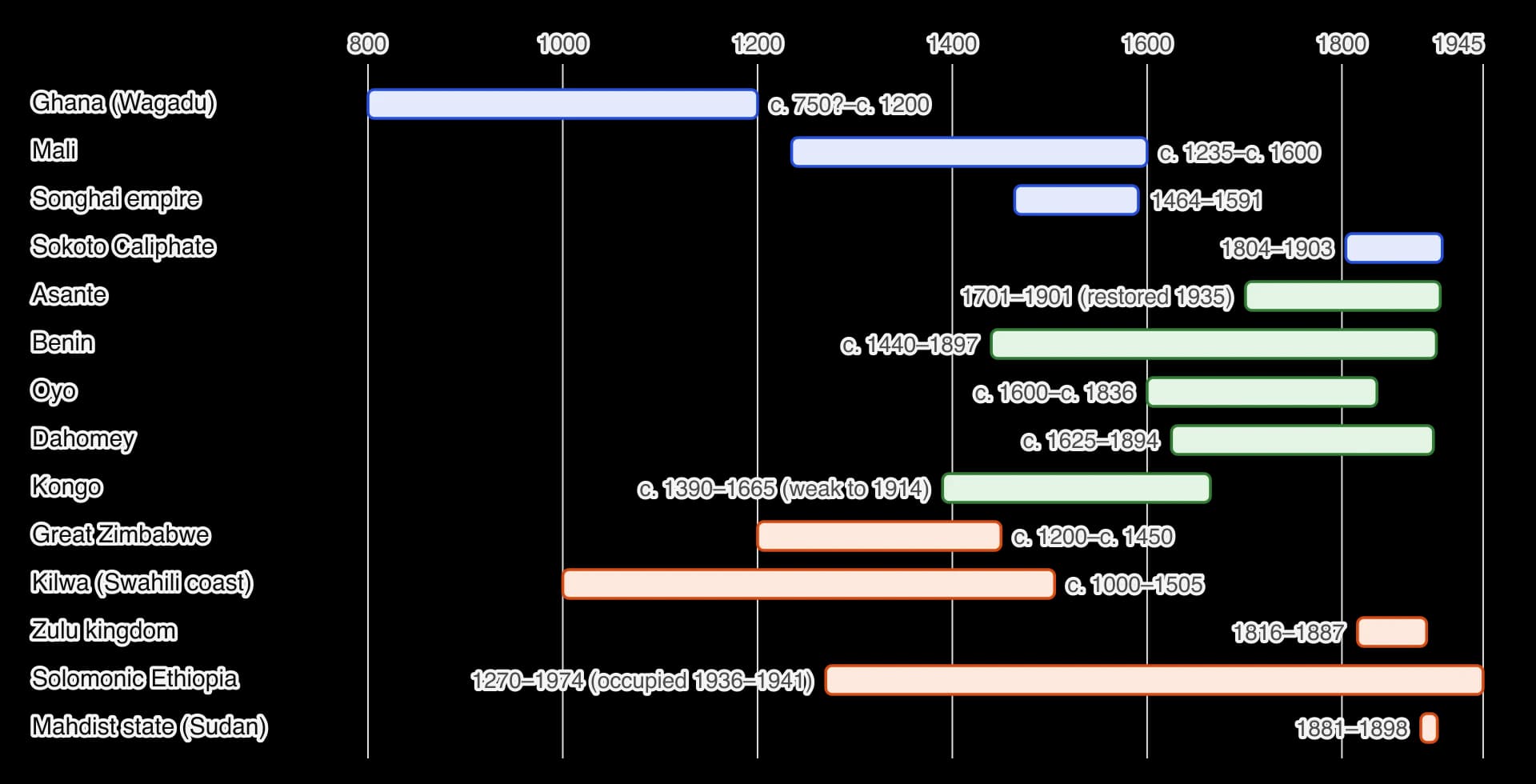
The chart of the lifespans of the main states shows two clusters. The first, from about 800 to 1600, is dominated by the empires of the West African savanna (Ghana, Mali and Songhai), by the Swahili towns and Great Zimbabwe in the east and south, and by the Solomonic monarchy in Ethiopia. The second, from about 1700 to the European conquest, includes Asante, Dahomey, the Zulu kingdom, the Sokoto Caliphate and the reunified Ethiopian empire. Kongo, Benin and Oyo bridge the two.
States, peoples and evidence in pre-colonial Africa
Kinds of political community
Not every African society was organised as a state. Many people lived in stateless societies, such as the Igbo of south-eastern Nigeria or the Tiv, where order was kept by lineage elders, age-grades, councils and religious authorities rather than by a king and his officials. Historians no longer treat these societies as "primitive" but as a different way of keeping order. They often traded with states and resisted their attempts at conquest.
Among the states themselves, four broad types appear in the study:
Type | Main source of power | Examples |
|---|---|---|
Savanna trading empire | Control of the trans-Saharan trade routes and markets; cavalry; tribute from conquered peoples | Ghana, Mali, Songhai, Kanem-Bornu |
Forest and coastal kingdom | Gold, kola and, from the 1500s, the Atlantic trade; firearms; a strong capital and court | Asante, Benin, Dahomey, Oyo (savanna edge), Kongo |
Military kingdom built by conquest | New military organisation and a ruler who absorbed defeated chiefdoms | Zulu kingdom, Ndebele, Samori's Wassoulou empire |
Religious state | A reform movement or ancient church that gave the ruler legitimacy | Sokoto Caliphate, the Mahdist state in Sudan, Christian Ethiopia |
The categories overlap. Mali was a trading empire whose rulers were Muslims; Asante was a forest kingdom built by conquest; Ethiopia combined an ancient church with a plough-farming economy and, in the nineteenth century, a modern army. The types are useful for comparison, but each state has to be explained on its own terms.
How historians know: the sources
The evidence for African states before about 1500 comes from three kinds of source, each with its own strengths and limits.
Arabic writers. Geographers and travellers from North Africa and the Middle East described the savanna states: al-Bakri on Ghana (completed in 1068), al-'Umari on Mali (1330s), Ibn Battuta, who visited Mali in 1352–1353, and Ibn Khaldun (late fourteenth century). Most of them, al-Bakri included, never crossed the Sahara and relied on merchants' reports; all wrote as Muslims judging societies by Islamic standards.
Archaeology. Excavations at Koumbi Saleh (probably Ghana's capital), Jenne-jeno, Great Zimbabwe, Kilwa and Igbo-Ukwu show towns, trade goods and craft production that no written source records. Archaeology dates and measures but rarely explains why people acted as they did.
Oral tradition. Many states kept their history in the memory of professional specialists. In the Mande world these were the griots (jeli), hereditary bards attached to royal families, who recited genealogies, praise poems and epics such as the epic of Sunjata, the founder of Mali.
From the fifteenth century onwards these are joined by European accounts (Portuguese chroniclers in Kongo, Dutch and British traders on the Gold Coast, missionaries and explorers) and, from the sixteenth century, by African chronicles in Arabic, such as the Tarikh al-Sudan and Tarikh al-Fattash written in Timbuktu in the 1600s, and by Ethiopian royal chronicles in Ge'ez.
Since time immemorial the Kouyatés have been in the service of the Keita princes of Mali; we are vessels of speech, we are the repositories which harbour secrets many centuries old. … I will give you my father's words just as I received them; royal griots do not know what lying is.
Djeli Mamoudou Kouyaté, griot of Keyla, in D. T. Niane, Sundiata: An Epic of Old Mali, recorded in Guinea in the 1950s and translated by G. D. Pickett, 1965. The griot claims an unbroken, faithful line of transmission from the thirteenth century. His family's place depended on its service to the Keita dynasty, so the epic glorifies Sunjata and explains the order of Mali's society as it existed when it was told. Historians use it for Mande ideas of kingship and for the outline of Mali's founding, which Arabic writers partly confirm, but not for exact events or dates.
Emergence and consolidation of the state
No single cause explains why states formed where and when they did. Historians group the explanations as political, military, social and economic, and the balance between them differs from one state to the next. A state also had to be consolidated: conquests had to be turned into lasting rule, with an ideology that persuaded people to obey, institutions that outlived the founder and a way of absorbing conquered peoples.
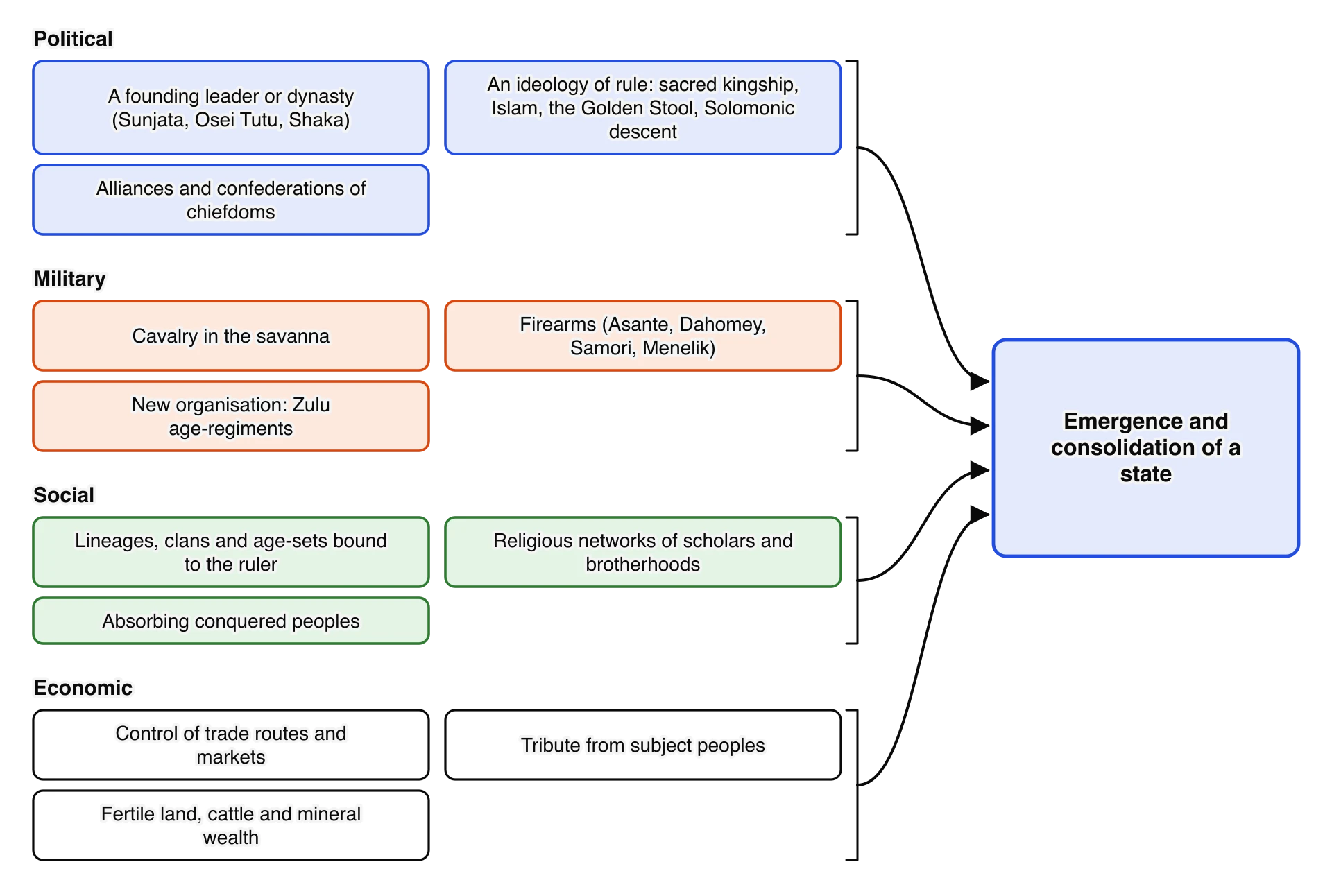
The diagram of factors in the emergence of states groups the causes that recur across the period. The savanna empires grew mainly from the control of trade, the Zulu kingdom from military reorganisation in a time of crisis, and Sokoto and the Mahdist state from religious revolution, but in every case several factors worked together.
Ghana (Wagadu), c. 750–c. 1200
Ghana was the first West African state known to outside writers. Its people were the Soninke, who called their state Wagadu; "ghana" was one of the titles of its king, which Arab writers used as the name of the country. It lay in the dry Sahel north of the upper Senegal and Niger rivers, in what is now south-eastern Mauritania and western Mali. An Arab geographer of the late eighth century, al-Fazari, already described it as a land of gold.
Ghana's rise rested on its position between two zones that needed each other. To the north lay the Sahara, with its salt mines and the Berber merchants who crossed it with camels; to the south lay the goldfields of Bambuk and Bure, worked by Mande-speaking miners. The kings of Ghana did not control the goldfields directly, but they controlled the markets where gold was exchanged for salt, copper, cloth and horses, and they taxed every load that passed through. Iron weapons, horses and the ability to raise a large army allowed the kings to force neighbouring chiefdoms to pay tribute.
Ghana's kings were not Muslims, but they used Muslim merchants and scholars as advisers, interpreters and treasury officials, because they could read and write Arabic and had contacts across the Sahara. The capital, probably the site of Koumbi Saleh in Mauritania, had two towns: a merchants' town with mosques and a royal town with the king's palace and the sacred groves of the royal cult. This arrangement allowed the king to profit from Islam's commercial network without abandoning the religion on which his own authority rested.
Mali under Sunjata and his successors, c. 1235–1360
After Ghana's decline in the twelfth century, the Sosso kingdom under Sumaoro Kanté took over much of its territory. Mali emerged from the struggle against Sosso. Its founder, Sunjata Keita, was a prince of the Malinke (Mande) chiefdoms of the upper Niger. According to oral tradition he united several Mande chiefdoms and defeated Sumaoro at the battle of Kirina, around 1235. The tradition also describes an assembly at Kurukan Fuga where the clans of the new empire were given their roles: some as warriors, some as griots, smiths or traders. Historians treat the details of the assembly with caution, but it shows how Mali was remembered as a federation of clans under one ruler.
Sunjata's successors turned a war coalition into an empire. Mali's rulers took direct control of the goldfields of Bure and Bambuk, which Ghana had never done, and expanded west to the Atlantic and east along the Niger bend. Under Mansa Musa (r. c. 1312–1337) Mali reached its greatest extent, taking in Timbuktu and Gao. Al-'Umari, writing in Cairo in the 1330s, described an empire that took a year to cross and was divided into provinces under governors and tributary kings.
Mali was consolidated by several factors working together. It controlled the gold supply as well as the trade routes; it had a large army with a cavalry wing; its rulers used both the Mande religious traditions of their subjects and Islam, which linked them to North African merchants and scholars; and it absorbed conquered chiefdoms by leaving local rulers in place as long as they paid tribute.
 YouTube
Songhai, 1464–1591
Songhai grew from the kingdom of Gao on the eastern bend of the Niger, which had been a tributary of Mali in the fourteenth century. Sunni Ali (r. 1464–1492) turned it into an empire. A soldier-king who used cavalry on land and a fleet of war canoes on the river, he took Timbuktu from the Tuareg in 1468 and Jenne after a long siege in the early 1470s. Muslim chroniclers in Timbuktu remembered him as a tyrant because he persecuted the town's scholars, whom he suspected of supporting his enemies, and because he kept the rituals of the Songhai royal cult.
After Sunni Ali's death, one of his generals, Muhammad Ture, overthrew his son in 1493 and founded the Askia dynasty. Askia Muhammad (r. 1493–1528) consolidated the state on different foundations. He made the pilgrimage to Mecca in 1496–1497, where he was recognised as the caliph's deputy for West Africa, and he ruled with the advice of the scholars of Timbuktu. Islam gave him a source of legitimacy that did not depend on the old royal family, and the scholars gave him administrators and judges. He also created a permanent professional army and pushed the empire's borders to the Hausa cities in the east and the Sahara in the north.
Kongo, c. 1390–1542
The kingdom of Kongo lay south of the lower Congo river, in what is now northern Angola and the western Democratic Republic of the Congo. According to Kongo tradition it was founded in the late fourteenth century by Lukeni lua Nimi, who crossed the river from the north and conquered the plateau around Mbanza Kongo. The new rulers married into local lineages and won the support of the earth-priests of the region, so the conquest became an alliance.
The kingdom grew by drawing neighbouring provinces (Soyo, Mbamba, Mpemba, Nsundi, Mpangu and Mbata) under the rule of the king, the manikongo, who appointed their governors. The king controlled the main currency, the nzimbu shells collected on Luanda island, and received tribute in raffia cloth, food and labour. When the Portuguese arrived in 1483, Kongo was already a centralised kingdom of several hundred thousand people, and its rulers saw the newcomers as allies who could strengthen royal power.
King Nzinga a Nkuwu was baptised as João I in 1491. His son Afonso I (Mvemba a Nzinga, r. 1509–1542) won a succession war against a half-brother with Christian support and then built a Catholic monarchy: he sent young nobles to study in Lisbon, his son Henrique became a bishop in 1518, and churches and schools were built in the capital, renamed São Salvador. Christianity gave the king a new ideology and a link to Portugal and the papacy, and it was used to strengthen the centre against provincial rivals.
Asante, c. 1680–1750
Asante emerged in the forest of what is now central Ghana, a region rich in gold and kola nuts. In the late seventeenth century several Akan chiefdoms around Kumasi, led by the Oyoko clan, were tributaries of the stronger state of Denkyira. Osei Tutu, the chief of Kumasi (d. c. 1717), united them into a confederation with the help of the priest Okomfo Anokye.
According to Asante tradition, Okomfo Anokye called down a golden stool from the sky, which landed on Osei Tutu's knees. The Golden Stool was declared to hold the sunsum (soul) of the whole Asante nation; the chiefs buried their old stools, the symbols of their separate authority, and swore loyalty to the new one. This gave the confederation an ideology of unity that rose above the separate chiefdoms. The Asantehene (king of Asante) ruled as the occupant of the Golden Stool, not as the head of one clan.
The new union won its independence by defeating Denkyira at the battle of Feyiase in 1701. Victory brought control of the trade routes to the coast, including the Dutch fort at Elmina, and access to European firearms. Under Osei Tutu's successor Opoku Ware (r. c. 1720–1750) Asante expanded in every direction, conquering Bono, Akyem and, in the north, Gonja and Dagomba, which became tributaries. By the end of the eighteenth century Asante ruled most of modern Ghana and parts of Côte d'Ivoire and Togo.
 YouTube
The Zulu kingdom and the Mfecane, c. 1816–1840
In the late eighteenth century the land between the Drakensberg mountains and the Indian Ocean, in what is now KwaZulu-Natal in South Africa, was divided among many small Nguni-speaking chiefdoms. Several pressures pushed them into larger units: population growth, competition for good grazing land, a severe drought and famine in the early 1800s, and a growing trade in ivory and cattle with the Portuguese port at Delagoa Bay. Two large confederations, the Mthethwa under Dingiswayo and the Ndwandwe under Zwide, emerged first.
Shaka, a son of the chief of the small Zulu chiefdom, served in Dingiswayo's army and took over the Zulu with Mthethwa support around 1816. When Zwide killed Dingiswayo, Shaka took over the Mthethwa following, defeated the Ndwandwe in 1818–1819 and built a kingdom between the Thukela and Phongolo rivers. He incorporated defeated chiefdoms by placing their young men in his own regiments and their chiefs under royal supervision.
The Zulu army's strength came from its organisation more than from new weapons. Shaka's regiments were drilled to fight at close quarters with a short stabbing spear (the iklwa) and a large cowhide shield, and to attack in the "bull's horns" formation, in which a central "chest" pinned the enemy while two "horns" encircled it. Because the regiments were loyal to the king rather than to their home chiefdoms, they bound the new kingdom together.

The rise of the Zulu kingdom was part of a wider upheaval known as the Mfecane (in Sesotho, the Difaqane). Defeated groups fled or moved off to conquer others: Mzilikazi's Ndebele went north-west onto the highveld and later into what is now Zimbabwe, Soshangane founded the Gaza kingdom in southern Mozambique, and Sobhuza built the Swazi kingdom. In the mountains to the west, Moshoeshoe gathered refugees at the flat-topped mountain of Thaba Bosiu from 1824 and built the Sotho kingdom, the core of modern Lesotho, by diplomacy and protection more than by conquest. The timeline of the Zulu kingdom shows how quickly the new states formed in the 1820s.
The Sokoto Caliphate, 1804–1817
In the late eighteenth century the Hausa city-states of what is now northern Nigeria (Gobir, Kano, Katsina, Zaria and others) were ruled by kings who were Muslims but who also kept older religious practices, levied heavy taxes on cattle and markets, and sometimes enslaved free-born Muslims. Usman dan Fodio (1754–1817), a Fulani scholar of the Qadiriyya Sufi brotherhood, preached in Gobir from the 1770s against these practices and called for a society governed by Islamic law (sharia).
Usman attracted followers whose grievances differed. Scholars wanted religious reform; Fulani herders resented the cattle tax; Hausa peasants resented taxes and forced labour; some enslaved people hoped for freedom. When the king of Gobir, Yunfa, turned against the community, Usman and his followers withdrew to Gudu in February 1804. Like the Prophet Muhammad's migration from Mecca to Medina, this hijra was followed by a declaration of jihad, and Usman was proclaimed amir al-mu'minin, commander of the faithful.
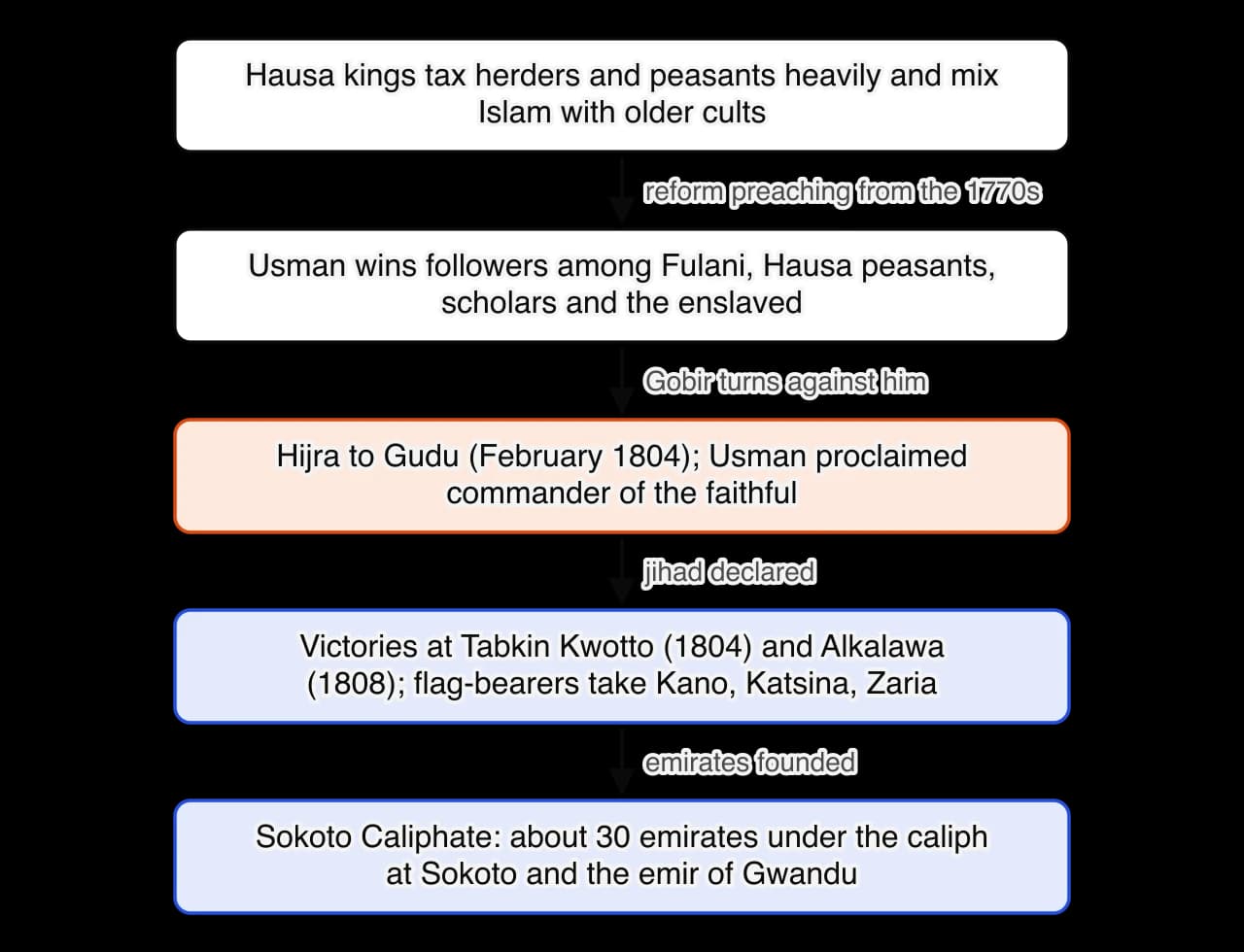
The chain from preaching to caliphate shows how the jihad turned a reform movement into a state. Usman gave flags to local leaders, mostly Fulani scholars, who raised armies and overthrew the Hausa kings: Kano, Katsina and Zaria fell between 1804 and 1809, and the Gobir capital, Alkalawa, was taken in 1808. Each became an emirate under an emir who owed allegiance to the caliph. Usman's son Muhammad Bello founded Sokoto as the capital in 1809 and ruled the eastern emirates, while Usman's brother Abdullahi ruled the western emirates from Gwandu. When Usman died in 1817, Bello became the first sultan of Sokoto. The caliphate, with some thirty emirates and a population of perhaps ten million by the late nineteenth century, was one of the largest states in Africa.
The jihad failed where local rulers had their own Islamic legitimacy. In Bornu, the scholar and general Muhammad al-Kanemi drove back the jihadists after 1808 and wrote to Bello asking how Muslims could make war on fellow Muslims. Their correspondence is one of the best sources for the debate within West African Islam about what made a ruler a true Muslim.
Ethiopia: the Solomonic monarchy and its reunification, 1270–1896
The Christian kingdom of Ethiopia in the northern highlands was the heir of Aksum, whose king Ezana had adopted Christianity in the fourth century. In 1270 a noble from Amhara, Yekuno Amlak, overthrew the Zagwe dynasty and founded the Solomonic dynasty, which claimed descent from King Solomon of Israel and the Queen of Sheba. The claim was set out in the Kebra Nagast ("Glory of the Kings"), compiled in the early fourteenth century, which made the emperor the divinely chosen ruler of a new Israel. The Ethiopian Orthodox Church, with its monasteries and land, became the dynasty's main ally.
Solomonic emperors such as Amda Seyon (r. 1314–1344) and Zara Yaqob (r. 1434–1468) expanded the empire south and east against Muslim sultanates and strengthened the Church. The empire survived the great invasion of Imam Ahmad ibn Ibrahim, known as Gragn ("the left-handed"), of the sultanate of Adal between 1529 and 1543, but only with Portuguese help. From the 1630s the emperors ruled from Gondar, and from 1769 they lost real power to regional lords in the period called the Zemene Mesafint ("Era of the Princes").
Three nineteenth-century emperors rebuilt central power, each by force of arms. Tewodros II (r. 1855–1868), a frontier warlord, defeated the regional lords and was crowned in 1855; he tried to build a salaried standing army, cast his own cannon and limit the Church's land, but provoked rebellions and died at Maqdala in 1868 when a British expedition stormed his fortress. Yohannes IV (r. 1872–1889), from Tigray, used weapons left by the British to defeat his rivals and the Egyptian armies that invaded in 1875–1876, and ruled through a looser alliance in which regional kings accepted his supremacy. Menelik II, king of Shewa and from 1889 emperor, completed the work.
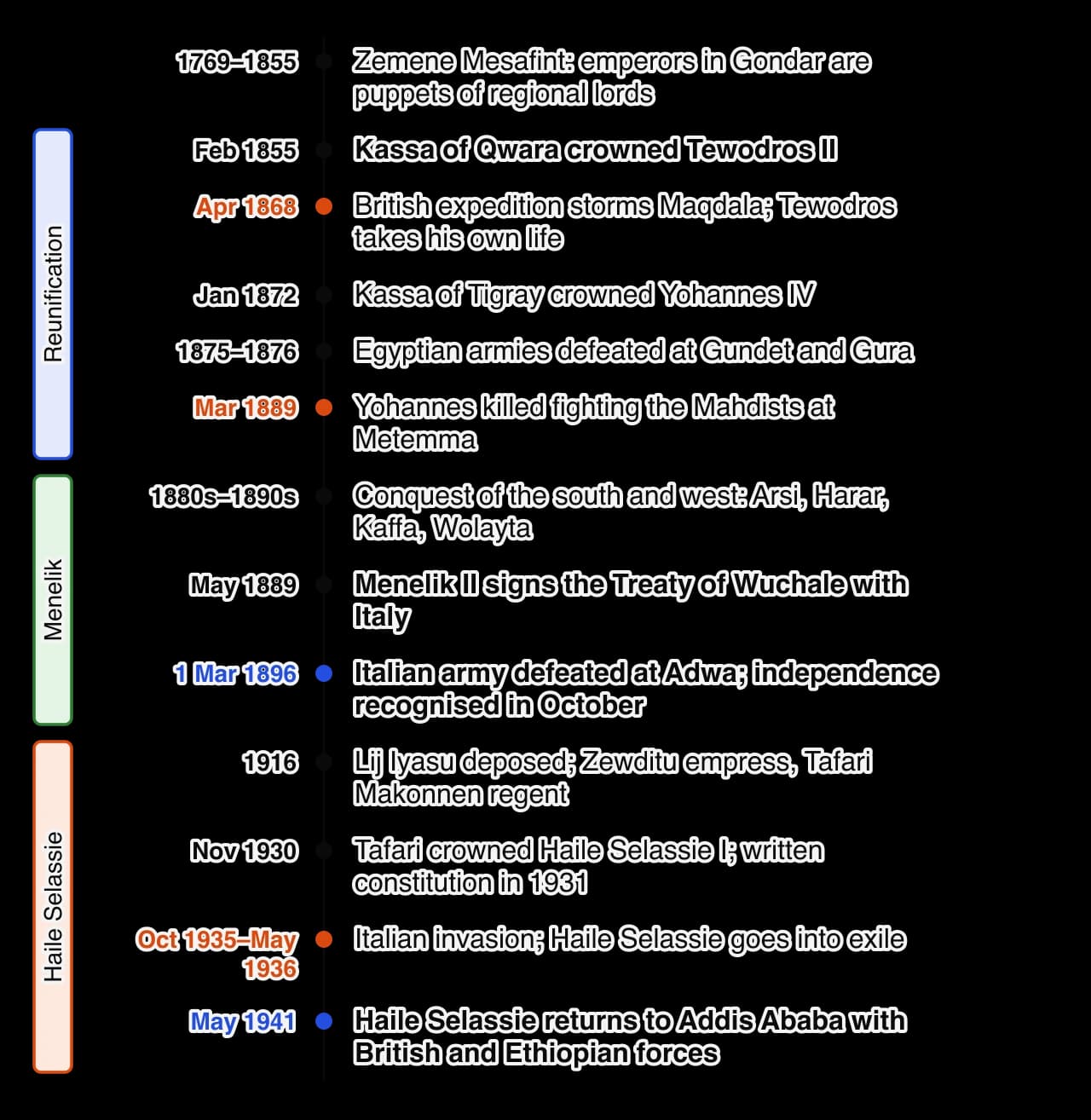
The timeline of Ethiopia from 1855 to 1941 shows that reunification and expansion went together. From the 1870s Menelik's Shewan armies, equipped with tens of thousands of rifles bought from French, Italian and other traders, conquered the Oromo, Sidama, Gurage, Wolayta and Kaffa lands of the south and west, and the emirate of Harar in 1887. The empire roughly doubled in size. The conquered lands supplied the empire with coffee, ivory, gold, musk and enslaved people, and land and tribute to reward Menelik's soldiers. Menelik founded Addis Ababa as his capital in 1886.
Other routes to statehood in the nineteenth century
The nineteenth century saw several new states built by religious leaders and military entrepreneurs, often in response to outside pressure.
The Mahdist state in Sudan (1881–1898). Sudan had been ruled from Egypt since 1821. Heavy taxes, the employment of Christian Europeans such as Charles Gordon as governors, and attempts to suppress the slave trade turned many Sudanese against the regime. In 1881 a Sufi teacher, Muhammad Ahmad, declared himself the Mahdi, the redeemer expected by many Muslims at the end of time. His followers (the Ansar) destroyed an Egyptian army under William Hicks in 1883 and took Khartoum on 26 January 1885, killing Gordon. The Mahdi died in June 1885, and his successor, the Khalifa Abdallahi, ruled until the Anglo-Egyptian conquest at Omdurman in 1898.
Samori Touré's Wassoulou empire (c. 1878–1898). Samori, a Mande trader from what is now Guinea, built an army in the 1860s and from the 1870s created a state on the upper Niger. He took the Muslim title almamy in 1884, organised a professional army of infantry (sofa) with blacksmiths who copied and repaired European rifles, and divided his empire into provinces. Islam gave the multi-ethnic state a common ideology.
Dahomey (c. 1625–1894). The Fon kingdom of Dahomey, inland from the Bight of Benin, expanded to the coast under King Agaja, who conquered Allada in 1724 and Whydah in 1727 to trade directly with European slave traders. It was a tributary of Oyo from the 1730s until King Gezo (r. 1818–1858) ended the payments in the 1820s.
Oyo (c. 1600–1836). The Yoruba kingdom of Oyo, on the savanna north of the forest, built a cavalry empire with horses bought from the north and dominated the region between the Niger and the coast in the eighteenth century.
Comparing the cases shows that the same four kinds of factor worked in different proportions. Trade was decisive for Ghana and important for Mali and Asante; military reorganisation was decisive for the Zulu kingdom and Samori; religion founded Sokoto and the Mahdist state and legitimised Ethiopia's emperors; and every state depended on leaders who could hold a coalition together. Consolidation depended on ideology and institutions: the Golden Stool, the Kebra Nagast, the caliphate and the age-regiments all turned personal conquests into states that survived their founders.
Reasons for the growth of production and trade
Every state in the study rested on farming and herding: millet, sorghum and rice in the savanna, yams and plantains in the forest, cattle in the south and east, and plough-cultivated teff and barley in the Ethiopian highlands. States grew rich when they could add to this base the profits of long-distance trade and the labour of large numbers of people. The growth of production and trade had four sources: valuable commodities, the routes that carried them, productive land and mineral resources, and the mobilisation of labour.
Main commodities
Commodity | Where it came from | Where it went | States that profited |
|---|---|---|---|
Gold | Bambuk, Bure, the Akan forest, the Zimbabwe plateau | North Africa, Egypt and Europe; the Indian Ocean | Ghana, Mali, Songhai, Asante, Great Zimbabwe, Kilwa |
Salt | Saharan mines (Taghaza, Taoudenni); coastal lagoons | Savanna and forest, where it was scarce | Ghana, Mali, Songhai (by taxing it) |
Kola nuts | The forest zone (Asante, Gonja) | Hausa cities and the savanna, where Muslims used them as a permitted stimulant | Asante, the Hausa states and Sokoto |
Ivory | Elephant-hunting regions across the continent | India, Arabia, Europe | Swahili towns, Mutapa, Asante, Ethiopia under Menelik |
Copper | Saharan mines (Takedda) and central Africa | Across West and central Africa, as ornament and currency | Mali, Kongo |
Cloth | Kano dyed cotton, Kongo raffia, Indian and European imports | Regional markets | Sokoto (Kano), Kongo, Swahili towns |
Horses | North Africa and the Sahel | Savanna kingdoms south of the desert | Mali, Songhai, Oyo, Bornu (as buyers) |
Enslaved people | War captives and people seized in raids | North Africa and the Middle East; from the 1500s the Americas | Songhai, Kongo, Dahomey, Asante, Oyo, Sokoto, Ethiopia |
The commodities in the table show that African states exported mostly raw materials and people and imported manufactured goods, horses and luxuries. For centuries this exchange strengthened the rulers who controlled it, because imports such as horses, guns and fine cloth could be given to followers or used in war.
Trade routes: the trans-Saharan trade
Camels, introduced into the Sahara in the first centuries CE, made regular caravans across the desert possible, and the spread of Islam across North Africa after the seventh century created a network of Muslim merchants with shared law, credit and language. From about the eighth century the main western route ran from Sijilmasa in southern Morocco through Taghaza to Awdaghust and the capital of Ghana; later routes ran to Walata, Timbuktu and Gao, and further east from Tripoli and Tunis to Kano and Bornu.
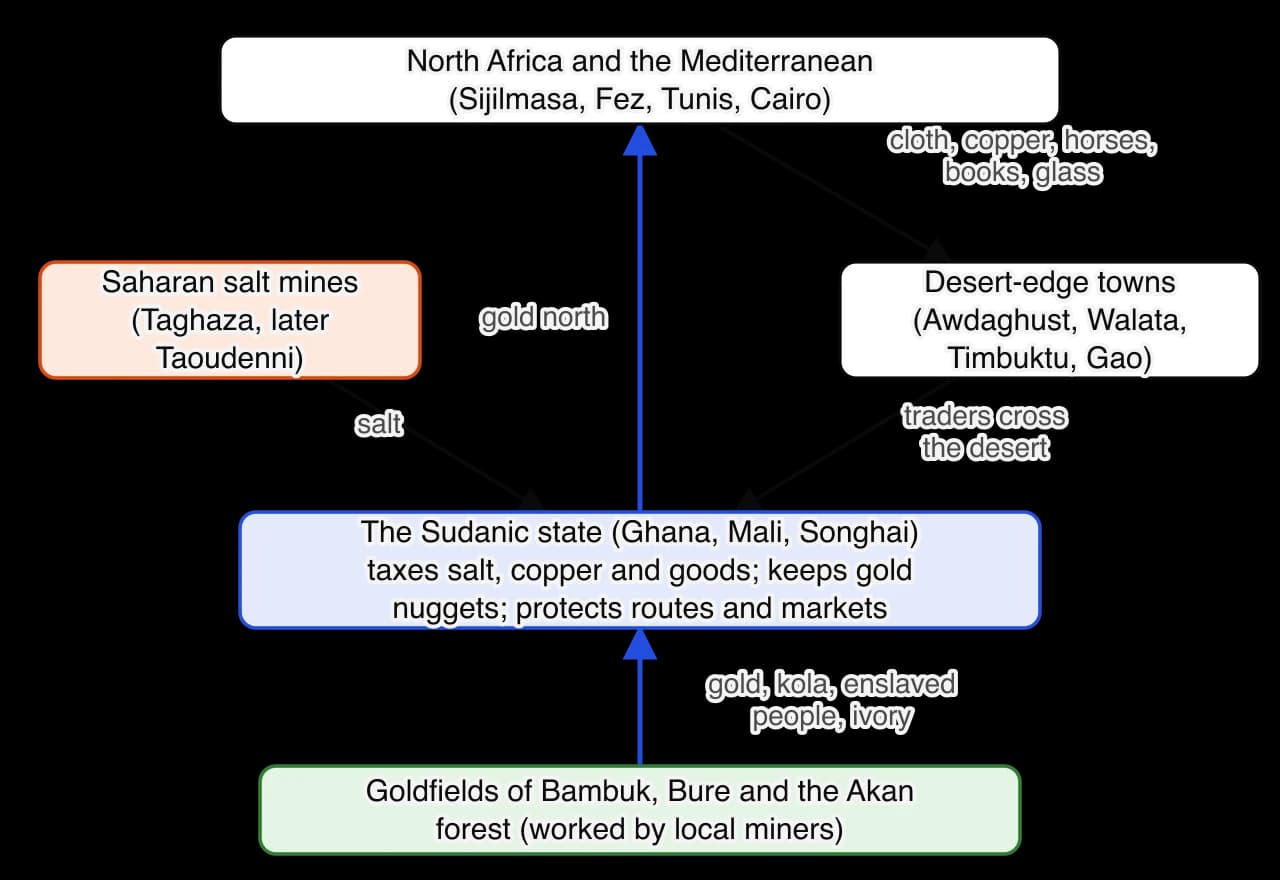
The diagram of the trans-Saharan trade shows why the savanna states grew rich without producing either gold or salt themselves: they controlled the meeting point. Al-Bakri, writing in Córdoba from merchants' reports, describes how the king of Ghana taxed the trade.
On every donkey-load of salt when it is brought into the country their king levies one golden dinar and two dinars when it is sent out. From a load of copper the king's due is five mithqals, and from a load of other goods ten mithqals. … The nuggets found in all the mines of his country are reserved for the king, only this gold dust being left for the people. But for this the people would accumulate gold until it lost its value.
Al-Bakri, The Book of Routes and Realms, completed in 1068, translated in N. Levtzion and J. F. P. Hopkins (eds), Corpus of Early Arabic Sources for West African History, 1981. Al-Bakri never travelled south of the Sahara, but his informants were merchants who had paid these taxes, so the commercial detail is likely to be reliable. The explanation that the king kept nuggets to stop the price of gold collapsing may be the merchants' or al-Bakri's own interpretation rather than the king's stated policy.
The savanna states moved their centres east over time as the routes shifted. Mali's trade went through Walata and later Timbuktu and Jenne; Songhai's went through Gao and Timbuktu. Ibn Battuta, who crossed the desert in 1352, recorded that at Taghaza the houses and mosque were built of blocks of salt, that the mines were worked by enslaved people belonging to the Massufa (a Berber group), and that a camel-load of salt sold for eight to ten mithqals of gold at Walata and twenty to thirty, sometimes forty, in the capital of Mali.
Trade routes: the Indian Ocean, the Swahili coast and Great Zimbabwe
On the east coast, the monsoon winds blow from the north-east from about November to March and from the south-west from about April to September, so ships from Arabia, Persia and India could sail to East Africa and back within a year. From the ninth century a chain of trading towns grew along the coast from Mogadishu to Sofala: Lamu, Malindi, Mombasa, Zanzibar, Kilwa and others. Their people spoke Swahili, a Bantu language with many Arabic words, and most of their ruling families were Muslim by the twelfth century.
Kilwa, on an island off southern Tanzania, became the richest of the towns in the late thirteenth and fourteenth centuries because it controlled the trade in gold from Sofala, the port that served the Zimbabwe plateau. Its sultans minted their own copper coins and built the Great Mosque and the palace of Husuni Kubwa in coral stone. Ibn Battuta, who visited in 1331, described Kilwa as one of the most beautiful and best-built towns he had seen.
The gold came from the plateau between the Zambezi and Limpopo rivers, where Great Zimbabwe was the centre of a Shona state from about 1200 to 1450. Its rulers drew wealth from cattle, which grazed the plateau's pastures, and from control of the gold and ivory traded to the coast. Archaeologists have found Chinese porcelain, Persian pottery, Syrian glass and a coin minted in Kilwa at the site.
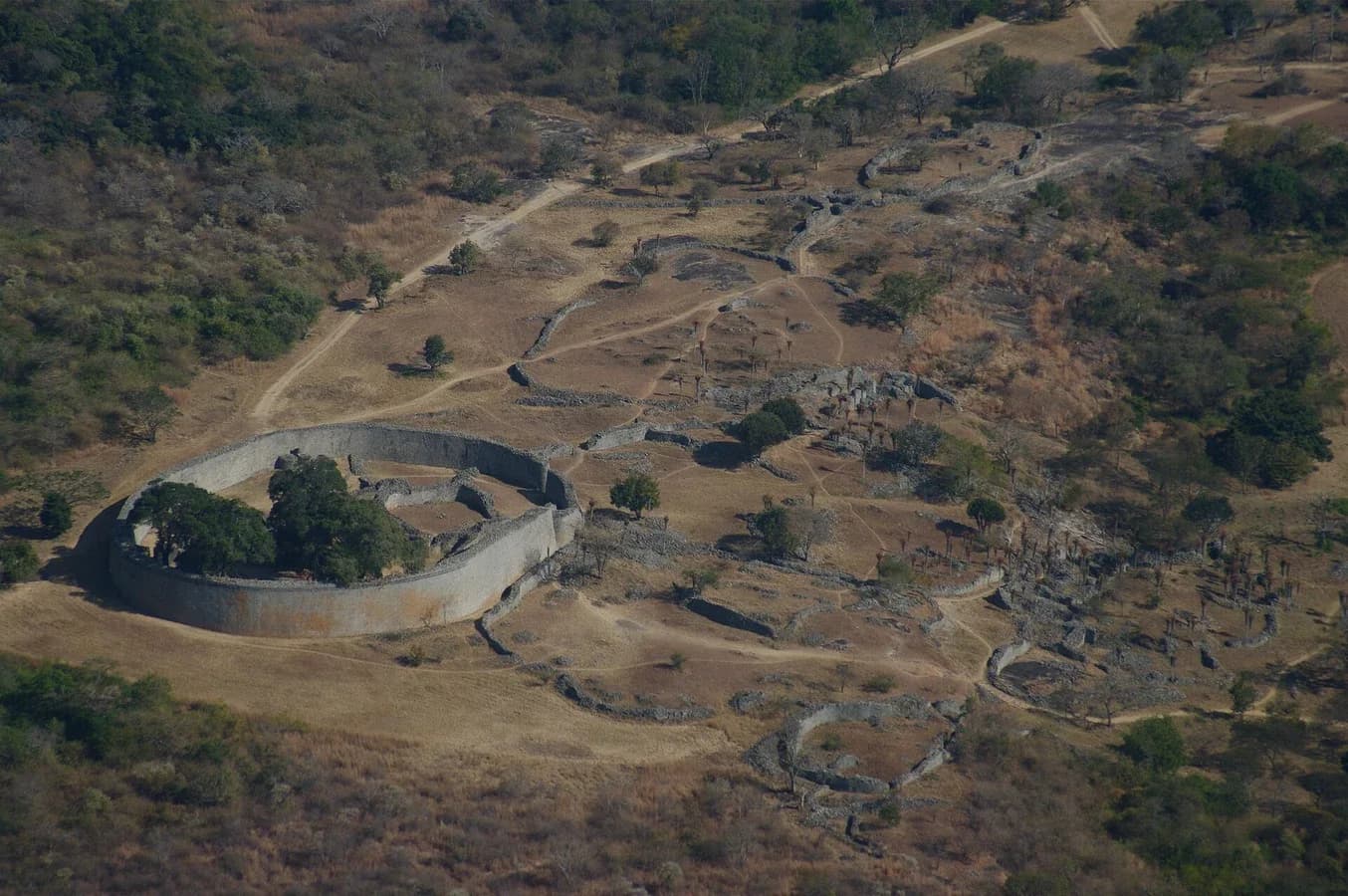
The size of the stone enclosures in the photograph shows the labour that the rulers of Great Zimbabwe could command; estimates of the population of the town at its height range from about 10,000 to about 18,000, and are contested because only part of the site has been excavated.
Trade routes: the Atlantic, from the fifteenth century
The arrival of Portuguese ships on the West African coast from the 1440s opened a third route. Gold could now be bought at the coast, at forts such as Elmina (founded in 1482), and carried by sea, so the coastal and forest states gained at the expense of the savanna. From the sixteenth century the main Atlantic export became enslaved people, carried to Brazil, the Caribbean and North America. States that controlled supplies of captives and access to the coast, such as Dahomey, Asante, Oyo and, at first, Kongo, grew rich and well armed on this trade. Not every state took part on the same terms: from the early sixteenth century until the early eighteenth century the obas of Benin restricted the sale of male captives to Europeans and exported pepper, cloth and ivory instead. The trade as a system, its scale and its effects on Africa as a whole form a regional study of their own (the African slave trade, 1500–1900).
After Britain abolished its slave trade in 1807 and other powers followed, West African states had to shift to "legitimate commerce": exports of palm oil, palm kernels, groundnuts, gum and later rubber. Some adapted well. Dahomey under Gezo set up palm-oil plantations worked by enslaved people while still selling captives where it could; in the Niger Delta, traders such as Jaja, a former slave who founded the state of Opobo in 1869, built fortunes on palm oil. Others, whose rulers had depended on royal monopolies of the slave trade, found that small-scale producers could now trade without them.
Productive lands, mineral resources and labour
Trade only mattered because the land could feed large populations and produce goods to sell. Several states sat on unusually productive land: the Inland Niger Delta, flooded every year, grew rice and fish for Mali and Songhai; the Akan forest held gold and kola; the Zimbabwe plateau combined good pasture with gold; the Ethiopian highlands were farmed with ox-drawn ploughs, unlike most of Africa, and grew teff and barley; and the Zulu kingdom lay in well-watered grassland suited to cattle. Mineral resources were worked by local specialists: Akan and Shona gold miners, Saharan salt workers, smiths across the continent.
States grew when they could mobilise labour on a larger scale. Labour came from four main sources:
Tribute and service. Subjects owed labour or produce to the ruler. Zulu amabutho herded royal cattle and worked royal fields as well as fighting; Ethiopian peasants gave a share of their harvest and labour to the holders of gult rights granted by the emperor.
Specialist groups. In Mali and Songhai, smiths, leatherworkers and griots formed hereditary occupational groups (nyamakala) who served the court.
Household slavery. Enslaved people were absorbed into households as servants, farmers, wives and soldiers; their descendants could become members of the lineage, though they kept a lower status.
Plantation slavery. In some states enslaved people worked on large estates. The Askias of Songhai owned farming estates worked by enslaved people with fixed quotas of grain; in the nineteenth century the Sokoto Caliphate and Dahomey developed plantations on a large scale. The historian Paul Lovejoy estimates that by 1900 the Sokoto Caliphate held at least one million and perhaps as many as 2.5 million enslaved people.
Maintenance of authority
A state that had been built by conquest or trade could fall apart as quickly as it rose. Rulers kept their authority through four main means: the personal standing and ritual role of the ruler, the centralisation of power in institutions and officials, the control of succession within a dynasty, and diplomacy with neighbours and distant powers.
The role of leaders
Most rulers in the study were sacred kings: their authority rested on a religious role as well as on force. The king of Ghana, according to al-Bakri, sat in a domed pavilion surrounded by guards with gold-decorated swords, and his non-Muslim subjects greeted him by kneeling and sprinkling dust on their heads. The Asantehene sat on the Golden Stool's behalf and led the great annual Odwira festival, at which the royal ancestors were honoured, the chiefs renewed their oaths and disputes were settled. In Dahomey the king presided over the annual Customs, at which he distributed goods to his followers and sacrificed captives to the royal ancestors. In these states ritual and display were tools of government: they made the ruler's power visible and tied it to the gods and ancestors.
Muslim and Christian rulers added the authority of a world religion. Mansa Musa's pilgrimage of 1324, Askia Muhammad's recognition as caliph's deputy in 1497 and Usman dan Fodio's reputation as a scholar and saint all gave their rule a legitimacy that local rivals could not match. In Ethiopia, the emperor's coronation by the Church and the Solomonic claim of the Kebra Nagast made rebellion against him a sin as well as a crime.
Personal leadership mattered most in new states and in crises. Shaka ruled by fear as well as by success: he executed opponents, and after his mother Nandi died in 1827 he ordered a period of mourning in which many were killed, which turned his own family against him. Menelik II, in contrast, held a diverse empire together through negotiation with regional nobles, rewards of land and office, and a reputation built on victory at Adwa. The contrast shows that personal leadership could both make and endanger authority.
Centralisation of power
States differed greatly in how far power was centralised. Asante is the best-documented case of a strongly centralised state in the nineteenth century.
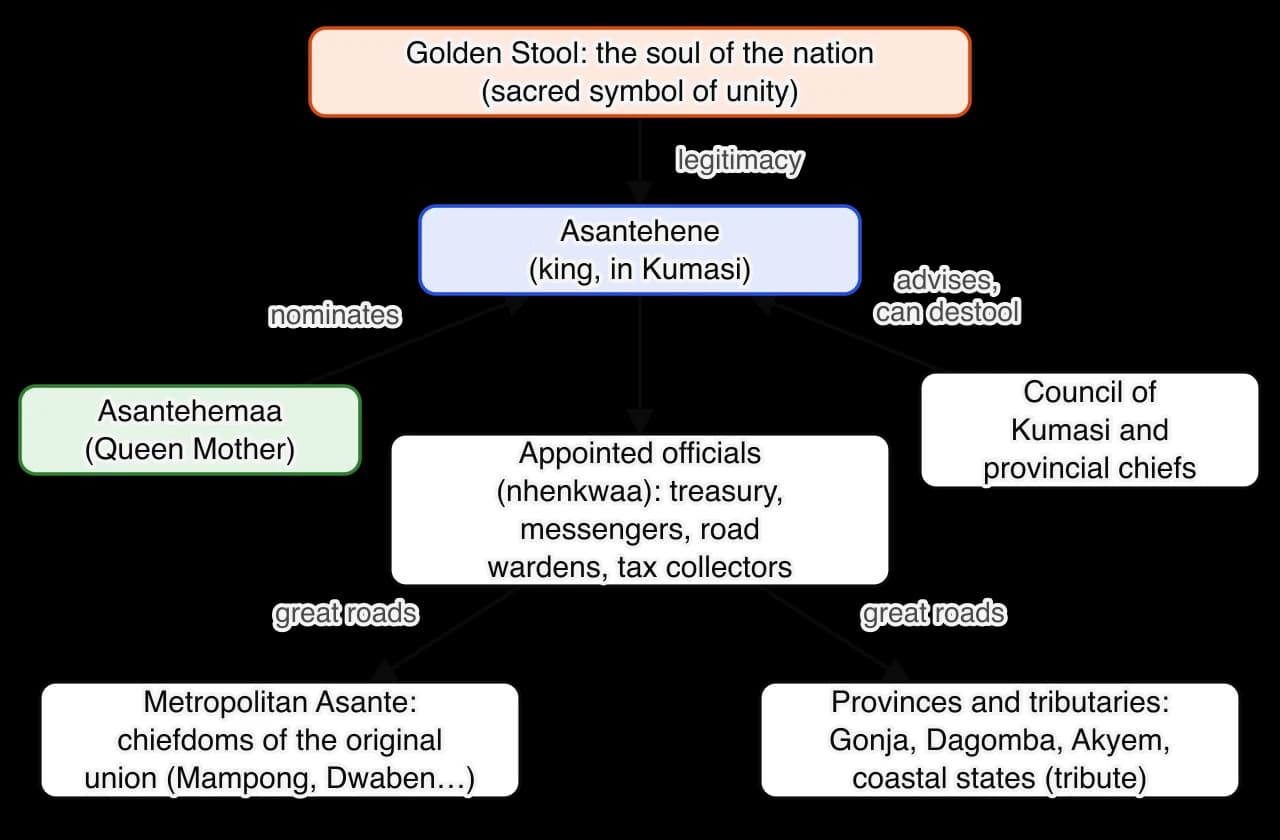
The diagram of Asante government shows the main institutions. From the 1760s, under Osei Kwadwo, the Asantehenes built up a corps of appointed officials who owed their posts to the king rather than to birth: treasurers who weighed the gold dust in which taxes and fines were paid, messengers and ambassadors, road wardens and collectors of tolls. A network of great roads radiating from Kumasi carried officials, soldiers and traders to the provinces and the coast. The king's power was nevertheless limited by councils, as a British envoy observed in 1817.
The King, the Aristocracy, now reduced to four, and the Assembly of Captains, are the three estates of the Ashantee government. The constitution requires or admits an interference of the Aristocracy in all foreign politics, extending even to a veto on the King's decision; but they watch rather than share the domestic administration, generally influencing it by their opinion, but never appearing to control it from authority.
Thomas Edward Bowdich, Mission from Cape Coast Castle to Ashantee, 1819. Bowdich led a mission of the British African Company of Merchants to Kumasi in 1817 to negotiate a treaty, and spent several months at the court. He saw government from the outside and described it in the language of the British constitution ("three estates", "aristocracy"), which may make Asante institutions look more fixed than they were. His account is still one of the main sources for historians who argue that Asante had a constitutional and bureaucratic government.
Other states found their own ways to bind distant provinces to the centre.
Mali and Songhai divided their empires into provinces under governors appointed by the ruler (in Songhai, often royal kinsmen or enslaved officials loyal only to the king), with tributary kingdoms on the edges. Askia Muhammad created a standing army and appointed officials to inspect markets and enforce standard weights and measures.
The Sokoto Caliphate was much less centralised. Each emir ruled his emirate with his own officials, army and courts; the caliph confirmed new emirs, received annual gifts and tribute, settled disputes and could call on the emirs in war. Shared loyalty to the caliph and to Islamic law held the system together for a century.
Ethiopia was ruled through regional nobles who held gult, the right to collect tribute from the peasants of a district in return for service to the emperor. Gult made the nobles powerful, which is why the empire broke up in the Zemene Mesafint. Menelik appointed governors from his own Shewan nobility to the conquered south, and Haile Selassie went further: his written constitution of 1931 created a parliament appointed or chosen by the nobility, but it declared the emperor's person sacred and kept real power in his hands, and he built a central treasury, a modern army and a salaried administration.
Buganda, on the northern shore of Lake Victoria, was one of the most centralised kingdoms in East Africa. In the nineteenth century the kabaka appointed and dismissed the chiefs of the provinces himself, rather than accepting hereditary clan heads, and ruled with a council of chiefs, the lukiko. Under Mutesa I (r. 1856–1884) and Mwanga II, Muslim, Protestant and Catholic factions formed at court, and their wars of 1888–1892 opened the way to a British protectorate in 1894.
The Zulu kingdom was held together by the regiments and by royal homesteads (amakhanda) across the country, each run by a royal woman or a trusted official (induna).
Dynasties and succession
Succession was the moment of greatest danger for any monarchy. Most African states had no rule of automatic inheritance by the eldest son; instead a council or a group of electors chose among eligible members of the royal lineage. This allowed the ablest candidate to be chosen but invited rivalry.
State | Rule of succession | Effect on authority |
|---|---|---|
Ghana | Matrilineal: the king was succeeded by his sister's son (al-Bakri) | Kept the throne in one royal lineage; limited by the decline of the state |
Mali | Disputed between brothers and sons of mansas | Repeated usurpations and civil wars after the 1360s weakened the empire |
Songhai | No fixed rule; sons and brothers of the Askia competed | Askia Muhammad was deposed by his own son (1528); the civil war of 1588 divided the state on the eve of the Moroccan invasion |
Kongo | King chosen by electors from descendants of Afonso I | Rival royal houses (the Kinlaza and Kimpanzu) fought civil wars after 1665 |
Asante | Matrilineal: the Queen Mother nominated a candidate from the royal lineage; the council approved and could destool him | Gave stability and a check on bad rulers; Kusi Obodum was destooled in 1764 |
Zulu kingdom | No fixed rule among the king's sons and brothers | Shaka was killed by his half-brothers (1828); Mpande overthrew Dingane (1840); Cetshwayo defeated his brother Mbuyazi in 1856 |
Ethiopia | Any male descendant of the Solomonic line was eligible; princes were long confined on a mountain-top (amba) to prevent revolts | Legitimacy depended on Solomonic blood, which nineteenth-century emperors claimed even when their descent was doubtful |
Sokoto | The caliph was chosen by a council of electors from Usman dan Fodio's descendants | Peaceful transfers of power for most of the nineteenth century |
The table of succession rules shows a pattern: where the rules gave a council or a senior woman a clear role (Asante, Sokoto), successions were usually peaceful; where any royal male could claim the throne by force (Mali, Songhai, the Zulu kingdom, Kongo after 1665), succession disputes became a leading cause of decline.
Diplomatic relations
African rulers conducted diplomacy with their neighbours and with distant powers, using gifts, marriages, letters and embassies. The most famous diplomatic journey of the period was Mansa Musa's pilgrimage through Cairo in 1324, described by an Egyptian official a few years later.
This man flooded Cairo with his benefactions. He left no court emir nor holder of a royal office without the gift of a load of gold. The Cairenes made incalculable profits out of him and his suite in buying and selling and giving and taking. They exchanged gold until they depressed its value in Egypt and caused its price to fall.
Shihab al-Din al-'Umari, Masalik al-absar (an encyclopaedia of the Mamluk realms), written in Cairo around 1340, translated in Levtzion and Hopkins, 1981. Al-'Umari arrived in Cairo after the visit and relied on officials who had met Musa, so his account repeats what Cairenes remembered a decade later. It shows how Musa used gifts to win prestige in the Islamic world; al-'Umari's informants also stressed Musa's piety and his refusal at first to kiss the ground before the Mamluk sultan, which suggests that he saw himself as an equal ruler.
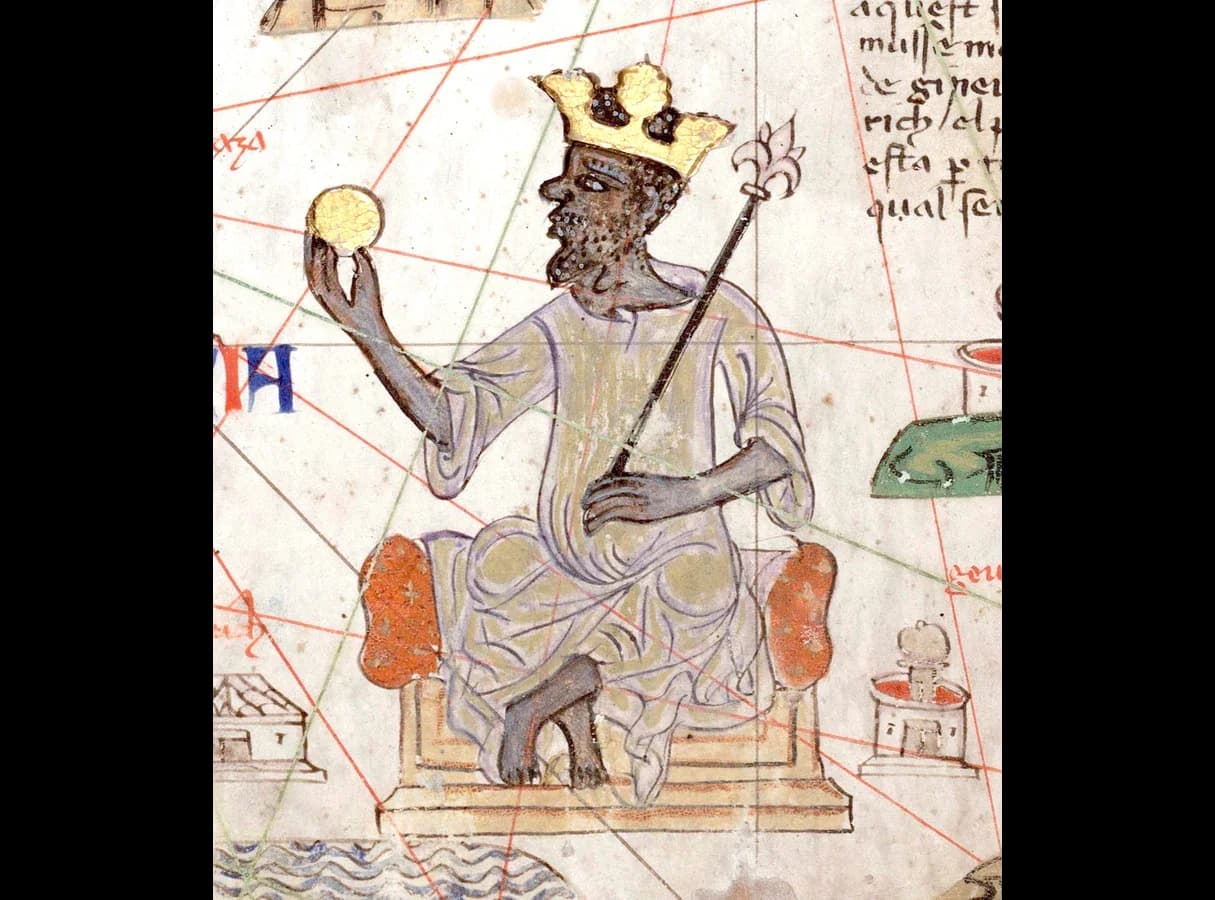
The map detail from the Catalan Atlas shows the result: by the 1370s, Mali appeared on European maps as a kingdom of gold. Other rulers used diplomacy in different ways:
Kongo exchanged embassies with Portugal and the papacy. Afonso I corresponded with the kings of Portugal for thirty years, and in 1608 King Álvaro II sent an ambassador to Rome to seek the Pope's support against Portuguese interference.
Asante sent embassies to the British and Dutch on the coast and signed a treaty with the British mission of 1817, while using war and the threat of war to keep the coastal Fante states in line.
Ethiopia under Menelik played the European powers against each other. In the Treaty of Wuchale (1889) with Italy, the Amharic text said that Ethiopia could use Italy to conduct its foreign relations, while the Italian text made this compulsory, so that Italy claimed a protectorate. Menelik rejected the claim, bought arms from France and Russia, defeated Italy at Adwa in 1896 and then signed boundary treaties with Britain, France and Italy. Haile Selassie took Ethiopia into the League of Nations in 1923.
Moshoeshoe of Lesotho used French missionaries as advisers and, under pressure from the Orange Free State, asked for British protection, which turned Basutoland into a British protectorate in 1868 but kept its land out of Boer hands.
Impact of the state
States changed the lives of the people they ruled and of their neighbours. Their impact can be traced in religion, in culture, in social organisation and law, and in the experiences of women, which differed sharply by status.
Religious impact
The spread of Islam in West Africa followed the trade routes and the courts. In Ghana Islam was the religion of merchants and royal advisers, while the king and most of his people kept the older religion. In Mali the rulers became Muslims but kept Mande rituals for their non-Muslim subjects: this "court Islam" let the mansas be Muslim rulers to North African merchants and sacred kings to the farmers of the Niger valley. Mansa Musa returned from his pilgrimage with scholars and an Andalusian architect, Abu Ishaq al-Sahili, and built the Djinguereber mosque in Timbuktu. Under the Askias, Timbuktu became a centre of Islamic scholarship, with teachers such as Ahmad Baba (1556–1627) and libraries of manuscripts on law, theology, astronomy and medicine, many of which survive.
For most of the period Islam in the savanna was the religion of towns, traders and rulers more than of the countryside. The jihads of the eighteenth and nineteenth centuries changed this. The Sokoto jihad, and others in Futa Jallon, Masina and the empire of al-Hajj Umar Tal, aimed to replace mixed practice with strict observance of Islamic law, and Sokoto's schools, courts and scholars spread Islam among rural Hausa and Fulani. Scholars wrote in Arabic and, increasingly, in Hausa and Fulfulde written in Arabic script (Ajami), which carried religious teaching to people who did not read Arabic.
Ibn Battuta, a Moroccan scholar and judge who spent eight months in Mali in 1352–1353, judged the country by the standards of Islamic law.
They are seldom unjust, and have a greater abhorrence of injustice than any other people. Their sultan shows no mercy to anyone who is guilty of the least act of it. There is complete security in their country. Neither traveller nor inhabitant in it has anything to fear from robbers or men of violence. … They are careful to observe the hours of prayer, and assiduous in attending them in congregations, and in bringing up their children to them.
Ibn Battuta, Travels in Asia and Africa 1325–1354, dictated in Fez in 1355, translated by H. A. R. Gibb, 1929. Ibn Battuta was a well-travelled outsider with no reason to flatter Mali, and in the same passage he condemned customs he found un-Islamic, such as the freedom of women and the dust-throwing greeting of the king, which makes his praise of security and piety more convincing. His view is that of an urban Muslim scholar, so he says little about the non-Muslim majority in the countryside.
In Kongo, Christianity became the religion of the king and nobility after 1491 and gradually spread through the provinces. Kongo Christianity used Kongo words and ideas: priests were called by the term for traditional spiritual experts (nganga), and saints and crosses were understood partly through older beliefs about the other world. When Kongo was torn by civil war, a young noblewoman, Kimpa Vita (baptised Beatriz), claimed in 1704 to be possessed by St Anthony and taught that Jesus and the saints had been Kongolese. Her Antonian movement called for the reunification of the kingdom under one king at São Salvador; she was burned as a heretic in 1706 on the orders of King Pedro IV, though her followers helped him restore the capital.
In Ethiopia, the Orthodox Church was a pillar of the state. Monasteries trained the clergy, kept chronicles in the Ge'ez language and held large estates, and the Church crowned the emperor. The rock-hewn churches of Lalibela, carved in the twelfth and thirteenth centuries under the Zagwe king Lalibela, remain a centre of pilgrimage.
Cultural impact
States created wealth that paid for building, art and learning on a large scale. Four kinds of evidence stand out:
Architecture. The earthen mosques of Timbuktu and Jenne, rebuilt many times in the same style (the present Great Mosque of Jenne dates from 1907); the dry-stone walls of Great Zimbabwe; the coral-stone mosques and palaces of Kilwa; the castles of Gondar; the rock churches of Lalibela; the palace and great roads of Kumasi.
Art. The brass plaques and heads of Benin, cast for the oba's palace from the fifteenth century onwards and recording court ceremonies and the arrival of the Portuguese; Asante goldwork, gold-weights and woven kente cloth; the bronzes of Igbo-Ukwu (ninth and tenth centuries), made by a society without a state.
Scholarship and writing. The manuscripts of Timbuktu and Sokoto; the Tarikh al-Sudan and Tarikh al-Fattash; Ethiopian chronicles; the hundreds of works in Arabic, Fulfulde and Hausa by Usman dan Fodio, Abdullahi, Muhammad Bello and Nana Asma'u.
Oral literature. The epic of Sunjata, Zulu praise poetry (izibongo) and Asante drum histories preserved state history and values in performance.
Royal patronage shaped this culture. Benin's brass-casters formed a guild that worked only for the oba; Asante goldsmiths worked under royal control; Timbuktu's scholars depended on the protection and gifts of the Askias. When states fell, the craft and scholarly traditions often survived under new patrons, but royal arts such as Benin's were most exposed: in February 1897 a British punitive expedition captured Benin City and carried off several thousand objects, which became known as the Benin Bronzes and were sold to museums in Europe and North America. Their return has been debated since Nigerian independence; in 2022 Germany agreed to transfer ownership of more than 1,000 of them to Nigeria (as of 2026, many other museums still hold collections).
Social impact
States reshaped social organisation in several ways. They created towns: Koumbi Saleh, Timbuktu, Jenne, Gao, Kano, Kumasi, Mbanza Kongo and Gondar were centres of trade, craft and government with tens of thousands of people at their height. They introduced law enforced by the ruler: Islamic courts in Mali, Songhai and Sokoto, the Asantehene's courts in Kumasi, and royal justice in Ethiopia. And they deepened social hierarchy, with royal lineages and nobles at the top, free farmers and herders, hereditary occupational groups such as smiths and griots, and enslaved people at the bottom.
The impact was uneven. For merchants, scholars and officials, a strong state meant protection and opportunity: Ibn Battuta's praise of security in Mali reflects what a strong state offered travellers and traders. For conquered peoples the same state could mean tribute, conscription and raids. The Zulu kingdom shows both sides: incorporation into the regiments gave young men of defeated chiefdoms a place in the new kingdom, but the king's control of marriage delayed family life for men and women alike, and the wars of the Mfecane drove thousands from their homes.
Slavery grew with state power in many cases. States produced captives in war and absorbed many of them; enslaved people could rise high, as soldiers, officials or royal wives, or be worked hard on estates, and were always exposed to sale. The growth of plantation slavery in nineteenth-century Sokoto and Dahomey shows how the social impact of state-building could worsen the position of the enslaved even as the state flourished.
Experiences of women
Women's experience depended above all on status. Royal and elite women in many states held formal power; most women carried the main burden of farming, food preparation, trade in local markets and child-rearing; and enslaved women, who made up most of the captives kept within Africa, worked as farm labourers, servants and concubines.
State | Women with power and influence | Constraints and burdens |
|---|---|---|
Mali | Royal women influenced succession; Ibn Battuta was shocked that women in Walata and Mali went unveiled and had male friends, which shows a freedom unusual in Muslim societies of the time | Enslaved women served at court and in households; Ibn Battuta's account reflects an outsider's disapproval |
Asante | The Asantehemaa (Queen Mother) nominated the king and sat in council; queen mothers in each chiefdom had their own courts; Yaa Asantewaa, queen mother of Ejisu, led the war of 1900 against the British | Marriage and labour obligations to husbands and lineages; enslaved women in households |
Dahomey | Female soldiers (the Mino, called "Amazons" by Europeans) formed regiments of the royal army; the queen mother (kpojito) and palace women held offices | Palace women lived under strict royal control; many female soldiers were captives or given to the king |
Sokoto | Nana Asma'u (1793–1864), daughter of Usman dan Fodio, wrote poetry and teaching texts in three languages and organised the 'Yan Taru network of women teachers who educated rural women | Seclusion of free married women grew in the cities; large numbers of enslaved women worked as concubines and on farms |
Ethiopia | Empress Taytu Betul, wife of Menelik II, opposed the Treaty of Wuchale and commanded troops at Adwa; Zewditu reigned as empress from 1916 to 1930 | Peasant women bore heavy farm and household labour; enslaved women from the conquered south were traded and kept in elite households |
Kongo and Ndongo | Kimpa Vita led a religious and political movement (1704–1706); Queen Njinga of Ndongo and Matamba (r. 1624–1663) resisted the Portuguese for decades while herself trading captives to them | Women farmed most of the land; female captives were less often exported than men, so many were kept as slaves |
The table of women's experiences shows that the same state could empower some women and burden others. Nana Asma'u's teaching network spread literacy and Islamic knowledge among women in Sokoto, but it served a state whose prosperity depended partly on the labour of enslaved women. Historians stress that "women" in these states were never a single group: their experience depended on whether they were royal or common, free or enslaved, Muslim or not, and urban or rural.
Reasons for decline and collapse
The states of the study declined for four kinds of reason: opposition, resistance and civil war within; challenges from outside; economic change; and the effects of the trade in enslaved people. In most cases a foreign challenge delivered the final blow to a state already weakened from within, so the key question for any state is how the internal and external factors interacted.
Ghana and the Almoravids
In the eleventh century a reform movement arose among the Sanhaja Berbers of the western Sahara. Its founder, the scholar Abdallah ibn Yasin, preached a strict form of Sunni Islam from the 1040s, and his followers, the Almoravids (al-Murabitun), united the desert tribes, took the trading town of Awdaghust from Ghana in 1054–1055 and went on to conquer Morocco and Muslim Spain. Later Arabic writers reported that the Almoravids conquered Ghana itself in 1076.
Historians now doubt that a conquest took place. No writer of the time records it, and al-Bakri, writing in 1068, describes a powerful kingdom. David Conrad and Humphrey Fisher argued in 1982–1983 that the conquest was a later invention and that Ghana declined for other reasons: the loss of Awdaghust and of control over the northern trade, a drier climate that made the Sahel harder to farm, a shift of the gold trade eastward towards new goldfields and routes, and the rise of rival states such as Sosso. Ghana's kings converted to Islam by the twelfth century, and the state survived in a reduced form until Sosso and then Mali absorbed it in the early thirteenth century.
Mali and Songhai
Mali declined from the late fourteenth century mainly through internal division. Succession disputes among the descendants of Sunjata and Musa produced weak rulers and usurpers, and provinces on the edges broke away: Gao and the Songhai in the east, the Wolof in the west. The Tuareg took Timbuktu in 1433, the Mossi raided from the south, and Songhai under Sunni Ali took the Niger bend in the 1460s. The arrival of the Portuguese on the Gambia and Senegal rivers from the 1450s drew some trade to the coast. Mali survived as a small kingdom on the upper Niger into the seventeenth century.
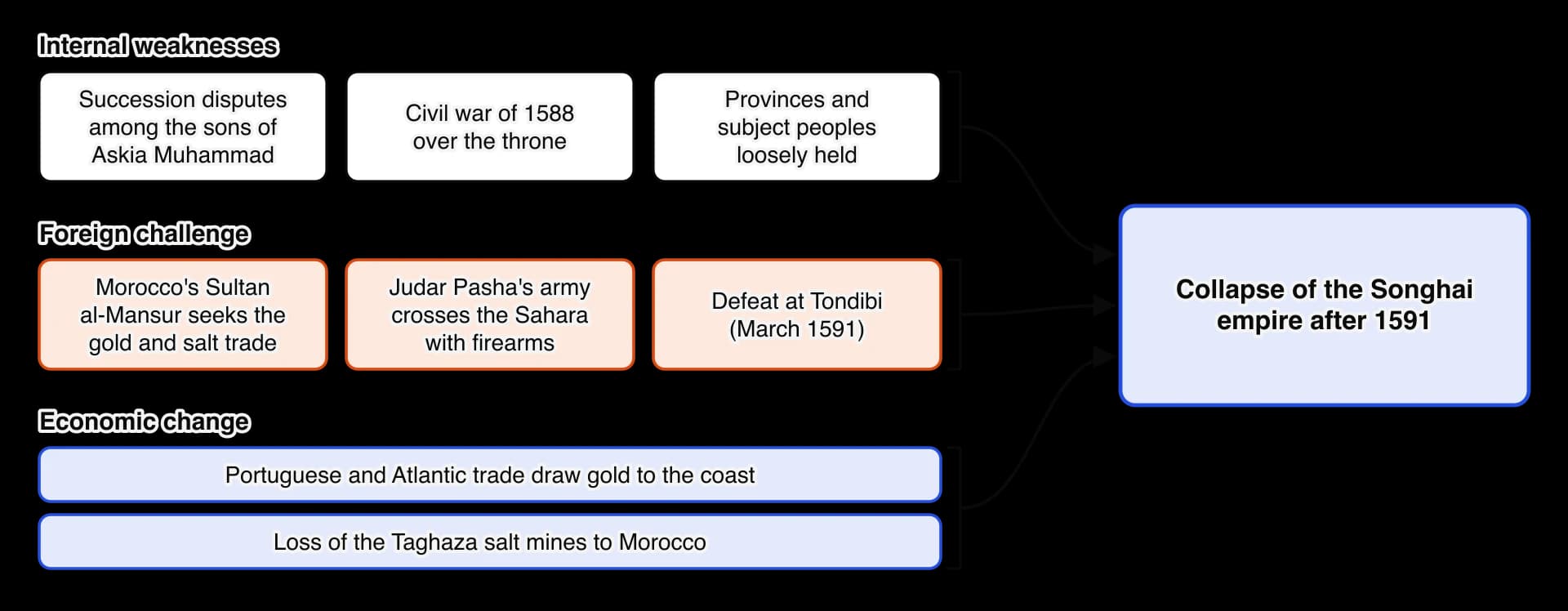
Songhai fell suddenly. Sultan Ahmad al-Mansur of Morocco, who wanted the gold of the Sudan and control of the salt mines, sent an army of about 4,000 men, many of them armed with muskets, across the Sahara under Judar Pasha. At Tondibi, near Gao, on 13 March 1591, it defeated a much larger Songhai army, whose cavalry and archers could not withstand firearms. The diagram of the collapse of Songhai shows that the invasion succeeded because of the empire's internal weakness: a civil war between rival Askias in 1588 had divided the ruling family and the army, and the provinces broke away once the centre was defeated. The Moroccans occupied Timbuktu, Gao and Jenne but never ruled the whole empire.
Kongo and the trade in enslaved people
Kongo's decline shows most clearly how the Atlantic slave trade could weaken a state. At first the kings controlled the trade, selling captives taken in wars beyond their borders in exchange for goods they gave to loyal nobles. By the 1520s, however, Portuguese traders from São Tomé and Kongo nobles were dealing directly with each other, and free Kongolese were being seized.
In a letter to João III of Portugal in July 1526, Afonso complained that Portuguese merchants were seizing his free subjects, including nobles and members of his own family, and that the trade was depopulating the kingdom; he asked that only priests and teachers be sent, and set up a royal commission to check that every captive sold had been lawfully enslaved. The letter was written to persuade a fellow Catholic king, so it may exaggerate the depopulation, and Afonso did not ask for an end to the slave trade as such. Historians such as John Thornton read it as evidence of a struggle over who controlled the trade, in which the king was losing ground to his own nobles and to Portuguese merchants, rather than as a protest against slavery itself.
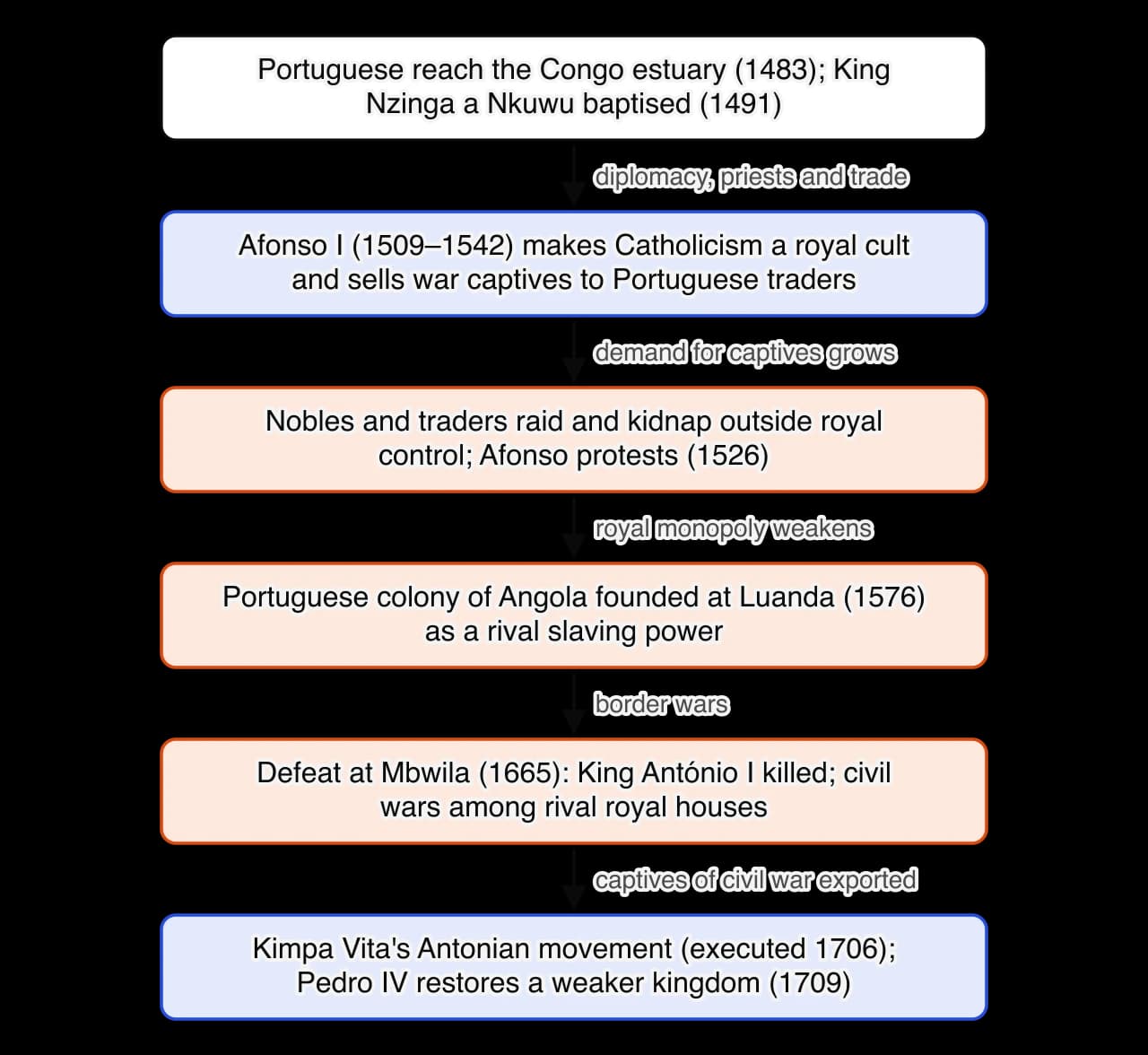
The chain of events from 1483 to 1709 shows how the problem deepened. The Portuguese founded their own colony of Angola at Luanda in 1576 and waged war on Kongo's southern neighbours and finally on Kongo itself. At the battle of Mbwila (Ambuila) in October 1665, a Portuguese and allied army defeated the Kongo army and killed King António I. Without an accepted heir, rival branches of the royal family fought for the throne for more than forty years; São Salvador was sacked and abandoned in 1678, and thousands of captives from the civil wars were sold to Atlantic traders. Pedro IV restored the kingdom in 1709, but it was now a loose collection of provinces with a mainly ceremonial king. It was divided among Portugal, Belgium and France in the 1880s, and the Portuguese abolished the title of king in 1914.
Oyo, Asante and the Zulu kingdom: civil war and conquest
Oyo collapsed through internal conflict. Power in Oyo was balanced between the alafin (king), the council of seven nobles (the Oyo Mesi) led by the Basorun, and the Ogboni, a society of elders and earth-cult priests that mediated between them. In the late eighteenth century the Oyo Mesi fought the alafin for power, and successive alafins were forced to take their own lives. In 1817 Afonja, the commander of the provincial army based at Ilorin, rebelled and called in Fulani Muslim supporters and Hausa slaves; the Fulani then seized Ilorin, which became an emirate of the Sokoto Caliphate. Without its northern horse supply and army, Oyo could not defend itself, and its capital was abandoned around 1836. Dahomey had already stopped paying tribute in the 1820s.
Asante survived longer but was weakened by a cycle of wars with Britain over the coastal Fante states. Asante defeated a British force at Nsamankow in 1824, but in 1874 a British expedition under Garnet Wolseley burned Kumasi, and Asante lost its southern provinces. Civil wars among rival claimants followed in the 1880s. In 1896 a British force occupied Kumasi without fighting and exiled the Asantehene, Prempeh I; when the British governor demanded the Golden Stool in 1900, Yaa Asantewaa led a last war of resistance, and Asante was annexed to the Gold Coast colony in 1901–1902.
The Zulu kingdom under Cetshwayo was invaded in January 1879 by Britain, which wanted to bring the independent African states of the region into a confederation of South Africa. The Zulu army destroyed a British column at Isandlwana on 22 January but was defeated at Ulundi on 4 July. The British exiled Cetshwayo and divided the kingdom among thirteen appointed chiefs, some of them enemies of the royal house. The civil war that followed between Cetshwayo's uSuthu supporters and the chief Zibhebhu destroyed more lives and cattle than the British invasion, and Britain annexed what was left of Zululand in 1887.
The process in Zululand shows a pattern seen in many states in the late nineteenth century: a European victory in battle, followed by a political settlement that set Africans against one another and completed the destruction of the state.
Foreign challenges: the European conquest
Between the 1870s and 1900s European powers conquered almost every independent African state of the time. The partition of Africa as a whole, and African resistance and collaboration, are a regional study of their own; for the states themselves, the main point is that European armies had decisive advantages in firepower (breech-loading rifles, then the Maxim machine gun from the 1880s), medicine and finance, and could recruit African allies and soldiers.
State | Conquering power | Key events |
|---|---|---|
Zulu kingdom | Britain | Anglo-Zulu War, 1879; annexation, 1887 |
Mahdist state | Britain and Egypt | Battle of Omdurman, 2 September 1898 |
Samori's empire | France | Wars from 1882; Samori captured in September 1898 |
Dahomey | France | Wars of 1890 and 1892–1894; King Behanzin surrendered in 1894 |
Benin | Britain | Punitive Expedition and sack of Benin City, February 1897; Oba Ovonramwen exiled |
Asante | Britain | Kumasi burned 1874; Prempeh I exiled 1896; War of the Golden Stool 1900 |
Sokoto Caliphate | Britain | Kano and Sokoto taken in 1903; Caliph Attahiru I killed at Burmi, July 1903 |
Ethiopia | Italy | Italian defeat at Adwa, 1896; Italian invasion and occupation, 1935–1941 |
The table of European conquests shows that only Ethiopia resisted successfully in the nineteenth century. At Adwa on 1 March 1896 Menelik's army, usually estimated at between about 70,000 and 100,000 men, most armed with modern rifles, faced about 17,700 Italian and Eritrean troops; he had united the regional nobility behind him; and Italy fought alone. Forty years later the balance had changed. Italy invaded in October 1935 with aircraft, tanks and poison gas; the League of Nations imposed only limited sanctions; and Italian troops entered Addis Ababa in May 1936. Haile Selassie appealed to the League in person in June 1936 and returned to his throne in 1941 with British and Ethiopian patriot forces after Italy entered the Second World War. British officers and advisers kept wide powers at first, but the Anglo-Ethiopian Agreements of January 1942 and December 1944 restored most of Ethiopia's sovereignty, and in 1945 Ethiopia was one of the founding members of the United Nations.
Economic factors
Economic change undermined several states. Ghana suffered from drought and the eastward shift of the gold trade. Great Zimbabwe was abandoned in the fifteenth century, probably because its large population had exhausted the soil, pasture and firewood nearby and because the gold trade shifted north to the Zambezi valley, where the Mutapa state took over. Kilwa lost its wealth when the Portuguese, seeking to control the Indian Ocean gold trade, sacked the town in 1505 and built a fort at Sofala. Mali and Songhai lost part of their trade to the Atlantic coast.
In the nineteenth century the end of the Atlantic slave trade forced states that had depended on it to adapt. The economic historian A. G. Hopkins argued in An Economic History of West Africa (1973) that this caused a crisis of adaptation for rulers such as those of Asante and Dahomey, because palm oil and other products could be produced by small farmers and traders without royal control, so the rulers lost revenue and power. Others, such as Robin Law in his work on Dahomey, have argued that rulers adapted more successfully than this suggests, for example by running palm-oil plantations with slave labour.
The trade in enslaved people: strength or weakness?
Historians disagree about the effect of the slave trade on African states. For some states the trade was a source of strength: Dahomey, Asante and Oyo used the guns and goods they received to expand and centralise power in the eighteenth century. For others it was a source of decline: Kongo lost control of its nobles and then of its territory, and smaller societies across West and central Africa were raided and depopulated. Walter Rodney argued that, taken as a whole, the trade drained Africa of people and distorted its economies, so that even the states that profited from it were weakened in the long run by dependence on a trade they did not control. The trade as a whole is a subject of its own; for any one state, the question is whether it controlled the trade or was controlled by it.
Impact of decline and collapse
The collapse of a state rarely meant the collapse of a society. The diagram of what followed the fall of a state groups the consequences into four kinds, and the balance between continuity and change differed from case to case.
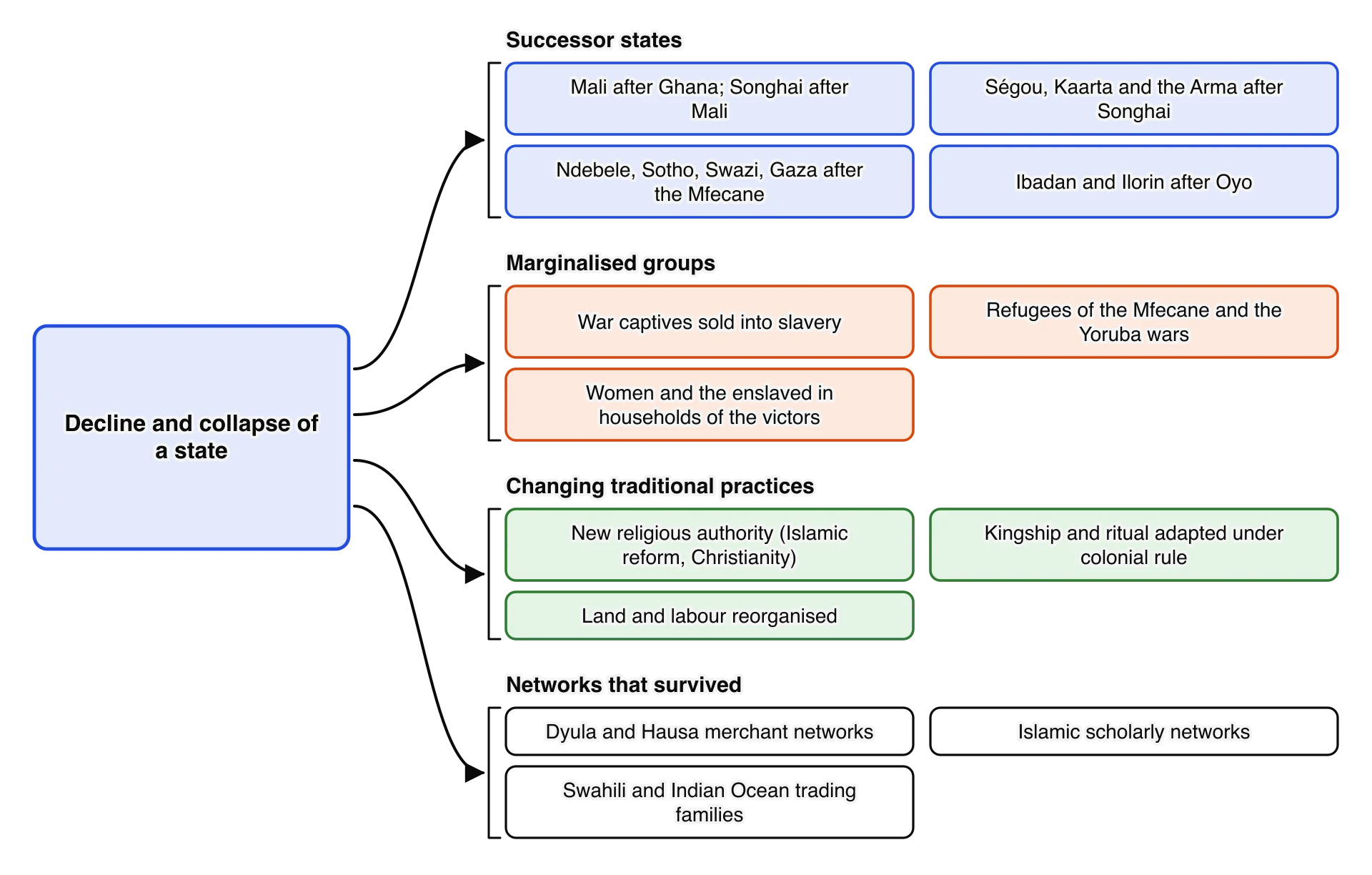
Successor states
New states usually grew from the remains of the old, often using the same trade routes, titles and ideas of kingship. Mali replaced Ghana and Songhai replaced Mali. After 1591 the Songhai heartland was divided: the descendants of the Moroccan soldiers, the Arma, ruled Timbuktu and the Niger bend as a military elite who soon stopped obeying Morocco, while Songhai princes held out in Dendi to the south-east, and the Bambara kingdoms of Ségou (from about 1712) and Kaarta rose on the upper Niger. After Great Zimbabwe, the Mutapa state to the north and the Torwa (later Rozvi) state to the south-west took over the plateau and its gold trade.
The collapse of Oyo in the 1830s produced a new generation of Yoruba states: Ibadan, founded as a war camp around 1829, became the leading military power; refugees founded Abeokuta in 1830; and a new Oyo was built further south. These states fought the Yoruba wars for most of the rest of the century, until British mediation in 1886 and conquest in the 1890s. In the south-east, the Mfecane left the Ndebele, Sotho, Swazi and Gaza kingdoms as its successors, and some of them, such as Lesotho and Eswatini, still exist as independent states.
European rule produced successor states of another kind. Under indirect rule, the British governed Northern Nigeria through the emirs of the Sokoto Caliphate after 1903, keeping the sultan and the emirs in office but under British residents. In Asante, the British allowed Prempeh I to return from exile in 1924 as a chief, and in 1935 they restored the Asante Confederacy with his successor Prempeh II as Asantehene, using the old monarchy to govern. Buganda kept its kabaka and council under the Buganda Agreement of 1900. In each case the old institutions survived, but now served a colonial power.
Challenges for marginalised groups
The costs of collapse fell most heavily on the weakest. Civil wars and the wars of successor states produced captives: the Kongo civil wars after 1665 and the Yoruba wars after Oyo's fall sent tens of thousands of people into the Atlantic slave trade, which is why Yoruba culture and religion became so influential in nineteenth-century Brazil and Cuba. The Mfecane created large numbers of refugees; some, known as the Mfengu, moved into the eastern Cape, where many became labourers on settler farms and early converts to Christianity.
Enslaved people were often the last to benefit from political change. Colonial governments abolished the slave trade but moved slowly against slavery itself, for fear of upsetting the rulers through whom they governed: in Northern Nigeria the legal status of slavery was abolished only in 1936. In southern Ethiopia, the peoples conquered by Menelik were made to provide labour and tribute to northern soldiers and settlers, a system that lasted until the Italian occupation and, in modified forms, after it.
Changing traditional practices
Collapse changed religion, kingship and the organisation of land and labour, but often slowly. After Songhai fell, the Moroccans deported leading scholars of Timbuktu, including Ahmad Baba, to Marrakesh in 1594, and the town lost much of its standing; yet Islam continued to spread through rural West Africa, carried by scholars and traders who no longer depended on royal patrons. In Kongo, Christianity survived the decline of the monarchy, kept alive by lay teachers when priests were few. Under colonial rule, kings and chiefs kept their titles and rituals but lost the power to make war, collect tribute or sell captives, and they became paid officials of colonial governments.
Commercial and social networks
Trading and scholarly networks were often more durable than states. The Mande traders known as the Dyula (or Wangara) carried gold and kola between the forest and the savanna for centuries, through the rise and fall of Ghana, Mali, Songhai and Asante. Hausa merchants and Islamic scholars moved along the same routes. On the east coast, Swahili trading families and their culture survived the Portuguese attacks of the sixteenth century and the Omani takeover of Mombasa in 1698. In the Bight of Benin, freed Africans returning from Brazil in the nineteenth century set up Afro-Brazilian communities in Ouidah and Lagos that linked West Africa and the Americas.
Perspectives and debates
From colonial myth to African history
Colonial-era writers often denied that Africans had a history of states at all. In the late nineteenth century, European visitors and settlers in Rhodesia claimed that Great Zimbabwe had been built by Phoenicians, Arabs or the Queen of Sheba, because they could not accept that Africans had built it. The archaeologist David Randall-MacIver showed in 1905, and Gertrude Caton-Thompson confirmed in 1929, that the site was African and medieval; yet the white-minority government of Rhodesia still pressured official guidebooks to blur this in the 1970s. The case shows how history could be used to justify colonial rule, and why the study of African states became a political act.
After independence in the 1950s and 1960s, African and European historians built the modern field of African history, using oral tradition, archaeology and Arabic sources alongside European records. Their work stressed African agency: Africans as the makers of their own states and economies rather than passive objects of outside forces. It also produced a debate about how far that agency was limited by external pressures.
Internal development or external pressure?
The broadest debate concerns the weight of internal and external factors. Walter Rodney, in How Europe Underdeveloped Africa (1972), argued that European trade, above all the Atlantic slave trade, drained Africa of labour, encouraged warfare and made African economies dependent on Europe, so that states that seemed to prosper from the trade were weakened in the long run. John Thornton, in Africa and Africans in the Making of the Atlantic World, 1400–1680 (1992), argued that African rulers entered the Atlantic trade on their own terms, controlled the supply of captives and could not be forced to trade, and that Kongo's Christianity was an African creation. The two views can be weighed by period and by state: Thornton's case is strongest for the sixteenth and early seventeenth centuries and for strong states such as Kongo in Afonso's reign, Rodney's for the long-term effects on smaller societies and on states such as Kongo after 1665.
Debate | Historians | Argument | Evidence stressed |
|---|---|---|---|
Did the Almoravids conquer Ghana? | Nehemia Levtzion, Ancient Ghana and Mali (1973) | Accepted a conquest in 1076, followed by Islamisation and decline | Later Arabic writers (al-Zuhri, Ibn Khaldun) |
David Conrad and Humphrey Fisher, "The Conquest That Never Was" (1982–1983) | No conquest; Ghana declined through drought, loss of trade and rival states | Silence of contemporary sources; al-Bakri's description in 1068 | |
What caused the Mfecane? | J. D. Omer-Cooper, The Zulu Aftermath (1966) | An African revolution: Zulu state-building set off migration and new states across southern Africa | Zulu expansion; the new kingdoms of the 1820s–1830s |
Julian Cobbing, "The Mfecane as Alibi" (1988) | A settler myth that blamed the Zulu and hid slave-raiding from Delagoa Bay and labour raids from the Cape | Delagoa Bay slave trade; Griqua and settler raids for labour | |
Carolyn Hamilton (ed.), The Mfecane Aftermath (1995); Elizabeth Eldredge | Internal African dynamics remain important; Cobbing's slave-raiding thesis is only partly supported by the evidence | Drought, competition for land and trade before the 1820s | |
How centralised was Asante? | Ivor Wilks, Asante in the Nineteenth Century (1975) | A centralised, bureaucratic state with a professional administration | Appointed officials, the great roads, treasury records, Bowdich's account |
T. C. McCaskie, |
The table of debates shows a common pattern. In each case an older interpretation emphasised one powerful cause (a conquest, Zulu militarism, a bureaucracy, religion, heroic resistance), and later historians complicated it by stressing other actors, other sources or the experiences of less powerful groups. Using these debates in an argument means more than naming historians: it means explaining which evidence each view rests on and judging how far that evidence supports it.
The states in profile
Each profile brings together the evidence for one state under the six questions historians ask of any state, so that one or two states can be prepared in depth. Dates of rulers are reign dates.
Ghana and Mali
Profile: Ghana (c. 750–c. 1200) and Mali (c. 1235–c. 1600)
Question | Ghana | Mali |
|---|---|---|
Emergence | Soninke kings control markets between Saharan salt and southern gold; iron weapons, horses; tribute from neighbours | Sunjata unites Mande chiefdoms against Sosso (Kirina, c. 1235); clan federation (Kurukan Fuga tradition) |
Production and trade | Taxes on salt and copper; gold nuggets reserved to the king; goldfields outside its control | Direct control of Bure and Bambuk gold; Niger valley rice; Walata, Timbuktu, Jenne |
Authority | Sacred king with Muslim advisers; matrilineal succession; twin-town capital | Mansa as sacred king and Muslim ruler; provinces and tributary kings; Musa's hajj (1324) and Cairo diplomacy |
Impact | Islam among merchants and officials | Court Islam; Djinguereber mosque; Timbuktu scholarship; griot tradition; Ibn Battuta on justice and security |
Decline | Loss of Awdaghust to the Almoravids (1054–1055); drought; trade moves east; rise of Sosso (conquest of 1076 contested) | Succession disputes; Tuareg take Timbuktu (1433); Songhai and Mossi; Atlantic trade |
After the fall | Sosso, then Mali, take over; Soninke traders spread across the region | Small kingdom survives on the upper Niger; Mande traders and griots carry its memory |
Songhai
Profile: Songhai (1464–1591)
Question | Evidence |
|---|---|
Emergence | Sunni Ali's cavalry and river fleet take Timbuktu (1468) and Jenne; Askia Muhammad seizes power (1493) |
Production and trade | Niger bend trade through Gao and Timbuktu; Taghaza salt; royal estates worked by enslaved people |
Authority | Askia Muhammad's Islamic legitimacy (hajj 1496–1497), provinces under appointed governors, standing army, market inspectors |
Impact | Timbuktu's golden age of scholarship (Ahmad Baba); Islamic law courts |
Decline | Succession disputes and civil war (1588); Moroccan invasion and Tondibi (1591); Atlantic shift of trade |
After the fall | Arma pashalik in Timbuktu; Songhai princes in Dendi; Bambara kingdoms; scholars deported to Marrakesh |
Kongo
Profile: Kongo (c. 1390–1709)
Question | Evidence |
|---|---|
Emergence | Conquest by Lukeni lua Nimi and alliance with local lineages and earth-priests; provinces under royal governors |
Production and trade | Nzimbu shell currency (royal monopoly); raffia cloth; copper; from the 1500s captives traded to the Portuguese |
Authority | Manikongo elected from royal descendants; Catholic monarchy under Afonso I (1509–1542); embassies to Portugal and Rome |
Impact | African Catholicism; São Salvador as a Christian capital; Kimpa Vita's Antonian movement |
Decline | Nobles trade captives outside royal control (Afonso's letter, 1526); Angola (1576); Mbwila (1665) and civil wars |
After the fall | Pedro IV's restoration (1709) of a weak kingdom; captives of civil war exported; Christianity survives; colonial partition in the 1880s |
Asante
Profile: Asante (c. 1680–1935)
Question | Evidence |
|---|---|
Emergence | Osei Tutu and Okomfo Anokye; the Golden Stool; victory over Denkyira at Feyiase (1701); Opoku Ware's conquests |
Production and trade | Gold, kola to the Hausa north, captives to the coast (until 1807); firearms imported |
Authority | Asantehene, Queen Mother and councils; appointed officials and great roads; Odwira festival; destoolment as a check |
Impact | Kumasi as a capital; goldwork and kente; queen mothers' power; Yaa Asantewaa |
Decline | Wars with Britain (1824, 1874); civil wars of the 1880s; Prempeh I exiled (1896); War of the Golden Stool (1900); annexation (1901–1902) |
After the fall | Prempeh I returns (1924); Asante Confederacy restored under Prempeh II (1935) within the Gold Coast |
The Zulu kingdom
Profile: the Zulu kingdom (c. 1816–1887)
Question | Evidence |
|---|---|
Emergence | Land and drought pressures; Mthethwa and Ndwandwe rivalry; Shaka's centralised age-regiments, iklwa and bull's horns tactics; incorporation of defeated chiefdoms |
Production and trade | Cattle (the king's herds); regiments as labour; ivory traded to Delagoa Bay and Port Natal |
Authority | Shaka's personal rule and terror; royal homesteads run by royal women; no fixed succession rule |
Impact | Mfecane migrations and new states; control of marriage through the regiments |
Decline | Succession violence (1828, 1840, 1856); Voortrekkers (Blood River, 1838); Anglo-Zulu War (1879); civil war (1883–1884) |
After the fall | Thirteen chiefdoms; British annexation (1887); royal house survives as a focus of Zulu identity |
The Sokoto Caliphate
Profile: the Sokoto Caliphate (1804–1903)
Question | Evidence |
|---|---|
Emergence | Usman dan Fodio's reform preaching; Fulani, peasant and scholarly grievances; hijra and jihad (1804); flag-bearers found emirates |
Production and trade | Kano cloth and leather; kola trade; plantation slavery; trans-Saharan trade through Kano |
Authority | Caliph at Sokoto, emir of Gwandu; about thirty emirates; Islamic law; electors choose the caliph |
Impact | Spread of Islam and literacy; Ajami writing; Nana Asma'u and the 'Yan Taru; expansion of slavery |
Decline | Raids and frontier wars; British conquest (1903) by Lugard's West African Frontier Force; Burmi |
After the fall | Indirect rule through the sultan and emirs; slavery abolished slowly (legal status ended 1936) |
Ethiopia
Profile: Ethiopia (1270–1945)
Question | Evidence |
|---|---|
Emergence | Solomonic dynasty (1270) and the Kebra Nagast; reunification after the Zemene Mesafint by Tewodros, Yohannes and Menelik |
Production and trade | Plough agriculture; gult tribute; coffee, ivory, gold, musk and captives from the conquered south; arms imports |
Authority | Church coronation; Solomonic descent; regional nobles; Menelik's governors; Haile Selassie's 1931 constitution and centralisation |
Impact | Orthodox Church, Lalibela and Gondar; Empress Taytu; expansion over Oromo and other southern peoples |
Decline | Zemene Mesafint (1769–1855); Maqdala (1868); Italian invasion (1935–1936) |
After the fall | Italian occupation (1936–1941); restoration of Haile Selassie (1941) with British support |
Applying the ideas in exam questions
The practice questions that follow use the stem patterns of the regional paper: a claim about the most significant factor, a statement to evaluate and a perspective to test. Each is answered with reference to one state.
Paper 3: emergence and consolidation
Paper 3: maintenance of authority
Paper 3: decline and collapse
Paper 3: impact of the state
Paper 3: impact of decline
Self-check
- To do:
I can explain what a state is, how it differed from a stateless society, and the main types of state in the study.
- To do:
I can evaluate Arabic writers, archaeology, oral tradition and European accounts as evidence for African states.
- To do:
I can explain the political, military, social and economic factors in the emergence and consolidation of at least two states.
- To do:
I can describe the main commodities, the trans-Saharan, Indian Ocean and Atlantic trade routes, the productive lands and the ways labour was mobilised.
- To do:
I can explain how rulers maintained authority through leadership, centralisation, succession rules and diplomacy, with examples from Asante, Ethiopia, Sokoto and Mali.
- To do:
I can assess the religious, cultural and social impact of a state, including the spread of Islam and Christianity.
- To do:
I can describe the experiences of elite, free and enslaved women in at least two states, with named examples.
- To do:
I can explain the decline of a state through opposition and civil war, foreign challenges, economic change and the trade in enslaved people, and judge how these interacted.
- To do:
I can explain what followed the collapse of a state: successor states, the fate of marginalised groups, changes in traditional practices and surviving networks.
- To do:
I can outline the debates over Ghana and the Almoravids, the Mfecane, Asante centralisation, the Sokoto jihad, Menelik's expansion and the slave trade's effects on states.