R1 Africa and the Middle East
The twelve HL regional studies of Africa and the Middle East, from the Abbasid caliphate to 2020: how they fit together, the themes that link them, and how two of them are chosen and examined.
- IB History
- HL only
What R1 covers
From the subject guide: what you need to know and be able to do.
Regional study: HL students study two of these twelve, examined in paper 3.
12 subtopics in Africa and the Middle East
Each one has its own page once something is published for it.
- R1.1Transformation in North Africa and the Middle East (750–1291)notes
- R1.2Pre-colonial sub-Saharan African states (circa 800–1945)notes
- R1.3The African slave trade (1500–1900)notes
- R1.4The Ottoman Empire and the creation of Türkiye (circa 1790–1938)notes
- R1.5European imperialism and the partition of Africa (circa 1840–1920)notes
- R1.6Developments in South Africa (1867–2020)notes
- R1.7Colonialism and crisis in Rwanda and the Congo (circa 1875–2003)notes
- R1.8Colonialism in Côte d’Ivoire, Kenya, Mozambique, Nigeria, Senegal and Uganda (1890–1980)notes
- R1.9Conflict and instability in the Middle East (1896–2020)notes
- R1.10Independence movements in Algeria, Angola, Ghana, Guinea, Namibia and Tanganyika (circa 1900–2000)notes
- R1.11Revolution, reform and foreign relations in the Middle East (circa 1945–2020)notes
- R1.12Modern developments in Ethiopia, Niger, Somalia, Tunisia, Zambia and Zimbabwe (circa 1945–2020)notes
An overview of R1 Africa and the Middle East
Africa and the Middle East is one of the four regions of the HL regional studies. Its twelve studies run from the Abbasid revolution of 750 to 2020 and cover North Africa, the Middle East and Africa south of the Sahara: medieval caliphates and African states, the slave trades, the Ottoman Empire, European imperialism and colonial rule, independence movements and new states, and the conflicts and revolutions of the modern Middle East.
Twelve regional studies
Each regional study is a page of its own. The chart of the twelve studies places them on one time axis.
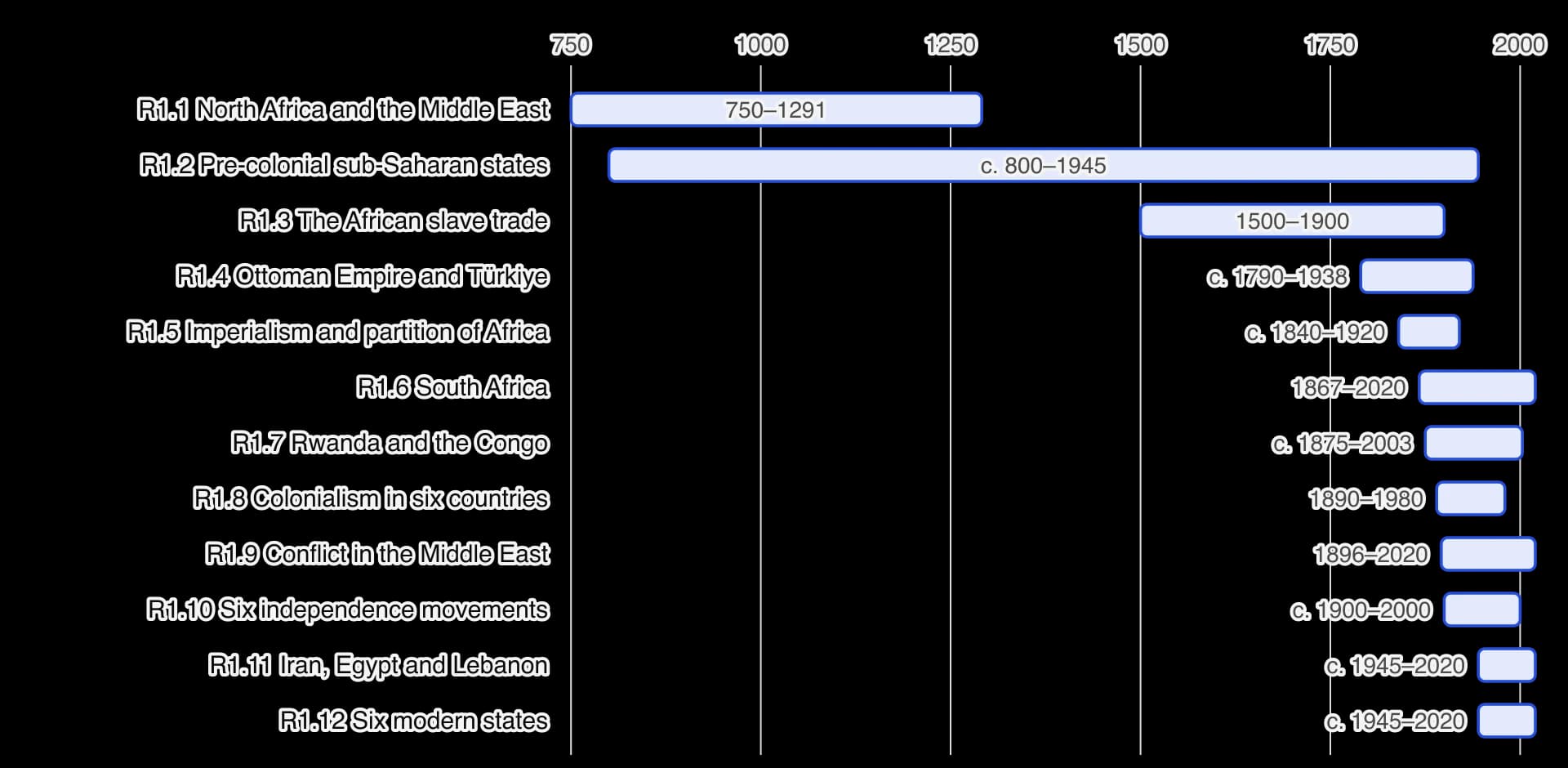
The studies overlap in time, so the same event often appears in two of them from different angles. The First World War, for example, ends the Ottoman Empire in one study and begins the British mandate in Palestine in another. The table of themes groups the studies by what they are mainly about.
Theme | Studies | What they cover |
|---|---|---|
States, faith and trade before colonial rule | R1.1, R1.2, R1.3 | The Abbasid caliphate, the Crusades and the Mamluks (750–1291); African states from Ghana and Mali to Asante, the Zulu kingdom and Ethiopia (c. 800–1945); the Atlantic, Saharan and East African slave trades and their abolition (1500–1900) |
Empire and colonial rule | R1.4, R1.5, R1.7, R1.8 | Ottoman decline, the Tanzimat and Atatürk's Türkiye (c. 1790–1938); the Scramble for Africa (c. 1840–1920); Leopold II's Congo, Belgian Rwanda and the genocide of 1994 (c. 1875–2003); British, French and Portuguese rule in six African countries (1890–1980) |
Nationalism, independence and new states | R1.6, R1.10, R1.12 | South Africa from the Mineral Revolution through apartheid to democracy (1867–2020); six independence movements, peaceful and armed (c. 1900–2000); authoritarian rule, democratisation, development and conflict in six states (c. 1945–2020) |
The modern Middle East | R1.9, R1.11 | The Arab–Israeli and Israeli–Palestinian conflict (1896–2020); revolution, reform and foreign relations in Iran, Egypt and Lebanon (c. 1945–2020) |
Big ideas that run through the region
Outside pressure and local agency are the thread running through almost every study. Crusaders, Mongols, European traders, colonial powers and Cold War superpowers all shaped the region, but its own rulers, merchants, armies and movements decided much of the outcome. African rulers controlled the supply of captives on most of the coast; African societies chose resistance, collaboration or negotiation in the partition; and independence was won, conceded and negotiated in different measures. Since the 1960s historians have stressed African initiative, and weighing it against outside forces is a recurring debate.
Religion and power are closely linked. The Abbasids ruled as caliphs, Saladin united Syria and Egypt around the idea of jihad, Atatürk abolished the caliphate and built a secular state, and the Iranian Revolution of 1979 created an Islamic Republic. Colonial rule left legacies that later studies examine: borders drawn in Europe, racialised identities such as those recorded on Rwandan identity cards, settler economies in Kenya and South Africa, and economies tied to one or two exports.
Several studies deal with genocide, slavery, colonial violence and contested national narratives, above all over 1948 in Palestine and over responsibility for the genocide against the Tutsi. Perspectives therefore matter greatly. Much of the written record was made by outsiders (Arab geographers, European traders, missionaries and colonial officials), so historians also use archaeology, oral tradition and African and Middle Eastern sources to recover other voices. All four historical concepts apply in every study, and impact questions, asking how far something changed a society and for whom, are among the most common.
How the regional studies are studied and examined
The regional studies are taken by HL students only; SL students do not study them. Each school chooses one of the four regions (Africa and the Middle East, the Americas, Asia and Oceania, or Europe) and then two of its twelve studies, taught in about 90 hours. They are the part of IB History that builds skill in evaluating historical arguments.
The regional studies are assessed by Paper 3 (2 hours, 30 marks; 35 per cent of the HL grade). There is a separate paper for each region, with two essay questions on each of its twelve studies. Students answer two questions, each from a different study, so both of their studies are needed, and each essay is marked out of 15. Every question gives an argument to evaluate and asks "To what extent do you agree …?". The IB's published sample for this region asks: "To what extent do you agree with the perspective that the African National Congress (ANC) adopted armed struggle because of the Sharpeville Massacre?" Some studies name several countries or many states; questions on these can ask students to answer with reference to one country or state they have studied.
Carry on with R1 in Augment
With a free account, Augment remembers where you stopped and what you have practiced.