2 Ecology
How living things interact with each other and their environment: populations and communities, energy flow, nutrient cycles, climate and biomes, and how ecosystems change over space and time.
- IB Environmental Systems and Societies
- SL and HL
What 2 covers
From the subject guide: what you need to know and be able to do.
How ecosystems work: populations, energy flow, nutrient cycles, biomes and succession.
5 subtopics in Ecology
Each one has its own page once something is published for it.
An overview of 2 Ecology
Ecology studies how organisms interact with each other and with their physical environment, from a single population of barnacles on a rocky shore to the distribution of rainforests and deserts across the planet. It supplies the scientific foundation for almost every environmental issue in the course, because fisheries, farming, forestry, conservation and climate change all depend on how ecosystems work and how they respond to pressure.
Questions the topic asks
How can natural systems be modelled, and can these models predict the effects of human disturbance?
What controls where a species lives, how large its population becomes, and how it interacts with other species?
How do energy and matter flow through ecosystems, and why does so little energy reach the top of a food chain?
How are carbon and nitrogen cycled between living things, the atmosphere, the oceans and the rocks, and how have humans changed these cycles?
Why does climate produce distinct biomes, and how will biomes shift as the climate warms?
How do communities change along a gradient and over time, and what happens when humans interrupt that change?
The five subtopics
Subtopic | What it covers |
|---|---|
2.1 Individuals, populations, communities and ecosystems | Levels of organisation; species and classification; abiotic and biotic factors; niches; interactions between populations; carrying capacity, regulation and growth curves; human carrying capacity; sampling methods and the Lincoln index; ecosystems as open systems; tipping points; keystone species; biosphere integrity. Extended example: reindeer on St Matthew Island, Alaska. |
2.2 Energy and biomass in ecosystems | The laws of thermodynamics; photosynthesis and respiration; food chains, food webs and trophic levels; gross and net productivity; why food chains are short; ecological pyramids; bioaccumulation, biomagnification and microplastics. Extended example: DDT and the birds of prey of North America. |
2.3 Biogeochemical cycles | Stores, sinks, sources and residence times; the carbon cycle and sequestration; fossil fuels; ocean acidification; ecosystems and farmland as stores, sinks or sources. Extended example: the Amazon rainforest switching from a carbon sink to a source. |
2.4 Climate and biomes | Weather and climate; biomes and climate graphs; the tricellular model of atmospheric circulation; the oceans and heat; biome shifts under global warming. Extended example: vegetation moving upslope on Chimborazo, Ecuador. |
2.5 Zonation, succession and change in ecosystems | Zonation along gradients and its measurement with transects; primary and secondary succession; changes in productivity, diversity and soil during succession; diversity and resilience. Extended example: succession on the volcanic island of Surtsey, Iceland. |
How the subtopics connect
The first subtopic sets out the units ecology works with (individuals, populations, communities and ecosystems) and the methods used to measure them. The others follow what passes through those units. Energy enters as sunlight and flows along food chains, leaving as heat; matter such as carbon and nitrogen is recycled again and again between living and non-living stores. Climate sets the conditions that decide which communities can develop in each region, and those communities change over time through succession and over space through zonation.
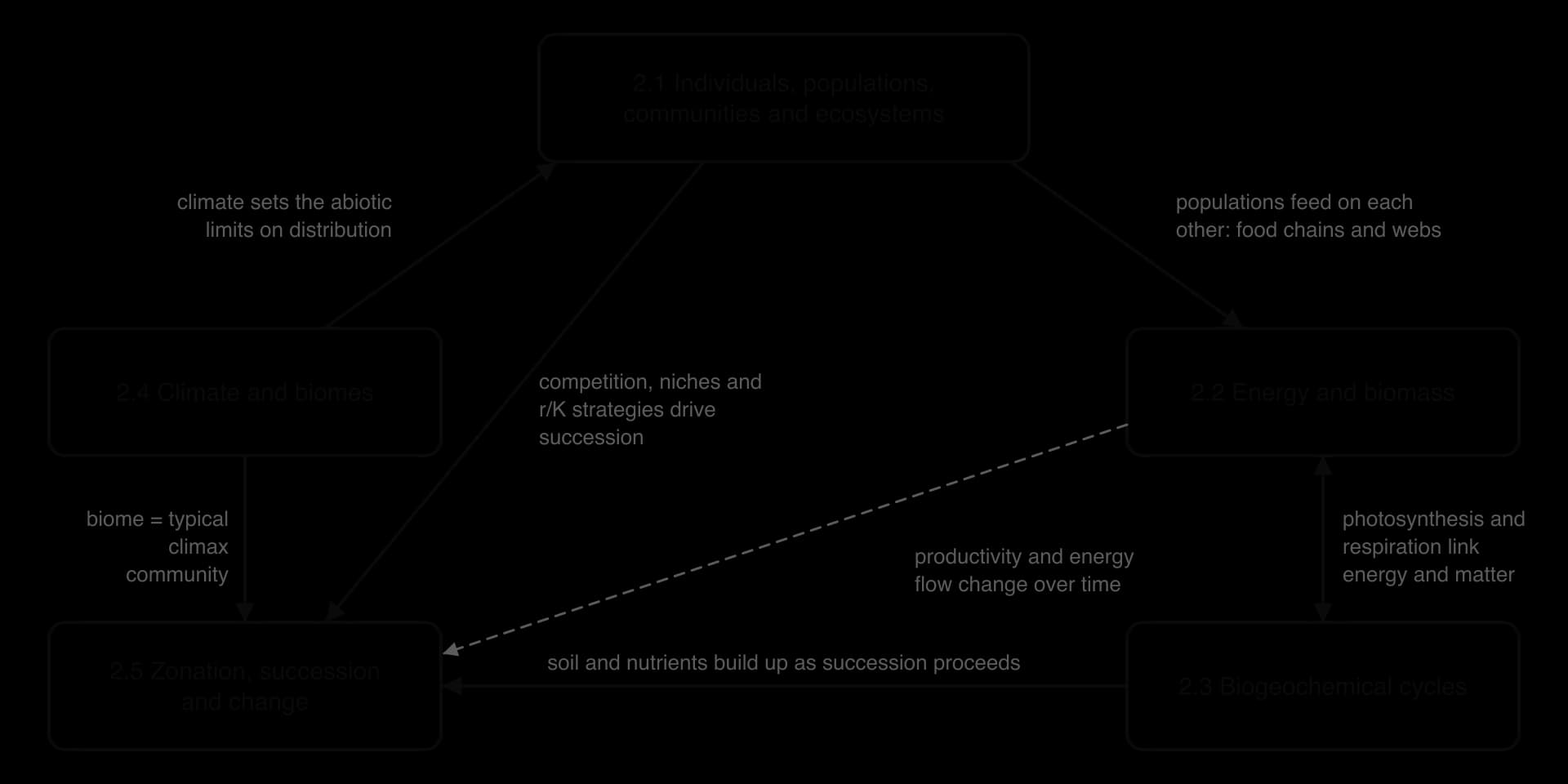
Several ideas run through all five subtopics. The ecosystem as an open system appears in energy flow, nutrient cycles and succession. Negative feedback regulates populations around their carrying capacity, while positive feedback can push forests and lakes past tipping points. Photosynthesis and respiration link the flow of energy with the cycling of carbon. Sampling methods such as quadrats and transects are used to measure populations, zonation and succession alike.
Perspectives, systems and sustainability
Systems
Ecology is where the systems approach is applied most directly. Food chains, energy pyramids, the carbon cycle and the stages of succession are all drawn as systems diagrams with storages, flows, inputs and outputs, and each can be evaluated as a model: useful for prediction, but simplified. Predator–prey cycles and the effect of keystone species are examples of how the behaviour of a whole ecosystem emerges from the interactions of its parts.
Sustainability
Natural ecosystems are models of sustainability: they run on renewable solar energy, recycle almost all of their matter and can persist for millions of years in steady-state equilibrium. Human activity tests that sustainability by harvesting more than ecosystems produce, adding nutrients and carbon faster than cycles can absorb them, and removing species. Ecology supplies the evidence for three of the planetary boundaries: biosphere integrity (crossed, as extinction rates show), biogeochemical flows of nitrogen and phosphorus (crossed), and climate change, through its effect on biomes and the carbon cycle.
Perspectives
Ecological knowledge does not by itself decide what should be done. A technocentric view might respond to falling fish stocks with better monitoring and aquaculture, an anthropocentric view with managed harvests at a sustainable yield, and an ecocentric view with large protected areas where no harvesting takes place. Indigenous and local knowledge of ecosystems, built up over many generations, is a further source of understanding about how populations change and how they can be managed.
How SL and HL differ
SL and HL students study the same common content in all five subtopics. Each subtopic also has HL-only sections, marked “(HL only)”, which HL students study in addition:
2.1 (HL): clades and cladograms; difficulties with the traditional hierarchy of taxa; fundamental and realised niches (Connell’s barnacles); r- and K-strategists; using classification, niches and life cycles to predict human impacts such as phenological mismatch.
2.2 (HL): autotrophs, heterotrophs and chemosynthesis; primary and secondary productivity; maximum sustainable yield and eating at lower trophic levels; ecological efficiency; entropy.
2.3 (HL): carbon in the lithosphere (limestone); methane and methanogenesis; the nitrogen cycle and the Haber process; human impacts on nitrogen and the nitrogen planetary boundary.
2.4 (HL): climate types and their biomes; why the predicted biome does not always develop; the ocean conveyor belt; El Niño–Southern Oscillation; tropical cyclones.
2.5 (HL): factors that shape the community that develops; changes in gross and net productivity during succession; r- and K-strategists in pioneer and climax communities; the debate over the climax community and the Vera hypothesis; plagioclimax.
HL students also apply the three HL lenses to ecology. Environmental law covers the legal protection of species and habitats and international agreements on shared ecosystems. Environmental economics covers the value of ecosystem services, maximum sustainable yields as a basis for harvesting, and the costs of nutrient pollution. Environmental ethics asks whether species and ecosystems have value of their own and what duties humans have when their actions push ecosystems past tipping points.
Assessment
Ecology is examined in both Paper 1 and Paper 2. Paper 1 case studies often include field data from an unfamiliar place, such as quadrat and transect results, population counts, food webs, energy values or climate graphs. Typical questions ask for calculations (the Lincoln index, percentage cover, the efficiency of energy transfer, percentage change), descriptions of patterns in the data, explanations using ecological concepts, and evaluation of the sampling method or of a management strategy.
Paper 2 Section A includes definitions, short explanations (why food chains are short, how density-dependent factors regulate a population, the role of a keystone species) and data-based items. Section B essays use ecology as the basis for extended evaluation, for example of human carrying capacity, the impact of humans on the carbon cycle, or how far succession and resilience help ecosystems recover from disturbance. Named examples and well-drawn diagrams (growth curves, energy pyramids, systems diagrams of cycles) earn high marks, and at HL, answers are strengthened by legal, economic and ethical angles.
 YouTube
Flashcards for 2
The official decks for this part of the syllabus.
- 2.1 Individuals, populations, communities, and ecosystems319 cards
- 2.2 Energy and biomass in ecosystems245 cards
- 2.3 Biogeochemical cycles214 cards
- 2.4 Climate and biomes250 cards
- 2.5 Zonation, succession and change in ecosystems174 cards
Carry on with 2 in Augment
With a free account, Augment remembers where you stopped and what you have practiced.