Explain how couples therapies, relationship education and cooperative strategies try to improve relationships, and evaluate the evidence for how much and how lastingly they bring about change.
Each is in the Psychology glossary, with every other term in the subject.
A form of couples therapy based on learning theory that increases rewarding behaviour between partners and teaches communication and problem-solving skills.
A psychological treatment in which a therapist works with both partners together to reduce relationship distress, for example by changing communication, behaviour or emotional responses.
A form of couples therapy based on attachment theory that helps partners identify their negative cycle of interaction and express underlying attachment needs to rebuild a secure bond.
A form of couples therapy that combines behavioural change strategies with strategies that help partners accept each other's differences, developed by Jacobson and Christensen.
A cooperative learning technique in which each student in a mixed group learns one part of a task and teaches it to the others, so every member depends on every other.
Programmes, usually given to groups of couples before or early in a relationship, that teach communication and conflict-management skills to prevent future distress.
Describe the main strategies for improving interpersonal relationships: couples therapy, relationship education, online programmes and cooperative strategies for relationships between groups.
Explain how behavioural, integrative and emotionally focused couple therapies try to bring about change, and the theories they are based on.
Describe and evaluate the randomised trial of integrative and traditional behavioural couple therapy by Christensen and colleagues.
Evaluate the evidence for the effectiveness of couples therapy and relationship education, including how long their effects last.
Discuss how strategies are adapted to different cultures and social conditions.
Evaluate strategies for improving relationships with reference to change, measurement, causality and responsibility.
Apply knowledge of strategies to suggest how an unfamiliar relationship could be improved.
Strategies for improving relationships are planned interventions that aim to make relationships more satisfying, more stable or less harmful. They range from therapy for one distressed couple to programmes for hundreds of couples and to classroom methods that reduce hostility between groups of students. Relationship distress is common and is linked to poorer mental and physical health in partners and their children, so effective strategies matter beyond the couple.
Every strategy applies an explanation of why relationships go wrong. Behavioural approaches apply operant conditioning and social exchange ideas; others target the attributions and communication patterns described in cognitive research, or the emotional needs described by attachment theory. Testing these strategies is also the strongest test of the explanations, because an intervention that changes a factor and then improves the relationship is evidence that the factor plays a causal role. The concept of
With a free account, Augment remembers where you stopped and what you have practiced.
Improvement can mean several different things, and each strategy chooses its own goal and measure. Most couples research measures relationship satisfaction with a questionnaire such as the Dyadic Adjustment Scale, but researchers also measure observed communication, whether couples separate or divorce, the partners’ individual well-being and, in some programmes, violence between partners. A strategy can succeed on one outcome and fail on another: a programme can improve communication skills without making couples less likely to separate.
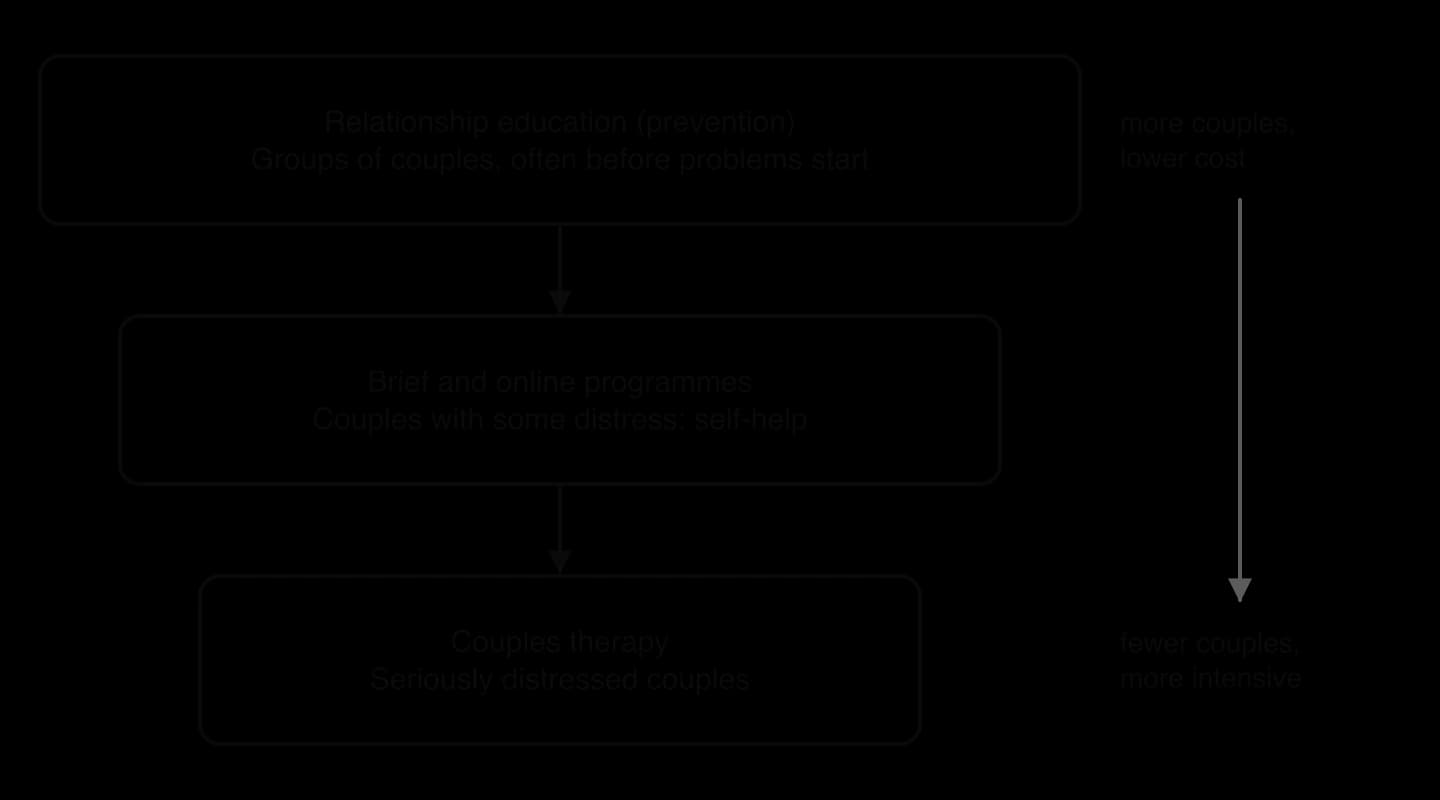
Strategies also differ in whom they reach. Prevention programmes are offered to many couples before serious problems develop, so they are cheap per couple but each couple has little to gain. Therapy is offered to fewer couples who are already distressed, so it is intensive and expensive, but there is more room for improvement. Between the two lie brief and online programmes for couples with some distress.
Strategy | Theory it draws on | What it tries to change |
|---|---|---|
Traditional behavioural couple therapy | Operant conditioning; social exchange theory | The balance of rewarding and costly behaviour; communication and problem-solving skills |
Integrative behavioural couple therapy | Behavioural theory plus acceptance | Behaviour, and partners’ emotional acceptance of differences that will not change |
Emotionally focused therapy | Attachment theory | The negative cycle of interaction and the attachment needs and fears beneath it |
Gottman method | Gottman’s observational research | The Four Horsemen, repair during conflict, friendship and positive interaction |
Relationship education (e.g. PREP) | Research on communication and conflict | Communication and conflict-management skills, before problems develop |
Jigsaw classroom | Superordinate goals; contact between groups | Relationships between students from different groups through cooperative interdependence |
Couples therapy is a psychological treatment in which a therapist works with both partners together, usually in weekly sessions over several months. It is used for general relationship distress, and some forms are also used when one partner has a mental health problem such as depression. Several schools of couples therapy exist. Traditional and integrative behavioural couple therapy and emotionally focused therapy have the most research behind them.
Behavioural couple therapy grew from behaviourism and social exchange theory in the 1970s. Its traditional form (TBCT) assumes that distressed couples exchange too few rewarding behaviours and too many punishing ones, and that they lack the skills to solve problems. Therapy therefore has two main parts. In behaviour exchange, each partner identifies and increases behaviours the other finds rewarding, such as helping with chores or showing affection, which increases positive reinforcement in the relationship. In communication and problem-solving training, the therapist teaches and rehearses skills such as listening without interrupting, summarising what the partner has said, and defining a problem specifically before discussing solutions.
TBCT has a long record of research and works well for many couples, but it has two limits that led to new therapies: a substantial minority of couples do not improve, and some couples who improve at first relapse later. Problems that rest on lasting differences in personality or needs are not easily solved by negotiation or skill training.
Andrew Christensen and Neil Jacobson developed integrative behavioural couple therapy (IBCT) to address these limits. IBCT keeps the change strategies of TBCT but adds strategies for emotional acceptance. The therapist helps partners understand their conflicts as a pattern that arises from understandable differences in their histories and needs, rather than as evidence that one partner is bad. Partners learn to describe the pattern together as a shared problem, rather than blaming each other, and to tolerate some behaviour that is unlikely to change.
The reasoning behind acceptance is that when partners stop trying to force each other to change, their conflicts become less intense, and each partner often then changes spontaneously because the pressure has gone. This reasoning echoes research on the demand–withdraw pattern, in which pressure for change provokes withdrawal and withdrawal provokes more pressure.
Christensen and colleagues aimed to compare the effectiveness of traditional and integrative behavioural couple therapy for couples whose relationships were seriously and chronically distressed, and to find out whether any benefits lasted for years after therapy ended.
The study was a randomised controlled trial in the USA. The sample was 134 married couples who were seriously and chronically distressed, and they were divided into moderately and severely distressed groups before being randomly allocated to TBCT or IBCT, so that the level of distress was balanced across the two therapies. Each couple received about 8 months of therapy.
The main outcome was marital satisfaction, measured with the Dyadic Adjustment Scale and other questionnaires. Satisfaction and marital status were assessed about every 3 months during treatment and every 6 months for 5 years after it ended. Couples were classified as clinically improved or recovered when their satisfaction score changed by more than could be explained by measurement error and, for recovery, moved into the range of non-distressed couples. Communication was also measured by observing couples discussing relationship problems.
During treatment, TBCT couples improved more quickly at first and then levelled off, while IBCT couples improved steadily throughout. By the end of treatment, 71% of IBCT couples and 59% of TBCT couples were reliably improved or recovered, a difference that was not statistically significant. Communication and individual well-being improved in both groups.
At the 2-year follow-up, with data from 130 of the 134 couples, 69% of IBCT couples and 60% of TBCT couples were clinically improved. Both groups showed a "hockey-stick" pattern: satisfaction fell immediately after therapy ended and then rose for most of the follow-up period, and IBCT couples turned upwards sooner. Through these two years IBCT was significantly but modestly better.
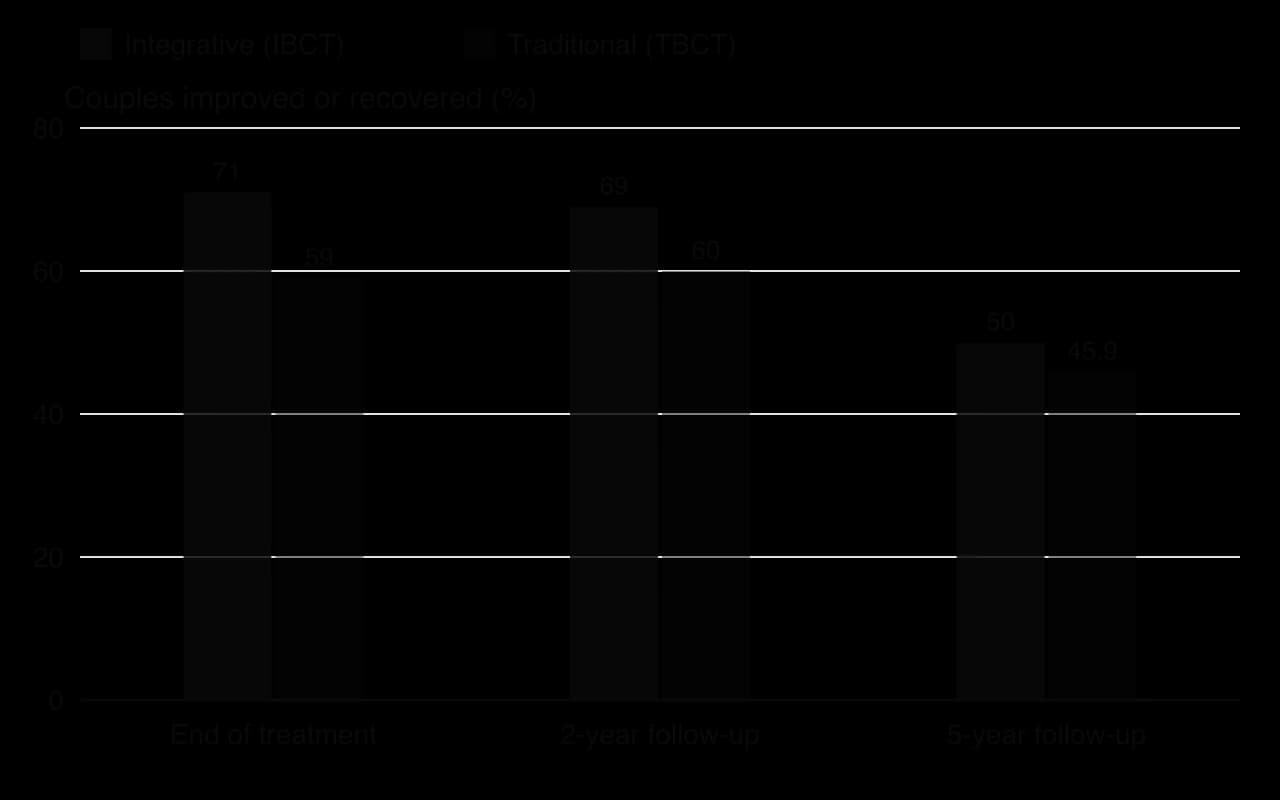
At the 5-year follow-up, 50.0% of IBCT couples and 45.9% of TBCT couples were clinically improved, and 25.7% and 27.9% were separated or divorced. The effect size for the change in satisfaction from before treatment was large for both therapies (d = 1.03 for IBCT and 0.92 for TBCT), and the differences between the therapies were no longer significant.
Both behavioural couple therapies produced substantial improvement, even for couples who had been distressed for a long time. IBCT gave somewhat better and more stable results for about two years, but without further help the outcomes of the two therapies converged. About half of the couples were still clinically improved five years after therapy, which compares favourably with other long-term results of couples therapy, but it also means that about half were not.
The study is one of the few to follow couples for five years after therapy, which shows how change develops: an early gain, a drop after therapy ends, partial recovery and convergence. A study that stopped at the end of treatment would have given a far more optimistic and less accurate picture of lasting change. The finding that about half of couples kept their gains is a realistic benchmark for what couples therapy can achieve.
Random allocation allows a causal comparison between the two therapies. There was no untreated control group, because withholding help from severely distressed couples for five years would be unethical, so the study cannot show how much of the improvement was caused by therapy rather than by time, regression to the mean (couples recruited at their worst tend to improve anyway) or expectancy effects. Other trials with wait-list controls help to answer that question.
Satisfaction was measured with standardised, reliable questionnaires, and the classification of couples as "improved" used statistical criteria for reliable change rather than any increase at all. The measures were still self-reported, and partners who have invested months in therapy may report more satisfaction to justify the effort. The addition of observed communication and of marital status, which is not self-rated in the same way, strengthens the conclusions.
The couples were American, married and heterosexual, and they volunteered for a demanding trial, so they may have been more motivated than many distressed couples. The therapies were developed by members of the research team, so researcher bias in favour of IBCT is possible, although the convergence of results over time suggests it did not decide the outcome.
Sources: Christensen, A., et al. (2004). Traditional versus integrative behavioral couple therapy for significantly and chronically distressed married couples. _Journal of Consulting and Clinical Psychology, 72(2), 176–191; Christensen et al. (2006), 74(6), 1180–1191; Christensen et al. (2010), 78(2), 225–235._
Emotionally focused therapy (EFT) was developed by Sue Johnson and Les Greenberg in the 1980s. It is based on attachment theory: it treats adult love as an attachment bond and relationship distress as the result of partners feeling insecure in that bond. Partners caught in a negative cycle, such as one pursuing and criticising and the other withdrawing, are seen as protecting themselves from fears of rejection or abandonment.
Therapy proceeds in three stages. In de-escalation, the therapist helps the couple identify their negative cycle and the emotions underneath each partner’s position, and reframes the problem as the cycle rather than either partner. In restructuring the bond, partners express their needs and fears directly and respond to each other’s, creating new "bonding events". In consolidation, the couple applies the new pattern to old problems. Where behavioural therapy focuses on skills and behaviour, EFT focuses on emotion as the driver of interaction.
Johnson et al. (1999) combined the four most rigorous early trials of EFT in a meta-analysis and reported a larger effect than any other couple intervention had achieved. The psychologist James Coyne later criticised it as a poor-quality meta-analysis of small pilot studies run by the therapy’s own developers, and much EFT research has been carried out by its developers.
Rathgeber et al. (2019) carried out a meta-analysis of 33 randomised controlled trials of behavioural couple therapy and EFT, with 2,730 participants in total. Both therapies produced medium effects on relationship satisfaction at the end of treatment and smaller effects six months later, but the effects of behavioural therapy were not maintained after 12 months, and there were too few studies to estimate EFT’s effect at that point.
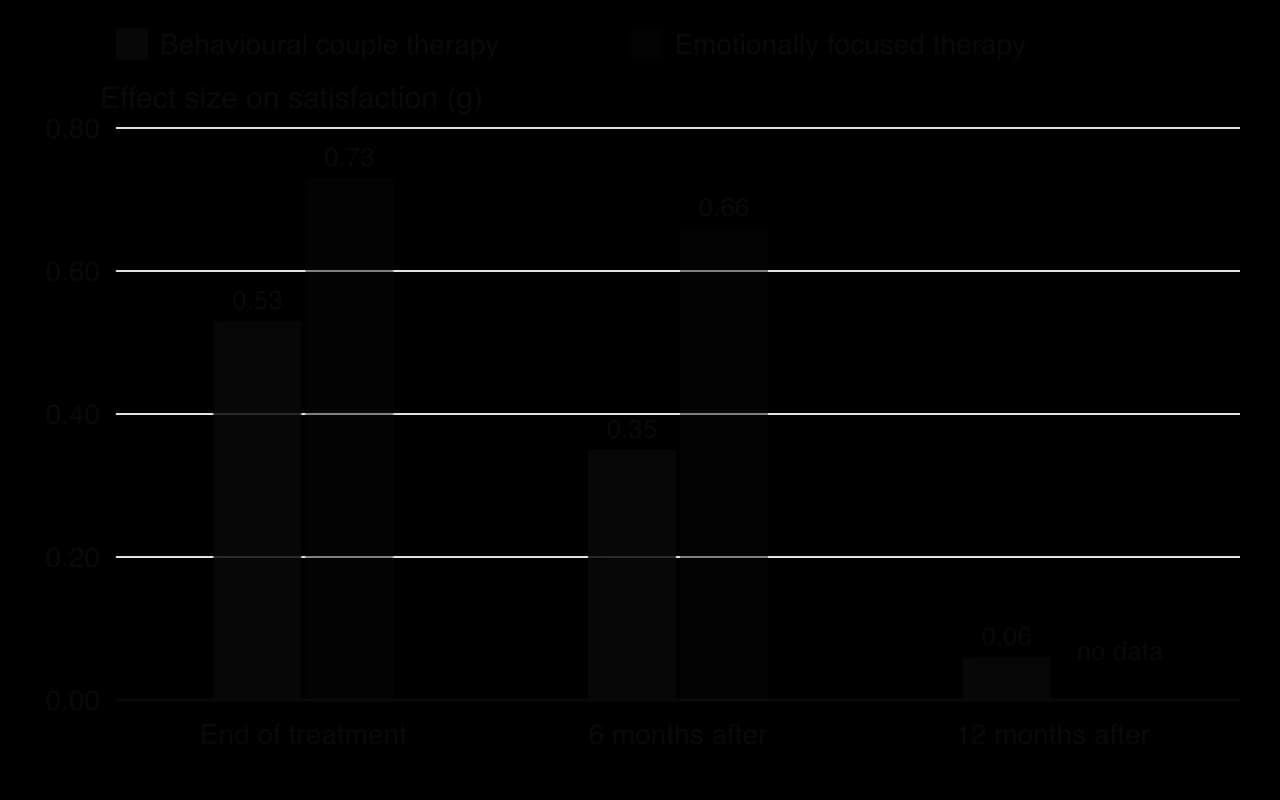
The authors found no significant difference between the two kinds of therapy and warned that the results should be interpreted with caution because of possible publication bias. Taken together with Christensen’s trial, the evidence suggests that several different therapies help many couples in the short term, that their effects fade, and that no single theory of relationship distress has been shown to produce clearly better results.
 YouTube
The Gottman method applies the observational research on communication directly to therapy. It aims to replace the Four Horsemen with their antidotes (a gentle start-up, a culture of appreciation, accepting responsibility and self-soothing), to strengthen friendship and positive interaction between partners, and to teach couples to repair after conflict. Its strength is that it is built on a large body of observational research on what distinguishes stable from unstable couples. Its weakness is that the therapy itself has been tested in far fewer randomised trials than behavioural couple therapy or EFT, so its effectiveness rests more on the research that inspired it than on direct tests.
Relationship education programmes teach couples communication and conflict-management skills, usually in groups and often before serious problems develop, for example before marriage or after the birth of a first child. The best known is the Prevention and Relationship Enhancement Program (PREP), developed by Howard Markman, Scott Stanley and colleagues, which teaches skills such as structured speaking and listening, recognising danger signs like escalation and withdrawal, and taking time out when an argument becomes heated.
Some trials have found encouraging results. Stanley et al. (2010) randomly allocated married couples in the US Army either to a version of PREP delivered by army chaplains (248 couples) or to a no-treatment control group (228 couples). One year later, 2.03% of the PREP couples had divorced, compared with 6.20% of the control couples, about a third of the rate. The authors noted that this showed a reduced risk of divorce at least in the short term and for military couples.
Larger evaluations give a more modest picture. In the USA, government funding has supported relationship education for lower-income couples since 2006. Hawkins et al. (2022) carried out a meta-analysis of 32 controlled studies of these programmes. They found small but statistically significant effects on relationship quality (d = 0.11), relationship skills (d = 0.13), mental health and co-parenting, but no significant effects on whether couples stayed together, on parenting or on child well-being. These effects are much smaller than those of early trials with more advantaged couples.
Fewer than a third of divorcing couples in the USA use couples therapy, so researchers have developed programmes that couples can complete at home. OurRelationship is an 8-hour online programme adapted from IBCT, in which couples complete activities online and have four 15-minute calls with project staff. Doss et al. (2016) randomly allocated 300 couples, broadly representative of the US population, to begin the programme immediately or to a 2-month wait-list control. Compared with the wait-list, couples who completed the programme reported significant improvements in relationship satisfaction (d = 0.69) and in individual problems such as depressive and anxious symptoms.
Online programmes reach couples who cannot afford or would not seek therapy. A 12-month follow-up of the same trial by Doss et al. (2019) found that the gains in satisfaction were maintained. Roddy, Rothman and Doss (2018) then randomly allocated 356 couples to low or high levels of coach support: satisfaction improved similarly in both groups, but couples with less support were more likely to drop out, so some human contact still matters in digital interventions.
Most couples therapies were developed with married, Western, middle-class couples, and their assumptions, such as open discussion of feelings between two partners who are equals, do not fit every culture. Strategies that work elsewhere are often adapted to local family structures, gender norms and problems.
The Bandebereho programme in Rwanda is an example of a culturally grounded strategy. It worked with expectant and current parents of young children through 15 group sessions that combined relationship and parenting skills with critical reflection on gender norms. In a randomised trial, 575 couples were assigned to the programme and 624 to a control group.
Six years later, Doyle et al. (2023) found that women in the programme group reported less physical, sexual, economic and emotional violence from their partners in the previous year, and couples reported less physical punishment of children, fewer depressive symptoms, and more shared household work and decision-making. Three of the authors had helped to develop the programme, which they declared as a conflict of interest.
The programme shows that improving relationships can mean reducing harm as well as raising satisfaction, and that strategies can address social norms rather than only a couple’s private interaction. It also shows that strategies can produce lasting change in a non-Western, low-income setting, which most Western couples research has not tested.
Strategies for improving relationships also apply to relationships between groups, such as students of different ethnic backgrounds in a school. Research on intergroup conflict suggests that competition between groups increases hostility and that cooperation towards superordinate goals reduces it, while the contact hypothesis proposes that contact reduces prejudice under conditions such as equal status and cooperation.
The jigsaw classroom, designed by Elliot Aronson in 1971 for newly desegregated schools in Austin, Texas, applies these ideas to the classroom. Students work in mixed groups; each member learns one part of the material, discusses it with members of other groups who studied the same part, and then teaches it to their own group. Because no one can succeed without the others, the task makes every student depend on every other student.
 YouTube
Early studies were promising. Blaney et al. (1977) compared ten fifth-grade jigsaw classes in seven schools with traditional classes and found that self-esteem rose in jigsaw classes while it fell in traditional ones. In Australia, Walker and Crogan (1998) found that jigsaw students attributed fewer negative traits to Asian- and European-Australians, while ordinary cooperative learning without interdependence did not have the same effect.
Later research was less positive. In two studies in Norwegian schools, Bratt (2008) measured attitudes before, immediately after and six months after jigsaw teaching and found that the results did not support a reduction in prejudice. He also criticised earlier studies, noting for example that Walker and Crogan had reclassified a jigsaw class as a control class after the technique failed in it, and argued that there is no solid evidence that the jigsaw method reduces prejudice.
The difference between early and later findings may reflect the context: the technique was designed for classrooms with open intergroup tension, and its effects may be smaller where relations are already calm, or the earlier studies may have overestimated the effect.
Each strategy emphasises one approach, but successful strategies usually work at several levels at once. Behavioural therapy changes behaviour and the rewards partners receive; IBCT and EFT also change how partners interpret each other and the emotions they express; programmes such as Bandebereho also change shared norms. Biological factors are involved as well: self-soothing in the Gottman method targets the physiological arousal that makes calm discussion impossible during conflict.
Level | Example of a target | Strategy that addresses it |
|---|---|---|
Biological | Physiological flooding during conflict | Taking a break of at least 20 minutes to calm down (Gottman method) |
Cognitive | Blaming, distress-maintaining attributions | Describing the problem as a shared pattern (IBCT); reframing the cycle (EFT) |
Behavioural | Too few rewarding exchanges; poor problem-solving | Behaviour exchange and skills training (TBCT, PREP) |
Sociocultural | Gender norms; financial stress; intergroup competition | Reflection on gender norms (Bandebereho); cooperative interdependence (jigsaw classroom) |
This interaction helps explain why no single therapy is clearly superior. Different therapies may change different parts of the same system, and changing any one part can shift the others: calmer arguments allow more generous attributions, which allow more rewarding behaviour.
The evidence shows that strategies can bring about real change. Couples therapy improves satisfaction for most distressed couples by the end of treatment, online programmes help couples who would not seek therapy, and Bandebereho reduced partner violence six years later.
The size and durability of the change are the main limits. Effects are medium at the end of therapy, shrink after it ends, and converge across therapies; relationship education for low-income couples has small effects and no clear effect on whether couples stay together. Barriers to change include cost, the reluctance of many couples to seek help, and life stresses outside the relationship that skills cannot remove.
Randomised controlled trials are the main method for testing strategies, and random allocation allows conclusions about cause. Trials that compare a strategy with a wait-list or no-treatment control show whether the strategy has an effect at all; trials that compare two therapies, like Christensen’s, show which works better but not how much either works beyond time and expectation. Because different therapies produce similar results, the active ingredient may be something they share, such as the attention of a therapist, hope, or simply a structured opportunity to talk, rather than the specific techniques each theory recommends.
Common factors are features shared by many therapies, such as a trusting relationship with the therapist, the expectation of improvement, and a structured time in which partners talk and listen to each other. If different therapies produce similar results, these shared features may explain much of their effect, and the specific techniques that each theory emphasises may matter less than their developers believe.
Most outcomes are self-reported satisfaction, which is easy to measure reliably but is open to demand characteristics after months of therapy. Divorce or separation is a more objective outcome, but staying together is not always an improvement, for example in a violent relationship. Observed communication and reports of violence add other measures, and studies that use several measures give a fuller picture of change, as a form of triangulation.
Most trials involve married, heterosexual, Western couples who volunteer for treatment, which limits generalisation to cohabiting, same-sex and non-Western couples and to those who never seek help. Many trials are run by the developers of the therapy being tested, which creates a risk of researcher bias, and Rathgeber et al. (2019) warned of possible publication bias. Independent replications and pre-registered trials reduce these problems.
Joint therapy assumes that both partners can speak openly and safely. Where one partner is violent or controlling, joint sessions may put the other at risk, so services screen for violence before offering couples therapy and may offer individual help instead. Strategies must also respect cultural values about family and gender, while not reinforcing practices that harm one partner; programmes such as Bandebereho address this by involving communities in reflecting on their own norms. Psychologists who promote relationship programmes also have a responsibility not to overstate the evidence, especially for government-funded programmes with small effects.
This area of study can appear in Paper 1 Section B, where a scenario describes a relationship problem and asks you to apply an approach term, for example to suggest or explain a strategy, and in Section C, where an essay asks you to evaluate strategies through a concept. Change is the natural concept, but causality, measurement and responsibility also fit well.
Strategies for improving relationships range from prevention programmes for many couples to intensive therapy for distressed couples, and include cooperative strategies for relationships between groups.
Traditional behavioural couple therapy applies operant conditioning and social exchange: behaviour exchange plus communication and problem-solving training.
Integrative behavioural couple therapy adds emotional acceptance of differences; emotionally focused therapy applies attachment theory to the couple’s negative cycle.
Christensen et al.: 134 distressed couples; 71% (IBCT) and 59% (TBCT) improved at the end of treatment, 50.0% and 45.9% after five years; IBCT was better for two years, then the therapies converged.
Rathgeber et al. (2019) found medium effects at the end of therapy that shrink afterwards, with no clear difference between behavioural therapy and EFT.
Relationship education reduced divorce among army couples in Stanley et al. (2010) but had small effects for low-income couples in Hawkins et al. (2022); online programmes widen access.
Culturally grounded programmes such as Bandebereho in Rwanda can produce lasting reductions in partner violence by working on norms as well as skills.
The jigsaw classroom improved liking between groups in early studies, but later research in Norway found no effect on prejudice.
Evaluation: change is real but moderate and often temporary; causality depends on control groups; outcomes are mostly self-reported; samples and researcher allegiance limit generalisation.
I can describe the main strategies for improving relationships and the levels at which they work.
I can explain how TBCT, IBCT and EFT try to bring about change and the theories behind them.
I can describe and evaluate the trial by Christensen and colleagues, including its five-year follow-up.
I can evaluate the evidence on how effective and how lasting couples therapy and relationship education are.
I can discuss how strategies are adapted to cultures and social conditions, with an example.
I can explain the jigsaw classroom and evaluate the evidence for it.
I can evaluate strategies with reference to change, causality, measurement and responsibility.
I can suggest and justify a strategy for improving an unfamiliar relationship.