Explain how self-disclosure, conflict behaviour and responses to good news shape relationships, evaluate Gottman’s research on predicting divorce, and discuss how culture and technology change communication.
Each is in the Psychology glossary, with every other term in the subject.
Sharing good news with another person; how the listener responds, especially with active and constructive enthusiasm, affects well-being and the quality of the relationship.
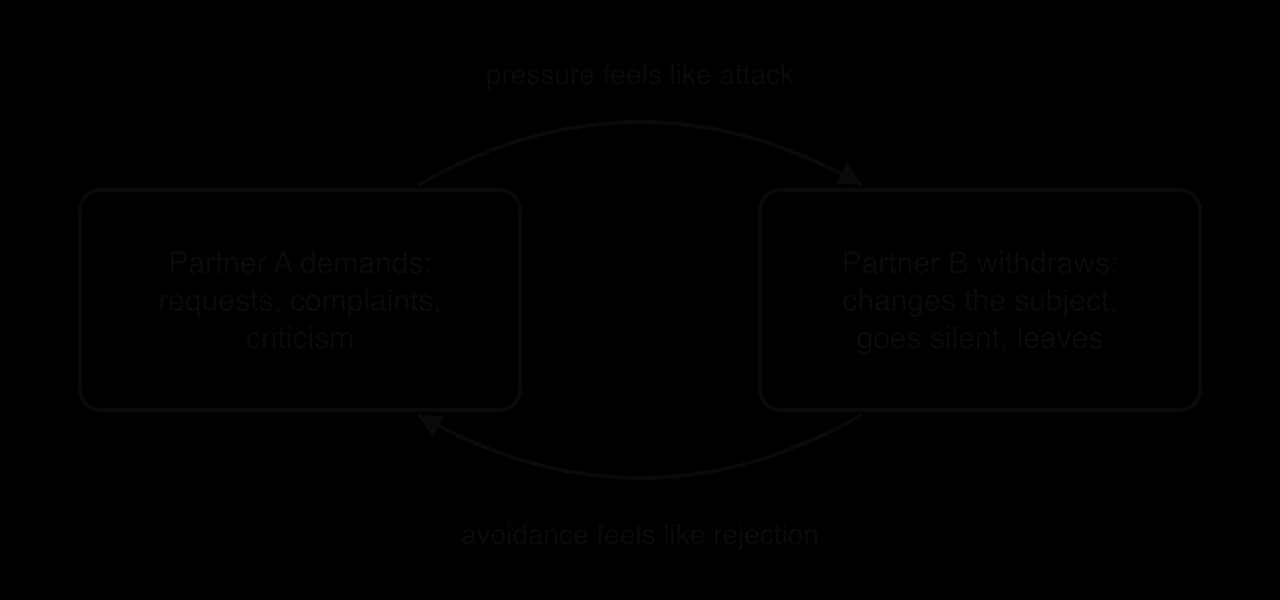
A pattern of communication in conflict in which one partner pressures the other for change through requests, criticism or complaints while the other avoids the discussion or withdraws.
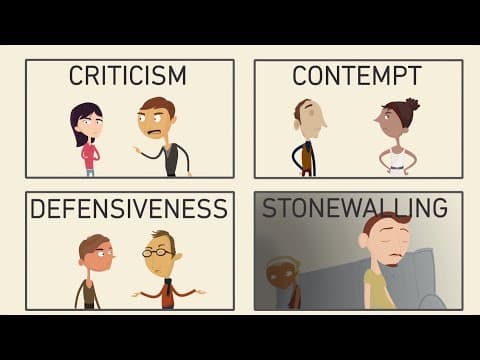
Gottman's term for four negative communication behaviours during conflict, criticism, contempt, defensiveness and stonewalling, which predict relationship breakdown.
The sending of information without words, through facial expression, eye contact, gesture, posture, touch, use of space and tone of voice.
The degree to which people in a society or social context have opportunities to form new relationships and to end existing ones.
The act of revealing personal information about oneself, such as thoughts, feelings and experiences, to another person.
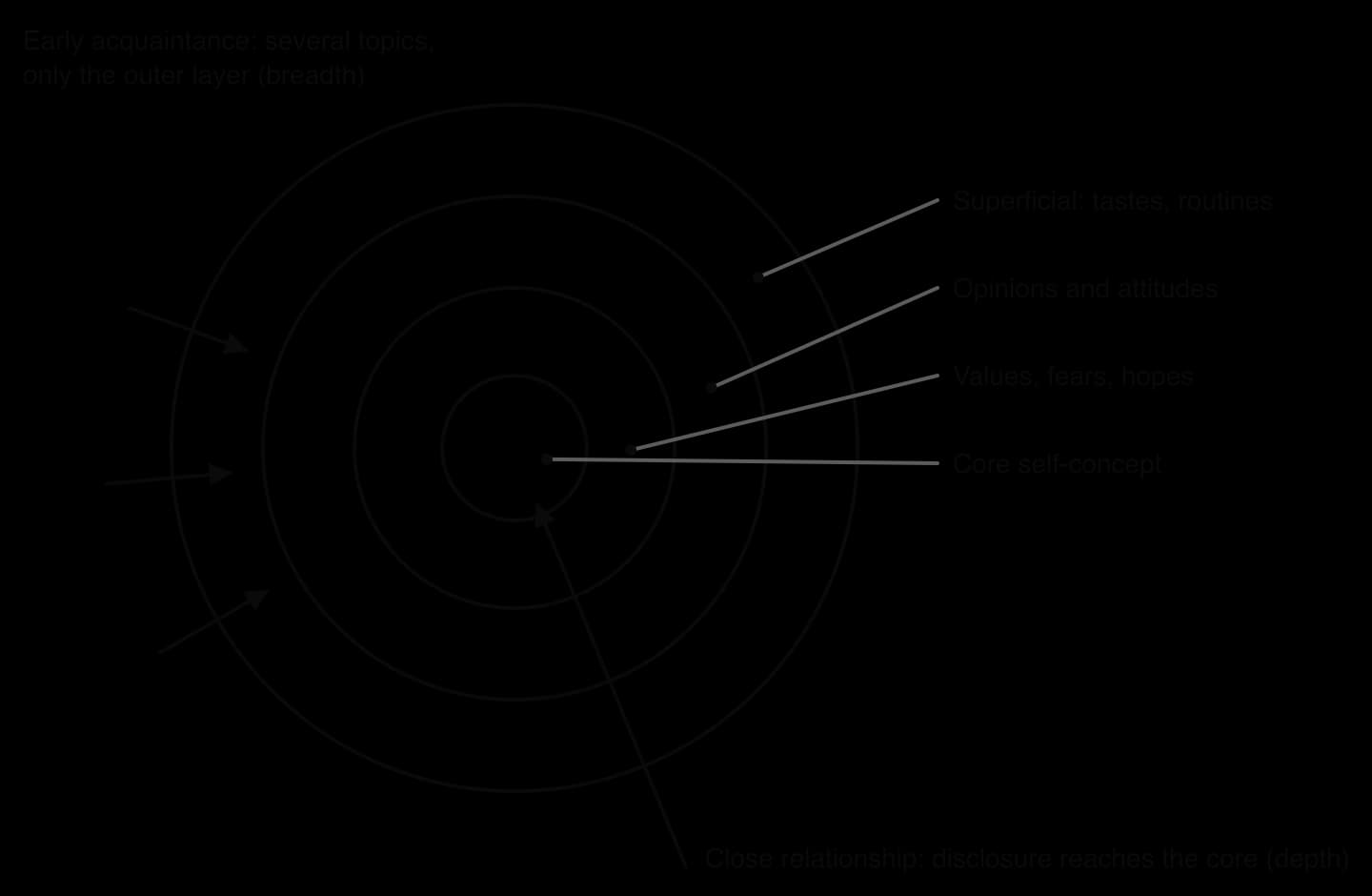
Altman and Taylor's theory that relationships develop as self-disclosure gradually increases in breadth (the range of topics) and depth (how personal the information is).
Describe the main forms of communication in relationships, including verbal and nonverbal communication.
Explain the role of self-disclosure in developing relationships, with reference to social penetration theory and research.
Explain how communication during conflict, including the Four Horsemen and the demand–withdraw pattern, affects relationship outcomes.
Describe and evaluate Gottman and Levenson’s (2000) study of communication and the timing of divorce.
Explain the role of positive communication, including capitalisation, in maintaining relationships.
Discuss how culture and online communication affect communication in relationships.
Evaluate research on communication in relationships with reference to measurement, causality and bias.
Apply research on communication to unfamiliar situations involving interpersonal relationships.
Communication is the process by which partners share information, feelings and needs, through words and through tone, facial expression and touch. Every interpersonal relationship is built and maintained through it: people become close by telling each other about themselves, and relationships often break down through the way partners argue rather than through what they argue about.
Research on communication draws on several approach terms. Disclosure and conflict behaviour can be learned by watching others, as social learning theory predicts; the way a message is interpreted depends on schemas and cognitive biases; and what counts as appropriate communication is shaped by culture. The field has also developed some of the most careful observation
With a free account, Augment remembers where you stopped and what you have practiced.
Communication has a verbal channel, the words themselves, and a nonverbal channel. Nonverbal communication includes facial expressions, eye contact, posture, gestures, touch and the use of space, as well as paralanguage: the tone, loudness and speed of the voice. The two channels often carry different information. Words usually carry the content of a message, while nonverbal signals carry much of its emotional meaning and show how the speaker feels about the listener.
In close relationships, the emotional meaning of a message often matters more than its content. "Fine, whatever" can be agreement or an expression of hurt, depending on tone and expression. Because partners know each other well, they rely on shared meanings and short-cuts, which makes communication efficient when it works and makes misunderstandings hard to see when it does not.
Research on communication in relationships focuses on three broad functions.
Function | Question it answers | Main research |
|---|---|---|
Building closeness | How do strangers become intimate partners or friends? | Self-disclosure; social penetration theory; the "36 questions" procedure |
Managing conflict | Why do some couples’ arguments damage the relationship while others’ do not? | Gottman’s Four Horsemen; the demand–withdraw pattern |
Sustaining positive feelings | What keeps a relationship rewarding day to day? | Capitalisation; the ratio of positive to negative interaction |
Self-disclosure is the sharing of personal information about oneself: facts, thoughts, feelings, fears and experiences. Disclosure makes the speaker known and makes them vulnerable, and a warm, accepting response from the listener builds trust. Disclosure is therefore one of the main ways in which acquaintances become friends and partners.
Social penetration theory, proposed by Altman and Taylor (1973), describes the development of a relationship as a gradual increase in self-disclosure. The theory pictures the self as having layers, like an onion. The outer layers hold superficial information, such as tastes in music or daily routines; deeper layers hold attitudes and values; the core holds the most private aspects of the self, such as fears, hopes and self-concept.
Disclosure grows in two dimensions. Breadth is the range of topics people talk about; depth is how far into the self the disclosure reaches. Early in a relationship, people disclose about a few topics at a superficial level. As trust develops, they discuss more topics and reach deeper layers. Disclosure is usually reciprocal: when one person discloses, the other tends to disclose at a similar level, and a disclosure that is much too deep too early can feel inappropriate and push the listener away. When a relationship declines, partners may disclose less, a process called depenetration.
The theory draws on social exchange ideas: people decide whether to disclose more by weighing the rewards of closeness against the risks of being hurt or rejected. Disclosure is therefore a cognitive decision as well as a behaviour, affected by expectations of how the listener will respond.
Collins and Miller (1994) carried out a meta-analysis of research on self-disclosure and liking. They found three related effects: people who make intimate disclosures tend to be liked more than people who disclose less; people disclose more to those they already like; and people come to like others as a result of having disclosed to them. The size of the effects depended on the study design, the type of disclosure and the gender of the discloser, and the three effects together suggest a cycle in which disclosure and liking increase each other.
Aron et al. (1997) developed a procedure to create closeness between strangers in a laboratory. Pairs of participants spent 45 minutes on self-disclosure and relationship-building tasks, taking turns to answer sets of questions that began with fairly superficial topics and became gradually more personal. Compared with pairs who spent the same time on small-talk tasks, these pairs reported greater closeness. In later studies, closeness did not depend on whether pairs were matched for agreement on important attitudes or on whether getting close was made an explicit goal.
 YouTube
How much people disclose, and to whom, varies across cultures. Chen (1995) gave a questionnaire on disclosure across different topics and to different people to 200 American and 144 Chinese students, and found that the American students disclosed more on both measures. Such differences are sometimes explained by individualism and collectivism, but that explanation names a difference rather than showing how it arises.
Schug, Yuki and Maddux (2010) tested a more specific explanation: relational mobility, the degree to which people in a society have opportunities to form new relationships and leave old ones. In a comparison of Japan and the USA, the difference in self-disclosure to a close friend was explained by participants’ perceptions of relational mobility. A second study within Japan found that people who perceived higher relational mobility also disclosed more, because they were more motivated to use disclosure to strengthen their relationships.
The idea links communication to the cognitive explanations of relationships. Where relationships can easily be ended and replaced, as in societies with high relational mobility, people have to keep showing commitment to keep their relationships, and disclosure is one way of doing this. Where relationships are stable and given, such as many relationships in rural or tightly knit communities, heavy disclosure is less necessary. The same behaviour therefore has a different function in different social settings.
Disagreement is part of every close relationship, so research on conflict focuses on how partners argue and which ways of arguing predict that a relationship will become unhappy or end. The best-known programme of research is that of John Gottman and Robert Levenson, who from the 1980s brought couples into a laboratory (later called the "Love Lab"), video-recorded them discussing an area of continuing disagreement, measured their physiological responses and followed them for years to see which couples stayed together.
Gottman’s team measured communication through structured observation with detailed coding systems. The Specific Affect Coding System (SPAFF) classifies each moment of a conversation as neutral, as one of several negative emotions (such as anger, contempt, sadness, fear or whining) or as one of several positive emotions (such as affection, humour, interest or joy). Coders use facial expression, voice, words and context together, so SPAFF captures nonverbal as well as verbal communication. Training coders took more than 200 hours, and agreement between coders was checked statistically.
This approach is a form of operationalisation: an abstract construct such as "contempt" is turned into specific behaviours that trained observers can recognise and count. It allows researchers to measure what couples actually do, rather than what they say they do, which avoids some of the problems of self-reported data.
From this research Gottman identified four communication behaviours during conflict that predicted relationship breakdown, which he called the Four Horsemen. Each is a different way of turning a disagreement about a problem into an attack on, or retreat from, the partner.
Behaviour | What it is | Example | Antidote proposed by the Gottman Institute |
|---|---|---|---|
Criticism | An attack on the partner’s character rather than a complaint about a specific behaviour | Saying that the partner “never thinks about anyone else” | A gentle start-up: complain about one behaviour without blame, saying what one feels and needs |
Contempt | Treating the partner as inferior: mockery, sarcasm, insults, disgust | “Oh, of course, the great expert has spoken.” | Building a culture of appreciation and respect |
Defensiveness | Responding to a complaint with excuses or counter-attack, which shifts blame back to the partner | “It’s not my fault. The real problem is…” | Accepting responsibility for at least part of the problem |
Stonewalling | Withdrawing from the interaction: going silent, looking away, refusing to respond | Staring at a phone while the partner talks | Physiological self-soothing: taking a break of at least 20 minutes to calm down |
Stonewalling is often linked to physiological flooding: during intense conflict the partner’s heart rate and arousal rise so much that they cannot process what is being said, and withdrawal is a way of escaping. This connects communication to the autonomic nervous system and shows how biological and social processes interact in an argument.
 YouTube
Gottman and Levenson (1992) studied 73 married couples in 1983 and again in 1987. They divided couples by a single measure of the balance between positive and negative behaviour during conflict. Couples in which positive behaviour did not outweigh negative behaviour ("nonregulated" couples) had lower satisfaction, more negative and less positive emotional expression, more defensiveness and withdrawal, poorer health, and a greater risk of separation four years later than "regulated" couples.
The Gottman Institute summarises this research as a "magic ratio": stable couples show about five positive interactions for every negative one during conflict, while a ratio of one to one or lower indicates a relationship at risk. The ratio is a rule of thumb rather than a precise law. The underlying finding is that negative behaviour does most harm when positive behaviour does not outweigh it, and this idea is central to later work on couples therapy.
Another well-studied pattern is the demand–withdraw pattern. One partner presses for change through requests, complaints or criticism, while the other avoids the discussion by changing the subject, going silent or leaving. Each partner’s behaviour provokes more of the other’s: pressure feels like an attack to the withdrawing partner, and withdrawal feels like rejection to the demanding one.
Christensen and Heavey (1990) observed 31 married couples in two discussions: one about a change the wife wanted and one about a change the husband wanted. Across the two discussions, the wife-demand and husband-withdraw pattern was more common than the reverse, but only when the couple discussed a change the wife wanted. Both spouses were more demanding when discussing a change they wanted and more withdrawn when discussing a change their partner wanted. The pattern depends partly on the structure of the conflict, on who wants something to change, and not only on gender.
Christensen, Eldridge and colleagues (2006) asked 363 participants in Brazil, Italy, Taiwan and the USA to report on communication in their romantic relationships. In all four countries, constructive communication was linked to higher satisfaction and demand–withdraw communication to lower satisfaction, and woman-demand and man-withdraw was more common than the reverse. Partners who differed more in how much closeness and independence they wanted showed more demand–withdraw communication. The consistency across four very different cultures suggests that the pattern reflects something general about how couples handle conflict over change.
Gottman and Levenson aimed to find out whether the communication patterns that predict divorce early in marriage are the same as those that predict divorce later, and in particular whether negative affect during conflict and a lack of positive affect predict divorce at different times.
The study was a prospective longitudinal design combining observation with questionnaires. In 1983, couples in Bloomington, Indiana, were recruited through newspaper advertisements. About 200 couples completed questionnaires on marital satisfaction, and 85 were invited to the laboratory, chosen so that the full range of satisfaction was represented. Complete data were obtained from 79 couples. At the start, husbands were on average 30.8 years old and wives 28.9, and they had been married for an average of 5 years.
Couples came to the laboratory after at least 8 hours apart and had three 15-minute conversations, always in the same order: the events of the day, an area of continuing disagreement, and a pleasant topic. Video-recordings of the first two conversations were coded in two ways. The Rapid Couples Interaction Scoring System (RCISS) coded each turn of speech for behaviours including criticism, defensiveness, contempt and stonewalling. The Specific Affect Coding System (SPAFF) coded positive and negative emotions. Agreement between coders was good (Cohen’s kappa = 0.72 for RCISS and 0.75 for SPAFF).
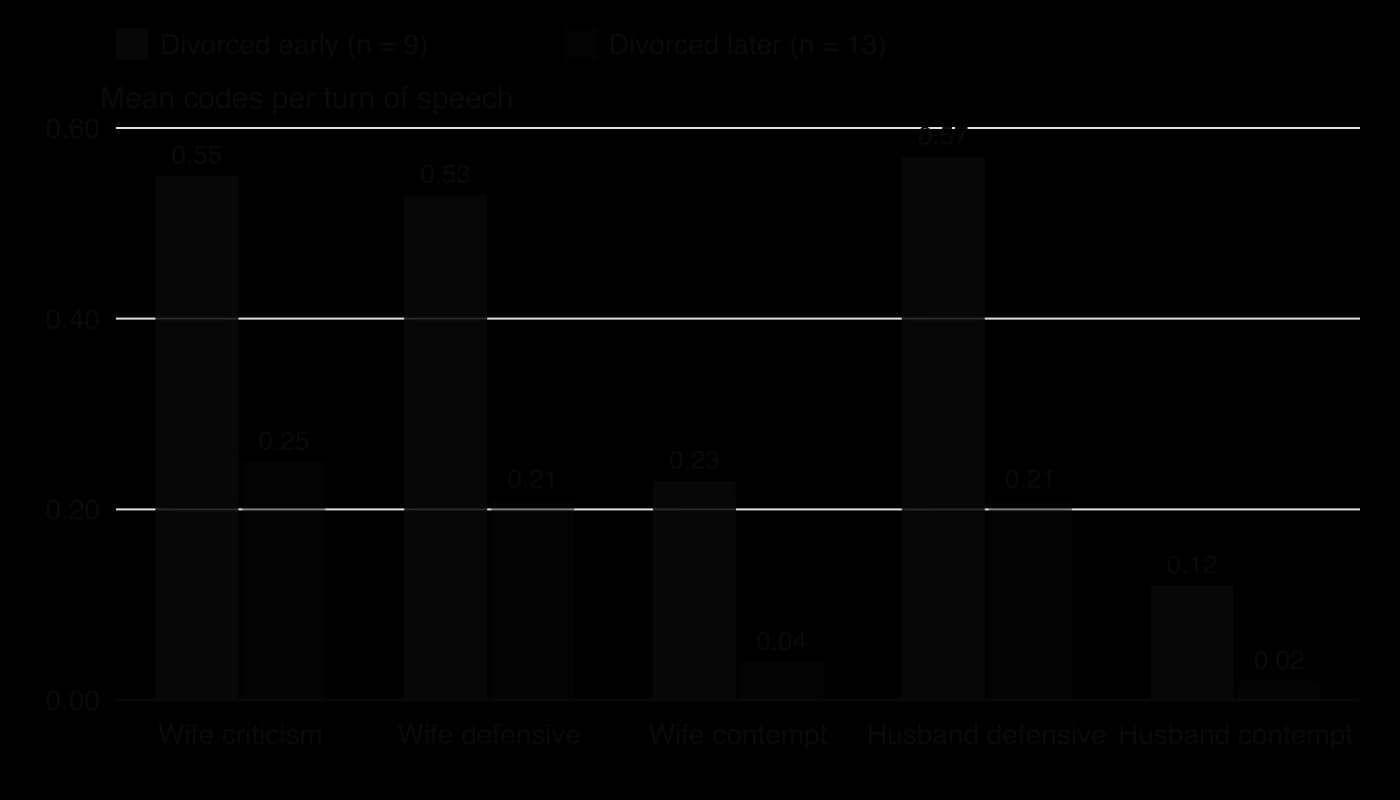
Couples were contacted again after 4 years, when 73 of the 79 took part, and then periodically until 14 years after the first session. By then, 22 couples (27.8%) had divorced. Nine had divorced early, on average 7.4 years after marrying; 13 had divorced later, on average 13.9 years after marrying.
Different variables predicted early and later divorce. A model including the Four Horsemen during conflict and marital satisfaction predicted early divorce with 83.5% accuracy, but positive affect did not predict early divorce. For later divorce, the reverse was true: a lack of positive affect during the events-of-the-day and conflict conversations predicted divorce, but the Four Horsemen did not. A model with marital satisfaction, thoughts of divorce and separation, and affect in both conversations predicted divorce over the 14 years with 93% accuracy.
Outcome | Predictors in the model | Classified correctly |
|---|---|---|
Early divorce (vs stable) | Four Horsemen in conflict and marital satisfaction | 83.5% |
Later divorce (vs stable) | Positive affect, satisfaction and thoughts of divorce and separation | 88.5% |
Divorce over 14 years | Satisfaction, thoughts of dissolution and affect in both conversations | 93% |
Early vs later divorce (divorced couples only) | Four Horsemen in conflict only | 95% |
Among the couples who divorced, the Four Horsemen alone distinguished those who divorced early from those who divorced later with 95% accuracy. Early-divorcing couples showed significantly more defensiveness and contempt from both husbands and wives; the difference in wives’ criticism was in the same direction but not statistically significant.
A demand–withdraw variable (the wife criticising more than the husband and the husband stonewalling more than the wife) predicted both early and later divorce. It was less common when both spouses had shown more positive affect in the events-of-the-day conversation, which suggests that how couples connect in ordinary conversation affects how they handle conflict.
Two different routes lead to divorce. In volatile marriages, intense negative communication during conflict makes the marriage hard to sustain, and divorce comes early. In emotionally distant marriages, conflict is less intense but positive affect is missing, and the marriage ends later. Communication in everyday, non-conflict conversation matters as well as communication during arguments.
The study measured behaviour directly through video-recorded observation with standardised coding systems and good inter-rater reliability, rather than relying on what couples said about their communication. However, a laboratory discussion of a conflict, with physiological sensors attached, is an artificial setting, and couples may behave more politely or more negatively than at home. The researchers also note that the conversations were always in the same order, so behaviour in the conflict conversation may partly reflect "spillover" from the conversation before it.
The prospective design shows that communication came before divorce, which supports a predictive link. The study was still correlational: negative communication may be a symptom of a marriage already in trouble rather than its cause. The high accuracy figures were calculated after the outcomes were known, on the same small sample used to build the models. Heyman and Slep (2001) showed that when divorce-prediction equations are tested on new samples (cross-validation), their accuracy drops sharply, and that because divorce is relatively uncommon over a few years, even an accurate-looking model wrongly identifies many stable couples as likely to divorce.
A statistical model chooses the weights for its predictors that best separate the couples who divorced from those who did not in the data it is given. Some of that fit comes from real patterns and some from chance features of that particular sample. Cross-validation tests the model on couples who were not used to build it. If accuracy stays high, the model has captured real patterns; if it falls, much of the original accuracy was chance. With only 79 couples and many possible predictors, chance fit is a serious risk.
Only 22 couples divorced, divided into groups of 9 and 13, so the comparisons of early and later divorce rest on very small numbers. All the couples lived in one American town and were recruited in 1983, and the sample was heterosexual and married. Communication norms, divorce rates and the costs of divorce differ across cultures and generations, which limits generalisability.
Sources: Gottman, J. M., and Levenson, R. W. (2000). The timing of divorce: Predicting when a couple will divorce over a 14-year period. _Journal of Marriage and the Family, 62(3), 737–745._
Most research on couples’ communication has focused on conflict, but Gottman and Levenson’s finding that a lack of positive affect predicts later divorce points to the importance of everyday positive exchanges. In their discussion they described moments in the events-of-the-day conversation when one partner excitedly shared something and was met with disinterest or irritation, a pattern of "turning away" that they suggested may carry over into the rest of the relationship.
Gable et al. (2004) studied capitalisation: telling another person about a positive event, such as a success at work. In four studies, sharing good news was linked to higher daily positive mood and well-being beyond the effect of the event itself. The benefits were greater when the listener was perceived to respond actively and constructively, and close relationships in which partners usually responded to good news with enthusiasm had higher intimacy and daily satisfaction.
Constructive | Destructive | |
|---|---|---|
Active | Enthusiastic interest and questions: “That’s brilliant! When did the news come? All that hard work paid off.” | Pointing out the downside: “That means longer hours. Will there be any time left for us?” |
Passive | Quiet, low-energy approval: “That’s nice.” | Ignoring the news or changing the subject: “What’s for dinner?” |
Gable, Gonzaga and Strachman (2006) video-recorded 79 dating couples taking turns to discuss a recent positive event and a recent negative event. Both the disclosers’ ratings of how understood and cared for they felt and outside observers’ codes of the responders’ behaviour showed that responses to positive event discussions were more closely related to relationship well-being and to break-up two months later than responses to negative event discussions. How a partner reacts to good news may matter at least as much as how they support their partner through bad news.
Cultures differ in how directly people say what they mean. In low-context cultures, meaning is carried mainly by explicit words; in high-context cultures, much of the meaning is carried by context, shared understanding and nonverbal signals, and saying things too directly can seem rude. These differences affect what counts as good communication in a relationship. A partner from a high-context background may express disagreement through silence or a change of topic, which a partner from a low-context background could read as stonewalling.
Research has tested whether the Western findings on couples’ communication apply elsewhere. Rehman and Holtzworth-Munroe (2007) observed marital communication in 50 white American couples, 52 Pakistani couples in Pakistan and 48 Pakistani immigrant couples in the USA. In all three groups, positive and negative communication behaviours were associated with marital satisfaction. However, satisfaction was more strongly related to communication in the American group than in the Pakistani group, with the immigrant couples in between.
The finding suggests that communication matters everywhere, but that its weight in judging a marriage depends on culture. Where marriage is understood mainly as a partnership of two individuals who chose each other, the quality of their conversation may be central to how satisfied they feel; where marriage is embedded in family obligations and roles, other factors, such as fulfilling those roles, may carry more weight. The immigrant group’s intermediate position is consistent with acculturation changing what people expect from a marriage.
Technology has changed how relationships begin and how partners communicate. Cacioppo et al. (2013) surveyed a nationally representative sample of 19,131 Americans who had married between 2005 and 2012 and found that more than a third had met their spouse online. Marriages that began online were slightly less likely to have ended in separation or divorce and were associated with slightly higher satisfaction, even after demographic differences were controlled. The survey was commissioned by an online dating company, one author was a scientific adviser to it and another its former research director, which is a possible source of bias, although independent statisticians oversaw the analyses.
Mobile phones can also interfere with face-to-face communication. In two experiments, Przybylski and Weinstein (2013) found that the mere presence of a mobile phone on a table, even when it was not used, reduced the closeness, connection and conversation quality that pairs of strangers reported, especially when they discussed personally meaningful topics. This mere presence effect has been influential, but a close replication by Linares and Sellier (2021), with 356 participants in two experiments, did not find it.
Phone use can also affect established couples. In surveys of American adults, Roberts and David (2016) found that people who reported more "partner phubbing", being snubbed by a partner who uses a phone during time together, reported more conflict over phone use and lower relationship satisfaction.
Online communication also changes self-disclosure. Messages can be written and edited, people can disclose without seeing the listener’s immediate reaction, and conversations continue across distance, all of which may make early disclosure easier. The same features remove much nonverbal information, so tone is easier to misread. Whether technology helps or harms a relationship depends on how it is used: it can support long-distance couples, or it can create technoference, interruptions of time together by devices.
Communication is a clear example of biological, cognitive and sociocultural factors working together. A single argument involves physiological arousal, interpretation and learned cultural rules.
Approach | Contribution to communication in relationships |
|---|---|
Biological | Physiological arousal during conflict (flooding) makes calm listening difficult and is linked to stonewalling; conflict activates the stress response, including the release of cortisol |
Cognitive | Attributions and schemas decide how a message is interpreted: the same complaint can be heard as a request or as an attack; confirmation bias leads partners to hear what they expect |
Sociocultural | Communication styles are learned from parents, peers and media (social learning) and shaped by cultural norms about directness, emotional expression and gender roles |
The demand–withdraw pattern shows the interaction. It is partly structural (whoever wants change tends to demand), partly linked to gender roles (Christensen, Eldridge and colleagues (2006) found woman-demand and man-withdraw more common in four countries), partly cognitive (each partner interprets the other’s behaviour as the cause) and partly physiological (withdrawal reduces unpleasant arousal).
The strength of this research is its measurement. Observational coding systems such as SPAFF operationalise abstract constructs as specific behaviours, use trained coders and report inter-rater reliability, and they measure behaviour directly rather than through memory. Their limitations are cost (hundreds of hours of training and coding), the artificial setting of the laboratory and the possibility that couples behave differently when observed (reactivity). Self-report measures, used by Christensen, Eldridge and colleagues (2006) and in phone research, are cheaper and allow larger samples across cultures but depend on partners’ accuracy and honesty.
Most of the evidence is correlational and longitudinal. It shows that communication patterns come before relationship outcomes, but not that they cause them: a deteriorating relationship may produce negative communication, and third variables such as stress, depression or personality may cause both. Experiments are possible with strangers, as in Aron et al. (1997) and Przybylski and Weinstein (2013), and the strongest causal evidence for couples comes from intervention studies that change communication and then measure satisfaction, which are the basis of strategies for improving relationships.
The classic studies used American, heterosexual, mostly married couples, often small samples recruited through advertisements. Gender findings, such as women demanding and men withdrawing, may reflect the roles and power differences of particular societies rather than fixed sex differences, since Christensen and Heavey (1990) found that the pattern reversed depending on who wanted change. Cross-cultural work in Pakistan, Taiwan, Brazil, Italy and Japan shows that the basic links hold in other cultures but vary in strength.
Because communication is learned behaviour, it can be changed, which makes this research directly useful for couples therapy and relationship education. The research also raises responsibility issues. Claims that a few minutes of observation can predict divorce with over 90% accuracy are widely repeated in the media, and they may lead couples to see their relationship as doomed. Psychologists who communicate such findings have a responsibility to explain their uncertainty, including the problem of calculating accuracy after the outcome is known.
Communication in relationships can appear in Paper 1 in two ways. A Section B question can describe a couple, a friendship or a family and ask you to apply an approach term, such as a cognitive bias, schema theory or social learning theory, to their communication. A Section C essay can ask about the role of communication in interpersonal relationships through one of the concepts; measurement and causality fit this research especially well.
Communication in relationships uses verbal and nonverbal channels; nonverbal signals carry much of the emotional meaning of a message.
Social penetration theory describes relationships developing as self-disclosure grows in breadth and depth; disclosure is usually reciprocal.
Disclosure and liking increase each other, as Collins and Miller (1994) found, and Aron et al. (1997) showed that escalating mutual disclosure creates closeness between strangers.
Schug et al. (2010) explained cultural differences in disclosure through relational mobility, the ease of forming and ending relationships.
Criticism, contempt, defensiveness and stonewalling (the Four Horsemen) and too little positive behaviour predict relationship breakdown.
In the demand–withdraw pattern one partner presses and the other withdraws; it depends on who wants change and appears in several cultures.
Gottman and Levenson (2000): negative conflict predicted early divorce and a lack of positive affect predicted later divorce, but accuracy was calculated after the fact on a small sample.
Responding to good news actively and constructively (capitalisation) predicts relationship well-being.
Culture changes how strongly communication is linked to satisfaction, and technology changes how partners meet and how attention is shared.
I can describe verbal and nonverbal communication and their roles in relationships.
I can explain social penetration theory and research on self-disclosure.
I can explain the Four Horsemen and the demand–withdraw pattern, with research evidence.
I can describe and evaluate Gottman and Levenson (2000).
I can explain capitalisation and active-constructive responding.
I can discuss how culture and online communication affect communication in relationships.
I can evaluate communication research with reference to measurement, causality and bias.
I can apply research on communication to an unfamiliar relationship scenario.