 YouTube
Explain how thinking shapes attraction, satisfaction and commitment in relationships, through social exchange, equity, the investment model, attributions and relationship schemas, and evaluate each through the concepts.
Each is in the Psychology glossary, with every other term in the subject.
The process of explaining the causes of one's own or another person's behaviour, for example by referring to personality or intentions (internal) or to the situation (external).
The intention to continue a relationship and a feeling of psychological attachment to it; in the investment model, the variable that most directly predicts staying or leaving.
A relationship in which people give benefits in response to the other person's needs without keeping track of returns, unlike an exchange relationship, in which benefits are expected to be repaid.
In social exchange theory, the standard of outcome a person believes they deserve, based on past experience and expectations; the comparison level for alternatives (CLalt) is the best outcome available elsewhere.
A theory proposing that people are most satisfied when the ratio of each partner's contributions to benefits is similar, and that being under-benefited or over-benefited causes distress.
The tendency to overestimate personal or dispositional causes and underestimate situational causes when explaining other people's behaviour.
A cognitive bias in which one positive characteristic of a person, such as physical attractiveness, leads others to assume that the person also has other positive characteristics.
Describe the cognitive factors that influence initial attraction, including proximity and mere exposure, physical attractiveness, the halo effect and the matching hypothesis.
Explain social exchange theory, including rewards, costs, the comparison level and the comparison level for alternatives.
Explain how equity theory and the investment model extend social exchange theory.
Describe and evaluate Rusbult’s (1983) longitudinal test of the investment model.
Explain how attributions and relationship schemas affect satisfaction, with reference to research on couples.
Discuss how cultural context affects cognitive explanations of relationships.
Evaluate cognitive explanations of interpersonal relationships with reference to measurement, causality, bias and perspective.
Apply cognitive explanations to unfamiliar situations involving interpersonal relationships.
Cognitive explanations of interpersonal relationships propose that what happens between two people depends on how each of them thinks: what they notice about the other, what they expect, how they judge costs and benefits, and how they explain the other person’s behaviour. Two couples facing the same problem, such as a partner who forgets an important date, can react in opposite ways because they interpret it differently.
These explanations draw on several approach terms from the cognitive approach: schemas and schema theory, cognitive biases such as confirmation bias, and cognitive dissonance. They also work alongside biological explanations, such as the chemical messengers involved in bonding, and sociocultural ones, such as norms about marriage, because no single approach accounts for a relationship on its own.
With a free account, Augment remembers where you stopped and what you have practiced.
Rusbult's model in which commitment to a relationship rises with satisfaction and investment size and falls with the quality of alternatives, and commitment predicts whether the person stays.
The proposal that people tend to form relationships with partners whose physical attractiveness or overall social desirability is similar to their own.
The tendency to develop a more positive attitude towards a person or stimulus simply because of repeated exposure to it.
Idealised perceptions of a romantic partner that are more favourable than the partner's own self-view, linked to greater relationship satisfaction and stability.
A theory proposing that people evaluate relationships by comparing rewards with costs, and that satisfaction and stability depend on how this outcome compares with expectations and with available alternatives.
A cognitive explanation locates the cause of relationship behaviour in mental processes: perception, memory, judgement and expectation. It does not deny that emotions and hormones matter, but it argues that the same feeling or event has different effects depending on how it is appraised. A partner’s silence at dinner may be read as tiredness by one person and as rejection by another, and the two readings lead to different behaviour.
Apart from the processes involved in initial attraction, most cognitive explanations of relationships fall into two groups. Economic or exchange models treat a relationship as a series of judgements about value: what a person gets from it, what it costs, what they think they deserve and what else is available. Social-cognitive models focus on interpretation: the attributions partners make, the schemas they bring from earlier relationships and the biases that colour how they remember events. The two groups answer different questions. Exchange models explain why people stay or leave; social-cognitive models explain why satisfaction rises or falls.
Group of explanations | Main question | Examples |
|---|---|---|
Attraction | Why is a person drawn to one person rather than another? | Mere exposure, halo effect, matching hypothesis |
Exchange models | Why do people stay in or leave relationships? | Social exchange theory, equity theory, investment model |
Social-cognitive models | Why do partners feel more or less satisfied? | Attributions, relationship schemas, positive illusions |
Interpersonal attraction is the positive evaluation of another person that makes someone want to approach them and spend time with them. Several cognitive processes shape whom a person finds attractive before any relationship exists. They are cognitive because they rest on familiarity, on inferences from appearance and on judgements about one’s own chances.
People are more likely to form relationships with those they see often. In the Westgate studies of student housing at the Massachusetts Institute of Technology, Festinger, Schachter and Back (1950) found that friendships formed most often between residents who lived close to each other, and that residents whose doors were near a staircase had more friends on other floors. Physical distance, and the "functional distance" created by the layout of a building, predicted who became friends.
One cognitive explanation for this is the mere exposure effect. Zajonc (1968) showed that repeated exposure to a neutral stimulus, such as a nonsense word or an unfamiliar face, increased how much participants liked it, even though nothing else about it changed. Familiar stimuli are processed more easily, and this ease of processing is experienced as liking.
A meta-analysis by Bornstein (1989) of 208 experiments found the effect to be reliable but modest (r = 0.26), strongest with brief exposures of unfamiliar stimuli. Exposure also has limits. A later meta-analysis by Montoya et al. (2017) found an inverted-U pattern: liking rises with the first exposures and then falls again after many exposures. Exposure to someone who is disliked from the start can increase dislike, which is why living next door to a person does not guarantee friendship.
YouTubeAppearance is often the first information available about another person, and people make inferences from it. Dion, Berscheid and Walster (1972) asked 60 students at the University of Minnesota to rate photographs of people of high, average and low attractiveness. Attractive people were judged to have more socially desirable personalities and were expected to have happier marriages and more successful careers.
The halo effect is a schema-driven inference: a "what is beautiful is good" schema fills in information that the perceiver does not have. Its content depends on culture. Wheeler and Kim (1997) asked 157 university students in Korea to rate photographs of Korean students. Attractive targets were not seen as more powerful or dominant, as they tend to be in North American samples, but were seen as higher in integrity and concern for others. All cultures seem to stereotype by appearance, but the qualities assumed to go with beauty reflect what each culture values.
If everyone prefers attractive partners, most people cannot get the partner they would like best. The matching hypothesis proposes that people judge their own social value and seek partners of roughly equal value, because aiming higher risks rejection. This is a cognitive explanation because it depends on a realistic self-assessment and a judgement of the chances of success.
The first test did not support it. In the "computer dance" study, Walster et al. (1966) told 752 students that they would be matched by a computer for a dance, but paired them at random. Judges rated each student’s physical attractiveness. During the dance, the strongest predictor of liking a date and wanting to see them again was the date’s physical attractiveness, regardless of the participant’s own attractiveness.
Later research separated what people want from whom they end up with. Couples who are already together tend to be similar in attractiveness, and Shaw Taylor et al. (2011), using laboratory data and data from users of a popular online dating site, found evidence of matching on physical attractiveness, popularity and self-worth, but to different degrees and not always at the same stage of the dating process. Matching may therefore be an outcome of mutual choice in a competitive market rather than a deliberate strategy each person follows.
Physical attractiveness is not the only basis for matching. People also tend to be similar in attitudes, education and values, and similarity in attitudes is linked to liking. Eastwick and Finkel (2008) found that the qualities speed-daters said they wanted in an ideal partner before the event did not predict whom they actually desired when they met them. This shows a limit of self-report in attraction research: people may not know what influences their own choices.
Social exchange theory, proposed by Thibaut and Kelley (1959), applies an economic idea to relationships. Each partner gains rewards (companionship, support, affection, sex, status, fun) and pays costs (time, effort, money, conflict, compromise and missed opportunities). The outcome of a relationship is its rewards minus its costs. People are assumed to want outcomes that are as good as possible, although the calculation is usually quick and not fully conscious.
The size of the outcome on its own does not decide how a person feels. Thibaut and Kelley proposed two separate standards of comparison, which explain two different things.
The comparison level (CL) is the outcome a person believes they deserve. It comes from earlier relationships, from watching other people’s relationships and from cultural messages, including the media. An outcome above the CL feels satisfying; one below it feels disappointing.
The comparison level for alternatives (CLalt) is the best outcome the person believes they could get elsewhere, from another partner or from being single. If the current outcome is better than the CLalt, the person depends on the relationship and is likely to stay.
Because the two comparisons are separate, satisfaction and staying can come apart. A person can be dissatisfied but stay because nothing better seems available, or be satisfied but leave because a much better alternative appears. Simple accounts based only on happiness cannot explain these cases.
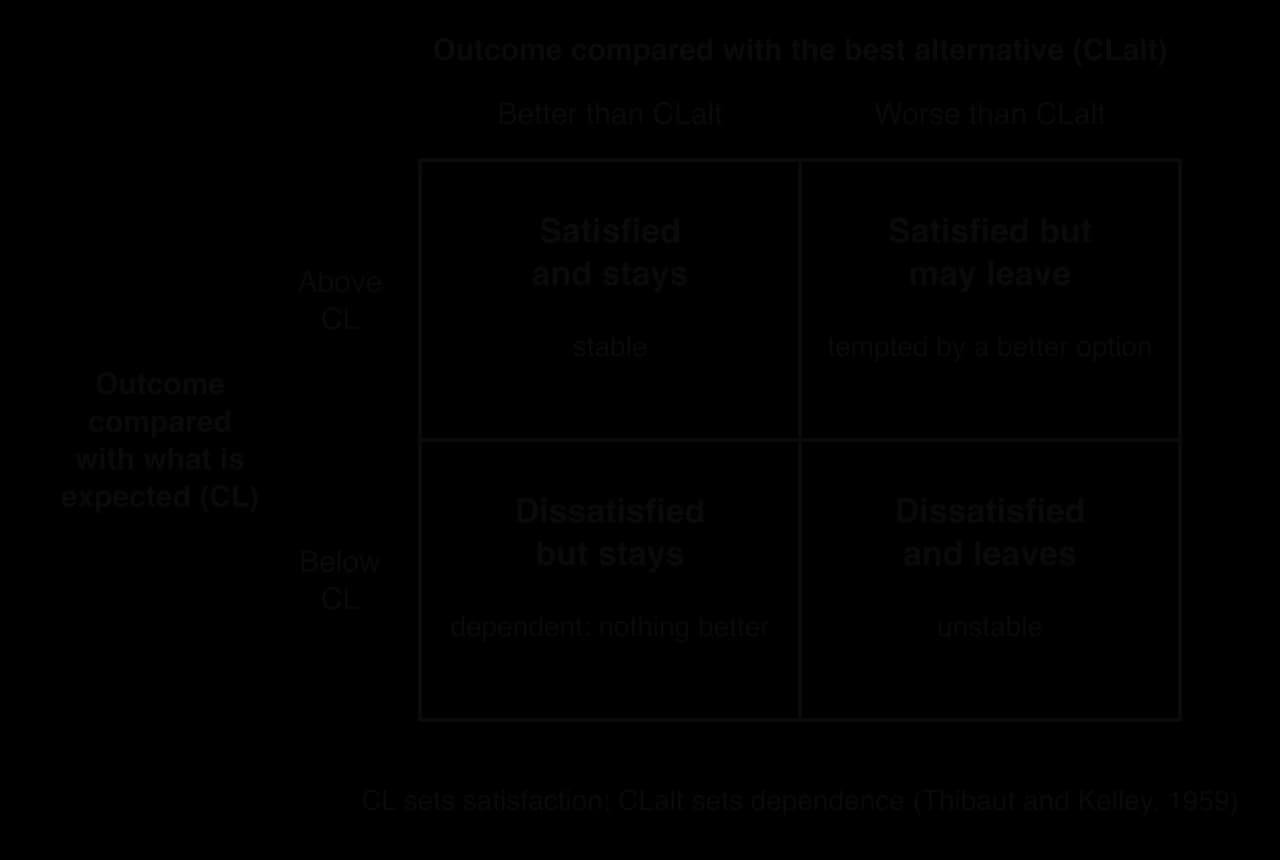
Thibaut and Kelley also described stages in a relationship’s development: sampling (exploring the rewards and costs of possible partners), bargaining (negotiating, often without words, what each partner gives and receives), commitment (exchanges become predictable and costs fall) and institutionalisation (shared norms are established). The stages are a description rather than a tested model, but they show the theory’s assumption that relationships develop through repeated judgement.
The theory’s main strength is that it explains staying and leaving as separate from satisfaction, which fits people who remain in unhappy relationships. Its comparison levels also link individual judgement to social experience: the CL is learned from family, peers and media, so the theory explains why expectations of relationships differ between generations and cultures.
Its central terms are hard to measure. Rewards and costs are subjective: a partner’s constant attention is a reward to one person and a cost to another. Unless rewards and costs are measured independently of behaviour, the theory risks being circular, because whatever a person chose can be called the most rewarding option after the event.
Clark and Mills (1979) argued that the theory describes some relationships better than others. In exchange relationships, such as those with colleagues or acquaintances, people expect benefits to be repaid and keep track of them. In communal relationships, such as those with close friends, partners and family, people give benefits in response to the other person’s needs, and keeping a careful record of costs and rewards is itself a sign that something is wrong.
Equity theory (Walster, Walster and Berscheid, 1978) adds fairness to the exchange idea. The theory proposes that people are most satisfied not when they get the most out of a relationship, but when the ratio of what each partner gives to what each partner gets is roughly equal. Equity is not the same as equality: a partner who earns less but does more of the childcare can still judge the relationship as fair.
Inequity in either direction causes distress. A partner who gives more than they receive (under-benefited) feels anger and resentment; a partner who receives more than they give (over-benefited) feels guilt. The theory predicts that people try to restore equity in one of two ways: by changing what they actually give or receive, or by changing how they perceive the contributions, for example by deciding that a partner’s emotional support counts as a contribution after all. The second route is cognitive and resembles dissonance reduction.
Equity theory has practical relevance because judgements of fairness are themselves biased. People tend to overestimate their own share of joint tasks, partly because their own efforts are easier to remember than their partner’s, so each partner can sincerely feel under-benefited at the same time. Arguments about housework and childcare are therefore often arguments about perception as much as about the work itself.
The theory has limits. Not everyone is equally concerned with fairness: some people tolerate being under-benefited, and in long-term communal relationships partners may accept periods of imbalance, for example when one is ill, because they expect reciprocity over many years. The direction of cause and effect is also unclear, since dissatisfied partners may notice unfairness that satisfied partners overlook.
Social exchange theory could not explain why some people stay in relationships that are unsatisfying even when alternatives are available. Rusbult’s investment model answers this by adding a third factor, investment: everything a person would lose if the relationship ended. The model predicts commitment rather than satisfaction, and treats commitment as the best predictor of whether a relationship lasts.
Factor | Meaning | Effect on commitment |
|---|---|---|
Satisfaction level | How the relationship’s rewards and costs compare with the person’s comparison level | Higher satisfaction, more commitment |
Quality of alternatives | How attractive other options are: another partner, friends, being single | Better alternatives, less commitment |
Investment size | Resources tied to the relationship that would be lost if it ended. Intrinsic: time, effort, emotional energy, self-disclosure. Extrinsic: shared friends, a home, money, children, memories, a shared identity | Larger investments, more commitment |
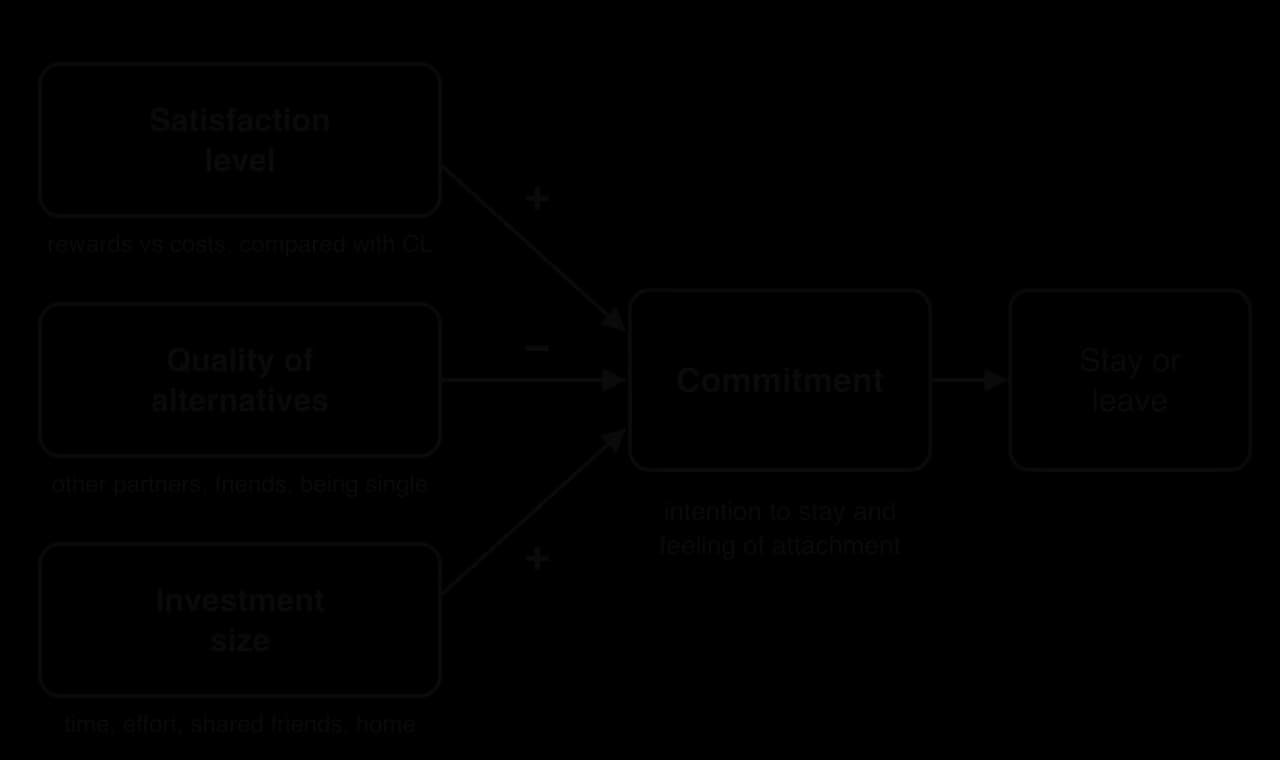
Commitment also changes how people think. Committed partners tend to see attractive alternatives as less appealing, to respond to a partner’s bad behaviour with tolerance rather than retaliation, and to make sacrifices for the relationship. These maintenance processes are cognitive and behavioural responses that protect the relationship and can raise satisfaction in turn.
Rusbult aimed to test whether the investment model could explain how satisfaction and commitment develop, or decline, over the course of real dating relationships, and whether changes in commitment predicted who stayed and who left.
The study was a longitudinal design using repeated questionnaires. Of 119 students who volunteered in response to a flyer, 34 undergraduates at Franklin and Marshall College in the USA were selected: 17 men and 17 women, each in a heterosexual dating relationship that had begun no more than eight weeks earlier. Only one partner from each couple took part. Their mean age was about 20, and they were paid $2.50 for each questionnaire.
Participants first described the start of their relationship, then completed the same questionnaire every 17 days over about seven months, 12 times in all, until the relationship ended or the academic year finished. Each variable was operationalised through several concrete items followed by general rating items on 9-point scales.
Rewards were measured through items such as the partner’s personality, intelligence, sense of humour and ease of communication; costs through items such as lost freedom, time, money and conflict; alternatives through how appealing other possible partners and being single were; investments through items such as shared friends, shared possessions, time spent together and self-disclosure. Commitment was measured with items such as how long the participant wanted the relationship to last and how attached they felt.
The general measures were internally consistent at almost every time point. Across the sample, increases in rewards predicted increases in satisfaction, while changes in costs did not significantly affect satisfaction. Satisfaction, alternatives and investments together predicted commitment strongly (R² = 0.89): satisfaction and investments were positively related to commitment, and the quality of alternatives negatively. The pattern was the same for men and women.
Outcome predicted | Predictor | Standardised coefficient (β) |
|---|---|---|
Satisfaction (R² = 0.88) | Rewards | 0.890 (significant) |
Costs | 0.045 (not significant) | |
Commitment (R² = 0.89) | Satisfaction | 0.845 (significant) |
Quality of alternatives | −0.500 (significant) | |
Investment size | 0.840 (significant) |
Sources: Rusbult (1983), Table 3: regressions across all participants and time points, with differences between participants controlled.
During the study, 10 of the 34 relationships ended. Rusbult compared the trends over time of three groups: stayers, leavers (who ended the relationship themselves) and the abandoned (whose partners ended it).
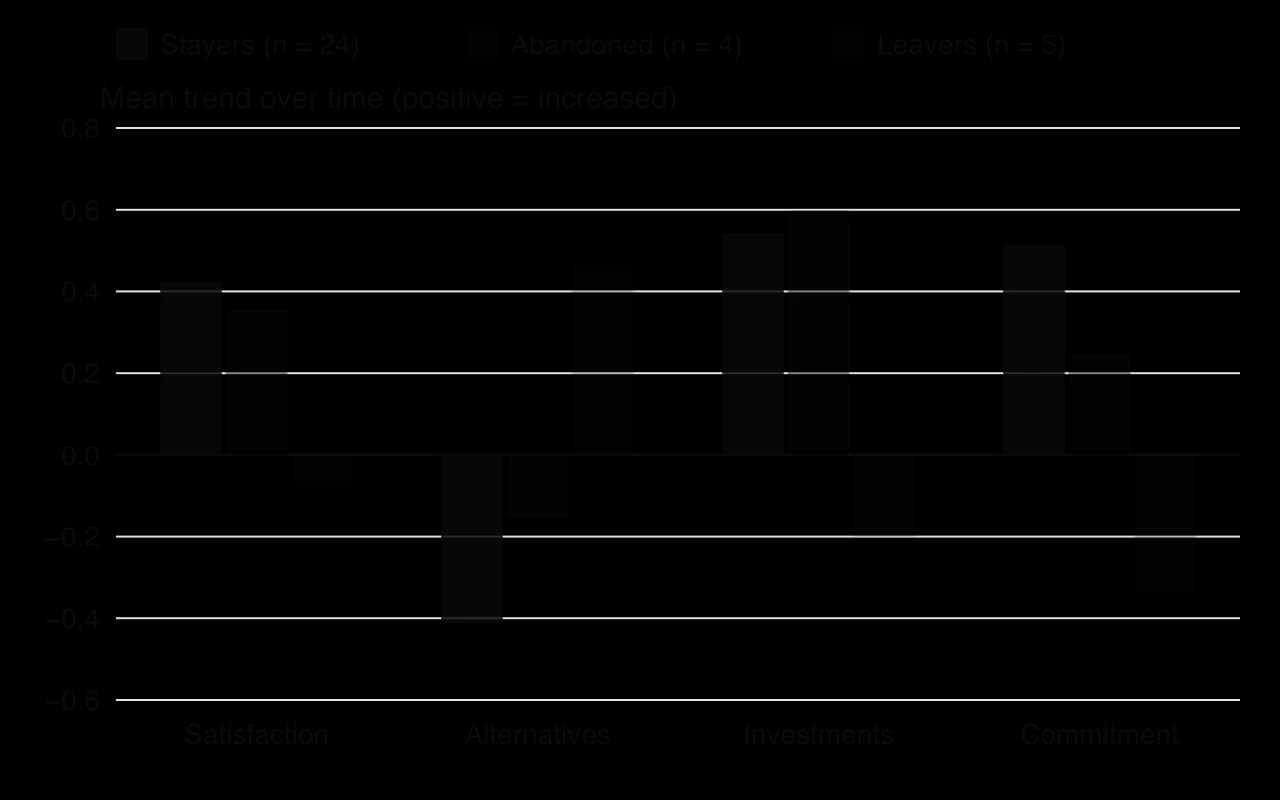
For stayers, rewards and satisfaction grew, alternatives became less attractive, investments grew and commitment increased. Leavers showed almost no increase in rewards, a large increase in costs, rising alternatives, falling investments and declining commitment. The abandoned group showed what Rusbult called entrapment: their satisfaction grew only a little, but their alternatives continued to decline and they kept investing as much as stayers, so their commitment kept rising until their partners left them.
Commitment depends on investments and alternatives as well as satisfaction, and changes in commitment over time are linked to whether a relationship continues. The entrapment pattern shows how investment can bind a person to a relationship that is not very satisfying, which social exchange theory alone could not explain.
All the variables were self-reported, and constructs such as "investment" and "rewards" are abstract. Rusbult used concrete items before each general item to help participants understand the constructs, and the general items were reliable. She did not measure the comparison level at all, because she judged that participants could not separate what they received from what they expected. Completing the same questionnaire 12 times may also have made participants think about their relationships more than they otherwise would have, although the rate of break-ups suggests the procedure did not hold relationships together.
The longitudinal design is a strength: measuring the same people repeatedly showed that changes in investment model variables preceded staying or leaving, which a single questionnaire could not show. The study was still correlational. Rising satisfaction may lead people to invest more, rather than investments raising commitment, and Rusbult noted that her stay-or-leave outcome was categorical, so formal path analysis was not possible.
The sample was small (34 participants, with only 4 abandoned and 5 leavers by the end), self-selected from volunteers (four of whom stopped responding before the end), and drawn from young American students in new heterosexual dating relationships at one college in the late 1970s. These features limit generalisability to marriages, older adults, same-sex couples and cultures where relationships are less freely chosen. Later research tested exactly these limits.
Sources: Rusbult, C. E. (1983). A longitudinal test of the investment model: The development (and deterioration) of satisfaction and commitment in heterosexual involvements. _Journal of Personality and Social Psychology, 45(1), 101–117._
Le and Agnew (2003) carried out a meta-analysis of 52 studies with 60 independent samples and 11,582 participants. Satisfaction, alternatives and investments each correlated significantly with commitment and together accounted for nearly two thirds of the variance in it, and commitment predicted break-up. Support was stronger for relationships than for non-relational commitments such as jobs, and the associations varied little with ethnicity or relationship length.
Rusbult and Martz (1995) applied the model to a question with serious real-world consequences: why some women return to abusive partners. Using intake interviews at a shelter for women who had experienced domestic violence in the USA, they found that commitment was greater among women with poorer economic alternatives, larger investments (such as being married) and less severe abuse, and commitment distinguished women who returned to their partners immediately after leaving the shelter from those who did not. The finding moves the explanation away from blaming individual women and towards factors, such as money and housing, that services can change.
Lin and Rusbult (1995) surveyed young adults in the USA and Taiwan about their dating relationships and cross-sex friendships. In both places commitment was stronger with greater satisfaction, poorer alternatives and larger investments, which supports the model’s cross-cultural generality. Normative support from others had little effect on commitment, and Americans reported weaker commitment than their satisfaction, alternatives and investments would predict.
Exchange models describe how people weigh a relationship, but they say little about how partners interpret each other’s behaviour from day to day. Attribution research fills this gap. An attribution is an explanation of why something happened, and in a relationship most attributions are explanations of the partner’s behaviour: why he was late, why she was quiet, why he bought flowers.
Attributions about a partner vary on three main dimensions:
Locus: is the cause internal to the partner (personality, intentions) or external (traffic, work, illness)?
Stability: will the cause keep operating (stable) or is it temporary (unstable)?
Globality: does it affect many areas of the relationship (global) or only this one (specific)?
A general bias in attribution makes negative interpretations likely. The fundamental attribution error is the tendency to explain other people’s behaviour by their personality and to underestimate the situation. In a relationship it leads partners to see a lapse as a sign of character ("he is careless") rather than of circumstances ("he was exhausted"), while explaining their own lapses by the situation.
 YouTube
Bradbury and Fincham (1990) reviewed research on married couples and found that dissatisfied spouses, compared with satisfied ones, explain their partner’s behaviour in ways that cast it in a negative light. They described two patterns, which differ in how positive and negative behaviour are treated.
Partner’s behaviour | Relationship-enhancing attribution (typical of satisfied couples) | Distress-maintaining attribution (typical of distressed couples) |
|---|---|---|
Positive: brings flowers | Internal, stable, global: “She is thoughtful; she always looks after me.” | External, unstable, specific: “She only did it because she felt guilty about yesterday.” |
Negative: arrives an hour late | External, unstable, specific: “The traffic must have been terrible tonight.” | Internal, stable, global: “He is selfish; he never thinks about me.” |
Effect | Good behaviour earns full credit; bad behaviour is excused | Good behaviour earns no credit; bad behaviour confirms the worst |
Distress-maintaining attributions keep a relationship unhappy because they make it hard for either partner to improve things. A kind act is discounted, so it does little to raise satisfaction, while a thoughtless act is taken as proof of the partner’s character, which leads to anger, criticism and a negative response from the partner. The cycle then repeats.
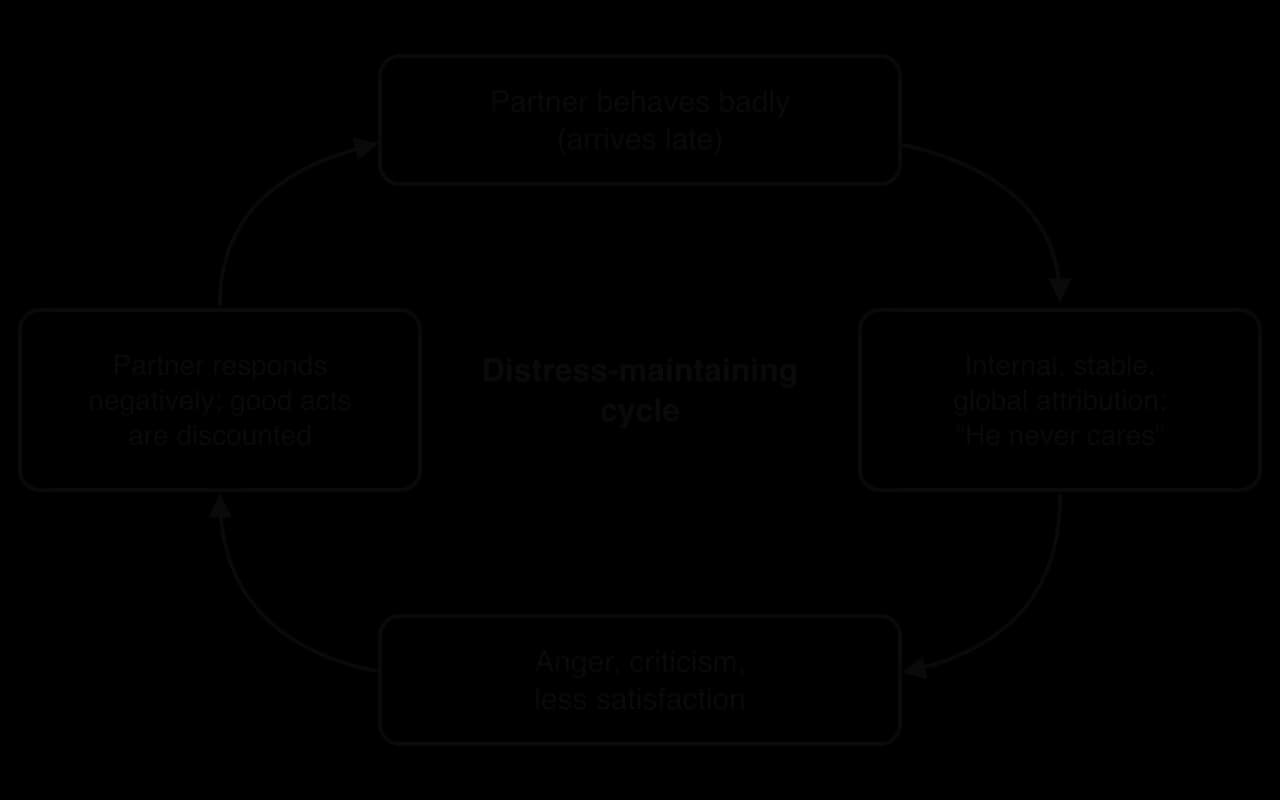
Bradbury and Fincham also reviewed experimental, clinical and longitudinal evidence suggesting that attributions may influence satisfaction rather than only reflect it. They described their conclusion as a promising start, because most studies at the time measured attributions and satisfaction at the same moment.
Longitudinal research has tested the direction of the link. Karney and Bradbury (2000) analysed eight waves of data from newlywed couples. They found no evidence of a fixed attributional style: attributions changed over time, and changes in attributions went together with changes in satisfaction within each spouse. However, the attributions spouses made at the start predicted later changes in satisfaction more strongly than initial satisfaction predicted later changes in attributions, which is consistent with attributions playing a causal role.
A third variable may also be involved. Karney et al. (1994) studied 80 married couples and found that spouses high in negative affectivity, a general tendency to experience and express negative thoughts and feelings, made more maladaptive attributions. Attributions and satisfaction remained linked after negative affectivity was controlled, so personality does not explain the whole association, but it contributes to it.
The link has been found outside the USA. Cao et al. (2019) followed 268 newlywed couples in China over three annual waves and found that wives higher in neuroticism (a tendency to experience negative emotions) later made more negative attributions about their marriage, which in turn predicted lower satisfaction for both spouses. Context matters as well: Nguyen et al. (2021) studied 231 low-income, ethnically diverse newlywed couples in the USA and found that the link between maladaptive attributions and low satisfaction was stronger when couples’ social networks had fewer financial resources and fewer married couples. The authors suggested that stress strengthens the effect of negative thinking on satisfaction.
Partners bring mental frameworks to a relationship. A relationship schema is an organised set of beliefs about how relationships work and what partners are like, built from earlier experience. Like other schemas, relationship schemas direct attention, fill gaps in information and bias memory towards what fits them, so two people can remember the same argument very differently.
Attachment theory proposes that early relationships with caregivers produce an internal working model: a mental representation of whether others can be trusted and whether the self deserves care. Hazan and Shaver (1987) proposed that romantic love is an attachment process and that adults’ internal working models shape how they experience love, with secure, avoidant and anxious adults describing their relationships in different ways. The internal working model is a schema in the cognitive sense: an anxious partner expects rejection, notices signs of it and interprets ambiguous behaviour, such as a late reply to a message, as confirmation.
People also hold ideals for a partner and for a relationship, and compare their actual partner with them. This comparison resembles Thibaut and Kelley’s comparison level, but it concerns specific qualities. Fletcher et al. (1999) found in a series of studies that people’s ideals for a partner fell into three groups: warmth and trustworthiness, vitality and attractiveness, and status and resources. In the same research, the closer a person’s current partner and relationship matched their ideals, the more positively they evaluated the relationship.
Satisfied partners do not see each other accurately. Murray, Holmes and Griffin (1996) asked both members of dating couples to complete measures of idealisation and of relationship well-being three times over a year. People who idealised their partners, seeing them more positively than the partners saw themselves, were more likely to still be together at the end of the year, and their satisfaction rose and their conflicts and doubts fell over the year, even when there were conflicts. Partners even came to see themselves in the idealised way their partners saw them.
Positive illusions work partly through confirmation bias: a partner who believes the other is kind notices and remembers kind acts and interprets faults charitably. The same bias can work in the opposite direction in distressed relationships. Positive illusions also connect to cognitive dissonance. Having invested in a partner, people are motivated to see the investment as worthwhile, much as Aronson and Mills (1959) found that people who went through an unpleasant initiation to join a group later rated the group more favourably (effort justification).
Most of the research on cognitive explanations was carried out with young adults in the USA, in relationships they chose freely and could leave easily. Exchange theories in particular assume that individuals compare alternatives and choose for themselves, an assumption that fits individualism better than collectivism. Where families arrange or strongly influence marriages, or where divorce brings serious social costs, the comparison level for alternatives may matter less and obligations to the wider family more.
Research shows both generality and variation. Lin and Rusbult (1995) found that the investment model predicted commitment in Taiwan as well as in the USA, and Cao et al. (2019) found that negative attributions predicted lower satisfaction in Chinese newlyweds, so the basic processes are not limited to Western couples. The content of cognition changes, however: in the study by Wheeler and Kim (1997), Korean students linked attractiveness with integrity and concern for others rather than with dominance.
Arranged marriages are a test of the assumption that satisfaction depends on free choice. Regan, Lakhanpal and Anguiano (2012) compared 58 Indian adults living in the USA, 28 in arranged marriages and 30 in love-based marriages, on measures of satisfaction, commitment, companionate love and passionate love. Contrary to their expectation, they found no differences between the two groups: both reported high love, satisfaction and commitment. Cognitive processes such as investment and positive interpretation may build satisfaction after a marriage begins, whoever chose the partner.
Indigenous and non-Western perspectives also question the focus on the couple as an isolated pair of decision-makers. In many communities a relationship is embedded in obligations to extended family and community, so what counts as a "reward", a "cost" or an "investment" is defined collectively. A cognitive explanation applied without this context risks an imposed etic, measuring other people’s relationships with concepts built for one culture.
Le and Agnew (2003) found that the links between commitment and its three predictors varied little with ethnicity. One reason may be real universality: people everywhere stay with partners when they are satisfied, have few alternatives and have invested a lot. Another is how the research was done. Most of the samples were from the USA, ethnic groups within one country share much of a culture, and most studies used translated versions of the same questionnaire, which can only find what its items ask about. Similar results from similar instruments are partly a measurement issue.
Cognitive explanations are strongest when they are combined with the other approaches. A single relationship event, such as falling in love or deciding to stay after a betrayal, involves all three.
Approach | What it adds | How it interacts with cognition |
|---|---|---|
Biological | Chemical messengers such as dopamine and oxytocin are linked to reward and bonding; attachment may have evolved to keep caregivers and partners together | Rewarding feelings are what social exchange theory calls rewards; bonding may make positive illusions easier to sustain |
Cognitive | Judgements of rewards, costs, alternatives and fairness; attributions, schemas and biases | Determines how the same feelings and events are interpreted and acted on |
Sociocultural | Norms about marriage and divorce, family involvement, media images of relationships, economic conditions | Sets the comparison level, defines what counts as an investment, and limits real alternatives (as for women in shelters) |
Rusbult and Martz (1995) show the interaction clearly. Commitment is a cognitive variable, but it was driven by economic alternatives (a social and material factor) and by investments such as marriage and children (a social institution). Treating staying in an abusive relationship as only a matter of individual thinking would miss the structural causes.
Rewards, costs, commitment and attributions are constructs that cannot be observed directly, so most research relies on self-reported data. Self-report allows large samples and repeated measures, but it depends on people being able and willing to report their thinking. Eastwick and Finkel (2008) found that the partner qualities speed-daters said they valued did not predict whom they actually desired, which suggests that people may lack insight into their own preferences. Attribution measures also present hypothetical events, which may not reflect the explanations partners give in real arguments. Social desirability bias is likely when people describe commitment or fairness.
Most research is correlational, and relationships involve bidirectional ambiguity: negative attributions may reduce satisfaction, and dissatisfaction may produce negative attributions. Longitudinal designs, such as those of Rusbult (1983) and Karney and Bradbury (2000), show which change tends to come first, but they cannot rule out third variables such as the negative affectivity identified by Karney et al. (1994), or stress. Experiments are possible for attraction (the computer dance randomly paired students) but not for commitment or long-term satisfaction, which cannot be ethically manipulated.
The studies on which these theories were first built used small, self-selected samples of young, mostly white, heterosexual American students in short dating relationships. This sampling bias limits generalisation to marriages, older couples, same-sex couples and other cultures. The economic assumptions of exchange theories may also reflect a cultural bias towards individualistic societies in which relationships are freely chosen and easily ended.
Exchange models use an economic metaphor that treats people as evaluators of profit, an example of reductionism, since a relationship is reduced to a series of judgements. They say little about emotion, passion or the biological processes of bonding, and they struggle with self-sacrifice in communal relationships. Social-cognitive models are more flexible, but they also explain relationships mainly within the individual’s head. An interactionist explanation, combining cognitive appraisal with biological and sociocultural factors, accounts for more of the evidence.
Concept | Main issue for cognitive explanations | Example |
|---|---|---|
Measurement | Private judgements measured by self-report | Eastwick and Finkel (2008): speed-daters’ stated preferences did not predict their choices |
Causality | Correlational and longitudinal data; bidirectional links; third variables | Karney and Bradbury (2000): initial attributions predicted later satisfaction more than the reverse |
Bias | Small, young, American, heterosexual student samples | Rusbult (1983): 34 students at one college |
Perspective | Economic metaphor; neglect of emotion and biology | Clark and Mills (1979): communal relationships do not fit the exchange model |
Responsibility | Applying findings without blaming individuals | Rusbult and Martz (1995): why women return to abusive partners |
Cognitive explanations have practical value: attribution research informs couples therapies that teach partners to consider situational explanations, and the investment model has been used to explain why victims of abuse stay. Applications must be careful. Describing a person in an abusive relationship as "committed" because of their investments must not suggest that they are responsible for staying, and research with such participants requires strict protection of confidentiality and attention to their safety.
Questions on cognitive explanations of relationships appear in Paper 1. Section B gives a short unseen scenario in the human relationships context and asks you to apply an approach term, such as schema theory, a cognitive bias or cognitive dissonance, to it; a cognitive explanation of relationships is often the best way to do this. Section C may ask an essay question on cognitive explanations of interpersonal relationships through one of the six concepts.
Cognitive explanations propose that relationships depend on how partners judge and interpret each other: comparisons, expectations, attributions and schemas.
Initial attraction is influenced by proximity and mere exposure, by the halo effect, and by matching, in which people end up with partners of similar attractiveness.
Social exchange theory explains satisfaction through the comparison level (CL) and dependence through the comparison level for alternatives (CLalt).
Equity theory adds fairness: under-benefit and over-benefit both cause distress, and equity can be restored in fact or in perception.
The investment model predicts commitment from satisfaction, alternatives and investment; Rusbult (1983) found that these factors tracked who stayed, who left and who was "abandoned" over seven months.
Distressed partners make distress-maintaining attributions; longitudinal research suggests attributions predict later satisfaction, alongside third variables and stress.
Internal working models, ideal standards and positive illusions are relationship schemas that bias interpretation in or against a relationship’s favour.
The basic processes appear in Taiwan, China and India-origin couples, but culture shapes what counts as rewards, alternatives and investments.
Evaluation: self-report measurement, correlational causality, small WEIRD samples and reductionist economic assumptions.
I can describe how proximity, mere exposure, the halo effect and matching influence initial attraction.
I can explain social exchange theory, including the difference between the CL and the CLalt.
I can explain how equity theory and the investment model extend social exchange theory.
I can describe the aim, method, results and conclusions of Rusbult (1983) and evaluate it.
I can explain relationship-enhancing and distress-maintaining attributions and the evidence on their direction of effect.
I can explain how internal working models, ideal standards and positive illusions act as relationship schemas.
I can discuss how culture affects cognitive explanations of relationships.
I can evaluate cognitive explanations with reference to measurement, causality, bias and perspective.
I can apply cognitive explanations to an unfamiliar relationship scenario.