8.7 Chemical messengers
Explain how dopamine, oxytocin, vasopressin, serotonin and testosterone are involved in attraction, love and bonding, and evaluate this research through causality, measurement and perspective.
- IB Psychology
- Part of 8 Human relationships
- SL and HL
Key terms introduced here
Each is in the Psychology glossary, with every other term in the subject.
- Intranasal administration
Giving a substance, such as oxytocin, as a nasal spray so that it is absorbed through the lining of the nose, used in experiments to raise its levels without an injection.
- Pair bonding
The formation of a lasting, selective relationship between two mating partners, shown by a preference for the partner over others and by shared care of offspring.
- Partner preference
A laboratory measure of pair bonding in animals in which an animal chooses between its familiar mate and an unfamiliar one; spending more time with the mate shows a preference.
- Romantic love
An intense attraction to one particular person, involving focused attention, craving for emotional union and intrusive thoughts about the beloved, usually strongest early in a relationship.
- Vasopressin
A hormone and brain chemical messenger, closely related to oxytocin, that regulates water balance and, in the brain, is involved in partner bonding and social recognition, especially in males.
- Ventral tegmental area
A region of the midbrain containing dopamine-producing neurons that form the starting point of the brain’s reward system.
Notes on 8.7 Chemical messengers
Learning objectives
Describe how chemical messengers are involved in the different stages of interpersonal relationships, from attraction to long-term attachment.
Explain the role of dopamine and the reward system in romantic love, with reference to brain imaging research across cultures.
Explain the role of oxytocin and vasopressin in pair bonding, using animal and human research.
Describe and evaluate the study by Scheele et al. (2012) on oxytocin and social distance in men in relationships.
Explain how testosterone changes with relationship and parenting status.
Discuss how biological, cognitive and sociocultural factors interact in relationships.
Evaluate research on chemical messengers in relationships with reference to causality, measurement, perspective and responsibility.
Apply knowledge of chemical messengers to unfamiliar situations involving interpersonal relationships.
Introduction
Falling in love, staying with a partner and caring for children are among the most important interpersonal relationships in people’s lives. Research on chemical messengers asks how the brain and body support these relationships: why a new partner can feel almost addictive, why some bonds last for decades, and why people differ in how strongly they commit.
The research draws on several approach terms: chemical messengers and neurotransmission from the biological approach, genetic inheritance, animal research and brain imaging. Its findings are strongest when combined with cognitive explanations, such as how partners think about costs and rewards, and sociocultural ones, such as norms about marriage, because relationships are shaped by all three.
Chemical messengers: a brief recap
Chemical messengers carry signals between cells by binding to receptors. Neurotransmitters such as dopamine and serotonin act across synapses within milliseconds; hormones such as testosterone and cortisol are released by glands into the blood and act more slowly and widely. Some, including oxytocin and vasopressin, act both as hormones in the body and as messengers within the brain.
Two points from the general study of chemical messengers matter especially in relationships. The relationship between messengers and behaviour is bidirectional: social contact changes hormone levels as much as hormones change social behaviour. And most evidence about the brain is indirect, from drugs given by nasal spray, from levels in blood or saliva, or from animals, which limits how confidently findings can be applied to human love.
Lust, attraction and attachment: love as several systems
The anthropologist Helen Fisher (1998) proposed that romantic relationships depend on three separate but connected brain systems, each linked to different chemical messengers and each with its own evolutionary function. Lust, the desire for sexual contact, is linked to the sex hormones testosterone and oestrogen and motivates people to seek partners in general. Attraction, or romantic love, is linked to dopamine and noradrenaline and to lower serotonin activity, and focuses energy on one particular partner. Attachment, the calm, secure bond of long-term partners and of parents and children, is linked to oxytocin and vasopressin.
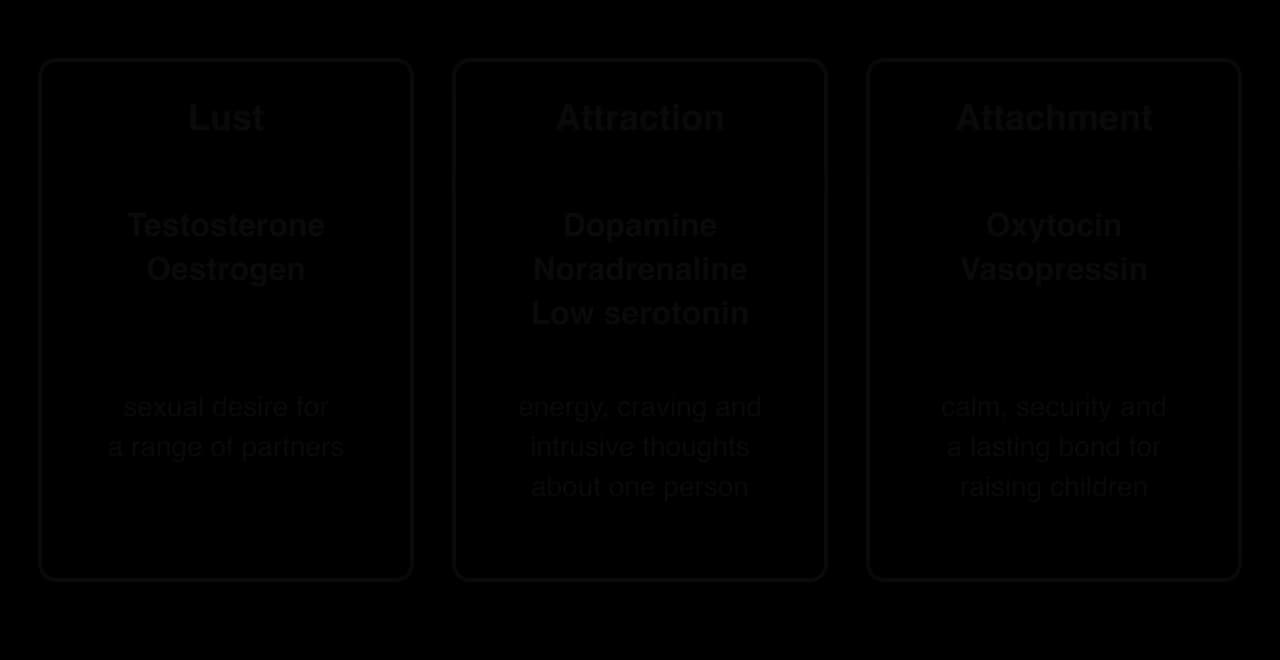
The systems can operate independently, which helps explain experiences that people find confusing, such as feeling attached to a long-term partner while being attracted to someone else, or feeling sexual desire without romantic interest. The model is a useful framework for organising research, but it is a simplification: each chemical is involved in more than one system, and the evidence for the specific links varies in strength.
Attraction and romantic love: dopamine and the reward system
People in the early stages of romantic love often describe euphoria, high energy, loss of appetite and sleep, and a craving to be with the beloved. These features resemble the effects of drugs that act on the brain’s reward system, which led researchers to ask whether romantic love uses the same dopamine pathways. The central structure is the ventral tegmental area (VTA), a small group of dopamine-producing neurons in the midbrain that projects to the nucleus accumbens, the caudate nucleus and the prefrontal cortex.
Aron et al. (2005) scanned 17 young adults (10 women and 7 men) who had been intensely in love for between 1 and 17 months. In an fMRI scanner, each participant looked at a photograph of their beloved and, as a control, a photograph of a familiar acquaintance, separated by a distraction task of counting backwards. Viewing the beloved activated the right VTA and the caudate nucleus, dopamine-rich areas of the reward system. Activity in the caudate was greater in participants who scored higher on a questionnaire measuring the intensity of their passionate love.
 YouTube
Is the reward response to love universal?
Brain imaging studies of love were first done in the United States and the United Kingdom, so it was not clear whether the findings applied in cultures with different norms about love and marriage. Xu et al. (2011) repeated the procedure of Aron et al. with 18 Chinese participants in Beijing who were in the early stages of intense romantic love. Again, viewing the beloved activated the VTA and caudate. The researchers also measured how far each participant held traditional or modern Chinese values, and found that these attitudes were related to activity in the nucleus accumbens, part of the reward system.
The finding suggests that the reward response of romantic love is not limited to Western samples, which supports the idea of a shared biological basis. It also shows how cultural values relate to the activity of the same biological system, a clear case of biological and sociocultural factors interacting. Both studies were small, however, and samples of 17 and 18 people cannot show whether the response is the same across all cultures.
Love in long-term relationships
If dopamine-driven attraction faded completely after the first months, long-term partners would be expected to show little reward response to each other. Acevedo et al. (2012) scanned 17 people (10 women and 7 men) married for an average of 21 years who reported still being intensely in love with their spouse. Viewing the partner activated the VTA and dorsal striatum, as in early-stage love, and also areas linked to attachment and maternal bonding. In some long-term relationships, the reward value of a partner appears to be maintained alongside a calmer attachment.
Serotonin and obsessive thinking in early love
People newly in love often report thinking about the beloved for most of the day, in a way that can resemble the intrusive thoughts of obsessive-compulsive disorder. Marazziti et al. (1999) tested whether the two share a biological feature. They measured the density of the serotonin transporter, the protein responsible for serotonin reuptake, on blood platelets in 20 people who had fallen in love within the previous six months, 20 patients with untreated OCD and 20 controls. Both the people in love and the OCD patients had significantly lower transporter density than the controls, and did not differ from each other.
The study is often cited as evidence that love lowers serotonin, but it supports a more limited conclusion. Platelets are blood cells, so their transporter density is only an indirect indicator of serotonin activity in the brain. The design is also correlational, the samples were small, and the study does not show whether the difference causes the obsessive thinking.
Attachment and pair bonding: oxytocin and vasopressin
Lasting relationships require more than attraction. Partners must recognise each other, prefer each other over others and stay together through difficulties. In animals, this selective, lasting bond between mates is called pair bonding. Only a small minority of mammal species form pair bonds, which makes those that do valuable for research into its biology.
What voles show about pair bonds
The best-studied example is the prairie vole, a small North American rodent that is socially monogamous: after mating, a male and female usually stay together, share a nest and raise their young together. Closely related species, such as the meadow vole and the montane vole, are promiscuous and do not form pair bonds. Researchers measure bonding in the laboratory with a partner preference test, in which a vole can spend time with its mate or with an unfamiliar vole of the opposite sex.
The species differ less in how much oxytocin and vasopressin they produce than in where their receptors are. Insel and Shapiro (1992) found that prairie voles have a high density of oxytocin receptors in reward areas such as the nucleus accumbens and prefrontal cortex, where montane voles have few. Prairie voles also have more receptors for vasopressin, of the type called V1a, in the ventral forebrain. According to the model reviewed by Young and Wang (2004), mating releases oxytocin, vasopressin and dopamine together in these reward areas, so the partner’s individual smell and features become associated with reward, producing a conditioned preference for that partner.
Lim et al. (2004) tested this explanation experimentally. They used a harmless virus to carry the gene for the V1a receptor into the ventral forebrain of male meadow voles, increasing the number of receptors there. These normally promiscuous males then showed a much stronger preference for their partner, which shows that changing the expression of one gene in one brain region can alter a complex social behaviour in voles.
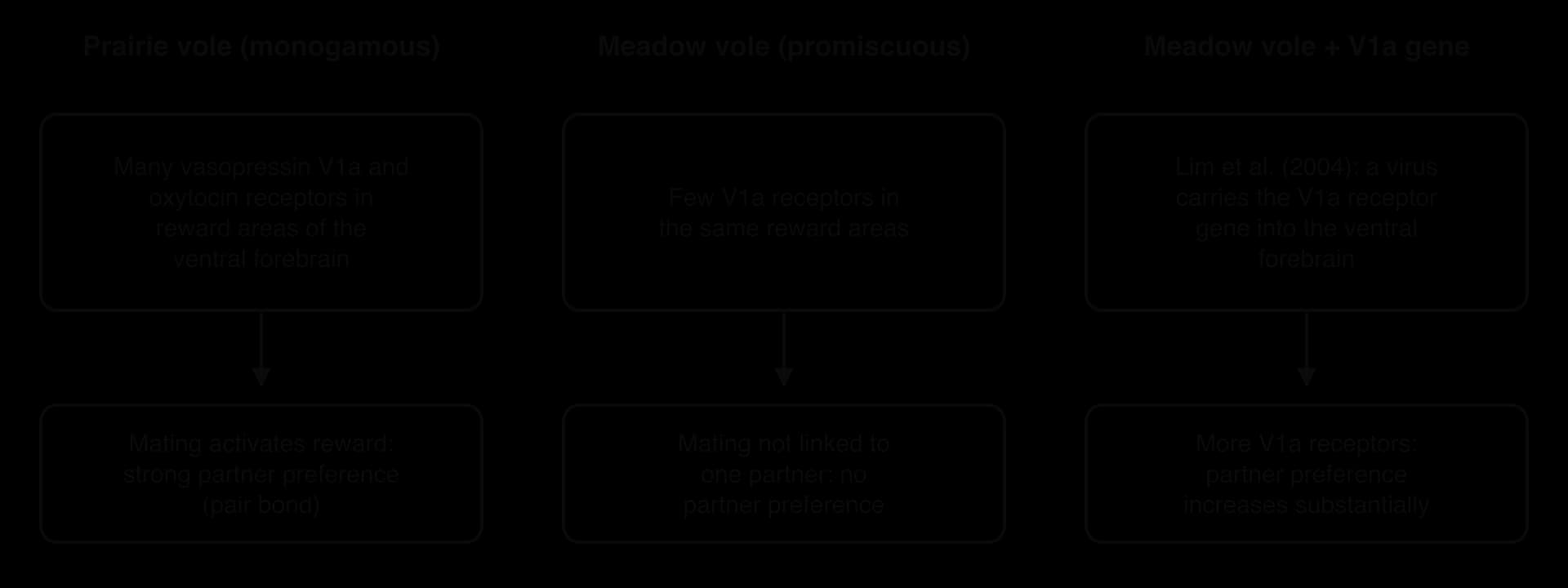
The vole research is an excellent example of what an animal model can do: it allowed researchers to manipulate genes and brain regions in ways that would be impossible in humans, and to test cause and effect directly. Its limitation is extrapolation. Human relationships depend on language, culture, shared history and choice; whether the same receptors play a similar role in people has to be tested in human research.
A vasopressin receptor gene and human relationships
Walum et al. (2008) tested whether variation in the human gene for the V1a receptor (AVPR1A) is linked to relationship behaviour. The participants came from the Twin and Offspring Study in Sweden: 552 pairs of same-sex twins, together with their spouses or partners, all in relationships of at least five years. The researchers looked at one variable section of the gene, called RS3, and in particular at one version of it, known as allele 334. Men completed a 13-item questionnaire on partner bonding, and their partners rated the quality of the relationship.
Men with two copies of allele 334 scored lower on partner bonding than men with none. They were also about twice as likely to report a marital crisis or threat of divorce in the past year and to be living with their partner without being married, and their partners rated the relationship lower on some measures. No link was found in women.
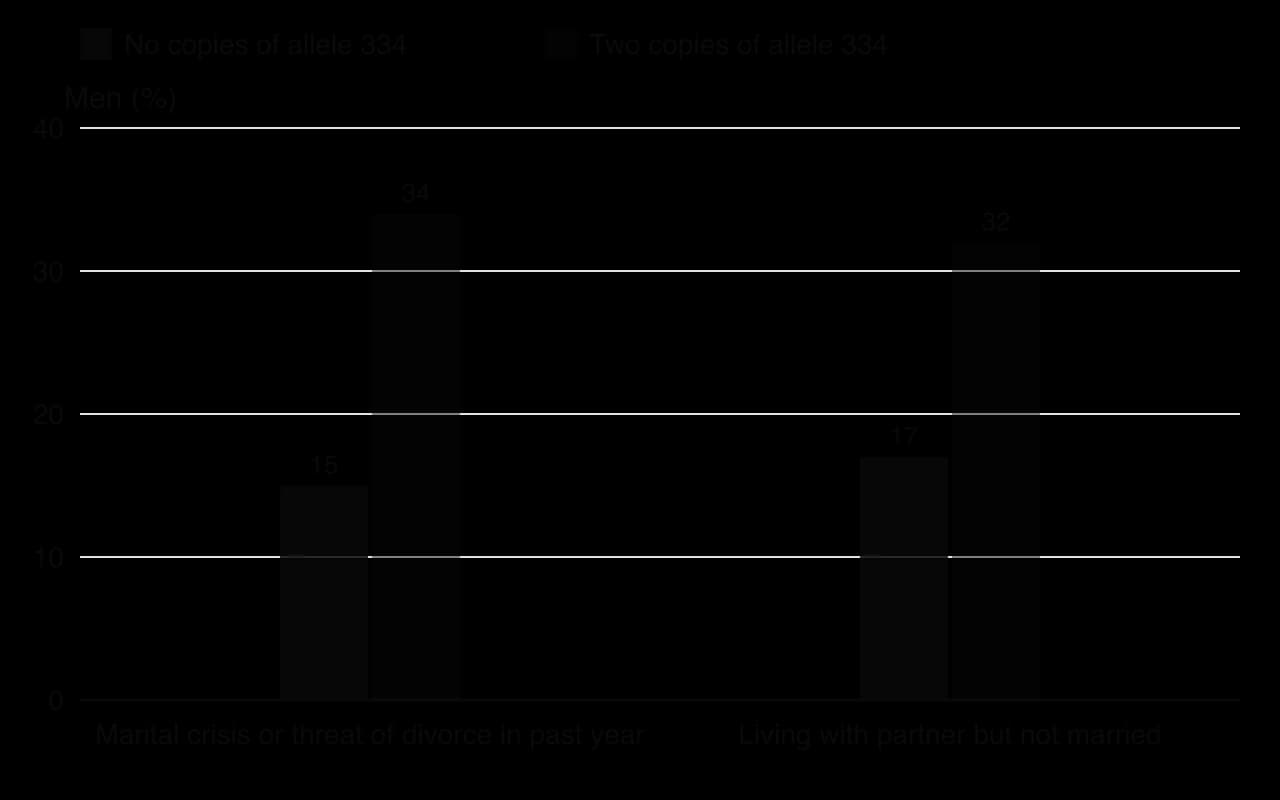
The study links human relationships to the same receptor that is involved in pair bonding in voles. However, the effect was small, the authors themselves stated that the gene cannot be used to predict an individual’s behaviour, and genetic association studies of single genes have often failed to replicate. The data are also correlational and based on self-report, so the gene may act through other traits, such as personality, rather than through bonding directly.
Oxytocin in couples
Oxytocin rises during touch, sex and breastfeeding, and human research has tested whether it supports closeness between partners. Ditzen et al. (2009) gave 47 heterosexual couples in Zurich either oxytocin or a placebo by nasal spray before asking them to discuss a topic they often disagreed about. The discussions were videotaped and coded for positive and negative behaviour, and saliva was collected to measure cortisol. Couples given oxytocin showed more positive communication relative to negative behaviour and had lower cortisol after the conflict than couples given the placebo.
These results fit the idea that oxytocin makes social interaction feel safer and less stressful. Caution is needed, however. The best-known oxytocin finding, Kosfeld et al.’s (2005) result that a nasal spray of oxytocin increases trust in a stranger, has not held up in larger replications, as Nave, Camerer and McCullough (2015) concluded in a critical review. Many single studies of intranasal administration of oxytocin are small, and it remains uncertain how much of the spray reaches the brain.
 YouTube
Key study: Scheele et al. (2012), oxytocin and social distance
Aim
Research on prairie voles suggested that oxytocin helps to maintain pair bonds once they have formed, not only to create them. Dirk Scheele, René Hurlemann and colleagues at the University of Bonn aimed to find out whether oxytocin influences how men in committed relationships behave towards an attractive woman they meet for the first time, compared with single men.
Method
The participants were 57 healthy heterosexual men from Germany, with a mean age of 25: 30 were in a monogamous relationship and 27 were single. In a double-blind, placebo-controlled experiment with an independent samples design, each man received either 24 international units of oxytocin or a placebo by nasal spray, randomly allocated, 45 minutes before testing.
Behaviour was measured with a stop-distance procedure. An attractive female experimenter either walked towards the participant from 2 metres away or stood still while the participant walked towards her, sometimes making eye contact and sometimes not.
The participant said “stop” at the distance he found ideal, and again at the point where he began to feel slightly uncomfortable. The distance between their chins was measured with a laser. To check whether any effect was specific to an attractive woman, a separate group of 29 men in relationships did the same task with a male experimenter. In a second task, participants used a joystick to pull pictures towards them (approach) or push them away (avoid), including pictures of attractive women.
Results
Oxytocin led men in relationships, but not single men, to keep a greater distance from the female experimenter, by about 10–15 cm. With the experimenter approaching from 2 metres with eye contact, for example, men in relationships stopped her at an average of 70.4 cm under oxytocin compared with 55.9 cm under placebo. With a male experimenter, the difference was small and not significant. The effect appeared whether the experimenter or the participant was moving and whether or not she made eye contact.
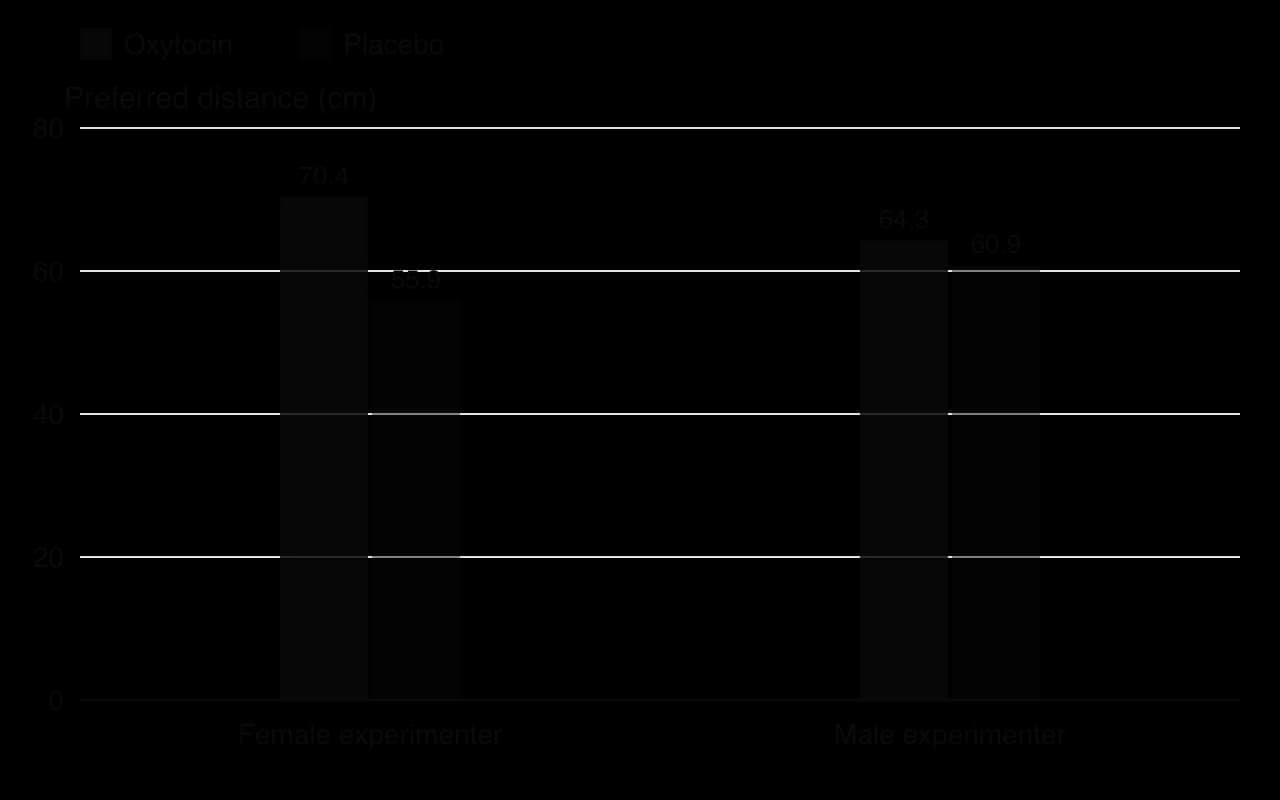
In the picture task, men in relationships given oxytocin were slower to pull pictures of attractive women towards them. Oxytocin did not change how attractive the men rated the experimenter or the women in the pictures, or how arousing they found the pictures.
Sources: Scheele, D., Striepens, N., Güntürkün, O., Deutschländer, S., Maier, W., Kendrick, K. M. & Hurlemann, R. (2012). Oxytocin modulates social distance between males and females. _Journal of Neuroscience, 32(46), 16074–16079._
Conclusions
The researchers concluded that oxytocin may help to maintain monogamous relationships by making men in a relationship avoid signalling romantic interest to other women through close physical approach. Because attractiveness ratings were unchanged, the effect seems to be on approach behaviour, not on how attractive other women seem. This parallels the role of oxytocin in maintaining pair bonds in prairie voles.
Evaluation
Causality: what the design allows
Random allocation, a placebo and a double-blind procedure mean that the difference in distance among men in relationships can be attributed to oxytocin. The male-experimenter condition is an important control: because the effect was much weaker with a man, oxytocin did not simply make participants want more personal space from everyone. Relationship status, however, was not manipulated, so the study cannot show why oxytocin affected only men in relationships; men who are in relationships may differ from single men in other ways, such as personality or age.
Measurement: distance as an indicator of fidelity
Stopping an experimenter at a certain distance is a precise, objective behavioural measure, which avoids the problems of self-report. But it is a narrow way of operationalising a complex construct. Keeping 15 cm more distance from a stranger in a laboratory is not the same as remaining faithful over years, and the conclusion that oxytocin “promotes fidelity” goes well beyond what was measured. The dose was also artificial: a single nasal spray does not reproduce the way oxytocin is naturally released during intimacy.
Bias and generalisability: a narrow sample
The sample was small, male, heterosexual and German, so the results cannot be generalised to women, to same-sex couples or to other cultures without further research. The small sample and the general replication problems of intranasal oxytocin research, highlighted by Nave et al. (2015), mean that the finding should be treated as promising rather than established until it is repeated by other research groups.
Responsibility
The procedure posed minimal risk, and participants gave informed consent. The wider responsibility lies in how such findings are reported. Describing oxytocin as a “fidelity hormone” could suggest that faithfulness is chemically determined or could be controlled with a spray, which the evidence does not support and which raises ethical questions about manipulating a partner’s behaviour.
Testosterone: mating and parenting
Testosterone is linked to competition and to seeking sexual partners. In many bird and mammal species in which fathers help raise their young, male testosterone is high during the mating season and falls when the young are born, which is thought to shift effort from competing for mates to caring for offspring. Researchers have asked whether the same trade-off exists in human fathers.
Gettler et al. (2011) used data from a large, representative study of young men in Cebu City in the Philippines. Testosterone was measured from saliva in 624 men at age 21 and again four and a half years later. Single men with higher testosterone at the start were more likely to have become partnered fathers by the follow-up.
Once they became fathers, their testosterone fell sharply, by a median of 26% in the morning and 34% in the evening, much more than in men who remained single without children. Fathers who spent three or more hours a day on childcare had lower testosterone at follow-up than fathers who were not involved in care.
Because the study was longitudinal, it could show the order of events, which a single measurement could not. It shows that the relationship runs both ways: higher testosterone predicted later mating success, and becoming a father, especially an involved one, then lowered testosterone. The sample also widens research beyond Western university students.
Aggression in relationships
Where interpersonal relationships are studied through conflict and aggression instead of attraction and bonding, testosterone is the chemical messenger most often investigated. The evidence linking it to aggression in adults is largely correlational, and its effects depend on other hormones, such as cortisol, and on the situation. The same caution about direction applies: competition, threats to status and conflict all change testosterone levels, so a correlation between testosterone and aggression in a relationship does not show which caused which.
How the approaches interact in relationships
Chemical messengers do not produce relationships on their own. A person’s brain chemistry influences how rewarding a partner feels, but whom the person meets, how they interpret the partner’s behaviour and whether they marry are shaped by cognition and culture. Explanations that combine the approaches fit the evidence better than any single approach.
Approach | Example of its role | How it interacts with chemical messengers |
|---|---|---|
Biological | Dopamine reward response to a partner; oxytocin and vasopressin in bonding | Provides the reward and bonding mechanisms through which relationships feel rewarding and secure. |
Cognitive | Partners weigh costs and rewards and form expectations about each other | What a person expects and how they interpret the partner affects whether contact is experienced as rewarding or threatening, and so affects the chemical response. |
Sociocultural | Norms about dating, arranged and love marriages, and fathers’ roles | Norms shape who becomes a partner and how much time fathers spend on childcare, which in turn changes hormone levels, as Gettler et al. (2011) found; cultural values relate to reward activity, as Xu et al. (2011) found. |
Arranged marriages, common in parts of South Asia and the Middle East, illustrate this interaction. In such marriages, romantic attraction is not usually the starting point; partners are chosen through families and cultural criteria. Attachment between the partners can develop after marriage, which suggests that the chemical systems of attachment can be engaged by shared life and commitment as well as by initial passion.
Evaluating research on chemical messengers in relationships
Causality: animals, experiments and correlations
The research uses three kinds of evidence with different strengths. Animal experiments, such as Lim et al. (2004), can show cause and effect at the level of genes and receptors, but require extrapolation to humans. Human experiments with intranasal oxytocin, such as Scheele et al. (2012) and Ditzen et al. (2009), test causes in people but only for short-term behaviour in the laboratory.
Human brain imaging, genetic and hormone studies, such as Aron et al. (2005), Walum et al. (2008) and Marazziti et al. (1999), are correlational and cannot show direction. Longitudinal designs, such as Gettler et al. (2011), help by showing the order of events, and they show that relationships change chemical messengers as well as the reverse.
Measurement: indirect and proxy measures
Almost every measure in this field is indirect. fMRI shows changes in blood flow in regions rich in dopamine neurons, not dopamine release. Serotonin transporters on blood platelets are a proxy for activity in the brain. Oxytocin given by nasal spray may not reach the brain in meaningful amounts, and methods for measuring oxytocin in the blood have been criticised as unreliable. Love, bonding and fidelity are also hard constructs to operationalise: looking at a photograph, choosing a stopping distance or answering a bonding questionnaire each captures only one part of them.
Why does it matter whether a nasal spray reaches the brain?
Experiments with intranasal oxytocin assume that the spray raises oxytocin in the brain areas involved in bonding. If only a small amount reaches the brain, the behavioural effects could come from oxytocin acting elsewhere in the body, for example on the heart or gut, which then send signals to the brain. The behaviour would still have changed, so the experiment would still show a causal effect of the spray, but it would not show that oxytocin acts on the bonding circuits identified in voles. This uncertainty weakens the link between the human experiments and the animal model.
Perspective: reductionism and holism
Explaining love through dopamine or bonding through vasopressin is a form of biological reductionism. It has produced precise, testable hypotheses and genuine discoveries, such as the receptor differences between vole species. But it cannot explain why people fall in love with particular people, why norms about marriage differ between societies, or how couples recover after conflict. A more holistic view treats chemical messengers as one level of explanation that interacts with cognition and culture.
Bias: who has been studied
Most human studies use small samples of young, heterosexual participants, often only men, from Western countries. Scheele et al. (2012) tested only men; Walum et al. (2008) found effects only in men; same-sex relationships are almost absent from the research.
Xu et al. (2011) in China and Gettler et al. (2011) in the Philippines are valuable exceptions, but much more cross-cultural work is needed before claims about universal mechanisms can be made. Publication bias is also a risk: early positive oxytocin findings were widely reported, while later null results received less attention.
Responsibility: from findings to applications
Animal research on voles involves breeding, genetic manipulation and brain surgery, so it must be justified on a cost-benefit analysis and follow the three Rs of replacement, reduction and refinement. Applications to humans raise further questions. Commercial “trust sprays”, proposals to give oxytocin to couples, or genetic tests that claim to predict commitment would rest on weak evidence and could be used to manipulate or judge partners. Researchers have a responsibility to communicate how small and uncertain most effects are.
Concept | Strength of the research | Limitation of the research |
|---|---|---|
Causality | Animal and placebo-controlled human experiments test causes; longitudinal studies show direction | Most human evidence is correlational; relationships also change hormones |
Measurement | Objective measures (fMRI, stop distance, saliva hormones) avoid self-report bias | Measures are indirect proxies; love and fidelity are narrowly operationalised |
Perspective | Biological research produces precise, testable mechanisms | Reductionist: leaves out cognition and culture |
Bias | Some non-Western samples (China, Philippines) | Small, mostly male, heterosexual and Western samples; publication bias |
Responsibility | Knowledge could help understand bonding problems | Animal welfare; risk of misusing weak findings in products or genetic tests |
Exam practice
Chemical messengers in relationships can appear in Paper 1 Section B as a scenario about a couple, a family or a conflict, and in Section C as a concept-based essay. In Section B, the task is to apply the role of a chemical messenger to the people in the scenario; in Section C, to evaluate research on chemical messengers in relationships through the named concept.
Summary
Fisher’s model separates lust (sex hormones), attraction (dopamine, noradrenaline, lower serotonin) and attachment (oxytocin and vasopressin).
Viewing a beloved partner activates the dopamine-rich VTA and caudate, in American and Chinese samples, and in some long-married couples.
Early romantic love has been linked to lower serotonin-transporter density, similar to OCD, but the measure is an indirect, correlational proxy.
In voles, oxytocin and vasopressin receptors in reward areas underlie pair bonding; adding V1a receptors to meadow voles produced partner preference.
In Swedish men, a version of the vasopressin receptor gene was linked to weaker partner bonding, but the effect was small.
Scheele et al. (2012) found that oxytocin led men in relationships, but not single men, to keep about 10–15 cm more distance from an attractive woman.
Testosterone predicts later fatherhood and then falls after men become fathers, especially involved fathers, so relationships also change hormones.
The research is limited by indirect measures, correlational designs, extrapolation from animals, narrow samples and replication problems; chemical messengers interact with cognitive and cultural factors.
Self-check
- To do:
I can describe Fisher’s three systems and the chemical messengers linked to each.
- To do:
I can explain the role of dopamine and the reward system in romantic love, with research from more than one culture.
- To do:
I can explain how oxytocin and vasopressin are involved in pair bonding, using vole and human research.
- To do:
I can describe and evaluate Scheele et al. (2012).
- To do:
I can explain how testosterone changes with fatherhood and why this shows a two-way relationship.
- To do:
I can discuss how biological, cognitive and sociocultural factors interact in relationships.
- To do:
I can evaluate this research through causality, measurement, perspective, bias and responsibility.
- To do:
I can apply chemical messengers to an unfamiliar relationship scenario.
Carry on with 8.7 in Augment
With a free account, Augment remembers where you stopped and what you have practiced.