 YouTube
Explain how acculturation strategies affect behaviour and mental health in groups in contact, including acculturative stress and host-community attitudes, and evaluate the research through the concepts.
Each is in the Psychology glossary, with every other term in the subject.
A difference between family members, usually parents and children, in how far and how fast they acculturate, which can lead to conflict over values, language and behaviour.
Stress caused by the demands of acculturation, such as language difficulties, discrimination, loss of social support and conflict between cultural values, which can lead to anxiety and depression.
The confusion, anxiety and disorientation that can follow moving into an unfamiliar culture, when familiar cues and routines no longer apply.
A society’s policy and attitude of accepting cultural diversity, in which different cultural groups keep their heritage while sharing full participation in the larger society.
Explain how acculturation strategies affect the behaviour and mental health of members of immigrant and minority groups.
Describe acculturative stress and culture shock and explain the factors that increase or reduce them.
Explain why acculturation is a two-sided intergroup process, with reference to the Interactive Acculturation Model and host-community attitudes.
Explain how biological, cognitive and sociocultural factors interact in acculturative stress.
Describe and evaluate the study of cultural identity and mental health in east London adolescents by Bhui and colleagues (2005).
Discuss research on acculturation in group behaviour with reference to causality, measurement, bias and responsibility.
Apply acculturation strategies to unseen situations involving groups in contact.
When groups with different cultures live side by side, members of each group change. How immigrant and minority groups combine their heritage culture with the culture of the wider society affects their friendships, schooling, family life and mental health, and how the majority responds affects whether relations between the groups are harmonious or hostile.
This area of study belongs to the human relationships context and to group behaviour. It applies the approach term acculturation and draws on social identity theory and cultural dimensions from the sociocultural approach, cognitive appraisal from the cognitive approach, and stress physiology from the biological approach.
With a free account, Augment remembers where you stopped and what you have practiced.
Scope: An area of study in the human relationships context (group behaviour), studied at SL and HL: different acculturation strategies and their effects on behaviour and mental health. It applies the approach term models of acculturation to groups in contact, so the model itself is recapped only briefly.
Berry’s model of acculturation describes acculturation along two independent dimensions: whether people keep their heritage culture and whether they seek contact with the host culture. Crossing the two gives four strategies: integration (keeping both), assimilation (adopting the host culture and giving up the heritage culture), separation (keeping the heritage culture and avoiding the host culture) and marginalisation (little involvement with either). Large studies of immigrant youth across many countries find that integration is, on average, linked to the best psychological adaptation and sociocultural adaptation, and marginalisation to the worst.
In the context of human relationships, the important point is that these strategies are not only individual choices. They are shaped by the groups a person belongs to, carried out through relationships with members of both groups, and constrained by how the majority responds. Acculturation is therefore a form of group behaviour: it concerns how groups in contact relate to each other and how membership of those groups affects individuals.
Acculturation happens to communities as well as individuals. Migrants often settle near others from the same background, forming neighbourhoods with their own shops, places of worship, media and associations. These communities make separation possible, but they also support integration by providing a secure base from which members can engage with the wider society. Newly arrived migrants learn how to acculturate partly by watching earlier arrivals from their own group, so community norms about language, marriage and religion shape individual strategies.
The majority group acculturates too. Long-term residents of a city that becomes more diverse encounter new foods, languages, religions and music, and some adopt them. Majority members also hold attitudes about how newcomers should acculturate. Berry described these as the host society’s orientations: multiculturalism (diversity accepted and valued), the melting pot (newcomers expected to assimilate), segregation (groups kept apart) and exclusion (newcomers rejected).
The host society’s orientation sets limits on what minority groups can do. Integration requires a society that allows people to keep their heritage while taking part; where the majority demands assimilation or practises exclusion, minorities who want integration may be pushed into separation or marginalisation. This is why researchers increasingly study acculturation as the outcome of a relationship between groups.
YouTubeMoving between cultures brings many demands: learning a language, finding work, understanding new rules, and coping with loss of family, friends and status. When these demands are appraised as greater than a person’s resources, the result is acculturative stress. It shows itself in anxiety, depression, feelings of marginality and alienation, physical symptoms and identity confusion.

The framework, developed by Berry and colleagues from comparative studies of acculturative stress in the 1980s, explains why acculturation is not automatically harmful and why many migrants adapt well. Stress is most likely when demands are high (a forced move, a large cultural distance, discrimination) and resources are low (little language, no social support, a marginalised strategy).
Language barriers. Difficulty understanding teachers, doctors or officials reduces control over daily life and limits social contact with the majority.
Discrimination and prejudice. Being treated as an outsider is one of the strongest predictors of poor mental health among migrants, and it can push people from integration towards separation.
Loss of social networks and status. Migrants often lose extended family and friends, and qualified professionals may work in jobs far below their training.
Intergenerational conflict. Children usually learn the host language and norms faster than their parents. When parents favour separation and children assimilation, disagreements about dating, clothing, religion and duties to the family can create conflict, sometimes called an acculturation gap.
Pre-migration trauma. Refugees may have experienced war, persecution or dangerous journeys, which add to and interact with the stress of resettlement.
Hovey and King (1996) surveyed 70 immigrant and second-generation Latino adolescents in a bilingual programme at a high school in southern California. About a quarter reported critical levels of depression and suicidal ideation, and both were positively correlated with acculturative stress. Perceived family dysfunction and negative expectations for the future were the best predictors of acculturative stress and depression, which suggests that family relationships are a key resource or risk in acculturation.
Culture shock is the confusion and anxiety that can follow moving into an unfamiliar culture, when familiar cues for behaving and communicating no longer apply. The anthropologist Kalervo Oberg described it in stages: a “honeymoon” of excitement, a crisis of frustration and homesickness, gradual adjustment and finally adaptation. Research on international students has not found that everyone passes through these stages in order; difficulties are often greatest soon after arrival and ease as people learn the culture.
Culture shock is best seen as a short-term reaction that most sojourners and migrants move through as they learn the new culture, while acculturative stress is a broader, potentially longer-lasting response that depends on the group’s situation in the host society. A refugee family facing discrimination may experience acculturative stress for years after any initial culture shock has passed.
Acculturative stress shows how biological, cognitive and sociocultural factors work together. The sociocultural approach identifies the stressors: discrimination, loss of networks and conflicting norms. The cognitive approach explains why the same stressor affects people differently: stress depends on cognitive appraisal, so a migrant who sees language learning as a challenge rather than a threat is less stressed. The biological approach explains the health effects: prolonged stress activates the HPA axis and raises cortisol, which over time is linked to sleep problems, lowered immunity and depression.
Approach | Contribution to explaining acculturative stress | Example |
|---|---|---|
Sociocultural | Stressors arise from intergroup relations and host attitudes | Discrimination at school; segregated housing |
Cognitive | Appraisal and coping determine whether demands become stress | Seeing a new language as an opportunity rather than a threat |
Biological | Chronic stress affects the HPA axis and health | Raised cortisol, poor sleep, low mood |
The four strategies are linked to mental health through different routes. Each strategy changes how much social support a person can draw on, how much discrimination and value conflict they meet, and how secure their sense of identity is.
Integration is most consistently linked to good mental health. In the International Comparative Study of Ethnocultural Youth, immigrant adolescents with an integration profile had the best psychological adaptation in 13 host societies. Nguyen and Benet-Martínez (2013) combined 83 studies in a meta-analysis and found that biculturalism was more strongly related to psychological adjustment, such as life satisfaction, and to sociocultural adjustment than identifying with either culture alone.
Three explanations are usually given. Integrated people can turn to both their own community and members of the majority for help, so a setback in one group does not leave them isolated. They also have the language and social skills to deal with schools, employers and health services, which reduces daily stress. Finally, a secure identity that includes both cultures protects self-esteem when one of the groups is criticised.
 YouTube
Assimilation might be expected to bring good mental health, because the person fits in with the majority. The evidence is more mixed. Lara and colleagues (2005) reviewed research on Latinos in the United States and found that greater acculturation to American culture was linked to worse outcomes for substance use, diet and birth outcomes, but to better use of health care and better self-rated health.
One explanation is that assimilation can mean giving up protective heritage norms, such as close family ties, traditional diets and disapproval of alcohol and drug use, while taking on the host culture’s risks. Assimilated individuals may also still meet discrimination, because adopting the majority culture does not guarantee acceptance by it. If the majority does not accept them, they can lose the support of the heritage group without gaining the support of the majority, which moves them towards marginalisation.
Separation keeps people within their heritage group. It can limit sociocultural adaptation: in the ICSEY study, adolescents with an ethnic (separation) profile had moderately good psychological adaptation but poorer sociocultural adaptation than integrated adolescents. A close heritage community can still protect mental health. Bécares, Dewey and Das-Munshi (2018) meta-analysed international studies of the ethnic density effect, the link between living among many members of one’s own ethnic group and mental health. Each 10-percentage-point increase in own-group density was associated with lower odds of psychotic experiences (OR 0.82) and suicidal ideation (OR 0.88); associations with depression and anxiety pointed the same way but were not statistically significant.
The usual explanation is that a strong local community buffers the effects of discrimination and provides practical and emotional support in the heritage language. The finding shows that keeping the heritage culture is itself protective, which is one of the two parts of integration. Living in an area with many members of one’s own group is not the same as choosing separation, however, so the ethnic density effect is evidence about community support rather than a direct test of the strategy.
Marginalisation is linked to the poorest mental health. Adolescents with a diffuse profile in the ICSEY study had the worst psychological and sociocultural adaptation, and in the study by Bhui and colleagues (2005) marginalised pupils were the group with the highest odds of mental health problems. Marginalised people lack support from either group, often have an uncertain identity, and have usually not chosen their position, because marginalisation tends to follow enforced cultural loss combined with exclusion by the majority.
Strategy | Typical association with mental health | Main explanation | Evidence |
|---|---|---|---|
Integration | Best on average | Support and skills from both groups; secure bicultural identity | ICSEY integration profile; Nguyen and Benet-Martínez (2013) |
Assimilation | Mixed; some risks rise with time in the host society | Loss of protective heritage norms; continued discrimination | Lara et al. (2005) review of Latino health |
Separation | Moderately good psychologically, poorer sociocultural adaptation | Community support buffers discrimination, but contact with the host society is limited | ICSEY ethnic profile; ethnic density effect (Bécares et al., 2018) |
Marginalisation | Worst | No support from either group; identity confusion; exclusion | ICSEY diffuse profile; Bhui et al. (2005) reference group |
The pattern in the table is an average, and it does not hold equally for every group. In the RELACHS data from east London, integration was linked to lower risk of depression for Bangladeshi pupils, but the associations for African-Caribbean pupils were different and sometimes unexpected. Lara and colleagues found that acculturation to the host culture was harmful for some health outcomes and helpful for others. Which strategy is healthiest therefore depends on the group, the outcome and the host society.
Measurement adds a second limit. Many health studies measure acculturation only by language use or years in the country, which cannot show which of Berry’s strategies a person is following. A person who speaks mainly English may be assimilated or integrated, depending on whether they have kept their heritage culture. Results from such studies cannot be mapped directly onto the four strategies.
Because both groups hold views about how acculturation should happen, the meeting of those views shapes relations between them. Richard Bourhis and colleagues (1997) built this into the Interactive Acculturation Model. It predicts that relations will be consensual when immigrant and majority orientations match, problematic when they partly match and conflictual when they clash, and that state policies influence the orientations of both groups.
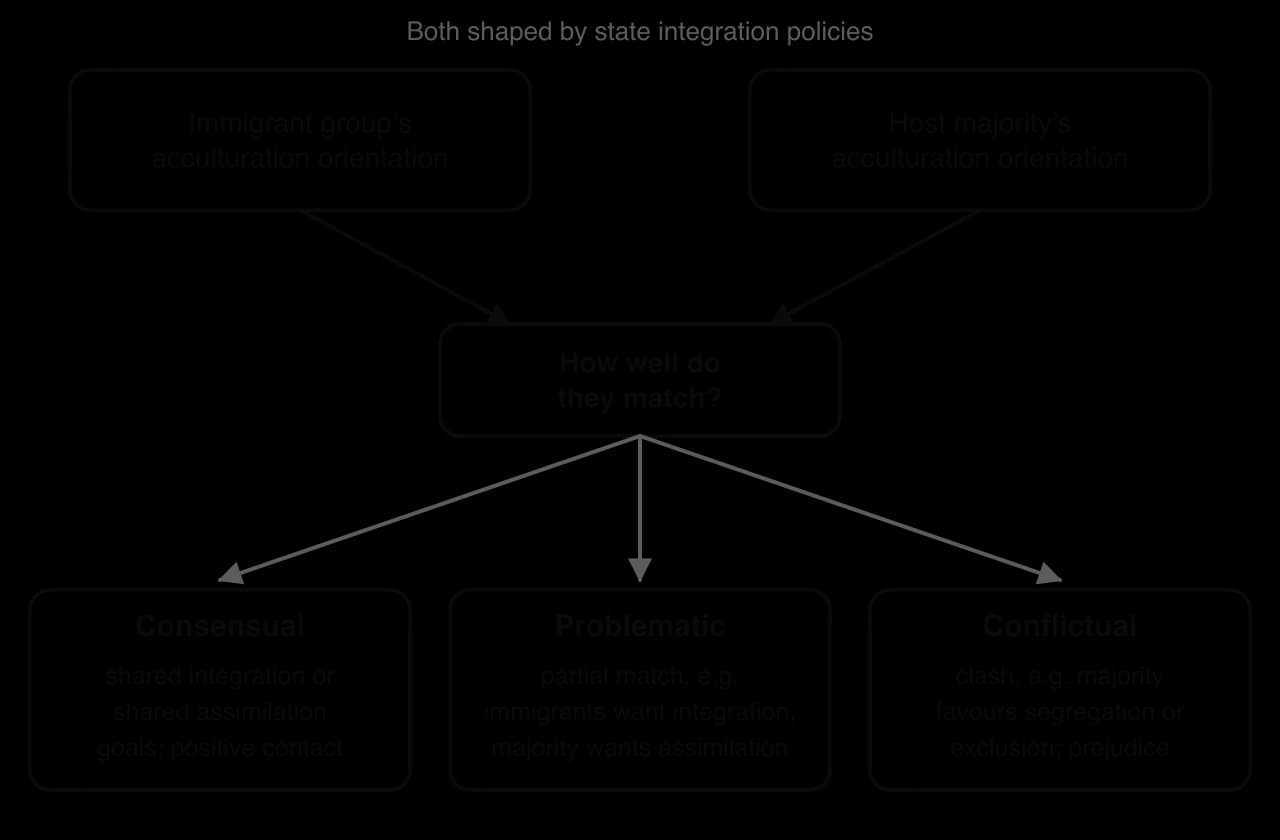
Zagefka and Brown (2002) tested these ideas with school students in Germany. They gave questionnaires to 193 German majority students and 128 students from immigrant backgrounds, measuring each group’s preferred acculturation strategy and the quality of intergroup relations. In general, a preference for integration was associated with more favourable intergroup relations in both groups, and a mismatch between what immigrants wanted and what the majority wanted for them was associated with the most negative relations.
Studies of this kind show that acculturation is two-sided. Majority members who believe immigrants want to keep apart, or who feel threatened by cultural difference, are more likely to favour assimilation or exclusion, and minority members who meet these demands may respond by holding more tightly to their heritage culture. Each group’s strategy partly reacts to its perception of the other’s, which links acculturation to social identity theory: when a group identity feels threatened, people tend to strengthen it.
The contact hypothesis proposes that contact between groups reduces prejudice when it is equal-status, cooperative, aimed at shared goals and supported by authorities. Integration is, by definition, a strategy of contact with the majority while keeping one’s own group identity. Where schools and workplaces create the right conditions for contact, integration and good intergroup relations may reinforce each other; where contact is unequal or hostile, it may increase tension instead.
Acculturation strategies show up in everyday behaviour. They affect which language people speak and where, who their friends are, how they dress, what they eat, which media they follow, whom they marry and how they bring up their children. These behaviours are both signs of a strategy and ways of carrying it out.
Behaviour | Integration | Assimilation | Separation | Marginalisation |
|---|---|---|---|---|
Language | Uses both, often switching by setting | Mainly host language; heritage language fades | Mainly heritage language | Limited fluency or use of either |
Friendships | Friends from both groups | Mainly majority friends | Mainly own-group friends | Few close friends in either group |
Family relations | Negotiates between family and wider norms | Possible conflict with heritage-oriented parents | Close to family norms | Often weakened family ties |
Intergroup attitudes | Positive towards both groups | May distance self from own group | May distrust the majority | Alienation from both |
Friendship choices are particularly important for group behaviour, because they are the point at which acculturation becomes a relationship. Researchers often use the ethnic make-up of a young person’s friendships as a behavioural measure of their acculturation strategy, as in the study of east London adolescents by Bhui and colleagues (2005).
Digital technology has added new ways of acculturating. Messaging apps and video calls allow migrants to keep daily contact with family and friends in their country of origin while learning the host language through online resources and joining host-country networks. Technology can therefore support integration, but it can also make separation easier by allowing people to live largely within heritage-language media.
Kamaldeep Bhui and colleagues aimed to find out whether cultural identity, classified using Berry’s acculturation strategies, was a risk factor for mental health problems among adolescents in a multi-ethnic urban area. They focused on behaviour that reflects acculturation in group life: the cultural backgrounds of the friends young people chose and the styles of clothing they wore.
The study was a cross-sectional, school-based population survey, part of the Research with East London Adolescents Community Health Survey (RELACHS). Participants were 2,623 adolescents aged 11 to 14 from a representative sample of 28 schools in east London, one of the most ethnically diverse areas of the UK, with large Bangladeshi, Black Caribbean and white British communities. It was a correlational design: no variable was manipulated.
Cultural identity was operationalised through questions about the cultural origins of pupils’ friends and the style of clothes they preferred. On the basis of their answers, pupils were classified into one of four cultural identity types matching Berry’s strategies, including “integrated” (friends from both their own and other cultures) and “marginalised” (friends from neither their own nor other cultures).
Mental health problems were measured with the Strengths and Difficulties Questionnaire (SDQ), a widely used questionnaire that screens for emotional, conduct, hyperactivity and peer problems. Results were analysed as odds ratios, comparing each identity type with the marginalised group: an odds ratio of 1 means the same odds of mental health problems as marginalised pupils, and a value below 1 means lower odds.
A companion paper checked the validity of the cultural identity questions. Focus groups with African-Caribbean, Bangladeshi and white British young people explored what cultural identity meant to them and whether the questions made sense. The friendship questions were judged more useful than the clothing questions.
Compared with marginalised pupils, pupils who made culturally integrated friendship choices were less likely to have mental health problems. The effect held for all pupils, was stronger for boys, and was strongest among Bangladeshi pupils, whose odds of mental health problems were about a seventh of those of marginalised pupils.

Group with integrated friendship choices | Odds ratio (95% confidence interval) |
|---|---|
All pupils | 0.60 (0.4 to 0.9) |
Boys | 0.45 (0.22 to 0.91) |
Bangladeshi pupils | 0.15 (0.04 to 0.55) |
Sources: Bhui, K., Stansfeld, S., Head, J., Haines, M., Hillier, S., Taylor, S., Viner, R., & Booy, R. (2005). Cultural identity, acculturation, and mental health among adolescents in east London’s multiethnic community. _Journal of Epidemiology and Community Health, 59(4), 296–302. Companion validation study: Bhui et al. (2005), Social Psychiatry and Psychiatric Epidemiology, 40(4), 259–266._
The companion study found that associations differed between ethnic groups. For Bangladeshi pupils, integration was associated with a lower risk of depression, while for African-Caribbean pupils the patterns were different and sometimes unexpected, which led the authors to conclude that the link between acculturation and health is not the same for every group.
Integrated friendship choices, meaning friendships with young people from one’s own and other cultures, were associated with lower levels of mental health problems, especially for boys and for Bangladeshi pupils. The researchers concluded that friendship choices are a useful measure of cultural identity, and that cultural identity, expressed through relationships with both the heritage group and other groups, is relevant to adolescents’ mental health.
The design is correlational and cross-sectional, so it cannot show that integrated friendships protect mental health. Bidirectional ambiguity is likely: adolescents with emotional or peer problems may find it harder to make friends in any group, which would place them in the marginalised category because of their difficulties.
A later prospective study by Bhui and colleagues (2008) followed 900 white British and Bangladeshi pupils from the same survey for two years and found that friendship choices did not predict later mental health problems, while some clothing choices did, which weakens the claim that integrated friendships protect mental health. A third variable, such as family income or experience of discrimination in a particular school, could affect both friendship patterns and mental health.
Using friendship and clothing choices is a strength because it measures acculturation through actual behaviour rather than attitudes alone, and the validation study with focus groups checked that the questions were meaningful to young people from each community, which is a form of triangulation. However, the validation found that clothing choices did not work well, and a few questions cannot capture language, values, religion and identity. The SDQ is a screening tool, so it identifies likely problems rather than diagnosed disorders.
The sample was large and drawn from a representative set of schools, which reduces sampling bias and supports generalisation to east London adolescents. Generalising further is harder: east London has a particular history of migration and particular communities, and the companion study showed that associations differed between ethnic groups. Treating “integration is good for mental health” as true for every group would ignore this variation.
Research with minority adolescents about mental health is socially sensitive. Findings could be misused to blame young people for their own difficulties (“they should just make more friends”) when exclusion by the majority may limit their choices. The researchers’ use of focus groups to involve young people from each community in shaping the measures is an example of responsible practice.
Almost all studies linking acculturation strategies to behaviour and mental health, including Bhui et al., Hovey and King, and Zagefka and Brown, are cross-sectional and correlational. Integration may improve well-being and relations, but good mental health and positive contact may also make integration easier. Longitudinal studies that follow groups over time, and intervention studies that change the conditions of contact, give stronger evidence about direction.
Studies operationalise strategies in different ways: attitude statements, identity scales, language use, friendship choices or clusters of several measures. Results depend on the measure: the same person may look integrated on friendships and separated on language. Acculturative stress and mental health are also usually measured through self-report questionnaires, which may be understood differently across cultural groups, so measurement equivalence is a constant concern.
Much research has studied the acculturation of minority groups while treating the majority as a fixed background. The Interactive Acculturation Model and studies such as Zagefka and Brown’s correct this by measuring both groups. Research has also been concentrated in Western host societies, so findings may not apply to migration between non-Western countries, to internal migration, or to Indigenous peoples, for whom “acculturation” has often meant forced assimilation.
Acculturation research has practical uses. Schools that support heritage languages and create cooperative contact between groups, health services that recognise acculturative stress, and multicultural policies all draw on the finding that integration is linked to better outcomes. Researchers also carry a responsibility in how findings are reported: emphasising migrants’ “choices” can hide the role of discrimination, while presenting groups as having fixed strategies can feed stereotypes.
Concept | Application to acculturation in group behaviour |
|---|---|
Causality | Cross-sectional data cannot separate the effect of strategy on mental health from the effect of mental health on strategy |
Measurement | Strategies operationalised by attitudes, identities, language or friendships give different results; self-report equivalence across groups |
Bias | Focus on minorities, not majorities; Western host societies; group-specific findings over-generalised |
Perspective | Sociocultural stressors, cognitive appraisal and biological stress responses interact |
Change | Strategies and relations change over time and with policy; interventions can improve intergroup contact |
Responsibility | Socially sensitive research; risk of blaming minorities rather than examining exclusion |
Acculturation as an area of study in human relationships can be the setting for a Paper 1 Section B question, in which a model of acculturation or another approach term is applied to an unseen situation involving groups, and for a Paper 1 Section C essay, which asks about acculturation strategies and their effects through one of the six concepts.
Acculturation strategies (integration, assimilation, separation, marginalisation) are shaped by groups and carried out through relationships with both the heritage group and the majority.
The majority group also acculturates and holds orientations (multiculturalism, melting pot, segregation, exclusion) that limit which strategies are available.
Acculturative stress arises when acculturation demands exceed resources; language, discrimination, lost networks, intergenerational conflict and trauma are key sources.
Culture shock is a short-term reaction to an unfamiliar culture; research does not support fixed stages.
Integration is linked to the best mental health and marginalisation to the worst; assimilation has mixed effects, and close heritage communities can protect mental health (the ethnic density effect).
The Interactive Acculturation Model and Zagefka and Brown (2002) show that the fit between groups’ preferences predicts intergroup relations.
Bhui et al. (2005) found that east London adolescents with integrated friendship choices had lower odds of mental health problems, especially Bangladeshi pupils (OR 0.15).
Sociocultural stressors, cognitive appraisal and biological stress responses interact in acculturative stress.
Most evidence is correlational, strategies are measured in different ways, and findings differ between groups and host societies.
I can explain how acculturation strategies affect behaviour and mental health in groups.
I can describe acculturative stress and culture shock and the factors that affect them.
I can explain why acculturation is two-sided, using the Interactive Acculturation Model and Zagefka and Brown (2002).
I can explain how biological, cognitive and sociocultural factors interact in acculturative stress.
I can describe and evaluate Bhui et al. (2005).
I can discuss acculturation research with reference to causality, measurement, bias and responsibility.
I can apply acculturation strategies to an unseen scenario and plan a concept-based essay.