Explain how compliance techniques such as social-norm messages and commitment change the behaviour of groups, evaluate the research and its limits, and design interventions for unfamiliar group settings.
Each is in the Psychology glossary, with every other term in the subject.
An unintended result of a persuasive message in which behaviour moves in the opposite direction to the one intended, such as low energy users increasing their use after learning the average.
A social norm that describes what most people actually do in a situation, such as most hotel guests reusing their towels, as opposed to what people approve of.
A social norm that describes what most people approve or disapprove of, that is, what a person ought to do, as opposed to what most people actually do.
A descriptive norm that refers to people in the same specific setting as the target, such as previous guests in the same hotel room, rather than people in general.
Explain how compliance techniques can be applied to change the behaviour of groups rather than individuals.
Describe the difference between descriptive and injunctive norms and explain how each is used to change group behaviour.
Describe and evaluate the hotel towel-reuse study by Goldstein, Cialdini and Griskevicius (2008).
Explain the boomerang effect and how it can be prevented.
Discuss how commitment, reciprocity and social proof have been applied in community, environmental and public-policy settings.
Discuss how culture affects the success of compliance techniques applied to groups.
Evaluate the application of compliance techniques to group behaviour with reference to change, measurement, bias and responsibility.
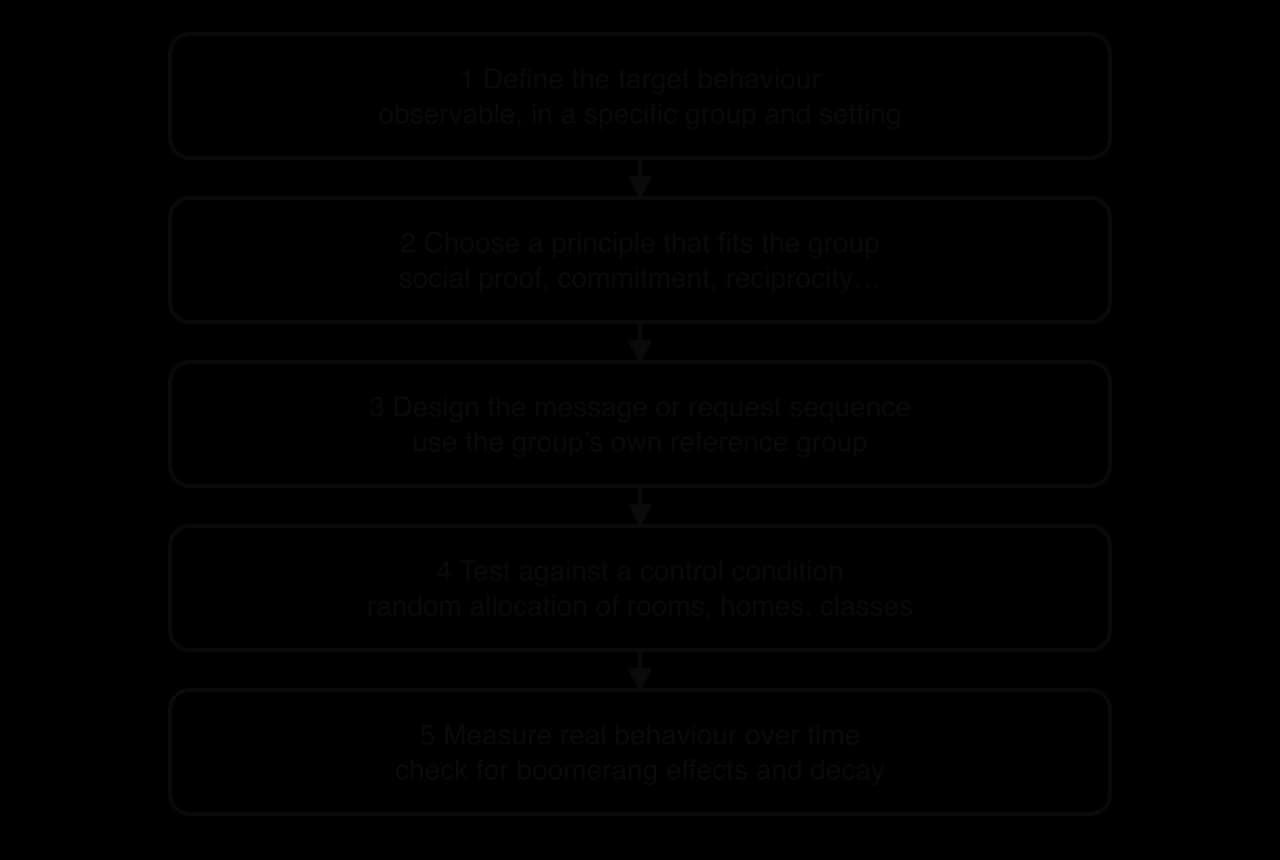
Apply one or more compliance techniques to an unfamiliar scenario involving group behaviour.
Compliance techniques are usually studied as requests from one person to another, but many of their most important uses aim to change what a whole group does: the guests in a hotel, the households in a town, the students in a school or the taxpayers of a country. Applied at this scale, small changes in behaviour add up to large effects on energy use, health and public services.
Compliance techniques are ways of making a request that increase the chance of agreement, by activating social rules such as reciprocity, consistency and social proof. The best-known are the foot-in-the-door technique (a small request before a larger one) and the door-in-the-face technique (a large, refused request before a smaller one). Applied to groups, the principle that matters most is social proof: telling people what others like them do. This brings in
With a free account, Augment remembers where you stopped and what you have practiced.
When a charity collector uses the door-in-the-face technique on one passer-by, the technique works through a face-to-face relationship: the collector appears to make a concession, and the passer-by feels obliged to reciprocate. Changing the behaviour of a group is different. There is often no personal contact at all, only a sign, a letter, an email or a message on an app, and the target is everyone who sees it.
This changes which principles are useful. Reciprocity and liking depend on a relationship, so they are hard to use with thousands of people at once. Social proof and commitment can be used at scale, because a message can tell everyone what others in the group do, and a pledge or sign-up can be built into a programme. For this reason most research on changing group behaviour uses normative messages: statements about what other members of the group do or approve of.
Groups also bring in processes that individual requests do not. People compare themselves with others in the group, and the more they identify with that group, the more its behaviour guides their own. A message about “people like us” draws on social identity, which is why the reference group named in a message matters so much.
Feature | Request to an individual | Intervention to change group behaviour |
|---|---|---|
Contact | Face to face, one at a time | Signs, letters, emails, apps, often with no personal contact |
Main principles | Reciprocity, liking, commitment (FITD, DITF, low-ball) | Social proof (norms), commitment (pledges), reciprocity by organisations |
Outcome measured | Did this person agree? | Did the rate of the behaviour change across the group? |
Typical setting | Doorstep, street, shop, laboratory | Hotels, neighbourhoods, schools, tax offices, online platforms |
A social norm is an unwritten rule about how people in a group behave or should behave. Cialdini and colleagues distinguished two kinds, descriptive norms and injunctive norms, and the difference between them explains why some normative messages work and others backfire.
A second kind of norm concerns approval rather than frequency.
Descriptive norms work mainly through social proof. If most people do something, it is probably sensible, and it is the expected thing to do in that setting. Injunctive norms work through social approval: they signal what the group will think of a person who acts in a certain way. The two can point in different directions. A sign that says “many visitors have taken pieces of petrified wood, changing the forest” tries to send an injunctive message (stealing is wrong) but also sends a descriptive one (many people steal), which may increase the behaviour it is trying to stop.
A descriptive norm is only persuasive if the person sees the reference group as relevant to them. Research on hotel guests showed that norms about people in the same setting can be more effective than norms about people who share an identity such as gender or nationality. Goldstein and colleagues called these provincial norms, because they refer to the local situation rather than to a broad social group.
Provincial norms work because people assume that others in the same situation faced the same choice, so their behaviour is informative. This is close to informational social influence in conformity: in an unfamiliar setting such as a hotel, others’ behaviour is the best guide to what is appropriate.
Many hotels place cards in bathrooms asking guests to reuse their towels to protect the environment. Goldstein, Cialdini and Griskevicius aimed to find out whether a descriptive-norm message (telling guests that most other guests reuse their towels) would increase towel reuse more than the standard environmental appeal, and, in a second experiment, which reference group made a norm most effective.
The researchers carried out two field experiments in a hotel in the United States. Rooms were assigned to different cards hung in the bathroom, so guests did not know they were taking part in a study. Hotel staff recorded whether guests reused their towels. Towel reuse was therefore an observed behaviour, not a self-report.
In Experiment 1, the card carried either the hotel industry’s standard message, which asked guests to help save the environment, or a descriptive-norm message stating that most guests who had stayed at the hotel had taken part in the programme by reusing their towels. In Experiment 2, the standard message was compared with four norm messages that differed only in the reference group: guests in general, guests who had stayed in this room, men and women (gender identity), and citizens who cared about the environment.
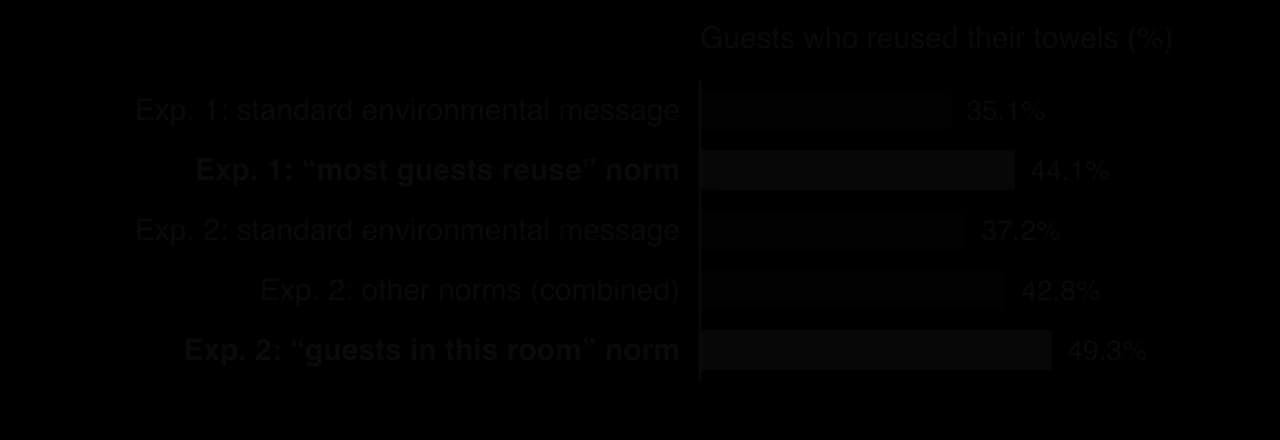
In Experiment 1, 44.1% of guests who saw the descriptive-norm card reused their towels, compared with 35.1% of guests who saw the standard environmental card. In Experiment 2, the standard card produced 37.2% reuse, the norm cards about guests in general, gender and citizenship produced 42.8% on average, and the card about previous guests in the same room produced 49.3%. Describing a norm in the setting closest to the guest’s own situation was more effective than describing one linked to personally important identities such as gender.
Telling guests what other guests did was more effective than appealing to the value of protecting the environment, even though almost everyone agrees with that value. The researchers concluded that social proof is a powerful and cheap way of changing the behaviour of a group of strangers, and that norms work best when they describe people in the same situation (provincial norms). For hotels, this meant that changing a few words on a card could increase reuse by about a third relative to the standard message, at no extra cost.
The study measured real behaviour in a natural setting, recorded by staff who did not interact with guests, which gives it high ecological validity and avoids social desirability bias. However, the behaviour was recorded on a single day, so the study does not show whether reuse continued over a longer stay or across later visits. Rooms rather than individuals were the units, so it is not always clear how many different people made each decision.
Random allocation of rooms to messages, with a standard-message control, supports a causal conclusion that the wording of the card changed behaviour. The differences between messages were small in size, and the comparison between reference groups in Experiment 2 involved several conditions, which raises the chance that one difference occurred by chance.
The study took place in one hotel in one country with guests who chose to stay there, so the sample may not represent travellers in general. A replication in two German hotels by Bohner and Schlüter (2014) found very high reuse rates under every message, and descriptive-norm messages were no more effective than the standard environmental message. This suggests that the effect depends on culture and on how common the behaviour already is.
Guests were not asked for consent and were not debriefed. The intervention involved no deception about the norm, since the figures reflected real behaviour, and its costs to guests were minimal, so most ethics committees would accept it. The study raises the wider question of whether organisations should change people’s behaviour with messages they do not recognise as influence, which applies to all large-scale norm interventions.
Sources: Goldstein, N. J., Cialdini, R. B., & Griskevicius, V. (2008). A room with a viewpoint: Using social norms to motivate environmental conservation in hotels. _Journal of Consumer Research, 35(3), 472–482. Bohner, G., & Schlüter, L. E. (2014). A room with a viewpoint revisited. PLoS ONE, 9(8), e104086._
Descriptive norms pull behaviour towards the average. That is useful for people who are doing worse than average, but for people who are already doing better than average, the same message signals that they could do less. This unintended result is called the boomerang effect.
Schultz et al. (2007) tested this with households in a Californian community. Households received door-hanger messages showing how much energy they had used compared with the average household in their neighbourhood. Households that had used more than the average reduced their energy use, as intended. Households that had used less than the average increased their use, moving towards the norm. When a smiley face was added for below-average users, an injunctive message of approval, the increase disappeared and their low use was maintained.
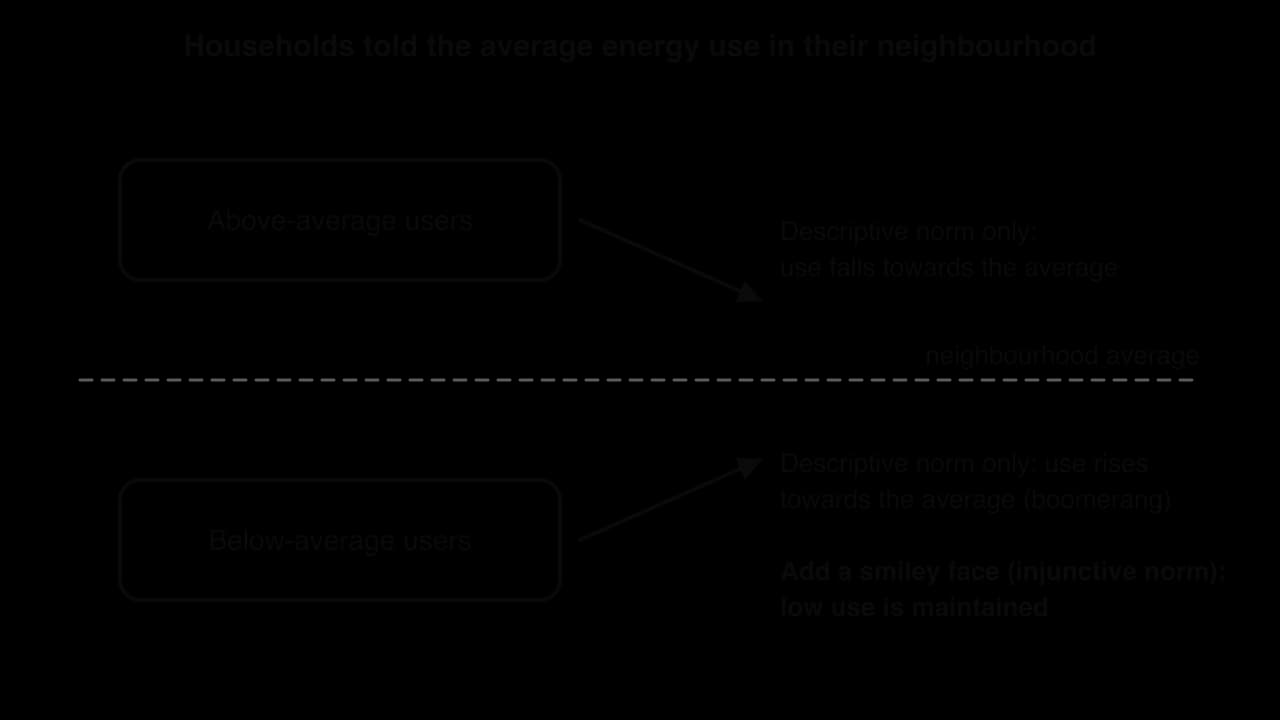
The study shows how two kinds of norm can be combined to steer a whole group in one direction. The descriptive norm moves the above-average users down, and the injunctive norm stops the below-average users from moving up. Many energy companies later used this combination in home energy reports, which compare each household’s use with that of similar neighbours and add a smiling face or the words “great” or “good” for efficient homes.
The home energy reports allowed the approach to be tested on a very large scale. Allcott (2011) analysed randomised controlled trials of home energy reports with about 600,000 households across the United States and found that the reports reduced energy use by 2.0% on average compared with control households. The heaviest users reduced their use most (about 6%), while the lightest users barely changed. An earlier analysis of the first programme, in Minnesota, found that when reports came only every three months, the effect faded between letters and rose again when the next letter arrived, which suggests that norm messages need to be repeated to keep working.
 YouTube
Social proof is the principle most often used with groups, but commitment, reciprocity and sequential requests have also been applied to change the behaviour of communities and organisations.
Commitment-based interventions ask members of a group to make a promise, often in writing or in public, to perform a behaviour such as recycling, saving water or car-sharing. The commitment and consistency principle predicts that people then act consistently with what they have promised, especially when the commitment is freely made, active and visible to others. A pledge wall in a school or a sign in a front window adds social proof, because other members of the group can see who has committed.
Lokhorst et al. (2013) reviewed field studies of commitment-making in environmental research in a meta-analysis. They concluded that commitment-making interventions produced modest increases in pro-environmental behaviour compared with control conditions. This fits the foot-in-the-door idea that a small first act can lead to further behaviour that is consistent with it.
Governments have used normative messages to change the behaviour of whole populations. Hallsworth et al. (2017) ran two large field experiments with over 200,000 people in the United Kingdom who had not yet paid the tax they owed. Adding a short social-norm message, stating that most people pay their tax on time, to the standard reminder letter increased the proportion who paid, and so did messages about the public services that taxes fund. The letters cost nothing extra to send and increased the tax collected during the study period.
These large studies show both the strength and the limits of the approach. The changes are small for each person, a few percentage points, but because the messages cost almost nothing and reach very large groups, the total effect on behaviour and on public money can be large.
 YouTube
Charities and community organisations use reciprocity when they send a small gift, such as a pen or a set of cards, with a request for donations, and the door-in-the-face technique when they ask for a regular monthly gift before suggesting a one-off donation. Workplaces use foot-in-the-door when they ask staff to join a short trial of a new practice, such as a week of cycling to work, before asking them to commit to it. In each case a technique designed for one-to-one requests is turned into a standard procedure applied to every member of a group.
Whether a technique changes group behaviour depends on the culture of the group. Cialdini et al. (1999) asked university students in Poland and the United States whether they would take part, without pay, in a marketing survey. Before deciding, some considered information about their own past compliance with such requests (commitment and consistency) and others considered their peers’ past compliance (social proof). Both kinds of information influenced decisions in both countries, but personal consistency had a greater effect on American students and peers’ behaviour had a greater effect on Polish students.
Further analysis showed that this was mainly explained by each student’s own individualist or collectivist orientation rather than by their nationality.
This suggests that norm-based messages may be especially effective in groups with a collectivist orientation, while pledge-based interventions that rely on personal consistency may suit individualist groups. The finding at the level of the individual is important: within any country, people vary in how individualist they are, so a campaign aimed at a whole population will work differently for different members of it.
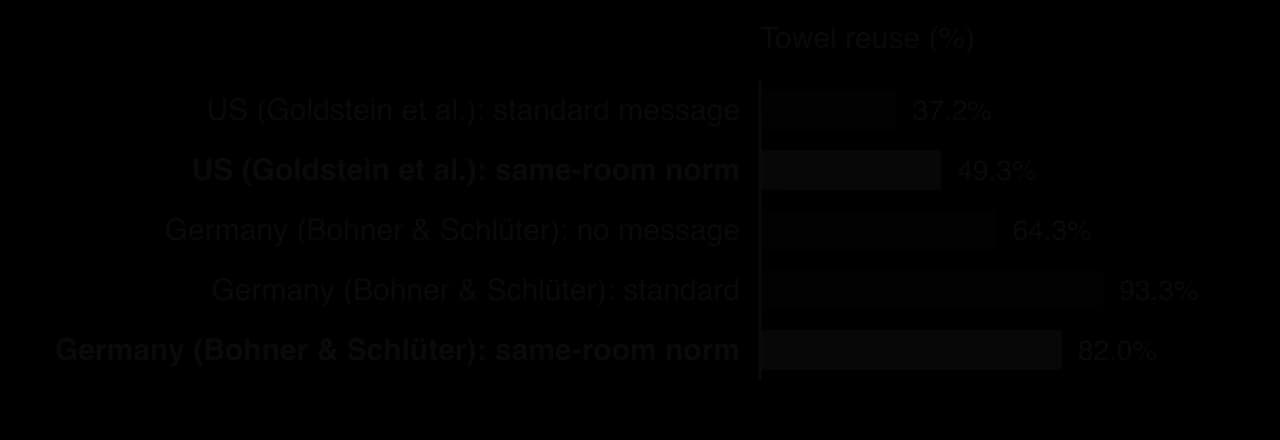
The German towel study shows a second cultural factor: how common the behaviour already is. Where environmental behaviour is already widespread, as Bohner and Schlüter suggested is the case in Germany, a message stating that 75% of guests reuse their towels may tell guests nothing new, or may even suggest that a quarter do not. A normative message is likely to help most where the desired behaviour is common but people underestimate how common it is.
Explaining why a group changes its behaviour after a normative message requires more than one approach. A sociocultural explanation describes the norms and the reference group. A cognitive explanation describes how members process the message: most people read a hotel card or a letter quickly, using fast and automatic processing (System 1 in dual processing theory), so a simple cue such as “most guests do this” is more influential than an argument about the environment. People with more knowledge of persuasion, or who think about the message carefully, may react differently.
Social identity theory adds a further layer. People follow the norms of groups they identify with, and they may react against the norms of groups they do not. A message about “students at this school” will influence students who feel they belong there more than students who feel excluded. Biological factors may also play a part, since social approval and disapproval are experienced as rewarding or stressful, but research on compliance in groups has focused on sociocultural and cognitive factors.
Approach term | Its role in changing group behaviour | Example |
|---|---|---|
Compliance techniques | The request and how it is structured | A card asking guests to reuse towels; a pledge sequence |
Conformity | Others’ behaviour as information and pressure | Following the provincial norm of “guests in this room” |
Social identity theory | Which reference group matters to the person | A norm about “students at this school” works best for students who feel they belong |
Dual processing theory | Fast processing makes simple cues effective | A brief norm statement beats a longer environmental argument |
Cognitive dissonance | Acting against a public commitment is uncomfortable | Keeping a pledge made in front of a class |
Research on changing group behaviour is applied research: it asks not only whether an effect exists but whether it is large enough, lasting enough and acceptable enough to be worth using. The concepts give a structure for judging it.
Norm-based and commitment-based interventions reliably produce change, but the changes are usually small for each person and can fade. Home energy reports reduced use by about 2%, and their effect decayed between letters. Bergquist et al. (2023) combined ten meta-analyses covering 430 field studies of interventions to reduce climate-damaging behaviour. Interventions based on social comparison were among the most effective types, but in large, well-powered interventions with more than 9,000 participants the average effect was only about 2 percentage points, much smaller than in small studies. The barriers to change in group behaviour, such as habits, cost and convenience, are not removed by a message.
Small effects can still matter. When an intervention costs almost nothing and reaches millions of people, as with tax letters, a change of a few percentage points is valuable. The judgement depends on the cost, the scale and whether the change is maintained, which is why long-term follow-up is essential.
The strongest studies in this area measure real behaviour without relying on self-report: towels reused, kilowatt-hours used, taxes paid. This avoids social desirability bias and gives high ecological validity. However, measures are often taken over a short period, and group-level measures, such as the reuse rate in a set of rooms or the average use in a neighbourhood, can hide large differences between individuals, as the boomerang effect shows.
Small studies with striking effects are more likely to be published (publication bias), which is one reason why small studies show larger effects than large ones. Most studies come from the United States and Western Europe, and cross-cultural studies such as Cialdini et al. (1999) show that the same technique can work differently elsewhere. The German towel replication is a reminder that a finding can depend on local norms that researchers did not measure.
Group interventions are usually delivered without informed consent, because the people affected are customers, residents or citizens rather than research participants. Supporters argue that normative messages are truthful, cheap and leave people free to choose, so they respect autonomy more than rules or fines. Critics argue that people should know when they are being influenced, and that organisations may use the same methods for their own benefit rather than the public’s. Using accurate norms, being open about the purpose of a campaign and allowing public scrutiny of government use of these techniques are ways of meeting this responsibility.
Concept | Strength | Limitation |
|---|---|---|
Change | Reliable change in real behaviour at low cost and large scale | Small effects in large studies; effects can fade without repetition |
Measurement | Objective measures of behaviour in natural settings | Short follow-up; group averages hide boomerang effects |
Causality | Randomised field experiments with control conditions | Hard to tell which part of a complex message caused the change |
Bias | Replications in several countries test generalisability | Publication bias; mostly Western samples; results depend on local norms |
Responsibility | Truthful messages that leave people free to choose | No consent; potential for manipulation by organisations |
Applied to groups, compliance techniques mainly use social proof (normative messages) and commitment (pledges), because they can reach many people without personal contact.
A descriptive norm states what most people do; an injunctive norm states what people approve of. Messages that describe an undesirable behaviour as common can backfire.
Goldstein et al. (2008) found towel reuse of 44.1% with a descriptive norm versus 35.1% with an environmental appeal, and 49.3% with a norm about guests in the same room (a provincial norm).
Schultz et al. (2007) found that average-use feedback pulled low energy users upwards (the boomerang effect) unless an injunctive norm, a smiley face, was added.
Large applications such as home energy reports (about 2% less energy use) and UK tax letters show small effects that are valuable at scale but can fade.
Commitment-making interventions produce modest increases in pro-environmental behaviour.
Culture matters: social proof influenced Polish students more and personal consistency American students more, and norm messages had no advantage in German hotels with high baseline reuse.
Evaluation: real behaviour measured in randomised field experiments, but effects are small in large studies, results depend on context, and influence without consent raises questions of responsibility.
I can explain how compliance techniques are applied to change the behaviour of groups.
I can explain the difference between descriptive and injunctive norms with an example of each.
I can describe and evaluate Goldstein, Cialdini and Griskevicius (2008).
I can explain the boomerang effect and how an injunctive norm prevents it.
I can discuss commitment and social proof in community and policy settings.
I can discuss how culture affects whether a technique changes group behaviour.
I can evaluate group applications of compliance techniques with reference to change, measurement, bias and responsibility.
I can design a compliance-based intervention for a group in an unfamiliar scenario.