
Explain how culture shapes behaviour in health, development, relationships and cognition, evaluate the problems of researching culture, and analyse unseen sources on culture.
Each is in the Psychology glossary, with every other term in the subject.
A theory proposing that effective communication between people from different cultures depends on keeping anxiety and uncertainty about each other within a middle range, mainly by communicating mindfully.
The regular use of two languages by an individual or a community; bilingual people differ in when they learned each language, how fluent they are and how often they switch.
The spread of beliefs, practices, products or technologies from one cultural group to another through contact such as trade, migration, media or the internet.
The increasing economic, social and cultural interconnection of societies across the world, driven by trade, migration, travel and communication technologies, which speeds up cultural diffusion.
With a free account, Augment remembers where you stopped and what you have practiced.
Explain what culture is, how it operates at the level of the culture of enculturation, the local culture and global culture, and how cultural diffusion and globalisation change it.
Describe how psychologists operationalise culture, and explain the strengths and limitations of each common proxy.
Discuss the role of culture in health and well-being, human development, human relationships, and learning and cognition, using research from each context.
Explain the main methodological challenges of research on culture: the ecological fallacy, imposed etic bias, measurement equivalence, WEIRD sampling, within-group variation, confounding variables and publication bias.
Describe and evaluate Becker et al. (2002) as a natural experiment on cultural diffusion and health.
Analyse unseen quantitative and qualitative sources about culture, explaining what limits their interpretation and what conclusion they support.
Evaluate claims about the influence of culture on behaviour with reference to bias, causality, measurement and perspective.
Culture is the set of beliefs, values, norms and practices shared by a group and passed on from one generation to the next. It shapes how people express distress, raise children, choose partners and even how they pay attention to a scene, so any claim that a psychological finding is universal has to be tested across cultures before it can be accepted.
The culture extension asks how far the theories, measures and treatments of psychology hold in different cultural groups, and how researchers can tell a real cultural difference from an artefact of the way it was measured. It draws on the sociocultural approach, and above all on the concept of perspective, because each culture offers its own view of what behaviour means. It also raises problems of bias and measurement, since most psychological tools were built in a few Western countries, and of causality, because culture can never be assigned to people at random.
Culture is learned, shared and changeable. It is learned because children acquire it through enculturation, the process of absorbing the norms and values of the group they grow up in. It is shared because it exists in the expectations a group holds about how its members should behave. It is changeable because groups meet, trade, migrate and communicate, so ideas and practices move between them.
A useful way to think about any one person’s culture is as three layers. The innermost layer is the culture of enculturation: the family, language and community that shaped the person in childhood. Around it sits the local culture, the place where the person lives now, which may differ from the first for a migrant or for someone who has moved from a village to a city. The outer layer is global culture: ideas, products, media and values that circulate across national borders.
The layers matter for research because they can pull in different directions. A teenager in Seoul may hold family values that stress duty to parents, attend a school whose norms reward individual competition, and spend several hours a day on video platforms dominated by American content, so all three layers shape her behaviour at once.
Cultural diffusion is as old as human contact, but its speed has changed. Globalisation is the growing interconnection of economies, societies and cultures across the world through trade, travel, migration and communication technologies. It increases the amount of diffusion and makes it faster, so a style of dress, a body ideal or a diagnostic label can spread across continents within a few years.
Globalisation raises three kinds of question for psychology. For health, it asks whether imported diets, media images or diagnostic categories change rates of illness, as in research on body image after the arrival of television in Fiji. For identity, it asks how people combine a local and a global identity; many young people describe themselves as both, and switch between the two depending on the setting. For relationships, it asks how people from different cultures meet, communicate and form friendships or marriages, and how families adjust when generations hold different values. These questions link culture to acculturation, the change that follows contact between cultures, and to change as a concept.
Culture cannot be observed directly. It is a construct, an abstract idea that has to be inferred from what people say and do. To study it, a researcher must operationalise it, choosing something measurable to stand for it. Every choice keeps some aspects of culture and loses others.
How culture is operationalised | Example | Strength | Limitation |
|---|---|---|---|
Nationality or country of residence | Comparing students in Japan and the USA | Simple, easy to record and to compare across studies | Treats everyone in a country as culturally the same; ignores regions, minorities and migrants |
Ethnicity or heritage | Asian American and European American participants | Closer to the culture of enculturation than nationality | Very broad labels hide large differences (e.g. dozens of heritages under “Asian American”); degree of acculturation varies |
Scores on a values scale | An individual’s individualism or self-construal score | Measures culture in the individual, so individuals can differ | Self-report; the scale itself may carry the assumptions of the culture that built it |
Country-level indices | A country’s score on a cultural dimension | Allows comparison of many countries at once | Describes the average of a country, not any person in it (the ecological fallacy) |
Ecological or historical features | History of rice or wheat farming in a region | Can explain why cultures differ, not only how | Indirect; many other features vary with the one chosen |
Researchers who study culture use the cultural dimensions (such as individualism and collectivism) as the most common way to describe how cultures differ. A related dimension is tightness-looseness, how strong a culture’s social norms are and how much deviation it tolerates; tighter norms tend to develop where there has been a history of threats such as high population density, scarce resources, conflict or disease.
 YouTube
Three questions run through research on culture and health. Do rates of disorder really differ between cultures? Does culture change how a disorder is expressed and recognised? And does treatment work better when it fits the culture of the person receiving it? Each question links biological, cognitive and sociocultural factors, because a disorder with a biological basis is still experienced, named and treated inside a culture.
Weissman et al. (1996) used similar structured diagnostic interviews with about 38,000 adults in ten countries. Lifetime rates of major depression ranged from 1.5 per 100 adults in Taiwan to 19.0 per 100 in Beirut, while rates of bipolar disorder were much more similar (0.3 to 1.5 per 100) and women had higher rates of depression than men in every country.
For judging a source, the important point is that a tenfold difference has at least three readings. It may be real, reflecting different stressors such as Beirut’s long civil war. It may reflect different willingness to describe sadness to an unfamiliar interviewer. Or the interview may fit the way distress is expressed in some cultures better than in others. Patterns that stay the same across countries, such as the sex difference, are less open to these alternative readings than overall rates.
In many cultures distress is described mainly through the body: tiredness, headaches, poor sleep or pain. This somatisation was documented in China by Kleinman in the early 1980s and is one reason a questionnaire built around low mood can undercount depression. Many cultures also have an idiom of distress, a local way of naming and talking about suffering; in Zimbabwe, the Shona term kufungisisa, “thinking too much”, is used for what Western psychiatry calls common mental disorders such as depression and anxiety.
Culture also shapes emotional behaviour inside a disorder. Chentsova-Dutton et al. (2007) found that depressed European Americans cried less at a sad film than non-depressed European Americans, while depressed Asian Americans cried more than non-depressed Asian Americans. A measure that treats reduced emotional expression as a sign of depression would therefore work in one group and mislead in the other.
The main diagnostic manuals were written largely by psychiatrists trained in Western countries. Applying their categories elsewhere without checking that they fit is an imposed etic. Researchers have responded in two ways: by adapting existing treatments to the culture of the people who receive them, and by building treatments from local concepts from the start. Both ways try to make treatment fit the explanatory model that patients already hold about what their problem is and how it should be treated.
Culturally adapted treatments deliver therapy in the client’s language, use culturally familiar examples and values, and often involve the family. A meta-analysis by Hall et al. (2016) of 78 studies, with 95% of participants not European American, found that adapted interventions outperformed unadapted versions of the same intervention (g = 0.52). Because each adaptation changes many things at once, the meta-analysis shows that adaptation helps but not which change matters.
The Friendship Bench in Zimbabwe shows the second route, and the research problems it raises. Its problem-solving therapy is delivered by trained lay health workers rather than professionals (task-sharing) and draws on the Shona idiom kufungisisa, and a cluster randomised trial by Chibanda et al. (2016) found clear benefits over enhanced usual care. Because the cultural framing, the lay workers and the peer support were introduced together, the trial cannot show which ingredient mattered, and whether the programme transfers to other cultures depends on adapting it again rather than exporting it unchanged.
Indigenous models of health go further, questioning the separation of mind and body that Western treatment assumes. Te Whare Tapa Whā, a Māori model, describes health as a house with four walls (physical, mental and emotional, family, and spiritual health), so a treatment that ignores family or spiritual well-being is seen as incomplete. Such models are a reminder that “what works” in treatment depends on what the patient counts as being well, an issue of perspective.
Several explanations are possible and are hard to separate. Adapted treatment may be easier to understand because it uses the client’s language and examples; it may feel more legitimate because it matches the client’s explanatory model; it may keep clients in treatment longer, so they receive more of it; and it may involve the family, who then support change at home. Because adaptations bundle many changes together, most studies cannot show which ingredient matters, a problem of causality.
Developmental psychology grew up mainly in Europe and North America, and many of its milestones were first described in middle-class Western children. The culture extension asks how cultural values shape children’s social and cognitive development, how far Western models fit Indigenous and non-Western children (and the other way round), and how culture shapes the developing sense of self.
Keller et al. (2004) found that toddlers of Nso farmers in Cameroon, whose mothers used body contact (proximal parenting), showed self-regulation earlier, while toddlers of urban Greek families, whose mothers used face-to-face play (distal parenting), recognised themselves in a mirror earlier. Calling one path “advanced” would be a value judgement rather than a finding. The mirror test itself may also be an imposed etic, since children with little experience of mirrors could understand themselves perfectly well without passing it.
The same link between culture and self appears in memory. Wang (2001) asked 256 American and Chinese university students for their earliest childhood memory and a set of self-descriptions. American students’ earliest memories came from about six months earlier and were longer, more specific, more self-focused and more emotional, while Chinese students described brief memories of collective activities and routines and more social roles in their self-descriptions. These findings fit the distinction between an independent self-construal and an interdependent self-construal.
Attachment theory was developed in Britain and tested with the Strange Situation in the United States. Van IJzendoorn and Kroonenberg (1988) compared almost 2,000 Strange Situation classifications from eight countries. Avoidant attachment was relatively more common in Western European samples and resistant attachment in Israeli and Japanese samples, but the variation between samples within a country was nearly 1.5 times the variation between countries. Some samples from one country resembled samples from another country more than they resembled each other.
Theory of mind shows a similar mix of universal and cultural patterns. Liu et al. (2008) carried out a meta-analysis of false-belief tasks with more than 3,000 children in mainland China and Hong Kong and compared them with North American children. Children in both regions followed the same developmental sequence, but the age at which they passed the tasks differed between communities by as much as two years or more.
Research with Indigenous-heritage communities can also show strengths that Western models overlook. Alcalá, Rogoff and López-Fraire (2018) asked sibling pairs aged 6 to 10 in California to plan the shortest route through a model grocery store. Pairs from Mexican Indigenous-heritage families more often worked as an ensemble, building fluidly on each other’s ideas, while middle-class European American pairs more often divided the decisions or had one child take over. A model of development that treats independent problem-solving as the goal would miss this skill.
Area of development | Shared across cultures | Varies with culture |
|---|---|---|
Attachment | Secure attachment is the most common type in every country studied | Relative frequency of avoidant and resistant types; large differences within countries |
Theory of mind | Same sequence of false-belief understanding | Timing, by up to two years or more |
Self | Children develop a sense of self and self-control | Which comes first (self-recognition or self-regulation); how the self is described |
Collaboration | Children can work together on shared tasks | Whether they coordinate as an ensemble or divide the work |
The table summarises a general pattern in cultural developmental research: broad sequences tend to be shared, while timing, form and the value placed on each outcome vary. This supports an interactionist view in which biological maturation sets a general path and enculturation shapes how it unfolds.
Culture shapes what people expect from relationships, how they show feelings to others and how they read the signals of people from other groups. In a globalised world more relationships cross cultural lines, in classrooms, workplaces, friendships and marriages, so research asks both how cultures differ in relationships and which strategies help people build and keep relationships across cultures.
Levine et al. (1995) found that university students in 11 countries gave love more importance in deciding to marry in more individualist cultures, with the differences clearer for starting a marriage than for keeping one going. In more collectivist cultures marriage joins two families as well as two people, so other considerations can matter as much as romantic feeling. The study also carries a measurement problem, because one rating of “love” assumes that the word means the same thing in every language.
Cultures differ in their display rules, the norms about which emotions may be shown, to whom and how strongly. Matsumoto, Yoo and Fontaine (2008) gave a questionnaire about display rules to more than 5,000 people in 32 countries. Some patterns were universal: in every culture people endorsed showing more emotion to members of their in-group than to outsiders. Others varied: individualist and collectivist cultures differed in how much expression of emotion they endorsed overall, and in which specific emotions could be shown to in-groups and to out-groups.
Display rules help explain misunderstandings in cross-cultural relationships. A person from a culture that values emotional restraint may seem cold to someone from a culture that values open expression, while the second person may seem rude or overwhelming to the first. Each person is judging the other’s behaviour by the norms of their own culture, a form of ethnocentrism.
Communication styles differ too. In a high-context culture, much of the meaning of a message is carried by the relationship, the setting and non-verbal cues, so people often say less directly; in a low-context culture, meaning is normally stated explicitly in words. A direct refusal that seems honest in a low-context setting can seem hurtful in a high-context one, while an indirect hint may be missed completely by a listener from a low-context culture.
Gudykunst’s anxiety/uncertainty management (AUM) theory explains why communication between people from different cultures is often harder than communication within a culture. Meeting someone whose norms are unfamiliar raises uncertainty (being unable to predict or explain their behaviour) and anxiety (feeling uneasy about what will happen). Too much of either leads people to avoid the interaction or to fall back on stereotypes; too little leads to overconfidence and careless misreading. The theory proposes that people communicate most effectively when they manage both within a middle range by communicating mindfully, which means paying attention to the other person’s perspective rather than responding automatically.
Research suggests several strategies for developing and keeping relationships across cultures, most of them drawn from wider theories of group behaviour:
Contact under good conditions. The contact hypothesis proposes that contact between groups reduces prejudice when the groups have equal status, shared goals and support from authorities. Pettigrew (1997) used survey data from seven European samples and found that cross-group friendships were consistently linked with lower prejudice.
Learning the other culture’s rules. Training in display rules and in high- and low-context communication helps people interpret behaviour by the norms of the person producing it.
Managing anxiety and uncertainty. Following AUM theory, people can reduce uncertainty by asking questions and learning about the other person, and reduce anxiety through repeated positive contact.
Building a shared identity. Emphasising a common group (the same team, class or family) can turn an out-group member into an in-group member.
Research on culture and cognition asks whether basic processes such as attention, memory and reasoning work in the same way across cultures, how cultural practices shape learning, and whether growing up with more than one language changes cognition. The answers are a mixture of shared processes and differences in how those processes are used.
Cross-cultural research has repeatedly found that people from East Asian cultures tend towards holistic cognition, paying attention to context and relationships between objects, while people from Western cultures tend towards analytic cognition, focusing on a central object and its attributes, as in the underwater-scene experiments of Masuda and Nisbett. Most of this research compares countries, which raises the question of what it is about a culture that produces the difference.
Talhelm et al. (2014) found that Han Chinese participants from the rice-growing south thought more holistically than those from the wheat-growing north, even in neighbouring counties on either side of the rice–wheat border. Rice farming historically required more cooperation between households, for example to share irrigation. The study shows large differences within one country and proposes an ecological cause for them, but because farming history cannot be randomly assigned, the evidence remains correlational.
Bilingualism is a cultural experience that many children share, and researchers have asked whether managing two languages strengthens the general skills used to control attention. Bialystok et al. (2004) compared monolingual and bilingual middle-aged and older adults on the Simon task, in which participants must ignore the position of a stimulus and respond to its colour. Bilinguals showed smaller costs from conflicting information, and the advantage was larger in older participants, which suggested that bilingualism might offset some age-related decline in cognitive control.
Later research has not supported a general bilingual advantage. Paap and Greenberg (2013) compared bilinguals and monolinguals on 15 indicators of executive processing across three studies and found no consistent advantage, even when the groups were matched for parents’ education or restricted to highly fluent bilinguals. De Bruin, Treccani and Della Sala (2015) then traced conference abstracts on bilingualism and executive control from 1999 to 2012 and found that studies supporting the bilingual advantage were the most likely to be published and studies challenging it the least likely, a pattern of publication bias.
The bilingual debate also shows a confounding variable problem. In many countries bilinguals are immigrants or children of immigrants, so they differ from monolinguals in education, income and cultural background as well as language. Any difference between the groups could come from these factors rather than from bilingualism itself, which is why later studies matched groups more carefully.
In every context, findings about culture are easy to over-interpret. Judging a source about culture means asking a standard set of questions about how culture was measured, who was studied and what else might explain the result. The questions apply to a published study, a news report or a short unseen source alike.
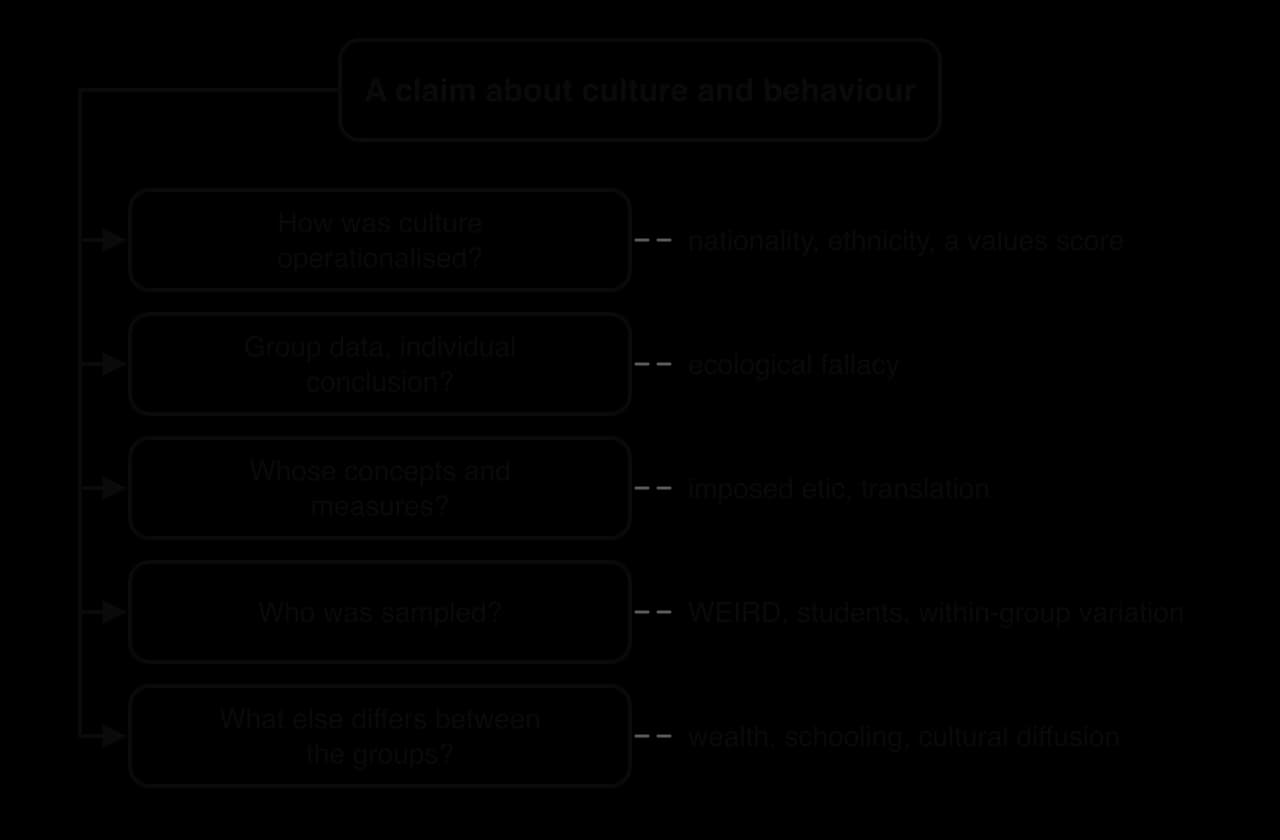
Many studies of culture use data about groups: a country’s average score on a cultural dimension, the prevalence of a disorder in a region, the proportion of a population who seek help. The ecological fallacy is the error of assuming that what is true of a group on average is true of each individual in it. A country can be more collectivist than another on average while containing many highly individualist people.
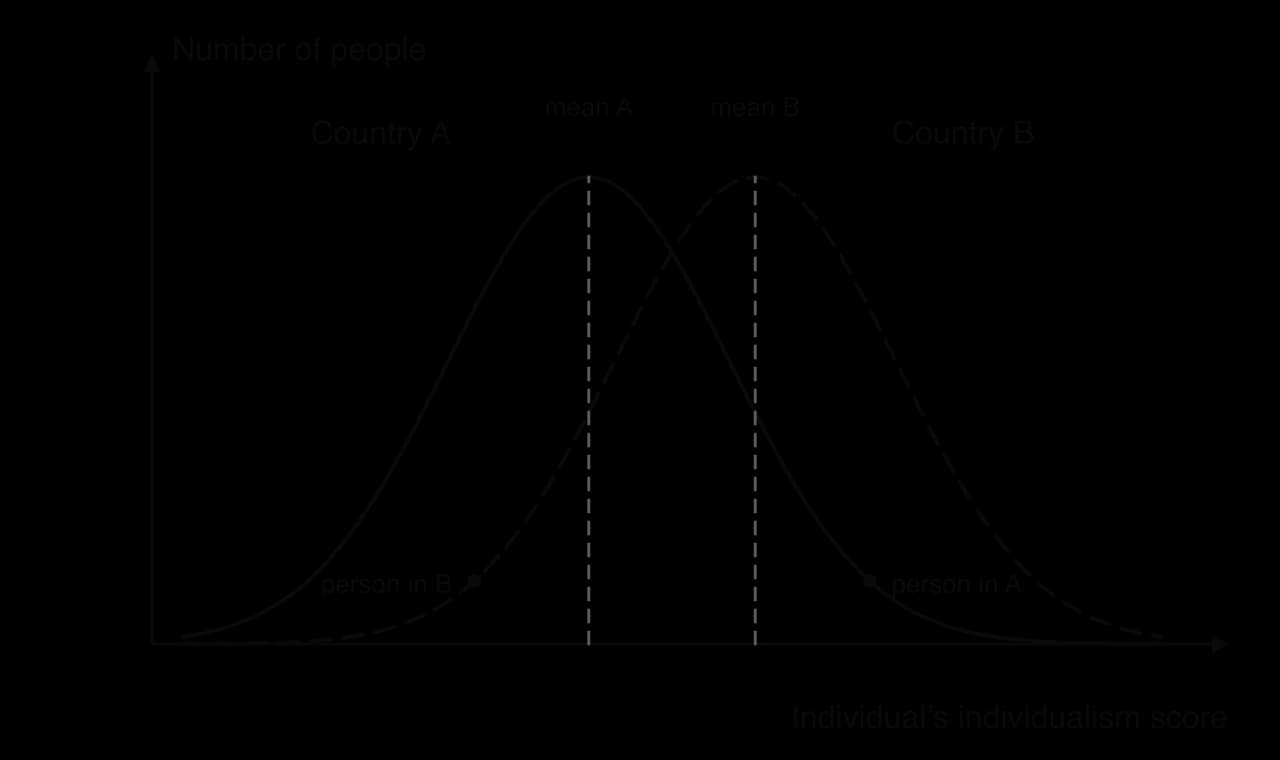
Hofstede’s country scores are a common source of the fallacy. They describe the average responses of samples in each country and are useful for comparing countries, but using them to predict how one student from that country will behave misuses them. The same applies to correlations between country averages: if countries with higher individualism have higher rates of some behaviour, that does not show that individualist people show the behaviour more, because the relationship could hold between countries but not within them.
An etic approach compares cultures using concepts and measures assumed to apply everywhere, while an emic approach studies a culture from within, using its own concepts. An imposed etic occurs when a concept or finding from one culture is assumed to apply to another without checking. Applying research on modesty in one agricultural society in Africa to an agricultural society in South America, simply because both farm, would be an example: the meaning of modest dress or behaviour may differ completely.
Even a carefully translated questionnaire can lack measurement equivalence, meaning that its items do not measure the same construct in the same way in each group. A word such as “depressed”, “love” or “shy” may have no exact equivalent, and a behaviour such as avoiding eye contact may be polite in one culture and evasive in another. Researchers use back-translation (translating a measure into the new language and then independently back into the original to check the meaning), pilot interviews and statistical checks of whether items behave in the same way in every group.
Response styles create further problems. Acquiescence bias, the tendency to agree with statements regardless of their content, and the tendency to avoid extreme answers both vary between cultures, so a difference in average scores can reflect how people use a rating scale rather than what they believe.
Henrich, Heine and Norenzayan (2010) reviewed research in areas such as visual perception, fairness, cooperation, reasoning and self-concepts and concluded that people from Western, educated, industrialised, rich and democratic (WEIRD) societies are often unusual compared with the rest of humanity, yet supply most of the participants in psychology. A finding based on WEIRD samples may not be universal, and cross-cultural comparisons often still compare university students from different countries, who are more alike than the populations they are taken to represent.
 YouTube
Within-group variation is often larger than variation between groups, as van IJzendoorn and Kroonenberg found for attachment and Talhelm and colleagues for thinking style within China. Samples chosen from one city or one university in each country can therefore produce very different results from samples chosen elsewhere in the same country, which limits the generalisability of any single comparison.
Researchers cannot randomly allocate people to cultures, so cross-cultural comparisons are quasi-experiments or correlational studies. Groups compared by culture usually also differ in wealth, education, diet, health care, religion and political history, any of which could cause a difference that is attributed to culture. Natural experiments, such as the arrival of television in Fiji, and designs that compare closely matched groups, such as neighbouring counties along the rice–wheat border, are ways of narrowing the alternatives, but they do not remove them.
Cultural diffusion adds another complication. Groups compared as “collectivist” and “individualist” are exposed to the same global media and may be changing at different speeds, and migrant participants differ in how far they have acculturated. A study that operationalises culture as heritage can therefore compare groups whose members hold a wide range of values.
Researchers who study a culture other than their own may misread behaviour through the norms of their own culture, ask questions that participants find strange or offensive, or interpret answers in ways that fit their expectations, a form of confirmation bias. Reflexivity, a researcher’s ongoing awareness of how their own background shapes the research, together with collaboration with members of the community and checking interpretations with participants, improves the credibility of qualitative findings.
Reporting on culture also raises questions of responsibility. A finding that one community has high rates of a disorder or a harmful practice can add to stigma or to stereotypes, especially when it is reported without context. Researchers have a duty to describe communities accurately, explain the limits of their data and share findings with the community studied.
Claims that culture shapes behaviour can be evaluated through any of the six concepts. Four are particularly useful, because the main research problems map onto them.
Concept | Question to ask | Example from research on culture |
|---|---|---|
Bias | Do the measures, samples or interpretations favour one culture’s view? | Diagnostic categories and questionnaires built in Western countries may undercount somatised distress; publication bias inflated the bilingual advantage. |
Causality | Could something other than culture explain the difference? | Bilinguals and monolinguals often differ in education and immigration history; the Fiji study cannot rule out economic change. |
Measurement | How was culture operationalised, and do the measures mean the same thing in each group? | Nationality as a proxy for values; the mirror test with children who rarely see mirrors. |
Perspective | Whose concepts frame the research, and what would an emic or Indigenous view add? | Te Whare Tapa Whā and the Friendship Bench start from local concepts of distress and health. |
A balanced judgement usually concludes that culture has real effects in every context, shown most clearly where several methods agree (quantitative comparisons, observation and interviews) and where designs rule out obvious alternatives. Claims are weakest when they rest on a single country-level comparison, a translated questionnaire never validated in the new culture, or a sample of university students treated as representative of a nation.
Anne Becker and colleagues aimed to find out whether prolonged exposure to television, a powerful channel of cultural diffusion, would increase disordered eating attitudes and behaviours in a population with almost no previous exposure to television and traditional values that favoured a robust body shape. They also asked whether any change would be linked to body dissatisfaction and to a gap between the values of the girls and their parents.
The study took place in Nadroga province, Fiji. Television arrived there in 1995, and at that time only one case of anorexia had been reported in the whole of Fiji. Traditional Fijian culture valued robust appetites and bodies, and commented with concern when people lost weight. The design was a natural experiment with two cross-sectional waves: two separate samples of girls from the same school years at the same schools were compared, rather than the same girls followed over time.
Sample: all ethnic Fijian girls in Forms 5–7 at two secondary schools. In 1995, 63 girls took part within a month of television arriving; in 1998, 65 girls took part after three years of television. The mean ages were 17.3 and 16.9 years, and mean body mass index did not differ between the samples.
Quantitative measure: a modified 26-item Eating Attitudes Test (EAT-26), with a score above 20 counted as high, plus questions on bingeing, purging and household ownership of a television. Girls who reported bingeing or purging were interviewed to confirm the behaviour.
Qualitative measure: in 1998, open-ended semi-structured interviews with 30 girls chosen by purposive sampling to cover a range of eating attitudes and viewing habits. Questions asked how they felt about their weight, what they thought of television characters and whether television had affected Fijian traditions. Transcripts were analysed for themes.
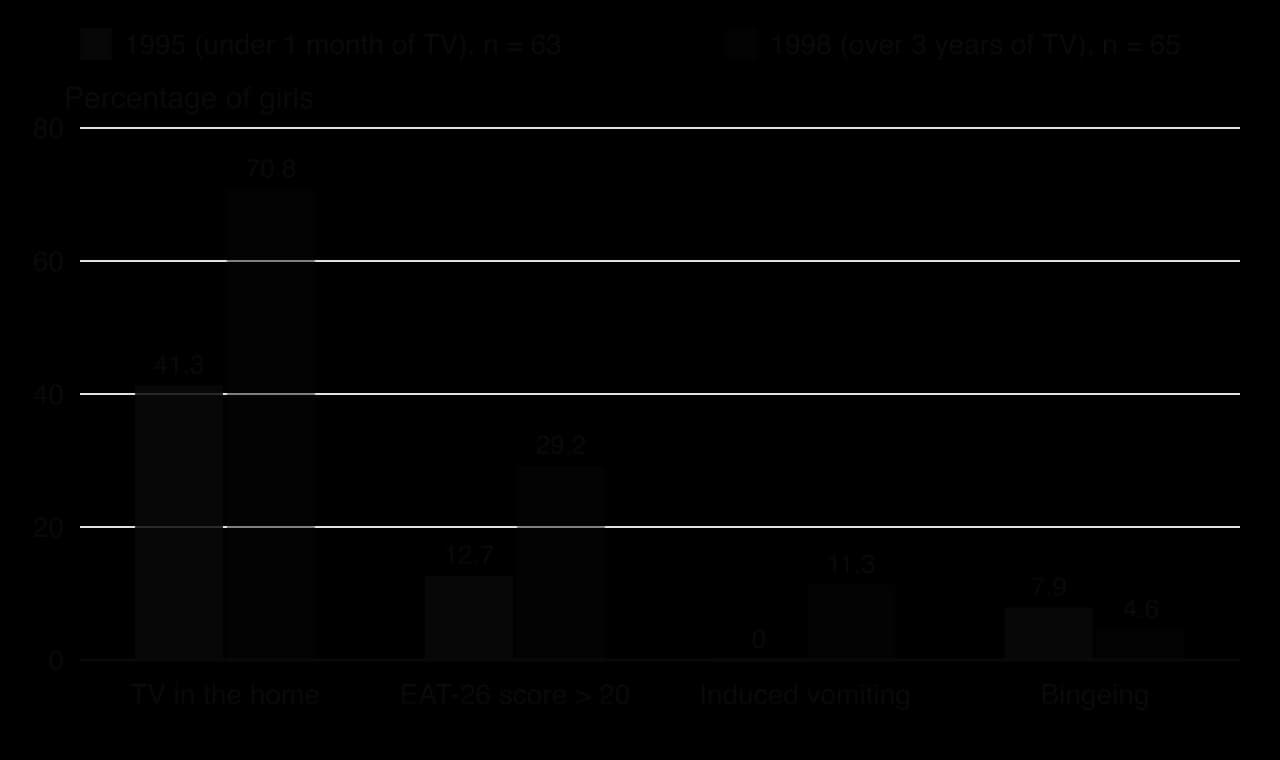
The proportion of girls with high EAT-26 scores rose from 12.7% in 1995 to 29.2% in 1998, and self-induced vomiting to control weight rose from 0% to 11.3%; both differences were statistically significant. Bingeing did not change significantly (7.9% and 4.6%). In 1998, 69% of the girls said they had dieted to lose weight at some time and 74% said they felt “too big or fat” at least some of the time, in a culture where dieting had previously been rare.
The interviews linked these changes to television. Almost all the girls interviewed admired television characters and wanted to be like them; 83% said television had influenced their friends or themselves to feel differently about their body shape or weight, and 77% said it had influenced their own body image. Some linked a slimmer body to getting a job, and several described tension with parents who thought they should eat more.
The researchers concluded that the arrival of television was followed by a sharp rise in disordered eating attitudes and behaviours in a population whose traditional culture had protected against them, and that the girls themselves linked the change to Western television characters. The study supports the claim that cultural diffusion through media can change body ideals and, through them, health-related behaviour. The authors also suggested that the effect worked through the peer group: television changed what the girls’ community admired, not only what each girl watched.
The design cannot show that television caused the change. The two samples were different girls, and in the same years Fiji was moving from subsistence farming to a cash economy, with more consumer goods and more pressure on young people to earn a wage. The authors themselves noted that television was probably only one of several social changes. The interviews strengthen the causal case, because the girls named television as the influence, but self-reports of influence can be shaped by what participants think the interviewer wants to hear. Viewing was so widespread in both samples that the researchers could not compare heavy and light viewers within a sample.
The EAT-26 was developed in North America and has been used in many cultures, and it needed no translation because the girls were fluent in English, but whether a high score means the same thing in Fiji is uncertain. The researchers reduced this problem by confirming reported purging in interviews and by showing that high scores were linked with dieting and vomiting in the 1998 sample. Combining a questionnaire with interviews is a strength: the qualitative data give the girls’ own account of why their attitudes changed, which a score cannot.
The samples were small (63 and 65), from two schools in one province, all female and all ethnic Fijian, so the findings may not apply to boys, to Indo-Fijian girls or to other Pacific communities. The response rate was 71% in 1998 and unknown in 1995, so the samples may not represent all eligible girls. The authors warned that Fijian girls might be especially vulnerable because the body shapes on television differed so much from local ones.
Written consent was obtained from both the girls and a parent or guardian. Reporting a rise in disordered eating in a named community carries a risk of portraying it as damaged by modern life; the study handles this by presenting the girls’ own voices and the cultural context, and by treating the community’s traditional values as protective.
Sources: Becker, A. E., Burwell, R. A., Gilman, S. E., Herzog, D. B. and Hamburg, P. (2002). Eating behaviours and attitudes following prolonged exposure to television among ethnic Fijian adolescent girls. _British Journal of Psychiatry, 180, 509–514._
Culture appears only in Paper 3, through a booklet of unseen sources built around one claim about the role of culture in one context. The four questions ask you to explain an issue that limits the interpretation of a source, analyse a source’s findings and link them to the claim, discuss a qualitative source (its credibility, how bias could be avoided, or its transferability), and write an extended response that weighs the claim using at least three sources and your own knowledge. The practice items use one invented booklet; all its data are hypothetical.
Claim for the practice booklet: culture influences whether people seek help for mental health problems.
A researcher collected published figures on the percentage of university students who had seen a counsellor in the past year in four countries, and arranged the countries by their national individualism score (IDV, 0–100).
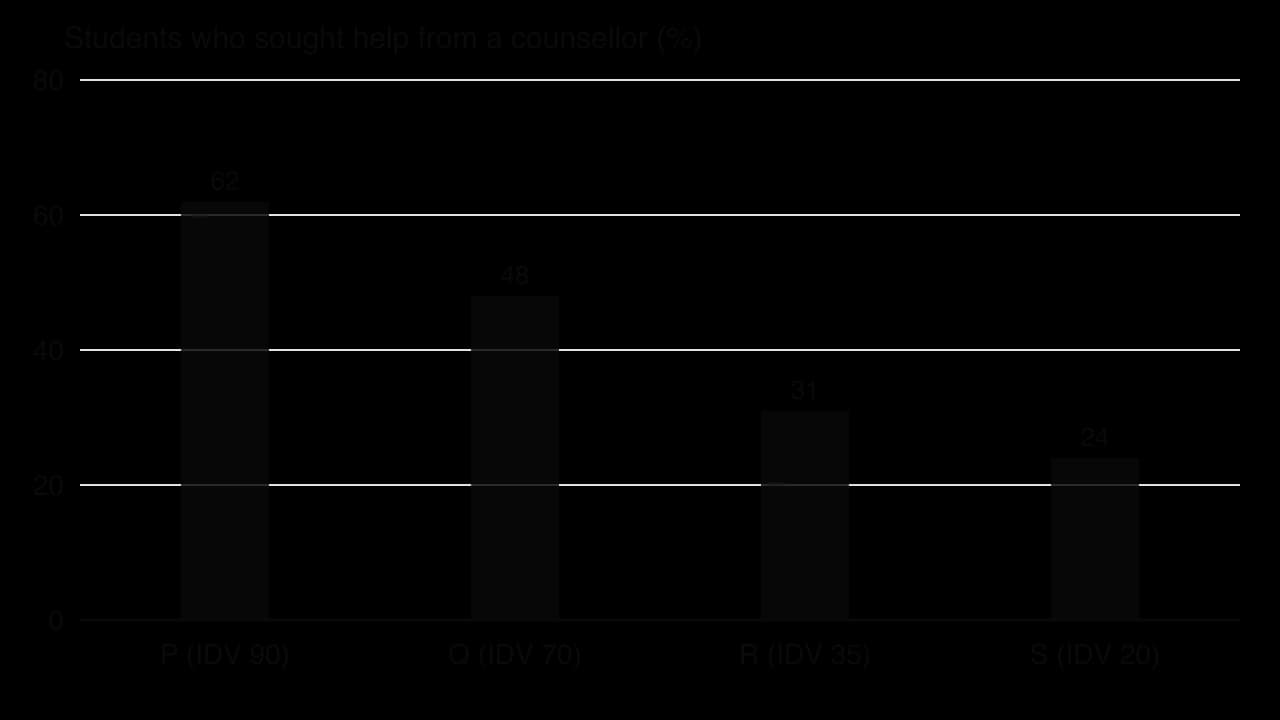
A questionnaire study surveyed 240 international first-year students at one university: 120 from countries with collectivist cultural norms and 120 from countries with individualist norms (classified by the students’ country of origin). Participants completed a scale measuring perceived stigma of mental illness (1–7, higher = more stigma) and rated how likely they would be to see a counsellor if they felt very low for several weeks (1–7, higher = more likely).
Group (n = 120 each) | Perceived stigma: mean (SD) | Intention to seek help: mean (SD) |
|---|---|---|
Collectivist countries of origin | 4.6 (1.3) | 3.1 (1.6) |
Individualist countries of origin | 3.4 (1.2) | 4.4 (1.5) |
Difference between groups | p < 0.01 | p < 0.01 |
Correlation of stigma with intention (all 240 students) | r = −0.48, p < 0.01 |
Hypothetical data for practice.
A researcher from outside the community ran one focus group in English with ten students who had all migrated from the same region as children. The students were recruited through a cultural society at their university. The researcher identified a theme of “keeping it in the family” and reported these quotations:
If something is wrong, you tell your mother or your aunt first. Going to a stranger means the family failed. … My cousin saw a counsellor and people talked about it for a year. … I would go to the doctor and say I can’t sleep. That is easier to say.
— Hypothetical focus group extract, written for practice
Culture is the shared beliefs, values, norms and practices of a group; each person carries a culture of enculturation, lives in a local culture and is exposed to global culture.
Cultural diffusion and globalisation spread ideas, products and body ideals across cultures, raising questions about health, identity and relationships.
In health, culture affects recorded prevalence, the expression of distress (somatisation, idioms of distress, crying in depression) and the effectiveness of treatment; culturally adapted treatments outperform unadapted ones.
In development, broad sequences (attachment, theory of mind, the self) are shared, but timing, form and value vary with parenting goals and cultural practices.
In relationships, culture shapes expectations of marriage, display rules and communication styles; contact, cultural learning and managing anxiety and uncertainty help cross-cultural relationships.
In cognition, thinking styles differ even within one country (rice and wheat regions of China), and the claimed bilingual advantage has not held up and was inflated by publication bias.
The main research problems are the ecological fallacy, imposed etic measures and measurement equivalence, WEIRD and unrepresentative samples, within-group variation, confounding variables, researcher bias and publication bias.
Becker et al. (2002) found high eating-attitude scores rose from 12.7% to 29.2% and vomiting from 0% to 11.3% after television reached Fiji, a natural experiment limited by its design and small samples.
I can explain what culture is, the three layers of culture and how cultural diffusion and globalisation change them.
I can describe the main ways culture is operationalised and a limitation of each.
I can discuss the role of culture in each of the four contexts, with a piece of research for each.
I can explain the ecological fallacy, imposed etic bias, measurement equivalence, WEIRD sampling and confounding in research on culture.
I can describe and evaluate Becker et al. (2002) through causality, measurement, bias and responsibility.
I can explain an issue that limits the interpretation of an unseen source on culture and analyse its findings in relation to a claim.
I can discuss the credibility, bias and transferability of a qualitative source on culture.
I can evaluate a claim about culture and behaviour using several sources and my own knowledge.