 YouTube
Plan, run and analyse an experiment practical on a cognitive process, control variables and bias, calculate the mean, median and mode, and answer the four kinds of question asked about the method.
Each is in the Psychology glossary, with every other term in the subject.
Statistics that summarise a set of data, such as measures of central tendency and of dispersion, without testing whether results could be due to chance.
A measure of central tendency calculated by adding all the scores in a set of data and dividing by the number of scores.
A single value that represents the typical or central score in a set of data: the mean, the median or the mode.
A measure of central tendency: the middle score when all the scores are put in order, or the midpoint of the two middle scores.
A measure of central tendency: the score or category that occurs most often in a set of data.
Keeping the procedure, instructions, materials and setting of a study the same for every participant, so that differences in results are not caused by differences in treatment.
Describe true experiments and quasi-experiments, and laboratory, field and natural experiments.
Explain how to plan an experiment practical on a learning and cognition topic: aim, operationalised variables, hypotheses, design and sample.
Apply the ethical rules for school practicals to an experiment, including when partial deception is acceptable.
Explain how standardisation and other controls deal with extraneous variables, demand characteristics and order effects.
Interpret experimental data by calculating the mean, median and mode, and present results in a table and graph.
Explain each of the six concepts in relation to an experiment practical.
Evaluate experiments with reference to a published experiment on memory.
Compare and contrast experiments with other methods, and design another method on the same topic.
An experiment is a research method in which the researcher changes one variable and measures its effect on another, while keeping other variables constant. It is the method of the class practical in the learning and cognition context, because cognitive processes such as memory, attention and decision-making can be tested with short, standardised tasks in a classroom.
Experiments are the main way psychologists test claims about causality: whether a change in one thing produces a change in another. That strength depends on careful measurement of the variables and on controlling bias from participants and researchers, and it comes with responsibility for how participants are treated when a study is designed to influence them.
With a free account, Augment remembers where you stopped and what you have practiced.
Scope: The experiment class practical, carried out in the learning and cognition context: true or quasi-experiments planned, conducted, analysed with descriptive statistics and evaluated. The general theory of experiments as a research method belongs to research methods; the assessment of this practical focuses on the method rather than on the topic investigated.
Every experiment has an independent variable (IV), which the researcher manipulates, and a dependent variable (DV), which the researcher measures. In an experiment on memory, the IV might be whether words are presented as pictures or as written words, and the DV the number of words recalled. Any other variable that could affect the DV is an extraneous variable; if it changes along with the IV, it becomes a confounding variable and the result cannot be interpreted.
In a true experiment, the researcher manipulates the IV and uses random allocation to put participants into conditions, so that differences between people are spread evenly across the conditions. Only a true experiment can show cause and effect with confidence. In a quasi-experiment, the groups already exist and cannot be allocated at random, for example when the IV is culture, age or gender. Because the groups may differ in many ways, a quasi-experiment cannot establish that the IV caused the difference.
Masuda and Nisbett (2001) compared how Japanese and American students described and remembered animated underwater scenes; the Japanese students made more statements about the background and the relationships between objects. This is a quasi-experiment: culture could not be allocated at random, so differences in language, education or familiarity with the scenes could also explain the results.
Type | Setting and control | Strength | Limitation |
|---|---|---|---|
Laboratory experiment | Artificial setting; researcher controls the IV and most extraneous variables | High internal validity; easy to replicate | Low ecological validity; demand characteristics |
Field experiment | Natural setting; researcher still manipulates the IV | More natural behaviour | Less control; consent may be difficult |
Natural experiment | The IV changes naturally (a new policy, a disaster); the researcher only measures | Studies variables that could not be manipulated ethically | No random allocation; many confounds |
Most class practicals are laboratory experiments carried out in a classroom: the setting is familiar, but the task, the materials and the timing are controlled by the researcher. Some are quasi-experiments, such as comparing how Grade 9 and Grade 12 students perform on the same memory task.
Cognitive processes cannot be seen directly, but their effects on performance can be measured: how many words are recalled, how quickly a colour is named, how far an estimate moves towards a number seen earlier. A short task can be given to every participant in the same way, and the IV can be changed while everything else stays constant. This makes it possible to test theories of memory, attention and thinking, for example whether the wording of a question changes what people remember.
YouTubeAn experiment aim states the effect of one variable on another in a population: “to investigate the effect of a high or low anchor on students’ numerical estimates.” From the aim come two hypotheses. The alternative hypothesis predicts an effect of the IV on the DV; the null hypothesis states that there will be no effect, and any difference found is due to chance.
An alternative hypothesis can be directional (one-tailed), predicting which condition will score higher, when theory or previous research gives a clear reason; or non-directional (two-tailed), predicting only that the conditions will differ. A good hypothesis includes both variables in their operationalised form.
Operationalisation turns each variable into something precise and measurable. “Memory” is too vague to be a DV; “the number of words correctly recalled out of 20 in two minutes” is not. The IV is operationalised by describing exactly what differs between the conditions, such as the verb in a question or the presence or absence of a phone on the desk.
An independent samples design puts different participants in each condition. A repeated measures design tests the same participants in every condition. A matched pairs design uses different participants who have been matched in pairs on a variable that could affect the DV, such as a memory pre-test score, with one member of each pair in each condition.
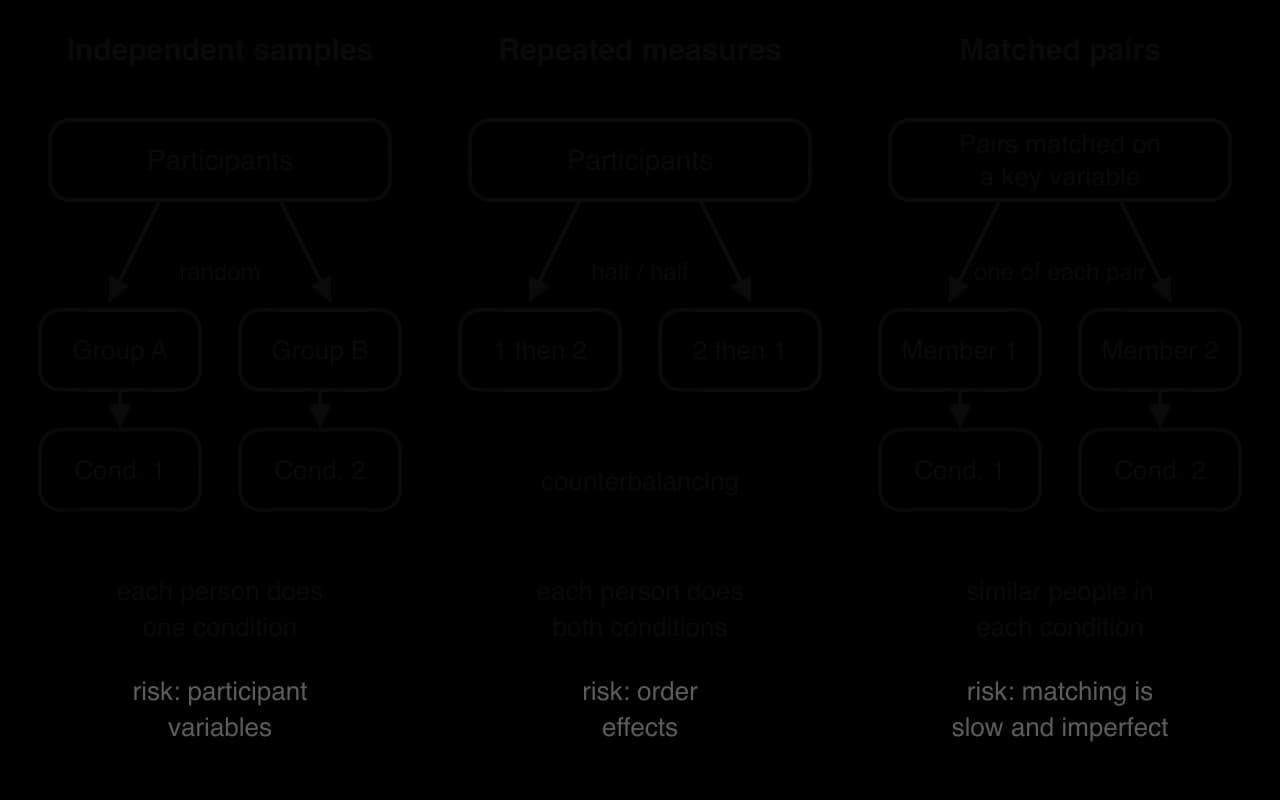
In a repeated measures design, participants may do better in the second condition because of practice, or worse because of tiredness or boredom. These order effects are controlled by counterbalancing: half the participants do condition A then B, and half do B then A, so that order effects affect both conditions equally. Some tasks cannot be repeated at all. An anchoring estimate cannot be made twice with different anchors, because the first anchor would affect the second answer, so anchoring practicals use independent samples.
Design | Main strength | Main limitation | Typical practical |
|---|---|---|---|
Independent samples | No order effects; each participant sees one version | Participant variables may differ between groups; needs more participants | Anchoring; leading questions |
Repeated measures | Participant variables are the same in each condition; fewer participants needed | Order effects; participants may guess the aim | Stroop task; recall with and without music |
Matched pairs | Controls a key participant variable without order effects | Matching takes time and is never perfect | Memory strategy study with pairs matched on a pre-test |
Most experiment practicals use opportunity sampling (students in available classes) or self-selected sampling. The minimum for a student-led experiment practical is five participants, but with so few people a single unusual participant can change the result, so larger samples are better. In an independent samples design, participants are randomly allocated to conditions, for example by shuffling question sheets so that each student receives one version by chance.
 YouTube
Experiments deliberately change participants’ experience, so the ethical principles of informed consent, the right to withdraw, protection from harm, deception and debriefing apply with particular force. Schools apply further rules to class practicals.
Rule for school practicals | What it means for an experiment |
|---|---|
Teacher supervision | The teacher approves the task, materials and instructions; student-led experiments outside lessons use the school’s practical research form. |
Written informed consent | Each participant signs a consent form; under-16s need a parent’s or guardian’s written consent. |
Right to withdraw | Participants can stop at any time and withdraw their results afterwards, usually by quoting a participant number. |
No harm, stress or discomfort | No tasks designed to frustrate, embarrass, frighten or tire participants; no feedback that makes anyone feel they have failed. |
Partial deception only when necessary | Participants may be given a general aim if the full aim would change their behaviour, provided the deception causes no harm and participants are fully debriefed and offered the chance to withdraw their data. |
No conformity or obedience studies | Studies that pressure participants to conform to a group or obey an authority are never permitted. |
No animals and free participation | No animals are used, and no one takes part who is not in a fit state to respond freely and independently. |
Anonymity and data protection | Results are recorded by participant number, stored securely and deleted afterwards. |
Partial deception is common in cognitive experiments. In an anchoring practical, telling participants that the study is about how anchors bias estimates would make them deliberately ignore the anchor, so the aim is given as “a study of how people make estimates”. This is acceptable because the task is harmless and the full aim is explained in the debrief, with the right to withdraw the estimate.
Conformity studies are banned in class practicals for good reasons. In Asch’s line-judgement experiments, participants who faced a unanimous wrong majority often showed visible tension, and the design depended on confederates deceiving them. Pressure from classmates in a school, where participants have to see each other every day, could cause real embarrassment that a debrief cannot undo.
Standardisation means keeping everything except the IV the same for every participant: the same written instructions, the same materials, the same timing, the same setting and the same way of recording answers. If one group is given clearer instructions, or more time, any difference in the DV could be due to that rather than to the IV.
Standardised instructions are written out in full and read aloud word for word or printed on the task sheet. They tell participants what to do, how long they have and that they can stop at any time, without hinting at the hypothesis. A standardised procedure is also what allows another researcher to replicate the experiment and check whether the results are reliable.
Participants in an experiment often try to work out what it is about. Demand characteristics are cues in the situation that suggest the aim, which may lead participants to behave as they think the researcher wants, or deliberately not to. A repeated measures design makes this more likely, because participants experience both conditions and can compare them.
Researchers can also influence results without meaning to, through the expectancy effect: a researcher who expects one condition to do better may give its participants more encouragement or score borderline answers more generously. A single-blind procedure, in which participants do not know which condition they are in, reduces demand characteristics; a double-blind procedure, in which the person running the session also does not know, reduces researcher bias as well.
In an independent samples design, the groups may differ in ability, motivation or previous knowledge. Random allocation spreads these participant variables across conditions, but with small samples the groups can still differ by chance. Situational variables, such as noise, time of day or a classmate laughing, are controlled by running all conditions in the same room at the same time.
Experiments produce quantitative data: one score per participant on the DV. Raw scores are recorded in a table by participant number and condition, and then summarised with descriptive statistics, which describe the data without testing whether the results could be due to chance.
A measure of central tendency is a single number that represents the typical score in a set of data. There are three.
Measure | How it is calculated | Strength | Limitation |
|---|---|---|---|
Mean | Add all the scores and divide by the number of scores | Uses every score; the most sensitive measure | Distorted by extreme scores |
Median | Put the scores in order and take the middle one (or the midpoint of the two middle ones) | Not affected by extreme scores | Ignores the exact values of most scores |
Mode | The most frequent score or category | The only measure for categories (such as yes/no answers) | There may be several modes, or none |
The choice of measure depends on the data. When one or two participants give extreme answers, which is common in estimation tasks, the mean is pulled towards them and no longer describes the typical participant, so the median is the better summary. When data are categories, such as whether participants reported seeing broken glass, only the mode or a percentage makes sense.
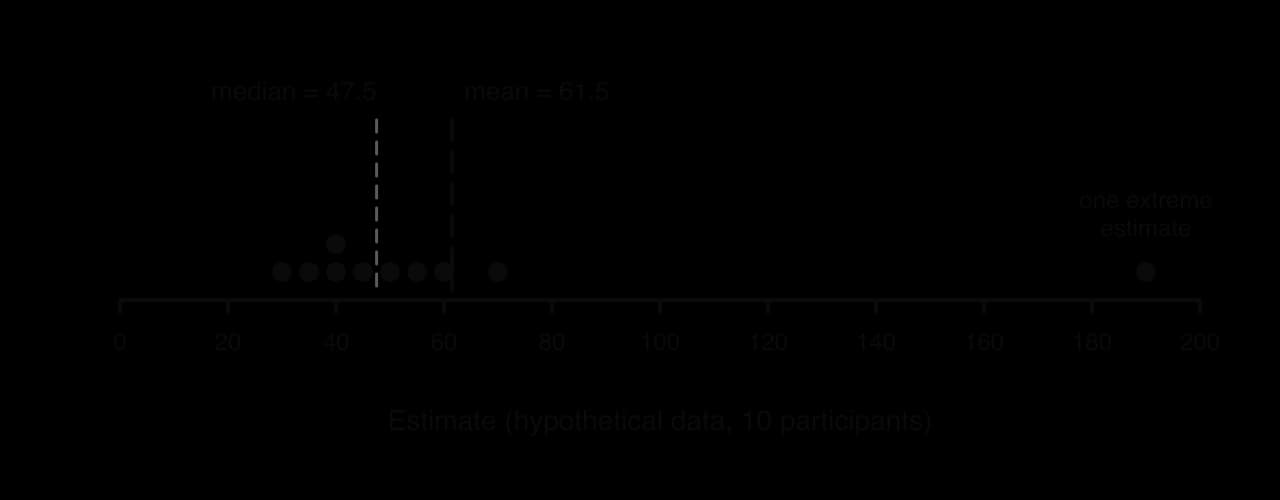
Central tendency is only half the description. Two conditions with the same mean may differ in how spread out their scores are; the simplest measure of spread is the range, the difference between the highest and lowest score. Results are usually presented in a summary table of means (or medians) and a bar chart with one bar per condition, labelled with the IV on the horizontal axis and the DV, with its units, on the vertical axis.
Descriptive statistics show whether the conditions differed in the sample, but not whether the difference is large enough to be unlikely to be due to chance. That question is answered by an inferential test, which gives the probability of the result if the null hypothesis were true; a result with p < 0.05 is usually described as statistically significant. With the very small samples of most class practicals, a real effect may not reach significance.
The Stroop task, first reported by Stroop (1935), is a common repeated measures practical: participants name the ink colours of colour words and take longer when the word names a different colour. Because every participant does both conditions, counterbalancing the order controls practice and fatigue effects.
Concept | How it applies to an experiment practical |
|---|---|
Bias | Demand characteristics and the expectancy effect; sampling bias from opportunity samples of classmates; order effects in repeated measures; participant variables in independent samples. |
Causality | A true experiment can establish cause and effect, because the IV is manipulated, extraneous variables are controlled and participants are randomly allocated. A quasi-experiment cannot. |
Change | Experiments test whether an intervention changes behaviour or cognition, such as a study technique improving recall, and so give evidence for applying psychology. |
Measurement | IV and DV must be operationalised; the DV must be a valid and reliable measure of the process (is a speed estimate a measure of memory?); descriptive statistics summarise it. |
Perspective | Experiments reflect a reductionist, mostly cognitive and etic perspective: one variable at a time, measured with the researcher’s definitions, often with WEIRD samples. |
Responsibility | Consent forms, the right to withdraw data, partial deception only when justified, a full debrief, no stressful tasks and no conformity or obedience studies. |
In experiments there is often a trade-off between causality and measurement. Tight control of the task makes causal conclusions stronger, but it often makes the task less like real life, so the DV may measure performance on an artificial task rather than the everyday process the experiment is about. This trade-off between internal validity and ecological validity is the most common point in evaluating experiments.
The following worked practical follows a true experiment on anchoring bias from plan to results. The data are hypothetical.
The procedure was standardised so that the anchor was the only thing that differed between the two groups.
The estimates were entered into a table by participant number and summarised by condition.
Published experiments show both how much the method can establish and how easily its findings can be overstated. Rauscher and colleagues (1997) studied 78 preschool children: 34 had private keyboard lessons, 20 had private computer lessons and 24 formed other control groups. Only the keyboard group improved significantly on a test of spatial-temporal reasoning. The study concerned music training over months, which differs from the earlier and widely publicised “Mozart effect” claim that simply listening to Mozart briefly improves reasoning. Meta-analyses by Chabris (1999) and by Pietschnig and colleagues (2010) found little or no effect of listening, a reminder that a single experiment is not proof.
Sources: Rauscher, F. H. et al. (1997). Music training causes long-term enhancement of preschool children’s spatial-temporal reasoning. _Neurological Research, 19(1), 2–8._
Context-dependent memory has also been tested with experiments in unusual settings: Godden and Baddeley (1975) had divers learn and recall word lists on land or under water, and recall was better when the two settings matched. Experiments such as these show how an IV can be manipulated in a field setting while the DV is still measured precisely.
Loftus and Palmer carried out two laboratory experiments to test whether the wording of a question asked after an event can change what a witness remembers. The study is a model for experiment practicals: one operationalised IV, a clearly measured DV, an independent samples design and a simple, harmless procedure.
The researchers aimed to find out whether a leading question about the speed of cars in a traffic accident would change participants’ estimates of speed (Experiment 1), and whether it would also change their later memory of the accident, leading them to report details that were not there (Experiment 2).
In Experiment 1, 45 students at the University of Washington watched seven short film clips of traffic accidents, lasting between 5 and 30 seconds. After each clip they answered questions, including the critical question “About how fast were the cars going when they _ each other?”. The IV was the verb in this question: smashed, collided, bumped, hit or contacted, with each verb given to a different group of participants. The DV was the estimated speed in miles per hour.
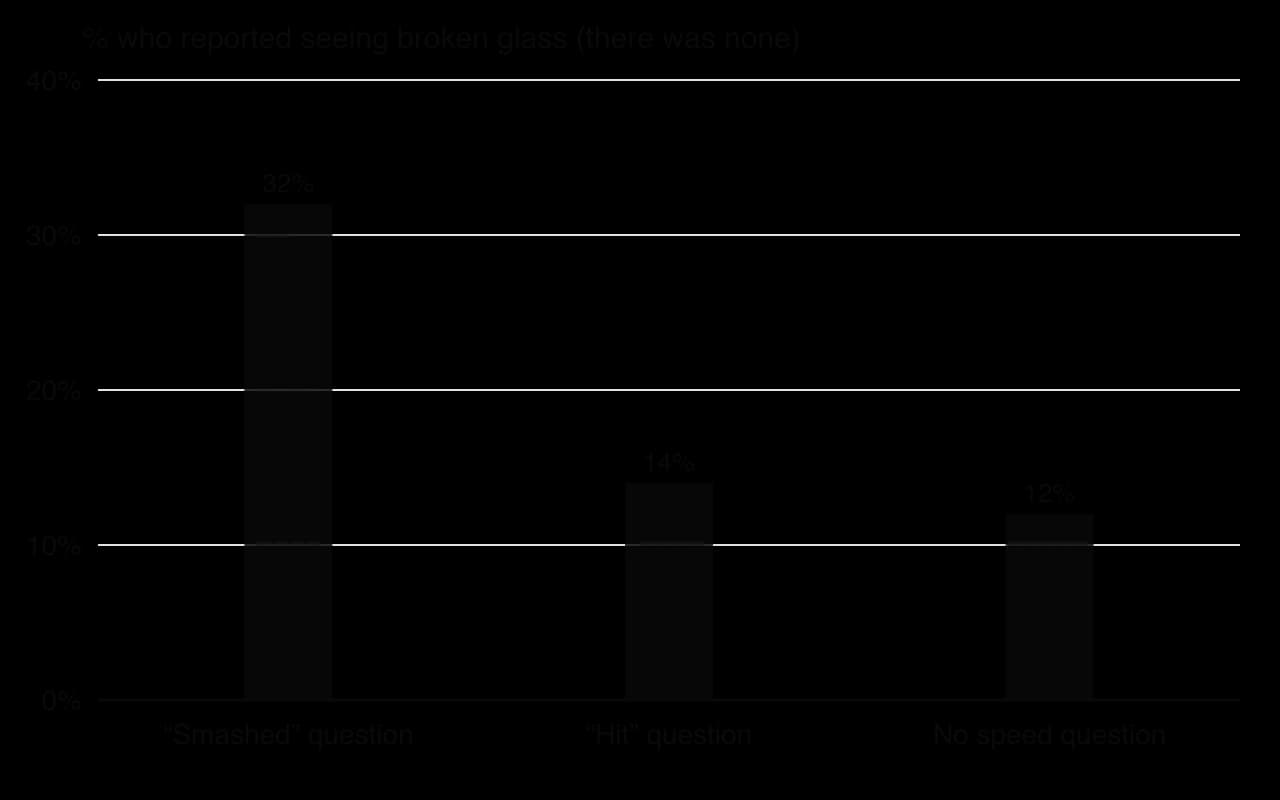
In Experiment 2, 150 students watched a film lasting less than a minute that included a four-second multiple-car accident. They were divided into three groups of 50: one was asked “About how fast were the cars going when they smashed into each other?”, one the same question with “hit”, and a control group was not asked about speed. One week later, without seeing the film again, all participants answered a series of questions, including a critical question asking whether they had seen any broken glass. There was none in the film. The DV was the percentage of each group answering “yes”.
Verb in the question (Experiment 1) | Mean speed estimate (mph) |
|---|---|
Smashed | 40.8 |
Collided | 39.3 |
Bumped | 38.1 |
Hit | 34.0 |
Contacted | 31.8 |
In Experiment 1, estimates rose with the intensity of the verb, from 31.8 mph for “contacted” to 40.8 mph for “smashed”. In Experiment 2, the “smashed” group again gave higher speed estimates (mean 10.46 mph) than the “hit” group (8.00 mph), and a week later they were more than twice as likely to report seeing broken glass.
Sources: Loftus, E. F. & Palmer, J. C. (1974). Reconstruction of automobile destruction: an example of the interaction between language and memory. _Journal of Verbal Learning and Verbal Behavior, 13(5), 585–589._
The wording of a question can change both a judgement made at the time and a later memory of the event. Loftus and Palmer proposed that two kinds of information combine in memory: what was perceived during the event and information supplied afterwards, such as the meaning of “smashed”. Over time these merge into a single memory, so participants “remembered” broken glass that fitted a violent crash. This supports the view that memory is reconstructive, and has direct implications for how police and lawyers question witnesses.
The verb was the only thing that differed between groups; all participants saw the same films under the same conditions, and Experiment 2 included a control group that was not asked about speed. Because the groups differed only in the IV, the differences in estimates and in reports of broken glass can be attributed to the wording of the question. The control group also shows that some false reports (12%) occur even without a leading question, so the effect of “smashed” is the difference above that baseline.
Speed estimates are a convenient DV, but people are poor at judging speed in general, so the verb may have influenced their guess without changing their memory, a response bias rather than a memory change. Experiment 2 addressed this: the broken glass question measured memory of a detail a week later, and the “smashed” group’s higher rate of false reports suggests the memory itself had changed.
Participants were university students in the United States, an opportunity sample that may not represent witnesses in general. Watching a film in a laboratory carries none of the emotion or consequences of seeing a real accident, which lowers ecological validity. Participants may also have guessed what was expected (demand characteristics). In a field study of witnesses to a real shooting, Yuille and Cutshall (1986) found that witnesses’ memories remained accurate months later and were little affected by misleading questions, which suggests the laboratory effect may be weaker in real, emotional events.
The procedure involved brief, non-graphic films and a harmless form of deception, since participants were not told the purpose of the speed question. This makes the study a useful template for class practicals on memory, whereas a design showing distressing footage of a real accident would not be acceptable.
Paper 2 Section A asks four questions on one class practical, named by its method: describe how the method was used [4], explain one concept in relation to it [4], compare and contrast it with another method [6], and design a study on the same topic with a different method [6]. The model answers use the worked practical on anchoring.
An explain question names one concept; the answer explains it and links it to two or three decisions in the practical.
Compare and contrast answers need both similarities and differences, each explained with reference to both methods.
An experiment manipulates an IV and measures its effect on a DV while controlling other variables; only a true experiment with random allocation can establish cause and effect.
Quasi-experiments compare existing groups; laboratory, field and natural experiments differ in setting and control.
Planning covers an aim, operationalised IV and DV, null and alternative hypotheses, a design (independent samples, repeated measures with counterbalancing, matched pairs), and a sample of at least five.
Experiment practicals need consent forms, the right to withdraw data, a full debrief, no harm, and no conformity or obedience studies; partial deception only when necessary and harmless.
Standardisation, random allocation, blind procedures and counterbalancing control extraneous variables, demand characteristics, researcher bias and order effects.
Results are summarised with the mean, median or mode; the median is better when there are extreme scores, and the mode for categories.
Loftus and Palmer (1974) found that the verb in a question changed speed estimates (31.8 to 40.8 mph) and false reports of broken glass (32% for “smashed”, 14% for “hit”, 12% for controls).
Tight control gives internal validity but often lowers ecological validity.
I can describe true and quasi-experiments, and laboratory, field and natural experiments.
I can plan an experiment practical with operationalised variables, hypotheses, a design and a sample.
I can apply the ethical rules for school practicals to an experiment, including partial deception.
I can explain how standardisation and other controls deal with extraneous variables and bias.
I can calculate the mean, median and mode and choose the right measure.
I can explain each of the six concepts in relation to my experiment practical.
I can evaluate experiments with reference to Loftus and Palmer (1974).
I can compare and contrast experiments with observation, and design a questionnaire on the same topic.