11 Culture, motivation and technology
How culture, motivation and technology shape behaviour across the four contexts, how the three HL extensions connect, and how they are assessed through unseen sources in Paper 3.
- IB Psychology
- HL only
What 11 covers
From the subject guide: what you need to know and be able to do.
HL extensions: how culture, motivation and technology shape behaviour across the four contexts.
3 subtopics in Culture, motivation and technology
Each one has its own page once something is published for it.
- 11.1Culturenotes
- 11.2Motivationnotes
- 11.3Technologynotes
Key terms introduced here
Each is in the Psychology glossary, with every other term in the subject.
- HL extensions
The four HL-only parts of the course that extend the core: the roles of culture, motivation and technology in behaviour across the four contexts, and data analysis and interpretation.
An overview of 11 Culture, motivation and technology
This topic studies three forces that shape behaviour in every context: the culture people grow up in and live among, the motivation that gives their behaviour direction and energy, and the digital technology that now surrounds them. Each is studied in health and well-being, human development, human relationships, and learning and cognition, together with the problems researchers face when they try to study it.
The three HL extensions are not separate units with their own body of facts. They are lenses that deepen what is already known about the contexts, and they are designed to train the skill of judging evidence: deciding how far a set of findings supports a claim about how culture, motivation or technology influences behaviour.
Questions the topic answers
How far do psychological findings, measures and treatments hold across cultures, and how can a real cultural difference be told apart from an artefact of the way it was measured?
Why do people act, persist and change, and when do rewards, goals and beliefs about ability strengthen or weaken motivation?
What do smartphones, social media and artificial intelligence do to well-being, development, relationships and cognition, and how much of what is claimed is supported by evidence?
What makes research on each of these questions difficult, and how should the evidence be read as a result?
The subtopics
Subtopic | What it covers |
|---|---|
11.1 Culture | Culture at the level of the culture of enculturation, the local culture and global culture; cultural diffusion and globalisation; culture in the expression, diagnosis and treatment of mental health problems, in children’s development, in relationships and communication, and in cognition and bilingualism. Research challenges: operationalising culture, the ecological fallacy, imposed etic bias, measurement equivalence, WEIRD samples and confounding variables. |
11.2 Motivation | Primary and secondary motives; intrinsic and extrinsic motivation; self-determination theory and the basic psychological needs; how motivation is measured; motivation in health behaviour change, children’s social development, groups and workplaces, and learning. Research challenges: self-report and demand characteristics, bidirectional ambiguity, short-term outcomes, small effects, replication failures and publication bias. |
11.3 Technology | Digital technology and artificial intelligence; teletherapy, virtual reality and chatbots in treatment; social media and well-being; technology and the developing self and attachment; echo chambers and acculturation; media multitasking and attention. Research challenges: correlational designs, inaccurate self-reported use, sampling bias, researcher bias, publication bias and funding, and the speed of change. |
How the subtopics connect
The three extensions share a structure. Each one names an influence on behaviour, shows it at work in the four contexts, and then asks how trustworthy the evidence for that influence is. The research challenges are what turn knowledge of the extensions into the ability to judge unseen evidence, which draws on the skills of data analysis and interpretation.
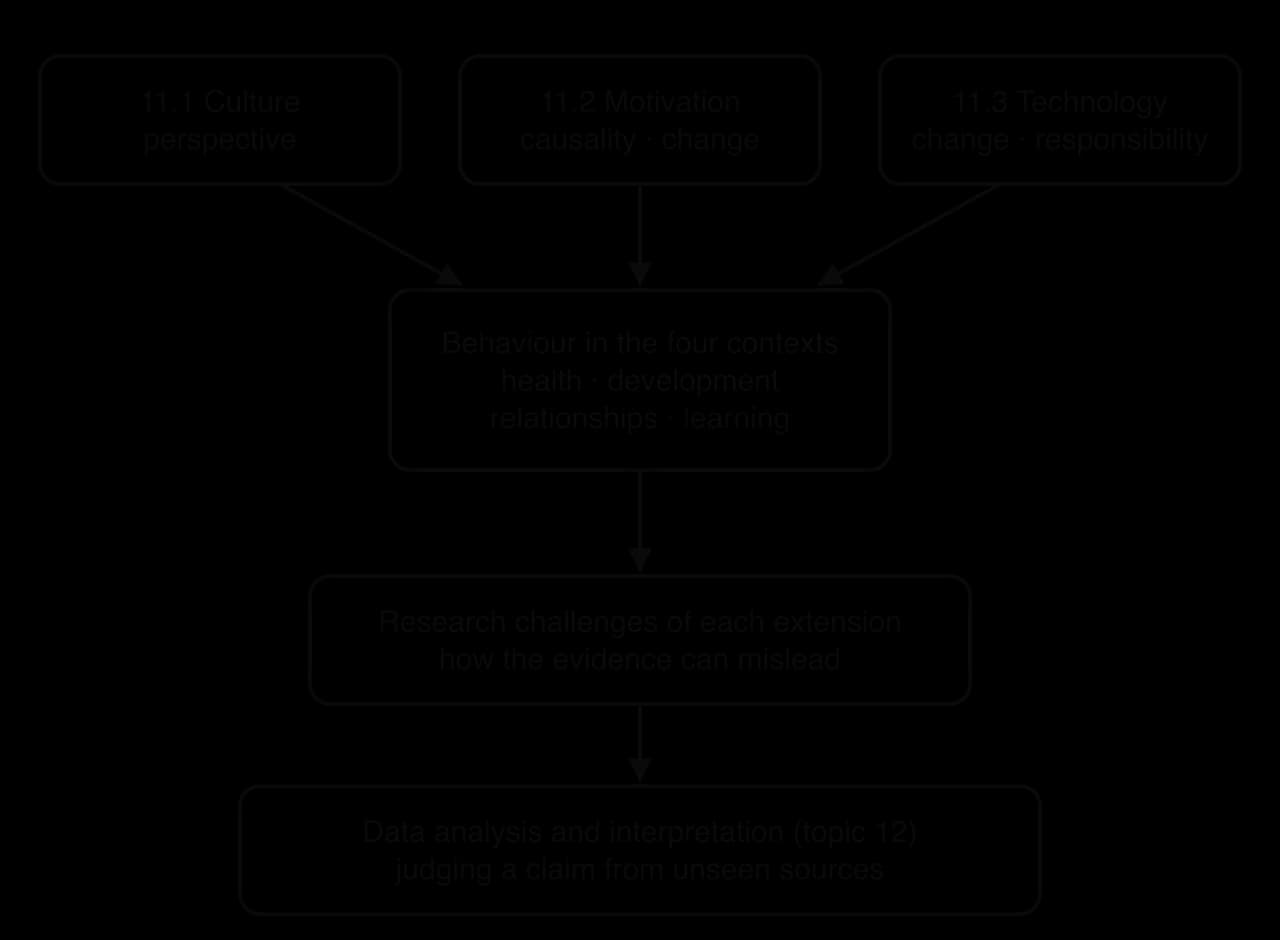
The extensions also overlap. Culture changes how motivation works: personal choice increases intrinsic motivation more for some cultural groups than for others. Technology carries culture across borders, as when television reached Fiji and imported new body ideals, and it is designed around motivation, using rewards such as likes and notifications. A single real-world question, such as why some students seek help for anxiety and others do not, can involve all three.
Links to the concepts and the rest of the course
Each extension develops particular concepts. Culture develops perspective, including the perspectives of Indigenous peoples, and bias in measures and samples. Motivation develops causality, because motivation is inferred from the outcomes it is supposed to explain, and change, because many interventions try to change behaviour by changing motivation. Technology develops change, perspective and responsibility, since decisions about phones in schools or chatbots in mental health care are being made on uncertain evidence. Measurement runs through all three.
Part of the course | How topic 11 builds on it |
|---|---|
Sociocultural approach | Cultural dimensions, emic and etic approaches, enculturation and acculturation become tools for analysing culture across all four contexts. |
Cognitive approach | Conditioning, schemas and cognitive biases underpin motivation (rewards, beliefs about ability) and the effects of technology on attention and memory. |
Biological approach | Primary motives, reward systems in the brain and brain imaging in research on motivation and technology. |
Research methodology | Experiments, correlational studies, interviews, sampling, credibility and transferability are the basis of every research challenge in the topic. |
Data analysis and interpretation | Graphs, descriptive and inferential statistics and thematic analysis are used to analyse the sources about each extension. |
How SL and HL differ
SL and HL students study the same concepts, content, contexts and class practicals, and sit the same Papers 1 and 2. HL students add four extensions: the roles of culture, motivation and technology in shaping behaviour, which make up this topic, and data analysis and interpretation, which SL students also study but are not assessed on. SL students do not study the culture, motivation and technology extensions.
The extensions are designed to deepen the shared course rather than add new, separate content. For each extension the syllabus gives examples of areas of inquiry in each of the four contexts, such as culture in diagnosing and treating mental health problems, motivation in changing health behaviour, or technology and attachment, and teachers may develop other areas of inquiry. Students are therefore expected to understand each extension well enough to apply it to research they have not seen before, rather than to memorise a fixed list of studies.
Assessment
The three extensions are assessed only in Paper 3, which is taken only by HL students. The paper provides a resource booklet of several sources, usually four to six, built around one claim about the role of culture, motivation or technology in one of the four contexts, such as a claim about technology in education and students’ mental health. The sources include quantitative and qualitative findings from experimental and non-experimental research, and the data may be authentic or created for the examination.
Question | What it asks | What the extension contributes |
|---|---|---|
Question 1 (3 marks) | Explain one issue that limits the interpretation of the information in a source. | Typical problems of the extension, such as the ecological fallacy or correlational data about technology |
Question 2 (6 marks) | Analyse the findings of a source and state a conclusion linked to the claim. | Knowing what the findings mean for the influence of culture, motivation or technology |
Question 3 (6 marks) | Discuss a qualitative source: how credibility could be improved, how bias could be avoided, or how far the findings are transferable. | Awareness of outsider researchers, volunteer samples and researcher bias in the field |
Question 4 (15 marks) | To what extent the claim is valid, using at least three sources and own knowledge. | Research from the extension and its research challenges, used to interpret the sources and weigh different points of view |
Knowledge of the extensions is assessed through its application to unseen material. Detailed descriptions of studies earn credit in question 4 only when they help to interpret the sources or to judge the claim, so the most useful preparation combines a secure grasp of each extension’s main research with practice in analysing short sources.
Carry on with 11 in Augment
With a free account, Augment remembers where you stopped and what you have practiced.