Notes on 11.2 Motivation
Learning objectives
Explain what motivation is and describe the difference between primary and secondary motives and between intrinsic and extrinsic motivation.
Explain self-determination theory, including the basic psychological needs and the continuum from controlled to autonomous motivation.
Describe how motivation is measured, and explain the problems of physiological, self-report, behavioural and experimental measures.
Discuss the role of motivation in health and well-being, human development, human relationships, and learning and cognition, using theories and research from each context.
Explain the methodological challenges of research on motivation, including self-report, bidirectional ambiguity, short-term outcomes, small effects, replication failures and publication bias.
Describe and evaluate Yeager et al. (2019) as a large preregistered experiment on changing motivation.
Analyse unseen sources about motivation and evaluate claims about how far motivation causes and changes behaviour.
Introduction
Motivation is what gives behaviour its direction and energy: why a person starts an activity, how hard they work at it and how long they keep going. It explains why one student revises every evening while another with the same ability does not, why some smokers quit and others relapse, and why rewarding a child for helping can make the child help less.
The motivation extension links most closely to the cognitive approach, because beliefs, goals and expectations drive much of human motivation, and to two concepts. The first is causality: motivation is usually invisible and is inferred from behaviour, so it is hard to show that it causes an outcome rather than resulting from it. The second is change: many interventions in health, education and work aim to change behaviour by changing motivation, and research asks which changes last.
What motivation is
Motivation cannot be seen directly. It is a construct inferred from three features of behaviour: its direction (what a person chooses to do), its intensity (how much effort they put in) and its persistence (how long they continue, especially after setbacks). A student who chooses to practise a language, works hard at it and keeps going after a poor test result is showing strong motivation on all three.
Motivation draws on all three approaches. Biological processes produce drives such as hunger; cognitive processes such as goals, expectations and beliefs about ability shape effort; and sociocultural factors decide which goals are valued and which rewards are available. A full explanation of why a person behaves as they do usually needs all three, which is why single-cause accounts of motivation tend to be reductionist.
Primary and secondary motives
Psychologists distinguish motives that come from the body’s survival needs from those that are learned. A primary motive is a biologically based drive such as hunger, thirst or the need for sleep. These motives work largely through homeostasis, the body’s tendency to keep internal states such as blood glucose and fluid levels within a stable range: when a state moves out of range, a drive pushes the person to correct it.
Because primary motives have a physiological basis, they can be partly measured through the body. Cummings et al. (2004) took blood samples every five minutes from people who had eaten lunch and could ask for dinner whenever they wished, without clocks or food cues. Levels of ghrelin, a hormone produced mainly in the stomach, fell after lunch and rose again before the freely requested dinner, and followed a similar pattern to participants’ hunger ratings, supporting a role for ghrelin in starting meals.
A secondary motive is learned through experience and culture rather than built in. Examples include the motive to affiliate with others, to compete and achieve, and to pursue particular interests and goals. Secondary motives differ widely between people and cultures, and they can override primary ones, as when a person fasts for religious reasons or an athlete trains through exhaustion.
Primary motives | Secondary motives | |
|---|---|---|
Origin | Biological needs linked to survival | Learning, socialisation and culture |
Examples | Hunger, thirst, sleep | Achievement, affiliation, competition, interests and goals |
Typical measures | Physiological measures (blood glucose, hormone levels) and behaviour (food intake) | Self-report (asking people why they acted), behaviour (choice, persistence) and experiments |
Variation | Similar across people and cultures, though expressed differently | Vary widely between individuals and cultures |
Intrinsic and extrinsic motivation
The most important distinction for applying motivation to real behaviour concerns the source of the reasons for acting. Intrinsic motivation is doing something because it is interesting or satisfying in itself: a child drawing for the pleasure of it, an adult solving puzzles for fun. Extrinsic motivation is doing something to obtain a separate outcome, such as a reward, a grade, praise or the avoidance of punishment.
The same activity can be motivated in either way. A teenager may play the piano because she loves the music, because her parents pay her to practise, or for both reasons at once, and the balance between the two can shift over time.
Extrinsic motivation works through the principles of operant conditioning: behaviour that is followed by reinforcement becomes more frequent, and behaviour followed by punishment less frequent. It is powerful and often useful, for example in getting people to start a behaviour they would never try otherwise. Problems arise when an extrinsic reward is added to an activity that a person already finds interesting.
When rewards undermine motivation
Lepper, Greene and Nisbett (1973) showed that preschool children who expected and received a certificate for drawing later spent less free time drawing than children who had not been rewarded, the overjustification effect. Deci, Koestner and Ryan (1999) pooled 128 experiments in a meta-analysis to find out how general this effect is. In most studies, intrinsic motivation was measured as the time participants chose to spend on the task in a “free-choice” period after the reward phase, when they were left alone and could do whatever they liked.
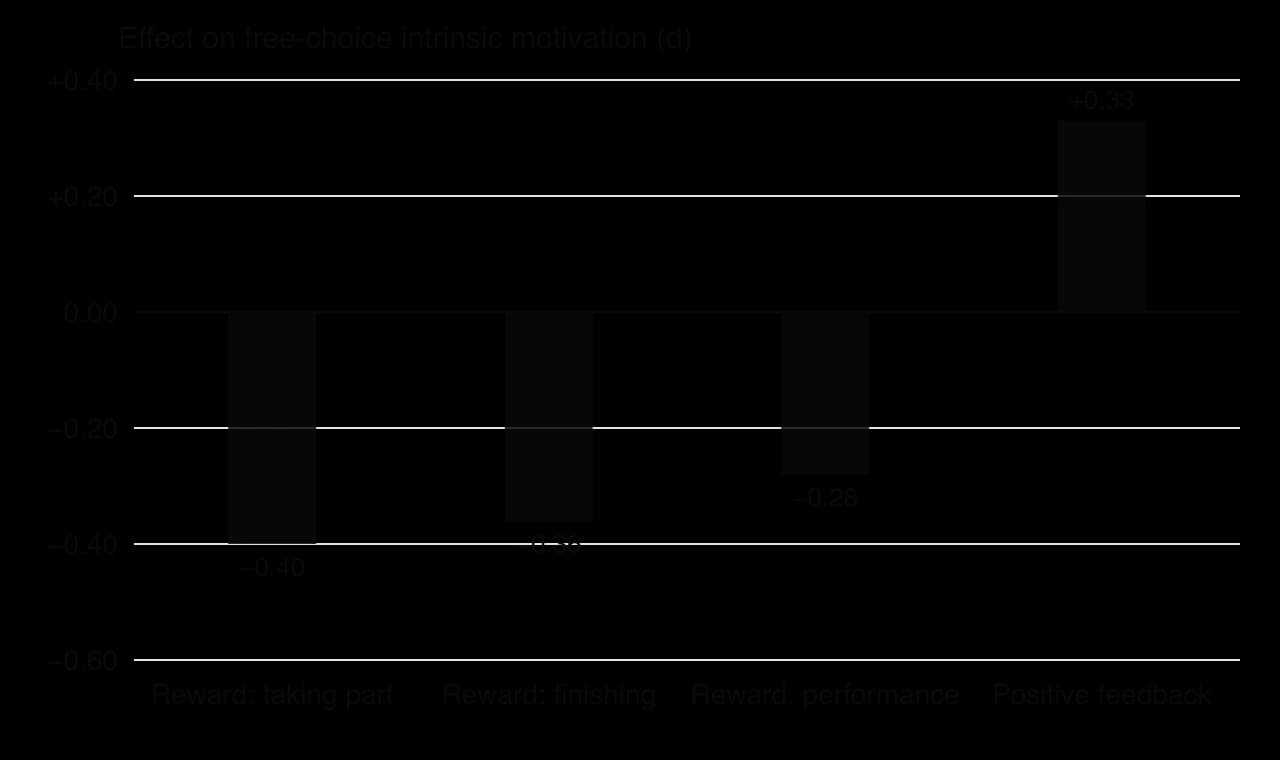
Tangible rewards (money, prizes, certificates) given for taking part, finishing or performing well all reduced free-choice intrinsic motivation, with effect sizes from d = −0.28 to d = −0.40, and tangible rewards tended to be more harmful for children than for university students. Positive feedback had the opposite effect (d = +0.33). The authors explained the pattern through self-determination theory, in which a reward and a piece of feedback can affect motivation in opposite ways.
Murayama et al. (2010) found a possible biological correlate of the effect. Participants who had been paid according to their performance on a game-like task later chose to play it less often in a free-choice period than unpaid participants, and fMRI showed that activity in the anterior striatum and prefrontal areas, which are involved in valuing outcomes, decreased along with the drop in motivation.
Rewards are not always harmful
The undermining effect has limits. It applies to activities that are already interesting; for dull tasks there is little intrinsic motivation to undermine, and rewards simply increase effort. Cerasoli, Nicklin and Ford (2014) analysed 183 samples from school, work and sport with more than 200,000 participants and found that intrinsic motivation predicted performance whether or not incentives were present. Intrinsic motivation was the better predictor of the quality of performance and incentives the better predictor of its quantity, so the two are best seen as working together rather than against each other.
Self-determination theory
Self-determination theory (SDT), developed by Edward Deci and Richard Ryan from the 1970s onwards, is the most widely used theory of intrinsic motivation. It starts from the assumption that people have an innate tendency to grow, explore and master their surroundings. Whether this tendency flourishes depends on whether the social environment satisfies three basic psychological needs.
The three basic psychological needs
SDT describes three basic psychological needs that every person has, in every culture. Autonomy is the need to experience one’s actions as chosen and endorsed by oneself rather than imposed. Competence is the need to feel effective and capable of mastering challenges. Relatedness is the need to feel connected to, and cared for by, other people.
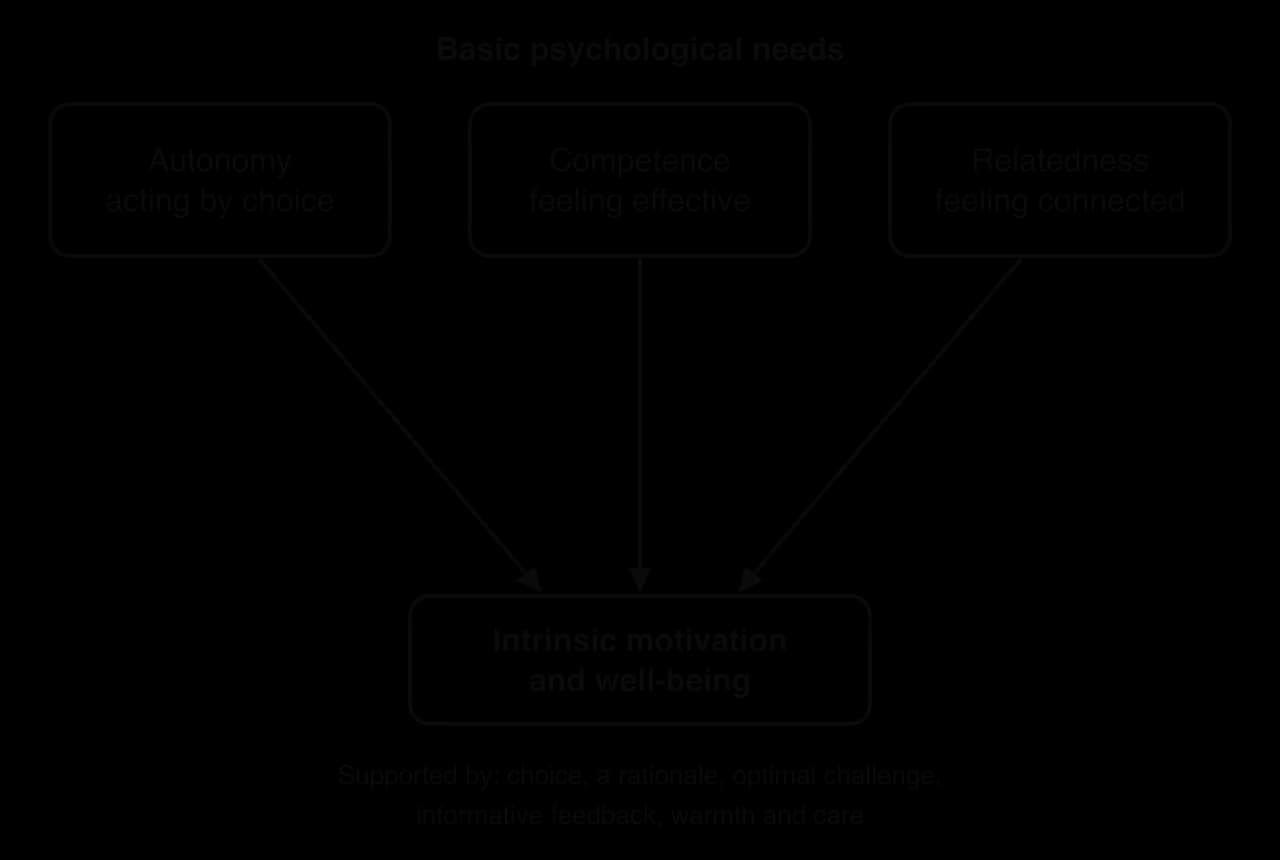
The theory explains the reward findings. A reward that is experienced as controlling (a payment for doing as instructed) shifts the reason for acting from inside the person to outside, which reduces autonomy and therefore intrinsic motivation. Feedback that is experienced as informational (“that solution was elegant”) supports competence and can increase intrinsic motivation. The same reward can therefore have different effects depending on how it is given and understood.
 YouTube
A continuum from controlled to autonomous motivation
SDT does not treat all extrinsic motivation as the same. It describes a continuum according to how far a person has taken the reasons for an activity into their own values, a process called internalisation.
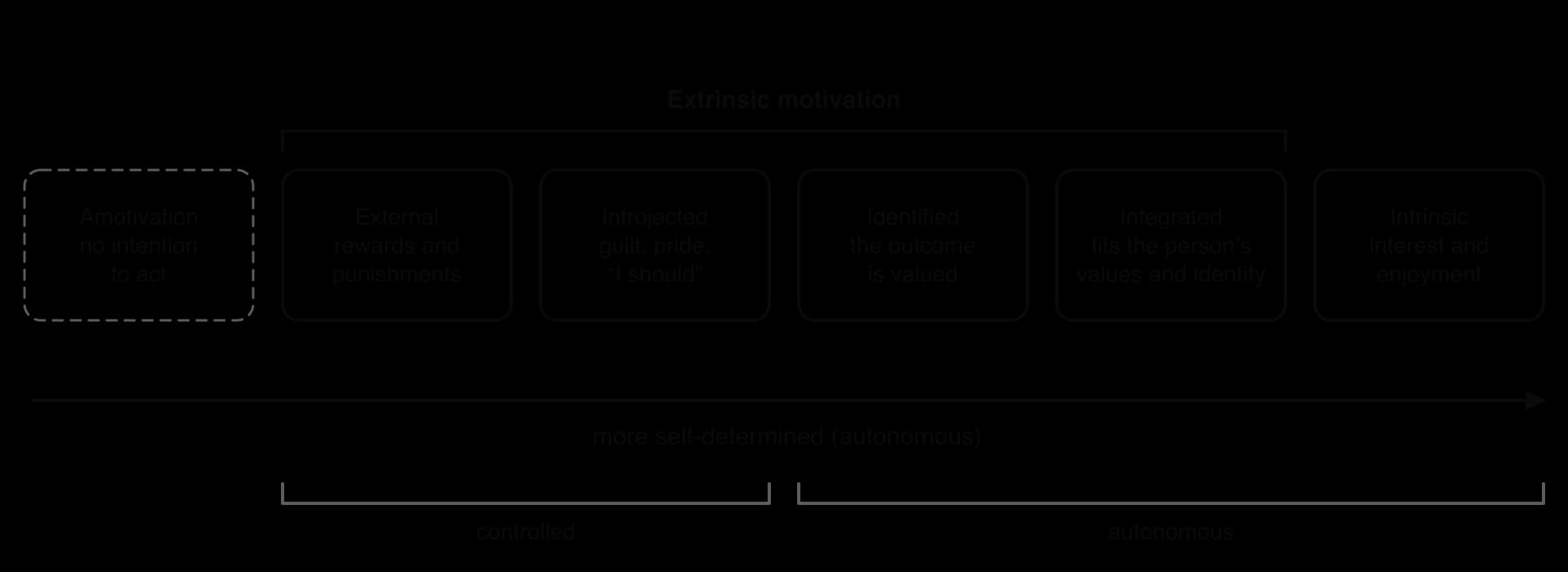
Amotivation: no intention to act, often because the person sees no point or feels unable to succeed.
External regulation: acting to gain a reward or avoid a punishment (“I revise because my parents will take my phone if I fail”).
Introjected regulation: acting to avoid guilt or gain pride (“I revise because I would feel ashamed not to”).
Identified regulation: acting because the outcome is personally valued (“I revise because I want to become a nurse”).
Integrated regulation: the activity fits the person’s wider values and identity.
Intrinsic motivation: acting because the activity is enjoyable or interesting in itself.
The continuum matters because research links the more autonomous forms with better persistence, deeper learning and better well-being. Most important behaviours (taking medication, revising, exercising) are not intrinsically enjoyable for most people, so the realistic goal of a teacher or doctor is often to move a person from external towards identified regulation rather than to make the activity fun.
Evaluating self-determination theory
SDT has strong support from experiments in which autonomy support or controlling rewards are manipulated, from meta-analyses such as Deci, Koestner and Ryan (1999), and from field research in schools, workplaces and health care. Its practical recommendations (offer choice, explain the reason for a rule, give informative feedback) have been applied in teacher training and health services.
Critics raise several points. Many SDT studies measure motivation by self-report questionnaires, which are open to social desirability bias. The theory is broad enough that almost any finding can be explained after the event by pointing to one of the three needs, which makes it hard to falsify. Its claim that autonomy is a universal need has also been questioned from a cultural perspective.
Iyengar and Lepper (1999) tested the value of personal choice with Anglo American and Asian American children. Anglo American children were most intrinsically motivated, persisting longer and performing better on puzzles, when they chose the task themselves. Asian American children were most motivated when the choice was made for them by a trusted person such as their mother or classmates. SDT researchers reply that autonomy means acting with endorsement, not acting alone, so following a trusted person’s choice can be autonomous; critics reply that this makes the concept hard to test.
How motivation is measured
Because motivation is an inferred construct, every measure is indirect, and each type of measure suits some motives better than others. Primary motives can be measured partly through physiology, while secondary motives depend mostly on what people say or do.
Type of measure | Example | Strength | Limitation |
|---|---|---|---|
Physiological | Blood glucose or hormone levels as indicators of hunger, for example in research on eating disorders | Objective; not affected by what the participant wants to report | Shows a bodily state, not the reasons for a choice; mostly limited to primary motives |
Self-report | Questionnaires asking why a person studies or exercises; interviews asking people what made an activity matter to them | The only direct access to reasons, goals and feelings | Social desirability and demand characteristics; people may not know their own reasons |
Behavioural | Free-choice time spent on a task; persistence after failure; choosing hard or easy problems | Observes what people do rather than what they say | Behaviour has many causes, so the link to motivation must be inferred |
Experimental manipulation | Randomly giving or withholding a reward and measuring later free-choice engagement | Can show that an external motivator causes a change | Short laboratory sessions; artificial tasks; motivation in real life builds over months |
Self-report is particularly vulnerable to demand characteristics. A participant asked after an experiment how much they enjoyed a task may guess what the researcher hopes to find, and a student asked by a teacher why they study is likely to give a socially acceptable reason. Researchers reduce the problem by combining self-report with behavioural measures, such as how long participants choose to stay on a task when they think they are unobserved, and by measuring outcomes such as grades from school records rather than asking participants.
Motivation in health and well-being
Many of the biggest health problems, such as smoking, obesity and harmful drinking, depend on behaviour, and changing behaviour depends on motivation. Research in this context asks which motivational theories underpin effective prevention and treatment, and how motivation changes during the process of changing behaviour.
Motivational interviewing
Motivational interviewing (MI) is a counselling style developed by William Miller and Stephen Rollnick for people who feel two ways about changing a behaviour such as drinking. Rather than telling the client to change, the counsellor helps the client explore their own reasons for and against change, reflects back the client’s “change talk” and respects the client’s right to choose. The approach fits SDT, because it aims to build autonomous rather than controlled motivation.
Lundahl et al. (2010) carried out a meta-analysis of 119 studies of MI targeting substance use, health behaviours such as diet and exercise, gambling and engagement in treatment. Compared with weak comparison groups such as waiting lists, MI produced small but statistically significant and lasting effects (average g = 0.28). Compared with other specific treatments, it did about as well (g = 0.09, not significant). MI therefore helps, but it is not clearly better than other active treatments.
MI is often combined with the transtheoretical model, which describes stages of readiness to change (from not yet considering change, through preparation and action, to maintenance). Matching the intervention to the person’s stage is meant to avoid pushing people who are not ready, although evidence that stage-matched interventions outperform others is mixed.
Extrinsic incentives for health behaviour
Health services also use extrinsic motivation directly. Volpp et al. (2009) randomly allocated 878 employees of a US company who smoked either to information about stop-smoking programmes or to the same information plus financial incentives of up to 750 US dollars for completing a programme and for stopping smoking, confirmed by a biochemical test. Nine or twelve months after enrolment, 14.7% of the incentive group had stopped compared with 5.0% of the information group, and the difference remained 15 or 18 months after enrolment (9.4% against 3.6%), after the incentives had ended.
Why do incentives help people stop smoking when rewards reduce children’s drawing?
The two findings involve different tasks. Drawing is enjoyable for most young children, so there is intrinsic motivation for a reward to crowd out. Stopping smoking is unpleasant at first and has delayed benefits, so there is little intrinsic motivation to lose and the incentive supplies a reason to act now. Incentives may also help people through the first weeks, after which health benefits and identified regulation (“I want to be healthy for my children”) can take over.
The study shows that extrinsic motivation can start and sustain a hard behaviour change, even after the incentives end, which does not fit a simple prediction that rewards always undermine motivation. Most participants still did not quit, and the sample came from one large company, which limits generalisation.
Self-determination theory in health care
SDT predicts that health behaviour lasts longer when patients are autonomously motivated. Williams et al. (1996) followed 128 patients on a six-month very-low-calorie weight-loss programme for nearly two years. Patients whose motivation for losing weight was more autonomous attended more regularly, lost more weight and kept more of it off at follow-up, and their autonomous motivation was predicted partly by how far they saw the staff as supporting their autonomy. A later meta-analysis of 184 data sets by Ng et al. (2012) found that autonomy support from practitioners, need satisfaction and autonomous motivation were related to better mental and physical health outcomes.
Most of these findings are correlational. Patients who feel autonomous may also be those who were already more confident or healthier at the start, so autonomy could be partly a consequence of early success rather than its cause, a problem of bidirectional ambiguity.
Motivation in human development
Children’s motivation develops through interaction with parents, teachers and peers, who use rewards, praise, punishment and encouragement, often without thinking about their effects. Research in this context asks which motivational theories explain development and how extrinsic motivators affect children’s social development.
Rewards and children’s helping
Warneken and Tomasello (2008) studied 20-month-old infants who had a series of chances to help an adult, for example by picking up an object the adult had dropped. In a treatment phase, some infants received a small toy after helping, some received praise and some received nothing. In a later test phase with no rewards, infants who had received the material reward helped less than those who had received praise or no reward. The authors concluded that even the earliest helping is intrinsically motivated and that material rewards can undermine it.
The finding suggests that prosocial behaviour may not need to be taught through rewards and can be harmed by them. Parents and teachers who reward helping with sweets or stickers may teach children that helping is something done for payment.
Praise and the development of beliefs about ability
Praise is the most common motivator adults use, but its form matters. Mueller and Dweck (1998) ran six studies with children around ten or eleven years old (fifth graders in the United States). After solving a first set of problems, children were praised either for their intelligence (being told they must be smart at the problems) or for their effort (being told they must have worked hard). After a later failure, children praised for intelligence showed less persistence, less enjoyment and worse performance than children praised for effort, and they were more likely to describe intelligence as a fixed trait.
The study connects motivation to children’s developing theories of ability. Praise for intelligence implies that success shows a fixed quality, so failure threatens it; praise for effort implies that success comes from something the child controls. This idea became the basis of growth mindset theory and of later interventions such as the one tested by Yeager et al. (2019).
Culture and motivation in development
Parents in different cultures use motivation differently, and the same practice can mean different things. Iyengar and Lepper’s finding that Asian American children were most motivated when trusted others chose for them suggests that children enculturated into an interdependent view of the self may experience parental guidance as supporting rather than controlling. Applying conclusions from research with Western middle-class children to other groups, without testing them, risks an imposed etic.
Motivation in human relationships
People’s motivation changes when they work with others. Research in this context asks how motivation influences group behaviour, which strategies change individual behaviour inside groups, and what motivates employees to be satisfied and perform well.
Motivation in groups
People often put in less effort when working in a group than alone, a pattern called social loafing. The collective effort model of Karau and Williams (1993) explains it in motivational terms: people work hard only when they expect their own effort to make a difference to an outcome they value. In a large group where individual contributions cannot be identified, effort seems to matter less, so motivation falls. The model predicts that loafing is reduced when individual contributions are visible, when the task is meaningful and when people value the group, which links motivation to social identity theory.
Baumeister and Leary (1995) proposed that the need to belong, to form and keep lasting positive relationships, is a fundamental human motive. It overlaps with relatedness in SDT and helps explain why group membership motivates behaviour as diverse as conformity, cooperation and the distress caused by rejection.
Goal setting
Goal-setting theory, developed by Edwin Locke and Gary Latham from research mostly in workplaces, proposes that specific, difficult goals lead to higher performance than vague goals such as simply being asked to try hard. Goals direct attention, increase effort and persistence, and encourage people to find better strategies. The effect is strongest when people are committed to the goal, receive feedback on progress and have the ability to reach it.
Goal setting can conflict with intrinsic motivation if goals are imposed and tied to rewards, and difficult performance targets can encourage cutting corners or cheating. Goals that people set or accept for themselves fit SDT’s idea of autonomous motivation better than targets set by managers.
Motivating employees
Herzberg’s two-factor theory, based on interviews in which employees described times they felt very good or very bad about their jobs, distinguished hygiene factors from motivators. Hygiene factors (pay, working conditions, company policy, relationships with supervisors) cause dissatisfaction when they are poor but do not create satisfaction when they are good. Motivators (achievement, recognition, responsibility, interesting work, advancement) create satisfaction and effort. The theory anticipates the distinction between extrinsic and intrinsic motivation.
The method used to build the theory has been criticised. When people describe good and bad events, they tend to credit themselves for good ones and blame their circumstances for bad ones, so the split between motivators and hygiene factors could partly reflect this attributional bias rather than two real kinds of factor. The findings of Cerasoli and colleagues on quality and quantity of work suggest that pay and interest work together rather than on separate outcomes.
Motivation in learning and cognition
Motivation affects learning in two ways: it decides how much time and effort students spend, and it changes how they process information while they study. Research in this context asks how motivation can enhance a cognitive process, how students can become independent learners, and how far motivation can be assessed at all.
Motivation and depth of processing
Vansteenkiste et al. (2004) carried out three field experiments with secondary school and university students. Students learned text material or physical exercises framed either in terms of intrinsic goals (personal growth, community, health) or extrinsic goals (money, image), presented in either an autonomy-supportive or a controlling way. Intrinsic goal framing and autonomy support each improved depth of processing, test performance and persistence, and together they produced the deepest processing and best test performance; the effects were explained by more autonomous motivation.
The study connects motivation to memory. Students who studied for intrinsic reasons processed the material more deeply, linking it to meaning rather than memorising it, which is known to improve later recall. Motivation therefore enhances a cognitive process through what students do while learning, not only through how long they study.
Growth mindset
A growth mindset is the belief that intellectual ability can be developed through effort, good strategies and help from others; a fixed mindset is the belief that ability is a fixed quantity. Dweck’s theory predicts that students with a growth mindset treat difficulty as a chance to learn, while students with a fixed mindset treat it as a sign that they lack ability and so avoid challenges and give up after failure.
Mindset interventions try to change achievement by changing this belief. They are short, cheap and easy to deliver online, which made them very popular in schools. Whether they work, for whom and how much is one of the most debated questions in educational psychology.
Becoming an independent learner
Self-regulated learners set their own goals, choose strategies, monitor their progress and adjust when something does not work. Research on motivation suggests that these habits grow when students experience autonomy (some choice over tasks and methods), competence (tasks that are challenging but achievable, with feedback that shows how to improve) and relatedness (teachers and peers who support them). Controlling environments, with heavy use of grades, deadlines and rewards, can produce compliance but tend to produce less independent learning.
Ego depletion: a failed replication
One influential idea treated self-control as a resource that runs down with use: after one task requiring self-control, people would have less left for the next, a state called ego depletion. Hagger et al. (2016) tested the idea in a preregistered replication in 23 laboratories with 2,141 participants using a standard protocol. The effect was close to zero (d = 0.04, with a confidence interval that included zero), so the original finding is now widely doubted.
Some researchers have suggested that what changes after effort is motivation rather than a depleted resource: people become less willing, not less able, to keep exercising control. The failure of such a well-known effect to replicate is one reason for caution about other motivation findings.
The challenges of researching motivation
Motivation is invisible, changes over time and is entangled with the outcomes it is supposed to explain. These features create a set of recurring problems that are useful for judging any study or source about motivation.
Measurement: self-report and demand characteristics
Most secondary motives are measured by asking people about them. Participants may give answers that make them look hard-working or that fit what they think the researcher expects, especially when the researcher is also their teacher or doctor. Self-reported motivation also depends on wording: “I study because I enjoy it” and “I study because learning is valuable to me” may be answered differently by the same person. Behavioural measures and independent records, such as grades from school databases, reduce these problems.
Causality: which way does the relationship run?
Correlations between motivation and success are hard to interpret. Motivated students may achieve more, but success also raises motivation, because doing well satisfies the need for competence. A third variable, such as family support, could raise both. Experiments that change motivation and then measure later outcomes, such as Yeager et al. (2019), are the strongest way to show a causal effect, but even they show the effect of an intervention, which may work through routes other than motivation.
Change: short-term effects and long-term outcomes
Many experiments measure motivation within a single session, minutes after a reward or a message. Real motivation develops over months, and an effect that appears in a laboratory may fade, grow or reverse in daily life. Long follow-ups, like the 15- to 18-month results of Volpp et al., are rarer and more convincing.
Small effects, replication and publication bias
Effects of motivational interventions on real outcomes are usually small. A small effect can still matter when an intervention is cheap and reaches millions of students, but it is easily exaggerated. Three recent analyses of growth mindset interventions show how much the estimate depends on which studies are included.

Sisk et al. (2018) carried out two meta-analyses: one of 273 effect sizes from 365,915 students on the link between mindset and achievement, and one of 43 effect sizes from 57,155 students on mindset interventions. Both overall effects were weak, although students from low-income families or at academic risk might benefit.
In 2023 two meta-analyses of the interventions were published side by side. Burnette et al. found small positive effects on achievement (d = 0.14) when interventions targeted the students expected to benefit and were delivered faithfully. Macnamara and Burgoyne found a small overall effect (d = 0.05) that was no longer significant after correcting for possible publication bias, an effect close to zero in the six highest-quality studies, and larger effects reported by authors with a financial interest in positive findings.
The debate shows several sources of bias at once: publication bias (positive results are more likely to be published), researcher allegiance (researchers who developed an intervention tend to find it works) and conflicts of interest. Preregistration, in which the hypotheses and analyses are recorded before data are collected, and data collection by independent organisations are the main protections.
Bias: culture and samples
Much motivation research uses university students or schoolchildren from Western countries. Because the effect of choice differs between cultural groups, as Iyengar and Lepper found, findings from one population may not transfer to others.
Evaluating claims about motivation through the concepts
Concept | Key question | Example |
|---|---|---|
Causality | Does motivation cause the outcome, or does the outcome change motivation? | The link between autonomous motivation and weight loss in Williams et al. (1996) is correlational; Volpp et al. (2009) randomised the incentive. |
Change | Does the change in behaviour last when the motivator is removed? | Smoking incentives still had an effect after they ended; toddlers rewarded for helping helped less once rewards stopped. |
Measurement | How was an invisible motive operationalised? | Free-choice time, self-report scales, grades from school records, hormone levels. |
Bias | Could publication bias, allegiance or demand characteristics have inflated the result? | Larger mindset effects reported by authors with a financial interest; ego depletion failing to replicate. |
A balanced conclusion is that motivation is a real and important cause of behaviour in every context, and that the distinction between autonomous and controlled motivation is well supported. Claims that a short intervention can transform motivation and achievement are much weaker: effects are usually small, depend on context and need large, preregistered studies to establish.
Key study: Yeager et al. (2019), a national growth mindset experiment
Aim
David Yeager and a team of researchers from several universities aimed to find out whether a short online intervention teaching a growth mindset would improve the grades of lower-achieving students in a nationally representative sample of US secondary schools, and in which kinds of school the effect would be largest. Earlier mindset studies had used small or convenience samples, so it was unclear whether the effect would hold across a whole country.
Method
Design: a randomised controlled trial, the National Study of Learning Mindsets. Students were randomly allocated, individually, to the growth mindset programme or a control programme.
Sample: 12,490 ninth-grade students (aged about 14–15) in a stratified random sample of 65 regular public secondary schools in the United States, chosen to represent the national population of such schools. The main analysis focused on the 6,320 lower-achieving students, those whose earlier grades were at or below the median of their own school.
Procedure: students completed two self-administered online sessions of about 25 minutes each, roughly 20 days apart, during school hours in 2015–16. The intervention taught that the brain is like a muscle that grows stronger with challenging learning, asked students to reflect on how to strengthen their own brains, and had them write advice to a future ninth-grader. The control programme also described brain functions but did not mention beliefs about intelligence.
Measures: the main outcome was the grade point average (GPA) in core courses at the end of ninth grade, taken from school records. Mindset was measured by self-report after the second session. Each school’s peer norms were measured with a behavioural task in which students chose between challenging and easy maths problems; the average choice of control students in each school indicated how far peers valued challenge.
Controls on bias: the analysis plan was preregistered; data were collected and processed by an independent research company rather than by the researchers; and a team of statisticians who did not know the hypotheses re-analysed the data.
Results
The intervention reduced fixed-mindset beliefs compared with the control programme (a standardised effect of 0.33). Among lower-achieving students, core-course GPA at the end of the year was 0.10 grade points higher in the growth mindset group (95% confidence interval 0.04 to 0.16), a standardised effect of 0.11. Higher-achieving students showed no significant change in GPA (0.01).
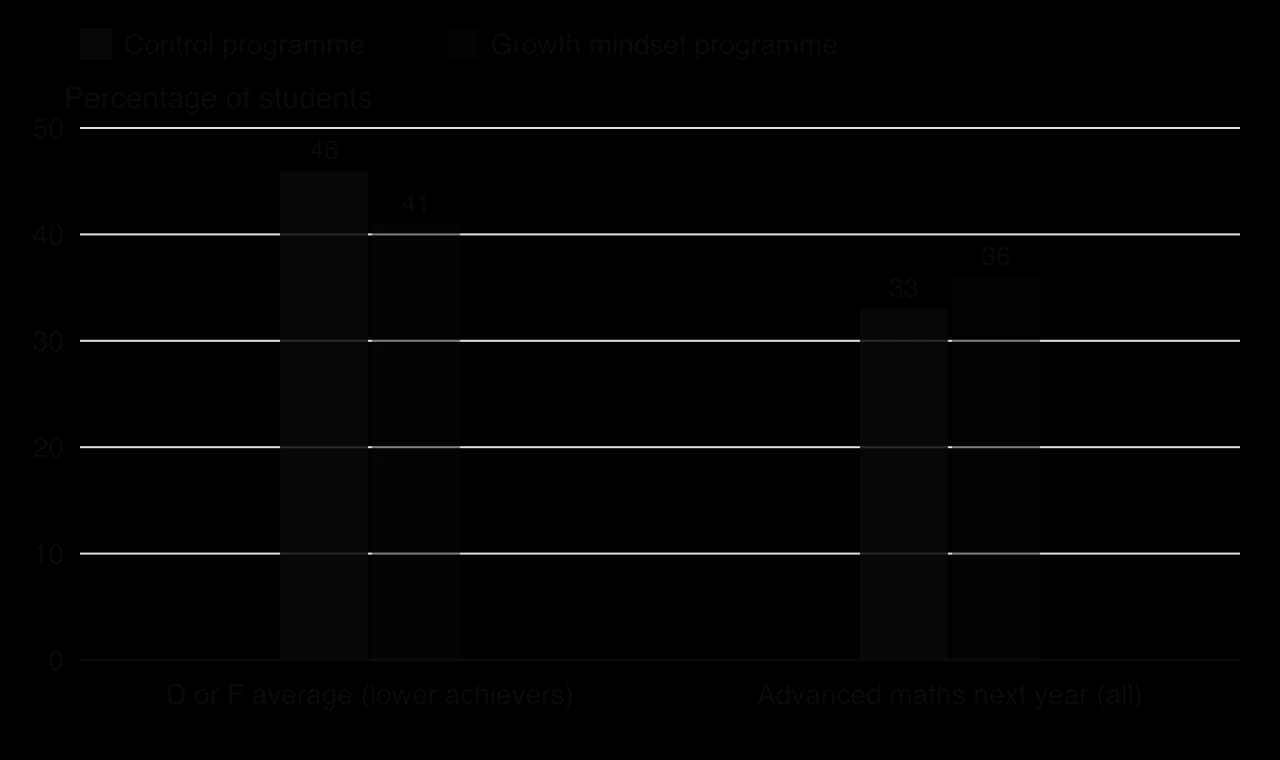
The proportion of lower-achieving students with a D or F average in core courses, which marks them as off track for graduation, fell from 46% in the control group to 41% in the intervention group. Across all students in 41 schools, enrolment in advanced mathematics the following year rose from 33% to 36%. The GPA effect was larger in schools where peer norms supported taking on challenges and close to zero where they did not.
Conclusions
A brief, cheap, online message about the nature of ability changed students’ beliefs and produced a small improvement in grades among lower achievers across a nationally representative sample. Motivation can therefore be changed at scale, but the effect depends on context: a change in an individual’s beliefs lasted and affected grades mainly where the school’s peer culture allowed the new belief to be acted on.
Evaluation
Causality
Random allocation of individual students within each school means that the two groups differed only by chance at the start, so the difference in grades can be attributed to the programme. Because the control programme was also an online lesson about the brain, the effect cannot be explained simply by students receiving attention or doing something new. The study shows that the intervention caused the change, but not exactly which part of it did so: the change in mindset is the most likely route, yet the design cannot rule out others, such as a general rise in confidence.
Measurement
Grades were taken from school records and collected independently, so they were not open to the students’ self-presentation or the researchers’ expectations. Mindset itself was measured by self-report straight after the intervention, when students knew what message they had just received, so the reported change in beliefs could be inflated by demand characteristics. GPA is a broad outcome affected by many factors, which partly explains why the effect is small.
Bias and the wider evidence
The study was designed to reduce bias: preregistration prevented the researchers from choosing favourable analyses after seeing the data, and an independent company collected the data. Several authors, however, had promoted mindset research to schools and the public, a possible source of allegiance bias, although none had a financial link to companies selling mindset products. The result fits the small, context-dependent effects found in later meta-analyses.
Generalisability and responsibility
The sample represents US public secondary schools well, a major strength, but not other countries, school systems or age groups, and the effect depended on peer norms that vary between cultures. Students gave assent, and parents were informed where school districts required it, because the study ran as an evaluation of a school programme. Promoting a small effect as a cure for low achievement would be irresponsible, because it could divert resources from changes to teaching and school structures with larger effects.
Sources: Yeager, D. S., Hanselman, P., Walton, G. M., et al. (2019). A national experiment reveals where a growth mindset improves achievement. _Nature, 573, 364–369._
Exam practice
Motivation appears only in Paper 3, through a booklet of unseen sources built around one claim about the role of motivation in one context. The questions ask you to explain an issue that limits the interpretation of a source, to analyse a source’s findings and link them to the claim, to discuss a qualitative source, and to judge the claim using at least three sources and your own knowledge. All data in the practice booklet are hypothetical.
Claim for the practice booklet: extrinsic rewards reduce students’ motivation to learn.
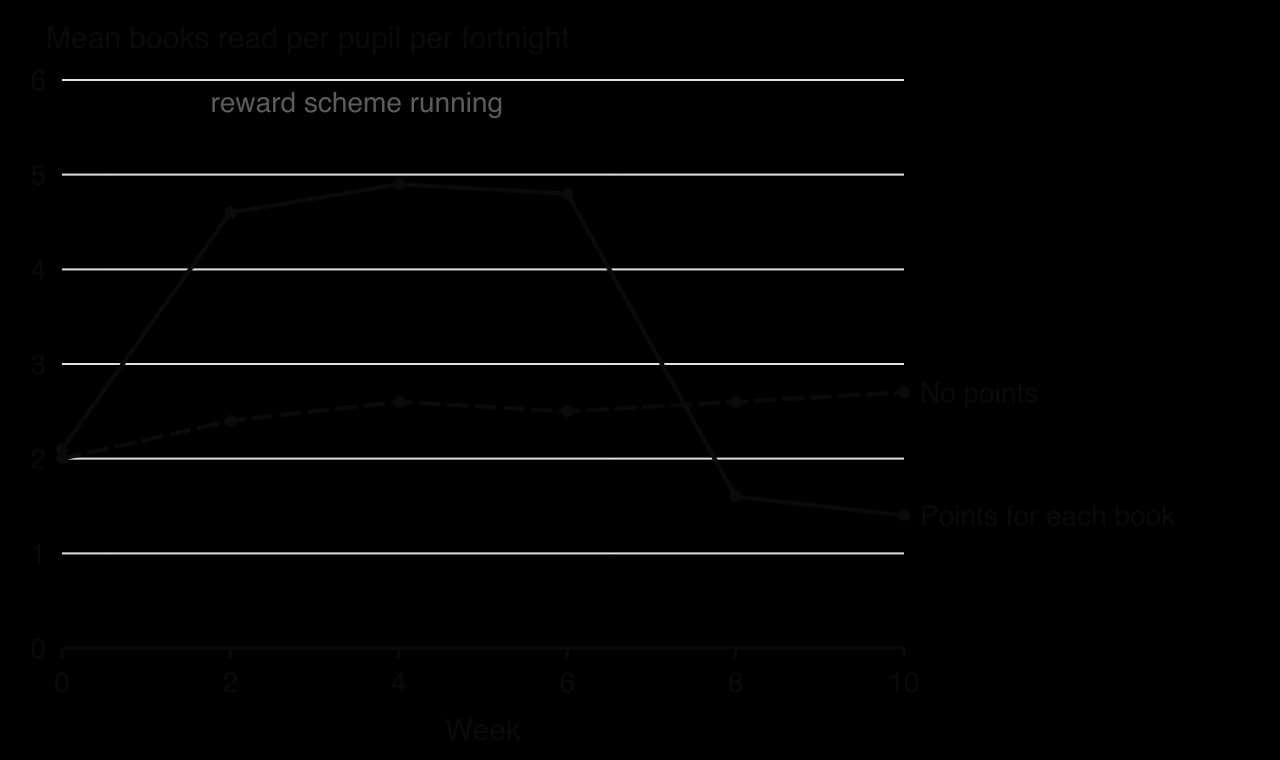
Source 1: a classroom reading scheme
A primary school teacher ran a reading scheme in one class, giving points that could be exchanged for small prizes for each book a pupil read, from week 1 to week 6. A parallel class with a different teacher received no points. The teacher recorded the mean number of books read per pupil in each fortnight.
Source 2: a laboratory experiment
Ninety university students were randomly allocated to three conditions while solving interesting puzzles: paid a small amount per puzzle solved, given positive verbal feedback, or given nothing. Afterwards, each student was left alone for eight minutes with more puzzles and magazines, and the researchers recorded secretly how many minutes they spent on the puzzles. Students then rated their interest in the puzzles (1–7).
Condition (n = 30 each) | Free-choice minutes on puzzles: mean (SD) | Self-reported interest, 1–7: mean (SD) |
|---|---|---|
Paid per puzzle | 2.1 (1.8) | 5.2 (1.1) |
Positive feedback | 4.6 (2.0) | 5.6 (0.9) |
No reward | 3.9 (2.1) | 5.3 (1.0) |
Difference between conditions | p < 0.01 | p = 0.31 (not significant) |
Hypothetical data for practice.
Source 3: interviews with teachers
A researcher carried out semi-structured interviews with eight teachers at one private secondary school with a strict merit-and-demerit system. The teachers were volunteers. One theme was “rewards as a crutch”:
The merits get them started, but some of them won’t do anything without asking “Is this for merits?” first. … The ones who really love the subject don’t care about merits at all. … I think it depends on the child more than the system.
— Hypothetical interview extract, written for practice
Synthesis
Summary
Motivation gives behaviour direction, energy and persistence; it is inferred rather than observed and involves biological, cognitive and sociocultural factors.
Primary motives (hunger, thirst, sleep) are biologically based and can be partly measured physiologically; secondary motives (achievement, affiliation, interests) are learned and mostly measured by self-report and behaviour.
Intrinsic motivation comes from the activity itself; extrinsic motivation comes from separate outcomes. Expected tangible rewards tend to reduce free-choice engagement in interesting tasks, while positive feedback increases it.
Self-determination theory explains intrinsic motivation through the needs for autonomy, competence and relatedness, and describes a continuum from controlled to autonomous motivation; its universality has been questioned from a cultural perspective.
In health, motivational interviewing, financial incentives and autonomy-supportive care all change behaviour, with small to moderate effects.
In development, material rewards reduced toddlers’ helping and praise for intelligence reduced persistence after failure; in groups, goal setting and the collective effort model explain effort; in learning, intrinsic goals and autonomy support deepen processing.
Research on motivation faces self-report bias, bidirectional ambiguity, short-term measures, small effects, replication failures (ego depletion) and publication bias (growth mindset).
Yeager et al. (2019) found a small, preregistered, nationally representative improvement in lower achievers’ grades (0.10 GPA points), larger where peer norms supported challenge.
Self-check
- To do:
I can explain motivation and the differences between primary and secondary motives and between intrinsic and extrinsic motivation.
- To do:
I can explain self-determination theory, the three basic psychological needs and the continuum of motivation.
- To do:
I can describe physiological, self-report, behavioural and experimental measures of motivation and a problem with each.
- To do:
I can discuss the role of motivation in each of the four contexts with a piece of research for each.
- To do:
I can explain the research challenges of studying motivation, including bidirectional ambiguity, small effects and publication bias.
- To do:
I can describe and evaluate Yeager et al. (2019).
- To do:
I can analyse an unseen source on motivation and link its findings to a claim.
- To do:
I can evaluate a claim about motivation using several sources and my own knowledge.