10 Class practicals
How the four class practicals pair a research method with a context, the ethical rules they share, how they link to the concepts and the rest of the course, and how they are assessed.
- IB Psychology
- SL and HL
What 10 covers
From the subject guide: what you need to know and be able to do.
Four practicals, one for each research method, examined in paper 2.
4 subtopics in Class practicals
Each one has its own page once something is published for it.
- 10.1Interviewnotes
- 10.2Observationnotes
- 10.3Survey or questionnairenotes
- 10.4Experimentnotes
Key terms introduced here
Each is in the Psychology glossary, with every other term in the subject.
- Class practical
A small-scale research study carried out by a class, led by the teacher or by students under supervision, to experience a research method at first hand within one of the course’s contexts.
- Consent form
A written document in which a participant, and for a minor a parent or guardian, confirms that they understand a study’s aim, procedure and rights, and agree to take part.
- Pilot study
A small trial run of a study’s procedure or data collection tool with a few people before the main study, used to find and fix problems such as unclear questions or timing.
An overview of 10 Class practicals
Class practicals are small research studies that students carry out, or take part in, during the course: one interview, one observation, one questionnaire and one experiment. Each uses one research method to investigate a topic in one of the four contexts, so that the methods studied in research methodology are experienced at first hand rather than only read about.
Questions the class practicals answer
How is a research question turned into a study that can actually be carried out, with real participants, in limited time?
Which method fits which kind of question: experience and meaning, behaviour as it happens, attitudes across many people, or cause and effect?
How are constructs such as stress, play, closeness or memory operationalised and measured, and how good are those measures?
How do ethical rules shape what can be studied, and how do they affect the data?
What can each method conclude, and where do bias and the limits of causality come in?
The four practicals
Each context is paired with one method. The pairing reflects what each context studies: health and well-being depend on personal experience, development is seen in children’s behaviour, relationships involve attitudes that can be self-reported, and cognitive processes can be tested with controlled tasks.
Subtopic | Context | Variants of the method | Smallest sample for a student-led practical | What it teaches |
|---|---|---|---|---|
10.1 Interview | Health and well-being | Structured or semi-structured individual interview; focus group | One participant, or one focus group of 3–8 | Interview schedules, rapport, transcription, thematic analysis, credibility |
10.2 Observation | Human development | Naturalistic or controlled; overt or covert; participant or non-participant | One participant | Behavioural categories, event and time sampling, inter-rater reliability, observer bias, reactivity |
10.3 Survey or questionnaire | Human relationships | Closed and open items, Likert and rating scales, online or on paper | Ten participants | Operationalising constructs as items, wording, reverse scoring, response rate, self-report bias, correlation |
10.4 Experiment | Learning and cognition | True experiment or quasi-experiment | Five participants | Operationalised IV and DV, hypotheses, designs, standardisation, controls, descriptive statistics |
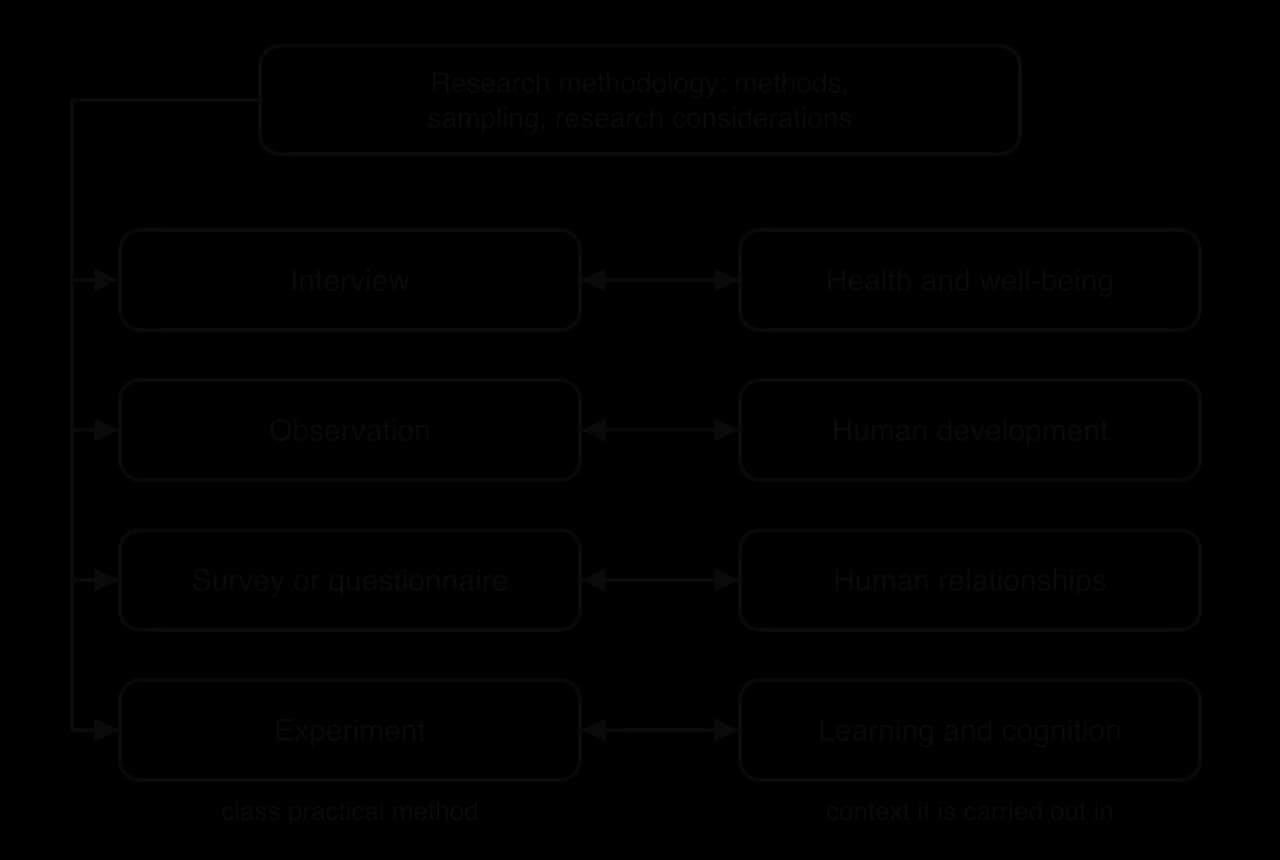
A practical can be teacher-led, with the teacher as researcher and the class as participants, or student-led, with small groups of students running the study under supervision. Most take place in lessons. A student-led practical outside lessons needs a class practical research form approved by the teacher, and every practical needs signed consent forms. The topic of each practical is chosen so that it could also be studied with the other three methods, which makes comparing the methods much easier.
Ethics shared by all four practicals
Every practical follows the general ethical principles of psychology and a stricter set of rules for school research. Students are participants as well as researchers, so the rules protect classmates as much as anyone else.
Rule | In practice |
|---|---|
Supervision | The teacher approves every plan, tool and procedure. |
Written informed consent | Every identifiable participant signs a consent form; implied consent is not accepted. Under-16s need a parent’s or guardian’s consent, and research with children in a school also needs their teachers’ written consent. |
Right to withdraw | Participants can stop at any time and withdraw their data. |
No harm | Nothing that causes anxiety, stress, pain or embarrassment; sensitive topics such as mental health problems, bullying or self-harm are avoided; cultural sensitivity throughout. |
Deception | Only partial deception, only when the full aim would change behaviour, only when harmless, always followed by a full debrief. |
Banned designs | No conformity or obedience studies, no animals, and no participants who cannot respond freely. |
Observation in public | Observation without consent only where people expect to be seen by strangers. |
Data protection | Anonymity, secure storage, use only for the agreed purpose, and deletion afterwards. |
Testing a procedure on a few people first, a pilot study, is part of good practice for every method: it catches unclear questions, unworkable categories and timing problems before real participants are involved.
Links to the concepts and to the rest of the course
The practicals are where the six concepts become concrete. Measurement appears in every decision about how to operationalise a construct; bias in interviewer effects, observer bias, social desirability and demand characteristics; causality in the contrast between the experiment, which can test cause and effect, and the other three methods, which cannot; responsibility in consent, deception and data protection; perspective in the choice between emic, open methods and etic, closed ones; and change in how findings could inform an intervention.
The practicals also connect the two halves of the course. They apply research methodology (research methods, sampling techniques and research considerations such as credibility and generalisability) to the four contexts, and their topics draw on the approaches: a memory experiment tests a cognitive model, an observation of play applies theories of development, a questionnaire on friendship measures constructs from the sociocultural approach. Every published study met elsewhere in the course used one of the same methods, so experience with the practicals makes it easier to evaluate research in any topic.
How SL and HL differ
SL and HL students carry out the same class practicals, with the same methods and ethical rules, and are assessed on them in the same way. HL students build on them in the HL extension on data analysis and interpretation, which develops the descriptive statistics, graphs and thematic analysis used in the practicals into fuller work on distributions, inferential statistics and qualitative analysis, assessed in Paper 3.
Assessment
The class practicals are assessed in Paper 2 Section A. The questions name one of the four methods and focus on the method rather than the topic investigated. There are four questions on the named practical: describe how the method was used, explain one of the six concepts in relation to it, compare and contrast it with another method, and design a study on the same topic using a different method.
The practicals also prepare for Paper 2 Section B, the evaluation of an unseen study through the concepts, and for the internal assessment, a research proposal in which students design, but do not carry out, a study on a real-life problem using one of the same four methods. The practical record itself is not assessed.
Carry on with 10 in Augment
With a free account, Augment remembers where you stopped and what you have practiced.