Plan, run and analyse an observation practical on child development, apply the ethical rules for observing children and the public, and answer the four kinds of question asked about the method.
Each is in the Psychology glossary, with every other term in the subject.
A clearly defined, observable behaviour listed on an observation schedule, operationalised so that different observers record the same actions in the same way.
An observation sampling method in which the observer records every occurrence of each behavioural category during the whole observation period.
Written qualitative records made during or soon after an observation, describing what happened, in what context, and the observer’s reflections.
A data collection tool for observations that lists operationalised behavioural categories and sets out how and when each occurrence is recorded, usually as tallies.
A distortion in observational data caused by the observer’s expectations, beliefs or interpretations affecting what they notice and how they record it.
A change in participants’ behaviour caused by their awareness of being observed or studied, which makes the observed behaviour less natural.
An observation sampling method in which behaviour is recorded only at set intervals, for example which categories occur in a ten-second window every minute.
Describe the types of observation: naturalistic and controlled, overt and covert, participant and non-participant.
Explain how to plan an observation practical in human development, including its aim, setting, participants and duration.
Apply the ethical rules for school practicals to observing children and people in public places.
Design an observation schedule with operationalised behavioural categories, and choose between event sampling and time sampling.
Explain how inter-rater reliability is measured and how observer bias and reactivity are reduced.
Explain each of the six concepts in relation to an observation practical.
Evaluate observation as a research method, with reference to a published observational study of children.
Compare and contrast observation with other research methods, and design another method on the same topic.
An observation is a research method in which researchers watch and record behaviour as it happens, rather than asking people about it. It is the method of the class practical in the human development context, because development is seen most directly in what children do: how they play, share, talk and solve problems at different ages.
Observation records what people actually do, which avoids many of the problems of self-report. It brings its own problems of measurement, because behaviour has to be divided into categories that observers can count; of bias, because observers see what they expect; and of responsibility, because people, and especially children, are being watched.
With a free account, Augment remembers where you stopped and what you have practiced.
Scope: The observation class practical, carried out in the human development context: naturalistic or controlled, overt or covert, participant or non-participant observations, planned, conducted, analysed and evaluated. The general theory of observation as a research method belongs to research methods; the assessment of this practical focuses on the method rather than on the topic investigated.
In an observation the researcher does not manipulate any variable: behaviour is recorded as it occurs. Observation can be a method in its own right, as in a study of how toddlers play in a nursery, or a way of measuring the dependent variable inside an experiment, as when researchers count children’s aggressive acts after they have watched an aggressive or a calm adult.
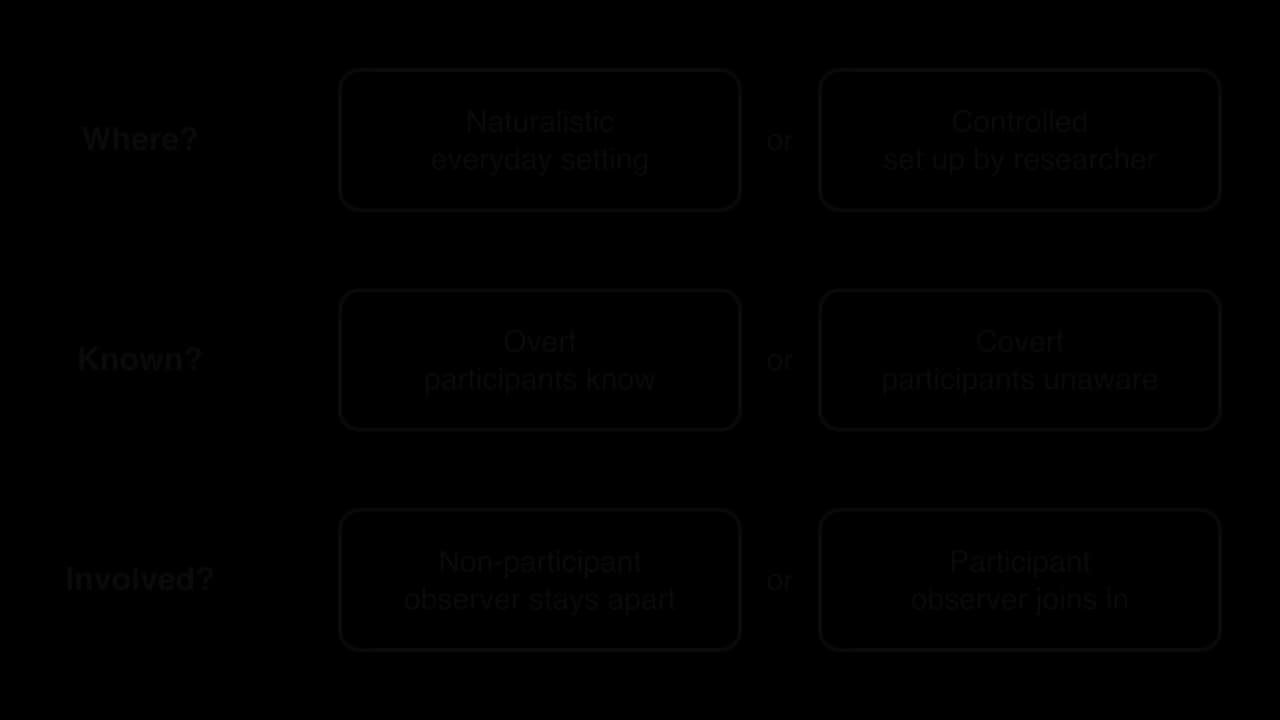
Every observation can be described by three separate choices. The setting can be natural or arranged by the researcher; participants can know or not know that they are being observed; and the observer can stay apart or take part in the group being studied.
Type | What it means | Main strength | Main limitation |
|---|---|---|---|
Naturalistic | Behaviour in its everyday setting, such as a playground or a family home | High ecological validity: behaviour is natural | No control over extraneous variables; behaviour of interest may not occur |
Controlled | Behaviour in a setting arranged by the researcher, often a laboratory playroom | Standardised, so it can be replicated and compared | Artificial setting may change behaviour |
Overt | Participants know they are being observed | Consent can be obtained | Reactivity: people behave differently when watched |
Covert | Participants do not know they are being observed | Behaviour is natural | No consent; ethically acceptable only in limited situations |
Non-participant | The observer watches from outside the group | Observer stays objective and can record systematically | May miss the meaning of behaviour for the group |
Participant | The observer joins the group being studied | Insider understanding of meaning and context | Observer may lose objectivity; hard to record at the time |
Observations also differ in how the data are recorded. In a structured observation, observers use a prepared list of behaviours and count how often each occurs, producing quantitative data. In an unstructured observation, observers write detailed descriptions of everything relevant, producing qualitative data. Many studies combine the two: tallies to compare groups, and notes to explain what the numbers mean.
Young children cannot fill in questionnaires or describe their thinking in an interview, but they can be watched. Developmental research therefore relies heavily on observation, from how infants respond to separation from a carer to how preschool children move from playing alone to playing together. Observation also shows development in context: how children behave with siblings, in classrooms and in different cultures.
Observation has limits in this context. It shows what children do but not why: two children who play alone may do so for very different reasons, such as shyness, concentration or not yet understanding the game. Researchers often combine observation with other methods, such as interviews with parents or teachers, to interpret what they see. Using more than one method in this way is a form of triangulation.
 YouTube
An observation aim names a behaviour, a group and, often, a comparison: “to investigate the types of social play shown by four- and five-year-olds during free play” or “to investigate whether toddlers in a public playground stay closer to their carer on unfamiliar equipment”. The behaviour must be visible. Aims about thoughts or feelings, such as “to find out how children feel about sharing”, need another method or must be turned into behaviour that can be seen.
The setting follows from the aim and from ethics. A naturalistic observation needs a place where the behaviour occurs often enough to be recorded in the time available, such as a playground at break time. A controlled observation needs a setting the researcher can arrange, such as a classroom with a chosen set of toys, so that every child meets the same situation.
An observation samples twice. It samples people: the target children or adults, chosen by opportunity sampling (whoever is present in the setting), self-selected sampling (volunteers or children whose parents agree) or occasionally by another technique. It also samples behaviour: observers cannot record everything, so they decide which behaviours to record and when. For a student-led practical, the minimum sample is one participant, for example a single toddler observed during several play sessions.
Duration matters as well. A single ten-minute observation may catch an unusual day; observing the same children on several days gives a more reliable picture. Observers often spend a short time in the setting before recording, so that participants become used to them.
Observation raises its own ethical questions because people may not know they are being watched, and because development research often involves children. The general principles of informed consent, protection from harm, anonymity and confidentiality apply, and schools add rules for class practicals.
Rule for school practicals | What it means for an observation |
|---|---|
Teacher supervision | The teacher decides which settings and behaviours are appropriate and approves the observation schedule. |
Public places only without consent | A naturalistic observation without consent is limited to places where people expect to be seen by strangers, such as a shopping centre, a park or public transport. Private places, such as homes, changing rooms or toilets, are never used. |
Written consent for identifiable participants | Where participants are chosen and can be identified, as in a school class, they give written consent on a consent form; implied consent is not acceptable. |
Children | Children under 16 need a parent’s or guardian’s written consent; observing children in a school also needs the written consent of their teachers. Children under 12 may be observed with appropriate safeguards, especially fully informed parental consent. |
No recording of identifiable minors | No photographs or video of children who could be identified, unless consent covers it; tally sheets use codes, not names. |
No harm or distress | Nothing is set up to frustrate, frighten or embarrass anyone. Settings that would create conflict between children are avoided. |
Data protection | Records are stored securely, used only for the agreed purpose and destroyed afterwards. |
Consent and debriefing are impractical in a naturalistic observation of strangers, which is why such observations are restricted to public settings and to non-intrusive behaviour. Covert participant observation, in which the observer joins a group under false pretences, involves deception and is not suitable for a class practical.
Ethical choices affect the data. Children who know they are being watched, or whose parents have told them about the study, may behave differently; families who give consent may differ from those who do not. Observing only in public settings limits the behaviours that can be studied. These effects connect responsibility directly with validity.
The data collection tool of a structured observation is the observation schedule, also called a behaviour checklist or coding scheme. It lists the behaviours to be recorded, defines each one precisely, and sets out how and when observers record them.
Most aims are about a construct that cannot be seen directly, such as prosocial behaviour, attachment or cooperation. The construct is broken into behavioural categories, and each category is given an operational definition that says exactly which actions count. This is operationalisation applied to behaviour.
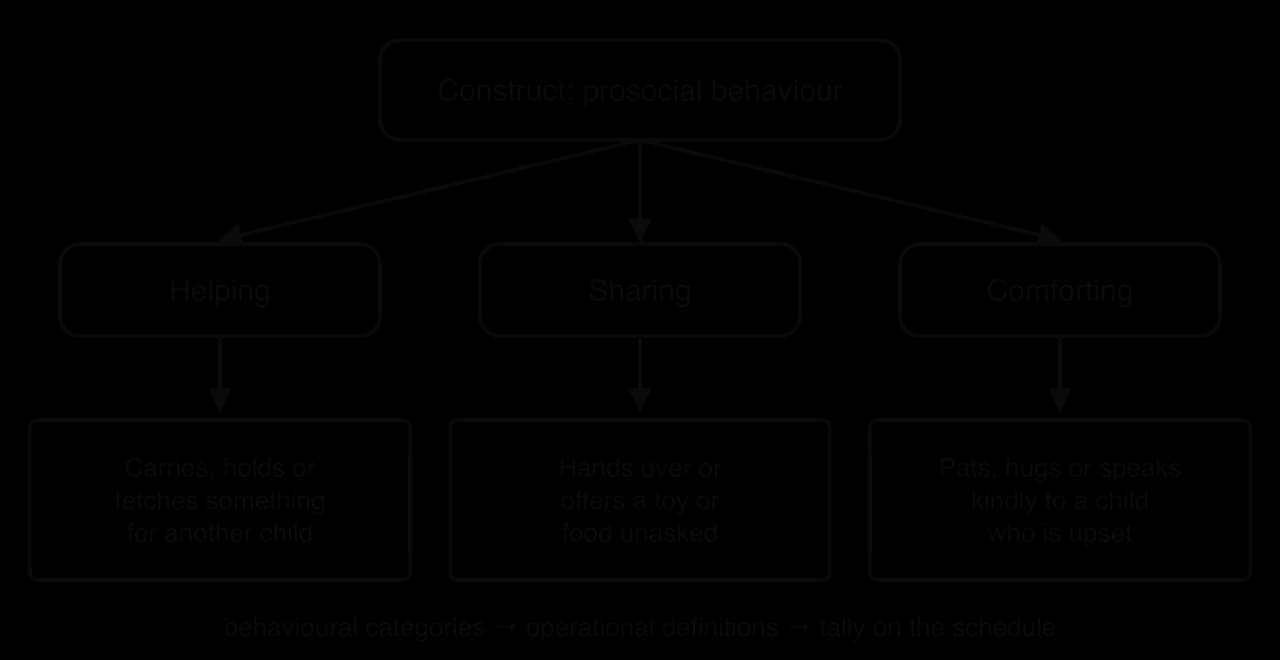
Good categories share four features. They are observable: they describe actions, not inner states (“cries or calls for carer”, not “feels anxious”). They are mutually exclusive: one action fits only one category. They are exhaustive enough to cover the behaviours that matter for the aim. And they are few enough to record in real time: a schedule with twenty categories cannot be used reliably by a beginner.
Weak category | Problem | Operationalised category |
|---|---|---|
“Is happy” | An inner state; observers will disagree | “Smiles or laughs while looking at another child” |
“Plays nicely” | Vague and judgemental | “Takes turns: waits, then uses the toy after another child” |
“Is aggressive” | Too broad; includes play-fighting | “Hits, kicks or pushes another child, who moves away or cries” |
“Plays with others” and “Talks” | Overlap: talking happens during play with others | Separate play categories from talking, or define one set only |
The schedule is usually laid out as a grid, with categories as columns and time intervals or target children as rows, so that observers can tick quickly without looking away for long. Before the main study, observers carry out a pilot study, for example by coding a short video of children at play. The pilot shows which categories are unclear, which never occur and whether observers can keep up.
Observers have to decide when to record. In event sampling, they record every occurrence of each category during the whole observation. In time sampling, they record only at set moments, for example which categories occur in a ten-second window at the start of each minute, or what a target child is doing every 30 seconds.

The two methods suit different behaviours. A fight or a request for help is short, clearly bounded and fairly rare, so every instance can be caught. Play type or attention to a task is continuous, so a snapshot at regular moments describes it well.
Event sampling | Time sampling | |
|---|---|---|
Best for | Behaviours that are infrequent and clearly start and stop (a fight, a request for help) | Frequent or continuous behaviours (type of play, being on task) |
Strength | Records every occurrence, so rare behaviours are not missed | Manageable; several children or categories can be recorded in turn |
Limitation | Hard to keep up when behaviour is frequent or several things happen at once | Behaviour between sampling points is missed; brief behaviours may be under-recorded |
Time sampling has a long history in developmental research. Parten (1932) observed children aged about two to five at a nursery school for one minute at a time on many different days, classifying what each child was doing into categories of social participation: unoccupied, onlooker, solitary play, parallel play, associative play and cooperative play. Older children spent more of their time in associative and cooperative play, and her categories are still used to code children’s play.
Sources: Parten, M. B. (1932). Social participation among pre-school children. _Journal of Abnormal and Social Psychology, 27(3), 243–269._
An observation is reliable if different observers watching the same behaviour record the same thing. This is inter-rater reliability. It is checked by having two observers code the same session independently and comparing their records. The simplest measure is percentage agreement; professional researchers often use statistics that also allow for agreement by chance, or correlate the two observers’ tallies.
Agreement of about 80% or more is usually taken as acceptable. Low agreement does not mean that one observer was “wrong”; it usually means that a category is unclear. The fix is to redefine the category, train the observers on examples and check again.
 YouTube
Observer bias occurs when what an observer expects or believes affects what they notice and how they record it. An observer who expects boys to be more aggressive may record rough play by boys as “hitting” and the same behaviour by girls as “play”. Bias is greatest when categories are vague and when observers know the hypothesis or which group a child belongs to.
Three controls reduce observer bias. Precise, operationalised categories leave less room for interpretation. Several observers, with inter-rater reliability checked, show whether one person’s view is distorting the data. Observers who are “blind” to the hypothesis or to the condition each participant is in cannot let expectations steer their coding. In the Bobo doll research of Bandura, Ross and Ross (1961), children’s behaviour was recorded through a one-way mirror in five-second intervals, and 51 of the children were coded independently by two observers so that agreement could be checked. The observers knew which condition each child had been in, which is a common criticism of the study.
Reactivity is a change in behaviour caused by participants’ awareness that they are being observed. People may behave more politely, work harder or show off; children may stare at the observer or play to the audience. A related idea is the Hawthorne effect, in which performance improves simply because people know they are being studied.
Observers reduce reactivity by spending time in the setting before recording so that participants get used to them (habituation), by sitting out of the way and avoiding eye contact, by observing through a one-way mirror, or, in public places, by observing covertly. Ainsworth’s Strange Situation, a controlled observation of infants’ responses to being separated from and reunited with a carer, used observers behind a one-way mirror and a fixed sequence of short episodes, so that every infant met the same situation and the observers did not change it.
Not all observations count behaviour. In an unstructured observation, observers write field notes: descriptions of what happened, in what order and in what context, plus their own reflections. The notes are later analysed into themes in the same way as interview transcripts. This approach suits questions about meaning and process, such as how a group of children negotiates the rules of a new game.
Participant observation is usually qualitative. Rosenhan (1973) reported a covert participant observation in which eight people without mental illness gained admission to psychiatric hospitals and recorded how staff treated them. The study is widely taught, but later archival research by the journalist Susannah Cahalan found inconsistencies in its records, and some of its reported details may not be accurate. It shows both the insight participant observation can give and how hard it is for others to check what a single covert observer reports.
Qualitative observation gives rich, contextual data and an insider view, but it is harder to check than a tally. Two observers may write very different notes about the same scene. Credibility is supported by detailed descriptions of the setting, by notes written immediately, and by reflexive comments on how the observer’s presence and views may have shaped what was recorded.
Concept | How it applies to an observation practical |
|---|---|
Bias | Observer bias from expectations; reactivity in overt observation; the sample (only children whose parents consented, or only the children present on certain days). |
Causality | A naturalistic observation describes behaviour and can show that behaviours occur together, but it cannot show cause and effect: nothing is manipulated and extraneous variables are uncontrolled. Observation inside an experiment can measure the DV of a causal study. |
Change | Repeated observations can track developmental change, for example how play becomes more cooperative with age, or the effect of a school programme on playground behaviour. |
Measurement | Constructs are operationalised as behavioural categories; event or time sampling decides what is recorded; inter-rater reliability checks consistency. Behaviour is measured directly rather than through self-report. |
Perspective | Categories are chosen by the researcher (an etic view) and may not match what behaviour means to the participants or their culture; participant observation and field notes give a more emic view. |
Responsibility | Consent from parents and teachers for children; public places only for observation without consent; no identifiable recordings; covert participant observation avoided. |
Measurement and perspective are closely linked in observation. A category such as “plays alone” is easy to count, but its meaning depends on context and culture: in some communities children play alone less because they spend much of their time caring for younger siblings. Counting the behaviour without understanding the setting can lead to wrong conclusions about development.
The following worked practical follows an overt, non-participant naturalistic observation from plan to findings, using Parten’s play categories. The data are hypothetical.
The observation schedule uses Parten’s categories, operationalised so that student observers can tell them apart quickly.
Category | Operational definition |
|---|---|
Unoccupied or onlooker | Not playing; wandering or watching other children without joining in |
Solitary play | Playing alone with materials different from those of nearby children; no talk with others |
Parallel play | Playing beside another child with similar materials, without talking to them or exchanging materials |
Associative play | Playing with another child, talking or exchanging materials, but with no shared goal or roles |
Cooperative play | Playing with others towards a shared goal or with roles (building one tower together, playing “shop”) |
With eight children each sampled 15 times, each observer recorded 120 observations. The two observers agreed on 101 of them.
The Six Cultures Study of Socialization, led by the anthropologists Beatrice and John Whiting of Harvard University, is one of the largest naturalistic observation studies of children ever carried out. Its findings were summarised by Whiting and Whiting (1975) in Children of Six Cultures.
The study aimed to find out how children’s everyday social behaviour differs across cultures, and which features of a community’s way of life explain the differences. A central question was whether patterns found in Western child development research were universal or specific to Western societies.
Beginning in 1954, six teams of field researchers, mostly husband-and-wife pairs trained in anthropology and child development, each lived in one community: Nyansongo, a Gusii community in Kenya; Khalapur, a Rajput community in northern India; Taira, a village in Okinawa, Japan; Juxtlahuaca, a Mixtec community in Mexico; Tarong, a hamlet in the Philippines; and Orchard Town, a New England community in the USA. All teams followed a shared field guide.
The sample was 134 children aged 3 to 11, with equal numbers of girls and boys. Each child was observed many times in five-minute naturalistic observations of everyday settings, such as at home, in the yard or with other children; in total there were nearly 2,000 observation periods. Observers wrote running descriptions of each social interaction, which were later coded into summary categories of social behaviour, such as offering help, offering support, suggesting responsibly, seeking help, seeking attention and seeking dominance.
Pattern of behaviour | Categories | Where it was more common |
|---|---|---|
Nurturant–responsible | Offers help, offers support, suggests responsibly | Simpler, mainly farming communities: Nyansongo (Kenya), Juxtlahuaca (Mexico), Tarong (Philippines) |
Dependent–dominant | Seeks help, seeks attention, seeks dominance | More complex societies with more occupational specialisation and social hierarchy: Orchard Town (USA), Khalapur (India), Taira (Japan) |
Sources: Whiting, B. B. & Whiting, J. W. M. (1975). _Children of Six Cultures: A Psycho-Cultural Analysis. Harvard University Press._
Children in the simpler communities more often helped, supported and gave responsible suggestions to others. In these communities mothers had heavy workloads and delegated real economic and domestic tasks to children from an early age. Children in the more complex communities more often sought help, attention and dominance; they were given fewer responsible tasks.
Children’s social behaviour is shaped by the everyday settings and tasks their culture gives them. Being given responsible economic and domestic tasks appears to encourage nurturant, responsible behaviour, while settings in which children are cared for rather than caring for others appear to encourage dependent and attention-seeking behaviour. Development of prosocial behaviour is therefore not only a matter of age but of cultural context, which is an argument against treating Western samples as the norm.
Using the same field guide, the same five-minute observation format and the same summary categories in every community made the data comparable, which is the main strength of the design. Observing behaviour directly avoided the problems of asking young children, or their parents, to report it. However, a category such as “seeks dominance” may not mean the same thing in every culture: a child giving orders to a younger one may be carrying out an assigned duty rather than seeking dominance.
Most of the observers were American researchers living in small communities, so reactivity was likely: children and families knew they were being watched by visible outsiders. The categories were designed by Western researchers, so the study partly imposes an etic framework on other cultures, although the teams’ long fieldwork and local assistants gave them some insider understanding. The link between tasks and behaviour is also correlational: communities differed in many ways at once, so the study cannot show that chores alone caused the differences.
Long-term naturalistic observation of children in their homes depends on the trust of families and communities. The researchers also had a responsibility in how they described communities in print, so that differences were reported as adaptations to ways of life rather than as deficits. Modern ethics standards would expect written consent and community agreement to be documented more formally than in the 1950s.
Paper 2 Section A asks four questions on one class practical, named by its method: describe how the method was used [4], explain one concept in relation to it [4], compare and contrast it with another method [6], and design a study on the same topic with a different method [6]. The model answers use the worked practical on social play.
Explain questions give one concept. The answer explains the concept and links it to two or three decisions in the practical.
A compare and contrast answer needs both similarities and differences, each explained with reference to both methods.
An observation records behaviour as it happens; it is described by three choices: naturalistic or controlled, overt or covert, participant or non-participant.
Observation suits human development because young children cannot self-report but their behaviour can be watched in context.
Planning covers a visible behaviour, a setting where it occurs, the sample of people (minimum one) and the sample of behaviour.
Observation without consent is limited to public places; observing identifiable children needs written consent from parents and teachers, with no identifiable recordings.
An observation schedule breaks a construct into operationalised behavioural categories that are observable, mutually exclusive and few enough to record.
Event sampling records every occurrence; time sampling records at set intervals.
Inter-rater reliability, blind observers and clear categories reduce observer bias; habituation, one-way mirrors and covert observation reduce reactivity.
The Six Cultures Study used five-minute naturalistic observations of 134 children in six communities and linked nurturant behaviour to children’s everyday responsibilities.
Observation shows what people do but not why, and naturalistic observation cannot establish cause and effect.
I can describe the types of observation and give a strength and a limitation of each.
I can explain how to plan an observation practical in human development.
I can apply the ethical rules for observing children and people in public places.
I can design an observation schedule with operationalised behavioural categories and choose event or time sampling.
I can calculate percentage agreement and explain how observer bias and reactivity are reduced.
I can explain each of the six concepts in relation to my observation practical.
I can evaluate observation with reference to the Six Cultures Study.
I can compare and contrast observation with a questionnaire, and design an interview on the same topic.