A Space, time and motion
How the five subtopics of theme A describe, explain and predict motion, how they link to the rest of the course, and how SL and HL differ.
- IB Physics
- SL and HL
5 subtopics in Space, time and motion
Each one has its own page once something is published for it.
- A.1Kinematics122 questions · notes · 80 quick fire
- A.2Forces and momentum244 questions · notes · 95 quick fire
- A.3Work, energy and power213 questions · notes · 75 quick fire
- A.4Rigid body mechanicsHL only80 questions · notes · 60 quick fire
- A.5Galilean and special relativityHL only60 questions · notes · 60 quick fire
An overview of A Space, time and motion
Theme A is about motion: how to describe it, what causes it to change, and what stays the same while it changes. The ideas apply to everything from a falling raindrop to a spacecraft, and they form the base on which every later theme builds.
The theme is built around a small number of quantities (displacement, velocity, acceleration, force, momentum and energy) and a few powerful laws: Newton's laws of motion and the conservation of momentum and energy. HL students extend these to rotating bodies and to observers moving relative to each other, where Einstein's special relativity replaces everyday ideas about space and time.
How the subtopics fit together
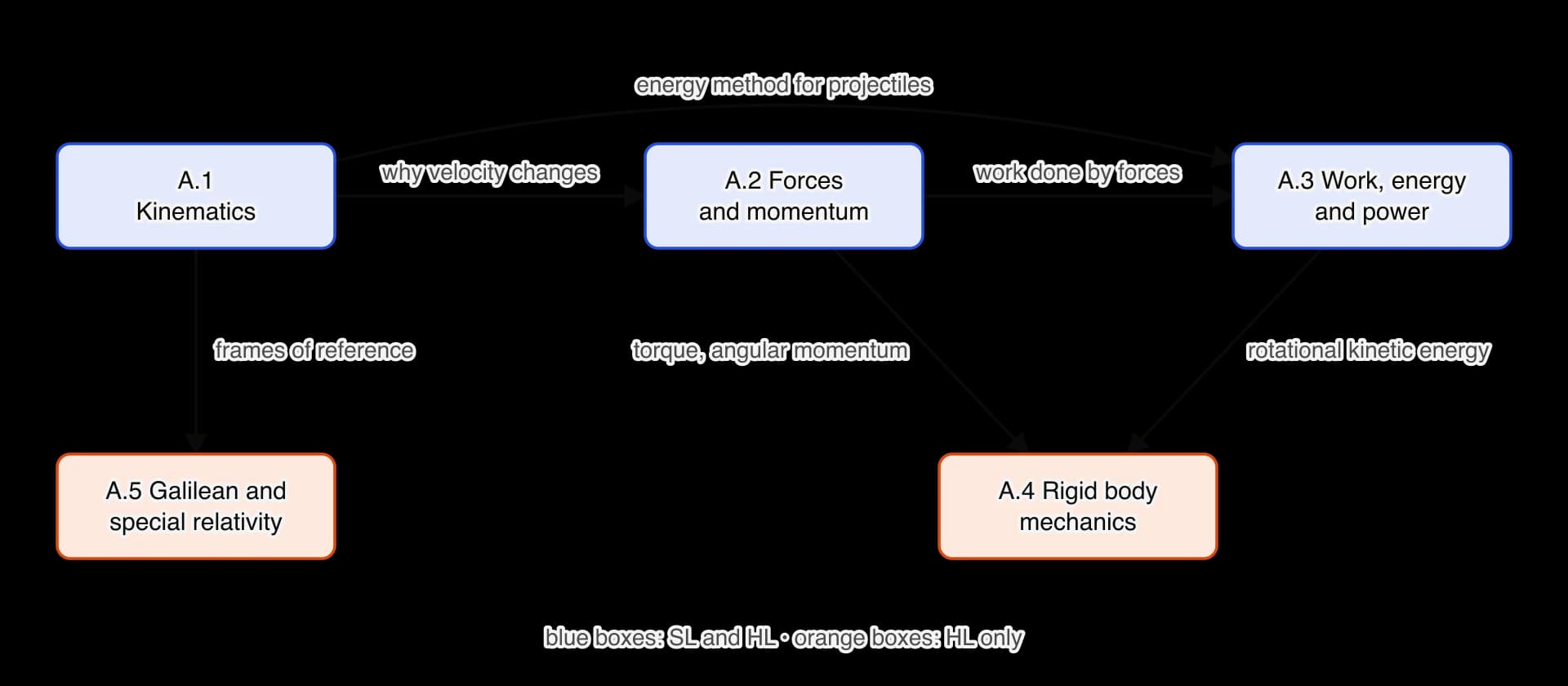
The subtopics form a chain. Each adds a new way of analysing the same motions, and many problems can be solved in more than one way.
A.1 Kinematics describes motion without asking about its cause: displacement, velocity and acceleration, motion graphs, the equations of motion for uniform acceleration, free fall, stopping distances and projectiles, plus the qualitative effect of fluid resistance.
A.2 Forces and momentum explains why motion changes. Newton's three laws, free-body diagrams and the common contact and field forces lead to momentum, impulse and collisions, and to circular motion, where a force perpendicular to the velocity changes its direction but not its speed.
A.3 Work, energy and power looks at motion through energy transfers. Work done by a force transfers energy; kinetic, gravitational and elastic potential energy are exchanged, and the principle of conservation of energy, together with power and efficiency, gives a second route through many problems from A.1 and A.2.
A.4 Rigid body mechanics (HL) extends these ideas to extended bodies that rotate: torque, moment of inertia, angular acceleration, angular momentum and rotational kinetic energy. Each linear quantity has a rotational partner, and the equations have the same form.
A.5 Galilean and special relativity (HL) asks how observers in different reference frames describe the same events. Galilean relativity works at everyday speeds; at speeds approaching that of light, the two postulates of special relativity lead to the Lorentz transformations, time dilation, length contraction and the relativity of simultaneity, all shown on space–time diagrams.
Big ideas that run through the theme
Vectors and their components. Displacement, velocity, acceleration, force and momentum all have direction. Resolving a vector into perpendicular components lets a two-dimensional problem be split into two one-dimensional ones, as for a projectile, a block on a slope or a two-dimensional collision.
Rates of change and areas under graphs. Velocity is the gradient of a displacement–time graph and acceleration the gradient of a velocity–time graph; the area under a velocity–time graph is a displacement, the area under a force–time graph is an impulse, and the area under a force–displacement graph is the work done. The same gradient-and-area reasoning returns in C.1 (oscillations), B.4 (work done by a gas from a pressure–volume graph, HL) and E.3 (activity from the gradient of a decay curve).
Conservation laws. Momentum is conserved when no resultant external force acts, and energy is always conserved. These laws often answer a question without the detail of the forces involved, which is why they reappear throughout physics: energy in thermal physics (B.1, B.4), circuits (B.5), fields (D.1, D.2) and nuclear physics (E.3–E.5); momentum in the kinetic model of a gas (B.3) and in nuclear decay.
Models and their limits. Bodies are modelled as point particles, then as rigid bodies; fluid resistance is often neglected; Newtonian mechanics is itself a model that fails at speeds close to that of light. Knowing when a simplification is justified, and how a prediction changes when it is not, is part of every calculation in the theme.
Motion in fields. The kinematics of A.1 and the dynamics of A.2 are used again in theme D. A charged particle in a uniform electric field follows a parabola like a projectile, a satellite orbit is circular motion with gravity as the centripetal force, and a charge moving across a magnetic field moves in a circle (D.1, D.3). Simple harmonic motion (C.1) is another kind of motion with non-uniform acceleration, analysed with the same graphs.
Standard level and higher level
Every student studies A.1, A.2 and A.3. A.1 and A.3 are the same at both levels. HL adds two whole subtopics and one extension within A.2.
Subtopic | SL | HL |
|---|---|---|
A.1 Kinematics | Studied in full | Same as SL |
A.2 Forces and momentum | Collisions and explosions in one dimension | Adds collisions and explosions in two dimensions, solved with momentum components |
A.3 Work, energy and power | Studied in full | Same as SL |
A.4 Rigid body mechanics | — | HL only |
A.5 Galilean and special relativity | — | HL only |
In A.2, SL students apply conservation of momentum along a single line. HL students also analyse collisions and explosions in a plane, where momentum is conserved separately in two perpendicular directions; this part of A.2 is marked HL.
A.4 and A.5 appear only in the HL view of the notes. A.4 builds directly on A.2 and A.3 by giving every linear quantity a rotational partner (torque for force, moment of inertia for mass, angular momentum for momentum). A.5 builds on the reference frames and velocities of A.1 and changes the picture of space and time itself; the survival of fast-moving muons created high in the atmosphere is the experimental evidence for its time dilation and length contraction.
Flashcards for A
The official decks for this part of the syllabus.
- A.1 Kinematics213 cards
- A.2 Forces and momentum282 cards
- A.3 Work, energy and power219 cards
- A.4 Rigid body mechanics226 cards
- A.5 Galilean and special relativity193 cards
From the data booklet
The entries of the physics data booklet that A uses. Each opens in the explained booklet.
- Mathematical equationsMathematical equations
- Acceleration of free fallFundamental constants
- Speed of light in vacuumFundamental constants
- 1 radian (rad) Unit conversions
- 1 kilowatt-hour (kWh) Unit conversions
- Displacement from average velocity (constant acceleration)A. Space, time and motion › Standard level and higher level › A.1 Kinematics
- Final velocity (constant acceleration)A. Space, time and motion › Standard level and higher level › A.1 Kinematics
- Displacement from initial velocity and time (constant acceleration)A. Space, time and motion › Standard level and higher level › A.1 Kinematics
- Velocity from displacement (constant acceleration)A. Space, time and motion › Standard level and higher level › A.1 Kinematics
- Static frictionA. Space, time and motion › Standard level and higher level › A.2 Forces and momentum
And 37 more in the data booklet.
Carry on with A in Augment
With a free account, Augment remembers where you stopped and what you have practiced.