Notes on A.4 Rigid body mechanics
Rigid body mechanics extends the laws of linear motion to bodies that turn. A wheel, a door, a spinning skater and a planet are all extended objects, and the way they rotate depends on where forces act and on how their mass is spread out, not only on the size of the forces and the total mass. Every quantity of linear mechanics has a rotational counterpart: force becomes torque, mass becomes moment of inertia, and momentum becomes angular momentum.
The same ideas explain why a door handle is placed far from the hinges, how a flywheel stores energy, why a diver tucks to spin faster, and why a solid ball beats a hoop in a race down a slope.
Rigid bodies and axes of rotation
In linear mechanics a moving object is modelled as a point particle: all of its mass sits at one point, and only its position changes. That model cannot describe a spinning wheel, because different parts of the wheel move in different directions at the same moment. A better model for such objects is the rigid body.
No real object is perfectly rigid; a tyre squashes and a diving board bends. The model works well when these changes in shape are small compared with the size of the motion. A rigid body can move in two ways at once. In translation, every point moves through the same displacement. In rotation, every point moves in a circle about a line called the axis of rotation. A general motion, such as a rolling ball, is a combination of the two.
For a body acted on by gravity, the whole weight can be treated as acting at a single point, the centre of mass. For a uniform rod, plank or ladder this is at the midpoint; for a uniform disc or sphere, it is at the centre. Where the weight acts matters in rotational problems, because a force produces a different turning effect depending on where it is applied.
Torque: the turning effect of a force
A door is easy to open with a push at the handle and almost impossible to open with the same push near the hinges. Pushing straight towards the hinges, along the plane of the door, does not open it at all. The turning effect of a force therefore depends on three things: the size of the force, how far from the axis it acts, and its direction.
The line of action of a force is the straight line through its point of application in the direction of the force. The spanner diagram shows two equivalent ways of reading . Either is the perpendicular distance from the axis to the line of action, or is the component of the force at right angles to the spanner, multiplied by . The component along the spanner,
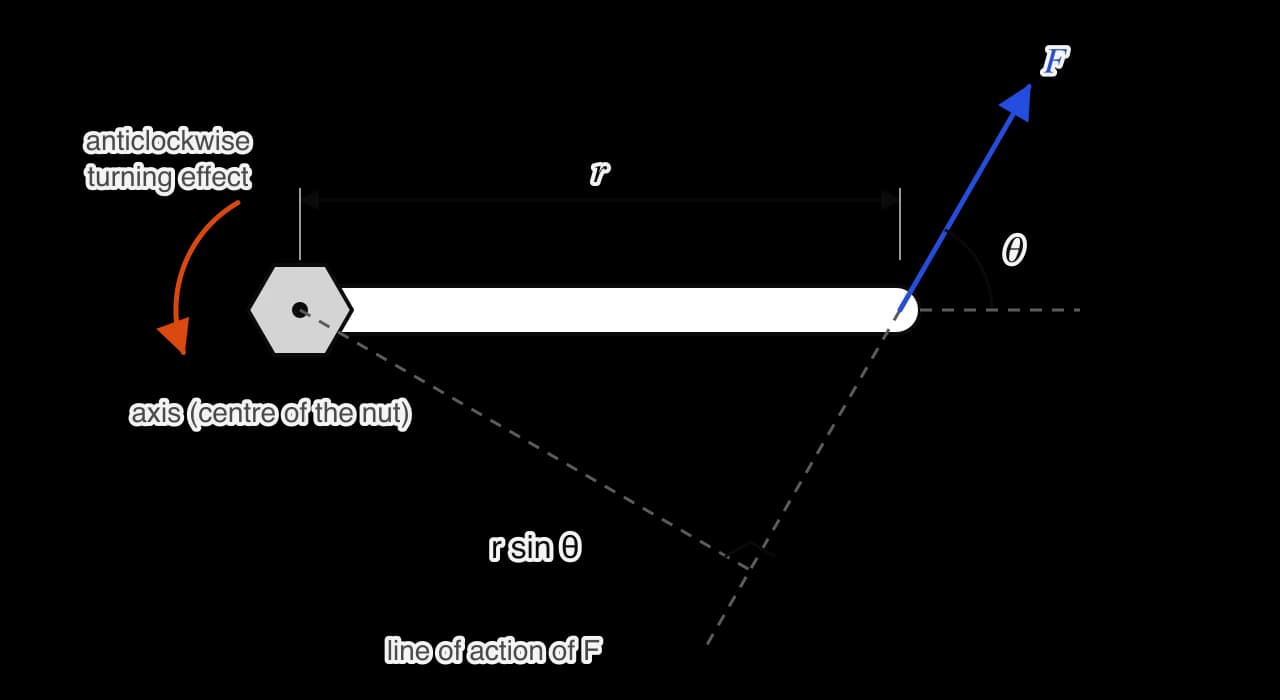
The torque is largest when the force is perpendicular to the line from the axis (, so ).
The torque is zero when the line of action passes through the axis (
Torque and work share the unit , but they are different quantities. Work is a force multiplied by a distance moved along the force; torque is a force multiplied by a distance at right angles to it. Torque is never written in joules.
Sense of rotation and resultant torque
A torque tends to turn a body either clockwise or anticlockwise; this is its sense. When several forces act, one sense is chosen as positive and the torques are added with signs. The resultant torque is the sum of all the torques about the same axis.
A see-saw with a child on each side shows this. The child on the left produces an anticlockwise torque and the child on the right a clockwise one. If the two torques are equal in size, the resultant torque is zero and the see-saw does not start to turn.
Couples
Two equal forces acting in opposite directions along parallel but separate lines form a couple. The resultant force is zero, so a couple produces no translation, but its torque is not zero. Hands on a steering wheel, the twist of a screwdriver and the forces on a compass needle in a magnetic field are all couples.

Taking torques about the centre of the wheel, each force has a perpendicular distance from the axis and both turn the wheel anticlockwise, so the total torque is
Rotational equilibrium
A body at rest stays at rest only if nothing makes it start to move or to turn. Zero resultant force is not enough on its own: the steering wheel acted on by a couple has zero resultant force but still starts to rotate. Equilibrium of a rigid body therefore has two conditions.
The torque condition is often stated as the principle of moments: for a body in rotational equilibrium, the sum of the clockwise torques about any axis equals the sum of the anticlockwise torques about the same axis. A body in rotational equilibrium need not be at rest. A wheel turning at a steady rate with no resultant torque on it is also in rotational equilibrium, just as a body moving at constant velocity is in translational equilibrium.
Choosing the axis
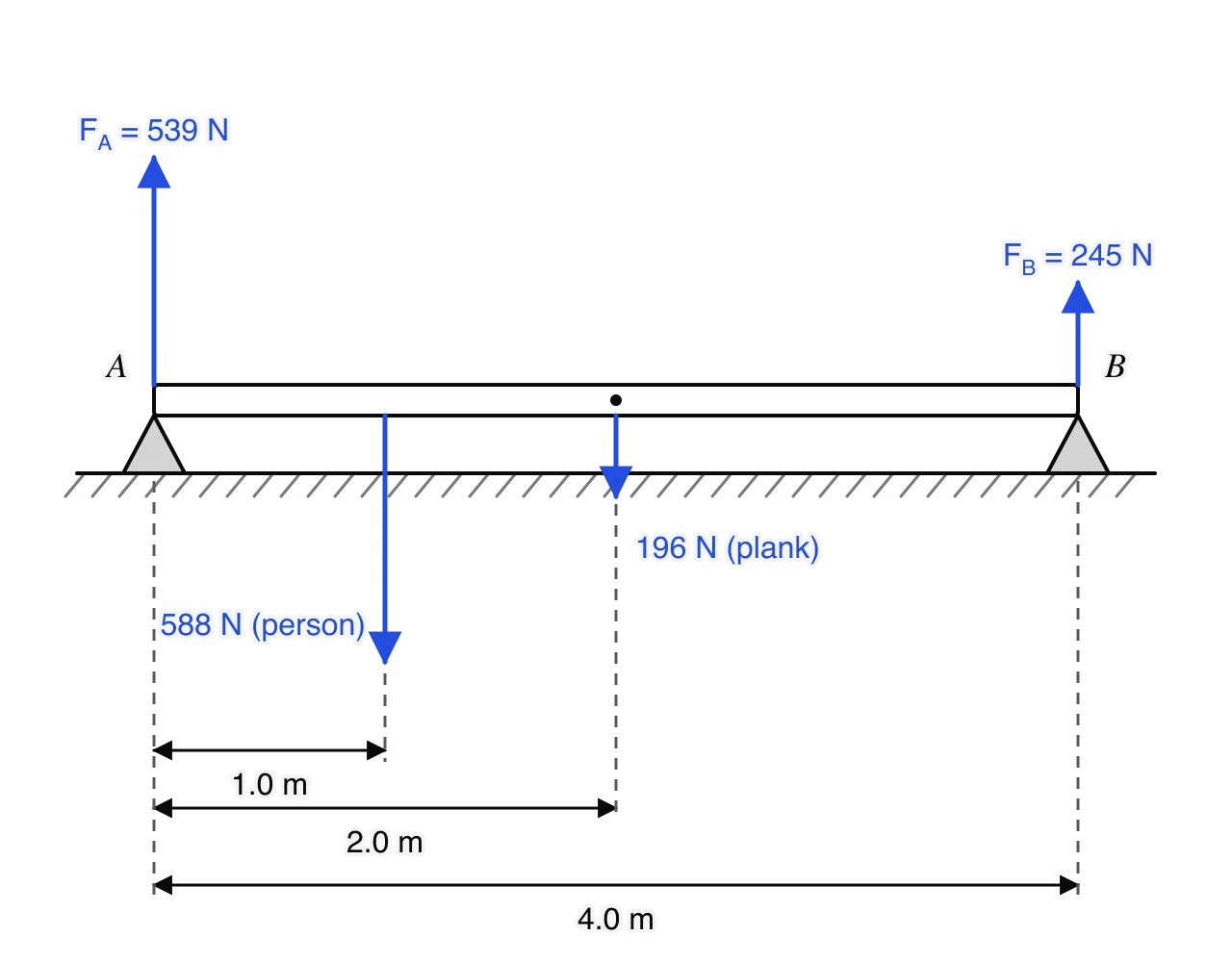
When a body is in equilibrium, the resultant torque is zero about every axis, so any point can be chosen as the axis for taking torques. A good choice is a point where an unknown force acts. That force then has zero perpendicular distance and drops out of the equation, leaving fewer unknowns. The resultant-force condition then gives any remaining forces.
Draw the body with every force on it, at the point where it acts (weights at the centre of mass).
Choose the axis at a point where an unknown force acts.
Write clockwise torques = anticlockwise torques about that axis and solve.
Use ΣF = 0 vertically and horizontally for the remaining forces, and check with torques about a second axis if there is time.
Ladders and the role of friction
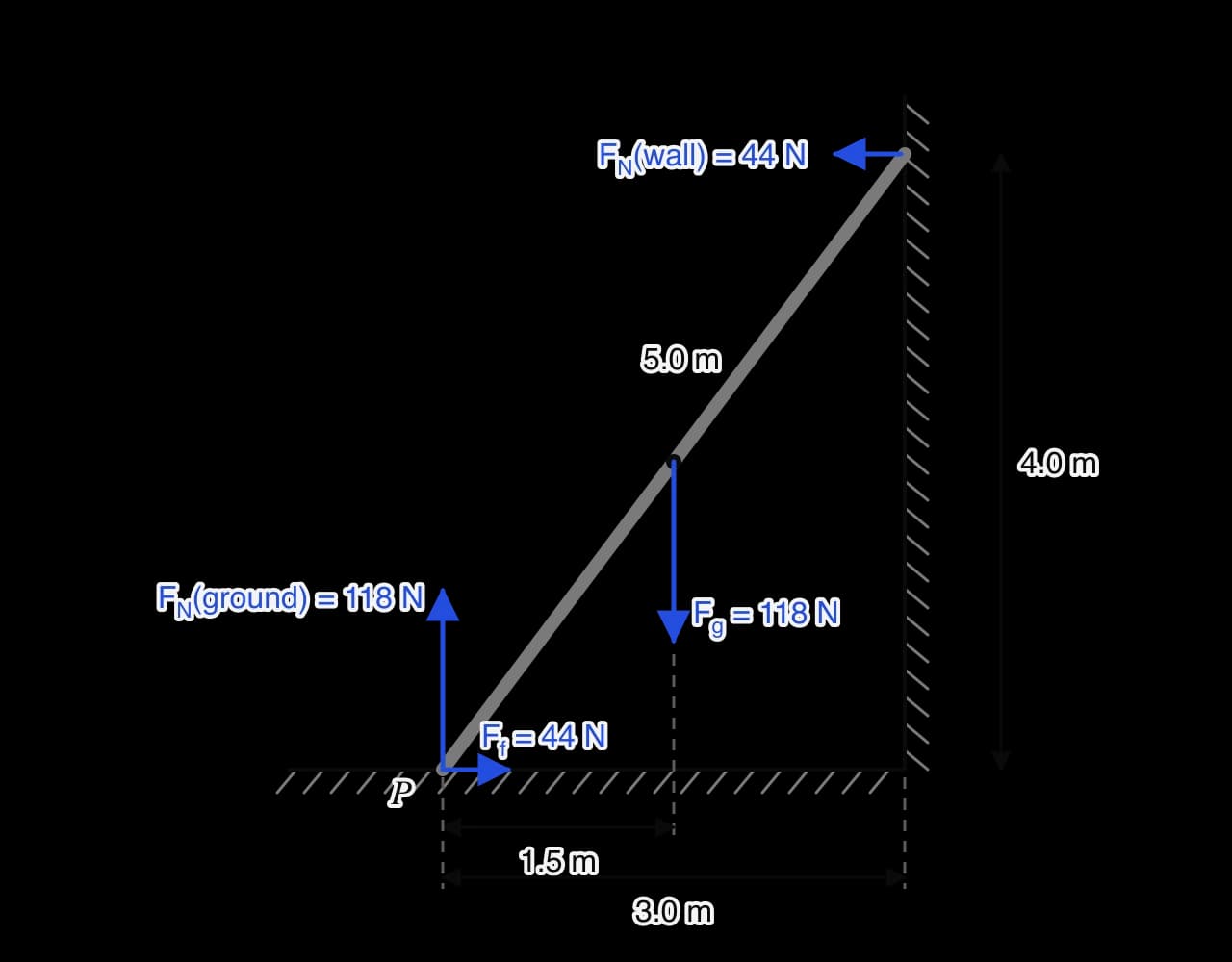
A ladder leaning against a wall is a standard equilibrium problem with forces in two directions. The weight acts down at the centre of the ladder. The ground pushes up with a normal force and also exerts friction at the foot. A smooth wall can only push at right angles to its surface, so it exerts a horizontal normal force at the top. Without friction at the foot, nothing would balance the horizontal push of the wall, and the foot would slide outwards.
Describing rotation: angular displacement, velocity and acceleration
Different points of a turning wheel move different distances in the same time, so distance and speed do not describe the rotation of the whole body. Every point of a rigid body does, however, turn through the same angle in the same time. Rotation is therefore described with angles.
Angular displacement and the radian
One radian is the angle at the centre of a circle subtended by an arc equal in length to the radius. In general , where is the arc length, so one complete turn is rad. Angles in rotational equations must be in radians; the conversions are
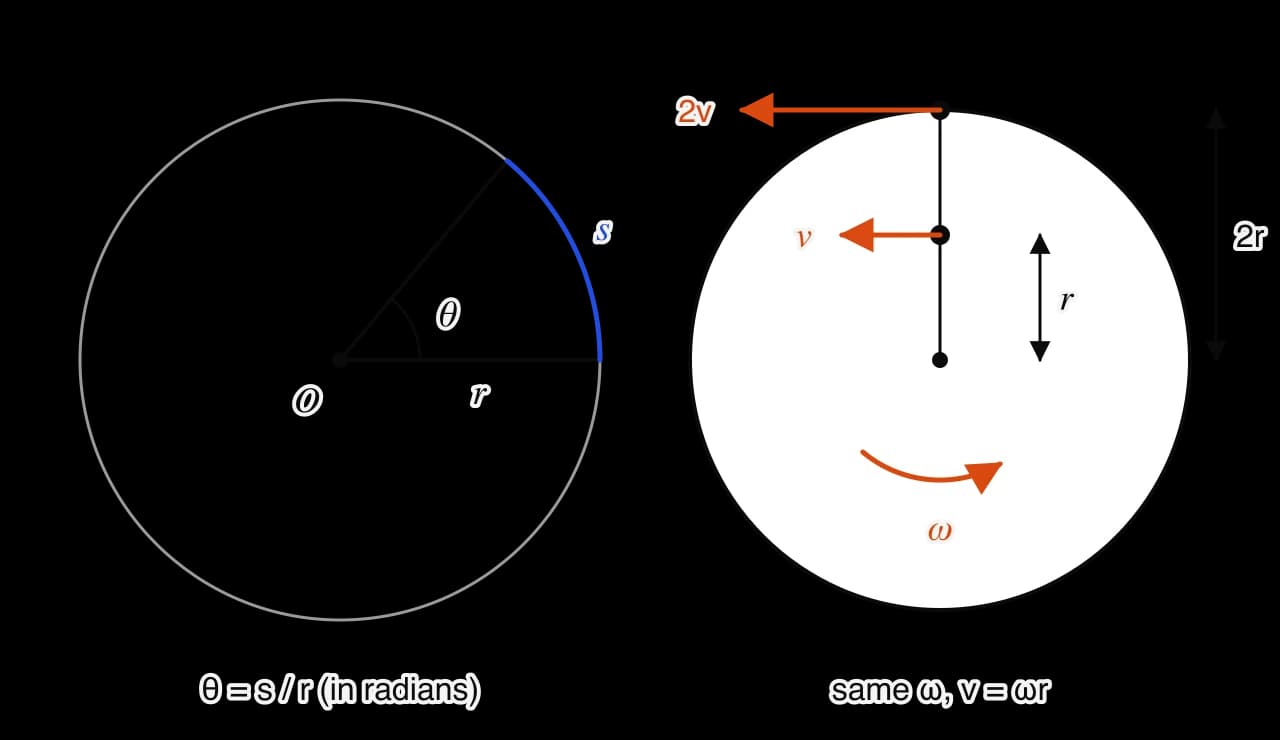
Like linear displacement, angular displacement has a sense: turning anticlockwise is usually taken as positive and clockwise as negative. Counting revolutions is common in practical problems; each revolution is rad.
Angular velocity
A body that makes revolutions per second turns through radians each second, so
where is the period of one revolution. Rotation rates of machines are often quoted in revolutions per minute (rpm); dividing by 60 gives revolutions per second. A point at distance from the axis moves along an arc of length , so its speed is . All points share the same angular velocity, but their speeds increase in proportion to their distance from the axis, as the disc in the radian diagram shows.
Angular acceleration
When the angular velocity of a wheel changes, the wheel has an angular acceleration, and a point at radius speeds up along its circular path with a tangential acceleration . For a body that is speeding up anticlockwise, is positive; a negative value means the angular velocity is decreasing (an angular deceleration), if is positive.
The tangential acceleration is not the only acceleration of a point on a turning wheel. As in A.2, a point moving in a circle also has a centripetal acceleration towards the axis, even when is constant. The tangential part, , is the one that changes the speed.
Linear quantity | Symbol and unit | Angular quantity | Symbol and unit | Link for a point at radius r |
|---|---|---|---|---|
Displacement | , m | Angular displacement | , rad | |
Velocity |
Graphs of rotational motion
Graphs of angular quantities against time are read in the same way as the motion graphs of A.1. The gradient of a – graph is the angular velocity. The gradient of an – graph is the angular acceleration, and the area under it is the angular displacement.
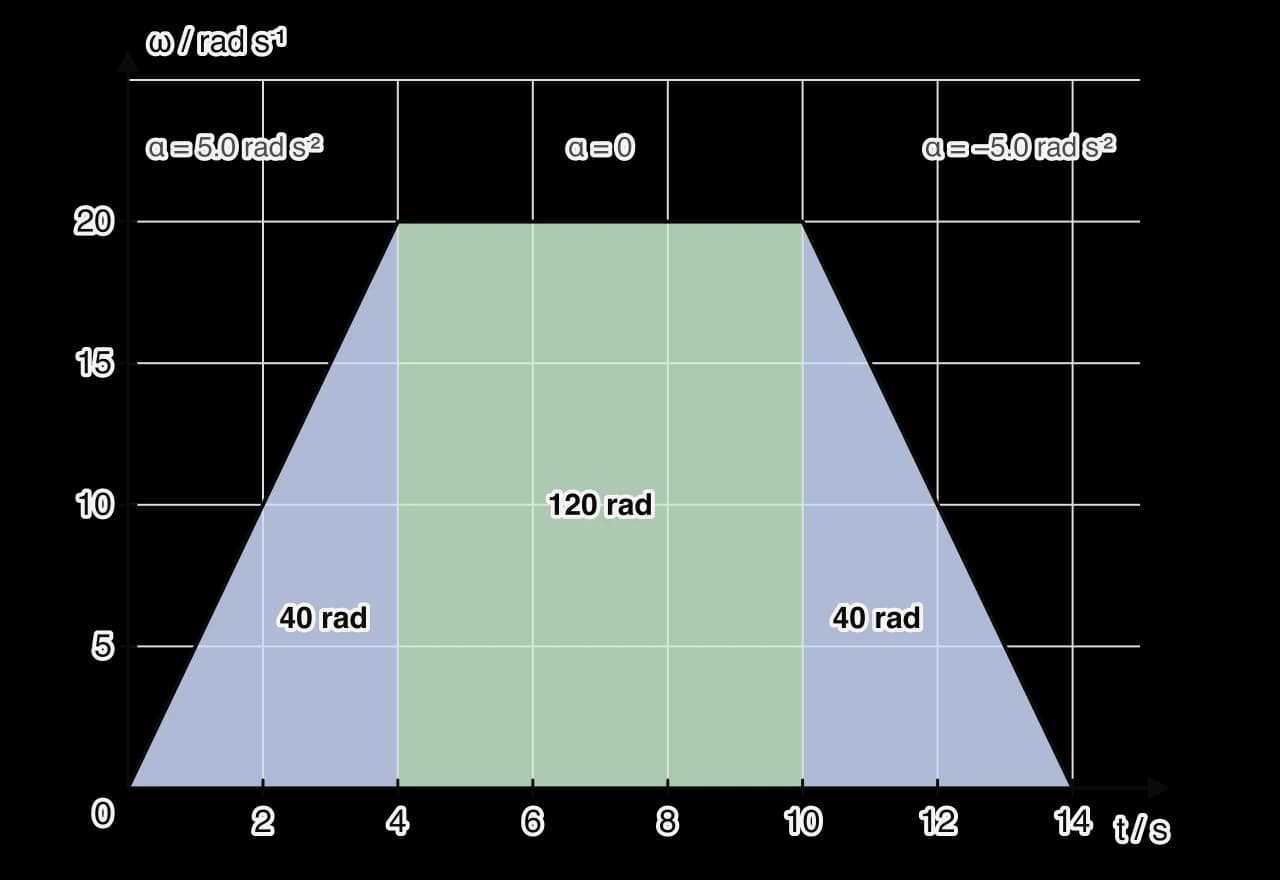
The flywheel in the – graph speeds up uniformly for 4 s, turns steadily for 6 s and then slows uniformly to rest. The matching – graph for the first 10 s is a parabola while the flywheel speeds up and a straight line once the angular velocity is constant.
Equations of motion for uniform angular acceleration
When the angular acceleration is constant, the angular quantities obey equations with the same form as the linear equations of motion. Here is the initial and the final angular velocity, and the angular displacement in time
Linear (A.1) | Rotational | Quantity not involved |
|---|---|---|
Each equation links four of the five quantities, so a problem needs three known values. The best equation is the one that does not contain the quantity that is neither known nor wanted. The equations apply only while the angular acceleration is constant; for a varying α, the gradient and area of an ω–t graph are used instead.
Problems often give the number of revolutions rather than a time, and that calls for the equation without t.
 YouTube
Moment of inertia
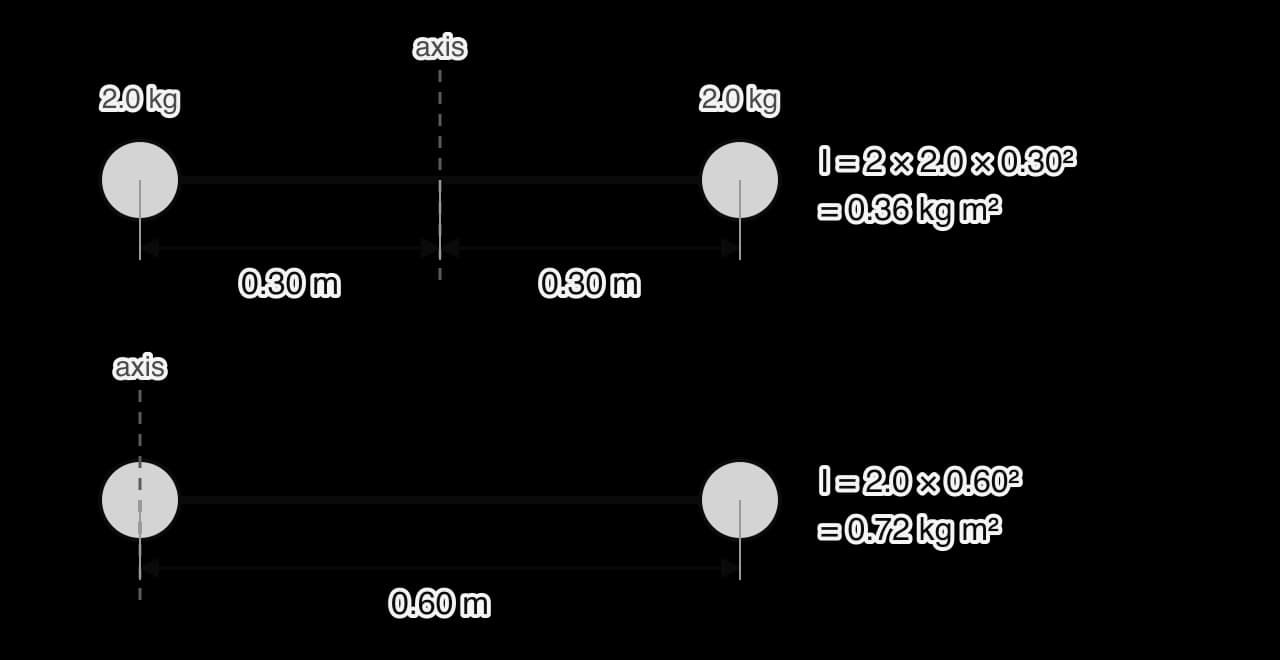
A heavy door is harder to set swinging than a light one, but a long pole is also much harder to twist about its middle than to spin about its own length, even though its mass is the same in both cases. Resistance to changes in rotation depends on the mass and on how far that mass lies from the axis.
Each piece of mass contributes in proportion to the square of its distance from the axis, so mass far from the axis has a much larger effect than mass close to it. Mass on the axis contributes nothing. The moment of inertia is therefore a property of a body and an axis, never of the body alone.
Moments of inertia of extended bodies
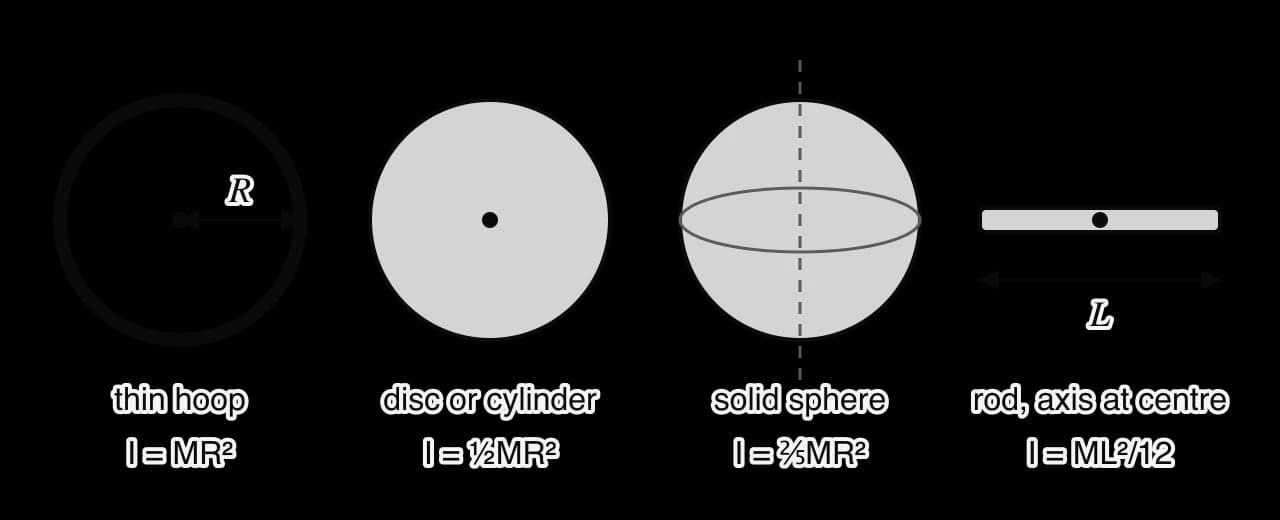
A solid body can be treated as many small masses, each contributing . The total depends on the shape. A thin hoop has all of its mass at distance from its centre, so . A disc of the same mass and radius has much of its mass nearer the centre and a smaller moment of inertia,
Body (axis through the centre) | Moment of inertia | Fraction of MR² |
|---|---|---|
Thin hoop or ring, axis perpendicular to its plane | 1 | |
Thin hollow sphere |
These formulas are supplied whenever a problem needs one; what matters is knowing how to use them and why they differ. Engineers use the effect deliberately. A flywheel is made with a heavy rim and a light hub to give the largest moment of inertia for its mass, and a racing bicycle has light rims so that its wheels are easy to spin up.
Newton's second law for rotation
An unbalanced force gives a body a linear acceleration, . In the same way, an unbalanced torque gives a rigid body an angular acceleration. For a single point mass at radius , a tangential force gives
The torque in this equation is the resultant torque, including any frictional torque at the axle with its sign. If the torque varies, gives the average angular acceleration when is the average torque. By Newton's second law for rotation, a body with a large moment of inertia needs a large torque for a given angular acceleration, which is why a heavy roundabout takes a lot of effort to start turning.
Falling masses and pulleys
A mass hanging from a string wound round a pulley (or an axle) is a coupled system: the mass moves in a straight line while the pulley rotates. If the pulley has mass, part of the energy goes into turning it, and the tension in the string is less than the weight of the hanging mass. Each body gets its own equation of motion, and the string links them.

For the hanging mass (linear): .
For the pulley (rotational): the string pulls tangentially at radius , so .
The string does not slip, so the edge of the pulley moves with the string:
The same method handles two masses hanging on either side of a heavy pulley, or a block pulled across a table by a falling mass. There are then two tensions, one in each section of string, and the resultant torque on the pulley is .
Angular momentum
The linear momentum of a body measures how much motion it has and how hard it is to stop. The rotational counterpart combines the moment of inertia with the angular velocity.
A small particle of mass moving with speed at right angles to a line of length from an axis also has angular momentum about that axis. Treating it as a point mass with and
Conservation of angular momentum
Forces inside a system, such as the pull of a skater's muscles on her arms or the friction between two discs that are pressed together, come in Newton's third law pairs. Their torques cancel, so they can move angular momentum from one part of the system to another but cannot change the total. Only an external torque can do that.
If the moment of inertia of a body changes while no external torque acts, its angular velocity changes so that stays the same:
Changing the moment of inertia: skaters, divers and stars
A figure skater begins a spin with arms and one leg stretched out, then pulls them in towards the axis. Ice exerts very little frictional torque on the skate, so the angular momentum of the skater is nearly constant. Pulling the arms in reduces , so must rise. Reversing the move, by spreading the arms again, slows the spin down before the skater glides away.
Skilled skaters can reduce their moment of inertia to about a third of its starting value, which roughly triples the rate of rotation. The fastest spin on ice skates recognised by Guinness World Records reached 342 rpm, about 5.7 revolutions per second, performed by Olivia Oliver of Canada in Warsaw in January 2015.
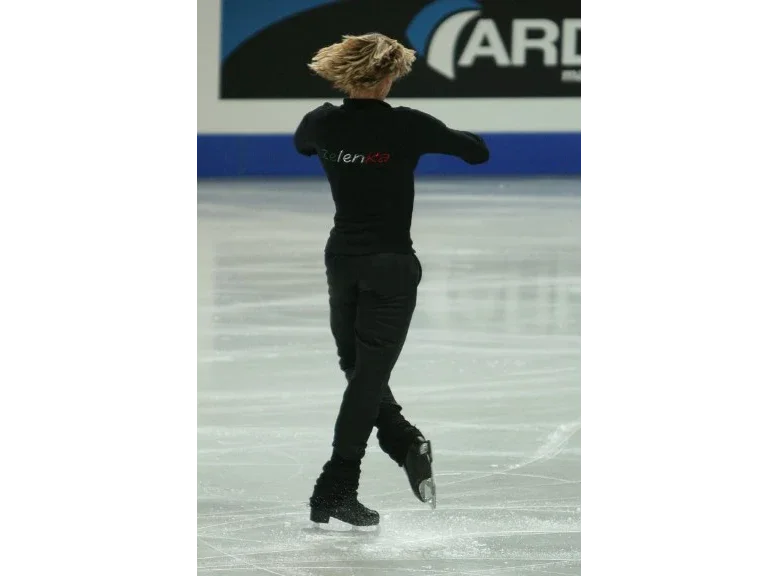
Divers and gymnasts use the same principle in the air. Once a diver leaves the board there is no external torque about the centre of mass (gravity acts at the centre of mass itself), so the angular momentum given by the take-off is fixed. Tucking into a ball reduces and speeds up the somersault; opening out before entering the water slows it down for a clean entry.
On a much larger scale, the core of a massive star can collapse at the end of its life into a neutron star only about 20 km across. Its moment of inertia falls by an enormous factor, so a core that turned slowly ends up spinning many times per second. The Crab pulsar, the neutron star left by a supernova recorded by astronomers in 1054, rotates about 30 times per second.
Coupled bodies and rotational collisions
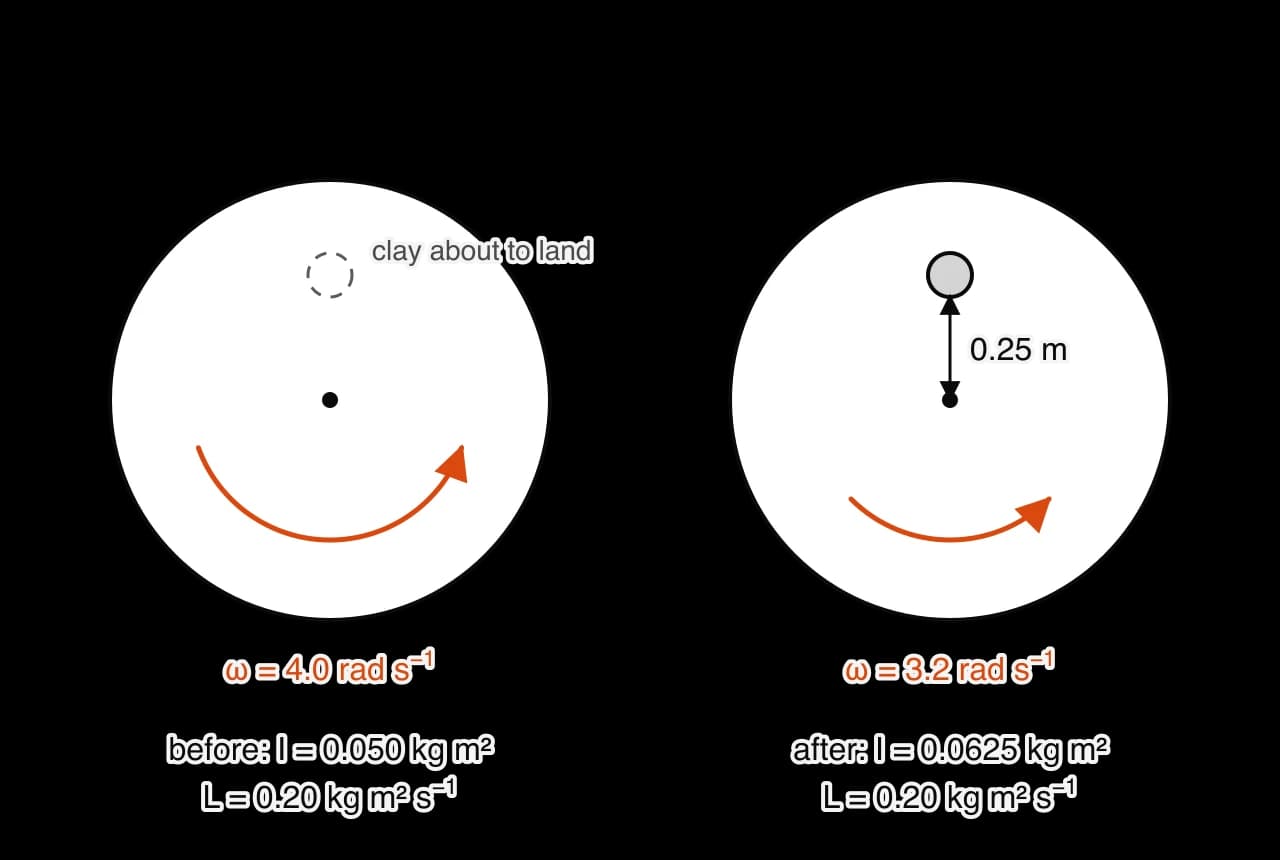
When a body is dropped onto a rotating turntable, or two discs on the same axle are pressed together until they turn as one, the friction between them is internal to the system. The total angular momentum is conserved, but kinetic energy is not: friction while the surfaces slide over each other turns some of it into internal energy. These are the rotational versions of inelastic collisions.
Two discs on a common axle that are brought together by a clutch behave in the same way. When the discs turn in opposite senses before they touch, one angular momentum is taken as positive and the other as negative, and the final angular velocity has the sense of the larger one.
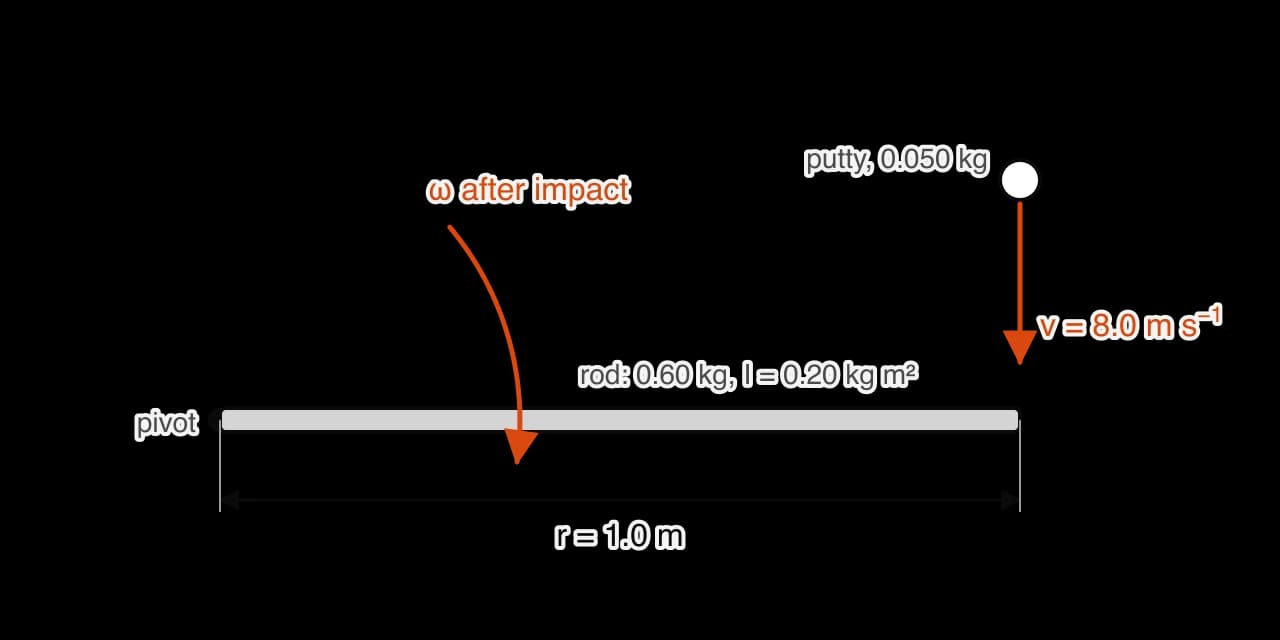
A particle that strikes a pivoted body is handled in the same way, with the particle's angular momentum about the pivot included before the collision. The pivot exerts a force during the impact, but that force acts through the axis and has no torque about it, so angular momentum about the pivot is conserved even though linear momentum is not.
 YouTube
Angular impulse
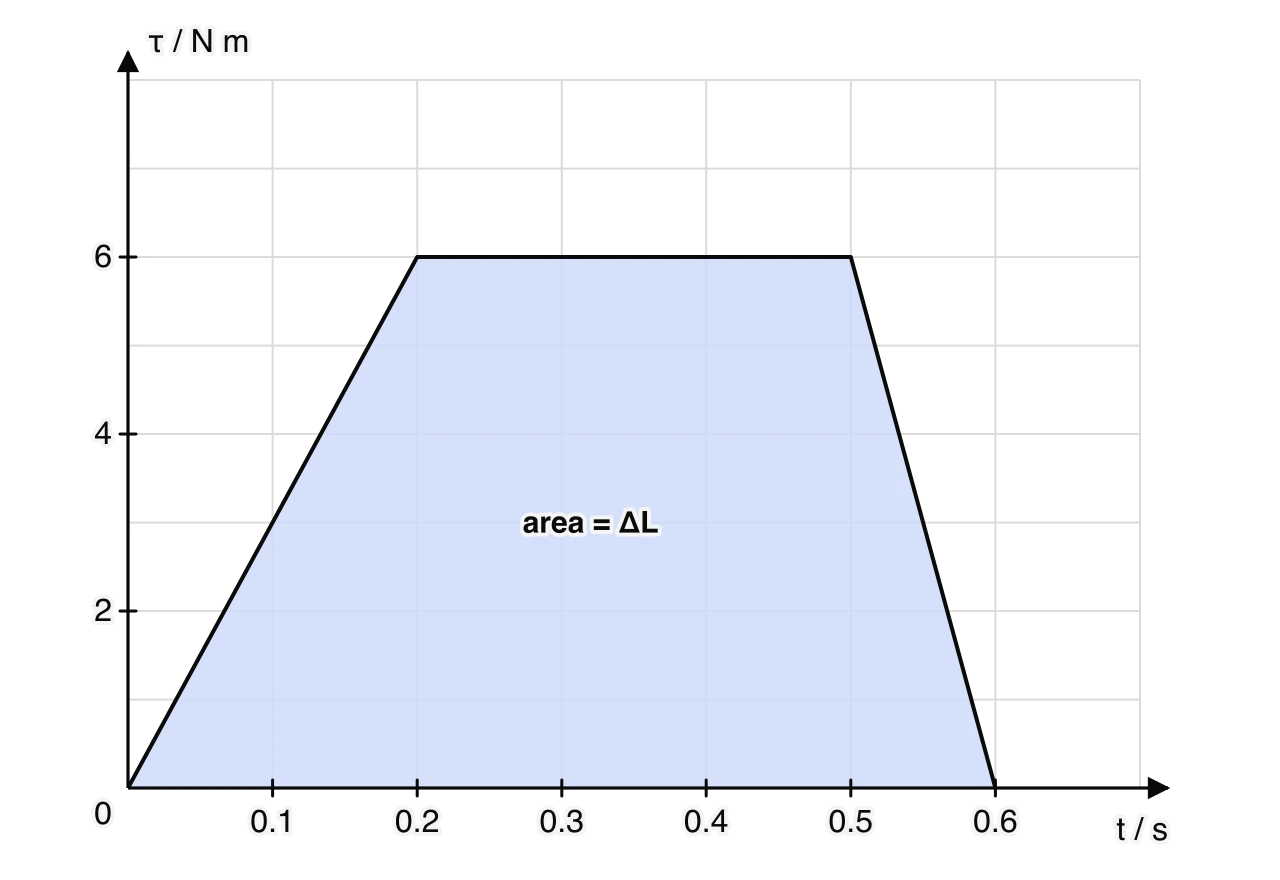
In linear motion, a force acting for a time changes the momentum of a body: . The rotational version follows from , so
When the torque changes with time, the angular impulse is the area under the torque–time graph, just as linear impulse is the area under a force–time graph. Kicking a roundabout, a short burst from a motor and the tug of a starter cord all deliver angular impulses.
Rotational kinetic energy
Every part of a rotating body is moving, so a rotating body has kinetic energy even if its centre stays still. A piece of mass at radius moves at and has kinetic energy
The second form comes from substituting . It is useful when the angular momentum is conserved: at fixed , the rotational kinetic energy is inversely proportional to , as the spinning skater showed. As with linear kinetic energy, is squared, so doubling the rate of rotation quadruples the energy stored.
A torque does work on a body as it turns it, just as a force does work as it moves a body. For a constant torque acting through an angular displacement , the work done is , and this work equals the change in rotational kinetic energy. The braking torque on a flywheel, for example, does negative work that transfers its kinetic energy to internal energy in the brake.
Flywheel energy storage
A flywheel is a heavy wheel designed to store energy as rotational kinetic energy. Its speed is increased by a motor when there is spare energy, and the stored energy is returned through a generator when needed. Large moments of inertia and high angular velocities give large stores, but the stress in the rim grows with , so modern flywheels use strong carbon-fibre rims spinning in a vacuum on magnetic bearings to reduce fluid resistance and friction.
The flywheel plant at Stephentown, New York, which reached its full capacity in 2011, uses 200 flywheels to absorb or supply up to 20 MW, smoothing the frequency of the electricity grid. The manufacturer's design ratings for each unit are 25 kWh of storage and 100 kW of output, with a rotor speed of up to 16 000 rpm. A rough estimate follows from these figures. At 16 000 rpm, , so storing
Rolling without slipping
A wheel or ball rolling along the ground both translates and rotates. If it does not slip or skid, the point in contact with the ground is momentarily at rest, and in one revolution the centre moves forwards by exactly one circumference, . Dividing by the time for one revolution links the speed of the centre to the angular velocity.
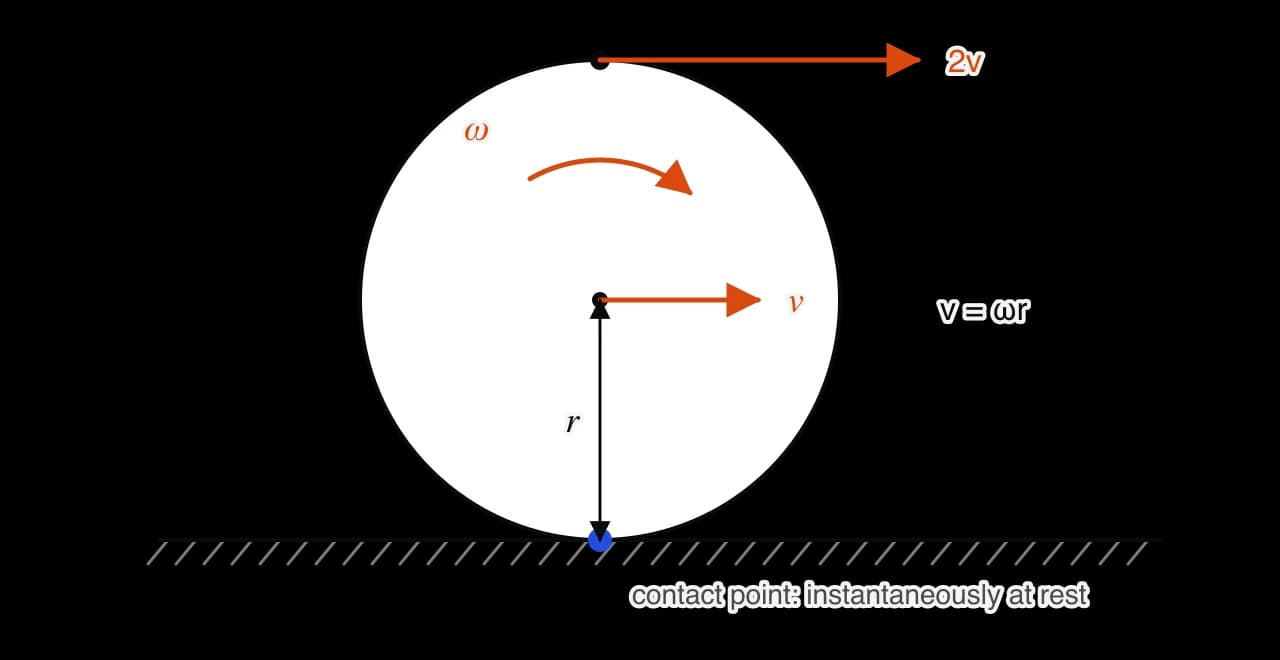
The rolling diagram shows the velocities this produces. The centre moves at . A point on the rim moves at relative to the centre, in a direction set by the rotation. At the top the two motions add to ; at the contact point they cancel to zero. A body rolling without slipping therefore has kinetic energy of two kinds:
The first term is the translational kinetic energy of the centre of mass, and the second is the rotational kinetic energy about it. Static friction at the contact point is what makes the body turn as it moves. Because the contact point does not slide, this friction does no work, and no energy is lost to it.
Rolling down a slope
A body that rolls from rest down a slope of vertical height converts gravitational potential energy into both kinds of kinetic energy. With and , where
The mass and the radius cancel. The speed at the bottom depends only on the height and on the shape, through . A body with more of its mass far from its axis (larger ) puts a larger share of its energy into rotation and so moves more slowly. A solid sphere beats a disc, which beats a hoop, whatever their masses and sizes; an object sliding without friction, with no rotation, is faster than all three.
Body | Share of kinetic energy that is rotational | Speed at the bottom of a 0.80 m drop | |
|---|---|---|---|
Sliding block (frictionless, no rotation) | 0 | 0 | |
Why the slope angle does not matter, and when rolling turns into slipping
The speed at the bottom depends only on the vertical drop, because both kinds of kinetic energy come from . A steeper slope gives a larger acceleration and a shorter time, but the same final speed.
On a very steep or very slippery slope, static friction cannot supply the torque needed to keep . The body then slides as well as rolls; friction becomes dynamic friction, does work against the motion, and the energy equation no longer holds in this simple form. Questions on rolling assume the slope is rough enough to prevent this.
Applying the ideas in exam questions
Rotational questions are often linked to energy (A.3) and momentum (A.2). A rolling body calls for energy conservation; a coupling or collision calls for conservation of angular momentum followed by a separate energy calculation.
Paper 1A: a disc dropped onto a spinning disc
Paper 1A: a hoop and a cylinder rolling down a slope
Paper 1B: a wheel slowing down
A student spins a bicycle wheel on a fixed axle and records its angular velocity every 2.0 s as it slows down under friction at the axle. The uncertainty in each value of is . The moment of inertia of the wheel is
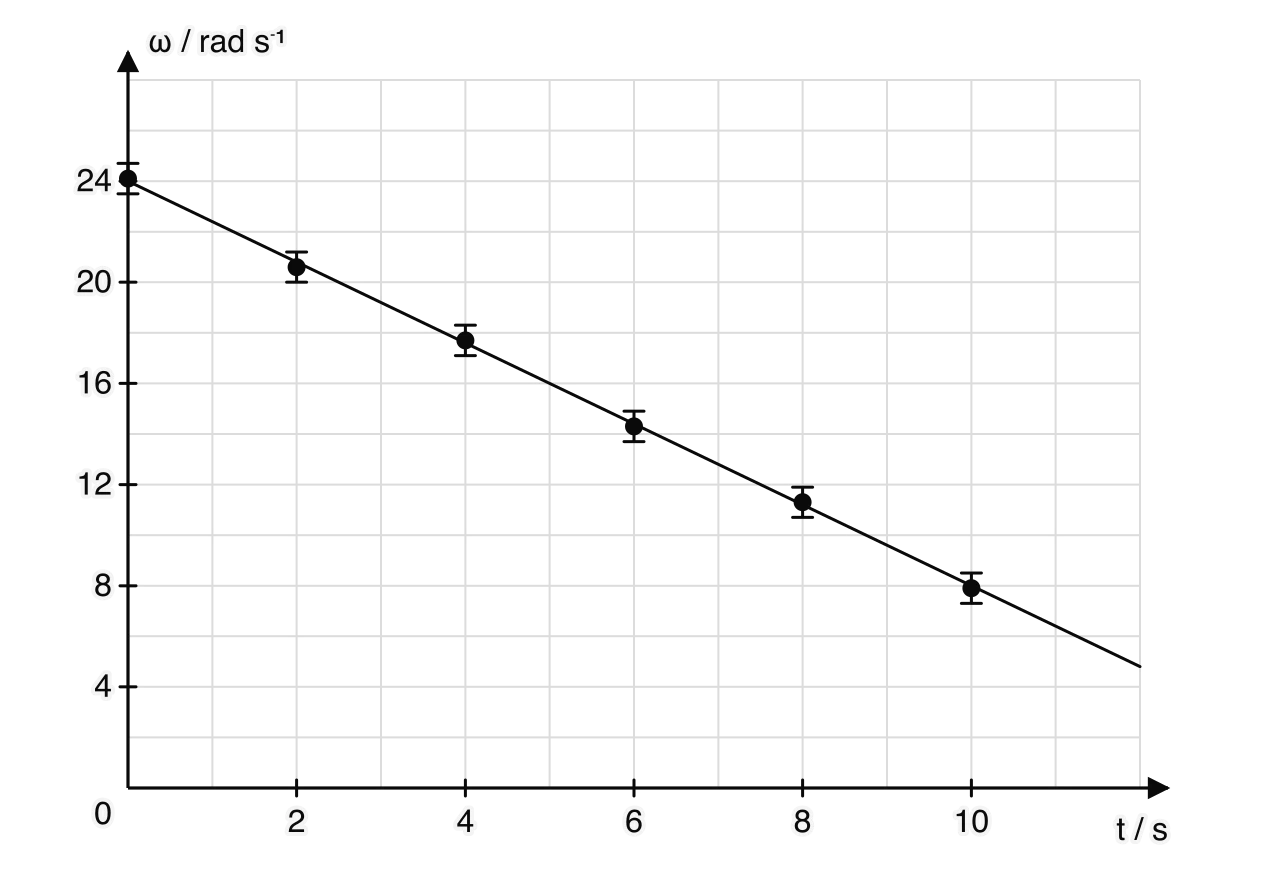
Paper 2: measuring the moment of inertia of a wheel
Paper 2: a sign supported by a hinged beam
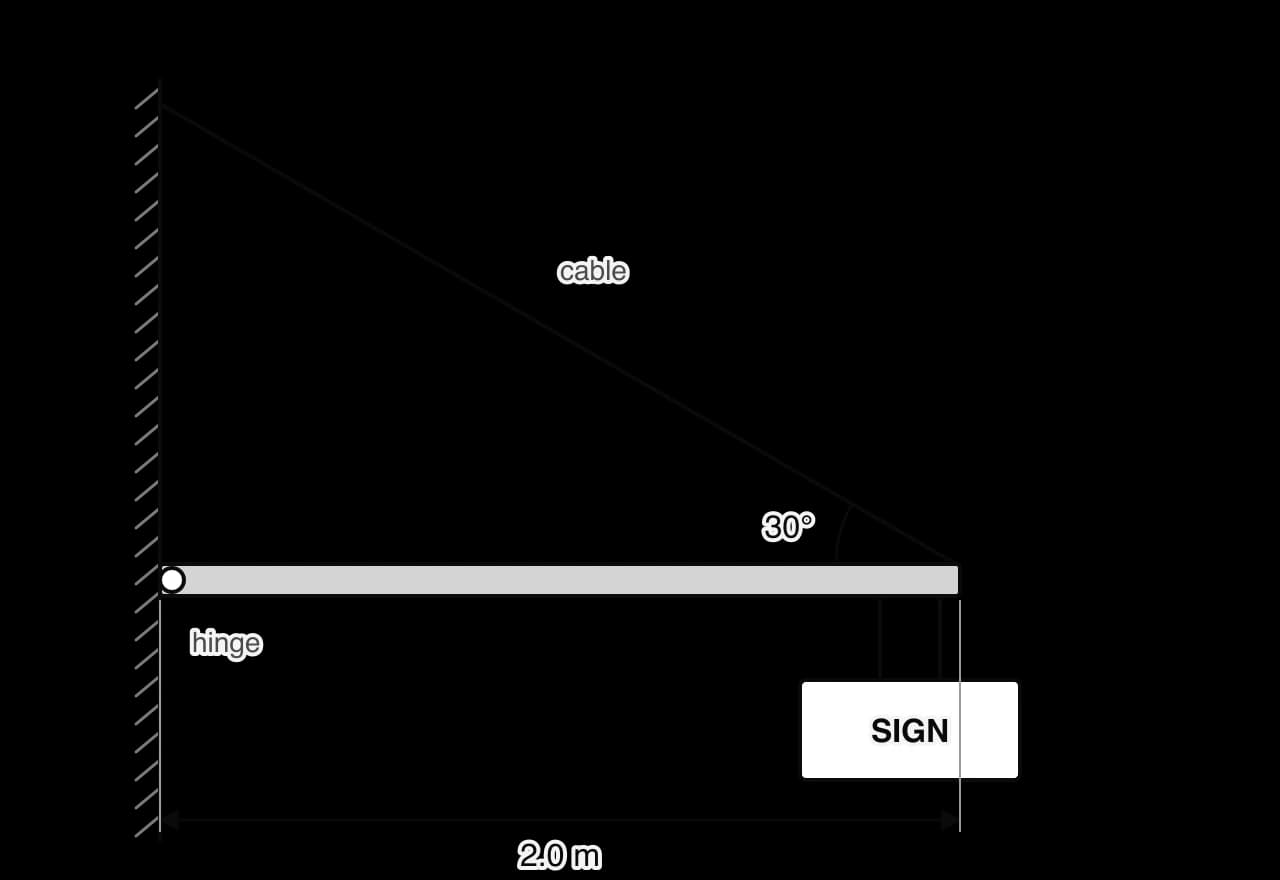
A uniform horizontal beam of length 2.0 m and mass 15 kg is hinged to a wall at one end. A cable from the other end of the beam to the wall makes an angle of 30° with the beam. A sign of mass 25 kg hangs from the end of the beam.
Self-check
- To do:
I can define torque and calculate it with τ = Fr sin θ, using the perpendicular distance to the line of action.
- To do:
I can find the resultant torque on a body, giving each torque a sense (clockwise or anticlockwise).
- To do:
I can explain why a couple produces rotation but no translation, and calculate its torque as Fd.
- To do:
I can state the conditions for equilibrium of a rigid body and solve problems on beams, planks and ladders by taking torques about a well-chosen point.
- To do:
I can define angular displacement, angular velocity and angular acceleration, use radians, and convert from rpm and revolutions.
- To do:
I can use v = ωr and a = αr to link the motion of a point to the rotation of the body.
- To do:
I can interpret θ–t and ω–t graphs, using gradients and areas.
- To do:
I can choose and use the equations of motion for uniform angular acceleration.
- To do:
I can calculate moments of inertia of point masses with I = Σmr², use given formulas for extended bodies, and explain how I depends on the axis and the distribution of mass.
- To do:
I can apply τ = Iα, including frictional torques and coupled systems of falling masses and pulleys.
- To do:
I can calculate angular momentum with L = Iω (and mvr for a particle) and apply its conservation to skaters, turntables, coupled discs and rods struck by particles.