Notes on A.5 Galilean and special relativity
Special relativity is the theory of how measurements of space and time made by observers moving relative to each other are connected. At everyday speeds its predictions are the same as those of Newtonian mechanics, which is why the differences went unnoticed for centuries. Close to the speed of light they become large: moving clocks run measurably slow, moving objects are shorter, and two observers can disagree about whether two events happened at the same time.
These effects are not small corrections that can be ignored in modern technology. Particle accelerators, the lifetimes of unstable particles and the clocks on navigation satellites all have to be described with special relativity, and its predictions have been confirmed in every test so far.
Reference frames, observers and events
Every measurement of position or time is made relative to something. A reference frame is a coordinate system used to make those measurements: an origin, a set of axes for position and a set of synchronised clocks that give the time at each point. In one dimension a frame needs only an axis and clocks, and a measurement gives the pair of coordinates .
An observer in physics is not a person looking at something. It is a whole reference frame, with clocks at every position, that records where and when each event happens. This matters in relativity, because a person who sees a distant explosion receives the light some time after it happened. The time of the event is the reading of the clock at the place of the explosion, not the time at which the light reaches the person.
Inertial frames
A train moving at a steady speed along a straight, level track is very nearly an inertial reference frame. A ball placed on a table in the carriage stays at rest, and a ball dropped falls straight down relative to the carriage. When the train brakes, the ball rolls forward although no horizontal force acts on it, so a braking or turning train is not an inertial frame. The ground is not perfectly inertial either, because the Earth rotates, but for most experiments its acceleration is too small to matter.
The standard arrangement uses two frames: S, for example the platform, and S′, for example a train, which moves at constant velocity in the positive direction relative to S. Quantities measured in S′ carry a prime (, ,
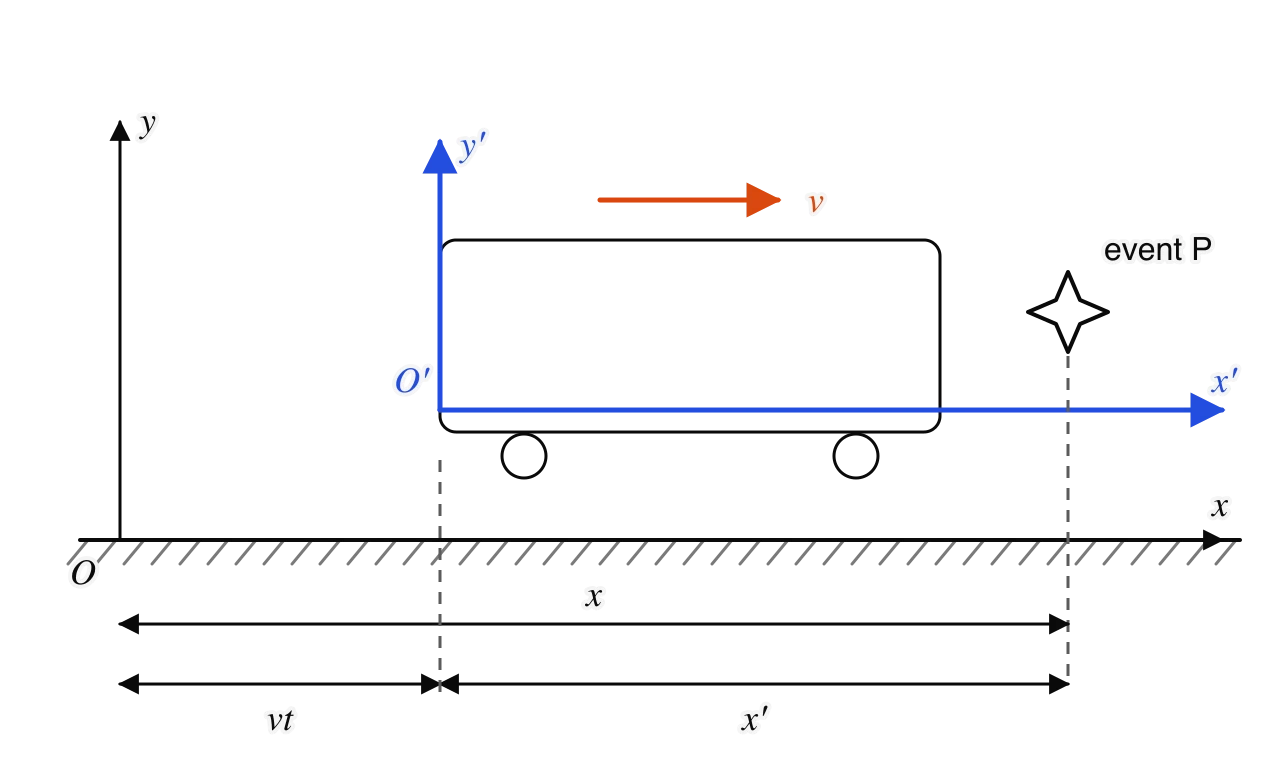
The diagram of the platform and train shows how positions in the two frames are related when time is the same for both: by time the origin of S′ has moved a distance , so a point at position in S is a distance from O′.
Galilean relativity
Galileo pointed out that experiments carried out in the closed cabin of a ship moving smoothly give the same results as experiments on land: a dropped object falls to the point directly below, and a fish swims equally easily in every direction in its bowl. No mechanical experiment carried out inside a frame can show whether that frame is at rest or moving at constant velocity.
The Galilean transformation
In Newtonian physics, time is absolute: every observer's clocks agree, whatever their motion. The Galilean transformation gives the coordinates of an event in S′ from its coordinates in S:
The first equation is the geometry of the diagram of the two frames. The second says that both frames agree on when every event happens. Differences in coordinates transform in the same way, so a length measured at one instant, when , is the same in both frames, and a time interval is the same in both frames.
Galilean velocity addition
If a body moves with velocity in S, its velocity in S′ follows from the change in over a time interval:
Signs matter: velocities in the positive direction are positive and those in the negative direction negative. A car on a road beside the track moving at has
Why Newton's laws are the same in every inertial frame
Because and is constant, any change in produces exactly the same change in
Quantity | Same in all inertial frames (Galilean)? | Reason |
|---|---|---|
Time interval | Yes | : time is absolute |
Length (measured at one instant) | Yes |
Where Galilean relativity fails
Galilean velocity addition predicts that light from a source moving towards an observer at speed should arrive at , and that an observer chasing a light beam at speed should measure it to move at . In the nineteenth century, Maxwell's theory of electromagnetism showed that light is an electromagnetic wave whose speed in a vacuum is fixed by two constants of nature,
Physicists at first assumed that light, like sound, travels through a medium, the "luminiferous ether", and that is its speed relative to the ether. The Earth moves round the Sun at about 30 km s⁻¹, so the speed of light measured on Earth should change slightly with direction. In 1887 the Michelson–Morley experiment compared the speed of light along two perpendicular arms of an interferometer sensitive enough to detect this change. Michelson and Morley found no difference, and repeated, more precise experiments have confirmed the null result. The result was evidence against the ether model and showed that Galilean velocity addition cannot apply to light.
A second problem came from electromagnetism itself. A charge moving parallel to a current-carrying wire experiences a magnetic force, but in the frame in which the charge is at rest there is no magnetic force on it, so Galilean relativity cannot explain why it is still pushed towards or away from the wire. Special relativity resolves the problem: in the charge's frame, length contraction changes the spacing of the moving charges in the wire, so the wire carries a net charge and exerts an electric force instead.
The postulates of special relativity
In 1905 Einstein took the experimental facts as the starting point of a new theory instead of trying to explain them away. He extended the principle of relativity from mechanics to all of physics, and accepted the constancy of the speed of light as a law.
The first postulate means that no experiment of any kind, mechanical, electrical or optical, can detect absolute motion. The second follows from the first together with Maxwell's equations: if the laws of electromagnetism are the same in every frame, they predict the same speed of light in every frame. Taken together, the postulates of special relativity rule out the Galilean transformation, because would give a different speed of light in each frame.
Accepting a constant speed of light forces a change in the idea of time. If two observers in relative motion both measure the same light pulse travelling at , they cannot also agree on all distances and all times. Time dilation, length contraction and the relativity of simultaneity all follow from the two postulates.
The Lorentz transformation
The Lorentz factor
Every relativistic effect depends on one number, the Lorentz factor , which depends only on the relative speed of the two frames:
At , . As increases, grows slowly at first and then very steeply, becoming infinite as approaches
0.10 | 0.50 | 0.60 | 0.80 | 0.866 | 0.90 | 0.98 | 0.995 | |
|---|---|---|---|---|---|---|---|---|
1.005 | 1.15 | 1.25 | 1.67 | 2.00 | 2.29 | 5.03 | 10.0 |
The transformation equations
The Lorentz transformation gives the coordinates of an event in S′ from its coordinates in S, when S′ moves at velocity along
These equations are consistent with both postulates. A light pulse leaving the common origin at has in S; substituting gives
Two features distinguish them from the Galilean equations. First, multiplies both expressions. Second, the time in S′ depends on position as well as on time in S, through the term . Space and time are therefore no longer separate: what one observer measures as a pure difference in position, another measures partly as a difference in time. This is why relativity treats events as points in a four-dimensional space-time (one dimension of it here).
The low-speed limit
When , and is negligible for everyday distances. For a train at
Differences between two events
Most problems compare two events rather than one event and the origin. Because the transformation is linear, the same equations apply to differences in the coordinates:
Here and
The inverse transformation
Frame S moves at velocity relative to S′, and the first postulate says the equations must have the same form. The coordinates in S are therefore found from those in S′ by swapping the primes and changing the sign of :
Units: light-years and years
Relativity problems often use years for time and light-years for distance. One light-year (ly) is the distance light travels in one year, so in these units . A speed of is then
With SI units the same method applies, but the terms must be calculated carefully because is so large. Writing as often keeps the numbers manageable.
Relativistic velocity addition
If a body moves with velocity in S, its velocity in S′ is not but
The numerator is the Galilean result; the denominator corrects it. When both and are small compared with , and the Galilean formula is recovered. The formula follows from the Lorentz transformation by dividing
Light always moves at c
For a light pulse, in S, so
whatever the value of : relativistic velocity addition builds in the second postulate. In the same way, combining any two speeds less than always gives a result less than , so no observer ever measures a body moving faster than light.
Signs and directions
The formula is written for S′ moving in the direction relative to S. To use it, choose a positive direction and give every velocity its sign before substituting: is the velocity of the frame being changed to, and the velocity of the body in the original frame. A common case is two bodies approaching each other, where one velocity is negative and the denominator becomes larger than 1.
Sometimes the speed of a body is given in the moving frame and its speed in S is needed. The inverse formula, found by swapping primes and changing the sign of , is
The invariant space-time interval
Different inertial observers disagree about the distance and the time between two events, but there is one combination of them on which all observers agree. The space-time interval between two events is defined by
Both terms are measured in units of length, since is the distance light travels in the time . Substituting the Lorentz transformation shows that
For the event at , transformed into a frame moving at , the check works exactly. In S,
Timelike, lightlike and spacelike intervals
Because the interval is invariant, so is its sign, and the sign tells whether the two events can be linked by any signal:
, timelike: , so a body moving slower than light can be present at both events. There is a frame in which the events happen at the same place, and every observer agrees on which comes first. One event can cause the other.
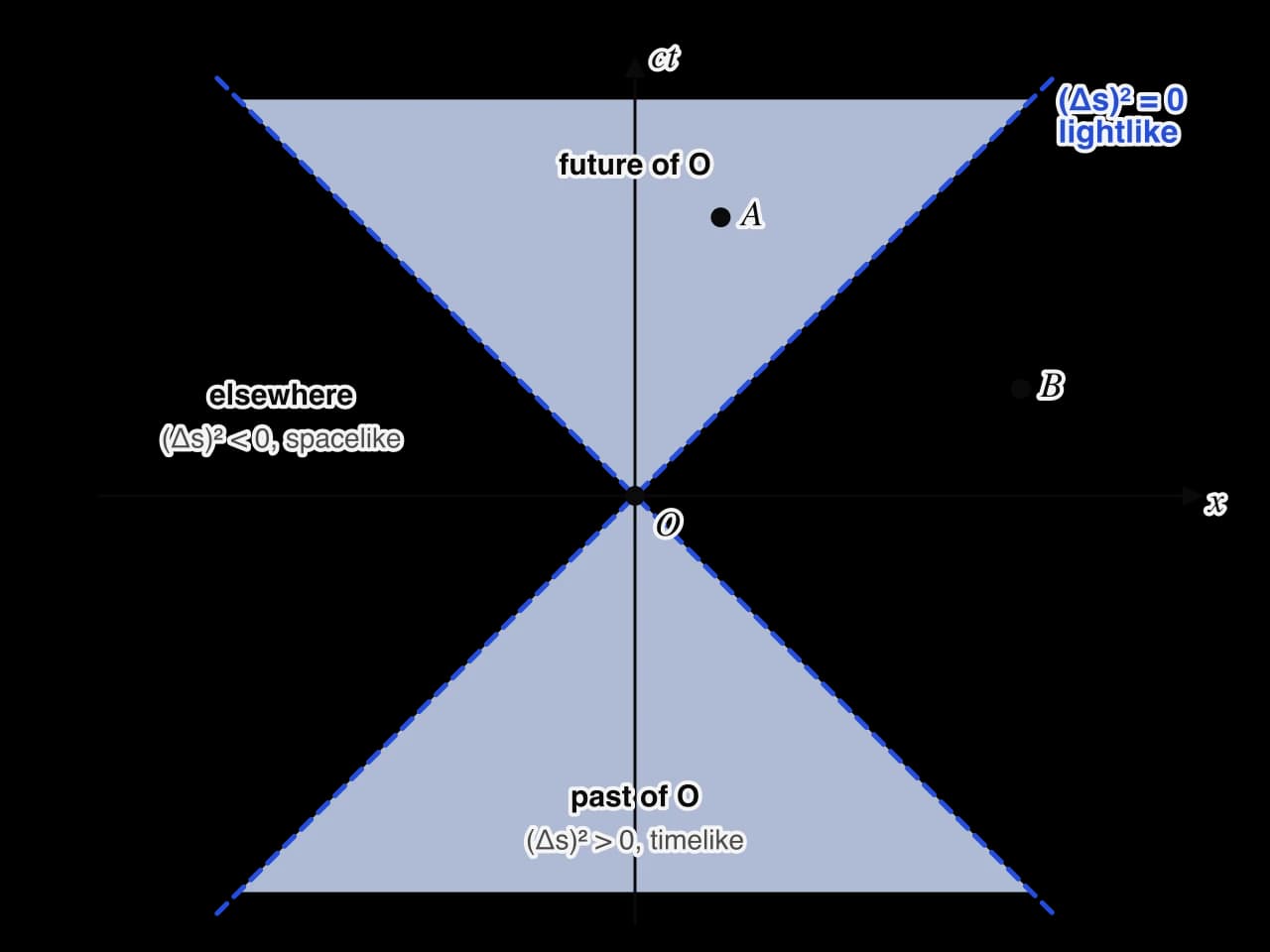
The light-cone diagram shows these regions for an event O. Since the order of timelike-separated events never changes, a cause always comes before its effect for every observer, and relativity keeps causality intact. The event at , , which happens before the origin event in a frame moving at , has a spacelike interval from the origin:
The relativity of simultaneity
In Newtonian physics, two events that happen at the same time for one observer happen at the same time for all. Special relativity shows that this is true only for events at the same place. For two events separated along the direction of relative motion, simultaneity depends on the frame.
The carriage thought experiment
A lamp at the exact centre of a railway carriage flashes once. In the frame of the carriage the light travels at in both directions and covers equal distances to the two end walls, so it reaches the rear wall and the front wall at the same instant. The two arrivals are simultaneous in the carriage frame.
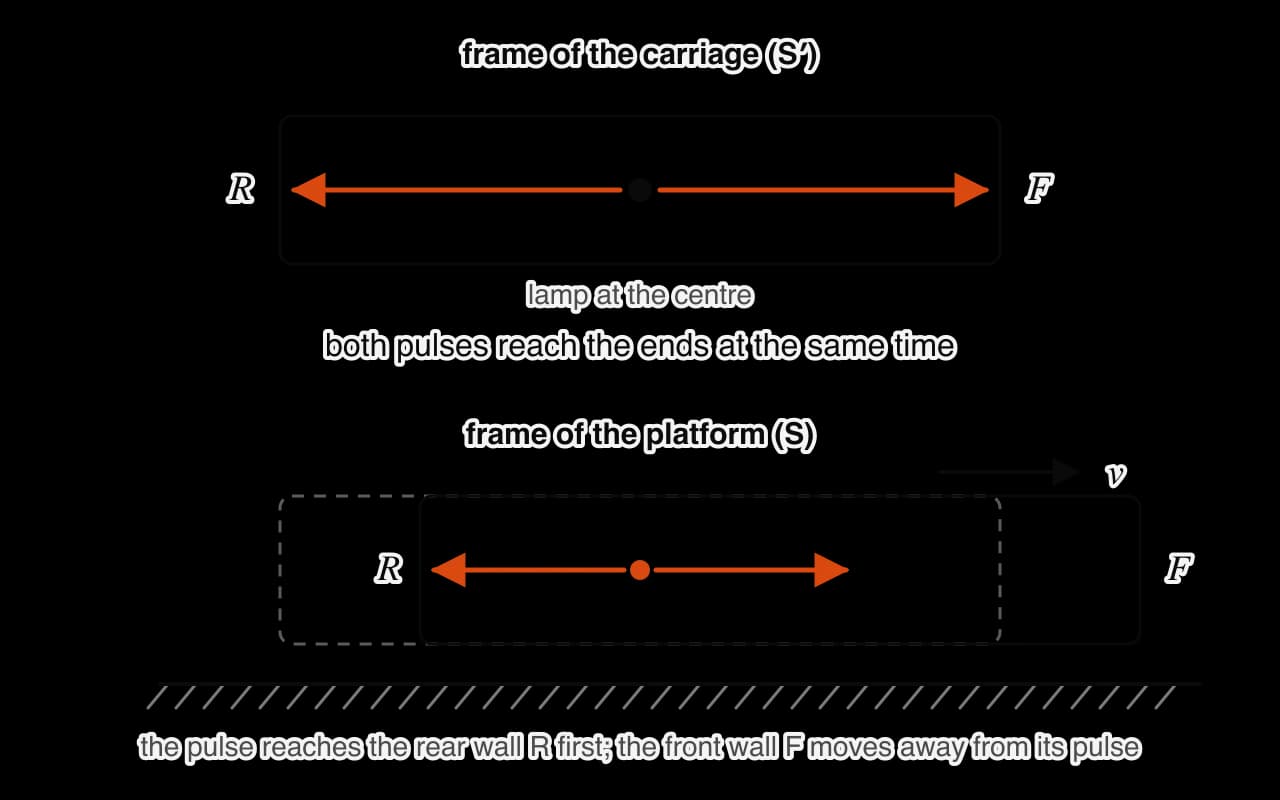
In the platform frame the carriage moves forwards while the light is in flight. By the second postulate the light still travels at in both directions in this frame, not at . The rear wall moves towards its pulse and the front wall moves away from its pulse, so the pulse reaches the rear wall first. For the platform observer the two arrivals are not simultaneous, as the two views of the carriage show. Both descriptions are correct, each in its own frame, and no frame-independent answer exists to the question of whether the two arrivals happened at the same time.
Simultaneity from the Lorentz transformation
Two events simultaneous in S have . In S′ the time between them is
This is zero only if . The minus sign shows that, in S′, the event with the larger (further along the direction in which S′ moves) happens first. The effect grows with both the speed and the separation, which is why it is never noticed at everyday speeds and distances.
Proper time and time dilation
Proper time
The ticks of a clock, the lifetime of a particle and the duration of a journey measured on board a spacecraft are all proper time intervals for that clock, particle or spacecraft, because in its own frame each event happens at the same place: where the clock is. Every other inertial observer sees the two events at different places and needs two separate clocks, one at each place, to time them.
Because the proper time interval is measured where , it is directly related to the invariant interval:
Time dilation
In any other inertial frame, moving at speed relative to the clock, the time between the same two events is longer:
Since , observers see a moving clock run slow: in the time on their own clocks, the moving clock advances by only . This time dilation affects every process in the moving frame equally, mechanical clocks, atomic clocks, heartbeats and radioactive decay, because by the first postulate the moving frame cannot have different laws of physics for different kinds of clock.
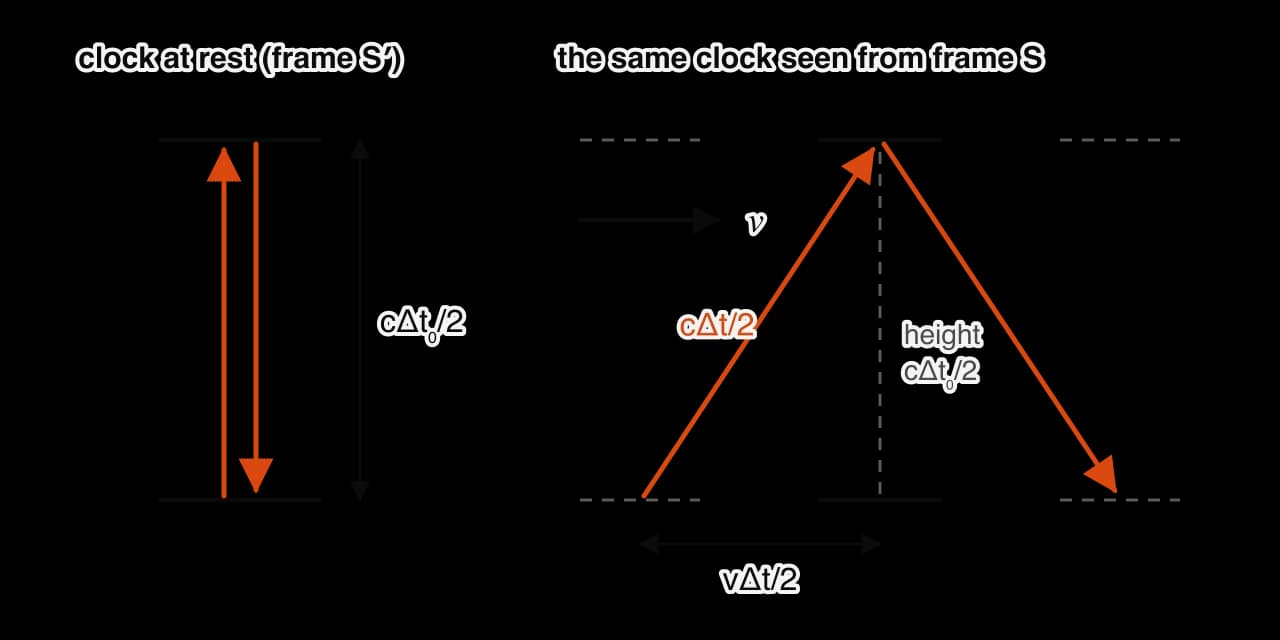
The light clock gives a picture of why this must happen. In the clock's own frame the light travels straight up and down. Seen from a frame in which the clock moves, the light follows a longer diagonal path, and since light travels at in both frames the round trip must take longer.
Optional: time dilation from the light clock
In S′ (the clock's rest frame) the light covers the mirror separation in half a tick, so . In S, during half a tick of duration , the clock moves sideways
Time dilation is symmetric
Each of two inertial observers in relative motion measures the other's clock to run slow. This is not a contradiction, because they compare different pairs of events. To compare one moving clock with its own clocks, an observer uses two of its own clocks at two places, and the readings depend on how that observer's clocks are synchronised. The other observer judges this synchronisation to be wrong, because of the relativity of simultaneity. The effect is real and measurable, not an illusion caused by light delays.
Round trips
If the spacecraft returns at the same speed, ignoring the short time spent turning round, the Earth frame records and the spacecraft clock . The traveller returns 12 years younger than a twin who stayed at home. The situation is not symmetric, because only the traveller changes from one inertial frame to another at the turnaround; the Earth-bound twin stays in one inertial frame throughout, and the time-dilation equation can be applied in that frame to each leg of the journey.
Time dilation in GPS satellites
Each Global Positioning System satellite carries atomic clocks and orbits at about 20 200 km above the Earth's surface with a speed of about . A receiver finds its position from the time signals take to arrive, so clock errors matter: in one microsecond light travels 300 m. At this speed
Optional: calculating the GPS time dilation
For a calculator may round to exactly 1. The binomial approximation
Proper length and length contraction
To measure the length of a moving object, an observer must record the positions of its two ends at the same time in the observer's own frame. Because the frames disagree about simultaneity, they disagree about the length. In a frame in which the object moves at speed along its length, its measured length is
This is length contraction: the moving object is shorter than its proper length by the factor . Only lengths parallel to the relative velocity contract; perpendicular lengths are the same in both frames. A sphere moving close to the speed of light would be measured as flattened in the direction of motion. The contraction is symmetric: each of two observers measures the other's metre rule as shorter.
Length contraction and time dilation describe the same physics from two frames. A spacecraft passing a station at speed takes time to pass the station's length in the station frame. In the spacecraft frame the station is shorter, , and passes in a time
Evidence from muon decay
A muon is an unstable subatomic particle similar to an electron but about 200 times more massive. Most cosmic-ray muons are produced roughly 15 km above sea level when high-energy cosmic rays from space collide with nuclei in the upper atmosphere. Measured at rest, muons decay with a mean lifetime of (a half-life of about ), and they travel downwards at speeds close to .
Without relativity, a muon moving at nearly would travel only about 660 m in one mean lifetime, so almost all of them should decay high in the atmosphere. In fact a large flux of muons reaches sea level, roughly one per square centimetre per minute. Muon experiments compare the number of muons detected at two heights with the number expected to survive the journey between them.
The Mount Washington experiment
In an experiment carried out in 1962 and published in 1963, David Frisch and James Smith counted muons at the summit of Mount Washington in New Hampshire and at sea level in Cambridge, Massachusetts, a height difference of about 1.9 km. They selected only muons moving at about and counted about 563 per hour at the summit and about 412 per hour at sea level, so roughly three-quarters survived the descent.
In the Earth frame the descent took about , nearly three mean lifetimes. Without time dilation only about 27 of the 563 muons per hour should have survived. The measured survival rate implied that the muons' clocks ran slow by a factor of , in agreement with the average factor of about 8.4 predicted for muons that slow from about to about as they lose energy in the air. Earlier measurements by Bruno Rossi and David Hall, published in 1941, comparing muon counts at Echo Lake (3240 m) and Denver (1616 m) in Colorado, had already shown the same effect less precisely.
Both frames agree on the count
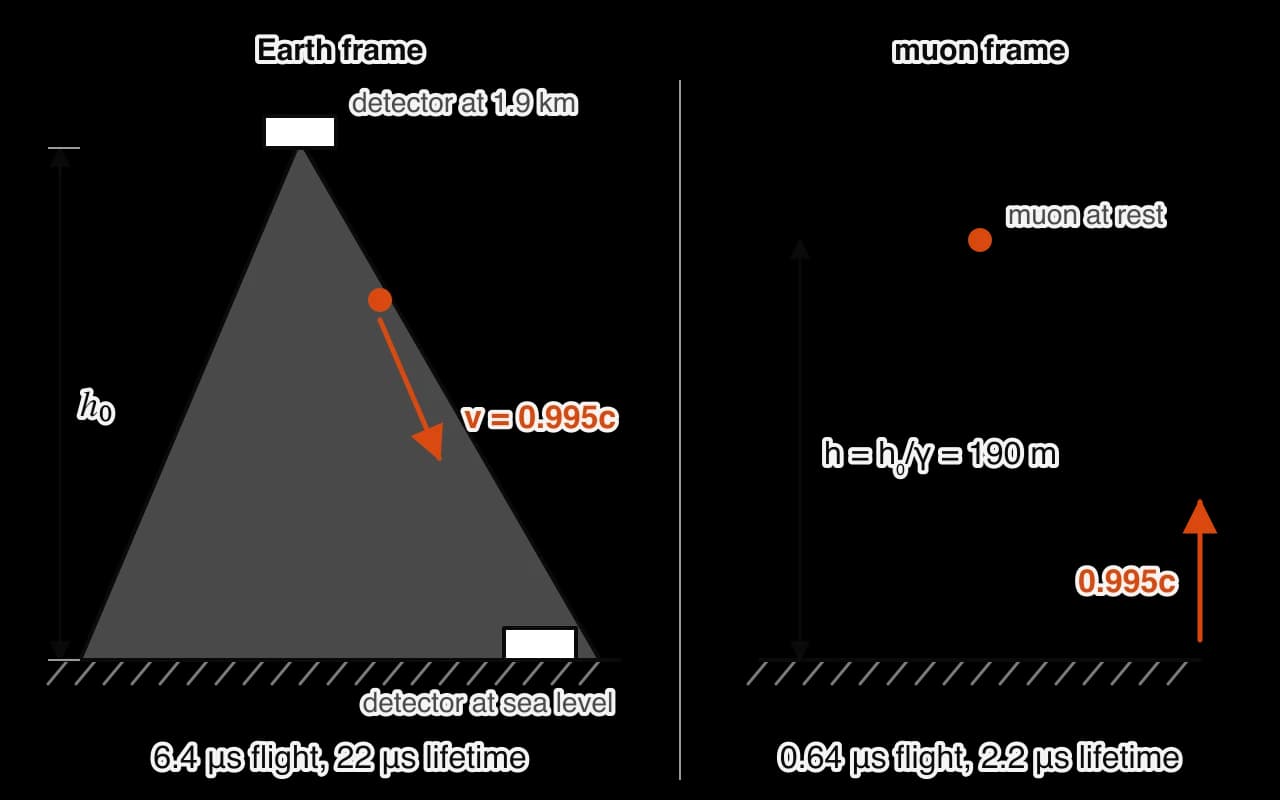
The number of muons detected at sea level is a physical fact, recorded by a counter, so every frame must predict the same number. The two descriptions in the diagram of the muon journey reach the same result by different reasoning:
Earth frame | Muon frame | |
|---|---|---|
Distance travelled | Proper length | Contracted: |
In the Earth frame, the muon's internal clock runs slow, so few muons decay during the 6.4 μs flight. In the muon's frame, its lifetime is the normal 2.2 μs, but the atmosphere rushes past it and is contracted to about 190 m, which passes in only 0.64 μs. Both frames predict that the journey lasts about 0.29 mean lifetimes, so both predict the same fraction of survivors.
The muon experiments are a strong test because they use a natural clock, the decay of a particle, that has nothing to do with light or electromagnetism. Since then, time dilation has been measured with particle beams moving at γ of about 30 in storage rings and with atomic clocks flown on aircraft, always in agreement with special relativity.
 YouTube
Space-time diagrams
A space-time diagram (also called a Minkowski diagram) shows events as points on a graph with position on the horizontal axis and on the vertical axis. Using instead of gives both axes units of length, so that light, which travels a distance in time , has a world line at 45°. In ly and years, one unit up the
World lines
The diagram of world lines shows the possibilities for bodies moving at constant velocity, which have straight world lines:
A body at rest in S has a constant , so its world line is vertical, parallel to the axis.
A body moving at constant velocity has a straight world line tilted from the vertical. In time it moves , so the angle
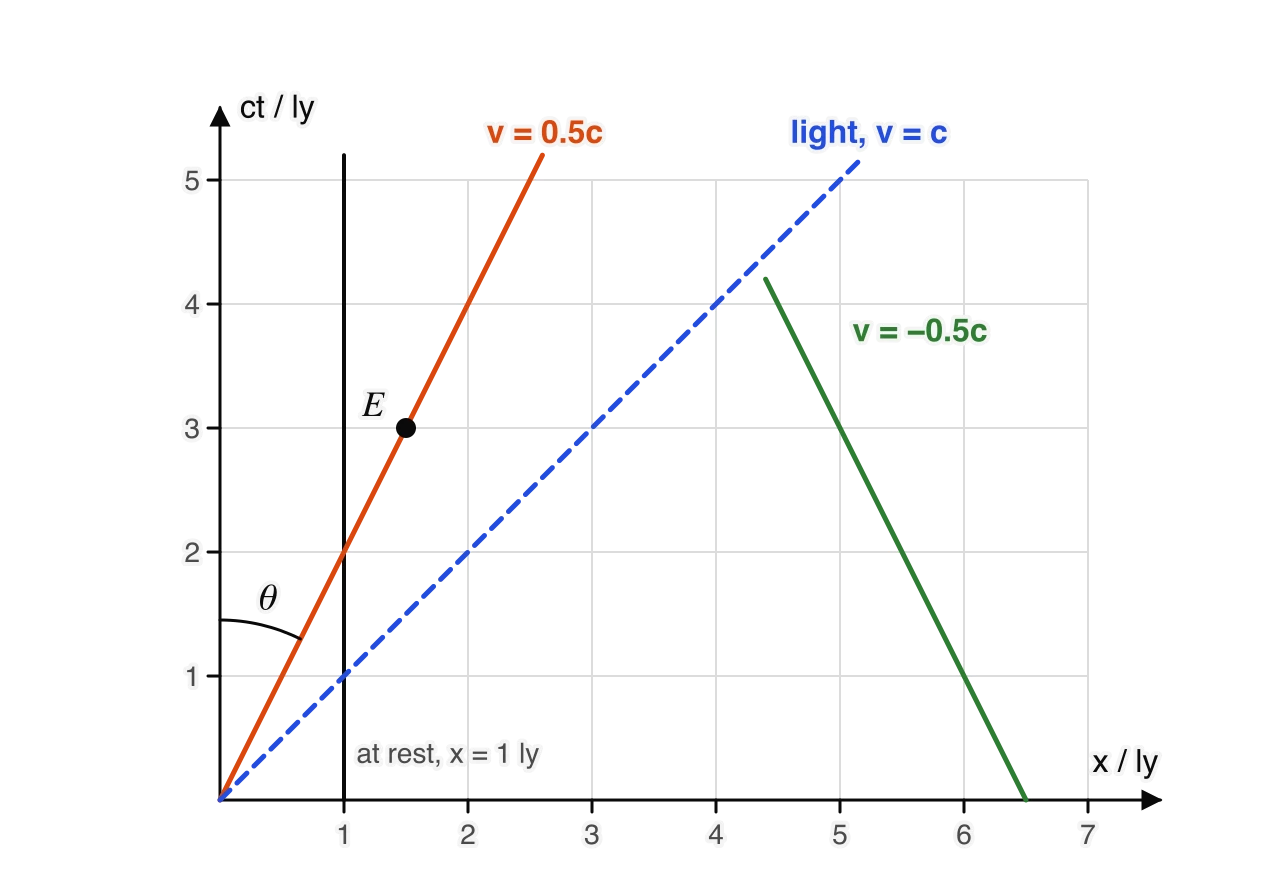
No body can reach , so every world line of a body makes an angle of less than 45° with the axis. A steeper line on the diagram means a slower body.
Drawing the axes of a moving frame
Frame S′ moves at relative to S. Its axes can be drawn on the diagram of S, so that one point represents an event and its coordinates can be read in either frame:
The axis is the set of events with : the world line of the origin of S′. It is a straight line through the origin at angle to the
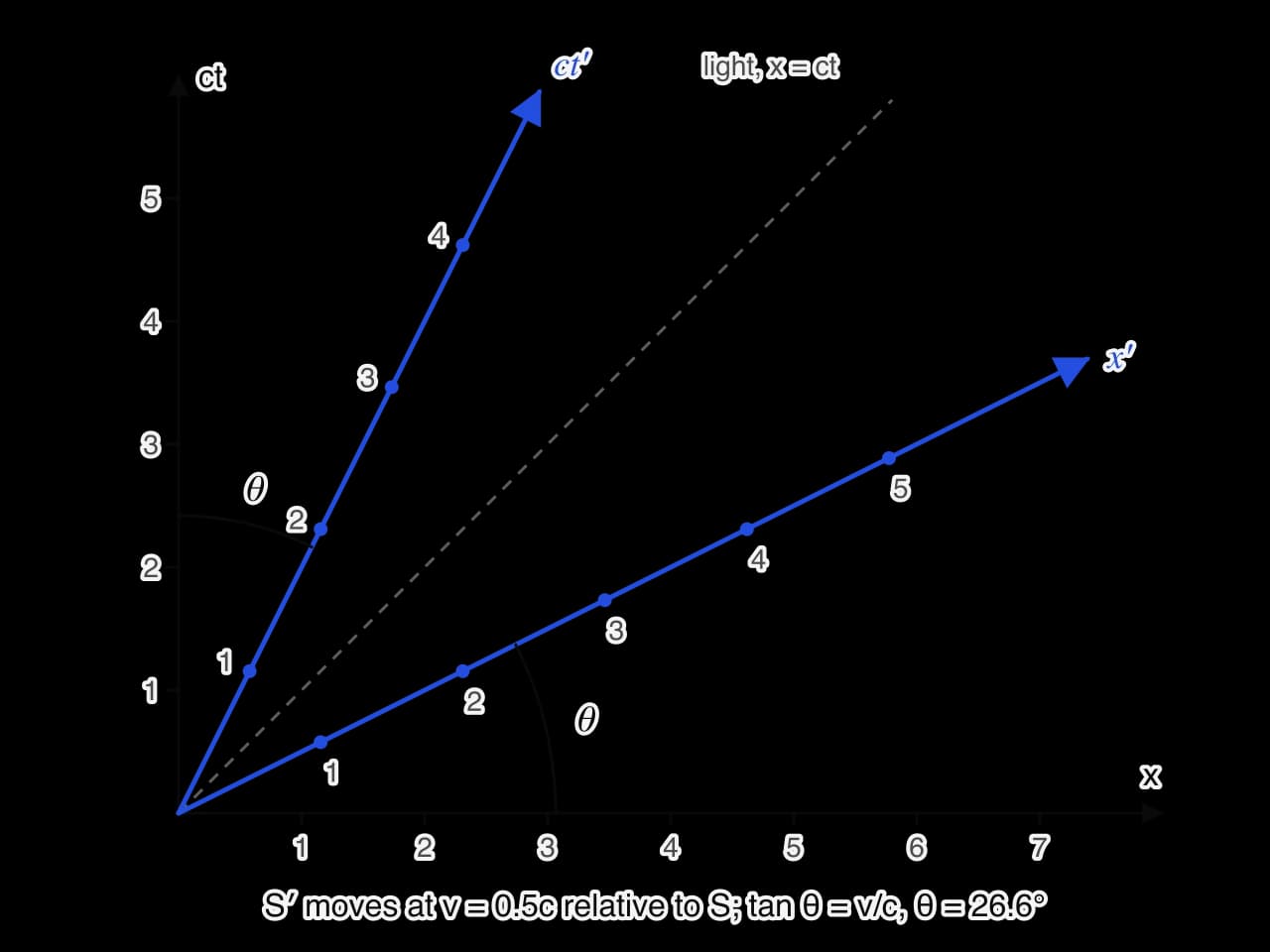
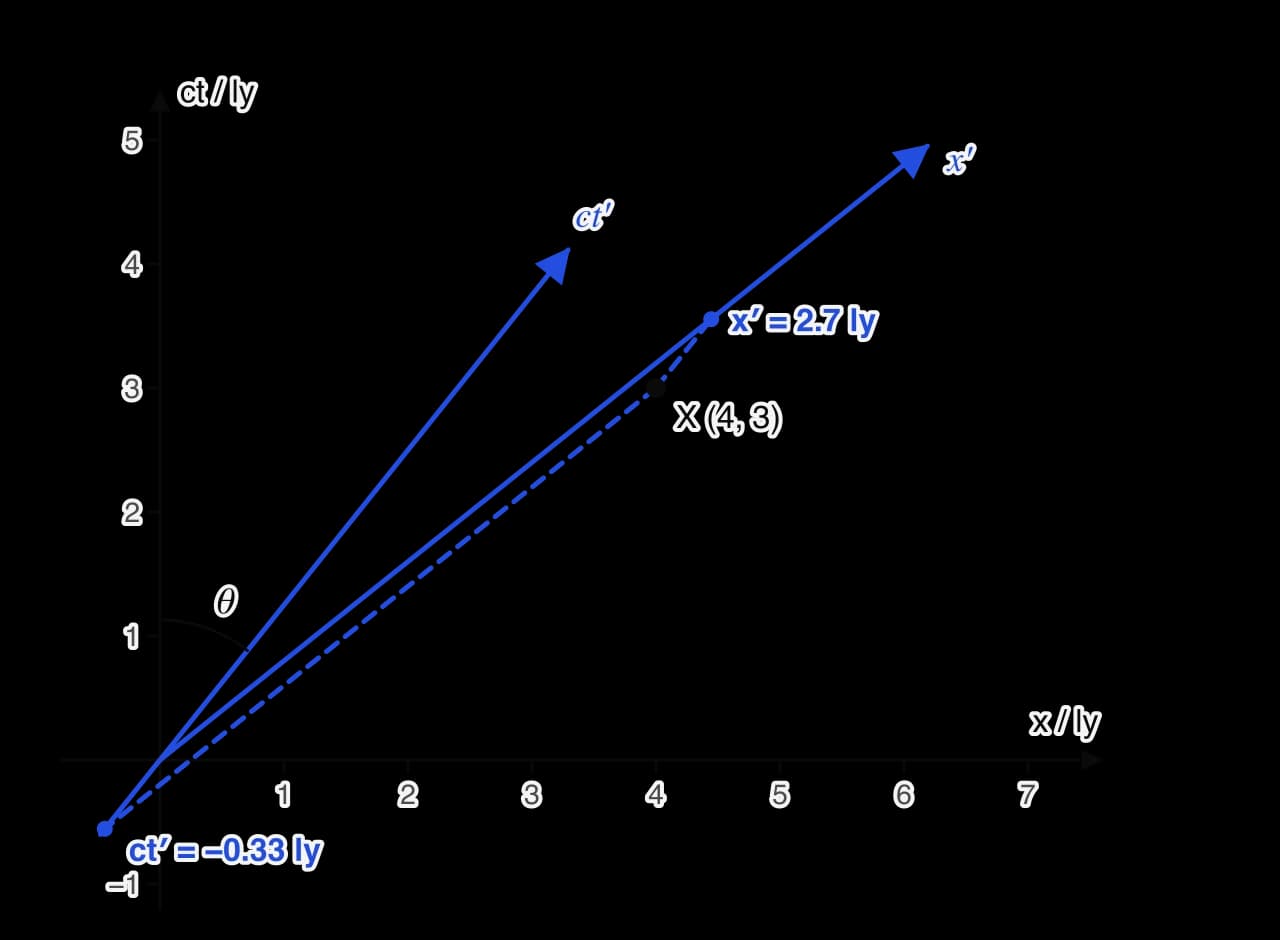
The diagram of the moving frame's axes shows the two tilted axes closing in on the light line like a pair of scissors. The light line still bisects the angle between and , which is how the diagram shows that light has speed in S′ as well. The faster S′ moves, the smaller the angle between its axes; at
Reading coordinates in both frames
To find the coordinates of an event in a frame, draw lines through the event parallel to that frame's axes:
In S, a line parallel to the axis (horizontal) meets the axis at the event's ; a line parallel to the axis (vertical) meets the axis at its .
In S′, a line parallel to the
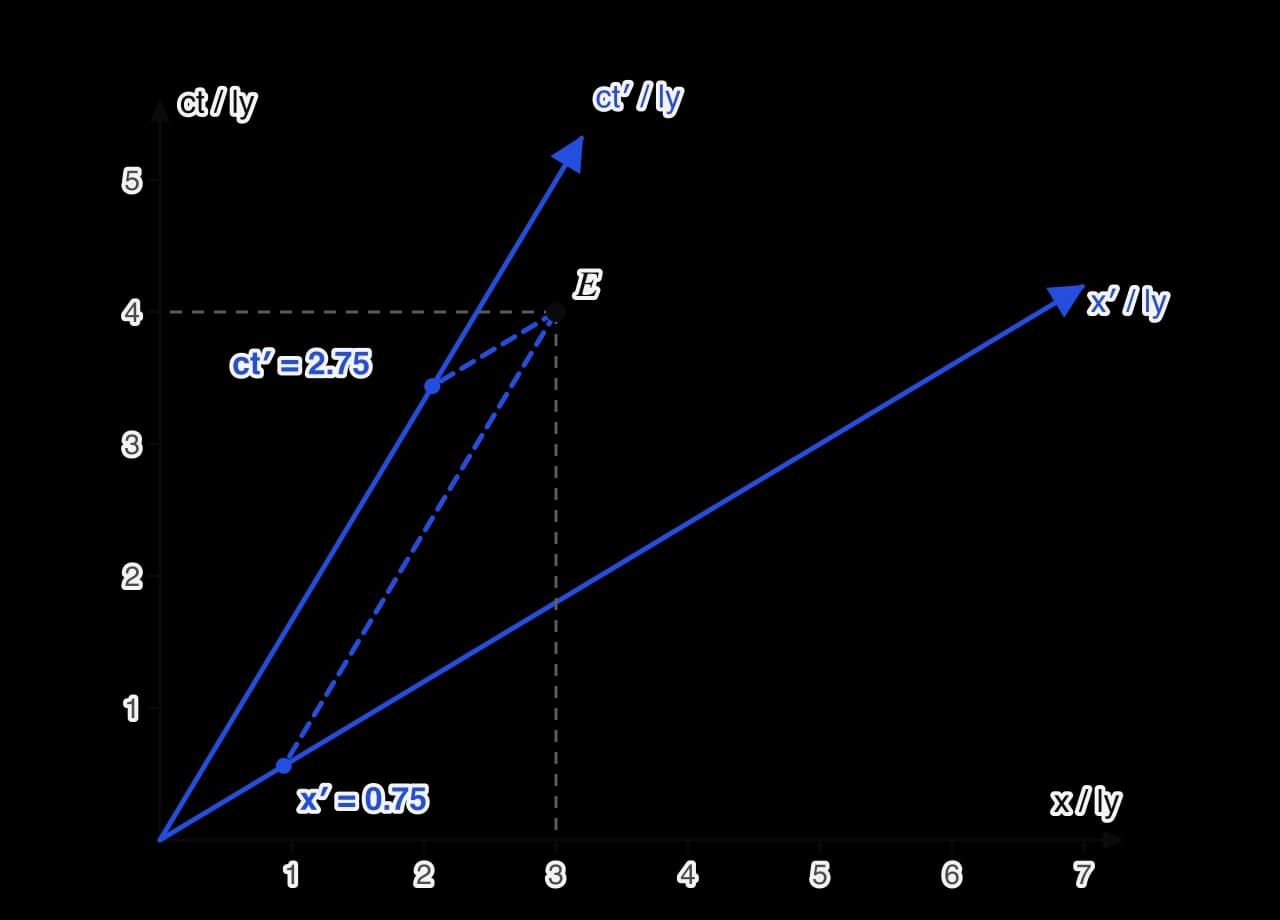
For the event E in the diagram of coordinates, with , the construction gives and
Scales on the moving axes
The unit marks on the and axes are not the same distance apart on paper as those on the and axes. The scale is fixed by the invariance of the interval. The event one unit up the
Calculating where a hyperbola meets the axis shows that the unit on the axis lies at , in S coordinates, a distance
Simultaneity on a space-time diagram
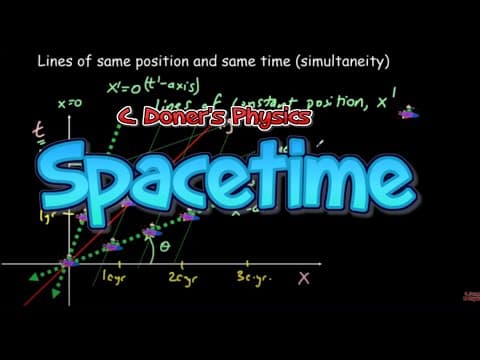
Events simultaneous in S lie on a line parallel to the axis. Events simultaneous in S′ lie on a line parallel to the axis, which is tilted. Two events on one horizontal line are therefore on different lines parallel to , and so happen at different times in S′.

In the diagram of simultaneity, A and B both happen at in S. The line through B parallel to meets the axis lower down than the line through A, so in S′ event B happens first. Calculation confirms this: with
The order of events can be read in the same way. Of several events, the one whose line parallel to crosses the axis lowest happens first in S′. An event below the axis has a negative : it happened before the origin event in S′, even if it is above the axis and so after the origin event in S.
Time dilation on a space-time diagram
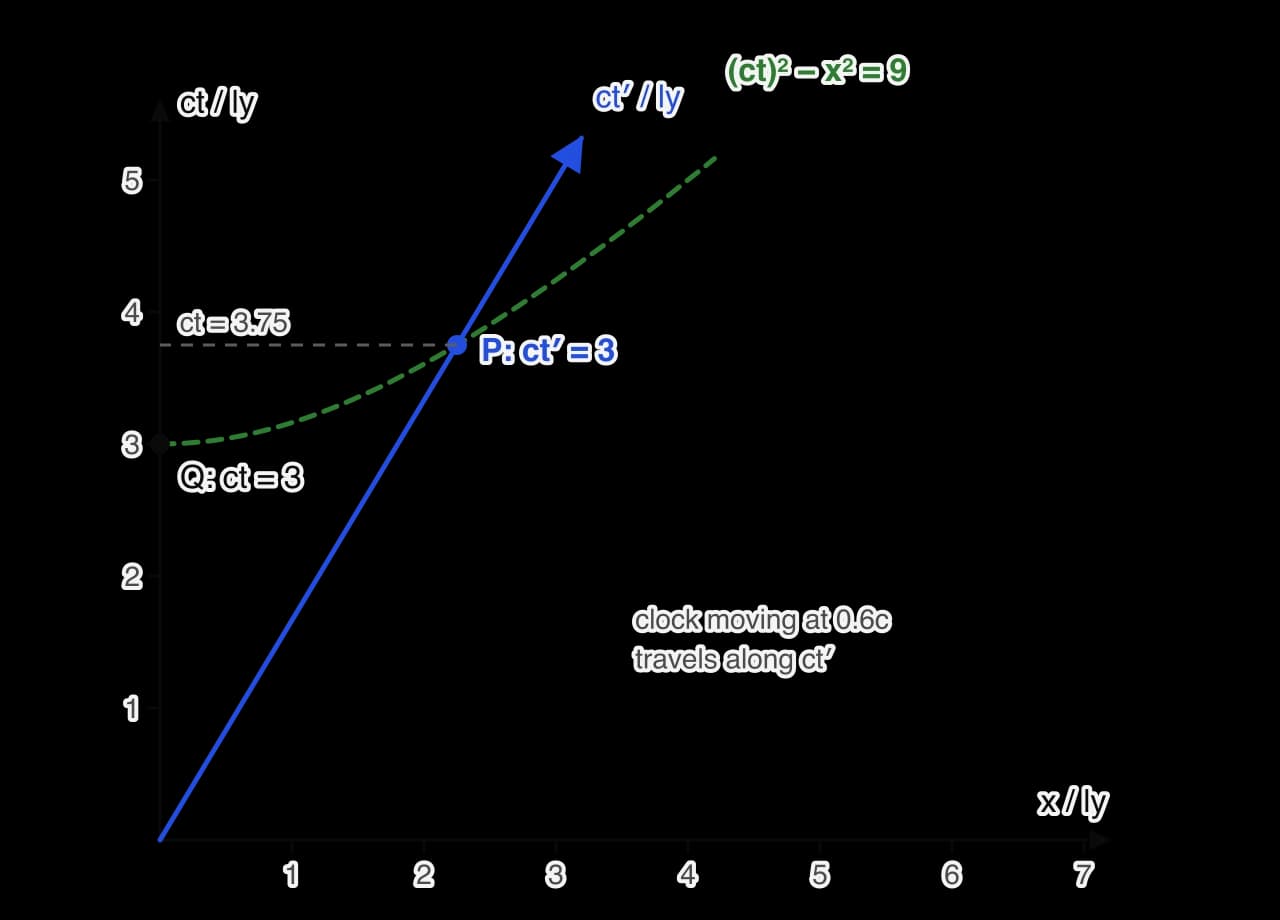
A clock at rest at the origin of S′ moves along the axis. The hyperbola in the time-dilation diagram marks the event P at which this clock reads , the same interval from the origin as the event Q where a clock at rest in S reads
The effect is symmetric on the diagram as well. Seen from S′, the event on the axis simultaneous with P (on a line parallel to the axis through P) is below Q, so S′ judges the S clock to have read less than 3: each frame measures the other's clock as slow.
Length contraction on a space-time diagram
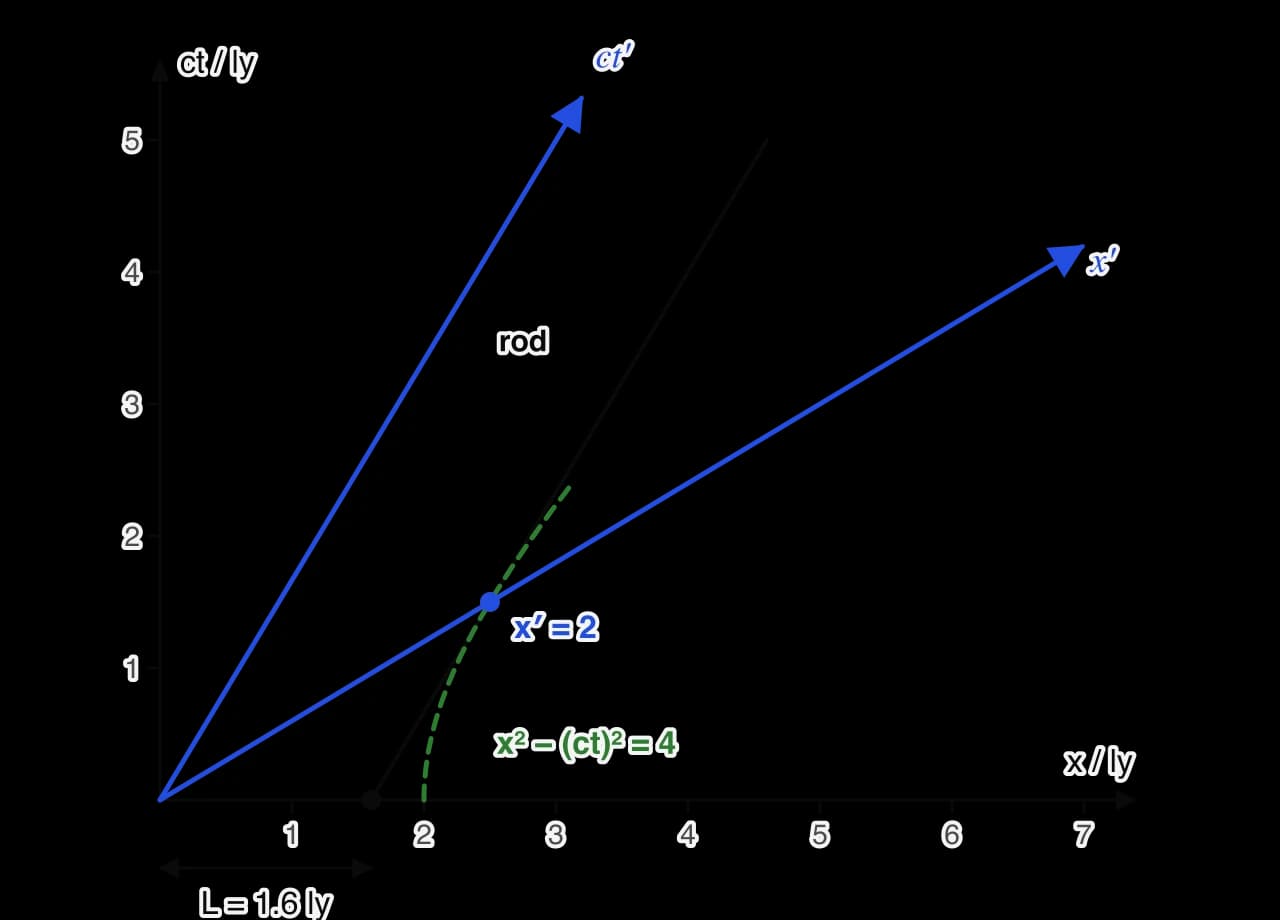
A rod at rest in S′ has world lines for both ends parallel to the axis, which sweep out the shaded strip in the length-contraction diagram. Its proper length is measured in S′ along the axis: from the origin to the point marked
 YouTube
Galilean and relativistic predictions compared
The Galilean and Lorentz transformations give practically identical results when , and very different results as approaches . Every Galilean statement is the low-speed limit of a relativistic one.
Galilean relativity | Special relativity | |
|---|---|---|
Transformation of position |
Galilean relativity remains an excellent model for everyday speeds; at , about 3000 km s⁻¹, the relativistic corrections are only 0.005 %. The change from Newtonian to relativistic physics is a standard example of a scientific theory being replaced by a more general one that includes it as a special case.
Applying the ideas in exam questions
Paper 1A: the Lorentz factor
Paper 1A: velocity addition
Paper 1A: a space-time diagram
Paper 1B: muon counts at two altitudes
Paper 2: a journey to a distant planet
Paper 2: muons and the two frames
Self-check
- To do:
I can define a reference frame, an event and an inertial reference frame, and describe an event with coordinates in two frames.
- To do:
I can state the principle of Galilean relativity and explain why Newton's laws keep their form under the Galilean transformation.
- To do:
I can use the Galilean transformation and Galilean velocity addition, with correct signs.
- To do:
I can explain why the constancy of the speed of light is incompatible with Galilean velocity addition, referring to the Michelson–Morley result.
- To do:
I can state the two postulates of special relativity.
- To do:
I can calculate the Lorentz factor and use the Lorentz transformation, including its difference form and its inverse, in SI units and in ly and years.
- To do:
I can show that the Lorentz transformation becomes the Galilean transformation when v is much less than c.
- To do:
I can use the relativistic velocity addition formula for bodies moving in the same and in opposite directions.
- To do:
I can calculate the space-time interval, use its invariance, and say whether two events can be causally connected.
- To do:
I can explain the relativity of simultaneity with a thought experiment and calculate the time between events that are simultaneous in another frame.
- To do:
I can define proper time and proper length, identify which frame measures them, and use time dilation and length contraction.