E Nuclear and quantum physics
How the atom, its nucleus and the photon fit together: atomic structure, quantum physics, radioactive decay, fission, and fusion in stars.
- IB Physics
- SL and HL
5 subtopics in Nuclear and quantum physics
Each one has its own page once something is published for it.
- E.1Structure of the atom80 questions · notes · 65 quick fire
- E.2Quantum physicsHL only65 questions · notes · 55 quick fire
- E.3Radioactive decay122 questions · notes · 85 quick fire
- E.4Fission54 questions · notes · 50 quick fire
- E.5Fusion and stars74 questions · notes · 60 quick fire
An overview of E Nuclear and quantum physics
Nuclear and quantum physics describes matter on the smallest scales, from the atom (about m across) down to its nucleus (about m). It explains where the light from atoms and stars comes from, why some nuclei are unstable, and how nuclear reactions release energy on a scale far beyond chemical reactions. The same ideas power nuclear reactors, date ancient objects, image the body in hospitals and make the stars shine.
How the five subtopics fit together
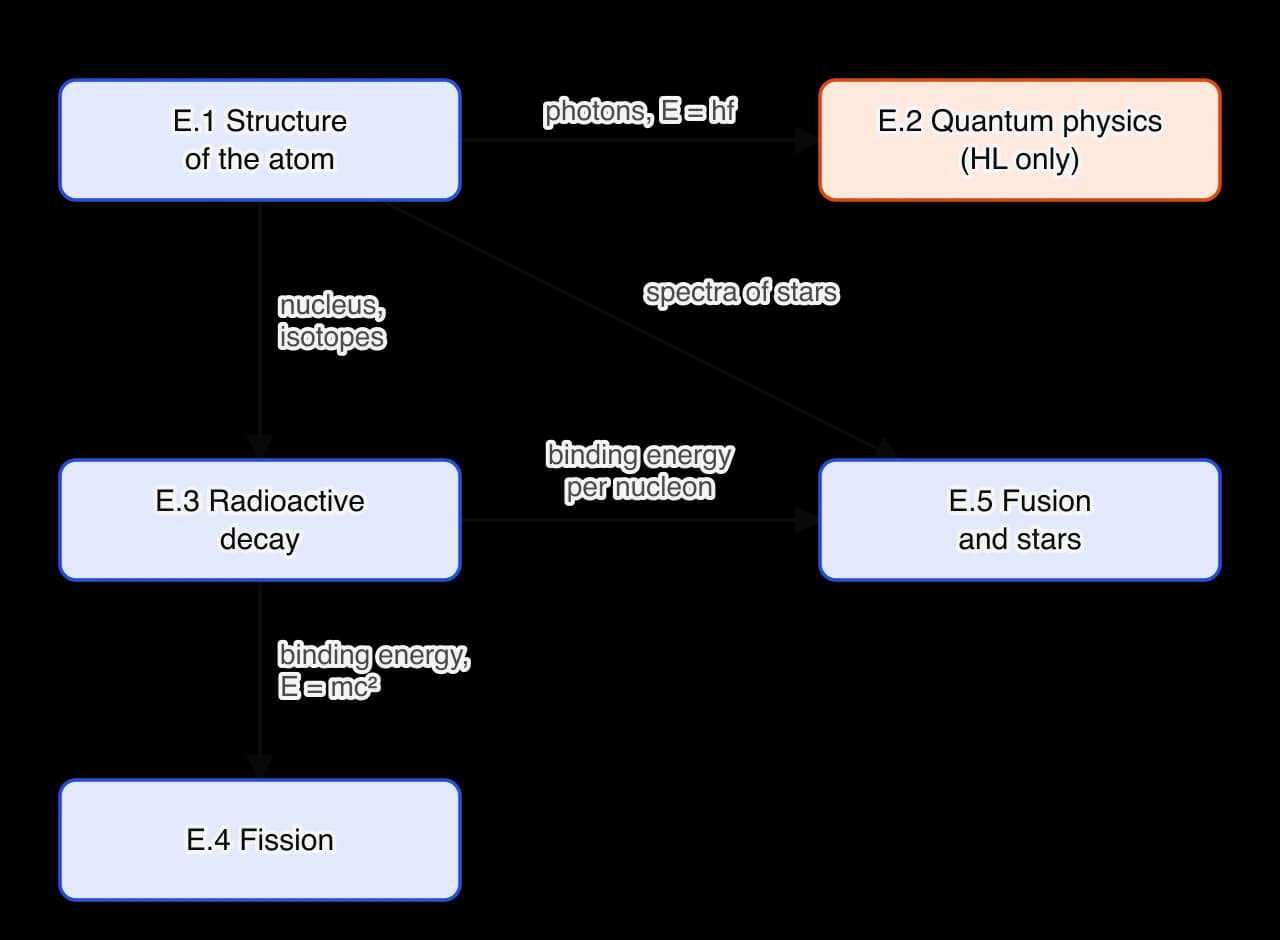
E.1 Structure of the atom sets up the nuclear model. Alpha-particle scattering shows that an atom has a tiny, dense, positive nucleus, and nuclear notation describes its protons and neutrons. Line spectra show that electrons in atoms can only have certain energies, and that light is emitted and absorbed as photons of energy . These spectra also identify the elements in a sample or in the atmosphere of a distant star.
E.2 Quantum physics (HL only) takes the photon further. The photoelectric effect and Compton scattering show that light behaves as particles, while electron diffraction shows that matter behaves as waves. Every particle and every photon shows both wave and particle behaviour.
E.3 Radioactive decay turns from the electrons to the nucleus. It explains what holds a nucleus together (the strong nuclear force), how stable it is (binding energy and mass defect, with ), and how unstable nuclei change by alpha, beta and gamma decay. Decay is random, but large numbers of nuclei follow a predictable half-life.
E.4 Fission uses the binding-energy curve to explain why splitting a heavy nucleus releases energy, how a chain reaction is started and controlled, and how a nuclear power station turns that energy into electricity and manages its waste.
E.5 Fusion and stars uses the same curve for light nuclei. Fusion powers the stars, which stay stable while the outward pressure of radiation and hot gas balances gravity. Spectra, luminosity and parallax measure the temperature, size and distance of stars, and the Hertzsprung–Russell diagram shows how a star's mass decides its life and death.
Big ideas across the theme
Quantisation
Several quantities that seem continuous in everyday life turn out to come in fixed amounts. Light energy arrives in photons, electrons in an atom occupy discrete energy levels, and charge comes in multiples of the electron charge. At HL, alpha and gamma spectra show that nuclei have discrete energy levels too.
Mass–energy equivalence and conservation
Energy is conserved in every atomic and nuclear process, provided mass is counted as a form of energy through . This is the same conservation principle used in mechanics (A.3) and thermodynamics (B.4), applied where the energy changes are large enough to change mass measurably. Conservation of charge and of nucleon number is used to balance every nuclear equation.
Models built from evidence
The theme shows models of the atom being replaced as new evidence appears: the plum-pudding model gave way to the nuclear model, which in turn needed the energy levels of the Bohr model and then the wave description of the electron. Each model is still useful within its limits, which makes the theme a clear example of how scientific theories develop.
Links to other themes
Electric fields and Coulomb's law (D.2) explain alpha-particle scattering and the forces inside the atom.
The wave model and diffraction (C.2, C.3) underlie spectroscopy and, at HL, the wave nature of matter.
Thermal radiation, Wien's law and luminosity (B.1) are used again to measure stars in E.5.
Energy, power and efficiency (A.3) apply to nuclear power stations, and the greenhouse effect (B.2) is part of the case for and against nuclear power.
Standard level and higher level
Subtopic | SL and HL | HL only |
|---|---|---|
E.1 Structure of the atom | Geiger–Marsden–Rutherford scattering (qualitative), nuclear notation, emission and absorption spectra, photons and energy levels, spectra and chemical composition | The Bohr model of hydrogen ( and eV); nuclear radius and constant nuclear density; distance of closest approach in head-on scattering; deviations from Rutherford scattering at high energies |
E.2 Quantum physics | — | The whole subtopic: the photoelectric effect, matter waves and the de Broglie wavelength, Compton scattering |
E.3 Radioactive decay | Isotopes, binding energy and mass defect, the strong nuclear force, α, β and γ decay, neutrinos, penetration and ionisation, activity and half-life over whole numbers of half-lives, background radiation | Evidence for the strong nuclear force; the neutron-to-proton ratio and stability; binding energy per nucleon roughly constant above ; α and γ spectra and nuclear energy levels; the continuous β spectrum as evidence for the neutrino; the decay constant, , and for any time interval |
E.4 Fission | The whole subtopic | — |
E.5 Fusion and stars | The whole subtopic | — |
At SL the theme is mostly about describing and explaining the evidence for atomic and nuclear structure and doing calculations with photon energies, binding energies and whole numbers of half-lives. At HL the same ideas become more quantitative: the Bohr model predicts the energy levels of hydrogen, the size and density of nuclei are calculated, and radioactive decay is described with exponential functions so that the number of nuclei or the activity can be found after any time.
Flashcards for E
The official decks for this part of the syllabus.
- E.1 Structure of the atom190 cards
- E.2 Quantum physics157 cards
- E.3 Radioactive decay228 cards
- E.4 Fission168 cards
- E.5 Fusion and stars218 cards
From the data booklet
The entries of the physics data booklet that E uses. Each opens in the explained booklet.
- Speed of light in vacuumFundamental constants
- Planck constantFundamental constants
- Electron rest massFundamental constants
- Proton rest massFundamental constants
- Neutron rest massFundamental constants
- (Unified) atomic mass unitFundamental constants
- Fermi radiusFundamental constants
- 1 light year (ly) Unit conversions
- 1 parsec (pc) Unit conversions
- 1 astronomical unit (AU) Unit conversions
And 21 more in the data booklet.
Carry on with E in Augment
With a free account, Augment remembers where you stopped and what you have practiced.