Notes on R2.6 The Mexican Revolution (1884–1940)
The Mexican Revolution was the first great social revolution of the twentieth century. Between 1910 and 1920 it overthrew a long-lasting dictatorship, destroyed the old federal army and cost perhaps a million or more lives; between 1920 and 1940 the victors built a new state, redistributed land on a large scale and took control of Mexico’s oil. Its constitution of 1917 was among the first in the world to write social and labour rights into a nation’s founding law.
 YouTube
Mexico under Porfirio Díaz, 1876–1911
Porfirio Díaz was a general of mixed Mixtec and Spanish descent from Oaxaca who became a national hero in the wars against the French intervention of the 1860s. He fought at the Mexican victory over the French at Puebla on 5 May 1862 and took Mexico City from the forces of the emperor Maximilian in 1867. In 1876 he seized power through the Plan of Tuxtepec, a revolt made in the name of “no re-election”, the principle that a president should serve only one term.
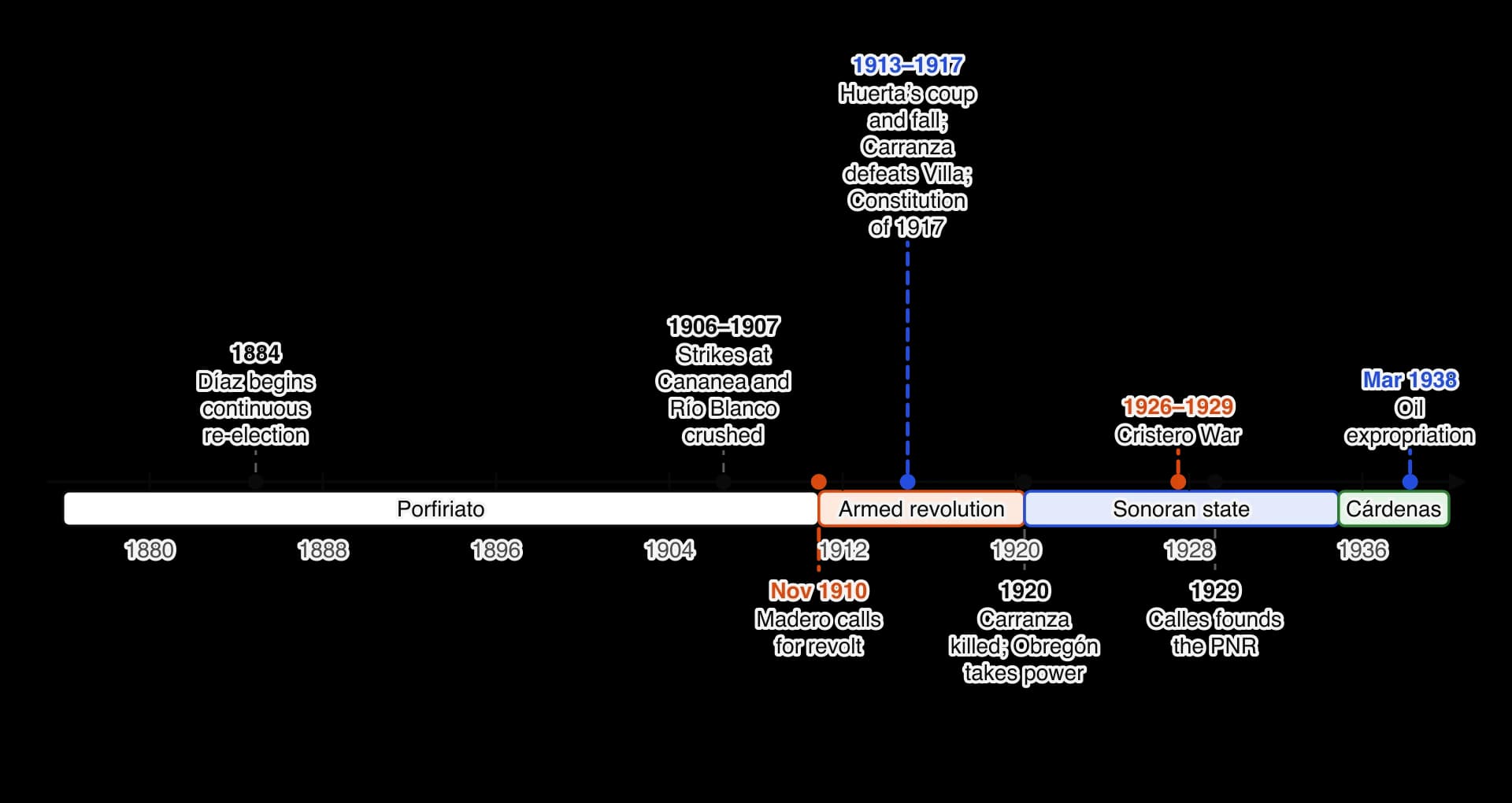
Díaz respected that principle once. After his first term (1876–1880) he handed the presidency to his ally Manuel González, then returned in 1884 and was re-elected every time until 1910. Congress amended the Constitution of 1857 in 1887 to allow one immediate re-election and in 1890 to allow re-election without limit. The period of his rule is called the Porfiriato.
Methods of political control
Díaz kept power through a system usually summed up in the phrase pan o palo, “bread or the stick”. Those who cooperated received rewards: governorships, seats in Congress, contracts, land concessions and the chance to make money from the new economy. Those who resisted faced force. Díaz balanced rival regional bosses against each other and made each depend on him.
Local power rested on two kinds of figure. A cacique was a local strongman who controlled a town or district through patronage and force. The jefe político was a district official appointed by the state governor who controlled local elections, conscription, the police and land disputes. Jefes políticos were among the most hated officials of the regime, because villagers met the dictatorship through them.
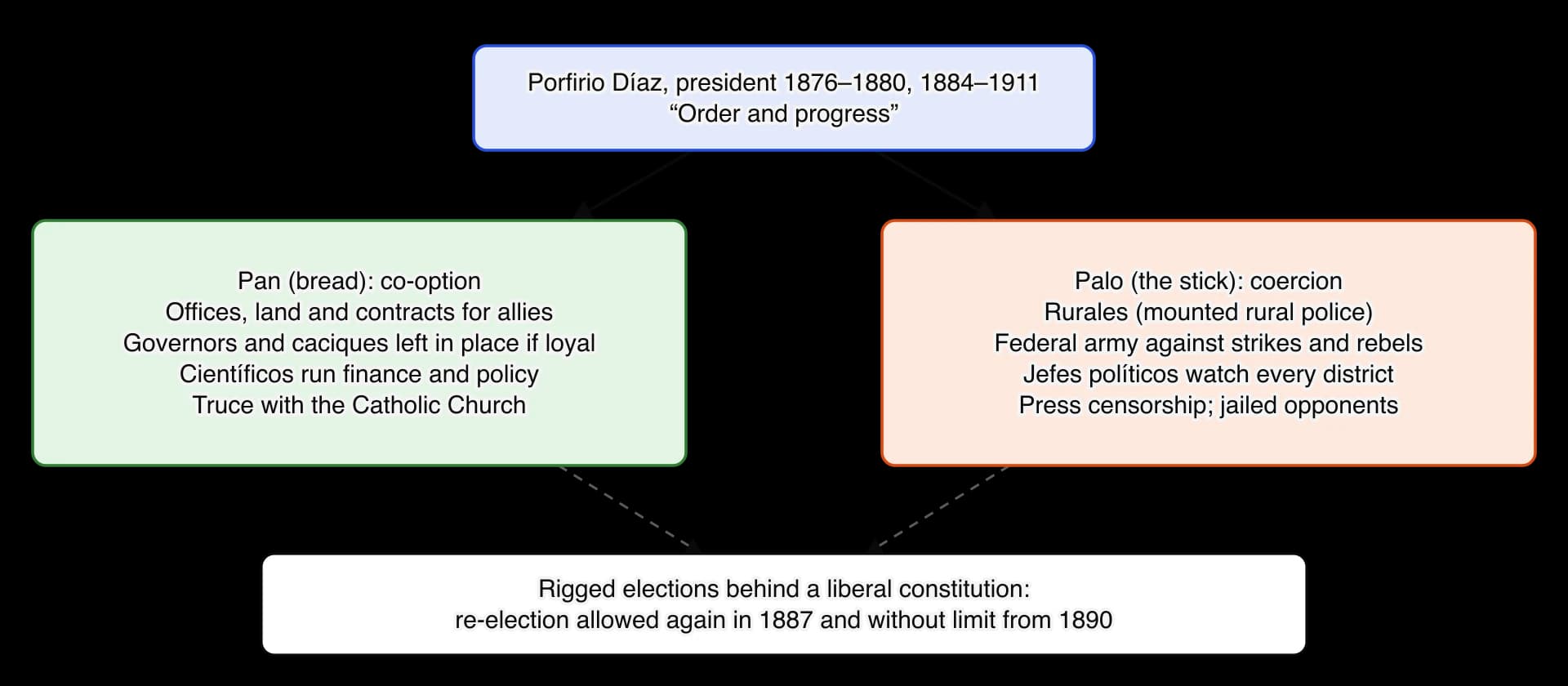
The diagram of pan o palo shows that force and reward worked together. The rurales, a mounted rural police force, kept order on the roads and in the countryside and became a symbol of the regime’s harshness, although historians such as Paul Vanderwood have shown that they were fewer and less effective than their reputation suggested. The federal army crushed rebellions by the Yaqui people of Sonora and the Maya of Yucatán. Opposition newspapers were closed and their editors jailed.
Díaz also avoided conflicts that had divided Mexico earlier in the century. The Reform laws of the 1850s, which had attacked the property and privileges of the Catholic Church, stayed on the books but were not enforced. In return, the Church hierarchy supported the regime. Elections were held as the constitution laid down, but the results were arranged from above.
We were harsh. Sometimes we were harsh to the point of cruelty. But it was all necessary then to the life and progress of the nation. If there was cruelty, results have justified it.
Porfirio Díaz, interview with James Creelman, “President Díaz: Hero of the Americas”, Pearson’s Magazine, March 1908. Díaz was describing how he had ended banditry in the 1870s and 1880s. He spoke to a sympathetic American journalist in an interview meant for readers in the USA, where most foreign investment in Mexico came from, so he presented his rule as a necessary stage on the way to democracy. The extract is valuable because the dictator himself admits the use of terror and justifies it by results.
The científicos and “order and progress”
From the 1890s Díaz relied on a group of advisers known as the científicos (“scientists”), lawyers, financiers and officials who believed that Mexico should be governed by experts according to scientific principles. Their ideas came from positivism, the philosophy of the French thinker Auguste Comte, which held that society progresses through stages and that order is the precondition of progress. The regime’s motto was “order and progress”.
The leading científico was José Yves Limantour, minister of finance from 1893 to 1911. He balanced the federal budget in 1894 for the first time in Mexican history, abolished internal customs duties (the alcabalas) in 1896, refinanced the foreign debt on better terms and put the peso on the gold standard in 1905. Mexico’s credit in London, Paris and New York became excellent.
Economic growth and foreign investment
The Porfiriato brought the fastest economic growth Mexico had known. Railways were the key: from about 640 km of track in 1876 the network grew to more than 19,000 km by 1910, linking mines and plantations to the ports and to the US border. Railways lowered transport costs, created a national market and allowed the federal army to move quickly against rebels.
Most of the capital came from abroad. Díaz offered generous concessions, tax exemptions and mining laws (1884 and 1892) that gave owners of the land rights to coal, oil and other substances beneath it, breaking with the colonial principle that the subsoil belonged to the state. By 1910 foreigners owned most of the mining industry, most of the railways until the government bought a controlling share in 1908, and nearly all of the new oil industry. US investors held the largest share; British capital was strongest in oil (Weetman Pearson’s El Águila company), railways and utilities.
Sector | Main developments, 1876–1910 | Who benefited |
|---|---|---|
Railways | About 640 km of track (1876) to over 19,000 km (1910); lines to the US border | Foreign companies; exporters; the state (troop movement) |
Mining | Silver, copper (Cananea, Sonora), lead and zinc; laws of 1884 and 1892 gave landowners rights to the subsoil | Mainly US and British companies |
Oil | First commercial wells in 1901 (Edward Doheny); El Águila (Pearson) from 1908 | US and British companies; little tax for Mexico |
Export agriculture | Henequen (sisal) in Yucatán, coffee, sugar in Morelos, cattle in the north | Hacendados and foreign buyers; workers often in debt peonage |
Public finance | Balanced budget (1894); internal customs abolished (1896); gold standard (1905) | Bondholders and investors; a stable currency |
Growth was real, but it was uneven. Industry grew in textiles, steel (the Monterrey foundry of 1900), beer and cement, but most Mexicans still worked on the land. Real wages for rural labourers probably fell in the 1900s as food prices rose, and much of the profit from mining and oil left the country.
Land, villages and the hacienda
Land was the deepest grievance of the Porfiriato. The liberal Ley Lerdo of 1856 had ordered the sale of land held by corporations, including both the Church and the Indigenous and mestizo villages that held land in common. It was meant to create a class of small farmers. In practice it allowed speculators and large landowners to buy up village lands.
Under Díaz the process accelerated. Laws of 1883 and 1894 on vacant public land (terrenos baldíos) allowed private survey companies to mark out land without clear title and keep up to a third of it as payment. Villages whose ownership rested on colonial grants or long use often could not produce documents acceptable to the courts and lost fields, woods and water. Railways raised land values and made the grab more profitable.
By 1910 the hacienda dominated rural Mexico. In Chihuahua the Terrazas–Creel family held estates estimated at about 2 million hectares or more. In Morelos, south of Mexico City, sugar haciendas expanded so far that some villages were left with no land outside their house plots. Historians’ estimates vary, but a widely quoted figure is that over 90 per cent of rural families in central Mexico owned no land by 1910.
Many rural workers lived in debt peonage. Workers on a hacienda bought food and goods on credit at the estate’s store (the tienda de raya), and debts could be passed to their children. In the henequen plantations of Yucatán and the tobacco fields of the Valle Nacional in Oaxaca, conditions came close to slavery. Thousands of Yaqui people captured in Sonora were deported to work on the Yucatán plantations in the 1900s.
Workers, the middle class and the north
Mexico in 1910 was still overwhelmingly rural: about four in five of its 15 million people lived in the countryside, and roughly three-quarters of the population could not read or write. Industrial and mining workers grew to several hundred thousand by 1910. Two strikes became symbols of the regime’s methods. At the US-owned copper mine at Cananea, Sonora, Mexican miners struck in June 1906 against lower pay than American workers received for the same jobs. The governor of Sonora allowed armed volunteers from Arizona, led by Arizona Rangers, to cross the border to help put down the strike; over twenty people were killed. In January 1907 troops fired on textile workers at Río Blanco, Veracruz, after a lockout and riot; estimates of the dead range from dozens to several hundred.
The most radical opposition came from the Partido Liberal Mexicano (PLM) of Ricardo and Enrique Flores Magón, whose newspaper Regeneración was published from exile in the USA. The PLM programme of 1906 called for no re-election, an eight-hour day, a minimum wage, the return of stolen lands and secular education. Several of these demands reappeared in the Constitution of 1917, though the Flores Magón brothers moved towards anarchism and played little part in the revolution after 1911.
Discontent was not only among the poor. The growing middle class of lawyers, teachers, clerks and small businessmen found that high office went to an ageing circle around Díaz; in 1910 the president was 80 and many ministers and governors were over 70, so critics called the regime a gerontocracy. In the north, landowning families such as the Maderos of Coahuila and the Carranzas resented the científicos, the favours given to foreign companies and their own exclusion from state government.
Why did revolution break out in 1910?
The crisis of 1907–1910
In the late 1900s three problems came together. The first was economic. A financial panic in the USA in 1907 cut demand for Mexican copper, silver and henequen; mines laid off workers, banks called in loans and credit dried up. Thousands of Mexicans who had worked in the USA came home without jobs. Poor harvests in 1908 and 1909 then pushed up the price of maize and beans, the basic foods of the poor.
The second was the succession. Díaz would be 80 in 1910, and he had never allowed a clear successor to emerge. The científicos and the followers of Bernardo Reyes competed for the vice-presidency, which might lead to the presidency if Díaz died in office. Díaz chose the unpopular Ramón Corral as his vice-president in 1904 and again in 1910, and sent Reyes abroad on a military mission in 1909.
The third was an opening that Díaz himself created. In an interview with the American journalist James Creelman, published in Pearson’s Magazine in March 1908 and reprinted in Mexico, he said that the country was now ready for democracy and that he would not seek re-election in 1910.
I welcome an opposition party in the Mexican Republic. If it appears, I will regard it as a blessing, not as an evil. And if it can develop power, not to exploit but to govern, I will stand by it, support it, advise it and forget myself in the successful inauguration of complete democratic government in the country.
Porfirio Díaz, interview with James Creelman, Pearson’s Magazine, March 1908. Díaz was speaking to an American audience of investors and politicians, and he probably intended to reassure them about Mexico’s future rather than to change his own plans: he stood again in 1910. As a source it shows the regime’s wish to appear modern and democratic abroad. Its effect inside Mexico matters more, because opposition groups took Díaz at his word and began to organise.
Francisco Madero and the anti-re-election campaign
The man who took up the challenge was Francisco I. Madero, the son of one of the richest families in Coahuila, with interests in cotton, mining and banking. He had studied in France and California, practised spiritualism and believed in liberal democracy. In 1908 he published La sucesión presidencial en 1910 (The Presidential Succession in 1910), a cautious book that argued for free elections and proposed that Díaz should stay as president with a freely chosen vice-president.
In 1909 Madero founded the Anti-Re-electionist Party under the slogan “Effective suffrage, no re-election”. His speaking tours drew large crowds, and in April 1910 the party nominated him for president. In June 1910, shortly before the vote, he was arrested in Monterrey and charged with inciting rebellion. Díaz was declared re-elected with almost all the recorded votes. Released on bail, Madero escaped to San Antonio, Texas, in October.
From Texas he issued the Plan of San Luis Potosí, dated 5 October 1910, his last day in San Luis Potosí, where he had been held, so that it would not appear to have been written on US soil. It declared the election void, named Madero provisional president and called on Mexicans to take up arms at six in the evening on 20 November 1910. Its third clause made a cautious promise on land that drew peasants into the revolt.
By abuse of the law on vacant lands, numerous small proprietors, most of them Indigenous, have been dispossessed of their lands, either by decisions of the Ministry of Development or by rulings of the courts of the Republic. It being entirely just to restore to their former owners the lands of which they were so arbitrarily dispossessed, such decisions and rulings are declared subject to review.
Francisco I. Madero, Plan of San Luis Potosí, clause 3, dated 5 October 1910 (translated from the Spanish). Madero’s main concern was political, and most of the plan dealt with the fraudulent election. The land clause was limited: it promised to review past rulings and to restore land taken by abuse of the vacant-lands law, case by case, with compensation for the dispossessed owners, but it said nothing about breaking up the haciendas as such. Villagers in Morelos and elsewhere read it as a promise of restitution, and the gap between the two readings later turned Zapata against Madero.
Weighing the causes
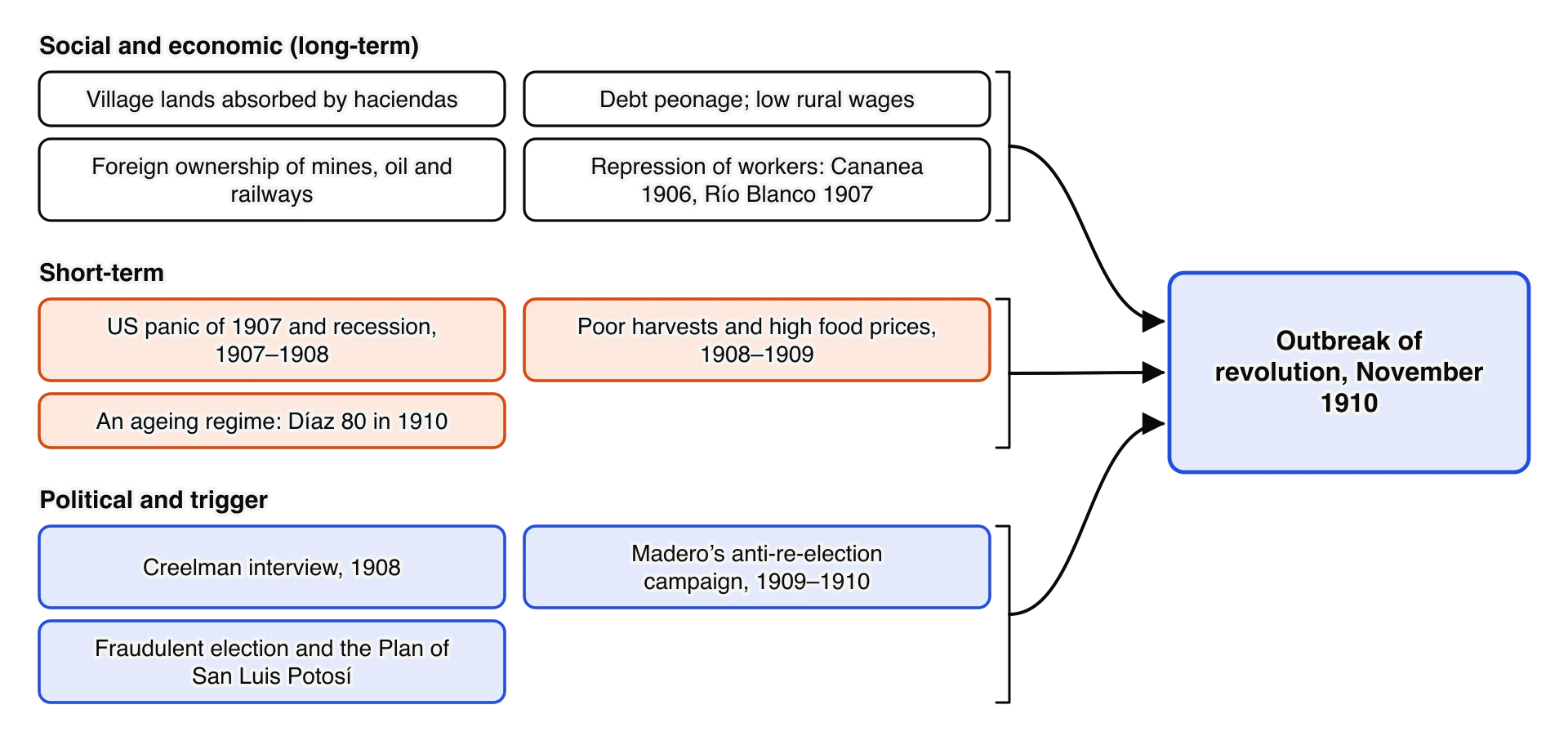
The diagram of causes groups them by timescale. No single group explains the outbreak on its own. The long-term social and economic grievances explain why so many people were ready to fight; they had existed for decades without producing a national revolution. The economic downturn of 1907–1909 explains why discontent rose at the end of the 1900s. The political crisis explains why revolt came in 1910 and why it was led at first by members of the elite.
Factor | Evidence that it mattered | Limits of the explanation |
|---|---|---|
Land and rural grievances (social and economic) | Village land losses under the laws of 1856, 1883 and 1894; Zapata’s Morelos rising; land restitution in the Plan of San Luis | Land had been lost for decades without revolution; the first rebel leaders were not peasants |
Foreign economic domination (economic) | US and British ownership of mines, oil and railways; Cananea 1906; resentment of foreigners in the north | Foreign investment also created jobs; the revolutionaries of 1910 did not attack foreign property at first |
Economic crisis, 1907–1909 (short-term economic) | Panic of 1907; unemployment in mines; harvest failures; rising food prices | Explains the timing of discontent more than its causes |
The political system (political) | Re-election since 1884; jefes políticos; ageing leadership; middle-class exclusion | The system had been the same for decades |
The succession crisis (trigger) | Creelman interview, 1908; Madero’s campaign; the stolen election of 1910 | A trigger only works where there are deep grievances to mobilise |
Francisco Madero: the fall of Díaz and a failed democracy, 1910–1913
The revolt of 1910–1911
The rising of 20 November 1910 began badly. In Puebla the police discovered the plans of the Maderista Aquiles Serdán, who was killed with members of his family on 18 November, and in most cities nothing happened. The revolt survived in the mountains of western Chihuahua, where rancheros, muleteers and small farmers took up arms under local leaders, including Pascual Orozco, a mule driver and merchant, and Francisco “Pancho” Villa, a former bandit and cattle rustler.
Over the winter of 1910–1911 the rebellion spread across the north and, from March 1911, into Morelos under Emiliano Zapata. The federal army, about 30,000 strong on paper, proved too small and badly organised to fight guerrillas in many places at once. On 10 May 1911 Orozco and Villa took the border city of Ciudad Juárez, against Madero’s orders.
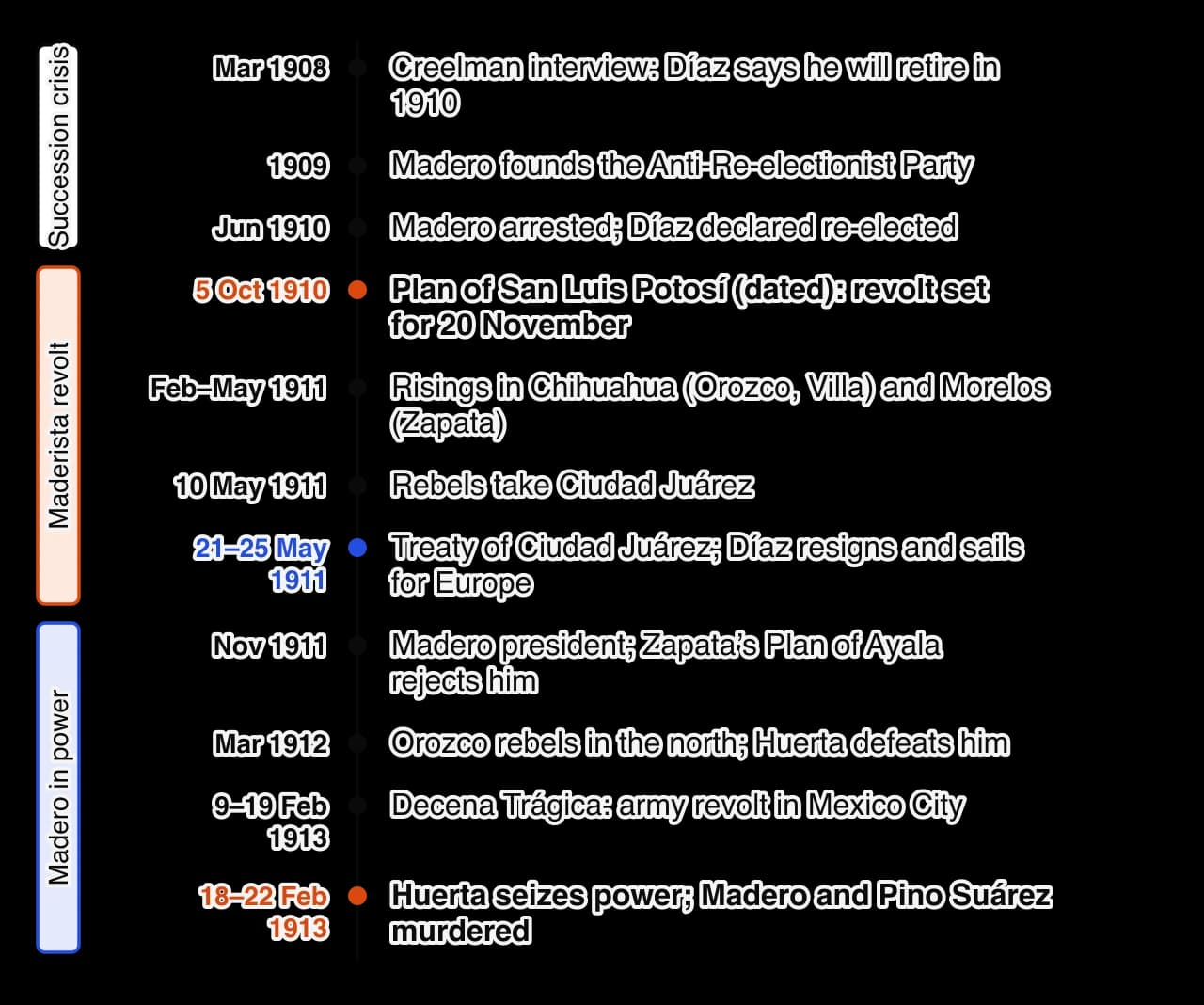
The timeline from 1908 to 1913 shows how quickly Díaz fell. Under the Treaty of Ciudad Juárez of 21 May 1911, Díaz agreed to resign; he left Veracruz for exile in France at the end of May. An interim government under Francisco León de la Barra, a Porfirian diplomat, held elections in October 1911, which Madero won easily. He took office in November 1911.
The treaty was a compromise. The federal army was kept and the revolutionary forces were to be disbanded. Most of the Porfirian Congress, judges and state officials stayed in place. Madero believed that a democratic political system would allow other problems to be solved gradually by law. Many of the people who had fought for him wanted land, better wages and local power now.
Madero in power, 1911–1913
Madero’s government was the most democratic Mexico had yet known. Elections for Congress in 1912 were relatively free, the press was uncensored, workers were allowed to organise, and a Department of Labour was created in 1911 to mediate disputes. Madero kept to the law and to his liberal principles.
Those principles left him weak against enemies on both sides. On the left, Zapata refused to disarm until village lands were returned, and in November 1911 he rejected Madero in the Plan of Ayala. In the north, Orozco, who felt cheated of reward, rebelled in March 1912 with the backing of Chihuahua landowners. On the right, Porfirian generals Bernardo Reyes (December 1911) and Félix Díaz, the dictator’s nephew (October 1912), attempted risings. Each was defeated, mostly by the old federal army under generals such as Victoriano Huerta, which increased the army’s confidence and power.
Area | Achievements | Failures and limits |
|---|---|---|
Political | Free elections (1911, 1912); free press; Congress and courts independent | Kept the Porfirian army, Congress and officials; leaned on relatives and old elites |
Land | A National Agrarian Commission studied the problem; some public land offered for sale | No restitution of village lands; broke with Zapata, who rebelled in November 1911 |
Labour | Department of Labour (1911); unions organised; the Casa del Obrero Mundial founded (1912) | Strikes still sometimes repressed; little change in wages or hours |
Order | Defeated the risings of Reyes, Orozco and Félix Díaz | Depended on the federal army and Huerta, who overthrew him |
The Decena Trágica and Madero’s murder
On 9 February 1913 army units in Mexico City rose against Madero, freeing Reyes and Félix Díaz from prison. Reyes was killed in the first assault on the National Palace, and the rebels occupied the Ciudadela, an arsenal in the city. For ten days of fighting, the Decena Trágica (“Tragic Ten Days”), artillery shells fell on the city centre and hundreds of civilians died. Madero entrusted the defence to Huerta, who secretly negotiated with the rebels.
On 18 February Huerta and Félix Díaz signed the Pact of the Embassy in the US embassy, with the support of the US ambassador, Henry Lane Wilson, who disliked Madero and believed a strong man would protect American interests. Huerta arrested Madero and his vice-president, José María Pino Suárez, and became provisional president through a legal manoeuvre in Congress. On the night of 22 February both men were shot while being moved to prison, officially while “trying to escape”.
Victoriano Huerta’s dictatorship, 1913–1914
Victoriano Huerta was a professional soldier of Huichol descent from Jalisco who had served Díaz in campaigns against the Maya and the Yaqui and had defeated Orozco for Madero in 1912. As president he restored the methods of the Porfiriato in harsher form. He set out to multiply the size of the federal army several times over, largely through the leva, the forced conscription of poor men seized in the streets and villages.
Opponents were murdered, including the senator Belisario Domínguez, who had denounced Huerta in Congress, in October 1913. When Congress protested, Huerta dissolved it and arrested more than a hundred deputies. Some historians, such as Michael Meyer in Huerta: A Political Portrait (1972), argue that Huerta was more than a reactionary, pointing to his spending on rural schools and his interest in land and labour questions; most still see his regime as a military dictatorship that tried to restore the old order.
Huerta’s coup had the opposite effect to the one he intended. It united Madero’s former supporters, revolutionaries who wanted land and northern governors who refused to accept him, into a far larger revolution than that of 1910. In Coahuila, Governor Venustiano Carranza refused to recognise Huerta; in Sonora, the state government and officers such as Álvaro Obregón and Plutarco Elías Calles joined him; in Chihuahua, Villa returned from exile in the USA in March 1913 with eight men and within months led an army.
Huerta was also isolated abroad. Woodrow Wilson, who became US president in March 1913, refused to recognise a government that had come to power by murder. By 1914 Huerta’s armies were losing in the north, his treasury was empty and the US Navy held Veracruz, Mexico’s main port. After Villa’s División del Norte destroyed the federal garrison at Zacatecas on 23 June 1914, Huerta resigned on 15 July and left for exile. The federal army was dissolved under the Treaty of Teoloyucan in August 1914.
Pancho Villa and Emiliano Zapata: the popular revolution
Villa and Zapata led the two largest popular movements of the revolution. Both came from poor rural backgrounds, both commanded armies of ordinary country people, and both became legends. Their movements differed in region, social base, aims and methods, and the differences help explain why they never formed a lasting alliance and why both were defeated.
Pancho Villa and the División del Norte
Francisco “Pancho” Villa (born Doroteo Arango in Durango) worked as a sharecropper, muleteer and bandit before joining Madero in 1910. Chihuahua was a frontier state of ranches, mines and railways, where the Terrazas–Creel family controlled both land and government. Its rebels were cowboys, miners, railway workers, small farmers and military colonists who had lost the land granted to their ancestors for fighting the Apache.
From 1913 Villa built the División del Norte (Division of the North), the largest revolutionary army, with perhaps 40,000–50,000 men at its peak in 1914. It moved by railway, with hospital trains and artillery directed by Felipe Ángeles, a former federal officer trained in France. Villa paid for arms bought in the USA with cattle, cotton and other goods taken from confiscated haciendas, and with paper money printed by his own government.
As governor of Chihuahua from December 1913 to January 1914, and as its real ruler until 1915, Villa confiscated the estates of the Terrazas family and other enemies. Instead of dividing them among peasants at once, he ran them as state enterprises whose income paid for the army and for the families of soldiers, and he promised that land would be distributed after victory. He also opened schools and sold cheap meat to the urban poor.
We have looked on at the robbing of our people, the simple, poor people, for thirty-five years, eh? We have seen the rurales and the soldiers of Porfirio Diaz shoot down our brothers and our fathers, and justice denied to them. We have seen our little fields taken away from us, and all of us sold into slavery, eh?
General Toribio Ortega, one of Villa’s commanders, speaking to John Reed, Insurgent Mexico, 1914. Reed was a young American radical journalist who travelled with the División del Norte in 1913–1914 and wrote for US magazines; he admired the revolutionaries and chose speakers who expressed their cause well. Even so, the extract records how a former cowboy turned general explained his motives: thirty-five years of the Porfiriato, the rurales and the loss of land, the same grievances the causes of 1910 point to.
Emiliano Zapata and the Plan of Ayala
Emiliano Zapata came from Anenecuilco, a small village in Morelos, a state south of Mexico City where sugar haciendas had swallowed village lands for decades. He was a small landholder and horse trainer, respected enough to be elected head of his village council in 1909, with the task of defending its land titles. When the courts failed, the villagers began to take back their fields by force, and in March 1911 Zapata joined the Maderista revolt.
After Madero failed to return the land, Zapata and his advisers issued the Plan of Ayala in November 1911. It denounced Madero as a traitor and set out a programme of land reform that became the core demand of the agrarian revolution.
In virtue of the fact that the immense majority of Mexican pueblos and citizens are owners of no more than the land they walk on, suffering the horrors of poverty without being able to improve their social condition in any way … because lands, timber, and water are monopolized in a few hands, for this cause there will be expropriated the third part of those monopolies from the powerful proprietors of them, with prior indemnization.
Emiliano Zapata and others, Plan of Ayala, clause 7, dated 25 November 1911 and proclaimed on 28 November (translated by John Womack, 1969). The plan was written by Zapata’s schoolteacher ally Otilio Montaño for an audience of Morelos villagers and to win national support, so it presents land as a matter of justice and law. It was moderate in one way (compensation for most expropriated land) and radical in another: villages with titles were to take back their lands at once, by force, and settle disputes afterwards.
Zapatismo was a guerrilla movement. Its soldiers were villagers who farmed between campaigns, and it rarely fought far from Morelos. Between 1914 and 1915, when federal forces had withdrawn, the Zapatistas returned land to villages across Morelos, giving the state the most complete land reform of the revolution. Their opponents responded with great brutality: Huerta’s and later Carranza’s generals burned villages and deported their people.
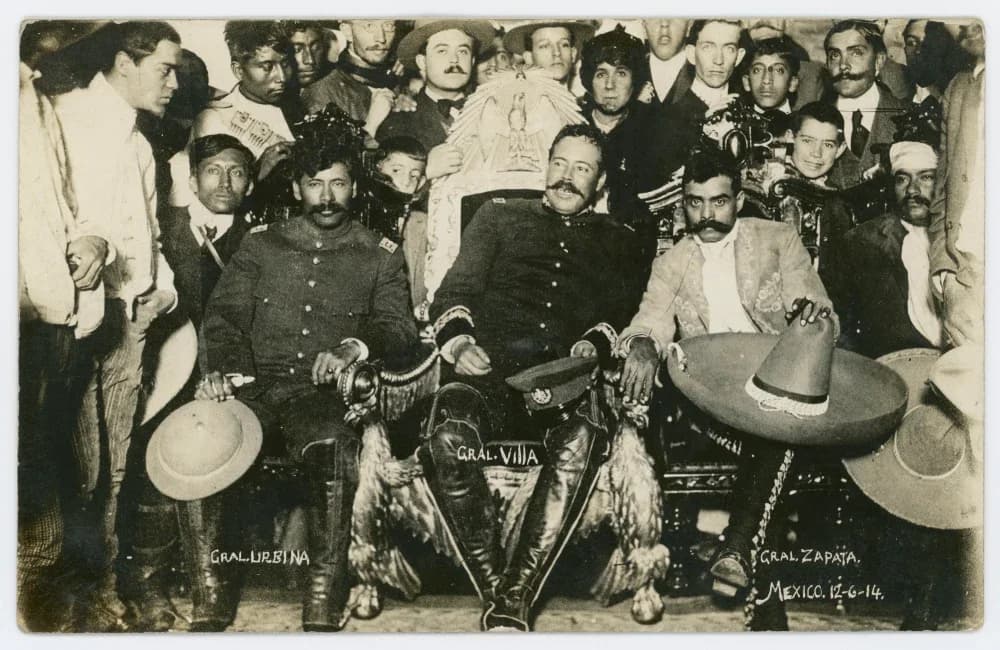
The photograph of 6 December 1914 shows the high point of the popular revolution, when the armies of Villa and Zapata occupied Mexico City together. Two days earlier the two leaders had met at Xochimilco and agreed to fight Carranza, but they did not create a national government that worked, and each soon returned to his own region.
Pancho Villa | Emiliano Zapata | |
|---|---|---|
Region | Chihuahua and the north: ranches, mines, railways, US border | Morelos and the south-centre: sugar haciendas and villages |
Social base | Cowboys, miners, railway workers, small farmers, military colonists | Villagers (campesinos) defending communal land |
Aims | Defeat of the old order; confiscation of enemy estates; land promised later | Return of village lands; one-third of hacienda land expropriated; village autonomy (Plan of Ayala) |
Methods | Large conventional army moving by rail; cavalry charges; arms bought in the USA | Guerrilla warfare by part-time peasant soldiers; local land seizures |
Fate | Defeated by Obregón in 1915; retired in 1920; assassinated in 1923 | Held out in Morelos; killed in an ambush at Chinameca, 10 April 1919 |
Venustiano Carranza and the Constitutionalist victory, 1913–1920
The First Chief
Venustiano Carranza was a landowner from Coahuila who had served Díaz as a senator and later joined Madero, who made him governor of Coahuila. On 26 March 1913 he issued the Plan of Guadalupe, which refused to recognise Huerta and named Carranza “First Chief” of the Constitutionalist Army. The name stated his aim: to restore the constitutional order broken by Huerta’s coup.
The Plan of Guadalupe said nothing about land or labour. Carranza was a conservative liberal who wanted a strong central state and Mexican control of the economy, not a social revolution. His strength lay in his political skill, his claim to legal authority and the generals who served him, above all Álvaro Obregón, a self-taught farmer from Sonora who proved the best commander of the revolution.
The war of the factions, 1914–1915
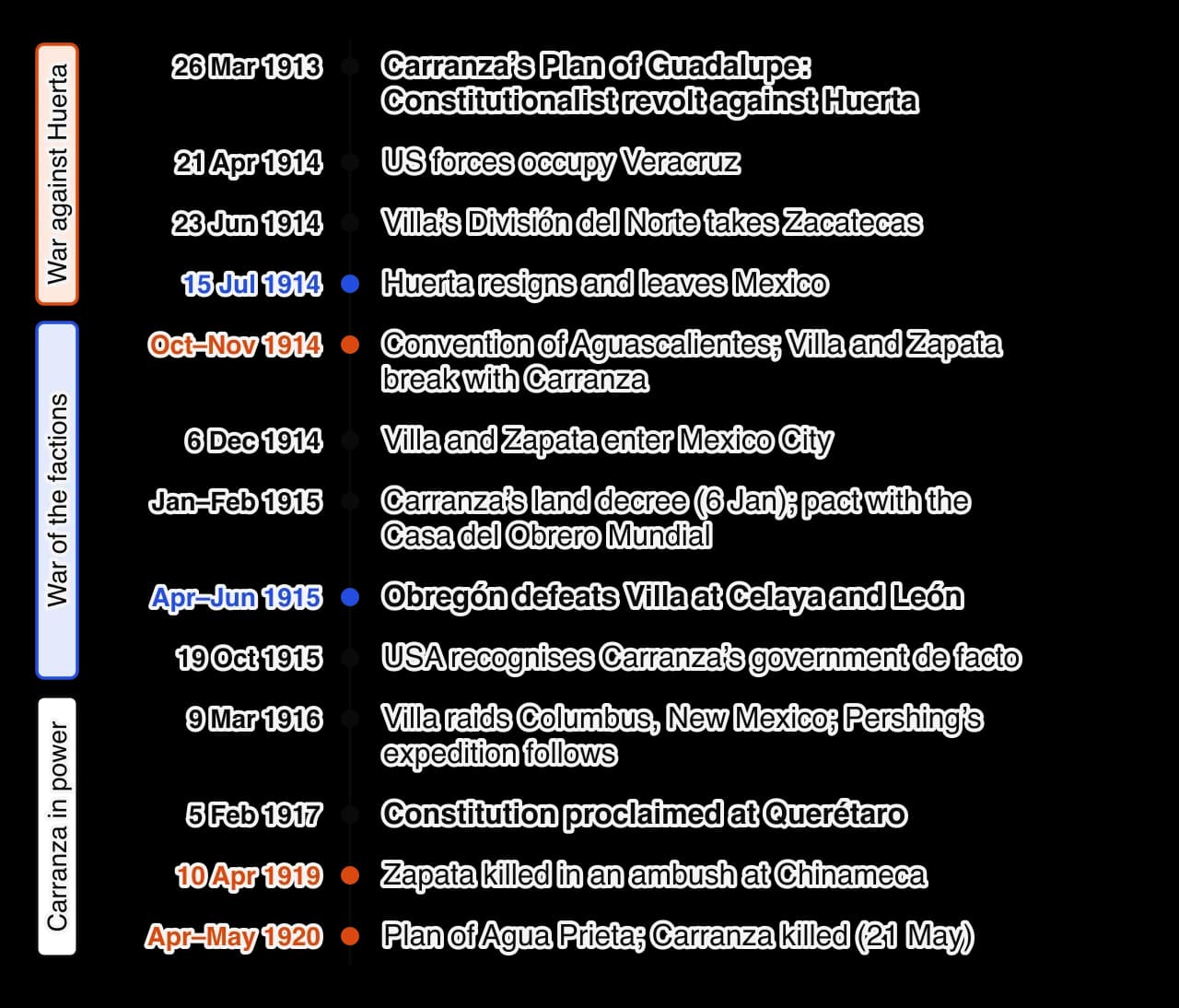
The timeline of 1913–1920 shows how the coalition that defeated Huerta broke apart. In October 1914 the revolutionary generals met at the Convention of Aguascalientes to agree on a government. Villa’s officers and Zapata’s delegates dominated it; the Convention adopted the principles of the Plan of Ayala and chose Eulalio Gutiérrez as provisional president. Carranza refused to accept its authority and withdrew to Veracruz, which US forces handed over to his troops in November 1914.
The war that followed, between the Conventionists (Villa and Zapata) and the Constitutionalists (Carranza and Obregón), decided the revolution’s outcome. Carranza won it for several connected reasons.
Reform to win support. Carranza’s decree of 6 January 1915 promised to restore village lands seized illegally and to grant land to villages that needed it, taking up the demand of the Zapatistas. In February 1915 he made a pact with the Casa del Obrero Mundial (House of the World Worker), an anarcho-syndicalist workers’ organisation in Mexico City, which supplied several thousand men in Red Battalions in return for support for unions.
Resources. The Constitutionalists held Veracruz and Tampico, with their customs revenue and oil taxes, and controlled the routes for imported arms.
Generalship. At Celaya in April 1915, Obregón’s army dug trenches, strung barbed wire and used machine guns, lessons from the First World War in Europe. Villa’s cavalry charged repeatedly and was destroyed. Further defeats at León (June 1915, where Obregón lost his right arm) and Aguascalientes (July) broke the División del Norte.
Divisions among the Conventionists. Villa and Zapata fought separate wars in different regions, and the Convention government had no secure capital, little revenue and leaders who quarrelled.
Recognition. The USA recognised Carranza’s government de facto in October 1915 and stopped arms sales to Villa.
After 1915 Villa returned to guerrilla warfare in Chihuahua, and his raid on Columbus, New Mexico, in March 1916 provoked a US military expedition. Zapata held out in Morelos until he was lured into an ambush at the hacienda of Chinameca on 10 April 1919 by Colonel Jesús Guajardo, acting for Carranza’s general Pablo González. His body was displayed in Cuautla to prove that he was dead.
Carranza in power, 1917–1920
Carranza called a constitutional convention at Querétaro in late 1916 and was elected president under the new Constitution in March 1917. He applied it cautiously. He returned some haciendas confiscated during the war to their owners, distributed only about 200,000 hectares of land, used troops against a general strike in Mexico City in 1916 and encouraged the founding in 1918 of a new, more moderate labour federation, the CROM (Regional Confederation of Mexican Workers). He did more to assert national control over oil, issuing decrees to tax the foreign companies and make them register their properties under Article 27.
Carranza’s fall came from inside his own coalition. When he tried to impose a civilian successor, Ignacio Bonillas, in the election of 1920, the Sonoran generals rebelled under the Plan of Agua Prieta of April 1920. Most of the army joined them. Carranza fled Mexico City by train for Veracruz and was killed at Tlaxcalantongo, Puebla, on 21 May 1920. After an interim presidency under Adolfo de la Huerta, during which Villa agreed to retire to a hacienda in Durango, Obregón was elected president.
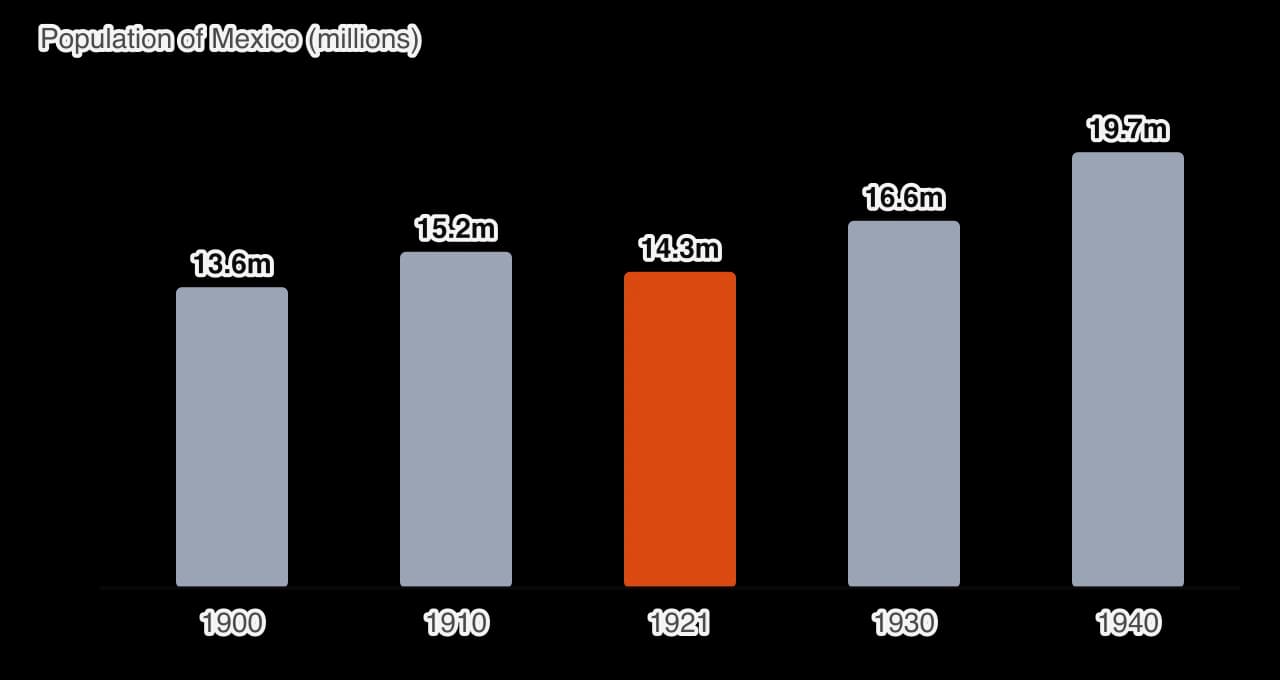
The census figures show the human cost of the decade. The population fell by nearly a million between 1910 and 1921, when it would normally have grown by about one and a half million. The figure of “one million dead” is often quoted; the demographer Robert McCaa (2003) estimates about 1.4 million excess deaths between 1910 and 1921, from fighting, executions, hunger, typhus and the influenza of 1918, and a total population loss of about 2.1 million when emigration and births that did not take place are included.
Weighing the leaders
Leader | Main impact on the revolution | Limits of that impact |
|---|---|---|
Madero (1910–1913) | Ended the Porfiriato; brought free elections and a free press; opened politics to mass participation | Kept the federal army and old officials; no land reform; overthrown within 15 months |
Huerta (1913–1914) | His coup and dictatorship united the revolutionaries and led to the destruction of the federal army | His impact was mainly unintended and destructive |
Villa (1910–1920) | Built the largest revolutionary army; won the decisive battle against Huerta at Zacatecas | Defeated in 1915; no national programme; his raid on Columbus brought US invasion |
Zapata (1911–1919) | Made land reform the central demand of the revolution; shaped Article 27 | Regional movement; never held national power; killed in 1919 |
Carranza (1913–1920) | Led the winning coalition; called the convention that wrote the Constitution of 1917; asserted national control over oil | Conservative in applying the Constitution; repressed workers and Zapatistas; overthrown in 1920 |
The Constitution of 1917
Carranza called a constituent congress at Querétaro, which met from 1 December 1916 to 31 January 1917. Its deputies were all Constitutionalists, since supporters of Villa, Zapata and Huerta were excluded, but they were divided. Carranza submitted a draft that was little more than a revised version of the liberal Constitution of 1857. A larger group of radicals, sometimes called the “Jacobins”, led by figures such as General Francisco Múgica of Michoacán, rewrote the key articles on land, labour, education and the Church. Many were young officers and professionals who had seen the strength of popular demands in the war.
The Constitution of 1917 was proclaimed on 5 February 1917. It kept the federal republic and the separation of powers of 1857, gave the president strong powers, and banned the re-election of presidents. Four articles made it a social and nationalist document.

Article 27: land and property
Article 27 declared that the nation was the original owner of all land and water, so private property existed only because the nation allowed it and could be limited in the public interest. It confirmed the land grants made under Carranza’s decree of January 1915 and gave villages the right to receive land taken from neighbouring estates. It returned to the colonial principle that minerals and oil belonged to the nation, and it limited the right of foreigners to own land, requiring them to agree to be treated as Mexicans in property matters and banning them from owning land within 100 km of the borders or 50 km of the coasts.
The ownership of lands and waters within the limits of the national territory is vested originally in the Nation, which has had and has the right to transmit title thereof to private persons, thereby constituting private property. Private property shall not be expropriated except for cause of public utility and by means of indemnification.
Constitution of the United Mexican States, Article 27, 5 February 1917 (English translation by H. N. Branch, published in The Mexican Review, Washington, March 1917). The translation was published by a journal that supported Carranza’s government, for American readers worried about their property. The text shows the legal basis for both land reform and the later expropriation of oil: by making the nation the original owner, it allowed the state to take back property in the public interest, with compensation.
The ejido became the main form of land reform. Its legal design mattered: because ejidatarios could not sell their land, villages were protected against the losses of the nineteenth century, but they also could not use it as security for loans and depended on the state for credit.
Article 123: labour
Article 123 was one of the most advanced labour codes in the world in 1917. It set a maximum working day of eight hours (seven at night), banned work by children under twelve and limited it to six hours for those aged twelve to sixteen, guaranteed a minimum wage sufficient for a worker’s needs, protected pregnant women and nursing mothers, gave workers the right to form unions and strike, and set up arbitration boards with representatives of workers, employers and the government to settle disputes.
Articles 3 and 130: education and the Church
The constitution was strongly anticlerical. Anticlericalism in Mexico meant the belief, held by liberals since the 1850s and sharpened by the Church’s support for Díaz and Huerta, that the Catholic Church was an obstacle to progress and national sovereignty and must be kept out of politics and education.
Article 3 made education in public schools secular and banned religious teaching in private primary schools as well; churches and priests could not run primary schools. Article 130 declared that the law did not recognise churches as legal bodies, made priests subject to registration as members of a profession, allowed state legislatures to limit their number, reserved the priesthood to Mexicans by birth, and denied priests the vote and the right to criticise the government. Article 27 nationalised Church buildings and banned religious bodies from owning property, and Article 5 banned monastic orders.
How far was the Constitution applied by 1940?
Article | What it promised | Application, 1917–1940 |
|---|---|---|
27: land | Restitution and grants of land to villages; break-up of large estates | Slow under Carranza (about 200,000 ha) and Obregón; faster under Calles; massive under Cárdenas (about 18 million ha) |
27: subsoil | Oil and minerals owned by the nation | Not applied retroactively to US firms after the Bucareli Agreements (1923) and the Morrow compromise (1927–1928); fully applied by the oil expropriation of 1938 |
123: labour | Eight-hour day, minimum wage, unions, right to strike | Federal Labour Law only in 1931; unions grew under the CROM (1920s) and CTM (1936), often tied to the government |
3: education | Secular schooling; no Church primary schools | Expansion of rural schools from 1921; “socialist education” added in 1934; Catholic schools survived with official tolerance |
130: Church | Priests registered and limited; Church without legal personality | Enforced by Calles in 1926, causing the Cristero War; enforcement eased after 1929 and especially after 1936 |
The table of application shows that the constitution was a programme as much as a law. Each government chose which articles to enforce, depending on its political needs, its relations with the USA and the pressure it faced from peasants, workers and the Church. That is why historians debate whether the revolution was completed under Cárdenas or remained unfinished.
Building the post-revolutionary state: Obregón and Calles, 1920–1934
In 1920 Mexico was exhausted, its economy damaged and its countryside full of armed men loyal to individual generals. The main task of the governments that followed was to rebuild a central state that could control the army, satisfy enough peasants and workers to prevent new risings, and win recognition from the USA. The two Sonoran generals who led this process, Obregón and Calles, were pragmatic men from the north-west, close to the US border, who admired American farming and enterprise.
Álvaro Obregón, 1920–1924
Obregón governed by balancing interests. He distributed about a million hectares of land, far more than Carranza, mainly to villages where agrarian movements were strong or where he needed allies, such as Morelos, where former Zapatistas were brought into the government. He allied with the CROM, the labour federation led by Luis Morones, which received official favour in return for political support and discipline among workers. He reduced the size of the army and bought the loyalty of generals with money and business opportunities.
The greatest achievement of his government was in education. José Vasconcelos, a lawyer and philosopher, became head of the new Secretariat of Public Education (SEP) in 1921, and under him education received a larger share of the federal budget than ever before; the money paid for rural schools, cultural missions and the first public murals.
Obregón’s foreign problem was recognition. The USA refused to recognise his government until it guaranteed that Article 27 would not be used against American property acquired before 1917. Under the Bucareli Agreements of August 1923, Mexico accepted that oil rights acquired before 1917 would not be taken away where the owners had carried out a “positive act” to exploit them, and agreed to compensate Americans for land taken in the reform. The USA recognised Obregón on 31 August 1923.
Recognition came just in time. When Obregón chose Calles as his successor, Adolfo de la Huerta, his finance minister, rebelled in December 1923 with the support of perhaps half the army. The USA sold arms and aircraft to Obregón’s government, and the rebellion was crushed by early 1924. Many rebel generals were executed, and the purge strengthened central control of the army. Villa, who had retired in 1920, was assassinated in Parral in July 1923, probably with the knowledge of the government.
Plutarco Elías Calles, 1924–1928
Calles, a former schoolteacher from Sonora, was more ideological and more of a state-builder than Obregón. His government set up a central bank, the Banco de México (1925), built roads and irrigation works, created a National Agrarian Credit Bank (1926) and distributed about 3 million hectares of land. In 1925 a new petroleum law tried to limit the foreign companies’ rights to fifty years, provoking a crisis with the USA that was settled in 1927–1928 by the new US ambassador, Dwight Morrow, through a ruling of the Mexican Supreme Court that upheld pre-1917 rights.
The defining conflict of his presidency was with the Catholic Church. Calles was a determined anticlerical who believed that the Church was the main obstacle to a modern, secular nation. In June 1926 he issued a decree, known as the Calles Law, which enforced Article 130 with criminal penalties: priests had to register with the government, foreign priests were expelled, religious education in primary schools was banned and wearing clerical dress in public was a crime. States reduced the number of priests, in some cases to one for every tens of thousands of people.
Opposition and the Cristero War, 1926–1929
The Mexican bishops responded by suspending all public worship from 31 July 1926, the day the law came into force, with the approval of the Pope. For almost three years no public Mass was celebrated in Mexico’s churches, although priests continued to say Mass in secret in private houses. Catholic organisations organised an economic boycott, and from late 1926 armed risings broke out, above all in the west-central states of Jalisco, Michoacán, Guanajuato, Colima and Zacatecas. The rebels took the name Cristeros from their cry “¡Viva Cristo Rey!” (“Long live Christ the King!”).
The Cristero War was a popular movement. Most Cristeros were small farmers, sharecroppers and ranchers, many of them in regions where land reform had brought little benefit or where agrarista villages armed by the government were their enemies. At its peak the movement had perhaps 50,000 fighters. Women organised supplies, intelligence and smuggled ammunition through the Feminine Brigades of St Joan of Arc. The federal army, unable to defeat the guerrillas, burned villages, hanged prisoners and from 1927 forced the population of some regions into concentrated settlements (the reconcentración).
The French historian Jean Meyer, whose La Cristiada (1973–1974) was based on interviews with surviving Cristeros, estimates about 90,000 combatant deaths on both sides. The war ended through negotiation. Mediated by Ambassador Morrow, who wanted stability for American investment, the bishops and President Emilio Portes Gil agreed the arreglos (“arrangements”) of 21 June 1929: the laws stayed on the books, but the government promised to apply them without seeking to destroy the Church, and worship resumed. Many Cristeros who laid down their arms were later killed.
The Maximato, 1928–1934
Obregón was elected president again in July 1928, after Congress amended the constitution to allow re-election after a gap. On 17 July, before he could take office, he was shot dead at a restaurant in Mexico City by José de León Toral, a young Catholic militant. The murder created a crisis: Obregón’s supporters suspected Calles, and the generals could have turned on each other as in 1920 and 1923.
Calles responded in his final address to Congress on 1 September 1928 by declaring that Mexico must pass from being a country of one man, the caudillo, to a nation of institutions and laws. He did not seek re-election. Instead, he dominated the next three presidents, Emilio Portes Gil (1928–1930), Pascual Ortiz Rubio (1930–1932, who resigned when he tried to act independently) and Abelardo Rodríguez (1932–1934), as the Jefe Máximo (“Supreme Chief”) of the revolution. This period is called the Maximato.
Calles’s most lasting creation was the Partido Nacional Revolucionario (PNR, National Revolutionary Party), founded in March 1929. It brought together the many regional parties and political machines of the revolutionary generals into one national organisation, so that disputes over power could be settled inside the party instead of by rebellion. The PNR, renamed the PRM in 1938 and the PRI in 1946, governed Mexico without interruption until 2000.
The new system was tested at once. In March 1929 General José Gonzalo Escobar rebelled with several thousand troops and was defeated within weeks, the last major military revolt. In the presidential election of November 1929, the official candidate Ortiz Rubio defeated José Vasconcelos, the former education minister, who had run an energetic campaign for clean government; Vasconcelos and his supporters denounced the result as fraudulent. The Maximato also turned more conservative: land distribution slowed, Calles declared in 1930 that the land reform had been a failure, and in 1934 Calles revived the anticlerical campaign with a call to win the minds of the young, followed by a constitutional amendment introducing “socialist education”.
Challenge to the post-revolutionary state | When | How the state responded | Outcome |
|---|---|---|---|
US non-recognition and the oil companies | 1920–1923; 1925–1928 | Bucareli Agreements (1923); Calles–Morrow compromise (1927–1928) | Recognition and US arms; Article 27 softened for foreign oil |
Military rebellions | 1923–1924 (de la Huerta); 1927 (Serrano and Gómez); 1929 (Escobar) | Defeat, executions, purges; generals bought off; the PNR | No successful revolt after 1920; army slowly professionalised |
The Catholic Church and the Cristeros | 1926–1929 and again 1934–1938 | Calles Law; military repression; arreglos (1929) | Stalemate; worship resumed; tension until the later 1930s |
The succession | 1928 (Obregón’s murder) | Maximato; the PNR (1929) | Power passed by party nomination, not rebellion |
Peasant and worker demands | Throughout | Land grants; the CROM; agrarian leagues; arms for agraristas | Partial: land reform slowed after 1930 |
The table of challenges shows why many historians judge the Cristero War the most serious threat in human terms, while seeing the military revolts and the succession crisis of 1928 as the most serious threats to the state itself. The Sonorans met each with a mixture of force, bargaining and institution-building.
Lázaro Cárdenas and the renewal of the revolution, 1934–1940
Lázaro Cárdenas was a general from Michoacán who had joined the revolution as a teenager in 1913, served under Calles and, as governor of Michoacán from 1928 to 1932, distributed land, encouraged peasant and worker organisations and promoted schools. The PNR chose him as its candidate in 1933, and Calles expected to control him as he had controlled the three presidents before. The party adopted a Six-Year Plan (1934–1940), a programme of land reform, labour rights, state direction of the economy and socialist education that reflected the radical mood in the party during the Great Depression.
Cárdenas campaigned across the country, visiting villages no candidate had seen before. After taking office on 1 December 1934 he cut his own salary, turned the presidential residence of Chapultepec Castle into a museum and set aside an hour a day for telegrams from ordinary citizens, which the telegraph office carried free of charge.
The break with Calles
In 1935 a wave of strikes broke out, which Cárdenas allowed to proceed. In June Calles publicly criticised the strikes and, by implication, the president. Cárdenas responded by removing Calles’s allies from the cabinet, the army command, the state governorships and the party, and by mobilising workers and peasants in his support. In April 1936 he had Calles, Morones and other leaders arrested and flown into exile in the USA. The Maximato was over, and with it the period in which the real power lay outside the presidency.
Land reform
Cárdenas carried out the largest land reform in Mexican history. His government distributed about 18 million hectares (estimates range from about 17.9 to 20 million), more than all previous governments together, to about 800,000 recipients. By 1940 ejidos held about half of Mexico’s cultivated land, and the hacienda as a social system had largely disappeared from central Mexico.
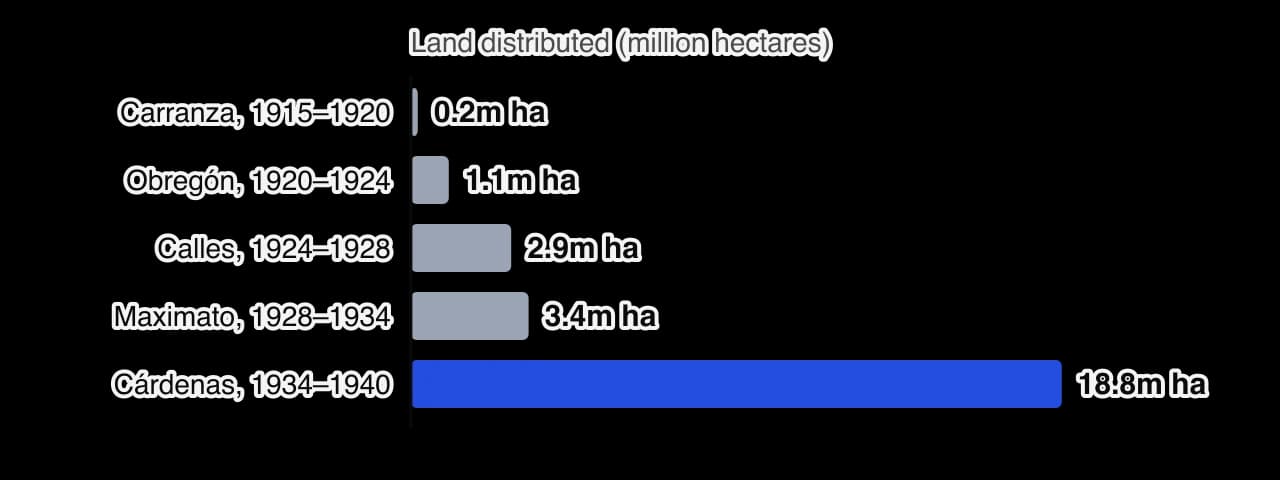
The chart of land distribution shows how sharply policy changed after 1934. Cárdenas also changed the kind of land given. Earlier governments had given villages mainly poor land in small plots, as a supplement to wage work on haciendas. Cárdenas expropriated the commercial estates themselves. After a general strike by farm workers’ unions in August 1936, a decree of 6 October 1936 handed about 450,000 hectares of cotton and wheat land in La Laguna, on the border of Coahuila and Durango, to about 35,000 ejidatarios in some 300 collective ejidos, and in 1937 the henequen plantations of Yucatán followed. A Banco Nacional de Crédito Ejidal (1935) provided credit, and ejidatarios were given arms and organised in militias to defend their land against landowners’ gunmen.
The results were mixed. Production on some collective ejidos fell, partly because the banks lacked funds and partly because ejidatarios depended on official credit, technical advice and the decisions of bank officials. Corruption and political control by the bank and the party became common. Critics argued that land reform reduced agricultural output; supporters reply that total farm output in the late 1930s did not fall much, and that the reform gave millions of rural Mexicans security and political loyalty to the state.
Labour and the corporatist party
Cárdenas supported organised labour as an ally of the state against foreign capital and conservative employers. In February 1936 the Marxist labour leader Vicente Lombardo Toledano founded the Confederación de Trabajadores de México (CTM, Confederation of Mexican Workers), which replaced the CROM as the main labour federation. Arbitration boards now often ruled for workers in disputes. In June 1937 the government nationalised the railways and later handed their management to the railway workers’ union.
Cárdenas wanted peasants organised separately from workers, so that neither could dominate the other or challenge the state. In 1938 the peasant leagues were united in the Confederación Nacional Campesina (CNC, National Peasant Confederation). In March 1938 he reorganised the ruling party as the Partido de la Revolución Mexicana (PRM, Party of the Mexican Revolution), built on four sectors.
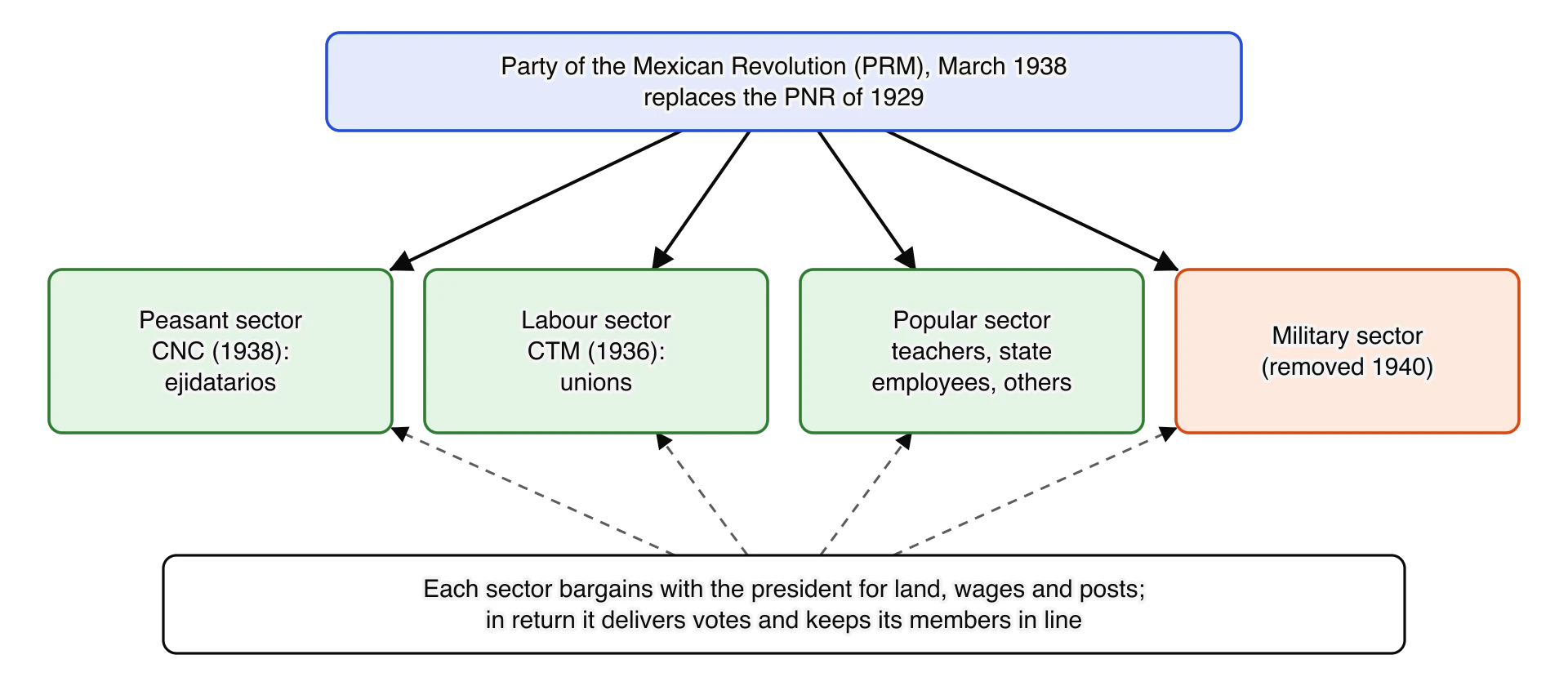
The diagram of the PRM shows a corporatist structure. Corporatism means organising society into officially recognised groups by occupation or function, each represented through a single body that negotiates with the state. It gave peasants and workers a recognised place in politics, but their organisations depended on the president for funds, posts and favours, and leaders who opposed the government could be replaced. After 1940 the same structure helped later presidents keep labour and peasant movements under control.
The oil expropriation, 1938
The oil industry was almost entirely owned by foreign companies, the largest being El Águila (owned by Royal Dutch Shell since 1919) and subsidiaries of Standard Oil of New Jersey and other US firms. Mexican oil workers were paid less than foreign employees and lived in poor conditions. In 1937 the oil workers’ union, formed in 1935, went on strike. A federal arbitration board ordered the companies to raise wages and improve conditions, and in March 1938 the Supreme Court upheld the award. The companies refused to comply, claiming that they could not afford it.
On 18 March 1938 Cárdenas announced in a radio address the expropriation of the property of seventeen foreign oil companies. Crowds of tens of thousands celebrated in Mexico City, and people of all classes, including Catholic women, donated money, jewellery and even chickens to help pay compensation. On 7 June 1938 the government created a state company, Petróleos Mexicanos (PEMEX), to run the industry.
It is the social interest of the working class in all the industries of the country that demands it. It is the public interest of Mexicans […] It is the very sovereignty of the nation, which would be exposed to the mere manoeuvres of foreign capital, which, forgetting that it has previously constituted itself into Mexican companies, under Mexican laws, seeks to evade the mandates and obligations imposed on it by the authorities of the country itself.
Lázaro Cárdenas, message to the nation on the oil expropriation, radio address, 18 March 1938 (translated from the Spanish). Cárdenas spoke to a domestic audience and framed the decision as a defence of national sovereignty and the law, not as an attack on property: the companies, he argued, had broken Mexican law. The speech helps explain why the expropriation won support across classes and became the founding moment of Mexican economic nationalism.
The companies organised a boycott of Mexican oil, and in May 1938, after a sharp exchange of notes over compensation, diplomatic relations between Mexico and Britain were broken off. The US government, under the Good Neighbor Policy of President Franklin D. Roosevelt and with the sympathetic ambassador Josephus Daniels, protested but did not intervene, partly because it wanted Mexican cooperation as war approached in Europe. Mexico sold oil to Germany, Italy and Japan for a time. Sinclair settled separately in 1940. For the other US companies, a joint commission set up under an agreement of November 1941 valued their property in 1942 at about 24 million dollars plus interest, far less than the companies had claimed, since they had counted the oil still underground. Britain settled in 1947.
Education, the army and the limits of Cardenismo
Cárdenas’s education policy followed the 1934 amendment to Article 3 that introduced “socialist education”: schooling that taught cooperation, opposed religious “fanaticism” and promoted a scientific view of the world. Thousands of rural schools were built and teachers became agents of land reform and political organisation, but in some Catholic regions teachers were attacked and killed by opponents, sometimes called the “second Cristiada”. Cárdenas also created the National Polytechnic Institute (1936), the Department of Indigenous Affairs (1936) and the National Institute of Anthropology and History (1939).
In foreign policy Cárdenas supported the Spanish Republic during the Spanish Civil War and later admitted over 20,000 Spanish Republican refugees. He gave asylum to the exiled Soviet revolutionary Leon Trotsky in 1937. In 1938 he crushed the last regional military revolt, by the former agrarian leader Saturnino Cedillo of San Luis Potosí.
By 1938–1939 the reforms faced limits. Inflation rose, capital left the country, oil exports fell under the boycott and the middle classes and business groups organised against the government. On the right, the Catholic and nationalist Sinarquismo movement, founded in 1937, attracted hundreds of thousands of rural members. For the 1940 election the PRM chose a moderate, General Manuel Ávila Camacho, over the radical Francisco Múgica. Ávila Camacho defeated the opposition candidate Juan Andreu Almazán in July 1940 in an election marked by violence and allegations of fraud.
Area | Achievements, 1934–1940 | Limits and costs |
|---|---|---|
Land | About 18 million ha to about 800,000 recipients; haciendas broken up; collective ejidos in La Laguna and Yucatán | Ejidos dependent on state credit; some falls in output; corruption; small plots |
Labour | CTM (1936); railways nationalised (1937); wage gains; strikes allowed | Unions tied to the party; workers’ management of railways ended in 1940 |
Oil and sovereignty | Expropriation (1938) and PEMEX; national unity; US non-intervention | Boycott, lost markets, compensation costs; break with Britain |
Politics | Ended the Maximato; strengthened the presidency; PRM with mass organisations | Corporatism limited independent organisation; disputed election of 1940 |
Society and culture | Rural schools, IPN, Indigenous affairs department, asylum for refugees | Socialist education provoked violent Catholic opposition; women still without the vote |
Foreign powers and the revolution
Mexico’s revolution took place next to the world’s largest economy and, after 1914, during a world war. Foreign governments and companies had large interests at stake, and every Mexican faction needed foreign arms, money or recognition. Their involvement took four forms: diplomatic, military, economic (including the supply of arms) and covert.
Motivations
Investment. US citizens had invested between about 1 and 2 billion dollars in Mexico by 1910 (estimates vary), in mines, oil, railways, ranches and plantations; British investors were second. Protecting this property was the most consistent aim of both governments.
Border security. The 3,000-km border was crossed by refugees, arms smugglers and raiders, and US politicians in Texas and Arizona demanded protection.
Ideology. President Woodrow Wilson (1913–1921) believed that the USA had a duty to promote constitutional government in Latin America, an approach known as moral diplomacy.
Strategy. During the First World War, Germany hoped to keep the USA tied down by conflict with Mexico, while Britain needed Mexican oil for the Royal Navy.
Diplomatic intervention
Under President William Howard Taft, the USA moved 20,000 troops to the border in March 1911, which may have encouraged Díaz to give up, and imposed an arms embargo in 1912 that favoured Madero against Orozco. The US ambassador Henry Lane Wilson then helped bring about Madero’s fall by brokering the Pact of the Embassy in February 1913.
Woodrow Wilson, inaugurated in March 1913, reversed this. He recalled Henry Lane Wilson, refused to recognise Huerta, and pursued a policy of watchful waiting: pressure without war, while waiting for Huerta to fall. In February 1914 he lifted the arms embargo for the Constitutionalists. Argentina, Brazil and Chile (the “ABC powers”) mediated at a conference at Niagara Falls in May–June 1914, but Carranza refused to accept any outside settlement. After Huerta’s fall, the USA recognised Carranza’s government de facto on 19 October 1915, and fully (de jure) in August 1917.
Germany’s most famous intervention was diplomatic. In January 1917 the German foreign secretary, Arthur Zimmermann, sent a coded telegram, the Zimmermann Telegram, to the German minister in Mexico. British naval intelligence intercepted and decoded it, and it was published in the US press on 1 March 1917.
We intend to begin on the first of February unrestricted submarine warfare. We shall endeavor in spite of this to keep the United States of America neutral. In the event of this not succeeding, we make Mexico a proposal [of] alliance on the following basis: make war together, make peace together, generous financial support and an understanding on our part that Mexico is to reconquer the lost territory in Texas, New Mexico, and Arizona.
Arthur Zimmermann, German foreign secretary, telegram to the German minister in Mexico, January 1917 (decoded English text, US National Archives). The telegram was a secret instruction written for German diplomats, not propaganda, so it is direct evidence of German aims. It shows how Mexico was valued as a way to divert the USA from Europe. Carranza studied the offer and refused it in April 1917, judging that Mexico could not win a war with the USA and that Germany could not supply arms; Mexico stayed neutral.
 YouTube
Military intervention
The USA intervened militarily twice. In April 1914, after Mexican federal soldiers briefly arrested US sailors at Tampico, Wilson used the incident and the expected arrival of a German ship, the Ypiranga, carrying arms for Huerta, as reasons to land troops at Veracruz on 21 April. About 19 Americans and at least 150 Mexicans, including cadets of the naval academy, were killed. US forces held the port until 23 November 1914. The occupation cut Huerta off from his main customs revenue and hastened his fall, but it was condemned by every Mexican faction, Carranza included.
The second intervention followed Villa’s raid on Columbus, New Mexico, on 9 March 1916, in which about 18 Americans were killed. Villa probably intended to provoke a US invasion that would discredit Carranza, whom the USA had just recognised, and he believed that Carranza had made a secret deal with the Americans. Wilson sent a Punitive Expedition of about 10,000 troops under General John J. Pershing into Chihuahua.

The expedition failed to catch Villa, and it nearly caused a war. At Carrizal on 21 June 1916 Mexican government troops fought a US cavalry unit, with dozens killed. Both governments pulled back, and Pershing withdrew in February 1917 as the USA prepared to enter the First World War. Villa’s popularity in the north grew because he had defied the Americans.
Economic intervention and the supply of arms
No Mexican faction made its own weapons in quantity, so access to the US arms market often decided campaigns. The USA used embargoes as a political tool, lifting and imposing them to favour one side: against Orozco in 1912, for the Constitutionalists in 1914 and against Villa after October 1915. Arms bought in the USA with cattle, cotton and confiscated goods equipped the División del Norte in 1913–1914; losing access to them weakened Villa in 1915.
Companies acted on their own account. Foreign oil companies paid Manuel Peláez, a local landowner and general, to protect the oilfields of the Huasteca region from Carranza’s forces between 1914 and 1920, creating an enclave outside the government’s control. German agents in the USA plotted in 1915 to return Huerta to power with German money; US authorities arrested him in New Mexico in June 1915, and he died in custody in El Paso in January 1916. Wartime demand made Mexico by 1921 the world’s second-largest oil producer, which raised the stakes of Article 27.
Form of intervention | Main examples | Effect on the revolution |
|---|---|---|
Diplomatic | Pact of the Embassy (1913); non-recognition of Huerta; Niagara Falls (1914); recognition of Carranza (1915, 1917); Zimmermann telegram (1917); Bucareli (1923) | Weakened Huerta; strengthened Carranza against Villa; recognition was traded for limits on Article 27 |
Military | Troops on the border (1911); Veracruz (1914); Punitive Expedition (1916–1917) | Hastened Huerta’s fall; provoked nationalism; did not destroy Villa |
Economic and arms | Embargoes lifted and imposed; arms sales; oil company payments to Peláez; arms to Obregón (1924) | Often decisive in particular campaigns; helped the central state survive the 1923–1924 rebellion |
Covert | German support for Huerta (1915); German and British agents during the First World War | Little lasting effect; increased US suspicion of Mexico |
How significant was foreign intervention?
Historians disagree about how much foreign powers shaped the revolution. Friedrich Katz, in The Secret War in Mexico (1981), used German, British, French and US archives to show how great-power rivalry, especially during the First World War, gave Mexican leaders room to play foreign powers against each other. John Mason Hart, in Revolutionary Mexico (1987), argues that resentment of US economic penetration was a central cause of the revolution. Alan Knight, by contrast, stresses that the revolution’s dynamics were overwhelmingly domestic: foreign powers influenced timing and particular outcomes, but could not control the factions or decide what the revolution became.
The evidence supports a qualified judgement. Foreign action helped decide some outcomes, such as Huerta’s fall in 1914, Carranza’s victory over Villa in 1915 and Obregón’s survival in 1924. But the USA failed to install the leaders it wanted, failed to catch Villa and could not prevent the Constitution of 1917 or the oil expropriation of 1938. Repeated intervention also strengthened Mexican nationalism, which became one of the revolution’s most lasting results.
The impact of the revolution

The diagram of consequences groups the revolution’s impact into political, economic and social and cultural change. Judging that impact means asking what changed, for whom and by when: the effects of 1910–1920 were mainly destruction and political upheaval, while most of the lasting social change came from the reforms of the 1920s and 1930s.
Economic impact
The fighting of 1913–1917 did great damage. Railways were wrecked and locomotives used as armoured trains; mining output fell sharply; cattle herds in the north were slaughtered to feed armies or sold across the border; and each faction printed its own paper money, which quickly became worthless. Hunger and typhus followed in 1915–1917, the worst years.
Some sectors grew despite the war. Oil production, concentrated on the Gulf coast away from the main fighting, rose rapidly with wartime demand and peaked in 1921, when Mexico produced about a quarter of the world’s oil. It then declined as wells were exhausted and companies moved investment to Venezuela, partly because of the uncertainty created by Article 27.
In the longer term the revolution changed the structure of the economy. The hacienda lost its dominance; by 1940 about half the cropland was held in ejidos. The state became an economic actor through the Banco de México (1925), agricultural banks, roads, irrigation, the nationalised railways (1937) and PEMEX (1938). These foundations, together with the protection of national industry during the Second World War, made possible the rapid industrial growth after 1940, sometimes called the “Mexican miracle”. Historians still debate whether land reform reduced agricultural productivity; output on some ejidos fell, but national farm output did not collapse, and the political stability that reform helped create was itself economically valuable.
Education, culture and the arts
The revolutionary governments saw education as the way to turn a divided, mostly rural and illiterate population into a nation. José Vasconcelos, as head of the new Secretariat of Public Education (SEP) from 1921 to 1924, received a large share of the federal budget. He launched a literacy campaign, sent cultural missions of teachers, doctors and agricultural experts from 1923 to train rural teachers and improve village life, built about a thousand rural schools by 1924, opened public libraries and printed cheap editions of world classics.
Under Calles and Cárdenas the rural school became the main point of contact between the state and the village. The historian Mary Kay Vaughan, in Cultural Politics in Revolution (1997), shows that rural teachers did not simply impose official ideas: communities accepted, adapted or rejected the school according to their own needs, and in the 1930s the teacher often became a local leader for land reform. In Catholic regions, by contrast, the secular and later “socialist” school provoked boycotts and violence.
Vasconcelos also commissioned artists to paint the walls of public buildings, beginning the movement known as Mexican muralism. Diego Rivera, José Clemente Orozco and David Alfaro Siqueiros painted large public works that told Mexican history as a struggle of the people against conquest, the Church, foreign capital and the Porfirian elite. Rivera painted the walls of the SEP building (1923–1928) and the history of Mexico on the main staircase of the National Palace (1929–1935); Orozco painted the Hospicio Cabañas in Guadalajara (1936–1939). Their manifesto of the Syndicate of Technical Workers, Painters and Sculptors (1923) rejected easel painting for the wealthy in favour of public art for the people.
The revolution also shaped music, literature and popular culture. Corridos, narrative ballads sung across the country, spread news of battles and celebrated leaders such as Villa; “La Adelita” and “La Cucaracha” became famous. The composer Carlos Chávez used Indigenous melodies and instruments in his Sinfonía india (1935–1936), and Silvestre Revueltas drew on popular music. Mariano Azuela, a doctor with Villa’s forces, published Los de abajo (The Underdogs, 1915), a bleak novel of the fighting that questioned what it had achieved; Martín Luis Guzmán’s El águila y la serpiente (1928) described the revolutionary leaders from the inside.
Behind much of this lay indigenismo, a current of thought and policy that celebrated Indigenous cultures as the root of the nation while seeking to integrate Indigenous people into a modern, Spanish-speaking, mestizo Mexico. The anthropologist Manuel Gamio, in Forjando patria (Forging a Nation, 1916), argued that Mexico could become a nation only by fusing its peoples. Vasconcelos’s La raza cósmica (The Cosmic Race, 1925) praised racial mixing as the basis of a new civilisation.
Experiences of women
Women took part in the revolution in large numbers and in many roles, and the revolution changed some of their legal rights and public roles. Whether it significantly changed the role of women is one of the main debates about its impact. The answer depends on which women, which period and which kind of change is in question.
Women in the armed revolution, 1910–1920
Tens of thousands of women followed the armies. The soldaderas cooked, foraged, nursed the wounded, carried ammunition and looked after children, travelling on the roofs of troop trains; without them the armies could not have moved or eaten, since most had no regular supply system. Some were wives or partners of soldiers; others were taken by force, especially by the federal army under the leva, and many suffered violence.
A smaller number of women fought and held command. Petra Herrera fought with Villa’s forces at Torreón in 1914 and later led her own unit; Carmen Parra de Alanís carried messages and arms for Madero and fought at Ciudad Juárez. Among the Zapatistas, Amelio Robles Ávila, assigned female at birth, rose to the rank of colonel and lived as a man from the revolution onwards, later recognised as a veteran by the Ministry of Defence. Other women worked as spies, couriers, nurses in the Red Cross and journalists.
The historian Elizabeth Salas, in Soldaderas in the Mexican Military (1990), shows that after 1920 the army excluded the soldaderas, the official histories turned them into the sentimental figure of the Adelita, and few received the pensions given to male veterans.
Feminism and legal change, 1915–1930
The revolution also gave space to organised feminism. Hermila Galindo, a journalist and secretary to Carranza, founded the magazine La Mujer Moderna (The Modern Woman) in 1915 and asked the Querétaro convention to give women the vote. In Yucatán the revolutionary governor Salvador Alvarado called two Feminist Congresses in Mérida in January and November 1916, the first in Mexico, which debated education, sexuality and political rights. Under the socialist governor Felipe Carrillo Puerto, three women, including his sister Elvia Carrillo Puerto, were elected to the Yucatán state legislature in 1923, though they were forced out after his murder in 1924.
National law changed in several ways. Carranza legalised divorce by decree in 1914–1915, and his Law of Family Relations (1917) gave married women more control over their property and children. Article 123 protected women workers and nursing mothers. Thousands of women became rural teachers, the largest new profession open to them, and girls’ schooling expanded.
Mobilisation and the vote, 1930–1940
Women organised in large numbers in the 1930s, on both sides of the political divide. Catholic women were central to the resistance to anticlerical laws: the Feminine Brigades of St Joan of Arc supplied the Cristero armies, and Catholic women’s organisations had hundreds of thousands of members. On the left, the Frente Único Pro Derechos de la Mujer (Sole Front for Women’s Rights), founded in 1935, claimed some 50,000 members and campaigned for the vote, land for women and protection for workers.
Cárdenas proposed an amendment giving women the vote in 1937. Congress and the states approved it, but it was never formally declared in force, largely because politicians in the ruling party feared that women, seen as more influenced by the Church, would vote for conservative candidates. Jocelyn Olcott, in Revolutionary Women in Postrevolutionary Mexico (2005), shows how women activists used the revolution’s language of citizenship to make claims on the state, even without the vote. Women gained the vote in municipal elections only in 1947 and in national elections in 1953.
Area | Change | Continuity or limits |
|---|---|---|
War, 1910–1920 | Women essential to the armies; some fought and commanded | Soldaderas often forced, abused and later excluded from pensions and recognition |
Law | Divorce (1914–1915); Law of Family Relations (1917); protections in Article 123 | Married women still subordinate in many areas of law; no national vote |
Education and work | Rural teaching opened a profession; girls’ schooling expanded | Most rural women still in household and farm work; ejido land usually granted to male heads of household |
Politics | Feminist congresses (1916); Yucatán women legislators (1923); FUPDM (1935); 1937 amendment passed | The amendment was never put into force; national vote only in 1953 |
Religion | Catholic women organised on a mass scale, including in the Cristero War | Their activism defended tradition and was used as a reason to deny women the vote |
Experiences of marginalised groups
The revolution was made in the name of the people, and some groups that had been excluded under Díaz gained land, schools and organisations. Others found that the revolutionary state had little place for them, or became targets of its nationalism.
Peasants and Indigenous villages. Land reform returned or granted land to thousands of villages, many of them Indigenous, and Cárdenas’s reforms reached about 800,000 recipients. But land came through the state, the ejidal bank and the CNC, so ejidatarios depended on officials for credit and on the party for protection. Critics have argued that this replaced dependence on the hacienda with dependence on the state.
Indigenous peoples. Indigenismo honoured the Indigenous past in museums, murals and school textbooks, and Cárdenas created a Department of Indigenous Affairs (1936). But official policy aimed at integration: schooling was in Spanish, and Indigenous languages and forms of government were treated as obstacles. The Yaqui of Sonora fought the federal army again in 1926–1927 before Cárdenas recognised part of their territory in 1937.
Workers. Article 123, the Federal Labour Law of 1931 and the CTM gave workers real gains in wages, hours and the right to strike. Their unions were drawn into the ruling party, which could reward loyal leaders and remove independent ones.
Catholics. Practising Catholics, the large majority of Mexicans, faced the closing of churches, the expulsion of foreign priests and the banning of religious schools, especially between 1926 and 1929 and again in the mid-1930s.
Chinese Mexicans. About 13,000 Chinese immigrants lived in Mexico in 1910, mostly as merchants in the north. On 15 May 1911 Maderista troops and local people killed 303 Chinese residents in Torreón, Coahuila. Anti-Chinese campaigns in the 1920s led to laws against marriage between Chinese men and Mexican women in Sonora, and in 1931–1934 most of the Chinese population of Sonora and Sinaloa was expelled.
Afro-Mexicans. The new national identity was built on the idea of the mestizo, the mixture of Indigenous and Spanish peoples. Mexicans of African descent, concentrated on the Pacific and Gulf coasts, were left out of the official story and were not officially recognised until the twenty-first century.
These experiences show the double character of revolutionary nationalism. The same state that gave land to villages and schools to the poor also demanded that its citizens become Spanish-speaking, secular mestizos, and treated those who did not fit, such as practising Catholics, Indigenous communities that resisted, and the Chinese, with suspicion or violence.
Perspectives and debates: what kind of revolution?
Historians have argued about the Mexican Revolution since it began. The main questions are whether it was a genuine popular and agrarian revolution, who gained from it, and whether the state built after 1920 fulfilled or betrayed its aims. The answers changed as new evidence and new political concerns appeared, especially after the Mexican government’s massacre of student protesters at Tlatelolco in 1968, which made many scholars sceptical of the ruling party’s claim to embody the revolution.
The orthodox view: a popular, agrarian revolution
The first historians, writing in the 1920s and 1930s, saw a spontaneous rising of the rural masses against the hacienda, fulfilled by the revolutionary state. The American scholar Frank Tannenbaum, in The Mexican Agrarian Revolution (1929) and Peace by Revolution (1933), presented it as a revolution made by anonymous peasants without a single leader or ideology, whose demands were written into Article 27 and carried out by land reform. This view suited the ruling party, which called itself the heir of the revolution, and it reached its height in the Cárdenas years.
John Womack’s Zapata and the Mexican Revolution (1969) gave this tradition its best-known study. It opens with the sentence: “This is a book about country people who did not want to move and therefore got into a revolution.” Womack showed the Zapatistas as conservative in their aims, defending village land and ways of life, and radical in their methods.
Revisionism: a “great rebellion” and a stronger state
From the late 1960s revisionist historians challenged the orthodox view. Ramón Eduardo Ruiz, in The Great Rebellion: Mexico, 1905–1924 (1980), argued that the events of 1910–1920 were not a true revolution because they did not change the capitalist economy or the class structure; middle-class and elite leaders used popular discontent to modernise Mexican capitalism. The Marxist Adolfo Gilly, in La revolución interrumpida (The Interrupted Revolution, 1971), saw a genuine peasant revolution, at its height when Villa and Zapata held Mexico City in 1914, which was defeated by Carranza’s bourgeois faction.
Other revisionists focused on the state. Jean Meyer’s La Cristiada (1973–1974) presented the Cristero War as a popular rising against the revolutionary state, reversing the official picture of the state as the people’s champion. François-Xavier Guerra, in Le Mexique: de l’Ancien Régime à la Révolution (1985), stressed political origins: the revolution began as a struggle over the Porfirian political system among elites and middle-class liberals. Studies of regions showed that the revolution looked very different in Sonora, Chihuahua, Morelos or Yucatán.
Post-revisionism: a popular revolution with limited outcomes
Alan Knight’s two-volume The Mexican Revolution (1986) restored the popular, agrarian character of the revolution while keeping the revisionists’ attention to regions and the state. He argues that the movements of 1910–1920 were genuinely popular, decentralised and agrarian, and that they forced real change in land ownership and politics, even though the new state was built by northern elites. In “Cardenismo: Juggernaut or Jalopy?” (1994) he argues that the Cárdenas state was weaker and more dependent on negotiation than its critics or admirers believed. Nora Hamilton’s The Limits of State Autonomy (1982) explains the turn to moderation after 1938 by the pressure of domestic and foreign capital.
Cultural historians since the 1990s, such as Mary Kay Vaughan and the contributors to Everyday Forms of State Formation (edited by Gilbert Joseph and Daniel Nugent, 1994), have studied how ordinary people negotiated with the state through schools, land petitions and festivals. Their work presents the post-revolutionary order as the result of bargaining between state and society, not simply imposed from above.
Interpretation | Historians | Main argument | Evidence stressed |
|---|---|---|---|
Orthodox (popular, agrarian) | Frank Tannenbaum (1929, 1933); John Womack (1969) | A spontaneous peasant revolution against the hacienda, fulfilled by land reform | Zapatismo; the Plan of Ayala; Article 27; Cárdenas’s land reform |
Revisionist (great rebellion, elite or bourgeois revolution) | Ramón Eduardo Ruiz (1980); Adolfo Gilly (1971); Jean Meyer (1973–1974); François-Xavier Guerra (1985) | Elites and the middle class led and won; the peasant revolution was defeated or betrayed; the state oppressed the people | Carranza’s victory; the Sonoran state; the Cristero War; capitalism after 1920 |
Post-revisionist | Alan Knight (1986, 1994); Mary Kay Vaughan (1997); Joseph and Nugent (1994) | A genuine popular revolution with real but limited results, shaped by negotiation between state and society | Regional movements; land reform; rural schools; the limits of Cárdenas’s power |
Foreign role | Friedrich Katz (1981); John Mason Hart (1987) | Great-power rivalry (Katz) and nationalist reaction against US economic power (Hart) shaped the revolution | German and US archives; foreign ownership; Veracruz; oil |
Women | Elizabeth Salas (1990); Jocelyn Olcott (2005); Gabriela Cano | Women were central participants whose roles were later romanticised or ignored; they claimed citizenship without the vote | Soldaderas; feminist congresses; FUPDM; the 1937 amendment |
The table of interpretations shows that each school stresses a different phase and group. The orthodox view fits Morelos and the Cárdenas years; the revisionist view fits the Constitutionalist victory, the Sonoran state and the Cristero regions; the post-revisionist view tries to combine both by showing how popular pressure and state-building shaped each other. A balanced judgement can accept that the revolution was popular in its origins and fighting, and that its results were real but were delivered by, and tied to, a new and powerful state.
Did Cárdenas renew or betray the revolution?
This debate runs through the period 1934–1940. For admirers, following Tannenbaum, Cárdenas fulfilled the revolution: he distributed land on a vast scale, supported workers, recovered the oil and gave ordinary Mexicans a stake in the nation. For critics on the left, he built the corporatist machinery through which later governments controlled peasants and workers and abandoned reform after 1940. For critics on the right and many Catholics, he imposed socialist education and collectivism. Knight’s image of a “jalopy” rather than a “juggernaut” suggests a middle position: Cárdenas’s achievements were real, but his government depended on alliances and negotiation, and its reforms were limited by local resistance, economic crisis and the choice of a moderate successor in 1940.
Applying the ideas in exam questions
Keep to the dates in the question. A question on the outbreak of the revolution ends in November 1910 or, at the latest, with Díaz’s fall in May 1911; a question on the post-revolutionary state runs from 1920 to 1940. Material from outside the dates earns credit only when it is clearly linked, such as the Constitution of 1917 in a question on Cárdenas.
Paper 3: the outbreak of the revolution
Paper 3: revolutionary leaders
Paper 3: the post-revolutionary state
Paper 3: foreign powers
Paper 3: the impact on women
Self-check
- To do:
I can explain how Díaz kept power through co-option and coercion, and the role of the científicos, jefes políticos and rurales.
- To do:
I can describe economic growth under Díaz and explain who gained and who lost from it, including villagers, peons and workers.
- To do:
I can explain how the Creelman interview, Madero’s campaign and the election of 1910 turned discontent into revolt.
- To do:
I can weigh the social, economic and political causes of the outbreak of the revolution and reach a judgement.
- To do:
I can assess the impact of Madero, Huerta, Villa, Zapata and Carranza on the revolution.
- To do:
I can explain why the Constitutionalists won the war of the factions in 1915.
- To do:
I can explain what Articles 3, 27, 123 and 130 of the Constitution of 1917 said and judge how far each was applied by 1940.
- To do:
I can explain how Obregón and Calles rebuilt the state, and the significance of the Bucareli Agreements, the Maximato and the PNR.
- To do:
I can explain the causes, nature and outcome of the Cristero War and compare it with other challenges to the state.
- To do:
I can assess Cárdenas’s land reform, labour policy, oil expropriation and party reorganisation, and their limits.
- To do:
I can explain the motives and methods of foreign intervention, including arms supply, and judge its significance.