Notes on R2.7 The Great Depression in the Americas (circa 1920–1939)
The Great Depression was the worldwide economic collapse that began in 1929 and lasted, in most countries, until the late 1930s. It started in the USA, the world’s largest economy, and spread through trade, debt and the gold standard to every country of the Americas, where it changed governments, parties, economic policies and the role of the state in people’s lives.
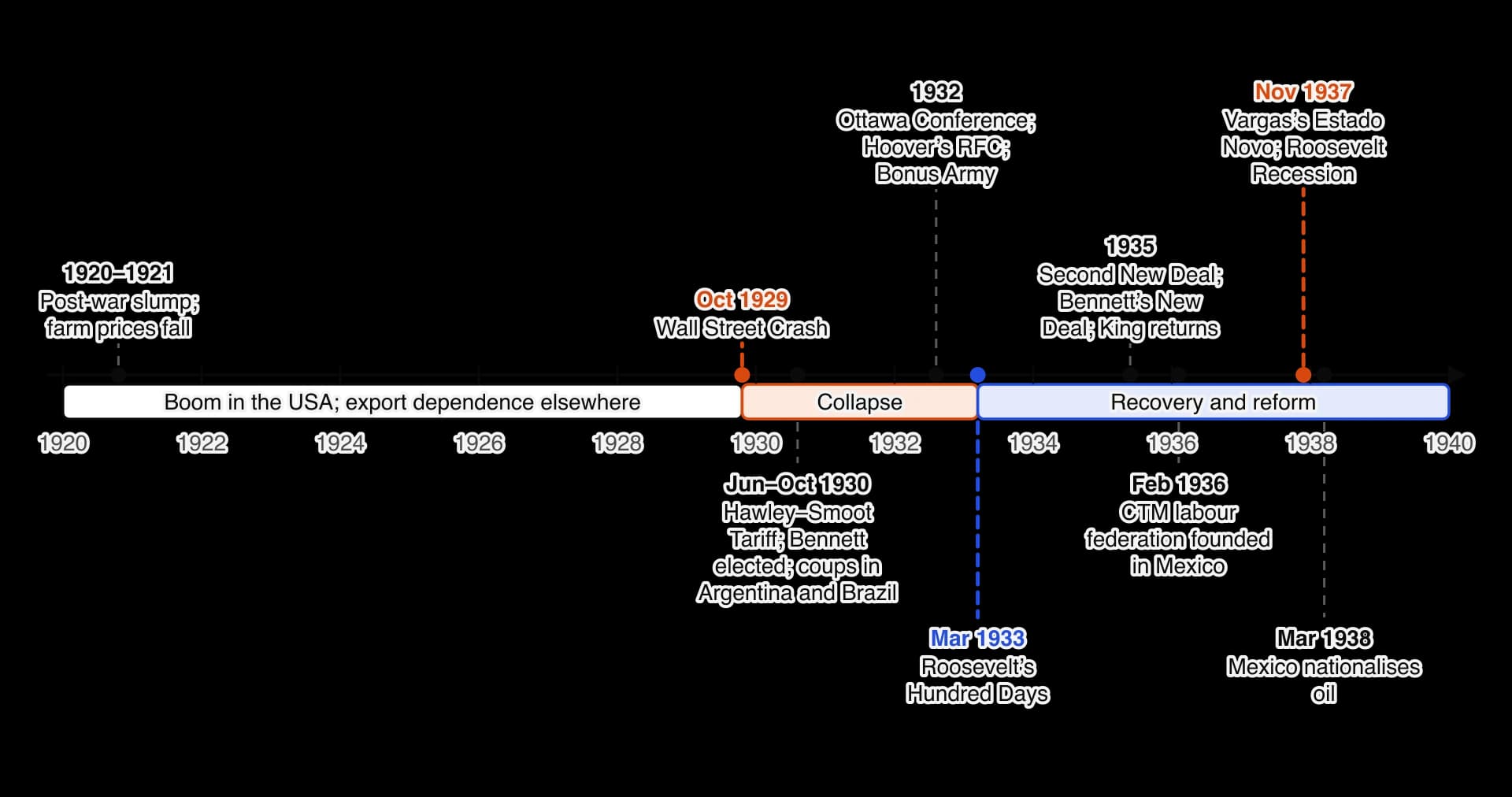
The overview timeline shows three phases. In the 1920s the USA boomed while farmers everywhere struggled; between 1929 and 1933 output, prices, trade and employment collapsed across the Americas; and from 1933 governments of every kind experimented with new solutions, from Roosevelt’s New Deal to Vargas’s dictatorship in Brazil.
The Americas in the 1920s: a fragile prosperity
The roots of the Depression lay in the 1920s. The decade was a time of rapid growth in the USA, but the growth was uneven, and the economies of Canada and Latin America were tied to the US economy and to world markets in ways that made them very vulnerable to a downturn. The growth of the export economies before 1929 is covered in the study of the formation of modern nations; here the focus is on the weaknesses that turned a slump into a depression.
The US boom
After a short post-war slump in 1920–1921, the US economy grew quickly. Mass production, pioneered by Henry Ford’s moving assembly line, made cars, radios, refrigerators and vacuum cleaners affordable to many families for the first time. Electricity reached most urban homes, and new industries such as chemicals, aviation and film expanded. Productivity in manufacturing rose sharply because of new machinery and electric power.
The Republican presidents of the decade, Warren Harding (1921–1923), Calvin Coolidge (1923–1929) and Herbert Hoover (from March 1929), believed that business, not government, created prosperity. Andrew Mellon, Secretary of the Treasury from 1921 to 1932, cut taxes on high incomes, arguing that the rich would invest their savings and create jobs. Tariffs were raised (the Fordney–McCumber Tariff of 1922) to protect US industry from foreign competition.
Weaknesses beneath the boom
Several weaknesses lay beneath the prosperity. Historians disagree about how much each one mattered, but together they explain why the economy was fragile by 1929.
Unequal incomes. Profits and the incomes of the richest Americans rose much faster than wages. By 1928 the top 1 per cent of earners received almost a quarter of all income, the highest share recorded before the 2000s. Many workers could buy the new consumer goods only on credit, so demand depended on borrowing.
Overproduction and weak demand. By 1928–1929 the market for cars and houses was close to saturated. Housing construction had begun to fall in 1926, and car sales fell in 1929. Factories had built more capacity than consumers could absorb.
"Sick" industries. Coal, textiles, railways and shipbuilding did not share in the boom; they faced competition from oil, electricity, synthetic fibres and trucks, and their workers suffered wage cuts and unemployment through the decade.
Farming. Farmers had expanded production during the First World War, when Europe needed food. After 1920 prices fell sharply as European farming recovered, but farmers in the USA and Canada kept producing to pay their debts, which pushed prices down further. Farm incomes stayed low throughout the 1920s, and hundreds of small rural banks failed every year.
Credit and speculation. Consumers bought cars and appliances by instalment buying (hire purchase). Investors bought shares and land in the belief that prices would keep rising: the Florida land boom collapsed in 1926, and the stock market boom of 1927–1929 followed.
Canada and Latin America: economies built on exports
Canada and the countries of Latin America grew in the 1920s by exporting raw materials. Canada sold wheat from the prairie provinces, newsprint (paper for newspapers), lumber and minerals, mostly to Britain and the USA. Latin American economies depended on even fewer products: coffee made up about 70 per cent of Brazil’s exports; Argentina sold beef and wheat; Chile depended on nitrates and copper, Cuba on sugar, and Mexico on oil and silver.
These economies were vulnerable in three ways. Their export prices were set on world markets they could not control. Their governments drew much of their revenue from customs duties on trade, so a fall in trade meant a fall in tax income. And they had borrowed heavily in the 1920s, increasingly from New York instead of London: US lending to Latin America grew rapidly after 1924. When US banks stopped lending and US customers stopped buying, these economies had no cushion.
The causes of the Great Depression
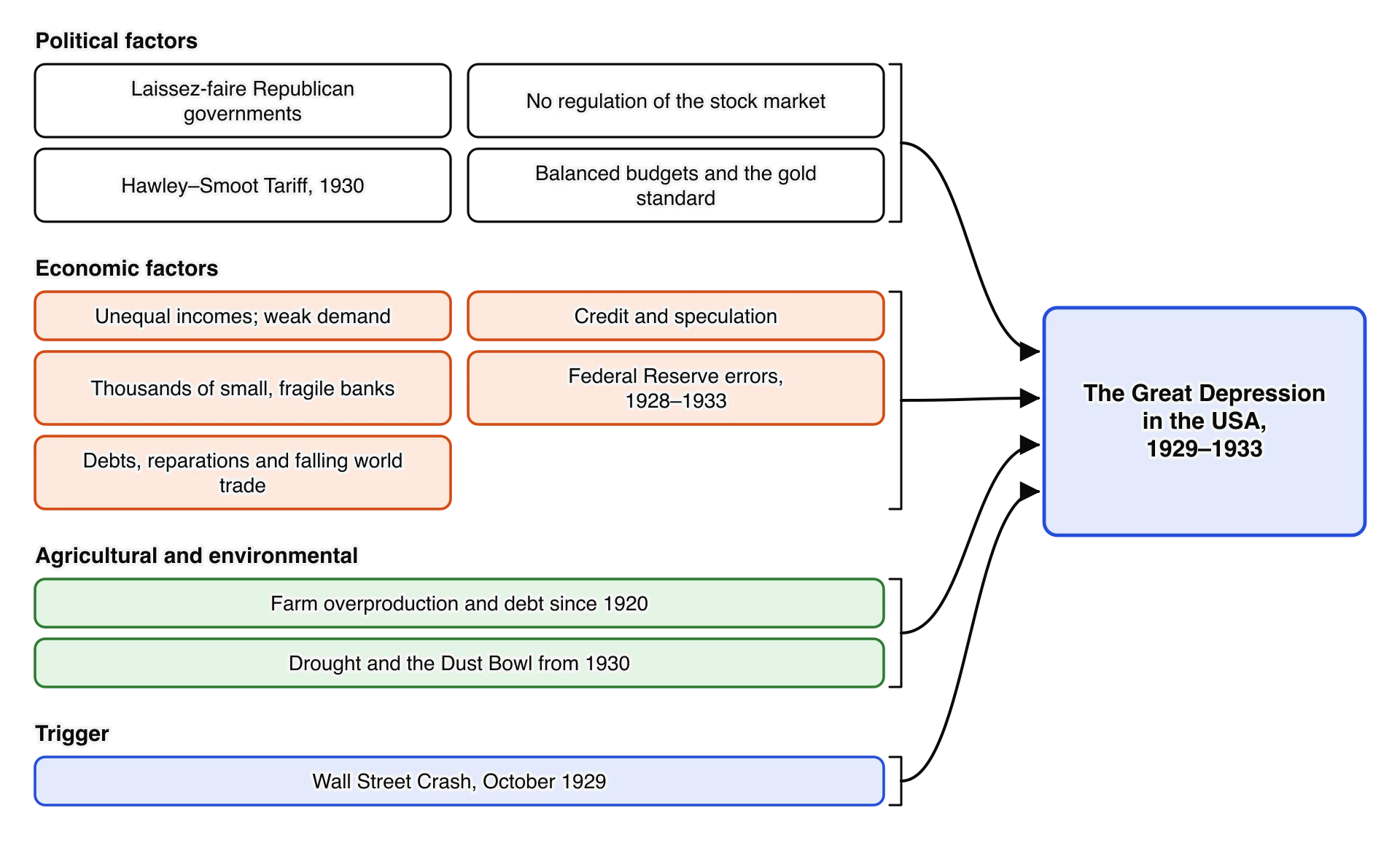
A depression is a severe and prolonged fall in economic activity, much deeper and longer than an ordinary recession. Between 1929 and 1933 real output in the USA fell by about a quarter, industrial production by nearly half and prices by about a quarter, and unemployment rose from about 3 per cent to about 25 per cent. The diagram of causes groups the explanations historians and economists give: political factors, economic factors (the banking system and trade), agricultural and environmental factors, and the crash that set the downturn off.
Political factors: laissez-faire and failures of regulation
US governments in the 1920s did little to regulate business or finance. The stock market had no federal regulator: companies did not have to publish reliable accounts, insiders could organise "pools" to push up a share’s price and sell at the top, and brokers lent freely to investors who bought shares "on margin". The Federal Reserve, the central bank created in 1913, was divided between twelve regional banks and a board in Washington that often disagreed.
Government policy also made the crisis worse once it began. The Hawley–Smoot Tariff, signed by Hoover on 17 June 1930 despite a petition from more than a thousand economists, raised US duties on over 20,000 imported goods. Canada, European countries and others retaliated with their own tariffs, and world trade shrank. Economists still debate how much damage the tariff itself did, but it signalled that each country would protect itself at the expense of others.
Governments everywhere also believed that budgets must balance and that currencies must stay on the gold standard. Both beliefs led them to cut spending and raise interest rates during the slump, which made it deeper.
Economic factors: banking and the Federal Reserve
The US banking system was unusually fragile. Most states banned branch banking, so the country had about 25,000 small, separate banks in 1929, many of them in farm towns with no reserves to fall back on. Deposits were not insured: when a bank failed, its depositors lost their savings, so rumours of trouble caused "runs" in which depositors rushed to withdraw their money.
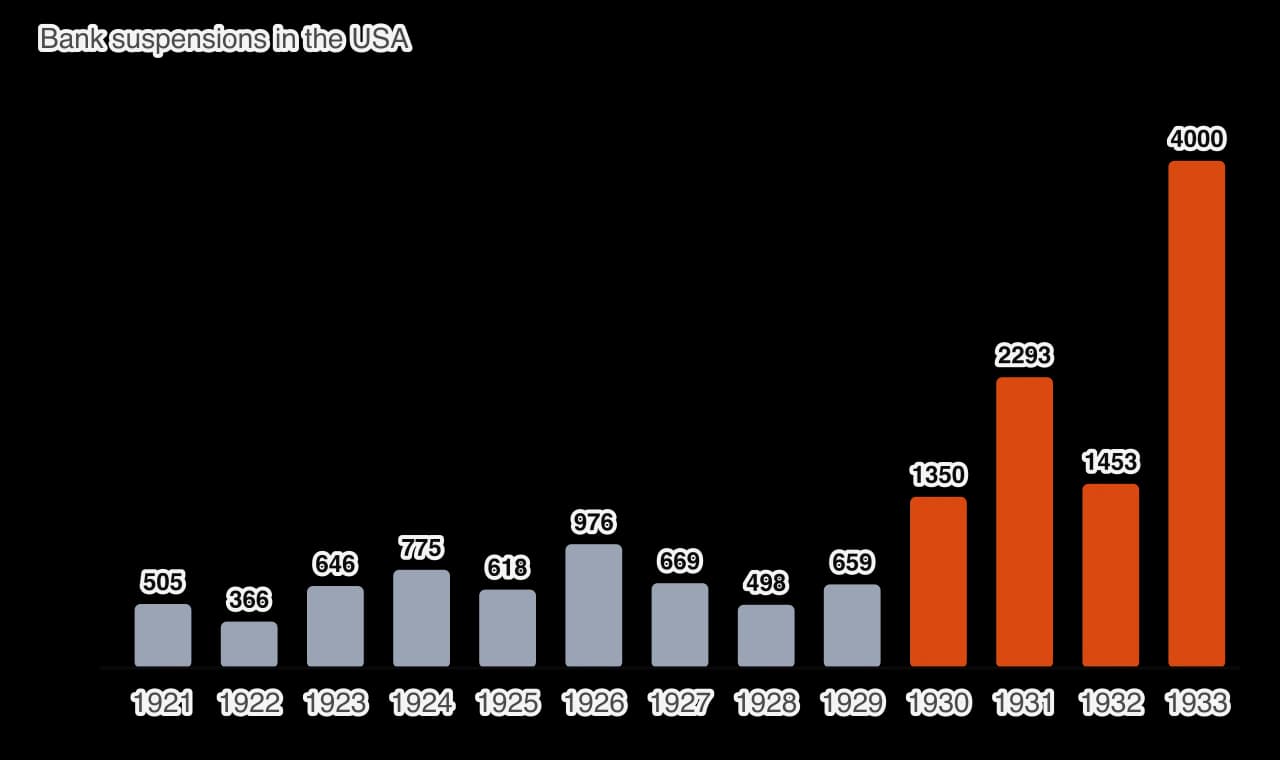
The chart of bank suspensions shows that bank failures were common even in the 1920s, mostly among rural banks hit by low farm prices. After the crash they came in waves. In late 1930 a panic spread from the collapse of Caldwell and Company in Tennessee, and on 11 December 1930 the Bank of United States in New York, with about 400,000 depositors, closed. Further waves followed in 1931 and in early 1933. By the end of 1933 the number of commercial banks had fallen to just over 14,000, about half the number of 1920.
The Federal Reserve made the crisis worse. In 1928–1929 it raised interest rates to curb speculation, which slowed the economy. After the crash it failed to act as a lender of last resort, lending to sound banks facing runs, and it allowed the money supply to fall by about a third between 1929 and 1933. In October 1931, after Britain left the gold standard on 21 September, it raised its discount rate sharply to stop gold leaving the country, at the worst possible time for American borrowers.
Economic factors: trade, debts and the gold standard
The world economy of the 1920s depended on a circle of loans. Germany paid reparations to Britain and France under the Dawes Plan of 1924 (and the Young Plan of 1929) largely with money borrowed from US banks; Britain and France used reparations to repay their war debts to the USA. Latin American governments and businesses also borrowed in New York. When US lending fell in 1928, as investors moved their money into the booming stock market, and then stopped after the crash, the circle broke.
Lower demand in the USA and Europe, falling lending and rising tariffs drove down the prices of food and raw materials. Producers in Canada and Latin America responded by producing more to maintain their income, which drove prices down further. The chain of the crisis’s spread shows how this hit the export economies of the Americas.

The gold standard turned these national problems into an international depression. Countries losing gold had to deflate, cutting spending, wages and prices. Countries that left gold early (Argentina and Brazil in effect in 1929–1931, Britain and Canada in 1931, the USA in April 1933) could lower interest rates and expand their money supply, and in general they recovered earlier.
Agricultural and environmental factors
Farmers were the largest group that never shared in the boom. In 1929 about a quarter of Americans lived on farms. Farm prices fell after 1920 and fell again, much more steeply, after 1929: net farm income fell by more than half between 1929 and 1932. Farmers who had borrowed to buy land and machinery in the war years could not repay, and thousands of farms were foreclosed (taken by lenders). In parts of the Midwest in 1932–1933 farmers blocked roads to stop produce reaching market and threatened auctioneers at foreclosure sales.
Environmental disaster deepened the crisis on the Great Plains. During the wheat boom of the war years and the 1920s, farmers had ploughed up millions of acres of grassland in Kansas, Oklahoma, Texas, Colorado and New Mexico. When drought struck from 1930–1931, the exposed topsoil blew away in huge "black blizzards". The worst storms came in 1934–1936; on Black Sunday, 14 April 1935, a storm carried dust across the southern Plains and turned day into night. The region became known as the Dust Bowl.
Canada’s prairie provinces suffered in the same way. Drought, dust storms and grasshoppers struck southern Saskatchewan and Alberta, the region known as Palliser’s Triangle, while the price of wheat fell to its lowest level in centuries. Saskatchewan, almost wholly dependent on wheat, was the hardest-hit province in Canada.
The Wall Street Crash and reactions to it
Share prices on the New York Stock Exchange more than doubled between 1927 and 1929. The Dow Jones Industrial Average, an index of thirty leading companies, peaked at 381.17 on 3 September 1929. Brokers’ loans to investors buying on margin rose to about 8.5 billion dollars. Prices fell unevenly through September and early October as some investors began to sell.
On Black Thursday, 24 October 1929, panic selling began. A group of leading bankers bought shares to steady the market, and prices recovered briefly. On Black Tuesday, 29 October, more than 16 million shares were sold and prices collapsed. Investors who had bought on margin were wiped out, and the banks and brokers who had lent to them suffered heavy losses. After a partial recovery in early 1930, prices kept falling: the Dow reached its lowest point, 41.22, on 8 July 1932, about 89 per cent below its peak.
Reactions to the crash spread its effects. Consumers and businesses who had lost money, or feared losing it, cut spending and investment. Banks became cautious and called in loans. Hoover called business leaders to the White House in November 1929 and won promises not to cut wages, and he asked state governors to speed up public works; for a few months confidence seemed to return. Abroad, US banks stopped lending and recalled short-term loans, which spread the crisis to Germany, Austria and Latin America.
The crash alone did not cause the Depression. Only a minority of Americans, perhaps 3 million, owned shares in 1929. The crash turned into a depression because it hit an economy with weak demand, fragile banks, a farm crisis and an international system held together by US loans, and because the policy responses of 1930–1932 deepened the slump.
The USA under Herbert Hoover, 1929–1933
Herbert Hoover took office in March 1929 with a reputation as one of the most able administrators in the country. A mining engineer who had organised food relief for Belgium during the First World War, he had served as Secretary of Commerce under Harding and Coolidge, encouraging businesses to cooperate voluntarily to reduce waste and stabilise prices. His ideas about the proper role of government shaped his response to the Depression.
We were challenged with a peace-time choice between the American system of rugged individualism and a European philosophy of diametrically opposed doctrines – doctrines of paternalism and state socialism. The acceptance of these ideas would have meant the destruction of self-government through centralization of government.
Herbert Hoover, campaign speech in New York ("Rugged Individualism"), 22 October 1928. Hoover was answering Democratic proposals to bring government into business, from the sale of liquor to farm marketing and hydroelectric power, a year before the crash, so the speech states his principles in a time of prosperity. Later in the same speech he claimed that America had come nearer to the abolition of poverty than any nation before. His opponents used both phrases against him once the Depression began.
Hoover’s response
Hoover did more to fight the Depression than any president had done in earlier slumps. He held that the federal government should encourage, coordinate and lend, but that direct federal relief payments to individuals would undermine self-reliance and the role of the states. His main measures were:
Voluntary agreements. In November 1929 he won promises from business leaders to maintain wages and investment. Most firms kept wage rates until 1931, but they cut hours and jobs instead.
Agriculture. The Agricultural Marketing Act (June 1929) created a Federal Farm Board with 500 million dollars to buy surplus crops and support prices. Its funds ran out by 1931, and prices kept falling because production was not limited.
Tariffs. He signed the Hawley–Smoot Tariff (June 1930), which hurt US exporters as other countries retaliated.
Relief through others. The President’s Emergency Committee for Employment (1930) and the Organization on Unemployment Relief (1931) encouraged private charities and local governments to help the unemployed. By 1932 many cities had run out of money.
International action. The Hoover Moratorium of June 1931 suspended payments of war debts and reparations for a year to stop the collapse of the German and Austrian banking systems.
Credit for business. The Reconstruction Finance Corporation (RFC), set up in January 1932, lent to banks, railways, insurance companies and, later, states. It saved many institutions, but critics complained that it helped big business while the unemployed went without.
Relief at last. The Emergency Relief and Construction Act (July 1932) allowed the RFC to lend 300 million dollars to the states for relief and more for public works. Hoover agreed to it only after long resistance.
Hoover also kept the USA on the gold standard and, to balance the budget, signed the Revenue Act of 1932, the largest peacetime tax increase in US history to that date. Both decisions reduced spending at the worst point of the slump.
The Bonus Army and the loss of public trust
By 1932 Hoover had become a symbol of failure. Shanty towns of the homeless on the edges of cities were called "Hoovervilles", and newspapers used as blankets were "Hoover blankets". In the summer of 1932 about 15,000–20,000 First World War veterans and their families, the Bonus Army, camped in Washington to demand early payment of a bonus promised for 1945. When the Senate rejected the bill, most stayed. On 28 July 1932, after police shot two veterans in a clash, Hoover ordered the army to clear the area; General Douglas MacArthur went further than his orders, driving the veterans out with tanks and tear gas and burning their camp. Hoover defended the action, and newsreel images of soldiers attacking veterans damaged him badly.
How effective was Hoover?
For decades Hoover was remembered as the president who did nothing. Historians since the 1970s have shown that this is unfair. The RFC, the Federal Home Loan Bank Act (1932) and loans for relief were new departures, and some were continued under Roosevelt. Joan Hoff Wilson, in Herbert Hoover: Forgotten Progressive (1975), presents him as an activist reformer whose ideas pointed towards later government management of the economy. Other historians, such as David Kennedy in Freedom from Fear (1999), stress that Hoover’s commitment to balanced budgets, the gold standard and voluntary action kept his measures too small for the crisis, and that his refusal to give federal relief to individuals left millions without help.
Franklin D. Roosevelt and the New Deal, 1933–1939
Franklin Delano Roosevelt (FDR), the Democratic governor of New York, defeated Hoover on 8 November 1932 by 472 electoral votes to 59, with about 57 per cent of the popular vote. He had promised "a new deal for the American people" in accepting his party’s nomination, but he offered few specific policies. By the time he was inaugurated on 4 March 1933, unemployment stood at about a quarter of the labour force and banks in most states had closed or restricted withdrawals.
This great Nation will endure as it has endured, will revive and will prosper. So, first of all, let me assert my firm belief that the only thing we have to fear is fear itself—nameless, unreasoning, unjustified terror which paralyzes needed efforts to convert retreat into advance.
Franklin D. Roosevelt, First Inaugural Address, Washington, 4 March 1933. The speech was broadcast to a nation in the middle of a banking panic. Its purpose was to restore confidence, and it treated fear itself as the immediate enemy. Later in the speech Roosevelt warned that if Congress did not act he would ask for broad executive power to wage a war against the emergency, as great as if the country had been invaded, a claim that pointed to the expansion of presidential power to come.
The Hundred Days and the First New Deal, 1933–1934
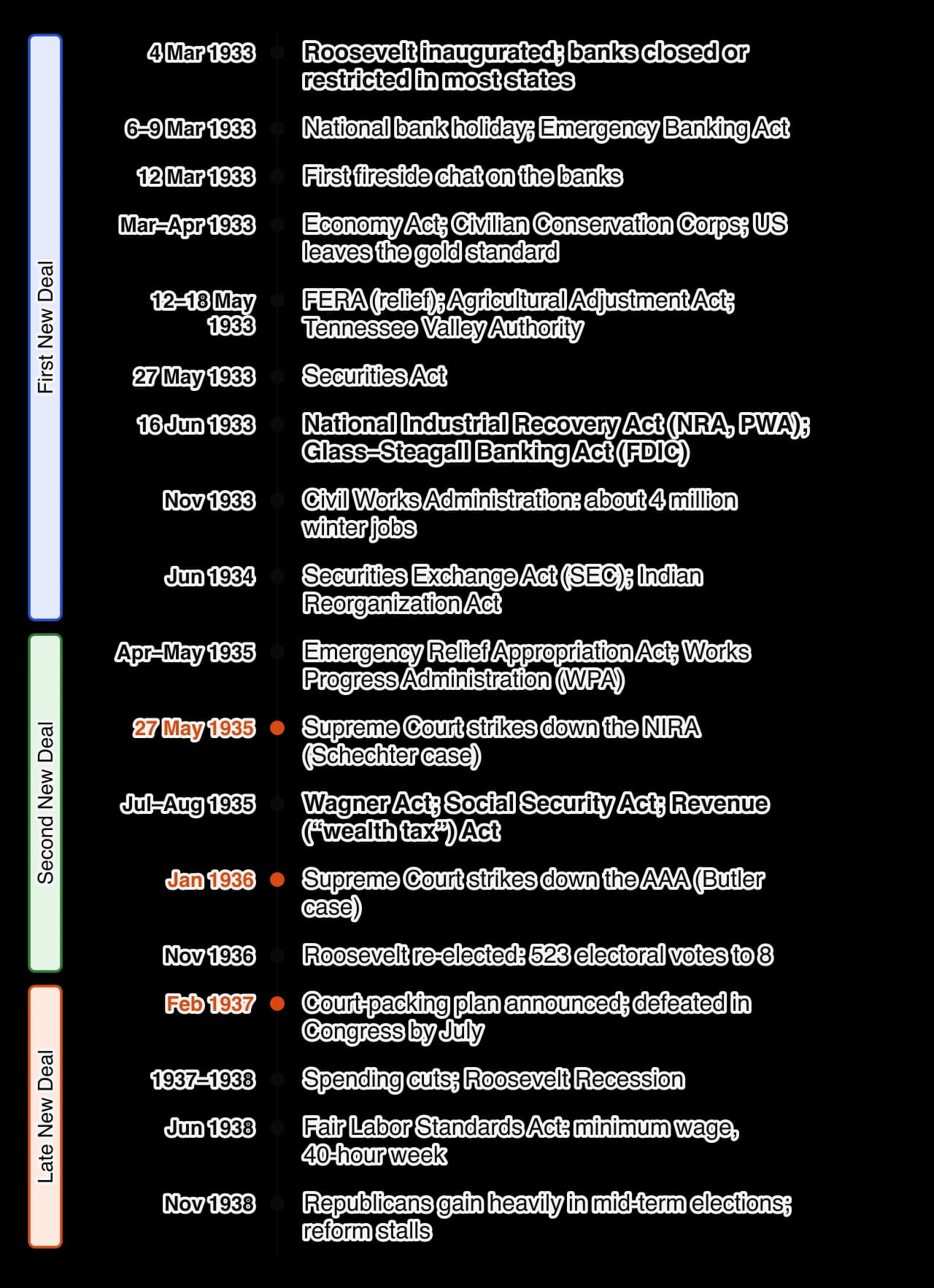
Roosevelt called Congress into special session, and in the Hundred Days between 9 March and 16 June 1933 it passed fifteen major laws. The timeline of the New Deal shows how quickly the programmes followed one another.
Saving the banks
On 6 March Roosevelt declared a national bank holiday, closing every bank. On 9 March Congress passed the Emergency Banking Act in a single day; it allowed sound banks to reopen under Treasury licence and gave the government power to reorganise the rest. On 12 March Roosevelt gave the first of his radio fireside chats, explaining in plain language why money would be safer in a reopened bank than under the mattress. When the banks reopened, deposits flowed back in. The Glass–Steagall Banking Act (16 June 1933) created the Federal Deposit Insurance Corporation (FDIC), which insured deposits, and separated ordinary banking from riskier investment banking. Bank runs almost disappeared.
Relief
The Civilian Conservation Corps (CCC, March 1933) employed young unmarried men in camps planting trees, fighting soil erosion and building parks; about 3 million served before it closed in 1942. The Federal Emergency Relief Administration (FERA, May 1933), led by the social worker Harry Hopkins, gave 500 million dollars in grants to the states for relief, the first large-scale federal relief in US history. In the winter of 1933–1934 the Civil Works Administration (CWA) employed about 4 million people on short-term public works.
Recovery: industry and agriculture
The Agricultural Adjustment Act (AAA, May 1933) paid farmers to reduce production, financed by a tax on food processors, in order to raise prices. In 1933 farmers ploughed under about 10 million acres of cotton and slaughtered about 6 million young pigs, at a time when many Americans went hungry. Farm incomes rose, but payments went mainly to landowners, and many landlords in the South evicted the tenants and sharecroppers whose land they took out of production.
The National Industrial Recovery Act (NIRA, June 1933) set up the National Recovery Administration (NRA), which drew up "codes of fair competition" with each industry to fix prices, wages and hours and to end cut-throat competition. Firms that joined displayed the NRA’s Blue Eagle symbol. Section 7(a) gave workers the right to organise unions and bargain collectively. The act also created the Public Works Administration (PWA), under Harold Ickes, which spent about 6 billion dollars on dams, bridges, schools and other large projects over the decade. The codes were complex, favoured large firms and were widely evaded, and by 1935 the NRA had lost much of its support.
The Tennessee Valley Authority (TVA, May 1933), a public corporation, built dams to control floods and generate cheap electricity in one of the poorest regions of the country, covering parts of seven states. It was the boldest experiment in government planning in the New Deal, and private power companies fought it in the courts.
Reform of finance and the dollar
The Securities Act (1933) obliged companies to publish accurate information when selling shares, and the Securities Exchange Act (1934) created the Securities and Exchange Commission (SEC) to regulate the stock market. In April 1933 Roosevelt took the USA off the gold standard; the dollar was later fixed at 35 dollars an ounce by the Gold Reserve Act of January 1934, a devaluation of about 40 per cent. Many economists now see leaving gold as one of the most effective recovery measures, because it allowed the money supply to grow again.
The Second New Deal, 1935–1936
By 1935 Roosevelt faced pressure from two sides: business leaders attacked the New Deal as a threat to free enterprise, while populists such as Huey Long demanded far more for the poor. On 27 May 1935 the Supreme Court struck down the NIRA in Schechter Poultry Corp. v. United States, ruling that Congress had given away too much lawmaking power and had regulated trade within a state. Roosevelt responded with a new wave of legislation, often called the Second New Deal, which focused on jobs, security and the rights of workers.
Measure (date) | What it did | Type |
|---|---|---|
Works Progress Administration, WPA (May 1935) | Employed about 8.5 million people over its life on roads, schools, airports and parks, and artists, writers and actors on cultural projects | Relief |
National Labor Relations Act, or Wagner Act (5 July 1935) | Guaranteed workers’ right to join unions and bargain collectively; set up the National Labor Relations Board (NLRB) to enforce it | Reform |
Social Security Act (14 August 1935) | Old-age pensions paid from taxes on workers and employers; unemployment insurance run by the states; aid for dependent children and the disabled | Reform |
Revenue Act, the "wealth tax" (August 1935) | Raised taxes on high incomes, large estates and corporations | Reform |
Banking Act (1935) | Centralised control of the Federal Reserve in its Board in Washington | Reform |
Rural Electrification Administration (1935) | Loans to cooperatives to bring electricity to farms; about one farm in ten had it in the mid-1930s, about one in three by 1940 | Recovery and reform |
Resettlement Administration (1935), later Farm Security Administration (1937) | Helped poor farmers and moved some to better land; employed photographers to record rural poverty | Relief |
The Social Security Act and the Wagner Act were the most lasting measures of the New Deal. Together they created the basis of the American welfare state and of modern labour law, although both left out large groups of workers, above all farm labourers and domestic servants, many of whom were Black or female.
 YouTube
The late New Deal, 1937–1939
Roosevelt won the election of November 1936 by 523 electoral votes to 8, carrying every state except Maine and Vermont. He then overreached. On 5 February 1937 he proposed to add up to six new justices to the Supreme Court, one for each justice over seventy who did not retire. Critics, including many Democrats, called it court-packing and an attack on the separation of powers, and Congress rejected the plan by July 1937. The Court had already changed course: in West Coast Hotel v. Parrish (March 1937) it upheld a state minimum wage law, and in NLRB v. Jones & Laughlin Steel (April 1937) it upheld the Wagner Act. This shift is often called "the switch in time that saved nine".
In 1937, believing recovery was secure, Roosevelt cut spending to balance the budget, and the Federal Reserve tightened credit. The economy fell into a sharp recession: industrial production dropped by about a third and unemployment rose from about 14 per cent to about 19 per cent. This Roosevelt Recession of 1937–1938 persuaded the administration to resume spending in 1938. The Fair Labor Standards Act (June 1938) set a federal minimum wage of 25 cents an hour and a maximum working week (moving to 40 hours), and banned most child labour.
In the mid-term elections of November 1938 the Republicans gained more than seventy seats in the House of Representatives. Republicans and conservative Southern Democrats now formed a coalition that blocked most new reform. By 1939, as war began in Europe, the New Deal as a reform programme was over, although the Reorganization Act of 1939 created the Executive Office of the President, strengthening the presidency for the future.
The political impact of the Depression in the USA
Party politics: the New Deal coalition
Before 1929 the Republicans had been the majority party for most of the period since the Civil War; the Democrats’ strength lay mainly in the white South and among Catholic immigrants in northern cities. The Depression reversed this. Roosevelt built the New Deal coalition, an alliance of groups that voted Democratic for a generation:
industrial workers and the new unions of the CIO;
Catholic and Jewish voters, many of them children of immigrants from southern and eastern Europe, in the northern cities;
white Southerners, who had voted Democratic since Reconstruction;
farmers helped by the AAA, especially in the Midwest and West;
African Americans in the North, who shifted from the Republicans, the party of Lincoln, to the Democrats in 1936;
intellectuals, liberals and many women active in reform.
The coalition was powerful but contradictory. It joined Black voters in northern cities with white Southern Democrats who defended segregation, and union workers with farmers who disliked high food prices for their urban customers. Roosevelt kept it together by avoiding direct attacks on segregation. Political scientists call the change a realignment: a lasting shift in the balance of the parties, which made the Democrats the majority party until the late 1960s.
The expansion of executive power and the federal government
The New Deal changed the relationship between the federal government, the states and the people. Before 1933 most Americans had little contact with the federal government apart from the post office. By 1939 federal agencies paid pensions, insured bank deposits, regulated the stock market, fixed minimum wages, supervised union elections, paid farmers and employed millions on public works. Federal spending rose from about 3 per cent of national output in 1929 to about 10 per cent in the late 1930s (approximate figures from the US Office of Management and Budget historical tables).
Power within the federal government also shifted towards the president. Roosevelt proposed most of the legislation Congress passed, used radio to speak directly to the people over the heads of Congress and the press, and governed through dozens of new agencies, known by their initials as the alphabet agencies. The Reorganization Act of 1939 created the Executive Office of the President, giving the presidency its own staff and budget office. Historians describe the result as the beginning of the "modern presidency".
Historians describe the New Deal state in different ways. Some call it a broker state, in which government balanced the claims of organised groups (business, farmers, labour) instead of following a single plan. Others stress its limits: power remained divided with the states, which ran unemployment insurance and much relief, and Southern Democrats in Congress shaped programmes to protect their region’s racial order.
Labour rights and social policies
The New Deal changed the position of organised labour. Section 7(a) of the NIRA and then the Wagner Act gave workers a legal right to organise. In 1935 John L. Lewis of the United Mine Workers led several unions out of the craft-based American Federation of Labor to organise whole industries, such as steel and cars, including unskilled, Black and immigrant workers; this became the Congress of Industrial Organizations (CIO). In the Flint sit-down strike (30 December 1936 to 11 February 1937), car workers occupied General Motors plants until the company recognised the United Auto Workers. US Steel recognised a union in March 1937 without a strike.
Employers often fought back violently. On 30 May 1937, police in Chicago fired on strikers and their families outside the Republic Steel plant, killing ten people, in the Memorial Day massacre. Even so, union membership rose from about 3 million in 1933 to about 8–9 million by 1939 (estimates vary with the source).
Social policy moved in the same direction. The Social Security Act created old-age pensions and unemployment insurance; the Fair Labor Standards Act set minimum wages and maximum hours; and public housing began with the Housing Act of 1937. These measures were limited, and many of the poorest workers were excluded, but they established the principle that the federal government was responsible for a basic level of economic security.
Opposition to the New Deal
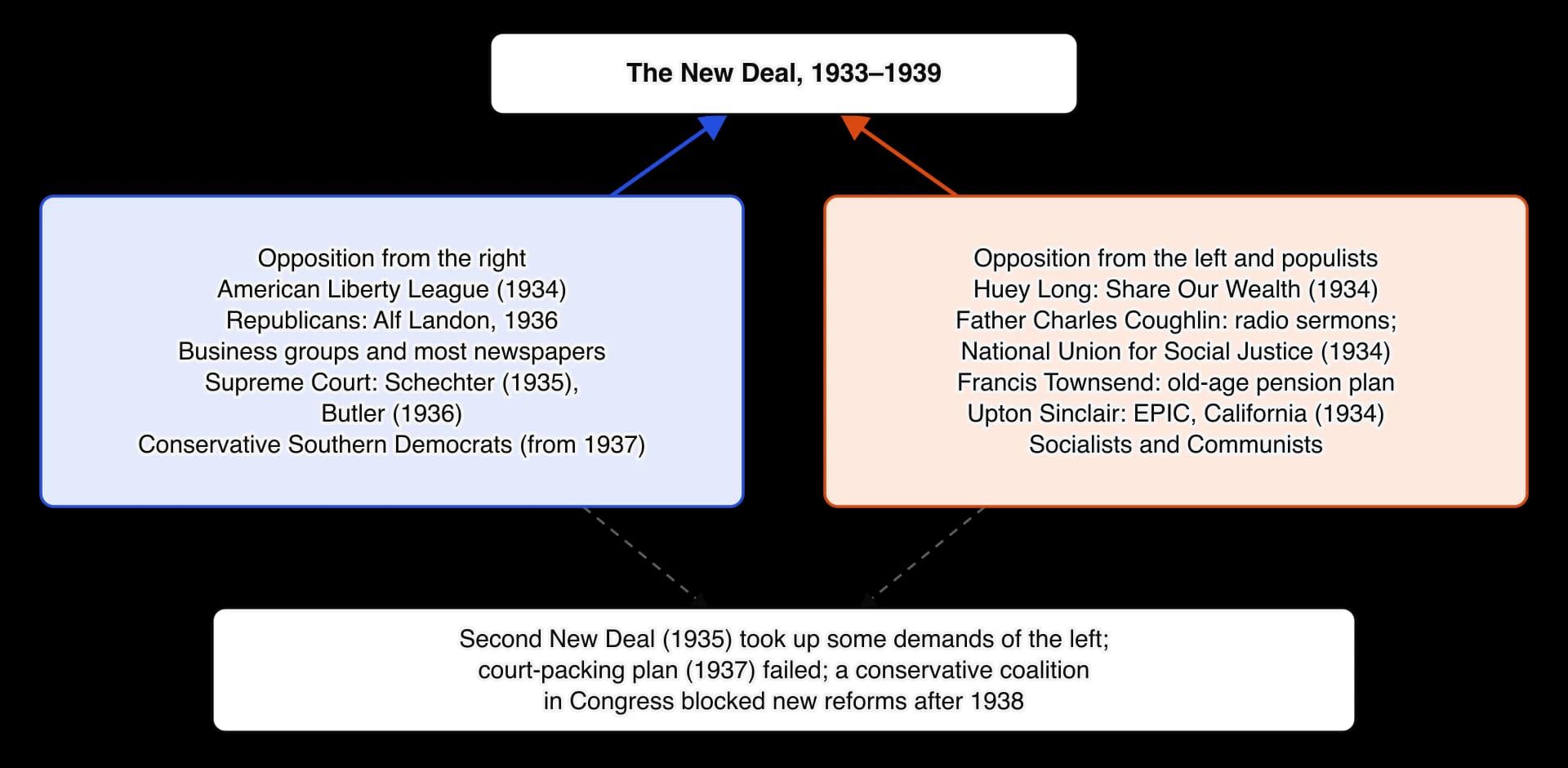
The New Deal was attacked from the right as a threat to liberty, property and the Constitution, and from the left as too timid. The diagram of opposition sets out the main critics.
From the right
The American Liberty League, founded in August 1934 and funded by wealthy businessmen including the du Pont family, accused Roosevelt of creating a dictatorship and destroying free enterprise. Many business leaders called Roosevelt a traitor to his class. The Republican candidate in 1936, Alf Landon, governor of Kansas, accepted parts of the New Deal but attacked its waste and centralisation; he won only two states. The Supreme Court, dominated by conservative justices, struck down the NIRA (1935), the AAA (United States v. Butler, January 1936) and several other laws. After 1937 conservative Southern Democrats, worried about union drives in the South and federal interference in race relations, joined Republicans to block further reform.
From the left and populists
The most dangerous challenge came from populists who claimed the New Deal did too little. Huey Long, the former governor and then senator from Louisiana, launched his Share Our Wealth movement in 1934. It claimed over 7 million members in its clubs and planned to make Long a presidential candidate in 1936.
Now, we have organized a society, and we call it "Share Our Wealth Society," a society with the motto "every man a king." … We propose to limit the wealth of big men in the country. … We have to limit fortunes. Our present plan is that we will allow no one man to own more than $50,000,000.
Huey P. Long, "Every Man a King", national radio address, 23 February 1934 (text as published on the Huey Long family website, hueylong.com). Long spoke to a mass radio audience, and the plan was designed to be simple and appealing: a guaranteed family wealth of about 5,000 dollars, pensions and free education, paid for by confiscating great fortunes. Economists said the sums did not add up. Its value as a source lies in showing the anger at inequality that Roosevelt had to answer; Long was assassinated in September 1935.
Father Charles Coughlin, a Catholic priest from Michigan, reached tens of millions of listeners with his weekly radio sermons. He first supported Roosevelt, then attacked him for protecting bankers, formed the National Union for Social Justice in 1934, and by the late 1930s spread antisemitic views. Dr Francis Townsend, a retired physician from California, proposed a pension of 200 dollars a month for everyone over sixty, on condition that it was spent within the month; Townsend clubs claimed millions of members. In California the novelist Upton Sinclair won the Democratic nomination for governor in 1934 with his EPIC ("End Poverty in California") plan, before losing to a well-funded campaign against him. The Socialist Party of Norman Thomas and the Communist Party also gained support, although never mass votes.
The populist challenge had a clear effect. The Social Security Act answered the Townsend movement, the "wealth tax" answered Long, and the Wagner Act answered the strikes of 1934. The Second New Deal moved the administration to the left partly to keep these voters inside the Democratic coalition. In 1936 Coughlin, Townsend and Long’s successor Gerald L. K. Smith backed William Lemke of the Union Party, who won under 2 per cent of the vote.
How effective was the New Deal?
The effectiveness of the New Deal depends on what it is measured against. The three Rs give three standards: did it relieve suffering, did it bring recovery, and did it reform the system to prevent another collapse?
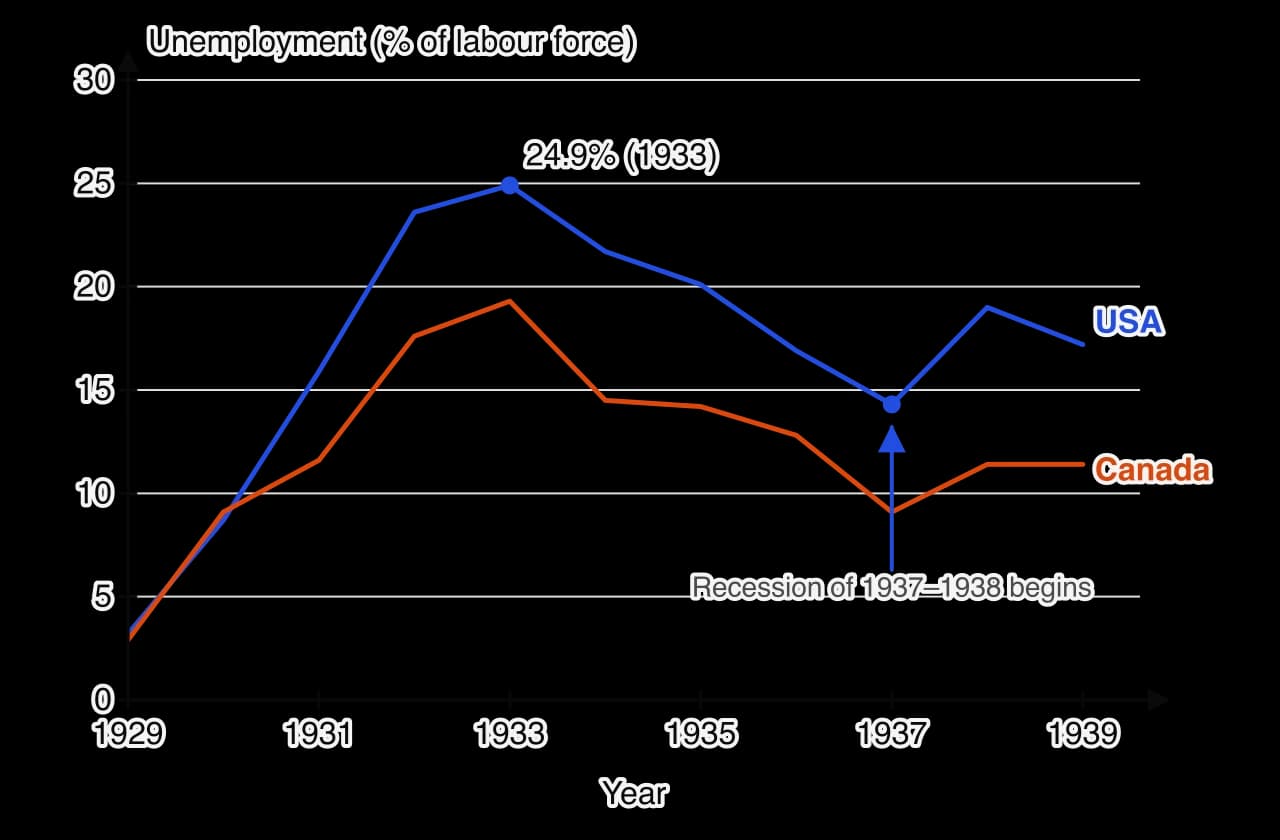
The graph of unemployment shows that recovery was real but incomplete. Real output grew quickly from 1933 to 1937 and regained its 1929 level by about 1936–1937, but unemployment never fell below about 14 per cent in the 1930s on the Lebergott series, and the recession of 1937–1938 undid part of the gains. Full employment came only with rearmament and war production in 1941–1943. Canada, with a much smaller government programme, followed a very similar path, which suggests that world conditions mattered as much as national policies.
Measure of success | Evidence of success | Evidence of failure or limits |
|---|---|---|
Relief | Millions employed by the CCC, CWA and WPA; FERA grants; nobody starved on the scale of 1932; restored morale | Relief reached only a minority of the unemployed at any time; WPA wages were low; local officials discriminated against Black, Mexican American and women applicants |
Recovery | Banks stabilised in 1933; output grew about 9 per cent a year in 1933–1937; leaving gold allowed the money supply to grow | Unemployment still 17 per cent in 1939 (Lebergott); the 1937–1938 recession; private investment stayed low; deficits were small compared with the gap in demand |
Reform | FDIC, SEC, Social Security, Wagner Act, minimum wage: lasting institutions; a new role for the federal state | Agricultural and domestic workers left out of Social Security; TVA-style planning not repeated; the AAA hurt sharecroppers; segregation untouched |
Economists debate why recovery was slow. Keynesian economists, following John Maynard Keynes’s General Theory (1936), argue that the New Deal never spent enough: federal deficits were small, and state governments raised taxes and cut spending at the same time. Monetarists such as Milton Friedman credit recovery mainly to leaving the gold standard and the growth of the money supply after 1933, and blame the 1937 recession on the tightening of credit. Some economists on the right, notably Harold Cole and Lee Ohanian (2004), argue that NRA codes and union power kept wages and prices too high and slowed the return to work, and the journalist Amity Shlaes (The Forgotten Man, 2007) argues that uncertainty about government policy discouraged investment.
Canada: the political impact of the Depression and the search for solutions
Canada was one of the countries hardest hit by the Depression. It depended on exporting wheat, newsprint, lumber and minerals, mainly to the USA and Britain, and these were the products whose prices fell furthest. Its national income fell by about 40 per cent in money terms between 1929 and 1933. Saskatchewan, almost wholly dependent on wheat and struck by drought, suffered worst: the Rowell–Sirois Commission later estimated that average income in the province fell by about 70 per cent between 1928–1929 and 1933.
Measuring unemployment in Canada is difficult. The official historical series, which counts farmers and their families as employed, shows unemployment rising from about 3 per cent in 1929 to about 19 per cent in June 1933. Among wage earners outside agriculture the rate was much higher, and contemporary estimates of about 27–30 per cent are often quoted. Relief was the responsibility of municipalities and provinces under the constitution, the British North America Act of 1867, but many of them, especially in the West, were close to bankruptcy.
William Lyon Mackenzie King, 1929–1930
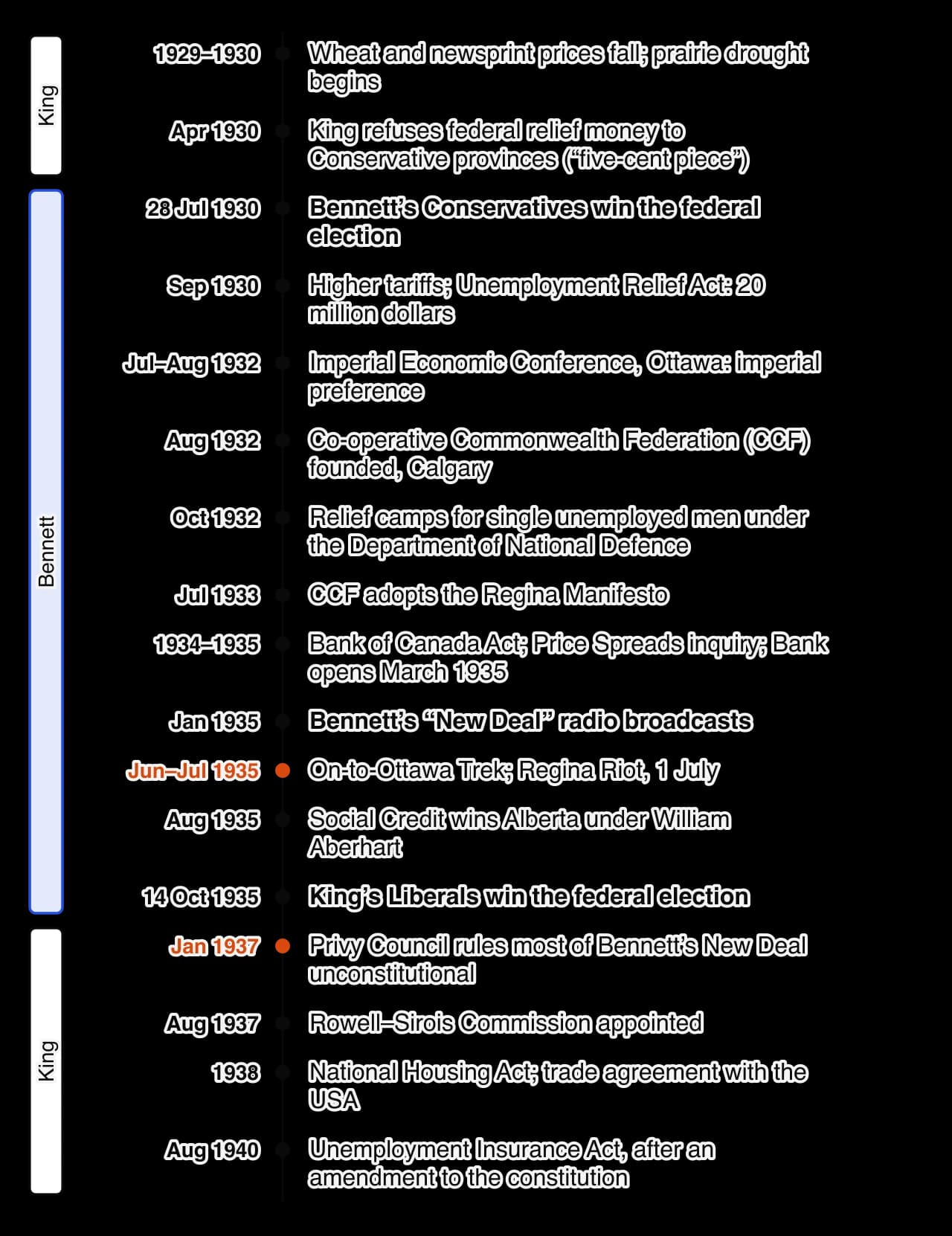
William Lyon Mackenzie King, the Liberal prime minister since 1921 (apart from a few months in 1926), treated the slump as a temporary downturn and unemployment relief as a matter for the provinces. In a debate in the House of Commons in April 1930 he declared that he would not give a "five-cent piece" for relief to any provincial government run by the Conservatives. The remark made him appear indifferent to suffering, and the Conservatives used it throughout the election campaign. On 28 July 1930 the Conservatives under Richard Bedford Bennett won a clear majority.
R. B. Bennett, 1930–1935: tariffs, relief and order
R. B. Bennett was a wealthy Calgary lawyer and businessman who promised to end unemployment and to use tariffs to "blast" Canada’s way into the markets of the world. His government’s response had four parts.
Tariffs. A special session of Parliament in September 1930 raised tariffs on many imports, in part as retaliation for Hawley–Smoot. Protection saved some manufacturing jobs in Ontario and Quebec but raised costs for prairie farmers, who still had to sell their wheat on the world market.
Imperial preference. At the Imperial Economic Conference in Ottawa (July–August 1932), Britain and the dominions agreed lower tariffs on each other’s goods than on goods from outside the Empire. Canada gained some access to the British market for wheat, timber and other products, but the agreements did not restore earlier export levels.
Relief. The Unemployment Relief Act of 1930 gave 20 million dollars to the provinces and municipalities for public works and direct relief, and further grants followed each year. Bennett accepted that Ottawa must pay, but he insisted that relief remain temporary and minimal. Families on relief faced means tests and humiliating inspections, and immigrants who went on relief risked deportation: about 28,000 people were deported between 1930 and 1935 (a commonly cited figure).
Order. Bennett treated Communist agitation as a threat. Section 98 of the Criminal Code, passed after the Winnipeg General Strike of 1919, made membership of an "unlawful association" a crime; in 1931 Tim Buck and seven other Communist leaders were convicted under it and imprisoned.
In October 1932 the government opened relief camps for single, homeless unemployed men, run by the Department of National Defence under General Andrew McNaughton. The men built roads, airfields and other public works in remote areas for board, lodging and 20 cents a day. About 170,000 men passed through the camps before they closed in 1936. The camps kept unemployed men away from the cities, where the government feared they would turn to radicalism, but the men called them "slave camps" and resented the low pay, isolation and lack of any vote or voice.
The On-to-Ottawa Trek, 1935
In April 1935 about 1,500 men left the camps in British Columbia and went on strike in Vancouver, organised by the Communist-led Relief Camp Workers’ Union. In June about 1,000 of them climbed onto freight trains to take their demands for "work and wages" to Ottawa; their numbers grew to about 2,000 as they crossed the prairies.
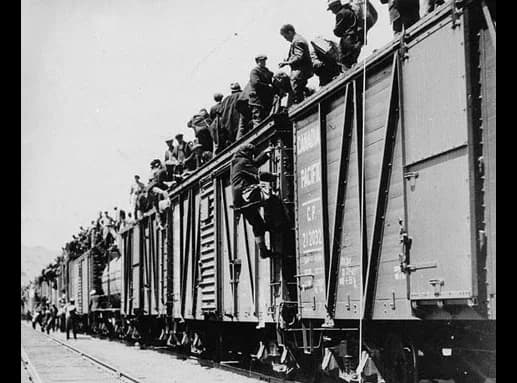
The photograph of trekkers riding boxcars through Kamloops shows the discipline and scale of the protest. The government stopped the trekkers at Regina, Saskatchewan, and allowed eight leaders to travel to Ottawa, where they met Bennett on 22 June. The meeting ended in insults on both sides. On 1 July 1935 the Royal Canadian Mounted Police and city police moved in to arrest the leaders at a public meeting in Regina. In the Regina Riot that followed, a city police detective was killed and dozens of people, police and trekkers, were injured. The trek ended, but the violence damaged Bennett further.
Bennett’s New Deal, 1935
Facing an election and the evident failure of his policies, Bennett surprised Canadians, and his own cabinet, with a series of five radio broadcasts in January 1935. He announced a programme of reform modelled partly on Roosevelt’s New Deal and partly on the findings of a parliamentary inquiry into price spreads led by his trade minister, H. H. Stevens.
I am for reform. And, in my mind, reform means Government intervention. It means Government control and regulation. It means the end of laissez faire. Reform heralds certain recovery. There can be no permanent recovery without reform.
R. B. Bennett, first radio address, "The Premier Speaks to the People", 2 January 1935 (text as reproduced on Wikisource). Bennett was a lifelong Conservative businessman speaking in an election year after four years of failing policies, so the broadcast can be read as genuine conversion or as a bid to win back voters from the new radical parties. As evidence, it shows how far the Depression had moved political language in Canada: the head of the party of business now attacked laissez-faire.
Parliament passed laws for a minimum wage, maximum working hours and a weekly day of rest; the Employment and Social Insurance Act for unemployment insurance; the Natural Products Marketing Act to regulate farm marketing; and the Canadian Wheat Board Act (July 1935), which set a minimum price for wheat. Bennett had already created the Bank of Canada (act of 1934; opened in March 1935), giving Canada a central bank to manage the currency and credit, and the Prairie Farm Rehabilitation Act (1935) funded dams, dugouts and new farming methods to fight drought on the prairies.
The reforms came too late to save Bennett. Many voters saw them as an election device, and Stevens left the cabinet to form his own Reconstruction Party. In the election of 14 October 1935 the Liberals won 173 of 245 seats and the Conservatives were reduced to about 40. In January 1937 the Judicial Committee of the Privy Council in London, then Canada’s highest court of appeal, ruled that most of the labour and social insurance laws were unconstitutional, because they dealt with matters that belonged to the provinces.
Mackenzie King, 1935–1939: caution and commissions
King returned to power promising moderation. He signed a trade agreement with the USA in November 1935 (followed by a second in 1938), which lowered tariffs and helped recovery. He kept the Bank of Canada and the Wheat Board, and in 1938 brought the Bank fully into public ownership. The National Employment Commission (1936) studied unemployment, and the National Housing Act (1938) supported house building. The Canadian Broadcasting Corporation (CBC) was set up in 1936 as a public broadcaster.
King was cautious by temperament and believed that the constitution blocked federal action. He cut relief spending in 1936–1937 to balance the budget, and he closed the relief camps. In August 1937 he appointed the Royal Commission on Dominion–Provincial Relations, the Rowell–Sirois Commission, to study how responsibilities and taxes should be divided. Its report (1940) recommended that Ottawa take over unemployment relief and pay grants to the poorer provinces. A constitutional amendment in 1940 allowed the Unemployment Insurance Act of August 1940, during the Second World War.
New parties and opposition
The Depression broke the two-party system in Canada, especially in the West and in Quebec, where voters turned to new movements that promised radical solutions.
Movement | Leader and base | Ideas | Result in the 1930s |
|---|---|---|---|
Co-operative Commonwealth Federation (CCF), founded in Calgary, August 1932 | J. S. Woodsworth, a Methodist minister and Labour MP; farmers’ groups, labour, intellectuals of the League for Social Reconstruction | Democratic socialism: public ownership of banks and key industries, planning, social insurance (the Regina Manifesto, July 1933) | Seven federal seats in 1935; official opposition in British Columbia (1933) and, through its Farmer-Labour allies, Saskatchewan (1934); later governed Saskatchewan from 1944 |
Social Credit | William Aberhart, a Calgary school principal and radio evangelist; Alberta farmers | The monetary theories of C. H. Douglas: a "social dividend" of 25 dollars a month to every citizen to restore purchasing power | Won 56 of 63 seats in Alberta in August 1935; its banking and press laws were struck down or disallowed by Ottawa |
Union Nationale | Maurice Duplessis; Quebec conservatives and nationalists | Quebec nationalism, Catholic social teaching, attacks on the corrupt Liberal government and on trusts | Won Quebec in August 1936; the Padlock Act (1937) allowed police to close premises used to spread communism |
Reconstruction Party | H. H. Stevens, former Conservative trade minister | Controls on big business and price spreads to protect small firms and consumers | About 9 per cent of the vote in 1935 but one seat; it split the Conservative vote |
Communist Party of Canada and the Workers’ Unity League | Tim Buck; unemployed workers, miners, camp workers | Revolution; organised strikes, hunger marches and the relief camp workers | Leaders jailed under Section 98 (repealed 1936); organised the On-to-Ottawa Trek |
Data: official election returns (Elections Canada and provincial records).
The founding programme of the CCF set out the most radical alternative to both old parties.
We aim to replace the present capitalist system, with its inherent injustice and inhumanity, by a social order from which the domination and exploitation of one class by another will be eliminated, in which economic planning will supersede unregulated private enterprise and competition, and in which genuine democratic self-government, based upon economic equality will be possible.
Co-operative Commonwealth Federation, Regina Manifesto, adopted at the party’s first national convention, Regina, July 1933. The manifesto ended with the promise that no CCF government would rest content until it had eradicated capitalism. It was written by intellectuals of the League for Social Reconstruction for a convention of farmers, workers and socialists in the worst year of the Depression, and its language is more radical than the party’s later policies. It shows how the crisis discredited capitalism for many Canadians, while its commitment to democratic methods separated the CCF from the Communists.
How effective were King and Bennett?
Mackenzie King (1929–1930, 1935–1939) | R. B. Bennett (1930–1935) | |
|---|---|---|
Beliefs | Liberal, cautious, respectful of provincial rights; balanced budgets | Conservative, protectionist; strong federal leadership; converted to reform in 1935 |
Main measures | Refused federal relief in 1930; US trade agreements (1935, 1938); National Housing Act; Bank nationalised (1938); Rowell–Sirois Commission | Higher tariffs; relief grants; Ottawa Conference; relief camps; Bank of Canada; Wheat Board; 1935 New Deal laws |
Strengths | Trade agreements helped exports; built consensus; prepared the constitutional ground for the welfare state | Accepted federal responsibility for relief; created lasting institutions (Bank of Canada, Wheat Board, PFRA) |
Weaknesses | Slow and passive in 1930; cut relief in 1937; unemployment still about 11 per cent in 1939 | Tariffs hurt farmers; camps and Section 98 seen as repressive; reforms late, partly struck down |
Neither leader ended the Depression in Canada; recovery came with rising world prices after 1933 and with war in 1939. Historians are divided over Bennett. In the collection The Bennett New Deal: Fraud or Portent? (1968), J. R. H. Wilbur set out the debate over whether the 1935 reforms were electoral opportunism or the real start of the Canadian welfare state. H. Blair Neatby, in The Politics of Chaos (1972), presents King’s caution as a deliberate strategy of holding a divided country together, while James Struthers, in No Fault of Their Own (1983), argues that both governments put balanced budgets and the fear of encouraging idleness ahead of the needs of the unemployed.
Latin America and the Depression: collapse and political crisis
For Latin America the Depression was above all a crisis of exports. Prices of coffee, sugar, wool, wheat, copper, tin and nitrates collapsed between 1929 and 1932, and the volume of exports fell as well. According to figures collected by the economic historian Rosemary Thorp and others, the value of Chile’s exports fell by about 83 per cent between 1929 and 1932, Peru’s by about 72 per cent and Brazil’s by about 44 per cent in the same period. By League of Nations calculations, Chile was the country most severely affected by the collapse of world trade.
The effects spread through every part of these economies. Foreign loans stopped, and the cost of servicing old debts rose as export earnings fell; by the mid-1930s most Latin American governments had suspended payments on at least part of their foreign debts, Argentina being the main exception. Governments that relied on customs duties lost much of their revenue and cut salaries, including those of army officers. Mines, ports and plantations laid off workers, and wages fell.
The fall of governments, 1930–1933
The economic collapse discredited the governments of the 1920s, most of them run by narrow elites of landowners and exporters committed to free trade, foreign investment and the gold standard. Between 1930 and 1933 governments in most of the region were overthrown, usually by the armed forces.
Country | Date | What happened |
|---|---|---|
Dominican Republic | February 1930 | President Horacio Vásquez overthrown; Rafael Trujillo begins a dictatorship lasting until 1961 |
Bolivia | June 1930 | President Hernando Siles overthrown by the army |
Peru | August 1930 | Augusto Leguía, in power since 1919, overthrown by Colonel Luis Sánchez Cerro |
Argentina | September 1930 | General José Félix Uriburu overthrows the elected Radical president Hipólito Yrigoyen |
Brazil | October 1930 | Revolution of 1930 brings Getúlio Vargas to power |
Chile | July 1931 | Carlos Ibáñez resigns after strikes and protests; a year of instability follows |
El Salvador | December 1931 | General Maximiliano Hernández Martínez seizes power; a peasant rising is crushed in January 1932 with thousands killed (La Matanza) |
Cuba | August 1933 | Gerardo Machado driven out by a general strike and army revolt |
Not every change was a military coup: in Brazil a civilian politician took power with army support, and in Chile a dictator fell to civilian protest. The common pattern was that the army became a central political actor, claiming to stand above parties as the guardian of the nation. The diagram of consequences summarises the political, economic and social effects of the crisis across the region.
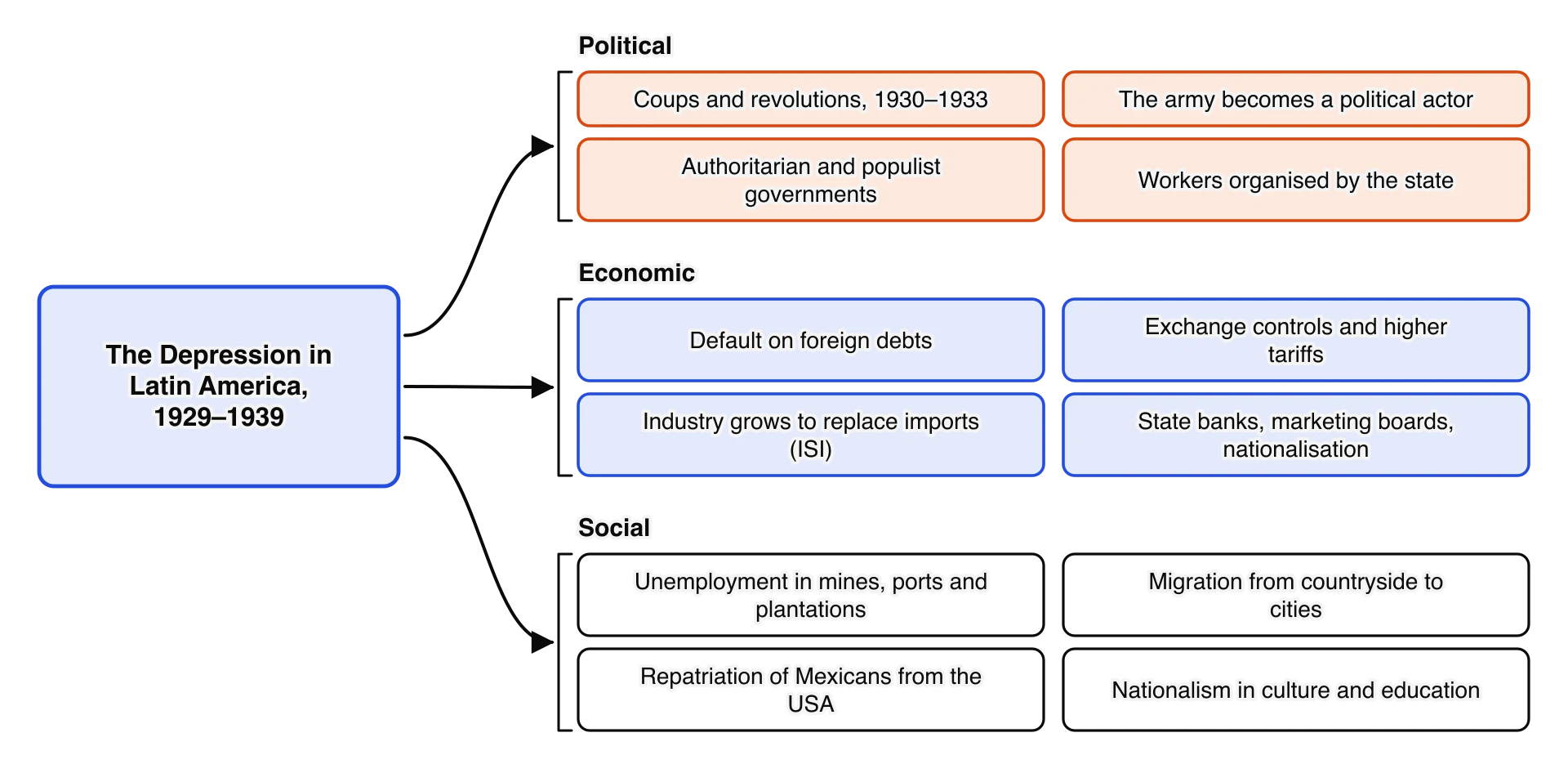
From crisis to new solutions
The governments that took power after 1930 could not restore the export economy of the 1920s, so they used the state in new ways. They left the gold standard, imposed exchange controls, raised tariffs, created central banks and marketing boards, defaulted on debts and encouraged local industry. The economic historian Carlos Díaz Alejandro distinguished between "active" countries such as Brazil, Mexico, Argentina and Colombia, whose governments used these tools and recovered relatively quickly, and "passive" ones, mostly smaller economies tied to one export, which waited for world prices to recover.
ISI in the 1930s was mostly unplanned. When export earnings collapsed, countries could not afford imported goods, so local factories expanded to supply textiles, food, shoes, cement and simple consumer goods. Tariffs and exchange controls, introduced to protect the balance of payments, protected these industries further. Only later, in the 1940s and 1950s, did economists such as Raúl Prebisch of the UN Economic Commission for Latin America turn ISI into an explicit development strategy.
 YouTube
Brazil under Getúlio Vargas, 1930–1939
Brazil is the clearest case in Latin America of how the Depression changed political power, social policy and the economy together. Before 1930 Brazil was governed under the Old Republic (1889–1930), a federal system dominated by the coffee planters of São Paulo and the ranchers and politicians of Minas Gerais, who took turns to hold the presidency in an arrangement known as café com leite ("coffee with milk"). Coffee made up about 70 per cent of Brazil’s exports, and the federal and São Paulo governments had spent the 1920s buying up surplus coffee to hold up its price, using foreign loans.
The coffee crisis and the Revolution of 1930
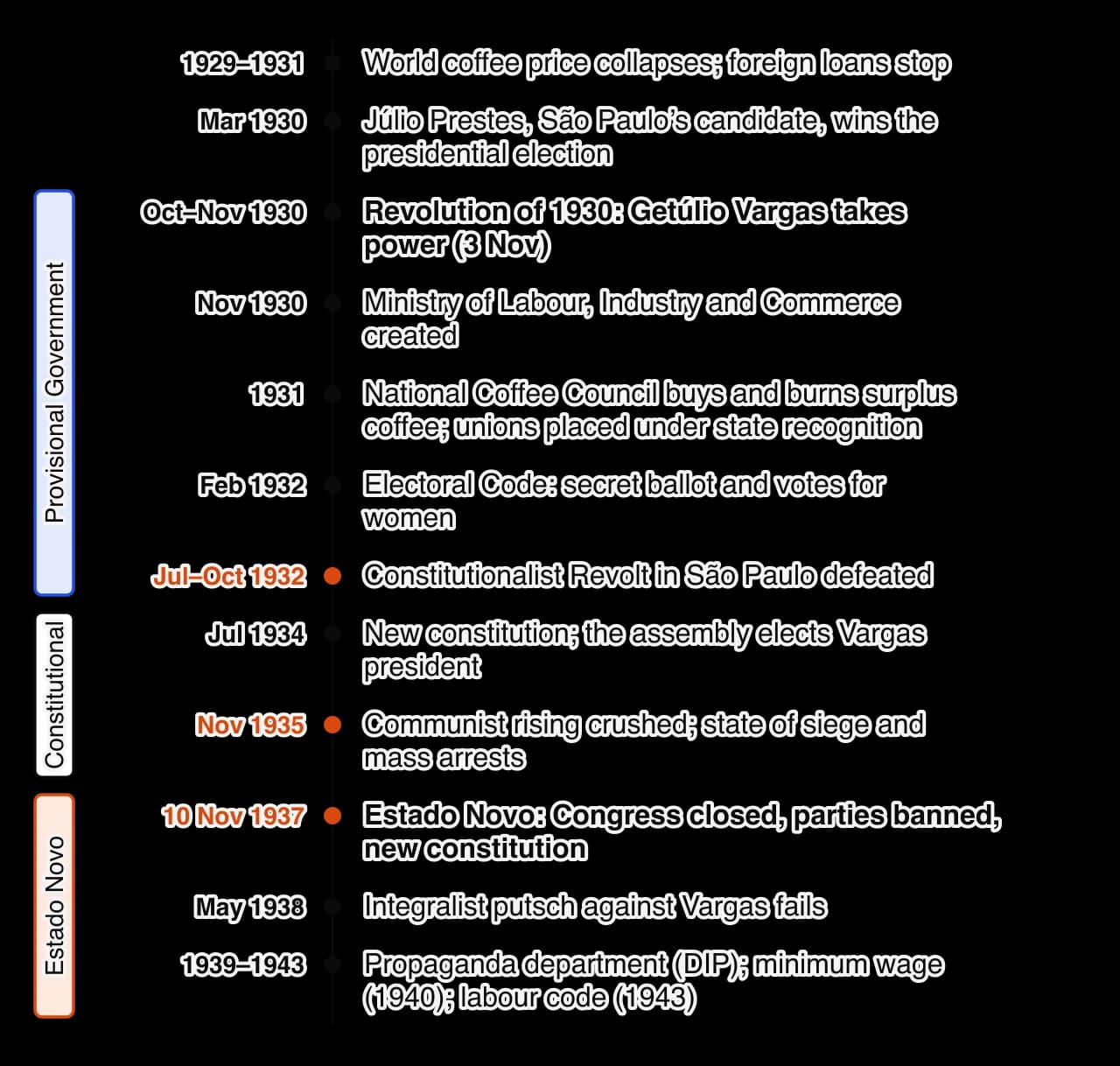
The Depression destroyed this system. The world price of coffee fell by about two-thirds between 1929 and 1931, foreign lending stopped and the coffee support scheme collapsed. In the presidential election of March 1930 the outgoing president, Washington Luís, broke the café com leite pact by backing another Paulista, Júlio Prestes, instead of a candidate from Minas Gerais. Minas joined Rio Grande do Sul and Paraíba in the Liberal Alliance, whose candidate was Getúlio Vargas, governor of Rio Grande do Sul. Prestes won an election marked, like all elections of the Old Republic, by fraud.
The murder of Vargas’s running mate, João Pessoa, in July 1930 (for personal and local reasons) gave the opposition a martyr. In October 1930 the Liberal Alliance rose in revolt, supported by many of the tenentes ("lieutenants"), junior officers who had rebelled in the 1920s against the corruption of the Old Republic. Senior army commanders deposed Washington Luís on 24 October, and on 3 November 1930 Vargas took office as head of a provisional government.
Political impact: centralisation and instability, 1930–1937
Vargas used the crisis to transfer power from the states to the federal government. He dissolved Congress and the state legislatures and replaced elected state governors with appointed interventores (federal administrators), often tenentes. São Paulo’s elite, which had lost control of the federal government, rose in the Constitutionalist Revolt of July–October 1932, demanding a constitution; federal forces defeated it in three months of fighting, but Vargas agreed to call a constituent assembly.
The Constitution of July 1934 confirmed women’s vote and the secret ballot (both introduced by the Electoral Code of February 1932), created labour courts and gave the federal government more economic powers. The assembly elected Vargas president for a four-year term. Politics then polarised between two mass movements, a pattern seen in Europe at the same time:
Brazilian Integralist Action (AIB, founded in 1932 by the writer Plínio Salgado) was a fascist-style movement with green shirts, a salute and the slogan "God, Fatherland and Family". It claimed hundreds of thousands of members, many from the urban middle class and German and Italian communities.
The National Liberation Alliance (ANL, 1935) was a popular front of Communists, socialists and tenentes, with the Communist former tenente Luís Carlos Prestes as its honorary president. Vargas banned it in July 1935.
In November 1935 Communist-led army units rose in Natal, Recife and Rio de Janeiro. The rising (later called the Intentona Comunista) was crushed within days, and Vargas used it to obtain a state of siege, arrest thousands of suspected leftists, purge the army and create a National Security Tribunal. Many democratic opponents were jailed alongside the Communists.
The Estado Novo, 1937
The 1934 Constitution barred Vargas from standing in the presidential election due in January 1938. In September 1937 the army published the Cohen Plan, a document said to expose a new Communist plot; it was a forgery, written by an Integralist officer. Using the alarm it created, on 10 November 1937 Vargas closed Congress with army support, cancelled the election and announced a new constitution. He called the regime the Estado Novo ("New State").
The Estado Novo was a centralised, authoritarian state. Political parties were banned, including the Integralists, whose attempted putsch against the presidential palace in May 1938 failed. The president governed by decree-law, the press was censored, and from December 1939 the Department of Press and Propaganda (DIP) controlled newspapers, radio and film and built a cult of Vargas. Federal power over the states was symbolised by the public burning of the state flags in November 1937. The regime borrowed ideas from Salazar’s Portugal and Mussolini’s Italy, but it had no mass party and Vargas joined the Allies in 1942.
Art. 136 – Work is a social duty. Intellectual, technical and manual work has the right to the special protection and care of the State. … Art. 139 – … Strikes and lock-outs are declared anti-social resources, harmful to labour and capital and incompatible with the higher interests of national production.
Constitution of the United States of Brazil, 10 November 1937, Articles 136 and 139 (own translation from the Portuguese text on the Brazilian Presidency’s legislation site). The constitution was drafted by the jurist Francisco Campos and imposed by decree, not debated by any elected body. The two articles show the bargain the Estado Novo offered workers: protection by the state in return for giving up independent action. Article 140 went on to organise the economy into corporations under state supervision.
Labour rights and social programmes
Vargas’s most lasting policy was a system of labour law that brought urban workers into national life under state control. In November 1930 he created the Ministry of Labour, Industry and Commerce. A decree of March 1931 allowed one officially recognised union for each trade in each area, approved by the Ministry; unrecognised unions lost the right to represent workers. Over the following decade the government introduced the eight-hour day in commerce and industry (1932), the work card (carteira de trabalho, 1932), holidays with pay, rules on the work of women and children, social security institutes for different occupations, labour courts and a minimum wage (law of 1936, applied from 1940). In 1943 these laws were brought together in the Consolidation of Labour Laws (CLT).
The benefits were real for those who received them, and Vargas’s propaganda presented him as the "father of the poor" (pai dos pobres). But the system covered only urban workers in the formal economy. Rural workers, the majority of the population, gained almost nothing, because Vargas needed the support of landowners. Independent and Communist union leaders were imprisoned, strikes were banned, and union officials depended on the Ministry. Historians debate whether workers were simply manipulated or whether they used the laws to press their own claims; the labour courts handled large numbers of complaints from workers who knew their new rights.
Economic solutions: coffee, ISI and nationalisation
Saving coffee
Vargas could not abandon coffee, which still provided most of Brazil’s foreign earnings. The federal government took over the support of coffee prices through the National Coffee Council (1931) and the National Coffee Department (1933), buying surplus coffee with money raised by a tax on coffee exports and by printing money. Between 1931 and 1944 it destroyed about 78 million bags of coffee, burning it or dumping it at sea, roughly two or three years of world consumption. By maintaining planters’ incomes, these purchases kept money flowing in the economy, which the economist Celso Furtado later described as an unintended policy of supporting demand.
Industrialisation by substitution
The collapse of exports cut Brazil’s ability to pay for imports, and the devalued currency made imported goods expensive. Domestic industry, especially textiles, food processing, cement, paper and simple metal goods, grew quickly to fill the gap, using spare capacity built up in the 1920s. Industrial output grew much faster than agriculture through the 1930s, and industry recovered its 1929 level by about 1933. The government added exchange controls, tariffs and, from 1937, a full suspension of payments on the foreign debt, which freed foreign currency for imports of machinery.
Under the Estado Novo the state moved from protecting industry to directing it. The 1937 Constitution reserved mines and waterfalls to Brazilians; the National Petroleum Council (1938) took control of the oil sector; and Vargas bargained with both Germany and the USA for help to build a national steel industry. In 1940 the USA agreed to lend the money, and the National Steel Company (CSN) was founded in 1941 to build the Volta Redonda steelworks (opened in 1946). The mining company Vale do Rio Doce followed in 1942. Brazilian nationalism also took a cultural form: the regime promoted brasilidade ("Brazilianness"), restricted immigration from 1934 and forced German, Italian and Japanese communities to use Portuguese in schools and newspapers.
Agrarian policy
Agrarian reform was the weakest area of Vargas’s solutions. He did not redistribute land, because the large landowners of the states were essential allies, and rural labour was left outside the labour laws. The Estado Novo’s "March to the West" (from 1938) aimed to settle the interior through colonisation projects, but its results were small before the 1940s.
How effective were Vargas’s solutions?
Area | Achievements, 1930–1939 | Limits and costs |
|---|---|---|
Economy | Fast recovery compared with most of the region; industrial growth; state planning and the steel project; coffee incomes maintained | Coffee burning wasted resources; growth depended on protection; capital goods still imported; inflation from the coffee programme |
Labour and welfare | Ministry of Labour; eight-hour day, paid holidays, social security institutes, minimum wage, labour courts | Only urban formal workers covered; unions controlled by the state; strikes banned; Communist and independent leaders jailed |
Agrarian reform | Colonisation schemes in the interior | No land redistribution; rural workers excluded; landowners’ power left intact |
Politics | Ended the power of the coffee oligarchy; built a strong national state | Dictatorship from 1937: Congress closed, parties banned, censorship, political prisoners |
Thomas Skidmore, in Politics in Brazil, 1930–1964 (1967), sees Vargas as a skilled pragmatist who balanced competing groups and used the crisis to modernise the state. Robert Levine, in Father of the Poor? Vargas and His Era (1998), stresses the gap between his image as a protector of workers and a reality in which most poor Brazilians, in the countryside, gained little and the regime used repression freely. Vargas’s later career as an elected populist president (1951–1954) is part of the study of political developments in Latin America from 1934.
Mexico: the Depression and Cárdenas’s solutions
The Depression reached Mexico during the Maximato (1928–1934), when the former president Plutarco Elías Calles, the "Jefe Máximo", controlled three short-lived presidents from behind the scenes. Mining and oil, the main exports, collapsed: the real value of Mexico’s exports fell by about three-quarters between 1928 and 1932. But exports were a smaller share of Mexico’s economy than of Chile’s or Argentina’s, and most Mexicans still lived from farming for local markets, so the fall in total output was less severe.
Impact and early responses, 1929–1934
The government first followed orthodox policy. A monetary law of July 1931 took gold coins out of circulation in an attempt to defend the currency, which deepened the deflation. In 1932 the new finance minister, Alberto Pani, reversed course, expanding the money supply and government spending; recovery followed, and Mexico’s output regained its 1929 level by the mid-1930s, earlier than in most of the region. In 1934 the government created Nacional Financiera, a state development bank to finance industry.
The Depression also sent hundreds of thousands of people back to Mexico. As jobs disappeared in the USA, local, state and federal authorities organised "repatriation" campaigns, sometimes voluntary, often under pressure or by deportation, of Mexicans and Mexican Americans. Estimates of the numbers who left between 1929 and 1936 range from about 400,000 to about 1 million; Francisco Balderrama and Raymond Rodríguez, in Decade of Betrayal (1995), argue that many of them were US citizens, many of them children. Mexico had to absorb them at the worst point of the slump.
Cárdenas’s solutions, 1934–1940
Lázaro Cárdenas, president from 1934 to 1940, used the radical promises of the Constitution of 1917 to respond to the social crisis. His presidency is studied in full as the culmination of the Mexican Revolution; here his policies are assessed as solutions to the Depression.
Agrarian reform. His government distributed about 18 million hectares of land to about 800,000 recipients, mostly as ejidos (village lands held in common), including collective ejidos on the commercial cotton estates of La Laguna (1936). A new ejidal bank lent to the new farmers. Land reform gave rural Mexicans security and loyalty to the state, but credit was short and output on some collective farms fell.
Nationalisation. The railways were nationalised in June 1937. On 18 March 1938, after foreign oil companies refused to obey a labour award upheld by the Supreme Court, Cárdenas announced the expropriation of the foreign oil industry; the state company Petróleos Mexicanos (PEMEX) was created on 7 June 1938. The USA, under the Good Neighbor Policy, did not intervene.
Labour rights and social programmes. Cárdenas allowed strikes, sided with workers in many disputes and backed the new labour federation, the Confederation of Mexican Workers (CTM, February 1936). He built thousands of rural schools and expanded health and Indigenous affairs programmes.
Import substitution. Protection, state credit and the rise of a domestic market encouraged industry, but large-scale ISI in Mexico came mainly after 1940 under his successors, helped by the demand of the Second World War.
As solutions, Cárdenas’s reforms did more to tackle the social effects of the Depression than to promote growth. Inflation, capital flight and the oil boycott slowed the economy in 1938–1939. Their long-term effect was political: they strengthened a state that organised workers and peasants inside the ruling party and gave it the means, through PEMEX and the development bank, to direct industrialisation after 1940.
Argentina: the Infamous Decade, 1930–1943
Argentina in 1929 was the richest country in Latin America, a major exporter of beef, wheat, maize and wool, mostly to Britain. Since 1916 it had been governed by the Radical Civic Union (UCR), the party of the middle classes, under presidents elected by universal male suffrage. The Depression ended this democratic period.
Political impact: the coup of 1930
Export prices fell sharply in 1929–1930, government revenue collapsed, and the elderly Radical president Hipólito Yrigoyen, re-elected in 1928, seemed unable to act. On 6 September 1930 General José Félix Uriburu led a military coup that overthrew him with little resistance. It was the first successful military coup in Argentina since the constitution of 1853, and it began a long period in which the army intervened in politics.
Uriburu wanted to replace parliamentary democracy with a corporatist state, but most officers and conservatives preferred to restore the old elite’s rule through controlled elections. In the elections of November 1931 the government vetoed the Radical candidate, the party abstained, and General Agustín P. Justo won the presidency for the Concordancia, a coalition of conservatives, anti-Yrigoyen Radicals and independent socialists. Justo (1932–1938), Roberto Ortiz (1938–1940) and Ramón Castillo (1940–1943) governed through what their own supporters called patriotic fraud: ballot-stuffing, intimidation and the falsification of results, justified as necessary to keep "irresponsible" Radicals out of power. Ortiz tried to end the fraud but fell ill and handed power to Castillo, who restored it.
Economic solutions
The Concordancia governments used state intervention to defend Argentina’s export economy and its ties to Britain, while laying the ground, often unintentionally, for industrialisation.
Exchange controls (from October 1931) rationed foreign currency, favouring imports from countries that bought Argentine goods.
The Roca–Runciman Pact (1 May 1933), negotiated by Vice-President Julio A. Roca and the British trade minister Walter Runciman, guaranteed Argentina a quota of the British market for chilled beef at about its 1932 level. In return Argentina cut tariffs on British goods, promised favourable treatment for British companies and allowed most meat exports to pass through British- and US-owned meat-packing plants.
Marketing boards for grain and meat (1933) bought produce at minimum prices.
The Central Bank (1935), planned by the young economist Raúl Prebisch, managed credit and the currency; a national road programme created jobs.
Industry grew behind the protection of exchange controls and devaluation, especially textiles, food processing and light manufacturing, and drew internal migrants from the countryside to Buenos Aires.
Argentina recovered relatively quickly, and by the late 1930s output was above its 1929 level. Politically the decade left deep resentments. Nationalists attacked the Roca–Runciman Pact as a surrender to British imperialism; in 1935 the senator Lisandro de la Torre exposed tax evasion by the foreign meat-packers, and during the Senate debate his colleague Enzo Bordabehere was shot dead. The fraud discredited the parties, while the new industrial workers of Buenos Aires had no political home. When officers seized power again on 4 June 1943, one of them, Colonel Juan Perón, would build a movement on exactly these workers, as the study of political developments in Latin America from 1934 explains.
Chile: the hardest-hit economy
Chile depended on exports of copper and nitrates, which provided a large share of government revenue. Nitrate exports had already been declining because of synthetic fertilisers made in Germany; the Depression completed the collapse, and copper prices fell too. Foreign loans, which had financed the public works of the dictator Carlos Ibáñez (1927–1931), stopped.
The political consequences were rapid. Strikes and student protests forced Ibáñez to resign in July 1931. In June 1932 a group of officers led by the air force commander Marmaduke Grove declared a Socialist Republic, which lasted only about twelve days before another coup. Order returned with the election of Arturo Alessandri, who governed from December 1932 to 1938. His finance minister, Gustavo Ross, followed orthodox policies, repaid part of the debt and promoted construction, and the economy recovered slowly, while the government repressed strikes and the left.
In 1938 a Popular Front of Radicals, Socialists and Communists won the presidency with Pedro Aguirre Cerda. After an earthquake devastated Chillán in January 1939, his government created the Production Development Corporation (CORFO, April 1939), a state agency that planned and financed industry, energy and infrastructure. CORFO made Chile one of the first Latin American countries to adopt ISI as deliberate state policy.
The social impact of the Depression
The Depression affected people very differently according to class, race, gender, region and age. Professionals with secure jobs and falling prices could live better than before; miners, factory workers, farm tenants and the young unemployed faced hunger and lost homes. The evidence is richest for the USA, which is the main case, with comparisons from Canada, Brazil and other countries.
Demography and the standard of living
At the lowest point, in early 1933, about 13 million Americans were unemployed, and many more worked short hours. Families who lost their income lost their homes when they could not pay rent or mortgages; by 1933 about a thousand home mortgages a day were being foreclosed. Diets worsened, and doctors and social workers reported malnutrition among children in mining regions and big cities. Families coped by taking in lodgers, moving in with relatives, growing food and sending wives and teenage children out to work.
People delayed marriage and children. The US marriage rate fell by about a fifth between 1929 and 1932, and the birth rate fell to the lowest level then recorded. Hundreds of thousands of young people left home to look for work, "riding the rails" on freight trains; a commonly cited estimate puts the number of teenagers among them at about 250,000. Internal migration rose: about 2.5 million people left the Great Plains states during the decade (a commonly cited estimate), and several hundred thousand migrants from Oklahoma, Arkansas, Texas and Missouri, all called "Okies", went west to California, where they found low-paid seasonal farm work and hostility.
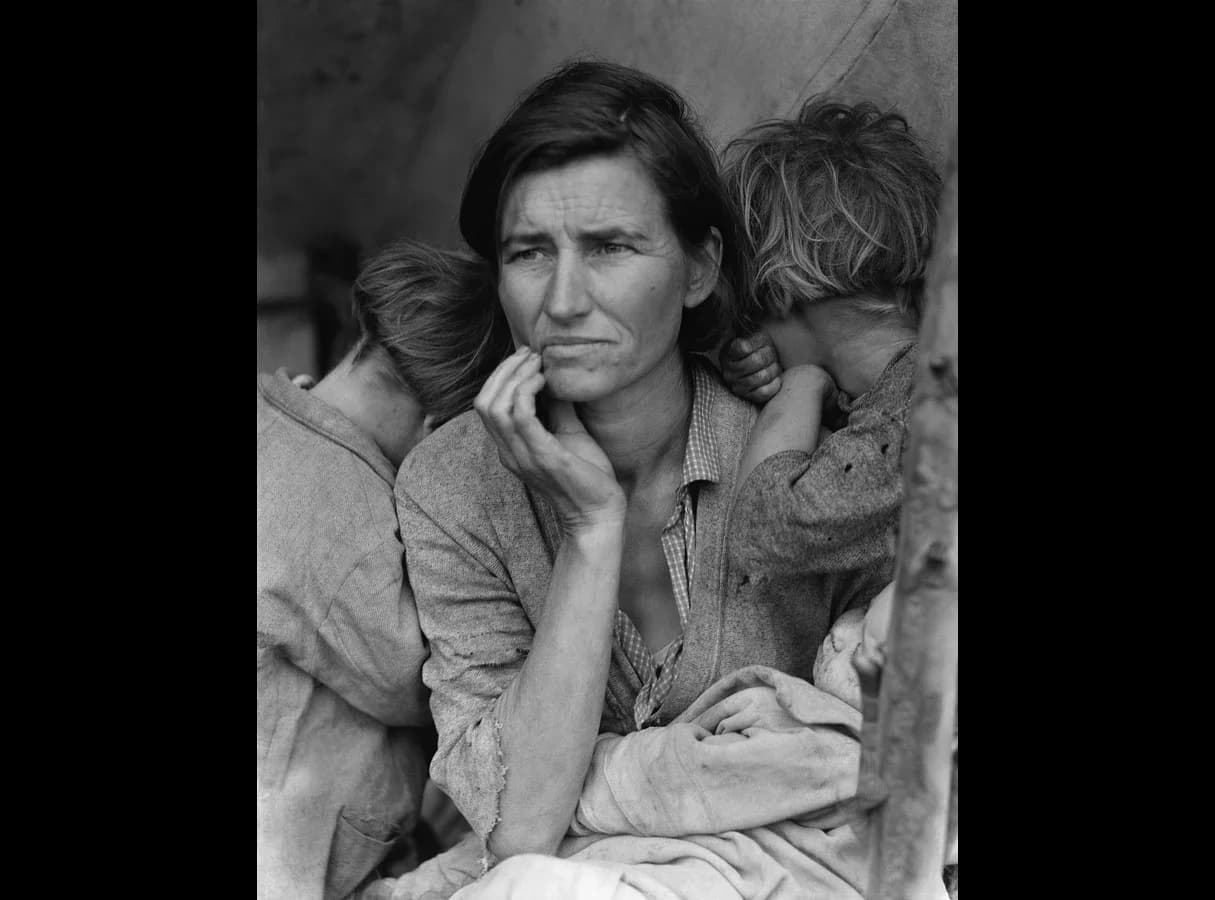
The photograph Migrant Mother became the best-known image of the Depression. Lange made several exposures of the family in a pea-pickers’ camp at Nipomo, and her photographs, published in a San Francisco newspaper, led the government to send food to the camp. As evidence, the image shows real poverty, but it is also a carefully composed piece of advocacy for the Resettlement Administration, whose photographers were asked to document rural suffering in ways that would build support for New Deal programmes. Florence Thompson, who was of Cherokee descent, said later that she received no money from the image and that she felt exploited by it.
In Canada the prairie provinces lost population as families abandoned dried-out farms, and in the cities as much as a fifth of the population depended on relief at times. Cars that owners could no longer afford to fuel were pulled by horses and called "Bennett buggies". In Latin America the impact fell on export workers: nitrate and copper miners in Chile, coffee workers in São Paulo, meat-packers and port workers in Argentina. Many migrated from the countryside to the cities, where the new industries of the 1930s offered work.
The experiences of women
The Depression had contradictory effects on women. Unemployment among men was higher than among women at first, because heavy industry and construction, where men worked, collapsed fastest, while clerical, retail and domestic service work, where women were concentrated, held up better. Many married women went out to work for the first time to keep their families going, and the proportion of married women in paid work rose during the decade.
At the same time there was strong hostility to women, and above all married women, taking jobs that might go to men. Section 213 of the federal Economy Act of 1932 laid down that when staff were cut, married people whose spouses also worked for the government should be dismissed first; in practice this meant wives. Many school boards and some states refused to employ married women teachers. Public opinion polls showed that a large majority of Americans opposed married women working if their husbands had jobs.
The New Deal both helped and discriminated against women. About a quarter of NRA codes set lower minimum wages for women than for men doing similar work. Relief programmes were designed for male breadwinners: the CCC took only men, and the WPA employed women mainly in sewing rooms and domestic projects, with a limit of one WPA job per family. Social Security left out domestic workers, many of them women, and Black women above all. But the New Deal also brought women into government at a new level. Frances Perkins, Secretary of Labor from 1933 to 1945, was the first woman in a US cabinet and played a central part in drafting Social Security. Eleanor Roosevelt travelled the country, wrote a daily newspaper column and pressed her husband on behalf of women, the poor and African Americans.
In Canada, relief went to male heads of household, and single women were often refused it or offered domestic service instead; women were excluded from the relief camps. In Brazil, women won the vote in the Electoral Code of 1932, after a long campaign led by the scientist Bertha Lutz, and Vargas’s labour laws included rules on women’s work, though most women workers, in agriculture and domestic service, fell outside them.
The experiences of marginalised groups
African Americans
African Americans were, in a phrase of the time, "last hired, first fired". In 1932 about half of Black workers in many northern cities were unemployed, and in the South white workers pushed Black workers out of jobs they had held for years. The AAA’s crop reduction payments went to landowners, who evicted Black (and white) sharecroppers and tenants; in response the interracial Southern Tenant Farmers’ Union was founded in Arkansas in July 1934. Racial violence continued: in the Scottsboro case (1931), nine Black teenagers were falsely accused of rape in Alabama, and eight of them were sentenced to death by all-white juries, a case that became a national and international cause.
New Deal programmes were often run by local officials who discriminated, and Southern Democrats in Congress made sure that Social Security and the Fair Labor Standards Act excluded agricultural and domestic workers; a commonly cited estimate is that this left out about two-thirds of Black workers. Roosevelt refused to support a federal anti-lynching bill, fearing to lose Southern votes. Yet Black Americans also gained: the WPA and CCC employed hundreds of thousands, Harold Ickes and Harry Hopkins banned discrimination in some programmes, and an informal "Black Cabinet" of advisers, including Mary McLeod Bethune of the National Youth Administration, gave African Americans a voice in Washington for the first time. In 1936 most Black voters in the North voted Democratic, a lasting change.
Mexican Americans, Asian Americans and Native Americans
Mexican Americans and Mexican immigrants faced the repatriation campaigns of 1929–1936, and the Okie migration to California pushed Mexican farm workers out of jobs. Filipino workers on the West Coast faced riots and, under a law of 1935, were offered free passage home on condition that they did not return. For Native Americans the Indian Reorganization Act of June 1934, promoted by the Commissioner of Indian Affairs John Collier, ended the policy of dividing reservations into individual plots (allotment), restored some land to tribal control and encouraged tribal self-government, although its constitutions were often drafted by officials and did not suit every nation.
Canada and Latin America
In Canada, immigrants on relief risked deportation, and Communists and other radicals were deported after arrest. In Vancouver and other cities, Chinese Canadians received lower relief payments than white Canadians. First Nations people on reserves depended on federal Indian agents, whose relief payments were very low. In Latin America, Indigenous and rural workers, the poorest groups, were largely untouched by the new labour laws of Brazil and Argentina; in El Salvador the 1932 rising of mostly Indigenous peasants was followed by a massacre of thousands.
The impact on culture and the arts
The Depression produced some of the most important American art, writing and photography of the century, much of it paid for by the government. In 1935 the WPA set up Federal Project Number One, which employed artists, writers, actors and musicians:
The Federal Art Project employed thousands of artists to paint murals for public buildings, teach art classes and record American design. (Most murals in post offices were commissioned by a separate Treasury programme, the Section of Fine Arts.)
The Federal Writers’ Project produced guidebooks to every state and collected more than 2,300 life histories of formerly enslaved people (1936–1938), now one of the main sources for the history of slavery.
The Federal Theatre Project, led by Hallie Flanagan, staged plays for millions, many of them seeing live theatre for the first time, until Congress closed it in 1939 amid accusations of communist influence.
The Federal Music Project funded orchestras, concerts and the collection of folk music.
Photographers of the Resettlement Administration and the Farm Security Administration, including Dorothea Lange, Walker Evans and Arthur Rothstein, recorded rural poverty. Novelists and songwriters told the story of the dispossessed: John Steinbeck’s The Grapes of Wrath (1939), about an Okie family travelling to California, and Woody Guthrie’s Dust Bowl Ballads (1940). This "documentary" mood in the arts reflected a new interest in ordinary Americans and in social criticism.
Popular culture often offered escape. Weekly cinema attendance stayed high throughout the decade; Hollywood produced musicals, gangster films, screwball comedies and the films of the child star Shirley Temple, alongside social films such as Charlie Chaplin’s Modern Times (1936). Radio became the main medium of the decade, carrying swing music, comedy, soap operas, Roosevelt’s fireside chats and, in October 1938, Orson Welles’s broadcast of The War of the Worlds, which alarmed some listeners who took it for news.
In Canada the Canadian Broadcasting Corporation (1936) and the National Film Board (1939) gave the state a role in national culture. In Brazil, the Vargas regime used culture to build national identity: it promoted samba and carnival as national symbols, used the radio programme Hora do Brasil to broadcast government news, and supported painters such as Cândido Portinari, whose painting Café (1935) showed coffee workers at the centre of Brazilian life. In Mexico the muralist José Clemente Orozco painted his murals in Guadalajara (1936–1939), ending with the cycle in the Hospicio Cabañas, under Cárdenas.
Comparing responses across the Americas
Every government in the Americas faced the same collapse of prices, trade and credit, but they responded within very different political systems. The comparison table brings together the main cases.
USA | Canada | Brazil | Mexico | Argentina | |
|---|---|---|---|---|---|
Political system in the 1930s | Democracy; power shifts to the president | Democracy; federal powers limited by the courts | Provisional government, then dictatorship (1937) | One-party state led by a reforming president | Conservative rule through fraud after a coup |
Main economic tools | Bank rescue, leaving gold, public works, farm price support | Tariffs, imperial preference, relief grants, central bank | Coffee purchases, debt default, exchange controls, state industry | Monetary expansion, land reform, nationalisation | Exchange controls, marketing boards, Roca–Runciman, central bank |
Labour and social policy | Wagner Act, Social Security, minimum wage | Little before 1940; unemployment insurance in 1940 | State-recognised unions, labour courts, minimum wage | Support for CTM unions and strikes; rural schools | Little; unions weak until the 1940s |
Recovery by 1939 | Partial; unemployment about 17 per cent | Partial; unemployment about 11 per cent | Relatively strong industrial growth | Early recovery; slowdown in 1938–1939 | Relatively strong; output above 1929 |
Lasting legacy | Federal welfare state; New Deal coalition | Bank of Canada, CCF, path to welfare state | Corporatist labour system; state-led industry | PEMEX, ejidos, corporatist party |
Several patterns stand out. Countries that broke early with orthodox policy, by leaving the gold standard, defaulting on debts or expanding credit, generally recovered sooner than those that held on. Democracies (the USA and Canada) expanded the state through elected governments but were slowed by courts and federal constitutions; in Latin America the expansion of the state often came with authoritarian rule. And in every case the Depression shifted responsibility for welfare and employment towards national governments, a change that lasted long after 1939.
Perspectives and debates
What caused the Great Depression?
Historian or economist (work, year) | Argument | Evidence stressed |
|---|---|---|
John Kenneth Galbraith, The Great Crash, 1929 (1955) | Speculation and a fragile, unequal economy turned the crash into a depression | Margin buying, investment trusts, income inequality, weak banks |
Milton Friedman and Anna Schwartz, A Monetary History of the United States (1963) | The Federal Reserve turned a recession into the "Great Contraction" by letting the money supply collapse | Bank failures of 1930–1933; fall of about a third in the money supply; the October 1931 rate rise |
Peter Temin, Did Monetary Forces Cause the Great Depression? (1976) | A fall in spending, especially consumption, caused the slump; monetary factors followed | Fall in consumer spending in 1930 before the bank panics |
Charles Kindleberger, The World in Depression, 1929–1939 (1973) | The world economy lacked a leader: Britain could no longer stabilise it and the USA would not | Collapse of US lending; tariffs; no lender of last resort for the world |
Barry Eichengreen, Golden Fetters (1992) | The gold standard spread the Depression and prevented recovery | Countries that left gold earlier recovered earlier |
These explanations are often combined. Most economic historians today accept that the monetary contraction and the gold standard explain the depth and spread of the Depression, while the weaknesses of the 1920s and the crash explain why the downturn began.
How should the New Deal be judged?
William Leuchtenburg, in Franklin D. Roosevelt and the New Deal (1963), argues that the New Deal was a limited but real revolution in the role of government, which made the federal state responsible for the welfare of its citizens while leaving capitalism intact. New Left historians of the 1960s, notably Barton Bernstein in "The New Deal: The Conservative Achievements of Liberal Reform" (1968), argue that it saved capitalism and helped organised groups while doing little for the poorest, Black Americans and the unorganised. Anthony Badger, in The New Deal: The Depression Years, 1933–1940 (1989), explains its limits by the obstacles it faced: federalism, Congress, the courts and local elites.
David Kennedy, in Freedom from Fear (1999), argues that the New Deal’s real aim and achievement was economic security (insured deposits, pensions, union rights, farm price supports) more than recovery. Ira Katznelson, in Fear Itself (2013), stresses that the votes of Southern Democrats shaped the New Deal and wrote racial exclusions into it. From the right, Amity Shlaes (The Forgotten Man, 2007) and the economists Cole and Ohanian argue that New Deal policies prolonged the Depression; most economic historians reject the strong form of this claim but accept that some NRA policies slowed recovery.
Was the Depression an opportunity for Latin America?
Dependency theorists such as Andre Gunder Frank argued in the 1960s that crises in the core economies weakened Latin America’s ties to them and allowed real development, so the 1930s were a period of opportunity. Carlos Díaz Alejandro, in an essay in Rosemary Thorp’s collection Latin America in the 1930s (1984), showed that "active" governments recovered faster than "passive" ones, so policy choices mattered. Victor Bulmer-Thomas, in The Economic History of Latin America since Independence (1994), argues that industrialisation had begun before 1929 and that the 1930s accelerated it more than they began it; the larger countries with an existing industrial base benefited most, while small export economies stayed dependent.
Weighing these views shows that the answer depends on the country and the measure. Brazil and Argentina gained industry and a more active state; Chile and Cuba suffered a collapse from which recovery was slow; and the political price, in coups and dictatorship, was high nearly everywhere.
Applying the ideas in exam questions
This study ranges over many countries. Questions on the political impact or the solutions in "one country" exclude the USA if they say so, and questions on Latin America need a Latin American country. An answer that surveys several countries when one is asked for, or that strays outside 1920–1939, loses focus.
Paper 3: the causes of the Depression
Paper 3: the New Deal
Paper 3: political impact in one country
Paper 3: solutions in Canada
Paper 3: social impact
Self-check
- To do:
I can explain the strengths and weaknesses of the US economy in the 1920s and the dependence of Canada and Latin America on exports.
- To do:
I can explain the political, economic (banking and trade), agricultural and environmental causes of the Depression and the role of the Wall Street Crash.
- To do:
I can weigh the causes of the Depression and outline the views of Galbraith, Friedman and Schwartz, Kindleberger, Temin and Eichengreen.
- To do:
I can describe and assess Hoover’s response to the Depression.
- To do:
I can explain the main measures of the First and Second New Deal and the changes after 1937.
- To do:
I can analyse the impact of the Depression on US party politics, executive power, labour rights and social policy.
- To do:
I can explain the opposition to the New Deal from the right, the left and the Supreme Court, and its effects.
- To do:
I can judge how far the New Deal achieved relief, recovery and reform, using evidence and historians’ views.
- To do:
I can explain the political impact of the Depression in Canada, including new parties, and compare the responses of King and Bennett.
- To do:
I can explain why governments fell across Latin America in 1930–1933 and what import substitution industrialisation was.
- To do:
I can analyse the political impact of the Depression in Brazil and assess Vargas’s solutions, including labour laws, ISI, nationalisation and the absence of agrarian reform.