Explain how historians describe and judge continuity and change (pace, extent, direction, scope, turning points and periods), with Russia from 1914 to 1924 as a case study.
Each is in the History glossary, with every other term in the subject.
A group of French historians, named after the journal Annales founded in 1929, who studied long-term social, economic and geographical structures more than political events.
A system of government in which one person holds supreme power without legal limits, as the Russian tsar did.
A member of the Marxist party led by Vladimir Lenin, which seized power in Russia in October (November) 1917 and later took the name Communist Party.
A difference between the way things were at one point in time and the way they were at a later point.
The Soviet political police founded in December 1917 to fight "counter-revolution"; it carried out the Red Terror and was later renamed and reorganised several times.
The forced merging of private peasant farms into large collective farms controlled by the state, carried out in the USSR from 1929.
The assembly elected in Russia in November 1917 to decide the country's constitution; the Bolsheviks, who were a minority in it, dissolved it after one day in January 1918.
Whatever persisted over a period of time: institutions, beliefs, practices and conditions that stayed the same or changed very little.
Continuity and change is the study of what changed over time, what stayed the same, and how far, how fast and for whom things changed. It turns a sequence of events into an argument about the past, such as whether the First World War transformed the lives of women or whether Indian independence in 1947 was a complete break with British rule.
With a free account, Augment remembers where you stopped and what you have practiced.
The name, meaning "broken" or "oppressed", used by people formerly called "untouchables" in the Indian caste system.
Lenin's decree of 8 November 1917 (26 October in the old calendar) that abolished landlords' ownership of land without compensation and placed estates at the disposal of peasant committees and soviets.
The elected Russian parliament created after the revolution of 1905, which had only limited power over the tsar's government.
The reform of 1861 that freed the serfs of the Russian Empire from personal bondage to their lords, while making them pay for their land through redemption payments.
How deep a change went, from superficial or limited to fundamental.
A national plan setting production targets for five years. Stalin's first Five-Year Plan began in 1928; India adopted its own Five-Year Plans from 1951.
A change in laws, institutions, official policies or rulers.
The British law of 1832 that redistributed parliamentary seats towards growing towns and gave the vote to more middle-class men, raising the electorate of England and Wales to about 650,000.
The elite administrative service of British India; after independence it continued as the Indian Administrative Service.
The change from hand production to machine production in factories, powered by water and then steam, that began in Britain around 1760 and spread to other countries in the nineteenth century.
An identity document that citizens needed in order to live and move within their own country. Used by the tsars, abolished after 1917 and reintroduced by Stalin in December 1932.
A change in people's everyday experience, such as their work, income, rights in practice and family life. It can lag far behind formal change.
French for "long duration": the slow, almost unchanging structures of geography, climate and everyday life that the historian Fernand Braudel argued shaped events.
A rule that women had to leave certain jobs, such as teaching or the civil service, when they married. In Britain marriage bars lasted in many professions until the 1940s.
The Russian peasant commune, which held village land in common and periodically redistributed strips among households.
Continued economic or political control by a former colonial power, or another powerful state, over a formally independent country; the term was popularised by Kwame Nkrumah in 1965.
The policy introduced by Lenin in March 1921 that ended grain requisitioning and allowed peasants and small traders to sell goods privately, while the state kept large industry.
The secret political police of the Russian Empire from 1881 to 1917.
How quickly a change happened, from sudden to gradual.
A form of rule in which the ruler treats the country and its people as his own property; Richard Pipes used it to describe tsarist and Soviet government.
The division of the past into named periods. Every periodisation is an interpretation, because it claims that the boundaries mark real changes.
The council of workers' and soldiers' deputies formed in Petrograd in March 1917, which shared power with the Provisional Government; a soviet is an elected council.
Change judged to be an improvement by some standard. A claim of progress needs the standard and the people for whom it was progress to be named.
The government formed from Duma leaders that ruled Russia after the abdication of Nicholas II in March 1917, until the Bolsheviks overthrew it in November 1917.
A system of compulsory grain quotas imposed on the peasants, first introduced by the tsarist government in December 1916 and used much more harshly by the Bolsheviks under war communism.
British law that gave the vote to all men over 21 and to women over 30 who met a property qualification.
A British law of 1919 that required employers to restore the pre-war working practices agreed with trade unions, returning many skilled jobs taken by women during the First World War to men.
The section of the Civil Rights Act of 1964 that banned discrimination in employment on the basis of race, colour, religion, national origin and sex.
A moment after which the direction or pace of change shifted significantly. Calling an event a turning point is a claim that has to be tested against what happened before and after it.
The practice of excluding people from the lowest-ranked groups in the caste system from contact with others; abolished by Article 17 of the Indian Constitution of 1950.
The US law of 1965 that suspended literacy tests and allowed federal examiners to register voters in southern states that had excluded African Americans from voting.
The economic policies of the Bolsheviks during the Civil War of 1918–1921: nationalisation of industry, a ban on private trade and forced requisitioning of grain.
A way of writing history as a story of steady progress towards the present, judging past people by how far they seemed to point towards modern values; criticised by Herbert Butterfield in 1931.
The two always exist together. Even the most dramatic revolution leaves much unchanged: the language people speak, the land they farm, many of the officials who run the state. Even the most stable period contains slow changes that are easy to miss, such as the growth of towns or a shift in the age at which people marry. Historians therefore usually ask how much changed, in what ways, and what stayed the same.
The concept is closely linked to cause and consequence. Explaining a change means finding its causes, and many consequences are changes. The difference is in the question asked. Cause and consequence asks why something happened and what it led to; continuity and change asks what the past looked like at different moments and how to describe the difference between them.
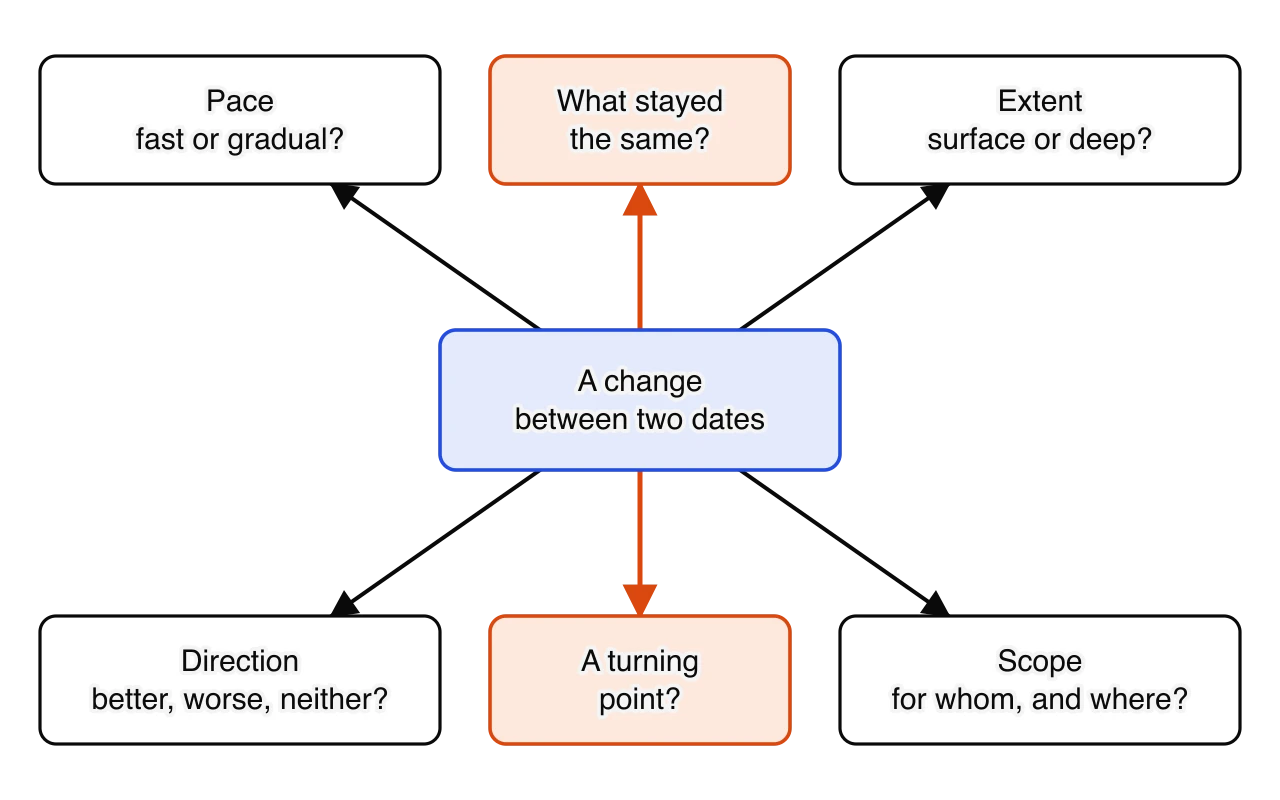
Words such as "transformed", "revolutionised" or "changed completely" are often used without the evidence to support them. Historians describe change more precisely by asking a set of questions about it.
The diagram of the six questions can be applied to any change. The four questions in black describe the change itself; the two in orange place it in context.
Dimension | Question | Terms to use | Example |
|---|---|---|---|
Pace of change | How fast did it happen? | rapid, sudden, gradual, slow, accelerating, uneven | The Bolsheviks nationalised banks and large industry within a year of October 1917, but the peasant commune survived for twelve years |
Extent of change | How deep did it go? | superficial, limited, partial, fundamental, structural | Indian independence in 1947 changed who governed, but much of the law and the civil service stayed the same |
Direction | Did things get better, worse, or neither, and by what measure? | progress, improvement, decline, regression, mixed | Real wages of English labourers rose after the Black Death, while landlords' incomes fell |
Scope | Who and where did it affect? | widespread, localised, for elites, for the majority, urban, rural | British industrialisation transformed Manchester long before it changed most villages |
Continuity | What stayed the same? | persisted, survived, endured, was preserved, was restored | Autocratic, one-man rule in Russia before and after 1917 |
Turning point | Did the direction of change shift here? | turning point, watershed, break, rupture, step in a longer trend | 1945 as a turning point in the decline of European empires |
Pace of change and extent are often confused, but they are independent. A change can be rapid and shallow: in 1868 the Japanese government restored direct imperial rule within a few months, but the new government was run by samurai from a handful of domains, members of the same warrior class that had governed under the Tokugawa shoguns, and the social changes that ended samurai privileges came only over the following decade. A change can also be slow and deep: the spread of literacy in Europe between 1500 and 1900 took four centuries, but it changed how almost everyone received information. Describing both dimensions makes a judgement more exact.
The direction of a change depends on the criterion used to measure it. During the British Industrial Revolution total output and national income rose fast, but historians have long disputed whether the living standards of workers rose before the 1840s. Optimists such as R. M. Hartwell stressed rising real wages and cheaper goods; pessimists such as Eric Hobsbawm and E. P. Thompson stressed long hours, child labour, crowded and unhealthy towns and the loss of independence for handloom weavers and other skilled workers. Later studies of heights and life expectancy, which fell in many industrial towns in the early nineteenth century, suggest that growth in output did not at first bring better health.
The most important question about any change is often "for whom?". The same development can be a gain for one group, a loss for another and no change at all for a third. The emancipation of the serfs in the Russian Empire in 1861 freed about 23 million serfs from personal bondage to their lords, but most had to pay for their land through redemption payments over forty-nine years, and the land they received was often smaller than the plots they had farmed before. For nobles the reform meant compensation; for peasants it meant legal freedom with continued poverty and a new debt to the state.
It is tempting to read the past as a story of steady improvement leading to the present: more freedom, more wealth, more knowledge. Historians call this habit Whig history, after the British historians of the nineteenth century, many of them supporters of the Whig party, who described English history as the gradual growth of parliamentary liberty. In The Whig Interpretation of History (1931), Herbert Butterfield criticised the habit of studying the past with constant reference to the present: picking out the people who seemed to point towards modern values, praising them as progressive and ignoring the rest.
Butterfield's criticism does not mean that nothing ever improved. It means that whether a change was progress has to be shown with evidence, for particular people, by a stated measure. Some changes that look like progress in law brought little change in practice, and some brought new forms of the old conditions.
The Haitian Revolution is a clear example. Slavery in Saint-Domingue was abolished by the French commissioner Léger-Félicité Sonthonax in August 1793, and Haiti became an independent state without slavery in 1804. Yet the constitution that Toussaint Louverture issued in 1801 obliged former slaves, now called cultivators, to keep working on the plantations to sustain the export economy, and later Haitian governments used similar labour codes. For many former slaves, freedom from ownership did not bring freedom to choose their work. (The Haitian Revolution is a focused study of its own.)
Historians divide the past into periods to make it easier to study: the medieval period, the Meiji era (1868–1912), the interwar years, the Cold War. A period is a stretch of time that historians treat as having its own character, marked off by turning points at each end. This division is called periodisation.
Because periods are interpretations, the choice of boundaries shapes the story. A history of Russia from 1917 to 1991 presents the Soviet period as a break with the tsarist past; a history running from 1861 to 1941 invites comparison of tsarist and Soviet modernisation. Names carry judgements too. "The Dark Ages" for early medieval Europe, or "the Age of Discovery" for European voyages from the fifteenth century, describe these periods from the point of view of later Europeans, which is why many historians now avoid them. The dates attached to any field of study, such as "Russia, 1914–1924" or "Kenyan independence, 1945–1978", are periodisations too: each start and end date is a choice about where the important changes lie.
The British historian Eric Hobsbawm divided modern history into periods that did not match calendar centuries. In four books published between 1962 and 1994 he described a "long nineteenth century" running from the French Revolution in 1789 to the First World War in 1914, and a "short twentieth century" from 1914 to the collapse of the Soviet Union in 1991.
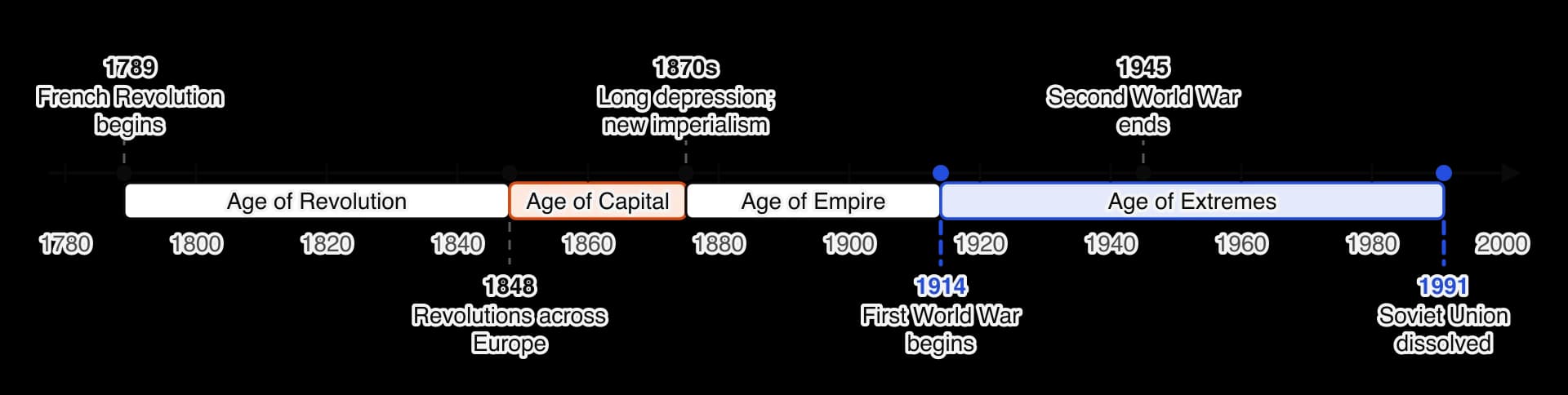
The timeline of Hobsbawm's periods shows how a periodisation makes an argument. By ending the nineteenth century in 1914, Hobsbawm claimed that the world of liberal capitalism and European empire created by the "dual revolution" (the French and Industrial Revolutions) lasted until the First World War destroyed it. Historians of Asia or Africa might choose different boundaries, such as the Opium War of 1839–1842 for China or the decolonisation of the 1950s and 1960s for Africa.
A turning point is a moment after which the direction or pace of change shifts significantly. Calling an event a turning point is a claim that can be tested. A useful test has three parts: what was the direction of change before the event, what was it after, and did the event cause the difference, or did it happen at the same time as a change that was already under way?
Historians sometimes describe an event as a turning point that failed to turn. G. M. Trevelyan described the European revolutions of 1848 as the moment at which modern history reached a turning point and failed to turn, because liberal and nationalist movements across Europe rose and were defeated within two years. The phrase is a reminder that expected changes can fail to happen, and that continuity also needs explaining.
The French historian Fernand Braudel, in La Méditerranée et le monde méditerranéen à l'époque de Philippe II (1949), argued that history moves at three speeds at once: the almost motionless time of geography and climate, which he called the longue durée ("long duration"); the slower rhythms of economies, states and societies over decades; and the fast time of events, such as battles and political crises. Braudel and the Annales school of French historians to which he belonged argued that historians had paid too much attention to events and too little to the slow structures that shaped them.
Braudel's model explains why the same period can look like change or continuity depending on the timescale. Between 1914 and 1924 the government of Russia changed several times; the climate, the length of the growing season and the methods of peasant farming barely changed at all.
Analysing continuity and change means comparing the past at two or more moments on clearly defined criteria. Three methods help make the comparison rigorous.
The first method is to compare the situation before and after a change across the main areas of life: political, economic, social and cultural. Doing this area by area prevents an impression from one area, usually politics, from standing for the whole. Indian independence in 1947 shows how differently the areas can move. The same comparison lies at the heart of any political and economic transition, such as Japan after the Meiji Restoration of 1868 or Russia after the end of Soviet rule in 1991, where the question is how much of the old order survived the new one. (Both transitions are focused studies of their own.)
Area | What changed in 1947–1950 | What continued |
|---|---|---|
Political | Sovereignty passed from Britain to India; the Constitution of 1950 made India a republic with universal adult suffrage | A parliamentary system on the British model; much of the Constitution's structure drew on the Government of India Act of 1935 |
Administrative and legal | Indians replaced British officials at the top of government | The Indian Civil Service continued as the Indian Administrative Service; the Indian Penal Code of 1860 stayed in force until 2024 |
Military | An Indian army under Indian command; Partition divided the forces between India and Pakistan | The regiments, ranks and traditions of the British Indian Army |
Social | The Constitution abolished untouchability (Article 17) and promised equality before the law | Caste discrimination and untouchability persisted in practice, especially in rural India |
Economic | Planned development through Five-Year Plans from 1951 | Widespread rural poverty; most Indians still worked on the land |
The table of Indian independence shows a pattern common to many transfers of power: the most visible change, a new sovereign government, sat on top of strong administrative, legal and social continuities. Indian nationalists themselves were divided about this. Jawaharlal Nehru, the first prime minister, kept the inherited civil service to hold the new state together during the crisis of Partition, while B. R. Ambedkar, who chaired the committee that drafted the Constitution and was himself from a Dalit ("untouchable") family, warned that political equality would mean little without social and economic equality.
The second method separates formal change, a change in laws, institutions or rulers, from lived change, a change in how people actually lived. Laws are easy to date and to find in the sources, so histories often treat them as the moment of change. But a law may not be enforced, may be evaded, or may take decades to change behaviour.
Two laws passed by the US Congress in the 1960s show the difference. Title VII of the Civil Rights Act of 1964 banned discrimination in employment on grounds of sex as well as race. Yet women working full-time all year had median earnings just under 60 per cent of men's in 1964 and still about 60 per cent in 1980; the ratio barely moved for sixteen years. The Voting Rights Act of 1965 had a much faster effect on the lives of the people it was meant to help.
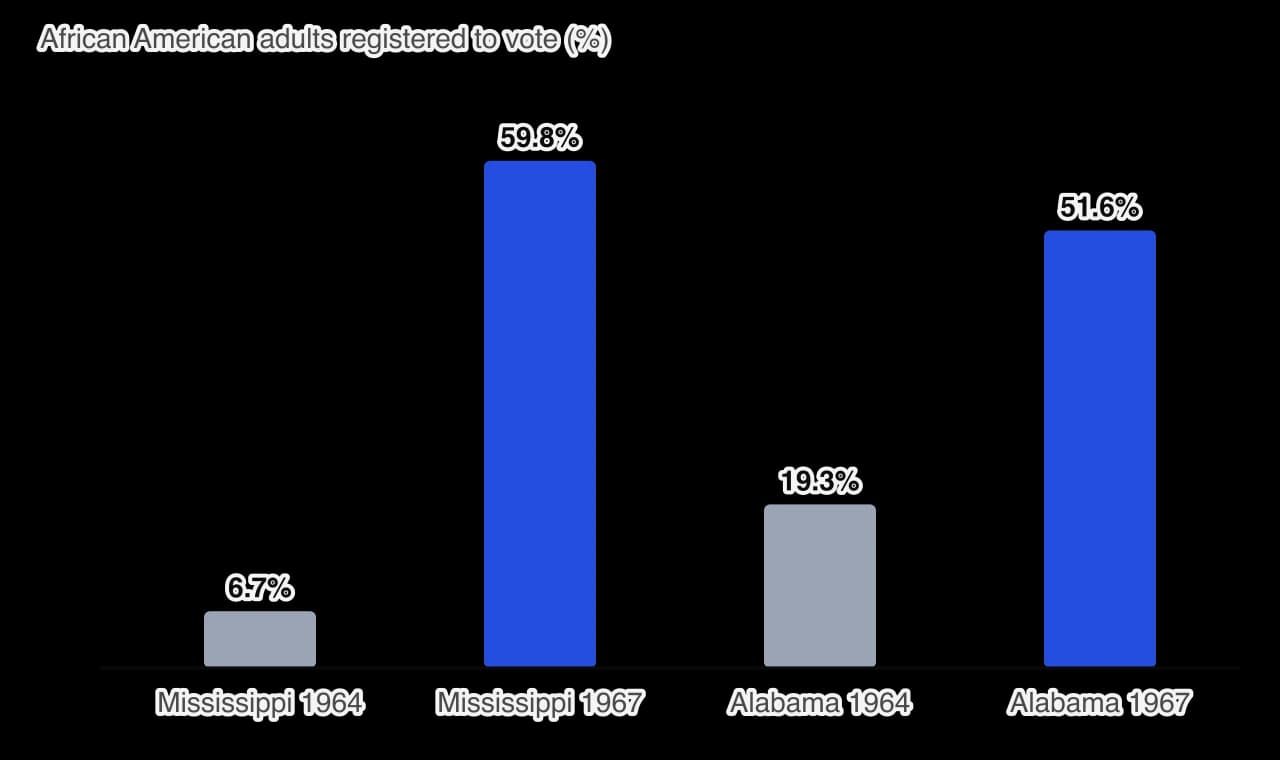
The chart of voter registration shows why the Voting Rights Act changed lives quickly. It suspended the literacy tests that southern registrars had used to exclude Black voters and sent federal officials to register voters directly, so the formal change came with the means to enforce it. Title VII, by contrast, relied at first on a new agency, the Equal Employment Opportunity Commission, which had little power to enforce its rulings and gave sex discrimination a low priority, and pay depended on deep patterns of work, such as the concentration of women in low-paid jobs, that no single law could change. (The movement for women's rights in the United States in these years is a focused study of its own.)
The third method asks how the same change affected different groups and places. The British Representation of the People Act of 1918 gave the vote to about 8.4 million women, but only to women over thirty who met a property qualification, or were married to a man who did; women aged twenty-one to twenty-nine, many of whom had worked in munitions factories during the war, had to wait until the Equal Franchise Act of 1928. The same Act gave the vote to all men over twenty-one. A change described as "women got the vote in 1918" was a change for some women and, in practice, a larger change for working-class men.
 YouTube
Each thematic study raises its own questions about continuity and change. The short examples that follow show the concept at work in each; the thematic studies themselves treat these cases in full.
The First World War brought rapid change in women's work in Britain. The share of working-age women in paid employment (not counting domestic servants) rose from about 24 per cent in 1914 to between about 38 and 47 per cent in 1918, depending on the estimate, and by the end of the war almost a million women worked in munitions. Women also worked as bus conductors, in offices and banks, and on the land, in jobs that had been closed to them.
Much of this change was temporary. The Restoration of Pre-War Practices Act of 1919 returned skilled jobs to men, and many women were dismissed as soldiers came home. Marriage bars in teaching and the civil service kept married women out of many professions until the 1940s. The war changed the pace of change for a few years, but the long-term continuities of low pay and domestic work reasserted themselves; the lasting changes were in politics, through the Representation of the People Act of 1918 and the Sex Disqualification (Removal) Act of 1919, which opened the legal profession and other careers to women.
Between about 1760 and 1850 the British economy changed faster than any economy had before. Cotton spinning moved from homes to water- and steam-powered mills, coal output and iron production rose many times over, and railways spread from the 1830s. By the census of 1851, for the first time, just over half the population of England and Wales lived in towns.
Political power changed far more slowly. The landed aristocracy dominated Parliament and government throughout. The Reform Act of 1832 gave the vote to more of the middle class, but it raised the electorate of England and Wales only to about 650,000, roughly one adult man in five, and most ministers remained landowners until late in the century. Rapid economic change and slow political change existed side by side for decades, which is one reason historians debate whether to call the period a revolution at all.
Stalin's "revolution from above" brought some of the most rapid economic change in history. The first Five-Year Plan began in October 1928, and the collectivisation of agriculture from the winter of 1929–1930 forced more than 90 per cent of peasant households into collective farms by the late 1930s. Millions of peasants moved to the cities and the new industrial towns.
The way Russia was ruled showed strong continuities with the tsarist past. Power was concentrated in one man, the political police were used against opponents, and in December 1932 the regime brought back the internal passport, which the tsars had used to control movement and which the Bolsheviks had abolished as a symbol of oppression. The American historian Richard Pipes argued that Soviet rule continued the "patrimonial" tradition of Russian government, in which the ruler treated the country as his property; other historians reply that the Soviet state's aims and its reach into everyday life were new.
The Supreme Court's ruling in Brown v. Board of Education (1954) that segregated public schools were unconstitutional was a fundamental formal change. Yet in the school year 1963–1964, almost ten years later, only about 1.2 per cent of Black pupils in the eleven states of the former Confederacy attended school with white pupils, because state and local governments used delay, closures and "pupil placement" laws to resist. Real change came only after the Civil Rights Act of 1964 allowed federal funds to be withheld from segregated schools. Indian independence, examined in the table of what changed and what continued after 1947, is a second example from this thematic study.
The Russian revolutions of 1917 promised one of the most complete breaks with the past in modern history. The Bolsheviks, the Marxist party led by Vladimir Lenin that took power in October 1917, promised to abolish private property in land and industry, end the rule of the nobility and the Church, and build the first socialist society. Within ten years Russia had lost its monarchy, its nobility, its landed estates and its parliament, and had become a one-party state. Yet historians have long argued that much of the old Russia survived inside the new one.
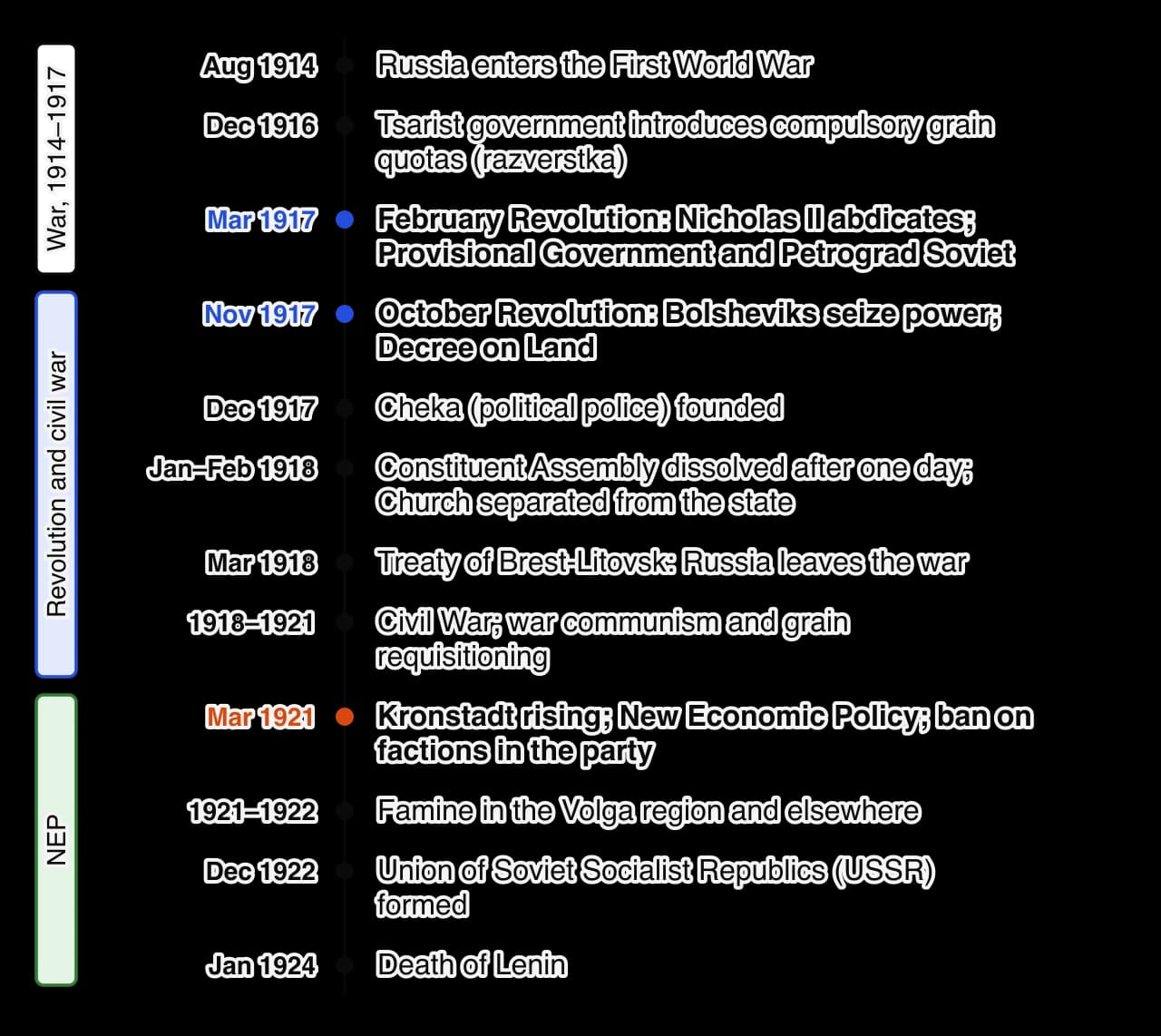
The timeline of Russia from 1914 to 1924 runs from the outbreak of war to the death of Lenin. It includes the war years because many of the changes usually linked to the revolution, and some of the continuities, began during the war, before the tsar fell.
Russia entered the First World War in August 1914 as an autocracy: the tsar, Nicholas II, held supreme power, and the elected parliament created after the revolution of 1905, the Duma, had only limited rights. Defeats, the loss of millions of soldiers killed, wounded or captured, inflation and food shortages in the cities destroyed the regime's authority. In February 1917 (March in the Western calendar) strikes and bread riots in Petrograd, joined by mutinous soldiers, forced Nicholas to abdicate.
Power was then shared, uneasily, between the Provisional Government, formed from leaders of the Duma, and the Petrograd Soviet, a council of workers' and soldiers' deputies. The Provisional Government kept Russia in the war and postponed land reform until a Constituent Assembly could meet. In October 1917 (November in the Western calendar) the Bolsheviks seized power in Petrograd in the name of the soviets.
The changes of the first months of Bolshevik rule were sweeping. On the day after the seizure of power, the Congress of Soviets approved Lenin's Decree on Land.
(1) Landed proprietorship is abolished forthwith without any compensation. (2) The landed estates, as also all crown, monastery, and church lands, with all their livestock, implements, buildings and everything pertaining thereto, shall be placed at the disposal of the volost land committees and the uyezd Soviets of Peasants' Deputies pending the convocation of the Constituent Assembly.
Vladimir Lenin, Decree on Land, approved by the Second All-Russian Congress of Soviets, 26 October (8 November) 1917 (English translation in Lenin's Collected Works, Marxists Internet Archive). The decree recognised a change that was already happening: peasants had been seizing landlords' estates since the summer of 1917. Lenin, whose party had little support in the countryside, adopted the land programme of the rival Socialist Revolutionaries to win peasant backing. The decree therefore shows a revolutionary change in landholding, and also how far the Bolsheviks followed events in 1917 instead of leading them; its promise of land "at the disposal" of peasant committees later sat uneasily with Bolshevik plans for state control of agriculture.
Other changes followed quickly. Banks, foreign trade and, during the Civil War of 1918–1921, almost all industry were nationalised. The legal privileges of the nobility and the old ranks and titles were abolished in November 1917. In January 1918 the Bolsheviks dissolved the elected Constituent Assembly, in which they were a minority, after a single day. A decree separated the Church from the state and schools, and the Church's property was confiscated. A new family code of 1918 made marriage a civil matter and divorce easy, and in 1920 Soviet Russia became the first state to legalise abortion. Russia adopted the Western calendar in February 1918 and a simplified spelling of Russian in the same year. In 1922 the Russian state and the Soviet republics of Ukraine, Belarus and the Transcaucasus formed the Union of Soviet Socialist Republics.
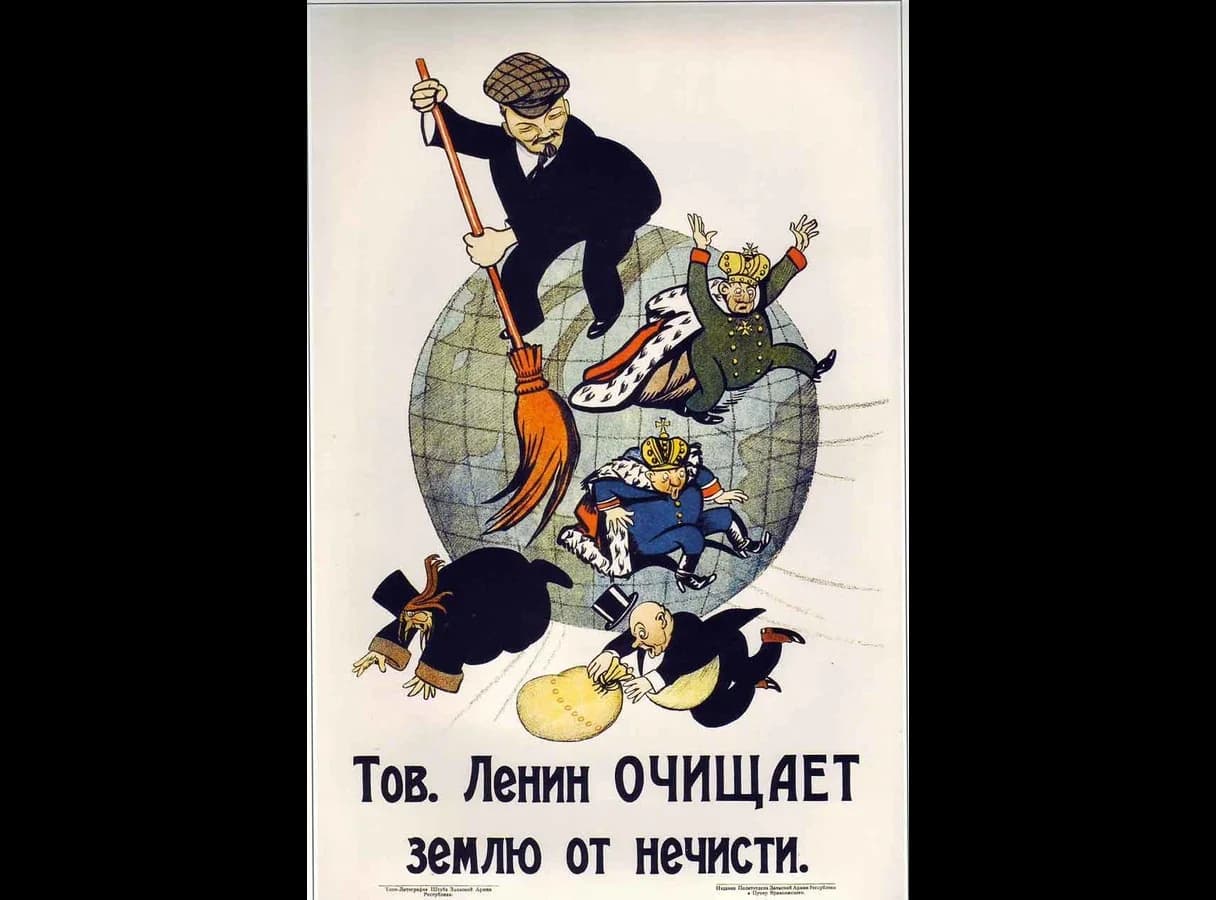
Behind these changes stood important continuities, which historians stress in different degrees.
Concentrated, unaccountable power. The tsar's autocracy was replaced by the rule of one party, which banned other parties by 1921 and, at the Tenth Party Congress in March 1921, banned organised factions inside the party too. Power remained concentrated at the top and free of control by elected bodies or courts.
Political police. The tsarist secret police, the Okhrana, was abolished in 1917, but in December 1917 the Bolsheviks created the Cheka to fight "counter-revolution". It became far more violent than the Okhrana had been: during the Red Terror and the Civil War it executed many thousands of people, with estimates ranging from tens of thousands upwards.
Censorship. The Decree on the Press of October 1917 closed opposition newspapers, at first as a "temporary" measure; censorship, which the tsars had relaxed after 1905, returned in a stricter form.
Officials and officers. To run the state and win the Civil War the Bolsheviks employed tens of thousands of former tsarist officers in the Red Army and many former officials in the ministries, known as "specialists" (spetsy).
Territory. By 1922 the new state had regained most of the territory of the Russian Empire, apart from Finland, the Baltic states, Poland and Bessarabia, and ruled it from Moscow.
Peasant life. In the villages the revolution strengthened the traditional peasant commune, the mir, which redistributed the seized land among households in strips. Farming methods, the wooden plough and the three-field system changed little, and most peasants lived much as their parents had until collectivisation from 1929.
One continuity cuts across the usual dividing line of 1917. Grain requisitioning, often seen as a Bolshevik policy, began under the tsar: in December 1916 the tsarist government introduced compulsory grain quotas, called razverstka, to feed the army and the cities. The Provisional Government declared a state monopoly of grain in March 1917. The Bolsheviks' food requisitioning under war communism from 1918 was far more violent, using armed detachments in the villages, but it extended methods of state control over food that the war had already made normal across Europe.
Area | Change, 1914–1924 | Continuity, 1914–1924 |
|---|---|---|
Government | Monarchy ended (1917); one-party Soviet state; USSR formed (1922) | Power concentrated at the top; no effective elected check on rulers |
Security and law | Okhrana abolished; new revolutionary courts | Political police (Cheka from 1917), more violent than before; censorship |
Land and economy | Landed estates seized; industry nationalised; NEP from 1921 restored small private trade | State control of grain from 1916; peasant farming methods and the commune |
Society and religion | Nobility and titles abolished; Church separated from the state; easy divorce, legal abortion | Most people still peasants (over four-fifths of the population); religious belief widespread in the villages |
Empire | Finland, the Baltic states and Poland independent; federal Soviet union | Most of the former empire ruled again from the centre |
The table of change and continuity shows why historians reach different judgements. In some areas, such as landholding, the legal position of the nobility and the Church, and the ideology of the state, the change was fundamental. In others, such as the concentration of power, the use of political police and the daily life of peasants, continuity was strong.
The revolution affected different groups in different ways. Nobles, clergy, merchants and factory owners lost their property and status, and many fled abroad. Peasants gained the landlords' land in 1917–1918, the change they wanted most, but then suffered requisitioning during the Civil War and the famine of 1921–1922. Estimates of famine deaths vary widely, from about two million to more than five million, because no reliable count was made; about five million is the figure most often cited. Industrial workers, in whose name the Bolsheviks governed, saw their factory committees replaced by one-man management and their independent trade unions brought under party control. Women gained legal rights unmatched in most of Europe, but most still lived in villages where family life changed slowly. For non-Russian peoples the revolution brought brief independence in some regions and, after the Civil War, a new form of rule from Moscow.
The weight historians give to change and continuity in Russia depends partly on their questions and partly on their timescales.
Historian | Work | Interpretation | Evidence stressed |
|---|---|---|---|
Richard Pipes | Russia under the Old Regime (1974); The Russian Revolution (1990) | Strong continuity: Bolshevik rule revived the patrimonial autocracy of the tsars in a more extreme form | The political police, the concentration of power, the absence of rights against the state |
Sheila Fitzpatrick | The Russian Revolution (1982) | Revolution as a long process from 1917 to Stalin's "revolution from above", not a single event in 1917 | Social change, the rise of new elites, the link between 1917 and the policies of 1928–1932 |
Orlando Figes | A People's Tragedy (1996) | A revolution with popular roots from 1891 that ended in a dictatorship over the people | Peasant and worker experiences, the famines of 1891 and 1921 |
Peter Holquist | Making War, Forging Revolution: Russia's Continuum of Crisis, 1914–1921 (2002) | A "continuum of crisis" from 1914 to 1921 (the subtitle of his book); wartime practices carried across 1917 | Grain requisitioning, surveillance and violence by the tsarist, Provisional and Soviet states |
Each interpretation follows from a choice of dates. Pipes compares the Soviet state with the centuries of tsarist government before it, so its continuities with autocracy stand out. Fitzpatrick extends the revolution to the 1930s, so 1917 looks like the beginning of change, not its completion. Holquist starts in 1914, so the war, not the revolution, becomes the main turning point.
Revolutions combine sudden change with deep continuity. The more dramatic the change at the top, the more important it is to check what stayed the same underneath.
Formal and lived change move at different speeds. The Decree on Land and the family code changed the law at once; peasant farming and family life changed slowly.
Turning points depend on the timescale. Seen from 1914–1921, 1917 sits inside a longer crisis of war; seen from the longer history of Russian government, it is the start of a new kind of state with old habits.
Change for one group can be loss for another. The same revolution gave peasants land and took it from nobles, gave women legal rights and took political freedom from almost everyone.
Disagreements about continuity and change are among the most common in history. Historians rarely dispute that a law was passed or a ruler fell; they dispute how much difference it made. The disagreements have several sources.
Braudel's three speeds of history explain many disputes. A political historian looking at events sees the years 1914–1924 in Russia as a decade of upheaval; an economic or social historian looking at the longue durée sees the slow persistence of peasant agriculture. Each describes a different layer of the past, and a full answer says which layer it is judging.
Social historians and historians of women, workers, enslaved people and colonised peoples have often challenged accounts of change written from the point of view of governments. The American historian Joan Kelly asked in an essay of 1977, "Did Women Have a Renaissance?", and answered that the cultural flowering of Renaissance Italy brought, for women of the noble and merchant classes, a narrowing of the freedom they had had in the medieval courts. Her question has been applied to many other periods of supposed progress: a change that looks like progress for one group can look like continuity, or decline, for another.
Historians of empire disagree about how far independence changed former colonies. Many nationalist leaders presented independence as a complete break. Kwame Nkrumah, the first president of Ghana, argued in Neo-Colonialism: The Last Stage of Imperialism (1965) that former colonial powers kept economic control over formally independent states through trade, investment and aid, so that political change hid economic continuity. Other historians stress how much did change: new states built schools and universities, ran their own foreign policies and, in some cases, nationalised foreign-owned industries.
Whig history and Marxist history both saw the past as moving in a direction, towards liberty in the first case and towards socialism through a series of stages in the second. Many historians since the mid-twentieth century have been sceptical of any such direction, and have preferred to describe change without assuming where it was going. Others reply that some long-term changes, such as the fall in infant mortality since 1900 or the spread of literacy, can fairly be described as improvements by measures almost everyone accepts. The debate is about whether "progress" is a historical finding or a value judgement brought to the evidence.
Approach | Historians | View of change | Typical evidence |
|---|---|---|---|
Whig history | Nineteenth-century liberal historians such as T. B. Macaulay; criticised by Herbert Butterfield (1931) | History as steady progress towards liberty and parliamentary government | Constitutional documents, parliamentary history |
Marxist history | Eric Hobsbawm, E. P. Thompson | Change driven by economic structures and class conflict, moving through stages | Wages, working conditions, class organisations |
Annales school | Fernand Braudel (1949) | Slow structures of geography, climate and economy matter more than events | Long runs of prices, population, harvests and trade |
Social and women's history | Joan Kelly (1977), many others | Change must be judged separately for each group; progress for some is loss for others | Family records, legal status, personal testimony |
Postcolonial history | Kwame Nkrumah (1965) and later historians of empire | Formal independence could hide economic and cultural continuities | Trade and investment data, administrative records |
These approaches can be weighed by asking which evidence each explains best. The Annales approach explains the persistence of peasant farming in Russia better than a narrative of revolutionary decrees; a political narrative explains the speed with which the monarchy, the nobility and the Church lost their place. A strong judgement uses the approach that fits the question asked, and acknowledges what it leaves out.
 YouTube
A top-band answer is about 350–450 words: a sentence naming the example and the dates being compared, with a short claim about the concept; two or three analytical paragraphs, each on one facet of continuity and change; and a closing sentence on what the example shows about the concept. A second example earns no extra credit.
I can define change and continuity and explain why both exist in every period.
I can describe a change by its pace, extent, direction and scope.
I can test whether an event was a turning point and explain why historians disagree about turning points.
I can explain why change is not the same as progress, and what Whig history is.
I can explain periodisation and why the choice of dates shapes an argument, using Hobsbawm's periods or another example.
I can distinguish formal change from lived change, with evidence such as voter registration or earnings data.
I can analyse how one change affected different groups in different ways.
I can explain what changed and what continued in Russia between 1914 and 1924, and outline the views of Pipes, Fitzpatrick, Figes and Holquist.
I can apply the concept to one example from my thematic study with precise dates, figures and names.