Explain how historians identify, classify and weigh causes and consequences, from triggers and necessary causes to unintended results, with the Black Death as a case study.
Each is in the History glossary, with every other term in the subject.
The capacity of individuals and groups to make choices that change the course of events.
The system that followed the abolition of slavery in most British colonies in 1834, under which most freed people had to keep working without pay for their former owners; it ended in 1838.
The pandemic of plague that swept across western Asia, the Middle East, North Africa and Europe between 1346 and 1353, killing perhaps a third to a half or more of the population.
The US Supreme Court decision of 17 May 1954 that racial segregation in public schools was unconstitutional.
A sequence of events in which each is a consequence of the one before and a cause of the one after.
The relationship between causes and their effects. In history, explaining causation means showing how earlier conditions, actions and events led to a later event.
Dependence of an event on circumstances that could have turned out differently, such as an accident, an illness or a chance meeting.
A question or argument about what would have happened if one cause had been absent or different. Historians use short counterfactuals to test whether a cause was necessary.
Cause and consequence is the study of why things happened in the past and what they led to. Almost every historical question involves it: why the First World War broke out, why the printing press spread so quickly, why dictators came to power, why popular movements emerged and what they achieved.
With a free account, Augment remembers where you stopped and what you have practiced.
The view that events were bound to happen because of the conditions that preceded them, leaving no room for choice or chance.
A US Supreme Court ruling of 1857 that African Americans could not be citizens and that Congress could not ban slavery in the western territories.
A member of the groups of Christian penitents who marched from town to town whipping themselves during the Black Death, hoping to win God's mercy.
The view, associated with Thomas Carlyle in the nineteenth century, that history is shaped mainly by the actions of exceptional individuals. Most historians now reject it as a general explanation.
The movement of about six million African Americans from the rural South to cities in the North and West of the United States between about 1910 and 1970.
A result that the people who acted wanted and planned for.
An interpretation that explains the policies of a regime, especially Nazi Germany, mainly through the ideas and intentions of its leader.
The laws and customs that enforced racial segregation and denied African Americans the vote in the southern United States from the 1890s to the 1960s.
A US law of 1854 that let settlers in the Kansas and Nebraska territories decide for themselves whether to allow slavery, overturning the Missouri Compromise of 1820.
A condition that developed over years or decades and made an event possible or likely, without deciding when it happened.
A result that develops over decades after an event, often mixed with the effects of later causes.
A member of the military elite of slave origin that ruled Egypt and Syria from 1250 to 1517; also the name of the state they ran.
An approach to history, based on the ideas of Karl Marx, that gives the main causal weight to economic structures and conflict between social classes.
Corrupted or poisonous air, which medieval and early modern doctors believed caused epidemic disease.
An explanation that attributes an event to a single cause. In history such explanations are usually incomplete, because the same cause rarely has the same effect everywhere.
The idea that historical events have several causes, which act together and differ in importance.
The National Association for the Advancement of Colored People, a US civil rights organisation founded in 1909 that campaigned against segregation, above all through the courts.
A cause without which an event would not have happened. Most necessary causes produce an event only in combination with others.
An English law of June 1349, re-enacted as the Statute of Labourers in 1351, that ordered workers to accept the wages paid before the Black Death.
The rising of peasants and townspeople in south-east England in May–June 1381, set off by a poll tax, which demanded an end to serfdom before it was crushed.
A disease caused by the bacterium Yersinia pestis, spread by flea bites (bubonic plague) or through the air from infected lungs (pneumonic plague).
A long-term condition that makes an event possible. Historians sometimes contrast preconditions with precipitants, the short-term causes and triggers that decide when the event happens.
Payments demanded from a defeated state to compensate the victors for the costs and damage of a war, as imposed on Germany after the First World War; the word is also used for compensation claimed for historic wrongs such as slavery.
The tightening of lords' control over peasants in much of eastern Europe from the fifteenth and sixteenth centuries, when serfdom was declining in the West.
A system in which peasants were legally bound to a lord's land and owed him labour, dues and obedience, and could not leave without permission.
A development in the months or few years before an event that brought an existing situation to a head.
A result that appears within months or a few years of an event.
An interpretation that explains the policies of a regime, especially Nazi Germany, mainly through the structures of the state and the competition between its agencies and officials.
Structure means the large, impersonal conditions that limit what people can do, such as the economy, social classes, climate and institutions; it is usually contrasted with agency.
A cause that would have produced an event on its own, whatever else was present. Sufficient causes are rare in history.
The peace treaty signed by Germany and the Allied powers on 28 June 1919, which took territory from Germany, limited its armed forces and made it liable to pay reparations.
The incident that sets off a larger event whose conditions already existed. It explains the timing and form of the event more than its deeper causes.
A result that the people who acted did not aim at, which may be welcome, unwelcome or simply unexpected.
The name Germans gave to Article 231 of the Treaty of Versailles, under which Germany accepted responsibility for the loss and damage caused by the First World War. It was the legal basis for reparations.
A cause is a condition, action or event that helped to bring about another event or development. A consequence is a result of an event or development. The two ideas are linked: most events are both the consequence of earlier causes and the cause of later consequences.
Explaining causes is different from describing events. A description of the outbreak of the US Civil War says that Confederate forces fired on Fort Sumter on 12 April 1861. An explanation says why the two sections of the United States had reached a point where war was possible, why it came in 1861 and not earlier, and why compromise, which had worked in 1820 and 1850, failed this time.
Historians almost never explain an event through a single cause. A mono-causal explanation ("the Great Depression caused Hitler's rise") is usually incomplete, because the same cause did not have the same effect everywhere: the Depression hit the United States and Britain hard too, and neither became a dictatorship. To explain why the Nazis came to power in Germany, the Depression has to be combined with other causes, such as resentment of the Treaty of Versailles, the loss of middle-class savings in the hyperinflation of 1923, the weaknesses of the Weimar constitution and the choices of conservative politicians.
Several causes are not the same as many equal causes. Historians try to show which causes mattered most and how the causes worked on each other. In his lectures What is History? (1961), the British historian E. H. Carr argued that a historian faced with a long list of causes feels a need to arrange them in a hierarchy of importance, and that this ordering is the historian's main task when explaining an event.
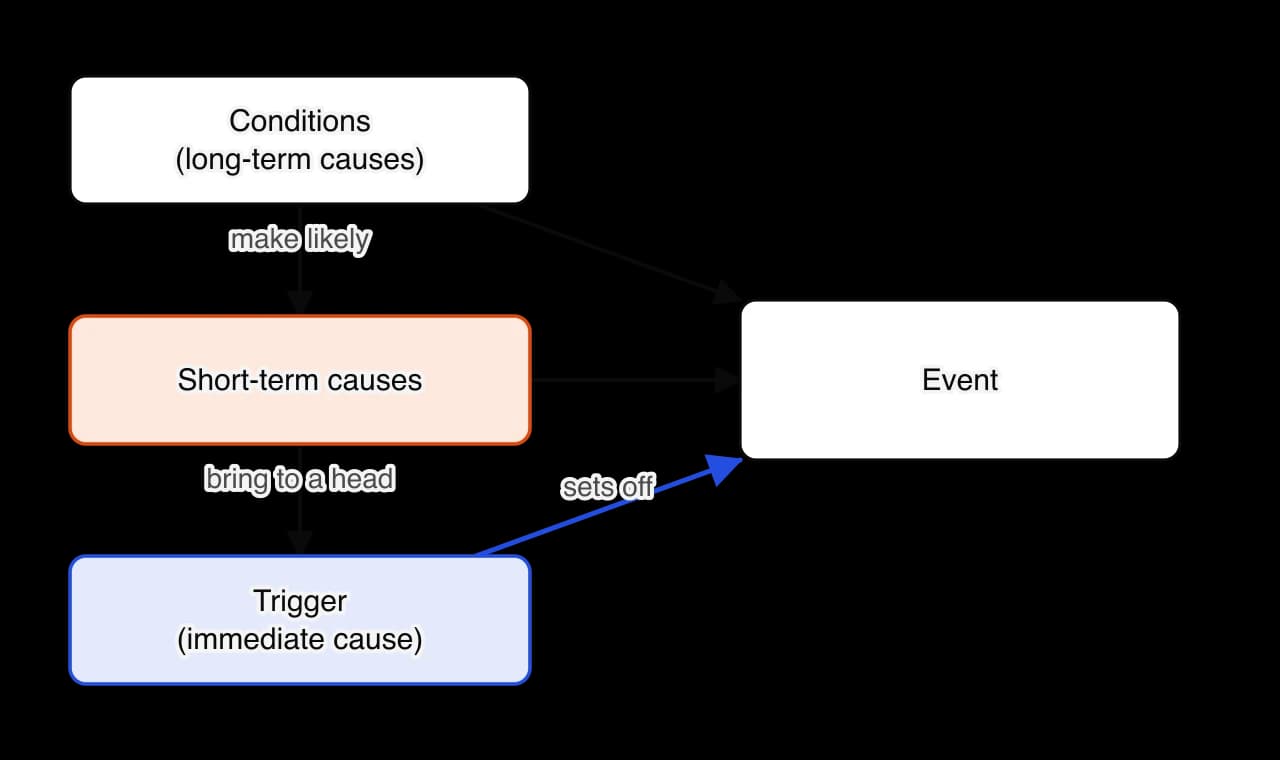
The most common way to organise causes is by timescale. A long-term cause is a condition that developed over years or decades and made an event possible or likely. A short-term cause is a development in the months or few years before the event that brought the situation to a head. A trigger, or immediate cause, is the action or incident that set the event off.
The diagram of conditions and triggers shows why historians keep the three apart. Long-term conditions can exist for a long time without producing the event. Slavery divided the United States from the founding of the republic, but it did not lead to war until 1861. The short-term causes explain why the conditions became explosive at one moment, and the trigger explains why the event began on a particular day.
The outbreak of the US Civil War is a clear example. The long-term cause was slavery. By 1860 there were about four million enslaved people in the southern states, and the cotton they grew was the country's most valuable export. The southern economy and southern politics were built around protecting slavery, while in the North a growing abolitionist movement and a free-labour economy produced opposition to its spread.
The short-term causes were the crises of the 1850s over whether slavery could expand into the western territories. The Kansas–Nebraska Act of 1854 let settlers in those territories decide the question themselves, which overturned the Missouri Compromise of 1820 and led to armed conflict in Kansas. The Supreme Court's Dred Scott decision of 1857 ruled that Congress could not ban slavery in the territories. John Brown's raid on the federal arsenal at Harpers Ferry in October 1859, an attempt to start a slave rising, convinced many white southerners that the North meant to attack slavery by force.
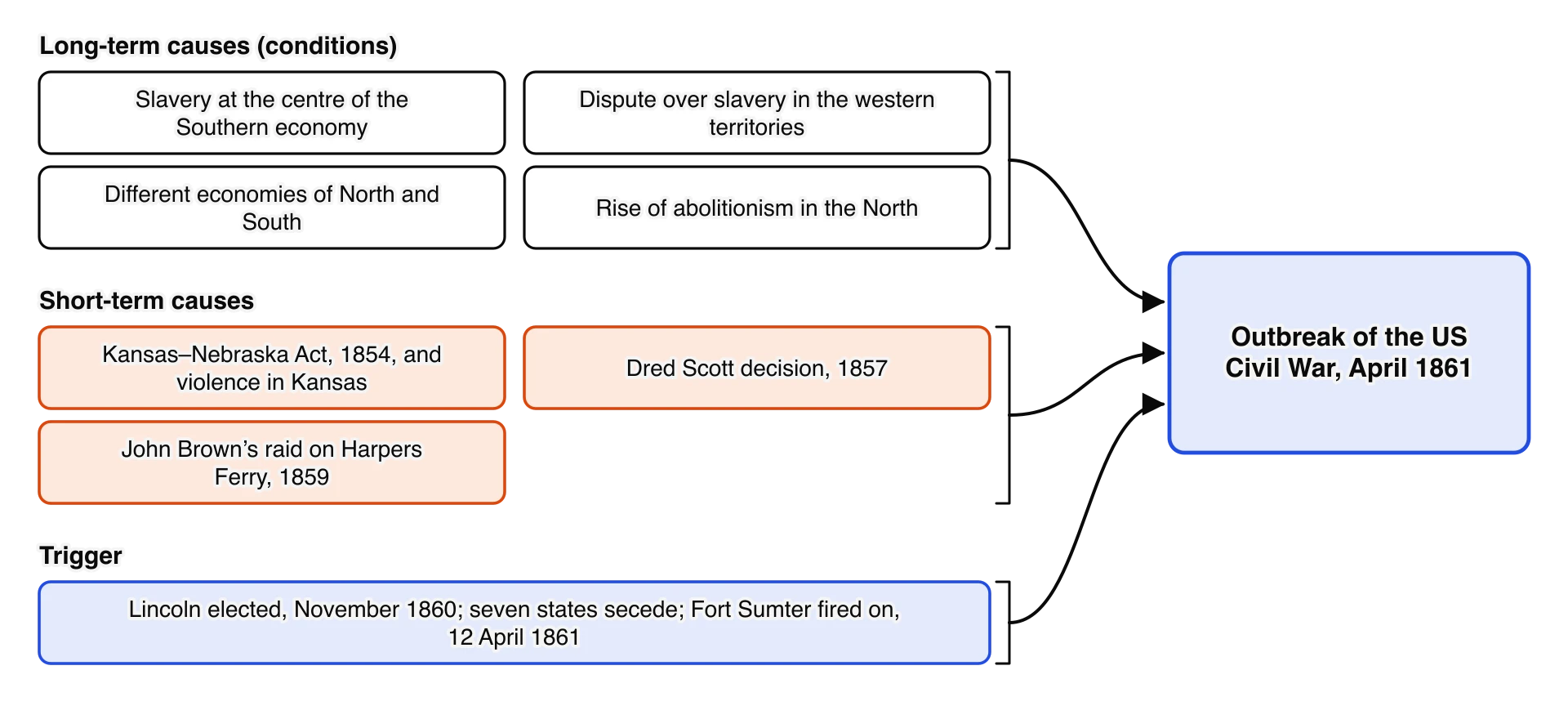
The trigger was the election of Abraham Lincoln in November 1860 on a programme of stopping the spread of slavery. South Carolina seceded on 20 December 1860, six more southern states followed, and they formed the Confederate States of America. The war itself began when Confederate guns fired on the federal garrison at Fort Sumter on 12 April 1861.
A trigger is often a small event compared with its consequences. On 28 June 1914 the Bosnian Serb nationalist Gavrilo Princip shot the heir to the Austro-Hungarian throne, Archduke Franz Ferdinand, in Sarajevo. Within six weeks the great powers of Europe were at war. On 17 December 2010 Mohamed Bouazizi, a street vendor in Sidi Bouzid in Tunisia, set himself on fire after officials confiscated his goods; within a month President Ben Ali had fled the country. In both cases the trigger released tensions that had been building for years: rivalry between the great powers in 1914, and unemployment, corruption and repression in Tunisia.
The distinction also works the other way. A trigger is not just an accident with no meaning. The assassination at Sarajevo mattered because of the way Austria-Hungary chose to respond to it, and Bouazizi's death became a trigger because many Tunisians recognised their own grievances in it and because images of the protests spread on social media and satellite television. A good explanation shows why this particular incident, and not others like it, set off the event.
Some historians use a slightly different pair of terms. Preconditions are the long-term conditions that make an event possible; precipitants are the short-term causes and triggers that decide when it happens. The terms were used by the historian Lawrence Stone in The Causes of the English Revolution, 1529–1642 (1972), which divided the causes of the English Civil War into preconditions, precipitants and triggers. Whatever the labels, the idea is the same: some causes create a situation, others turn it into an event.
Causes can also be grouped by their nature. The most common groups are political, economic, social and ideological or cultural, sometimes remembered by the initials PESC, and many historians add environmental, military, technological and religious causes. Each category asks a different question about the past.
Category | Question it asks | Examples (with the theme they illustrate) |
|---|---|---|
Political | How did governments, laws, parties, leaders and states shape events? | Lincoln's election in 1860 (conflict); the Weimar constitution's emergency powers under Article 48 (authoritarian rule) |
Economic | How did wealth, trade, work, prices and economic crisis shape events? | The Great Depression and Nazi votes (authoritarian rule); cotton and the profits of slavery (conflict) |
Social | How did the structure of society, class, race, gender and religion shape events? | The Great Migration of African Americans to northern cities (popular movements) |
Ideological, the role of ideas | How did beliefs, ideologies and political ideas shape events? | Nationalism in the Balkans before 1914 (conflict); Gandhi's idea of satyagraha (popular movements) |
Environmental | How did climate, harvests, disease and geography shape events? | The Black Death (innovation and transformation); the 1788 harvest failure in France (popular movements) |
Military and technological | How did armed force, weapons and new technology shape events? | Railway mobilisation timetables in 1914 (conflict); the screw press and metal type behind printing (innovation) |
Categories are useful for organising evidence, but real causes often belong to more than one. The demand for cheap African American labour in northern factories during the two world wars was an economic cause of the Great Migration, but the migration also had social and political consequences: it created Black communities in northern cities where African Americans could vote, which made civil rights a question in national elections by the 1940s. Placing a factor in one box can hide these links.
The emergence of printing in Mainz in the 1450s shows the same overlap among causes. Its conditions were technological (paper, which had spread to Germany by about 1400, and the screw presses already used for wine and paper-making), economic (merchants and lenders willing to invest in a costly new process) and cultural (demand for texts from universities, the Church and a growing number of literate townspeople). Gutenberg's skill as a metalworker in making type that could be cast in large numbers added agency to these conditions. The detailed story of why printing and other innovations emerged belongs to the study of new innovations.
Environmental causes deserve special attention because they were long neglected. Climate and disease shaped many events, from the Black Death to the famines of the 1870s in India and China, which the historian Mike Davis connected with droughts brought by the El Niño weather pattern and with colonial policy in Late Victorian Holocausts (2001). Environmental causes rarely act alone: harvests failed in many years, but only some harvest failures led to revolt or famine, depending on how governments and societies responded.
Timescales and categories describe causes. To judge how important a cause was, historians also ask what difference it made. Two terms borrowed from logic help.
The bacterium Yersinia pestis was a necessary cause of the Black Death, since there is no plague without it, but it was not sufficient: plague had existed among rodents in Central Asia for centuries without causing a pandemic across Eurasia. Lincoln's election was a necessary cause of secession in the winter of 1860–1861, since no state seceded before it; but it was not sufficient, because it led to secession only in a country already divided by the crises of the 1850s.
Sufficient | Not sufficient | |
|---|---|---|
Necessary | Rare in history: the cause alone guaranteed the event, and nothing else could have produced it | Most important causes: needed, but only effective together with others (Lincoln's election and secession; Yersinia pestis and the Black Death) |
Not necessary | A cause that would have produced the event on its own, though the event could also have come about another way | Contributory causes: they made the event more likely or shaped its form, but it could have happened without them |
The usual way to test whether a cause was necessary is to ask a counterfactual question: what would probably have happened if this cause had been absent? If the event would still have happened in much the same form, the cause was not necessary. If it would not, the cause was necessary, and probably important.
The method is useful, but it has limits. A counterfactual cannot be proved, since there is no evidence about things that did not happen. The further it moves from what happened, the weaker it becomes: asking whether Germany would have mobilised as quickly in 1914 without its railway timetables is a reasonable test of a cause; asking what Europe would look like today if Franz Ferdinand had survived is speculation. Historians therefore use counterfactuals cautiously, as short tests of a causal claim, and support them with evidence of what contemporaries expected and what alternatives they considered.
Historians disagree about how far to use them. Carr dismissed elaborate counterfactual history as a "parlour game" with the might-have-beens of the past. Others, such as Niall Ferguson in the collection Virtual History (1997), argued that considering the alternatives that contemporaries themselves saw is the only way to understand the choices they made.
A second big question in any explanation is how much weight to give to large impersonal forces and how much to the choices of individuals. Historians call these structure and agency.
Structural explanations stress the conditions that made an event likely whoever was in charge. An agency-based explanation stresses the decisions of leaders, activists or ordinary people that turned possibilities into events. Most good explanations combine the two. The German philosopher Karl Marx put the balance in a passage that historians still quote.
Men make their own history, but they do not make it as they please; they do not make it under self-selected circumstances, but under circumstances existing already, given and transmitted from the past.
Karl Marx, The Eighteenth Brumaire of Louis Bonaparte, 1852 (translation from the Marxists Internet Archive). Marx wrote the essay to explain how Louis Napoleon Bonaparte had seized power in France in December 1851, and as a revolutionary he wanted to show that the coup came from class conflict and not from one man's cleverness. The sentence is often quoted as a general statement about agency and structure, but its context shows that Marx, who believed economic structures shaped history, gave the circumstances the larger role.
At the other extreme, the Scottish writer Thomas Carlyle argued in his lectures On Heroes, Hero-Worship, and the Heroic in History (1841) that the history of the world was "the Biography of Great Men". Explanations of this kind, now called the great man theory, dominated much nineteenth-century writing and still shape popular history, in which Napoleon, Lincoln, Hitler or Gandhi often appear as the main causes of the events around them.
Most historians now reject the view as a general theory. It ignores the conditions that gave leaders their opportunities and the many people whose actions made leaders effective, and it leaves out women and ordinary people almost entirely. The US civil rights movement is a good test. Martin Luther King Jr was a gifted leader, but the movement rested on decades of work by the National Association for the Advancement of Colored People (NAACP), founded in 1909, on Black churches and colleges, and on thousands of local activists such as Rosa Parks and Jo Ann Robinson in Montgomery in 1955. Social historians have studied this "bottom-up" history to restore the agency of people that the great man view left out.
Contingency means that an event depended on circumstances that could have turned out differently: an accident, an illness, the weather, a wrong turning. It reminds historians that the past was not inevitable. People at the time did not know how events would end, and small chances sometimes had large effects.
The assassination at Sarajevo depended on chance. An earlier bomb attack that morning had failed, and Princip was able to shoot the archduke only because the driver of his car took a wrong turning and stopped close to where Princip stood. Hitler's appointment in January 1933 is another example. In Hitler's Thirty Days to Power (1996) the historian Henry Ashby Turner argued that it resulted from intrigue among a few conservative politicians, above all the former chancellor Franz von Papen, in the last weeks of January, and that different decisions could easily have kept Hitler out of power.
Contingency does not mean that history is random. In What is History? Carr separated "rational" causes, which can be generalised and applied to other situations, from "accidental" ones, which cannot. A historian, he argued, should give most weight to the rational causes. The wrong turning in Sarajevo explains why the archduke died that morning; it does not explain why his death led to a European war.
Causes do not act one at a time. They strengthen, weaken and change each other, and a good explanation shows these connections. Two kinds of connection appear again and again: causal chains and interacting causes.
In a causal chain, each event is a consequence of the one before and a cause of the one after. The rise of the Nazis to power can be explained as a chain that runs from an economic crisis in the United States to a political decision in Berlin.
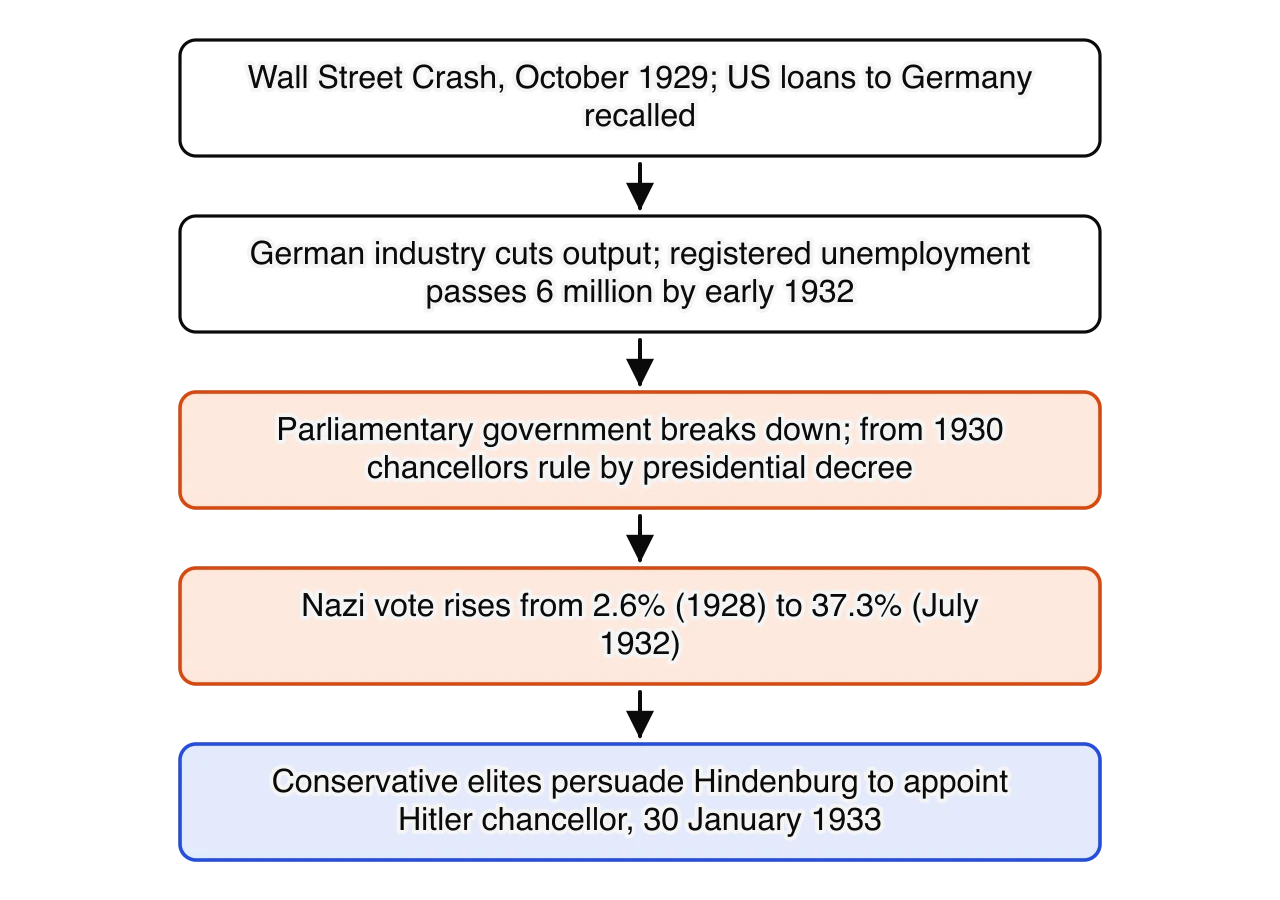
The chain from the Wall Street Crash to Hitler's appointment shows the strength of the method: it explains how a distant economic event could have political effects in Germany. It also shows a danger. A chain can make an outcome look automatic, when each link involved choices. Unemployment did not have to lead to rule by decree; President Hindenburg and his advisers chose to govern without a parliamentary majority from 1930. The final link was a decision by a few people.
Causes also interact when one cause changes the effect of another. Before 1929 many Germans already resented the Treaty of Versailles, but the resentment did not make the Nazis popular. Once the Depression hit, Nazi propaganda linked the two, blaming unemployment on reparations, on the politicians who had signed the treaty and on Jews, and the combination won votes that neither grievance had won alone. The election results show the turning point.
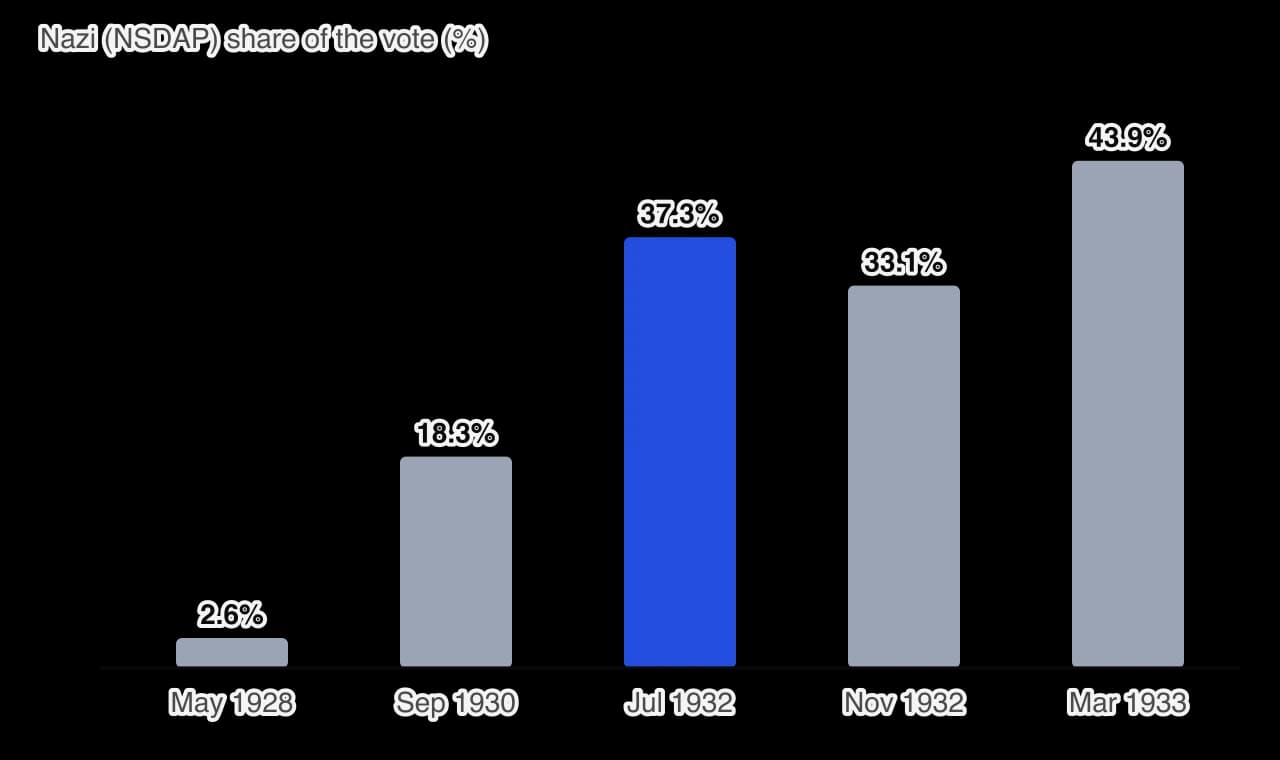
The chart of the Nazi vote also warns against a simple economic explanation. The Nazi share fell by more than four points between July and November 1932, when unemployment was still very high, and Hitler became chancellor two months later after his party's vote had started to decline. The economic crisis made the Nazis a mass party; it did not by itself put Hitler in office. The rise of Hitler is examined in full in the study of why authoritarian rule emerged.
Judging which causes mattered most is the heart of causal analysis. Historians rarely say so, but they use a small number of criteria, and stating them makes a judgement more convincing.
Criterion | Question to ask | A cause scores highly if … |
|---|---|---|
Necessity | Would the event have happened without it? | a counterfactual test suggests the event would not have happened, or would have been very different |
Breadth | How many other causes did it affect or make possible? | it created the conditions in which other causes could act |
Directness | How directly did it lead to the event? | it led to the event with few intermediate steps |
Timing | Does it explain why the event happened when it did? | it explains the timing as well as the possibility of the event |
Evidence | How strong is the evidence for its effect? | contemporaries described it, and its effects can be traced in the sources |
The criteria often point in different directions. A long-term condition scores highly on necessity and breadth but low on timing; a trigger scores highly on timing and directness but low on breadth. A good judgement says which criterion matters most for the question asked. "Why did the US civil rights movement emerge in the 1950s?" is a question about timing, so causes that explain why the movement grew then, and not in the 1920s, deserve particular weight.
 YouTube
Consequences are as varied as causes, and historians classify them in similar ways. The most useful distinctions are between intended and unintended consequences, and between short-term and long-term ones.
Many of the most important consequences in history were unintended. Johannes Gutenberg, a goldsmith in Mainz, developed printing with movable metal type in the 1440s and 1450s to make money by producing books more cheaply than scribes could; his first major work was a Latin Bible completed around 1455. He did not intend to weaken the Catholic Church. Yet within seventy years printing allowed Martin Luther's criticisms of the Church to spread across Germany far faster than the authorities could suppress them. From 1518 Luther wrote mostly in German for lay readers, printers in dozens of towns reprinted his short pamphlets because they sold, and he became the most published author in the German lands in the early 1520s. The religious split of the Reformation was an unintended consequence of a commercial invention.
Event | Intended consequences | Unintended consequences |
|---|---|---|
Printing press, from the 1450s (innovation) | Cheaper books; profit for printers | Rapid spread of Reformation ideas; standardised national languages; harder censorship |
Treaty of Versailles, 1919 (conflict) | German disarmament; reparations; security for France | Lasting German resentment, used by nationalist parties including the Nazis |
Hindenburg appoints Hitler, January 1933 (authoritarian rule) | A government with mass support that conservatives expected to control | A dictatorship that removed the conservatives' own power within eighteen months |
Montgomery bus boycott, 1955–1956 (popular movements) | Courteous treatment and fairer seating on the city's buses, and later their desegregation | A national leader in Martin Luther King Jr; a model of non-violent mass protest |
The table of intended and unintended consequences shows a pattern. Unintended consequences tend to be larger when an action changes something that many other people depend on, such as the means of communication or the balance of power in a state, because those people respond in ways the original actors cannot control.
Short-term consequences appear within months or a few years of an event; long-term consequences develop over decades and are often mixed with the effects of later causes. The further a consequence lies from the event, the harder it is to separate it from other influences, and the more historians disagree about it. The long-term consequences of the First World War are an example: historians agree that it ended four empires (the German, Austro-Hungarian, Russian and Ottoman), but they disagree about how far it caused the Second World War, two decades later.
The Treaty of Versailles of June 1919 is both a consequence and a cause. It was a consequence of the Allied victory in the First World War and of the aims of the victors, especially the French wish for security. Its terms, including reparations, then became a cause of later instability. Article 231 is the best-known example.
The Allied and Associated Governments affirm and Germany accepts the responsibility of Germany and her allies for causing all the loss and damage to which the Allied and Associated Governments and their nationals have been subjected as a consequence of the war imposed upon them by the aggression of Germany and her allies.
Article 231 of the Treaty of Versailles, 28 June 1919 (text from the Avalon Project, Yale Law School). The article was written as the legal basis for Germany's liability to pay reparations, and its drafters chose the wording with that purpose in mind. Germans, who had not been allowed to negotiate the treaty, read it as a moral verdict that Germany alone had caused the war and called it the "war guilt clause". The article is itself a causal claim about the First World War, made by the victors; its consequences show how such a claim could become a cause of later events.
Whether a consequence was good or bad depends on whose experience is considered. When the British Parliament abolished slavery in most of the British Empire in 1833, about 800,000 enslaved people were freed, but the government paid £20 million in compensation to the slave owners, not to the people they had enslaved, and most of the freed people were made to work as unpaid "apprentices" until 1838. The same law was a liberation for some, a profitable settlement for others and, for many of those freed, a continuation of forced labour for another four years. Judging consequences means asking: consequences for whom?
The Black Death was the pandemic of plague that swept across western Asia, the Middle East, North Africa and Europe between 1346 and 1353. It was probably the deadliest event in recorded history in proportion to population. It shows almost every idea about cause and consequence at work: a necessary biological cause that was not sufficient, environmental, economic and social conditions, human responses that shaped its spread, and consequences that differed sharply between societies.
Genetic studies of victims' remains published in 2022 traced the strain that caused the Black Death to the region of the Tian Shan mountains in present-day Kyrgyzstan, where a cemetery records deaths from "pestilence" in 1338–1339. From there plague spread west along the trade routes of the Mongol world. In 1346 it broke out among the army of the Golden Horde, a Mongol state, which was besieging the Genoese trading port of Caffa in the Crimea. The Italian lawyer Gabriele de' Mussis later wrote that the besiegers threw infected corpses over the walls. He was not there himself, and historians treat the story with caution; the plague more probably entered the town through rats and fleas.
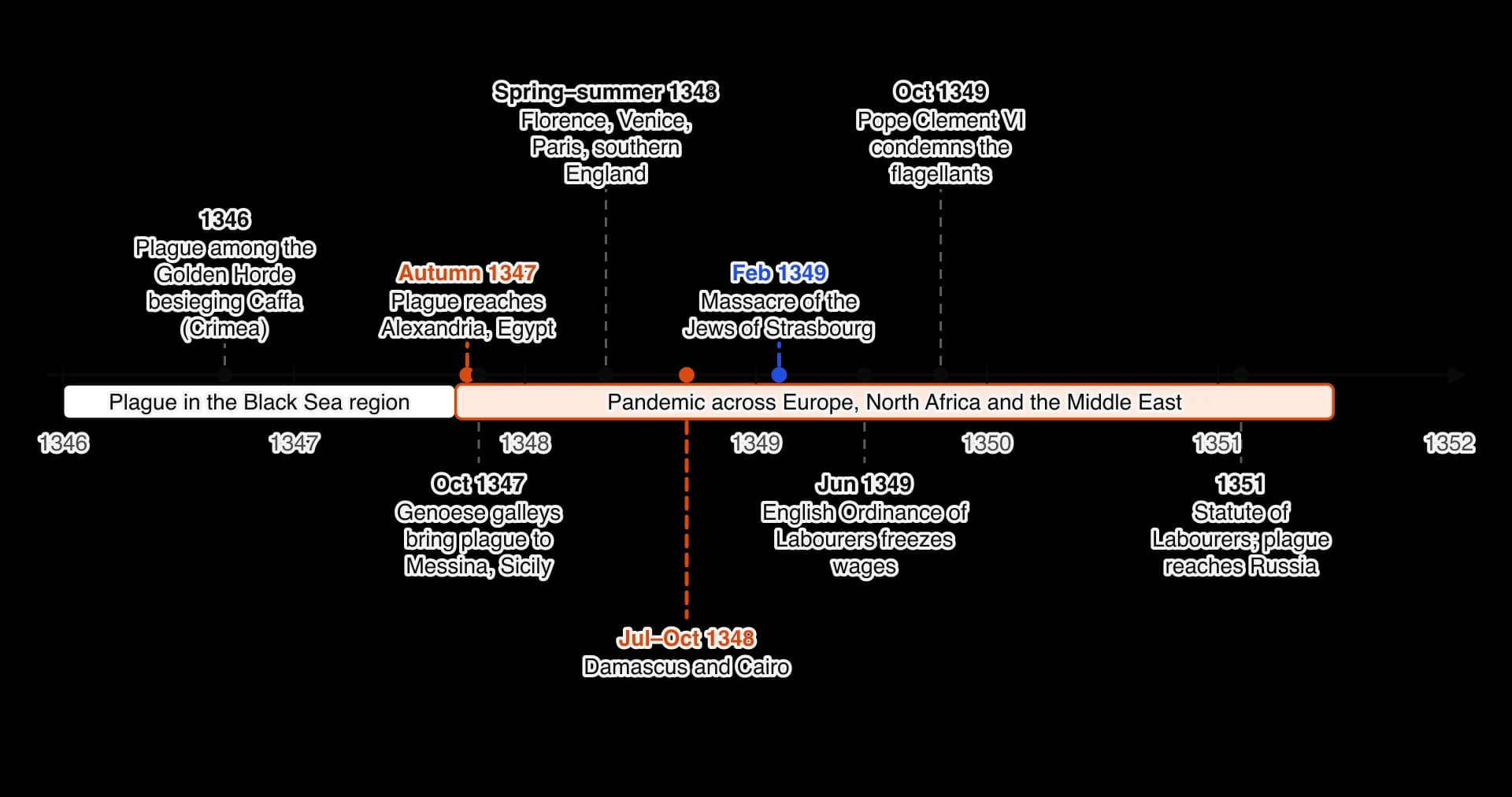
The timeline of the spread shows how closely it followed trade. Genoese galleys carried plague from the Black Sea to Constantinople and then to Messina in Sicily in October 1347. Ships took it to Alexandria in Egypt in the autumn of 1347, and from there it moved up the Nile to Cairo and along the coast to Syria and Palestine. It reached Marseille in November 1347, Florence, Venice, Paris and southern England in 1348, and in 1349–1351 Scandinavia, the Baltic and Russia. Mecca was struck in 1349, probably carried by pilgrims.
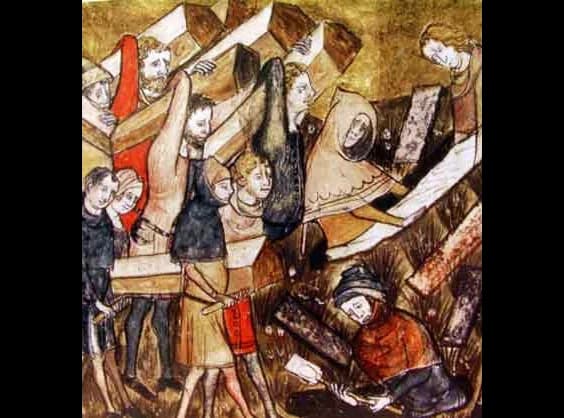
The bacterium was a necessary cause: without it there would have been no pandemic. But plague had existed among wild rodents in Central Asia for a very long time. To explain why it caused a catastrophe in the 1340s, historians look at the conditions that allowed it to spread and to kill.
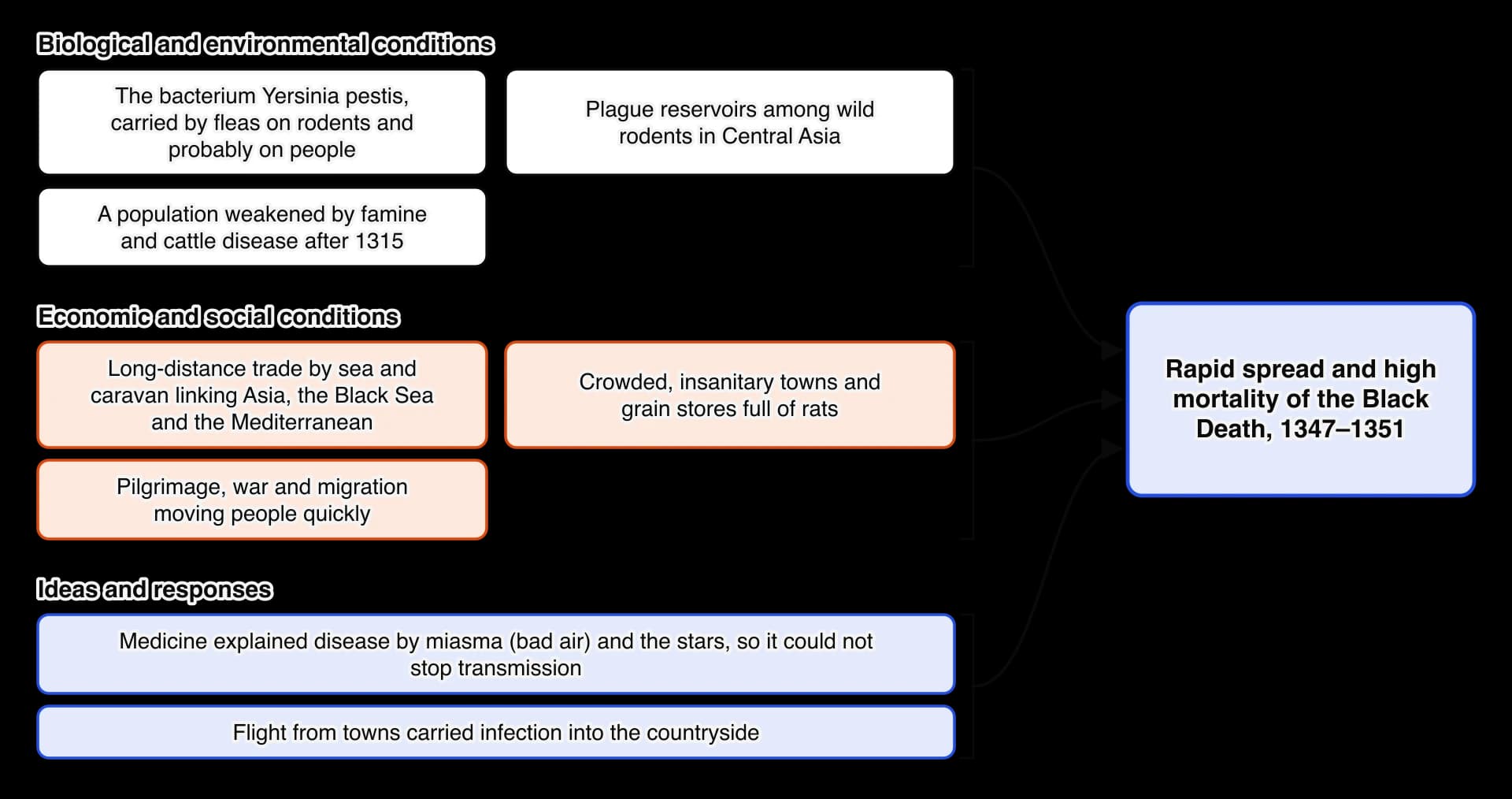
The diagram of causes groups these conditions. The commercial expansion of the thirteenth and early fourteenth centuries had tied Asia, the Black Sea and the Mediterranean together through regular shipping and caravan routes, so the disease moved at the speed of trade. Towns were crowded and dirty, and the grain carried by ships and stored in towns supported large rat populations. Many historians argue that Europe's population, which had grown to the limits of its food supply by 1300, had been weakened by the Great Famine of 1315–1317 and by cattle disease, although the effect of earlier hunger on deaths in 1348 is debated.
Human responses also shaped the spread. Medieval doctors, following the Greek physician Galen and Arab medical writers such as Ibn Sina, explained epidemic disease by miasma, corrupted air, or by the alignment of the planets; the medical faculty of the University of Paris blamed a conjunction of Saturn, Jupiter and Mars in 1345. These explanations could not stop transmission by fleas and breath. People who could afford it fled the towns, and some carried the infection with them.
The mechanism of transmission is still debated. The classic explanation is that fleas living on black rats spread plague to people. Some researchers have argued from the speed of the spread that human fleas and lice passed it directly from person to person, and in The Black Death Transformed (2002) the historian Samuel Cohn questioned whether the disease was plague at all. Ancient DNA from a London plague cemetery at East Smithfield, published in 2011, settled the identity of the disease as Yersinia pestis, but not every detail of how it moved.
No one counted the dead, so every figure is an estimate. The traditional figure is that about a third of Europe's population died. Ole Benedictow, in The Black Death 1346–1353: The Complete History (2004), argued from local records that the figure was nearer 60 per cent. Michael Dols, in The Black Death in the Middle East (1977), estimated that Egypt and Syria lost roughly a quarter to a third of their people, although the region has even fewer records to count from than Europe. The estimates differ because historians use different local records, such as tax lists and manorial records, and because death rates varied widely from place to place.
Contemporary figures are rarely reliable. The Moroccan traveller Ibn Battuta, who passed through Damascus in late July 1348, described Muslims, Christians and Jews going out together to pray for an end to the epidemic; he recorded that deaths in the city that day stayed below two thousand, and repeated a report that in Cairo they reached twenty-four thousand a day, a figure historians treat as a great exaggeration.
The immediate consequences were social and religious as much as economic. Many Christians saw the plague as God's punishment for sin. The flagellants, groups of penitents who marched from town to town whipping themselves, spread through Germany and the Low Countries in 1348–1349 until Pope Clement VI condemned them in October 1349.
The worst short-term consequence was violence against Jews, who were accused of causing the plague by poisoning wells. Clement VI issued bulls in 1348 forbidding the attacks and pointing out that Jews were dying of the plague too, but town authorities and crowds ignored him. In Strasbourg the town council tried to protect the Jewish community, but in February 1349 the craft guilds forced the councillors from office, and on 14 February, as the plague approached the city, the new council had the Jews burned; the figure usually given is about two thousand, although the number is uncertain. Jewish communities were destroyed in many towns of the Rhineland and Switzerland. These massacres were a consequence of the plague, but also of long-standing Christian hostility to Jews and of the wish of some townspeople to cancel debts owed to Jewish lenders.
Governments responded to the sudden shortage of labour. Surviving workers could now demand higher wages, and landlords and employers turned to the law to stop them. In England, Edward III issued the Ordinance of Labourers in June 1349, while the plague was still raging.
Because a great part of the people and especially of the workmen and servants has now died in that pestilence, some, seeing the straights of the masters and the scarcity of servants, are not willing to serve unless they receive excessive wages, and others, rather than through labour to gain their living, prefer to beg in idleness: We, considering the grave inconveniences which might come from the lack especially of ploughmen and such labourers, have held deliberation and treaty concerning this with the prelates and nobles and other learned men sitting by us …
Edward III, the Ordinance of Labourers, June 1349 (translation printed by the Avalon Project, Yale Law School, under the title of the Statute of Labourers of 1351, which re-enacted it). The ordinance went on to order every able-bodied man and woman under sixty to work for the wages paid before the plague. It was written by and for landowners, after consulting "prelates and nobles", so it presents rising wages as greed and idleness. As a source it shows the labour shortage through the eyes of employers, and the fact that Parliament had to repeat it in 1351 suggests the law was not working.
In the long term the plague changed the balance between land and labour in western Europe. With far fewer people, land became cheaper and labour dearer. Despite the labour laws, wages for English labourers and craftsmen rose markedly in the decades after 1350, and many peasants were able to rent land on better terms or move to landlords who offered more. Attempts by lords to hold them in serfdom and by the government to tax them helped cause the English Peasants' Revolt of 1381, whose trigger was a poll tax. The revolt was crushed, but serfdom declined in England over the following century and had almost disappeared by about 1500.
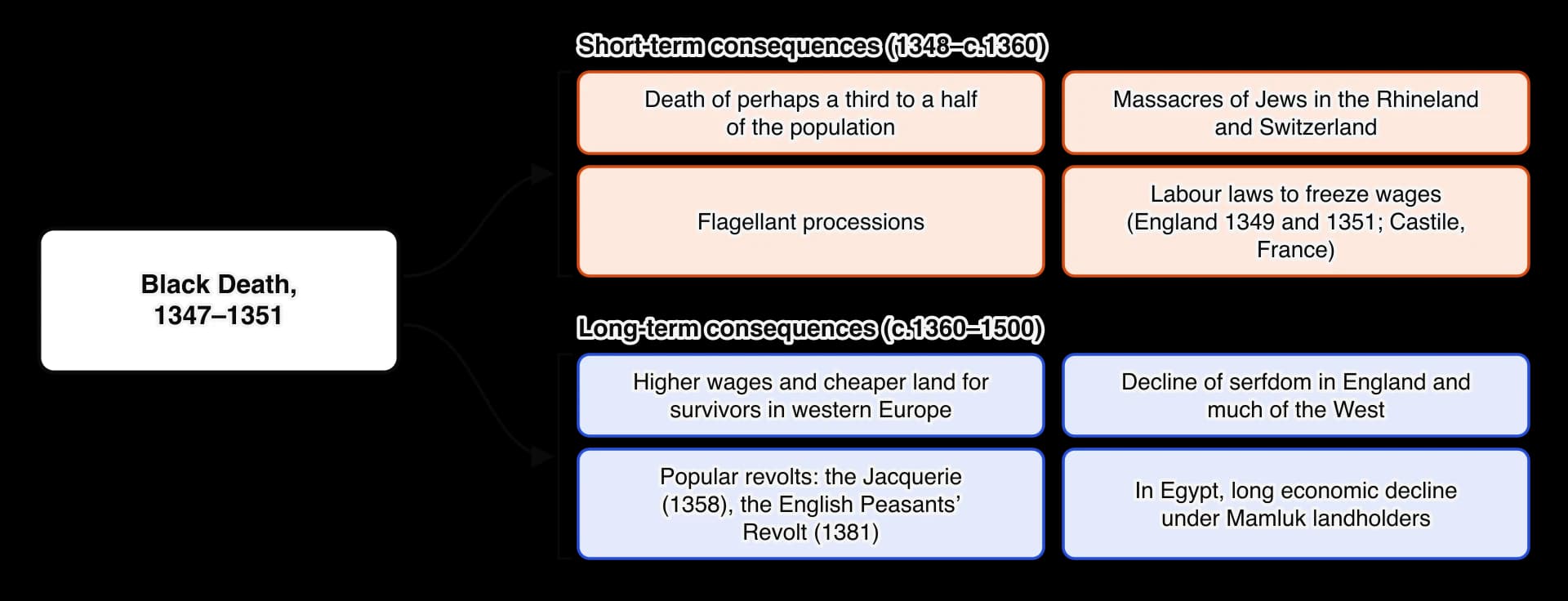
The diagram of consequences shows a further point: the same shock produced different long-term results in different societies. In much of eastern Europe, east of the Elbe, lords later tightened their control over peasants instead of losing it, a development called the "second serfdom" that took shape in the fifteenth and sixteenth centuries. In Egypt the economy declined for more than a century. In The Black Death in Egypt and England (2005), the historian Stuart Borsch argued that the difference lay in landholding. In England, landlords lived on their estates and had to bargain with tenants, so the economy adjusted. In Egypt, the land was held by the Mamluk military elite, who lived in Cairo and collected revenue through officials; when the population fell they raised demands on the surviving peasants, irrigation works decayed, and the economy did not recover.
Necessary is not sufficient. The bacterium was needed, but trade, towns, ideas about disease and human behaviour explain the speed and scale of the deaths.
Consequences depend on structures. The same demographic shock raised the bargaining power of peasants in England and lowered it in parts of eastern Europe; the existing social and political structures decided the result.
Unintended consequences dominate. Labour laws meant to hold wages down helped provoke revolt; the plague itself, which no one intended, reshaped the economies of two continents.
Historians weigh consequences differently. The plague can be seen as the cause of the end of serfdom, or as a shock whose effects depended on older conflicts between lords and peasants.
Historians who study the same event often disagree about its causes. They rarely disagree about the basic facts; they disagree about which causes mattered most, and why. The disagreements come from three sources: the questions historians ask, the evidence they stress, and their assumptions about what drives change.
In The Origins of the Second World War (1961), the British historian A. J. P. Taylor argued that Hitler was an opportunist who took advantage of the mistakes of other statesmen, more than a leader following a plan for war. Most historians since have rejected much of Taylor's case, pointing to evidence of Hitler's long-term aims, but his book forced them to show how plans and opportunities interacted. A related debate concerns the Nazi state itself. Intentionalist historians explain its policies, including the Holocaust, mainly through Hitler's ideas and intentions; structuralist (or functionalist) historians stress the competition between rival agencies and officials within the regime, which pushed policy towards ever more radical measures. Ian Kershaw's survey The Nazi Dictatorship (1985) set out the two positions and argued for a synthesis.
In Griff nach der Weltmacht (1961; translated as Germany's Aims in the First World War), the German historian Fritz Fischer argued that Germany's leaders had long-term aims of expansion and used the July Crisis of 1914 to fight a war they had considered for years. The argument caused a storm in West Germany because it placed the main responsibility on Germany, as Article 231 had done. Christopher Clark, in The Sleepwalkers (2012), argued that historians should ask how the war came about before asking why, and showed that decisions in Vienna, Belgrade, St Petersburg, Paris, London and Berlin all contributed, so that no single government bore sole responsibility.
Economic historians such as Michael Postan explained the decline of serfdom after 1350 mainly through demography: with fewer people, labour became scarce and peasants could demand better terms. In an article of 1976 the American historian Robert Brenner argued that this could not explain why the same fall in population ended serfdom in the West and strengthened it in the East. The result, he argued, depended on the balance of power between lords and peasants in each region. The long dispute that followed became known as the "Brenner debate".
Debate | Historian (work, date) | Explanation stressed | Evidence stressed |
|---|---|---|---|
Outbreak of the Second World War | A. J. P. Taylor (The Origins of the Second World War, 1961) | Opportunism and the mistakes of statesmen; contingency | Diplomatic documents of the 1930s; Hitler's improvised responses to crises |
Outbreak of the First World War | Fritz Fischer (Griff nach der Weltmacht, 1961) | Long-term German aims of expansion | German government records, the "September Programme" of war aims of 1914 |
Outbreak of the First World War | Christopher Clark (The Sleepwalkers, 2012) | Shared misjudgements in several capitals; how, before why | Decision-making in all the capitals during the July Crisis |
Policies of the Nazi state | Ian Kershaw (The Nazi Dictatorship, 1985) | Synthesis of intentionalist and structuralist explanations | Both Hitler's ideas and the rivalries within the regime |
Consequences of the Black Death | Robert Brenner (article in Past and Present, 1976) | Class power, not population alone | Different outcomes for serfdom in western and eastern Europe |
Consequences of the Black Death | Stuart Borsch (The Black Death in Egypt and England, 2005) | Systems of landholding | Agricultural and irrigation records of Mamluk Egypt compared with English manorial records |
Behind many of these debates lie different assumptions about what drives historical change. Marxist history gives the main causal weight to economic structures and class conflict. Liberal and political historians tend to stress ideas, institutions and the decisions of individuals. Since the 1970s, social historians have stressed the agency of ordinary people, and since the 1990s environmental historians have argued that climate and disease deserve a place among the main causes of events: Bruce Campbell's The Great Transition (2016) places the Black Death within a wider crisis of climate and disease in the fourteenth century, and Geoffrey Parker's Global Crisis (2013) links wars and revolutions across the world in the mid-seventeenth century to the cold of the Little Ice Age.
These perspectives can be weighed against each other in the same way as causes. A historian's explanation is strongest when it accounts for the evidence that other explanations stress. Brenner's argument was influential because it explained a difference (between East and West) that a purely demographic explanation could not; Clark's was influential because it used records from every capital, not only Berlin.
 YouTube
A top-band answer is about 350–450 words. Open with a sentence naming the example and a short claim about the concept ("Historical events have multiple causes because long-term conditions, short-term developments and triggers interact, and their relative importance can be weighed"). Then write two or three paragraphs, each analysing one facet of the concept with dates, people and decisions from your example. A second example earns no extra credit and costs time.
I can define cause, consequence, causation and multi-causality, and explain why mono-causal explanations are usually incomplete.
I can distinguish long-term causes, short-term causes and triggers, and explain what each explains about an event.
I can group causes by category and show how one cause can belong to several categories.
I can explain necessary and sufficient causes and use a counterfactual question carefully to test a cause.
I can explain structure, agency and contingency, and avoid determinism.
I can show how causes interact and form chains, using the rise of the Nazis or another example.
I can weigh causes using clear criteria and reach a supported judgement.
I can distinguish intended and unintended, short-term and long-term consequences, and explain how judging consequences depends on perspective.
I can explain the causes of the spread of the Black Death and its short- and long-term consequences in Europe and the Middle East.
I can outline at least three historians' debates about causes and explain why historians disagree.
I can answer a concept question on cause and consequence with one precise example from my thematic study.