C Historical concepts
The four historical concepts (cause and consequence, continuity and change, perspectives and significance): what each one asks, how they fit together, and how they run through every study at SL and HL.
- IB History
- SL and HL
What C covers
From the subject guide: what you need to know and be able to do.
Four concepts used throughout the course and assessed directly in paper 2.
4 subtopics in Historical concepts
Each one has its own page once something is published for it.
- C.1Cause and consequencenotes
- C.2Continuity and changenotes
- C.3Perspectivesnotes
- C.4Significancenotes
An overview of C Historical concepts
The historical concepts are four ways of thinking that historians use to turn information about the past into explanation and argument: cause and consequence, continuity and change, perspectives and significance. They apply to every period, region and study in IB History, from the Norse voyages of the tenth century to the politics of 2020.
Knowing what happened is the starting point. The concepts are the questions that make that knowledge useful: why it happened, what it changed, how differently people saw it, and why it still matters.
Four concepts, four questions
Each concept asks a different question of the same past, and each has its own vocabulary. The table of the four concepts sets out the question each one asks and the main ideas that its page teaches.
Concept | The question it asks | Main ideas |
|---|---|---|
Cause and consequence (C.1) | Why did it happen, and what did it lead to? | Long-term causes, short-term causes and triggers; types of cause; necessary and sufficient causes and counterfactual reasoning; structure, agency and contingency; intended and unintended consequences; weighing causes against each other |
Continuity and change (C.2) | What changed, what stayed the same, and for whom? | Pace, extent, direction and scope of change; turning points; change and progress; periodisation; formal change in law against lived change in daily life |
Perspectives (C.3) | How did different people see it, and how have historians interpreted it? | Three layers: people at the time, sources and historians; perspective and bias; historical empathy; schools of interpretation; missing and marginalised voices |
Significance (C.4) | Why does it matter, to whom, and by what measure? | Criteria for judging historical significance; why judgements change over time and differ between groups; memory, commemoration and public history; selection and Eurocentrism |
The four pages follow the same pattern. Each one explains the concept and its vocabulary, shows it at work in short examples from all four thematic studies (conflict, innovation and transformation, authoritarian rule and popular movements), and develops one extended case study: the Black Death of 1347–1351 for cause and consequence, Russia from 1914 to 1924 for continuity and change, the atomic bombings of 1945 for perspectives, and the voyage of Columbus in 1492 for significance.
How the concepts fit together
The concepts are separate tools, but in practice historians use them together. The diagram of the concepts and the contexts shows them as four lenses on a single activity, historical inquiry, which takes place in each part of IB History.
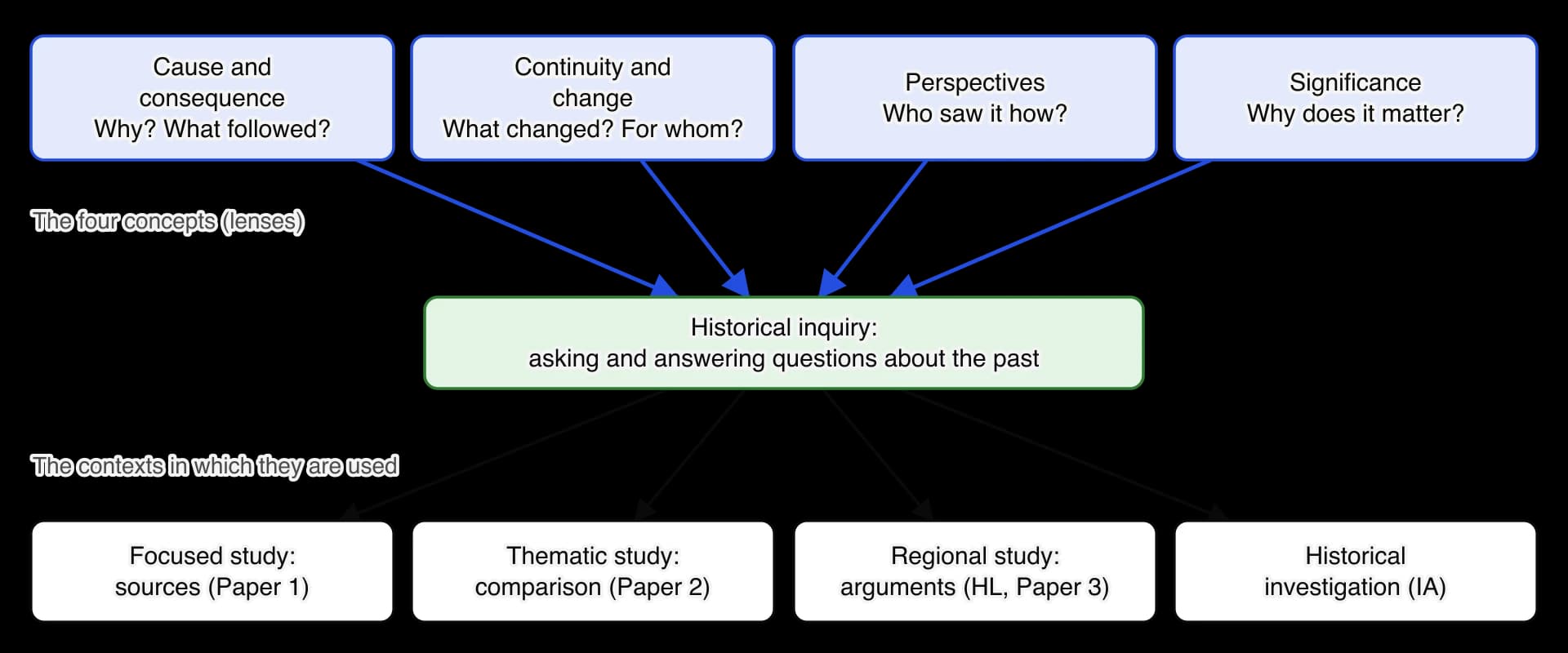
The links between the concepts are close. Consequences are the most common evidence of change, and the scale of its consequences is one of the main criteria for judging an event significant. Perspectives run through the other three: people at the time disagreed about causes, experienced change differently and valued events differently, and historians since have done the same.
The Meiji Restoration in Japan (1853–1894) shows all four at once. The arrival of Commodore Perry in 1853 and the unequal treaties that followed were short-term causes of the fall of the Tokugawa shogunate. The abolition of the domains and of the samurai class was rapid change, while the constitution of 1889, which kept sovereignty with the emperor, preserved important continuities. Former samurai and the new oligarchs saw the reforms very differently, and historians still debate whether the events were a revolution or a restoration. Its significance depends on the measure chosen: for Japan it created a modern state, and for East Asia it began half a century of Japanese expansion.
Where students meet the concepts, and how they are examined
The concepts are not a separate block of content. All students, at SL and HL, use them in every study they take: the focused study (studied through primary and secondary sources), the thematic study (studied by comparing examples from different regions), the regional studies at HL (studied in depth through historians' arguments) and the historical investigation. The concepts are the common language that links studies of very different times and places.
They are assessed in two ways. They are used throughout the papers and the internal assessment: Paper 1 asks how the perspectives of sources can be used, Paper 2 essays and Paper 3 essays weigh causes, consequences and change, and the historical investigation asks students to evaluate perspectives in their sources. They are also assessed directly in Paper 2 Section A, which sets two concept questions, of which students answer one, worth 6 marks. Each question asks students to analyse one concept, such as how historical events can have multiple causes, and to support the analysis with one example from their thematic study. Because the four thematic studies cover different content, each concept page draws its examples from all four.
Carry on with C in Augment
With a free account, Augment remembers where you stopped and what you have practiced.