Understand how people at the time, sources and historians see the past from different perspectives, what shapes those perspectives, and how to analyse them.
Each is in the History glossary, with every other term in the subject.
The people a source was made for. The intended audience shapes what a source says, how it says it and what it leaves out.
Distortion or one-sided selection in an account that misrepresents what happened, whether deliberate or not. A biased source is still evidence, above all of its author's views and aims.
Control by an authority over what may be published, broadcast or said, so that some information and views are suppressed.
A source produced during or close to the time of the events it describes, before the outcome was fully known.
Checking one source against others to see which of its details are confirmed, contradicted or found only in that source.
History that studies the relationship between human societies and climate, disease, ecology and natural resources.
History that recovers women's experiences and examines how inequality between women and men shaped the past.
British law of 1812 that made the deliberate destruction of stocking frames and other textile machinery a capital offence, passed in response to Luddism.
History that examines how ideas of masculinity and femininity shaped power, work, politics and identity in the past.
Mao Zedong's campaign of 1958–1962 to industrialise China rapidly through mass mobilisation and people's communes, which led to a famine in which tens of millions died.
An Algerian Muslim who served as an auxiliary with the French army during the Algerian War of Independence (1954–1962).
The survivors of the atomic bombings of Hiroshima and Nagasaki in 1945; the Japanese word means people affected by the bomb.
Knowledge of how events turned out, available to people looking back but not to those living through them.
The evidence-based attempt to understand the beliefs, feelings and choices of people in the past within their own context, without necessarily approving of them.
The study of how history has been written: how historians' interpretations of a subject differ, how they have changed, and why.
An approach to history that studies the experiences and actions of ordinary people rather than only elites and leaders.
A connected set of political, social or economic ideas that explains how society works and how it should be organised, such as liberalism, nationalism or Marxism–Leninism.
A historian's explanation or judgement of the past, built from evidence and argument.
The movement of English textile workers who broke machinery in 1811–1816 to defend their trades, wages and customs; by extension, opposition to new technology.
The secret American programme, with British and Canadian participation, that built the first atomic bombs between 1942 and 1945.
A group pushed to the edge of a society's political, economic or social life, with less power and voice than others, such as enslaved people, colonised peoples, minorities, refugees and in many societies women.
Files removed from British colonies at independence and held secretly in Britain, whose existence the government admitted in 2011.
The recording and study of people's spoken memories of events they lived through.
The first interpretation of an event to become widely accepted, often close to the views of the winners or the government of the time.
A very large collective unit created in rural China from 1958 that organised farming, industry, local government and daily life, sometimes with tens of thousands of members.
The point of view from which someone sees, experiences or explains an event, shaped by their position, knowledge, time of writing and purpose. In history it can mean the view of a person at the time, of a source, or of a historian.
An interpretation that combines elements of an orthodox view and the revisionist challenge to it.
An approach that studies how colonial power shaped knowledge, archives, identities and societies, including after independence.
Statement of 26 July 1945 by the United States, Britain and China calling on Japan to surrender unconditionally or face "prompt and utter destruction".
Judging or interpreting the past by the values, knowledge and assumptions of the present.
A source produced during the period being studied, usually by someone involved in or close to the events, such as a letter, law, speech, photograph or diary.
Information, images or ideas spread deliberately, usually by a state or political movement, to shape what people believe and how they act.
The origin of a source: who made it, when, where, for whom and for what purpose.
In historiography, an interpretation that challenges an established one, often using new sources or asking new questions.
A source produced later by someone interpreting the past, usually from primary sources, such as a history book or scholarly article.
A school of history founded in the early 1980s, led by Ranajit Guha, that studies the politics of peasants and other subordinated groups in South Asia, ignored by both colonial and nationalist histories.
A member of the Women's Social and Political Union (WSPU), founded in Britain in 1903, which used militant methods to campaign for women's right to vote.
A campaigner for women's right to vote by legal and peaceful methods, such as members of the National Union of Women's Suffrage Societies (NUWSS) in Britain.
Historical perspectives are the different ways in which people have seen the same past. A strike, a war or a revolution looked different to the factory owner and the worker, to the general and the conscript, to the coloniser and the colonised, and it looks different again to historians who write about it decades later. Understanding perspectives allows historians to explain why people acted as they did, to use biased sources as evidence, and to weigh the competing interpretations of the past that fill libraries and political debates.
With a free account, Augment remembers where you stopped and what you have practiced.
No one sees the whole of an event. A soldier in a trench sees a few hundred metres of a front; a general sees a map; a politician in a capital sees reports, casualty figures and newspaper headlines. Each of them has a partial view, and each partial view is real evidence about the event. The historian's task is to understand these partial views, explain why they differ, and combine them into an account that is fuller than any single one.
The word "perspective" is used in three different ways in history, and clear thinking depends on keeping them apart.
Historical actors' perspectives: the views of people who lived through the event: participants, victims, bystanders, rulers and the ruled. In the Kenyan Emergency of the 1950s, for example, a Mau Mau fighter, a Kikuyu loyalist who joined the Home Guard, a white settler farmer and a British colonial official each saw the conflict in a different way.
Sources' perspectives: the viewpoint that a particular source expresses. A source is produced by someone, for some purpose and audience, in particular circumstances; these decide what it says and leaves out. A government report and a diary written on the same day may describe the same event in opposite ways.
Historians' perspectives: the interpretations of people who study the past later. Historians ask different questions, use different sources and work from different assumptions, so they reach different conclusions. Their interpretations are often grouped into schools of thought.
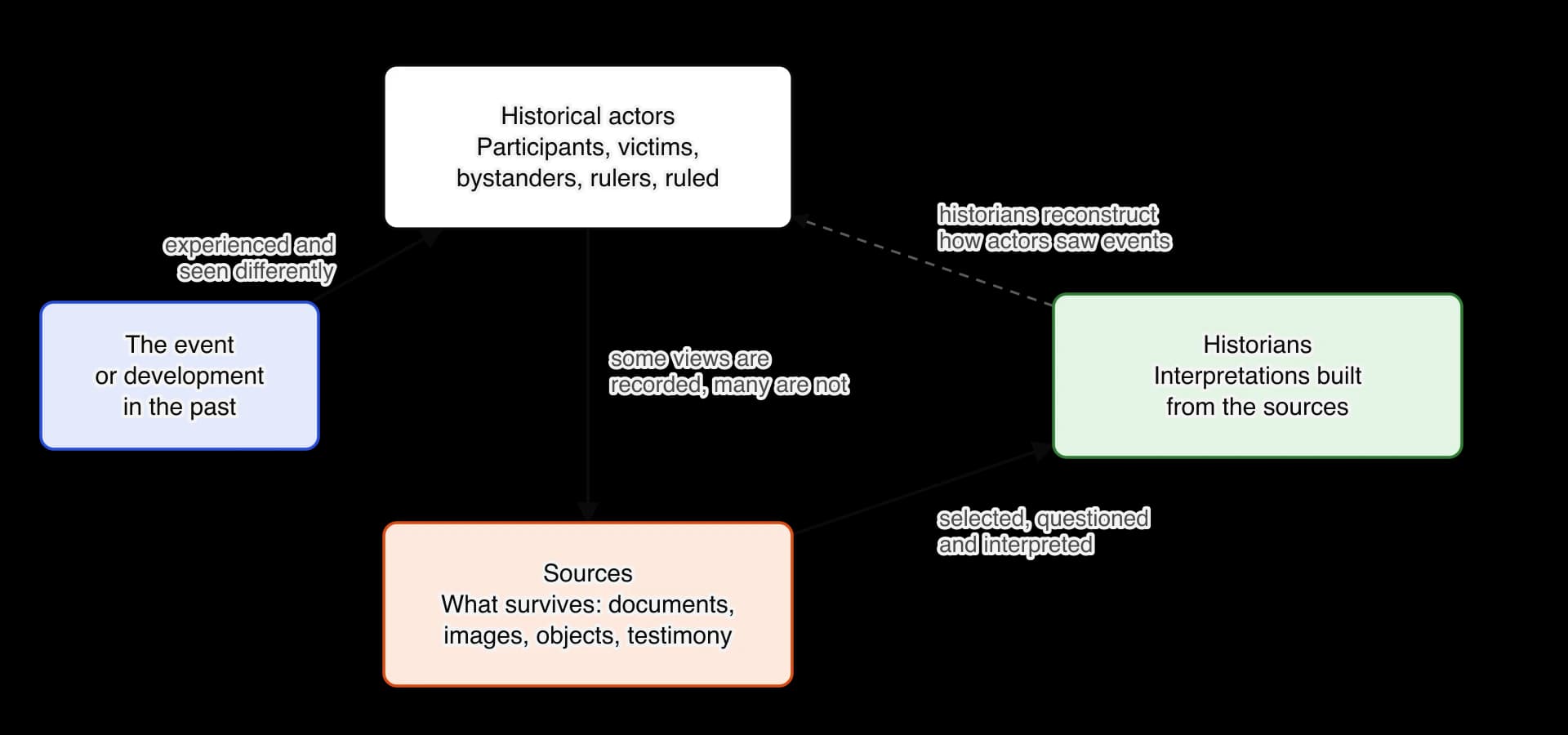
The diagram of the three layers shows how they connect. Most of what historical actors thought was never recorded, so the sources give only a selection of their perspectives. Historians then work from those sources, and their own perspective shapes which sources they choose and what they ask of them. A historian's account of how peasants experienced a famine is therefore a perspective (the historian's) on a set of perspectives (the sources') on the experiences of people at the time.
Students often treat a perspective as a fault to be removed. Every account has a perspective, including the most careful historian's, so the useful question is not "Is this source biased?" but "Whose view does this source give, why does it take this view, and what can it show?"
A piece of wartime propaganda, for example, is a poor guide to what happened on the battlefield but an excellent guide to what a government wanted its people to believe, which fears it expected them to have and which values it thought would persuade them. Historians of Nazi Germany use the films of Joseph Goebbels's propaganda ministry in exactly this way: as evidence of the regime's aims and methods, not as a record of events.
Perspective also explains why accounts by honest witnesses disagree. Two eyewitnesses to a riot can sincerely give different numbers, different sequences of events and different explanations of who started it, because each saw a different part of it, at a different moment, with different expectations. Historians compare such accounts through corroboration: checking one source against others to see which details are confirmed, which are contradicted and which appear in only one account.
 YouTube
Perspectives differ for reasons that can be identified and explained. The diagram of the factors that shape a perspective groups them under three questions: who the person was, what they could know, and why and for whom they were speaking.
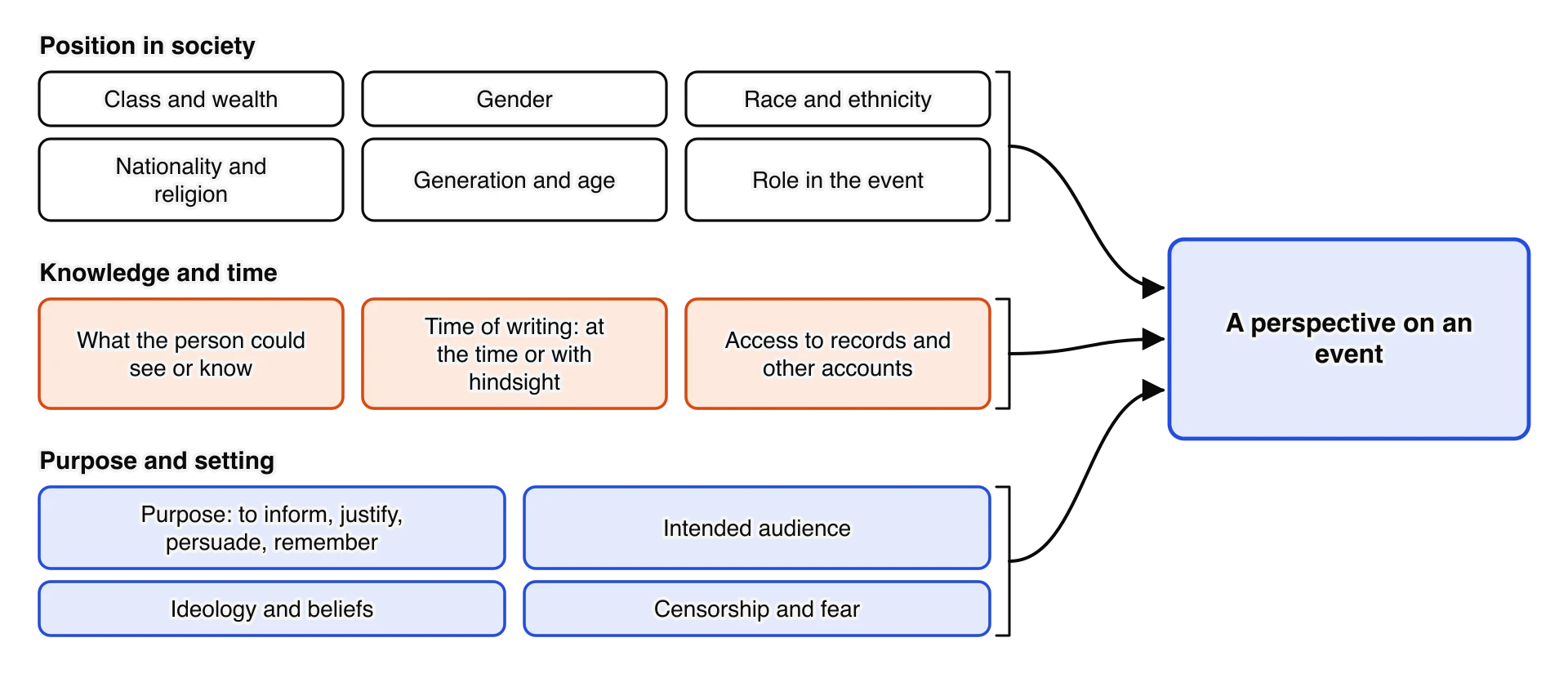
A person's place in society decides what they experienced and what they had to gain or lose. Class, gender, race, ethnicity, nationality, religion and age all matter, and so does the person's role in the event itself: a decision-maker, a soldier carrying out orders, a victim, a bystander. The same new law could be a liberation for one group and a threat to another.
Position does not decide a view on its own. People of the same class or nation disagreed, and individuals changed their minds. Historians therefore treat position as a reason to expect a certain view, then test that expectation against what the person actually said and did.
People at the time did not know how events would end. A contemporary source, produced during or close to the event, shows what people expected, feared and believed before the outcome was known, which makes it valuable for explaining their decisions. An account written later has the benefit of hindsight: more information, more distance, and knowledge of the consequences. Hindsight also has a cost. Memoirs written years afterwards tend to tidy events into a story, to forget doubts the author once had, and to justify the author's own conduct.
Access to information matters as well. A government minister could read intelligence reports that ordinary citizens never saw; a villager in a remote province might know only what officials and rumour told them. A source is limited by what its author was in a position to know.
Sources are produced for a reason: to inform, to persuade, to justify, to remember, to entertain, to petition. The intended audience shapes the message. A general writing to his government, to his troops and to his wife about the same battle will describe it in three different ways. An ideology, a connected set of political ideas such as liberalism, nationalism or Marxism–Leninism, gives its believers a framework for explaining events. Censorship and fear decide what can be said at all: in a one-party state, what is missing from the official record can be as revealing as what is in it.
The Luddites were textile workers in the English Midlands and North who broke machinery between 1811 and 1816. Stocking-knitters in Nottinghamshire smashed knitting frames used to make cheap goods at low wages; cloth finishers (croppers) in Yorkshire attacked the new shearing frames that threatened their skilled trade; weavers in Lancashire attacked power looms. They signed their threatening letters in the name of a mythical leader, "Ned Ludd" or "General Ludd". The government sent about 12,000 troops to the disturbed districts and passed the Frame Breaking Act of 1812, which made the destruction of machinery a capital offence.
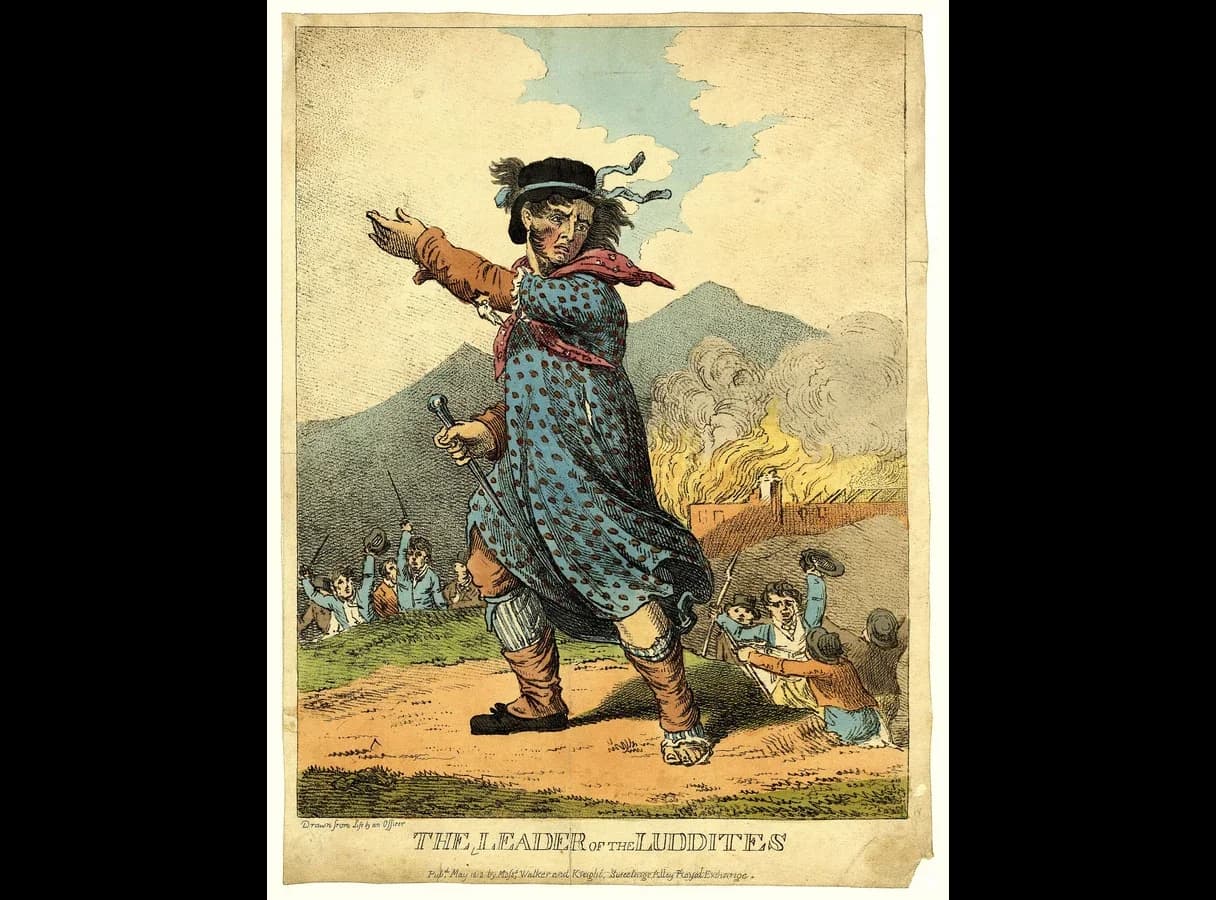
The print of "the Leader of the Luddites" gives one perspective on the disturbances, that of a London printmaker selling to a middle-class public. Mill owners such as William Cartwright, who defended his mill at Rawfolds in Yorkshire against an attack in April 1812, saw the Luddites as criminals threatening property and progress. Ministers saw a danger of insurrection in a country already at war with Napoleonic France. The workers themselves, whose voices survive mainly in their letters and in the evidence of spies and trials, presented their actions as a defence of their trades, their wages and their customary rights against employers who broke the rules of the trade.
A small number of people with power took the workers' side. In his first speech in the House of Lords, the poet Lord Byron opposed the Frame Breaking Bill.
But whilst these outrages must be admitted to exist to an alarming extent, it cannot be denied that they have arisen from circumstances of the most unparalleled distress: the perseverance of these miserable men in their proceedings, tends to prove that nothing but absolute want could have driven a large, and once honest and industrious, body of the people, into the commission of excesses so hazardous to themselves, their families and the community.
Lord Byron, speech in the House of Lords on the Frame-Work Bill, 27 February 1812 (Hansard). Byron came from Nottinghamshire and had seen the distress he describes, but he was also a young Whig peer attacking a Tory government and making his name as an orator. His speech is evidence of how an opposition aristocrat explained Luddism, as the product of poverty, and of the arguments available against the government in 1812; it is not the workers' own voice.
Perspective | How the Luddites were seen | What shaped the view |
|---|---|---|
Mill owners and merchants | Criminals destroying property and blocking efficient production | Investment in new machines; competition; fear of attack |
Government and magistrates | A threat to public order, possibly revolutionary | War with France; fear of a rising like that of 1789; reports from spies |
The workers | Defenders of their trade, wages and customs | Falling wages, high food prices, loss of skilled status |
Lord Byron (1812) | Desperate men driven by poverty | Local knowledge; opposition politics; humanitarian sympathy |
E. P. Thompson (1963) | A rational, organised protest by skilled workers with a sense of their rights | A Marxist historian writing "history from below" |
In the twentieth century the word "Luddite" came to mean anyone who blindly opposes new technology, which is itself a perspective: the winners' view that the machines were progress and the machine-breakers were simply wrong. In The Making of the English Working Class (1963), the historian E. P. Thompson set out to rescue such workers from what he called "the enormous condescension of posterity", arguing that their protest made sense in their own terms and in their own situation.
Explaining why people in the past acted as they did requires understanding how the world looked to them. The history education researchers Peter Seixas and Tom Morton, in The Big Six Historical Thinking Concepts (2013), make taking historical perspectives one of their six core concepts. It involves reconstructing the beliefs, values, knowledge and pressures of people in the past, which were often very different from those of today.
Historical empathy is not the same as sympathy. A historian can explain why many Germans supported the Nazi regime in the 1930s, given the memory of defeat in 1918, the Depression and the fear of communism, without excusing that support. Understanding a perpetrator's outlook is often the only way to explain what happened.
Avoiding presentism does not mean giving up moral judgement. Many people at the time condemned slavery, colonial violence and persecution, and their voices show that other choices were possible. The historian's task is to know which values were available in a society, who held them and why some people acted against them, rather than to apply present-day values as if they had always been obvious.
The campaign for votes for women in Britain shows how people on the same side of an argument could see it very differently. The National Union of Women's Suffrage Societies (NUWSS), formed in 1897 and led by Millicent Fawcett, were suffragists: they campaigned by legal and peaceful means such as petitions, meetings and lobbying of MPs. The Women's Social and Political Union (WSPU), founded in Manchester in 1903 by Emmeline Pankhurst and her daughters, adopted the slogan "Deeds, not words". Its members, the suffragettes, disrupted meetings, chained themselves to railings and broke windows; from 1912 the WSPU ran a campaign of mass window-smashing and, increasingly, arson. Imprisoned suffragettes went on hunger strike, and the government responded first with force-feeding and then with the "Cat and Mouse Act" of 1913, which released hunger strikers until they recovered and then re-arrested them.
Group or person | Perspective on militancy and the vote | What shaped it |
|---|---|---|
WSPU (suffragettes) | Peaceful campaigning had failed for forty years; only militancy would force the government to act | Frustration with broken promises by Liberal governments; a small, disciplined, middle-class leadership |
NUWSS (suffragists) | Militancy alienated MPs and the public and gave opponents an excuse to refuse reform | A much larger, older, mainly law-abiding membership; links with the Liberal and later Labour parties |
Anti-suffragists | Women's sphere was the home; politics and empire were men's concerns | Ideas of separate spheres; Mary Ward and other women led the Women's National Anti-Suffrage League, founded in 1908 |
Asquith's Liberal government | Votes for women could not be granted under threat of violence | Party calculation about which women would vote for whom; public order |
Historians have continued the argument. In The March of the Women (2000), Martin Pugh argues that the suffragettes' violence from 1912 was counter-productive: it hardened opposition in Parliament at a time when the constitutional campaign was winning support. Historians more sympathetic to the WSPU, such as June Purvis in her biography Emmeline Pankhurst (2002), argue that militancy made votes for women an issue that no government could ignore. Women over 30 who met a property qualification gained the vote under the Representation of the People Act 1918, after a war in which both organisations had suspended their campaigns, so the evidence allows more than one reading.
Every source has an author (or a body that produced it), a date, a purpose, an intended audience and a context. Together these are its provenance. Reading a source for its perspective means asking how each of these shaped what it says, what it leaves out and how it says it.
The line between the two depends on the question being asked. A history of the French Revolution written in 1847 is a secondary source on the revolution but a primary source on how French writers saw the revolution in the 1840s. Neither type is automatically more reliable: a primary source may be propaganda, and a secondary source may rest on archives that no one at the time could read.
In 1958 Mao Zedong launched the Great Leap Forward, a campaign to overtake Britain's industrial output within fifteen years by mass mobilisation. Peasants were organised into huge people's communes, tens of millions were moved from farming into steel-making in small "backyard furnaces", and local officials, under pressure to report success, sent in grain figures far above real harvests. The state took grain on the basis of these false figures. The result was the deadliest famine in recorded history, which lasted from 1959 to 1961.
Sources on the Great Leap Forward give sharply different perspectives. Official newspapers of 1958–1959 celebrated record harvests. Party leaders who questioned the campaign were silenced: at the Lushan Conference in July 1959, the defence minister Peng Dehuai criticised its excesses in a private letter to Mao and was purged. In 1981, five years after Mao's death, the Chinese Communist Party gave its official verdict in a resolution on its own history.
It was mainly due to the errors of the Great Leap Forward and of the struggle against "Right opportunism" together with a succession of natural calamities and the perfidious scrapping of contracts by the Soviet Government that our economy encountered serious difficulties between 1959 and 1961, which caused serious losses to our country and people.
Chinese Communist Party Central Committee, Resolution on Certain Questions in the History of Our Party since the Founding of the People's Republic of China, adopted 27 June 1981 (official English translation, Foreign Languages Press). The resolution was written under Deng Xiaoping to admit Mao's errors while keeping the Party's authority and Mao's place as its founder. Its perspective shows in its choice of words: the famine appears only as "serious difficulties" and "serious losses", blame is shared with natural disasters and the Soviet Union, and no death toll is given.
Other perspectives come from people who lived through the famine, whose memories were collected much later by journalists and historians, often secretly. The journalist Yang Jisheng, whose own father starved to death in 1959, spent years gathering local records and interviews for Tombstone (published in Hong Kong in 2008 and banned in mainland China). The historian Frank Dikötter used Communist Party archives in several provinces, opened to researchers in the 2000s, for Mao's Great Famine (2010), which estimates at least 45 million premature deaths and stresses violence and coercion by officials as well as hunger.
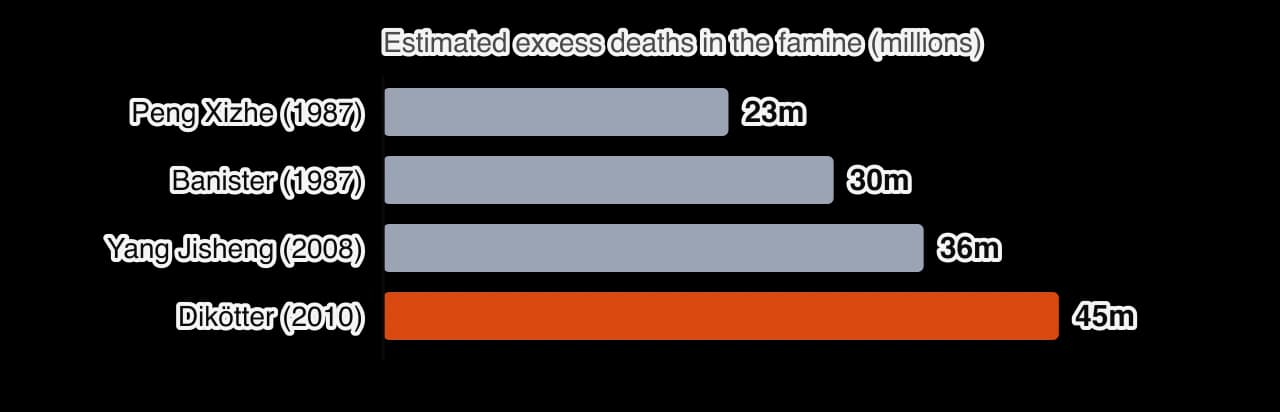
The chart of famine estimates shows how far historians' perspectives can differ even on a number. Demographers such as Judith Banister and Peng Xizhe worked in the 1980s from census data and reconstructed birth and death rates; Yang and Dikötter later used local Party records. Some scholars have questioned Dikötter's methods and his high figure, while accepting that the famine killed tens of millions. The range reflects different sources, different methods and different assumptions about how many people would have died anyway, not simply disagreement for its own sake.
Historians do not simply collect facts. They choose a question, select sources, decide which evidence matters most and build an argument. In What Is History? (1961), the British historian E. H. Carr told his readers to "study the historian before you begin to study the facts", because the historian's own time, country, politics and questions shape the history that is written. The nineteenth-century German historian Leopold von Ranke had hoped to show the past "as it actually was"; most historians since Carr accept that every account is an interpretation, while insisting that interpretations must be tested against evidence.
Debates on many subjects pass through a common pattern. A first, orthodox interpretation becomes established, often close to the views of the winners or of the government of the time. A revisionist interpretation then challenges it, often using new sources or asking new questions. A post-revisionist interpretation later combines elements of both. The labels are relative: "revisionist" means only that a view revised the one before it.
Historiography of the origins of the Cold War is the classic example. Orthodox historians in the late 1940s and 1950s blamed Soviet expansion; revisionists in the 1960s, influenced by the Vietnam War, stressed American economic and strategic expansion; post-revisionists such as John Lewis Gaddis in the 1970s and 1980s described a conflict of mutual misunderstanding and security fears. The atomic bombings of 1945, examined in the case study that follows, went through a similar sequence.
Historians are also grouped by the assumptions and questions they bring to the past. The table of schools of interpretation gives the main ones that appear across many historical topics.
School or approach | Main assumption or question | Examples of historians and works |
|---|---|---|
Liberal / national | History as the growth of liberty, the nation or the state; focus on leaders, institutions and politics | Thomas Babington Macaulay, History of England (1848–1861) |
Marxist history | Economic structures and class conflict drive change | Georges Lefebvre on the French Revolution (1939); Eric Hobsbawm, The Age of Revolution (1962) |
History from below | The experiences and actions of ordinary people, not only elites | E. P. Thompson, The Making of the English Working Class (1963) |
Nationalist and anti-colonial | The nation's struggle against foreign rule; recovering a national past | Many histories written after independence in Africa and Asia |
Feminist history and gender history | Women's experiences; how ideas of masculinity and femininity shaped power | Joan Wallach Scott, "Gender: A Useful Category of Historical Analysis" (1986) |
Subaltern studies | The politics of peasants and other subordinated groups, ignored by both colonial and nationalist elites | Ranajit Guha and the Subaltern Studies series on South Asia (from 1982) |
Postcolonial history | How colonial power shaped knowledge, archives and identities, even after independence | Edward Said, Orientalism (1978) |
Environmental history | How climate, disease, ecology and resources shaped human history | Alfred Crosby, The Columbian Exchange (1972) |
These approaches are not exclusive. A historian may combine a Marxist interest in class with a feminist interest in gender, and most historians today draw on several. The labels help to explain why two historians reading the same evidence emphasise different things.
Interpretations change for three main reasons.
New sources. The opening of the Soviet archives after 1991 transformed the history of Stalin's USSR and the Cold War. In 2011, during a court case brought by Kenyan victims of the Emergency, the British government admitted that it held thousands of files removed from its colonies at independence, the so-called migrated archives. Their release confirmed much of what the historians Caroline Elkins (Imperial Reckoning, 2005) and David Anderson (Histories of the Hanged, 2005) had argued from oral testimony and court records about the abuse of detainees.
New questions. Historians influenced by the women's movement of the 1960s and 1970s began to ask what familiar events meant for women; environmental historians asked what they meant for land, water and climate. The same sources yield new answers to new questions.
The concerns of the present. Each generation asks the past about its own problems. American historians writing during the Vietnam War looked again at the origins of the Cold War; historians writing after the end of European empires looked again at colonial rule. This is not a weakness in itself, but it is one reason to study the historian before the facts.
 YouTube
The surviving record of the past over-represents the powerful. Governments, churches, companies and educated elites produced most written documents and controlled most archives. People who could not read or write, who were enslaved or colonised, or who were women in societies that kept them out of public life, left fewer records, and those records were less often kept.
In Silencing the Past (1995), the Haitian anthropologist and historian Michel-Rolph Trouillot argued that silences enter history at four moments: when sources are created (some events and people are never recorded), when archives are assembled (some records are kept and others thrown away), when historians retrieve facts to write narratives (some stories are told and others ignored), and when a society decides what matters in the long run. His main example is the Haitian Revolution (1791–1804), the only successful revolt of enslaved people to found a state, which European and North American writers for a long time treated as a minor episode or left out of the history of the "age of revolutions" altogether, because a revolution by enslaved Africans did not fit their assumptions about who made history.
Silences can be deliberate. Colonial officials in Kenya and elsewhere destroyed records before independence, and authoritarian states have hidden or rewritten the records of their crimes. They can also be structural: an archive of a plantation contains the owner's accounts and letters, in which enslaved people appear as names, prices and labour, not as people with their own views.
Historians have developed several methods for recovering perspectives that the written record leaves out.
Reading official sources "against the grain": using records produced by the powerful to find evidence of the views and actions of others. Court records, police reports and plantation records often record what the accused, the protesters or the enslaved said and did, even if through a hostile filter.
Oral history: recording the memories of people who lived through events. In the 1930s the US Federal Writers' Project interviewed more than 2,000 formerly enslaved people; since the 1980s, oral history projects have recorded survivors of the Holocaust, of Partition in South Asia and of colonial wars.
Oral tradition and material evidence: histories passed down in a community over generations, and objects, buildings and landscapes, which are central to the history of many Indigenous peoples and of African societies without written archives.
Changing the question: asking what a familiar event meant for women, for a minority or for colonised people, which brings new sources into view.
Each method has limits. Interviewers shape what they are told; memories change over decades and absorb later stories; oral traditions serve the needs of the community that keeps them. These are the same questions of perspective that apply to any written source: who is speaking, to whom, when, and why.
On 6 August 1945 an American B-29 bomber, the Enola Gay, dropped an atomic bomb on the Japanese city of Hiroshima. On 9 August a second bomb destroyed much of Nagasaki. Japan announced its surrender on 15 August. Few events of the twentieth century have been seen from such different perspectives, by those who took the decision, those who suffered it, and the historians and publics who have argued about it since.
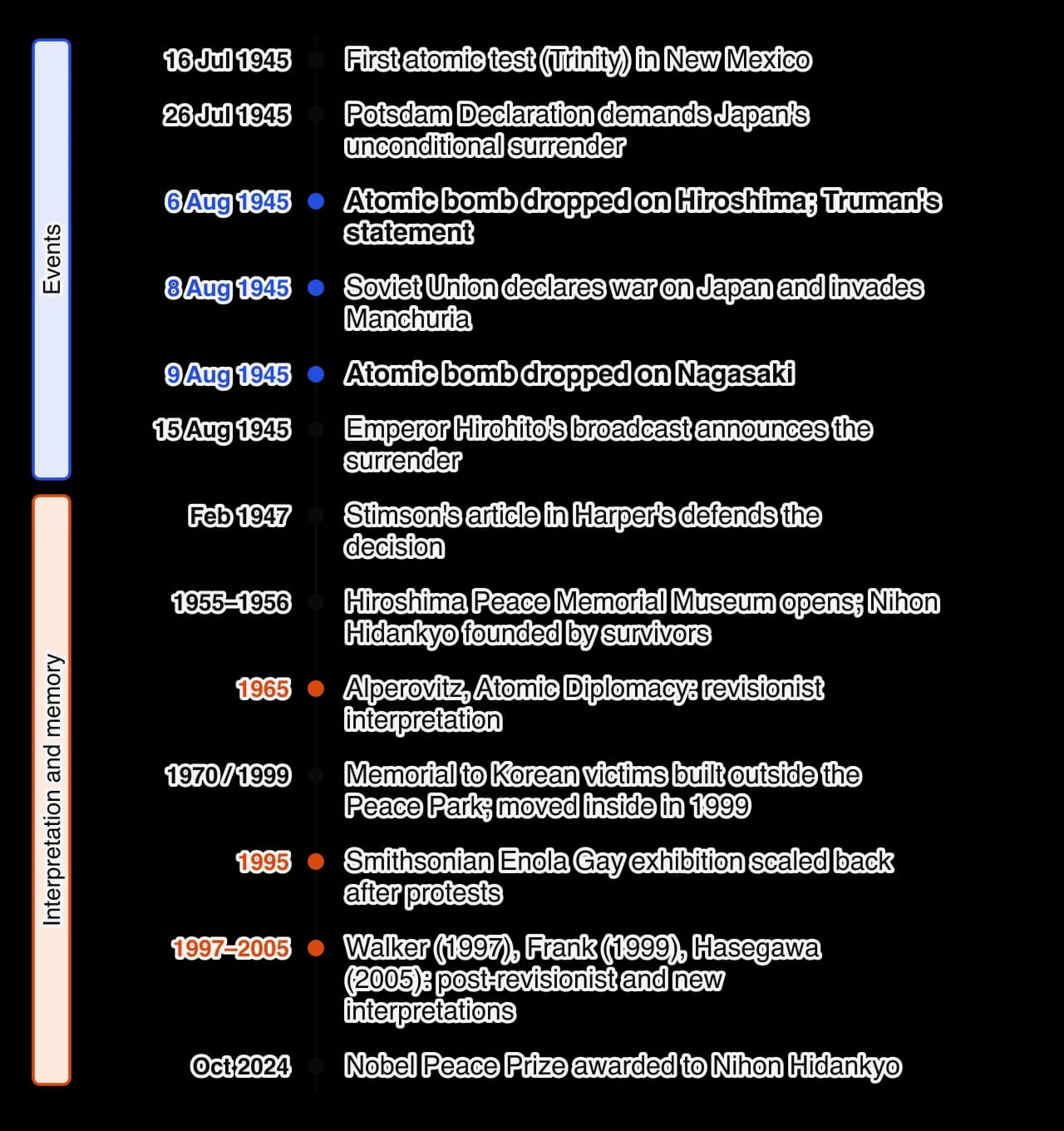
The timeline of the bombings and their interpretation shows how short the events were and how long the argument has lasted. By the end of 1945 about 140,000 people had died in Hiroshima and about 74,000 in Nagasaki, according to the estimates of the two cities; early American estimates were lower. The figures are uncertain because the population of each city on the day is not known exactly, many bodies were never found, and deaths from radiation continued for years.
The weapon was built by the Manhattan Project, a secret American programme with British and Canadian participation, which had begun because scientists feared that Nazi Germany would build an atomic bomb first. By the time the first bomb was tested in New Mexico on 16 July 1945, Germany had surrendered. On 26 July the Potsdam Declaration, issued by the United States, Britain and China, called on Japan to surrender unconditionally or face "prompt and utter destruction"; it did not mention the bomb. Japan's government did not accept. President Harry S. Truman announced the first bombing in a statement released sixteen hours after the attack.
The Japanese began the war from the air at Pearl Harbor. They have been repaid many fold. And the end is not yet. … It is an atomic bomb. It is a harnessing of the basic power of the universe. … If they do not now accept our terms they may expect a rain of ruin from the air, the like of which has never been seen on this earth.
Harry S. Truman, President of the United States, Statement by the President Announcing the Use of the A-Bomb at Hiroshima, 6 August 1945 (Truman Library). The statement was written for the American public and the world, and also as a warning to Japan's government. It presents the bomb as retribution for Pearl Harbor and as a scientific triumph, and it calls Hiroshima "an important Japanese Army base"; it says nothing about the civilians who made up most of the city's population. As a source it shows how the decision was justified at the time and which arguments its makers expected to persuade.
From the American leaders' perspective in the summer of 1945, the war in the Pacific was costing thousands of American lives a month; the battles for Iwo Jima and Okinawa had been among the bloodiest of the war, and an invasion of Japan's home islands was planned for November. Japan's army still held much of China and Southeast Asia. Months of firebombing had already killed large numbers of Japanese civilians, including tens of thousands in Tokyo on the single night of 9–10 March 1945, so the moral line between conventional and atomic bombing of cities seemed less sharp to decision-makers than it does to most people today.
Japan's leaders were divided. Some civilian ministers wanted to end the war if the position of the emperor could be kept; the army leaders wanted to fight on in the hope of better terms. On 8 August the Soviet Union, which Japan had hoped would mediate a settlement, declared war and invaded Manchuria. Even after Nagasaki, the inner war cabinet was deadlocked, and Emperor Hirohito intervened to accept the Potsdam terms. His radio broadcast of 15 August, the first time most Japanese had heard his voice, explained the decision.
Moreover, the enemy has begun to employ a new and most cruel bomb, the power of which to damage is indeed incalculable, taking the toll of many innocent lives. Should we continue to fight, it would not only result in an ultimate collapse and obliteration of the Japanese nation, but also it would lead to the total extinction of human civilization.
Emperor Hirohito, Imperial Rescript on the termination of the war, radio broadcast, 15 August 1945 (official English translation). The broadcast had to persuade a population and an army taught to fight to the end that surrender was honourable. Presenting the bomb as a threat to civilisation itself allowed the emperor to accept defeat without admitting that Japan had been beaten militarily, and it does not mention the Soviet declaration of war, although the emperor's separate rescript to the armed forces two days later named Soviet entry as a reason to stop fighting. This is one reason historians debate whether the bombs or the Soviet entry did more to bring about the surrender.
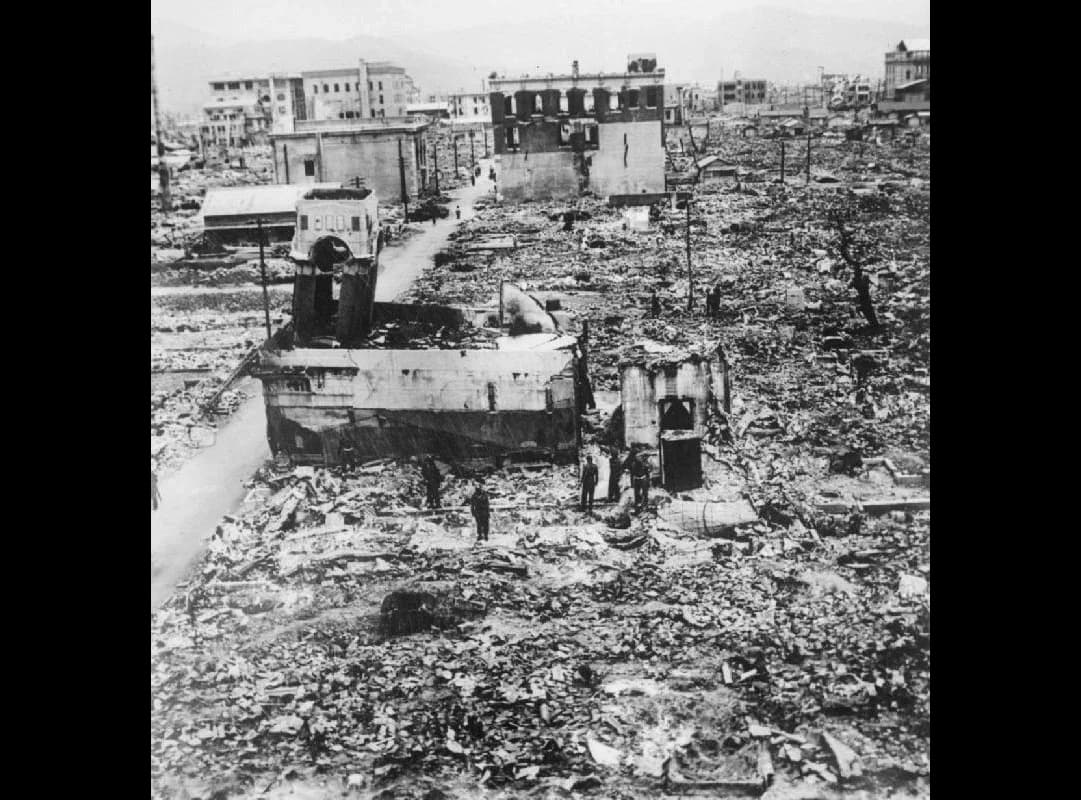
The survivors of the bombings are known in Japan as hibakusha, "bomb-affected people". Their perspective is that of people on the ground: the flash, the fires, the search for family members, and in the years that followed, radiation sickness, cancers and discrimination in jobs and marriage, because others feared their illnesses were inherited. During the American occupation of Japan (1945–1952), censorship limited what could be published about the effects of the bombs, so many survivors' accounts were written down only later.
Survivors organised in 1956 as Nihon Hidankyo, the Japan Confederation of A- and H-Bomb Sufferers Organizations, and spent decades giving testimony in schools and at the United Nations. In 2024 the Norwegian Nobel Committee awarded it the Nobel Peace Prize for its work for a world free of nuclear weapons and for showing through witness testimony that such weapons must never be used again. The award shows how the survivors' perspective, once marginal, has become central to the way the bombings are remembered worldwide.
Some victims were marginalised even among the survivors. Tens of thousands of Koreans, many brought to Japan as forced labourers under colonial rule, were in Hiroshima and Nagasaki in August 1945. Estimates of the Korean dead range from a few thousand to more than 30,000, and the uncertainty itself shows how little their deaths were recorded. A memorial to the Korean victims, paid for by Koreans living in Japan, was put up in 1970 outside Hiroshima's Peace Memorial Park and was moved inside the park only in 1999.
The first public defence of the decision came from Henry Stimson, the US Secretary of War in 1945, in an article published in Harper's Magazine in February 1947, at a time when critics had begun to question the bombings.
The decision to use the atomic bomb was a decision that brought death to over a hundred thousand Japanese. … But this deliberate, premeditated destruction was our least abhorrent choice. … It stopped the fire raids, and the strangling blockade; it ended the ghastly specter of a clash of great land armies.
Henry L. Stimson, former US Secretary of War, "The Decision to Use the Atomic Bomb", Harper's Magazine, February 1947. Stimson wrote as one of the men who had made the decision, with official help, to answer its critics; the article was planned to shape public memory. It became the foundation of the orthodox interpretation: the bomb was the least bad way to end the war quickly and avoid an invasion.
Interpretation | Historians and works | Argument | Evidence stressed |
|---|---|---|---|
Orthodox | Henry Stimson (1947); Herbert Feis, Japan Subdued (1961) | The bomb was used to end the war quickly and save the lives that an invasion would have cost | Japanese resistance on Iwo Jima and Okinawa; invasion plans; the refusal of the Potsdam terms |
Revisionist | Gar Alperovitz, Atomic Diplomacy (1965) and The Decision to Use the Atomic Bomb (1995) | Japan was close to surrender; the bomb was used largely to impress the Soviet Union and limit its gains in Asia | Intercepted Japanese peace feelers; the 1946 US Strategic Bombing Survey; the views of some US commanders |
Post-revisionist | J. Samuel Walker, Prompt and Utter Destruction (1997) | Ending the war quickly was the main aim; impressing the Soviets was a welcome extra; alternatives existed but were not seriously explored | Decision-makers' papers; the gap between later claims of lives saved and planners' estimates |
Defence of the decision renewed | Richard B. Frank, Downfall (1999) | Japan's leaders were not ready to surrender on acceptable terms; the bombs were needed | Decoded Japanese military messages showing the build-up of forces on Kyushu |
International | Tsuyoshi Hasegawa, Racing the Enemy (2005) | The Soviet declaration of war did more than the bombs to force Japan's surrender | Japanese, Soviet and American archives; the timing of the Japanese cabinet's decisions |
The debate turns on questions that the sources answer only partly. How close was Japan to surrender, and on what terms? How many lives would an invasion have cost? Truman and Stimson later spoke of hundreds of thousands, even a million, American casualties; the historian Barton Bernstein showed that the military planners' estimates in mid-1945 were much lower, while Frank argues that those estimates were rising as intelligence revealed Japan's reinforcement of the invasion beaches. Hasegawa's use of Japanese and Russian archives as well as American ones shows how a historian's choice of sources and of national perspective shapes the conclusion.
Perspectives on the bombings also divide publics. In 1995 the Smithsonian Institution in Washington planned an exhibition around the fuselage of the Enola Gay for the fiftieth anniversary. Veterans' organisations and members of Congress objected that its script gave too much attention to Japanese casualties and to the historians' debate, and too little to Japanese aggression and American losses; the exhibition was cut back to little more than the aircraft itself. In Japan, critics have argued that the way the bombings were long remembered presented Japan mainly as a victim and said little about the war of aggression that preceded them, and other Asian countries that suffered Japanese occupation remember August 1945 above all as liberation. In May 2016 Barack Obama became the first serving American president to visit Hiroshima; he honoured the dead but did not apologise.
Group | Perspective on the bombings | What shaped it |
|---|---|---|
US decision-makers, 1945 | A legitimate weapon of war that ended the war and saved lives | War aims; casualties on Okinawa; domestic opinion; the coming rivalry with the USSR |
Japanese leadership, 1945 | A new and cruel weapon that justified ending the war | The need to surrender without admitting military defeat; the Soviet declaration of war |
Hibakusha | A human catastrophe; nuclear weapons must never be used again | Direct experience; illness and discrimination; the peace movement |
Korean victims | Victims twice over: of colonial forced labour and of the bomb, long overlooked | Colonial rule; their exclusion from Japanese memory and compensation |
American veterans, 1995 | The bomb saved their lives and ended a war Japan started | Their own service; fear that their sacrifice was being judged |
People in formerly occupied Asian countries | The end of Japanese occupation and atrocities | Experience of Japanese rule, 1937–1945 |
The table of perspectives on the bombings shows how position decides perspective: each group saw the same event through what it had experienced and what was at stake for it. None of these perspectives is complete, and each is evidence for a part of the history.
Analysing perspectives means more than listing who thought what. The chain of four steps sets out a method that works for people at the time, for sources and for historians.
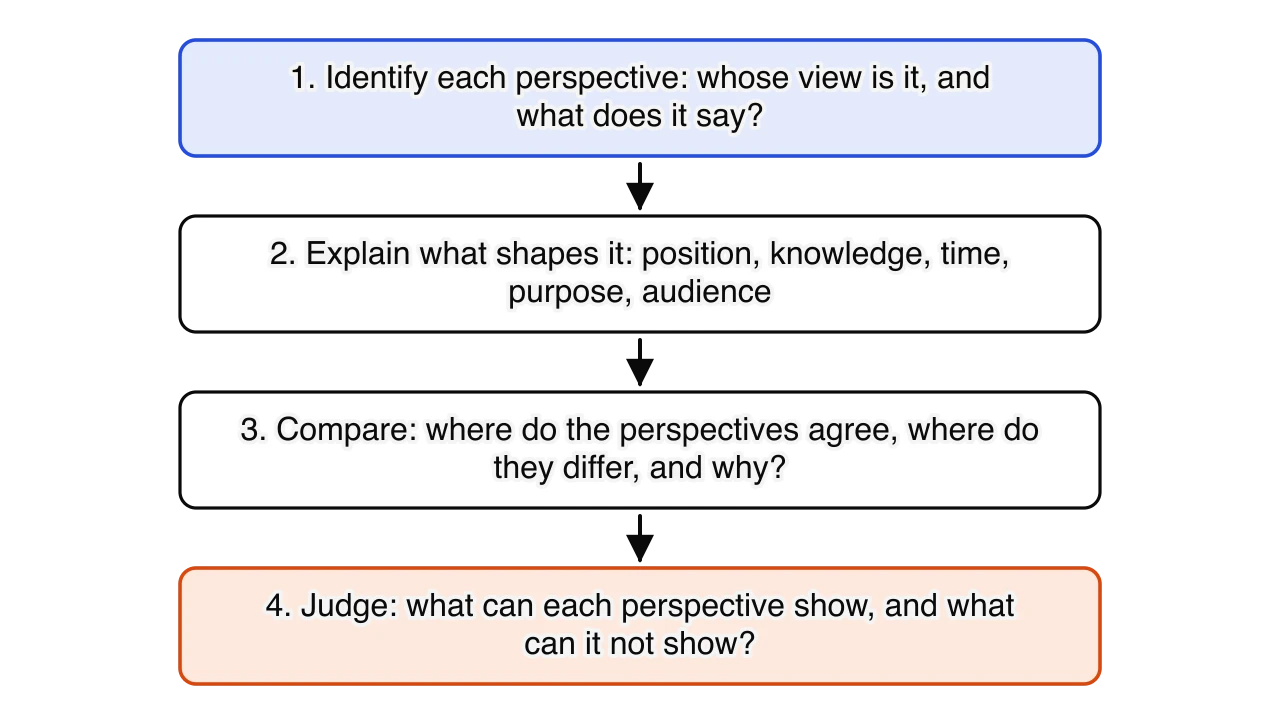
Identify each perspective precisely: whose view it is (a named person or a defined group, not "people"), and what they thought about the event.
Explain what shaped it, using the factors of position, knowledge, time, purpose, audience, ideology and censorship. Choose the factors that matter most for this perspective rather than listing all of them.
Compare the perspectives: where they agree (which strengthens a conclusion), where they differ, and why. Differences between perspectives are themselves evidence about the event.
Judge what each perspective allows a historian to say, and what it leaves out, then combine them into an account that none of them could give alone.
Grouping perspectives makes the comparison clearer. Perspectives can be grouped by role (decision-makers, participants, victims, observers), by side (government and opposition, colonisers and colonised), by time (contemporary and later) or by approach (orthodox and revisionist). The most useful grouping depends on the question.
The same method applies whichever thematic study is taken. The table of examples gives one event from each thematic study with the main perspectives on it.
Thematic study | Event | Contrasting perspectives |
|---|---|---|
Conflict | The atomic bombings of Hiroshima and Nagasaki (1945) | US decision-makers; the Japanese leadership; hibakusha and Korean victims; orthodox, revisionist and post-revisionist historians |
Innovation and transformation | Luddite machine-breaking (1811–1816) | Mill owners; the government (Frame Breaking Act, 1812); the workers; Byron; E. P. Thompson |
Authoritarian rule | The Great Leap Forward and famine (1958–1962) | Official propaganda in 1958; Peng Dehuai at Lushan in 1959; the Party's 1981 resolution; survivors; Yang Jisheng and Frank Dikötter |
Popular movements | British women's suffrage (1897–1918) | WSPU suffragettes; NUWSS suffragists; anti-suffragists; Asquith's government; Martin Pugh and June Purvis |
Each of these events also connects to the other historical concepts. Perspectives shape judgements of cause (was the famine caused by policy or by weather?), of change (did the suffrage campaign change women's position, or did the First World War?) and of significance (is Hiroshima remembered as the end of a war or as the start of the nuclear age?).
The focused studies are built on the same skill. In the Haitian Revolution, for example, the letters of General Leclerc to Napoleon in 1802 and the Haitian Declaration of Independence of 1804 give opposite perspectives on the same war, one from the commander of the French expedition and one from the new state that defeated it.
Concept questions on perspectives approach the concept from several angles: how one event was seen from different perspectives, why people at the time and later historians see events differently, how a person's position shaped their view, and why some voices are missing from the record. Each needs the same method, applied to one well-known example.
I can define a perspective and distinguish the perspectives of historical actors, of sources and of historians.
I can explain the difference between perspective and bias, and show how a biased source is still evidence.
I can explain how position, knowledge, time of writing, purpose, audience, ideology and censorship shape a perspective.
I can define historical empathy and presentism and explain why historians try to understand the past in its own terms.
I can distinguish primary and secondary sources and explain why neither is automatically more reliable.
I can explain what historiography is and describe orthodox, revisionist and post-revisionist interpretations.
I can outline the main schools of interpretation, including Marxist history, history from below, feminist history, subaltern studies and postcolonial history.
I can explain why interpretations change: new sources, new questions and the concerns of the present.
I can explain why marginalised perspectives are missing from the record and how historians recover them.
I can analyse perspectives on the atomic bombings of 1945: decision-makers, the Japanese leadership, survivors, Korean victims and historians.
I can apply the four-step method (identify, explain, compare, judge) to an example from my thematic study.
I can write a concept answer that analyses perspectives in two or three facets with precise evidence from one example.