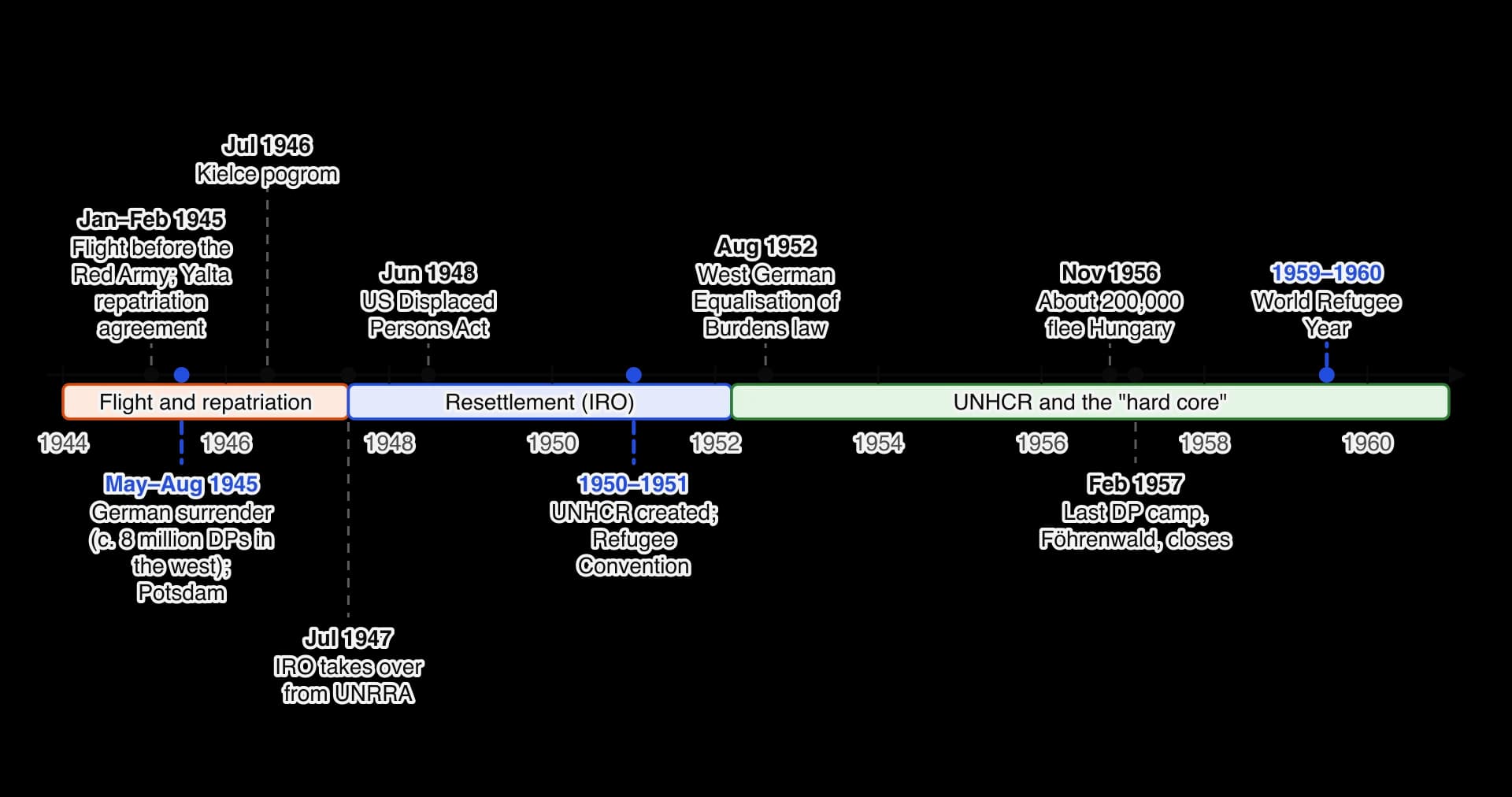
Explain why tens of millions of Europeans were uprooted in 1945–1950, how governments and the UN responded, and how survivors, refugees, expellees and former soldiers experienced displacement.
Each is in the History glossary, with every other term in the subject.
The body through which the four occupying powers (USA, USSR, Britain and France) governed Germany as a whole from 1945; in November 1945 it planned the reception of the Germans transferred from Eastern Europe.
A joint British–American committee that in April 1946 recommended the immediate admission of 100,000 Jewish displaced persons to Palestine; the British government did not accept the recommendation.
Hostility, prejudice and discrimination directed at Roma, Sinti and other groups labelled as "Gypsies".
The official Allied name for a camp where displaced persons were gathered, registered, fed and housed after 1945, usually before repatriation or resettlement.
Decrees issued by the Czechoslovak president Edvard Beneš in 1945 that, among other things, removed citizenship from most Germans and Hungarians in Czechoslovakia and confiscated their property.
The underground network (Hebrew for "flight") that moved Jewish survivors out of Eastern Europe to the DP camps of the western zones and towards Palestine in 1944–1948.
A declaration signed in Stuttgart on 5 August 1950 by leaders of German expellee associations, renouncing revenge and demanding equal rights, compensation and a "right to the homeland".
At the end of the Second World War in Europe, in May 1945, more people were displaced from their homes than at any earlier time in European history. Over the next fifteen years, governments, armies, United Nations agencies and charities tried to send them home, settle them elsewhere or absorb them, and in doing so created the international refugee system that still exists today.
With a free account, Augment remembers where you stopped and what you have practiced.
A boundary line between Poland and Soviet Russia proposed in 1919–1920; at Yalta in 1945 the Allies accepted it, roughly, as Poland's new eastern border.
In Allied usage after 1944, a civilian outside their own country because of the Second World War who needed help to return home or settle elsewhere; Germans were excluded. Today the term also covers people forced from their homes who remain inside their own country.
The US law of 25 June 1948, amended in 1950, that allowed displaced persons to enter the United States outside the normal quotas; about 400,000 DPs were admitted under it.
A camp in occupied Germany, Austria or Italy that housed, fed and registered displaced persons under Allied military and UN administration after 1945, usually organised by nationality.
The West German law of 1952 that taxed surviving property to compensate expellees and others who had lost homes and possessions in the war.
A displaced person recruited to work in Britain under government schemes of 1946–1949, usually in mills, mines, hospitals or farms.
A German or ethnic German forced out of, or not allowed to return to, a home in Eastern or Central Europe at the end of the Second World War.
The forcible removal of a population from its homes and from a state's territory by that state or its agents.
A Soviet camp in which returning soldiers, prisoners of war and deported civilians were interrogated by the secret police to decide whether they were loyal, collaborators or traitors.
Work done under compulsion by people who cannot leave, such as the millions of foreign civilians and prisoners of war deported to work in Nazi Germany.
The Soviet system of forced labour camps, run by the secret police, in which millions of prisoners were held from the 1930s to the 1950s.
The displaced persons, mostly the old, sick, disabled and those with tuberculosis, whom no resettlement country would accept and who remained in camps into the 1950s.
The report of August 1945 by Earl G. Harrison to President Truman on the conditions of displaced persons, especially Jews, in Germany and Austria, which led to separate and better camps for Jewish DPs.
The severe winter of 1946–1947, when food and fuel shortages left much of occupied Germany and Europe cold and underfed.
An organisation founded in 1951 to organise and pay for the transport of migrants and refugees from Europe overseas; it later became the International Organization for Migration.
The UN specialised agency that cared for refugees and displaced persons from 1947 to 1952; its main task was resettlement, and it resettled more than a million people.
The organisation at Bad Arolsen in Germany, set up after the war, that holds records of Nazi persecution and traces missing persons for families.
Italian soldiers disarmed by Germany after Italy changed sides in September 1943 and held as forced labourers without the rights of prisoners of war.
The killing of 42 Jews by a crowd including soldiers and police in Kielce, Poland, on 4 July 1946, which led tens of thousands of Polish Jews to flee the country.
An association of German expellees from the same home region, such as Silesia or the Sudetenland, formed in West Germany after the war.
The US programme of economic aid to Western Europe from 1948 to 1952, officially the European Recovery Program, worth about 13 billion dollars; it speeded recovery, helped absorb refugees and was meant to hold back communism.
The principle that a state must not return a refugee to a country where their life or freedom would be threatened; Article 33 of the 1951 Refugee Convention.
The border between Germany and Poland along the rivers Oder and western Neisse, set at Potsdam in 1945; it moved Poland westwards and led to the expulsion of the Germans east of it.
The name later given to the forced repatriation of Soviet citizens, many of them former soldiers, from the American zones to the USSR in 1946–1947.
The forced resettlement in 1947 of about 140,000 Ukrainians and Lemkos from south-eastern Poland to the former German territories in the west and north.
"Eastern workers": civilians from the occupied Soviet Union deported to work in Nazi Germany, who were made to wear an OST badge and lived under harsh controls.
The British law of 1947 that allowed Polish servicemen who would not return to communist Poland, and their families, to settle in Britain.
The genocide of Roma and Sinti by Nazi Germany and its allies; the Romani words mean "the devouring" and "mass killing".
The meeting of the USA, USSR and Britain from 17 July to 2 August 1945 that set the Oder–Neisse line, divided Germany into zones and accepted the transfer of Germans from Poland, Czechoslovakia and Hungary.
An escape route, mainly through Italy and Spain to South America, by which some Nazi war criminals and collaborators fled Europe after 1945.
A person outside their country of nationality who cannot or will not return because of a well-founded fear of persecution, as defined by the 1951 Refugee Convention. The word is also used more loosely for anyone who has fled war, persecution or violence.
The UN treaty adopted in Geneva on 28 July 1951 that defines a refugee as a person outside their country with a well-founded fear of persecution, and sets out refugees' rights, including protection from forced return. Its date and European limits were removed by the 1967 Protocol.
German citizens of the German Reich, as distinct from ethnic Germans who were citizens of other states.
The return of a person to their country of nationality or origin.
The permanent settlement of a refugee or displaced person in a third country, neither their home country nor the country where they first found refuge.
"The surviving remnant": the name Jewish Holocaust survivors in the displaced persons camps used for themselves.
Supreme Headquarters Allied Expeditionary Force, General Eisenhower's command of the western Allied armies in 1944–1945, which planned the first care and repatriation of displaced persons.
A person who is not recognised as a citizen by any state.
The Office of the United Nations High Commissioner for Refugees, created in December 1950, which protects refugees and supervises the 1951 Refugee Convention.
The United Nations Relief and Rehabilitation Administration (1943–1947), which provided relief to liberated countries and helped run displaced persons camps, with repatriation as its aim.
Ethnic Germans living outside Germany as citizens of other states, such as the Sudeten Germans or the Danube Swabians.
A charitable, often religious, organisation independent of governments, such as the JDC or the Red Cross, that provided relief and services to displaced persons.
The violent, largely unregulated expulsions of Germans from Poland and Czechoslovakia in May–July 1945, before the Potsdam Agreement.
A UN campaign from June 1959 to June 1960 to raise funds and close the remaining refugee camps in Europe and help refugees elsewhere.
The meeting of Roosevelt, Churchill and Stalin in February 1945 that agreed Poland's new borders, the division of Germany and the repatriation of liberated Soviet and Allied citizens.
The people uprooted by the war did not all have the same legal status, and the label a person received decided what help, if any, they would get. Allied officials, UN agencies and governments used several overlapping terms, and the differences between them run through the whole history of the period.
Allied planners at SHAEF (Supreme Headquarters Allied Expeditionary Force, General Eisenhower's command) used the term to separate foreigners brought into Germany by the Nazis from Germans. A DP was in principle someone the Allies had a duty to look after, unlike an enemy national.
In 1945 the Allies expected DPs to go home. A refugee, in the sense that developed after 1946, was someone with a recognised reason not to go home. The shift from one category to the other is a central theme of the period.
Volksdeutsche ("ethnic Germans") were people of German language and culture who were citizens of other states, such as the Sudeten Germans of Czechoslovakia or the Danube Swabians of Yugoslavia, Hungary and Romania.
Reichsdeutsche ("Reich Germans") were citizens of Germany, including the inhabitants of East Prussia, Silesia and Pomerania, provinces that were transferred to Poland and the USSR in 1945.
A stateless person has no nationality recognised by any state. Many DPs became stateless when their countries were annexed, as the Baltic states were by the USSR, or when they refused the citizenship of a new communist government.
Repatriation is the return of a person to their country of nationality; resettlement is their permanent settlement in a third country, such as the United States or Australia.
No one counted Europe's uprooted people accurately in 1945, and historians give ranges. The figure most often cited, from Mark Wyman and others, is that more than 40 million Europeans were displaced at the end of the war, including evacuees, prisoners of war and the Germans who fled from the east. The table of the main groups shows the orders of magnitude.
Group | Approximate number | Where they were in 1945 |
|---|---|---|
Foreign civilian workers and prisoners of war working in the Reich | c. 7.6 million (autumn 1944) | Factories, farms and mines across Germany and Austria |
Displaced persons found by the western Allies | c. 7–8 million (mid-1945) | Western zones of Germany and Austria; smaller numbers in Italy |
Germans who fled or were expelled from Eastern Europe | c. 12–14 million (1944–1950) | On the move westwards; most reached the four zones of Germany by 1950 |
Jewish displaced persons | c. 250,000 at the peak (1947) | Camps in the US zone of Germany, Austria and Italy |
The "last million": DPs who would not return home | c. 1 million (1947) | Camps in Germany, Austria and Italy |
Data: estimates from Ulrich Herbert, Hitler's Foreign Workers (1997); Mark Wyman, DPs: Europe's Displaced Persons, 1945–1951 (1989); R. M. Douglas, Orderly and Humane (2012). All figures are approximate and the groups overlap.
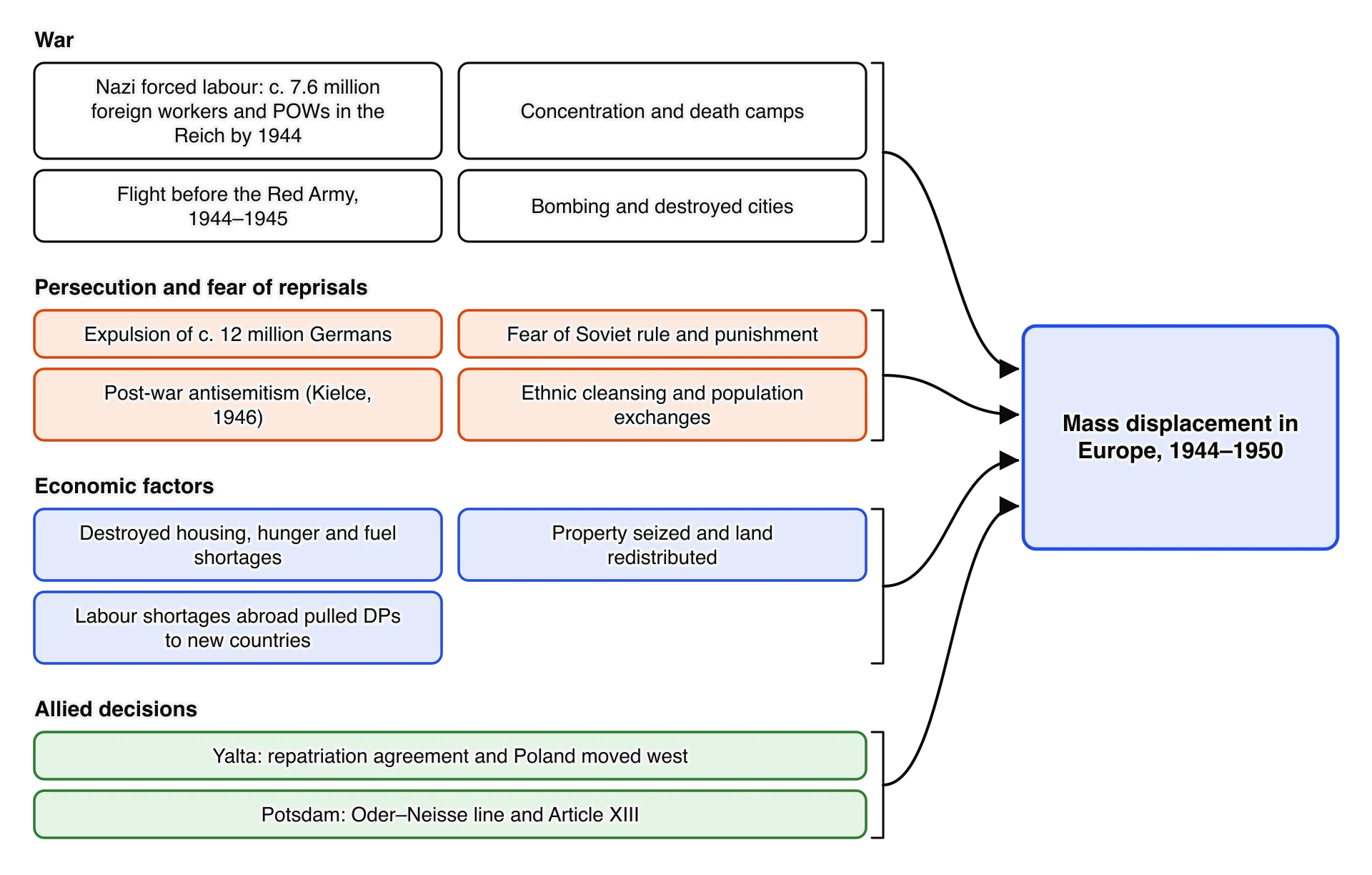
Displacement in post-war Europe had several causes, which worked over different timescales and affected different groups. The diagram of conditions groups them under war, persecution and fear of reprisals, economic factors and the decisions of the Allied governments.
The largest group of displaced persons in 1945 had been brought to Germany by the Nazi regime. To keep its war economy going while millions of German men served in the armed forces, the regime recruited and then forcibly deported workers from occupied Europe. According to the historian Ulrich Herbert, German records counted about 7.6 million foreign civilian workers and prisoners of war employed in the Reich in the autumn of 1944, about a quarter of the workforce.
The largest groups came from Poland and the occupied Soviet Union. The Ostarbeiter ("eastern workers") from Soviet territory, many of them young women from Ukraine, were paid little, wore a badge marking them as "OST" and lived in guarded camps. Workers from France, Belgium and the Netherlands were treated better, a racial ranking that reflected Nazi ideology.
Alongside them were the prisoners of the concentration camp system and the few survivors of the extermination camps. As the Allied armies advanced, the SS evacuated camps in the east and drove prisoners west on death marches in the winter of 1944–1945, so when Soviet troops reached Majdanek (July 1944) and Auschwitz (27 January 1945) most prisoners had already been moved. When western Allied troops reached the camps inside Germany, at Buchenwald (11 April 1945), Bergen-Belsen (15 April) and Dachau (29 April), they found thousands of sick and starving survivors from all over Europe.
The second great movement was flight. When the Red Army entered East Prussia in October 1944 and launched its main offensive in January 1945, millions of Germans fled west, often too late because Nazi officials had forbidden evacuation. Treks of horse-drawn carts crossed frozen lagoons, and ships evacuated civilians and soldiers across the Baltic. On 30 January 1945 a Soviet submarine sank the Wilhelm Gustloff, a liner carrying refugees from Gotenhafen (Gdynia); about 9,000 people died, probably the largest loss of life in the sinking of a single ship.
Inside Germany, Allied bombing had destroyed much of the housing in the large cities, and millions of women, children and elderly people had been evacuated to the countryside. At the surrender many were far from home. Together, forced labour, the camps, flight and evacuation explain why so many people were in the wrong place in May 1945, before any post-war policy had been made.
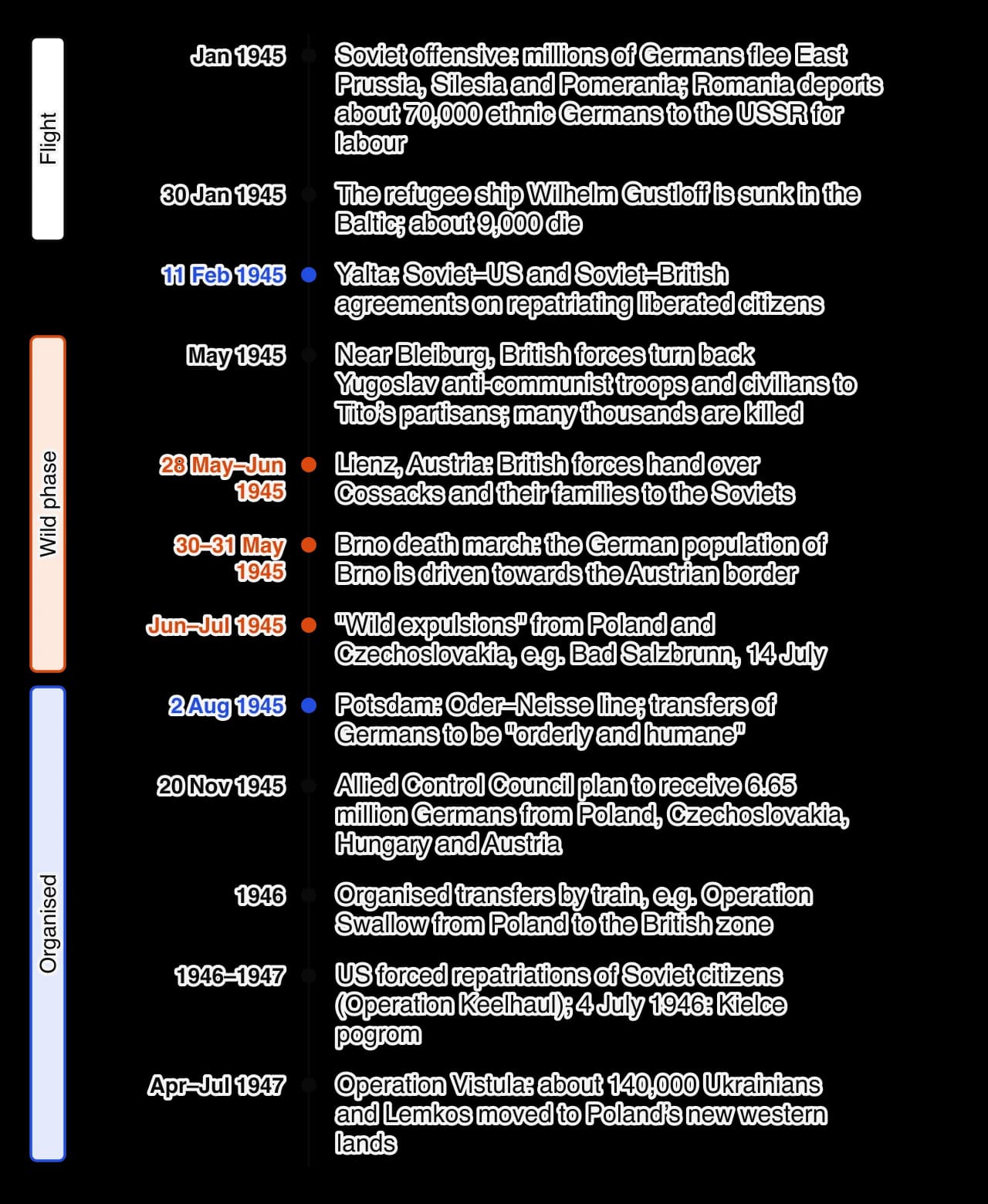
The third cause was deliberate policy. At the Yalta Conference in February 1945, Roosevelt, Churchill and Stalin agreed that Poland's eastern frontier would follow roughly the Curzon Line, so the USSR kept the eastern Polish lands it had occupied in 1939. Poland would be compensated in the west with German territory. A change of borders on this scale meant moving millions of people. Churchill had explained the logic to the House of Commons in December 1944.
The transference of several millions of people would have to be effected from the East to the West or North, as well as the expulsion of the Germans—because that is what is proposed: the total expulsion of the Germans—from the area to be acquired by Poland in the West and the North. For expulsion is the method which, so far as we have been able to see, will be the most satisfactory and lasting. There will be no mixture of populations to cause endless trouble, as has been the case in Alsace-Lorraine. A clean sweep will be made.
Winston Churchill, speech to the House of Commons, 15 December 1944 (Hansard). Churchill was defending the Soviet demand for eastern Poland and persuading MPs to accept it. The speech shows that the British government planned expulsion as a method of making peace, with the population exchange between Greece and Turkey after 1923 in mind. It says nothing about how the expulsions would be carried out, which was the question that later mattered most to the people expelled.
At Yalta the Allies also signed agreements on prisoners of war and liberated civilians. Their first article set out what would happen to Soviet citizens freed by the western armies.
All Soviet citizens liberated by the forces operating under United States command and all United States citizens liberated by the forces operating under Soviet command will, without delay after their liberation, be separated from enemy prisoners of war and will be maintained separately from them in camps or points of concentration until they have been handed over to the Soviet or United States authorities, as the case may be, at places agreed upon between those authorities.
Agreement relating to prisoners of war and civilians liberated by forces operating under Soviet command and forces operating under United States of America command, Yalta, 11 February 1945, Article 1. A similar agreement was signed with Britain. The western governments wanted the quick return of their own prisoners held in camps that the Red Army had overrun. The text does not mention the wishes of the people to be handed over, and its wording, "all Soviet citizens", became the basis for forced repatriation.
The Potsdam Conference (17 July–2 August 1945) settled the new map. Pending a peace treaty, the German lands east of the rivers Oder and western Neisse were placed under Polish administration, and the northern half of East Prussia under Soviet rule. The conference also accepted the expulsions that were already under way.
The Three Governments, having considered the question in all its aspects, recognize that the transfer to Germany of German populations, or elements thereof, remaining in Poland, Czechoslovakia and Hungary, will have to be undertaken. They agree that any transfers that take place should be effected in an orderly and humane manner.
Potsdam Agreement, section on the "Orderly transfer of German populations" (Article XIII of the Protocol), 1 August 1945. The wording "will have to be undertaken" presents the transfers as unavoidable, and the request that they be "orderly and humane" was in part a reaction to the violent expulsions of the summer. The same article asked Poland and Czechoslovakia to suspend expulsions until the Allied Control Council had planned how to receive the expellees, which shows the occupying powers' concern about the burden on their zones as much as about the expellees themselves.
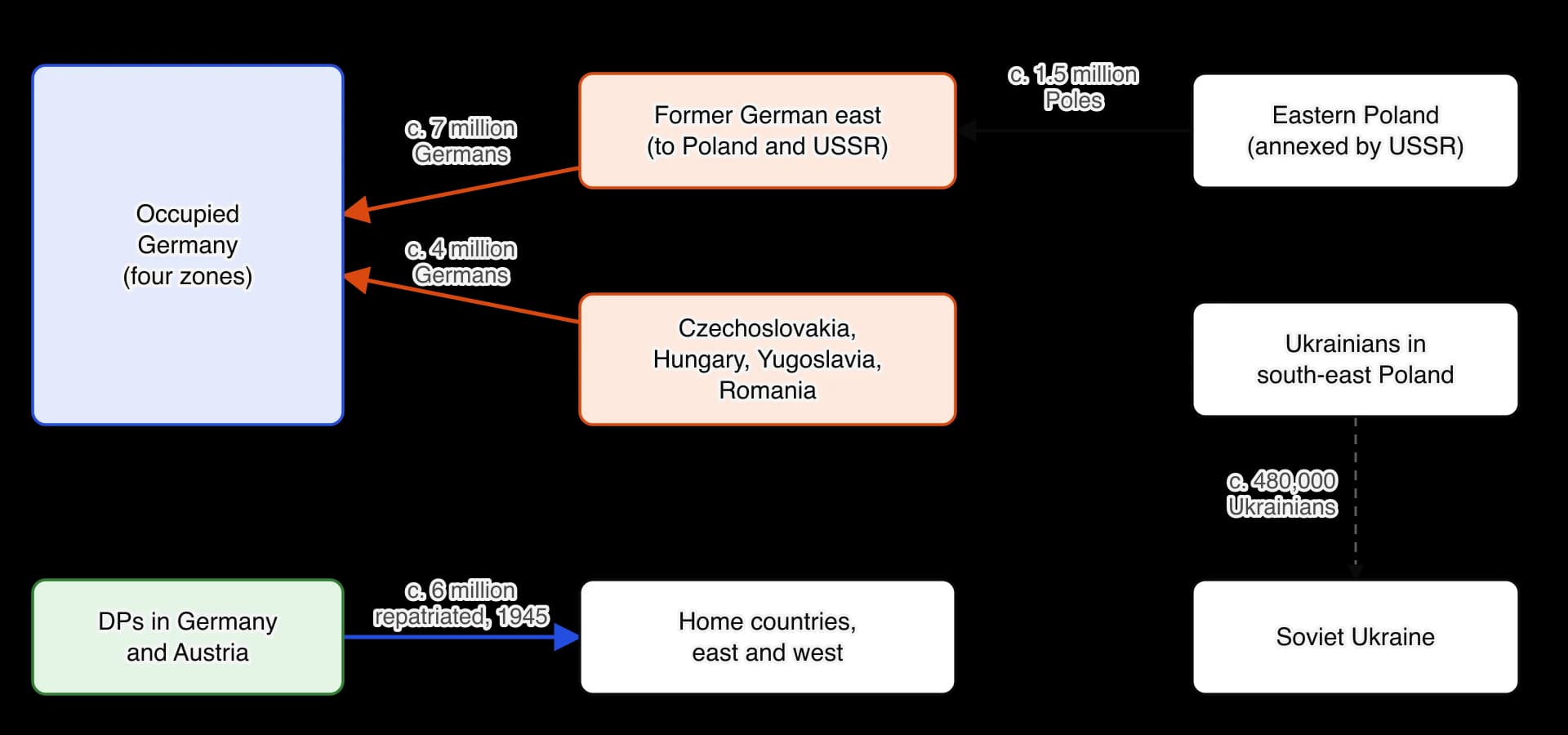
The diagram of population movements shows how Allied border decisions joined separate migrations into one chain. Poles left the eastern lands annexed by the USSR and were settled in the homes of Germans expelled from Silesia and Pomerania, while Ukrainians were moved in the opposite direction. The Oder–Neisse line remained Poland's western border, and West Germany recognised it only in 1970.
War explains why so many people were uprooted in 1945. Persecution and fear explain why millions of them were driven out after the fighting ended, or could not or would not return to the places they had come from. Three groups were affected most: Germans in the east, people who feared Soviet and communist rule, and Jewish survivors.
About 12 to 14 million Germans fled or were expelled from Eastern and Central Europe between 1944 and 1950, the largest forced population movement in European history. Most came from the former German provinces east of the Oder–Neisse line, from the Sudetenland in Czechoslovakia, and from the German minorities of pre-war Poland, Hungary, Yugoslavia and Romania.
Historians usually divide the expulsions into two phases. The "wild expulsions" of May–July 1945 were carried out by soldiers, militias and local officials, often with great violence. On 30–31 May 1945 most of the German population of Brno, about 20,000–27,000 people, mainly women, children and the elderly, were driven on foot towards the Austrian border; estimates of the deaths range from about 1,700 to more than 5,000. In Yugoslavia, the new communist authorities interned most of the Danube Swabians who had not fled in camps such as Gakovo and Rudolfsgnad (Knićanin) from late 1944; tens of thousands died there of hunger and disease before the camps were closed in 1948, and most survivors then left for Austria and Germany. The organised transfers of 1946–1947 followed the plan of the Allied Control Council of 20 November 1945 and moved people by train to the occupation zones.
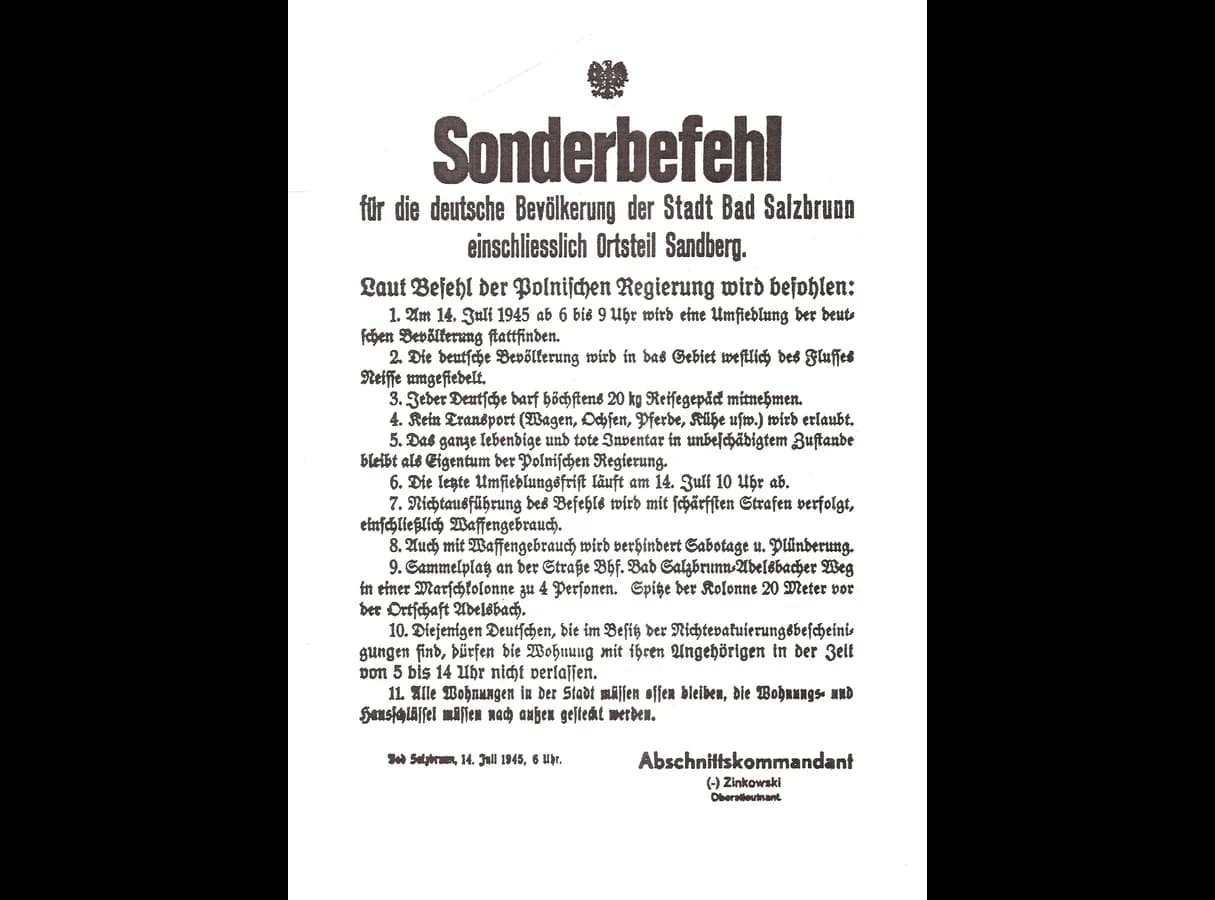
The order to the Germans of Bad Salzbrunn shows how the "wild" expulsions worked in practice. Translated from the German, its main points read:
1. On 14 July 1945, from 6 to 9 a.m., there will be a resettlement of the German population. 2. The German population will be resettled in the area west of the river Neisse. 3. Every German may take at most 20 kg of luggage. 4. No transport (wagons, oxen, horses, cows, etc.) is permitted. 5. All livestock and equipment remain, in undamaged condition, the property of the Polish government.
Sonderbefehl (special order) for the German population of Bad Salzbrunn, issued by Lieutenant-Colonel Zinkowski, section commander, 14 July 1945 (translation from the German). The order was issued by an army officer "by order of the Polish government", so it shows that the expulsion was state policy, not mob violence. It also shows the economic side of expulsion: the property left behind passed to the Polish state and to Polish settlers arriving from the east.
The motives for the expulsions combined revenge, security and nation-building. Six years of German occupation had killed millions of Poles and Czechs, and many people held the German minorities collectively responsible: the Sudeten German Party had campaigned for the destruction of Czechoslovakia in 1938, and many ethnic Germans had served the occupiers. The Czechoslovak president Edvard Beneš and the Polish communists argued that a state without German minorities could never again be broken up by Germany.
The Beneš decrees of 1945, issued by President Beneš before a parliament was elected, deprived most Germans and Hungarians in Czechoslovakia of their citizenship and confiscated their property. In Poland, the new communist authorities used the redistribution of German farms and houses to win support among Polish settlers. Persecution was therefore also a policy with economic and political rewards.
The human cost is disputed. In 1958 the West German government estimated that more than 2 million expellees had died or were unaccounted for, but this figure included people who could not be traced. Research since the 1990s by German and Czech historians, discussed by R. M. Douglas (2012), suggests that at least 500,000–600,000 deaths can be documented, from violence, hunger, disease and the conditions of internment camps such as Lamsdorf (Łambinowice) in Poland. Historians agree that the "orderly and humane" transfers promised at Potsdam did not happen in practice for many expellees.
 YouTube
A second group refused to go home because they feared what would happen to them. In 1945 Soviet law treated soldiers who surrendered as traitors, and Soviet citizens who had worked in Germany, even as deportees, were suspected of collaboration. Returnees passed through NKVD (Soviet secret police) filtration camps, where they were interrogated. Most were eventually allowed home or sent to labour battalions, but a substantial minority were sentenced to the Gulag, and nearly all faced discrimination for years.
Under the Yalta agreements, the western Allies handed over more than two million Soviet citizens in 1945–1946. Most went willingly, but some resisted with hunger strikes and suicide. At Lienz in Austria, from 28 May to early June 1945, British troops handed over Cossacks who had fought for Germany together with their wives and children, including some émigrés who had left Russia after 1917 and had never been Soviet citizens. At Dachau and Plattling in early 1946, American troops forcibly repatriated Soviet former soldiers in operations later known as Operation Keelhaul.
Forced repatriation troubled many western officers, and western policy changed quickly. The United States and Britain decided that people from territories annexed by the USSR after 1939 (the Baltic states, eastern Poland, western Ukraine) were not Soviet citizens for the purposes of Yalta, and by 1947 forced return had been limited to proven collaborators and war criminals. Baltic, Ukrainian and many Polish DPs therefore stayed in the West. Their reasons included fear of arrest, Soviet deportations from the Baltic states (about 90,000 people in March 1949 alone) and opposition to communism.
Jewish survivors who tried to return to their homes in Eastern Europe often found their families murdered, their houses occupied and their neighbours hostile. In Poland, hundreds of Jews were killed between 1944 and 1947. The worst attack, the Kielce pogrom of 4 July 1946, began with a false rumour that Jews had kidnapped a Christian boy; a crowd that included soldiers and police killed 42 Jews.
Kielce convinced many Polish Jews that they had no future in Poland. The Bricha ("flight" in Hebrew), an underground network organised by Zionist activists and Jewish soldiers, moved tens of thousands of Jews across the Czechoslovak and Austrian borders to the DP camps of the US zone of Germany in the following months. As a result, the number of Jewish DPs in Germany rose after 1946, at a time when most other DPs were leaving.
The expulsion of Germans was part of a wider reshaping of the region into more homogeneous national states. Between 1944 and 1946, agreements between the Polish Committee of National Liberation and the Soviet republics exchanged populations across the new border: about 1.5 million Poles moved west from the lands annexed by the USSR, and about 480,000 Ukrainians were moved from Poland to Soviet Ukraine, many of them by force.
Operation Vistula (April–July 1947): the Polish army deported about 140,000 Ukrainians and Lemkos from south-eastern Poland to the former German lands in the west and north, scattering them to break support for the Ukrainian Insurgent Army.
Istria and Dalmatia: between about 1945 and 1956 an estimated 250,000–350,000 Italians left the territories that passed to Yugoslavia, after killings by Yugoslav partisans and under pressure from the new communist authorities.
Czechoslovakia and Hungary: under a 1946 agreement, tens of thousands of Hungarians from Slovakia were exchanged for Slovaks from Hungary, and others were deported to work in the Czech lands.
Economic conditions did not usually start a person's displacement, but they shaped whether and where they moved. In 1945–1948 Europe faced a severe shortage of housing, food and fuel, and the destruction of homes and the seizure of property kept millions on the move.
About a fifth of Germany's housing had been destroyed, and far more in the big cities. Millions of expellees therefore arrived in a country that had nowhere to put them. They were sent mainly to rural areas of Schleswig-Holstein, Lower Saxony and Bavaria, where they were billeted in the homes of local people, often against their will, or housed in camps and barracks for years.
Food was scarce across the continent. In the British zone the official ration fell to about 1,000 calories a day in the spring of 1946, and the "hunger winter" of 1946–1947 was the coldest for decades. DPs in camps often received larger rations than German civilians, one reason why some stayed in the camps rather than leave to find work. Typhus and other diseases spread among refugees and in crowded camps, which is why arriving DPs were dusted with DDT powder before registration. Poverty in the countries they had come from also discouraged return: much of Poland, Ukraine and Belarus had been devastated.
The confiscation of property was both a result of displacement and a cause of it. In Poland and Czechoslovakia, German farms, houses and businesses were handed to new settlers, so expulsion created economic winners among the receiving population. In the Soviet zone of Germany, land reform in 1945 broke up the large estates, and the dismantling of factories as reparations for the USSR cut the number of jobs available to newcomers. As the new communist governments nationalised industry and, from 1948–1949, began to collectivise agriculture, more people left for economic as well as political reasons.
Displacement also responded to economic pull. After 1946 several countries recruited DPs to fill labour shortages, and their selection criteria shaped who was able to leave the camps.
Britain recruited about 80,000 DPs as European Volunteer Workers in 1946–1949, mainly young single people, through schemes such as "Westward Ho!" (1947), to work in textile mills, mines, hospitals and farms.
Belgium recruited DPs as coal miners; France, Canada and Australia offered contracts in agriculture, forestry, construction and domestic service.
Australia obliged DPs to work for two years wherever the government sent them, in return for passage and permanent residence.
Economic motives continued after the DP camps emptied. About 2.7 million people left East Germany for the West between 1949 and the building of the Berlin Wall in 1961, attracted by higher wages and greater freedom, and about 200,000 people fled Hungary after the Soviet suppression of the uprising of November 1956.
The response to displacement was shaped by three kinds of actor: the Allied armies and governments, which held power on the ground; the international organisations created to help; and the voluntary agencies, which supplied much of the daily care. Each had different aims, and their priorities changed between 1945 and 1960.
Allied planning assumed that DPs would go home quickly. As the armies advanced, they set up assembly centres in barracks, factories, former labour camps and even concentration camps, registered the DPs by nationality, and sent them home by train and truck. By the end of September 1945, less than five months after the surrender, about 6 million DPs had been repatriated, including almost all the French, Belgians, Dutch and Italians, and most Soviet citizens.
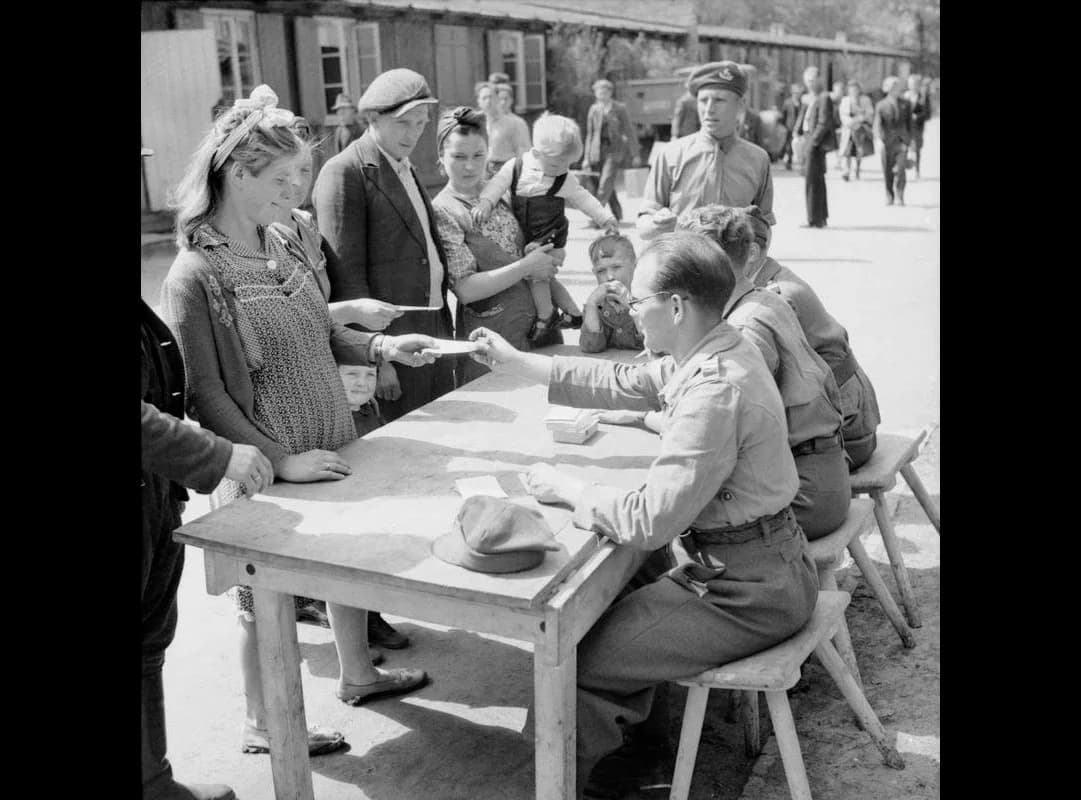
Repatriation was fast because it suited everyone in charge. Western governments wanted their own citizens back; the Soviet government demanded the return of all its citizens; and the military authorities wanted to empty the camps and reduce the cost of feeding them. For most western Europeans, going home was what they wanted too.
By 1946 about a million DPs remained, and most refused to return. They were mainly Poles, Ukrainians, Lithuanians, Latvians and Estonians who would not live under communist rule, together with Yugoslav anti-communists and a growing number of Jewish survivors. They lived in several hundred DP camps in the western zones of Germany and Austria and in Italy, organised by nationality and run by the military authorities with UNRRA teams.
The camps developed a life of their own. DPs elected camp committees, opened schools and churches, published newspapers in their own languages, and ran theatres, choirs and sports clubs; in Munich, UNRRA supported a university for DP students. For national groups that had lost their states, such as the Balts, the camps became places to preserve a national culture in exile. Yet camp life also meant crowded rooms in former barracks, little paid work, a black market and long uncertainty about the future.
Germans often resented the DPs, who received better rations and were blamed for black-market trading and crime. Many western officers also saw the remaining DPs as a burden. In April 1947 the American military governor, General Lucius Clay, closed the camps in the US zone to new arrivals.
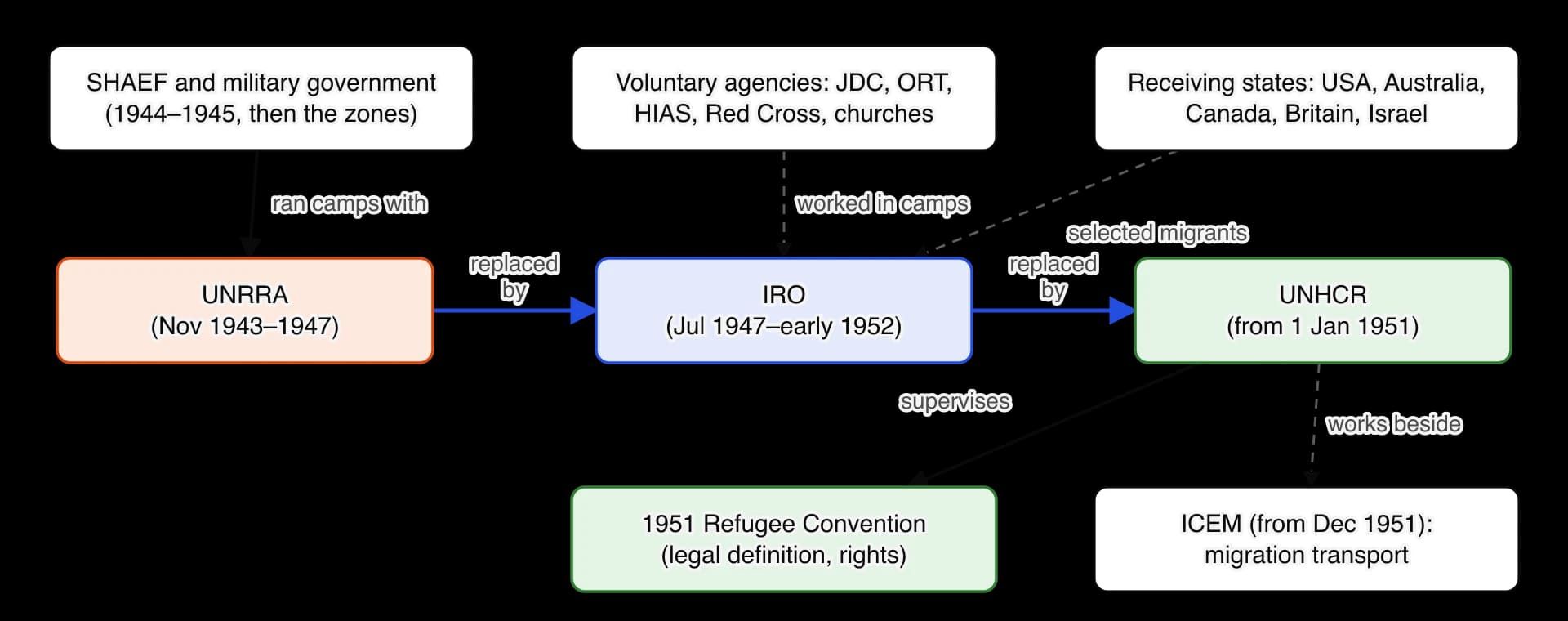
The refusal of the "last million" forced a change of policy. The western powers would not send them home by force, but the camps could not last for ever, so the only solution was resettlement in other countries. The chain from repatriation to resettlement shows how the policy changed between 1945 and 1960.

The change was also political. Soviet and Polish officials argued that the non-returners were collaborators or the victims of anti-communist propaganda in the camps, and demanded their return. Western governments increasingly presented them as people who had chosen freedom. The disagreement helped to end UNRRA and led to its replacement in 1947 by the International Refugee Organization (IRO), whose main task was resettlement.
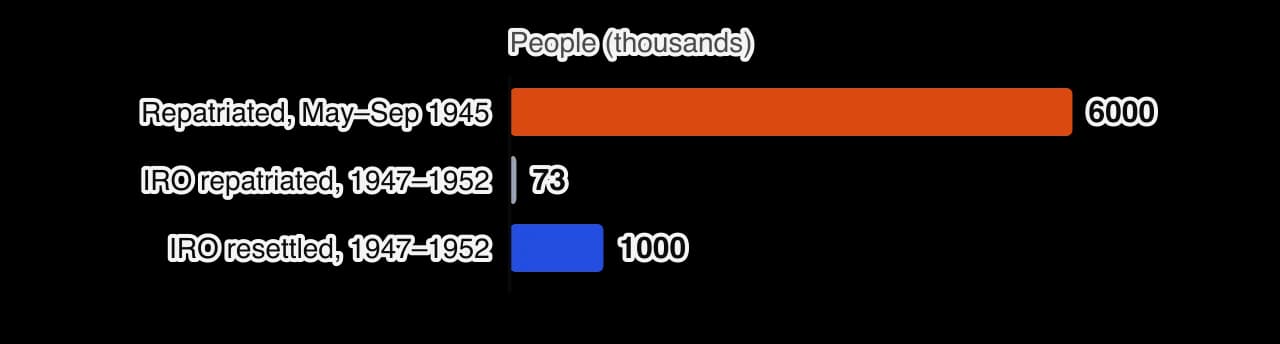
The bar chart of repatriation and resettlement shows the scale of the change. In the five months after the war, about 6 million people were sent home. Under the IRO, from 1947 to early 1952, more than a million were resettled and only about 73,000 repatriated.
Resettlement depended on the willingness of other countries to take DPs, and most chose them on economic, political and ethnic grounds. The table of the main resettlement schemes compares the destinations.
Destination | Scheme and dates | Approximate numbers | Who was chosen |
|---|---|---|---|
United States | Displaced Persons Act, 25 June 1948 (amended 1950) | About 400,000 DPs by 1952 | Quotas favoured Balts and farm workers; the original cut-off date of 22 December 1945 excluded most Jewish DPs until the 1950 amendment |
Australia | Agreement with the IRO, July 1947; first ship arrived November 1947 | About 170,000 DPs by the early 1950s | Young, fit workers on two-year labour contracts; Balts favoured at first |
Britain | European Volunteer Workers (1946–1949); Polish Resettlement Act 1947 | About 80,000 EVWs; more than 100,000 Polish ex-servicemen in the Polish Resettlement Corps, plus their families | Single workers for mills, mines and hospitals; Polish soldiers who would not return to communist Poland |
Canada | Bulk labour and family schemes from 1947 | More than 120,000 DPs | Workers for farms, forests, mines and domestic service |
Palestine / Israel | Illegal immigration until May 1948; open entry after the founding of Israel | About 136,000 Jewish DPs (most of the total) | Jewish survivors of all ages; entry open to all Jews from 1948 |
Latin America | Bilateral schemes with Argentina, Brazil, Venezuela and others | Tens of thousands | Farm workers and skilled tradesmen |
Data: Wyman (1989); Shephard (2010); United States Holocaust Memorial Museum (Jewish DPs to Israel); national immigration records. Figures are approximate and include family members.
In the United States, Congress debated for two years before passing the Displaced Persons Act of June 1948. Its terms provoked the president himself to criticise the law he signed.
The primary device used to discriminate against Jewish displaced persons is the provision restricting eligibility to those displaced persons who entered Germany, Austria, or Italy on or before December 22, 1945. Most of the Jewish displaced persons who had entered Germany, Austria, or Italy by that time have already left; and most of the Jewish displaced persons now in those areas arrived there after December 22, 1945, and hence are denied a chance to come to the United States under this bill.
Harry S. Truman, statement on signing the Displaced Persons Act, 25 June 1948. Truman issued the statement in an election year, when he was competing with a Republican Congress and seeking the support of Jewish and Catholic voters, so it is also a political attack on Congress. Its value lies in showing how a resettlement law could reproduce the exclusion of particular groups: the cut-off date shut out Jews who had fled Poland after Kielce, as well as Catholic refugees from communist countries.
The law was amended in 1950 to remove the discriminatory date. Other countries were equally selective. Australia's immigration minister, Arthur Calwell, chose fair-haired Baltic DPs for the first transport in November 1947 to win public support for non-British immigration under the White Australia policy. Selection by health, age and occupation meant that resettlement favoured those most able to work.
Most Jewish DPs wanted to go to Palestine, then a British mandate. Britain limited Jewish immigration to avoid a conflict with Palestine's Arab majority, so the Zionist movement organised illegal immigration by sea. In July 1947 the British navy intercepted the Exodus 1947, carrying about 4,500 DPs, and sent its passengers back to camps in Germany, which caused international outrage. From August 1946 to 1949, more than 50,000 Jews caught trying to enter Palestine were held in British camps in Cyprus. After the State of Israel was founded on 14 May 1948, the Jewish DP camps emptied quickly.
The expellees were the largest group of all, but they were not DPs and did not leave Europe. They had to be absorbed by a defeated, divided and impoverished Germany. The table compares how the two German states dealt with them.
West Germany (Federal Republic) | East Germany (GDR) | |
|---|---|---|
Number in 1950 | About 7.9 million expellees, about 16 per cent of the population | About 4 million, roughly a fifth of the population |
Official name | Vertriebene ("expellees") | Umsiedler ("resettlers"), later not mentioned at all |
Policy | Equalisation of Burdens law (1952), Federal Expellee Law (1953), a federal ministry for expellees | Land reform plots for some; recognition of the Oder–Neisse line as a "border of peace" (1950) |
Political voice | Expellee associations and their own party (BHE), part of the government from 1953 | No independent organisations allowed |
Data: West German census of 1950; East German statistics as cited by Douglas (2012).
In West Germany expellees organised into associations based on their home regions (Landsmannschaften), and in 1950 their representatives published a declaration of their aims.
We, the expellees, renounce all thought of revenge and retaliation. Our resolution is solemn and sacred in memory of the infinite suffering brought upon mankind, particularly during the past decade. … We have lost our homeland. The homeless are strangers on the face of the earth. God himself placed men in their native land. To separate man forcibly from his native land means to kill him in his mind.
Charter of the German Expellees, Stuttgart, 5 August 1950 (English translation published by Alfred de Zayas). The Charter was written by the leaders of expellee associations who wanted equal rights in West Germany and international recognition of a "right to the homeland". Its renunciation of revenge was designed to reassure the Allies and other Germans in the early Cold War. Critics note that it speaks of the "suffering brought upon mankind" without naming the Nazi crimes that preceded the expulsions.
The most important integration measure was the Equalisation of Burdens law (Lastenausgleich) of August 1952. It placed a levy of up to half the value of property that had survived the war, payable over 30 years, and used the money to compensate expellees and bombed-out Germans for their losses. Together with the rapid economic growth of the 1950s, it allowed most expellees to find work and housing within a decade, although many remained poorer than the local population for longer.
Until the summer of 1945 SHAEF controlled the DP operation in western Germany through its DP branch. After SHAEF was dissolved in July 1945, each occupying power ran the DPs in its own zone through its military government. Their approaches differed. The Soviet authorities allowed no DP camps in their zone and sent all Soviet citizens home. The Americans, whose zone in Bavaria and Hesse held the most DPs, became the most generous hosts after 1945. The British and French, short of money and food, were keener to reduce numbers.
Policy in the American zone changed after the Harrison Report. In June 1945 President Truman sent Earl G. Harrison, a former US Commissioner of Immigration and the dean of the University of Pennsylvania law school, to investigate the condition of DPs, especially Jews, in the US zone. Harrison travelled with Joseph Schwartz of the American Jewish Joint Distribution Committee and reported in August 1945.
As matters now stand, we appear to be treating the Jews as the Nazis treated them except that we do not exterminate them. They are in concentration camps in large numbers under our military guard instead of S.S. troops. One is led to wonder whether the German people, seeing this, are not supposing that we are following or at least condoning Nazi policy.
Earl G. Harrison, report to President Truman on displaced persons in Germany and Austria, August 1945 (published 29 September 1945). Harrison wrote for a president who could order changes, and he used deliberately shocking language to force them. The report is valuable evidence of conditions in the summer of 1945, but its comparison with Nazi camps is a rhetorical exaggeration that the army resented, and it says little about the work of the officers who had organised the repatriation of millions.
Harrison argued that Jews had been persecuted as Jews, not as Poles or Hungarians, and should be recognised as a separate group. Truman sent the report to General Eisenhower, who ordered separate camps for Jewish DPs, better rations and housing, and the appointment of an adviser on Jewish affairs. Harrison also recommended that 100,000 Jews be admitted to Palestine. In April 1946 an Anglo-American Committee of Inquiry repeated this recommendation, but the British government refused to accept it.
From 1946 the question of the DPs became part of the Cold War. Soviet, Polish and Yugoslav governments sent repatriation missions into the camps and accused the West of keeping their citizens to use as cheap labour or as anti-communist soldiers. Western governments came to see the anti-communist DPs as evidence that people were fleeing communism. The US-funded Marshall Plan (1948–1952) helped Western European recovery, which created jobs for refugees and made it easier for West Germany to absorb the expellees.
Much of the daily care in the camps came from voluntary agencies (non-governmental organisations), many of them religious. They supplied food, clothing, medicine, schools and training, traced relatives and organised emigration.
Agency | What it did |
|---|---|
American Jewish Joint Distribution Committee (JDC, the "Joint") | Funded food, clothing, schools and religious life in Jewish DP camps; supported the Bricha |
ORT | Vocational training for Jewish DPs, to prepare them for work in a new country |
HIAS (Hebrew Immigrant Aid Society) | Organised the emigration of Jewish DPs, especially to the Americas |
Catholic, Lutheran and other church agencies; the World Council of Churches (1948) | Relief and resettlement for Christian DPs and expellees; sponsorship of migrants |
Quakers (Friends Relief Service, American Friends Service Committee) | Relief teams in camps and in devastated German cities |
International Committee of the Red Cross (ICRC) | Tracing of missing persons; travel documents for stateless people |
The agencies also had their own agendas. Jewish agencies supported the Zionist aim of emigration to Palestine, and church agencies sponsored members of their own faith. The ICRC issued travel documents to people without passports, and a number of Nazi war criminals, including Adolf Eichmann in 1950, used such papers to escape to South America. Tracing the missing became the work of the International Tracing Service at Bad Arolsen in Germany, whose archive still answers enquiries from families today (as of 2026).
Three international organisations dealt with Europe's displaced people in turn. Each was created for a particular purpose, and each reflected the politics of the moment it was founded.
The United Nations Relief and Rehabilitation Administration (UNRRA) was founded on 9 November 1943 by 44 Allied nations, before the United Nations Organisation itself existed. It provided relief to liberated countries such as Poland, Yugoslavia and Greece, and from 1945 it supplied teams of doctors, nurses and welfare workers to run DP camps under military control. The United States provided about 70 per cent of its funding.
UNRRA's mandate was to help DPs to go home. Its leaders, Herbert Lehman and then Fiorello La Guardia, supported repatriation, and UNRRA staff in the camps were accused by Western critics of pressing DPs to return to communist countries. When Washington refused to keep funding an agency in which the Soviet bloc had a voice and which spent most of its money in Eastern Europe, UNRRA was wound up; its DP work ended in June 1947.
The International Refugee Organization (IRO) was created by a constitution adopted by the UN General Assembly on 15 December 1946 and began work, through a preparatory commission, on 1 July 1947. The USSR and its allies refused to join it, because its constitution accepted that people with "valid objections" could refuse to return home. These included fear of persecution and objections of a political nature. War criminals, collaborators and ethnic Germans were excluded from its help.
The IRO's main achievement was resettlement. It ran its own fleet of chartered ships, negotiated labour schemes with receiving countries, and by early 1952 had resettled more than a million people, mainly in the United States, Australia, Israel, Canada and Western Europe. It also screened DPs to decide who was eligible, a process that many experienced as humiliating and that let some collaborators through.
The IRO was always meant to be temporary, but by 1950 it was clear that refugees remained a permanent problem in Europe, as people continued to flee communist countries. The UN General Assembly created the Office of the United Nations High Commissioner for Refugees (UNHCR) on 14 December 1950. It began work on 1 January 1951 under the Dutch journalist Gerrit van Heuven Goedhart, with a small staff, a three-year mandate and a tiny budget, because the United States preferred to fund its own programmes. UNHCR won the Nobel Peace Prize in 1954.
Unlike the IRO, UNHCR did not resettle people itself. Its job was international protection: to make sure refugees had legal rights in the countries where they lived. The basis of that protection was the 1951 Refugee Convention, adopted at a conference in Geneva on 28 July 1951.
As a result of events occurring before 1 January 1951 and owing to well-founded fear of being persecuted for reasons of race, religion, nationality, membership of a particular social group or political opinion, is outside the country of his nationality and is unable or, owing to such fear, is unwilling to avail himself of the protection of that country.
Convention relating to the Status of Refugees, Geneva, 28 July 1951, Article 1A(2), the definition of a refugee. The definition was written by diplomats, mainly from Western states, with the post-war refugees of Europe in mind. Its focus on individual persecution suited people fleeing communist regimes, and the date limit of 1 January 1951, together with an option for states to apply it only to events in Europe, kept the obligations of signatory states limited. These limits were removed only by the 1967 Protocol.
Article 33 can be read as a response to the forced repatriations of 1945–1947: no Contracting State, it states, "shall expel or return ('refouler') a refugee in any manner whatsoever to the frontiers of territories where his life or freedom would be threatened on account of his race, religion, nationality, membership of a particular social group or political opinion." The Convention also gave refugees rights to work, education, freedom of religion and travel documents. It came into force on 22 April 1954, and a separate Convention relating to the Status of Stateless Persons followed in 1954.
The new system was soon tested. After the Hungarian uprising was crushed in November 1956, about 200,000 Hungarians fled to Austria and Yugoslavia. UNHCR coordinated the response, and within about two years most had been resettled in more than thirty countries, which showed that the Convention could be applied quickly to a new crisis. Western governments, which had treated the Hungarians as heroes of the fight against communism, were generous partly for Cold War reasons.
In 1958 the UN General Assembly declared a World Refugee Year (June 1959–June 1960) to raise money and political will to close the remaining refugee camps in Europe and to help refugees elsewhere. Governments, charities and the public raised funds, issued stamps and admitted some of the "hard core" of elderly and disabled refugees whom no country had wanted in the 1940s. Many of the camps in Europe closed in the following years, which is why 1960 is often taken as the end of the post-war refugee crisis.
Displacement meant different things to different people. A Dutch forced labourer might be home within weeks; a Latvian could spend six years in a camp before sailing to Australia; a Jewish survivor might wait three years for a chance to reach Palestine; a German from Silesia might never see home again. How each group was treated depended on how the Allies classified them, as victims, enemies or suspects.
For the "last million", displacement became a long period of waiting. Many had lost their citizenship as well as their homes. The Baltic states had been annexed by the USSR in 1940 and again in 1944, so Lithuanian, Latvian and Estonian DPs had no state that the Western powers would send them to, since Britain and the United States never recognised the annexation. Ukrainians, Belarusians and Poles from the eastern lands faced a similar problem. In practice they were stateless.
Being stateless meant having no passport, no consular protection and no right to work or travel without special papers. The IRO and later the 1951 Convention issued travel documents to fill this gap, following the precedent of the "Nansen passports" that the League of Nations had issued to Russian refugees from 1922. Those who stayed in West Germany after the IRO closed were given a special legal status as "homeless foreigners" by a West German law of 1951.
Welfare workers described the effects of long camp life: boredom, depression, and a loss of initiative that some UNRRA staff called "DP apathy". Kathryn Hulme, an American who directed the large Polish camp at Wildflecken in Bavaria, later described this world in her memoir The Wild Place (1953). Others stressed the energy of camp life: elections, schools, newspapers and the preservation of national cultures in exile.
Screening was a constant fear. To qualify for help, DPs had to prove that they were not collaborators and that they had a valid reason not to go home. Some changed their stated birthplace, for example to a town that had been in Poland before 1939, to avoid being classed as Soviet citizens. Officials, in turn, suspected that collaborators were hiding among genuine victims, and both suspicions were sometimes correct.
About six million European Jews had been murdered in the Holocaust. The survivors called themselves the Sh'erit ha-Pletah (Hebrew for "the surviving remnant"). In 1945 most Jewish DPs were former concentration camp prisoners, many of them very ill; by 1946–1947 most were Polish Jews who had survived the war in the Soviet Union and fled again after Kielce. Their number peaked at about 250,000 in 1947.
After the Harrison Report, Jewish DPs lived in separate camps such as Landsberg, Feldafing and Föhrenwald in the US zone, and the Hohne camp near Bergen-Belsen in the British zone. They elected their own leadership, including the Central Committee of Liberated Jews in Bavaria, published newspapers in Yiddish, and organised religious life and Zionist youth groups. The camps had one of the highest birth rates in the world, as survivors married quickly and started new families.
Most Jewish DPs saw emigration as the only answer. Agricultural training farms (hachshara) prepared young people for life on kibbutzim in Palestine. The Zionist movement gained strong support in the camps, both because Palestine offered a homeland and because most other countries kept their doors closed until 1948.
 YouTube
The Nazi regime persecuted Roma and Sinti as a racial group, and murdered between about 200,000 and 500,000 of them; estimates vary because records are incomplete. The genocide is known as the Porajmos ("the devouring") or Samudaripen ("mass killing"). Survivors often had no papers, no surviving relatives and nowhere to return to.
Unlike Jewish survivors, Roma and Sinti were rarely recognised as a persecuted group after the war. Allied officers and German officials often saw them through old prejudices as vagrants or criminals, and many were not given DP status. In West Germany, a ruling by the Federal Court of Justice in January 1956 decided that their deportation before 1943 had been a measure of crime prevention, not racial persecution, which denied many survivors compensation. The court changed its position in 1963, and the West German government formally recognised the genocide of the Sinti and Roma only in 1982.
Millions of soldiers were prisoners at the end of the war, and their experiences depended on who held them. Of about 5.7 million Soviet soldiers captured by Germany, about 3.3 million died in German hands. The survivors returned to a state that treated surrender as treason; they passed through filtration camps, and many were sent to labour battalions or the Gulag.
More than 11 million German soldiers became prisoners of the Allies. In the spring of 1945 the US army held hundreds of thousands in open-air camps on the Rhine (the Rheinwiesenlager), where conditions were very harsh and several thousand died. The Canadian writer James Bacque claimed in Other Losses (1989) that around a million German prisoners died through a deliberate American policy, but historians who checked the records, in a volume edited by Günter Bischof and Stephen Ambrose (1992), rejected the claim. Many German prisoners worked as labourers in Britain and France until 1948.
About three million German soldiers were held in the Soviet Union, where hundreds of thousands died; estimates range from about 380,000 in Soviet records to more than a million in German ones. The last of them, about 10,000 men, came home only in 1955–1956, after the West German chancellor Konrad Adenauer visited Moscow in September 1955. About 600,000 Italian soldiers, disarmed by Germany after Italy changed sides in 1943, had been held as "Italian military internees" and used as forced labour without the protection due to prisoners of war.
About a million Soviet citizens served in German uniform during the war, as volunteers, as conscripts or as prisoners of war who saw service as the only way to survive the German camps. Others came from the Baltic states, Ukraine, Yugoslavia and the German minorities of Eastern Europe. In 1945 the Allies had to decide whether these men were victims of two dictatorships, collaborators or war criminals.
The answer depended on nationality more than on what individuals had done. Soviet citizens were handed over under the Yalta agreements. General Andrei Vlasov, a captured Soviet general who led the German-sponsored Russian Liberation Army, was taken by Soviet forces in May 1945 and executed in Moscow in 1946. The Cossack units handed over by the British at Lienz and Judenburg suffered the same fate: their commanders were executed and most of the men were sent to labour camps.
Yugoslav anti-communist forces, among them the Croatian Ustaše, the Croatian and Slovene Home Guards and Serbian Chetniks, retreated towards Austria in May 1945 with many civilians. Near Bleiburg on the Austrian border the British refused their surrender and they were handed to Tito's partisans, and later in May the British returned thousands of Slovene Home Guards from camps in Carinthia. Many thousands were killed in mass executions; the numbers remain disputed.
Men from places the West did not regard as Soviet were treated differently. The Ukrainian 14th Waffen-SS Division "Galicia" surrendered to the British in Austria and was held in a prisoner-of-war camp near Rimini in Italy; because most of its men had been Polish citizens before 1939, they were not handed to the USSR, and about 8,000 were brought to Britain as workers in 1947. In 1950 the US Displaced Persons Commission decided that the Latvian and Estonian Waffen-SS legions, many of whose men had been conscripted, were not hostile to the United States, so their veterans could emigrate.
Screening was imperfect. Some genuine war criminals passed as DPs or escaped through the so-called ratlines, escape routes through Italy and Spain to South America that were organised with help from some Catholic clergy and, in some cases, used by Western intelligence services. Adolf Eichmann reached Argentina in 1950 by this route.
The table of groups brings together how the Allies classified each group and what that meant for their experience of displacement.
Group | How the Allies classified them | Main experience, 1945–1960 | Main outcome |
|---|---|---|---|
Western European forced labourers | DPs, to be repatriated | Quick return home, mostly within weeks | Repatriation in 1945 |
Soviet citizens | DPs, to be repatriated under Yalta | Filtration; forced return for some; suspicion and punishment at home | Repatriation, often against their will |
Baltic, Ukrainian and Polish non-returners | DPs with "valid objections" (IRO) | Years in national camps; screening; statelessness | Resettlement overseas, 1947–1952 |
Jewish survivors | DPs; separate camps after the Harrison Report | Separate camps, Zionist politics, high birth rate, waiting for visas | Emigration to Israel and the United States |
Roma and Sinti | Often not recognised as DPs or as racial victims | Continuing police registration and discrimination | Little recognition or compensation before the 1960s |
German expellees | Germans, not DPs; a German responsibility | Billets and camps in rural Germany; poverty; loss of home | Integration in West and East Germany |
Former forces under German command | Suspects; enemy personnel; some forcibly returned | Screening; forced return (Cossacks, Yugoslavs) or settlement in the West (Galicia Division) | Death or punishment for many returned; quiet integration for others |
Classification by nationality, not individual experience, decided most outcomes. A Ukrainian from Lviv (Polish before 1939) could emigrate to Canada; a Ukrainian from Kyiv (Soviet since the 1920s) might be sent home by force. Classification also changed over time: from 1946, the Cold War turned many former "suspects" from Eastern Europe into "refugees from communism".
Post-war displacement has been interpreted very differently by those who lived through it and by historians since. Displaced people, Allied officials, the governments of Eastern Europe and German expellee leaders each told a different story, and historians have weighed these perspectives in different ways. The table of historians summarises the main works.
Historian | Work | Main argument | Evidence stressed |
|---|---|---|---|
Mark Wyman | DPs: Europe's Displaced Persons, 1945–1951 (1989) | The DPs were active agents who rebuilt communities, cultures and politics in the camps, not passive victims | Camp newspapers, schools, elections and DP memoirs |
Ben Shephard | The Long Road Home: The Aftermath of the Second World War (2010) | The Allied and UNRRA response was improvised and often chaotic, but it repatriated millions and shaped modern humanitarian work | UNRRA and military records; the experience of relief workers |
Gerard Daniel Cohen | In War's Wake: Europe's Displaced Persons in the Postwar Order (2012) | The IRO and the refugee regime were shaped by Western Cold War politics, which turned the anti-communist DP into the model refugee | IRO debates, eligibility rules, the drafting of the 1951 Convention |
R. M. Douglas | Orderly and Humane: The Expulsion of the Germans after the Second World War (2012) | The expulsions were a state-organised policy approved by the Allies, and they were carried out with great brutality | Government documents, internment camp records, Allied reports |
Atina Grossmann | Jews, Germans, and Allies: Close Encounters in Occupied Germany (2007) | Jewish survivors, Germans and Americans lived side by side in occupied Germany; survivors built new lives and families there | DP camp life, births and marriages, relations with Germans |
Tony Judt | Postwar: A History of Europe since 1945 (2005) | Expulsions and population exchanges made Eastern Europe far more ethnically homogeneous than before the war | Comparisons of the ethnic map of Europe before and after the war |
Contemporaries disagreed sharply about the expulsions. Polish and Czechoslovak governments presented them as a just and necessary "transfer", approved by the Allies at Potsdam and caused by German aggression. In West Germany, expellee organisations and the government-sponsored Documentation of the Expulsion of Germans from East-Central Europe (edited by Theodor Schieder, 1953–1961), which collected thousands of testimonies, presented the expellees as victims of crimes. That collection was also meant to support West German claims in the Cold War, so historians use its testimonies with care.
In Eastern Europe under communism the subject was largely taboo. Since 1990 joint commissions of German, Czech and Polish historians have produced more balanced accounts. R. M. Douglas argues that the expulsions were neither spontaneous revenge nor "orderly and humane", but a policy planned by governments and approved by the Allies, carried out through internment camps and forced marches. Tony Judt places them in a longer process in which war, genocide and expulsion created ethnically homogeneous states in Eastern Europe. These approaches differ in emphasis, but they agree that the expulsions must be seen in the context of the Nazi occupation that came before them, without being excused by it.
The forced repatriation of Soviet citizens was hidden from public debate for decades. In the 1970s Nicholas Bethell (The Last Secret, 1974) and Nikolai Tolstoy (Victims of Yalta, 1977) used newly opened British records to condemn it as a betrayal. Defenders of the British and American governments argued that they had needed Soviet cooperation to recover their own prisoners of war, that the agreements were legally binding, and that many of those returned had fought for Germany.
Gerard Daniel Cohen argues that the turn from repatriation to resettlement in 1946–1947 was shaped by the Cold War: Western governments came to value anti-communist DPs as political symbols and as workers, and defined the refugee in ways that suited them. Others, such as Ben Shephard, put more stress on humanitarian motives and on the practical problem of a million people who would not go home. The selection of DPs for their health and skills shows that economic self-interest also played a large part.
Early accounts often treated DPs as a problem to be managed or as passive victims. Mark Wyman and later social historians, using camp newspapers, memoirs and oral testimonies, have stressed the DPs' own choices and their energy in rebuilding schools, churches, political parties and families. Atina Grossmann shows Jewish survivors marrying, having children and planning their futures in the land of their persecutors. Peter Gatrell (The Making of the Modern Refugee, 2013) places the European DPs in a longer, global history, in which states and international agencies defined who counted as a refugee while refugees themselves tried to shape how they were seen. This approach gives a voice to the displaced, but it depends on sources produced mainly by the educated and politically active.
The memory of displacement remains politically sensitive. In Germany, plans for a museum of the expulsions caused tension with Poland in the 2000s; a Documentation Centre for Displacement, Expulsion and Reconciliation finally opened in Berlin in 2021. The way each country remembers the period still reflects whether it sees its people mainly as victims, as perpetrators or as both.
Using the three provided sources on post-war displacement in Europe and considering the overarching inquiry question of "To what extent was persecution the main reason for post-war mass displacement in Europe?", respond to the following three questions. The inquiry question is the one in the IB's published sample for this study; the sources, questions and guidance are set in the IB style, not taken from a real paper.
Source A: Earl G. Harrison, US government envoy, in a report to President Truman on displaced persons in Germany and Austria (1945).
Very few Polish or Baltic Jews wish to return to their countries; higher percentages of the Hungarian and Rumanian groups want to return although some hasten to add that it may be only temporarily in order to look for relatives. … Palestine is definitely and pre-eminently the first choice. Many now have relatives there, while others, having experienced intolerance and persecution in their homelands for years, feel that only in Palestine will they be welcomed and find peace and quiet and be given an opportunity to live and work. In the case of the Polish and the Baltic Jews, the desire to go to Palestine is based in a great majority of the cases on a love for the country and devotion to the Zionist ideal. It is also true however, that there are many who wish to go to Palestine because they realize that their opportunity to be admitted into the United States or into other countries in the Western hemisphere is limited, if not impossible.
Source B: R. M. Douglas, a historian, in the academic book Orderly and Humane: The Expulsion of the Germans after the Second World War (2012). Adapted summary of the book's argument, not a quotation.
Douglas argues that the removal of about 12 million Germans from Eastern and Central Europe after 1945 was the largest forced population transfer in history. It was not a spontaneous outburst of revenge: the Czechoslovak and Polish governments planned it during the war, and Britain, the United States and the Soviet Union approved it, believing that states without German minorities would be more stable. In practice the expulsions were carried out through internment camps, forced marches and overcrowded trains, and hunger, disease and violence killed hundreds of thousands, so they were neither "orderly" nor "humane". Douglas argues that the policy was a deliberate decision by states, which Allied leaders accepted because it suited their plans for the post-war map.
Source C: Representatives of the German expellee associations, in the public declaration Charter of the German Expellees, signed in Stuttgart, West Germany (1950). English translation published by Alfred de Zayas.
We therefore feel called upon to demand that the right to our native land be recognized and realized as one of the basic rights of man, granted to him by God. … The nations must realize that the fate of the German expellees, just as that of all refugees, is a world problem the solution of which calls for the highest moral responsibility and for a commitment to tremendous effort.
Inquiry question: "To what extent were the decisions of Allied governments the main reason for post-war mass displacement in Europe?" Source A is Article 1 of the Yalta agreement on liberated prisoners of war and civilians (11 February 1945), on the handing over of "all Soviet citizens". Source B is the special order to the German population of Bad Salzbrunn (14 July 1945), with its numbered instructions for the "resettlement" of the town's Germans.
Inquiry question: "To what extent did humanitarian concern shape the response of receiving countries to displaced persons between 1945 and 1952?" The source is Harry S. Truman's statement on signing the Displaced Persons Act (25 June 1948), the extract on the cut-off date of 22 December 1945.
I can define a displaced person, a refugee, an expellee, a stateless person, repatriation and resettlement, and explain why the differences mattered.
I can explain how forced labour, the camps, flight before the Red Army and bombing had uprooted millions of people by May 1945.
I can explain how the decisions at Yalta and Potsdam led to population transfers and to the forced repatriation of Soviet citizens.
I can describe the wild expulsions and the organised transfers of Germans, explain why they happened and give the range of estimates for deaths.
I can explain why many Soviet citizens, Balts, Ukrainians, Poles and Yugoslavs feared to return home, with examples such as Lienz and Operation Keelhaul.
I can explain how post-war antisemitism, including the Kielce pogrom, and the Bricha caused further Jewish displacement.
I can explain how economic factors (destruction, hunger, property seizure and labour demand) shaped displacement.
I can describe life in the DP camps and explain the shift from repatriation to resettlement.
I can compare the main resettlement schemes and explain how selection favoured some groups over others.
I can explain how the two German states dealt with the expellees, including the Equalisation of Burdens law.
I can explain the roles of SHAEF, the military governments, the Harrison Report and the voluntary agencies.
I can describe the work of UNRRA, the IRO and UNHCR, and explain the importance of the 1951 Refugee Convention and non-refoulement.
I can compare the experiences of stateless refugees, Jewish survivors, Roma and Sinti, prisoners of war, German expellees and former forces under German command.
I can outline the debates about the expulsions, forced repatriation and the Cold War origins of the refugee system, naming historians and their arguments.
I can analyse sources on post-war displacement for their content, context and perspective.