Explain why more than three million people fled Vietnam, Cambodia and Laos after 1975, how states and UNHCR responded, and how different groups experienced flight, camps and resettlement.
Each is in the History glossary, with every other term in the subject.
The 1967 Protocol Relating to the Status of Refugees, which removed the 1951 Convention's limits of time and place so that it applied to refugees anywhere in the world.
The US law of 1987 (in force from 1988) that allowed Vietnamese children of American servicemen, and their close relatives, to emigrate to the United States with refugee benefits.
The programme run by UNHCR and Thailand from 1982 to 1991, funded by Western states, to protect boat people from pirates in the Gulf of Thailand through patrols, investigations and prosecutions.
The Association of Southeast Asian Nations, founded in 1967 by Indonesia, Malaysia, the Philippines, Singapore and Thailand. In 1979 its members jointly refused to accept more Indochinese refugees without Western resettlement.
Refugees who fled by sea in small or overcrowded boats; the term was first widely used for those who left Vietnam after 1975.
The alliance formed in June 1982 by the Khmer Rouge and two non-communist Cambodian resistance groups against the Vietnamese-backed government in Phnom Penh. It held Cambodia's UN seat and controlled many border camps.
A decline in public and government willingness to help victims of a long-running humanitarian crisis, used of Western attitudes to Indochinese refugees in the 1980s.
The Indochina refugee crisis was the mass flight of people from Vietnam, Cambodia and Laos after the communist victories of 1975. It is a study of how the end of a war, not only war itself, can uproot millions of people, and of how states and the United Nations High Commissioner for Refugees (
With a free account, Augment remembers where you stopped and what you have practiced.
The plan adopted at Geneva in June 1989 that kept first asylum for Indochinese asylum seekers but screened those arriving after a cut-off date, resettling refugees and returning those found not to be refugees. It ended in 1996.
A date after which new arrivals lose an entitlement given to earlier ones. Under the Comprehensive Plan of Action, Vietnamese arriving after the cut-off (14 March 1989 in most countries) had to be screened instead of being resettled automatically.
The official name of Cambodia under the Khmer Rouge regime, 1975–1979. After 1979 its representatives kept Cambodia's seat at the United Nations.
Disembarkation Resettlement Offers, a scheme from 1979 under which Western states guaranteed to resettle boat people rescued by ships of countries that did not take refugees, so that captains would stop to help. A later companion scheme was called RASRO.
The market reforms ("renovation") adopted by the Vietnamese Communist Party in December 1986, which allowed private business, family farming and foreign investment while keeping one-party rule.
One of the three permanent outcomes UNHCR seeks for refugees: voluntary return home, integration in the country of asylum, or resettlement in a third country.
A person who moves to another country mainly to find work or a better standard of living, rather than to escape persecution. Economic migrants have no claim to refugee status under international law.
Temporary protection given to refugees by the country they reach first while a lasting solution is found. In Southeast Asia after 1975 it was given on condition that other countries resettled the refugees.
The United Front for the Liberation of Oppressed Races, a resistance movement of Vietnam's highland peoples that fought for autonomy and continued armed resistance against the communist government after 1975.
The agreements of July 1954 that ended the First Indochina War, recognised the independence of Laos and Cambodia, and temporarily divided Vietnam at the 17th parallel pending elections that were never held.
A highland people of Laos (and of China, Vietnam and Thailand). Many Hmong fought in the CIA's secret army in Laos and fled to Thailand after the communist victory of 1975.
The ethnic Chinese of Vietnam, concentrated in Cholon (Saigon) as traders and in the North as workers and peasants. In 1978–1979 they were the largest group fleeing Vietnam, after the closure of private trade and the break with China.
A camp in Thailand, run with UNHCR, for Cambodians who crossed the border in 1979–1980, such as Khao-I-Dang, from which refugees could be considered for resettlement.
Thailand's policy from 1981 of keeping its border open to refugees but holding new arrivals in austere camps without access to resettlement, to discourage others from coming.
The US law signed on 23 May 1975 that funded the transport, reception and resettlement of refugees from Vietnam and Cambodia, extended to Laotians in 1976.
The Cambodian communist movement led by Pol Pot, which ruled Cambodia as Democratic Kampuchea from 1975 to 1979, emptying the cities and causing the deaths of an estimated 1.5–2 million people.
A white supremacist organisation founded in Tennessee in 1866 that used terror against Black Americans and their white allies during Reconstruction; later versions revived in the 1910s and 1950s.
A person's official family and political background in communist Vietnam. A "bad" background, such as service to the South Vietnamese state or a family of landowners or traders, led to discrimination in jobs, education and rations.
A French name ("mountain dweller") for the highland peoples of central Vietnam, many of whom fought alongside US Special Forces and were persecuted after 1975.
An area of undeveloped land in Vietnam to which the government moved urban people after 1975 to clear and farm, often with few tools or supplies; for many it was a form of punishment or forced relocation.
The US airlift of about 2,500–3,000 Vietnamese children, most of them orphans, for adoption abroad in April 1975, shortly before the fall of Saigon.
The final US helicopter evacuation of Americans and Vietnamese from Saigon on 29–30 April 1975.
The reception and processing of more than 111,000 Vietnamese evacuees on Guam between April and November 1975, before their onward movement to the United States.
The scheme agreed by UNHCR and Vietnam in 1979 that let Vietnamese emigrate legally by air to resettlement countries, mainly for family reunion, instead of risking escape by boat.
The agreement signed on 27 January 1973 by the United States, North Vietnam, South Vietnam and the Viet Cong, which allowed the withdrawal of US forces but did not end the war between North and South Vietnam.
In US immigration law, the attorney general's power to admit people temporarily in an emergency outside the normal quotas. It was used to admit Indochinese refugees until the Refugee Act of 1980.
The Lao communist movement, backed by North Vietnam, which fought the royal government and its US-backed forces and took power in 1975, proclaiming the Lao People's Democratic Republic.
Recognition of a whole group as refugees on the basis of the evident conditions they fled, without examining each person's claim. Vietnamese boat people received it from 1978 until the cut-off dates of 1988–1989.
A system, pioneered by Canada in 1979, in which groups of citizens, churches or organisations take on the cost and support of resettling particular refugees.
Turning back refugees at a border or towing their boats back out to sea, a practice used by Malaysia and Thailand against Indochinese refugees, especially in 1979.
A prison camp in which communist governments in Vietnam and Laos held people linked to the former regimes, without trial, for forced labour and political indoctrination, often for many years.
The US law of 17 March 1980 that adopted the UN definition of a refugee, set annual admission ceilings and created a permanent system for admitting and resettling refugees.
The legal procedure for deciding whether an individual asylum seeker meets the definition of a refugee. Under the Comprehensive Plan of Action it was called screening.
The breakdown of relations between communist China and the Soviet Union from the late 1950s, which by the 1970s made them rivals and shaped the conflicts in Indochina, where China backed Cambodia and the Soviet Union backed Vietnam.
A government ban on some or all trade with a particular country, used to put pressure on it without fighting, such as the US oil embargo on Japan in 1941 and the US embargoes on Cuba from 1962 and on Vietnam until 1994.
The UN body set up in January 1982 to supply food and services to Cambodians in camps along the Thai border. It had no mandate to protect them or to find lasting solutions.
The United Nations Transitional Authority in Cambodia, the UN peacekeeping and civil administration mission of 1992–1993 set up under the Paris Agreements of 1991. It organised the return of refugees from Thailand and the elections of May 1993.
The communist-led independence movement founded by Ho Chi Minh in 1941, which declared Vietnamese independence in 1945 and defeated France in the First Indochina War (1946–1954).
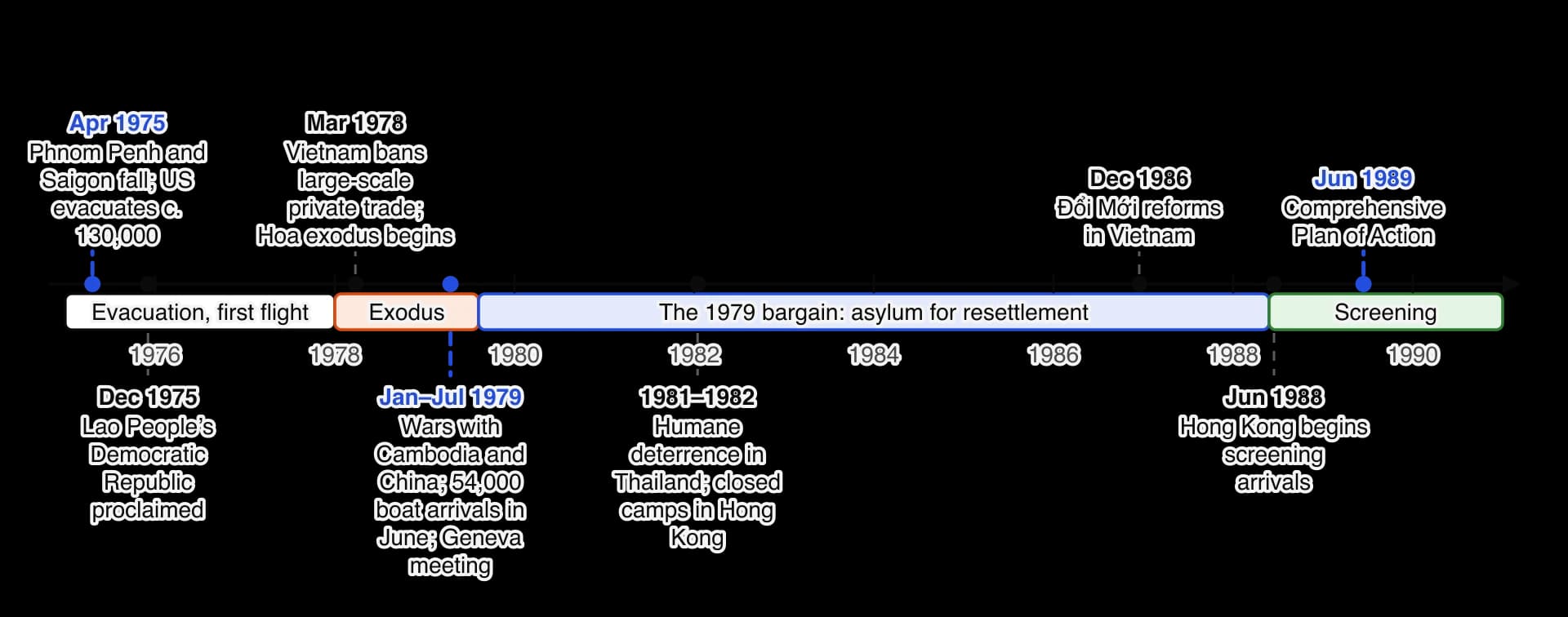
The timeline of the crisis shows three phases: limited flight in 1975–1977, a regional emergency in 1978–1979, and a decade of managed resettlement that ended in a renewed surge and a stricter system in 1987–1989.
The distinction mattered throughout the crisis. Most people displaced by fighting before 1975 never left their own countries. After 1975 the key question for governments became whether those who left were refugees fleeing persecution or economic migrants seeking a better life, since only refugees had a claim to protection.
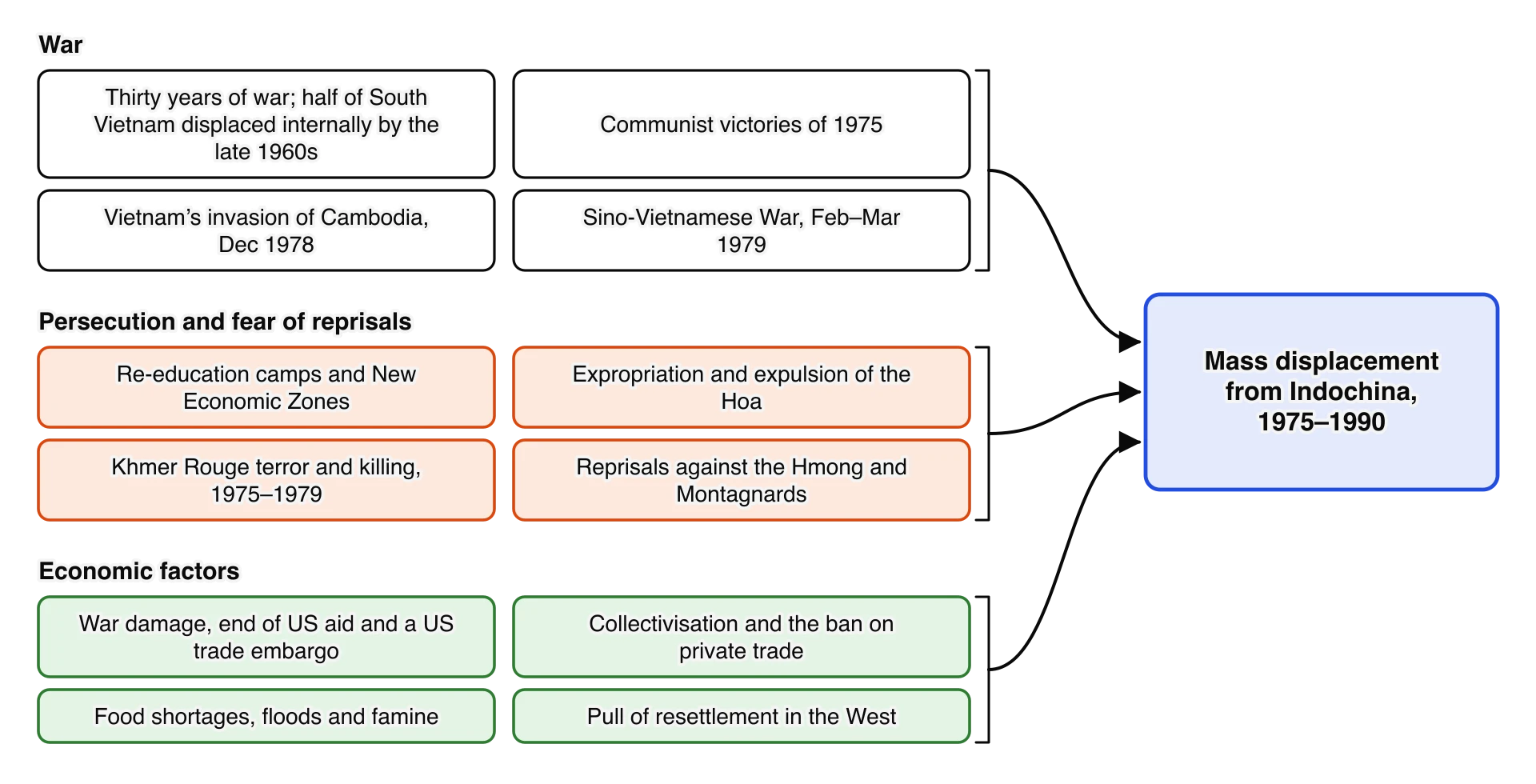
Three kinds of condition combined to produce the exodus: war and its end, persecution and fear of reprisals, and economic hardship. The diagram of conditions groups them.
Vietnam, Cambodia and Laos had been ruled by France as French Indochina since the late nineteenth century. The communist-led Viet Minh under Ho Chi Minh declared Vietnamese independence in September 1945, and the First Indochina War (1946–1954) ended with the French defeat at Dien Bien Phu.
The Geneva Accords of July 1954 divided Vietnam at the 17th parallel into a communist North and a non-communist South, pending elections that never took place. More than a million people moved south in 1954–1956, including nearly 800,000 Roman Catholics. Many of these families, having fled communism once, had good reason to fear its arrival in the South in 1975.
The United States backed the southern government of Ngo Dinh Diem from 1955, sent combat troops from 1965 and had more than 500,000 troops in Vietnam at the height of the war. Bombing, artillery, defoliants such as Agent Orange and the clearing of villages for “free-fire zones” drove peasants into camps and cities: by the late 1960s about half of South Vietnam’s 20 million people had been displaced at some time.
In Laos, the CIA armed a secret army of about 30,000 men, most of them Hmong highlanders under General Vang Pao, to fight the communist Pathet Lao and North Vietnamese forces. The United States dropped more than two million tons of bombs on Laos in 1964–1973, making it, per head, the most heavily bombed country in history. In Cambodia, US bombing from 1969 and the overthrow of Prince Norodom Sihanouk by General Lon Nol in March 1970 opened a civil war with the communist Khmer Rouge.
The Paris Peace Accords of 27 January 1973 allowed the United States to withdraw its combat troops, but the war went on. In 1975 the communist side won in all three countries:
Cambodia: the Khmer Rouge took Phnom Penh on 17 April 1975 and renamed the country Democratic Kampuchea.
Vietnam: North Vietnamese forces took Saigon on 30 April 1975; the country was reunified as the Socialist Republic of Vietnam in July 1976.
Laos: the Pathet Lao took power step by step and proclaimed the Lao People’s Democratic Republic on 2 December 1975, ending the Lao monarchy.
The first wave of refugees was made up of those most closely tied to the defeated side: South Vietnamese officers and officials, people who had worked for the Americans, and Hmong soldiers and their families.
The victories of 1975 were followed within four years by new wars. After Khmer Rouge attacks on its border, Vietnam, allied to the Soviet Union by a treaty of 3 November 1978, invaded Cambodia on 25 December 1978 and took Phnom Penh on 7 January 1979. China, which backed the Khmer Rouge, attacked northern Vietnam from 17 February to 16 March 1979. These wars were part of the Sino-Soviet split as much as local conflicts.
Each war produced refugees. The fall of the Khmer Rouge let hundreds of thousands of starving Cambodians reach the Thai border; the conflict with China turned the ethnic Chinese of Vietnam into suspected enemies; and Vietnam’s occupation of Cambodia until September 1989 kept a civil war going on the Thai border and drained Vietnam’s economy.
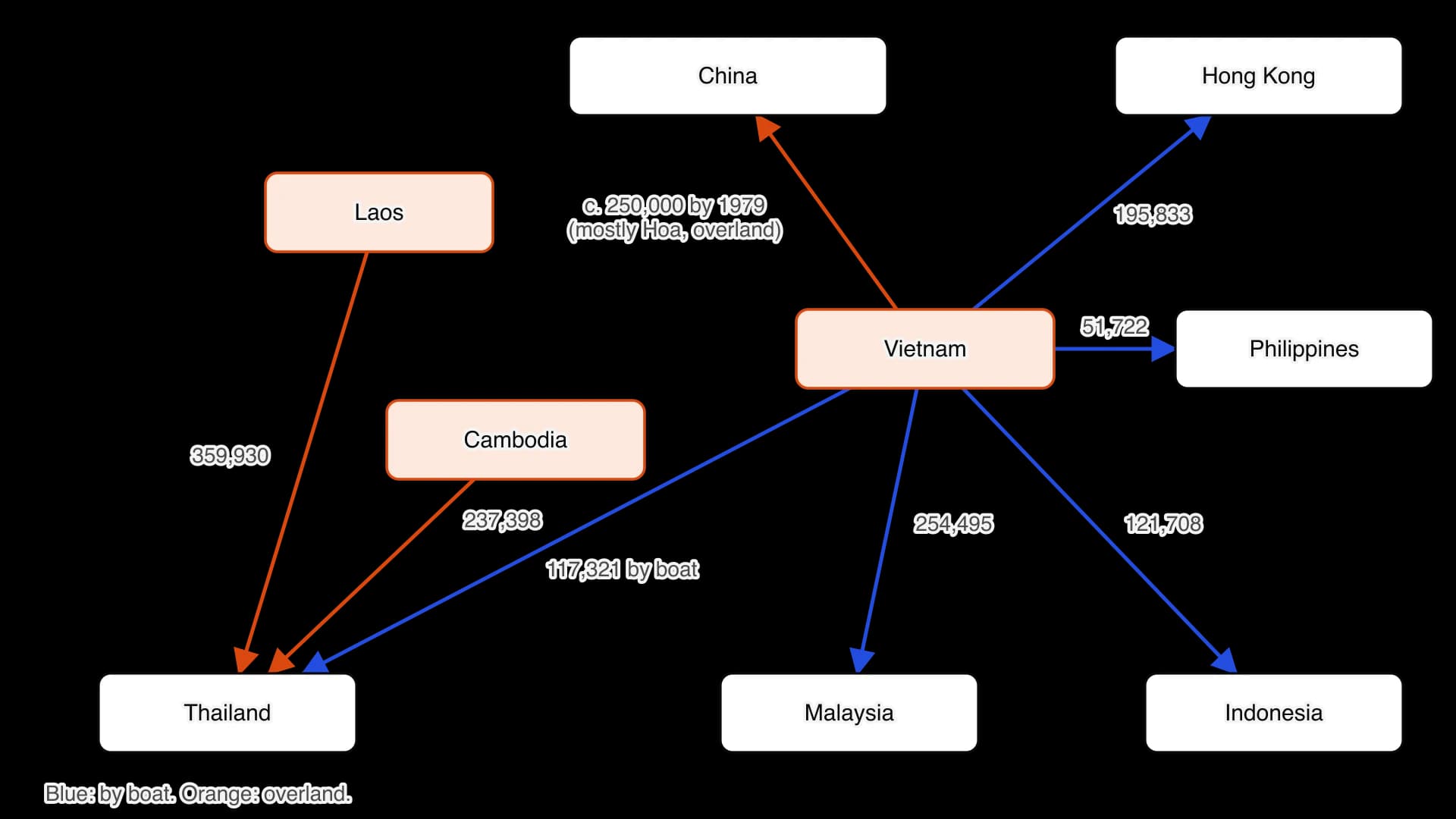
The diagram of refugee routes shows that Vietnamese left mostly by sea or overland to China, while Cambodians and Laotians crossed by land into Thailand.
The new governments treated large groups of their own people as enemies: those who had served the old regimes, those whose class or ethnicity made them suspect, and highland minorities who had fought on the American side.
In mid-1975 former officers, officials, police and others linked to the Republic of Vietnam were ordered to report for “study”. Officers and senior officials were sent to remote re-education camps (trại cải tạo) for hard labour, confessions and political lectures, without charge or trial. Many expected to stay a month; thousands were held for more than a decade, and many died.
The scale of re-education is disputed. UNHCR states that more than a million people were placed in the camps; most scholars think this counts everyone who attended even short courses, and estimate that 200,000–300,000 were held for long periods. Either way, almost every southern family that had served the old regime had a member in a camp or feared one.
A family’s political record, its lý lịch, decided access to jobs, university places and rations, and families with a “bad” background were watched for years. The government also moved hundreds of thousands of urban people to New Economic Zones, undeveloped land where they were expected to clear forest and farm with few tools; many drifted back to the cities, where without residence papers they received no rations. Leaders of the Unified Buddhist Church were arrested, Catholic institutions were taken over and the Hoa Hao and Cao Dai sects were suppressed.
The highland peoples of central Vietnam, the Montagnards, had been recruited by US Special Forces, and some fought on after 1975 in the resistance movement FULRO. They suffered arrests and military operations, but few could reach the sea; only a few hundred were resettled abroad, most in North Carolina from 1986.
The flight of the Hoa, Vietnam’s ethnic Chinese, is the clearest example of persecution and economic policy working together. Well over a million Hoa lived in Vietnam in 1975, most in Cholon, the Chinese district of Saigon, where they dominated rice milling, wholesale trade and banking; a smaller northern community were fishermen, workers and peasants.

The vertical timeline of 1978–1979 shows how quickly their position collapsed. On 24 March 1978 the government banned large-scale private trade in the South and about 30,000 businesses were closed; in May a new national currency wiped out savings kept in cash. These measures targeted “bourgeois” traders of every ethnicity but fell hardest on the Hoa, who were told to farm in New Economic Zones.
At the same time relations with China collapsed, and Hanoi came to see the Hoa as a “fifth column”. In the North officials pressed them to leave, and by the time China closed the border in mid-1978 an estimated 160,000 or more had crossed into China, which cut off its aid to Vietnam in July 1978. The Chinese attack of February 1979 deepened the suspicion.
In the South the exodus became a business. Officials let Hoa families leave on “semi-official” departures for payment in gold, commonly five to ten taels (about 190–375 grams) per adult, sometimes on steel freighters chartered by smuggling syndicates, such as the Hai Hong. By the end of 1978, 70 per cent of boat people reaching Southeast Asia were ethnic Chinese, and by the end of 1979 more than 250,000 people from Vietnam, nearly all Hoa, had taken refuge in China.
The Vietnamese government denied persecuting the Hoa, describing those leaving as capitalists unwilling to accept socialism; refugees and Western governments called it an expulsion. Both views hold part of the truth: many were pushed out by policy and suspicion, many chose to leave rather than lose their businesses, and the state profited from their going.
The Khmer Rouge regime of Democratic Kampuchea, led by Pol Pot, set out to build an agrarian communist society from “Year Zero”. Within days of taking Phnom Penh it drove the capital’s two million people into the countryside, abolished money, markets, schools and religion, and forced the population into collective labour.
The city dwellers, or “new people”, were treated as enemies; former soldiers, officials, teachers, monks and the educated were executed, and many more died of starvation and overwork. Estimates of the dead range from 1.5 to 2 million out of about 7.8 million people; Ben Kiernan’s widely used figure is about 1.7 million. Minorities suffered most: more than 100,000 ethnic Vietnamese were expelled in 1975, and Kiernan estimates that more than a third of Cambodia’s Cham Muslims died.
Escape was extremely difficult: the borders were mined and patrolled, and UNHCR estimates that only about 34,000 Cambodians reached Thailand in 1975–1978. The great Cambodian exodus came in 1979, when the Vietnamese invasion broke the regime’s control: by the middle of that year Thailand held 164,000 Cambodian and Laotian refugees in UNHCR camps, and by the end of the year several hundred thousand more Cambodians were living in makeshift settlements along the Thai border.
In Laos, officials and officers of the old government were sent to “seminars” that turned out to be re-education camps, where tens of thousands were held, some for more than a decade. King Savang Vatthana abdicated in December 1975, was arrested in 1977 and died in custody.
The Hmong had most to fear. As the core of the CIA’s army they were treated as enemies by the Pathet Lao, whose radio broadcasts in 1975 spoke of “wiping out” the American-trained forces. In May 1975 US planes flew Vang Pao and about 2,500 Hmong from the base at Long Tieng to Thailand; tens of thousands of others walked through the mountains and crossed the Mekong. By December 1975, 54,000 Laotians were in Thailand, all but 10,000 of them Hmong, and by 1995 nearly 360,000 Laotians, about one in ten of the population, had fled.
Some Hmong stayed and fought. Resistance groups, among them the millenarian Chao Fa movement, held out in the Phou Bia massif, and Lao and Vietnamese army offensives against them in 1977–1978 drove new waves of Hmong across the Mekong. Refugees reported the use of chemical weapons in these campaigns (“yellow rain”), a claim the United States made publicly in 1981 and that scientists have disputed ever since.
Persecution was the main reason for flight for former officers and officials, the Hoa, the Hmong and Cambodians, though even within these groups economic loss and family strategy played a part.
Vietnam in 1975 was one of the poorest countries in the world, its infrastructure wrecked and its fields full of unexploded bombs. American aid to the South stopped at once, and the United States extended its trade embargo on the North to the whole country and blocked loans from international banks.
The government’s own policies made things worse. From 1977–1978 it pushed southern peasants into collectivisation, which they resisted, nationalised commerce in 1978 and set low official prices for rice, so farmers sold on the black market or not at all. Floods in the Mekong Delta in 1978, the end of Chinese aid and the cost of the war in Cambodia deepened the crisis; food was rationed and inflation rose.
Hardship affected almost everyone, not only those the regime distrusted, which is why the exodus came to include fishermen, farmers and young men avoiding conscription for the war in Cambodia. The government changed course with the Đổi Mới reforms of December 1986, but the benefits took years to arrive.
In Laos, a drive to form agricultural co-operatives in 1978 met peasant resistance and was halted in 1979. In Cambodia, where the Khmer Rouge had abolished money and markets, the 1979 harvest was largely lost and famine threatened; aid agencies fed people through the “land bridge” at Nong Chan on the Thai border, where Cambodians collected rice and seed to carry home.
The case of the Hmong shows how hard it is to separate persecution from economic need. A UNHCR official in Laos and Thailand, Robert Cooper, accepted that most Hmong fled for fear of reprisal, but argued that there were also economic reasons:
A great many Hmong families came to rely increasingly on food drops by aircraft, handouts in the population centers, or the soldier’s pay earned by adult males … When, in 1975, the alternative means of livelihood came to an abrupt end, tens of thousands of Hmong found themselves abruptly face to face not only with the fear of the enemy’s revenge but also with a situation of accumulated resource scarcity … Had they remained in Laos, it is difficult to see how they could have avoided large-scale famine.
Robert Cooper, “The Hmong of Laos: Economic Factors in Refugee Exodus and Return”, in The Hmong in Transition, 1986, as quoted in UNHCR, The State of the World’s Refugees 2000. Cooper wrote as a UNHCR official when the agency was trying to persuade Hmong in Thai camps to go home, and stressing economic causes made return seem more possible. His point that the American war economy itself had left the Hmong without a livelihood is valuable all the same.
Economic factors also worked as “pull” factors. Once the West was resettling large numbers from the camps, the hope of a new life abroad encouraged people to risk the journey, and some families sent one member ahead to bring the rest out later. By the 1980s many governments argued that resettlement itself was keeping the exodus going.
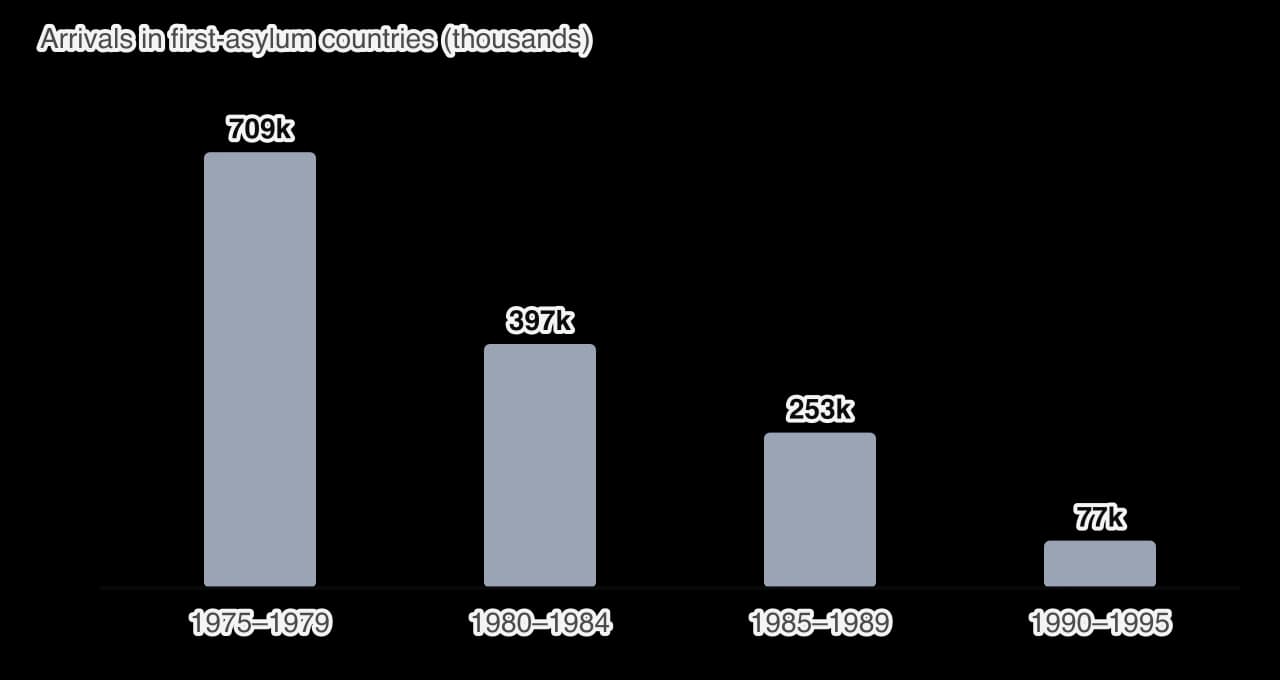
The chart of arrivals by period shows that the exodus peaked in 1975–1979 and declined through the 1980s, while the motives of those leaving changed, as the table of waves sets out.
Wave | Who left | Main conditions behind their flight |
|---|---|---|
April 1975 | About 130,000 Vietnamese evacuated by the United States; Hmong airlifted from Long Tieng | Defeat in war; fear of reprisals against those linked to the Americans |
1975–1977 | Officers and officials who escaped re-education; Lao and Hmong; a few Cambodians | Persecution and fear of reprisals; first effects of economic decline |
1978–1979 | Hoa from North and South Vietnam; Cambodians after the fall of the Khmer Rouge | Expropriation and ethnic suspicion; war with Cambodia and China; famine |
1980–1986 | Mixed: political prisoners’ families, young men avoiding the draft, fishermen and farmers | Continued repression, conscription for Cambodia, poverty; family reunification |
1987–1989 | Many young people from northern Vietnam, via China to Hong Kong; southerners via Cambodia to Thailand | Poverty and lack of opportunity; relaxed travel controls; hope of resettlement |
Persecution and the wars of 1978–1979 explain the largest numbers; economic factors were present from the start and became relatively more important later, which is why governments grew more sceptical in the 1980s. For many families the motives cannot be separated: a family barred from work by its political background was poor because it was persecuted.
The response passed through three stages: American evacuation and resettlement in 1975; an international system of temporary asylum and resettlement built in 1978–1979; and, in the 1980s, a tightening into deterrence, screening and return.
As North Vietnamese forces advanced in April 1975, Operation Babylift flew about 2,500–3,000 children, most of them orphans, out of Saigon; its first flight crashed on 4 April, killing 138 people, 78 of them children. The operation was controversial, since some children were not orphans and critics saw it as a bid for American sympathy.
More than 50,000 people left on fixed-wing flights from Tan Son Nhut airport during April. When the airport came under fire, Operation Frequent Wind on 29–30 April lifted 1,373 Americans and 5,595 Vietnamese and others by helicopter from the US embassy and the Defense Attaché Office to ships offshore. Tens of thousands more escaped by boat or flew South Vietnamese helicopters out to the US fleet. In all, about 130,000–140,000 Vietnamese came into American care.
This first wave was mostly urban, educated and closely linked to the old government or the Americans: more than a quarter of household heads had a university education, and over 40 per cent more had some secondary education. Many others with equally strong links were left behind.
Most evacuees went first to Guam, where Operation New Life housed more than 111,000 people in tent cities between April and November 1975, and then to four reception camps on military bases: Camp Pendleton (California), Fort Chaffee (Arkansas), Eglin Air Force Base (Florida) and Fort Indiantown Gap (Pennsylvania).
They were admitted under the attorney general’s emergency parole power, since US law had no general system for admitting refugees. To leave a camp, each family needed a sponsor (a church, family, employer or community group) found through one of nine voluntary agencies, and the government deliberately dispersed refugees across all fifty states so that no community would carry the burden alone. The last camp closed in December 1975; about 1,500 Vietnamese chose instead to sail home on the ship Thuong Tin.
American opinion was divided. Polls in May 1975 showed most Americans opposed admitting the refugees, many fearing competition for jobs in a recession. On 1 May the House of Representatives rejected a bill combining evacuation funds with refugee aid, and President Ford replied the same day.
This action does not reflect the values we cherish as a nation of immigrants. It is not worthy of a people which has lived by the philosophy symbolized in the Statue of Liberty. It reflects fear and misunderstanding rather than charity and compassion. … These refugees chose freedom. They do not ask that we be their keepers, but only, for a time, that we be their helpers.
Gerald R. Ford, Statement on House Action Rejecting Vietnam Humanitarian Assistance and Evacuation Legislation, 1 May 1975. Ford wrote to pressure Congress, appealing to American ideals and to the Cold War image of refugees who had “chosen freedom”. The statement shows the administration’s case, not the public mood, which the polls suggest was less generous.
Congress changed its mind: the Indochina Migration and Refugee Assistance Act of 23 May 1975 provided about US$455 million for resettlement, extended to Laotians in 1976. Until 1978, however, US policy treated the flight as the aftermath of the war, and further admissions from the Thai camps came in small parole programmes.
None of the countries nearest to Indochina had signed the 1951 Refugee Convention or its 1967 Protocol in 1975, so none had a legal duty to admit refugees, and all had reasons to keep them out: Thailand and Malaysia faced communist insurgencies, Malaysia feared that ethnic Chinese arrivals would upset its ethnic balance, and all feared that temporary guests would never leave. Thailand set out its position within weeks.
Should any displaced persons attempt to enter the Kingdom, measures will be taken to drive them out of the Kingdom as fast as possible. If it is impossible to repel them, such persons will be detained in camps.
Thai cabinet decision, June 1975, as quoted in UNHCR, The State of the World’s Refugees 2000. As an internal instruction, not a public statement, it shows the real priority of the Thai state, security and deterrence, and explains the mix of UNHCR-supported camps and border pushbacks in Thai policy for the next fifteen years.
Of the three durable solutions for refugees, voluntary repatriation was impossible for most while the new regimes ruled, and the region refused local integration (China, which settled about 250,000 Hoa on state farms, was the exception). That left resettlement in a third country as the only solution on offer.
When the Hai Hong anchored off Port Klang in November 1978 with about 2,500 people, Malaysia demanded that it be sent back to sea. UNHCR insisted that boat people from Vietnam were prima facie refugees, recognised as a group without checking each person’s case, and after weeks of negotiation the passengers were resettled in Canada, West Germany, France and the United States. For the next decade boat people who reached a UNHCR camp were accepted as refugees in this way.
In the first half of 1979 arrivals soared. Malaysia’s island camp of Pulau Bidong, opened in August 1978 for 4,500, held about 40,000 by mid-1979. Malaysia and Thailand towed boats back to sea in pushbacks, and Singapore let no one land without a guarantee of resettlement within 90 days. In June 1979, when more than 54,000 boat people arrived, Malaysia’s deputy prime minister Mahathir Mohamad was reported as saying new arrivals would be shot on sight (the government later said he was misreported), and Thai soldiers forced more than 42,000 Cambodians down a mountainside at Preah Vihear into minefields, where hundreds, possibly thousands, died. It was the largest case of refoulement (forced return to danger) UNHCR had faced, yet it made no public protest, which one of its senior officials later called “one of the low points of its protection history”.
On 28–30 June 1979 the five members of the Association of Southeast Asian Nations (ASEAN) declared that they had “reached the limit of their endurance” and would accept no new arrivals. The High Commissioner, Poul Hartling, warned of the danger.
A grave crisis exists in Southeast Asia … [for] hundreds of thousands of refugees and displaced persons … [the] fundamental right to life and security is at risk.
Poul Hartling, UN High Commissioner for Refugees, Note for the Meeting on Refugees and Displaced Persons in South-East Asia, 9 July 1979. Hartling wrote to win pledges from the governments meeting in Geneva, so he stated the crisis in the most urgent terms, but the events of June 1979 support his description.
The UN Secretary-General, Kurt Waldheim, convened the Meeting on Refugees and Displaced Persons in South-East Asia in Geneva on 20–21 July 1979, attended by 65 governments. The US delegation was led by Vice President Walter Mondale, who compared the world’s response with the Evian conference of 1938, at which the democracies had failed to take in Jewish refugees from Nazi Germany, and announced that the United States was preparing to admit another 168,000 Indochinese refugees in the coming year.
Let us not re-enact their error. Let us not be the heirs to their shame. … We face a world problem. Let us fashion a world solution. … History will not forgive us if we fail. History will not forget us if we succeed.
Walter Mondale, speech at the Geneva meeting, 21 July 1979 (extracts). Speaking for a government that had already doubled its intake, Mondale used the memory of Evian to put moral pressure on other states. The speech shows how the West framed the boat people, as victims of communist inhumanity, and says nothing of the American war that preceded the exodus.
 YouTube
The meeting produced the three-way agreement shown in the diagram of the 1979 bargain.

Resettlement countries raised their pledges from about 125,000 to 260,000 places. The United States had already doubled its intake to 14,000 a month in June; Canada tripled its rate to 3,000 a month.
Countries of first asylum agreed to give temporary refuge, and pushbacks largely stopped. Indonesia (Galang) and the Philippines (Bataan, opened 1980) provided regional processing centres.
Vietnam agreed to stop illegal departures “for a reasonable period of time” and to develop the Orderly Departure Programme agreed with UNHCR on 30 May 1979, for legal emigration by air.
The immediate crisis was averted. Resettlement rose from about 9,000 a month in early 1979 to about 25,000 later in the year, and between July 1979 and July 1982 more than twenty countries resettled 623,800 Indochinese refugees. The bargain came to be described as “an open shore for an open door”.
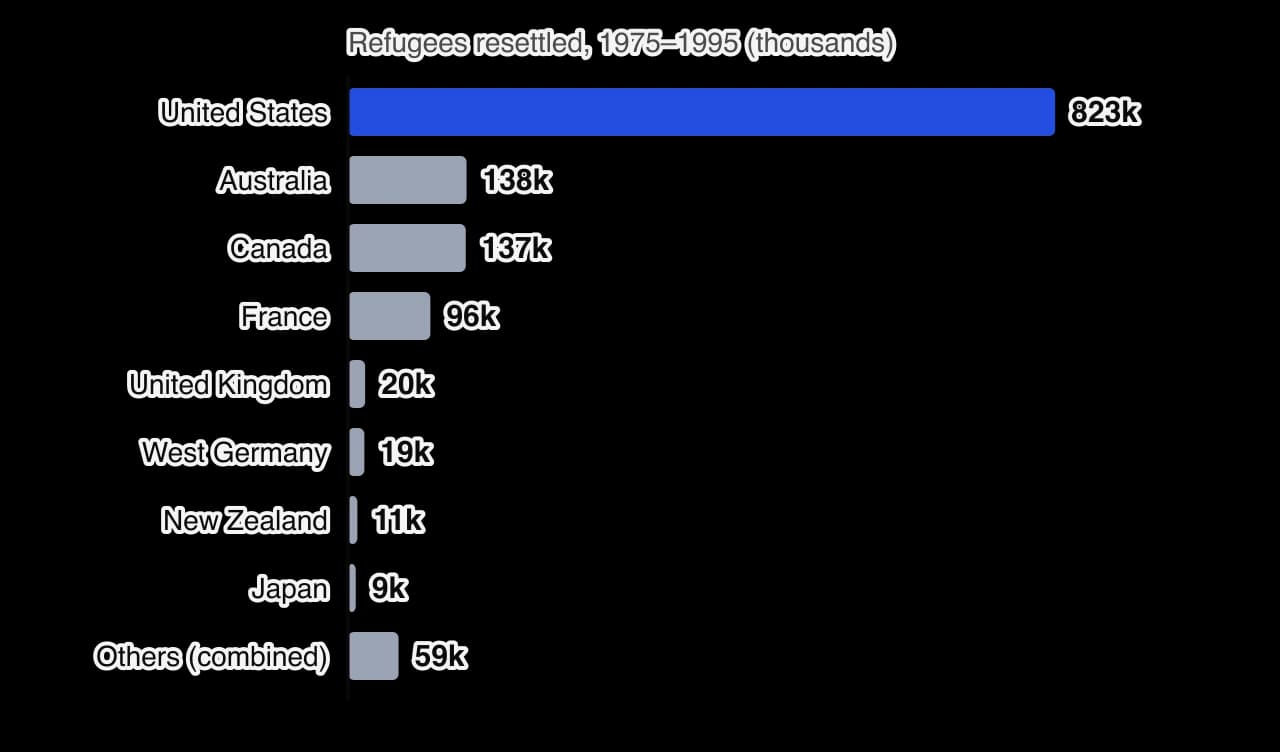
The chart of resettlement countries shows how unequally the burden was shared. The United States took almost two-thirds, out of a sense of debt to former allies and because receiving people who fled communism was a Cold War statement. Its Refugee Act of 17 March 1980 replaced ad hoc paroles with a permanent system, with annual ceilings, a federal Office of Refugee Resettlement and the UN definition of a refugee.
By adopting the international definition, the Refugee Act ended the Cold War rule that had limited US refugee status to those fleeing communist countries or the Middle East, though Indochinese arrivals were still accepted as a group until the late 1980s.
Canada resettled about 60,000 Indochinese in 1979–1980, more than half of them through private sponsorship by churches and citizens’ groups, and in 1986 “the people of Canada” received UNHCR’s Nansen Medal. Australia under Malcolm Fraser resettled large numbers from the camps, while some 2,000 boat people sailed directly to northern Australia in 1976–1981. France took more Cambodians and Laotians than any country except the United States, and in West Germany citizens chartered the ship Cap Anamur, which rescued more than 10,000 boat people from 1979.
The crossing of the Gulf of Thailand was the most dangerous route, because Thai fishing boats preyed on refugees who carried gold and had no state to protect them. In 1981, of 452 boats reaching Thailand, 349 had been attacked, on average three times each; 578 women had been raped, 228 abducted, and 881 people were dead or missing.
Eighteen persons leave in a small craft and in crossing the Gulf of Thailand are attacked by pirates, one girl who resists being raped is killed and another young girl of 15 is abducted. The remaining 16 persons who are of no use to the pirates have their boat rammed repeatedly and all perish at sea.
Michel Moussalli, UNHCR Director of International Protection, press release, 14 November 1983. The statement aimed to shock governments into funding anti-piracy measures, and rests on survivors’ reports, the only evidence for attacks of this kind.
UNHCR and Thailand began an anti-piracy programme in June 1982, funded with US$3.6 million from twelve countries, and attacks fell, though they grew more violent again in 1988–1989. To persuade ships to stop for boats in distress, the DISERO scheme of 1979 had Western states guarantee to resettle anyone rescued by ships of countries that took no refugees, and a companion scheme, RASRO (Rescue at Sea Resettlement Offers), shared out the rescued among resettlement countries. About 67,000 Vietnamese were rescued at sea in 1975–1990.
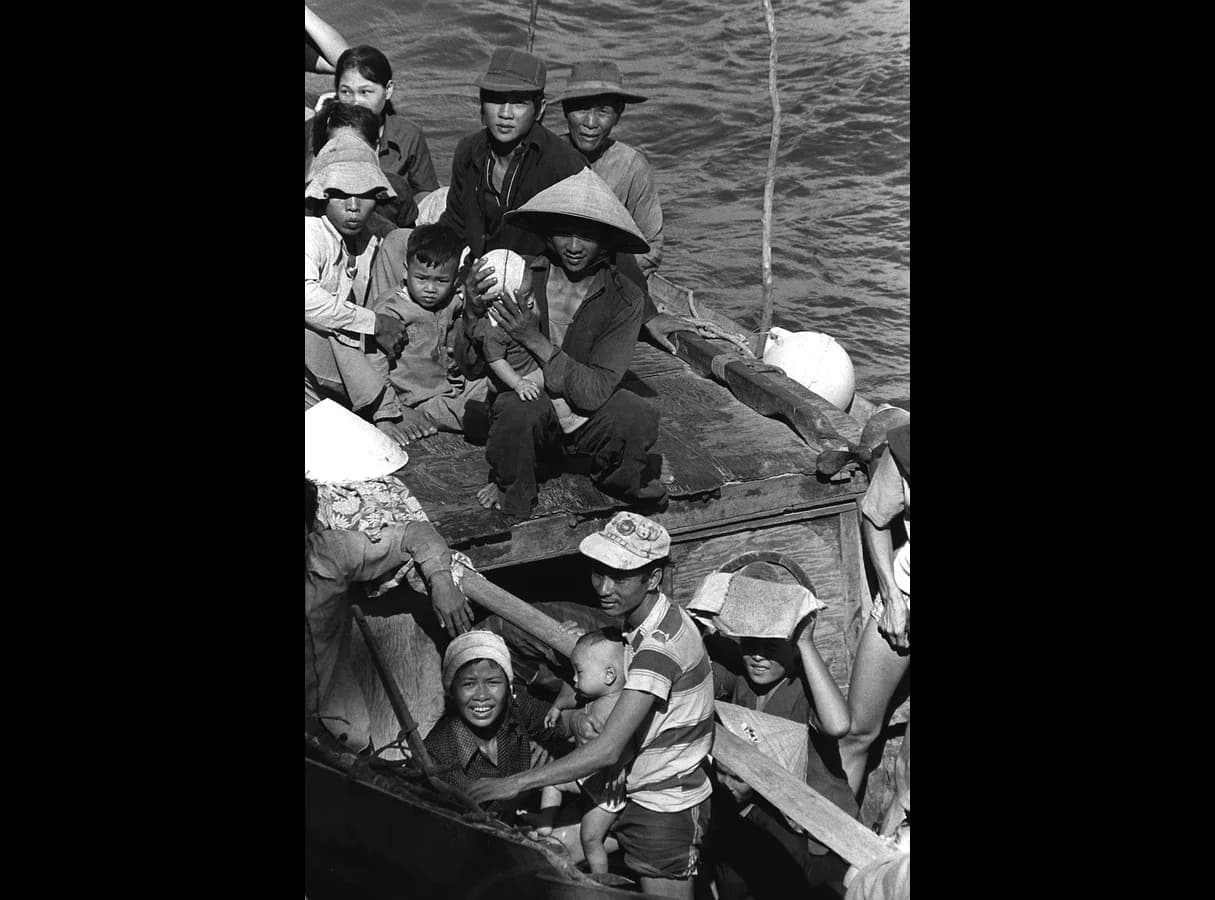
In October 1979 Thailand opened its border to Cambodians, and UNHCR built holding centres for them. The largest, Khao-I-Dang, opened on 21 November 1979 and held about 140,000 people by March 1980. In January 1980 Thailand closed the holding centres to new arrivals, and hundreds of thousands of Cambodians remained in camps along the border, without access to resettlement.
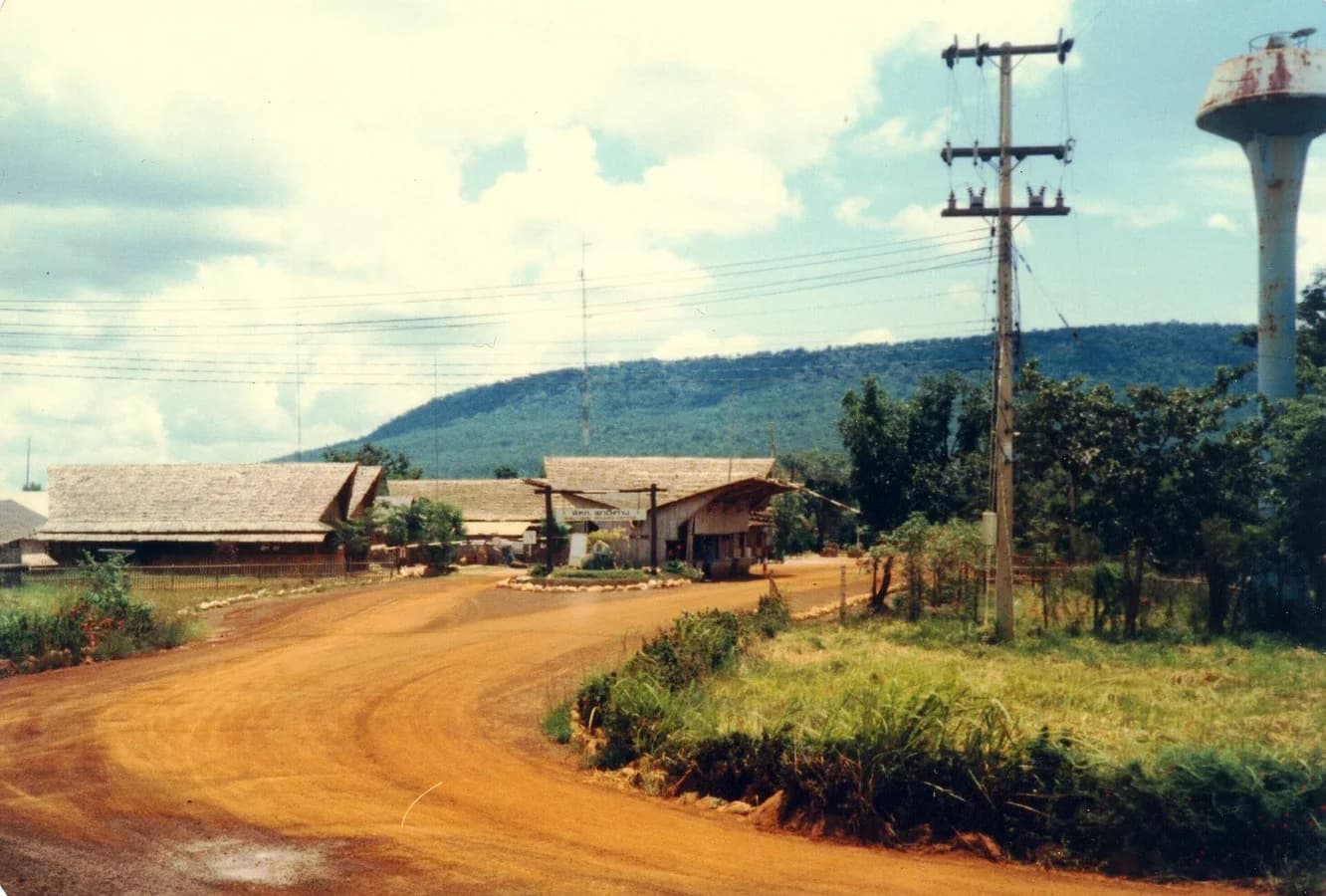
The border camps were controlled by the three resistance factions, the Khmer Rouge and two non-communist groups, which in June 1982 formed the Coalition Government of Democratic Kampuchea. The United Nations Border Relief Operation (UNBRO), set up in January 1982, fed the camps but had no mandate to protect their people. After a Vietnamese offensive in 1984–1985 the camps moved onto Thai soil, where the largest, Site 2, held more than 150,000 people.
The anthropologist Josephine Reynell, who studied the border camps in the 1980s, argued in Political Pawns: Refugees on the Thai–Kampuchean Border (1989) that their people were trapped. The Vietnamese and the government in Phnom Penh had mined the Cambodian side of the border, and because the camps were run by the resistance factions, camp residents feared they would be treated as traitors if they went home. Her study gives a view from inside the camps, written before the settlement of 1991 allowed most of their people to return safely.
The 1979 bargain worked for several years: from 1980 to 1986 resettlement outpaced new arrivals. But Western publics and governments tired of an emergency that never seemed to end, a mood called compassion fatigue, and grew doubtful about new arrivals’ motives, arguing that open-ended resettlement was itself drawing people out. Deterrence followed.
Thailand: “humane deterrence” (1981). New lowland Lao arrivals were held at Na Pho camp on survival rations with no access to resettlement; Laotian arrivals fell from about 29,000 in 1980 to 3,200 in 1982.
Hong Kong: closed camps (1982). From July 1982 new Vietnamese arrivals were held in camps they could not leave to work.
Resettlement countries: tighter criteria. The United States cut support for new refugees in 1982, and states gave priority to those with family or official ties, so many people waited in the camps for years.
Meanwhile legal departure grew: by 1984 the Orderly Departure Programme carried more people a year (29,100) than arrived by boat (24,865). Through it the United States admitted the children of American servicemen and their families under the Amerasian Homecoming Act of 1987, and, after an agreement of 30 July 1989, former re-education camp prisoners.
In 1987–1988 departures rose again, along new routes: southerners through Cambodia to the Thai coast, and northerners through southern China to Hong Kong, where more than 18,000 arrived in 1988. Few resettlement countries wanted these northerners. On 15 June 1988 Hong Kong announced that all new arrivals would be detained and screened, interviewed to decide whether each was a refugee; Thailand resumed pushbacks, and in May 1989 Malaysia again redirected boats.
A second international conference met in Geneva on 13–14 June 1989, with about 70 governments, including Vietnam and Laos. It adopted the Comprehensive Plan of Action (CPA), which kept first asylum but broke its automatic link to resettlement:
measures to reduce clandestine departures, including information campaigns in Vietnam, and an expanded Orderly Departure Programme;
temporary refuge for all asylum seekers until their status was decided;
screening of all new arrivals after a regional cut-off date (14 March 1989 in most of Southeast Asia; 16 June 1988 in Hong Kong) against international standards;
resettlement in third countries for those recognised as refugees, and for everyone who had arrived before the cut-off date;
return of those found not to be refugees, voluntarily if possible, with UNHCR monitoring their treatment and reintegration in Vietnam or Laos.
Temporary refuge will be given to all asylum seekers who will be treated identically regardless of their mode of arrival until the status determination process is completed.
Declaration and Comprehensive Plan of Action, Geneva, 1989 (approved in draft on 8 March 1989). The plain legal language records the promise first-asylum states made in return for Western help. The same document said that if voluntary return made too little progress, “alternatives recognized as being acceptable under international practices would be examined”, which most participants understood to mean forced return.
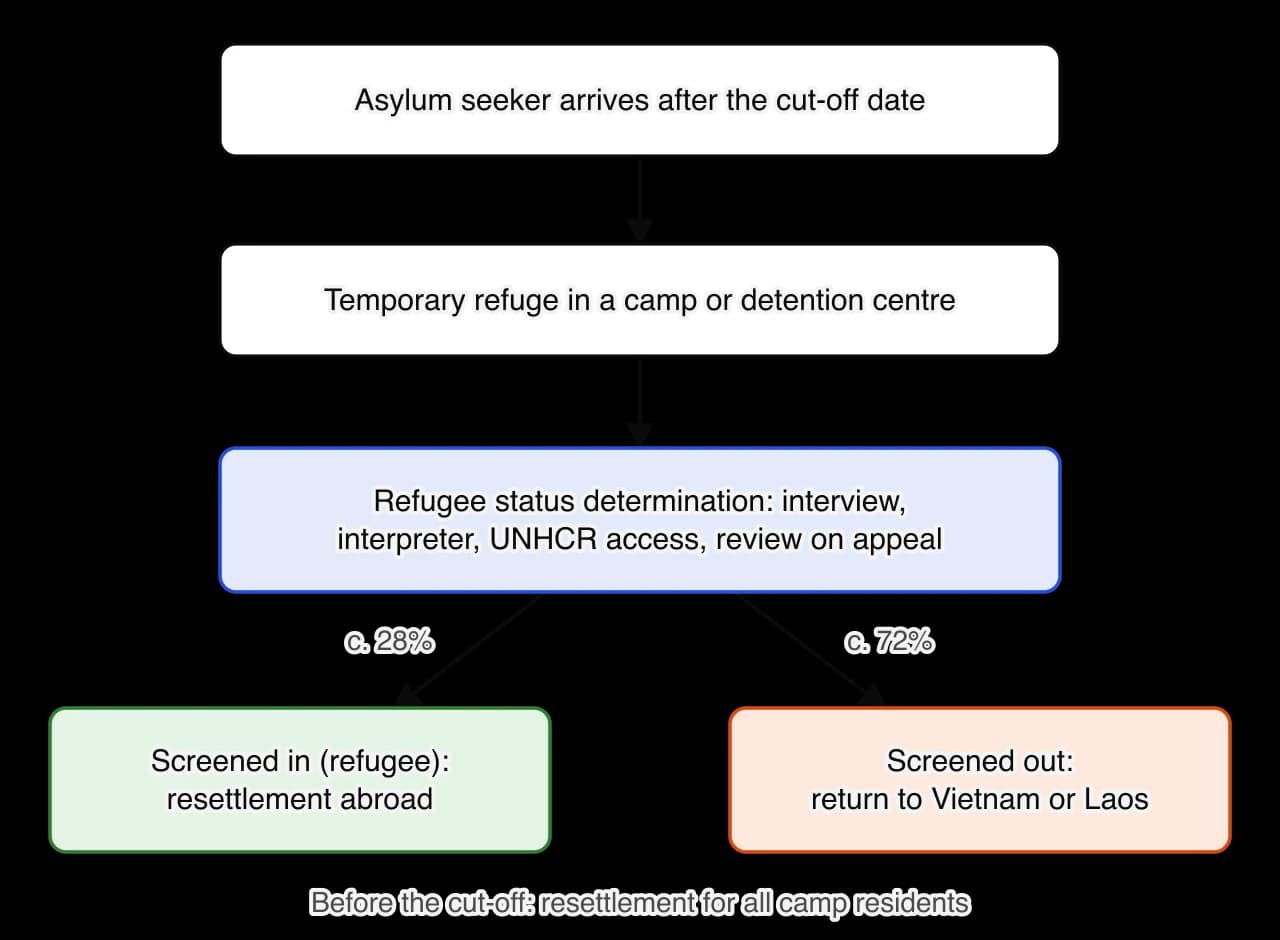
The flow chart of screening shows the result: about 28 per cent of Vietnamese applicants were recognised as refugees, and in Hong Kong, which interviewed the most (60,275), only 18.8 per cent. Vietnam promised in December 1988 not to punish returnees, and UNHCR monitors later reported no evidence of persecution. On 12 December 1989 Hong Kong police, before dawn, flew 51 Vietnamese men, women and children to Hanoi; protests halted forced returns for a time, but an Orderly Return Programme agreed in October 1991 restarted them, amid riots in the detention camps.
The plan achieved its main aim. About 70,000 Vietnamese sought asylum in the region in 1989; in 1992, only 41 did. During the CPA more than 530,000 Vietnamese and Laotians were resettled and more than 109,000 Vietnamese returned home; the plan ended in 1996. At the 1989 conference the High Commissioner, Jean-Pierre Hocké, had looked back on the record.
There have been occasions when the political will to provide asylum and durable solutions has faltered and even failed, resulting … in the outright denial of asylum, including tragic ‘push-offs’ of refugee boats, in restriction of access by my Office to asylum-seekers, or in prolonged internment of persons of our concern under difficult conditions which fall below minimum accepted standards.
Jean-Pierre Hocké, statement to the International Conference on Indo-Chinese Refugees, Geneva, 13 June 1989. Speaking to the governments his agency depended on, Hocké criticised them collectively without naming states; his frankness shows how far the consensus of 1979 had eroded, and why UNHCR accepted screening and return as the price of keeping first asylum.
Geneva meeting, July 1979 | Comprehensive Plan of Action, June 1989 | |
|---|---|---|
Context | Mass exodus; ASEAN refuses new arrivals; pushbacks | Renewed surge from 1987; resettlement slowing; Hong Kong detention |
View of those leaving | Boat people accepted as refugees as a group (prima facie) | Each new arrival screened; many presumed to be economic migrants |
Main solution | Resettlement in third countries | Resettlement for refugees; return for those screened out |
Role of Vietnam | Stop illegal departures; start orderly departure | Also accept returnees without penalty; UNHCR monitoring |
Whose commitment mattered most | The resettlement countries | The first-asylum countries and the country of origin |
Result | Pushbacks largely stopped; arrivals fell; 623,800 resettled 1979–1982 | Arrivals almost ended by 1992; 109,000 returned; camps closed by 1996 |
The comparison of the two conferences shows a change in attitudes, from refugees as victims to be rescued to many arrivals as migrants to be screened, alongside continuity in first asylum, UNHCR’s role and orderly departure. The CPA has been credited with restoring asylum and ending deaths at sea, and criticised for long detention and forced returns.
Displacement was not one experience. It depended on when and how people left, where they landed, and on their ethnicity, class, gender and age; one family could have members who left in 1975 by plane, in 1979 by boat and in 1990 by orderly departure.
Most refugees had several reasons for leaving, and the decision was usually a family’s. Political motives combined with ethnic ones for the Hoa, Montagnards, Cham and Hmong, and religious ones for Catholics and Buddhists; economic motives and family reunion grew in importance in the 1980s. Some families sent a son abroad to escape conscription for the war in Cambodia, or a child alone in the hope of bringing the rest out later.
Group | Main motives for leaving | How most left | Typical outcome by 1990 |
|---|---|---|---|
1975 evacuees | Fear of reprisals for service to the South or to the Americans | US evacuation by air and sea | Resettled in the United States within months |
Vietnamese boat people | Re-education, discrimination, conscription, poverty, family reunion | Small boats to Southeast Asia and Hong Kong | Resettled after months or years in camps; after 1989, screened |
Hoa | Expropriation, suspicion after the break with China, paid “semi-official” departures | Overland to China; freighters and boats | Settled in China, or resettled from the camps |
Cambodians | Survival after the Khmer Rouge; famine; civil war on the border | On foot to the Thai border | Years in border camps; many returned 1992–1993 |
Hmong | Reprisals for fighting for the CIA; loss of livelihood | On foot and across the Mekong | Ban Vinai camp; resettled in the US and France or returned |
Lowland Lao | Seminar camps; loss of freedoms; economic hardship | Across the Mekong | Resettled, or held under humane deterrence |
Amerasians | Discrimination against mixed-race children of US servicemen | Orderly Departure Programme | Admitted to the US under the 1987 Act |
Escape by boat was usually illegal and planned in secret. Families sold property to pay for places, often in gold, and many made several attempts; those caught could be imprisoned. Boats were small river or fishing craft, overloaded and short of fuel, food and water. Storms sank many, and ships passed boats in distress: one boat that reached the Philippines in July 1984 reported that about 40 vessels had passed it during 32 days at sea.
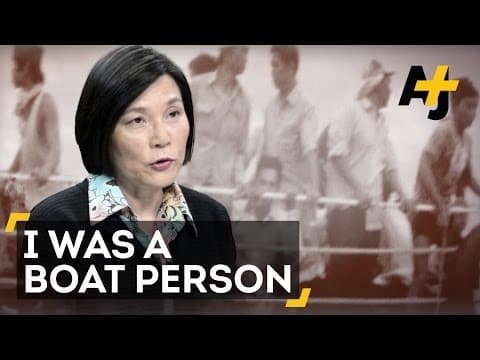
Women and girls faced the greatest danger from pirates, who robbed boats, raped women and abducted girls. In November 1979 a UNHCR field officer, Ted Schweitzer, rescued 157 refugees held by pirates on the Thai island of Koh Kra. Among them was Vu Thanh Thuy, a former Saigon war correspondent whose husband had been held in a re-education camp and who had made about twenty failed attempts to escape. Interviewed in Houston for Rice University’s Houston Asian American Archive (published 2016), she recalled her promise during captivity: “I promised God that if I could survive this, I wouldn’t forget it. I would tell everyone about it.” She later helped raise funds for rescue missions in the South China Sea, so her memory of the ordeal also served as testimony and advocacy.
No one knows how many boat people died. The journalist Barry Wain, writing in 1981, estimated that about 10 per cent of the boat people were lost at sea; later estimates widely attributed to UNHCR range from 200,000–250,000 to as many as 400,000 deaths over the whole period, while other writers put the total much lower. The figures are uncertain because boats that sank left no record, and both Vietnamese and Western authorities had political reasons to stress or play down the losses.
 YouTube
Cambodians and Laotians fled on foot. Cambodians reaching Thailand in 1979 crossed forests and minefields, avoiding Khmer Rouge and Vietnamese patrols, many already starving. Hmong families walked for weeks through the mountains under fire, then crossed the Mekong at night on rafts or bamboo floats, or by swimming; many drowned or were shot.
For most refugees the camp was where they spent months or years between escape and a new life. Conditions varied widely between camps and over time.
Island camps for boat people. On Pulau Bidong in 1979 about 40,000 people lived in shacks of boat timber and plastic sheeting, with water rationed and poor sanitation; later the camps organised schools and clinics. Galang and Bataan gave those accepted for resettlement months of language and cultural training.
Hong Kong’s closed camps and detention centres. From 1982 arrivals were held behind fences, and from 1988 detained to await screening; overcrowding and uncertainty led to riots and violence between groups of detainees.
Thai camps for Laotians. Ban Vinai, the main Hmong camp, held up to about 45,000 people and resembled a large Hmong village, but its people depended on rations and many waited a decade or more. It closed in 1992.
Cambodian camps. Khao-I-Dang had hospitals, schools and a route to resettlement; the border camps were militarised, shelled and ruled by the factions, which conscripted men and controlled food, and families lived in them for up to twelve years.
Camp life brought particular risks for women, including sexual violence inside and around the camps, and for children. About 7 per cent of Vietnamese who reached first-asylum countries were unaccompanied minors. Among the Cambodian children who reached Thailand in 1979, many were assumed to be orphans and were proposed for adoption abroad, until an investigation by the Norwegian agency Redd Barna and other agencies examined more than 2,000 files.
The evidence suggests that the majority of the unaccompanied minors’ parents are still alive inside Kampuchea, therefore the potential for eventual reunification is considerable.
Redd Barna and other agencies, report on unaccompanied Khmer children in the holding centres in Thailand, 1980, as quoted in UNHCR, The State of the World’s Refugees 2000. The agencies wanted to stop hasty adoptions and their report rested on careful casework, which makes it strong evidence that many “orphans” had been separated from their families by the chaos of 1979, not by death. Its hope of reunion proved wrong: Cold War politics blocked family tracing inside Cambodia for a decade, and most of the children were eventually resettled abroad.
Resettled refugees faced a new language, climate and culture, and most experienced downward mobility: doctors, officers and teachers took jobs as factory workers, cleaners or farm labourers, at least at first. Many carried trauma from war, imprisonment and the journey, and families were divided across continents. Older people and those from rural backgrounds found adjustment hardest.
The 1975 evacuees, mostly urban and educated, adapted relatively quickly. The boat people who came from 1978 had less education and less English, and arrived during a recession as support was cut. The Hmong, mostly farmers from the mountains, faced the greatest difficulties in American cities, and many depended on welfare for years; large communities formed in California’s Central Valley and Minnesota.
Over time refugees built new communities: Little Saigon in Orange County, California; Cabramatta in Sydney; the 13th arrondissement of Paris, home to many ethnic Chinese from Indochina; and Vietnamese communities in Canadian cities, whose businesses, newspapers, temples and churches helped newcomers.
Refugees also met hostility. On the Texas Gulf Coast, competition with local shrimp fishermen led to violence at Seadrift in 1979, and in 1981 the Ku Klux Klan burned boats and threatened Vietnamese fishermen in Galveston Bay until a federal court ordered it to stop.
Some refugees went home. After the Paris Agreements of October 1991 ended the Cambodian civil war, UNHCR organised the return of more than 360,000 Cambodians from the border camps between March 1992 and May 1993, in time for elections organised by the UN Transitional Authority in Cambodia (UNTAC); Khao-I-Dang closed in March 1993. Returnees received land or cash, but many came back to districts full of landmines and found their old land occupied.
For screened-out Vietnamese the return was often against their will and was experienced as a defeat: they had spent their savings, and sometimes years in detention, to reach the camps. UNHCR gave each returnee a grant of US$240–360 and funded small projects and loans in the areas they went back to. About 24,000 Laotians, many of them Hmong, had returned from Thailand by 1995, with a cash grant, an 18-month rice ration and land in settlement sites. UNHCR monitors reported few cases of persecution among returnees, but human rights groups questioned how far monitors could see what happened.
The crisis was interpreted differently by those involved at the time, and historians have since debated whether those who left were refugees or migrants, whether the response was humanitarian or political, and how far it succeeded.
Perspective | How it saw the exodus | Why it took this view |
|---|---|---|
Refugees | Flight from persecution, imprisonment and poverty; a choice forced by the new regimes | Personal experience of re-education, expropriation, killing and hunger; later, the need to show a claim to asylum |
Vietnamese government | Departure of people unwilling to accept socialism, or economic migrants encouraged by the United States and China; the Hoa as a security risk | Need to defend its reputation; war with China; the Soviet alliance; later, the wish to end Western pressure and restore aid |
First-asylum states (ASEAN, Hong Kong) | A burden and a security threat dumped on them by Vietnam and kept going by Western resettlement | Fear of communist infiltration, ethnic tension (Malaysia), cost; refugees seen as the West’s responsibility |
Resettlement states (USA above all) | People who had “chosen freedom”, owed help as former allies; later, increasingly, migrants | Cold War politics, guilt over the war, domestic pressure from churches; later, compassion fatigue and cost |
UNHCR | A humanitarian emergency requiring asylum, then lasting solutions; later, a mixed flow needing screening | Its mandate to protect refugees, but dependence on states for funding and access |
The table of contemporary perspectives shows that each actor’s view followed from its interests: Vietnam and the first-asylum states had reasons to describe those leaving as migrants, refugees and the United States to stress persecution.
UNHCR’s own history, The State of the World’s Refugees 2000, presents screening as a reasonable response to a changing flow that restored the principle of asylum. Critics reply that the distinction was artificial where economic disadvantage followed from political background, and that recognition rates as low as 18.8 per cent in Hong Kong reflected the wish to stop arrivals.
W. Courtland Robinson’s Terms of Refuge (1998), the standard history of the response, uses UNHCR records to show how the definition of who counted as a refugee shifted with the politics of resettlement, and asks whether UNHCR should have helped Vietnam stop its citizens leaving, since the right to leave is itself a human right.
In the United States the story has often been told as one of rescue. Gil Loescher and John Scanlan, in Calculated Kindness (1986), argue that US refugee policy served foreign policy: people fleeing communist states were welcomed as evidence of the West’s superiority, and the Indochinese fitted this pattern. Some analysts, cited in UNHCR’s own history, have gone further and argued that from 1975 Western governments had an interest in encouraging departures, to show the world that the people of southern Vietnam were “voting with their feet”.
Yen Le Espiritu, in Body Counts (2014), a work of critical refugee studies, argues that the image of America rescuing grateful refugees recast a lost war as a humanitarian success and obscured the US part in creating the refugees; she notes that refugees passed through military bases such as Guam, and puts refugees’ own memories at the centre.
Judgements depend on the measure used. Some 2.5 million people found new homes, Vietnam and Laos accepted orderly departure and return, and UNHCR developed new tools such as rescue-at-sea schemes and orderly departure. Against this stand the deaths at sea, the pushbacks and Preah Vihear expulsion of 1979, years of detention and forced returns. The journalist Barry Wain, in The Refused (1981), documented Vietnamese officials’ profits from the departures of 1978–1979 and the region’s readiness to turn boats away.
For Cambodia, William Shawcross, in The Quality of Mercy (1984), argued that border relief, shaped by the Cold War alignment against Vietnam, fed and sheltered the Khmer Rouge, while Ben Kiernan’s The Pol Pot Regime (1996) established the scale and racial targeting of Khmer Rouge violence that kept so many Cambodians from going home before 1991.
Historian or writer | Work | Argument | Evidence stressed |
|---|---|---|---|
UNHCR | The State of the World’s Refugees 2000, chapter 4 | The response was a long, imperfect but ultimately humane search for a combination of solutions; 1989 marked a turning point in Western attitudes | UNHCR records; arrival and resettlement figures; the CPA’s results |
W. Courtland Robinson | Terms of Refuge (1998) | Asylum in the region was bought with resettlement; the definition of a refugee shifted with the politics of the bargain | UNHCR archives; government policies; numbers over time |
Gil Loescher and John Scanlan | Calculated Kindness (1986) | US refugee policy served Cold War foreign policy | Admissions favouring those fleeing communism |
Yen Le Espiritu | Body Counts (2014) | The “rescue” narrative turned a lost war into a humanitarian victory and hid US responsibility | Military bases as refugee camps; refugee memory and silence |
Barry Wain | The Refused (1981) | Vietnam profited from the expulsion of the Hoa; the region refused asylum | Journalistic investigation of departures and pushbacks |
William Shawcross | The Quality of Mercy (1984) | Border relief was politicised and sustained the Khmer Rouge | The Thai border operation 1979–1982 |
These perspectives are not simply opposed: Robinson and UNHCR describe how the system worked; Loescher and Scanlan, Espiritu and Shawcross ask whose interests it served. A strong judgement uses both.
Written in the style of the IB. Using the three sources below on the Indochina refugee crisis and considering the overarching inquiry question of “To what extent were economic factors the main reason for mass displacement from Indochina after 1975?”, respond to the three questions that follow.
Source A: UNHCR, the UN refugee agency, in its official history The State of the World’s Refugees 2000: Fifty Years of Humanitarian Action (2000), chapter 4, “Flight from Indochina”.
As discontent with the new communist regime increased, however, so did the number of people fleeing the country. … It also embarked on a programme of resettling urban dwellers in the countryside in so-called ‘new economic zones’. More than a million people were placed in ‘re-education camps’. Many died, while tens of thousands were to languish in detention until the late 1980s. As time went by, it also became clear that the prominence of the ethnic Chinese population in the private economic sector was contrary to the socialist vision of the new authorities. By early 1978, formal measures were being taken to expropriate [take over] businesses of private entrepreneurs, most of whom were ethnic Chinese.
Source B: Central Intelligence Agency (CIA), United States, in a confidential intelligence memorandum, “Refugees and Human Rights: An Issue in US–ASEAN Relations” (16 December 1977), later published in Foreign Relations of the United States, 1977–1980, volume XXII.
Contrary to earlier indications that the number of fleeing Vietnamese would remain stable or decline toward the end of 1977, there has been a sharp increase in boat cases despite adverse seasonal weather conditions and increased Vietnamese security patrols. Poor economic conditions (including food shortages), conscription for the armed forces, and government economic and security policies (such as forced resettlement of urban dwellers in new economic zones) are cited among the most compelling reasons for taking the risk of setting out to sea in small, dilapidated boats. In addition, it is possible that many Vietnamese who were considering flight were encouraged by the announcement in late summer (broadcast by international radio) that the US would accept more “boat case” refugees.
Source C: US Department of State, in a confidential briefing paper, “UN Conference on Indochinese Refugees” (25 July 1979), written after the Geneva meeting at which the US delegation was led by Vice President Walter Mondale, later published in Foreign Relations of the United States, 1977–1980, volume XXII.
The Vietnamese performance was the most interesting and hard to judge. First, they (and the USSR) are clearly feeling concerted international moral/political pressure and announced their intention to reduce the outflow of refugees. … Second, the Vietnamese continued their efforts to place the entire responsibility for the refugee exodus upon the United States and China, also claiming inability to control it, even after having undertaken to stop “illegal departures for a reasonable period of time.” Their propaganda was moderately effective, and the idea of a moratorium [a temporary halt] was a great relief to the countries of Southeast Asia. … Most important, we must maintain the international pressures upon Vietnam to take concrete measures to provide more humane treatment for its people.
I can explain how thirty years of war, the communist victories of 1975 and the wars of 1978–1979 led to displacement.
I can describe re-education camps, New Economic Zones and lý lịch, and explain why the numbers held in re-education are disputed.
I can explain why the Hoa left Vietnam in 1978–1979, linking economic policy, ethnicity and the break with China.
I can describe the Khmer Rouge regime and explain why most Cambodians could flee only after January 1979.
I can explain why the Hmong and lowland Lao fled Laos.
I can weigh war, persecution and economic factors as reasons for flight, and explain how they changed between 1975 and 1989.
I can describe the US evacuation and reception of 1975 (Babylift, Frequent Wind, Guam, the four camps, the 1975 Act) and the debate it caused.
I can explain why first-asylum states pushed boats back and why ASEAN closed its doors in June 1979.
I can explain the three-way bargain of the Geneva meeting of July 1979 and the Orderly Departure Programme.
I can describe the roles of the main resettlement countries and of the US Refugee Act of 1980.
I can explain the anti-piracy and rescue-at-sea measures and the situation on the Cambodian border.
I can explain compassion fatigue, humane deterrence, screening and the Comprehensive Plan of Action, and compare 1979 with 1989.
I can describe experiences of escape, camp life, resettlement and repatriation for different groups.
I can outline the perspectives of refugees, governments and UNHCR, and the arguments of Robinson, Loescher and Scanlan, Espiritu and Shawcross.
I can analyse a source on the crisis by linking its context (author, date, audience, purpose) to what it can show.